
“The Originator of the heavens and the earth; He made mates for you from among yourselves, and mates of the cattle too, multiplying you thereby; there is nothing like unto Him; and He is the Hearing, the Seeing.” (Qur’an 42:11)

﷽
Our noble teacher Shaykh Hafidh Al Sawafi replies to the respected Dr. Hamza Bakr on the reasoning he posits for distance and seeing Allah in the afterlife.
May Allah (swt) bless Shaykh Hafidh @Alsawafiy for responding to this.
What follows is the English translation of the response:
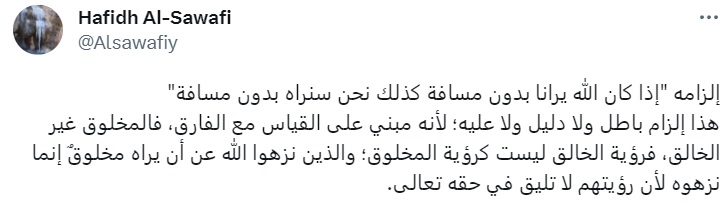
His argument:
“If God sees us without distance, then we too see Him without distance.”
This argument is invalid and baseless because it relies on a false analogy with a critical difference: The creation is not like the Creator. The vision of the Creator is not like the vision of the creation. Those who affirm Allah’s transcendence (by denying that a creation can see Him) also do so because human vision is unbefitting of His majesty.
What is established by both textual and rational evidence is that:
The Creator is the First, the Self-Sufficient—He existed before all things, and no change affects Him. Based on this, the correct stance is to affirm His transcendence above resembling His creation. A human cannot conceptualize the Creator or ascribe to Him physical, sensory estimations.
For this reason, the Mu’tazila firmly held that Allah’s attributes are His essence itself (i.e., not distinct entities).
Furthermore, those who claim that a creation can see its Lord without distance must:
- Reject all the narrations they rely on to prove this, as those texts describe seeing Allah with barriers and direction (which implies spatiality).
- Consistently affirm Allah’s transcendence above the very “distance” they deny—since denying spatiality for Allah necessitates denying physical vision of Him.
“If it is permissible for a creation to share with Allah in one of His exclusive attributes (like vision), then it would likewise be permissible for it to share in all His exclusive attributes. This would logically necessitate that the creation could also become divine—for if it can ‘see as Allah sees,’ it could also ‘know as Allah knows,’ ‘create as Allah creates,’ ‘give life as Allah gives life,’ and so on for all divine attributes.”
May Allah (swt) suffice us!


May Allah (swt) safe guard our tongues from being mean and our hearts from having ill opinions of fellow Muslims. It is just disappointing what passes for “sound” creed in this ummah.
You may be interested in reading the following:
May Allah Guide the Ummah.
May Allah Forgive the Ummah.


 Prima Quran