
“‘It is truly I. I am Allah! There is no god ˹worthy of worship˺ except Me. So worship Me ˹alone˺, and establish prayer for My remembrance.” (Qur’an 20:14)
﷽
It is related from Abu Hurayra,
“The Messenger of Allah, may Allah bless him and grant him peace, entered the mosque and a man entered and prayed. He greeted the Prophet, may Allah bless him and grant him peace, who returned the greeting and said, ‘Go and back and pray. You have not prayed.’ He went back and prayed as he had prayed before. Then he came and greeted the Prophet, may Allah bless him and grant him peace, who said three times, ‘Go back and pray for you have not prayed.’ He said, ‘By the One who sent you with the truth, I cannot do any better than that, so teach me.’ He said, ‘When you stand for the prayer, say the takbir and then recite something you know well from the Qur’an and then do ruku’ until you are at rest in your ruku’ . Then stand back up until you are completely upright. Then go into sajda until you are at rest in your sajda. Then sit back until you are at rest in the sitting position. Do that throughout all of your prayers.’
Sources: (https://sunnah.com/bukhari:757) & (https://sunnah.com/abudawud:856) & (https://sunnah.com/nasai:1314)
Dear respected readers, May Allah (swt) bless Shaykh Rashid Al Shukrey and may Allah reward him with abundant goodness in this life and grant him paradise!
This is perhaps one of the clearest and concise videos for those wanting to learn the way that our blessed Prophet (saw) prayed. In the video, the tutorial is for two rakats (or cycles/units) of prayer.
Unfortunately, the last part of the prayer that concludes with the taslim (sending salutation) is missing. Thus, we recommend using sister Bint Ibadh’s blog as a companion to this tutorial. You may find that here: https://bintibadh.blogspot.com/2013/01/learn-ibadhi-prayer.html
The tutorial will demonstrate a few things.
- The Tawjeeh (Orientation) intention and du’a before the actual prayer.
- Takbir. The opening words of the prayer.
- The first surah recited al-fatiha.
- Ruku (bowing and what is said)
- Returning to the standing (qiyam) position briefly.
- Sujud (prostration and what is said during prostration.
- Julus (sitting position)
- Back to the qiyam (standing) position.
That would complete one rakat cycle/unit of prayer.
For the second rakat cycle/unit you would continue from point 8 above.
- You are now back in the qiyam (standing position)
- Ruku (bowing and what is said)
- Returning to the standing (qiyam) position briefly.
- Sujud (prostration and what is said during prostration.
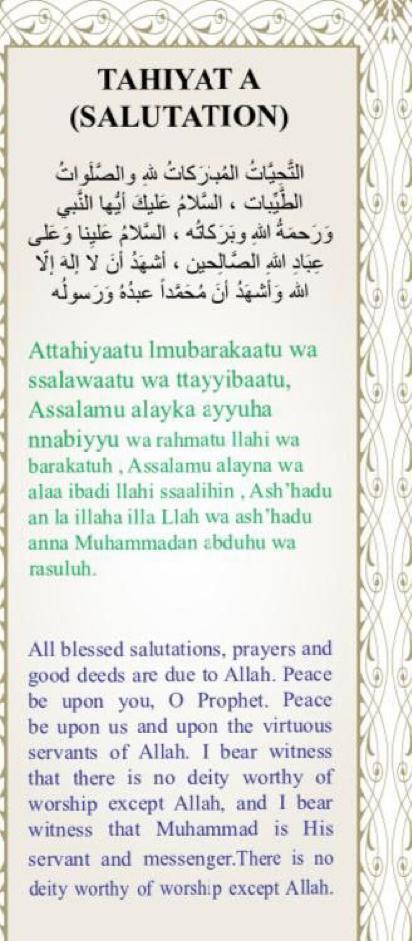
- Julus (sitting position) -Now as this is the 2nd rakat cycle/unit there is a special prayer to be said (refer to the diagram A).
That special prayer is called Tashahud (Tahy’yat) or Tahiyat because the Shaykh is only doing two rakat cycles/units of prayer. This is what you would do during the Fajr (morning prayers).
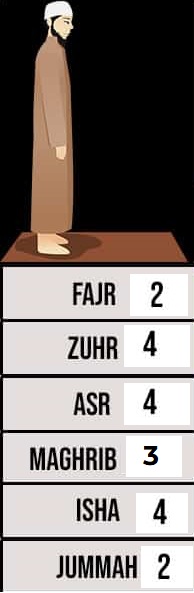
If you do the dhur/zuhr prayers, it would be 4 rakats. Therefore, you would say Tahiyat A in the 2nd sitting position (julus) and then you would say Tahiyat B in the 4th sitting position (julus).
Finally, after saying the tahiyat (if only two rakat like in fajr), you turn to your right and terminate the prayer with the taslim “As salamu’alikum”, then to the left with “warahmatullah.”
*Notes*
You may come across variations in Tawjeeh (Orientation) prayer.
As well as what is said in the Tahiyat in the 2nd /4th rakat.
Another point to take note of:
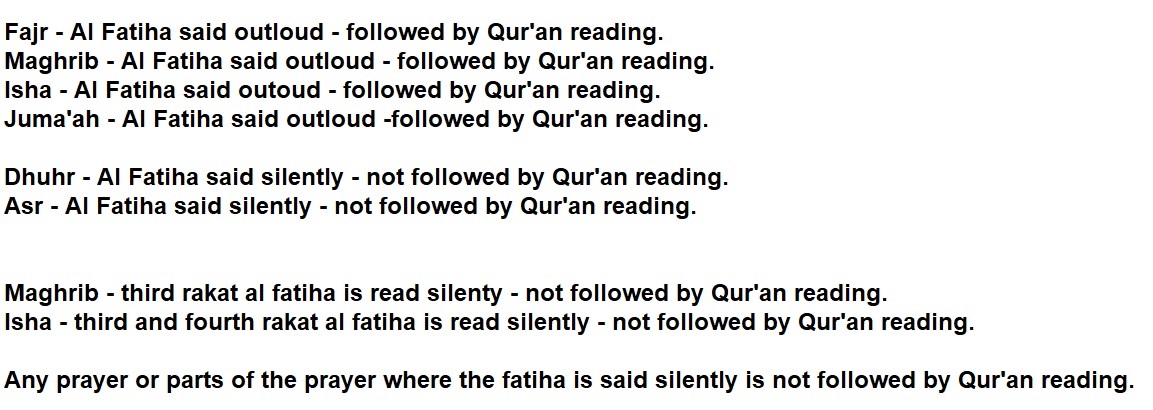
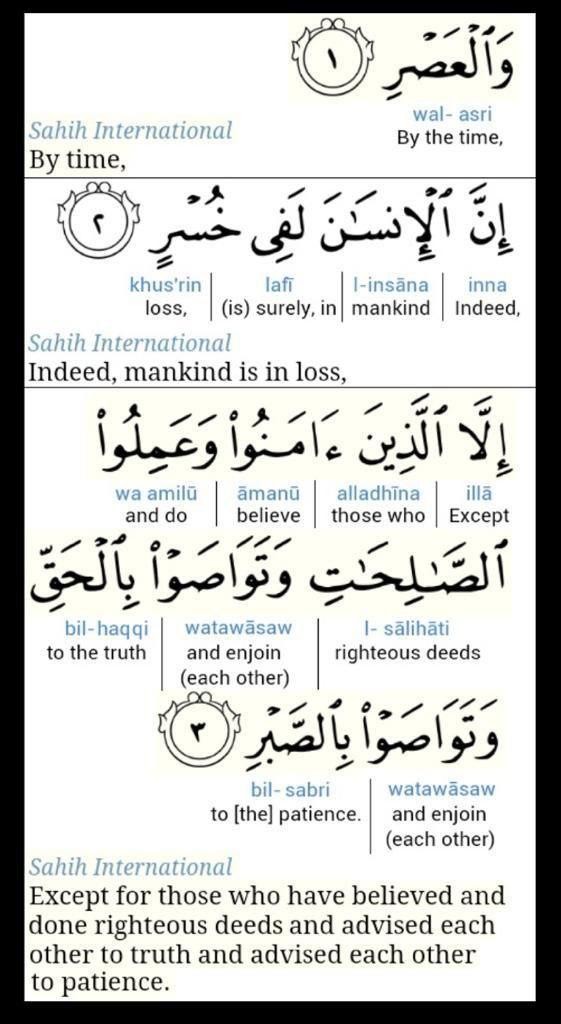
The Shaykh is doing a demonstration of the fajr prayer in which the Qur’an reading (in this case al fatiha and asr) would be said out loud.
Why don’t Ibadis do a Qur’an reading after al fatiha in the prayers?
The dhuhr/zuhr, asr, (afternoon/mid-afternoon) — the Qur’an readings are silent.
Maghrib (sunset) and Isha (night) — the Qur’an readings are out loud.
Another point about the dhuhr/zuhr and asr prayers is that only al fatiha is said (silently) during each rakat.
Why is this?
In maghrib, during the 3rd rakat—which is silent reading, only al-fatiha is read.
In Isha, during the 3rd and 4th rakat, which are silent reading, only al-fatiha is read.
Thus, dhur/zuhr and asr, all four of the rakats are silent reading and so, al-fatiha is read. This is also the mutawattir sunnah that we have practiced from the time of the Blessed Prophet (saw).
Narrated ‘Ubada bin As-Samit:
Allah’s Messenger (saw) said, “Whoever does not recite Al-Fatiha in his prayer, his prayer is invalid.”
Source: (https://sunnah.com/bukhari:756)
It is hopeful that the following chart is beneficial.
Why do Ibadis not have Qunut in the prayer?
We acknowledge that the Blessed Prophet (saw) used to do Qunut for the companions in time of crisis. However, this was something abrogated. That is our position.
Imam Malik and Imam Al Shafi’i considered Qunut in Fajr a confirmed Sunnah. Imam Ahmad considers it recommended during times of crisis. They do it during the witr prayers. Although they are not doing it currently for Palestine. Even if they think Hamas is a calamity, then still let them pray for their brothers! The Hanafi school believes that the Qunut is not done in any of the five daily prayers. However, they believe it is for the witr prayer. Zahiris do not do Qunut unless in times of crisis.
It was narrated from Abu Malik Al-Ashja’i that his father said:
“I prayed behind the Messenger of Allah (saw) and he did not say the Qunut, and I prayed behind Abu Bakr and he did not say the Qunut, and I prayed behind Umar and he did not say the Qunut, and I prayed behind Uthman and he did not say the Qunut, and I prayed behind Ali and he did not say the Qunut.” Then he said: “O my son, this is an innovation.”
Source: (https://sunnah.com/nasai:1080)
It was narrated from Anas:
“The Messenger of Allah (saw) said the Qunut for a month.”- (One of the narrators) Shu’bah said: “He cursed some men.” Hisham said: “He supplicated against some of the tribes of Arabs.”-“Then he stopped doing that after bowing.” This is what Hisham said. Shu’bah said, narrating from Qatadah, from Anas that the Prophet (saw) said the Qunut for a month, cursing Ri’l, Dhawkan and Lihyan.
Source: (https://sunnah.com/nasai:1077)
Please know, dear reader, that all the schools of Islamic jurisprudence have their proofs and justifications for why they do as they do. We follow what we believe is the correct sunnah of the Blessed Prophet (saw).
We also believe that the Blessed Prophet (saw) abolished raising the hands altogether.
Please see the link below.


TAHIYAT B: It can also be translated as: “O Allah! Grant Your grace to Muhammed and the people of Muhammed as you granted Your grace to Abraham and the people of Abraham.
And grant Your blessings to Muhammed and the people of Muhammed as you granted Your blessing to Abraham and the people of Abraham among the nations. You are the Praiseworthy, The Glorious. Our Lord! Give unto us in the world that which is good and in the Hereafter that which is good, and guard us from the doom of Fire.”
We would also highly recommend this video by Shaykh Al-Muatasim Al-Maawali. .May Allah bless him and grant him in this life and grant him the highest levels of paradise.
Please do take these useful guides:
The above is from Shaykh Al Muatasim Al-Maawali (May Allah reward him). We have been given permission by the Shaykh to share this far and wide. Please make du’a for him.
For everyone who adopts the prayer of the Blessed Prophet (saw), may it fill your hearts with tranquility and peace. May the above teachers, Shaykh Al Muatasim and Shaykh Rashid Al Shukrey reward them both for each time and every time someone adopts the prayer of the Blessed Prophet (saw) because of their huge act of kindness and mercy to humanity in teaching the Sunnah!
May Allah Guide the Ummah.
May Allah Forgive the Ummah.


 Prima Quran