“Creator of the heavens and the earth. He has made for you from yourselves, mates, and among the cattle, mates; He multiplies you thereby. There is nothing like unto Him, and He is the All-Hearing, the All-Seeing.” (Qur’an 42:11)
“Say, He Allah is Absolute. That which is indepenent of all but which all things are dependent upon. He does not bring forth like kind nor is He from like kind. And there is no equivalent to His being Absolute.” (Qur’an 112:1-4)
﷽
An eye opening and hopefully a (heart opening) talk.
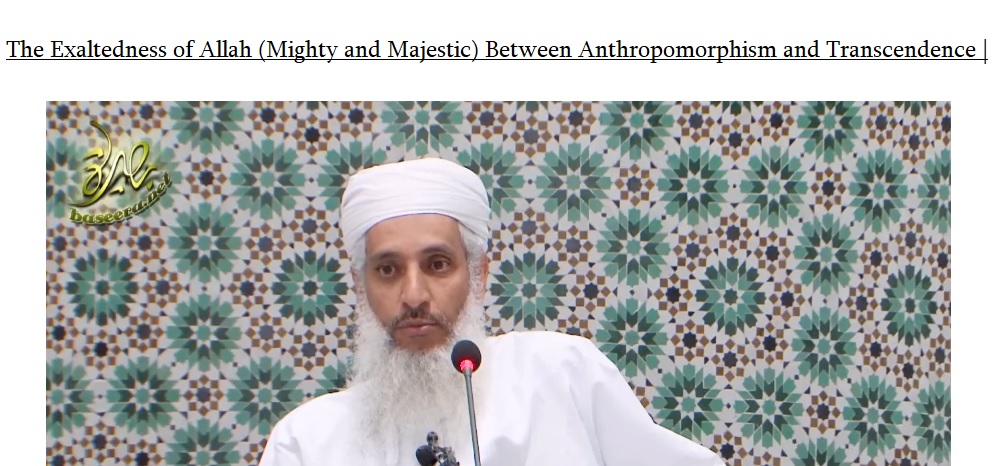
The Exaltedness of Allah (Mighty and Majestic) Between Anthropomorphism and Transcendence Shaykh Dr. Sulaiman bin Ahmed Al-Khalili
In the name of Allah, the Most Gracious, the Most Merciful. Praise be to Allah, Lord of the worlds. Praise be to Allah, the Exalted, the Great, the Righteous, the Generous. I praise Him, seek His help, and seek His guidance. I seek refuge with Allah from the evils of ourselves and from the misdeeds of our deeds, and from all anthropomorphism and division. Whomever Allah guides, none can mislead, and whomever He allows to stray, you will never find for him a guide to the straight path. I bear witness that there is no god but Allah alone, with no partner. He is the Exalted, the Great. “There is nothing like unto Him, and He is the All-Hearing, the All-Seeing.” I bear witness that our master and prophet Muhammed is His servant and messenger, His chosen one and close friend, the master of the knowers and the leader of those who declare Allah’s transcendence from the earlier and later generations. May Allah’s prayers and peace be upon him, upon his family, and upon all his companions.
To proceed: O believing brothers, I greet you with the good and blessed greeting of Islam. Peace be upon you, and the mercy of Allah and His blessings. I congratulate you and myself on this blessed gathering in this pure place on this blessed night. May Allah make me and you among those whom the angels surround, mercy covers, tranquility descends upon, and whom Allah mentions among those with Him.
The topic, as you know, is about Allah’s transcendence and exaltation between anthropomorphism and absolute transcendence. What prompted me to speak about this subject is that many people, after coming across the writings of the Ibadis and seeing that those writings indicate the sincerity of their intentions, the purity of their consciences, their keenness on unity and the interest of the nation, and their sharing with their brothers in their hopes and aspirations at the forefront of whom is our venerable father, may Allah preserve him he has tweets that have spread east and west, urging the nation towards unity, solidarity, mending the rift, holding fast to Allah’s strong rope, defending the Great Qur’an and the noble Prophet (peace be upon him), and warning against destructive calls, atheism, moral dissolution, sexual deviance, unjust killing, and the like. This matter upset a group of people, who began to spread their poisons. This group does not wish good for this nation, nor does it want it to unite under the banner of “There is no god but Allah.” They were angered by people gathering around or people gathering around the callers to truth and paying attention to what they write. So they began warning against them, against listening to them, and against reading their writings. This reminds me of what the disbelievers of Quraysh used to do when the verses of Allah were recited to them: they would whisper to one another, “Do not listen to this Quran and make noise during it, so that you may overcome.” Yet those tweets did not touch upon meaning, they warn people that these are Ibadis and that they deny Allah’s exaltation and plot against His establishment on the Throne, and so on. These tweets, as you have seen and as I have read, did not touch upon these subjects. Rather, they spoke about shared matters that concern the entire nation.
But they, that malicious group, are liars in their claims, in these false accusations and baseless allegations. For no Muslim denies, say: Allah is Exalted. How could they deny Allah’s exaltation when they repeat in their prostration in all their prayers, “Glory be to my Lord, the Most High,” and recite Allah’s saying, “Exalt the name of your Lord, the Most High,” and His saying, “He is the Exalted, the Great,” and “He is the Exalted, the Magnificent,” and the like? Yes, they transcend Allah above sensory elevation and need for a place. They say that this elevation is elevation of rank and status, their position being like that of the rest of the nation.
Many scholars have stated that the nation is unanimously agreed that Allah is not contained by any place nor subject to time, except for those who deviated from the anthropomorphists and those who liken Allah to creation. These likened Allah to His creation, affirming for Him a sensory elevation, affirming for Him a place in which He settles, a Throne upon which He sits, affirming for Him ascent, descent, coming, and going. Indeed, they even affirmed for Him eyes, a tongue, lips, two legs, two hands, a shin, and two sides, sometimes with disagreement about these matters. Some of their imams even said: “Affirm everything except the beard and the private parts.” What led them to this was that they analogized the unseen to the witnessed. This analogy is false and corrupt because it equates the Creator with the created, the Eternal with the temporal, the Everlasting with the perishable. It contradicts Allah’s saying: “There is nothing like unto Him, and He is the All-Hearing, the All-Seeing.” So whatever comes to your mind, Allah is different from that. Allah, the Exalted, existed when there was no place, no Throne, no Footstool, these things are all created by Allah, His creation.
Another matter is that they denied metaphor, which is established in the Quran and the Prophetic Sunnah. The result of this is that they emboldened people to overstep regarding the Divine Essence and to describe Allah with the attributes of His creation. Indeed, they opened the door to casting doubt on this religion and this creed, that they are contradictory and conflicting, due to the perceived contradiction in their primary source, the Book and the Sunnah, not to mention the infiltration of many corrupt creeds.
Yet the Quran was revealed in a clear Arabic tongue. It used the same words that the Arabs used and employed the same rhetorical styles that the Arabs employed. In it the Quran there is literal truth, metaphor, explicit meaning, and allusion. There are many examples of this. Allah, for instance, says: “O you who believe, fear Allah (ittaqullah)” although in the language, “taqwa” (fear/piety) linguistically means avoidance. Does that mean Allah commands us to avoid Him and stay away from Him? No. Rather, it means He commands us to beware of His wrath by obeying His commands. Likewise, He says: “And fear a Day when you will be returned to Allah” meaning the Day of Judgment. Can anyone truly avoid that Day? Can anyone tell his brothers or colleagues that he will not attend that Day because Allah commanded us to avoid it? How, when Allah has decreed that everyone in the heavens and earth will come to the Most Merciful as a servant? He has enumerated them and counted them exactly, and each will come to Him on the Day of Resurrection alone.
Likewise, Allah made the freeing of a slave one of the acts of righteousness. If we took this verse literally, “freeing a neck”, meaning cutting off necks, it would follow that this act earns Allah’s pleasure and that the happiest people would be those who cut off necks, kill innocents, and shed blood. Similarly, Allah says: “They are clothing for you, and you are clothing for them”. If taken literally, is a woman truly a garment for a man? And He says: “Guide us to the straight path”. Although “path” (sirat) is a road. Does that mean a specific road, or that my Lord is on a straight path? If taken literally, it would mean Allah is seated on the road. There are many such examples you know. And ask the village, meaning, no rational person can deny metaphor given the abundant evidence in Allah’s Book.
The same applies to the Prophetic Sunnah. The Prophet (peace be upon him) was an Arab and the master of eloquent speakers; therefore, he also used the same rhetorical styles the Arabs used. Among these is the Prophet’s saying: “Islam is built upon five”. Is there a literal, physical, material building here, or is this building a conceptual one, not material? Similarly, the sacred hadith, narrated from Allah: “My servant continues to draw near to Me with supererogatory acts until I love him. And when I love him, I become his hearing with which he hears, his sight with which he sees, his hand with which he strikes, and his foot with which he walks.” If we took this hadith literally, what would it mean? It would mean that Allah is the servant’s hearing, Allah is the servant’s sight, Allah is the servant, and the servant is Allah. It would mean that a person ascends in worship until he reaches this rank where he worships with his very limbs. This belief actually exists among Christians, who believe in the incarnation of the Divine in humanity, as well as among extremist Sufis (or their offshoots), who say that a person ascends in worship until Allah dwells in him! Exalted is Allah above that. One of their imams said: “Glory be to me! Glory be to me! How great is my station!” He was claiming that Allah had dwelt in him and spoke with his tongue.
Likewise, in the sacred hadith: “O My servant, I fell ill and you did not visit Me.” He said: “How can I visit You when You are the Lord of the worlds?” He said: “Did you not know that My servant so-and-so fell ill? Had you visited him, you would have found Me with him.” Can we take from this hadith an attribute of Allah? Namely illness and say Allah becomes ill because He said “I fell ill,” attributing illness to Himself? Does He truly become ill like His servants? Is that correct? No. Rather, in this hadith, Allah teaches us metaphor: “I fell ill and you did not visit Me.” He said: “How can I visit You when You are the Lord of the worlds?” He said: “Did you not know that My servant so-and-so” meaning the one who truly fell ill is the servant, but Allah attributed the illness to Himself as an honor for His servant due to his status with Allah. So what befell the servant is as if it befell Allah, but it is not correct to attribute literal illness to Allah. Then He said: “Had you visited him, you would have found Me with him”. The “found Me” also cannot be taken literally. Do we, when we visit the sick, find Allah with every patient? Rather, it means we find His reward.
If we took the texts whether from the Quran or the Prophetic Sunnah literally, we would find contradiction in Allah’s Book and in the Sunnah of the Prophet (peace be upon him). For example, Allah says: “They forgot Allah, so He forgot them,” and: “Today We will forget you as you forgot the meeting of this Day of yours.” We find that in these two verses, He affirms forgetfulness for Himself. “Today We will forget you,” “They forgot Allah, so He forgot them.” Do we say that Allah forgets? But this forgetfulness is not like our forgetfulness?! Exalted is Allah above that! Because these verses are among the ambiguous ones that must be referred back to the clear verses. Allah describes Himself by saying: “And your Lord is not forgetful” and says in His Book: “He does not err and does not forget.” Therefore, the forgetfulness affirmed in the previous two verses is not the literal forgetfulness that is negated; otherwise, there would be contradiction in the Quran.
Likewise, Allah says: “And when We intend to destroy a city, We command its affluent ones, but they transgress therein.” At first glance, one might think Allah commanded them apparently with transgression. Exalted is Allah above that, because Allah says: “Indeed, Allah does not command immorality. Do you say about Allah what you do not know?” And He says: “Indeed, Allah commands justice, good conduct, and giving to relatives, and forbids immorality, evil, and oppression.” So He commanded them to obey, but they chose transgression.
Similarly, Allah says: “And We have already created for Hell many of the jinn and mankind. They have hearts with which they do not understand, eyes with which they do not see, and ears with which they do not hear. They are like cattle; rather, they are more astray. Those are the heedless.” It is known that the one without reason, reason being the basis of accountability is exempt from accountability. How then, besides that, they do not hear or see, and then are cast into Hell? Is that the intended meaning? No, because this would be injustice. Exalted is Allah above injustice! And “Your Lord is not unjust to His servants.” And Allah says: “Allah does not burden a soul beyond its capacity.” If the case were that they do not reason, see, or hear like cattle, rather more astray they would be unaccountable and even more incapable than cattle, so they would have even more excuse from accountability; they would not be blameworthy for anything they did because the proof would not have been established against them. Is that intended? Of course not. Rather, they disabled the intellect, hearing, and sight that Allah had given them, using them not in what benefits them in pleasing Allah, so they were treated like those who have lost those faculties.
Likewise, Allah says: “The Messiah, Jesus, son of Mary, was but a messenger of Allah and His word which He directed to Mary and a spirit from Him.” Is the Messiah literally a “word” meaning it consists of letters and sounds? Is the Messiah like that, or is he a human being? If “word” here refers to a divine attribute, that would mean the Messiah is an uncreated divine attribute, thereby giving an argument to Christians that the Messiah is the son of Allah or is Allah himself. But this is to be referred back, as we said, to the clear verses. Allah describes the Messiah: “He was not but a servant upon whom We bestowed favor, and We made him an example for the Children of Israel,” and: “Indeed, the example of Jesus in the sight of Allah is like that of Adam. He created him from dust.”
There are many examples. Allah, for instance, says: “And whoever is blind in this [life] will be blind in the Hereafter and more astray in way,” while in another verse He says: “There is no blame upon the blind.” The “blindness” here is not the same as the “blindness” there.
Another matter that led them to anthropomorphism and division was the infiltration of Israelite traditions, as Jarir ibn Sa’id, one of the Tabi’un (followers of the Companions) mentioned. This is reported by a number of scholars, including al-Dhahabi in Siyar A’lam al-Nubala’, Ibn Kathir in al-Bidaya wa al-Nihaya, and Ibn ‘Asakir in Tarikh Dimashq. This Tabi’i warned, saying: “Be cautious of hadith. I saw us sitting with Abu Hurayrah, who would narrate from the Prophet and also narrate from Ka’b [al-Ahbar]. Then some would stand and confuse the Prophet’s words with Ka’b’s and Ka’b’s words with Abu Hurayrah’s.” This happened at an early time. Those who heard directly from Abu Hurayrah and then those who followed them, and so on down the chain. As the chain lengthened, the fear of corruption increased. Additionally, we find some scholars who fell into anthropomorphism and corporealism defending the Torah and the Gospel, claiming the Torah is full of attributes that the “negators” (as they call them) deny, alleging that this proves anthropomorphism. They say: “We did not see the Prophet denying any of that,” even though denying this is one of the most obligatory duties. Subhan Allah! We have Quranic verses warning against this very thing.
Then they say: “The attributes found in the Torah are not innovations of the People of the Book. If they were innovations, the Prophet would have denied them, and the Companions would have denied them.” Subhan Allah! Does that mean we must believe in the Torah and what it contains? That Allah was a guest of Abraham? In the Torah, it is mentioned that He was a guest of Abraham with the angels, and He was served food and ate. Do we find anything explicit from the Prophet confirming this? Does that mean it is true and we should affirm it? No, there was a general denial and warning against taking from them because they altered and distorted.
Then we find some, like Ibn Taymiyyah, citing the Gospel to prove Allah’s sensory elevation. That He is in heaven. He says the Gospel quotes Jesus: “Do not swear by heaven, for it is Allah’s throne,” and Jesus told the disciples: “If you forgive people, your Father in heaven will forgive you,” and “Your Father in heaven is the one who feeds you,” using this as evidence. He said there are many such witnesses in the Gospel, as if this is the intended meaning, trying to prove that Allah is in highness and in heaven, even though these texts affirm the creed of the Jews and Christians, who say Jesus is the son of Allah and say “we are the children of Allah and His beloved.” If he uses these texts to prove Allah is in heaven, he must also use them to prove Allah has children! Exalted is Allah above that.
Such speech and reasons are how Israelite traditions seeped into Muslim creed. I think I spoke about this in this province ten years ago.
Now, if we affirm sensory elevation in saying Allah is literally above, literally in heaven, what would that entail? Are the directions (above, below, front, back) eternal? If we affirm sensory elevation, we must either say these directions existed before Allah, or with Allah, or after Allah. If we say they existed before Him, that means they are more deserving of divinity, and that Allah is temporal and needs someone to bring Him into existence. If we say they coexisted with Him, that means they share in His eternity; yet Allah, as the Prophet said, “was and nothing was with Him,” and “was and nothing was with Him,” which agrees with the Quranic verses: “Allah is the Creator of all things.” These directions are things, and the heavens are things, so they are created by Allah, existing after they did not exist. If we say they came after Him, meaning before their existence, if we say Allah was in heaven before heaven existed, where was Allah? Then Allah is the Necessary Existent. What does that mean? It means His existence is inherent, not dependent on anything else. That means no heaven, no Throne, no Footstool. Whereas the existence of others is dependent on Allah’s existence. Thus, the heavens, the Throne, etc., are all created by Allah. He created them. Allah existed when there was no place, then He created place, created the heavens and the earth. Creating the heavens and the earth did not affect His essence nor change any of His attributes.Exalted is Allah above that. These creations do not affect Allah; they have no effect on Him. Meaning, before their existence, Allah was not in any place and had no limits. Then after they came into being, did He become limited; confined to the direction of “above,” with a specific measure? If He were in the direction “above,” He would have a specific measure, meaning the heavens had an effect on Him, changing one of His attributes. That He was not confined and then became confined, not in a place and then became so! Exalted is Allah above that. Do Allah’s creations affect His attributes? Then these creations, as we said, all depend on Allah, while Allah is independent of them. “Allah is the Self-Sufficient, the Praiseworthy.” He is not in need of heaven, the Throne, or any such thing. If we say He is in heaven, in a direction, on a Throne, etc., He would be carried; and surely the carrier is stronger than the carried, and the carrier is independent of the carried, while the carried needs to be carried. Does Allah need a place or something from His creation? Exalted is Allah above that.
Furthermore, if we say Allah is in a place, in highness, or in heaven, that would mean the place is greater than Him. That is because heaven contains Him!? Heaven contains countless angels, so it would contain them and contain Allah! Exalted is Allah above that. Thus, heaven would be greater than Allah. Additionally, if we say He is in heaven or in the direction “above,” He would be divisible and composed of parts, as Imam al-Salimi said in his Mashariq: in that case, what is above would not be what is below; what is in front would not be what is behind; what is on the right would not be what is on the left. Thus, the six directions would surround Allah! Exalted is Allah above that.
Moreover, Allah is the Subduer of the heavens and the earth and all things; nothing escapes His subjugation, His governance, His disposal. Allah says: “And they have not appraised Allah with true appraisal. The earth will be entirely within His grasp on the Day of Resurrection, and the heavens will be folded in His right hand.” If we take this literally as these anthropomorphists do as they affirm a literal “right hand” for Allah and affirm He is in heaven. Here Allah tells us the heavens are folded in His right hand, while He is in heaven. What does that mean? That He folded Himself with the heavens? Also Allah says: “Say: To whom belongs the earth and whoever is in it? Say: To Allah.” That would mean whatever is in heaven is Allah, meaning Allah is the owner of Himself! That He owns Himself? If He is in heaven, He would be a servant to Himself! Exalted is Allah above that!
Furthermore, as is well known, the earth is spherical or elliptical. If we say He is “above” relative to us, He would be “below” relative to those on the other side of the globe. And with the earth’s rotation, the situation might change! Exalted is Allah above that. When some anthropomorphists were confronted with this, it led them to deny the earth’s sphericity, claiming it is flat. Although this is a scientific certainty, to avoid this consequence, they denied the earth’s sphericity while speaking in the name of religion. So what is the reaction of the people and what is the reaction of the followers when they see that one speaking in the name of religion denies a scientific fact? It means this religion is false, resulting in a backlash. This actually happened. The Church, as you know, condemned to death those who discovered the earth’s sphericity, leading to apostasy. Likewise today, countries that adopt corporealism and anthropomorphism experience apostasy as a result of such matters; this is among the causes.
Does The Sun Orbit The Earth? | Shaykh Salih Al-Fawzan
Then the Prophet (peace be upon him) says: “O Allah, You are the First, so there is nothing before You; You are the Last, so there is nothing after You; You are the Manifest, so there is nothing above You; and You are the Hidden, so there is nothing below You.” Where is the sensory elevation here? If He is above, and there is nothing below Him, meaning there is nothing below Him, then He is not in a place. That which is in a place is a sensible thing, a material thing, which needs a place. But Allah, the Creator of place, does not need place. Many scholars, indeed, many declared as disbelievers those who affirm a place for Allah. Among that is what is narrated from Ja’far al-Sadiq, that he said: “Whoever says Allah is in something, or on something, or from something, has committed polytheism (shirk). For if He were in something, He would be limited; and if He were from something, He would be temporal.”
These anthropomorphists and likeners have used certain evidences, some rational and some textual, to argue for Allah’s sensory elevation. Among the rational evidences they used: they say the supplicant, when praying, raises his hands towards heaven. This, they claim, proves Allah is in heaven. However, this action of raising hands demonstrates need and humility before Allah. Moreover, there is a hadith in which the Prophet (peace be upon him) says: “Let people stop raising their eyes to heaven during supplication in prayer, or their eyesight will be snatched away.” He forbade raising eyes to heaven during supplication in prayer. Does that mean we understand from this hadith that if they raised their eyes, they would be distracted, and thus Allah is not there? No.
The Quran commands us to face the Ka’bah during prayer. Does that mean Allah is present in the Ka’bah or in its direction? No. Allah honors some places: just as heaven is, according to some scholars, the direction of the supplicant, the Ka’bah is the direction of the worshipper.
They also used Pharaoh’s statements as evidence. They said Pharaoh said: “O Haman, build for me a tower that I may reach the means, the means of the heavens so that I may look upon the God of Moses.” They claim Pharaoh, by his innate nature, knew that Allah is in heaven, while the “negators” deny this and do not know that Allah is in heaven. Yet after Allah narrated this, what did He say about Pharaoh? He said: “Thus was made pleasing to Pharaoh the evil of his deed, and he was turned away from the path.” Meaning what he said was a false creed, a Pharaonic creed that cannot be used as evidence. As our venerable father said in Burhan al-Haq: this is mentioned for reflection on their condition, not to use their statements as evidence. Otherwise, we would also have to believe that Pharaoh is Allah, because Allah narrated that he said: “I am your lord, the most high.” Do we believe that? And he said: “I know not for you any god other than me.” Then Allah said of Pharaoh: “And Pharaoh led his people astray and did not guide them,” and about him said: “And We made them leaders inviting to the Fire,” and said: “And the command of Pharaoh was not prudent.” So how can we use his statement as evidence? We do not want to mention their weak arguments. Can you believe that some even use a chicken raising its head to the sky, or a cow, and such cultural practices?!
Among the textual evidences they used is Allah’s saying: “Do you feel secure that He who is in heaven (man fi al-sama’) would not cause the earth to swallow you?” They say Allah explicitly stated He is in heaven. But in reality, this verse is among the ambiguous ones. First, the verse does not explicitly state that “Allah” is the one in heaven. It says “He who is in heaven” without specifying Allah. Even if we accept that Allah is meant, the meaning here is “the Exalted One, the Possessor of might, force, and subjugation”. The One who could cause the earth to swallow you. The Arabs customarily mention heaven when magnifying and exalting, as there are many examples. Among them is al-Nabigha al-Ja’di, who recited a poem before the Prophet and said: “We have ascended heaven, heaven above us / We have a lineage and forefathers / And we hope for a manifestation beyond that.” The Prophet did not say to him, “You lied; you did not ascend to heaven.” Or consider ‘Antarah praising his beloved ‘Ablah: “Your dwelling is in the sky’s atmosphere, a high place / And my arm is too short to reach the stars.” Does that mean ‘Ablah was in the sky and he was looking for a spaceship? No, it means high status and elevated rank.
So, as we said, if Allah is meant, the intended meaning is the Great One. It may also refer to Allah’s power, command, or authority. Allah says: “It is Allah who created seven heavens and of the earth the like thereof. The command descends among them.” So the intended meaning is the command of Allah. It descends from heaven to earth. It may also refer to the angels, as they reside in heaven. Some are charged with bringing down revelation, some with bringing down provisions, some with bringing down punishment. So it could be an angel tasked with sending down punishment, as Allah narrates about the angels when they visited Prophet Lot: “They said, ‘We will save you and your family, except your wife, she is to be among those who remain behind. Indeed, We will bring down upon the people of this city a punishment from heaven for their transgression.'” All these possibilities are open. But to believe that Allah is literally in heaven contradicts His transcendence and would confine Him. Exalted is Allah above that.
We find that Qadi ‘Iyad, as quoted by al-Nawawi, said: “There is no disagreement among all Muslims, whether jurists, hadith scholars, theologians, dialecticians, and laypeople that apparent texts mentioning Allah in heaven, like ‘Do you feel secure that He who is in heaven,’ are not to be taken literally, but are to be interpreted metaphorically. This is the case for all of them.” So Qadi ‘Iyad narrates consensus and agreement among all Muslims that such verses are not taken literally. He is not alone in narrating consensus; similar statements come from Fakhr al-Din al-Razi, Abu Hayyan, and a group of scholars who report agreement on this.
However, on the other hand, we see or hear Ibn al-Qayyim saying: “The negator openly declares enmity in the guise of purifying the Most Merciful, while the polytheists are less severe in their disbelief, and both are followers of Satan.” By “negator” he means the one who transcends Allah above place and says Allah cannot be contained by heaven or literally be in it. He says: “Whoever claims that is a polytheist. Indeed, the true polytheist is less severe in disbelief.” Meaning this is worse than polytheism. That would imply that the entire nation or the majority has disbelieved, because these scholars narrate consensus on that.
Also among what they used as evidence is Allah’s saying: “And He is the Subduer above His servants.” They take the word “above” to mean sensory elevation, with the context of “subduing” (qahir). But this means “subjugation” and dominance, not spatial elevation. This usage exists even among humans. Allah says of Pharaoh and his people: “And they were subdued above them.” Does that mean they were raised up or ascended on their shoulders? No, it means power and overcoming. It is said: “The sultan is above the sultan, and the sultan is above the vizier.” When someone hears that, do they imagine physical “above”? No, it means rank and status. So that is the intended meaning, not what the anthropomorphists claim.
For example, ‘Uthman ibn Sa’id al-Darimi says: “Who told you that the top of the minaret is not closer to Allah than its bottom, and the top of the mountain is not closer to Allah than its bottom? Because whoever is closer to heaven is closer to Allah.” This is astonishing speech. It would mean that a resident on the top floor of a skyscraper even if an atheist, ignorant, corrupt, with all blameworthy traits is closer to Allah, while the one on the ground floor even if pious, pure, righteous, and good is farther from Allah. That is not the intended meaning; the intended elevation is not sensory.
Also among what they used as evidence: the angels and the Spirit ascend to Him. They say this proves Allah is above. But the angels ascend to their dwelling places; heaven is the locus of Allah’s command and the place from which goodness descends. Everything that descends to earth, good or evil, comes from heaven, as heaven encompasses the earth. So when the angels ascend “to Him,” it means to where Allah commands. Is it conceivable to say, for instance, regarding Allah’s statement about Abraham: “Indeed, I am emigrating to my Lord” Does that mean he went to a place where Allah is? He left Iraq for Palestine, yet Allah says: “And whoever emigrates from his home to Allah.” The emigrants went to Medina, most of them from Mecca. Does that mean Allah is in Medina? No! They went to Allah, but that is not understood literally.
Also among what they falsely used as evidence is Allah’s saying: “Exalt the name of your Lord, the Most High.” They say this yet conversely, Allah says to Moses: “Fear not, indeed you are the most high.” Does that mean Moses was in heaven, looking down on Pharaoh and the magicians while they were on earth? No. And He says: “Do not weaken and do not grieve, and you will be the superior ones.” Does that imply sensory elevation? These claimants say that whoever interprets figuratively is distorting Allah’s Book. So they themselves fall into distortion because when they come to verses that seemingly contradict these which apparently indicate Allah is everywhere they are forced to interpret them. For example, “He is with you wherever you are”. What do they say about that? “There is no secret conversation of three except that He is the fourth of them, nor of five except that He is the sixth of them, nor less than that nor more except that He is with them”. They say “with His knowledge.” Why do they interpret here? They interpret saying “with His knowledge” while for “establishment” and “elevation” they insist on literal power and subjugation? Why do they interpret here and thereby engage in distortion? That is also distortion.
They also say: “Prostrate and draw near.” Does every time a person prostrates, he literally draws closer to Allah? No. These verses are not to be taken literally, nor are those verses to be taken literally, because Allah is not in a place. It is also wrong to say “He is everywhere.” Rather, it is said: Allah does not need a place; He is not in a place. If we say “He is everywhere” with His knowledge, His power, His favor. Likewise, Allah says: “Then Allah brought them from where they did not expect,” and “So Allah came to their structure from the foundations.” If taken literally, these verses would mean Allah is in the foundations and under the earth. If we take these literally and those literally, there would be contradiction. The criterion is the clear verses: “There is nothing like unto Him”. He does not need a place, “and there is none comparable to Him,” and similar verses.
And He says: “Wherever you turn, there is the Face of Allah.” Wherever we turn, Allah’s Face is before us. How then can He be in highness? Would that mean His Face hangs down to face every person? There are many evidences, and there are also evidences from the Prophetic Sunnah but there are also other evidences that contradict them. The Prophet said: “The closest a servant is to his Lord is when he is prostrating,” and he said: “O Allah, You are the Companion in travel.” If we took these literally and those texts literally how can He be the Companion in travel while also being above? There are many such hadith. But time is pressing, and we do not wish to prolong it. We will stop here.
O Allah, teach us what we do not know, make us understand what we do not understand, and guide us to the straightest path.
End of lesson.
May Allah Guide the Ummah.
May Allah Forgive the Ummah.


