
“O Adam, dwell, you and your wife, in Paradise and eat there from abundance from wherever you will. But do not approach this tree, lest you be among the (l-ẓālimīna)wrongdoers.” (Qur’an 2:35)
“But Satan caused them to slip out of it and removed them from that in which they had been. And We said, “Go down, as enemies to one another, and you will have upon the earth a place of settlement and provision for a time.” (Qur’an 2:36)
“So he brought about their fall through deception. And when they tasted of the tree, their nakedness was exposed to them, prompting them to cover themselves with leaves from Paradise. Then their Lord called out to them, “Did I not forbid you from that tree and tell you that Satan is your sworn enemy?” (Qur’an 7:22)
“And Adam and his wife ate of it, and their private parts became apparent to them, and they began to fasten over themselves from the leaves of Paradise. And Adam disobeyed (waʿaṣā ) his Lord and erred.”
(Qur’an 20:121)
“They replied, “Our Lord! We have wronged ourselves. If You do not forgive us and have mercy on us, we will certainly be losers.” (Qur’an 7:23)
“Allah said, “Descend as enemies to each other. You will find in the earth a residence and provision for your appointed stay.”(Qur’an 7:24)
﷽
A bone chilling reminder. Dear brothers and sisters and truth seekers. This is the month of mercy and forgiveness. Seek it!
Shaykh Dawud Bu-Sinani reminds us:
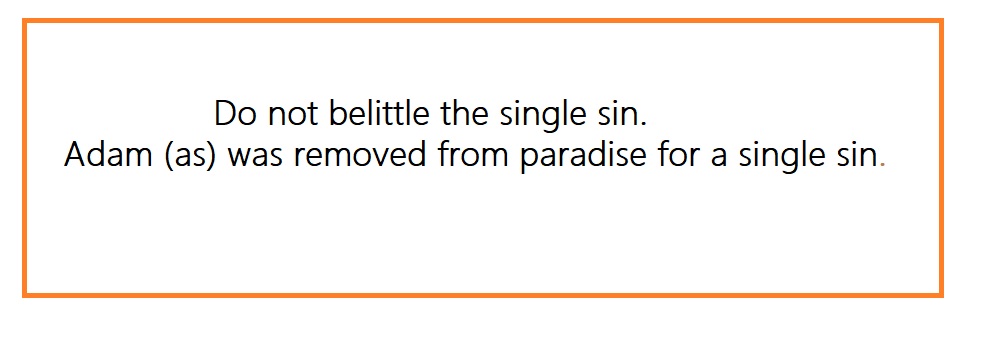
“Allah The Exalted, removed our Father Adam alayi salam, from heaven. For what reason did Allah (swt) remove him? For the reason of committing a single sin only! For the people of now (in these times) belittle committing a single sin and consider it severe only when they gather many (sins).”
“As if a problem only arises and is connected only to when the sins become many. No!”
“A sin in the sight of Allah is considered severe. Even if it were just one!”
“And if it were not like that, then why did Allah The Exalted remove our Father Adam alayhi salam, from a huge blessing in the form of heaven for the sake of committing one sin only, only! “
“Do not disobey your lord, even if it is just by one sin (one time) only! For it is not the number of sins committed that is considered; rather, it is He who you have sinned against that is considered. And that is ALLAH the MAGNIFICIENT!”
“So if you commit a sin under the pretext that it is just one (one time) and one only and that you won’t commit more. And as a result of continuing such, you eventually lose huge favour (from Allah) such as: health, offspring, spouse, work, shelter or any other favour!”
“Then do not blame anyone other than yourself! For you are not greater than our Father Adam alayi salam.”
Prima Qur’an comments:
“And We had already taken a promise from Adam before, but he forgot (fanasiya); and We found not in him determination.” (Qur’an 20:115)
Allah (swt) removed Adam (as) from paradise for what we may consider a simple act of fanasiya (negligence). Look at this Arabic word (fanasiya) and look how it used here:
“And from those who say, “We are Christians” We took their covenant; but they forgot (fanasū) a portion of that of which they were reminded. So We caused among them animosity and hatred until the Day of Resurrection. And Allah is going to inform them about what they used to do.” (Qur’an 5:14)
The Christians were cursed and given the curse of animosity and hatred among each other until the day of resurrection. This means Allah (swt) must have found in them determination. Where as witih Adam (as) he did not.
What about the Muslim who goes beyond what we may consider simple matters of negligence? One who sins and persist in the sinning. One who does not even seek forgiveness from Allah (swt)? What is that person’s condition?
Is there any Muslim today who considers themselves better or the equal of Adam (as)?
Allah (swt) inspired Adam (as) with words of forgiveness and the Allah (swt) forgave Adam. Yet, the effects of the sin took place. That is the explusion from the paradise.
According to the proofs and evidence advanced by the Sunnī schools of theology (Ashʿarī, Atharī, Māturīdī) if a Muslim dies without repenting from their major sins, they will spend an undisclosed period in hellfire. (Billions of years perhaps).
According to the proofs and evidence advanced by the Shiʿi and Ibāḍī schools of theology, if a Muslim dies without repenting from their major sins they will be in hellfire without reprieve.
No matter our theological position on what happens to the unrepentant sinners in the hereafter (billions of years in hellfire or indefinitely), the Shaykh has made a forceful point.
Even in the various Ṣūfī tariqa. How often during the day is it permissible to be in a state of ghaflah (heedlessnes)? In taṣawwuf, when is it permissible to not be in a state of dhirk (remembrance) of Allah? When is it permissible to forget Allah?
When we sin are we in a state of dhirk or ghaflah?
We need to get right with Allah. We need to purfiy ourselves and our intentions.
“And keep in mind that Allah’s Messenger is in your midst. If he were to yield to you in many matters, you would surely suffer. But Allah has endeared faith to you, making it appealing in your hearts. And He has made disbelief, rebelliousness, and disobedience detestable to you. Those are the ones rightly guided.” (Qur’an 49:7)
You may wish to read the following:
May Allah Guide the Ummah.
May Allah Forgive the Ummah.


