
“Only the knowledgeable in awe of Him. Allah is indeed Almighty, All-Forgiving.” (Qu’ran 35:28)
“Allah will elevate those of you who are faithful, and those gifted with knowledge in rank. And Allah is All-Aware of what you do.” (Qur’an 58:11)
“He grants wisdom to whoever He wills. And whoever is granted wisdom is certainly blessed with a great privilege. But none will be mindful except people of reason.” (Qur’an 2:269)
﷽
While it is true that Muslims were lovers of books and knowledge and science, we cannot approach our history with naivety. We also have to acknowledge the past. We cannot have a romanticized picture of our past.
You can name virtually any Islamic scholar from history and learn about the great many books or treaties that were written by them only to be disappointed to find out that a handful of their books survived us.
No doubt we hear about the Mongol invasion and the siege of Baghdad where entire libraries were destroyed. Legends tell of the Tigris river turned black from the ink of books thrown into it.
During the Crusades. Christian crusaders destroyed or plundered major islamic libraries in Syria, Palestine, and North Africa.
During the so-called Reconquista in Spain, when the libraries of Córdoba and Granda were taken, whole libraries were destroyed, and massive book burnings took place. Who knows what treasures of the Umayyads, the Malikis, Ibadis and Dhahiri were effaced.
The loss of a significant portion of early Muslim books and manuscripts was not caused by a single factor, but rather a combination of catastrophic destruction and environmental degradation. But the truth is, many of the books of knowledge among Muslims were often burned by other Muslim sects because those books were deemed to be heretical or simply lead people away from the truth, according to those who were burning the books.
One can only wonder if these books had survived, how they might have shaped the discourse on virtually every topic among Muslims. How many books, for example, may have caused the Muslims to reconsider a hadith now graded as sahih to be weakened? How many books, for example, may have caused the Muslims to reconsider a hadith now graded as daif to be strengthened? How many insightful legal verdicts are now lost to us forever. Allah knows best.
In his master’s thesis titled:
ظاهرة إحراق وإتلاف الكتب والمكتبات في الغرب الإسلامي خلال القرنين الرابع والخامس الهجريين/العاشر والحادي عشر الميلاديين (نماذج من الأندلس)
(The Phenomenon of Burning and Destroying Books and Libraries in the Islamic West during the 4th–5th centuries AH / 10th–11th centuries CE — Examples from Andalusia). This work by Taher Bakhda done at the University of Oran 1 Ahmed Ben Bella has some invaluable insights into our collective history.
Another researcher who has great insights in our collective history is Abd al-Rahman al-Kawakibi he wrote: Taba’i’ al-Istibdad wa Masari’ al-Isti’bad (The Nature of Tyranny And the Struggle Against Enslavement)
In this video, Dr. Abdul Rahman Al Hajji recounts the story of the burning of Arabic manuscripts after the fall of Andalusia and how some of them ended up in the Library of the Monastery of San Lorenzo de El Escorial.
The speaker is Dr. Abdul Rahman Ali Al-Hajji. A PhD in Andalusian History from Cambridge University (1966). He was a professor of the Prophet’s biography, Islamic history, and Andalusian history at several universities. He authored dozens of books, including: *Andalusian History from the Islamic Conquest to the Fall of Granada*. He passed away in Madrid, Spain, on January 18, 2021.
Upon a thorough investigation of the incidents of book burning in Islamic heritage, we find that the majority of this reprehensible phenomena are due to the actions of the authorities and the evils of politics. Every despotic authority has an inclination against knowledge and what it entails in terms of freedom of thought and enlightenment. The scholar Abd al-Rahman al-Kawakibi clarifies this meaning in his book ‘(The Nature of Tyranny And the Struggle Against Enslavement) by saying: “Just as it is not in the interest of the guardian for the orphans to reach maturity, so too it is not in the interest of the despot for the subjects to be enlightened by knowledge. [It is] not hidden from the despot – however stupid he may be – that there is no enslavement or tyranny except as long as the subjects are foolish and floundering in the darkness of ignorance and the bewilderment of blindness.”
Some authorities were under the illusion that by doing these actions they were performing an enlightening act, by fighting what they believed were foreign or corrupt beliefs in order to strengthen the legitimacy of the regime among the public and to reinforce the structure of the political community around it. These were the books that contradicted the correct doctrine, such as the classifications of astrology and what was associated with it of magic and talismans, as well as some jurisprudential and behavioral books that an authority might describe – at any given moment – as having fragmented the fabric of society.
What confirms the dominance of the political factor here is that those reckless burnings – and burning any book is certainly a reckless act, for a statement is countered by another statement. This occurred at the beginnings of the establishment of states, during conflicts between regimes, and when states are on the front lines or in contact with their enemies, where the distinctions between cultural and border penetration disappear.
Thus, we find that, despite the general openness and positive reputation of Islamic states in intellectual dialogue and scientific production, there was also a profound sensitivity towards certain new works and differing ideas. It is truly remarkable that Andalusia—despite its renowned literary and intellectual distinction—was among the centers of intense tension and sensitivity towards some of these ideas. Indeed, the religious stance towards certain books (on jurisprudence, Sufism, and philosophy) was often inextricably linked to political manipulation.
But Muslim historians, while observing this phenomenon, tried to point to a historical context for it in which previous nations were not free from such incidents. For example, in the days of the Greeks, books were burned under the supervision of the great philosophers. The historian Ibn Abi Usaybi’ah mentions in ‘Uyun al-Anba’ that ‘Plato burned the books written by [the philosopher] Thales (= Thales of Miletus, d. c. 546 BC) and his companions, and those who adopted one opinion from [those who believe in] experience and analogy, and left the old books that contained both opinions,’ because he believed in ‘both opinions together’ and the invalidity of taking analogy alone or experience alone.
We also find in Ibn Abi Usaybi’ah that Galen (d. 210 AD) was opposed to the opinion of the philosopher-physicians – and medicine was then a part of philosophy – who said that “there is no craft other than the craft of tricks, and that is the true craft of medicine.” He used to criticize their books written in this doctrine, to the point that he “burned what he found of them and invalidated this craft of tricks.”
But one of the strangest aspects of this phenomenon remains the sight of some Muslim scholars and thinkers voluntarily burning or destroying their books in any way possible (by burning, tossing them in rivers, or tearing them up).The strange thing here is that the writer would destroy the knowledge that his own hands had produced over long periods of time, with effort and suffering, perhaps due to an excessive sensitivity to the lack of appreciation from society, or due to a shift in the methods of thought and ways of accessing or faithfully preserving knowledge, or out of fear of raising doubts that the average reader might not understand.
In any case, those darknesses – whose most prominent facts and motives we will examine in this article – remained a slight and isolated shadow of darkness, which did not affect the energy of light that Islamic civilization spread throughout its regions and throughout the world, disseminating through it its scientific, cultural and artistic heritage, and the legacy of the nations that preceded it after it nurtured, refined, explained and completed it, and the intellectual fruits of all that continued to nourish the human mind – especially the Western mind – to the present moment.
What ever was lost could not happen except by the decree of Allah (swt). We have to trust that what we have of the Qur’an and the Sunnah and the knowledge that has been passed down to us by our elders is sufficient for our guidance.
Origin and explanation of this phenomena.
The first thing that can draw attention to the phenomenon of burning books and libraries is that it has been – since ancient times until now – one of the methods of repression and control used by the despotic political authority against its opponents and adversaries. Despotic governments do not like science or the enlightenment of people with knowledge, so they fear it and work hard to block ideas, to the extent that reformers work to produce and spread them!
One of the oldest texts that establishes the position of the despotic authority, which is often opposed to science and knowledge, is what came in the document ‘The Covenant of Ardashir’ attributed to the founder of the Sasanian Persian state, Ardashir ibn Babak, in which he ‘advised’ those kings who would come after him not to worry about corrupting the minds of their people so that they would ensure the survival of their kingdom! In that regard, he says: ‘Those kings before us used to scheme to corrupt the minds of those they feared (= their opponents)! For the wise man’s good nature does not benefit him if his mind is rendered barren and lifeless!’
The scholar Abd al-Rahman al-Kawakibi clarifies this meaning in his book ‘(The Nature of Tyranny And the Struggle Against Enslavement)’ by saying: “Just as it is not in the interest of the guardian for the orphans to reach maturity, so too it is not in the interest of the despot for the subjects to be enlightened by knowledge; [it is] not hidden from the despot – however stupid he may be – that there is no enslavement or tyranny except as long as the subjects are foolish and floundering in the darkness of ignorance and the bewilderment of blindness.”
When the government proceeds to burn the books of a scholar, all or some of them, whether they be on jurisprudence, Sufism, or philosophy, it often attributes this to what it claims is the care of the public interest and what serves the people on the level of “awareness front” and “intellectual security” that ensures the survival of the thrones, which in reality may not be more than an objection to the topics or methodologies of certain books that may differ from the official propaganda of the court.
One of the earliest examples we have of the political authority burning the books of those who disagreed with its religious and civilizational vision in the pre-Islamic eras is what the historian and physician Ibn Abi Usaybi’ah mentioned in ‘Uyun al-Anba’ that “Alexander (the Macedonian, d. 323 BC) when he took possession of the kingdom of Darius and conquered Persia, he burned the books of the Magian religion, and he took to the books of astronomy, medicine and philosophy and translated them into the Greek language, and sent them to his country and burned their originals.”
The earliest recorded instance in Islamic history of authorities burning books in protest against their content, which contradicted their official propaganda, was the action of Sulayman ibn Abd al-Malik (d. 99 AH/719 CE) – when he was Crown Prince – with a book on the Blessed Prophet’s biography that was written – at his behest – by the judge of Medina, Aban ibn Uthman ibn Affan (d. around 105 AH/724 CE). However, Sulayman did not like what was mentioned in the book regarding the virtues of the Ansar tribes, “so he ordered that the book be burned,” according to the genealogist historian Al-Zubayr ibn Bakkar (d. 256 AH/870 CE) in his book ‘Al-Akhbar Al-Muwaffaqiyyat’.
Sulayman’s action was admired by his father, the Umayyad Caliph Abd al-Malik ibn Marwan (d. 86 AH/706 AD), who praised his decision to burn the book, justifying it by saying that it served the interests of their subjects in the Levant. He said: “What need do you have to bring [to the Levant] a book in which we have no merit? You are informing the people of the Levant of matters we do not want them to know about the virtues of the Ansar!”
The political context of those fears is that the revolution of the people of Medina against the Umayyads in the Battle of al-Harrah in 63 AH/AD 682 was still fresh in people’s minds at that time, and the people of the Levant were the spearhead of the Umayyads in crushing their rebels, most of whom were Ansar; so how could a book be presented to them that narrated their virtues when they had been, just yesterday, the target of official propaganda demonizing them?
Various pretexts for the burning of books.
Authorities often used the pretext of suppressing dissenting opinions, labeling the speaker an innovator, heretic, or atheist, among other such claims intended to justify their actions in the eyes of the Muslim elite and public opinion. We also find the origin of this practice officially employed by the Persian king Ardashir, who said: “They would trick those who criticized the religion into attacking the kings by calling them innovators, so that religion itself would kill them and rid the kings of them. The king should not acknowledge that worshippers, ascetics, and those devoted to the faith are more deserving of the religion, more protective of it, or more angered by it than he is!”
It appears that Al-Mahdi al-Abbasi was the first to try to establish his legitimacy in ruling on the issue of confronting what was called “heretics”, to the point that Imam Al-Dhahabi says about him – in ‘History of Islam’ – that he “exaggerated in destroying the heretics and burned their books when they revealed corrupt beliefs.”
Also of this type is what historians have narrated about the fate of a large part of the huge library that existed during the days of the Umayyad Caliph in Andalusia, Al-Hakam al-Mustansir, and it was called “The Treasury of Sciences and Books,” according to Al-Maqqari al-Tilimsani in ‘Nafh al-Tayyib’.
Al-Maqqari mentioned that this al-Mustansir “was a lover of sciences, honoring its people, and collecting books of all kinds in a way that no king before him had collected”. Then he added that “the number of index [registers] containing the names of books is forty-four indexes, and in each index there are twenty pages, containing nothing but the mention of the names of the Diwans (= the works) and nothing else”.
Regarding the fate of the philosophical section of this great library’s treasures, al-Dhahabi tells us in ‘Siyar A’lam al-Nubala’ that after al-Hakam’s death, al-Mansur ibn Abi ‘Amir assumed the vizierate. He became the ‘chamberlain of the Andalusian kingdoms’ and the master of the Umayyad palace in Cordoba. ‘At the beginning of his rule, he went to al-Hakam’s book repositories, displayed their contents in the presence of scholars, and ordered the separation of the ‘works of the ancients’ and philosophers, excluding books on medicine and arithmetic (= geometry). He ordered them to be burned, and some were burned and others buried. He did this to ingratiate himself with the common people and to discredit al-Hakam’s practice’ of acquiring such philosophical books, which al-Dhahabi described as ‘extremely numerous’!
The phrase “his first victory” – which appears in the text above – sheds an important light on the political goal that was in the mind of this shrewd minister. At that time, he was still in conflict with his rivals from among the powerful statesmen to seize control of the country following the death of Caliph al-Mustansir, such as the minister al-Hajib Ja’far ibn Uthman al-Mushafi and the army commander Ghalib ibn Abd al-Rahman al-Umawi.
To achieve his political goal, al-Mansur enlisted the help of the influential group of jurists of the time, and his alliance with the wife of the late Caliph, Subh al-Bashkunshiyya (She is named after the land of Bashkunsh/Bashkuns = today the Spanish Basque Country), whose young son, Prince Hisham ibn al-Hakam, ascended the throne, but he remained under the guardianship of the powerful minister, al-Mansur al-Amiri.
What confirms what al-Dhahabi mentioned about the presence of political opportunism behind al-Mansur’s actions is his personal love of philosophy; according to what al-Maqqari tells us – in ‘Nafh al-Tayyib’ – who says that the people of Andalusia “have a share and attention to all sciences except philosophy and astrology, for they have a great share among their elite, and they do not openly practice them for fear of the common people, for whenever it is said that so-and-so reads philosophy or engages in astrology, the common people call him a ‘heretic’ and restrict his breathing…and their kings often order the burning of books on this subject if they are found, and thus al-Mansur ibn Abi Amir drew closer to their hearts at the beginning of his rise [to power], even though [he] was not free from engaging in that (= the sciences of philosophy) in secret”.
A Striking distinction
Books on pure science (medicine and engineering) commanded the respect of book burners as they were clearly beneficial to everyone, despite their close connection to philosophy in those days. However, it seems that purely philosophical studies became – almost since the end of the fourth century AH/10th century AD – widely condemned, so that sultans worked to strengthen their legitimacy by burning them to gain favor with the masses and influential scholars who opposed them; as we saw in what the minister and “enlightened intellectual” al-Mansur al-Amiri did in Andalusia, and also under the rule of his counterpart in culture and political charisma in the Islamic East, the Buyid minister al-Sahib ibn Abbad.
The historian Yaqut al-Hamawi narrates – in ‘Mu’jam al-Udaba’ – on the authority of Ali ibn al-Hasan al-Katib his statement about his relationship with this minister Ibn Abbad*: “I saw nothing but good from him until another boredom befell him, so he put me in prison for a year, and collected my books and burned them with fire, and in them were copies of the Qur’an and many fundamental books on jurisprudence and theology, so he did not distinguish them from the ‘books of the ancients’ (= books of philosophy and astrology), and he ordered that the fire be thrown into them without verification, but rather due to his extreme ignorance and extreme impetuosity!
*note: Not to be confused with Ibn Ibad (Abdulah ibn Ibad) whose name sake the Ibadi school was named by it’s opponents.
His statement, “He did not distinguish it from the ‘books of the ancients’,” is an indication of the real reason for the burning, for Ibn Abbad only wanted to burn the books of philosophy specifically. This is confirmed by what was stated in his description by Abu Hayyan al-Tawhidi, who says about him in ‘Al-Imtaa’ wal-Mu’anasa’: “The majority of his speech is that of the Mu’tazilite theologians, and his writing is mixed with their methods, and his debate is tainted with the expression of writers, and he is very prejudiced against the people of wisdom (philosophy) and those who look into its parts, such as geometry, medicine, astrology, music, logic, and arithmetic.”
Not far from the era of Ibn Abi ‘Amir and Ibn Abbad, who were among the learned princes, we find the historian Ibn al-Athir mentioning – in his book ‘Al-Kamil’ – that the founder of the Ghaznavid state, Mahmud ibn Subuktigin al-Ghaznawi, overthrew the Buyid state in Khorasan in the year, then “burned the books of philosophy, the doctrines of Mu’tazilism and astronomy” which were numerous in the libraries of its kings.
The political context of this refers to the intellectual conflict, which has always been strengthened by the means of the existing authority, and which has continued since the days of the Abbasid Caliph al-Ma’mun between the “People of Hadith,” to whom Mahmud of Ghazna was seeking support and backing, and the Mu’tazilite movement, whose views were adopted by Ghaznavid’s Buyid opponents as a doctrinal extension of their Zaidi Shi’i school of thought.
Historical turning points
Then the disapproving tendency towards philosophy intensified, especially at the end of the fifth century AH. Perhaps what contributed to consolidating that disapproval was the attack launched by Imam al-Ghazali on the philosophers in his book ‘The Incoherence of the Philosophers’. The defense and support that Imam Abu al-Walid Ibn Rushd the grandson later offered to philosophy in his two books: ‘The Incoherence of the Incoherence’ and ‘The Decisive Treatise’ did not help in mitigating its effects.
Indeed, Ibn Rushd himself suffered a great ordeal at the end of the following century during the reign of the Almohad Sultan al-Mansur Abu Yusuf Yaqub ibn Yusuf, even though he was his personal physician and therefore one of the closest people to him. Al-Dhahabi tells us in ‘Al-Siyar’ that ‘someone who opposed him sought to harm him before Yaqub, and they showed him [words] in his handwriting relating that the philosophers [say that] [the planet] Venus is one of the gods. So he summoned him and said: Is this your handwriting? He denied it, so he said: May Allah curse whoever wrote it, and he ordered those present to curse him, then he made him stand in humiliation, and he burned the books of philosophy except for medicine and geometry’!
Ibn Abi Usaybi’ah states that the reason for Ibn Rushd’s ordeal was his preoccupation with the sciences of philosophy. He said that al-Mansur “was angry with Abu al-Walid Ibn Rushd… and also with a group of other eminent scholars… and he claimed that he did this to them because of what was alleged about them [that] they were engaged in wisdom (= philosophy) and the ‘sciences of the ancients’!” Supporting this explanation is what Abu Hayyan al-Andalusi quoted in his ‘Al-Bahr al-Muhit fi al-Tafsir’ from a poem by one of the poets, “inciting al-Mansur of the Almohads against the philosophers.”
“Burn their books east and west, for in them lies hidden the evil of knowledge,
creeping into beliefs through its harm, poisons, and beliefs are like bodies!”
Around the time of that incident, we find in the biography of Imam al-Amidi that he taught philosophy and logic at the al-Zafiri Masjid in Cairo. Then he was accused of doctrinal deviance, to the point that the chief judge and historian Ibn Khallikan says – in ‘Wafayat al-A’yan’ – that the jurists ‘put their pens in order to permit the shedding of blood [of him], so he left [Egypt] in secret and went down to Hama’ in the Levant.
Scientific books may have fallen victim to the authorities settling scores with senior officials or scholars who criticize them, whose behavior they do not approve of. An example of this is what happened in Baghdad to Chief Justice Yahya bin Saeed Ibn al-Marakhim, who was accused of corruption and of “taking bribes,” according to Ibn al-Jawzi in Al-Muntazam.
Therefore, a decision was issued to arrest this judge Ibn al-Murakhkham, and his money was confiscated, and his books were burned in al-Rahba (a public square in Baghdad), including the book ‘al-Shifa’ [by Ibn Sina] and ‘Ikhwan al-Safa’, and he was imprisoned and died in prison.
The broader historical context
The historian Ibn Khaldun al-Hadrami tells us in his history that the Hafsid Sultan of Tunis, Muhammed al-Mustansir, was resentful of the Andalusian Imam Muhammed ibn Abdullah, known as Ibn al-Abbar al-Quda’i. The Sultan sent for him at his house, and all his books were brought to him. He found, as they claimed, a note containing verses, the first of which was:
A successor has become tyrannical in Tunisia ** They have unjustly named him: ‘Caliph’!!
The Sultan became enraged and ordered him to be questioned and then killed. He was killed by being stabbed with spears in the middle of Muharram of the year 658 AH. Then his limbs were burned, and the volumes of his books, and all his collections were brought and burned with him.
The American historian of civilizations, Will Durant, said in ‘The Story of Civilization’ that when the leader of the Sophist school, the Greek philosopher Protagoras (d. 420 BC), announced his simple ideas that ‘all truth, goodness, and beauty are relative and personal matters’, the ‘Athenian Assembly’, which was the elected legislative body to govern the city of Athens, was terrified by them, and saw that they ‘foreshadowed a terrible evil, so it decided to exile Protagoras, and the Athenians were ordered to hand over all of his writings that they might have, and his books were burned in the public marketplace’!
Ibn Abi Usaybi’ah mentioned in ‘Uyun al-Anba’ that “Plato (d. 347 BC) burned the books written by [the philosopher] Thales (= Thales of Miletus, d. c. 546 BC) and his companions, and those who adopted one opinion from [those who believe in] experience and analogy, and he left the old books that contained both opinions,” because he believed in “both opinions together” and the invalidity of taking analogy alone or experience alone.
Plato burned the books of his opponents among the philosophers, even though he was one of the founders of the science of philosophy.
We also find in Ibn Abi Usaybi’ah that Galen (d. 210 AD) was opposed to the opinion of the philosopher-physicians – and medicine was then a part of philosophy – who said that “there is no craft other than the craft of tricks, and that is the true craft of medicine.” He used to criticize their books written in this doctrine, to the point that he “burned what he found of them and invalidated this craft of tricks.”
Indeed, the Greeks went beyond burning what they disliked from books of philosophy and medicine to burning collections of poetry; for this historian Ibn al-Ibri recounts – in ‘Abridged History of States’ – that the philosopher Plato ‘distinguished himself – in his youth – in the science of poetry, so when he saw [his teacher] Socrates (d. 399 BC) disparaging (= criticizing) this art – among the sciences – he burned his books of poetry’.
The case of biased rejection
And like the books of philosophy, and perhaps because of their general association with it at that time, the Muslim sultans extended their oppression to books of astrology, as we find in an incident that happened to the grandson of the founder of the Qadiriyya Sufi order, who was Abd al-Salam ibn Abd al-Wahhab ibn Sheikh Abd al-Qadir al-Jili, who was mentioned in his biography by Imam Ibn Hajar al-Asqalani – in ‘Lisan al-Mizan’ – that “he was of reprehensible character, an astrologer who delved into the philosophy of the ancients, so his books were burned publicly in Baghdad.”
Al-Dhahabi says in ‘The History of Islam’ that this Abd al-Salam was ‘humiliated by the burning of his astronomical books’ in the year 588 AH, and that this burning was ‘in a public gathering, and in them (the burned books) was the statement that there is no manager of the world other than the stars and that they are the providers’!
Al-Dhahabi adds – in ‘Al-Siyar’ – that the burning of these books was done “at the suggestion of [Imam] Ibn al-Jawzi” because he “did not treat Sheikh Abdul Qadir [al-Jili] fairly and diminished his worth, so his children hated him.” This later exposed Ibn al-Jawzi to a great calamity that lasted five years, when a minister close to the family of Abdul Qadir al-Jili arrived at the court of the Abbasid Caliph in Baghdad, and he took revenge on him for them, as “some of Ibn al-Jawzi’s books were burned and the rest were sealed [with a ban],” according to Imam Ibn Kathir in ‘Al-Bidaya wa al-Nihaya’.
In conclusion, the ultimate goal of those events was rejection of their opponents or rejection of their ideas.
The authorities’ pursuit of the works was not limited to what they called “the books of the ancients” of philosophy, astrology and the like; rather, the sectarian incitement by some scholars led to the burning of the books of their colleagues who differed with them in the scientific doctrines and intellectual orientation, or even in the presentation and interpretation within the same doctrine itself!
However, we often find the presence of authority in such events, as state officials exploit these natural disagreements within scholarly circles, manipulating them for their political ends, especially if one party in the scholarly dispute enlists their help to bolster their position or school of thought; as we saw in the story of Ibn al-Jawzi’s involvement in the burning of Abd al-Salam al-Jili’s books. Indeed, the scourge of sectarian fanaticism might even lead a sultan to order the burning of an entire school of Islamic jurisprudence simply because it contradicted his own affiliation!
The “revival” crisis
Among the recorded events of that time was what happened during the reign of the Sultan of the Almoravid state in Andalusia and the Islamic West, Ali bin Tashfin, whom al-Dhahabi described in ‘Al-Siyar’ as someone who “greatly respected scholars and consulted with them. During his time, jurisprudence, books, and branches flourished until they became lazy about Hadith and traditions, and philosophy was humiliated, and theology was rejected and despised.”
One of the effects of that demonization of theological and philosophical sciences was that “the people of that time condemned anyone who appeared to be delving into any of the theological sciences, and the jurists at the time of Ali bin Tashfin, decided to condemn theology, and the hatred of the predecessors for it and their abandonment of anyone who appeared to be involved in it, and that it is an innovation in religion and most of it may lead to differences in beliefs,” according to the account of Abd al-Wahid al-Marrakushi in ‘Al-Mu’jib fi Talkhis Akhbar al-Maghrib’.
Al-Marrakushi adds that in that hostile atmosphere towards theological and philosophical discussions, Prince Ali ibn Tashfin adopted the positions of the jurists who opposed everything that contradicted the official legal school of the country, which was the Maliki school, after “hatred for theology and its people had taken root in him (the prince), so he would write about it at every time to the country, stressing the prohibition of engaging in any of it, and he threatened anyone who was found with any of its books. When the books of Abu Hamid al-Ghazali entered Morocco, the prince of the Muslims ordered them to be burned, and he issued severe threats – of bloodshed and confiscation of wealth – to anyone who was found with any of them; and the matter became very serious in that regard!
It appears that the effect of the official decision to burn al-Ghazali’s books – although the actual burning was limited to his book ‘Ihya Ulum al-Din’ – extended for about forty years, which is the period of the rule of Prince Ali bin Tashfin, who took power in the year 500 AH. Imam al-Dhahabi tells us – in ‘al-Siyar’ – about what appears to be the first incident of burning this book, as he says that in the same year, “the news reached [Alexandria] of the burning of al-Ghazali’s books in Almeria” in Andalusia.
Copies of the book were burned throughout the Andalusian lands under the supervision of the Maliki “Judge of the Community” (Judge of Judges) Muhammed ibn Ali ibn Hamdin al-Taghlibi, whom al-Dhahabi described as “criticizing Imam Abu Hamid in the Sufi way, and writing in response to him.”
In the year 538 AH, this prince issued one of his last decrees in his life, which included the following: “Whenever you come across a book of heresy or a heretic, beware of him, especially – may Allah guide you – the books of Abu Hamid al-Ghazali. Their traces should be followed, and their news should be cut off by continuous burning. They should be searched for, and oaths should be made binding on anyone accused of concealing them!” This is according to the text of the decree document cited by the historian specializing in the history of Andalusia, Muhammed Abdullah Anan, in his book ‘The Islamic State in Andalusia,’ quoting from its manuscript in the Spanish Escorial Library.
The dual vision
It is understood from the words of Judge Iyad al-Maliki that the deep Sufi content of the book ‘Ihya’ was the main motive behind its burning. He says, as quoted by al-Dhahabi in ‘al-Siyar’: “Shaykh Abu Hamid [al-Ghazali] – the one with the heinous news and the great writings – went to extremes in the way of Sufism and devoted himself to supporting their doctrine, and became a preacher of it and wrote his famous works on it. He was criticized in some places in it, and the suspicions of a nation were bad about him, and Allah knows best his secret. The order of the Sultan in our country in Morocco and the fatwa of the jurists to burn it and stay away from it were carried out, and that was obeyed.”
The philosopher and physician Abu al-Hajjaj Ibn Tumlus al-Andalusi confirms in his “Introduction to the Art of Logic” what Qadi Iyad stated regarding the centrality of the Sufi factor in the burning of the book “Ihya’ Ulum al-Din” (The Revival of Religious Sciences). He points out that the Andalusian Maliki jurists were surprised by “The diverse books of Abu Hamid al-Ghazali, which struck their ears with things they were unfamiliar with and did not know, and with words that deviated from their usual understanding of Sufi issues and other groups with whom the people of Andalusia were not accustomed to debating or conversing. Their minds were far from accepting it, and their souls recoiled from it. They said: If there is disbelief and heresy in the world, then what is in al-Ghazali’s books is disbelief and heresy! And they all agreed on that. So al-Ghazali’s books were burned, and they did not know what was in them!”
Then Ibn Tumlus – who was a senior student of the philosopher Ibn Rushd – notes the historical reversal – in Andalusia and the Islamic West in general – towards al-Ghazali’s books a few years after they were burned, and the role of the doctrinal/political factor in this great transformation, when the Almoravid state was violently overthrown in 541 AH by the Almohads, who considered al-Ghazali to be the Shaykh of the founder of their religious movement, Muhammad Ibn Tumart.
Therefore, as soon as things settled down for the Almohads, “People were encouraged to read the books of al-Ghazali, and it was known from his school of thought (= Ibn Tumart) that he agreed with him (= al-Ghazali); so people began to read them, and they were impressed by them and by what they saw in them of the quality of the system and arrangement, the like of which they had never seen in any authorship, and there was no one left in these regions who was not overcome by love for the books of al-Ghazali except those who were overcome by excessive rigidity from the extreme imitators, so reading them became a law and a religion after it had been disbelief and heresy”.
Ibn Tumart traveled to Baghdad where he met with contemporaries of Imam Al Ghazali as well as his students. This interaction ignited a flame, a passion within Ibn Tumart, who came back to the Maghrib (North Africa) and virtually slaughtered all those who did not accept the Ashari’ theological creed. He later proclaimed himself the ‘Mahdi’.
However, methodological fairness in presenting the facts requires us to point out that the Maliki jurists in Andalusia were not in agreement with the authority’s position against al-Ghazali’s books. A group of them opposed this from the very first moment of the decision to burn them, led by Imam Ali bin Muhammed bin Abdullah al-Judhami al-Barji, and they issued a joint fatwa that required “The punishment of the one who burned them and making him pay their value because they are the property of a Muslim,” according to Ibn al-Abbar al-Quda’i in his book ‘Dictionary of the Companions of Judge Abu Ali al-Sadafi’.
It is strange that we find some scholars expanding the scope of the fatwa prohibiting the burning of books and including their value for whoever burns them, making it include even the books of non-Muslims, in order to protect freedom of belief and preserve peaceful religious coexistence among the components of society. Among the jurisprudential texts in this regard is what came in the book ‘Al-Bujayrami’s Commentary on Al-Khatib al-Shirbini’ by the scholar Sulayman bin Muhammed al-Bujayrami al-Misri al-Shafi’i, which states the certainty of “Prohibiting the burning of the books of the disbelievers because they contain the names of Allah Almighty, and because it involves wasting money!”
Therefore, we see, for example, that Samuel ibn Yahya al-Maghribi, who was a Jewish scholar and converted to Islam, records – in his book ‘Exerting Effort in Refuting the Jews’ – that the Jewish community is ‘Undoubtedly the most fortunate of communities’ in terms of preserving its writings and monuments, despite being ‘One of the oldest nations in history, and due to the many nations that conquered it, from the Canaanites, Babylonians, Persians, Greeks, Christians, and Muslims. None of these nations did not intend to harm them with the utmost intent and seek to exterminate them, and went to great lengths to burn and destroy their lands and burn their books; except for the Muslims,’ for they preserved for them their free religious presence like the rest of the non-Muslim communities.
Many Islamic sects burned the books and writings of other Islamic sects.
The phenomenon of burning books was not limited to a particular Islamic sect, but rather it transcended the boundaries of sects within the Islamic scientific arena, as many sects practiced it against the other, and we even find it within the ranks of the same sect; many of the incidents mentioned here in this article are examples of this.
Another example is what Qadi Iyad mentioned in ‘Tartib al-Madarik’, that the authority in the Fatimid state tested one of the scholars of Alexandria named, Abu Abdullah Muhammed ibn Abdullah ibn Attab known as Ibn al-Muqri. He was a Maliki jurist, considered one of the best Muslims, trustworthy and reliable. The Banu Ubayd (= the Fatimids) beat him and and burned his books! Also, the Fatimids – who were Ismaili Shii’i- set fire to the books of a great imam who belonged to the Twelver Shi’i school of thought, because he wrote in refutation of the opinions of their school of thought.
Imam al-Dhahabi tells us – in ‘al-Siyar’ – that the Shii’i Ja’fari Imam Abu al-Hasan Thabit ibn Aslam al-Halabi was “The jurist of the Shi’i, and the grammarian of Aleppo… He took the lead in teaching and he had a work on exposing the flaws (= defects) of the Ismailis and the beginning of their call, and that it was based on deception. So the caller of the people (= their religious guide in the Levant) took him and he was taken to Egypt and al-Mustansir (the Fatimid Caliph) and impailed him. May Allah not be pleased with whoever killed him. And for that reason the library of books in Aleppo was burned, and it contained ten thousand volumes. May Allah have mercy on this innovator who defended the religion!”
This is a precious and profound insight from al-Dhahabi, who, in terms of his scholarly formation, was a Hanbali in creedal principles and a Shafi’i in jurisprudential branches. Despite describing the jurist al-Halabi as an “innovator,” he looked at what he had in common with him and praised him for “defending the faith,” and prayed for Allah’s displeasure with his killer and denounced the ordeal he faced at the hands of the Ismaili Shi’a!
Al-Dhahabi’s work demonstrates his broad understanding, grasp of reality and its priorities, and deep awareness of the relativity and complexity of positions. The actual founder of the Safavid state—a Twelver Shi’a state—Sultan Ismail Shah, was accused of “killing scholars and burning their books,” as mentioned in Ibn al-Imad al-Hanbali’s “Shadharat al-Dhahab.”
It is interesting to find the love of scientific excellence and intellectual leadership among the reasons for burning other people’s books. This is mentioned in what Zahir al-Din al-Bayhaqi narrates – in ‘Tatimmat Siwan al-Hikma’ – about the reason for the burning of a great library that belonged to the Samanid state court in its capital, Bukhara. Some accused the famous philosopher Ibn Sina of “Burning those books to add those sciences and treasures to himself, and to cut off the lineage of those benefits from their owners”.
In other words, it is claimed that he burned the library so that he (Ibn Sina) could pawn those ideas off as his own! In those times, we did not have the World Intellectual Property Organization (WIPO). Although we should be cautious about such claims, it is not at all implausible that such things happened.
Imagine! Ibn Sina (Avicenna) the book burner! The library torcher! Or so it was said of him.
So keep in mind dear readers when people accuse the Ibadis of this or that that the history books are filled with them accusing each other of all sorts of crimes.
It was also strange that the pledge to burn books of jurisprudence was a tool of political propaganda for some power-hungry individuals, and part of their “program for governance” should they reach the seat of power. Imam al-Sakhawi mentioned in “al-Daw’ al-Lami’” that one of the Mamluks, named Lajin al-Jarkasi (= al-Shirkasi), due to his lack of intellect, claimed that he owned the Egyptian lands and openly declared this without concealment. The Circassians (among the princes) revered him and believed in the validity of this claim. He promised to abolish the endowments of the masjids and congregational masjids, burn books of jurisprudence, and punish the jurists, among other absurdities, and to restore matters to what they were during the time of the Caliphs!
Hazmiya’s ordeal
Among the reasons for the burning of books was the jealousy that arose among some scholars of the different schools of Islamic jurisprudence, along with disputes, disagreements, and rivalries for prominence and leadership, which led to them telling on one another to kings and princes. For example, the Maliki jurists of Andalusia criticized Imam Ibn Hazm al-Andalusi on many aspects of his legal methodology and his approach to argumentation and scholarly debate, just as he vehemently criticized them, accusing them of fanaticism and rejecting religious texts in favor of human opinions.
Therefore, al-Dhahabi, in his biography in Siyar A’lam al-Nubala, summarizes Ibn Hazm’s ordeal: “He was persecuted for his outspokenness against scholars, and he was exiled from his homeland… A group of Malikis rose up against him… The rulers of the region turned against him, so the state banished him and burned volumes of his books.” This burning was ordered by the chief ruler of Andalusia at the time, al-Mu’tadid ibn Abbad, at the instigation of those influential jurists.
As we saw from the victory of the Almohad sultans for the books of al-Ghazali after their ordeal of being burned, until “Reading them became a religious duty and a religious obligation after they had been considered heresy and apostasy,” according to Ibn Tumlus, the books of Ibn Hazm found – about a century and a half after his death – in one of these sultans who restored their prestige and wrote a victory for them, namely Sultan al-Mansur Yaqub bin Yusuf al-Muwahhidi, whose story with Ibn Rushd and his burning of philosophical books was mentioned earlier.
The historian of Andalusian literature, al-Maqqari al-Tilimsani, describes – in ‘Nafh al-Tayyib’ – this al-Mansur as being impressed by the personality and opinions of Ibn Hazm, and that he stood one day at his grave and said: “All scholars are dependent on Ibn Hazm!” It seems that this admiration is what made him “avenge” Ibn Hazm against his opponents, the jurists, so he obliged people to the Zahiri school and ordered in the year 591 AH the burning of books of branches of Maliki jurisprudence under the pretext of the necessity of abandoning tradition and returning to the texts of revelation, Qur’an and Sunnah, not only in Andalusia but also in the Maghreb.
Regarding the events of this burning and its purely sectarian motives, an eyewitness to one of these events in Fez, Morocco, tells us about it. He is the historian al-Marrakushi, who says in his book ‘Al-Mu’jib’: “[Al-Mansur] ordered the burning of the books of the [Maliki] school of thought… I witnessed—while I was in the city of Fez at that time—that loads of books were brought in, placed on the ground, and set on fire… His overall intention was to eradicate the Maliki school of thought and remove it from Morocco once and for all, and to force people to adhere to the literal interpretation of the Qur’an and Hadith. This same intention was also the intention of his father (= Abu Ya’qub) and his grandfather (= Abd al-Mu’min), but they did not make it public, while this Ya’qub did.”
While al-Mansur’s actions with the Maliki books were considered “revenge” for Ibn Hazm’s books, it is not unlikely that the motive behind his father’s and grandfather’s desire to burn them was “revenge” for the burning of al-Ghazali’s book ‘Ihya’, who – as previously mentioned – was the shaykh of the founder of their movement that paved the way for the establishment of their state, Ibn Tumart.
And if books of jurisprudence – especially the Maliki and Zahiri schools, which became among the extinct schools of jurisprudence – had their share of burnings, similar to books of philosophy and astrology, then books of Sufism were also included in the burning in some eras and countries, as we saw in the story of the continued burning of al-Ghazali’s most important work in the science of Sufism – which is the book ‘Ihya’ – in the region of the far west of Morocco and Andalusia for four decades, which is half the life of the Almoravid state.
After that, incidents of burning the writings of controversial Sufi figures were repeated, and some of their books were burned many times. For example, “the books of Muhyiddin Ibn Arabi (al-Hatimi) were burned more than once,” according to what Ibrahim Ibn Omar al-Biqa’i reported in his book ‘Tanbih al-Ghabi’.
Absolute Gas incinerators! Burn it all down!
Among the greatest fires that befell books and libraries in the ancient Islamic civilization were those that occurred whenever the lands of Islam fell under foreign occupation; from the Crusader attack from the West on the Levant, to the Mongol invasion of the Islamic lands from the Far East to its heart, where they brought down the capital of its caliphate in Baghdad; and ending with the libraries of Andalusia, which the Spanish Christians set on fire whenever they subjugated one of its Islamic lands.
The historian Jamal al-Din al-Qifti translated – in ‘Inbah al-Ruwat’ – Abu al-Ala al-Ma’arri, and among what he said about the fate of his rich library at the hands of the Crusader invaders was: “Most of Abu al-Ala’s books were lost, and only those that left Ma’arra before the attack of the infidels (= the Crusaders) on it (in the year 491 AH), and the killing of those who were killed from its people, and the looting of what was found for them; as for the great books that did not leave Ma’arra, they were lost, and if anything of them is found, then only a part of each book is found.”
At the beginning of the sixth century AH, the city of Tripoli – located today in northern Lebanon – was ruled by the Banu Ammar al-Kutami dynasty, which was affiliated with the Fatimid state. They built a large library in it with diverse classifications in various fields of knowledge and arts, so much so that it was known as “the famous house of knowledge in the histories,” according to a description of it that appeared in the book ‘Masalik al-Absar’ by Ibn Fadlallah al-Umari.
That library met a sad fate when the Crusaders subdued Tripoli in 503 AH after a long and painful siege. As soon as it fell into their hands, they “Plundered what was in it, captured its men, and took its women and children captive. What came into their hands—from its belongings, treasures, and books (= classifications) of its house of knowledge (= library), and what was in the treasuries of its owners—was innumerable and too many to be mentioned”!! As the historian Ibn al-Qalanisi al-Tamimi recounts in ‘The History of Damascus’.
To understand the magnitude of the disaster that befell this library, it suffices to refer to what the historian Jurji Zaydan mentions in ‘The History of Islamic Civilization’: that ‘when the Franks conquered Tripoli in the Levant during the Crusades, they burned its library by order of Count Bertram Saint-Gilles (= the French Prince Bertrand, son of Raymond Saint-Gilles). He had entered a room containing many copies of the Qur’an and ordered the entire library to be burned, which, according to their claim, contained three million volumes!’
In turn the Tahert (or Tahret), the capital of the Ibadi Rustamid dynasty, was captured by the Fatimid Caliphate on 296 AH. Tahert was famous as ‘Iraq al-Maghrib, al-‘Iraq ash-Shaghir, Balkh al-Maghrib, or Little Basra. Entire works on Ibadi theology, tafsir, Arabic literature, mathematics, astronomy, jurisprudence and other sciences were lost forever as the Fatimid’s burned the library of al-Ma’shumah was burned to the ground.
In the following century, the personal libraries of scholars suffered successive calamities whenever the Mongols invaded one of the cities of Islam, beginning with the start of their devastating conquests in 616 AH.Imam al-Dhahabi, in his ‘History of Islam’, provides us with an example of what these libraries were subjected to. In his biography of the hadith scholar Imam Abu Rashid al-Ghazal al-Isfahani, he says that he was wealthy and ‘collected a great many books… and lived in Bukhara for a while until the enemy (= the Mongols) entered it and plundered it; so his books were burned and his wealth was lost.’
The historian Ibn Taghribirdi informs us – in ‘Al-Nujum al-Zahira’ – that when the Mongols occupied Iraq in 656 AH, “Baghdad was utterly destroyed, and the books of knowledge that were in it, of all sciences and arts that were not in the world, were burned; it was said that they built a bridge of mud and water instead of bricks (= burnt mud)”!
The Andalusian catastrophe
And with the beginning of the second, third of the seventh century AH itself, a series of terrible burnings began in the far west of the Islamic world, fueled by the libraries of the Andalusian cities, in which scientific contributions of all kinds had accumulated over about eight centuries. These burnings continued as the Christian kings continued to sweep through the Andalusian regions until the fall of its last strongholds in Granada was completed.
The truth is that the emergence of this phenomenon in Andalusia dates back centuries before that, as it accompanied the Islamic-Christian conflict there from its beginning. Imam Ibn Hazm, in his usual scathing style, compared what the Banu Abbad state did to his books—driven by the incitement of his opponents among the jurists—by burning them, with what the Christians were doing to the Qur’anic manuscripts whenever they conquered a Muslim country. He said in his famous verses:
“If you burn the paper, do not burn what the paper contains, for it is in my heart.
Likewise, the Christians burn the Qur’an in the border cities when their hands are raised!”
What really happened was that Ibn Hazm’s observation of the similarity of the two actions was repeatedly confirmed by events in the centuries following his time. In his valuable book, ‘The Islamic State in Andalusia’, the historian Abdullah Anan recounts a summary of the events of the burning of Islamic books in Granada after its surrender to the Spanish in 897 AH. He says that Cardinal Francisco Jiménez directed “The perpetration of a shameful barbaric act, which was that he ordered the collection of all that could be collected of Arabic books from the people of Granada and its suburbs, and huge piles were arranged in the Bab al-Ramla Square, the greatest square of the city, including many beautifully decorated Qur’ans, and thousands of books of literature and science, and they were all set on fire!”
Anan adds that the fires consumed those enormous collections of books, “and [Bishop Jiménez] spared only three hundred books of medicine and science, which were taken to the university he established in the city of Alcalá de Henares. Tens of thousands of Arabic books, the essence of what remained of the Islamic intellectual heritage in Andalusia, fell victim to this barbaric act!”
Anan refers to historians’ estimates of the number of books consumed by the fire of this fanatical Catholic bishop, whose act was the greatest expression of the roots of Christianhate of Islam in Andalusia. He says that “Spanish historians differ in estimating the number of Arabic books that fell victim to this measure. De Robles estimates them at one million and five thousand books; Bermendez de Pedraza estimates them at one hundred and twenty-five thousand; some others estimate them at only five thousand, and [the Orientalist José] Conde estimates them at eighty thousand, and perhaps his estimate was closer to reasonable.”
Then Anan quotes comments from some Western Orientalists who condemn the actions of Bishop Jimenez; among them is an eloquent comment by the American historian of Spanish origin, William Prescott, in which he says: “This sad act was not committed by an ignorant barbarian, but by an educated scholar, and it occurred not in the darkness of the Middle Ages, but at the dawn of the sixteenth century, and in the heart of an enlightened nation that owes – to the greatest extent – its progress to the very treasuries of Arab wisdom”!
Among the events of modern history related to the phenomenon of library burnings, regardless of the degree of the perpetrator on the ladder of civilization and even modernity in the contemporary Western sense, is that famous incident of the English forces burning the Library of Congress during their invasion of Washington in 1329 AH, which led to the destruction of 35,000 books, or about 60% of its contents at that time!
Voluntary burning
While the majority of book burnings in our history are part of the existing power mechanisms employed to control the scientific and intellectual landscape within its geographical area, it has happened – on many occasions – that the scientists themselves burned their books with their own hands. The reasons for this are numerous, ranging from fear of the consequences of doctrinal disagreement and the pressure exerted on them by their doctrinal opponents, or fear of the oppression of the political authority, or due to the fluctuations of one of their psychological moods and their distress over their living conditions, or for real or imagined scientific methodological reasons.
The encyclopedic writer Abu Hayyan al-Tawhidi recognized this phenomenon and observed the multiplicity of its causes. He said, addressing his friend, Judge Abu Sahl Ali ibn Muhammed, when he wrote to him rebuking him for burning his books at the end of his life when the world became too much for him: “Your letter reached me… in which you described… what afflicted your heart and inflamed your chest from the news that reached you concerning what I did in burning my precious books with fire and washing them with water; so I was amazed at the absence of any excuse from you in that matter!”
Then al-Tawhidi explained to his friend the judge the various reasons that prompted him to do that; foremost among them was that he did it in imitation of some scholars who burned or destroyed their books in various ways and for different motives; so he said: “Furthermore, I have in burning these books an example of imams who are followed… among them is Abu Amr ibn al-Ala’ (al-Basri) – who was one of the great scholars with apparent asceticism and well-known piety – who buried his books in the ground and no trace of them was found; and this is Dawud al-Ta’i (al-Kufi) – who was one of the best of Allah’s servants in asceticism, jurisprudence and worship and he is called ‘the crown of the nation’ – who threw his books into the sea…!
And this is Yusuf ibn Asbat (al-Kufi) who carried his books to a cave in a mountain, threw them into it, and sealed its entrance. And this is Abu Sulayman al-Darani who gathered his books in an oven and set them ablaze, then said: By Allah, I did not burn you until I almost burned with you. And this is Sufyan al-Thawri who tore up a thousand volumes and scattered them in the wind. And this is our Shaykh Abu Saeed al-Sirafi, the master of scholars, who said to his son Muhammed: I have left you these books so that you may gain good in the Hereafter with them, so if you see them betraying you, then make them food for the fire!
Yaqut al-Hamawi, who preserved for us the text of al-Tawhidi’s letter in ‘Dictionary of Writers’, believes that Abu Hayyan only “burned his books at the end of his life because of their lack of [worldly] benefit to him, and because he was stingy with them for those who would not know their value after his death”.
The truth is that al-Hamawi brilliantly summarized what al-Tawhidi himself presented in his aforementioned letter. He said, “These books contain various kinds of knowledge, both secret and public. As for what was secret, I did not find anyone who truly desired it, and as for what was public, I did not find anyone eager to seek it. However, I collected most of them for the people, to seek their respect, to establish leadership among them, and to extend my prestige with them. I was deprived of all of that… and I disliked, along with this and other things, that it should be an argument against me, not for me!”
The Psychological motives
Then al-Tawhidi elaborates on the psychological motives that made him burn his books, saying: “What sharpened my resolve to do this and revealed the reason behind it was that I lost a noble son, a beloved friend, a close companion, a learned follower, and a generous leader (who rewarded with prizes). It was difficult for me to leave them to people who would tamper with them and defile my honor if they looked at them, and gloat over my lapses and mistakes if they browsed through them, and expose my shortcomings and flaws because of them… And how could I leave them to people I lived with for twenty years, yet I never received any genuine affection from any of them, nor did any of them show me any loyalty (= covenant), and I was forced among them – after fame and recognition – to shamefully beg from the elite and the common people, and to sell my religion and honor!”
Subhan’Allah! What a rip!
Historians tell us that among those who burned their own books for fear of intellectual opponents was Imam Ibn Aqil al-Hanbali. Ibn al-Jawzi says in al-Muntazam: “Our companions [the Hanbalis] resented him (Ibn Aqil) for his frequent visits to Abu Ali ibn al-Walid (the Mu’tazili) because of things he used to say… It so happened that he (Ibn Aqil) fell ill, so he gave some of his books to a man [whom he] used to seek refuge with, called Ma’ali al-Ha’ik, and told him: If I die, burn them after me!”
The man examined it and saw in it evidence of the Mu’tazilites’ veneration. The weaver then went and showed this to Sharif Abu Ja’far (Ibn Abi Musa al-Hashimi, the Imam of the Hanbalis) and others. This greatly angered our companions, and they sought to bring him down, so he went into hiding. Ibn Aqil only ordered the weaver to burn his books after his death because he feared the power of his Hanbali opponents and the influence they wielded through their connections with the Abbasid court in Baghdad.
There are other reasons, such as the change that some scholars experience in their scientific and behavioral temperaments. Similarly, there is what was previously reported about al-Tawhidi regarding the reason why Abu Amr Ibn al-Ala’ al-Nahwi destroyed his books, which is confirmed by al-Qifti – in ‘Inbah al-Ruwat’ – by saying: “Abu Amr was the most knowledgeable of people about the Arabs and Arabic, and about the Qur’an and poetry… and his books – which he wrote about the eloquent Arabs – had filled a house of his up to almost the ceiling, then he changed and burned them all, and when he returned to his former knowledge, he had nothing but what he had memorized with his knowledge.”
Imam al-Dhahabi explains to us in ‘al-Siyar’ the nature of this “change” that occurred to this great scholar. He says that “his books filled a house to the ceiling, then he became an ascetic and burned them”! When Ibn al-Ala’ became an ascetic and devoted himself to ritualistic worship, he saw that he should get rid of his books as they were distractions from devoting himself to his new direction, since “the [love of] looking and reading stirs in his chest at a certain time, and that is a preoccupation with something other than Allah Almighty,” according to the explanation of Haji Khalifa in ‘Kashf al-Zunun’.
Similarly, the historian Muhammed Khalil al-Husseini mentioned in ‘Silk al-Durar’ about the scholar Abd al-Jawad al-Kayyali al-Shafi’i as he says that “he had complete knowledge and a long reach in the strange arts and engaging in them, and his writings were great in them, but he did not pretend to know anything, and he burned all of them and did not leave anything for himself or for others, and he turned away from all of that, and whenever he spoke of something of that, he would cry and ask for forgiveness, and he devoted himself to engaging in the knowledge of the Sufi masters and reading their books, and he was not before that engaged in the aforementioned sciences, but rather he was devoted to the formal sciences (= intellectual).”
Imam al-Khatib al-Baghdadi draws our attention to a methodological reason, which is their fear of what would compromise scientific integrity after them. This often prompted the ancient scholars to destroy their works. In his book, ‘Restricting Knowledge’, he says: “More than one of the early scholars, when death approached him, destroyed his books or bequeathed that they be destroyed, for fear that they would fall into the hands of someone who was not knowledgeable and would not know their rulings, and would take everything in them literally, and perhaps add to them and subtract from them, and that would be attributed to its original author. All of this and similar things have been reported from the early scholars as a precaution against it.”
The Methodological factors
Whether the burning of books was a voluntary act by its author and owner, or a punishment from his opponents, whoever they may be, there are many texts indicating that this sometimes affected their status and scientific credibility. The phenomenon of scholars being saddened by the burning of their books became widespread, as if they suffered from psychological depression as a result, which changed their moods and psyches, so that they were not worthy of fulfilling the trust of science and the rights of its students.
Imam Taj al-Din al-Subki translated in his “Great Classes of Shafi’i Scholars” the judge, hadith scholar, and jurist Abdullah ibn Muhammed al-Qazwini al-Shafi’i, mentioning that “The memorizers would gather in his house and he would dictate to them, and a great crowd would gather in his council… [Then] he became confused at the end of his life and placed hadiths on texts; so he was exposed and his books were burned in his face” as punishment for his breach of scientific integrity by forging the chains of transmission and texts of prophetic hadiths.
And similar to this is what Imam Ibn Hajar al-Asqalani explained – as reported by Haji Khalifa in Kashf al-Zunun – regarding the destruction of some of the early scholars of Hadith by burning and other means; he said that it was because they “Believed that if someone narrated it by finding it (= narrating books without an approved license), he would be considered weak [by the Hadith scholars], so they saw that the harm of destroying it was less than the harm of weakening [the narrators of Hadith] because of them.”
Among the examples of their grief over the burning of their books is what Yaqut al-Hamawi mentioned in ‘Mu’jam al-Udaba’: ‘Uthman ibn Jinni said: Our Shaykh Abu Ali (al-Farisi) told us that a fire broke out in the City of Peace (= Baghdad) and all the knowledge of the Basrans was taken away. He said: I had written all of that in my own handwriting and read it to our companions, but I did not find anything at all from the box that burned except half of the book on divorce by Muhammed ibn al-Hasan (al-Shaybani). I asked him about his consolation and comfort [in that], and he looked at me in amazement and then said: I remained for two months without speaking to anyone out of grief and worry!’
If all the knowledge of the Basrans was taken away this would include those works by the shining stars of the Ibadi school.
Al-Hafiz Sibt Ibn al-Ajami al-Shafi’i translated in his book ‘Al-Ightibat bi-Ma’rifat Man Rumi bi-al-Ikhtilat’ for Imam Omar Ibn Ali Ibn al-Mulaqqin al-Shafi’i, saying that he “became confused [his mind] before his death because of the burning of his books”; that is, because of his sadness and grief over their burning.
Al-Sakhawi adds, in his book ‘Al-Tawdih al-Abhar’, that Ibn al-Mulaqqin’s confusion was ‘a reason for his son preventing him from transmitting hadith.’ This distress over the burning of books is powerful evidence of the extent to which scholars were attached to the books they had spent their lives collecting, acquiring, recording, reading, studying, and teaching!
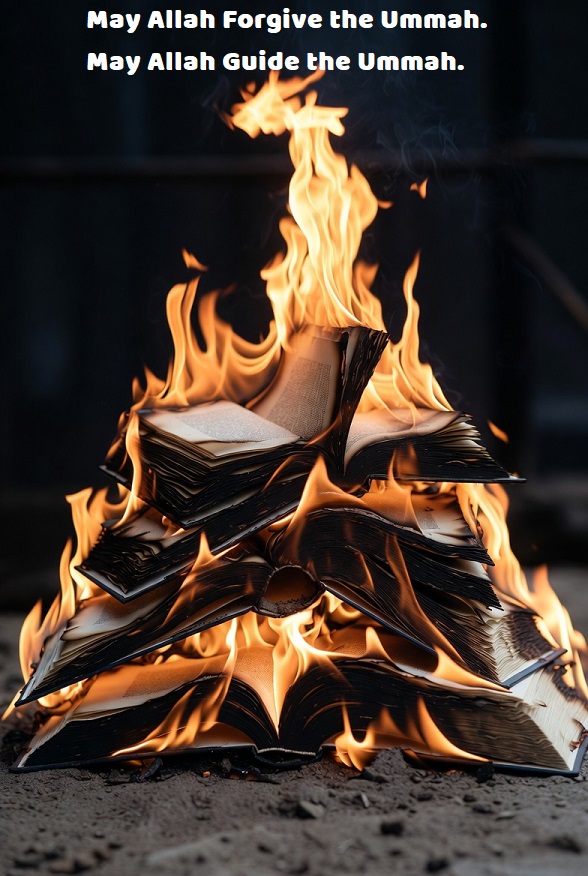
May Allah Guide the Ummah.
May Allah Forgive the Ummah.


 Prima Quran