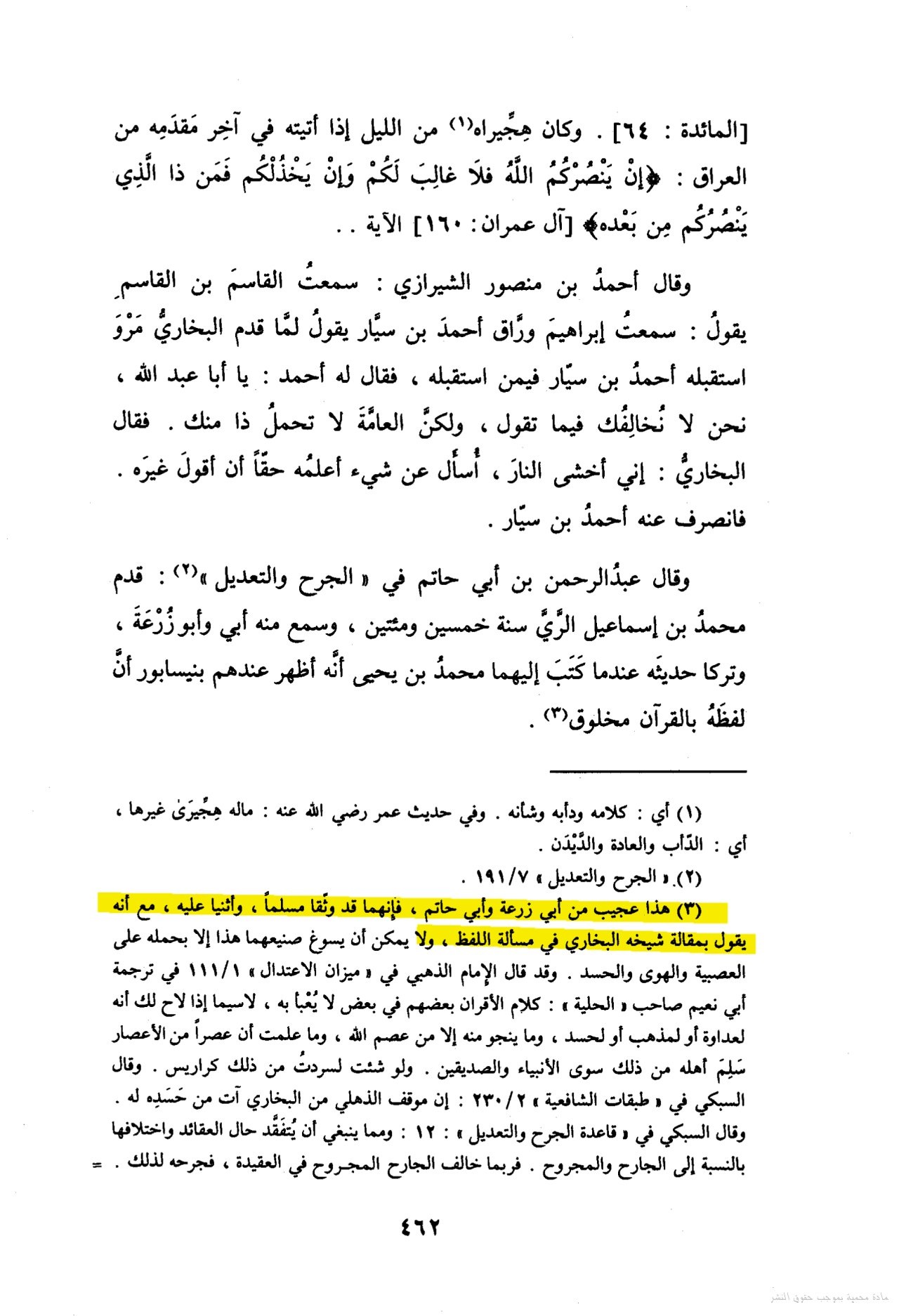
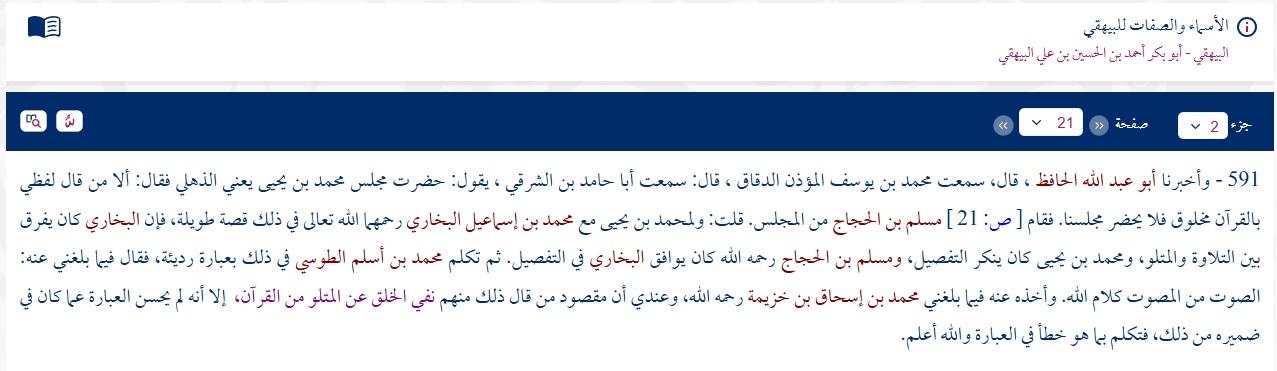
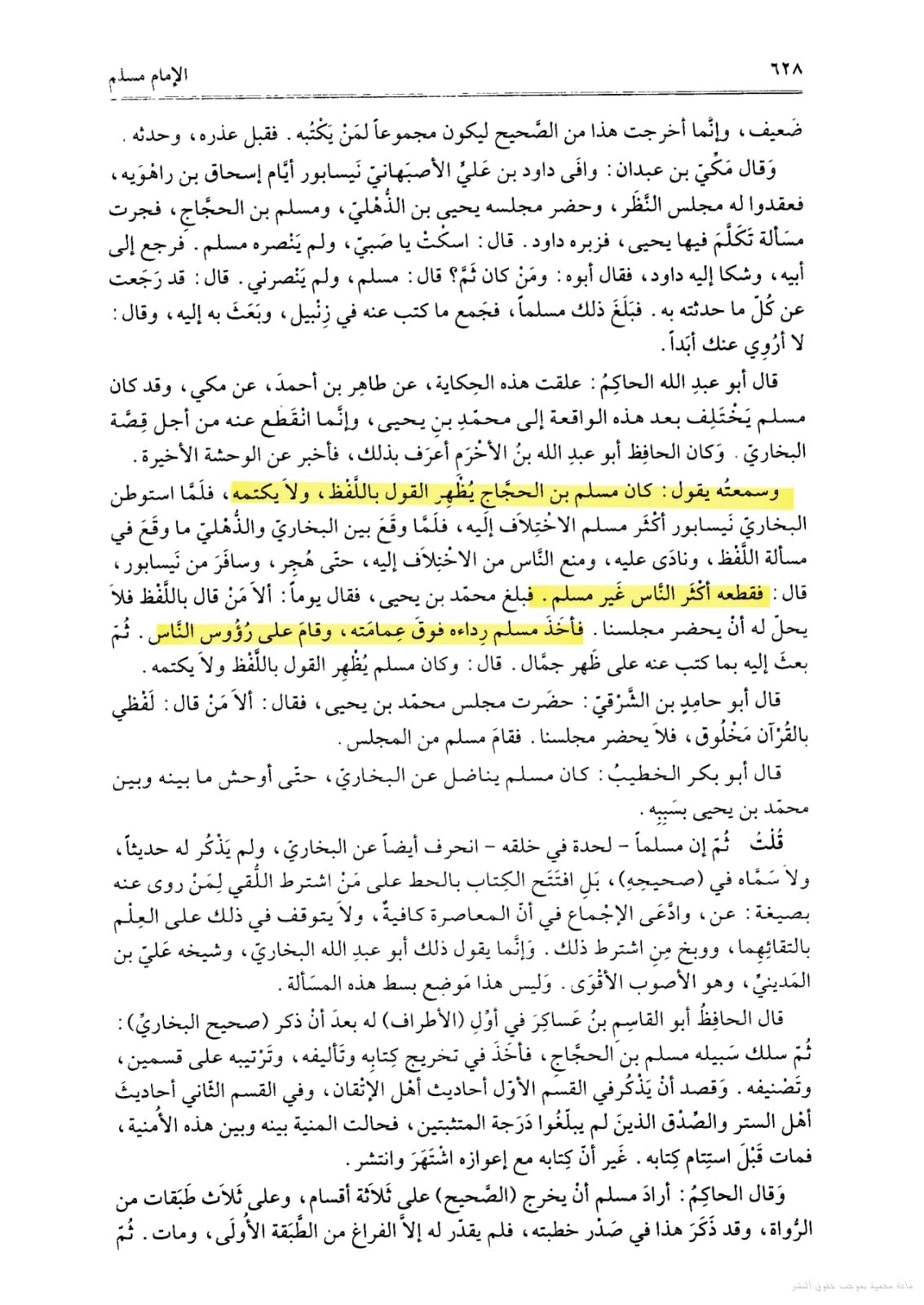
“Those who split up their Religion, and become (mere) Sects,- each party rejoicing in that which is with itself!” (Qur’an 30:32)
﷽
Well, if you haven’t heard of them by now know that they are coming to a Masjid near you!
We suspect Neo-Umayyadism was around before the Syrian civil war but the Syrian civil war certainly spurred it on.
We really wanted to be the one’s to break the story to you but it seems that we were beaten to the punch line. Although the following article addresses Neo-Umayyadism on a surface level it does indeed go much deeper.
First and foremost what is Neo-Umayyadism? It is a romanticize idea of the ideal Islamic state. When the so called ‘real’ and ‘orthodox’ Muslims were at their peak. It is fiercely defensive of anything related to the Umayyads. This includes but is not limited to Mu’awiya 1, Yazid 1, Al-Hajaj bin Yusuf, Ubayd Allah ibn Ziyad, Marwan 1 etc.
They see the Umayyad dynsty as the peak of potential. A period where Islam was free of Alidism, Esotericism and Shi’ism of all forms.
They see the majority of Sunni Muslims as products of the the Abbasid dynasty. They strongly believe a Shiafication of Sunnism took place under the Abbasid dynasty. They firmly believe that ‘Abbasid Sunnism’ is a gate way drug that can lead any nominal Sunni into becoming a full fledged Zaydi, or Imami etc.
While their is certainly some underlying truth to their claims in our interactions with such people they have gone so far as to accuse Shu’ayb ibn Muharram al-Albani al-Arna’ut, Ali ʿIzz ad-Din Abū al-Ḥasan ibn Muḥammed ash-Shaybānī and even Aḥmad ibn Muḥammed ibn Ḥanbal ash-Shaybānī himself of Shi’ism!
They see themselves as a bulkwark against any Shi’i led political influences.
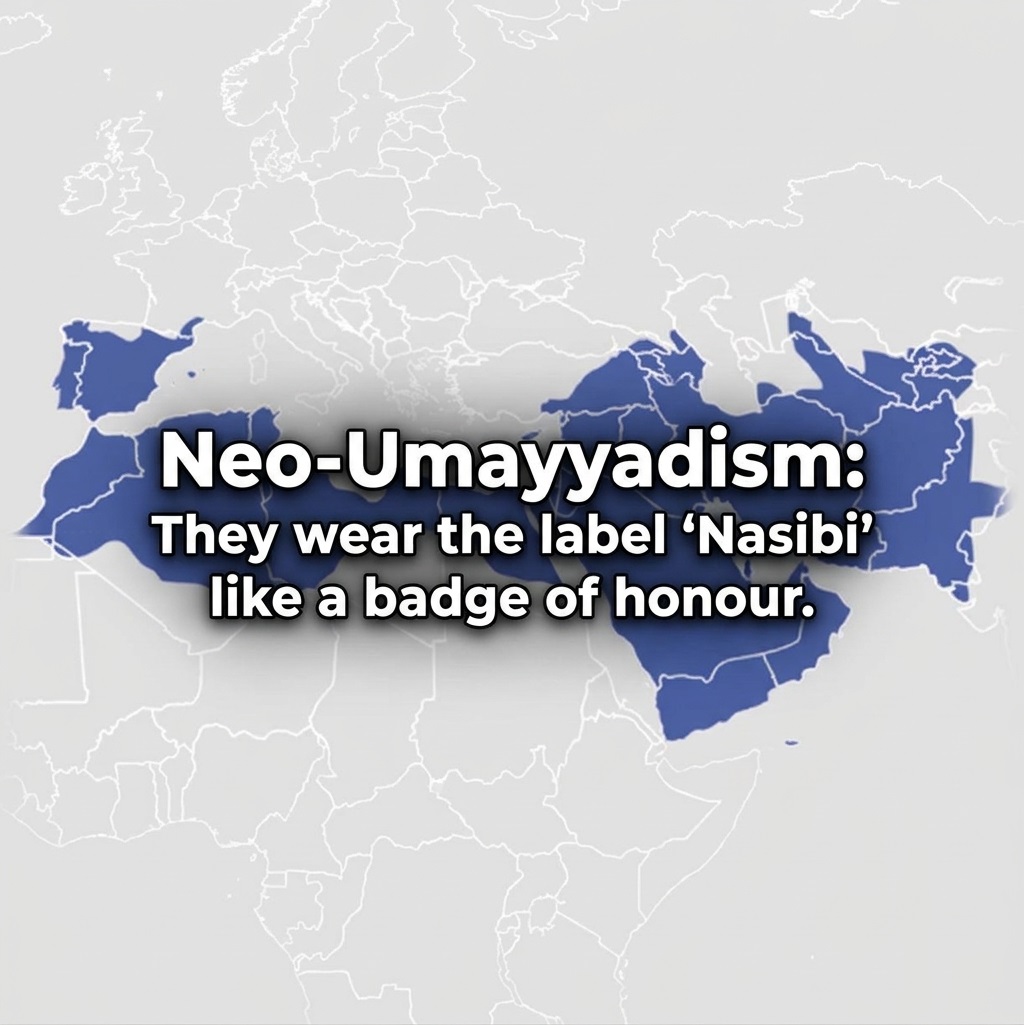
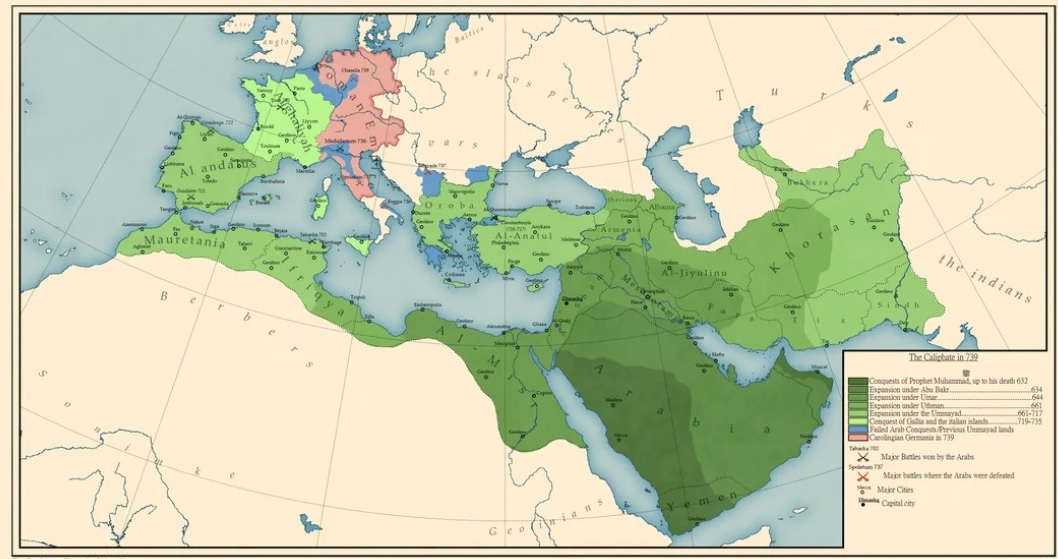
They show young men this map and say to them to the effect:
“At it’s height during the years 661 to 750 the caliphate was 11.1 million square km making it one of the largest contiguous empires in world history. It was an empire where the praise of Ali and his household was not central at all.”
“All that went away with the cursed Abbasids came along! and the Ummah until today is under thier grip!”
Whereas a normative Sunni by today’s standards would recoil at being called a ‘Nasibi’ these people wear it as a badge of honour! They embrace it and wear it as a perfume whose aroma they hope reach the nose of all who have the least favourable thing to say about Imam Ali Ibn Abu Talib.
This movement is particularly strong in Syria, Lebanon, Jordan, and Iraq. It has gained traction in Saudi Arabia, Kuwait, Turkey and Egypt.
Do not think that the reach of this movement is only in the Middle East. That is a far cry from the truth. As one brother mentioned to us about its reach in Indonesia where a marker of one’s true Sunnism is to name one’s child Yazid, Mu’awiya or at the very least have these in their name. Abu Bakr and Umar will not do because the ‘Abbasid Sunni’ who they see as Crypto-Shi’i name their children Abu Bakr and Umar.
For the Umayyad Sunni, the Caliphs were four: Abu Bakr, Umar, Uthman and Mu’awiya.
Where as in our (Ibadi) normal interactions with Sunni Muslims who recoil and are shocked to find that certain companions of the Blessed Messenger (saw) had a hand in the assination of Uthman ibn Affan, these Umayyad Sunni have no problem in accepting this.
In fact, one of the arguments against the sincerity of Mu’awiya 1 is their opponents ask: “Why didn’t he track down and go after those who killed Uthman ibn Affan then!”
These Umayyad Sunni’s respond: “He did exactly that! From Muhammed ibn Abi Bakr [the son of Abu Bakr] who had his head removed and was desecrated by being stuffed into the carcass of a dead donkey and set on fire!”
They are quite prepared to give a you list of all those who they accuse of having a hand in the assassination of Uthman Ibn Affan and how Mu’awiya 1 and his proxies executed them one by one.
You see dear reader, and you may want to sit down for this one. In their view Ali Ibn Abu Talib is/was a Kharijite and everyone who supported him was and is a Kharijite!
These people from what we have seen and what we have have interacted tend for the most part to follow the Maliki school, the Salafi school and the Hanbali school. However, there is real tension when the issue of the accuastion of Ahmad Ibn Hanbal being a shi’i or having shi’i sympathies comes up.
They have their own shaykhs and teachers and for the most part those tend to stay in the background (due to some of their more controversial takes) even among Sunni who share hostility and disdain towards Shi’i.
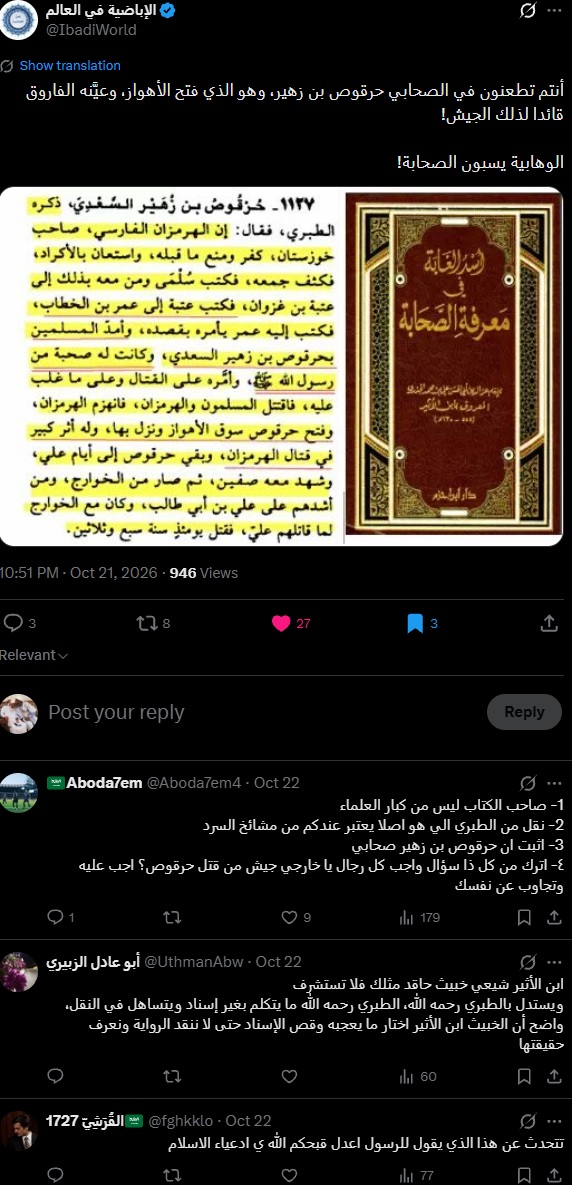
We can give you one free sample of one interaction between us (Ibadi) and these Umayyad Sunni. You will not fell to notice a single reply from any other Sunni to this main even though he is making a strong accusation against a major Sunni scholar.
This was an exchange where one of our brothers is defending the noble companions Hurqus ibn Zuhair (ra) from the vicious attacks of these people!
@UthmanAbw (notice the name Uthman why of course) says:
“Ibn al-Athir is a malicious, resentful Shiite like you, so don’t try to speculate. And he cites al-Tabari, may Allah have mercy on him. Al-Tabari, may Allah have mercy on him, doesn’t speak without a chain of narration and is lenient in transmission. It’s clear that the malicious Ibn al-Athir chose what pleased him and cut the chain so we wouldn’t critique the narration and know its truth.”
Prima Qur’an Comments: What a feral little otter pup! But anywho these gentlemen would be in for a treat once they read:
‘Ali told one of his followers named Al-Ashtar: “I told you that I assigned to Muhammed bin Abi Bakr the governorship (of Egypt); (but) these Khawarij have revolted against him.” Thus, according to ‘Ali, Mu’awiya and his followers were the Khawarij.
So, maybe now that this post is public someone will rush to the comment section on X to go and scold UthmanAbw.
Not all Sunni scholars are asleep. Shaykh Al-Diddu has taken notice of this and spoke about it here:
Translation as follows:
“The idea of Nusb (enmity towards Ali and his family) and the innovation of Nusb that emerged now has led to many people in Sham (Syria), for example, saying: ‘We are Umayyads, and our affiliation is entirely to Banu Umayyah; our history began with Abdul Malik bin Marwan, and our allegiance is to Yazid bin Mu’awiyah,’ and so on. There is no doubt that in this there are great exaggerations and excesses. For this Ummah is one Ummah, and its best are the noble Companions, then those who follow them in goodness, and so on. Just as the Rafidah (Shia) slander Mu’awiyah bin Abi Sufyan (may Allah be pleased with him, his father, and his mother), and slander Amr bin al-Aas (may Allah be pleased with him), and slander a number of the Companions, likewise these Nawasib (those hostile to the Prophet’s family) slander the noble Family of the Prophet (Ahl al-Bayt). Both of these two groups have strayed from the right path.” -Shaykh Al-Diddu
But unfortunately Shaykh Al-Diddu is a product of Abbasid Sunnism. The very kind that this Neo-Umayyad Sunnism warns about.
Some Sunni’s have even gone so far as to disavowal certain books altogether!
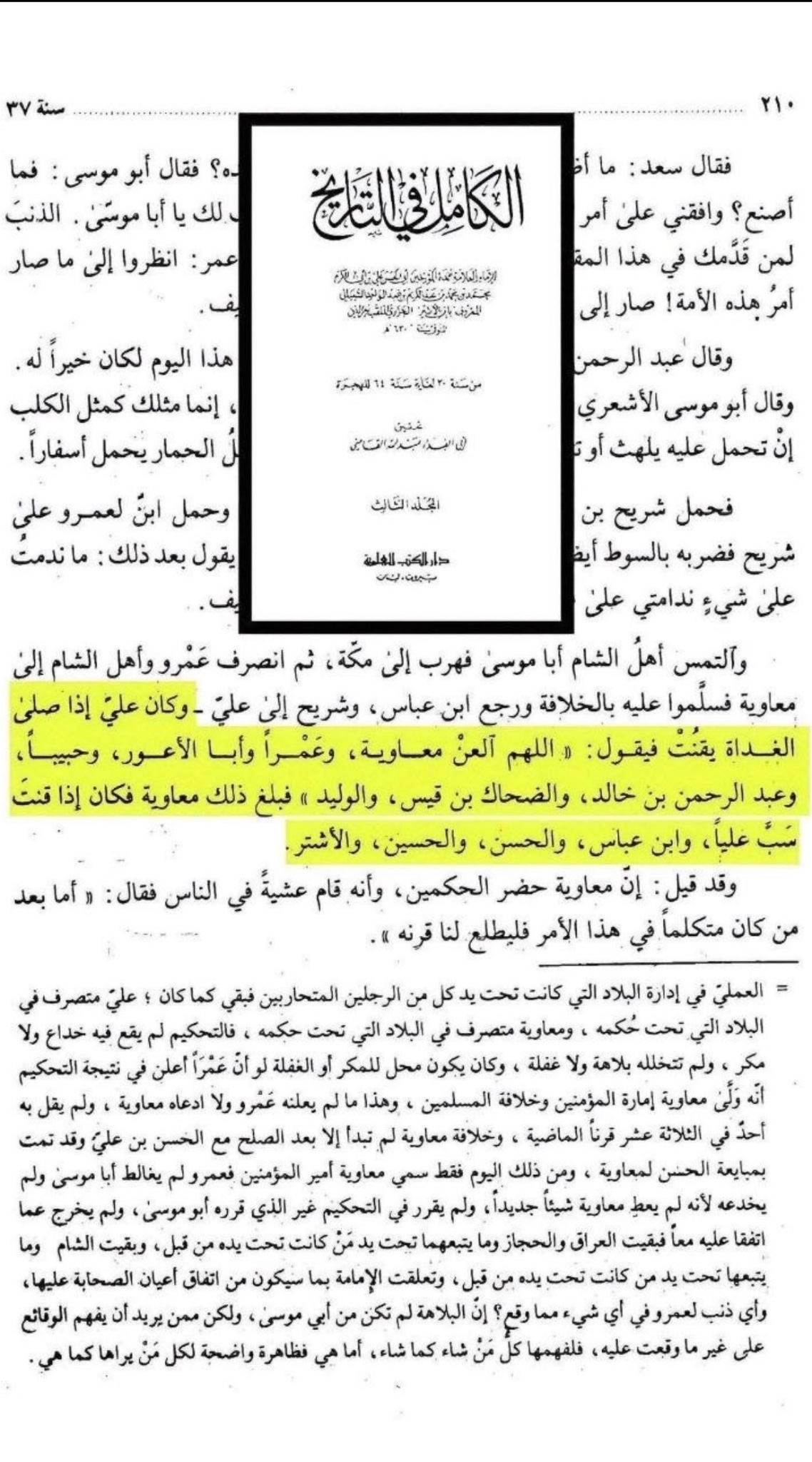
Like the following which is not considered a controversial attribution.
“The people of Sham (Syria) sought Abu Musa, so he fled to Mecca, then Amr and the people of Sham headed to Mu’awiyah, so they pledged allegiance to him as Caliph, and Sharik returned to Ibn Abbas. And Ali (may Allah be pleased with him) – when he prayed the morning prayer, he would say in his Qunut: “O Allah, curse Mu’awiyah, and Amr, and Abu al-A’war, and Habib, and Abd al-Rahman bin Khalid, and al-Dahhak bin Qais, and al-Walid.” This reached Mu’awiyah, so when Ali cursed [them]…
[Highlighted Text] “He (Mu’awiyah) would curse Ali, and Ibn Abbas, and al-Hasan, and al-Hussein, and al-Ash’ath.”
Source: (Title: Al-Imamah wal-Siyasah (The Imamate and Politics) Author: Abi Abdullah Muhammed bin Muslim bin Qutaybah al-Dinawari (d. 276 AH) (Translator/Compiler equivalent): Dr. Ali Shiri Volume: Part One (الجزء الأول) Page Number: 210 Publisher: Dar al-Adwaa al-Haqq (دار الأدواء الحق) –Beirut (بيروت)
You can research yourself the current controversy surrounding this work. Many scholars of ‘Ahl Sunnah’ have authenticated this book as being the work of Al-Dinawari. Some scholars of ‘Ahl Sunnah’ have shown dissapointment that he spoke about these matters of the companions.
It used to be that many Salafi and Wahhabi people would want to create a huge fuss over this attribution. However, now that the Umayyad Sunnis are in town they have put thier hand over the mouth of the others and told them to quite down. They see in this work an angle they can utilize to their benefit.
From the Abbasid Sunni (majority Sunni) position this is not a good look. Ali is said to specifically be cursing Mu’awiyah, and Amr and a host of others. That just cannot because we need to show the world a highly edited telling of past events. Shi’i love this work because it shows Ali cursing Mu’awiyah, and Amr. Ironically the Umayyad Sunnis love it for the same reason that the Shi’i do! Not that they like or approve of the cursing of Mu’awiyah, and Amr no.
Read the text again. It shows Ali as the initiator of such a practice!
This reached Mu’awiyah, so when Ali cursed [them]…“He (Mu’awiyah) would curse Ali, and Ibn Abbas, and…
So when we come to the following hadith in which Mu’awiyah ask Amir b. Sa’d b. Abi Waqqas why he didn’t curse Abu Turab (Ali) the Ummayad Sunnis will smile and say of course! He is only responding in kind to the curses directed towards him!
In the middle of all the sectarian fighting going on someone had the idea to release a film on the very fitna of the companions!
In this particular moving scene it doesn’t take a rocket scientist to imagine what goes on in the head of some people. The Ummayad Sunnis see themselves as the people of truth. Ali and his supporters are the Kharijites who assassinated Uthman ibn Affan unjustly. So replace Mu’awiyah with (Syria) or and replace the assasination of Uthman with images of widows and children crying for justice.
Ali and his supporters are seen as the protagonist today they could be Iran, or even the Abbasid Sunnis with their perceived esoteric doctrines and lovers of Ali’s bloodline.
We could be mistaken (someone please correct us) but for dramatic effect we believe the video has ʿAqīl ibn Abī Ṭālib-who is the full elder brother of ʿAlī ibn Abī Ṭālib and ʿUbayd Allāh ibn ʿUmar ibn al-Khaṭṭāb the son of Umar ibn al-Khaṭṭāb both flanking Mu’awiyah. Both Ali’s brother and Umar’s son fought against Ali.
“We seek nearness to Allah through this war. By Allah, we are not fighting except those who wronged Uthman and Allah does not love the wrongdoers!!! These people killed their Caliph unjustly and aggressively! They killed the Caliph of the Messenger of Allah Uthman bin Affan! And they command us not to fight, so are you pleased with that? Indeed, this day is the day of distinction between truth and falsehood. Those who fight us today reject the pledge of allegiance! They understand [only] wealth and power as the greatest! So will you leave the soldiers of falsehood to rise over you today? O killers of Uthman, if you come out to us, we will fight you to the exclusion of the rest of the Muslims! Come out, O killers! How could you Ali?! O Allah Bring out the killers! O Allah is the Greatest!!! Allah is the Greatest!!! Allah is the Greatest!!! Allah is the Greatest, Allah is the Greatest !!! Allah is the Greatest, Allah is the Greatest !!! Allah is the Greatest.” -Mu’awiyah as depicted in the film.
Then of course the moving nasheed:
Allah’s blessings upon Sham (Syria) through the Banu Umayyah, They swept away the filth of the tyrants, so it became green and radiant. When soldiers from the land of Idlib came to it, They chanted ‘Allah is the Greatest’, fearing not death. They blocked its liberation and let all mankind know, We have returned to Damascus with pride after defeating the arrogant. They chanted ‘Allah is the Greatest, Allah is the Greatest, Allah is the Greatest’, fearing not death. They took the enemies by surprise at dawn when they attacked fiercely. They conquered Aleppo [Shahba] at noon, then called out to mankind. Immediately they found the march, and headed for the land of wine [referring to Homs/Hama region]. They conquered Hama at night, they conquered Hama at night, then called out ‘O my enemy’. They conquered Hama at night, then called out ‘O my enemy’. They conquered it, then marched on to prostrate in Al-Khalidiya. They marched towards Sham, marched towards Sham, marched towards Sham, And they returned it to Umayyad rule, and the era of the regime ended. So it became free, the era of the regime ended, so it became free. Allah’s blessings upon Sham through the Banu Umayyah, Like eagles sweeping away the filth of the tyrants, so it became green and radiant.
“Indeed, We created humans in the best form.” (Qur’an 95:4)
﷽
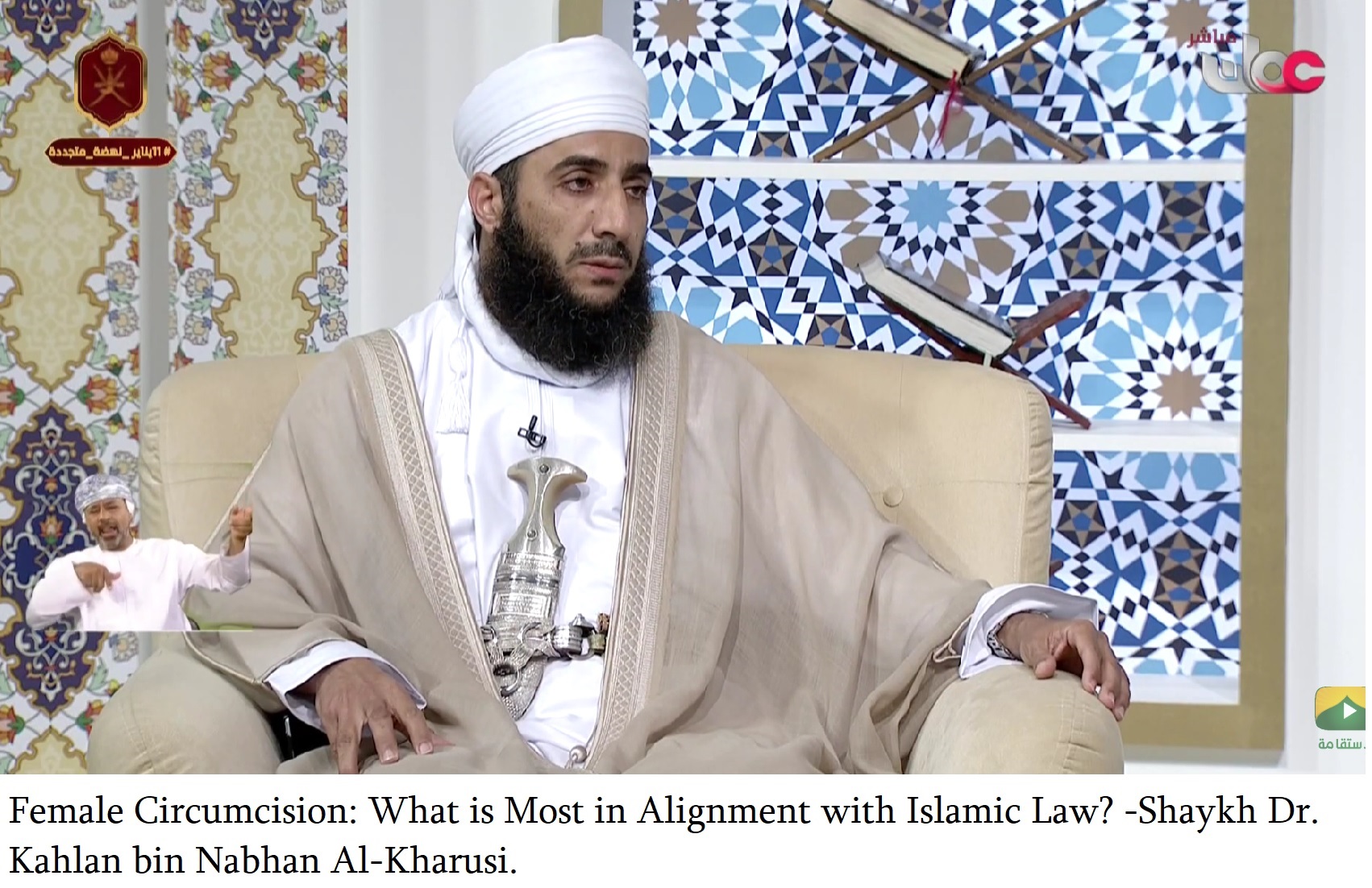
An interview with the honourable Shaykh Dr. Kahlan bin Nabhan Al-Kharusi on a very important topic.
Translation is as follows:
We come to another topic, and this time it relates to the circumcision of girls. Yes. Perhaps among the customs and traditions that people have inherited is that a girl must be circumcised just as a boy is circumcised. You mentioned in a previous fatwa that this means something permissible perhaps an advisory Sunnah was reported regarding it. However, people have greatly expanded in taking this concession that you spoke about, this permissibility, and they have begun committing acts that may not be good, that are harmful to the girl. So now, has your fatwa changed on this topic?
“No, the fatwa has not changed, and the fatwa, considering what exists in our jurisprudential heritage, was contrary to much of what the scholars of religion said on this matter.” -Shaykh Dr. Kahlan bin Nabhan Al-Kharusi
Yes.
“Rather, I said in it that my wish was that Muslim doctors would speak about this matter.” -Shaykh Dr. Kahlan bin Nabhan Al-Kharusi
Yes.
“What I mentioned in that answer was shocking to many jurists and students of Islamic legal knowledge because it was contrary to what they are accustomed to.” -Shaykh Dr. Kahlan bin Nabhan Al-Kharusi
Aha.
“Let us clarify the matter once again. The narrations that have come regarding the practice of khafd (female circumcision), which is known as circumcision for females. They are not free of criticism. None of these narrations can be relied upon with confidence. All the narrations that have come are not free of weakness, not free of defect.” -Shaykh Dr. Kahlan bin Nabhan Al-Kharusi
Yes.
“And what can be accepted with great leniency from these narrations does not, in reality, indicate what many jurists have concluded. Some narrations, for example, such as the narration that circumcision is an honor for the woman. It contains no legal ruling, so it cannot be used even to establish recommendation (istihbab), because this description “an honor for the woman” does not indicate a legal ruling.” Shaykh Dr. Kahlan bin Nabhan Al-Kharusi
Yes.
“And the Messenger of Allah’s instruction (peace and blessings be upon him and his family) in another narration which is one of the most relied-upon narrations by those who hold the view of recommendation and those who hold the view of obligation regarding circumcision for females is that he said to Umm Atiyya: “Trim but do not exhaust” or “reduce but do not exhaust”. This indicates the opposite of what was intended, it indicates the opposite of what many jurists have said, even assuming acceptance of this narration with great leniency.” -Shaykh Dr. Kahlan bin Nabhan Al-Kharusi
Yes.
“Moreover, I am more convinced by the view of those jurists and scholars, both early and late, who held that all these narrations are not free of criticism. Nevertheless The Messenger of Allah (peace and blessings be upon him) it is not established that he instructed anyone to do it, or commanded it for his daughters or his wives (peace be upon him) or the believing women. It is only according to the narration that when he migrated to Medina, a woman who performed circumcision said to be Umm Atiyya al-Ansariyya asked him, and he said to her: “Trim but do not exhaust.” Now this indicates that the intent was to lighten a practice that already existed.” -Shaykh Dr. Kahlan bin Nabhan Al-Kharusi
Yes.
“And therefore the guidance was for “ishmam” (light touching), for minimal taking without exaggeration. It is also apparent from this report, assuming its acceptance once again that the woman was qualified and capable of doing it properly, otherwise the Messenger of Allah (peace be upon him) would never have permitted her!” -Shaykh Dr. Kahlan bin Nabhan Al-Kharusi
Yes.
“So now let us summarize what we have said so far.” -Shaykh Dr. Kahlan bin Nabhan Al-Kharusi
Aha.
“None of the narrations that have come regarding female circumcision, regarding the circumcision of girls, is free of criticism that weakens it. Right?” -Shaykh Dr. Kahlan bin Nabhan Al-Kharusi
“And accordingly, the utmost that can be said is that it is among the permissible matters. Among the permissible matters in Islamic law. Now we say it is permissible, that it is within legal permissibility, if it is done by someone who is qualified and knowledgeable, aware of the correct method, taking the necessary precautions, and not exaggerating in it.” -Shaykh Dr. Kahlan bin Nabhan Al-Kharusi
Yes.
“So if we say it is permissible, and it is established that it is in fact practiced by people; meaning when we say it is permissible, the first conclusion we arrive at is that leaving it involves no sin in Islamic law and no wrongdoing.” -Shaykh Dr. Kahlan bin Nabhan Al-Kharusi
Yes.
“And this is an important conclusion. We respect the views of our imams and scholars from the various Islamic schools of thought. Perhaps some early Shafi’i scholars are among those who held it obligatory, and some Hanbali scholars, but others among the scholars of the Islamic schools for example, the Ibadi, Hanafi, and Maliki did not go that far. Some of them spoke of permissibility, and some said it is recommended, and they did not mention the derived legal evidence. These jurisprudential views are respected and are part of our Islamic heritage, but they should be understood, in terms of legal ruling, in light of the evidence that reached them.” -Shaykh Dr. Kahlan bin Nabhan Al-Kharusi
Yes.
“And in terms of actual practice, they never intended that it be done by women who lack qualification, knowledge, sufficiency, and capability, and who do not take the necessary precautions to avoid harming the girls.” -Shaykh Dr. Kahlan bin Nabhan Al-Kharusi
Beautiful.
“So since the matter is such that it is no more than permissible, and there is no sin in leaving it and no wrongdoing upon one who leaves it, then we can take the matter further than this.” -Shaykh Dr. Kahlan bin Nabhan Al-Kharusi
Yes.
“Because what has happened in people’s actual practice is poor application, even in this act. On one hand, as you noted, they imagine legal rulings that have been shown to have no validity or to be exaggerated. But in practice, there are many incidents in which young girls have suffered great harm from bleeding or tearing, yes? Or exaggeration in exhausting to the point of affecting the urinary tract and the genital area.” -Shaykh Dr. Kahlan bin Nabhan Al-Kharusi
Yes.
“Not to mention the injury and impact on the ability to conceive and bear children and on legitimate enjoyment in marriage And these are cases I have personally seen, seen from reality. Therefore, since the matter reaches this level of harm and damage, and lack of knowledge of correct application and correct execution even in the permissible amount; especially since it is not studied in medicine at all. There are no women practicing surgery for women who know how to do it, because contemporary medical sciences do not teach it. There are no specifications, no method, no standards, no procedure for doing it which is unlike the obligatory circumcision for males.” -Shaykh Dr. Kahlan bin Nabhan Al-Kharusi
Yes.
“This is not studied at all; it is not in the curricula. And what some Muslim doctors have mentioned of benefits and advantages of it unfortunately, in following up, I did not find that they rely on scientific evidence. They were advocating for jurisprudential views, and they should have stopped at the limit of permissibility.” -Shaykh Dr. Kahlan bin Nabhan Al-Kharusi
Yes.
“Because establishing health benefits should be based on sound medical evidence.But we do not find this. We find descriptions and praise and mentions, but without relying on sound scientific evidence that could be relied upon. And even if that were established, it would be conditional on correct execution but if it cannot be executed in a correct manner, because there is no one who can do it at all, since it is not studied and does not exist in medical curricula, then leaving it in this case is preferable either it is viewed as restricting the permissible due to the harms resulting from doing it, or it is viewed through the principle of blocking the means that lead to harm, damage, and corruption for the girls for whom it is done. And Allah Almighty knows best. And forgive me for the length.” -Shaykh Dr. Kahlan bin Nabhan Al-Kharusi
Okay, but the question relates to this topic. Since you mentioned that you have seen cases through perhaps your contact with doctors and your participation in biology conferences
Yes.
Is it permissible because no text prohibiting it has come, for example, or forbidding it? Or because the evidence found leads to the conclusion that it is permissible? Why is it not forbidden if it leads to such harms? The matter is very open.
“The view of prohibiting it is based only on what was mentioned previously.” -Shaykh Dr. Kahlan bin Nabhan Al-Kharusi
Yes.
There is no text from which prohibition can be taken from a prohibition by the Messenger of Allah (peace and blessings be upon him and his family). Rather, it is based on what was mentioned previously. And therefore a group and this can increase people’s confidence; a group of fatwa bodies and fatwa institutions in our Islamic countries today are also saying to prohibit this act.” -Shaykh Dr. Kahlan bin Nabhan Al-Kharusi
Yes.
“And they say so also because of what they have learned and reached regarding the weakness of the evidence that has come on this matter, and because of what has been established for them of poor practice leading to great harm and extreme harm.” -Shaykh Dr. Kahlan bin Nabhan Al-Kharusi
“It has reached the point with some circumcisers that they perform it behind hospitals and health centers because they know the result so that it may be closer to rescue and first aid, they do it near hospitals. And there is no limit to what could be said about the instruments used they are far removed from the health requirements required in this matter, let alone complete ignorance of it. The cases that the Omani female doctors told us about are not minor cases that can be overlooked.” -Shaykh Dr. Kahlan bin Nabhan Al-Kharusi
Yes.
“But what remains is that the foundation we rely on is: is this matter obligatory in the religion of Allah, Blessed and Exalted? Is it recommended and called for? The matter is not so.”-Shaykh Dr. Kahlan bin Nabhan Al-Kharusi
Yes.
“Is it permissible? Yes, we cannot say it is not permissible. But permissibility is restricted by what was mentioned previously of light touching, minimal taking and that it be done by someone with complete knowledge and understanding. But even so, can this permissibility be restricted due to the magnitude of harms that result from its application and practice? Yes, it can be restricted, as is the case with a number of permissible matters. Therefore, the view that is most convincing and most suited to people’s conditions today is to leave this act. And Allah Almighty knows best.” -Shaykh Dr. Kahlan bin Nabhan Al-Kharusi
Let us now move the ruling from the act to the actor. By this we are meaning the one who performs this task but does not possess this expertise. Is she committing something forbidden?
“Yes, she is committing a forbidden act, since she is ignorant. And whoever practices medicine without medical knowledge is liable. Yes.” -Shaykh Dr. Kahlan bin Nabhan Al-Kharusi
This is narrated as a report, but it has become a legal maxim. There is no doubt that such an act originally requires knowledge, understanding, and science, and that one should adhere to that. That is why, as mentioned, these reports. Yes, there are narrations about naming the place “al-khatanun” (the two circumcisers). These are sound hadiths, but we know that in such dual-form names, the description may often be used by predominance.” -Shaykh Dr. Kahlan bin Nabhan Al-Kharusi
Yes.
“For example It is said “the two black ones” for dates and water by predominance. It is said, for example, “the two moons” for the sun and the moon, by predominance. So this does not mean that the description applies to both described things together?” -Shaykh Dr. Kahlan bin Nabhan Al-Kharusi
Yes.
“Therefore we said that the view in principle is permissibility restricted by its conditions. But this permissible act should now be left because of the transgression that has occurred in it, the severe harms that have afflicted girls, the lack of a sound scientific method, and the lack of qualified people to perform it. And Allah Almighty is the one whose help is sought.” -Shaykh Dr. Kahlan bin Nabhan Al-Kharusi
Yes, may Allah reward you with good. Thank you. Yeah.
Prima Qur’an comments:
People come in different shapes, colours and sizes. Some people have features distinct from others. This is part of our diversity. It is plausible that some women have larger labia than other women. So perhaps in the view of some cultures they felt having a larger labia would not be appealing to a prospective partner. It could also be due to what they perceive as hygene related. Perhaps in places where water was scarce and sand is plentiful this practice came about.
After all, in the event of no availability of water or the preference to preserve the water for drinking we as Muslims perform tayammum.
Also, as the Shaykh mentinoned we also know of couples whose intimacy has been ruined through this practice. Some layman whom we spoke with from the Shafi’i school had insisted that the practice is to keep the excitability of women in check! Very unfortunate!
However, we do not know any reason that has any merit for the excising of a woman’s clitoris!
There is a principle in Shari’a law
لا ضرر ولا ضرار
“Lā ḍarar wa lā ḍirār” = No harm and no reciprocating harm.
Abu Sa‘īd al-Khudri reported: The Messenger of Allah (saw) said: “There should be no harm or reciprocal harm. Whoever causes harm, Allah harms him, and whoever makes things difficult, Allah makes things difficult for him.
We also have in Islamic law we also have what is known as: ‘Preventing harm takes precedence over attaining benefit.’ This is also known as: darʾ al-mafāsid muqaddam ʿalā jalb al-maṣāliḥ.
Thus, as the Shaykh said we have no proof text that explicitly forbids the practice. We also have no proof text that estabilshes that this was done by the Blessed Prophet (saw). It is not established that he instructed anyone to do it, or commanded it for his daughters or his wives (peace be upon him) or the believing women.
Examination of the ‘go to’ hadith itself.
As the Shaykh mentioned the hadith is weak. In fact, Imam Abu Dawud (the one who transmits this hadith) himself said it was weak!
Narrated Umm Atiyyah al-Ansariyyah:
A woman used to perform circumcision in Medina. The Prophet (ﷺ) said to her: Do not cut severely as that is better for a woman and more desirable for a husband.
Abu Dawud said: It has been transmitted by ‘Ubaid Allah b. ‘Amr from ‘Abd al-Malik to the same effect through a different chain.
Abu Dawud said: It is not a strong tradition. It has been transmitted in mursal form (missing the link of the Companions)
Abu Dawud said: Muhammed b. Hasan is obscure, and this tradition is weak.
However, when you click on the link above you will find that al-Albānī (Shu’ayb al-Arna’ut) gave the hadith a grade of Sahih (meaning sound)!
So from our perspective (speaking of the Prima Qur’an team) if an adult woman of sound mine wants to have this procedure than proceed. However, as it is very clear that infants, tolddlers and small children are not capable of giving thier consent it is best to abandon this practic altogether. Allah knows best and his help is sought. May Allah (swt) assist Shaykh Dr. Kahlan bin Nabhan Al-Kharusi in bringing light to the people!
For the interested Omani law states as follows:
Child Law (Article 20): Explicitly prohibits any person (especially doctors, nurses, and guardians) from engaging in, promoting, or assisting in “harmful traditional practices to the child’s health”.
Executive Regulations of the Child Law (Ministerial Decision No. 125/2019, Article 4): This is the crucial defining clause, which explicitly lists “female genital mutilation of any kind” as a “harmful traditional practice to the child’s health”.
Penalties (Child Law, Article 67): Violators face imprisonment of no less than 6 months and no more than 3 years
If you have found this entry informative you may enjoy the following articles:
“And if two parties from the believers should fight, then you [O men] should reconcile between them. Then if one of them transgresses against the other, then fight against the one that transgresses until it returns to the command of Allah. And if it returns, then reconcile between them in justice and act justly. Indeed, Allah loves those who act justly.” (Qur’an 49:9)
“And whoever kills a believer intentionally, their reward will be Hell. Therein they will stay indefinitely. Allah will be displeased with them, condemn them, and will prepare for them a tremendous punishment.” (Qur’an 4:93)
﷽
Introduction
Qur’an 49:9 stands as one of the most consequential verses in Islamic jurisprudence, politics, and theology concerning intra-community conflict.
The Ibadi tradition offers a uniquely rigorous and internally consistent reading of Qur’an 49:9, the verse commanding reconciliation. This article demonstrates how the Ibadi tafsir resolves tensions between the verse’s apparent designation of combatants as “believers” and its command to fight the transgressing party. The Ibadi position hinges on the distinction between kufr al-milla (disbelief of the religion) and kufr al-ni’ma (ingratitude of blessing), maintaining that the transgressor remains within the milla of Islam but enters a state of ingratitude subject to divine punishment. This framework is supported by the unique linguistic status of Qur’an 49:9, the Prophetic prohibition warning, and the strict rules of engagement established by the earliest Muslim community.
“And if two parties from the believers should fight, then make peace between them. But if one of them transgresses against the other, then fight against the one that transgresses until it returns to the command of Allah. Then if it returns, make peace between them with justice and be equitable. Indeed, Allah loves those who act equitably.” (Qur’an 49:9)
“min al-mu’minīn”–(مِنَ الْمُؤْمِنِينَ) The literal translation of “min al-mu’minīn” is “From the believers” or “Among the believers.”
This is very important to see how this verse of the Qur’an has been translated into English.
“Hence, if two groups of believers fall to fighting, make peace between them; but then, if one of the two [groups] goes on acting wrongfully towards the other, fight against the one that acts wrongfully until it reverts to God’s commandment; and if they revert, make peace between them with justice, and deal equitably [with them]: for verily, God loves those who act equitably.”-Muhammed Asad
“And if two parties of believers fall to fighting, then make peace between them. And if one party of them doeth wrong to the other, fight ye that which doeth wrong till it return unto the ordinance of Allah; then, if it return, make peace between them justly, and act equitably. Lo! Allah loveth the equitable.” -Marmaduke Pickthall.
This verse has generated extensive commentary across all Islamic schools of thought. However, the Ibadi tradition offers a uniquely rigorous and internally consistent reading that deserves careful attention. Drawing on the Ibadi tafsir Al-Abriz, the Taysir al-Tafsir of Atfayyish, the tafsir of al-Hawwari, the Prophetic tradition, and the broader Qur’anic framework, this article will demonstrate how the Ibadi position resolves apparent tensions in the text while maintaining a coherent theology of faith, sin, and community.
Asbāb al-Nuzūl: Reason or occasion for the revelation.
Ibn Abbas (or his report transmitted in Tanwīr al-Miqbās) (7th century / died 68 AH / 687 CE)
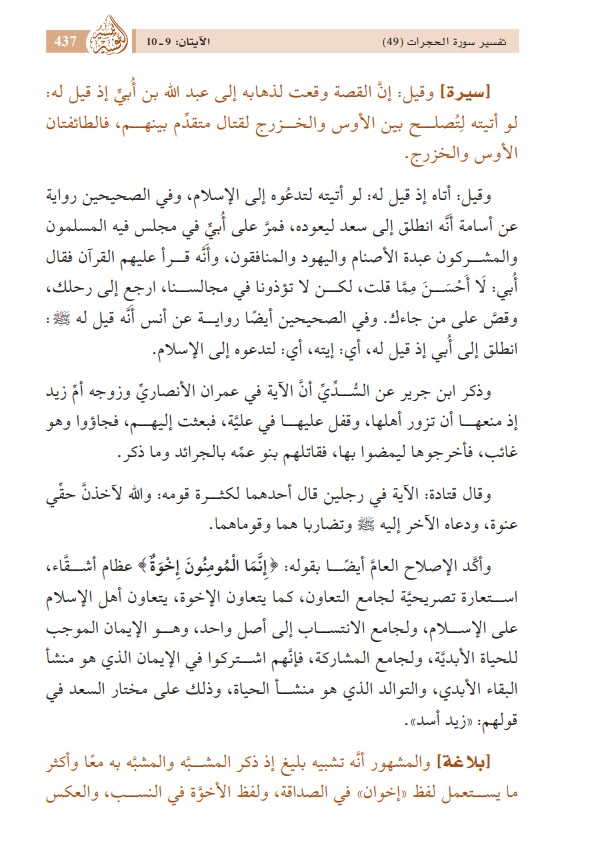
“(And if two parties of believers fall to fighting) this was revealed about the hypocrite ‘Abdullah Ibn Ubayy Ibn Salul and his host and ‘Abdullah Ibn Rawahah, a true believer, and his companions; these two parties fell to fighting after an exchange of words, and so Allah forbade them from fighting each other and commanded them to make up, saying, (And if two parties of believers fall to fighting then make peace between them) by referring to the Book of Allah. (And if one party of them) the party of ‘Abdullah Ibn Ubayy Ibn Salul (doeth wrong to) persists and transgresses against (the other) the party of ‘Abdullah Ibn Rawahah al-Ansari, and refuses to make peace by referring the matter to the Qur’an, (fight you that which does wrong till it return unto the ordinance of Allah) until it accepts to make peace by referring to the ordinances of the Qur’an; (then, if it return) if it accepts to make peace by referring the matter to the Book of Allah, (make peace between them justly, and act equitably) towards both parties. (Lo! Allah loveth the equitable) Allah loves those who judge justly by the Book of Allah, and act upon it.”
Tafsir al-Wahidi (by Abu al-Hasan al-Wahidi) 11th century / died 468 AH / 1075 CE) 400 years after Ibn Abbas.
“(And if two parties of believers fall to fighting, then make peace between them…) [49:9]. Muhammed ibn Ahmad ibn Ja‘far al-Nahwi informed us> Muhammed ibn Ahmad ibn Sinan al-Muqri’> Ahmad ibn ‘Ali al-Mawsili> Ishaq ibn Abi Isra’il> Mu‘tamir ibn Sulayman> his father> Anas who related: “I said: ‘O Prophet of Allah, why do you not visit ‘Abd Allah ibn Ubayy?’ The Prophet, Allah bless him and give him peace, decided to go and visit him. He mounted an ass and the Muslims walked with him. It happened that the ground was full of manure. So when the Prophet, Allah bless him and give him peace, reached ‘Abd Allah ibn Ubayy, the latter said: ‘Keep away from me, the staunch of your ass is offending me’. A man from the Helpers said to him: ‘By Allah, the ass of the Messenger of Allah, Allah bless him and give him peace, smells better than you’. One of the men of ‘Abd Allah ibn Ubayy got angry; then the men of both parties became angry because of what was said. They exchanged blows and hurled leafless palm leaves and sandals at each others. We heard that it is about them that (And if two parties of believers fall to fighting…) was revealed”. This was narrated by Bukhari from Musaddid and by Muslim from Muhammed ibn ‘Abd al-A‘la; both Musaddid and Muhammed ibn ‘Abd al-A‘la related it from al-Mu‘tamir.”
Tafsir Ibn Kathir (by Imad al-Din Ibn Kathir) (14th century / died 774 AH / 1373 CE) 300 years after al-Wahidi and 650 years after Ibn Abbas.
“(And if two parties among the believers fall to fighting, then make peace between them both.) Therefore, Allah calls both opposing groups among Muslims, believers, although they are fighting each other. Al-Bukhari and other scholars relied on this Hadith as evidence that committing a sin does not nullify faith, no matter how major the sin is. This creed contradicts the creed of the Khawarij sect and those who accepted their idea, such as the Mu`tazilah sect.“
” Said bin Jubayr said that the tribes of Aws and Khazraj once got into a scuffle using date tree branches and slippers. Allah revealed this honourable Ayah comanding them to make peace between them. As-Suddi said, A man from Al-Ansar, whose name was Imran, had a wife called Umm Zayd. She wanted to visit her family, but her husband prevented her from visiting them by locking her in an upper room. So, none of her family could visit or see her. She sent someone to her family. They came, took her down from the room and wanted to take her away. Her husband was absent at the time, so his family called on their people. Their cousins came to help prevent the wife from going with her family. A push and shove situation occurred that led to them fighting using slippers. This Ayah was then revealed in their case, and the Messenger of Allah sent someone to bring peace between them, and they both agreed to resort to the decision of Allah the Exalted.'”
Prima Qur’an comments. Ibn Kathir immediately evokes the so called ‘Khawarij’ and Mu’tazilah’ in which he puports to represent their position.
He then pivots to the Aws and Khazraj getting into a scuffle. He also narrates a conflict between among the Ansar themselves.
The prominent Maliki jurist Qadi Abu Bakr ibn al-Arabi (d. 1148 CE) from his landmark legal exegesis, Ahkam al-Qur’an remarked the following:
“The first: It was narrated by Saʿīd ibn Jubayr from Ibn ʿAbbās that it concerned Aws and Khazraj. A man from them insulted another, so each group supported its clansman until fighting erupted between them. Then the Messenger of Allah (saw) came and reconciled them, and Allah revealed the verse commanding justice and fairness.”
“The second: It was narrated that the verse was revealed concerning a dispute between two groups of the Anṣār. They took the case to the Prophet (saw), who judged between them. But one side refused the judgment and became angry, which led to fighting. Then Allah revealed the verse: “And if two groups of the believers fight each other, then reconcile between them.”
“The third: Al-Suddī narrated that a man from the Anṣār was married to a woman, and they had a disagreement. The woman wanted to go to her family, but her husband refused. She gathered her people, and he gathered his people, and they fought one another. Then the Prophet (saw) reconciled them, and the verse was revealed concerning them.”
“The fourth:It was said that the verse was revealed about ʿAbdullāh ibn Ubayy ibn Salūl (the hypocrite leader) who quarreled with a Muslim. Each of them brought his group to support him until fighting almost broke out. Then the Prophet (saw) reconciled them, and the verse was revealed.”
“Al-ʿArabī said: The most authentic of the narrations is the last one. “The correct opinion is that the verse is general, and it is not restricted to a particular cause of revelation. The Qur’anic verse remains general in meaning, even if it was revealed about a specific event. What is narrated about Aws, Khazraj, Ibn Ubayy, or the story of the husband and wife all of it fits the meaning, but the ruling of the verse applies universally to every case.”
The fourth case involves the hypocrite ʿAbdullāh ibn Ubayy ibn Salūl.
The second case involves one who refuses the very judgement of the Prophet (saw). Which makes you wonder how will you reconcile between those who won’t even accept the authority of the Prophet (saw). It is likely that ibn al-Arabi so the futility of that case from a matn perspective.
Ibn al-Arabi likely saw that the first case and the third case cancel each other out.
Why? Because if the verse was revealed for the first case it would be redundant to be revealed concerning the third case and if it was revealed concerning the third case it would be redunant concerning the first case.
The Ibadi scholars weigh in.
The eminent scholar Al-Qutb al-A’imma (r) said:
(“And if two groups from the believers fight”) – They are called believers based on their apparent state known to us before the fighting. Or it means: ‘And if two groups from the believers’ – like calling a prepubescent child a ‘disobedient sinner’ (‘āṣin) based on his state before reaching puberty, even though their fathers have died.”
The eminent scholar Shaykh Al-Khalīlī (h) said:
“As for His saying, the Exalted, (“And if two groups from the believers fight”), it is possible to understand it based on considering the faith (īmān) of the two groups before the fighting. Just as one says: ‘The disbeliever believed,’ ‘The people repented,’ ‘The misguided one was guided,’ ‘The Muslim apostatized,’ and ‘The pious person sinned’ – this is said with regard to what they were upon, even though after his belief he is no longer a disbeliever. Similarly, after his repentance he is no longer a sinner, after his guidance he is no longer misguided, and whoever apostatizes from his Islam is no longer a Muslim. Likewise, the trader, after he has sinned, is not pious.”
“Similarly, the faith of the two groups: it is correct to consider it with regard to what they were upon before the fighting. However, the faith that prevents its ascription [being removed] from a person and a sinner is the faith upon which success and salvation in the Hereafter are contingent. This is just as Islam is used in contrast to disbelief (kufr), for conventionally, every monotheist is called a Muslim, even if he falls short in fulfilling the obligations of Islam, even though…”
Question: Does this observation by the respected scholars find evidence in the Qur’an?
Answer: Yes! by using Tafsīr al-Qur’ān bi’l-Qur’ān which is the method of explaining or interpreting the meanings of one verse of the Quran by using another verse from within the Quran itself.
(49:9)fa-in baghat iḥdāhumā ‘alā al-ukhrā — “if one of them oppresses the other”
Is there any verse outside of Qur’an 49:9 that suggest that this is the conduct of the righteous and those who fear Allah? Is there anywhere in the Qur’an where Allah uses this descriptor to describe the righteous and those who fear Allah?
The root b-gh-y is not used for ordinary sinning. It is used for transgression, oppression, rebellion — a specific and severe category. This specific category is never applied to believers or to the righteous anywhere in the Qur’an.
Form I verb baghā (بَغَىٰ) — 25 times
Every single Qur’anic usage of Form I in the active sense is negative. It means to transgress, oppress, rebel, or wrong someone.
Examples:
(2:213)baghyan baynahum — “out of jealousy among themselves”
(3:19)baghyan baynahum — “out of envy among themselves”
(7:33)wal-baghya bighayri al-haqq — “and oppression without right” (forbidden)
(10:23)yabghūna fi’l-ard bighayri al-haqq — “they rebel in the earth without right”
(28:76)fa-baghā ‘alayhim — “but he oppressed them” (Qarun)
(38:22)baghā ba’ḍunā ‘alā ba’ḍ — “one of us has wronged the other”
(42:27)la-baghaw fi’l-ard — “they would surely rebel in the earth”
(49:9)fa-in baghat iḥdāhumā ‘alā al-ukhrā — “if one of them oppresses the other”
(55:20)lā yabghiyāni — “they do not transgress” (the two seas)
Conclusion: Form I verb baghā is never used in the Qur’an to describe the righteous positively. It is always transgression, oppression, or rebellion. The only “neutral” usage is in the sense of “seeking” in a few places, but even then the context is not describing the righteous as such. Example: (3:83) afaghayra dīn Allāh yabghūna — “Do they seek other than the religion of Allah?” — which is a rebuke.
Noun baghy (بَغْي) — 11 times
Every single usage is negative. It means transgression, oppression, envy, or rebellion.
(2:90)baghyan — “grudging”
(2:213)baghyan baynahum — “out of jealousy among themselves”
(3:19)baghyan baynahum — “out of envy among themselves”
(6:146)bibaghyihim — “for their rebellion”
(7:33)wal-baghya — “and oppression” (forbidden)
(10:23)baghyukum — “your rebellion”
(10:90)baghyan wa ‘adwan — “in tyranny and enmity” (Pharaoh)
(16:90)wal-baghyi — “and oppression” (forbidden)
(42:14)baghyan baynahum — “out of rivalry”
(42:39)al-baghyu — “tyranny”
(45:17)baghyan baynahum — “out of envy”
Conclusion: The noun baghy is never used positively. It is always a blameworthy quality.
Noun baghiyy (بَغِيّ) — 2 times
Both usages refer to an unchaste woman — a negative term:
(19:20)wa mā kuntu baghiyyan — “I have not been unchaste” (Maryam’s defense)
(19:28)wa mā kānat ummuki baghiyyan — “nor was your mother unchaste”
Conclusion: Always negative.
Verbal noun bighā’ (بِغَاء) — 1 time
(24:33)wa lā tukrihū fatayātikum ‘alā al-bighā’ — “do not compel your slave girls to prostitution”
Conclusion: Always negative.
Active participle bāgh (بَاغ) — 3 times
All three occur in the same phrase:
(2:173)ghayra bāghin wa lā ‘ādin — “neither desiring [it] nor transgressing”
(6:145) same
(16:115) same
Conclusion: The participle bāgh here means “one who desires” or “one who transgresses” — in the context of eating forbidden food under necessity. It is not describing the righteous; it is describing the limits of a concession for the one in need. The righteous person is the one who does not desire the forbidden thing.
Perhaps the most striking feature of the Sunni understanding of Qur’an 49:9 is that this is the only verse in the entire Qur’an where they can claim the apparent believers are described as bāghī (transgressors)!
The Sunni reading must work harder to explain why the Qur’an uses a term for believers in 49:9 that it never uses for believers anywhere else.
If the question is which reading is on firmer textual footing, the Ibadi reading has the stronger case. This is not because it is the majority position, but because it is the reading that accounts for the most textual data with the no unresolved tensions.
Where as we have seen using Tafsīr al-Qur’ān bi’l-Qur’ān the Sunni understanding doesn’t hold under scrutiny.
This misunderstanding not only clashes with the Qur’an but clashes with sound tranmission from the Blessed Prophet (saw).
As we have seen it clashes with the Qur’an. Such a descrption is never applied to believers or to the righteous anywhere in the Qur’an.
It also clashes with the following:
“And whoever kills a believer intentionally, their reward will be Hell. Therein they will stay indefinitely. Allah will be displeased with them, condemn them, and will prepare for them a tremendous punishment.” (Qur’an 4:93)
The (eternal punishment for intentional killing of a believer) creates a tension that the Sunni framework struggles to resolve without collapsing into Murji’ism.
This verse presents a serious problem for the Sunni reading:
If the bāghī remains a believer, and they intentionally kill another believer, then Qur’an 4:93 applies to them: eternal Hell.
But Sunni theology generally holds that a Muslim who commits a major sin does not face eternal Hell they face punishment, then eventually enter Paradise.
So either Qur’an 4:93 applies to the bāghī (and they face eternal punishment), or Qur’an 4:93 does not apply to the bāghī (which shouldn’t require an strenuous explanation).
Narrated Ibn `Umar:
I heard the Prophet (saw) saying, “Do not revert to disbelief (kuffaran) after me by striking (cutting) the necks of one another.”
The Ibadi reading is that this confirms that intra-Muslim fighting is a form of kufr. In particular kufr al-ni’ma, the kufr that does not expel one from the milla.
The Ibadi reading has the advantage of taking the word kufr seriously while still maintaining that the fighters remain within the community. The Sunni reading must explain why the Prophet (saw) used the word kufr if he did not mean kufr in some sense. Look at the verse:
“Then if one of them transgresses against the other, then fight against the one that transgresses until it returns to the command of Allah.”
The verse does not describe the two parties who did ijtihād and erred. Or had a “difference of opinion” — it uses the language of transgression.
It cannot be imagined that Allah (swt) is asking believers to fight against those who are in conformity with Allah and his Messenger.
This is proven by the fact that one faction has to return to the command of Allah. If they were upon the command of Allah they would not be fought.
The Verse of the Qur’an Does Not Call Both Parties Believers While They Fight.
Let us look at the actual Arabic:
وَإِن طَائِفَتَانِ مِنَ الْمُؤْمِنِينَ اقْتَتَلُوا Wa-in ṭā’ifatāni min al-mu’minīna iqtatalū
The structure is:
طَائِفَتَانِ (ṭā’ifatāni) — two factions
مِنَ الْمُؤْمِنِينَ (min al-mu’minīna) — from among the believers
اقْتَتَلُوا (iqtatalū) — they fought
The description “from among the believers” qualifies the subject before the action. The verse does not say “two factions of believers fought.” It says “if two factions from among the believers fight.”
Grammatically and logically, the min al-mu’minīn is identifying who these factions are drawn from — the believing community. It is describing their origin, their prior status, their membership in the community.
It is not saying they are believers in the state of fighting.
So when the Qur’an says “two factions from among the believers fought,” it is saying:
They were believers before the fighting.
The one who commits (baghy) transgression is to be fought.
The description “believer” applies to what they were, not to what they are doing.
The verse continues:
فَإِن بَغَتْ إِحْدَاهُمَا عَلَى الْأُخْرَىٰ فَقَاتِلُوا الَّتِي تَبْغِي Fa-in baghat iḥdāhumā ‘alā al-ukhrā fa-qātilū allatī tabghī “But if one of them transgresses against the other, then fight against the one that transgresses.”
So the Qur’an:
Identifies them as from among the believers (prior state).
Describes one of them as transgressing (baghat).
Commands fighting the transgressing one — not both.
If both parties remained believers in the state of fighting, the verse would not single out one as the transgressor. The verse makes a moral distinction: one party is in the wrong. The other is the wronged party. The wronged party is not fought. The transgressing party is fought until it returns to Allah’s command.
This is why the Sunni framing of “two groups of believers who had a misunderstanding” is problematic. The verse does not describe a mutual misunderstanding. It describes one party transgressing against the other.
What they were: believers.
What one of them did: transgressed.
What the community must do: fight the transgressor until it returns.
The one who fights unjustly is the bāghī. The one who is fought against is the wronged believer.
So the question becomes: what is the status of the believer who transgresses?
This is where the Ibadi framework comes in:
They remain within the milla(the religion). They are not kuffār in the sense of kufr al-milla.
But they have entered kufr al-ni’ma. That is the ingratitude of blessing by transgressing against their fellow believers.
They are subject to fighting until they return, and to divine punishment if they do not.
This is a coherent, textually grounded framework. And it does not require reading the verse as describing a “big misunderstanding” between two parties who remain believers while fighting.
The Argument from A Fortiori Reasoning (Qiyās al-Awlawī)
“O you who have believed, let not a people ridicule other people; perhaps they may be better than them; nor let women ridicule other women; perhaps they may be better than them. And do not insult one another and do not call each other by offensive nicknames. Wretched (bi’sa) is the name of disobedience (l-fusūqu) after [one’s] faith. And whoever does not repent – then it is those who are the (l-ẓālimūna) wrongdoers.” (Qu’ran 49:11)
If ridicule — a word, a gesture, a nickname — is enough to earn the label fāsiq and ẓālim, then what about killing?
The Qur’anic reasoning is:
Premise 1: Ridicule and insult are prohibited, and those who persist in them are called fāsiq and ẓālim (Qur’an 49:11).
Premise 2: Killing a believer intentionally is a far graver offense . It is the destruction of a life, the breaking of the community, the ultimate transgression against a fellow Muslim.
Conclusion: Therefore, the one who kills a believer is at least a fāsiq and a ẓālim and in fact, far worse.
Notice the sequence. The verse does not say:
“Ridiculing is a minor sin.”
“Insulting is a peccadillo.”
“Nicknames are a trivial matter.”
It says:
The one who does these things has been labeled with disobedience (fusūq).
The one who does not repent is among the wrongdoers (ẓālimūn).
These are Qur’anic categories of serious moral failure. They are not casual descriptors. They are the same categories used elsewhere in the Qur’an for grave offenses.
Now place this next to Qur’an 4:93:
“And whoever kills a believer intentionally, their reward will be Hell. Therein they will stay indefinitely. Allah will be displeased with them, condemn them, and will prepare for them a tremendous punishment.” (Qur’an 4:93)
If ridicule earns fusūq and ẓulm, then intentional killing which earns eternal Hell and divine curse cannot possibly leave the perpetrator in the same moral category as before.
Dear readers! What planet or universe does this make sense? Taking the life of a believer is a lesser offense than ridicule?!
This is precisely the point. The Sunni framework that says:
Ridicule → fāsiq, ẓālim
Intentional killing of other Muslims → are the actions of a Mu’min?
This creates a moral inversion. The lesser offense (ridicule) earns the label fāsiq and ẓālim. The greater offense (killing) supposedly leaves one a Mu’min in good standing. It is a matter of ijtihad?!
This is incoherent. And it is precisely why the Ibadi framework of kufr al-ni’ma is more consistent:
Ridicule → kufr al-ni’ma (ingratitude)
Intentional killing → kufr al-ni’ma (ingratitude), and far more severe
Both are within the milla outwardly, but both have entered kufr al-ni’ma. The difference is in the degree of the offense and the severity of the punishment.
The Qur’an does not say that the one who ridicules is a Mu’min in good standing. It says he is a fāsiq and a ẓālim unless he repents. How much more, then, the one who kills?
The Two Types of Kufr: Kufr al-Milla and Kufr al-Ni’ma
The Ibadi position hinges on a critical distinction between two categories of kufr (disbelief/ingratitude):
1. Kufr al-Milla (Disbelief of the Religion): This is outright rejection of Islam, placing one outside the community of believers entirely. This is the kufr of the polytheists and those who deny God’s existence or reject the Prophethood of Muhammed(saw).
2. Kufr al-Ni’ma (Disbelief/Ingratitude of Blessing): This applies to a Muslim who commits a major sin (kabīra) but still affirms the oneness of Allah (tawḥīd) and belongs to the milla of Islam. Such a person is a kāfir in the sense of being ungrateful for Allah’s blessings, but not a kāfir in the sense of being outside the faith.
This distinction is rooted in the Qur’an itself. In Surah Ibrahim (14:7), Allah declares:
“And [remember] when your Lord proclaimed, ‘If you are grateful (shakartum), I will surely increase you [in favor]; but if you are ungrateful (kafartum), indeed, My punishment is severe.'” (Qur’an 14:7)
The verse establishes a direct correlation between gratitude (shukr) and increase in favor, and between ingratitude (kufr) and severe punishment. The one who fights and kills fellow believers is acting in kufr al-ni’ma. They are ungrateful for the blessings of faith, brotherhood, and life itself.
Crucially, the Qur’an does not promise paradise to the ungrateful (kafartum) as a standalone category. Paradise is promised to the believers, the righteous, the Allah-conscious, the patient, and the repentant. In no place is it ever promised to the ungrateful (kafir) as a category. Therefore, the bāghī cannot claim the promise of paradise while persisting in their transgression.
The Qur’an explicitly warns:
“And whoever kills a believer intentionally, their reward will be Hell. Therein they will stay indefinitely. Allah will be displeased with them, condemn them, and will prepare for them a tremendous punishment.” (Qur’an 4:93)
This verse presents a serious theological problem: How can a believer who commits such a sin face eternal punishment? The Ibadi answer is that the intentional killer has entered a state of kufr al-ni’ma—a state of ingratitude so profound that they are subject to the severe punishment promised in Qur’an 14:7.
Qur’an 2:112 and The Two Conditions
“Yes [on the contrary], whoever submits his face (wholeself/being) in Islam to Allah while being a doer of good will have his reward with his Lord. And no fear will there be concerning them, nor will they grieve.”
The verse establishes two conditions:
أَسْلَمَ وَجْهَهُ لِلَّهِ (aslama wajhahu li’llāh) — submission of the face to Allah. This is the inward orientation: sincerity, devotion, turning toward Allah.
وَهُوَ مُحْسِنٌ (wa-huwa muḥsin) — being a doer of good. This is the outward manifestation: actions of obedience, iḥsān in practice.
The reward is contingent on both. Neither alone is sufficient. This is a key Qur’anic principle: faith and works are inseparable in the Qur’anic vision of salvation.
How This Fits the Ibadi Understanding
The Ibadi framework of kufr al-ni’ma (ingratitude of blessing) and kufr al-milla (disbelief of religion) maps directly onto this verse:
The person who claims belief but has no outward actions of obedience has entered kufr al-ni’ma. They have not left the milla — they are still outwardly Muslim, still part of the community — but they are not fulfilling the condition of iḥsān that Qur’an 2:112 requires for reward and security.
This is precisely why the Ibadi tradition takes outward conformity seriously. It is not enough to say “I believe”. The Qur’an demands that belief be accompanied by iḥsān (doing good).
By not, at the very least, calling out the lack of outward conformity, it becomes very easy for hypocrites to move about undetected, although the inward hypocrisy can only be dealt with by Allah.
The Ibadi framework does not pretend to judge the inward. It judges the outward, because that is what the community has access to, and it leaves the inward to Allah. But precisely because it takes the outward seriously, it does not allow outward conformity to be ignored.
Every Mumin is a Muslim but not every Muslim is a Mumin.
“The bedouins say, ‘We have believed.’ Say, ‘You have not believed; but say [instead], “We have submitted,” for faith has not yet entered your hearts.'” (Qur’an 49:14)
This verse is directly adjacent to Qur’an 49:9–12. It is part of the same surah, the same discourse, and the same thematic unit. And it establishes the exact distinction this article is builds on:
Term
Meaning
What it describes
Islam (أَسْلَمْنَا)
Submission, outward entry into the community
The dhāhir — what is visible, legal, social
Īmān (آمَنَّا)
Faith, inward conviction
The inward (bāṭin) —what is in the heart or the ḥaqīqa (reality) — is only accessible to Allah
The bedouins claimed īmān (inward faith). Allah corrected them: You have not believed; say instead that you have submitted. The outward profession of Islam is real, but the inward faith has not yet entered their hearts.
The bedouins in 49:14 are Muslims (aslamnā). That is they have entered the milla. But they are not yet believers (mā āmannā). Meaning īmān has not entered their hearts. Their status is:
Outwardly: Muslim part of the community, subject to its laws and protections.
Inwardly: Not yet a mu’min faith has not entered the heart.
Their reality: Their reality is known to Allah alone.
The Prophetic Warning
The Ibadi reading of Qur’an 49:9 is strongly supported by the Prophetic tradition.
“Do not revert after me as disbelievers, striking the necks of one another.”
The Arabic word used is kuffāran (كُفَّارًا). While some translations render this as “disbelievers,” the Ibadi understanding as reflected in our translation as “ungrateful ones” actually captures the essence of the warning. The Blessed Prophet (saw) was not saying that those who fight each other become actual disbelievers outside the fold of Islam. Rather, he was warning that fighting fellow Muslims is an act of extreme ingratitude (kufr al-ni’ma) that mimics the behavior of disbelievers.
Narrated Ibn `Abbas:
The Prophet (saw) said, “When (a person) an adulterer commits illegal sexual intercourse, then he is not a believer at the time he is doing it; and when somebody steals, then he is not a believer at the time he is stealing .”
The Prophet (saw) said, “An adulterer, at the time he is committing illegal sexual intercourse is not a believer; and a person, at the time of drinking an alcoholic drink is not a believer; and a thief, at the time of stealing, is not a believer.” Ibn Shihab said: `Abdul Malik bin Abi Bakr bin `Abdur-Rahman bin Al- Harith bin Hisham told me that Abu Bakr used to narrate that narration to him on the authority of Abu Huraira. He used to add that Abu Bakr used to mention, besides the above cases, “And he who robs (takes illegally something by force) while the people are looking at him, is not a believer at the time he is robbing (taking).
So when a person who is part of the milla of Islam is not described a believer at the moment they commit illegal sexual intercourse, steals, drinks, or robs then what is his status when he oppresses a fellow Muslim? Especially when this oppression leads to intentional killing?
The Ibadi commentary in Al-Abriz reinforces this point:
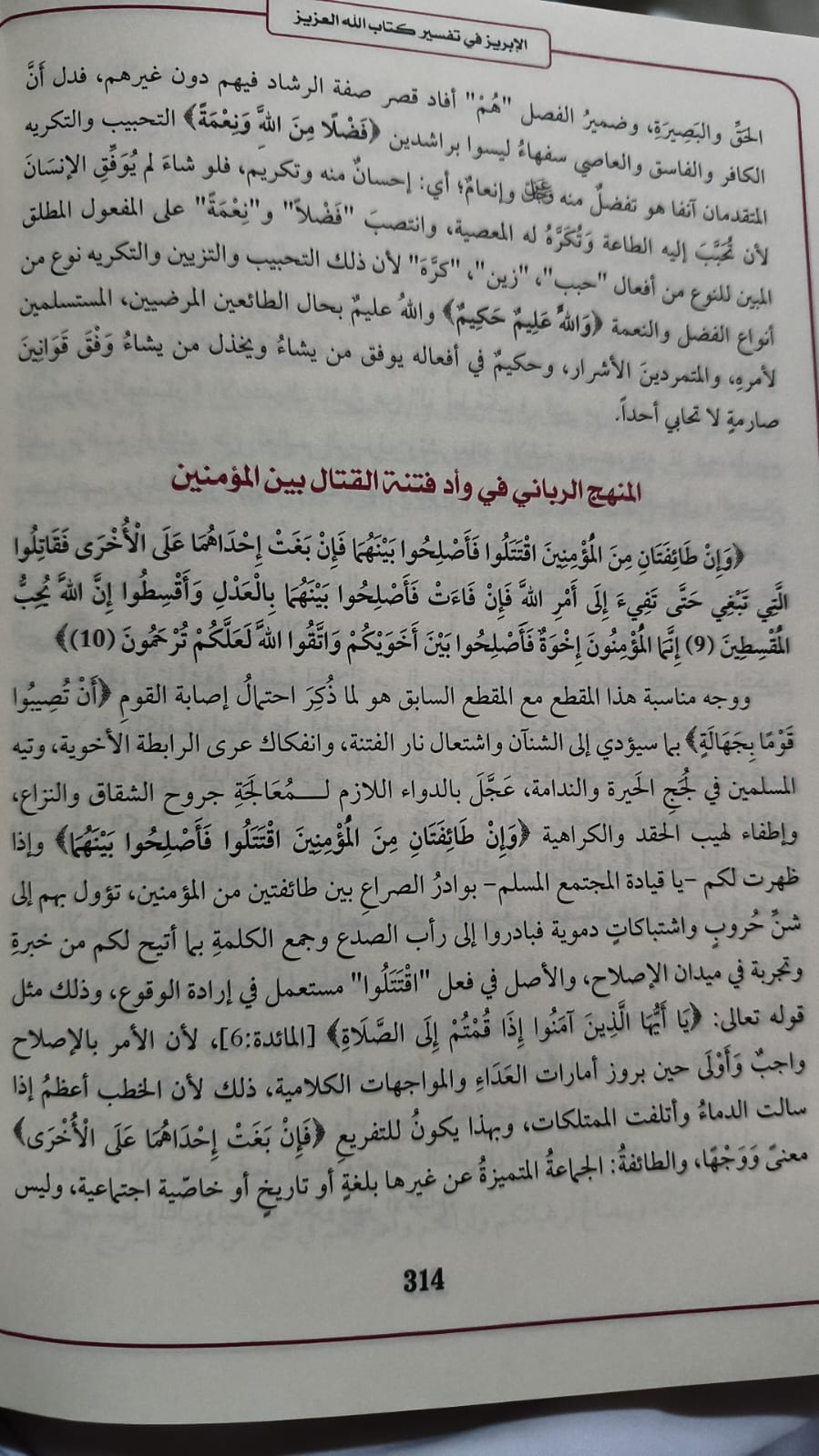
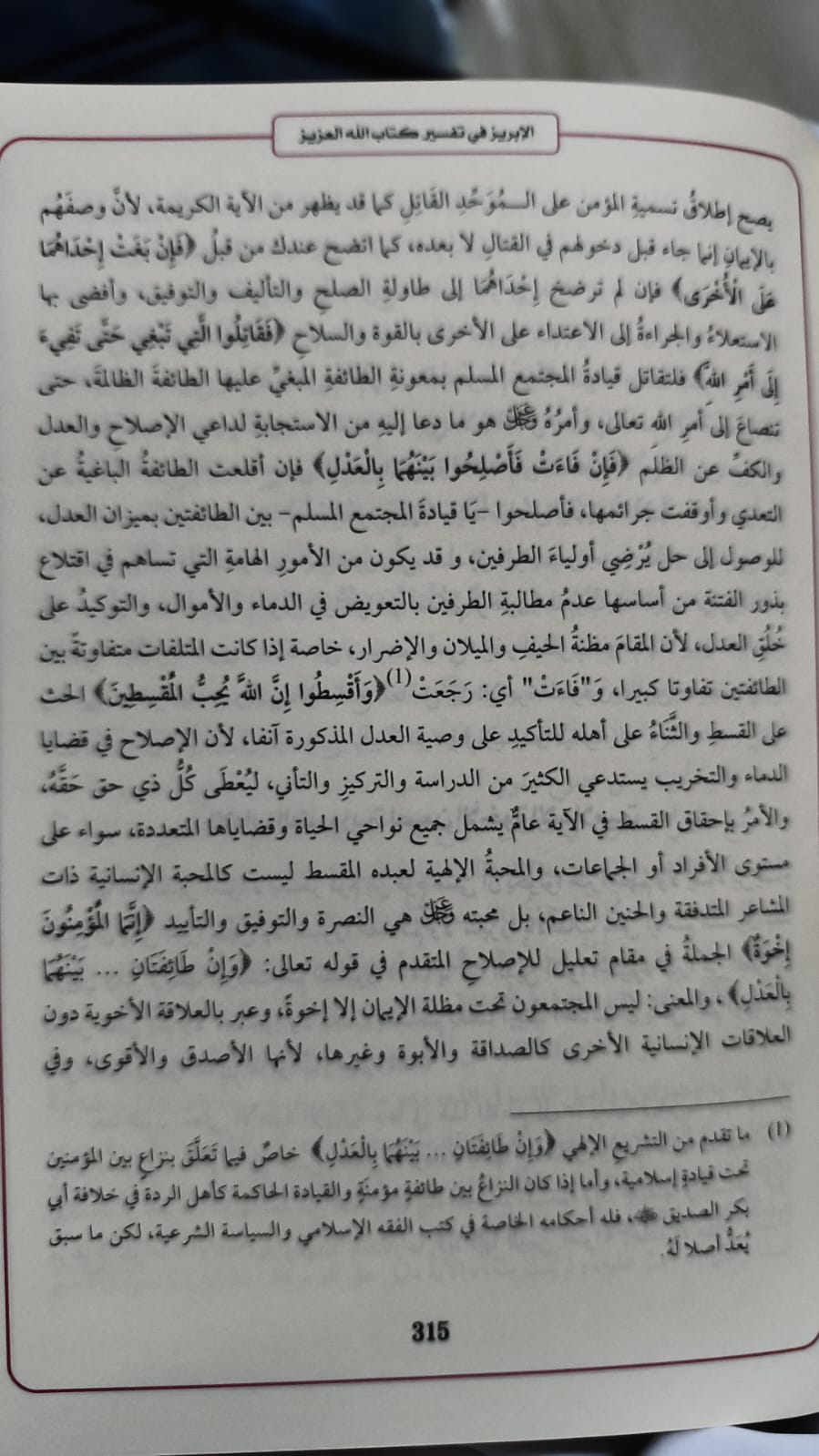
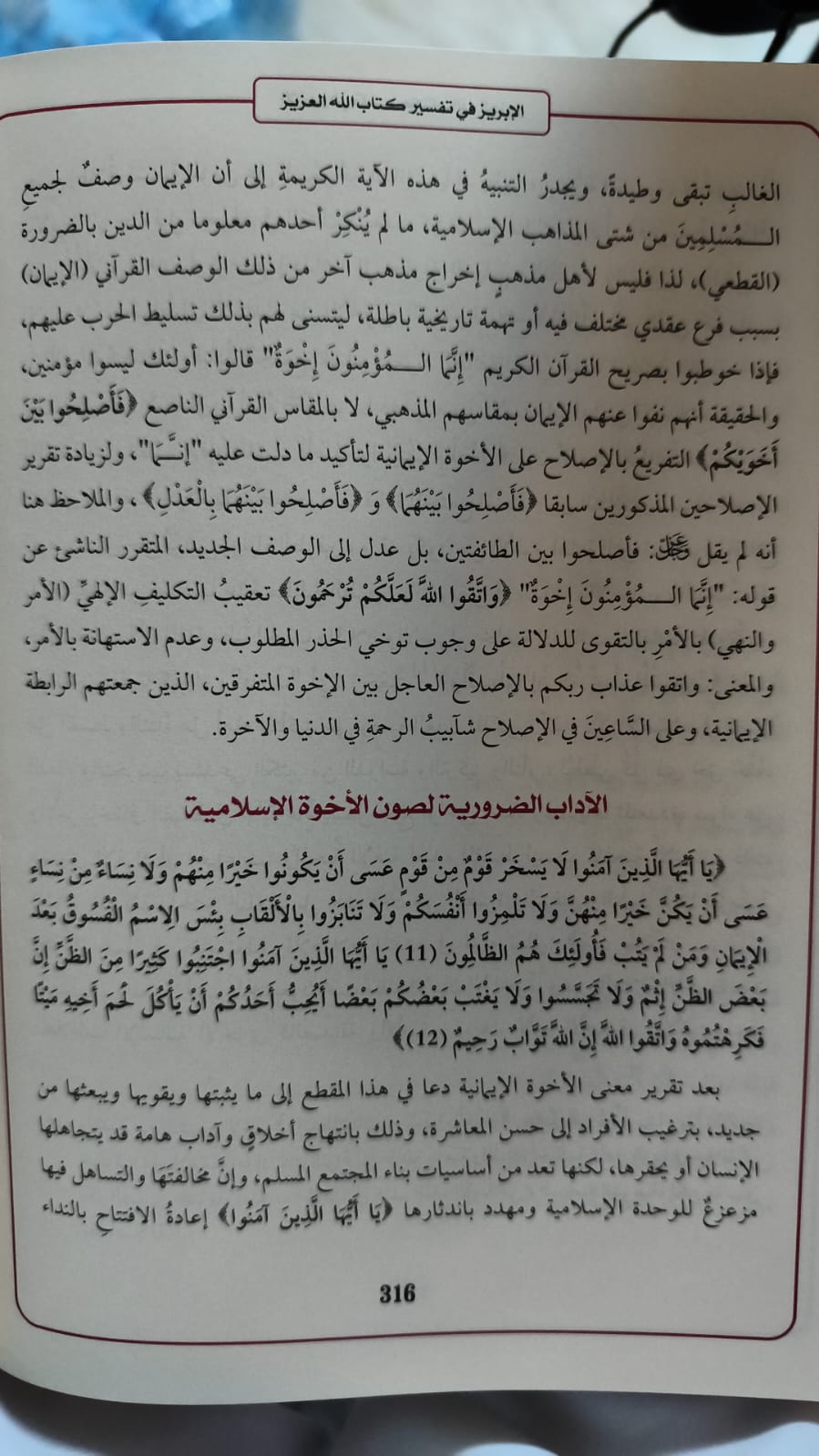
It is not valid to apply the name of ‘Believer’ to the one who commits major sins, as is apparent from the noble verse, because He described them with faith at the time of the fighting, before it.” (Al-Abriz, p. 315)
The Divine Method in Extinguishing the Fitnah of Fighting Between the Believers
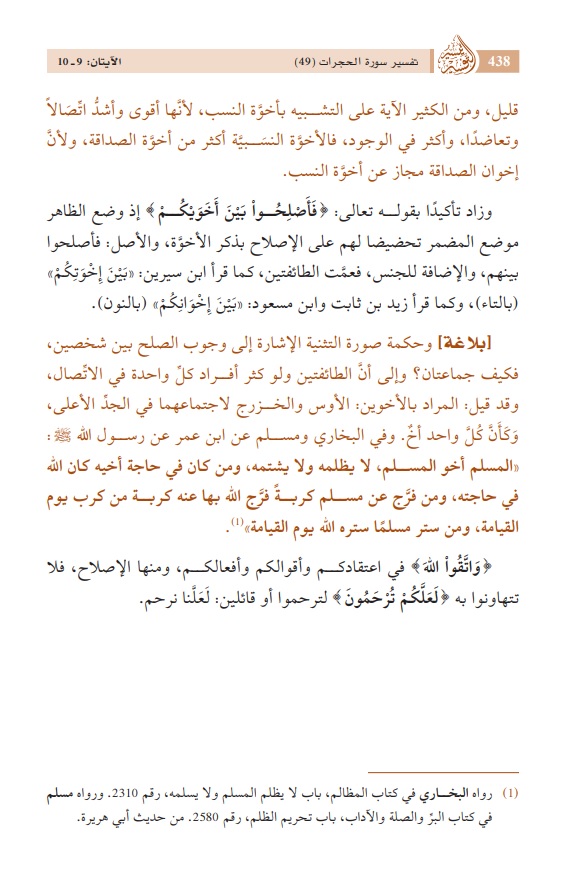
“And if two factions among the believers should fight, then make settlement between the two. But if one of them oppresses the other, then fight against the one that oppresses until it returns to the ordinance of Allah. And if it returns, then make settlement between them in justice and act justly. Indeed, Allah loves those who act justly. The believers are but brothers, so make settlement between your brothers. And fear Allah that you may receive mercy.” (Qur’an 49:9-10) -pg 314 Al-Ibriz fi Tafsir al-Qur’an al-‘Aziz
“And the point of connection between this passage and the previous passage is what was mentioned regarding the possibility of the people being afflicted with ignorance. This leads to the fire of discord and the disintegration of the bonds of brotherhood. And the Muslims, in the throes of confusion and regret, hasten with the necessary remedy to heal the wounds of division and conflict, and to extinguish the flames of hatred and aversion. And if “And if two factions among the believers should fight, then make settlement between the two” — O leaders of the Muslim community — the sparks of conflict between two factions of the believers appear, leading to outbreaks of wars and bloody clashes, then hasten to mend the breach and gather the word.” -pg 314 Al-Ibriz fi Tafsir al-Qur’an al-‘Aziz
” [This is] in light of what has been permitted to you of experience in the field of reform. The root [of the word] in the verb “should fight” (iqtatalū) is used in the sense of intending the occurrence. This is like His saying, the Most High: “O you who have believed, when you rise to [perform] prayer…” (5:6). [This is] because the command to reform is obligatory, and the nearest [course of action] when signs of enmity and verbal confrontations appear is that, because the matter is greater, blood has flowed and properties have been destroyed. And with this, there is a transition to the branch: “But if one of them oppresses the other.” And the meaning and the face [of it]: Al-Ta’ifah (the faction): the group distinguished from others by language, or history, or social specificity. And it is not valid to apply the name of “believer” to the one who commits major sins, as is apparent from the noble verse, because He described them with iman (faith) before their fighting, as became clear to you previously from His saying: “And if two factions among the believers should fight…” (49:9). If one of them does not submit to the other, [and] does not yield to the path of reconciliation, harmony, and agreement, it leads to arrogance and audacity in aggression against the other with force and weapons. [This is indicated by] His saying: “then fight against the one that oppresses until it returns to the ordinance of Allah” (49:9). So the leadership of the Muslim community aids the oppressed faction against the oppressive, transgressing faction until it submits to the command of Allah, and His command is what calls to it of responding to the call of reconciliation and justice, and refraining from injustice. “And if it returns, then make settlement between them in justice” (49:9).” -pg 314-315 Al-Ibriz fi Tafsir al-Qur’an al-‘Aziz
“If the transgressing faction desists from its aggression and stops its crimes, then make peace — O leadership of the Muslim community — between the two factions with the balance of justice, to reach a solution that satisfies the guardians of both parties. And it may be among the crucial matters that contribute to extinguishing the flames of discord: the absence of demanding compensation from the two parties for blood and wealth, and emphasis upon the removal of justice, for the position is one of caution regarding bias and harm, especially if the damages of the two factions are vastly different, and their losses are greatly disparate. “And act justly. Indeed, Allah loves those who act justly” (49:9) — meaning: return. And His saying “and act justly” is an emphasis upon the guardians of the matter to reaffirm the aforementioned testament of justice, because reform in matters of blood and destruction requires much study, focus, and deliberation, so that every possessor of a right is given their right. And the command to establish justice in the verse is general, encompassing all aspects of life and its multiple issues, whether at the level of individuals or groups. And the divine love for His servant who is just is not a sentimental emotion or a tender longing; rather, His love is His aid, support, and divine confirmation. Then the sentence “The believers are but brothers” (49:10) is in the position of explaining the previous [command] to make peace in His saying: “And if two factions among the believers should fight… then make settlement between them in justice” (49:9).” -pg 315 Al-Ibriz fi Tafsir al-Qur’an al-‘Aziz
“The meaning: those gathered under the shade of faith are nothing but brothers, and He expressed the relationship of brotherhood without [mentioning] other human relationships like friendship, fatherhood, and sonship, because it is the most truthful and strongest, and in it The majority remain firm, and it is appropriate to draw attention in this noble verse to the fact that iman (faith) is a description of all Muslims from the various Islamic schools of thought, as long as one of them does not deny something known of the religion by necessity (which is categorical).” -pg 315-316 Al-Ibriz fi Tafsir al-Qur’an al-‘Aziz
“Therefore, the people of a school of thought do not have the right to exclude another school of thought from that Qur’anic description (iman) due to a doctrinal branch in which it differs, or due to a baseless historical accusation, so that it becomes easy for them to impose war upon them. For they have been addressed by the explicit text of the Noble Qur’an: “The believers are but brothers” (49:10). They said: “Those are not believers.” But the truth is that they negated iman from them due to their school of thought, not according to the Qur’anic standard of the advisor: “So make settlement between your brothers”(49:10). The transition to reconciliation is based on the bond of faith, to emphasize what the word “only” (innamā) indicated, and to increase the affirmation of the two reconciliations mentioned previously: “So make settlement between them” (49:9) and “then make settlement between them in justice” (49:9). And the observation here is that He did not say: “So make settlement between the two factions,” but rather He shifted to the new description, which is established by His saying: “The believers are but brothers” (49:10). “And fear Allah that you may receive mercy” (49:10) is a follow-up to the divine obligation (the command and the prohibition) with the command of piety, to indicate the necessity of observing the required caution and not taking the matter lightly. And the meaning: And fear the punishment of your Lord by making immediate reconciliation between the believing brothers who have been separated, and [fear] the one who strives for reconciliation [regarding] the consequences of mercy in this world and the Hereafter.” -pg 316 Al-Ibriz fi Tafsir al-Qur’an al-‘Aziz
The Necessary Etiquettes for Preserving Islamic Brotherhood
“O you who have believed, let not a people ridicule [another] people; perhaps they may be better than them; nor let women ridicule [other] women; perhaps they may be better than them. And do not insult one another and do not call each other by [offensive] nicknames. Wretched is the name of disobedience after [one’s] faith. And whoever does not repent — then it is those who are the wrongdoers. O you who have believed, avoid much [negative] assumption. Indeed, some assumption is sin. And do not spy or backbite each other. Would one of you like to eat the flesh of his brother when dead? You would detest it. And fear Allah; indeed, Allah is Accepting of repentance and Merciful.” (Qur’an 49:11-12)” -pg 316 Al-Ibriz fi Tafsir al-Qur’an al-‘Aziz
“After affirming the meaning of the bond of faith in this passage, it calls for what strengthens it, establishes it, and raises it to a new level, by encouraging individuals to good companionship. This is done by adopting a set of ethics and etiquettes that a person may be ignorant of or belittle, but which are among the foundations of building a Muslim society. Indeed, laxity in them undermines the unity of the Islamic brotherhood and threatens its pillars with collapse. The opening of the call with “O you who believe” (49:11) -pg 316 Al-Ibriz fi Tafsir al-Qur’an al-‘Aziz
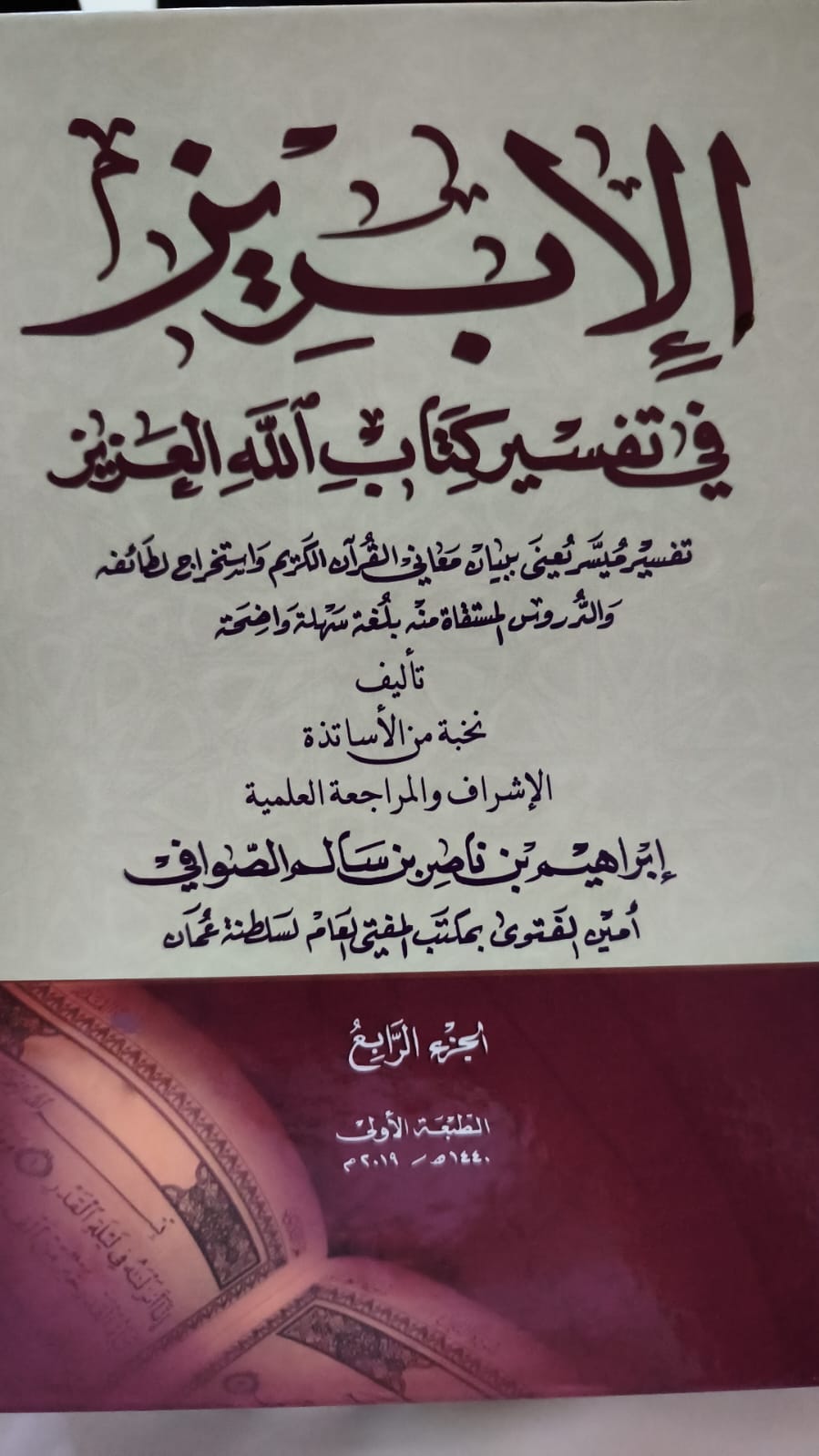
Source: (pgs. 314-316 Al-Ibriz fi Tafsir al-Qur’an al-‘Aziz – Pure Gold in the Interpretation of the Noble Qur’an – First Edition 2019 CE 1440 AH -The fourth Volume/Part 4 )
This is an Ibadi tafsir published under the supervision of the Office of Fatwa in the Sultanate of Oman. It is a contemporary, simplified commentary on the Qur’an produced by a committee of scholars.
Authored by a select group of professors/scholars. This was done under the supervison and scholarly review of Ibrahim Muhammed Fadil bin Salman al-Sawafi.
Rules of Engagement
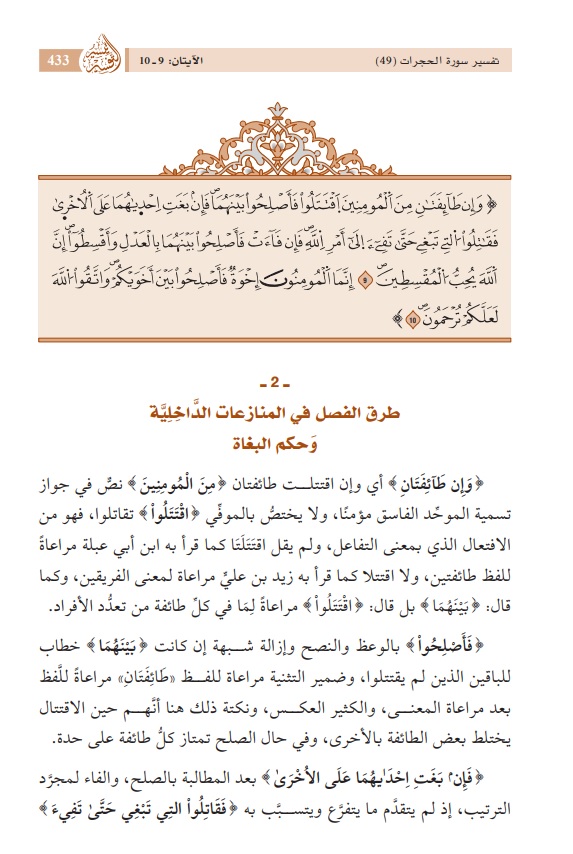
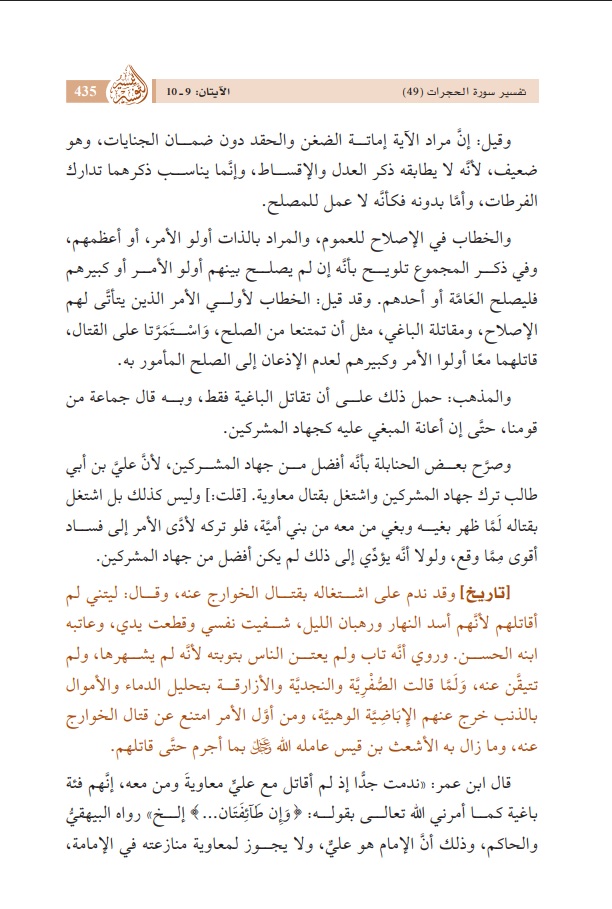
The passage from Atfayyish’s Taysir al-Tafsir provides the historical context for the revelation of Qur’an 49:9. It recounts a specific incident involving ‘Abdullah ibn Ubayy ibn Salul, the leader of the hypocrites (munafiqun) in Medina:
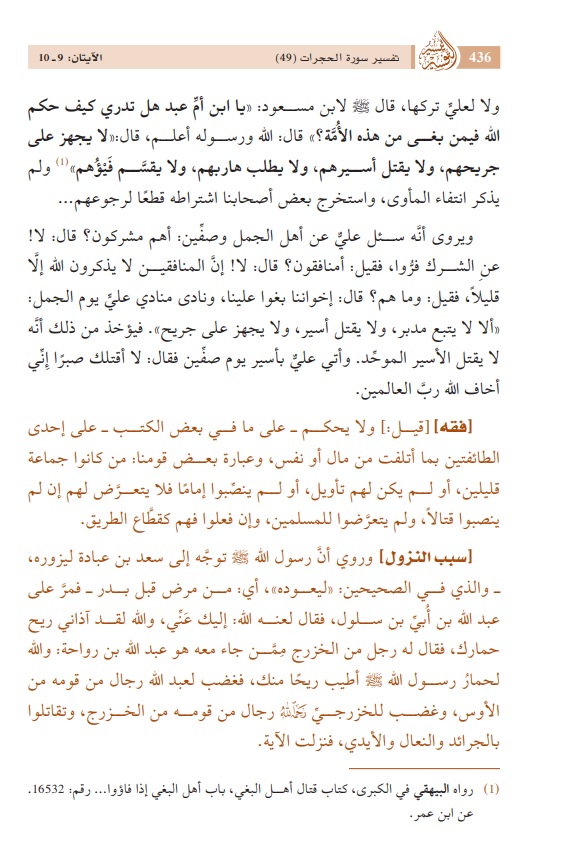
“It is mentioned in the story of Badr: Usama ibn Zayd was riding behind him [the Prophet], and on the donkey was Qutba ibn Abi Salul before he embraced Islam. Al-Khazraj passed by a gathering of the Jews, and they had idols and a Muslim with them. When the gathering was covered by the braying of the donkey, ‘Abdullah ibn Ubayy said: ‘Do not frighten us with your donkey.’ The Messenger of Allah (saw) stopped, descended, recited the Qur’an, and called them to Allah. ‘Abdullah said: ‘O man, there is nothing better than what you say, if it were true. So do not harm us in our gatherings.’ So the Messenger of Allah (saw) returned to his mount. Then ‘Abdullah ibn Rawaha said: ‘O Messenger of Allah, he is harming us in our gathering, so we are the polytheists…’ And the Jews and the Muslims almost fought. The Prophet (saw) continued to reconcile them until they were quiet, then he rode his mount. Then the verse was revealed.” Source: (Taysir al-Tafsir, Atfayyish, p. 436)
This historical context confirms that the verse 49:9 was revealed to address civil strife (fitnah) within the Muslim community. The Prophet’s own action—reconciling rather than fighting—demonstrates the priority of peace.
The passage also cites a narration from Al-Hasan:
“One of them was a hypocrite (munafiq) supported by his people, and the other was a believer (mu’min) supported by the Muslims, so they fought. Then it was revealed.”
Source: (Taysir al-Tafsir, Atfayyish, p. 436)
The Rules of Engagement (Fiqh al-Baghy)
The early Muslim community established strict rules of engagement for fighting the transgressing believers. Ibn Mas’ud ruled:
“The wounded among them is not to be finished off, the captive among them is not to be killed, the fugitive among them is not to be pursued, and no spoils are to be divided regarding them.”
Source: (Taysir al-Tafsir, Atfayyish, p. 436)
These rules prove beyond a doubt that the bāghī remains a Muslim. You do not take spoils from Muslims, nor do you execute Muslim captives. The goal is to restore order, not to exterminate the transgressors.
And a caller announced on the Day of the Camel:
“Do not pursue a fugitive, do not finish off a wounded person, and do not kill a captive.”
Source: (Taysir al-Tafsir, Atfayyish, p. 436)
When a captive was brought to Ali on the Day of Siffin, he said:
“I will not kill you, for I fear Allah, the Lord of the Worlds.”Source: (Taysir al-Tafsir, Atfayyish, p. 436)
This demonstrates the extreme caution the early Muslims exercised in shedding the blood of fellow believers.
The Sequence of Commands: Reconciliation, Fighting, and Justice
The Taysir al-Tafsir of Atfayyish provides a detailed legal analysis of the sequence of commands in Qur’an 49:9:
{“But if one of them transgresses against the other”} — after the request for reconciliation, and the refusal is merely [an act of] defiance. It has not yet been dealt with, so it necessitates {“then fight against the one that transgresses until it returns to the command of Allah”}.
Source: (Taysir al-Tafsir, Atfayyish, p. 433)
Atfayyish highlights a critical detail in the verse’s structure. The command to “make peace” (fa-aṣliḥū) appears twice:
First:“If two parties fight, make peace between them.” (General reconciliation)
Second:“Then if it returns, make peace between them with justice.” (Post-fighting reconciliation)
He explains that the first reconciliation is directed at both parties. But if one party transgresses (baghat), the second command to reconcile is directed specifically at the transgressor—they are the ones who must be brought back to obedience first, before peace can be established.
The Al-Abriz commentary adds:
“If one of them transgresses against the other, then fight against the one that transgresses until it returns to the command of Allah.” The purpose of fighting is not to exterminate the transgressors but to bring them back to obedience. The commentary notes that the verb qātilū (fight) is used in the sense of willing the occurrence, similar to the command to establish prayer. The goal is correction, not destruction. (Al-Abriz, p. 315)
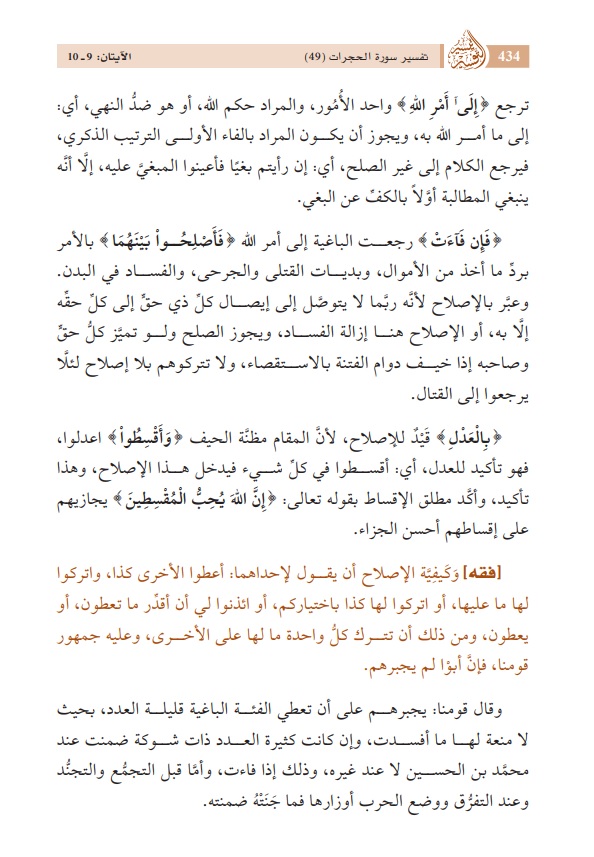
The Taysir al-Tafsir also confirms the linguistic point we discussed earlier:
{“Until it returns” (tafi’a)} — it is said that the meaning is: until it returns to the command of Allah, which is His ruling. [The word] tafi’a (returns) is used exclusively for returning to obedience after disobedience.
Source: (Taysir al-Tafsir, Atfayyish, p. 434)
This is a crucial theological point. The bāghī is not being called to “convert” to Islam (as a disbeliever would be). They are being called to return to obedience (ṭā’ah) after a state of disobedience (ma’ṣiyah). This confirms that they are already Muslims; they have simply fallen into kufr al-ni’ma.
“Until it returns” (tafi’a)}
Justice and Equity: The Goal of Reconciliation
The Taysir al-Tafsir emphasizes that reconciliation must be done “with justice” (bil-ʿadl). Why? Because the position is one of “suspicion of bias” (maẓinnat al-ḥayf). After blood has been shed, there is a natural tendency for one party to seek revenge or for the mediator to favor one side. The Qur’an commands absolute equity to prevent further injustice:
{“Then make peace between them with justice”} — the command [here] includes the prevention of wealth, and the blood-money for the killed and the wounded, and the corruption in the body. And the expression “with reconciliation” is because it may not lead to the restoration of every right to its owner, even if the reconciliation is [meant to be] clear. It is permissible for reconciliation to remove the corruption, even if it does not perfectly distinguish every right to its owner, if there is a fear of the continuation of the dissension.
Source: (Taysir al-Tafsir, Atfayyish, p. 434)
Atfayyish outlines the practical steps of reconciliation:
Prevention of wealth (badal min al-amwāl): The transgressor must compensate for destroyed property.
Blood-money (diyāt): Compensation for the killed and wounded.
Corruption in the body (al-fasād fī al-badan): Physical injuries must be accounted for.
This confirms that the bāghī is legally liable for their actions — proof that they are still a Muslim. You do not pay blood-money to a disbeliever’s family in the same way; you take their wealth as spoils.
The Al-Abriz commentary adds:
“This is a confirmation of the aforementioned instruction of justice, because reform in matters of blood and destruction requires much study, focus, and deliberation, so that every person with a right is given his right.” Sources: (Al-Abriz, p. 315) & (Taysir al-Tafsir, Atfayyish, p. 438)
The verse concludes with the statement that “Allah loves those who act equitably” (al-muqsiṭīn). This divine love is not a sentimental emotion but a promise of victory, success, and support for those who establish justice.
Source: (Taysir al-Tafsir, Atfayyish, p. 434)
The Brotherhood of Faith
Qur’an 49:10 immediately follows the verse on fighting:
“The believers are but brothers, so make peace between your brothers and fear Allah that you may receive mercy.” (Qur’an 49:10)
“Those gathered under the shade of faith are nothing but brothers, and the brotherhood relationship is without [the need for] other human relationships like friendship, fatherhood, and others, because it is the most truthful, strongest, and most powerful.” (Al-Abriz, p. 316)
This brotherhood is the basis for the command to reconcile. If the fighters were outside the milla of Islam, there would be no brotherhood to preserve. But because they are outwardly Muslims— guilty of kufr al-ni’ma — the doors to repentance and reconciliation must remain open so as to restore peace and unity.
The Taysir al-Tafsir notes that the sentence “The believers are but brothers” is in the position of explaining the previous instruction for reconciliation:
“And the meaning: Those gathered under the shade of faith are nothing but brothers, and the brotherhood relationship is without [the need for] other human relationships like friendship, fatherhood, and others, because it is the most truthful, strongest, and most powerful.”
Source: (Taysir al-Tafsir, Atfayyish, p. 438)
Source material: (Taysir al-Tafsir li’l-Qur’an al-Karim, Qutb al-A’imma Muhammed ibn Yusuf Atfayyish)
The Strength of the Ibadi Position
The Ibadi tafsir of Qur’an 49:9 offers a theologically rigorous and textually grounded reading that resolves several apparent tensions:
Principle
Ibadi Position
Evidence
Status of the Bāghī
Believer in milla, kāfir in ni’ma (ungrateful).
Qur’an 49:9 (nowhere in the Qur’an is bāghī for believers); Qur’an 14:7 (kafartum = severe punishment); Hadith Bukhari 7077 (“Do not revert as kuffāran“).
Goal of Fighting
To restore obedience and justice, not to exterminate.
Qur’an 49:9 (“until it returns to the command of Allah”); Taysir al-Tafsir (tafi’a = return to obedience after disobedience).
Rules of Engagement
No killing captives, no spoils, no pursuit of fugitives.
Ibn Mas’ud’s ruling in Taysir al-Tafsir, p. 436; the caller on the Day of the Camel; Ali’s statement “I will not kill you, for I fear Allah.”
Responsibility
The community leaders (ahl al-amr) must reconcile.
Qur’an 49:9 (“make peace between them”); Al-Abriz (leaders of the Muslim community).
Purpose
Eliminate rancor and hatred, establish justice.
Taysir al-Tafsir (purpose of the verse is the elimination of rancor and hatred); Qur’an 49:10 (brotherhood).
Nature of the Duty
Supporting the oppressed against the transgressor is a jihad.
Taysir al-Tafsir (a group of our people said: assistance of the oppressed is a jihad).
Conclusion
The Ibadi tafsir of Qur’an 49:9 offers a balanced theology that upholds the sanctity of faith while recognizing the gravity of sin.
The Ibadi position, is not one of extremism or excessive leniency. It is a rigorous, textually grounded, and spiritually profound reading of the Qur’anic text. It demonstrates that the Muslim community is called to be a community of justice, reconciliation, and mercy even in the midst of its most painful internal conflicts. It provides a framework for addressing intra-community conflict that neither demonizes the transgressor nor ignores their wrongdoing. It serves as a powerful reminder that faith and sin are not mutually exclusive—but the consequences of sin are severe, and the path to reconciliation requires justice, equity, and a steadfast commitment to the bonds of brotherhood.
The root b-gh-y is never used for believers elsewhere in the Qur’an.
The min al-mu’minīn describes prior state, not the state of fighting.
The hadith uses kufr language for intra-Muslim fighting.
Qur’an 4:93 creates a tension that the Ibadi framework resolves.
“Indeed, We have made it (ja’alnahu) an Arabic Qur’an that you might understand.” (Qur’an 43:3)
﷽
The truth of the matter is that the entire Muslim Ummah are in agreement that some aspect of the Qur’an is created. What they differ and disagree about are the specifics.
This debate has been framed incorrectly. It has been framed as a debate between those who believe the Qur’an is created and those who believe the Qur’an is uncreated.
The reality: The debate is about to what degree and which aspects of the Qur’an are created.
For example:
1. The Mushaf. The pages that the ink is printed upon. All Muslims call this the Qur’an. There is etiquette in regard to it. We do not bring it to dirty places. The proper disposal is to burn it’s pages. Yet, this is called ‘Qur’an’. Everyone who can be called Muslim agrees to this. That is that the Mushaf of the Qur’an is created. If there is a person who disagrees with this and or is hesitant to affirm this then know that they are upon something very strange.
2. The ink and the words which are written. The words and letters on the pages that were placed there by ink or the printing press. All Muslims call this the Qur’an. Everyone who can be called Muslim agrees to this. That is that the ink and the words on the pages are created.If there is a person who disagrees with this or is hesitant to affirm this then know they upon something very strange.
3. The recitation of the words of the Qur’an. This is is what we will be discussing today.
We will learn that the one who compiled ‘Sahih Bukhari’, whose full name is: Abū ʿAbd Allāh Muḥammed ibn Ismāʿīl ibn Ibrāhīm ibn al-Mughirah ibn Bardizbah al-Juʿfī al-Bukhārī and his supporter who compiled ‘Sahih Muslim’ . Both believed that their recitation of the Qur’an is created. This caused a boycott of Bukhari by major Hanbali scholars..
“Muhammed bin Yahya al-Nisaburi wrote to the people of Rayy, informing them of al-Bukhari’s position. The accusation was that al-Bukhari held “lafzi bil-Quran makhluq”. That his pronunciation/recitation of the Quran is created.”
“My father and Abu Zur’ah heard from him, then they both abandoned his hadith when Muhammed bin Yahya al-Nisaburi wrote to them that he [al-Bukhari] had made it apparent to them that his pronunciation of the Qur’an is created.”
Source: (page 462 from Volume 12 of Siyar A’lam al-Nubala’ (Biographies of the Noble Scholars) by Imam al-Dhahabi, edited by Shu’ayb al-Arna’ut.)
“[Al-Ma’idah: 64]. And his emigration (hijrah)(1) was from Mecca. He came to Iraq at the end of the night… [Quranic verse]: “If Allah helps you, none can overcome you; and if He forsakes you, who is there after Him that can help you?” [Al Imran: 160].”
“And Ahmad bin Mansur al-Shirazi said: I heard al-Qasim bin al-Qasim say: I heard Ibrahim, the scribe of Ahmad bin Sayyar, say: When al-Bukhari arrived in Marw, Ahmad bin Sayyar met him. So he said to him: “O Abu Abdullah, we do not oppose you in what you say, but the common people cannot bear this from you.” He [al-Bukhari] said: “I only ask about something I know to be true, fearing the Fire, lest I say other than it.” So Ahmad bin Sayyar turned away from him.”
“And Abd al-Rahman bin Abi Hatim said in Al-Jarh wa al-Ta’dil (2): Muhammed bin Isma’il al-Rayy came in the year 210 AH, and my father and Abu Zur’ah heard from him. And they abandoned his hadith when Muhammed bin Yahya al-Nisaburi wrote to them that he [al-Bukhari] had made it apparent to them that his pronunciation of the Quran is created.“
Then Shu’ayb al-Arna’ut comments on this.
By the way for those not familiar when you see the name Shu’ayb al-Arna’ut it is a reference to Abū Usāmah Shuʿayb ibn Muḥarram ibn ʿAlī al-Albānī al-Arnāʾūṭ.
Most people in Salafi/Athari circles simply refer to him as: al-Albānī.
So al-Albānī (Shu’ayb al-Arna’ut) comments:
“This is strange from Abu Zur’ah and Abu Hatim, for they both had already heard from him [al-Bukhari] and narrated from him, and they did not abandon him except based on the statement of their teacher al-Bukhari regarding the issue of lafz [pronunciation]. And it is not permissible for them to act upon this, due to what it entails of sin, caprice, and envy. And Imam al-Dhahabi said in Mizan al-I’tidal 1/111 in the biography of Abu Nu’aym, the author of Al-Hilyah: “The words of some of them regarding others are not to be relied upon, especially if it becomes clear to him that it is due to partisanship for a madhhab or envy. And no one is safe from that except one whom Allah protects. And I do not know of an era from the eras that is safe from that except the era of the Prophets and the Rightly Guided Caliphs. And if you wish, I could list that in volumes.” And al-Subki said in Tabaqat al-Shafi’iyyah 2/230: “The position of al-Dhuhali [Muhammed bin Yahya] regarding al-Bukhari came from envy of him.” And al-Subki said in Qa’idah al-Jarh wa al-Ta’dil 12: “And from what should be examined is the state of beliefs and their differences in relation to the critic and the criticized. For perhaps the critic is wronged in creed, so his criticism of him is [invalid].”-Shaykh al-Albānī
Source: (page 462 from Volume 12 of Siyar A’lam al-Nubala’ (Biographies of the Noble Scholars) by Imam al-Dhahabi, edited by Shu’ayb al-Arna’ut.)
Examining Shaykh al-Albānī charge of envy for abandoning Bukhari for his position on the createdness of the Qur’an.
Shaykh Shaykh al-Albānī’s argument in the highlighted footnote is essentially this: Abu Zur’ah’s criticism cannot be sincere because he also narrated from Muslim, who shared al-Bukhari’s theological position.
If Abu Zur’ah was willing to accept hadith from Muslim, he should have accepted them from al-Bukhari on the same grounds. Unless his abandonment of al-Bukhari was motivated by petty jealousy, or partisanship.
We have to be fair here in saying that Shaykh al-Albānī’s claim has a very strong basis.
This reasoning has some historical traction, but it is not the whole picture:
Muslim’s Position: It is well-established that Imam Muslim did agree with al-Bukhari on the lafz issue. Al-Bayhaqi explicitly stated that Muslim “was on the madhhab of al-Bukhari in the distinction” between recitation and the recited. Muslim also famously stood by al-Bukhari during the boycott, taking his written works back from al-Dhuhali and withdrawing from his circle.
Source: (Siyar A’lam al-Nubala’ 12/460, Huda al-Sari in the introduction to Fath al-Bari 2/264)
Imam Muslim was the only one who did not abandon Imam al-Bukhari, since they were upon the same creed. Their creed opposed that of the Hanbali who opposed them.
“And Makki bin Abdan said: Dawud bin Ali al-Asbahani came to Nisapur during the days of Ishaq bin Rahwayh. They held a session of debate for him, and he attended the circle of Yahya bin al-Dhuhali, and Muslim bin al-Hajjaj. A theological issue was discussed in which Yahya spoke, and he silenced him, saying: “Be quiet, O boy!” So Muslim did not support him. He returned to his father and complained to him. His father said: “Who was he?” He said: “Muslim.” He said: “You have returned from every single one of my hadiths!” [Meaning: you have ruined your standing with him]. When this reached Muslim, he gathered what he had written from him in a notebook, sent it to him, and said: “I will never narrate anything from you ever again.”
“Abu Abdullah al-Hakim said:I have noted this story from Tahir bin Ahmad, from Makki, and Muslim may have differed after this incident with Muhammed bin Yahya, but he only cut him off because of the issue of al-Bukhari. And al-Hafiz Abu Abdullah bin al-Akhram knew that, so he informed about the alienation [that occurred] later.”
“And I heard him [al-Hakim] saying:Muslim bin al-Hajjaj used to openly declare the statement regarding al-lafz [the pronunciation of the Quran], and he did not conceal it. When al-Bukhari settled in Nisapur, he openly declared more of the disagreement with him. When the issue of al-lafz occurred between al-Bukhari and al-Dhuhali, and the people of Nisapur were prevented from differing with him [al-Dhuhali], and he called to that, the majority of people cut off from Muslim, other than a few. It reached Muhammed bin Yahya, and he said one day: “Whoever says al-lafz is not created, it is not permissible for him to attend my circle.” So Muslim took his garment, placed it on his shoulder, stood up before the people, and sent to him what he had written from him, saying: “We only used to narrate from you because of al-lafz.” And Muslim used to openly declare the statement regarding al-lafz and not conceal it.“
“Abu Hamid bin al-Sharqi said: I attended the circle of Muhammed bin Yahya, and he said: “Whoever says: ‘My pronunciation of the Quran is created,’ let him not attend my circle.” So Muslim stood up from the circle.”
“Abu Bakr al-Khatib said: Muslim used to fight on behalf of al-Bukhari, until the relationship between him and Muhammed bin Yahya became estranged, due to his [al-Bukhari’s] reason.”
“I [al-Dhahabi] said:Then, [if] he was a Muslim due to his createdness [meaning: his stance on the creation of actions] he also turned away from al-Bukhari, and did not mention him as a narrator of hadith, nor did he name him in his Sahih. Rather, he began the book with the wording of those who stipulated al-lafz for whomever he narrated from, in a manner that claims consensus in the contemporary era is sufficient [to establish it], and he did not pause on that knowledge of the two of them, and he criticized whoever stipulated that. But rather, Abu Abdullah al-Bukhari said that, and his teacher Ali bin al-Madini, and it is the most correct and most sound [position]. And this is not the place to elaborate on this issue.”
“The Hafiz Abu al-Qasim bin Asakir said in Al-Atraf: It is after he mentioned [the Sahih of al-Bukhari]: Then he followed the path of Muslim bin al-Hajjaj, and he took the extraction of his book, its composition, and its arrangement into two parts. He intended to mention in the first part the hadiths of the reliable people of precision, and in the second part the hadiths of the people of covering and truthfulness, those who did not reach the rank of the firmly established. The death prevented him from completing this aspiration, and between him and this aspiration was the completion of his book. However, his book became famous and spread despite his need for it [to be completed].”
“And al-Hakim said: Muslim wanted to extract the Sahih into three categories, and upon three generations of narrators. He mentioned this at the beginning of his introduction, but he was not able to finish except the first category, and he died.”
Source: (page 628 from Volume 12 of Siyar A’lam al-Nubala’, in the biography of Imam Muslim)
The second point.
Abu Zur’ah’s Relationship with Muslim: Abu Zur’ah was not hostile to Muslim. In fact, Muslim submitted his Sahih to Abu Zur’ah for review, and Abu Zur’ah’s approval was seen as a mark of its authenticity. if Abu Zur’ah accepted Muslim’s Sahih despite his lafz views, why did he abandon al-Bukhari?
Insh’Allah we will update this page and provide an easily accessible online source when it becomes available.
If you would like to learn more about this specific subject please read the following:
“We certainly brought you the truth, but most of you, to the truth, were averse.” (Qur’an 43:78)
“And of the people is he who disputes concerning Allah without knowledge or guidance or an enlightening Book, twisting his neck to mislead from the way of Allah. For him in this world is disgrace, and We will make him taste on the Day of Resurrection the punishment of the Burning Fire.” (Qur’an 22:8-9)
﷽
In this article we explore who has the correct aqidah? Which of the Salafi (Athari) are among the Mu’attilah and which are not?
Who is correct in regarding a theological matter of great importance: HOW MANY FINGERS DOES ALLAH HAVE?
A matter in which Muslims can be removed from Islam and a matter in which the blood of a believer may be considered permissible.
Just how many fingers does Allah have? The debate among the Athari/Salafi rages on!
First let it be said as regard the video we disavow the meme and the laughing emojis. We can make our points without appealing to such.
Shaykh Uthman al-Khamis:
فهل نثبت لله خمسه اصابع؟ نثبت لله الاصابع والحديث ما في خمسه اصابع. الحديث ما في خمسه اصابع وانما قال ان الله يحمل السماوات على اصبع والاراضين على اصبع والجبال على اصبع والشجر على اصبع ما في تحديد خمس اصابع فلا نحدد نقول لله اصابع تليق به ونسكت
English Translation: “So do we affirm five fingers for Allah? We affirm fingers for Allah, but the Hadith does not mention five fingers. The Hadith does not mention five fingers; rather, it states that Allah places the heavens on a finger, the earths on a finger, the mountains on a finger, and the trees on a finger. There is no specification of five fingers, so we do not specify. We say that Allah has fingers that befit Him, and we remain silent. -Shaykh Uthman al-Khamis.
احسن الله اليكم سائل يقول هل الاعتقاد الصحيح هو ان لله خمس اصابع فقط
English Translation: “May Allah be good to you, a questioner asks: Is the correct belief that Allah has only five fingers?”
Shaykh Abdul-Aziz Bin Baz:
يعني كل يد لها خمس اصابع ان الله جل وعلا له يدان ولكل يد دن اصابع وهذا من الكمال
English Translation: “Meaning, each hand has five fingers. Indeed, Allah, Majestic and Exalted, has two hands, and each hand has fingers, and this is a matter of perfection.” -Shaykh Abdul-Aziz Bin Baz
Shaykh Muhammed Nasir al-Din al-Albani says the hadith does not prove Allah (swt) has five fingers.
Al-Albani was asked directly: “The hadith counts five. Does this mean Allah has five fingers?” He replied: “No! We do not add to the hadith nor subtract from it.” When pressed that the five is a mafhūm (implied meaning), he said: “There is no harm in taking the mafhūm as long as it does not contradict an explicit text.”
So here we have Shaykh Muhammed Nasir al-Din al-Albani saying that implication has a basis in theology!
Shaykh Al Uthaymin says Allah has an undetermined number of fingers.
Uthaymin was even more explicit in warning against the question itself. In his lecture on al-ʿAqīdah al-Saffārīniyyah, he said:
“A questioner asked me: ‘What do you say about Allah’s fingers. How many?’ I said: ‘Do you have to know this? Affirm that Allah has fingers as the Prophet ﷺ said. As for how many? We cannot speak about this.’ By Allah, you are not more eager for knowledge of Allah than the Companions! When the Prophet ﷺ said ‘Allah places the heavens on a finger,’ did they say: ‘O Messenger of Allah, does Allah have more than three fingers?’ They did not. Because they were more complete in manners and more reverent toward Allah than those who came after them.”
Shaykh Abdul-Aziz al-Rajihi believes that Allah (swt) has five fingers.
في هذه الأحاديث إثبات الأصابع للرب عز وجل، وأن لله خمسة أصابع وهي صفات ذاتية تليق بالله، وأن الله تعالى يضع السموات على أصبع والأرضين على أصبع والشجر والثرى على أصبع وسائر خلقه على أصبع. في الحديث الأول: «يُمْسِكُ السَّمَوَاتِ عَلَى إِصْبَعٍ، وَالأَْرَضِينَ عَلَى إِصْبَعٍ، وَالْجِبَالَ عَلَى إِصْبَعٍ، وَالشَّجَرَ عَلَى إِصْبَعٍ» فهذه خمسة أصابع.
English translation:
“In these hadiths there is affirmation of fingers for the Lord, Mighty and Majestic, and that Allah has five fingers, which are attributes of His essence befitting Allah, and that Allah, the Most High, places the heavens upon a finger, the earths upon a finger, the trees and the soil upon a finger, and the rest of His creation upon a finger. In the first hadith: ‘He holds the heavens upon a finger, the earths upon a finger, the mountains upon a finger, and the trees upon a finger’ So these are five fingers.”- Shaykh Abdul-Aziz al-Rajihi
Shaykh Saleh al-Fawzan’ mentions that Allah has five fingers and he affirms this as the belief of Muhammed ibn Abd al-Wahhab in his ‘Book of Tawhid’.
“نعم، شوف في آخر كتاب التوحيد أن الله -جَلَّ وَعَلا- يطوي السماوات السبع، والأراضين السبع بيديه، أو يجعل البحار على أصبع، أو يجعل الجبال على أصبع، راجع آخر كتاب التوحيد في هذا… إلى أن ذكر خمسة أصابع… نعم، نثبت الأصابع لله عز وجل.”
English translation:
“Yes, look at the end of Kitab al-Tawhid. That Allah, Mighty and Majestic, rolls up the seven heavens and the seven earths with His two Hands, or places the seas upon a finger, or places the mountains upon a finger. Refer to the end of Kitab al-Tawhid on this… until he mentioned five fingers… Yes, we affirm the fingers for Allah, Mighty and Majestic.” -Shaykh Al-Fawzan’
What are the Salafi (Athari) basing their theology on?
They are basing upon the statement of a Jewish scholar (al-ḥabr), where the Blessed Prophet (saw) laughed at what he said and then quoted a verse from the Qur’an in rebuke. However, due to their bizarre theology that relies heavily upon statements from Jews they have taken it as an evidence in regard to a grave matter!
“And they have thereof no knowledge. They follow not except assumption (probablistic), and indeed, assumption avails not against the truth at all.” (Qur’an 53:28)
“O humanity! Eat from what is lawful and good on the earth and do not follow Satan’s footsteps. He is truly your sworn enemy. He only incites you to commit evil and indecency, and to claim against Allah what you do not know.” (Qur’an 2:168-169)
What is the source of this discord among the various shayks of this Salafi sect?
Dear readers this is crucial. Pay close attention to the following information. We want you to note the details.
Narrated `Abdullah:
A (Jewish) Rabbi came to Allah’s Messenger (ﷺ) and he said, “O Muhammed! We learn that Allah will put all the heavens on one finger, and the earths on one finger, and the trees on one finger, and the water and the dust on one finger, and all the other created beings on one finger. Then He will say, ‘I am the King.’ Thereupon the Prophet (ﷺ) smiled so that his pre-molar teeth became visible, and that was the confirmation of the Rabbi. Then Allah’s Messenger (ﷺ) recited: ‘They made not a just estimate of Allah such as is due to Him. And on the Day of Resurrection the whole of the earth will be grasped by His Hand and the heavens will be rolled up in His Right Hand. Glorified is He, and High is He above all that they associate as partners with Him.’ (39.67)
A man from the People of the Book came to the Prophet, may God bless him and grant him peace, and said: O Abu al-Qasim, God holds the heavens on one finger, the earths on one finger, the trees and the soil on one finger, and the creatures on one finger, then He says: I am the King, I am the King. I saw the Prophet, may God bless him and grant him peace, laugh until his molars were visible, then he recited: {They have not appraised God with true appraisal} [Al-An’am: 91]
The [الأنعام: 91] reference in the Qur’an in the above quoted text is an editorial insertion by dorar.net—not part of the hadith wording itself. It is the website’s own cross-reference, added to tell the reader where they think the verse comes from.
The discrepencies between the two reports.
The Questioner: Who came to the Blessed Prophet (saw)?
“A (Jewish) Rabbi” — حَبْرٌ مِنَ الأَحْبَارِ or “A man from the People of the Book” — رَجُلٌ مِنْ أَهْلِ الْكِتَابِ
How does the questioner address the Blessed Prophet (saw)?
“O Muhammed!” — يَا مُحَمَّدُ or “O Abu al-Qasim!” — يَا أَبَا الْقَاسِمِ
This is also reflected here:
“Muhammed, or Abu al-Qasim.” Showing the uncertainty of the transmitter as well as the fluidity of the text.
The description of Allah (swt) putting/holding the creation.
4811: Lists heavens → earths → trees → water and dust(combined) → all other created beings. Five categories.
7415: Lists heavens → earths → trees AND soil (combined) → creatures. Four categories.
2786a: Lists heavens → earths → mountains and trees (combined)→ water and moist soil (combined) → rest of creation. Five categories.
Minor difference in wording: “put” (4811) vs. “holds” (7415)
What does Allah (swt) actually say?
Then He will say, ‘I am the King.’” (once)
“Then He says: ‘I am the King, I am the King.’” (twice — repeated)
How Much of the Qur’anic verse was recited?
Full verse: “They made not a just estimate of Allah such as is due to Him. And on the Day of Resurrection the whole of the earth will be grasped by His Hand and the heavens will be rolled up in His Right Hand. Glorified is He, and High is He above all that they associate as partners with Him.”
Partial verse: “They have not appraised Allah with true appraisal” — {وَمَا قَدَرُوا اللَّهَ حَقَّ قَدْرِهِ}
Qur’an 39:67 (full verse)
Qur’an 6:91 (partial quote) ?
Both verses contain the phrase “وَمَا قَدَرُوا اللَّهَ حَقَّ قَدْرِهِ” — but they are in different surahs and have different full contexts. This could be a way that the narrators shortened the hadith.
The narrator’s framing.
“Thereupon the Prophet smiled… and that was the confirmation of the Rabbi. Then Allah’s Messenger recited…”
“I saw the Prophet laugh… then he recited…”
Analysis.
4811: The narrator inserts an interpretive comment (“that was the confirmation of the Rabbi”) before mentioning the recitation.
7415: The narrator simply reports what he saw and heard: the Prophet laughed, then recited. No interpretation.
The critical phrase: “In confirmation of the Rabbi.”
“and that was the confirmation of the Rabbi” — تَصْدِيقًا لِقَوْلِ الْحَبْرِ
NOT PRESENT — no equivalent phrase
Prima Qur’an comments:
This is a very crucial and important point.
Both websites are quoting from two different hadith in Sahih al-Bukhari. However sunnah.com also has the exact same transmission and wording as that found as the hadith used at dorar.net.
Narrated `Abdullah:
A man from the people of the scripture came to the Prophet (ﷺ) and said, “O Abal-Qasim! Allah will hold the Heavens upon a Finger, and the Earth on a Finger and the land on a Finger, and all the creation on a Finger, and will say, ‘I am the King! I am the King!’ ” I saw the Prophet (after hearing that), smiling till his premolar teeth became visible, and he then recited: — ‘No just estimate have they made of Allah such as due to him… (39.67)
A Jew came to the Prophet (ﷺ) and said, “O Muhammad! Allah will hold the heavens on a Finger, and the mountains on a Finger, and the trees on a Finger, and all the creation on a Finger, and then He will say, ‘I am the King.’ ” On that Allah’s Messenger (ﷺ) smiled till his premolar teeth became visible, and then recited:– ‘No just estimate have they made of Allah such as due to him….(39.67) `Abdullah added: Allah’s Apostle smiled (at the Jew’s statement) expressing his wonder and belief in what was said.
The crucial part of the Arabic text which is not translated into English:
قَالَ يَحْيَى بْنُ سَعِيدٍ وَزَادَ فِيهِ فُضَيْلُ بْنُ عِيَاضٍ عَنْ مَنْصُورٍ عَنْ إِبْرَاهِيمَ عَنْ عَبِيدَةَ عَنْ عَبْدِ اللَّهِ فَضَحِكَ رَسُولُ اللَّهِ صلى الله عليه وسلم تَعَجُّبًا وَتَصْدِيقًا لَهُ
English translation:
Yahya ibn Sa’id said: Fudail ibn ‘Iyad added to it, from Mansur, from Ibrahim, from ‘Abidah, from ‘Abdullah: “The Messenger of Allah (ﷺ) smiled out of amazement and in confirmation of him.”
The Blessed Prophet (saw) rejects the stament of the Jewish Man (Rabbi or not)
What is the evidence?
Now, without getting into the chains of transmission let us just take this phrase: “and that was the confirmation of the Rabbi“ as established.
What does this mean? That is not the statement of the Blessed Prophet (saw). That is the statement of a narrator or sub narrator.
The phrase “in confirmation of” claims to know why the Blessed Prophet (saw) laughed. It asserts that his inner intention was to confirm the rabbi’s statement.
This is a claim about the unseen (ghayb). No Companion, no narrator, and certainly no later transmitter has access to the Prophet’s (saw) internal thought process unless the Prophet (saw) himself stated it. The Prophet (saw) did not say “I am laughing to confirm what you said.” He simply laughed and then recited the verse.
The second evidence.
Narrated Abu Huraira:
The people of the Book used to read the Torah in Hebrew and then explain it in Arabic to the Muslims. Allah’s Messenger (ﷺ) said (to the Muslims). “Do not believe the people of the Book, nor disbelieve them, but say, ‘We believe in Allah and whatever is revealed to us, and whatever is revealed to you.’ “
This is a clear prohibition. The Prophet (saw) instructed his followers not to confirm what the People of the Book said. If the Prophet himself had then “confirmed” the rabbi’s statement, he would be doing the exact opposite of what he commanded his community to do. This is a logical contradiction that cannot stand.
The third evidence.
The verse itself says:
وَمَا قَدَرُوا اللَّهَ حَقَّ قَدْرِهِ-“And they did not appraise Allah with true appraisal”
“They have not appraised Allah with true appraisal, while the earth entirely will be [within] His grip on the Day of Resurrection, and the heavens will be folded in His right hand. Exalted is He and high above what they associate with Him” (Qur’an 39:67) –Sahih International (Athari’s fav translation after Muhammed Muhsin Khan & Muhammed Taqi-ud-Din al-Hilali)
This verse:
Rebukes those who fail to appraise Allah properly.
Replaces the rabbi’s finger-by-finger image with a total, simultaneous grasp.
Declares Allah exalted above what they associate with Him — which includes the anthropomorphic image the rabbi just presented.
So the Prophet’s recitation was a corrective, not a confirmation. The phrase taṣdīqan lahu (“in confirmation of him”) is a narrator’s insertion. One that those who fell victim to anthropomorphism sized upon.
They turned a rebuke into an endorsement!
The broader usage of the word “hand” in the Qur’an reinforces this:
“Be patient over what they say, and remember Our servant, David, the possessor of many hands; he was one who repeatedly turned back [to Us].” (Qur’an 38:17)
Plural in Arabic begins with three and not two! So, at the very least David had three hands. However, notice something from the following site:
It is unanimous that they all translate ‘many hands’ as strength! Even the Salafi/Athari/Saudi translations do! Even the translation that gives us the most literal word for word meaning possible was too shy to translate David as having many hands.
“Be patient over what they say and remember Our servant, David, the possessor of strength; indeed, he was one who repeatedly turned back [to Allah ].” (Qur’an 38:17 Sahih International)
“Be patient (O Muhammed SAW) of what they say, and remember Our slave Dawood (David), endued with power. Verily, he was ever oft-returning in all matters and in repentance (toward Allah).” (Qur’an 38:17 Muhsin Khan & Muhammed Al Hilal)
If you would like to explore more on issues in regard to aqidah(creed) and theology you may be interested in the following:
“He said: “Allah only accepts from the righteous.” (Qur’an 5:27)
﷽
To be clear what we are saying is that one who commits a major sin nullifies their fast for the day that they commit the sin on. We are not saying that it invalides the entire fast of Ramadan.
Based upon the Qur’an and Sunnah: acts of worship are not merely valid or invalid based on external conditions (shurūṭ). They are real (accepted) or unreal (rejected) based on whether they achieve their intended effect.
Ṣalāh without khushū‘ and without abandoning ḥarām is not ṣalāh. It is mere movement.
Ṣawm without abandoning ḥarām is not ṣawm. It is mere hunger.
Zakāh given from ḥarām wealth is not zakāh. It is mere transfer of property.
Ḥajj without taqwā is not ḥajj. It is mere travel.
“He said: “Allah only accepts from the righteous.” (Qur’an 5:27)
This serves as a sufficient proof that Allah Almighty does not accept any act of worship from a disobedient person; this is the essential point, and there are numerous hadith that support this as well.
Similarily, if you turn to the Qur’an, there are many verses indicating that the deeds of a disobedient person are cast back upon him; the hadith also attest to this.
The Mixture of Righteous and Evil Deeds
Obedience and disobedience cannot occupy the same place in the heart of the diligent worshipper.
“And (there are) others who have acknowledged their sins, they have mixed a deed that was righteous with another that was evil. Perhaps Allâh will turn unto them in forgiveness. Surely, Allâh is Oft-Forgiving, Most Merciful.” (Qur’an 9:102)
Understanding the above evidence.
Allah (swt) says that the mixing of a righteous deed with another deed that was evil is acknowledged as a sin. It is like mixing pure water with toxin. The combination of the two is still toxic. The mixture is defined by the toxin, not the water. Allah (swt) doesn’t accept this mixture.
The Meaning of “La‘allakum Tattaqūna”
“O you who believe, fasting is prescribed upon you as it was prescribed upon those who were before you, so that you may become righteous.” (Qur’an 2:183)
la’allakum tattaqūna From the perspective of Arabic grammar la’alla is to achieve the reason for something. It is not to achieve the hope. For example: In English we might say, ‘Maybe I come to you’. The Arabic here is not about aiming for a ‘maybe’.
The grammatical analysis of Qur’an 2:183 is correct from the Ibadi perspective. The particle لَعَلَّ (la‘alla) here expresses purpose and intended outcome, not mere possibility or hope. The verse establishes taqwa as the raison d’être of fasting—the goal to be achieved. Fasting that does not produce taqwa has failed its purpose.
The Arabic here is talking about the reason and what is to be achieved! So the reason for fasting is to achieve taqwa!
In reality this is for all our ibadat. All our worship is to achieve this aim.
This is indicated by the verse:
“O mankind! worship your Lord, the One Who created you and those from before you, so that you may become righteous.” (Qur’an 2:21)
Two Possible Understandings of the Failure of Fasting
Understanding 1: The fast is valid but fruitless. The person fasted correctly. They abstained from food, drink, and marital relations during the prescribed hours. However, the fast did not produce taqwa because they did not couple it with obedience in other matters. The fast “failed its purpose” but was still technically performed.
Understanding 2: The fast was never truly performed. The Ibadi position is stronger and more consistent. If the person did not achieve taqwa, it is not that they fasted and the fast was deficient—rather, they did not truly fast at all. What they did was merely imsāk (abstention), not siyām (fasting). The outward form was present, but the reality was absent.
Why Understanding 2 is More Consistent
If لَعَلَّكُمْ تَتَّقُونَ expresses the purpose and intended outcome of fasting, that it is not merely a hoped-for side effect; then the relationship between fasting and taqwa is not accidental but essential. A thing that does not achieve its essential purpose is not truly that thing at all!
This aligns with the following hadith:
It was narrated from Abu Hurairah that the Messenger of Allah (saw) said:
“There are people who fast and get nothing from their fast except hunger, and there are those who pray and get nothing from their prayer but a sleepless night.”
The Blessed Prophet (saw) does not say they did not fast. He says they get nothing from their fast—meaning what they did was not fasting in the true sense. It was hunger without siyām.
And the following hadith:
Narrated Abu Huraira:
The Prophet (saw) said, “Whoever does not give up false statements (i.e. telling lies), and evil deeds, and speaking bad words to others, Allah is not in need of his (fasting) leaving his food and drink.”
Here the blessed Prophet (saw) is telling us by way of inspiration that Allah (swt) is saying:
I do not accept this as fasting at all. The person left food and drink, but that leaving was not siyām; because siyām by definition includes the abandonment of prohibitions.
The narration from Ibn Abbas (ra) makes this explicit:
Abu Ubaydah narrated from Jabir ibn Zayd, from Ibn Abbas, from the Prophet (saw), who said: “There is no faith for the one who does not pray, and there is no prayer for the one who does not perform ablution; and there is no fasting except by refraining from what Allah has forbidden.”
لَا صِيَامَ—”there is no fast”—not “there is no reward for the fast.” The fast itself does not exist for the one who has not abandoned prohibitions.
The grammatical point reinforces this.
If لَعَلَّ in the Qur’an expresses purpose (the ‘illah for which fasting was prescribed), then taqwa is not something added to fasting. It is the very thing fasting is meant to produce. A fast that does not produce taqwa is like a medicine that does not cure: it was not taken properly, the individual did not follow the instructions.
But the Qur’an makes it very clear : the fasting itself was not real fasting. The person may have gone through the motions, but siyām as Allah defined it never occurred.
The Qur’anic Pattern: Deeds that are “Ḥabiṭa” (Nullified)
This is why the Qur’an speaks of deeds being حَبِطَتْ (nullified, come to nothing):
“Those who disbelieve and avert from the way of Allah. He will waste their deeds.” (Qur’an 47:8)
“O you who have believed, obey Allah and obey the Messenger and do not invalidate your deeds.” (Qur’an 47:33)
The Qur’an and Sunnah repeatedly inform us that disobedience nullifies worship, not merely diminishes its reward. The deed is not stored up and then deducted from. No! It is erased. It never reached the stage of acceptance because it was never truly performed as an act of worship.
“Be quick in the race for forgiveness from your Lord, and for a Garden whose width is that (of the whole) of the heavens and of the earth, prepared for the righteous.” (Qur’an 3:133)
“Those who, upon committing an evil deed or wronging themselves, remember Allah and seek forgiveness for their sins and who forgives sins except Allah? And they do not knowingly persist in wrongdoing.” (Qur’an 3:135)
Examples that would nullify our fasting without doubt:
Watching porn even with no fap.
Deliberately sleeping through an entire prayer time. People literally skip dhur and imagine their fasting is still accepted.
Lying, doing all sorts of evil deeds, fighting with others.
Wasting time in Ramadan.
Wasting time in the month of Ramadan. The month of Ramadan is a barakah. If we do not seize on it by utilizing the time for baraka we literally wasting time.
Allah does not love those who waste.
“O Children of Adam! Dress properly whenever you are at worship. Eat and drink, but do not waste. Surely He does not like the wasteful.” (Qur’an 7:31)
If you are not engaged in something fruitful especially in the month of Ramadan, like reading the Qur’an or reading beneficial books in general. Excercising, doing volunteer work. Assisting those in need rather they be your family, friends or the local community or doing superagatory acts of worship. Then what are you engaged in? Vain and idle talk? Playing video games hours on end? Window shopping with no clear goal or objective.
The phrase: “Passing the time” should be a disliked phrase for us in the blessed month of Ramadan. We should replace ‘passing the time’ with ‘investing with time’ We should be engaging with the time Allah blessed us with. ‘Passing the time’ sounds like one who is in a state of boredom or doing some repetitive taslk in which they find no joy in. ‘Passing the time’ treats time as an obstacle to be endured rather than a blessing to reap. In Ramadan, this is a spiritual failure.
Fasting has not failed to become the spiritual engine of the Muslim Ummah. It is that the Ummah has followed interpretations and misunderstandings that have not allowed the Muslim Ummah to ignite this spiritual engine!
Thus, we particpate in collective movement in Ramadan. We partcipate in collective obstaining from food and drink. But somehow collectively the ummah’s engine is not jump started. The engine is not ignited because the fuel (taqwa) is not being produced.
The Ummah’s engine does not start because we have not connected the fast to its purpose. We have the form. We lack the reality.
If you have enjoyed this article you may like our series on Ramadan here:
“Satan made their evil deeds appealing to them, hindering them from the right way, although they were capable of reasoning.” (Qur’an 29:38)
﷽
First and foremost, please stop reading this if you are someone who has had a past of sexual abuse and/or has been traumatized by sexual abuse. This post is likely to trigger unwanted emotions or memories that we would rather not stir.
Kindly be advised.
Indeed as Allah (swt) informs us that Satan often may make our deeds appealling or fair seeming to us even though we are capable of reasoning.
In Islamic jurisprudence, extreme need or a state of dire necessity is called ‘ḍarūrah’
Our opponents inform us that what is being addressed is a case of ‘ḍarūrah‘. Such that if a man is fasting in the month of Ramadan and he feels that is very testicles are going to explode that he may alleviate himself via masterbating using the hand of a small slave girl or a toddler.
The logic is medical and legal: if the desire is so severe that it threatens physical injury, the lesser harm (masturbation) is permitted to avoid the greater harm (rupture).
While this is a real conditon known as: Epididymal hypertension, or commonly known as “blue balls,” is a temporary, harmless aching or heavy feeling in the testicles caused by prolonged sexual arousal without ejaculation.
Epididymal hypertension is not fatal. There have been no recorded cases (that we are aware of) where a person has died from such a condition.
Unfortunately, such lack of understanding has led to legal verdicts that undermine the rights of children, violate the sacred law and perpertuate an environment of exploitation of children.
You can see from the following that someone has doubts about this and so he asked an explanation from this Salafi/Athari/Hanbali affiliated website:
Question: In Ibn al-Qayyim’s book Bada’i’ al-Fawa’id: And in al-Fusul it was narrated on the authority of Ahmad concerning a man who feared that his bladder would burst from lust, or that his testicles would burst from retaining water during Ramadan, that he should extract the water, and he did not mention with what he should extract it. He (Ibn ‘Aqīl) said: And in my opinion, he should extract it with something that does not invalidate the fast of others, such as masturbating with his hand, or with the body of his wife, or his slave girl who is not fasting. If he has a slave girl who is a child, or a young girl, he should masturbate with her hand, and the same applies to a non-Muslim girl, and it is permissible to have intercourse with her in a way that does not invalidate the fast of others) How can Ibn Qayyim al-Jawziyya say that it is permissible to do that with a young girl?
Answer: Praise be to Allah, and peace and blessings be upon the Messenger of Allah, and upon his family and companions. Now then: The issue of enjoying a young girl has rules and details that we have thoroughly discussed in Fatwa No. 195133. By reviewing it, the problem will be resolved for you, Allah willing, and it will become clear to you that what Ibn al-Qayyim mentioned is not problematic at all. Enjoying a young slave girl or wife is permissible as long as it does not harm her. If intercourse or enjoyment harms her, then it is not permissible.
Translation: “It is narrated on the authority of Ahmad concerning a man who feared that his bladder would rupture from lust or that his testicles would rupture from retaining semen during Ramadan. He was instructed to release the semen, but it was not specified how. He (Ibn ‘Aqīl) said:
“In my opinion, he should release it in a way that does not invalidate the fast of others, such as masturbating with his hand or with the body of his wife or his non-fasting slave girl. If he has a young slave girl or toddler, he may masturbate with her hand, and the same applies to a non-Muslim slave girl. It is permissible to have intercourse with her in a manner other than penetration. If he desires vaginal intercourse when it is possible to release the semen in another way, then in my opinion, it is not permissible, because when necessity is removed, what lies beyond it is also forbidden.”
Now pay close attention:
From the green dot we can see Ibn al-Qayyim give the least problematic view of the three (between himself, Imam Ahmad and Ibn ‘Aqīl) he states: “And it is more appropriate that he masturbate with his own hand, and not with the hand of another.”
The underlined green text is Ibn al-Qayyim saying: “And the apparent meaning of Ahmad’s words is the permissibility of intercourse in the vagina with dislike.”
So how would Ibn al-Qayyim know this?
Ibn al-Qayyim would have access to the: Ṭabaqāt al-Ḥanābilah
The text with green highlight: “According to Ahmad, apart from Ibrahim ibn Yaʿqūb al-Jawzajānī, for he narrated it from Ismāʿīl ibn Saʿīd, and I have heard Abū Zurʿah al-Ṣaghīr narrating from Ibrahim ibn Yaʿqūb, from Ismāʿīl, from Abū ʿAbdillāh, regarding a man who is seized by desire in Ramadan for intercourse. He said: Abū ʿAbdillāh said: He has intercourse and expiates, and he fulfills his wife’s need. And that is because if the man takes [her], then it is obligatory upon him to fulfill her desire.”
So it is very likely that Ibn ‘Aqīl was commenting on what he saw as a deficiency on Imam Ahmad’s answer. The assumption that one has a wife. The assumption that the wife is not menstrating.
Ibn Al-Qayyim and Ibn ‘Aqīl: Who are they?
Ibn al-Qayyim (d. 751 AH) is a central figure in the Hanbali school. He was the foremost student of Ibn Taymiyyah and authored numerous influential works in fiqh, theology, and spirituality. His recording of this opinion in Badāʾiʿ al-Fawāʾid means it is preserved within the Hanbali scholarly tradition.
Ibn al-Qayyim recorded this opinion in his book, Badāʾiʿ al-Fawāʾid, and he is indeed a major authority of the Hanbali school.
Ibn ‘Aqīl (Abu al-Wafa’ Ali ibn Aqil, d. 513 AH) is a major Hanbali authority. He was one of the most prominent Hanbali jurists and theologians of Baghdad, a prolific author, and a central figure in the school’s intellectual history. He is not a nobody, and no one can dismiss him as such. When Ibn Aqil reports a position from Imam Ahmad, that is a serious, substantive attribution that carries weight within the Hanbali tradition.
So who reports what and who is attributed with what?
Ibn ‘Aqīl is reporting from Imam Ahmad the following: It is narrated on the authority of Ahmad concerning a man who feared that his bladder would rupture from lust or that his testicles would rupture from retaining semen during Ramadan. He was instructed to release the semen, but it was not specified how. Full stop.
Then Ibn ‘Aqīl gives his commentary and understanding:
“In my opinion, he should release it in a way that does not invalidate the fast of others, such as masturbating with his hand or with the body of his wife or his non-fasting slave girl. If he has a young slave girl or baby girl, he may masturbate with her hand, and the same applies to a non-Muslim slave girl. It is permissible to have intercourse with her in a manner other than penetration. If he desires vaginal intercourse when it is possible to release the semen in another way, then in my opinion, it is not permissible, because when necessity is removed, what lies beyond it is also forbidden.”
This is confirmed by the reply to the questioner in the website above:
“It will become clear to you that what Ibn al-Qayyim mentioned is not problematic at all.“
The phrase in Ibn al-Qayyim’s Badāʾiʿ al-Fawāʾid is:
أَمَة طِفْلَة أَوْ صَغِيرَة Amah ṭiflah aw ṣaghīrah
A break down of the words:
(Amah) her legal status is milk al-yamīn. This text is not addressing a free child. Amah is not an age descriptor it is a status descriptor. It tells you the female in question is not a free person.
(Ṭiflah). The age range is from birth until puberty, but strongly connotes a very young child such as infant or a toddler.
Prima Qur’an comments: We will rule out an infant here because of the obvious reasons. Although the training of a toddler to perform such in this situation is problematic.
One may be shocked. How can someone so young be described as milk al-yamīn.
Through the process of war. These young ones were not left to fend for themsleves but taken in by the tribe.
Through the ijtihad of the legal schools. Many Sunni legal schools rule that a child born to someone who is described as milk al-yamīn is themselves milk al-yamīn.
(Ṣaghīrah) is the standard legal term for a minor female who has not reached puberty. It is broader than ṭiflah. It can include older children. However, paired with ṭiflah, it clearly means a very young child i.e a toddler.
Ṣaghīrah being used as a descriptor reinfornces that the Amah Ṭiflah is younger still, as in an infant or a toddler.
Marriage and sex with toddlers according to Sunni Islamic Jurisrprudence.
From the perspective of the Ibadi school this view by Ibn ‘Aqīl is shocking and totally unacceptable on many levels and from many angles.
Keep in mind that this view is said in the context of the holy month of Ramadan.
The first issue would be: Can retaining/withholding semen reach the point of causing physical harm?
Does Epididymal hypertension lead to death?
The second issue would be: Is masturbation permissible?
The third issue would be: Is masturbation during fasting in the month of Ramadan even permissible?
The fourth issue would be: Is masturbation a sin?
The fifth issue would be: If masturbation is a sin (especially in this month) do sins (in general) validate the fast?
The sixth issue What is meant by “al-amah al-saghirah” ?
The seventh issue: Is non-penetrative sexual intimacy permissible during fasting in Ramadan?
The eighth issue: How can semen be extracted without invalidating the fast?
The ninth issue: Is it permissible to marry or have relations with a young girl?
The tenth issue: Is it permissible to show people’s private parts specifically the most intimate areas and is it permissible to display them during fasting in Ramadan?
The eleventh issue: The non Muslim slave girl. If this is a marriage from a disbelieving woman how is this permissible?
If this article was insightful you may wish to read the following:
They will reply, ‘We used to worship Messiah, the son of Allah.’ It will be said, ‘You are liars, for Allah has neither a wife nor a son. What: do you want (now)?’ They will say, ‘We want You to provide us with water.’ It will be said to them, ‘Drink,’ and they will fall down in Hell (instead). When there remain only those who used to worship Allah (Alone), both the obedient ones and the mischievous ones, it will be said to them, ‘What keeps you here when all the people have gone?’ They will say, ‘We parted with them (in the world) when we were in greater need of them than we are today, we heard the call of one proclaiming, ‘Let every nation follow what they used to worship,’ and now we are waiting for our Lord.’ Then the Almighty will come to them in a shape other than the one which they saw the first time, and He will say, ‘I am your Lord,’ and they will say, ‘You are our Lord.’ And none will speak to Him then but the Prophets, and then it will be said to them, ‘Do you know any sign by which you can recognize Him?’ They will say. ‘The Shin,’ and so Allah will then uncover His Shin whereupon every believer will prostrate before Him and there will remain those who used to prostrate before Him just for showing off and for gaining good reputation. These people will try to prostrate but their backs will be rigid like one piece of a wood (and they will not be able to prostrate). Then the bridge will be laid across Hell.” We, the companions of the Prophet (ﷺ) said, “O Allah’s Messenger (ﷺ)! What is the bridge?’
“Also among the narrations that contradict the verses of the Qur’an is that on the Day of Resurrection, people will be gathered on one plain. Then it will be said: then every nation will be commanded to follow what it used to worship. So the worshippers of the sun will follow the sun.” -Shaykh Masoud bin Muhammed Al Miqbali
“I don’t know where she is, the sun?! To protect the sun? Because the sun will be rolled up, so I don’t know who will protect the sun a second time. But the worshippers of the sun will follow the sun, and the worshippers of the moon will follow the moon. So each will follow what he used to worship.” -Shaykh Masoud bin Muhammed Al Miqbali
And this nation will remain, among them its hypocrites. Then Allah will come to them in a form other than the one in which they saw Him the first time — and in another narration, the one by which they knew Him the first time — and He will say to them, “What are you waiting for?” They will say, “We are waiting for our Lord; we will not leave our place until our Lord comes to us.” -Shaykh Masoud bin Muhammed Al Miqbali
“Then He will say, “I am your Lord.” They will say, “We seek refuge in Allah from you; you are not our Lord. We will not leave until our Lord comes to us.” Then He will go away from them, then come to them in another form and say to them, “I am your Lord.” -Shaykh Masoud bin Muhammed Al Miqbali
“In another narration, He says to them, “Is there a sign between you and Him?” They say, “Yes, the shin, the shin.” So He will uncover His shin for them, and they will all fall prostrate except those who did not pray in this world, for they will be prevented from prostrating. And this is His saying, the Most High: “On the Day when the shin shall be uncovered and they shall be called to prostrate, but they shall not be able.” -Shaykh Masoud bin Muhammed Al Miqbali
“This hadith I mean, it is more invalid than to be invalidated. And defining the known is not from the unknown.” -Shaykh Masoud bin Muhammed Al Miqbali
“First, attributing coming and going invalidates the divinity of Allah entirely! Because Ibrahim what did he say when the star set and the sun set? He said, “I do not love those that set.” Every god that disappears and appears this cannot be a god. “I do not love those that set.” And a god in this hadith who disappears and appears is not a god. What is Allah?” -Shaykh Masoud bin Muhammed Al Miqbali
“Then He has parts . He uncovers a shin. If you did not know, it is enough hmm. “On the Day when the shin shall be uncovered.” Okay, what was the barrier between Him and the shin? Is it an attribute of Allah, or something other than Allah? This is an issue. I mean, a dialectical, philosophical, theological matter.”-Shaykh Masoud bin Muhammed Al Miqbali
“But this which was uncovered? He did not say “so the shin is uncovered” or “so His shin is uncovered” like this. Okay, this which was uncovered, is it from Allah, an attribute of Allah’s attributes, or something additional? What is this which was uncovered?” -Shaykh Masoud bin Muhammed Al Miqbali
“And the shin. This means they do not know His face, they know His shin? They did not know Him by His face, they know Him by His shin? Something strange, this. And they saw Him the first time. Where did they see Him the first time?”-Shaykh Masoud bin Muhammed Al Miqbali
“And in reality, Allah said, “No vision can grasp Him. No vision can grasp Him, but He grasps all vision, and He is the Subtle, the Aware.” And the discussion ended. The hadith is sealed on this topic — the topic of vision. It was cooked until it was done, until it burned. It needs no words about it. So it is impossible for Allah, glorified and exalted, to ever be seen, absolutely.”-Shaykh Masoud bin Muhammed Al Miqbali
The Shaykh’s Critique: Point by Point
The Shaykh is analyzing the famous “hadith of the shin” / حديث الرؤية) and showing how it contradicts the Qur’an on multiple levels. Here is the breakdown:
The Narration Itself (Summary of the Hadith Being Critiqued)
The hadith describes the Day of Resurrection as follows:
People are gathered on one plain.
Every nation is told to follow what it used to worship.
Sun-worshippers follow the sun; moon-worshippers follow the moon.
The Muslim nation remains, including its hypocrites.
Allah comes to them in a form other than the one they first saw Him in.
They reject Him, saying: “We seek refuge in Allah from you — you are not our Lord.”
He leaves, then returns in a second form.
He says: “I am your Lord.”
They ask for a sign; He uncovers His shin.
They all prostrate except those who never prayed, who are prevented.
This is then linked to Qur’an 68:42: “On the day when it befalleth in earnest, and they are ordered to prostrate themselves but are not able.”
Point 2: The Sun Being “Rolled Up” Contradicts the Narration
The Shaykh’s argument:
The hadith says sun-worshippers will follow the sun on Judgment Day.
But the Qur’an says the sun will be “rolled up” (كُوِّرَتْ) — Qur’an 81:1.
So how can anyone “follow” the sun if it has already been extinguished/collapsed?
This is an internal contradiction in the narration itself.
Point 3: Coming and Going Invalidates Divinity
The Shaykh’s argument:
The hadith describes Allah as coming, leaving, then coming again in different forms.
But Ibrahim (Abraham) said about the star, moon, and sun when they set: “I do not love those that set” (Qur’an 6:76).
A god who disappears and reappears cannot be God.
If Allah “goes away” and “comes back,” He is subject to change, absence, and limitation — all of which contradict divine perfection.
Therefore, the very structure of the narration destroys Allah’s divinity.
Point 4: The “Shin” (Sāq) A Philosophical and Theological Problem
The Shaykh’s argument:
The hadith says Allah will “uncover His shin” as a sign.
The Shaykh asks: What was the barrier between them and the shin? Was the shin hidden? If so, why?
If the shin is an attribute of Allah, then Allah has body parts. Which contradicts His transcendence.
If the shin is something other than Allah, then what is it? And why would uncovering it serve as a sign of identity?
The people couldn’t recognize Him by His face, but they recognize Him by His shin? This is absurd.
The Qur’an says: “No vision can grasp Him, but He grasps all vision; and He is the Subtle, the Aware”(Qur’an 6:103).
This verse definitively closes the door on seeing Allah in any form.
Point 5: “Where Did They See Him the First Time?”
The Shaykh’s argument:
The hadith assumes they saw Allah before — “in the form they first saw Him.”
But when did they see Him the first time?
If seeing Allah is impossible (Qur’an 6:103), then the entire premise of the hadith collapses.
The narration is built on an assumption that itself contradicts the Qur’an.
Point 6: The Topic of Ru’yah (Seeing Allah) Is Settled
The Shaykh’s conclusion:
The hadith has been “cooked until it burned” meaning: it has been analyzed to death.
The Qur’an is explicit: Allah cannot be seen, ever, absolutely.
No further discussion is needed on this point.
The hadith is “more invalid than to be invalidated” — i.e., it is so clearly false that it doesn’t even need a formal refutation.
Summary Table of Contradictions
#
The Hadith Says
The Qur’an / Reason Says
Contradiction
1
Sun-worshippers follow the sun
The sun will be rolled up (81:1)
How can they follow something already destroyed?
2
Allah comes, leaves, returns
“I do not love those that set” (6:76)
A god who disappears is not God
3
Allah uncovers His shin
“No vision can grasp Him” (6:103)
Allah has no body parts; He cannot be seen
4
They saw Him the first time
When? Seeing Allah is impossible
False premise
5
They recognize Him by His shin
They couldn’t recognize His face
Absurd and degrading
The Shaykh’s Core Thesis
The hadith of the shin (and similar narrations about seeing Allah) are fabricated or corrupted because:
They contradict explicit Qur’anic verses.
They describe Allah withhuman-like attributes(body parts, movement, change).
They undermine tawhid (the absolute oneness and transcendence of Allah).
The Qur’an’s statement “No vision can grasp Him” is final and definitive — no hadith can override it.
The Shaykh is pointing to four Qur’anic verses that he says the hadith contradicts:
1. Qur’an 81:1 (Sūrat al-Takwīr) — “When the sun is wrapped up”
This verse states that on the Day of Resurrection, the sun will be extinguished and folded away. The Shaykh argues this contradicts the hadith’s claim that sun-worshippers will “follow the sun.” If the sun is already destroyed, how can anyone follow it?
2. Qur’an 6:76 (Sūrat al-An’ām) — “I do not love those that set”
This is from the story of Ibrahim (Abraham), who declared that a god who disappears (sets) cannot be Allah. The Shaykh argues this directly contradicts the hadith’s description of Allah “coming and going” in different forms. A deity subject to absence and change is, by Ibrahim’s own criterion, not divine.
This verse states that eyes cannot perceive Allah, while He perceives all vision. The Shaykh argues this absolutely closes the door on any possibility of seeing Allah. Whether in this world or the next. The entire premise of the hadith (that people will see Allah, recognize Him by His shin, etc.) is therefore impossible.
4. Qur’an 68:42 (Sūrat al-Qalam) — “On the day when it befalleth in earnest, and they are ordered to prostrate themselves but are not able”
Look at how various disparate English translations render the text:
The hadith uses this verse to justify its claim that Allah will literally “uncover His shin.” The Shaykh argues this is a gross misinterpretation. The verse is an Arabic idiom meaning a day of extreme hardship and severity. It is not a description of Allah’s body parts.
Look at: https://corpus.quran.com/wordbyword.jsp?chapter=68&verse=42#(68:42:1) The original Arabic word ساق which some translations render as ‘shin’ is in indefinite noun form. an-nakirah (النَّكِرَة). That is that it is not even a reference to Allah! That cannont be underscored enough!
If you enjoyed this article you may find the following articles useful:
“And among those We created is a community which guides by truth and thereby establishes justice.” (Qur’an 7:181)
﷽
Al-Khalil ibn Ahmad al-Farahidi: The Ibadi Scholar Behind the Harakat
The next time someone dismisses Ibadis as Khawarij or claims we take nothing from the broader Islamic tradition, it is worth remembering a name that every Muslim who has ever read the Qur’an has benefited from. Whether they know it or not.
That name is Al-Khalil ibn Ahmad al-Farahidi. May Allah cover him in mercy.
Al-Farahidi was born in Oman around 718 CE and died in Basra around 791 CE. He was an Arab philologist, a polymath, and one of the most original minds in the history of Arabic letters. He was the first scholar to subject the prosody of Classical Arabic poetry to a detailed phonological analysis, founding the discipline of ʿarūḍ. He compiled Kitāb al-ʿAyn, widely regarded as the first Arabic dictionary. And he was the teacher of Sībawayh, who would go on to write al-Kitāb fī an-naḥw, the foundational text of Arabic grammar.
He is also, by the account of Ibadi tradition, an Ibadi. That is to say a member of the school of Ahl al-Haqq wa al-Istiqāmah.
His contribution to the Qur’anic text
In al-Farahidi’s time, Qur’anic manuscripts were equipped with two distinct systems of marking: naqṭ iʿrāb (vowel points indicating pronunciation) and naqṭ iʿjām (dots distinguishing consonants). These were written in different colours. Red for vowel points, black for letter points which made the writing process cumbersome and reading error-prone.
Al-Farahidi is credited with reforming the vowel-marking system into the shapes we recognize today: fatḥah as a small alif above the letter, kasrah as a small yāʾ below it, ḍammah as a small wāw above it, and tanwīn by doubling each sign. This system made the Qur’anic text far more legible and recitable, and it is the direct ancestor of the harakat used in every muṣḥaf printed today.
What al-Farahidi did was standardize and systematize the system into the forms that endured. That is a major contribution. Arguably the decisive one.
On his sect
The claim that al-Farahidi left Ibadism to join the Sunni school is not substantiated by any reliable historical data. Classical biographies outside Ibadi sources generally do not dwell on his sectarian affiliation at all; they simply present him as a Basran philologist. This is a classic pattern in the historiography of minority traditions: figures who become too foundational to reject are simply detached from their origins. His Ibadi identity is maintained in Ibadi tradition. To outsiders this is entirely plausible given his time, place, and family background. It is not an emphasized fact in non-Ibadi sources.
What is not in dispute is his stature. Al-Farahidi was the “shining star” of the Basran school of Arabic grammar, and his influence on how Muslims read, recite, and understand the Qur’an is immense.
Al-Khalili ibn Ahmad Al-Farahdi an Ibadi?
What follows is our proofs and evidences for this claim.
Al-Khalil ibn Ahmad al-Farahidi al-Azdi al-Omani was nothing other than an Ibadi, and in what follows, we will demonstrate the invalidity of attributing the linguist Al-Khalil ibn Ahmad to the Athari Sunnis among them.
Some contemporary Salafis claim that Al-Khalil ibn Ahmad al-Farahidi was not an Ibadi, relying on what was narrated from Hammad ibn Zayd that he said: “Al-Khalil used to hold the view of the Ibadis until Allah blessed him with the company of Ayyub.” This statement is refuted from several aspects:
First Aspect: This phrase narrated from Hammad ibn Zayd has inconsistent wording (mudtarib). Some versions were transmitted with wording that does not indicate he abandoned Ibadism after sitting with Ayyub. Among them is the narration found in Masa’il Harb with a chain of transmission (isnad) in a better state than the aforementioned narration: “Among what Allah blessed Al-Khalil ibn Ahmad with is that he sat with Ayyub, and Ibadism was feared for him.” Thus, the text (matn) does not mention a change in Al-Khalil’s creed, unlike the popular narration; all it tells is that Al-Khalil benefited from Ayyub, and it separately reports that Ayyub feared Ibadism for him, nothing more.
Second Aspect: The narrator of the popular narration is Abu ‘Ubayd al-Ajurri from Abu Dawud from Hammad, which is a weak chain of transmission due to two flaws:
The first flaw: The obscurity (jahalah) of Abu ‘Ubayd, and some of his transmissions from Abu Dawud contradict the well-known, trustworthy companions of Abu Dawud.
The second flaw: The disconnection (inqita’) between Abu Dawud and Hammad; he did not meet him, but rather narrates from him in his Sunan through intermediaries.
Even as for the narration of Harb al-Kirmani, even if its chain from Hammad were sound, the attribution of the narration to Harb itself is weak according to the methodology of the Ahl al-Athar. That is because the copyist of Masa’il Harb is unknown, the time of its copying is not known, and there is no second copy to match its sole manuscript. Furthermore, it lacks a chain of transmission leading to Harb, and we have found no supporting evidence or quotation establishing the authenticity of its issuance from Harb. Everyone who wrote a biography of Al-Khalil omitted the text attributed to Harb, whereas they repeatedly cited the narration of Abu ‘Ubayd al-Ajurri and the words of Ibn ‘Abd Rabbih al-Andalusi. This suggests the possibility of it being falsely attributed to him. Therefore, what is narrated from Hammad ibn Zayd is not authentic at all through any of its routes.
Third Aspect: The linguistic views of Al-Khalil ibn Ahmad al-Farahidi (d. 175 AH) prove his divergence from the Athari Salafi school. Among these is his metaphorical interpretation (ta’wil) of loftiness (‘uluww) attributed to Allah, as well as his view that “lan” (لن) denotes perpetual negation (ta’bid). These two principles form the core pillars of the Ibadis’ argument in exalting the Creator above spatial highness, as well as their argument in denying the vision of the Creator eternally, whether on the Day of Gathering or in Paradise.
What this proves: Al-Khalīl held theological views consistent with the Ibadi school.
There are other corroborative points besides these aspects: among them is Al-Khalil’s lineage tracing back to Farahid, a clan of Azd Oman, which has been a purely and steadfastly Ibadi tribe across long centuries. Another piece of circumstantial evidence which we do not view as an independent argument is the narration regarding the flocking of Ibadis to the funeral of Al-Khalil’s mother, serving as a testament to the strong connection he and his family maintained with Ibadism.
This is significant. Al-Dhahabī, himself a staunch Sunni is quoting Abū Dāwūd (a major hadith scholar) saying that the Ibadis attended the funeral of al-Khalīl’s mother in large numbers, and that they were the greatest of people in that regard. This is a strong piece of evidence: The Ibadis of Basra claimed al-Khalīl and his family as their own, and this was known well enough that Abū Dāwūd commented on it.
What this proves: The Ibadis had a public, recognized connection to al-Khalīl’s family.
It is well known that all schools of thought vie for this great figure, each claiming his affiliation to them; and how could they not! He is the father of the Arabic language and the master of Sibawayh and Al-Kisa’i, the founders of the Basra and Kufa schools! Indeed, out of his sharp intellect and vast knowledge, he founded an entire discipline from scratch: prosody (‘ilm al-‘arud), to the point that it was said he was the most intelligent of the Arabs after the Blessed Prophet (peace and blessings of Allah be upon him). Above and beyond all that, he was renowned for his asceticism, piety, and faith. Imam Sufyan ibn ‘Uyaynah said: “Whoever wishes to look at a man created from gold and musk, let him look at Al-Khalil ibn Ahmad al-Farahidi al-Azdi al-Omani.”
Why this matters
Every time a child learns to read the Qur’an with harakat or every tarāwīḥ prayer, every private recitation, every gathering where the Qur’an is read correctly that blessing is built on a system al-Farahidi standardized. An Ibadi scholar’s work sits at the foundation of one of the most universal practices in the Muslim world.
This is simply a reminder that the history of Islamic scholarship is more intertwined than polemics and sectarian bias often allow, and that dismissing an entire school as outside the tradition is harder to justify than it may first appear.
May Allah cover al-Khalil ibn Ahmad al-Farahidi in mercy.
“By the sky and the night comer. And what can make you know what is the night comer? It is the piercing (al-najmu)star – (Qur’an 86:1-3)
﷽
So do we think it is weird that Saudi Arabia put a statue (idol) of Najma, The Morning Star, Venus, also known in the occult as Satan, just north of Medina? Yes, yes we do!
We think it is very very weird.
However,We highly doubt that you hear any of those people who claim they call to tawhid that would even mention this at all. Even when they are made aware of it.
Remember, that according to them Mauwlid is bad, Sufis are bad, the Shi’i are bad. Tawhid is the primary focus but hey! we got time to squeeze in idols related to the occult!
“For Allah is All-Seeing of what you do.” (Qur’an 57:4)
The idol “NAJMA” by Lita Albuquerque was placed in AlUla, the ancient oasis believed to be the location of Thamud, a civilization the Qur’an describes as destroyed by Allah for its arrogance and disbelief
“Seated atop a big anamorphous rock in AlUla, an ancient oasis in the Medina region of Saudi Arabia, is an electric blue sculpture of a woman seated in the meditative yogic position called “lotus.” Her legs are crossed while her hands extend out with her palms open on either knee. Her eyes are closed as she connects with the silence and nature that surrounds her.”
“The work, NAJMA (She Placed One Thousand Suns Over the Transparent Overlays of Space) by Santa Monica-based artist Lita Albuquerque, could be the first time in over 1,000 years that a figurative female sculpture has been displayed in Saudi Arabia, where Islamic art forbids figurative representation, especially of women.”
“Staged as part of the inaugural Desert X AlUla, Albuquerque tells how her fictional female astronaut arrived on earth to spread knowledge and understanding throughout the planet.”
Does anyone want to give us the source for this statement?
“where Islamic art forbids figurative representation, especially of women?”
Where is this from? The Qur’an, The Sunnah, Jurisprudence? Why especially of women? So you see the dig at Islam here.
Well, Madam Blavatsky co-founded the Theosophical Society and wrote books such as: The Secret Doctrine and Isis Unveiled. Isis of course a reference to the pagan goddess and not to the Israeli Security Intelligence Service.
This was the chosen symbol of the Theosophical Society.
Al hamdulilah no Islamic symbols there. Interestingly the symbols are pretty much what we see today. An alliance between Hindu Supremacist, Zionist Supremacist and White Nationalist.
So now back to the blue goddess idol that Saudi Arabia has so proudly installed in AlUla, Arabia.
In an article titled: Planet Queen: Lita Albuquerque on Art and the Cosmos we have some interesting information about the above blue goddess.
SN: Tell us about this being, who is portrayed in the film by your daughter, Jasmine Albuquerque.
LA: This character, Elyseria, is a 25th century female astronaut whose mission is to teach the inhabitants of the planet about their relationship to the stars, which is really about light. She comes into the year 6,000 B.C. to bring this interstellar consciousness. So in the scene where she is teaching dances to the medicine man character, those dances become part of their ritual on planet earth.
She is really here to retrieve a memory. There’s a line in the film—“I was told that the water on planet earth is made of tears, of tears from those beings who died trying to remember,”—because I think we have been in a long sleep. So it’s kind of a mythical story. But in the way I originally wrote the piece, which I’m hoping to finish as a feature film, she goes on to other times to help with the accelerating of consciousness—for instance, to Egypt of 3,000 B.C. to help with the building of the pyramids as astronomical instruments.
SN: You’ve described the sites of various installations as “lightning rods for the archaeology of culture.” Obviously that applies to Egypt, where you did the Sol Star piece in 1996. What do you hope to tap into in these places?
LA: There are certain energies in certain spots of the earth that connect you to higher dimensions. The Egyptian culture is completely about the relationship of the earth, sky, and stars. There, they somehow figured out a way of containing and transmitting energy through their aesthetic, through the sculptural works and the architecture—don’t ask me how!—so that now, that knowledge is being transmitted 3,000 years later. I can go around and hear things and sense certain ideas. They were able to materialize, to bring into matter, certain metaphysical ideas; there are resonances that can be accessed. I think it’s because it’s all based on the cosmos and sacred geometry.
Somehow—to answer your question—my ultimate goal is to get to that knowledge. If we can perceptually align ourselves to the stars we can access and be open to that knowledge. I’ve never even verbalized it but I realize that that’s what it is. If the body can be aligned the way the pyramids are, as a way of accessing the perceptual field, then it becomes about pattern recognition; and in that pattern recognition we get that access. One of the first spiritual laws is Hermes’s concept of “As above, so below,” and I think if the pattern of the stars aligned with the pattern of your body—I’m still exploring this, but once you get this, you’re never lonely. You’re so connected. It’s kind of big, doing all this in art.
AS ABOVE SO BELOW!
MUSLIMS! WAKE UP!!! PEOPLE OF IDOL ARABIA WAKE UP!!! PEOPLE WHO CLAIM SALAFIYYAH WAKE UP!!! BY ALLAH WAKE UP!!!
“By the sky and the night comer. And what can make you know what is the night comer? It is the piercing (al-najmu)star – (Qur’an 86:1-3)
But this is not what al najma means in the occult. The Morning Star has a special meaning for them. Especially those in the new age movement. The New Age movement is a Hodge Podge of various competing ideas and concepts. However, there are a few underlying and overlapping views.
There are ascended masters, ancient beings that teach secret doctrines to a few chosen on Earth.
Many people on Earth are actually not human at all! They are simply vessels of higher civilizations aimed at raising the vibration or raising conscious awareness -which many times translates into veganism, feminism, acceptance of lgbtq, male leadership is toxic, sexual liberation-marriage is not necessary, claims to love life but accepting of abortion on a whim.
Goddess worship. The Goddess is suppressed. This can be awakened (again depending upon the movement) by awakening the Kundalini, connecting to Star Beings through mediums etc.
Truth is relative there is no ultimate truth (except of course what the ascended masters, ancient beings or their gurus reveal as such).
DO YOU KNOW THE LOCATION OF WHERE THIS IDOL IS PLACED? AL-ULA!
Until very recently AlUla remained largely closed off to outsiders including to all Muslims – including those in Idol Arabia.
Al Ula is believed to be the location of the ancient city of Thamud, whose people were destroyed by Allah for their disobedience. The Quran mentions the destruction of Thamud in several verses, including (Qura’n 7:73-79), (Qur’an 15:80-84), and (Qur’an 26:141-159).
Narrated `Abdullah bin `Umar:
(While we were going for the Battle of Tabuk and when we reached the places of the dwellers of Al- Hijr), Allah’s Messenger (saw) said about the dwellers of Al-Hijr (to us). “Do not enter (the dwelling places) of these people unless you enter weeping, but if you weep not, then do not enter upon them, lest you be afflicted with what they were afflicted with.”