“By the sky and the night comer. And what can make you know what is the night comer? It is the piercing (al-najmu)star – (Qur’an 86:1-3)
﷽
So do we think it is weird that Saudi Arabia put a statue (idol) of Najma, The Morning Star, Venus, also known in the occult as Satan, just north of Medina? Yes, yes we do!
We think it is very very weird.
However,We highly doubt that you hear any of those people who claim they call to tawhid that would even mention this at all. Even when they are made aware of it.
Remember, that according to them Mauwlid is bad, Sufis are bad, the Shi’i are bad. Tawhid is the primary focus but hey! we got time to squeeze in idols related to the occult!
“For Allah is All-Seeing of what you do.” (Qur’an 57:4)
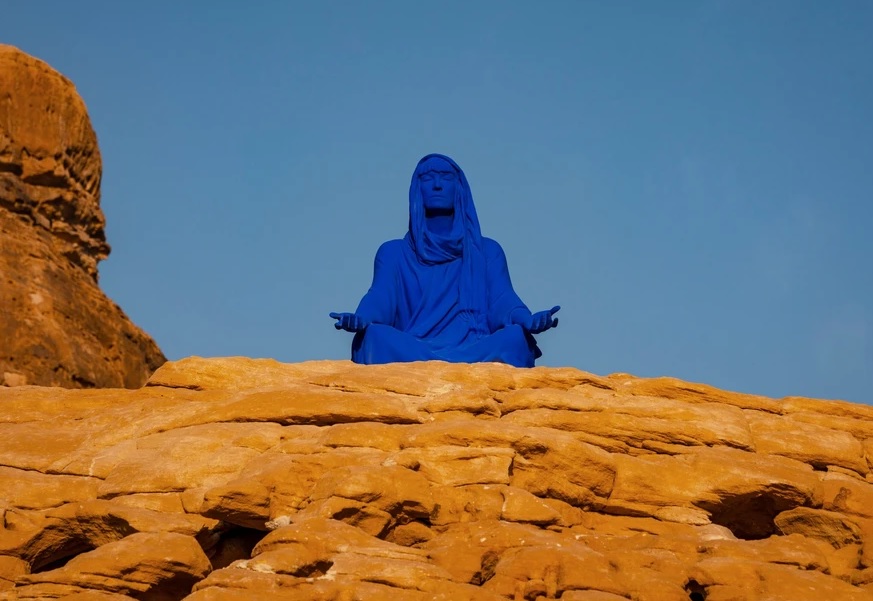
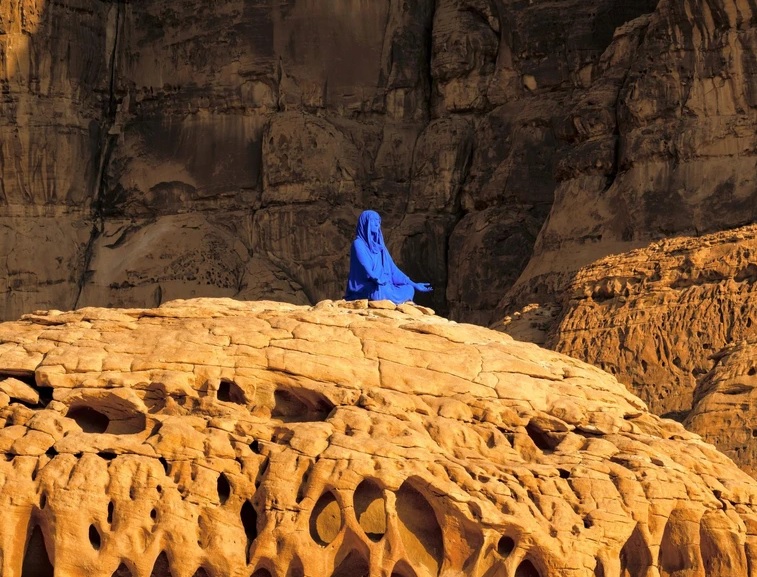
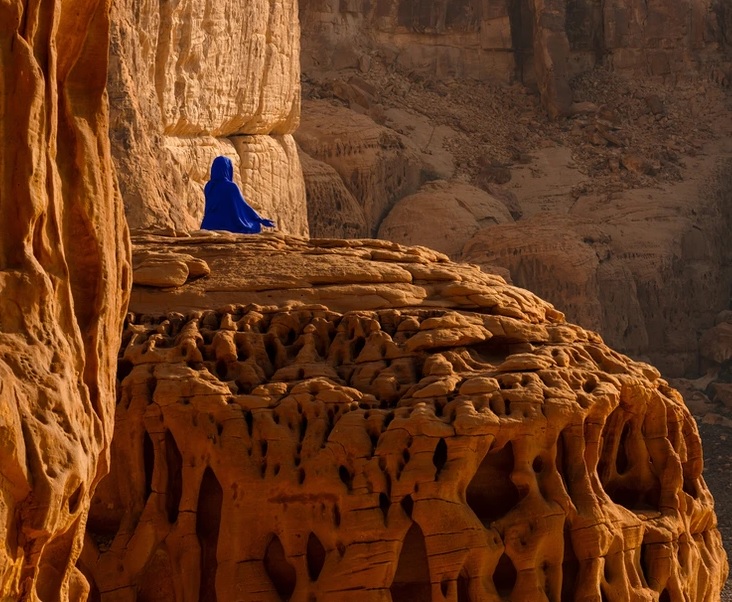
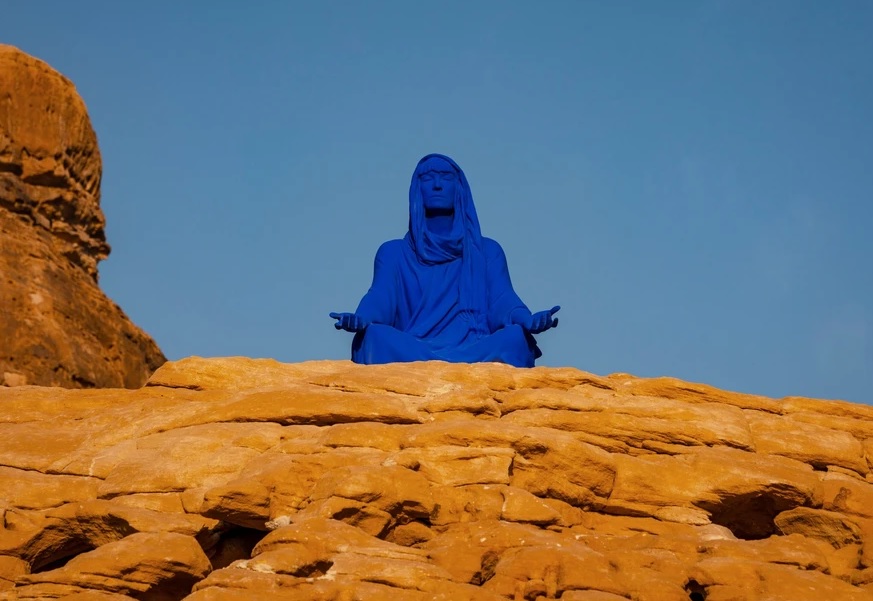
The idol “NAJMA” by Lita Albuquerque was placed in AlUla, the ancient oasis believed to be the location of Thamud, a civilization the Qur’an describes as destroyed by Allah for its arrogance and disbelief
“Seated atop a big anamorphous rock in AlUla, an ancient oasis in the Medina region of Saudi Arabia, is an electric blue sculpture of a woman seated in the meditative yogic position called “lotus.” Her legs are crossed while her hands extend out with her palms open on either knee. Her eyes are closed as she connects with the silence and nature that surrounds her.”
“The work, NAJMA (She Placed One Thousand Suns Over the Transparent Overlays of Space) by Santa Monica-based artist Lita Albuquerque, could be the first time in over 1,000 years that a figurative female sculpture has been displayed in Saudi Arabia, where Islamic art forbids figurative representation, especially of women.”
“Staged as part of the inaugural Desert X AlUla, Albuquerque tells how her fictional female astronaut arrived on earth to spread knowledge and understanding throughout the planet.”
Does anyone want to give us the source for this statement?
“where Islamic art forbids figurative representation, especially of women?”
Where is this from? The Qur’an, The Sunnah, Jurisprudence? Why especially of women? So you see the dig at Islam here.
Well, Madam Blavatsky co-founded the Theosophical Society and wrote books such as: The Secret Doctrine and Isis Unveiled. Isis of course a reference to the pagan goddess and not to the Israeli Security Intelligence Service.
This was the chosen symbol of the Theosophical Society.
Al hamdulilah no Islamic symbols there. Interestingly the symbols are pretty much what we see today. An alliance between Hindu Supremacist, Zionist Supremacist and White Nationalist.
So now back to the blue goddess idol that Saudi Arabia has so proudly installed in AlUla, Arabia.
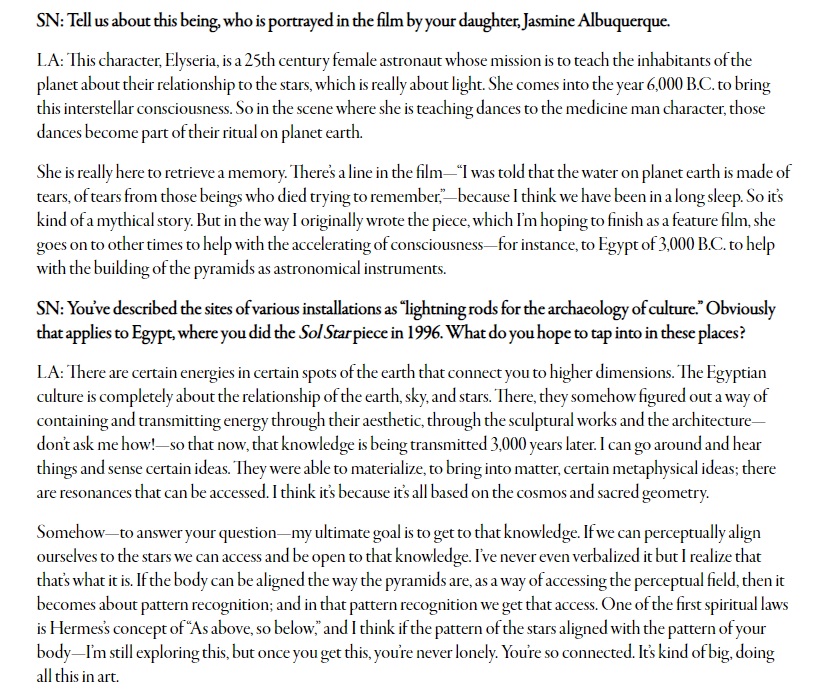
In an article titled: Planet Queen: Lita Albuquerque on Art and the Cosmos we have some interesting information about the above blue goddess.
SN: Tell us about this being, who is portrayed in the film by your daughter, Jasmine Albuquerque.
LA: This character, Elyseria, is a 25th century female astronaut whose mission is to teach the inhabitants of the planet about their relationship to the stars, which is really about light. She comes into the year 6,000 B.C. to bring this interstellar consciousness. So in the scene where she is teaching dances to the medicine man character, those dances become part of their ritual on planet earth.
She is really here to retrieve a memory. There’s a line in the film—“I was told that the water on planet earth is made of tears, of tears from those beings who died trying to remember,”—because I think we have been in a long sleep. So it’s kind of a mythical story. But in the way I originally wrote the piece, which I’m hoping to finish as a feature film, she goes on to other times to help with the accelerating of consciousness—for instance, to Egypt of 3,000 B.C. to help with the building of the pyramids as astronomical instruments.
SN: You’ve described the sites of various installations as “lightning rods for the archaeology of culture.” Obviously that applies to Egypt, where you did the Sol Star piece in 1996. What do you hope to tap into in these places?
LA: There are certain energies in certain spots of the earth that connect you to higher dimensions. The Egyptian culture is completely about the relationship of the earth, sky, and stars. There, they somehow figured out a way of containing and transmitting energy through their aesthetic, through the sculptural works and the architecture—don’t ask me how!—so that now, that knowledge is being transmitted 3,000 years later. I can go around and hear things and sense certain ideas. They were able to materialize, to bring into matter, certain metaphysical ideas; there are resonances that can be accessed. I think it’s because it’s all based on the cosmos and sacred geometry.
Somehow—to answer your question—my ultimate goal is to get to that knowledge. If we can perceptually align ourselves to the stars we can access and be open to that knowledge. I’ve never even verbalized it but I realize that that’s what it is. If the body can be aligned the way the pyramids are, as a way of accessing the perceptual field, then it becomes about pattern recognition; and in that pattern recognition we get that access. One of the first spiritual laws is Hermes’s concept of “As above, so below,” and I think if the pattern of the stars aligned with the pattern of your body—I’m still exploring this, but once you get this, you’re never lonely. You’re so connected. It’s kind of big, doing all this in art.
AS ABOVE SO BELOW!
MUSLIMS! WAKE UP!!! PEOPLE OF IDOL ARABIA WAKE UP!!! PEOPLE WHO CLAIM SALAFIYYAH WAKE UP!!! BY ALLAH WAKE UP!!!
“By the sky and the night comer. And what can make you know what is the night comer? It is the piercing (al-najmu)star – (Qur’an 86:1-3)
But this is not what al najma means in the occult. The Morning Star has a special meaning for them. Especially those in the new age movement. The New Age movement is a Hodge Podge of various competing ideas and concepts. However, there are a few underlying and overlapping views.
There are ascended masters, ancient beings that teach secret doctrines to a few chosen on Earth.
Many people on Earth are actually not human at all! They are simply vessels of higher civilizations aimed at raising the vibration or raising conscious awareness -which many times translates into veganism, feminism, acceptance of lgbtq, male leadership is toxic, sexual liberation-marriage is not necessary, claims to love life but accepting of abortion on a whim.
Goddess worship. The Goddess is suppressed. This can be awakened (again depending upon the movement) by awakening the Kundalini, connecting to Star Beings through mediums etc.
Truth is relative there is no ultimate truth (except of course what the ascended masters, ancient beings or their gurus reveal as such).
DO YOU KNOW THE LOCATION OF WHERE THIS IDOL IS PLACED? AL-ULA!
Until very recently AlUla remained largely closed off to outsiders including to all Muslims – including those in Idol Arabia.
Al Ula is believed to be the location of the ancient city of Thamud, whose people were destroyed by Allah for their disobedience. The Quran mentions the destruction of Thamud in several verses, including (Qura’n 7:73-79), (Qur’an 15:80-84), and (Qur’an 26:141-159).
Narrated `Abdullah bin `Umar:
(While we were going for the Battle of Tabuk and when we reached the places of the dwellers of Al- Hijr), Allah’s Messenger (saw) said about the dwellers of Al-Hijr (to us). “Do not enter (the dwelling places) of these people unless you enter weeping, but if you weep not, then do not enter upon them, lest you be afflicted with what they were afflicted with.”
Say, “O People of the Book! Let us come to common terms: that we will worship none but Allah, associate none with Him, nor take one another as lords instead of Allah.” But if they turn away, then say, “Bear witness that we are Muslims.” (Qur’an 3:64)
﷽
The Eastern Orthodox are a type of hydra where their views on Islam depend on the geo-political climate. insh’Allah we will come to this later.
The global Eastern Orthodox Church is organized into 14 universally or widely recognized self-governing (autocephalous) regional churches. Listed in traditional order of seniority (the diptychs), they include nine traditional patriarchates, the Georgian catholicosate, and five autocephalous national or regional churches. The 15th and 16th churches are a matter of internal dispute among the Eastern Orthodox Church.
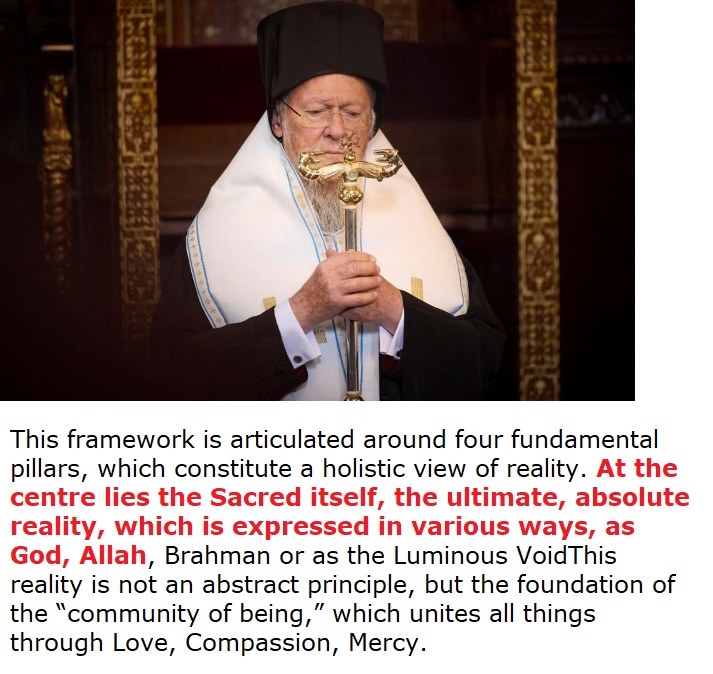
1. His Holiness Patariach Bartholomew of The Church of Istanbul. (Turkey)
As he is called, ‘The first among equals’ Patriarch Bartholomew is the Patriarch of Istanbul. He oversees the community of Orthodox Christians in Turkey. However, his title within his circle is Patriarch of Constantinople.
It has come to our attention is that his holiness Patriarch Bartholomew has recently claimed that ‘At the cewntre lies the Sacred itself, the ultimate, absolute reality, which is expressed in various ways, as God, Allah,
There is also an eye opening quote from an early Church Father that is worthy of a repost here:
“As the Great Cappadocian Father of the Church, Saint Gregory of Nyssa, teaches, it is impossible for anyone to ascend to that height where the light of truth is seen, unless the dead and earthly garment of skins is stripped away from the foundations of the soul… This is truly that which really exists, and the understanding of this is the knowledge of truth.”
as well as:
“The loss of the relationship with the Sacred translates into a loss of the bonds that constitute society, leaving behind it a sum of individuals in competition.”
2. Theodoros II, the Pope and Patriarch of Alexandria and All Africa. (Egypt)
The Pope and Patriarch of Alexandria has said:
“The Orthodox and Muslims are “brothers under the same sky,” «είμαστε αδέλφια κάτω από τον ίδιο τον ουρανό»
3. Patriarch John X Yazigi, whom is called Patriarch of Antioch and All the East. (Syria)
In a meeting with the Greek Orthodox Patriarch John X Yazigi, Syrian President Ahmad Al-Sharaa was presented with a copy of the “Ashtiname of Muhammed”, a document said to be written by Ali ibn Abi Talib in 632 CE on behalf of Prophet Muhammed (saw), which pledges protection for the Christians of the time.
The meeting between the leaders took place in Damascus on Sunday 26 October.
Patriarch Jonhn X Yazigi the Patriarch of Antioch and all the East has said this about Muslims.
“To start, we would like to direct our warmest greetings to the Syrian people as a whole and our Muslim brothers in particular on the occasion of Eid el-Adha. Many happy returns..”
“We as Christians live beside our Muslim brothers in these lands. Nothing separates us from them.”
“When the late Fares al-Khoury was asked about “the protection of Christians”, he quickly took to the pulpit of the Umayyad Mosque and said, “As a Christian member of parliament, I reject French or English protection and I ask the protection of my brothers who are praying with me in this mosque.” This is our history and this is what we continue to affirm always. There are many people with other goals who are trying to spread other ideas, but adversity brings forth real men and we are not afraid.”
4. Patriarch Theophilos iii of Jerusalem and all holy lands. (Palestine)
“He stressed his condemnation of insulting the Islamic faith with the same vigor of condemnation as he would if the insult afflicted any of the other monotheistic religions.”
“Patriarch Theophilos III of Jerusalem – Chairman of the Council of Heads of Churches of the Holy Land, denounced the unfortunate sequence of events in France, which started with insults to Islam and the honorable Prophet Muhammed, and was followed by a murder crime of a teacher on the hands of three students as a retaliation for the insults , which triggered a series of unfortunate crimes that targeted innocent Muslim civilians.”
5. Patriarch Kirill (Cyril) of Moscow and all Rus’. (Russia).
The respected and honourable Patriarch Cyril has said:
“поэтому всего сердца молитесь просите У Господа помощи Я знаю что здесь и христиане и мусульмане каждый обращается к одному и тому же Богу творцу и вот в ответ на это мы получаем реальную Божью помощь.” This is translated as:
“Therefore, pray with all your heart, ask the Lord for help. I know that here there are both Christians and Muslims. Each turns to the same God, the Creator. And in response to this, we receive real help from God.”- Patriarch Cyril of Moscow and all Rus.
6. Patriarch Porfirije. Patriarch of Serbia. (Serbia)
Patriarch Porfirije of the Serbian Orthodox Church Patriarch Porfirije congratulates Muslims on Kurban Bayram(Eid Al Dha). He says:
“On the occasion of the forthcoming Kurban Bayram, We extend Our most sincere congratulations to all faithful of the Islamic religion, with cordial wishes that the All-Merciful Creator may grant them blessing and spiritual strength, and that they may celebrate this great feast with their loved ones in peace, health, and prosperity. May the days of Kurban Bayram, inspired by the steadfast faith of the forefather Abraham, strengthen faith in God and be filled with understanding and mutual respect, in the spirit of the exalted traditional values that this feast embodies.”
7. Patriarch Daniel . The Patriarch of the Romanian Orthodox Church. (Romania)
When receiving a diplomat from Iran the Patriarch pointed out that onyx imported from the Islamic Republic of Iran was used in the arches of the iconostasis doors of the National Cathedral. He maintains cordial relations with Muslims.
9. Patriarch Shio III born Elizbar Mujiri head of the Georgian Orthodox Church (Georgia)
He has only recently been elected. He will most likely follow diplomatic protocol of those who came before him. His huge concern seems to be the rise of abortion and lgbtq activism in Georgia.
10. Archbishop of Nova Justiniana and All Cyprus.
One can say that his attitude towards Islam and Muslims is hostile. This is primarily coloured by the disputes between Turkey and Greece over Cyprus.
11. Archbishop Ieronymos II. Archbishop of Athens and All Greece. (Greece).
His view and position is notably hostile towards Islam and Muslims.
Here is a video of his statements:
12. Archbishop Sawa Archbishop of Warsaw and Metropolitan all of Poland. (Poland)
To our knowledge there really is no negative or positive statement towards Islam and/or Muslims. Muslims are an extreme minority in Poland. Poland for the most part is a homogenous society with the exception of being divided among Eastern Orthodox and Roman Catholic.
13. Joani (Joan), Archbishop of Tirana, Durrës and All Albania, Exarch of Illyricum. (Albania)
It is claimed that he was born into a non-practicing Bektashi “Muslim” family (a Sufi Islamic order prominent in Albania) under the country’s strict communist regime, before secretly converting and baptizing into Christianity in 1979. We use “Muslim” as we do not recognize the terminology of non-practicing Muslim. The term is an oxymoron. We want to draw attention to this. He was brought up in a secular household with secular values that had cultural attachments to Islam.
Nonetheless he has maintained cordial relations with the Muslim community. Congraulating the believers on the occasion of Eid al Fitr.
14. Rastislav Archbishop of Prešov, Metropolitan of the Czech Lands and Slovakia. (Czech Republic and the Republic of Slovakia).
To our knowledge there really is no negative or positive statement towards Islam and/or Muslims. To our knowledge the Muslim communities in the Czech Republic and Slovakia are quite small. They are mostly homogenous socities. The bigger divide being between Roman Catholic and the Eastern Orthodox.
15. This one we really cannot grant because the Eastern Orthodox Church has not been guided by the Holy Spirit in this matter. They have no consensus on either the status of the The OCA (Orthodox Church in America), as being self governing or a branch of the Russian Orthodox Church.
The OCU (Orthodox Church of Ukraine) is also one disputed in general.
So the Eastern Orthodox Church has not reached a consensus on the recognition of either as being a
It is divided on rather or not the OCA or OCU can be universally counted as the 15th autocephalous church.
Recall our statement: The Eastern Orthodox are a type of hydra where their views on Islam depend on the geo-political climate.
This is true. Those churches who live under the authority of Muslim majority governments, or have family members who have married among the Muslims have positions that are more cordial.
The history of the Ottoman empire invites different responses as we saw from the Bulgarian, Romanian, Greek and Cyprus churches.
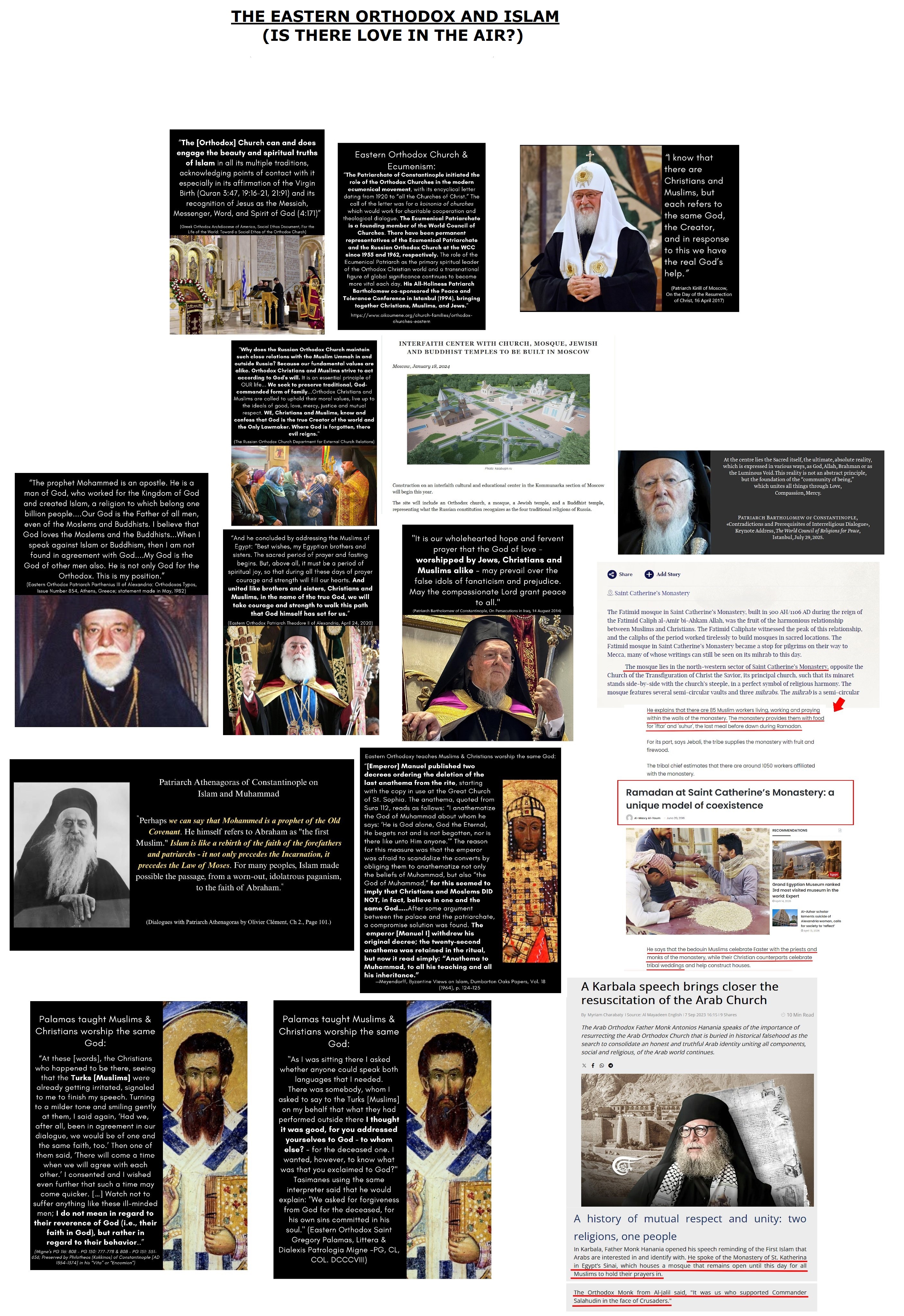
Accordingly, the Patariach Bartholomew of The Church of Istanbul as well as Patriarch Kirill (Cyril) of Moscow and all Rus’ have all but confirmed that the Allah of Islam is the same God that Christians worship.
Eastern Orthodox laity and catechumen should be very careful to watch their words concerning Allah (swt). Until their is a council that is convened and the 14 churches come to an agreement on thier position in regard to Allah (swt) it cannot be said that the Eastern Orthodox Church has an ‘offical position’ for or against.
What would be akward however, is that Eastern Orthodox Christians in Syria, Palestine, Jordan, Iraq, Egypt, Turkey and other places very often use the word Allah in their liturgy and day to day worship.
“Have they not travelled throughout the land so their hearts may reason, and their ears may listen? Indeed, it is not the eyes that are blind, but it is the hearts in the chests that grow blind.” (Qur’an 22:46)
“When they listen to what has been revealed to the Messenger, you see their eyes overflowing with tears for recognizing the truth. They say, “Our Lord! We believe, so count us among the witnesses.” (Qur’an 5:83)
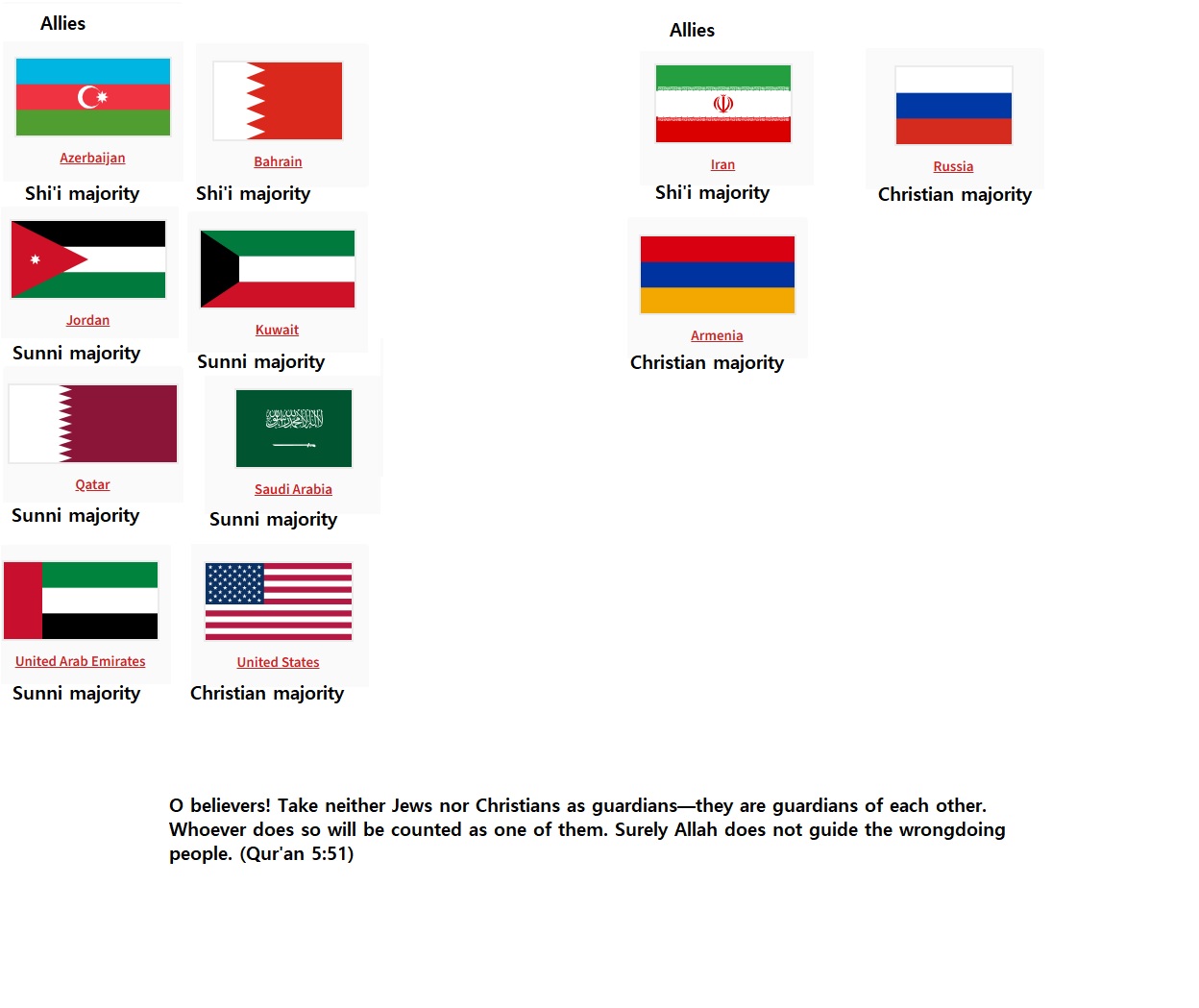
[Click on the image above. Then right click that image and select open image in new tab. Ctrl and mouse wheel or Ctrl and +,- to zoom in/out.] Voila!
May Allah (swt) guide the sincere Christians to the truth and save them form the torment of the hellfire.
“As for those who struggle in Our cause, We will surely guide them along Our Ways. And Allah is certainly with the good-doers.” (Qur’an 29:69)
﷽
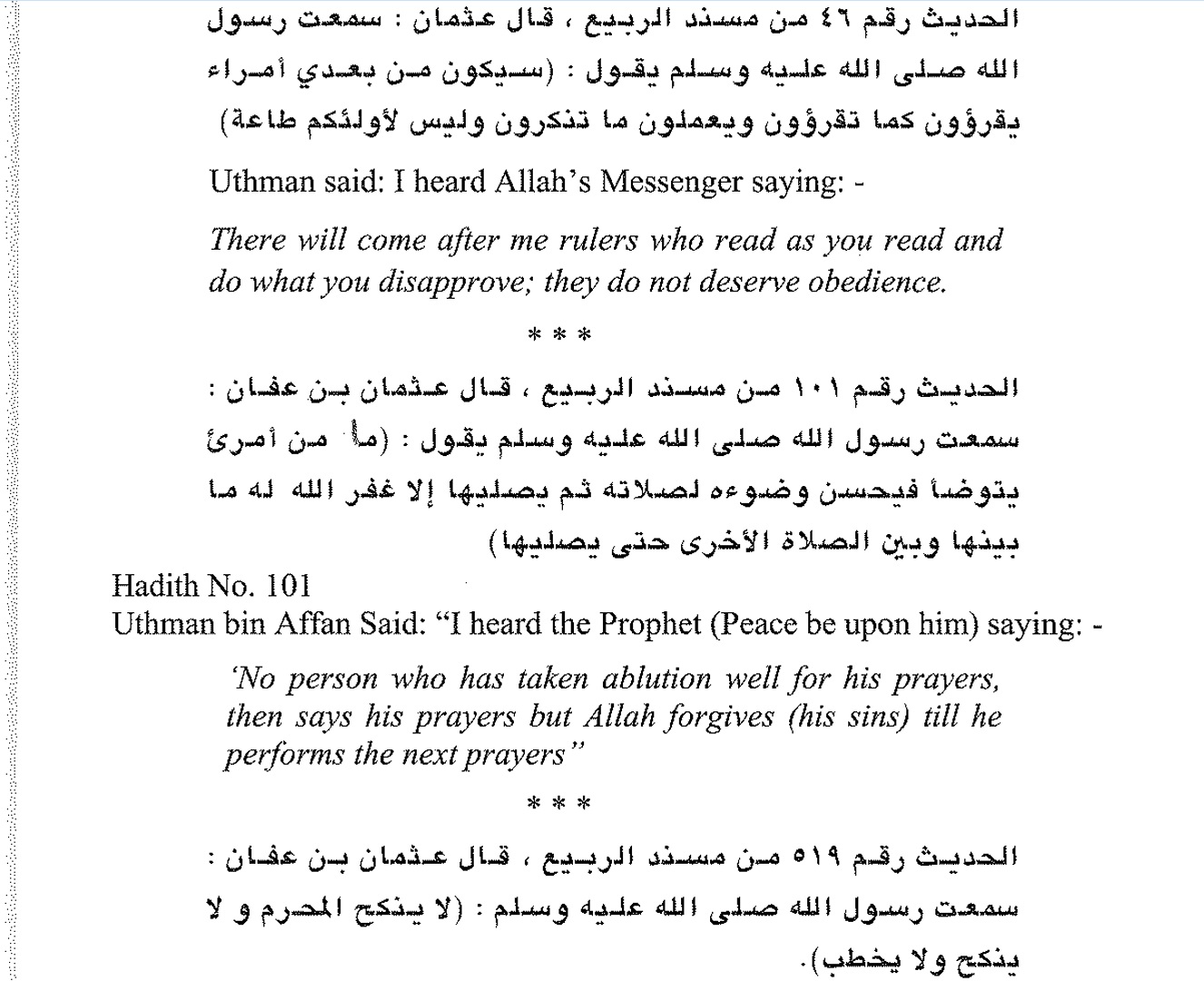
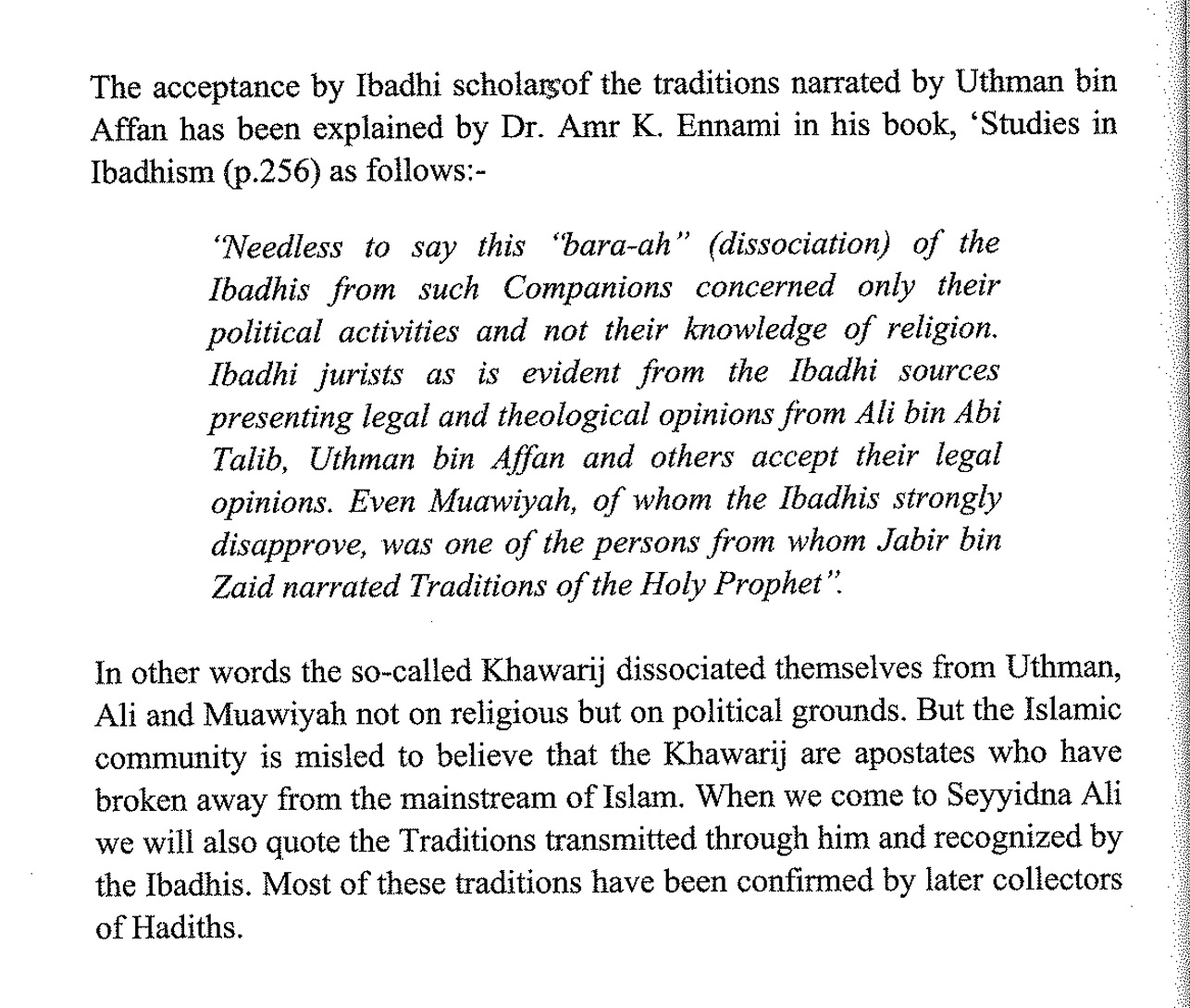
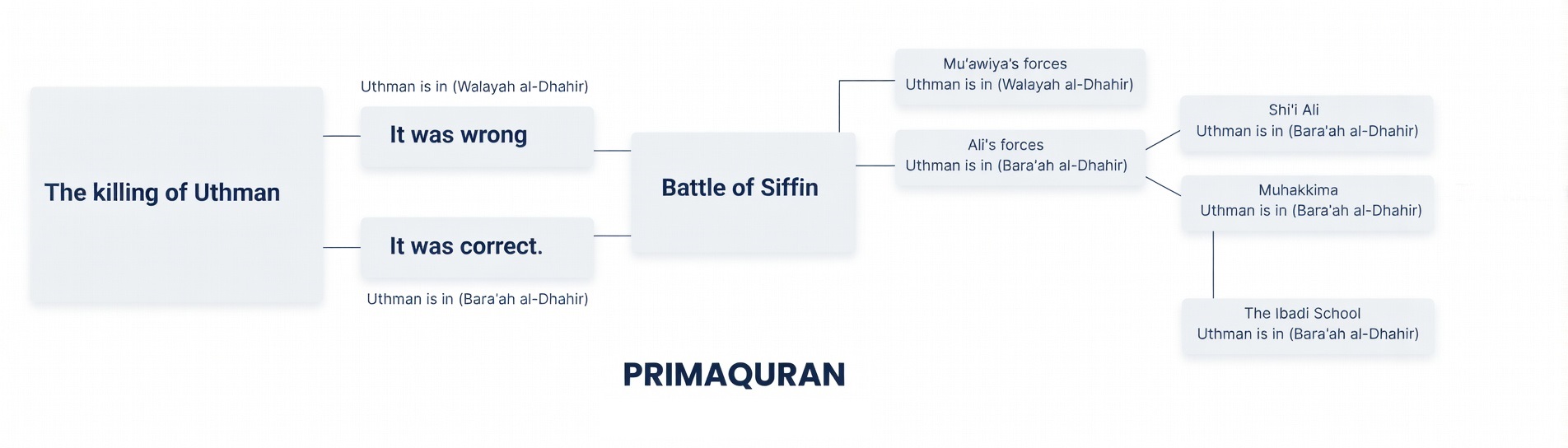
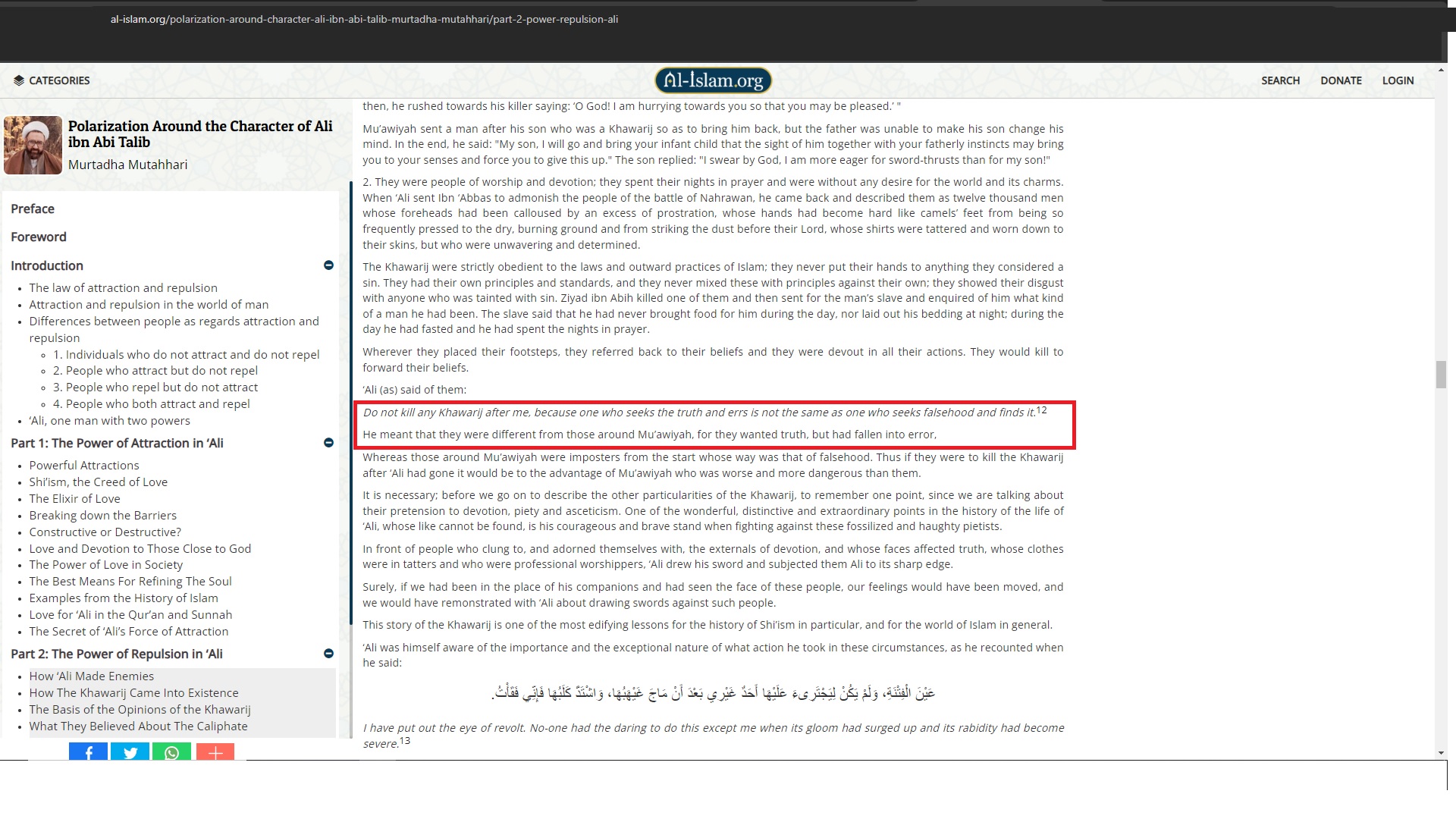
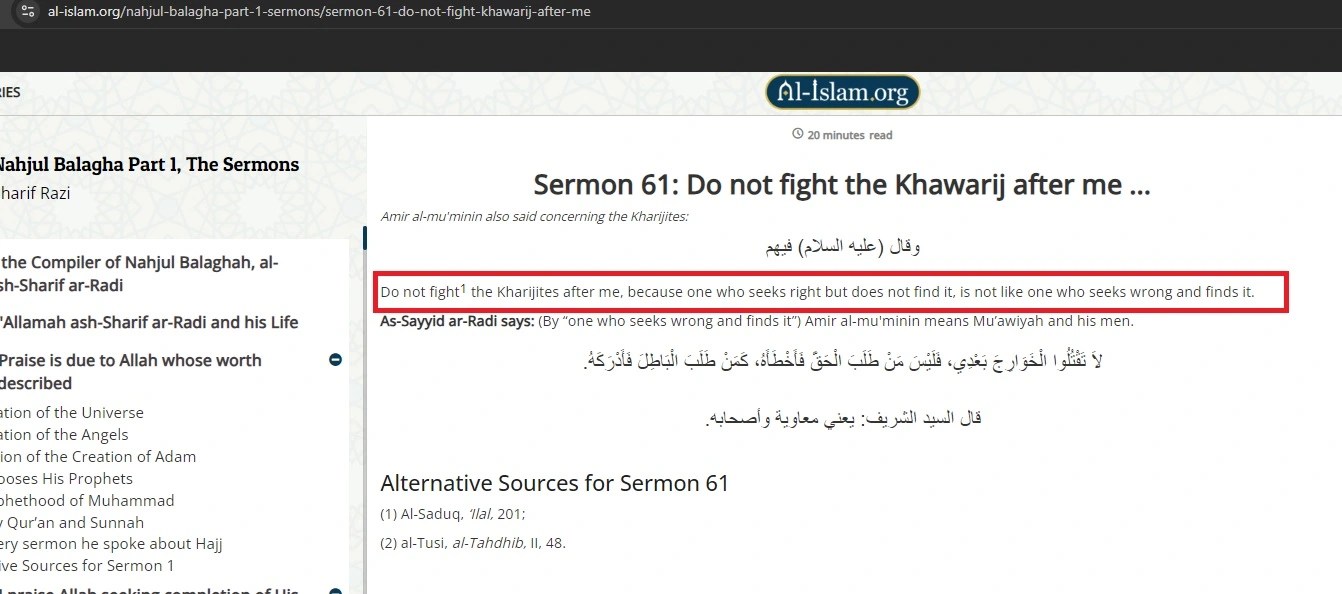
One of the searchers for truth among the Shi’i has had some questions to the Ibadi in regard to the matters of Siffin and Nahrawan.
Question: Why did the people who differed with Ali over the arbitration not continue fighting if Ali had stopped fighting?
Answer: It is not permissible to continue the fighting while they are without an imam, for fear that they will die a death of ignorance. They must be under the banner of an Imam. So, a new imam should have been appointed. It is not reasonable to appoint an imam while they are at war. They must rest a little and agree on a specific person away from the battle front.
The people were angry with him because the consensus of the nation is that he (Ali) is the legitimate caliph and those who rebelled against him are rebels according to the text of the Qur’an and must be fought. But his pledge of allegiance was broken, so how could Imam Ali be a caliph when he submitted to the rule and accepted the two arbitrations, and how could they pledge allegiance to him as caliph when he was not of their opinion and did not join them?
Question: Why didn’t the people of Nahrawan after electing Abdullah ibn Wahb Al-Rasibi press the attack against Mu’awiya and his forces?
Answer: How do we know if the people of Nahrawan wanted to fight Mu’awiya?
Did Ali give them a chance to do as such? He surprised them with his army and caused their deaths through the treachery of al-Ash’ath himself, whom had forced (Ali) into arbitration. Likewise, the people of Nahrawan are innocent because they were never followers of Mu’awiya, otherwise they would not have refused to pledge allegiance to Mu’awiya and they were fought against the Umayyad state. This is well known from history.
You may also be interested in reading the following:
“We have sent you only as a mercy for the whole world.” (Qur’an 21:107)
﷽
Face to Face with the Blessed Prophet (saw): How Oman Preserved Pure Islam Through Unbroken Transmission.
This will be a translation of the talk given by Shaykh Hilal Al Barwani (h) below:
The school of reciters: A starting point in Omani History -Shaykh Hilal Al Barwani (h).
Allah-Willing this lecture will establish a few key points.
The Islam of Oman was not a late or secondary arrival. It was taken directly, face-to-face, from the Prophet Muhammed (saw) through multiple delegations (wufud), and preserved through an unbroken, mutawatir (mass-transmitted) chain of transmission. Due to Oman’s geographical remoteness, this Islam remained pure, uncorrupted by foreign influences (Persian, Roman, Greek, Indian).
The Delegations (Wufud): The Shaykh lists at least 12 delegations from Oman to the Prophet (saw), including:
Mazin bin Ghadhub Al-Ta’i (three separate visits: pre-Hijra, 3 AH, 7 AH). The Prophet (saw) famously prayed for Oman: “O Allah, guide them and reward them… grant them chastity, sufficiency, and contentment… do not empower an outsider enemy against them.”
Delegations from Bani Nabhan, Bani Tahiyeh (including Ka’b bin Bursha’, who recognized the Prophet’s description in the Torah and Gospel), Bani Al-Haddan, Bani Thamalah, Bani Al-Farahid, Al-Atiq, Abdul Qais, Bani Rasib (Abdullah bin Wahb Al-Rasibi), and even a delegation of Omani women who met Aisha (ra).
Early Mosques and Qiblas: The existence of mosques in Oman oriented toward two qiblas (first Jerusalem, then Mecca) proves that prayer was established before the Prophet’s migration to Medina.
The School of the Reciters (Qurra’): After the Blessed Prophet’s school at Dar Al-Arqam in Mecca, the “School of the Reciters” was established in Medina. These Qurra’ (who memorized Quran, knew Sunnah, and reasons for revelation) were the elite missionaries, judges, and army leaders. Their tragic martyrdom at Bi’r Ma’unah and later at Nahrawan (alongside Abdullah bin Wahb Al-Rasibi) is highlighted.
Imam Jabir bin Zaid (18-21 AH – c. 93-103 AH): The central figure in preserving Omani Islam. A Tabi’i (Follower), he met 70 Companions who fought at Badr, traveled 40 times for Hajj to collect narrations, and copied the Blessed Prophet’s letter on sadaqat from the sons of Amr bin Hazm. He founded the school of Ahl al-Haqq wal-Istiqamah (People of Truth and Righteousness). His students included Abu Bilal Mirdas, Abdullah bin Ibadh, and Salim bin Dhakwan.
Codification (Tadwin): The lecture argues that Imam Jabir bin Zaid was the first to codify the Blessed Prophetic Sunnah, before any other school. This codification passed through Abu Ubaidah Muslim bin Abi Karimah → Al-Rabi’ bin Habib → then to Oman (Mahbub Al-Rahil in Sohar, Abu Al-Mundhir in Nizwa, Abu Ali Al-Azri in Izki).
Al-Khalil bin Ahmad Al-Farahidi (d. 175 AH / 791 CE): An Omani scholar who founded Arabic prosody (‘arud), diacritical marks, grammar (nahw), and authored the first Arabic dictionary (Kitab Al-‘Ayn), all in service of the Quran.
Reasons for Marginalization: Economic blockades, famine, migration to Africa, lack of enduring institutions (unlike Al-Azhar or Qayrawan), focus on tribal wars, and the burning of libraries by Abbasid forces (e.g., Ibn Bur). Over 12,000 Omani manuscript titles exist but lack publication and institutional support.
Lost Heritage: The repeated references to lost or unprinted manuscripts (Jami’ Abi Safrah, Musnad of Al-Rabi’, Diwan Al-Muarad, Jabir bin Zaid’s original books) point to a rich but endangered scholarly tradition.
Praise be to Allah, Lord of the worlds. We praise Him, the Exalted, seek His help, His guidance, and His forgiveness for all sins, and repent to Him. We send prayers and peace upon our Master Muhammed, and upon all his family and companions. Allah, the Glorified and Exalted, sent him as a mercy to the worlds. He delivered the message, fulfilled the trust, advised the nation, removed distress, and strove in the way of his Lord until certainty came to him. We ask Allah, the Glorified and Exalted, to make us among those who listen to the saying and follow the best of it. So, peace be upon you, and the mercy and blessings of Allah.
In this pleasant and blessed meeting, in a house among the houses of Allah, and in this gathering, we wish to present some of what concerns us from the history of our nation. That is the period during which the Messenger (saw) was sent, how it happened, and how our forefathers transmitted this Islam to us, and their relationship with the Messenger (saw). This is because historical references need someone to read and review them, and they need someone to study them. Also, much of what was written in the Omani biographical literature (Siyar) has not seen the light of day. Many of these Siyar still need verification, printing, and study.
Because people have not fully grasped this history, nor have they known it, if someone were to ask them: “How did Islam reach you? From whom did you take the religion? The Messenger (saw) was sent in Mecca and Medina, so how did you (in Oman) receive it? Who transmitted Islam to you from there to here?” In this phase, meaning in this context of historical understanding, we must know about the delegations that came from the people of Oman to the Messenger of Allah (saw).
And also the second point: the role of the scholars from the people of Oman in establishing the principles of Islam by establishing various schools, the codifications (mudawwanat) they wrote, the books they authored, and through which they preserved Islam. Islam remained with them in a strong context, untouched by alteration, substitution, or distortion. With Allah’s will, I will address two points.
The First Point: The delegations (Wufud) that came from the people of Oman to the Messenger of Allah (saw).
Of course, history mentions that a number of people from Oman came as delegations to the Messenger of Allah (saw). I will mention some of these delegations to make it clear to everyone that your fathers and forefathers took Islam through continuous transmission (mutawatir) from the Messenger of Allah (saw), generation after generation, group after group, so that it becomes firmly established in every person’s mind that the Islam our fathers and forefathers preserved was pure and correct, originating from the Messenger of Allah (saw).
These are the delegations that set out to the Messenger of Allah (saw) when they heard of his mission. As you know, only Mazin bin Ghadhub Al-Ta’i is studied in the school curricula, and his meeting with the Messenger (saw) is studied as if he was an individual who visited the Messenger (saw). However, in history books like the history of Ibn Kathir’s Al-Sirah Al-Nabawiyyah and books on the biographies of the Companions, it is mentioned that Mazin had three delegations.
It is mentioned in the book Subul Al-Huda wal-Rashad that a narration from Mazin bin Ghadhub says: “We arrived to the Messenger of Allah (saw) in Mecca Al-Mukarramah.” This narration indicates that Mazin met the Messenger (saw) in Mecca before his migration to Medina. He said: “We found Abu Bakr Al-Siddiq (RA), and he guided us to the Messenger of Allah (saw.” This indicates that there was a meeting between the people of Oman and the Messenger (saw). This view is supported by the fact that when Prophet Ibrahim (AS) built Mecca, he supplicated to his Lord: “My Lord, I have settled some of my descendants in an uncultivated valley near Your sacred House, our Lord, that they may establish prayer. So make hearts among the people incline toward them…” Thus, visitors to the Sacred House have come since the time of Prophet Ibrahim, so there were necessarily people from the tribes of Oman and the land of Oman who came to Mecca. This is evidence that they met the Messenger before his migration to Medina.
A second piece of evidence supporting this view is the existence of some mosques in Oman oriented towards the two Qiblas, such as one with us in Ibra, one mentioned in Nizwa, or some other mosques. This also indicates that they established prayer… What? Before the Messenger’s (saw) migration to Medina, and therefore they used to face Al-Aqsa Mosque.
The third piece of evidence is found in some graves indicating that, before Islam, they used to bury their dead facing Al-Aqsa Mosque, not facing the Qibla of the Kaaba. All these pieces of evidence support the view that the people of Oman met the Messenger (saw) in Mecca before his migration to Medina.
The second matter: After the migration, it is also narrated that Mazin came to the Messenger (saw). This is mentioned in the books of Companions’ biographies (those who met the Messenger). Mazin met the Messenger a second time in the third year of the Hijra. The books of Companions’ biographies detail this journey: he set out to the Messenger (saw). Of course, as you know, in that past time, it was not possible for a person to travel alone from these remote, distant areas to Medina due to the distance and the danger of the road. Therefore, they would travel in a caravan, a group, or a delegation. Also, as was the custom of the Arabs when meeting with rulers and princes, one would not go alone but rather in a delegation or a caravan with his group and family. So, they set out in a delegation.
It is also mentioned that among the delegation with Mazin bin Ghadhub in the sixth year was his student and servant, Abu Al-Kathir Salih bin Al-Mutawakkil. They arrived to the Messenger of Allah (saw) in Medina, stood before him, and recited verses found in history books and Companions’ biography books, saying: “To you, O Messenger of Allah, my mount wearily travels, crossing deserts from Oman to Al-Arj, so that you may intercede for me, O best of those who tread the earth, and my Lord forgives me, and I return with success.”
Out of love, honor, and reverence for the Messenger of Allah (saw), he recited the poem. It is narrated that the Messenger (saw asked him, “Who is this who is with you?” – referring to his young servant. He said, “This is my servant, Abu Al-Kathir Salih bin Mutawakkil.” The Messenger (saw) said, “Take good care of him,” so Mazin set him free in the presence of the Messenger (saw), out of love, reverence, and honor for the Messenger of Allah (saw).
As you know, when Mazin bin Ghadhub went out the first time he met him, and now the second time with those from Oman, what were they carrying? They were the nation (Ummah), wanting to save the nation from the ignorance (Jahiliyyah) they were upon. Mazin said to the Messenger (saw): “Supplicate to Allah for the people of Oman.” The Messenger (saw) said: “O Allah, guide them and reward them.” Mazin said, “More, O Messenger of Allah.” He said: “O Allah, grant them chastity, sufficiency, and contentment with what You have given them.” Mazin said, “More, O Messenger of Allah. The sea splashes next to us, so supplicate to Allah regarding our sea produce, our footwear (khuff), and our livestock (dhalf).” He (saw) said: “O Allah, increase the good from their sea for them, and bless them in their footwear and livestock.” Mazin said, “More, O Messenger of Allah.” The Messenger (saw) said: “O Allah, do not empower an outsider enemy against them. Say ‘Ameen,’ O Mazin.” So he said ‘Ameen,’ and then the supplication is answered.
Of course, after that, Mazin requested supplication for himself. The rest of the narration or story is known to you. In it, Mazin said upon returning to Oman, as mentioned in Ibn Kathir’s Al-Sirah Al-Nabawiyyah: “Then my people rebuked me, blamed me, and treated me harshly. They ordered their poet to satirize me. I said, ‘If I satirize them, I satirize myself.’ So I withdrew to one side, built a mosque, and stayed there…” The mosque upon his return in the sixth year after (meeting) the Messenger. He established the mosque and raised the call ‘Hayya ‘ala as-Salah’ (come to prayer) in it, and established the congregation. At that time, in Mecca, the Adhan had not been raised, nor was prayer established. So the Adhan was raised and prayer was established in Oman before Mecca, because Mecca was conquered in the eighth year of the Hijra, while Mazin established the mosque and raised the call to prayer there from the sixth year.
He says: “Then my people said… This mosque, no one in need would come and supplicate to Allah except that Allah answered him, nor would a sick person come and supplicate to Allah except that He cured him. He says: Then my people blamed themselves and came to me saying, ‘Yours is your religion, and you are the one in charge of our affairs, so return to us.’ So I returned to them.” Then he says: “Then Allah guided a people from Oman, and they entered Islam.” He says: “And in the following year, i.e., the seventh year of the Hijra, those whose souls yearned (for the Prophet) also came, accompanied by people from Oman, when he had told them about the Messenger’s (saw) conduct. They went to the Messenger of Allah (saw), and the Messenger (saw) gave them glad tidings, saying: ‘O pure one from the pure ones, O most generous from the most generous ones, Allah has guided a people from Oman, and they have entered Islam. Allah has made Oman prosperous and increased profits and abundant goodness from the land and sea.’ The Messenger (saw) said: ‘My religion is the religion of Islam, and Allah will increase the people of Oman in Islam. So blessed (Tuba) is he who believes in me and sees me, and blessed is he who believes in me but does not see me, and blessed, and then blessed is he who believes in me but does not see me, nor sees the one who saw me.'”
So here are three delegations with Mazin: before Mecca, the third year, and the seventh year.
Likewise, it is also mentioned – and you know that Mazin bin Ghadhub is from Bani Tayy, from As-Sa’di, from Sa’d Tayy in Samail – that there was another delegation. Perhaps it was with Mazin, before, or after – Allah knows best – but history does not mention it. They were from Bani Nabhan of Tayy, led by Khalid bin Sadus bin Asma’ Al-Nabhani, accompanied by Yazid bin Jabir bin Asma’ Al-Nabhani. They came to the Messenger of Allah (saw), embraced Islam, and took Islam directly from him.
So, how many delegations now? Four delegations. Also, in the sixth year when the Messenger concluded the Treaty of Hudaybiyyah, and in the seventh year he began writing to the leaders and kings of the world. The Messenger (saw) sent a letter to Kisra Shiroweih, the king of Persia. When the letter reached the Persian king, he tore it up. He wrote to his governor… so Allah empowered his son Shiroweih over him, who killed his father Kisra and Shiroweih and seized control of the Persian lands. Then Shiroweih wrote to some of his governors in Oman, called the Marzaban, saying: “Select for me a man, Arab-Persian (i.e., fluent in both languages), and send him to investigate the matter of this man (Muhammed).” So he selected Ka’b bin Bursha’ Al-Tahi from Bani Tahiyeh of the desert… So they formed a delegation – as you know, one cannot travel alone – and they came to the Messenger of Allah (saw). This was the first delegation from Bani Tahiyeh.
Ka’b bin Bursha’ Al-Tahi had read the scriptures of the People of the Book, the Torah and the Gospel, leaving nothing, and recognized what was in them. He knew the descriptions of the promised Prophet who would be sent at the end of time. When he arrived in Medina, he threw down his riding stick (signifying travel gear) before the Messenger (saw), sat with him, and began to learn from him, asking him about Islam and what he calls to. The Messenger (saw) clarified for him. He found those descriptions mentioned in the books of the People of the Book applied to the Messenger (saw). The proof was established for him, he entered Islam, and brought those with him into the religion. He returned to Oman and informed the Marzaban there of the truth of the Messenger’s (saw) prophethood. The Marzaban said, “Give me time until I return to Persia.” Ka’b began to inform the people of the truth of the Messenger’s (saw) prophethood, of the evidence and proofs he saw, and that the descriptions in the Torah and Gospel applied to the Messenger (saw). The souls of the people of Oman, the people of Sohar (Ka’b was sent from Sohar), yearned for the meeting with the Messenger (saw).
It is narrated that the Messenger, in the sixth year of the Hijra, sent Abu Zaid Al-Ansari (whose name was Thabit bin Qais bin…) to the people of Oman to call them to Islam. He sent Abu Zaid Al-Ansari in the sixth year, and he remained until the eighth year when Amr bin Al-Aas came, calling them to Islam and managing their affairs.
Also, after the return of the delegation of Bani Tahiyeh, the Messenger (saw) sent Al-Ala’ bin Al-Hadrami as governor over Oman and Bahrain. At that time, Bahrain was part of Oman. He sent him as governor over Oman and Bahrain. When Al-Ala’ Al-Hadrami arrived – and the Messenger (saw) had written a letter for him, a letter that exists in the Omani Sirah, printed but without verification, in the book Al-Muntakhab by the Ministry of Heritage – it is the Sirah of the Messenger of Allah (saw) by Al-Ala’ bin Al-Hadrami, which is the oldest Sirah. So the people of Oman formed a delegation led by Asad bin Yabraḥ Al-Tahi. They came to the Messenger of Allah (saw), met him, and took Islam directly from him, face to face. The Messenger taught them directly, and they took it by word and deed. They stayed with him, studied under him, and were honored by his companionship. When they wanted to return, they said, “O Messenger of Allah, send with us someone to teach us the matters of our religion.” Mukharrib Al-Abd (whose name was Mudrik bin Khowt) stood up and said, “O Messenger of Allah, send me with them, for they have a favor upon me. They captured me on the day of Janoub and then freed me as a favor.” So the Messenger (saw) sent them with him to Oman.
How many delegations now? Mazin’s three, the delegation of Bani Abban is four, the delegation of Ka’b bin Bursha’ Al-Tahi is five, and the delegation of Asad bin Yabraḥ Al-Tahi is six. All of them were from the desert region. So, six delegations.
When they came to Oman, Islam began to spread, and they themselves spread Islam. It is said that the Azd of Oman formed a delegation led by Salamah bin Iyadh Al-Azdi. They came to the Messenger of Allah (saw) – these delegations are mentioned in Ibn Sa’d’s Al-Tabaqat Al-Kubra – they met with him, learned from him, and took Islam directly from him, face to face. Then, when they wanted to return, they said, “O Messenger of Allah, supplicate to Allah to unite us.” The Messenger (saw) said: “O Allah, unite us.” So they returned to Oman, Islam spread among the people of Oman, and began to spread among the tribes.
Then the people of Oman formed two more delegations: the delegation of Bani Al-Haddan and the delegation of Bani Thamalah. As you know, there are mountains called the Haddan mountains, belonging to Bani Shams, Ma’awil bin Shams, and Tahi bin Shams, all from the Azd of Oman. The author of Al-Tabaqat says that they had already entered Islam in Oman (meaning they were Muslims when they left Oman, but they wanted to be honored by the company of the Messenger). The delegation of Bani Al-Haddan was led by Musalliyah bin Hazzan Al-Haddani, and the head of the delegation of Bani Thamalah was Abdullah bin Illas Al-Thamali. They came to the Messenger (saw), stayed with him, sat by his side, and sought blessings from his company. The Messenger (saw) wrote a letter for them when they wanted to return to Oman, which included: “In the name of Allah, the Most Gracious, the Most Merciful, from Muhammed, the Messenger of Allah (saw), to the dwellers of the coasts and the valleys of Sohar…” It is a letter regarding charity (Sadaqat), also found in Al-Tabaqat Al-Kubra, written by Thabit bin Qais bin Shammas, witnessed by Sa’d bin Ubadah and Muhammed bin Maslamah. They came to Oman, established themselves, and Islam spread throughout Oman, and they began teaching the people.
How many delegations now? With Allah’s will: Mazin’s two (or three), Bani Abban is four, the two Bani Tahiyeh delegations are six, the Azd of Oman delegation is seven, Al-Haddan delegation is eight, Bani Thamalah delegation is nine. Also, the delegation of Bani Al-Farahid.
Ibn Duraid, who is from Sohar and a famous scholar of the Arabic language, author of Al-Jamharah and Al-Ishtiqaq, lived in the third century (AH). He met Imam Al-Salt bin Malik in Nizwa and stayed with him. Ibn Duraid said: “I went out to Nizwa during days of rain and fertility. Imam Al-Salt bin Malik (may Allah have mercy on him) said to me, ‘Listen to us tomorrow, insha’Allah. We will pray two rak’ahs and supplicate to Allah to remove the rain from us,’ due to the heavy rainfall that had damaged houses. So he sat with him. In the morning, Imam Al-Salt prayed two rak’ahs and supplicated to Allah to place it on the mountains, hills, and tree growths – meaning he supplicated to Allah to lighten the rain for them. Ibn Duraid said: ‘The first one from the people of Oman to come to the Messenger of Allah (saw) was my grandfather Hammam bin Jarw bin Wasi’ Al-Farahidi, along with some people from his tribe.’ He said ‘with some people from his tribe,’ indicating it was a delegation, but it’s not specified whether it was before or after these other delegations. He said ‘the first,’ so perhaps it is among the earliest delegations that came to the Messenger (saw), perhaps even in Mecca – and Allah knows best. Because his phrasing is ‘The first from the people of Oman to come to the Messenger of Allah (saw) was my grandfather Hammam… with some people from his tribe.’ So it wasn’t just one individual, but they stayed with him, learned from him, and returned to Oman.
So, how many delegations now? Ten. The eleventh delegation is the delegation of Al-Atiq, led by Abu Safrah Sarif bin Dhalim from Sohar and also Dibba. He came to the Messenger (saw) wearing a yellow turban dragging behind him by a forearm’s length, with dignity and awe. The Messenger (saw) asked, “Who are you?” He said, “My name is Sarif bin Dhalim” (in one narration, ‘Sariq bin Dhalim’). The Messenger (saw) said… in a narration, ‘Ibn Al-Halqan, Ibn Al-Julanda, Ibn Al-Mustakbir, who seizes every ship by force’… narrations vary. The Messenger said, “Leave ‘Sarif’ or ‘Sariq’ and ‘Dhalim’ (names implying theft and injustice); you are Abu Safrah.” He said, “I bear witness that there is no god but Allah and that you are the Messenger of Allah, truly, truly. Allah blessed me with 18 children, and the last of them was a daughter, so I named her Safrah.” They stayed with him. However, it is mentioned that this delegation might have been after the eighth or ninth year of the Hijra.
So, delegations so far: 11.
The delegation of Abdul Qais: The author of Al-Tahdheeb (in the biography of the Companions) said that the delegation of Bani Abdul Qais came to the Messenger (saw). Their leader or chief was Al-Mundhir bin Al-Harith bin Abdul Qais. He was from Oman. He came to the Messenger (saw) and sat with him, wearing his best clothes. When they sat with the Messenger (saw) and he looked at them, he said: “There are two qualities in you that Allah and His Messenger love: forbearance (Hilm) and deliberation (Anah).” The author of Al-Tahdheeb said he was from Oman.
So, delegations now: 12.
The delegation of Bani Rasib, led by Abdullah bin Wahb Al-Rasibi. Sheikh Salim bin Hamud (Al-Siyabi) mentions in his book that he came as a delegation to the Messenger (saw) with his group and people from Oman. He stayed with the Messenger (saw), and his companionship was established. It is also mentioned in his biography that afterwards, perhaps they participated in the conquests during the time of Umar bin Al-Khattab (RA). When Umar (RA) wrote to his governor in Oman, Uthman bin Abi Al-Aas Al-Thaqafi, to advance to fight the Persians, crossing the sea, and after they were victorious, Al-Khattab gave them a part of Basra. They settled there. Later, when Sa’d bin Abi Waqqas needed help during the conquest of Persia, he wrote a letter to Umar bin Al-Khattab (RA) requesting assistance, so Umar wrote to Abdullah bin Wahb Al-Rasibi to come to him. He was the right-hand man in the conquests of Iraq. He participated twice: with the people of Oman and in the conquest of Iraq.
Also, the delegation of the women of Oman. As you know, women also used to go for Hajj. In Lawahaq Al-Musnad, Abu Sufyan (may Allah have mercy on him) said: “Azwar (the best I met from Oman) told me that some women from Oman entered upon Aisha (RA) during the days of Hajj… They entered upon Aisha (RA), and she asked them, ‘Who are you?’ They said, ‘From the people of Oman.’ She said, ‘I heard my beloved (saw) say: “Many people from Oman will come to my Basin (Hawd).”‘”
These are some of the delegations mentioned. See, even the women of Oman – from where did we take Islam? From the very heart of the Messenger’s (saw) house. We met the Mothers of the Believers and learned from Aisha (RA). Also, when the Messenger (saw) passed away to the Highest Companion, the news reached Oman. The people of Oman formed a delegation led by Abdul Janda, the ruler of Oman, accompanied by Amr bin Al-Aas. Seventy people from Oman went out with him. They came to Abu Bakr Al-Siddiq (RA), expressed their condolences regarding the Messenger (saw), and pledged allegiance to his Caliphate. They accompanied Amr bin Al-Aas and said, “This is a trust that the Messenger (saw) sent to us, and we return your trust to you.” So, see, 70 people from Oman stayed with Abu Bakr, with Al-Khattab, and with the senior Companions. They sat among them and took Islam directly from them, meeting the senior Companions.
Also, during the time of Abu Bakr Al-Siddiq (RA), the issue of the Dibba incident occurred. Khalaf bin Ziyad Al-Bahrani (a scholar from Oman around the 2nd century AH) wrote a letter (Sirah) explaining that when the Zakat collector came to Dibba to a woman there, he was supposed to take a mature (Musinnah) sheep, but she gave him a young one (Saghirah). He forcibly took a mature sheep from her. She sought help from her people. Hudhayfah bin Mihsan Al-Ghalfani thought she and her people had apostatized, so he surrounded them, captured them, and took them to Medina. The people of Dibba formed a delegation of three: Al-Hadid, Al-Hamhami… They came to Umar bin Al-Khattab (RA), explained the issue to him, clarified it, and met with senior Companions. Al-Khattab (RA) returned their wealth and offspring to them and gave each of them 300 dirhams.
The conclusion is that the people of Oman – your forefathers and fathers – had a meeting with the Messenger of Allah (saw). They took Islam directly from the Messenger (saw), face to face. They also took it through continuous transmission (mutawatir), meaning group from group, not individual from individual. Therefore, transmitted knowledge is the most authentic form of transmission – group from group, making it impossible for them to agree on a lie. They preserved it from the time of the Messenger (saw) in their lands. They were far from other civilizations. Because of this, when they preserved it, Roman, Persian, Greek, or Indian ideas did not mix with it. Thus, they preserved it correctly and purely. Consequently, the people of Oman did not have unusual religious rituals like others, because they were not influenced by other civilizations. They were far away and preserved Islam correctly as they transmitted it from the Messenger (saw). So, this removes any doubt: we took it directly from the Messenger.
This is the first path.
The Second Path: The matter of codification (Tadwin) and the precise control of codification. (But time is short, the lesson would be long and people might get bored).
The second phase is the phase of codification. After the Messenger (saw) began his call, every individual entering Islam had to learn the matters of the religion, especially those related to creed and faith in Allah. The Messenger established the first school for them: Dar Al-Arqam bin Abi Al-Arqam. He began to instill Islam and the foundations of the religion in them. In summary, the Messenger instilled in the souls of the Companions that Islam is a complete, integrated reality that does not accept partition, half-solutions, equality (with falsehood), or compromises. The Messenger alone was the ideal model and practical application of Islam. As you know, wealth and status were offered to the Messenger – did he agree? He was asked to compromise on the matter of Islam when they gathered with his uncle Abu Talib. He said his famous statement: “O uncle, by Allah, if they put the sun in my right hand and the moon in my left to leave this matter, I would not leave it until Allah makes it victorious.” A firm creed with no compromise, and it affected the Companions.
Similarly, in the second situation when Utbah bin Rabi’ah came to him and said, “Muhammed, if you want wealth by this matter, we will gather wealth for you; if you want leadership or sovereignty, we will make you our master,” etc. The Messenger recited the beginning of Surah Fussilat to him, and Utbah saw no sign of compromise from him. Then they came with half-solutions, saying, “Alright, you worship your god one day, and we will worship our god one day.” Then Allah revealed: “Say, O disbelievers, I do not worship what you worship…” Finally, they said, “Keep your religion, but stop criticizing our gods.” The Messenger said: “Say, ‘It is not for me to change it on my own accord. I only follow what is revealed to me. Indeed, I fear, if I disobey my Lord, the punishment of a tremendous Day.'” He told them all: Islam is a complete, integrated creed that does not accept partition. If part collapses, the whole collapses.
This creed selected the men who led this nation. Allah tested them. An example of a test: the boycott of Banu Hashim lasted three years. But the Messenger instilled the creed, and it bore fruit; they did not compromise their faith or creed, despite the hardship and suffering during that boycott. Sa’d bin Abi Waqqas (RA) said: “I went out one day to relieve myself. I heard a crunching under my feet. It was a camel hide. I took it, washed it, burned it, ground it, and subsisted on it for three days.”
In short, the school of Al-Arqam produced in the Companions the correct creed that the Messenger (saw) instilled. They never compromised their religion and sacrificed themselves for Islam. Later, when the Islamic call spread and the number of Muslims increased, and the harm from Quraysh intensified, the Messenger (saw) permitted them to migrate first to Abyssinia, but it was far. Then, after Allah blessed him with the second pledge of Aqabah from the people of Medina, who promised him victory, he permitted the weak Muslims to migrate to Medina. When they migrated, the Companions who graduated from the school of Al-Arqam established a school called the School of the Reciters (Qurra’). At that time, terms like exegetes, jurists, hadith scholars didn’t exist. Anyone who memorized the Quran or part of it, studied under the Messenger, preserved the Sunnah, and knew the reasons for revelation was called a Reciter (Qari’).
They built a school in Medina called the School of the Qurra’. The Companions would migrate to it and stay. These Qurra’ would go out in the morning, gather firewood, sell it, and bring food to the Qurra’. Every new convert to Islam would come to that school and sit there, and they would teach him the Quran and prayer matters. This school remained a beacon until the Messenger came to Medina and beyond. The Messenger relied on the graduates of this school for calling to Islam (Da’wah). He would send those who were proficient, had memorized the Quran, knew the Sunnah, and knew the reasons for revelation. Many Muslims in Medina, but he didn’t send just anyone. An example is the story of the companions of Ar-Raji’ when the delegations of Adal and Qarah came to the Messenger. They said, “Send with us those who will teach us the matters of our religion.” He sent with them seven or ten of the Qurra’. Also, when Al-Amir (Amr bin Malik) came to the Messenger and asked him to send a group to the people of Najd. The Messenger said, “I fear for them.” He said, “I guarantee their safety.” It is said he sent 40 or 70 of the Qurra’. He used the Qurra’ for Da’wah. They were the ones who led the army, presided over judgments, and upon them revolved the affairs of Islam and the Muslims. But the people of Najd betrayed them and killed them at Bi’r Ma’unah. This is called the Expedition of the Qurra’ or the Expedition of Bi’r Ma’unah.
The school remained in Medina, and then after the Messenger, Abu Bakr As-Siddiq (RA) relied on the Qurra’. In the battle of Al-Yamamah, the Companions said: “When the heat of battle intensified, we would seek refuge with the Qurra’,” as they stood firm on the battlefield because they sought death more than life and loved martyrdom. Umar bin Al-Khattab (RA) came to Abu Bakr and said, “O Caliph of the Messenger of Allah, preserve the memorizers of the Quran, for nearly 70 of the Qurra’ were killed in Al-Yamamah.” Abu Bakr ordered the Qurra’ to review the noble Mushaf written during the time of the Messenger and teach the people, so that the Qurra’ would not all be killed in battle, as they were the ones who stood firm.
Then came the era of Umar bin Al-Khattab (RA). He relied on them, brought them close in his gatherings, they were his army leaders and callers to Islam. So, during the time of Abu Bakr and Umar, the state was strong by relying on the scholars, the Qurra’. Then came the time of Uthman (RA). In the early years, he relied on them, but in later years, he brought his relatives closer, and the state began to show weakness. A rebellion occurred in Medina against Uthman, leading to his assassination. Then Ali bin Abi Talib (RA) assumed power, and the Qurra’ gathered around him. Some Muslims rebelled against him in the Battle of the Camel, and he defeated them. Then Muawiyah staged a military coup against Ali bin Abi Talib at Siffin. The Qurra’ gathered with him and fought with him, until victory was near for Ali, were it not for the trickery of Amr bin Al-Aas. What happened, happened.
When the Qurra’ advised Ali bin Abi Talib not to accept arbitration and that Muawiyah was a transgressor, and that he should fight them, but Ali did not listen to their opinion. The Qurra’ withdrew themselves. When the arbitration occurred and Ali was removed from the Caliphate, they said to him: “You have removed yourself from the Caliphate.” So they withdrew from him. Those people who withdrew were called the “Muhakkamah” (those who declare ‘Judgment belongs to Allah’). This Muhakkamah pledged allegiance to Abdullah bin Wahb Al-Rasibi as their imam. They considered Abdullah bin Wahb Al-Rasibi as the fifth of the Rightly Guided Caliphs after Ali bin Abi Talib. Then what happened between Ali and the Muhakkamah at the Battle of Nahrawan occurred. Abdullah bin Wahb Al-Rasibi was killed, along with many of the Qurra’ and those who remained with him. Among them were Abu Bilal Mirdas bin Hudayr, his brother Urwah bin Udiyyah, and others.
Those who remained gathered around Jabir bin Zaid (may Allah have mercy on him). Discussions took place among them. Imam Jabir bin Zaid established his school. When was that? Imam Jabir bin Zaid was born in 18 AH (or 21 AH). He abandoned fighting and that affair and returned to Da’wah. He began to establish this school, meaning he codified and wrote it down. Imam Jabir bin Zaid (may Allah have mercy on him) began to collect authentic narrations from the Companions from the Messenger of Allah (saw). Abu (?) Jabir bin Zaid traveled from Basra to Medina and Mecca in 40 journeys, during 40 Hajj seasons, to meet as many Companions as possible, ask them about the Messenger (saw), the situations they experienced with him, the events they witnessed, what they heard from the Messenger, and what he told them. It is narrated that Imam Jabir said: “I met 70 of the Badriyyun (those who fought at Badr) and took from their knowledge.” (He meant Abdullah bin Abbas was considered young on the day of Badr…). Imam Jabir bin Zaid would codify what he heard from those narrations. He said, “I met a number of Companions of the Messenger of Allah (saw),” and “A number of Companions narrated to me,” indicating the many he met. It was said to him, “The Messenger (saw) wrote a letter on Sadaqat to Amr bin Hazm Al-Ansari when he sent him as governor over Yemen.” So he traveled specifically from Basra to Medina, went to the house of Amr bin Hazm Al-Ansari, knocked on the door of his sons, and asked them to show him the letter the Messenger (saw) had written to their father. They gave him the letter, he saw it, and he copied it. It is said he wrote it down and transmitted it. Imam Jabir was extremely keen on transmitting these narrations.
Imam Jabir was not alone; with him were Abu Bilal Mirdas bin Hudayr, Abdullah bin Ibadh, Salim bin Dhakwan Al-Hilali, and Salim bin Hatti. Imam Jabir bin Zaid began to codify the narrations with those with him.
Firstly, the school of Imam Jabir bin Zaid and his followers was called the School of the People of Truth and Righteousness (Ahl al-Haqq wal-Istiqamah). The founders were some Companions, like Abdullah bin Wahb Al-Rasibi, Zaid bin Husn Al-Ta’i, and other Companions – the Qurra’ who were martyred at Nahrawan. The Followers (Tabi’un) met the senior Companions. Imam Jabir bin Zaid met all the Companions. He met the leaders who participated with Ali bin Abi Talib during the days of turmoil: the Day of the House (siege of Uthman), the Day of the Camel, the Day of Siffin, the Day of Nahrawan, the Day of Nakhlah. He met all of them and asked them in detail. He asked the Companions about these events. It is said that Imam Jabir bin Zaid and Abu Bilal Mirdas bin Hudayr (may Allah have mercy on him) entered upon Aisha (RA) – who was one of the Prophet’s wives well-acquainted with events – sat with her, and asked her in detail about the life of the Messenger (saw), what she heard, about the events, including the era of Abu Bakr, the events of Umar, the Day of Uthman, and the Battle of the Camel (in which she participated). She repented and sought Allah’s forgiveness. Imam Jabir and Abu Bilal had vast knowledge of the complex political events.
So, the summary: Firstly, the school of Imam Jabir bin Zaid met the Companions who met the Messenger (saw), so their transmission was correct and firmly established from the Messenger (saw). Secondly, they met the leaders who participated in those complex political events and battles, starting from the Day of the House, the Day of the Camel, Siffin, Nahrawan, Nakhlah. They met the leaders and knew who was correct and who was in error, so their understanding of the events was clear. Thirdly, they were residents of Basra, Iraq, and most of these events occurred in Iraq – they were present. So, they had a wide understanding of these matters. For example, Abdullah bin Ibadh wrote a letter (still extant, needing explanation and commentary) in which he says he met Uthman, Ali bin Abi Talib, and Muawiyah, and knew these events in detail. It is one of the oldest Siyar. Also, there is a Sirah by Salim bin Dhakwan Al-Hilali, a contemporary of Imam Jabir bin Zaid. The manuscript still exists, not yet printed, needing verification. There is also a Sirah by Salim bin Hilal, I don’t know if it exists or not. These Siyar were written in the first half of the first century AH or shortly after. They are codifications proving they were correct and on the right path because they witnessed the events, knew those who participated in them, met their leaders, took it directly from the correct sources, had full detail, and codified it. Therefore, their beliefs and narrations are truthful. It is not narrated that they fabricated a single narration attributed to the Messenger (saw).
Then, after Imam Jabir bin Zaid came Abu Ubaidah Muslim bin Abi Karimah, who further clarified and expanded the school. Then after Abu Ubaidah came Al-Rabi’ bin Habib. Then the school divided: to Oman, to Yemen, and to North Africa. In Oman, during the time of Imam Al-Rabi’ bin Habib, he came to Oman and settled there. He had students of knowledge (or bearers of knowledge) with him. Mahbub Al-Rahil established a school in Sohar. Scholars from the Al-Rahili family and others emerged from Sohar. Upon this school revolved the learning of this family and scholars, as you read in Omani history: the 2nd, 3rd, 4th, 5th centuries AH. Also, Abu Al-Mundhir Bashir bin Al-Mundhir was in Nizwa, established a school, built a mosque (later the Great Mosque), and was given the title ‘Sheikh’ in Omani heritage. He established his school, which continued. Also, Abu Ali Musa bin Ali Al-Azri in Izki. These schools branched from the school of Al-Rabi’. So, the chain connects: Al-Rabi’ from Abu Ubaidah, Abu Ubaidah from Jabir, Jabir from the senior Companions from the Prophet (saw). It is said that the books written by Imam Jabir bin Zaid were transmitted to Oman with Mahbub Al-Rahil, then Muhammed bin Mahbub carried them to Mecca. From Mecca, the people of the Maghrib (North Africa) copied them. But, by Allah, the books of Imam Jabir bin Zaid are still lost. What remains is what the students of Al-Rabi’ recorded from Abu Ubaidah or from some sheikhs from Imam Jabir bin Zaid. These were collected by Maghribi scholars in a book called Al-Diwan Al-Muarad ‘ala Al-Ashyakh (The Anthology Presented to the Sheikhs), consisting of 22 books. It is a compilation authored by scholars of Ahl al-Haqq wal-Istiqamah in the first and second centuries AH.
Among them is the Jami’ Abi Safrah, which are narrations of Al-Rabi’ from Dhamam from Jabir bin Zaid from the Companions. The second book is the Musnad of Imam Al-Rabi’, which are narrations of Al-Rabi’ from Abu Ubaidah from Jabir bin Zaid. The difference is that the narrations of Al-Rabi’ from Dhamam are one type, and his narrations from Abu Ubaidah are another. This book also contains the Book of Marriage (Nikah al-Shighar) by Imam Jabir bin Zaid, as well as the Fatwas of Al-Rabi’, narrations of his fatwas, his effects (Athar), letters from scholars of Basra, letters from scholars of Medina, Mecca, Mosul, and Kufa. This book is still a manuscript, not printed. May Allah provide someone to review it, publish it, and bring it to light. This is a very brief summary of the codification of this period.
Thus, we realize fully that the Companions codified it before others. The arrangement of the Noble Quran – the arrangement of the surahs (Alif-Lam-Mim, Al-Baqarah, An-Nisa’, Aal-Imran) – this arrangement according to the narration of Imam Jabir bin Zaid was written down. The first to codify the Prophetic Sunnah was Imam Jabir bin Zaid. Al-Khalil bin Ahmad Al-Farahidi (may Allah have mercy on him), who was from Oman, was the one who established the science of Arabic prosody (Al-Farahidi), the science of diacritical points (dotting), as writing was without dots. He established the vowel marks (fatha, damma, kasra, shadda). He established the dictionary (lexicon) – his first dictionary is Kitab Al-Ayn. He established the science of grammar (Nahw). All of this was in service of the Quran. The people of Oman were the foremost in serving the Noble Quran.
…Does anyone have a question about the topic? Discussions, comments, or a point not understood? Please, go ahead.
(The speaker continues)
The arrangement of the Mushafs (written copies of the Quran)… Al-Aswad. It is said – and Allah knows best – that some books mention this point. I have found references to it. But it is also said regarding Al-Khalil bin Ahmad, though they do not make explicit the favor of the people of Oman. I even found that Al-Khalil bin Ahmad Al-Farahidi (may Allah have mercy on him) used to make this supplication: “My Lord, forgive me and grant me knowledge that no one after me will need, for You are the Bestower.” He always made this supplication, so Allah opened for him the science of the Arabic language; he was the one who founded and established its principles.
Excellent.
Glory be to You, O Allah, and with Your praise.
Questioner: Shaykh, the reasons for marginalizing this history – ancient and modern Omani history – are there reasons that have led to its marginalization among many of the people, in their books or in their Siyar?
Shaykh Hilal Al Barwani: There are many reasons. The people of Oman themselves neglected it. A period came upon the people of Oman during the days of economic blockade, famine, and drought. They were preoccupied with earning a living. They migrated, and many went to Africa. At that time, so much history was lost because no one studied it or taught it. Also, the neglect of history, lack of reading, lack of study, and no institutions existed for them. For example, if we look at Egypt, they have Al-Azhar, which codified that jurisprudence and took charge of education, teaching, and instruction. It has been like a university since the time of the Fatimids. In the Maghrib (North Africa), the University of Qayrawan also played this role. In Iraq, Karbala and Najaf Al-Ashraf have their own Hawzas (religious seminaries), strong institutions supported by funds, and there are those who take on (the role). All of them have students of knowledge. As for us, we have absolutely nothing. Add to that our love for tribal histories and wars, and so on. It was all lost. And none of our Imams tried, except Imam Al-Arab bin Sultan (may Allah have mercy on him), who built Jabrin Fort as the first university for students of knowledge. But later, due to division and disagreement, it was lost, and no one followed up after that. The hope now is that history is being investigated, the Siyar are being printed, reviewed, and so on.
Questioner: Shaykh, are there existing (manuscripts) or effects of our companions?
Shaykh Hilal Al Barwani: In Rustaq? In Nizwa? We mean great libraries. But due to war… due to the Abbasid wars and the (campaigns) of (the Abbasid general) Ibn Bur? They burned these libraries. Our companions truly had large libraries… However, some of them are in the forts. But they were burned. Some remain in the private collections of individuals. For example, in Oman, more than 12,000 titles of manuscripts, documents, and Siyar have been discovered. The Omani Siyar contain more than 300 Sirah (singular of Siyar), which need verification and review – they exist. Many manuscripts exist now, but there is no institution to print them, publish them, review them, nor anyone to support them. Nor are there people to buy them. Even if someone prints the books, no one buys from him. So all circumstances pressure the reality, preventing publication. We truly call upon the Omani people and the scholars to do something, even a small thing, so that people can access it.
Questioner: (Insha’Allah, we will write, Mr. Shaykh Ahmad?) I understand.
Shaykh Hilal Al Barwani: Insha’Allah.
Questioner: Alright.
Shaykh Hilal Al Barwani: Excellent. Glory be to You, O Allah, and with Your praise. I bear witness that there is no god but You. I seek Your forgiveness and repent to You. O Allah, make this gathering of ours a blessed gathering, and make our dispersal after it a protected dispersal. Do not let there be among us or with us any wretched or deprived person. O Allah, make us doers of good with knowledge and avoiders of indecency. Remove from us the injustice of the oppressors. And may Allah send prayers and peace upon our Master Muhammed, and upon his family and all his companions.
“Only the knowledgeable in awe of Him. Allah is indeed Almighty, All-Forgiving.” (Qu’ran 35:28)
“Allah will elevate those of you who are faithful, and those gifted with knowledge in rank. And Allah is All-Aware of what you do.” (Qur’an 58:11)
“He grants wisdom to whoever He wills. And whoever is granted wisdom is certainly blessed with a great privilege. But none will be mindful except people of reason.” (Qur’an 2:269)
﷽
While it is true that Muslims were lovers of books and knowledge and science, we cannot approach our history with naivety. We also have to acknowledge the past. We cannot have a romanticized picture of our past.
You can name virtually any Islamic scholar from history and learn about the great many books or treaties that were written by them only to be disappointed to find out that a handful of their books survived us.
No doubt we hear about the Mongol invasion and the siege of Baghdad where entire libraries were destroyed. Legends tell of the Tigris river turned black from the ink of books thrown into it.
During the Crusades. Christian crusaders destroyed or plundered major islamic libraries in Syria, Palestine, and North Africa.
During the so-called Reconquista in Spain, when the libraries of Córdoba and Granda were taken, whole libraries were destroyed, and massive book burnings took place. Who knows what treasures of the Umayyads, the Malikis, Ibadis and Dhahiri were effaced.
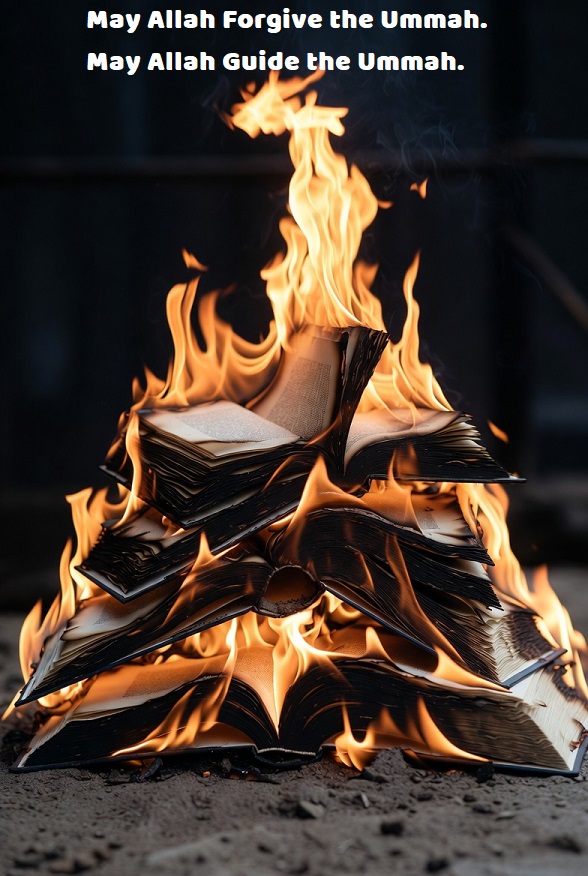
The loss of a significant portion of early Muslim books and manuscripts was not caused by a single factor, but rather a combination of catastrophic destruction and environmental degradation. But the truth is, many of the books of knowledge among Muslims were often burned by other Muslim sects because those books were deemed to be heretical or simply lead people away from the truth, according to those who were burning the books.
One can only wonder if these books had survived, how they might have shaped the discourse on virtually every topic among Muslims. How many books, for example, may have caused the Muslims to reconsider a hadith now graded as sahih to be weakened? How many books, for example, may have caused the Muslims to reconsider a hadith now graded as daif to be strengthened? How many insightful legal verdicts are now lost to us forever. Allah knows best.
In his master’s thesis titled: ظاهرة إحراق وإتلاف الكتب والمكتبات في الغرب الإسلامي خلال القرنين الرابع والخامس الهجريين/العاشر والحادي عشر الميلاديين (نماذج من الأندلس) (The Phenomenon of Burning and Destroying Books and Libraries in the Islamic West during the 4th–5th centuries AH / 10th–11th centuries CE — Examples from Andalusia). This work by Taher Bakhda done at the University of Oran 1 Ahmed Ben Bella has some invaluable insights into our collective history.
Another researcher who has great insights in our collective history is Abd al-Rahman al-Kawakibi he wrote: Taba’i’ al-Istibdad wa Masari’ al-Isti’bad (The Nature of Tyranny And the Struggle Against Enslavement)
In this video, Dr. Abdul Rahman Al Hajji recounts the story of the burning of Arabic manuscripts after the fall of Andalusia and how some of them ended up in the Library of the Monastery of San Lorenzo de El Escorial.
The speaker is Dr. Abdul Rahman Ali Al-Hajji. A PhD in Andalusian History from Cambridge University (1966). He was a professor of the Prophet’s biography, Islamic history, and Andalusian history at several universities. He authored dozens of books, including: *Andalusian History from the Islamic Conquest to the Fall of Granada*. He passed away in Madrid, Spain, on January 18, 2021.
Upon a thorough investigation of the incidents of book burning in Islamic heritage, we find that the majority of this reprehensible phenomena are due to the actions of the authorities and the evils of politics. Every despotic authority has an inclination against knowledge and what it entails in terms of freedom of thought and enlightenment. The scholar Abd al-Rahman al-Kawakibi clarifies this meaning in his book ‘(The Nature of Tyranny And the Struggle Against Enslavement) by saying: “Just as it is not in the interest of the guardian for the orphans to reach maturity, so too it is not in the interest of the despot for the subjects to be enlightened by knowledge. [It is] not hidden from the despot – however stupid he may be – that there is no enslavement or tyranny except as long as the subjects are foolish and floundering in the darkness of ignorance and the bewilderment of blindness.”
Some authorities were under the illusion that by doing these actions they were performing an enlightening act, by fighting what they believed were foreign or corrupt beliefs in order to strengthen the legitimacy of the regime among the public and to reinforce the structure of the political community around it. These were the books that contradicted the correct doctrine, such as the classifications of astrology and what was associated with it of magic and talismans, as well as some jurisprudential and behavioral books that an authority might describe – at any given moment – as having fragmented the fabric of society.
What confirms the dominance of the political factor here is that those reckless burnings – and burning any book is certainly a reckless act, for a statement is countered by another statement. This occurred at the beginnings of the establishment of states, during conflicts between regimes, and when states are on the front lines or in contact with their enemies, where the distinctions between cultural and border penetration disappear.
Thus, we find that, despite the general openness and positive reputation of Islamic states in intellectual dialogue and scientific production, there was also a profound sensitivity towards certain new works and differing ideas. It is truly remarkable that Andalusia—despite its renowned literary and intellectual distinction—was among the centers of intense tension and sensitivity towards some of these ideas. Indeed, the religious stance towards certain books (on jurisprudence, Sufism, and philosophy) was often inextricably linked to political manipulation.
But Muslim historians, while observing this phenomenon, tried to point to a historical context for it in which previous nations were not free from such incidents. For example, in the days of the Greeks, books were burned under the supervision of the great philosophers. The historian Ibn Abi Usaybi’ah mentions in ‘Uyun al-Anba’ that ‘Plato burned the books written by [the philosopher] Thales (= Thales of Miletus, d. c. 546 BC) and his companions, and those who adopted one opinion from [those who believe in] experience and analogy, and left the old books that contained both opinions,’ because he believed in ‘both opinions together’ and the invalidity of taking analogy alone or experience alone.
We also find in Ibn Abi Usaybi’ah that Galen (d. 210 AD) was opposed to the opinion of the philosopher-physicians – and medicine was then a part of philosophy – who said that “there is no craft other than the craft of tricks, and that is the true craft of medicine.” He used to criticize their books written in this doctrine, to the point that he “burned what he found of them and invalidated this craft of tricks.”
But one of the strangest aspects of this phenomenon remains the sight of some Muslim scholars and thinkers voluntarily burning or destroying their books in any way possible (by burning, tossing them in rivers, or tearing them up).The strange thing here is that the writer would destroy the knowledge that his own hands had produced over long periods of time, with effort and suffering, perhaps due to an excessive sensitivity to the lack of appreciation from society, or due to a shift in the methods of thought and ways of accessing or faithfully preserving knowledge, or out of fear of raising doubts that the average reader might not understand.
In any case, those darknesses – whose most prominent facts and motives we will examine in this article – remained a slight and isolated shadow of darkness, which did not affect the energy of light that Islamic civilization spread throughout its regions and throughout the world, disseminating through it its scientific, cultural and artistic heritage, and the legacy of the nations that preceded it after it nurtured, refined, explained and completed it, and the intellectual fruits of all that continued to nourish the human mind – especially the Western mind – to the present moment.
What ever was lost could not happen except by the decree of Allah (swt). We have to trust that what we have of the Qur’an and the Sunnah and the knowledge that has been passed down to us by our elders is sufficient for our guidance.
Origin and explanation of this phenomena.
The first thing that can draw attention to the phenomenon of burning books and libraries is that it has been – since ancient times until now – one of the methods of repression and control used by the despotic political authority against its opponents and adversaries. Despotic governments do not like science or the enlightenment of people with knowledge, so they fear it and work hard to block ideas, to the extent that reformers work to produce and spread them!
One of the oldest texts that establishes the position of the despotic authority, which is often opposed to science and knowledge, is what came in the document ‘The Covenant of Ardashir’ attributed to the founder of the Sasanian Persian state, Ardashir ibn Babak, in which he ‘advised’ those kings who would come after him not to worry about corrupting the minds of their people so that they would ensure the survival of their kingdom! In that regard, he says: ‘Those kings before us used to scheme to corrupt the minds of those they feared (= their opponents)! For the wise man’s good nature does not benefit him if his mind is rendered barren and lifeless!’
The scholar Abd al-Rahman al-Kawakibi clarifies this meaning in his book ‘(The Nature of Tyranny And the Struggle Against Enslavement)’ by saying: “Just as it is not in the interest of the guardian for the orphans to reach maturity, so too it is not in the interest of the despot for the subjects to be enlightened by knowledge; [it is] not hidden from the despot – however stupid he may be – that there is no enslavement or tyranny except as long as the subjects are foolish and floundering in the darkness of ignorance and the bewilderment of blindness.”
When the government proceeds to burn the books of a scholar, all or some of them, whether they be on jurisprudence, Sufism, or philosophy, it often attributes this to what it claims is the care of the public interest and what serves the people on the level of “awareness front” and “intellectual security” that ensures the survival of the thrones, which in reality may not be more than an objection to the topics or methodologies of certain books that may differ from the official propaganda of the court.
One of the earliest examples we have of the political authority burning the books of those who disagreed with its religious and civilizational vision in the pre-Islamic eras is what the historian and physician Ibn Abi Usaybi’ah mentioned in ‘Uyun al-Anba’ that “Alexander (the Macedonian, d. 323 BC) when he took possession of the kingdom of Darius and conquered Persia, he burned the books of the Magian religion, and he took to the books of astronomy, medicine and philosophy and translated them into the Greek language, and sent them to his country and burned their originals.”
The earliest recorded instance in Islamic history of authorities burning books in protest against their content, which contradicted their official propaganda, was the action of Sulayman ibn Abd al-Malik (d. 99 AH/719 CE) – when he was Crown Prince – with a book on the Blessed Prophet’s biography that was written – at his behest – by the judge of Medina, Aban ibn Uthman ibn Affan (d. around 105 AH/724 CE). However, Sulayman did not like what was mentioned in the book regarding the virtues of the Ansar tribes, “so he ordered that the book be burned,” according to the genealogist historian Al-Zubayr ibn Bakkar (d. 256 AH/870 CE) in his book ‘Al-Akhbar Al-Muwaffaqiyyat’.
Sulayman’s action was admired by his father, the Umayyad Caliph Abd al-Malik ibn Marwan (d. 86 AH/706 AD), who praised his decision to burn the book, justifying it by saying that it served the interests of their subjects in the Levant. He said: “What need do you have to bring [to the Levant] a book in which we have no merit? You are informing the people of the Levant of matters we do not want them to know about the virtues of the Ansar!”
The political context of those fears is that the revolution of the people of Medina against the Umayyads in the Battle of al-Harrah in 63 AH/AD 682 was still fresh in people’s minds at that time, and the people of the Levant were the spearhead of the Umayyads in crushing their rebels, most of whom were Ansar; so how could a book be presented to them that narrated their virtues when they had been, just yesterday, the target of official propaganda demonizing them?
Various pretexts for the burning of books.
Authorities often used the pretext of suppressing dissenting opinions, labeling the speaker an innovator, heretic, or atheist, among other such claims intended to justify their actions in the eyes of the Muslim elite and public opinion. We also find the origin of this practice officially employed by the Persian king Ardashir, who said: “They would trick those who criticized the religion into attacking the kings by calling them innovators, so that religion itself would kill them and rid the kings of them. The king should not acknowledge that worshippers, ascetics, and those devoted to the faith are more deserving of the religion, more protective of it, or more angered by it than he is!”
It appears that Al-Mahdi al-Abbasi was the first to try to establish his legitimacy in ruling on the issue of confronting what was called “heretics”, to the point that Imam Al-Dhahabi says about him – in ‘History of Islam’ – that he “exaggerated in destroying the heretics and burned their books when they revealed corrupt beliefs.”
Also of this type is what historians have narrated about the fate of a large part of the huge library that existed during the days of the Umayyad Caliph in Andalusia, Al-Hakam al-Mustansir, and it was called “The Treasury of Sciences and Books,” according to Al-Maqqari al-Tilimsani in ‘Nafh al-Tayyib’.
Al-Maqqari mentioned that this al-Mustansir “was a lover of sciences, honoring its people, and collecting books of all kinds in a way that no king before him had collected”. Then he added that “the number of index [registers] containing the names of books is forty-four indexes, and in each index there are twenty pages, containing nothing but the mention of the names of the Diwans (= the works) and nothing else”.
Regarding the fate of the philosophical section of this great library’s treasures, al-Dhahabi tells us in ‘Siyar A’lam al-Nubala’ that after al-Hakam’s death, al-Mansur ibn Abi ‘Amir assumed the vizierate. He became the ‘chamberlain of the Andalusian kingdoms’ and the master of the Umayyad palace in Cordoba. ‘At the beginning of his rule, he went to al-Hakam’s book repositories, displayed their contents in the presence of scholars, and ordered the separation of the ‘works of the ancients’ and philosophers, excluding books on medicine and arithmetic (= geometry). He ordered them to be burned, and some were burned and others buried. He did this to ingratiate himself with the common people and to discredit al-Hakam’s practice’ of acquiring such philosophical books, which al-Dhahabi described as ‘extremely numerous’!
The phrase “his first victory” – which appears in the text above – sheds an important light on the political goal that was in the mind of this shrewd minister. At that time, he was still in conflict with his rivals from among the powerful statesmen to seize control of the country following the death of Caliph al-Mustansir, such as the minister al-Hajib Ja’far ibn Uthman al-Mushafi and the army commander Ghalib ibn Abd al-Rahman al-Umawi.
To achieve his political goal, al-Mansur enlisted the help of the influential group of jurists of the time, and his alliance with the wife of the late Caliph, Subh al-Bashkunshiyya (She is named after the land of Bashkunsh/Bashkuns = today the Spanish Basque Country), whose young son, Prince Hisham ibn al-Hakam, ascended the throne, but he remained under the guardianship of the powerful minister, al-Mansur al-Amiri.
What confirms what al-Dhahabi mentioned about the presence of political opportunism behind al-Mansur’s actions is his personal love of philosophy; according to what al-Maqqari tells us – in ‘Nafh al-Tayyib’ – who says that the people of Andalusia “have a share and attention to all sciences except philosophy and astrology, for they have a great share among their elite, and they do not openly practice them for fear of the common people, for whenever it is said that so-and-so reads philosophy or engages in astrology, the common people call him a ‘heretic’ and restrict his breathing…and their kings often order the burning of books on this subject if they are found, and thus al-Mansur ibn Abi Amir drew closer to their hearts at the beginning of his rise [to power], even though [he] was not free from engaging in that (= the sciences of philosophy) in secret”.
A Striking distinction
Books on pure science (medicine and engineering) commanded the respect of book burners as they were clearly beneficial to everyone, despite their close connection to philosophy in those days. However, it seems that purely philosophical studies became – almost since the end of the fourth century AH/10th century AD – widely condemned, so that sultans worked to strengthen their legitimacy by burning them to gain favor with the masses and influential scholars who opposed them; as we saw in what the minister and “enlightened intellectual” al-Mansur al-Amiri did in Andalusia, and also under the rule of his counterpart in culture and political charisma in the Islamic East, the Buyid minister al-Sahib ibn Abbad.
The historian Yaqut al-Hamawi narrates – in ‘Mu’jam al-Udaba’ – on the authority of Ali ibn al-Hasan al-Katib his statement about his relationship with this minister Ibn Abbad*: “I saw nothing but good from him until another boredom befell him, so he put me in prison for a year, and collected my books and burned them with fire, and in them were copies of the Qur’an and many fundamental books on jurisprudence and theology, so he did not distinguish them from the ‘books of the ancients’ (= books of philosophy and astrology), and he ordered that the fire be thrown into them without verification, but rather due to his extreme ignorance and extreme impetuosity!
*note: Not to be confused with Ibn Ibad (Abdulah ibn Ibad) whose name sake the Ibadi school was named by it’s opponents.
His statement, “He did not distinguish it from the ‘books of the ancients’,” is an indication of the real reason for the burning, for Ibn Abbad only wanted to burn the books of philosophy specifically. This is confirmed by what was stated in his description by Abu Hayyan al-Tawhidi, who says about him in ‘Al-Imtaa’ wal-Mu’anasa’: “The majority of his speech is that of the Mu’tazilite theologians, and his writing is mixed with their methods, and his debate is tainted with the expression of writers, and he is very prejudiced against the people of wisdom (philosophy) and those who look into its parts, such as geometry, medicine, astrology, music, logic, and arithmetic.”
Not far from the era of Ibn Abi ‘Amir and Ibn Abbad, who were among the learned princes, we find the historian Ibn al-Athir mentioning – in his book ‘Al-Kamil’ – that the founder of the Ghaznavid state, Mahmud ibn Subuktigin al-Ghaznawi, overthrew the Buyid state in Khorasan in the year, then “burned the books of philosophy, the doctrines of Mu’tazilism and astronomy” which were numerous in the libraries of its kings.
The political context of this refers to the intellectual conflict, which has always been strengthened by the means of the existing authority, and which has continued since the days of the Abbasid Caliph al-Ma’mun between the “People of Hadith,” to whom Mahmud of Ghazna was seeking support and backing, and the Mu’tazilite movement, whose views were adopted by Ghaznavid’s Buyid opponents as a doctrinal extension of their Zaidi Shi’i school of thought.
Historical turning points
Then the disapproving tendency towards philosophy intensified, especially at the end of the fifth century AH. Perhaps what contributed to consolidating that disapproval was the attack launched by Imam al-Ghazali on the philosophers in his book ‘The Incoherence of the Philosophers’. The defense and support that Imam Abu al-Walid Ibn Rushd the grandson later offered to philosophy in his two books: ‘The Incoherence of the Incoherence’ and ‘The Decisive Treatise’ did not help in mitigating its effects.
Indeed, Ibn Rushd himself suffered a great ordeal at the end of the following century during the reign of the Almohad Sultan al-Mansur Abu Yusuf Yaqub ibn Yusuf, even though he was his personal physician and therefore one of the closest people to him. Al-Dhahabi tells us in ‘Al-Siyar’ that ‘someone who opposed him sought to harm him before Yaqub, and they showed him [words] in his handwriting relating that the philosophers [say that] [the planet] Venus is one of the gods. So he summoned him and said: Is this your handwriting? He denied it, so he said: May Allah curse whoever wrote it, and he ordered those present to curse him, then he made him stand in humiliation, and he burned the books of philosophy except for medicine and geometry’!
Ibn Abi Usaybi’ah states that the reason for Ibn Rushd’s ordeal was his preoccupation with the sciences of philosophy. He said that al-Mansur “was angry with Abu al-Walid Ibn Rushd… and also with a group of other eminent scholars… and he claimed that he did this to them because of what was alleged about them [that] they were engaged in wisdom (= philosophy) and the ‘sciences of the ancients’!” Supporting this explanation is what Abu Hayyan al-Andalusi quoted in his ‘Al-Bahr al-Muhit fi al-Tafsir’ from a poem by one of the poets, “inciting al-Mansur of the Almohads against the philosophers.”
“Burn their books east and west, for in them lies hidden the evil of knowledge, creeping into beliefs through its harm, poisons, and beliefs are like bodies!”
Around the time of that incident, we find in the biography of Imam al-Amidi that he taught philosophy and logic at the al-Zafiri Masjid in Cairo. Then he was accused of doctrinal deviance, to the point that the chief judge and historian Ibn Khallikan says – in ‘Wafayat al-A’yan’ – that the jurists ‘put their pens in order to permit the shedding of blood [of him], so he left [Egypt] in secret and went down to Hama’ in the Levant.
Scientific books may have fallen victim to the authorities settling scores with senior officials or scholars who criticize them, whose behavior they do not approve of. An example of this is what happened in Baghdad to Chief Justice Yahya bin Saeed Ibn al-Marakhim, who was accused of corruption and of “taking bribes,” according to Ibn al-Jawzi in Al-Muntazam.
Therefore, a decision was issued to arrest this judge Ibn al-Murakhkham, and his money was confiscated, and his books were burned in al-Rahba (a public square in Baghdad), including the book ‘al-Shifa’ [by Ibn Sina] and ‘Ikhwan al-Safa’, and he was imprisoned and died in prison.
The broader historical context
The historian Ibn Khaldun al-Hadrami tells us in his history that the Hafsid Sultan of Tunis, Muhammed al-Mustansir, was resentful of the Andalusian Imam Muhammed ibn Abdullah, known as Ibn al-Abbar al-Quda’i. The Sultan sent for him at his house, and all his books were brought to him. He found, as they claimed, a note containing verses, the first of which was:
A successor has become tyrannical in Tunisia ** They have unjustly named him: ‘Caliph’!!
The Sultan became enraged and ordered him to be questioned and then killed. He was killed by being stabbed with spears in the middle of Muharram of the year 658 AH. Then his limbs were burned, and the volumes of his books, and all his collections were brought and burned with him.
The American historian of civilizations, Will Durant, said in ‘The Story of Civilization’ that when the leader of the Sophist school, the Greek philosopher Protagoras (d. 420 BC), announced his simple ideas that ‘all truth, goodness, and beauty are relative and personal matters’, the ‘Athenian Assembly’, which was the elected legislative body to govern the city of Athens, was terrified by them, and saw that they ‘foreshadowed a terrible evil, so it decided to exile Protagoras, and the Athenians were ordered to hand over all of his writings that they might have, and his books were burned in the public marketplace’!
Ibn Abi Usaybi’ah mentioned in ‘Uyun al-Anba’ that “Plato (d. 347 BC) burned the books written by [the philosopher] Thales (= Thales of Miletus, d. c. 546 BC) and his companions, and those who adopted one opinion from [those who believe in] experience and analogy, and he left the old books that contained both opinions,” because he believed in “both opinions together” and the invalidity of taking analogy alone or experience alone.
Plato burned the books of his opponents among the philosophers, even though he was one of the founders of the science of philosophy.
We also find in Ibn Abi Usaybi’ah that Galen (d. 210 AD) was opposed to the opinion of the philosopher-physicians – and medicine was then a part of philosophy – who said that “there is no craft other than the craft of tricks, and that is the true craft of medicine.” He used to criticize their books written in this doctrine, to the point that he “burned what he found of them and invalidated this craft of tricks.”
Indeed, the Greeks went beyond burning what they disliked from books of philosophy and medicine to burning collections of poetry; for this historian Ibn al-Ibri recounts – in ‘Abridged History of States’ – that the philosopher Plato ‘distinguished himself – in his youth – in the science of poetry, so when he saw [his teacher] Socrates (d. 399 BC) disparaging (= criticizing) this art – among the sciences – he burned his books of poetry’.
The case of biased rejection
And like the books of philosophy, and perhaps because of their general association with it at that time, the Muslim sultans extended their oppression to books of astrology, as we find in an incident that happened to the grandson of the founder of the Qadiriyya Sufi order, who was Abd al-Salam ibn Abd al-Wahhab ibn Shaykh Abd al-Qadir al-Jili, who was mentioned in his biography by Imam Ibn Hajar al-Asqalani – in ‘Lisan al-Mizan’ – that “he was of reprehensible character, an astrologer who delved into the philosophy of the ancients, so his books were burned publicly in Baghdad.”
Al-Dhahabi says in ‘The History of Islam’ that this Abd al-Salam was ‘humiliated by the burning of his astronomical books’ in the year 588 AH, and that this burning was ‘in a public gathering, and in them (the burned books) was the statement that there is no manager of the world other than the stars and that they are the providers’!
Al-Dhahabi adds – in ‘Al-Siyar’ – that the burning of these books was done “at the suggestion of [Imam] Ibn al-Jawzi” because he “did not treat Shaykh Abdul Qadir [al-Jili] fairly and diminished his worth, so his children hated him.” This later exposed Ibn al-Jawzi to a great calamity that lasted five years, when a minister close to the family of Abdul Qadir al-Jili arrived at the court of the Abbasid Caliph in Baghdad, and he took revenge on him for them, as “some of Ibn al-Jawzi’s books were burned and the rest were sealed [with a ban],” according to Imam Ibn Kathir in ‘Al-Bidaya wa al-Nihaya’.
In conclusion, the ultimate goal of those events was rejection of their opponents or rejection of their ideas.
The authorities’ pursuit of the works was not limited to what they called “the books of the ancients” of philosophy, astrology and the like; rather, the sectarian incitement by some scholars led to the burning of the books of their colleagues who differed with them in the scientific doctrines and intellectual orientation, or even in the presentation and interpretation within the same doctrine itself!
However, we often find the presence of authority in such events, as state officials exploit these natural disagreements within scholarly circles, manipulating them for their political ends, especially if one party in the scholarly dispute enlists their help to bolster their position or school of thought; as we saw in the story of Ibn al-Jawzi’s involvement in the burning of Abd al-Salam al-Jili’s books. Indeed, the scourge of sectarian fanaticism might even lead a sultan to order the burning of an entire school of Islamic jurisprudence simply because it contradicted his own affiliation!
The “revival” crisis
Among the recorded events of that time was what happened during the reign of the Sultan of the Almoravid state in Andalusia and the Islamic West, Ali bin Tashfin, whom al-Dhahabi described in ‘Al-Siyar’ as someone who “greatly respected scholars and consulted with them. During his time, jurisprudence, books, and branches flourished until they became lazy about Hadith and traditions, and philosophy was humiliated, and theology was rejected and despised.”
One of the effects of that demonization of theological and philosophical sciences was that “the people of that time condemned anyone who appeared to be delving into any of the theological sciences, and the jurists at the time of Ali bin Tashfin, decided to condemn theology, and the hatred of the predecessors for it and their abandonment of anyone who appeared to be involved in it, and that it is an innovation in religion and most of it may lead to differences in beliefs,” according to the account of Abd al-Wahid al-Marrakushi in ‘Al-Mu’jib fi Talkhis Akhbar al-Maghrib’.
Al-Marrakushi adds that in that hostile atmosphere towards theological and philosophical discussions, Prince Ali ibn Tashfin adopted the positions of the jurists who opposed everything that contradicted the official legal school of the country, which was the Maliki school, after “hatred for theology and its people had taken root in him (the prince), so he would write about it at every time to the country, stressing the prohibition of engaging in any of it, and he threatened anyone who was found with any of its books. When the books of Abu Hamid al-Ghazali entered Morocco, the prince of the Muslims ordered them to be burned, and he issued severe threats – of bloodshed and confiscation of wealth – to anyone who was found with any of them; and the matter became very serious in that regard!
It appears that the effect of the official decision to burn al-Ghazali’s books – although the actual burning was limited to his book ‘Ihya Ulum al-Din’ – extended for about forty years, which is the period of the rule of Prince Ali bin Tashfin, who took power in the year 500 AH. Imam al-Dhahabi tells us – in ‘al-Siyar’ – about what appears to be the first incident of burning this book, as he says that in the same year, “the news reached [Alexandria] of the burning of al-Ghazali’s books in Almeria” in Andalusia.
Copies of the book were burned throughout the Andalusian lands under the supervision of the Maliki “Judge of the Community” (Judge of Judges) Muhammed ibn Ali ibn Hamdin al-Taghlibi, whom al-Dhahabi described as “criticizing Imam Abu Hamid in the Sufi way, and writing in response to him.”
In the year 538 AH, this prince issued one of his last decrees in his life, which included the following: “Whenever you come across a book of heresy or a heretic, beware of him, especially – may Allah guide you – the books of Abu Hamid al-Ghazali. Their traces should be followed, and their news should be cut off by continuous burning. They should be searched for, and oaths should be made binding on anyone accused of concealing them!” This is according to the text of the decree document cited by the historian specializing in the history of Andalusia, Muhammed Abdullah Anan, in his book ‘The Islamic State in Andalusia,’ quoting from its manuscript in the Spanish Escorial Library.
The dual vision
It is understood from the words of Judge Iyad al-Maliki that the deep Sufi content of the book ‘Ihya’ was the main motive behind its burning. He says, as quoted by al-Dhahabi in ‘al-Siyar’: “Shaykh Abu Hamid [al-Ghazali] – the one with the heinous news and the great writings – went to extremes in the way of Sufism and devoted himself to supporting their doctrine, and became a preacher of it and wrote his famous works on it. He was criticized in some places in it, and the suspicions of a nation were bad about him, and Allah knows best his secret. The order of the Sultan in our country in Morocco and the fatwa of the jurists to burn it and stay away from it were carried out, and that was obeyed.”
The philosopher and physician Abu al-Hajjaj Ibn Tumlus al-Andalusi confirms in his “Introduction to the Art of Logic” what Qadi Iyad stated regarding the centrality of the Sufi factor in the burning of the book “Ihya’ Ulum al-Din” (The Revival of Religious Sciences). He points out that the Andalusian Maliki jurists were surprised by “The diverse books of Abu Hamid al-Ghazali, which struck their ears with things they were unfamiliar with and did not know, and with words that deviated from their usual understanding of Sufi issues and other groups with whom the people of Andalusia were not accustomed to debating or conversing. Their minds were far from accepting it, and their souls recoiled from it. They said: If there is disbelief and heresy in the world, then what is in al-Ghazali’s books is disbelief and heresy! And they all agreed on that. So al-Ghazali’s books were burned, and they did not know what was in them!”
Then Ibn Tumlus – who was a senior student of the philosopher Ibn Rushd – notes the historical reversal – in Andalusia and the Islamic West in general – towards al-Ghazali’s books a few years after they were burned, and the role of the doctrinal/political factor in this great transformation, when the Almoravid state was violently overthrown in 541 AH by the Almohads, who considered al-Ghazali to be the Shaykh of the founder of their religious movement, Muhammad Ibn Tumart.
Therefore, as soon as things settled down for the Almohads, “People were encouraged to read the books of al-Ghazali, and it was known from his school of thought (= Ibn Tumart) that he agreed with him (= al-Ghazali); so people began to read them, and they were impressed by them and by what they saw in them of the quality of the system and arrangement, the like of which they had never seen in any authorship, and there was no one left in these regions who was not overcome by love for the books of al-Ghazali except those who were overcome by excessive rigidity from the extreme imitators, so reading them became a law and a religion after it had been disbelief and heresy”.
Ibn Tumart traveled to Baghdad where he met with contemporaries of Imam Al Ghazali as well as his students. This interaction ignited a flame, a passion within Ibn Tumart, who came back to the Maghrib (North Africa) and virtually slaughtered all those who did not accept the Ashari’ theological creed. He later proclaimed himself the ‘Mahdi’.
However, methodological fairness in presenting the facts requires us to point out that the Maliki jurists in Andalusia were not in agreement with the authority’s position against al-Ghazali’s books. A group of them opposed this from the very first moment of the decision to burn them, led by Imam Ali bin Muhammed bin Abdullah al-Judhami al-Barji, and they issued a joint fatwa that required “The punishment of the one who burned them and making him pay their value because they are the property of a Muslim,” according to Ibn al-Abbar al-Quda’i in his book ‘Dictionary of the Companions of Judge Abu Ali al-Sadafi’.
It is strange that we find some scholars expanding the scope of the fatwa prohibiting the burning of books and including their value for whoever burns them, making it include even the books of non-Muslims, in order to protect freedom of belief and preserve peaceful religious coexistence among the components of society. Among the jurisprudential texts in this regard is what came in the book ‘Al-Bujayrami’s Commentary on Al-Khatib al-Shirbini’ by the scholar Sulayman bin Muhammed al-Bujayrami al-Misri al-Shafi’i, which states the certainty of “Prohibiting the burning of the books of the disbelievers because they contain the names of Allah Almighty, and because it involves wasting money!”
Therefore, we see, for example, that Samuel ibn Yahya al-Maghribi, who was a Jewish scholar and converted to Islam, records – in his book ‘Exerting Effort in Refuting the Jews’ – that the Jewish community is ‘Undoubtedly the most fortunate of communities’ in terms of preserving its writings and monuments, despite being ‘One of the oldest nations in history, and due to the many nations that conquered it, from the Canaanites, Babylonians, Persians, Greeks, Christians, and Muslims. None of these nations did not intend to harm them with the utmost intent and seek to exterminate them, and went to great lengths to burn and destroy their lands and burn their books; except for the Muslims,’ for they preserved for them their free religious presence like the rest of the non-Muslim communities.
Many Islamic sects burned the books and writings of other Islamic sects.
The phenomenon of burning books was not limited to a particular Islamic sect, but rather it transcended the boundaries of sects within the Islamic scientific arena, as many sects practiced it against the other, and we even find it within the ranks of the same sect; many of the incidents mentioned here in this article are examples of this.
Another example is what Qadi Iyad mentioned in ‘Tartib al-Madarik’, that the authority in the Fatimid state tested one of the scholars of Alexandria named, Abu Abdullah Muhammed ibn Abdullah ibn Attab known as Ibn al-Muqri. He was a Maliki jurist, considered one of the best Muslims, trustworthy and reliable. The Banu Ubayd (= the Fatimids) beat him and and burned his books! Also, the Fatimids – who were Ismaili Shii’i- set fire to the books of a great imam who belonged to the Twelver Shi’i school of thought, because he wrote in refutation of the opinions of their school of thought.
Imam al-Dhahabi tells us – in ‘al-Siyar’ – that the Shii’i Ja’fari Imam Abu al-Hasan Thabit ibn Aslam al-Halabi was “The jurist of the Shi’i, and the grammarian of Aleppo… He took the lead in teaching and he had a work on exposing the flaws (= defects) of the Ismailis and the beginning of their call, and that it was based on deception. So the caller of the people (= their religious guide in the Levant) took him and he was taken to Egypt and al-Mustansir (the Fatimid Caliph) and impailed him. May Allah not be pleased with whoever killed him. And for that reason the library of books in Aleppo was burned, and it contained ten thousand volumes. May Allah have mercy on this innovator who defended the religion!”
This is a precious and profound insight from al-Dhahabi, who, in terms of his scholarly formation, was a Hanbali in creedal principles and a Shafi’i in jurisprudential branches. Despite describing the jurist al-Halabi as an “innovator,” he looked at what he had in common with him and praised him for “defending the faith,” and prayed for Allah’s displeasure with his killer and denounced the ordeal he faced at the hands of the Ismaili Shi’a!
Al-Dhahabi’s work demonstrates his broad understanding, grasp of reality and its priorities, and deep awareness of the relativity and complexity of positions. The actual founder of the Safavid state—a Twelver Shi’a state—Sultan Ismail Shah, was accused of “killing scholars and burning their books,” as mentioned in Ibn al-Imad al-Hanbali’s “Shadharat al-Dhahab.”
It is interesting to find the love of scientific excellence and intellectual leadership among the reasons for burning other people’s books. This is mentioned in what Zahir al-Din al-Bayhaqi narrates – in ‘Tatimmat Siwan al-Hikma’ – about the reason for the burning of a great library that belonged to the Samanid state court in its capital, Bukhara. Some accused the famous philosopher Ibn Sina of “Burning those books to add those sciences and treasures to himself, and to cut off the lineage of those benefits from their owners”.
In other words, it is claimed that he burned the library so that he (Ibn Sina) could pawn those ideas off as his own! In those times, we did not have the World Intellectual Property Organization (WIPO). Although we should be cautious about such claims, it is not at all implausible that such things happened.
Imagine! Ibn Sina (Avicenna) the book burner! The library torcher! Or so it was said of him.
So keep in mind dear readers when people accuse the Ibadis of this or that that the history books are filled with them accusing each other of all sorts of crimes.
It was also strange that the pledge to burn books of jurisprudence was a tool of political propaganda for some power-hungry individuals, and part of their “program for governance” should they reach the seat of power. Imam al-Sakhawi mentioned in “al-Daw’ al-Lami’” that one of the Mamluks, named Lajin al-Jarkasi (= al-Shirkasi), due to his lack of intellect, claimed that he owned the Egyptian lands and openly declared this without concealment. The Circassians (among the princes) revered him and believed in the validity of this claim. He promised to abolish the endowments of the masjids and congregational masjids, burn books of jurisprudence, and punish the jurists, among other absurdities, and to restore matters to what they were during the time of the Caliphs!
Hazmiya’s ordeal
Among the reasons for the burning of books was the jealousy that arose among some scholars of the different schools of Islamic jurisprudence, along with disputes, disagreements, and rivalries for prominence and leadership, which led to them telling on one another to kings and princes. For example, the Maliki jurists of Andalusia criticized Imam Ibn Hazm al-Andalusi on many aspects of his legal methodology and his approach to argumentation and scholarly debate, just as he vehemently criticized them, accusing them of fanaticism and rejecting religious texts in favor of human opinions.
Therefore, al-Dhahabi, in his biography in Siyar A’lam al-Nubala, summarizes Ibn Hazm’s ordeal: “He was persecuted for his outspokenness against scholars, and he was exiled from his homeland… A group of Malikis rose up against him… The rulers of the region turned against him, so the state banished him and burned volumes of his books.” This burning was ordered by the chief ruler of Andalusia at the time, al-Mu’tadid ibn Abbad, at the instigation of those influential jurists.
As we saw from the victory of the Almohad sultans for the books of al-Ghazali after their ordeal of being burned, until “Reading them became a religious duty and a religious obligation after they had been considered heresy and apostasy,” according to Ibn Tumlus, the books of Ibn Hazm found – about a century and a half after his death – in one of these sultans who restored their prestige and wrote a victory for them, namely Sultan al-Mansur Yaqub bin Yusuf al-Muwahhidi, whose story with Ibn Rushd and his burning of philosophical books was mentioned earlier.
The historian of Andalusian literature, al-Maqqari al-Tilimsani, describes – in ‘Nafh al-Tayyib’ – this al-Mansur as being impressed by the personality and opinions of Ibn Hazm, and that he stood one day at his grave and said: “All scholars are dependent on Ibn Hazm!” It seems that this admiration is what made him “avenge” Ibn Hazm against his opponents, the jurists, so he obliged people to the Zahiri school and ordered in the year 591 AH the burning of books of branches of Maliki jurisprudence under the pretext of the necessity of abandoning tradition and returning to the texts of revelation, Qur’an and Sunnah, not only in Andalusia but also in the Maghreb.
Regarding the events of this burning and its purely sectarian motives, an eyewitness to one of these events in Fez, Morocco, tells us about it. He is the historian al-Marrakushi, who says in his book ‘Al-Mu’jib’: “[Al-Mansur] ordered the burning of the books of the [Maliki] school of thought… I witnessed—while I was in the city of Fez at that time—that loads of books were brought in, placed on the ground, and set on fire… His overall intention was to eradicate the Maliki school of thought and remove it from Morocco once and for all, and to force people to adhere to the literal interpretation of the Qur’an and Hadith. This same intention was also the intention of his father (= Abu Ya’qub) and his grandfather (= Abd al-Mu’min), but they did not make it public, while this Ya’qub did.”
While al-Mansur’s actions with the Maliki books were considered “revenge” for Ibn Hazm’s books, it is not unlikely that the motive behind his father’s and grandfather’s desire to burn them was “revenge” for the burning of al-Ghazali’s book ‘Ihya’, who – as previously mentioned – was the shaykh of the founder of their movement that paved the way for the establishment of their state, Ibn Tumart.
And if books of jurisprudence – especially the Maliki and Zahiri schools, which became among the extinct schools of jurisprudence – had their share of burnings, similar to books of philosophy and astrology, then books of Sufism were also included in the burning in some eras and countries, as we saw in the story of the continued burning of al-Ghazali’s most important work in the science of Sufism – which is the book ‘Ihya’ – in the region of the far west of Morocco and Andalusia for four decades, which is half the life of the Almoravid state.
After that, incidents of burning the writings of controversial Sufi figures were repeated, and some of their books were burned many times. For example, “the books of Muhyiddin Ibn Arabi (al-Hatimi) were burned more than once,” according to what Ibrahim Ibn Omar al-Biqa’i reported in his book ‘Tanbih al-Ghabi’.
Absolute Gas incinerators! Burn it all down!
Among the greatest fires that befell books and libraries in the ancient Islamic civilization were those that occurred whenever the lands of Islam fell under foreign occupation; from the Crusader attack from the West on the Levant, to the Mongol invasion of the Islamic lands from the Far East to its heart, where they brought down the capital of its caliphate in Baghdad; and ending with the libraries of Andalusia, which the Spanish Christians set on fire whenever they subjugated one of its Islamic lands.
The historian Jamal al-Din al-Qifti translated – in ‘Inbah al-Ruwat’ – Abu al-Ala al-Ma’arri, and among what he said about the fate of his rich library at the hands of the Crusader invaders was: “Most of Abu al-Ala’s books were lost, and only those that left Ma’arra before the attack of the infidels (= the Crusaders) on it (in the year 491 AH), and the killing of those who were killed from its people, and the looting of what was found for them; as for the great books that did not leave Ma’arra, they were lost, and if anything of them is found, then only a part of each book is found.”
At the beginning of the sixth century AH, the city of Tripoli – located today in northern Lebanon – was ruled by the Banu Ammar al-Kutami dynasty, which was affiliated with the Fatimid state. They built a large library in it with diverse classifications in various fields of knowledge and arts, so much so that it was known as “the famous house of knowledge in the histories,” according to a description of it that appeared in the book ‘Masalik al-Absar’ by Ibn Fadlallah al-Umari.
That library met a sad fate when the Crusaders subdued Tripoli in 503 AH after a long and painful siege. As soon as it fell into their hands, they “Plundered what was in it, captured its men, and took its women and children captive. What came into their hands—from its belongings, treasures, and books (= classifications) of its house of knowledge (= library), and what was in the treasuries of its owners—was innumerable and too many to be mentioned”!! As the historian Ibn al-Qalanisi al-Tamimi recounts in ‘The History of Damascus’.
To understand the magnitude of the disaster that befell this library, it suffices to refer to what the historian Jurji Zaydan mentions in ‘The History of Islamic Civilization’: that ‘when the Franks conquered Tripoli in the Levant during the Crusades, they burned its library by order of Count Bertram Saint-Gilles (= the French Prince Bertrand, son of Raymond Saint-Gilles). He had entered a room containing many copies of the Qur’an and ordered the entire library to be burned, which, according to their claim, contained three million volumes!’
In turn the Tahert (or Tahret), the capital of the Ibadi Rustamid dynasty, was captured by the Fatimid Caliphate on 296 AH. Tahert was famous as ‘Iraq al-Maghrib, al-‘Iraq ash-Shaghir, Balkh al-Maghrib, or Little Basra. Entire works on Ibadi theology, tafsir, Arabic literature, mathematics, astronomy, jurisprudence and other sciences were lost forever as the Fatimid’s burned the library of al-Ma’shumah was burned to the ground.
In the following century, the personal libraries of scholars suffered successive calamities whenever the Mongols invaded one of the cities of Islam, beginning with the start of their devastating conquests in 616 AH.Imam al-Dhahabi, in his ‘History of Islam’, provides us with an example of what these libraries were subjected to. In his biography of the hadith scholar Imam Abu Rashid al-Ghazal al-Isfahani, he says that he was wealthy and ‘collected a great many books… and lived in Bukhara for a while until the enemy (= the Mongols) entered it and plundered it; so his books were burned and his wealth was lost.’
The historian Ibn Taghribirdi informs us – in ‘Al-Nujum al-Zahira’ – that when the Mongols occupied Iraq in 656 AH, “Baghdad was utterly destroyed, and the books of knowledge that were in it, of all sciences and arts that were not in the world, were burned; it was said that they built a bridge of mud and water instead of bricks (= burnt mud)”!
The Andalusian catastrophe
And with the beginning of the second, third of the seventh century AH itself, a series of terrible burnings began in the far west of the Islamic world, fueled by the libraries of the Andalusian cities, in which scientific contributions of all kinds had accumulated over about eight centuries. These burnings continued as the Christian kings continued to sweep through the Andalusian regions until the fall of its last strongholds in Granada was completed.
The truth is that the emergence of this phenomenon in Andalusia dates back centuries before that, as it accompanied the Islamic-Christian conflict there from its beginning. Imam Ibn Hazm, in his usual scathing style, compared what the Banu Abbad state did to his books—driven by the incitement of his opponents among the jurists—by burning them, with what the Christians were doing to the Qur’anic manuscripts whenever they conquered a Muslim country. He said in his famous verses:
“If you burn the paper, do not burn what the paper contains, for it is in my heart. Likewise, the Christians burn the Qur’an in the border cities when their hands are raised!”
What really happened was that Ibn Hazm’s observation of the similarity of the two actions was repeatedly confirmed by events in the centuries following his time. In his valuable book, ‘The Islamic State in Andalusia’, the historian Abdullah Anan recounts a summary of the events of the burning of Islamic books in Granada after its surrender to the Spanish in 897 AH. He says that Cardinal Francisco Jiménez directed “The perpetration of a shameful barbaric act, which was that he ordered the collection of all that could be collected of Arabic books from the people of Granada and its suburbs, and huge piles were arranged in the Bab al-Ramla Square, the greatest square of the city, including many beautifully decorated Qur’ans, and thousands of books of literature and science, and they were all set on fire!”
Anan adds that the fires consumed those enormous collections of books, “and [Bishop Jiménez] spared only three hundred books of medicine and science, which were taken to the university he established in the city of Alcalá de Henares. Tens of thousands of Arabic books, the essence of what remained of the Islamic intellectual heritage in Andalusia, fell victim to this barbaric act!”
Anan refers to historians’ estimates of the number of books consumed by the fire of this fanatical Catholic bishop, whose act was the greatest expression of the roots of Christianhate of Islam in Andalusia. He says that “Spanish historians differ in estimating the number of Arabic books that fell victim to this measure. De Robles estimates them at one million and five thousand books; Bermendez de Pedraza estimates them at one hundred and twenty-five thousand; some others estimate them at only five thousand, and [the Orientalist José] Conde estimates them at eighty thousand, and perhaps his estimate was closer to reasonable.”
Then Anan quotes comments from some Western Orientalists who condemn the actions of Bishop Jimenez; among them is an eloquent comment by the American historian of Spanish origin, William Prescott, in which he says: “This sad act was not committed by an ignorant barbarian, but by an educated scholar, and it occurred not in the darkness of the Middle Ages, but at the dawn of the sixteenth century, and in the heart of an enlightened nation that owes – to the greatest extent – its progress to the very treasuries of Arab wisdom”!
Among the events of modern history related to the phenomenon of library burnings, regardless of the degree of the perpetrator on the ladder of civilization and even modernity in the contemporary Western sense, is that famous incident of the English forces burning the Library of Congress during their invasion of Washington in 1329 AH, which led to the destruction of 35,000 books, or about 60% of its contents at that time!
Voluntary burning
While the majority of book burnings in our history are part of the existing power mechanisms employed to control the scientific and intellectual landscape within its geographical area, it has happened – on many occasions – that the scientists themselves burned their books with their own hands. The reasons for this are numerous, ranging from fear of the consequences of doctrinal disagreement and the pressure exerted on them by their doctrinal opponents, or fear of the oppression of the political authority, or due to the fluctuations of one of their psychological moods and their distress over their living conditions, or for real or imagined scientific methodological reasons.
The encyclopedic writer Abu Hayyan al-Tawhidi recognized this phenomenon and observed the multiplicity of its causes. He said, addressing his friend, Judge Abu Sahl Ali ibn Muhammed, when he wrote to him rebuking him for burning his books at the end of his life when the world became too much for him: “Your letter reached me… in which you described… what afflicted your heart and inflamed your chest from the news that reached you concerning what I did in burning my precious books with fire and washing them with water; so I was amazed at the absence of any excuse from you in that matter!”
Then al-Tawhidi explained to his friend the judge the various reasons that prompted him to do that; foremost among them was that he did it in imitation of some scholars who burned or destroyed their books in various ways and for different motives; so he said: “Furthermore, I have in burning these books an example of imams who are followed… among them is Abu Amr ibn al-Ala’ (al-Basri) – who was one of the great scholars with apparent asceticism and well-known piety – who buried his books in the ground and no trace of them was found; and this is Dawud al-Ta’i (al-Kufi) – who was one of the best of Allah’s servants in asceticism, jurisprudence and worship and he is called ‘the crown of the nation’ – who threw his books into the sea…!
And this is Yusuf ibn Asbat (al-Kufi) who carried his books to a cave in a mountain, threw them into it, and sealed its entrance. And this is Abu Sulayman al-Darani who gathered his books in an oven and set them ablaze, then said: By Allah, I did not burn you until I almost burned with you. And this is Sufyan al-Thawri who tore up a thousand volumes and scattered them in the wind. And this is our Shaykh Abu Saeed al-Sirafi, the master of scholars, who said to his son Muhammed: I have left you these books so that you may gain good in the Hereafter with them, so if you see them betraying you, then make them food for the fire!
Yaqut al-Hamawi, who preserved for us the text of al-Tawhidi’s letter in ‘Dictionary of Writers’, believes that Abu Hayyan only “burned his books at the end of his life because of their lack of [worldly] benefit to him, and because he was stingy with them for those who would not know their value after his death”.
The truth is that al-Hamawi brilliantly summarized what al-Tawhidi himself presented in his aforementioned letter. He said, “These books contain various kinds of knowledge, both secret and public. As for what was secret, I did not find anyone who truly desired it, and as for what was public, I did not find anyone eager to seek it. However, I collected most of them for the people, to seek their respect, to establish leadership among them, and to extend my prestige with them. I was deprived of all of that… and I disliked, along with this and other things, that it should be an argument against me, not for me!”
The Psychological motives
Then al-Tawhidi elaborates on the psychological motives that made him burn his books, saying: “What sharpened my resolve to do this and revealed the reason behind it was that I lost a noble son, a beloved friend, a close companion, a learned follower, and a generous leader (who rewarded with prizes). It was difficult for me to leave them to people who would tamper with them and defile my honor if they looked at them, and gloat over my lapses and mistakes if they browsed through them, and expose my shortcomings and flaws because of them… And how could I leave them to people I lived with for twenty years, yet I never received any genuine affection from any of them, nor did any of them show me any loyalty (= covenant), and I was forced among them – after fame and recognition – to shamefully beg from the elite and the common people, and to sell my religion and honor!”
Subhan’Allah! What a rip!
Historians tell us that among those who burned their own books for fear of intellectual opponents was Imam Ibn Aqil al-Hanbali. Ibn al-Jawzi says in al-Muntazam: “Our companions [the Hanbalis] resented him (Ibn Aqil) for his frequent visits to Abu Ali ibn al-Walid (the Mu’tazili) because of things he used to say… It so happened that he (Ibn Aqil) fell ill, so he gave some of his books to a man [whom he] used to seek refuge with, called Ma’ali al-Ha’ik, and told him: If I die, burn them after me!”
The man examined it and saw in it evidence of the Mu’tazilites’ veneration. The weaver then went and showed this to Sharif Abu Ja’far (Ibn Abi Musa al-Hashimi, the Imam of the Hanbalis) and others. This greatly angered our companions, and they sought to bring him down, so he went into hiding. Ibn Aqil only ordered the weaver to burn his books after his death because he feared the power of his Hanbali opponents and the influence they wielded through their connections with the Abbasid court in Baghdad.
There are other reasons, such as the change that some scholars experience in their scientific and behavioral temperaments. Similarly, there is what was previously reported about al-Tawhidi regarding the reason why Abu Amr Ibn al-Ala’ al-Nahwi destroyed his books, which is confirmed by al-Qifti – in ‘Inbah al-Ruwat’ – by saying: “Abu Amr was the most knowledgeable of people about the Arabs and Arabic, and about the Qur’an and poetry… and his books – which he wrote about the eloquent Arabs – had filled a house of his up to almost the ceiling, then he changed and burned them all, and when he returned to his former knowledge, he had nothing but what he had memorized with his knowledge.”
Imam al-Dhahabi explains to us in ‘al-Siyar’ the nature of this “change” that occurred to this great scholar. He says that “his books filled a house to the ceiling, then he became an ascetic and burned them”! When Ibn al-Ala’ became an ascetic and devoted himself to ritualistic worship, he saw that he should get rid of his books as they were distractions from devoting himself to his new direction, since “the [love of] looking and reading stirs in his chest at a certain time, and that is a preoccupation with something other than Allah Almighty,” according to the explanation of Haji Khalifa in ‘Kashf al-Zunun’.
Similarly, the historian Muhammed Khalil al-Husseini mentioned in ‘Silk al-Durar’ about the scholar Abd al-Jawad al-Kayyali al-Shafi’i as he says that “he had complete knowledge and a long reach in the strange arts and engaging in them, and his writings were great in them, but he did not pretend to know anything, and he burned all of them and did not leave anything for himself or for others, and he turned away from all of that, and whenever he spoke of something of that, he would cry and ask for forgiveness, and he devoted himself to engaging in the knowledge of the Sufi masters and reading their books, and he was not before that engaged in the aforementioned sciences, but rather he was devoted to the formal sciences (= intellectual).”
Imam al-Khatib al-Baghdadi draws our attention to a methodological reason, which is their fear of what would compromise scientific integrity after them. This often prompted the ancient scholars to destroy their works. In his book, ‘Restricting Knowledge’, he says: “More than one of the early scholars, when death approached him, destroyed his books or bequeathed that they be destroyed, for fear that they would fall into the hands of someone who was not knowledgeable and would not know their rulings, and would take everything in them literally, and perhaps add to them and subtract from them, and that would be attributed to its original author. All of this and similar things have been reported from the early scholars as a precaution against it.”
The Methodological factors
Whether the burning of books was a voluntary act by its author and owner, or a punishment from his opponents, whoever they may be, there are many texts indicating that this sometimes affected their status and scientific credibility. The phenomenon of scholars being saddened by the burning of their books became widespread, as if they suffered from psychological depression as a result, which changed their moods and psyches, so that they were not worthy of fulfilling the trust of science and the rights of its students.
Imam Taj al-Din al-Subki translated in his “Great Classes of Shafi’i Scholars” the judge, hadith scholar, and jurist Abdullah ibn Muhammed al-Qazwini al-Shafi’i, mentioning that “The memorizers would gather in his house and he would dictate to them, and a great crowd would gather in his council… [Then] he became confused at the end of his life and placed hadiths on texts; so he was exposed and his books were burned in his face” as punishment for his breach of scientific integrity by forging the chains of transmission and texts of prophetic hadiths.
And similar to this is what Imam Ibn Hajar al-Asqalani explained – as reported by Haji Khalifa in Kashf al-Zunun – regarding the destruction of some of the early scholars of Hadith by burning and other means; he said that it was because they “Believed that if someone narrated it by finding it (= narrating books without an approved license), he would be considered weak [by the Hadith scholars], so they saw that the harm of destroying it was less than the harm of weakening [the narrators of Hadith] because of them.”
Among the examples of their grief over the burning of their books is what Yaqut al-Hamawi mentioned in ‘Mu’jam al-Udaba’: ‘Uthman ibn Jinni said: Our Shaykh Abu Ali (al-Farisi) told us that a fire broke out in the City of Peace (= Baghdad) and all the knowledge of the Basrans was taken away. He said: I had written all of that in my own handwriting and read it to our companions, but I did not find anything at all from the box that burned except half of the book on divorce by Muhammed ibn al-Hasan (al-Shaybani). I asked him about his consolation and comfort [in that], and he looked at me in amazement and then said: I remained for two months without speaking to anyone out of grief and worry!’
If all the knowledge of the Basrans was taken away this would include those works by the shining stars of the Ibadi school.
Al-Hafiz Sibt Ibn al-Ajami al-Shafi’i translated in his book ‘Al-Ightibat bi-Ma’rifat Man Rumi bi-al-Ikhtilat’ for Imam Omar Ibn Ali Ibn al-Mulaqqin al-Shafi’i, saying that he “became confused [his mind] before his death because of the burning of his books”; that is, because of his sadness and grief over their burning.
Al-Sakhawi adds, in his book ‘Al-Tawdih al-Abhar’, that Ibn al-Mulaqqin’s confusion was ‘a reason for his son preventing him from transmitting hadith.’ This distress over the burning of books is powerful evidence of the extent to which scholars were attached to the books they had spent their lives collecting, acquiring, recording, reading, studying, and teaching!
“Wherever you are, turn your face towards the Sacred Mosque. And wherever you are, face towards it, so that people will have no argument against you, except the wrongdoers among them. Do not fear them; fear Me, so that I may perfect My favour upon you and so you may be guided.” (Qur’an 2:150)
﷽
Introduction: The Qur’anic Framework and the Principle of Non-Accountability
“That was a community that had already gone before. For them is what they earned and for you is what you have earned. And you will not be accountable for what they have done.” (Qur’an 2:141)
“And those who came after them say: “Our Lord! Forgive us, and our brethren who came before us into the Faith, and leave not, in our hearts, rancor (or sense of injury) against those who have believed. Our Lord! You are indeed Full of Kindness, Most Merciful.” (Quran 59:10)
These verses from the Qur’an should be very important for us. Sometimes, when reading these reports about what happened among the companions, people’s faith can be shaken. It shouldn’t. What can be shaken are false doctrines likeʿadālah aṣ-ṣaḥābah’. What we can say is that the companions of the Blessed Messenger (saw) did their job and Islam is here. None of them worshiped a golden calf. None of them declared Muhammed (saw) the son of Allah or even worshiped the Blessed Prophet (saw).
In general, the issue of the Caliphate of Uthman is historical, though a controversial one, but should not be the cause of discord in the Muslim community today. It is irrelevant because none of the existing sects took part in it. But enemies of Islamic unity keep recalling it repeatedly and putting the blame on the Ibadis as if they were the ones who killed him. The Ibadis recognizes the Caliphate of Uthman and have no dispute with him in the matter of religion. In fact, in the collection of hadiths by Imam Rabi’ which Ibadis rely on has recorded several traditions narrated by Uthman.
Sometimes some Muslims seem so certain of a particular companion’s status. Wasn’t he known as the one who opened Khaybar? Wasn’t he the one who married the daughter of the Prophet (saw)? In fact, did he not marry two of the Prophet’s (saw) daughters!!?
And so forth. These same people tend to forget the following hadith:
Narrated Anas:
The Prophet (saw) said, “Some of my companions will come to me at my Lake Fount, and after I recognize them, they will then be taken away from me, whereupon I will say, ‘My companions!’ Then it will be said, ‘You do not know what they innovated in the religion after you.”
This indicates that after the death of the Blessed Prophet (saw), he was unaware of the affairs and conditions of the companions.
Being married to righteous people does not indicate righteousness for oneself.
“Allah sets forth an example for the disbelievers: the wife of Noah and the wife of Lot. Each was married to one of Our righteous servants, yet betrayed them. So their husbands were of no benefit to them against Allah whatsoever. Both were told, “Enter the Fire, along with the others!” And Allah sets forth an example for the believers: the wife of Pharaoh, who prayed, “My Lord! Build me a house in Paradise near You, deliver me from Pharaoh and what he does, and save me from the wrongdoing people.” (Qur’an 66:10-11)
Another point to note is that the manifest declaration of disavowal regarding specific individuals and entities is reserved solely for scholars and jurists who are well-versed in the detailed rulings pertaining to it.
As for us laypeople, the innocence of the general statement suffices. Without singling out specific individuals. Except for those whom the Qur’an has identified as disbelievers or destined for the Fire.
Wuqoof is a well known and safe positioin within the Ibadi school.
“Do not judge or decide except based on what you know. If you are uncertain about a matter, wait until you understand it fully, or write to me concerning it.”
The Ibadi Methodological Distinction: Politics vs. Theology
Uthman, like Ali and Muawiyah, are narrators of hadith in the Al-Jami’i Al-Sahih (Musnad Al- Imam Al-Rabii).
Despite these political dissociations (which are a matter of barā’ah, or disassociation), we do not equate a political error with being a liar in religious matters. This allows us to accept a hadith from Ali or Uthman if its chain of transmission is sound by our own standards .
In short, the Sunnis find it strange because their ilm al-rijal (science of narrators) methodology is more intertwined with a narrator’s political and theological affiliations, whereas the Ibadi approach is to judge a hadith’s authenticity based on a separate set of criteria that can accept narrations from figures we politically disagree with.
As Shaykh Soud H. Al Ma’awaly (May Allah continue to benefit us by him) mentioned above that Uthman, Ali and Muawaiyah are dissociated on political grounds, not theological grounds. So you will find transmissions from them.
The above are taken from Shaykh’s book: Ibadhism: The Cinderella Story of Islam.
The Two Ibadi Positions: Wuqoof vs. Barā’ah al-Dhāhir
So, in regard to Uthman, there are two positions held among the Ibadi.
Wuqoof. Suspend judgement. That is not to put Uthman in wilayah or bara’ah. To leave his matter to Allah.
Bara’ah al-Dhahir – The apparent dissociation. This is a matter of jurisprudence. Uthman committed kufr ni’ma and there is no indication that he repented of his sins.
The Ibadi position on Uthman is that during the first part of his reign he was upon guidance, and it was good. However, gradually Uthman gave way to nepotism and corruption. Uthman was counseled many times by the believers.
The believers felt that he, as commander of the faithful, was duty-bound to be in service. From the perspective of those who revolted, so tone-deaf was Uthman to the cries of those who were suffering, those who were calling out inconsistencies in his administration that everything came to a head.
What started off as a protest became a full-blown insurrection. Once seen as a commander and servant of the faithful, Uthman, now a despot in the eyes of some of his companions, was violently deposed.
Ibadi authorities based upon their research have reported divergent attitudes held by companions concerning Uthman.
Those who held that Uthman deserved to be killed by Muslims for his innovations. The Muslims tried for six years to make him change and keep the path of his predecessors or resign. When he refused to agree with them they kliled him. Among this group were the companions: Abdullah bin Masud, Ammar bin Yasir, Abu Dharr, Al-Ghifari, Abdul Rahman bin Awf, Amr bin Muhammed bin Maslamah, and Zaid bin Thabit as well as most of the Ansaris. (Bara’ah al-Dhahir)
Those who held that the question of civil war (fitna) was a matter of personal judgement (ijtihad) some even say that both sides were correct. (Wuqoof)
Those who say that Uthman had repented for his innovations, and that he was killed after he repented, therefore his opponets were wrong. This was the opinion of the companions Talha, Al-Zubair and A’isha. (Walayah al-Dhahir)
Those who reserved their opinion on the civil war and refused to take part in it. Among those were Sa’ad bin Abi Waqqas, Abdullah bin Umar, Muhammed bin Maslamah and others. (Wuqoof)
Finally, the attitude of Mu’awiya and Amr bin Al’As who held that Uthman was right all the way and claimed revenge for his death. In fact, one thing you are not told is that those who went to fight Ali felt that he (Ali) had a hand in the death of Uthman. (Walayah al-Dhahir)
It is important to note there are no so called ‘Khawarij’ at this time. The Ibadi school did not come about until much later.
A person has to be truly lacking in intelligence to think anyone alive today took part in that revolution. That was 1400 years ago. Which person alive today is that age? Secondly, what of the people who convert to Islam and adopt the school? What possible part did their non-Muslim ancestors play?
In the case of the Caliph Uthman, there were no sects when he was killed; but there had been general complaints from all the spectrum of society in the Islamic state. The Ibadi historians reiterated what those complaints were, which happened to be shared by many of the companions.
The above chart shows the chains of transmission in regard to those who put Uthman in (Bara’ah al-Dhahir). That is those companions who removed Uthman by force. As those people joined the ranks of Ali Ibn Abu Talib. That was the position of the Shi’i Ali or the supporters of Ali. At Siffin, some of the companions differed over Ali’s decision. These are the Muhakkima. From the Muhakkima later came the Ibadi school. The position of Bara’ah al-Dhahir for Uthman is not something new or novel to the Ibadi school. Rather they are following a pattern. Rather, these were the views held by those deemed righteous and the views before them by those deemed righteous and so on. Ultimately we are with the companion Ammar bin Yasir (ra). Our position is his position.
The Sunni Shaf’i scholar Al-Dhahabī relates concerning the above.
In his book on trustworthy narrators, al-Dhahabī says on page 23:
“If we opened this door for ourselves, many Companions, Followers, and imams would enter into it. Some Companions declared others disbelievers based on interpretation.”
Al-Dhahabī affirms takfīr occurring among the Companions themselves. Based on interpretive ijtihād, not because the target of takfīr had actually left Islam.
If anyone from among the Sunni Muslims suggests that you kill those whom you are in walayah with, you need to tell them to take matters of the religion more seriously.
One of the secrets of the history of the people of truth and integrity is that if they appointed an imam after the advice of the people of the solution and the contract, the imam was their servant, and if he erred, they replaced him with another imam, and they never sanctified him and did not put him before the command of Allah.
This certainly seems to be the attitude of the sahabah, the first generation of Muslims.
The Imamate as a Servant-Leader.
First and foremost, it should be understood that the office of the Imamate or Caliphate has never been proven to be a position or post (for life).
For us, the office of the Imamate or Caliphate is like being the CEO of a company. If the CEO does well and manages the company well, it is good for everyone. If the CEO mismanages the company, it is unfortunate for everyone.
Part of our faith is an-naseehah (sincere advice). It is to be given to all Muslims, including the leadership. Thus, in the case of the CEO, he is advised by his board members, senior members and if he changes course, that is a good thing. It has khayer (goodness) and baraka (blessings) in it.
If he, the CEO, does not change course, he is asked to step down (peacefully) and if he does, no harm comes to him nor his family. Why should it?
Lastly, if the CEO does not change course after advice and after being asked to step down, then he is forcefully removed from office. We should add here that Ibadi scholars have stated this also depends upon the will of the people and their initiative to remove such a one. Otherwise a stale mate with civil war is not considered practical or pragmatic.
Two points of consideration and refutation of the lies said against this school.
Ibadis do not encourage revolts against the Imams. This is in order to avoid the obvious bloodshed that could result from such an undertaking.
The proof of the above is that the Ibadis had the third-longest running continuity of leadership in the history of the Muslims.
Which are the top 3 longest lasting Muslim empires/dynasties in terms of longevity & stability?
1. 1299-1922 Ottoman/Sunni/Hanafi = 623 years
2. 750-1258 Abbasid/Sunni/Hanafi = 508 years
3. 1154-1624 Nabhani/Ibadi = 470 years
The massive lie that Uthman was not removed by the companions of the Blessed Prophet (saw).
Do not be fooled by those who would lead you to think that Uthman was killed by some secret clan of ninjas, or delta force etc. It was the very companions of the Prophet (saw) that removed him.
In fact, one famous Salafi—Athari Shaykh had choice words for a companion that stabbed Uthman in the chest 9 times. When that same Salafi-Athari Shaykh was informed that it was a companion who stabbed Uthman, he walked back his words!
(May Allah be pleased with them all) is the doctrine. At least of the Abbasid Sunnis, not so the Umayyad Sunnis.
“‘Abdur-Rahmaan bin ‘Udays, the ringleader of the rioters rejected it saying: “If you are a liar, you are not fit to remain as a Caliph. In case you are true in your claim, then such a weak Caliph should not be left to rule if he is not able to keep control over his administration and lets anybody write anything on his behalf.” At last, ‘Abdur-Rahmaan bin ‘Udays asked ‘Uthmaan bin ‘Affaan to quit the Caliphate. However, he said: “I can’t put off the garment that Allah has caused me to put on.” That is, he refused to give up the post of the Caliph.”
“When the intensity of the siege increased and even the supply of water was stopped, ‘Uthmaan bin ‘Affaan went to the roof of his house and reminded them of his sacrifices for Islam and the position he held after embracing Islam. A section of the rioters seemed to forgive him but Maalik bin Al-Ashtar intervened to keep them firm in their plan. Moreover, when the rioters were convinced of the arrival of rescue forces from the provinces, they determined to do away with the Caliph.”
“The rioters scaled the walls, entered the house of ‘Uthmaan bin ‘Affaan, and made an assault on him. First of all Muhammed bin Abu Bakr came near ‘Uthmaan bin ‘Affaan, may Allah be pleased with him, and said catching hold of his beard: “O long-bearded one, may Allah put you to disgrace.” ‘Uthmaan, may Allah be pleased with him, replied: “I am not a long-bearded man, but ‘Uthmaan, the Chief of the Believers.” Thereupon Muhammed bin Abu Bakr angrily said: “You covet the Caliphate even in your old age.” ‘Uthmaan, may Allah be pleased with him, said: “Had your father been alive, he would have valued my old age.” At this Muhammed bin Abu Bakr got ashamed and left. Followed by his retreat a group of criminals came down scaling the wall. The group included ‘Abdur-Rahmaan bin ‘Udays, ‘Amr bin Hamiq, ‘Umayr bin Jannabi, Sudan bin Humraan, Al-Ghaafiqi and Kinaanah bin Bishr, who first struck ‘Uthmaan, may Allah be pleased with him, with a sword. His wife Naa’ilah came forward and stretched her hand to stop the stroke, with the result that her fingers were cut off and thrown away. However, he struck ‘Uthmaan, may Allah be pleased with him, a second time, which led to his martyrdom. It so happened when ‘Uthmaan, may Allah be pleased with him, was reciting the Quran, his blood dropped on the verse (which means): “…. and Allah will be sufficient for you against them. And He is the Hearing, the Knowing.” [Quran 2:137]”
“‘Amr bin Hamiq gave him nine wounds with his spear. ‘Umayr bin Jannabi moved forward and kicked him violently more than once, so that his ribs were broken. At every kick he would say: “It was you who had imprisoned my father and the poor man died in captivity.” Naa’ilah called out to those upstairs who were unaware of what was happening in the house. The rioters had completed their evil act before those upstairs arrived. The criminals fled and the slaves of ‘Uthmaan killed a few of them.”
“Nobody was needed now to guard the door. The rioters then made a forced entry into the house and plundered all the articles that they found. The news of this tragedy spread like lightning. This soul-shattering incident came to pass on Friday, Thul-Hijjah 18, 35 AH. The dead body of ‘Uthmaan laid unshrouded and unburied for three days.”
What information do we get from this? The following is claimed.
Abdur-Rahmaan bin ‘Udays, calls Uthman a liar. Demands he is removed from office.
Malik bin Al-Ashtar encourages people to continue to deny Uthman water. Muhammed bin Abu Bakr says to Uthman: “May Allah disgrace you!”
Amr bin Hamiq stabbed Uthman with a spear nine times.
Uthman’s body remained unburried for three days.
It is reported from the companion Hashim ibn Utbah bin Abi Waqqas that he, in introducing Uthman’s killers, said:
“He rushed to the attack and did not turn away until he had struck with his sword. He then made free with abuse and curses, and Hashim b. ‘Utbah said to him: “Servant of God, after such talk there is conflict and after such fighting there is the reckoning. Fear God, for you are returning to Him, and He will question ou about this encounter and what you sought by it.” He replied,”I am fighting you because your master does not perform the prayer ritual, as I have been told, and neither do you; I am fighting you because your master killed our caliph, and you urged him to it.” Hashim said to him: “What have you got to do with Ibn ‘Affan? It was the companions of Muhammed and the sons of his companions and the qurra’ of the people who killed him when he introduced innovations (ahdath) and opposed the authority (hukum)of the Book. They were people of religion (din) and more worthy of handling the affairs of the people than you and your companions. I do not think the affairs of this community and of this religion have been neglected even for an instant.”
“It was said that this man was ‘Abd al-Rahman ibn ‘Udays al-Balawi, who is the one who brought the people of Egypt to rebel against ‘Uthman (may Allah be pleased with him); he died in 36 AH. And it was said that Kinanah ibn Bishr, one of the leaders of the Kharijites, also led the people in prayer. When these people attacked Madinah, ‘Uthman (may Allah be pleased with him) used to go out and lead the people in prayer, and he continued to do this for a month, then he went out one day and they threw stones at him, which caused him to fall from the minbar, and he was not able to lead the prayer on that day, so Abu Umamah ibn Sahl ibn Hunayf led them in prayer. Then they stopped him from doing that, so they were led in prayer sometimes by ‘Abd al-Rahman ibn ‘Udays and sometimes by Kinanah ibn Bishr, and continued to do this for ten days. They were the ones of whom it was said that they were the imams of fitnah.”
Prima Qur’an comments: You will notice that they put Kinanah ibn Bishr as “one of the leaders of the kharijites” but when it comes to ‘Abd al-Rahman ibn ‘Udays al-Balawi, they do not add such a description! They patch up the case in the commentary.
Ibadis are the first group among the Muslims to accept the following as the first four caliphs: Abu Bakr-Umar-Uthman-Ali.
For the proto-Sunni -Umayyads, the first four caliphs are Abu Bakr-Umar-Uthman-Muaviya. None of the Umayyads put anyone after Uthman other than Muaviya. The proto-Sunnis kept the original Tashahhud, which did not be used to support an interpretation that included sending blessings upon the household of Ali.
The Abbasid Sunnis (those who are the majority today) the caliphs are: Abu Bakr-Umar-Uthman-Ali (in line with the Ibadis). These latter Sunnis accepted a modified Tashahhud which can be interpreted as including the sending of blessings upon the household of Ali.
Narrated by Ibn Mas`ud:
Allah’s Messenger (saw) taught me the Tashah-hud as he taught me a Sura from the Qur’an, while my hand was between his hands. (Tashah-hud was) all the best compliments and the prayers and the good things are for Allah. Peace and Allah’s Mercy and Blessings be on you, O Prophet! Peace be on us and on the pious slaves of Allah. I testify that none has the right to be worshipped but Allah, and I also testify that Muhammed is Allah’s slave and His Apostle. (We used to recite this in the prayer) during the lifetime of the Prophet (saw) , but when he had died, we used to say, “Peace be on the Prophet.”
The same happened over the meaning of the Āl Muḥammed
Interpretation
Meaning
Broad / General
Āl Muḥammed refers to all believers, the ummah (community) of the Prophet. This interpretation is sometimes supported by the idea that the “family” of a prophet includes his followers in a spiritual sense. Thus, they are covered.
Specific / Narrow
Āl Muḥammed refers specifically to the Prophet’s blood relatives: ʿAlī, Fāṭimah, and their descendants (Ali’s children), often excluding those who were not part of the household, such as the Umayyad branch. This usually intends to exclude the Prophet’s descendants through his other daughters.
You can imagine which version the Abbasis favoured.
The Historical Grievances: A Categorized List of Complaints
Uthman was besieged by his companions.
Abu ‘Abdur-Rahman narrated:
When ‘Uthman (ra) was circled (by the rebels), he looked upon them from above and said, “Ias you by Allah,I ask nobody but the Companions of the Prophet (saw), dont you know that Allah’s Messenger (saw) said, ‘Whoever will (buy and) dig the well of Ruma will be granted Paradise,’ and I (bought and) dug it? Don’t you know that he said. ‘Whoever equips the army of ‘Usra (i.e., Tabuk’s Ghazwa) will be granted Paradise,’ and I equipped it ?” They attested whatever he said. When ‘Umar founded his endowment, he said, “Its administrator can eat from it.” The management of the endowment can be taken over by the founder himself or any other person, for both cases are permissible.
Dear readers. These words that you see in red: (by the rebels) are not in the Arabic text at all! The people who translate this are trying to deflect the fact that those who are besieging Uthman were the companions of the Prophet (saw). Think about it. He (Uthman) was alive. He is speaking to his companions.
It was narrated by Nafi` from Ibn `Umar, that Uthman (رضي الله عنه) looked out at his companions when he was under siege and said:
Why do you want to kill me? I heard the Messenger of Allah (saw) say: `It is not permissible to shed the blood of a Muslim man except in one of three cases; a man who commits zina after being married, so he is to be stoned, or a man who killed deliberately (committed murder), so he is to be killed in retaliation, or a man who apostatised after having become Muslim, so he is to be executed.” By Allah, I never committed zina either during the Jahiliyyah or in Islam, I never killed anyone such that my life should be taken in retaliation; and I never apostatised since [became Muslim bear witness that there is no god but Allah and that Muhammed is His slave and His Messenger,
It is a wonder that Uthman did not shout from his house: “Oh, people who here remembered the Hadith of the ten promised paradise?”
The fact that Uthman appealed to his actions (digging the well, equipping the army) rather than a prophetic pronouncement about his status is itself revealing about what the community recognized as authoritative.
The besieging Companions many of whom were themselves among the ten (Talha, Zubayr, Sa’d, Abd al-Rahman ibn Awf, Ali) did not reference it either in their criticism of him or in his defense
This failure to do so raises legitimate historical questions about the provenance and circulation of this tradition at the time of the siege.
Talha and Zubayr, both among the ten promised Paradise according to Sunni tradition. They were part of the opposition to Uthman. Sa’d ibn Abi Waqqas and Abd al-Rahman ibn Awf, also among the ten, adopted a position of wuqoof (suspension) rather than actively defending Uthman. The behavior of these figures toward a fellow member of the ten is itself a historical problem for those who insist upon this tradition.
As our article shows: “Ali did not wash Uthman for burial nor did he pray the funeral prayer over him.”
If Ali believed Uthman was among the ten promised Paradise, his refusal to perform the funeral prayer is significant.
While Sunnis hold that Uthman was among the ten promised Paradise, Ibadi historians note that Uthman himself did not invoke this promise during the siege, suggesting this tradition may have been a later Umayyad-era attribution.
Ali ibn Abi Talib also did not invoke the “ten promised Paradise” tradition during his conflict with Mu’awiya. There are many questionable hadiths that inflate the status of Ali as well.
Some of the historical collections have been very careful in how they try to narrate events. Observe the following:
Source: Jalal al-Din al-Suyuti’s Tarikh al-Khulafa’ (تاريخ الخلفاء) History of the Caliphs.
Aisha (ra) the wife of the Messenger of Allah (saw) and mother of the believers incites others to kill Uthman?!
The Sunni, Shafi’i, Ash’ari, Shaykh Izz ad-Dīn Abū al-Hasan Ibn al-Athīr and others narrate that Aisha (ra) claim she issued a fatwa in which she says: “Kill Na’thal (meaning Uthman) becuase he has become a disbeliever.”
Sources: (See: Al-Futuh by ibn A’tham, Vol. 2, p. 437. The history of al-Tabari, Vol. 3, p. 477. Tajarib al-Umam by ibn Miskawayh, Vol. 1, p. 469. The complete history by ibn al–Athīr, Vol. 3, p. 206. al-Imāmah wal-Siyāsas by ibn Qutaybah, Vol. 1, p. 51.)
Nepotism and the Appointment of Relatives
The Case of the Governor of Egypt: Abdullah bin Abi Al Sarh
Let’s talk about this Abdullah bin Abi Al Sarh for a moment. Uthman in his prudent wisdom, gave control of the governorship to Abdullah bin Abi Al Sarh.
Abdullah bin Abi Al Sarh. This companion embraced Islam than left Islam and claimed that he was actually a Prophet! So not only was this a matter of leaving Islam, the man was clearly involved in the sedition of the highest magnitude for the fledgling community.
Source:(Abd al-Ghani al-Ghanimi al-Maydani, Sharh al-‘Aqida al-Tahawiya. Damascus: Dar al-Fikr, 1988, p. 124)
Narrated Sa’d:
“On the day when Mecca was conquered, the Messenger of Allah (saw) gave protection to the People except for four men and two women, and he named them. Ibn Abi Sarh was one of them. He then narrated the tradition. He said: Ibn Abi Sarh hid himself with Uthman ibn Affan. When the Messenger of Allah (saw) called the people to take the oath of allegiance, he brought him and made him stand before the Messenger of Allah (saw). He said: Messenger of Allah, receive the oath of allegiance from him. He raised his head and looked at him three times, denying him every time. After the third time he received his oath. He then turned to his Companions and said: Is not there any intelligent man among you who would stand to this (man) when he saw me desisting from receiving the oath of allegiance, and kill him? They replied: We do not know, Messenger of Allah, what lies in your heart; did you not give us a hint with your eye? He said: It is not proper for a Prophet to have a treacherous eye.”
So out of all the people that Uthman ibn Affan could have appointed governor of Egypt he appointed his own brother (Abdullah bin Abi Al Sarh) (through breast feeding), and one whom the Blessed Messenger (saw) would not have minded at all if he was killed for his treachery.
The Case of Al-Walid ibn Uqba.
He is also Uthman’s maternal half-brother. Al-Walid ibn Uqba converted to Islam only after the Blessed Messenger (saw) conquered Mecca. When it was obvious that Islam was the victor over the polytheist.
Uthman appointed al-Walid bin Uqba b bi Mua’ayt over Kufa Al-Walid led the people in the morning prayer while drunk, making four prostrations; then he vomited in the mihrab and turned to those praying behind him and said, Shall I give you more?”
“When al-Walid arrived (in Medina) , Uthman said, “Who will flog him?” The people held back due to al-Walid’s kinship. He was Uthman’s half-brother on his mother’s side. ‘Ali then rose up and flogged him. Later Uthman sent al-Walid to be in charge of collecting the alms payments (sadaqat) from the tribes of Kalb and Balqayn.”
Source: (The works of Ibn Wadih Al-Yaqubi An English Translation volume 3 pg. 800-801)
What is interesting is the report from Al-Yaqubi, a Shi’i historian, as well as the hadith in Bukhari (a Sunni hadith collection).
Now, of course, a big difference is the chains of transmission.
Woefully absent from Yaqubi’s telling. In Yaqubi’s telling, Ali is decisive and doesn’t hesitate to whip Uthman’s brother. Whereas in the Hadith, Ali refuses a direct order from the commander of the faithful. Ali passes the order to his eldest son Hasan, who refuses the order of his father (this annoys Ali), until finally Ali instructs Abd Allah ibn Ja’far (Ali’s nephew) to flog him.
In Yaqubi’s telling, Al-Walid ibn Uqba increases the rakats to 4, whereas in the hadith transmission the number is not disclosed, if any. Also, the way Al Walid presents himself is as if he is mocking the well-known occasion where the Blessed Messenger (saw) accidently performed an extra rakat in prayer.
The Shi’i don’t narrate this because it comes back to damage to their doctrines.
The case of Al Hakam (Uthman’s paternal uncle)
“Uthman wrote to al-Hakam b [Abi]l-As that he should come to him. Al-Hakam had been a man expelled by Allah’s messenger. When Abu Bakr came to power, Uthman and a group of the Banu Umayya came to Abu Bakr and petitioned him concerned al-Hakam, but Abu Bakr would not grant permission for him to return. When Umar came to power, they did the same thing, but Umar would not grant him permission. Therefore the people disapproved of Uthman’s permission to al-Hakam. One of them said: I saw al-Hakam b. Abi -‘As the day he arrived in Medina; he was wearing a tattered old garment and driving a Billy goat. He entered Uthman’s residence while people gazed at his evil state and that of his companions; he came out wearing a silk tunic (jubba) and a shawl (taylasan)
The reason for the Blessed Messenger (saw) expelling al-Hakam to al-Ta’if is given variously as his eavesdropping on the Blessed Messenger (saw), and relaying to his Qurayshi opponents his sayings about them or his mocking imitation of the Prophet’s gait. He would mock the way the Blessed Messenger (saw) would walk. Al Hakam had accepted Islam after the conquest of Mecca on 8/30. He was Uthman’s paternal uncle.
Sources: (Al Baladhuri, Ansab, 5:27; Ibn al–Athīr, al-Usd al-ghābah fi ma‘rifat al-sahabah, 2:35)
Uthman and his treatment of Companions
The case of Abdullah Ibn Mas’ud
Of the tribe of Hudhayl. This is the companion whom the Blessed Messenger (saw) spoke about when he said:
Narrated Masriq:
`Abdullah bin `Amr mentioned `Abdullah bin Masud and said, “I shall ever love that man, for I heard the Prophet (saw) saying, ‘Take (learn) the Qur’an from four: `Abdullah bin Mas’ud, Salim, Mu`adh and Ubai bin Ka`b.’ “
Uthman Ibn Affan withheld the pension and salary of Abdullah Ibn Mas’ud for two years.
Source: (History of Ibn Kathir 7/163 and al- Mustadrak 3/13)
“Abdullah Ibn Mas’ud entered the mosque while Uthman was giving the sermon. Uthman said, “Truly an evil beast has come to you!” When Ibn Mas’ud spoke harshly to Uthman, Uthman gave orders, and he was dragged away by his foot, so that two of his ribs were broken. When A’isha spoke up and said many things, Uthman sent her to the Ansar.”
Source: (al-Baladhuri, Ansab, IV/1, 524-526, and The Works of Ibn Wadih Al Ya’qubi volume 3, pages 810-811)
Abu Dharr had begun his agitation in Medina after Uthman had given 500,000 dirhams to Marwan I, 300,000 to al-Harith ibn al-Hakam, and 100,000 to the Medinan Zayd ibn Thabit from the khums of the booty seized in Africa in 27/647. He then quoted relevant Qur’anic passages threatening the hoarders of riches with hell-fire. Marwan complained to Uthman, who sent his servant Natil to warn Abu Dharr, but to no avail. Uthman displayed patience for some time until, in the presence of the caliph, Abu Dharr launched an angry verbal attack on Ka’ab al-Ahbar, who had backed Uthman’s free use of public money. Uthman now chided Abu Dharr and sent him to Damascus.
Historians have recorded Uthman’s letter to Mu’awiya. When Mu’awiya sent a report against Abu Dharr from Syria, Uthman wrote to him, “Send Jundub (Abu Dharr) to me on an unsaddled camel, alone, with a harsh man driving it day and night.” When he reached Medina, Abu Dharr’s legs were bruised and bleeding.
Sources: (Ibn Sa’d, in his Tabaqat, Volume IV, page 168 & Ibn -Athīr’s al-Nihayah fi Garib al-Hadith wa al-Athar)
“Words were exchanged between Ali and Uthman on account of this, so much so that Uthman said, As far as I am concerned, you are no better than he!” -and they spoke coarse words to each other. People criticized what Uthman had said and intervened between the two until they made peace.” Source:(Al-Baladhuri, Ansab, IV/1, 544)
“When Uthman learned of Abu Dharr’s death, he said: “May Allah have mercy on Abu Dharr.” Ammar b Yasir replied: “Yes, may Allah have mercy on Abu Dharr more than us!” This annoyed Uthman. Source:(Al-Baladhuri Ansab, IV/1,545)
Was Abu Dharr subtly accused of being a deviant by Mu’awiya?
Notice Abu Dharr’s ingenious way he deals with it. So Mu’awiya asked Abu Dharr to list down the deviants in Damascus. Abu Dharr knows that the only people who know them are those who associate with them. Hence, his reply: “What do I have to do with the deviants of Damascus and how would I know them?”
Hadith reports where Abu Dharr chided Uthman and those who hoard wealth.
Narrated Zaid bin Wahab:
I passed by a place called Ar-Rabadha and by chance I met Abu Dharr and asked him, “What has brought you to this place?” He said, “I was in Sham and differed with Mu’awiya on the meaning of (the following verses of the Qur’an): ‘They who hoard up gold and silver and spend them not in the way of Allah.’ (9.34). Mu’awiya said, ‘This verse is revealed regarding the people of the scriptures.” I said, It was revealed regarding us and also the people of the scriptures.” So we had a quarrel and Mu’awiya sent a complaint against me to `Uthman. `Uthman wrote to me to come to Medina, and I came to Medina. Many people came to me as if they had not seen me before. So I told this to `Uthman who said to me, “You may depart and live nearby if you wish.” That was the reason for my being here because even if an Ethiopian had been nominated as my ruler, I would have obeyed him.
While I was sitting with some people from Quraish, a man with very rough hair, clothes, and appearance came and stood in front of us, greeted us and said, “Inform those who hoard wealth, that a stone will be heated in the Hell-fire and will be put on the nipples of their breasts till it comes out from the bones of their shoulders and then put on the bones of their shoulders till it comes through the nipples of their breasts the stone will be moving and hitting.” After saying that, the person retreated and sat by the side of the pillar, I followed him and sat beside him, and I did not know who he was. I said to him, “I think the people disliked what you had said.” He said, “These people do not understand anything, although my friend told me.” I asked, “Who is your friend?” He said, “The Prophet (saw) said (to me), ‘O Abu Dharr! Do you see the mountain of Uhud?’ And on that I (Abu Dharr) started looking towards the sun to judge how much remained of the day as I thought that Allah’s Messenger (saw) wanted to send me to do something for him and I said, ‘Yes!’ He said, ‘I do not love to have gold equal to the mountain of Uhud unless I spend it all (in Allah’s cause) except three Dinars (pounds). These people do not understand and collect worldly wealth. No, by Allah, Neither I ask them for worldly benefits nor am I in need of their religious advice till I meet Allah, The Honorable, The Majestic.”
Abu Dharr said that he came with his stick in his hand and asked ‘Uthman for permission to enter and this was granted. ‘Uthman then told Ka‘b that ‘Abd ar-Rahman had died leaving some property and asked what he thought about it. When he replied that if he had given what was due to God on it there was no harm in it, Abu Dharr raised his stick and struck Ka’b and said he had heard God’s messenger say, “If I had a quantity of gold equivalent to this mountain which I could spend and have accepted from me, I would not like to leave six uqiyas behind me.” He then adjured ‘Uthman three times to tell him if he had not heard him, and he replied that he had. Ahmad transmitted it.
As for Ammar’s case, Al-Khatib al-Baghdadi mentions a report related by Al-Tabari which suggests that there was some friction between Ammar and Abbas ibn Utbah. Uthman felt that the two needed to be disciplined by physical punishment. Al-Khatib al-Baghdadi states that this is within the right and jurisdiction of the Caliph. Umar used to do that with many people, several of whom were of a higher standing than Ammar.
Source: (Al-Khatib in Tarikh Baghdad)
When Miqdad b ‘Amr died he appointed Ammar as his executor and Ammar prayed over hm without notifying Uthman. Uthman became furious at Ammar and said: “Woe to me from that son of a black woman! Yes, I know of his hidden antagonism towards me.”
Sources: (Ibn ‘Abd al-Barr, al-Isti’ab, 4:1863; a& Khalil ibn Aybak al-Safadi, Kitab al-Wafi bi’l-Wafayat, 15:457)
Fiscal Policy and Distribution of Public Funds
The case of Al Hurmazan and Ubayd Allah ibn Umar
“The people talked much about the blood of al-Hurmuzan and Uthman’s withholding of Ubaydallah b Umar. Uthman therefore ascended the pulpit and addressed the people. He said: I am indeed the guardian (wali) of al-Hurmuzan’s blood: I have granted it to Allah and to ‘Umar, and have relinquished it for ‘Umar’s blood.”
Al-Miqdad Bin Amr rose up and said: “Al-Hurmuzan was a client (mawla) of Allah and His Messenger. it is not up to you to grant that which belongs to Allah and His Messenger.” Uthman said, “We see things our way and you see things your way.” Uthman then sent Ubayd Allah ibn Umar out of Medina to Kufa and settled him in a residence; the place came to be called: “Kuwayfat Ibn Umar” after him.
This became a huge grievance against Uthman Ibn Affan. Al-Hurmuzan was killed without judicial process and he was a Muslim!
By withholding of Ubayd Allah ibn Umar from punishment for having killed al-Hurmuzan, the Persian general who been granted protection as a Muslim. Ubayd Allah ibn Umar killed al-Hurmuzan because he suspected him of involvement with his father’s assassin. Because al-Hurmuzan’s involvement was not proved, and because he had no heirs to take vengeance on his behalf, the onus fell on Uthman as head of the community. Uthman’s decision not to exact blood vengeance by killing Umar’s soon, and to accept blood money (which he paid himself) caused controversy.
It is also little wonder that Ubayd Allah ibn Umar fought on the side of Muaviyah at Siffin, against Ali. Rather or not, that was loyalty/treachery for Uthman, sparing him depends on whose side you were on and how you look at it.
Sources: (al-Tabari, Tarikh,1:2795-2797 & Al-Baladhuri Ansab, IV/1, 510 (where Ali is mentioned as explicitly demanding the death of Ubayd Allah ibn Umar via qisas.).
Apparently it’s O.K. for Al Miqdad Bin Amr to say to Caliph Uthman: “Al-Hurmuzan was a client (mawla) of Allah and His Messenger. It is not up to you to grant that which belongs to Allah and His Messenger.“
However, for some reason, it’s not O.K. for the Sahaba to say to Caliph Ali: “It is not up to you to grant which belongs to Allah,” at the battle of Siffin. Double standards much?
Al-Miqdad bin Amr also had a famous Qira’at of the Qur’an that is attributed to him. The Qira’at of Miqdad! He married Duba’ah Bint Al-Zubayr, the relative of the Blessed Messenger (saw), the daughter of his (saw) paternal uncle.
Analysis of the Assassination: Deconstructing the “Mysterious Letter” Narrative and the Role of Key Figures
The Most Shocking Account of Historical Events.
The following account from al-Suyuti is presented not as an objective fact, but as a narrative preserved in Sunni historiography. It contains literary motifs—such as the ‘mysterious letter’ and the forensic identification of handwriting—that warrant critical examination.
“Ibn Asakir narrated by another route that az-Zuhri said: I said to Sacid ibn al-Musayyab, ‘Can you tell me how was the killing of Uthman? What were people up to and what was he up to? And why did the Companions of Muhammed (saw), fail to help him? Ibn al-Musayyab said, ‘Uthman was killed unjustly, whoever killed him was wrongdoing, and whoever failed to help him is free of blame.’ I said, ‘How was that?’ He said, ‘When Uthman was appointed, a group of the Companions disliked his appointment, because Uthman used to love his people. He ruled people for twelve years. He used to appoint people from Bani Umayyah who had not kept company with the Prophet (saw). His amirs used to produce matters which the Companions of Muhammed (saw) would repudiate. Uthman used to ask people to have good will for them and he would not remove them.”
“In the year 35 AH. During the six last years he chose in preference the tribe of his paternal uncle. He appointed them and did not let anyone share with them. He ordered them to fear Allah, he appointed Abdullah ibn Abi Sarh in charge of Egypt and he remained in control there for years. The people of Egypt came to complain of him and to complain of his wrongdoing. There had been slights before from Uthman to Abdullah ibn Masud, Abu Dharr and Ammar ibn Yasir. Banu Hudhayl and Banu Zuhrah had what they had in their hearts because of the state of Ibn Masud. Banu Ghifar, their allies and whoever was angry because of Abu Dharr, had in their hearts what they had in them. Banu Makhzum were furious at Uthman because of the condition of Ammar ibn Yasir. ‘The people of Egypt came to complain of Ibn Abi Sarh, so he wrote a letter to him in which he threatened him, but Ibn Abi Sarh refused to accept what Uthman forbade him, he struck one of those of the people of Egypt who came to him from Uthman, one of those who had gone to Uthman, and he killed him. Seven hundred men left Egypt and dwelt in the mosque (of Madinah). They complained to the Companions at the times of the prayers about what Ibn Abi Sarh had done. Talhah ibn Ubaydullah stood and addressed Uthman very severely. A’ishah (ra) sent a message to him saying, “The Companions of Muhammed (saw) came to you and they asked you to remove this man and you refused? This one has killed a man from among them so treat them with justice (in their complaint) against your governor.”
“Ali ibn Abi Talib came to him and said, “They are only asking you for a man in place of (in retaliation for) a man and they have claimed from him (retaliation for the spilling of) blood. Remove him from over them and give a (just) decision between them. If there is anything due against him, be just to them.” He (Uthman) said to them (the Egyptians), “Choose from amongst yourselves a man whom I shall appoint over you in his (Ibn Abi Sarh’s) place.” The people indicated to him Muhammed ibn Abi Bakr. They said, “Appoint Muhammed ibn Abi Bakr over us.” He wrote his covenant and appointed him. A number of the Muhajirun and Ansar went with them to look into that (dispute) which was between the people of Egypt and Ibn Abi Sarh. Muhammed went and those with him. When they were about three days’ journey from Madinah they came upon a black slave on a camel beating the camel so much that it was as if he was pursuing or being pursued. The Companions of Muhammed (saw), said to him, “What is your story? What is your business? It is as if you were fleeing or pursuing someone.” He said to them, “I am the slave of the Amir al-Mu’minin and he has directed me to the governor of Egypt.” A man said to him, “This (Muhammed ibn Abi Bakr) is the governor of Egypt.” He said, “It is not this one I want.” Muhammed ibn Abi Bakr was told of his affair and so he sent a man in search of him who took him and brought him to him. He said, “Slave, who are you?” He began to say, one time, “I am the slave of the Amir al- Mu’minin,” and another time, “I am the slave of Marwan,” until one man recognised that he was the slave of Uthman.”
“Muhammed said to him, “To whom are you sent?” He said, “To the governor of Egypt.” He said, “With what?” He said, “With a message.” He said, “Do you have a letter with you?” He said, “No.” They searched him and didn’t find a letter with him. He had with him an ewer which was dry, in which was something which moved about, so they moved it about to bring it out but it didn’t come out. They broke the ewer and there was a letter in it from Uthman to Ibn Abi Sarh. Muhammed gathered those with them of the Muhajirun, the Ansar and others, then he opened the letter in their presence. There was in it, “When Muhammed, so-and-so, and so-and-so come to you, then find a way to kill them, and declare this letter to be false. Uthman ibn Afan ( Consider yourself confirmed in your governorship until my advice on it comes to you, and imprison whoever tries to come to me to accuse you of wrongdoing. My advice on that will certainly come to you, if Allah wills.” ‘When they read the letter they were terrified. Then they became resolved and returned to Madinah. Muhammed sealed the letter with the signet rings of the group who were with him, and then entrusted the letter to a man who was with them.”
“Then they went to Madinah. There they gathered together Talhah, az-Zubayr, Ali, Sa’d, and whoever there was of the Companions of Muhammed (saw). He broke (the seals of) the letter in their presence, and told them of the story of the slave. They read out the letter to them, and none of the people of Madinah was left who was not enraged at Uthman. It only increased those who were angry because of Ibn Masud, Abu Dharr and Ammar ibn Yasir in fury and rage. The Companions of Muhammed rose and kept to their houses. There was no-one among them who was not incoherent when he read the letter. The people besieged Uthman in the year 35 AH, and Muhammed ibn Abi Bakr raised Bani Taym and others against him.”
“When Ali saw that, he sent for Talhah, az-Zubayr, Sa’d, Ammar and a group of the Companions, all of whom were at Badr. Then he went in to Uthman, with him the letter, the slave and the camel. Ali said to him, “This slave is your slave?” He said, “Yes.” He said, “And the camel is your camel?” He said, “Yes.” He said, “Then you wrote this letter?” He said, “No,” and he swore an oath, “By Allah I did not write this letter, I did not order it, and I had no knowledge of it.” Ali said, “The seal is your seal?” He said, “Yes.” He said, “How does your slave go out on your camel, with a letter upon which is your seal, and you know nothing about it?” He swore again, “By Allah, I did not write this letter, I didn’t order it, and I never directed this slave to go to Egypt.” As for the handwriting, they recognised that it was that of Marwan, and they came to doubt as to Uthman. They demanded that he should give them Marwan and he refused, while Marwan was with him in the house. The Companions of Muhammed (saw) left him in anger, and in doubt about his affair. They knew that Uthman would not swear an oath that was false, but people said, “Uthman will never be free of guilt in our hearts unless he hands Marwan over to us for questioning, so that we know the situation of the letter, and how he could order the killing of a man of the Companions of Muhammed (saw) without right. If ‘Uthman wrote it, we will remove him from office. If Marwan wrote it as if it had been written by Uthman, then we will have to look seriously at what we shall do in the case of Marwan.”
“They stuck to their houses, and Uthman refused to send Marwan out to them, for he feared that he would be killed. People continued laying siege to Uthman, and they prevented water (from reaching him). He looked over the people (from an upper floor) and said, “Is Ali among you?” They said, “No.” He said, “Is Sa’d among you?” They said, “No.” He was silent and then he said, “Will no-one reach Ali and ask him to get us water to drink?” That reached Ali, so he sent him three water-skins full of water, but they almost didn’t reach him. Because of them a number of the freed slaves of Banu Hashim and Banu Umayyah were wounded in the course of the water getting to him. ‘It reached Ali that it was intended to kill Uthman, and he said, “We only want Marwan from him. As for the killing of Uthman, no!” He said to al-Hasan and al-Hussein, “Go with your two swords and stand at the door of Uthman and allow no-one to reach him.” | Then az-Zubayr sent his son, Talhah sent his son and a number of the Companions of the Prophet (saw) sent their sons to prevent people getting to Uthman, and to demand the surrender of Marwan.”
“When people saw that, they shot arrows against the door of Uthman until al-Hasan ibn ‘ Ali was reddened with blood at his door, an arrow struck Marwan while he was in the house. Muhammed ibn Talhah was smeared with blood and also Qanbar, the freed slave of Ali, was wounded in the head. ‘Muhammed ibn Abi Bakr was afraid that Banu Hashim would become angry because of the state of al-Hasan and al-Hussein and provoke a tumult. He took the hands of two men and said to them, “If Banu Hashim come and see blood on the face of al-Hasan they will remove these people from around Uthman and what we wanted will be rendered useless. Let us go and scale the wall of the house and kill him, without anyone knowing about it.”Muhammed andhis two mengot over the wall from the house of a man of the Ansar and entered Uthman’s house, without any of those who were with him (Uthman) knowing, because everyone with him was up above the houses (on the roofs). There was no-one with him but his wife. Muhammed said to the two of them, “Stay where you are, because his wife is with him, until I first enter. When I have taken hold of him, then you come in and strike him until you have killed him.” Muhammed went in and took hold of his beard, and Uthman said to him, “By Allah, if your father could see you, your behaviour to me would cause him great distress,” and so his hand slackened (and he held back), and then the two men entered and struck him until they had killed him. ‘They went out in flight by the same way that they had come in, and his wife cried out, but her cry was not heard in the house because of the commotion in the house. His wife went up to the people and said, “The Amir al-Mu’minin has been killed!” The people entered and they found him slaughtered. The news reached Ali, Talhah, az- Zubayr, Sa’d and whoever was in Madinah and they went out – and their intellects had gone, because of the news which had come to them — until they came in to Uthman and found him killed. They repeated again and again, “Truly we belong to Allah and truly we are returning to Him.” Ali said to his two sons, “How was the Amir al-Muminin killed while you two were at the door?” He raised his hand and slapped al-Hasan, struck the chest of al-Hussein, abused Muhammad ibn Talhah and Abdullah ibn az-Zubayr, and went out – enraged – until he came to his house.”
Source: (The History of the Khalifahs who took the right way by Jalal ad-Din as-Suyuti translated by Abdassamad Clarke pgs 167 to 173)
Prima Qur’an comments: First take a deep breath. Take time to process what you just read. It certainly is a very creative piece of narrative writing. Especially given that this is done in retrospect. Keep in mind we have to protect the doctrine of ʿadālah aṣ-ṣaḥābah‘. Marwan ibn al-Hakam becomes the fall guy, and of course, he gets removed from the list of companions.This narrative structure serves to exonerate Uthman by shifting culpability entirely to Marwan ibn al-Hakam, a figure whose reputation was already compromised in later Islamic historiography. It fits very nicely and dovetails into ʿadālah aṣ-ṣaḥābah‘. With the Umayyads out of the picture, using Marwan ibn al-Hakam as a plot device makes perfect sense.
However, we would like to draw the reader’s attention to some all too revealing points in the above account.
The first plot device.
The mysterious letter.
“When Muhammed, so-and-so, and so-and-so come to you, then find a way to kill them, and declare this letter to be false. Uthman ibn Afan (Consider yourself confirmed in your governorship until my advice on it comes to you, and imprison whoever tries to come to me to accuse you of wrongdoing.“
Notice: and declare this letter to be false? That doesn’t seem like thinking ahead. It’s as if the person knows the letter will be discovered. Notice that the letter is to the governor, Ibn Abi Sarh. So the letter instructs Ibn Abi Sarh to deny the letter after he receives it, which would be pointless. Simply destroy the letter duh! Also, if Ibn Abi Sarh is the type of person to just kill those under his rule, why the hell would he need to explain a letter to anyone?
Second plot device.
Forensic science.
“As for the handwriting, they recognised that it was that of Marwan, and they came to doubt as to Uthman.” As if they are forensic scientist!
Then just a little further down.
“If ‘Uthman wrote it, we will remove him from office. If Marwan wrote it as if it had been written by Uthman, then we will have to look seriously at what we shall do in the case of Marwan.”
So which is it? Did these forensic scientist recognize that the handwriting was that of Marwan or are they still wrangling over the possibility that Uthman really did write the letter and was lying. Really shows you what some of them thought of Uthman!
Third plot device.
Who are the two that killed Uthman?
“He said to al-Hasan and al-Hussein, “Go with your two swords and stand at the door of Uthman and allow no-one to reach him.”
“Muhammed ibn Abi Bakr was afraid that Banu Hashim would become angry because of the state of al-Hasan and al-Hussein and provoke a tumult. He took the hands of two men.“
“Muhammed andhis two mengot over the wall from the house of a man of the Ansar and entered Uthman’s house.“
“Muhammed said to the two of them.”
“Then the two men entered and struck him until they had killed him.“
“Ali said to his two sons, “How was the Amir al-Muminin killed while you two were at the door?” He raised his hand and slapped al-Hasan, struck the chest of al-Hussein.”
The Identity of the Assailants
Who were the two men who entered with Muhammed ibn Abi Bakr and struck Uthman? The account in al-Suyuti’s Tarikh al-Khulafa’ does not name them directly. Yet the narrative structure is striking.
Consider the sequence: Ali orders al-Hasan and al-Husayn to stand guard at the door with their swords, instructing them to allow no one to reach Uthman. Later, Muhammed ibn Abi Bakr enters the house from another direction—scaling the wall—accompanied by “two men.” These two deliver the fatal blows. When Ali discovers the assassination, his immediate reaction is not to pursue the intruders but to turn to his two sons, strike them, and demand: “How was the Amir al-Muminin killed while you two were at the door?”
The text does not explicitly name al-Hasan and al-Husayn as the killers. But it places them at the door, positions the actual assailants as anonymous figures who enter from elsewhere, and then shows Ali holding his sons accountable. The narrative, as preserved in al-Suyuti’s work, seems to invite the reader to connect these details—whether the implication is that they failed to prevent the killing or that they were more directly involved, the text leaves the reader to discern the connection.
It couldbe argued that the narrative subtly implicates al-Hasan and al-Husayn in the assassination itself. Others contend that it merely shows them failing in their protective duty, not participating in the killing, and that Ali’s anger was directed at their negligence. Still others point out that the historical sources are contradictory on this point, with different traditions assigning responsibility to different individuals—some naming Muhammed ibn Abi Bakr alone, others implicating figures whose identities have been obscured by later apologetic revision.
What is clear is that the ambiguity is itself revealing. Whether the sources intend to implicate them or simply place them at the scene in a protective role, the narrative’s structure speaks to the contested nature of these events. The convenient anonymity of the actual assailants, combined with the pointed direction of Ali’s fury, suggests a literary hand at work—one that must navigate between preserving the reputations of Ali’s household and recording the historical reality that those same household members were deeply entangled in the conflict.
This ambiguity is characteristic of historical writing from this period. Later historiographical traditions—whether Sunni, Shi’i, or Ibadi—reflect the deep divisions that emerged from these events, and each tradition has shaped its sources accordingly. For the contemporary reader, the most responsible approach is to acknowledge the uncertainty, resist the temptation to assign blame with certainty, and recognize that these are matters about which even the early sources do not speak with one voice.
Reflection.
Dear readers, consider the convert who comes to Islam seeking peace, clarity, and connection with Allah. What possible benefit could it bring them to be drawn into the conflicts of Ali’s family and the Umayyad clan? These were political struggles of a particular era. They are not the substance of faith. The substance of faith is the Qur’an, the Prophetic example, and the sincere worship of Allah alone.
The Prophet (saw) said: ‘Leave that which causes you doubt for that which does not cause you doubt.’ The disputes between Banu Hashim and Banu Umayya are a source of doubt, division, and confusion. Leave them. Turn instead to what is certain: the Qur’an, the authentic Sunnah, and the worship of Allah. In that is your spiritual fulfillment.
For the contemporary Muslim—whether a new convert or one born into the faith—the question of whether Banu Hashim or Banu Umayya held the upper hand in the seventh century is spiritually irrelevant. Islam came to address the heart’s longing for its Creator, not to enlist believers as partisans in dynastic disputes over which tribe or bloodline is meant to rule over the Muslims.
Enough! The Muslim who turns to Allah in prayer, who weeps over the Qur’an, who seeks to purify their soul—what have they to do with the quarrels of Banu Hashim and Banu Umayya? Those were political conflicts born of their time and place. To make them the centerpiece of Islamic identity is to miss the entire point of the revelation.
Conclusion: The Case for Wuqoof
The following is based upon the information provided to us by the Sunni, Shafi’i, Ash’ari, Shaykh Izz ad-Dīn Abū al-Hasan Ibn al-Athīr.
We are thankful to our teacher, Shaykh Masoud bin Muhammed Al Miqbali (hafidullah) for explaining the truth to the people!
TRANSCRIPT FROM THE SHAYKH.
“Moreover, before this there was manifest evil from Uthman towards Abdullah bin Masoud, Abi Thar, and Ammar bin Yasir.” “The people of Uthail and the people of Zuhra had in their hearts grieved concerning the condition of Ibn Masoud.” “And the tribe of Ghifar and it’s allies and all of them had rage in their hearts for what happened to Abu Thar.” “And the tribe of Makhzum were enraged against Uthman for the condition of Ammar bin Yasir.” –Shaykh Masoud bin Muhammed Al Miqbali (h)
“It says, “Uthman remained for three days not buried and then Hakim ibn Hizam Al Qurashi and Jubayr ibn Muṭʽim talked to Ali to allow his burial and he allowed it.” So the final decision was with Ali. And Hakim ibn Hizam and Jubayr ibn Mut’im talked to Ali to allow his burial. “And Hakim ibn Huzam and Jubayr ibn Mu’tim went and talked to allow, “allow”, his burial. What does this phrase mean? “Allow?!”-Shaykh Masoud bin Muhammed Al Miqbali (h)
What do you understand from their act of talking to Ali to allow his burial so he allowed? What do you understand from that?
Food for thought.
Ali did not wash Uthman for burial nor did he pray the funeral prayer over him.
“When those seeking him (Uthman) heard that, they stood along the way with rocks [to throw at his janaza] and few family members of Uthman accompanied his body. The people of Medina didn’t leave for his janaza, the people of Medina, the armies of which flattened the Persians and the Romans in the life of the Prophet (saw) and the life of the two Caliphs before, they were completely unconcerned with the burial of Uthman!” –Shaykh Masoud bin Muhammed Al Miqbali (h)
“This is what is documented in classical Sunni sources Oh Dr., this is not an Ibadi book. This is a book from the books which you trust and depend on. ” –Shaykh Masoud bin Muhammed Al Miqbali (h)
“And from those who did not bother with the burial is Al Zubayr, and Al Hassan and Abu Jahm and Hudaifa and Marwan, between Maghrib and Isha, and they brought him to a wall from the walls of Madina called, ‘Hash Kawkab’ and it’s outside of Baqee’ and Jubayr bin Mut’im prayed over him.” –Shaykh Masoud bin Muhammed Al Miqbali (h)
Ali bin Abi Talib did not wash the dead body of Uthman nor did he pray over him.
Ali bin Abi Talib didn’t pray over him, Ali didn’t pray the janaza over Uthman, even though he exists.
“And it was said Hakim ibn Hizam and it was said that Marwan, and the people from the Ansar, Al Andar which the Prophet (saw) advised us concerning: “And people from the Ansar approached to stop them from praying the janaza, then they let them be for fear of fitnah.” –Shaykh Masoud bin Muhammed Al Miqbali (h)
“There were people from the Ansar who wanted to stop them from praying on him. And Ali went to those sitting on the way wanting to throw stones at Uthman’s body and he stopped them. “And he was buried in Hash Kawkab’ “Meaning that he wasn’t buried in Al Baqee’. They were stopped from burying him in Al Baqee’.” “And when Muawiyah bin Abi Sufyan was in charge he ordered that the wall be crushed and so it was. And he was entered into Al Baqee.” “And he ordered the people, so they buried the dead near his grave till the grave eventually connected to the graves of Muslims.” –Shaykh Masoud bin Muhammed Al Miqbali (h)
“And it was said that he was buried in Al Baqee’ near Hash Kawkab and it was said that his Janaza was attended by Ali and Talha and Zaid bin Thaib and Ka’b bin Malik, the general population and then from his companions. “And it was said that they didn’t perform ghusl on him and he as shrouded in his clothes.” “These are documented in classical Sunni sources which testify to and speak about that.” -Shaykh Masoud bin Muhammed Al Miqbali (h)
“These are the stances of the sahaba. And in the book: “Tarikh Al-Khulafa” for Al Sayuti: “and narrated from Abi Al Tufayl Amr bin Wa’ila the companion that he entered on Muawiya, so Muawiya asked him: “Are you not from the killers of Uthman? He said: No, but I’m from those who were present but didn’t support him.” He said: “And what stopped you from helping him? He said: “The Muhajiroon and the Ansar didn’t support him.” -Shaykh Masoud bin Muhammed Al Miqbali (h)
“So the list is long. “If I wanted to narrate to you all those who stopped on Uthman. From them is Ammar bin Yasir. Ammar bin Yasir, the one who’s stomach was stomped on by Uthman’s leg, causing him severe pain. And a whole bunch of sahabah, I can narrate you a list with those that are documented in classical Sunni sources. For example: al-Isaba from Ibn Hajar and al-Usd al-ghābah from Ibn al–Athīr, and at-Tabaqat from Ibn Sa’d and many other books which you trust and depend upon. They mentioned who did Khuruj on Uthman and who faced him and declared his deviance and so on.” -Shaykh Masoud bin Muhammed Al Miqbali (h)
Final Reflections
In the end, the history seems rather murky. It seems the chief complaint against Uthman was nepotism. This is followed by accusations of what looks like Uthmans inability or unwillingness to punish his relatives when they did acts of injustice. The third accusation seems to be the distribution of public funds to members of his own family.In the end, it is probable although not certain that the sons of Ali Ibn Abi Talib, along with Muhammed ibn Abi Bakr, assassinated Uthman. This, of course, led to a permanent division among Muslims that has not healed until this day. It seems in hindsight and in retrospect, after the development of the doctrine of ʿadālah aṣ-ṣaḥābah’ and a few strokes of the pen, people are most likely companions and suddenly not companions and there are anonymous individuals where convenient.
It is very curious that you don’t see the Abbasid Sunnis (the majority of Sunnis today) remember the killing of Uthman like you see them remember the killing of Ali ibn Abu Talib. It is also noteworthy that you do not see the Abbasid Sunnis ask Allah (swt) to curse the killers of Uthman. Maybe they know something they don’t want to tell you.
The accusations against Uthman were used to justify his killing and later to delegitimize the Umayyads (who were his clan). The first Abbasid caliph, al-Saffah (“the Blood-Shedder”), ordered the hunting down of all Umayyad members, effectively destroying the dynasty in the east.
Ultimately those who championed the cause of Uthman came to be known as the Umayyads. They brought Islam to places it had not been before. At it’s height during the years 661 to 750 the caliphate was 11.1 million square km making it one of the largest contiguous empires in world history. It was an empire where the praise of Ali and his household was not central at all.
When it comes to Uthman Ibn Affan, the best position is to practice Wuqoof.
Wuqoof is to pause if there is khilaf on the person. Wuqoof is to stop at everyone you don’t know. You do not make a judgement on him/her to be in Walayah or Bara’ah. This is a very safe path to take.
“That was a community that had already gone before. For them is what they earned and for you is what you have earned. And you will not be accountable for what they have done.” (Qur’an 2:141)
“And those who came after them say: “Our Lord! Forgive us, and our brethren who came before us into the Faith, and leave not, in our hearts, rancor (or sense of injury) against those who have believed. Our Lord! You are indeed Full of Kindness, Most Merciful.” (Quran 59:10)
And, of course, for our Arabic readers: This is prepared by the noble and respected, Shaykh Abu Tayyib Khalfan Altywani. May Allah (swt) bless him for this enlightening work!
May Allah (swt) guide this Ummah to a course that is just!
“And each one hath a goal toward which he turns; so contend with one another in good works. Wheresoever you may be, Allah will bring you all together. Lo! Allah is Able to do all things.” (Qur’an 2:148)
“Allah will judge between you on the Day of Resurrection concerning that over which you used to differ.” (Qur’an 22:69)
“So after the truth, what else can there be, save error? How then are you turned away?” –(Qur’an 10:32).
﷽
Insh’Allah the following section in the future will be found under the section above: Engaging The Sunni & Shi’I
This is a collection of articles in regard to the Shi’i and their various claims. Also are articles in relation to the Shi’i.
“Do not fight the kharijites after me, because one who seeks a right but does not find it, is not like the one who seeks a wrong and finds it.” –Ali Ibn Abu Talib
Source: (Nahju Al-Balagha Vol. 1, p. 67, speech no. 56.)
The words “He who seeks a right but does not find it” – as ‘Ali himself says – is an allusion to the Nahrawanees who are otherwise known as the Khawarij. The words “Unlike he who seeks misguidance intentionally” refer to Mu’awiya and his Syrian forces.
“Are the Khawarij mushrikun?” Ali said: “They flee from shirk.” Are they munafiqun? Ali said: “The hypocrites remember Allah only a little.” Then what are they? Ali said: “They are our brothers who transgressed against us (ikhwanuna baghaw ‘alayna), so we fought them for their transgression.”
Source: (Al-Bidāya wa l-Nihāya 10:591)
The Ibadi are obviously not Khawarij to anyone who has common sense. However, for those who insist that we are you have to contend with the above statements.
DO READ THIS FIRST. It is important to understand that we believe and accept that those who call themselves ‘Shi’i’ are Muslims.
We understand that ‘Shi’i’ is a term for a loose federation of various sects that all come under the understanding that Ali Ibn Abu Talib should have been the first Amir of the Muslims or was the most deserving of being that Amir.
Be considerate when speaking to Imami Shi’i!
The issue and status of Ali for Imami Shi’is very simillar to the issue and status of Jesus (as) when speaking to a Christian. Let us give you an example. Imagine us as Muslims asking a Christian to become a Muslim. Think for a moment about who Jesus is to the Christian. Overall, Christians believe Jesus is God, he is the Son of God, he is central to their salvation, he is their entry into heaven and their protection from the hellfire. To ask a Christian to become a Muslim seems like such a massive downgrade in the status of Jesus (as).
So to ask these type of Shi’i to even entertain the Ibadi position(s) on Ali is such a massive downgrade in his status for them. The analogy here is on the status and the centrality not in regard to worship or deficiation.
The Shi’i are not all the same.
The name shi’i refers to a broad spectrum. From among them are those who simply prefer Ali. Believing he had the qualities best suited for leadership. Among them are those who believe in esoteric doctrines which blur the lines and distinction between the Creator and the created.
Even before the Amman accord the Ibadi have regarded the Shi’i as Ahl Al Qiblah.
You have your polemical works directed towards each other -Ithna-Ashari versus Zaydi versus Ismaili.
Thus it is in that spirit that this section is created. We have just as much right to contend for the truth as anyone else does.We have the right to allow the Muslim community to make an informed decision on various controversial issues.
You have your narrative and we have our narrative. Allah is with those who are the truthful!
“So after the truth, what else can there be, save error? How then are you turned away?” –(Qur’an 10:32).
There are a few reasons why we need to becareful or approach with caution what the Shi’i claim about themselves and their sources.
Dr. Musa Al-Musawi (The grandson of Ayatollah Abu L-Hassan al-Isfahani) says the following:
“Although we believe that most of the forged narratives from the Imams, were forged after al-ghiba al-kubra (the disappearance of Al-Mahdi Al Muntadhar)…..but any impartial researcher will necessarily conclude that even during the time of the Shiite Imams, many narratives were fabricated and ascribed to the Imams, in the like manner as they were fabricated and attributed to the Prophet.”
Source: (al-Shi’a wa-l-tashih: al-Sira’ bayn al-shi’a wa-l-tashayyu'(the struggle between Shia and Shiism p. 135)
We cannot take Ali at face value.
Abu Huraira narrated that the Prophet (saw) said:
“On the Day of Resurrection a group of companions will come to me, but will be driven away from the Lake-Fount, and I will say, ‘O Lord (those are) my companions!’ It will be said, ‘You have no knowledge as to what they innovated after you left; they turned apostate as renegades (reverted from Islam).
There are those who would make the Ummah believe that Ali is an article of faith or part of the testimony of faith. This is a far cry from the truth. This hadith shows that Ali has to be examined like anyone else. One cannot cite a particular hadith and say that Ali is exempted from examination. Why is this? Once one accepts this particular hadith,everyone becomes suspect. There are no exemptions. Because at this point we cannot be sure that those who narrate this or that in favour of this or that one are not among the apostates themselves! Therefore, we have to systematically examine the data case by case. Islam is a faith of proof and evidence and not a faith of emotions and rhetoric.
Our school is pragmatic.
Narrated Abu Huraira:
When Allah revealed the Verse: “Warn your nearest kinsmen,” Allah’s Messenger (saw) got up and said, “O people of Quraish (or said similar words)! Buy (i.e. save) yourselves (from the Hellfire) as I cannot save you from Allah’s Punishment; O Bani `Abd Manaf! I cannot save you from Allah’s Punishment, O Safiya, the Aunt of Allah’s Messenger (saw)! I cannot save you from Allah’s Punishment; O Fatima bint Muhammed! Ask me anything from my wealth, but I cannot save you from Allah’s Punishment.”
“Neither your relatives nor children will benefit you on Judgment Day—He will decide between you ˹all˺. For Allah is All-Seeing of what you do.” (Qur’an 60:3)
“It is not ˹proper˺ for the Prophet and the believers to seek forgiveness for the polytheists, even if they were close relatives, after it has become clear to the believers that they are bound for the Hellfire.” (Qur’an 9:113)
Social experiment: If Shi’i sources are to be believed it portrays Umar Ibn Al Khattab (ra) as a violent woman abuser and Ali Ibn Abu Talib as a cowardly man.
Agakhanism/Nizarism is an absolute joke. A womanizing playboy, “Imam Kardashian” who marries models and drinks alcohol on his megayacht? Such a good Muslim leader he is! A few online Nizari apologists probably know more about their religion than their actual “imam” (and since he has the right to change laws to keep up with modernity, a couple of imams down the line, and we’ll probably see their jamaat legalizing same-sex marriages, smoking cannabis, etc.).
The Mustaalite branches are even smaller in numbers, more isolated than Agakhanis and live in their bubbles, suffering from a number of schisms. These branches are just dying off. And before they vanish, they may suffer a few more schisms on their way. Irrelevant. إن شاء الله, some of them join the jamaat of أهل الحق والاستقامة!
Zaydis are like Ibadis in sheer numbers, but geographically limited to Yemen and a few thousand in Saudi Najran geographically (unlike Ibadis who’re more distributed). Their monarchist imamate has been absent since the establishment of the unified Yemeni Republic. If this dormant imamate is ever revived, it will be purely spiritual (no political governance). Unless Yemen breaks up again. The Houthis are more about politics than religion, they want to control the entire country, and so they don’t claim to revive their imamate. Their Zaydi imamate is as pointless as that of the Twelvers. Twelvers at least have the excuse that their imam is wandering the Earth and waiting for some right conditions to leave the state of occultation. Zaydis just outright don’t care about their imamate anymore, no explanation whatsoever, no efforts to revive it.
As for Twelvers, brother, you have a slight misconception. I have a Twelver Shia Azeri friend, quite knowledgeable and religious.
I was surprised to learn from him that the Iranian regime departed quite a lot from “orthodox” Twelverism (in general fiqh and in aqeeda too, e.g. Sufi pantheism/وحدة الوجود, false unity between the Creator and His creation, أعوذ بالله, but I digress, here I’ll be talking about fiqh of governance specifically).
He told me that when Khomeini succeeded in overthrowing Pahlavi and declared his Islamic Republic, the vast majority of then-ayatollahs actually refused to recognize the regime of wali al-faqih (one ayatollah who did later did tawba and rejected it, was placed under house arrest and died).
Since the constitution required the most knowledgeable cleric to take over after Khomeini’s death, the regime got stuck because other ayatollahs rejected it. So they just changed the constitution to allow a mid-ranking cleric like Khamenei to take over. They put loyalty above proper religious credentials.
Some Twelver clerics opposed to Wilayat al-faqih still support the idea of some collective clerical rule (shura al-fuqaha). Because however knowledgeable a single cleric is, he is not infallible (unlike their alleged Mahdi), so to mitigate the potential impact (mistakes in ijtihad, etc.) of political/religious decisions, you should have a BENCH with SEVERAL governing clerics (and even then the political extent of their authority is debatable), not one-man dictatorship we see in Iran. Because having one-man rule is usurping the rights of their awaited Mahdi. So no single wali faqih/imam/caliph (he told me referring to Khomeini and Khamenei as imams is blasphemous, the title of imam is reserved for their 12 infallible imams). If Sunnis are supposed to have a caliph elected by their shura (أهل الحل والعقد), Twelvers may be ruled by their shura itself.
Some more radical Twelvers even go as far as claiming ANY Islamic governance (even by several clerics) is fake. Any such “Islamic” regime should be rejected as a taghoot. Because there are several narrations in their hadith collections which promote passivity (and the Khomeinist revolution of 1979 is thus contrary to their view, for they don’t believe in any Islamic political activity and any Islamic state except the state of Mahdi. Only he is infallible and can properly apply sharia, so until he comes, just enjoy your secular rule). Some narrations he cited:
Sort of “Shia Madkhalism”, you know. It’s a possible option for Usulis (depending on whether they perceive these narrations as reliable by isnad or not). And it’s a MUST for Akhbaris (who accept these alleged narrations from their imams without questioning isnad).
It was a very eye-opening experience. Wilayat al-faqih is a “makeshift” heteredox doctrine, a بدعة. If the Iranian regime falls, it will be utterly discredited. And since Twelvers have no other shot at Islamic governance (Iraq has a significant Sunni minority, almost a third of its population, Twelver Islamic state is unviable there, lest we see a new Da’esh from reactionary Sunnis. Azerbaijan is the same, huge Sunni minority + ruled by a secular post-Soviet pro-Israeli dictator. Bahrain is the same + ruled by an apartheid Sunni monarchy propped up by the Saudis), Islamic governance will be completely dead for them (whether it is Wilayat al-faqih or Shura al-fuqaha). They will end up in the same situation as Zaydis.
I hope it helps you understand the Twelverist perspective better. It’s not just Iran.
You know, the whole situation serves as an additional confirmation of Ibadism to me as the most valid Islam. The Qur’an clearly instructs not to divide:
And yet Shias are divided: many sects have died off, but Twelvers, Zaydis, several Ismaili branches still remain there, and Twelvers are further subdivided into 3 aqeedas: Usuli, Akhbari, Ihqaqi (and Usulis are subdivided into allies of “Iranian” Shiism with Wilayat al-faqih, wahdat al-wujood, irfan and everything related and its enemies from more orthodox Twelvers).
So did Sunnis, with a bunch of fiqh schools (some died off, but 4 survive, Hanafi, Shafi’i, Hanbali, Maliki + there are some small ultra-rare pockets for the 5th madhab, Zahiri + there are some Salafi/athari who don’t follow any particular madhab) and 3 aqeedas (Salafi/athari, Maturidi, Ashari. Maybe 4 if you count neo-Mutazilites). And don’t forget a truckload of Sufi orders.
Ibadis are the only Muslims who take this ayat seriously. One fiqh school, one aqeeda, no Sufism, no schisms, no nonsense. It’s just beautiful.
“O you who have believed, whoever of you should revert from his religion – Allah will bring forth [in place of them] a people He will love and who will love Him [who are] humble toward the believers, powerful against the disbelievers; they strive in the cause of Allah and do not fear the blame of a critic. That is the favor of Allah ; He bestows it upon whom He wills. And Allah is all-Encompassing and Knowing. (Qur’an 5:54)
“And thus We set some wrongdoers on some others because of what they used to commit” (Qur’an 6:129)
﷽
Seeing Sunni-Shi’i sectarian /political point scoring over Palestine is actually kind of sick and disturbing.
We wanted to be happy about the Houthis than we realized. Wait a minute. Palestine has been suffering even before Oct 7th.
Why the rocket attacks now?
Do those attacks really benefit Palestine as much as they help Iran? Does it really present some united front for Palestine as much as it helps Iran send a message to the United States?
When will Iran/Turkey send troops to help Palestine? Well, you see there is a conflict going on between Turkey/Azerbaijan on one side and Armenia/Iran are going to need those troops for when it turns into a hot war between the two.
We have Shi’i majority Iran who are allied with Christian majority Armenia and Christian majority Russia against their own brothers, Shi’i Azerbaijan.
Then we have Shi’a Azerbaijan, which directly gives oil to the Zionists.
Every time there is a flare-up against Iran, look at who shows up. Surprise! Hezbollah!
Iran needs that proxy militia for when the real geopolitical conflict comes between Iran/Saudi or Saudi/US/Zionist.
Can’t be spending those soldiers’ lives on the freedom of Palestine now, can we?
Hezbollah really ruined their image by allying with Bashar Al Assad.
To be fair, that whole situation was murky.
You had the al Nusra Front, which claimed to have split from Al-Qaeda. You had ISIS. You had Hay’at Tahrir al-Sham (HTS)-led coalition—formerly Al Nusra Front, and the Turkish-backed Syrian National Army (SNA) and the U.S. backed Kurdish-dominated Syrian Democratic Forces (SDF).
This does not at all justify the culpability of the Iranian government and Hezbollah for the crimes committed against the Sunni in that nation anymore than it justifies the culpability of Qatar or U.A.E. or Saudi Arabia in any support they gave towards Sunni extremists and the crimes committed towards the Shi’i there.
Let us not forget about Sudan, where we have Saudi Arabia, who supports the Sudanese Armed Forces (SAF) led by Abdel Fattah al-Burhan, while the United Arab Emirates (UAE) is the primary patron and supporter of the paramilitary Rapid Support Forces (RSF).
“O believers! Take neither Jews nor Christians as guardians-they are guardians of each other. Whoever does so will be counted as one of them. Surely Allah does not guide the wrongdoing people. (Qur’an 5:51).
We cannot quote the above ayat when it is convenient to do so against Saudi Arabia, United Arab Emirates, Kuwait, Jordan, Qatar and Bahrain and then forget the ayat the moment Iran sides with Christian Armenia against Shi’i majority Azerbaijan or seeks aid from Christian majority Russia.
If we are honest and consistent, there is probably no Muslim country that has not violated the above ayat in some shape or form.
What can we do?
First and foremost, pray! We make du’a for the Ummah. Especially in Ramadan.
Take every country that has a Muslim majority and target where they can assist and help the oppressed and where they can harm and hurt the oppressors.
We could start with places like the Sunni majority United Arab Emirates, and the Sunni majority Saudi Arabia asking them to not recognize the rogue terrorist state. To mention from the minbar and during the Friday prayers the suffering of our brothers and sisters. We can ask the Shi’i majority Azerbaijan not to supply oil to the Zionists.
Point scoring and sectarian point scoring at this time is no bueno.
Who do we support in the ongoing clashes between the Shi’i in Iraq? (Sadrist -Khomeinist)
After the 2003 US-led invasion, the Sadrist Mahdi Army and Iran-backed militias like the Badr Brigades were ostensibly allied. However, tensions over Iran’s growing influence erupted into open fighting. A key moment was the August 2007 clashes in Karbala, where fighting between the Mahdi Army and Badr Brigades killed 50 Shia pilgrims.
Escalation and Fragmentation: By 2006, factions that were more loyal to Iran than to Sadr, such as Asa’ib Ahl al-Haq (AAH), broke away from the Mahdi Army . These “Special Groups” continued to fight, targeting both US forces and Sadrists, solidifying the split between the nationalist and pro-Iran camps.
Recent Confrontations: The rivalry remains a central feature of Iraqi politics. In August 2022, following Sadr’s electoral success, huge battles broke out in Baghdad between the Sadrists and Iran-backed militias, shutting down the headquarters of AAH and Badr in several areas. Clashes continued into September 2022 in Basra. As recently as April 2023, Iraqi forces had to intervene to prevent all-out fighting between the sides in Baghdad.
Even more recently, with the assassination of Khamenei, the Grand Ayatollah Sistani, himself represented by his office, and the broader religious establishment in Najaf, expressed condolences but did not issue a call for holy war or urge Iraqis to fight for Iran. Their focus remains on the interests of Iraq and preventing their country from becoming a battleground.
What can you do for Palestine?
Continue to do whatever you are doing now.
Do not vote for politicians that have strong pro-Zionist stances. Continue to raise awareness. Continue to boycott products that support the Zionists. Continue to attend protests and pro-awareness demonstrations. By any means that you can send support (that is when they allow it to get through). Continue to write to the heads of state in the Middle East, as a citizen and voice your anger and frustration at what is happening. Put pressure on all Muslim majority countries not to support the Zionist entity with economic trade and/or recognition at all.
Remember Islam is NOT an anti-semetic religion. We do not hate Jewish people.
“O believers! Stand firm for Allah and bear true testimony. Do not let the hatred of a people lead you to injustice. Be just! That is closer to righteousness. And be mindful of Allah. Surely Allah is All-Aware of what you do.” (Qur’an 5:8)
“And thus We set some wrongdoers on some others because of what they used to commit” (Qur’an 6:129)
This verse can be used against ANYONE in the Middle East involved in doing injustice. Allah (swt) uses some zalim to punish other zalim.
Remember the Shi’i in Iran and throughout the Middle East are extremely vulnerable. They are in a state of major shock.
They lost the Yamani and the Khorasani while waiting for the Sufyani. They are in a state of shock. Many are feeling disillusioned, and so we should have empathy for them.
Likewise, many Sunnis feel very disillusioned with their own leadership. This could be the beginning of something wonderful for the Muslim Ummah.
Don’t get behind countries. As if there are good guys and bad guys. Ask Allah (swt) to support the Muslims wherever they may be. Ask Allah (swt) to support the believers wherever they may be.
“Surely, Allah does not change the condition of a people unless they change themselves. When Allah intends evil for a people, there is no way to turn it back, and for them there is no patron other than Him.” (Qur’an 13:11)
Whenever Allah (swt) opens any ideas or means to support them insh’Allah pursue that avenue as well! Above all else, remember them, remember the Rohingya, the Uigurs, the people of Congo and all oppressed people on this Earth. Remember them in your prayers and especially in Ramadan.
“Beware of a trial that will not only affect the wrongdoers among you. And know that Allah is severe in punishment.” (Qur’an 8:25)
“Had We sent down this Quran upon a mountain, you would have certainly seen it humbled and torn apart in awe of Allah. We set forth such comparisons for people, perhaps they may reflect.” (Qur’an 59:21)
﷽
The first thing you should understand dear reader is that this issue on rather or not the Qur’an is created or uncreated was not discussed by the Blessed Prophet (saw) himself.
This issue was also not addressed by the noble companions of the Blessed Prophet (saw).
This issue came about later. The Umayyads did not restrain the tongue of John of Damascus and it is via his machinations that this debate and intrigue came to the Muslims.
Each side took a position and gave their proofs and justifications.
As regarding making takfir of other Muslims on this issue.
As our teacher, Shaykh Juma Muhammed al-Mazrui, (Hafidhullah) taught us we do not make takfir of other Muslims on this issue.
His Eminence Shaykh Dr Kahlan B. Nabhan al Kharusi, The Assistant Mufti of Oman, (Hafidhullah) has made our position clear:
What is not in dispute between us and the Sunni Muslims.
The things we both affirm about the Qur’an.
1) That Allah (swt) has never been unable to produce speech from all eternity.
2) That the Qur’an does not originate from any other than Allah (swt).
3) It is his Word, His Revelation and that which He sent down.
4) It was revealed in letters and words.
5) It was revealed to the heart of the Blessed Messenger (saw).
6) It is inimitable in its combinations and meanings. No human being can produce the like thereof.
7) It has been narrated from the Blessed Messenger (saw) through firm tawatur.
The truth of the matter is that the entire Muslim Ummah are in agreement that some aspect of the Qur’an is created. What they differ and disagree about are the specifics.
This debate has been framed incorrectly. It has been framed as a debate between those who believe the Qur’an is created and those who believe the Qur’an is uncreated.
The reality: The debate is about to what degree and which aspects of the Qur’an are created.
If we are going to have a dispute with Sunni Muslims about something more serious than whether the Qur’an is created, we would dispute with them concerning their belief that Muslims do not have the entire Qur’an.
The Ibadi position is that we have the Qur’an Allah intended for us to have as well as the entire Qur’an.
The Sunni position* is that we have the Qur’an Allah intended for us only. As much of the Qur’an had been lost, abrogated or outright forgotten altogether.
* Note * There are those who call themselves ‘Sunni’ who are not comfortable with the majority position and have pushed back against it.
You can see, as a well-known Sunni apologist argues, that this is actually a miracle for Islam!
Lost/Forgotten chapters of the Qur’an: A Proof/Miracle for Islam?
Many Hanbali scholars including Abu Zur’ah al-Razi abandoned al-Bukhari after learning about al-Bukhari’s belief regarding the creation of the Qur’anic recitation.
This discussion relates to some possible theological conundrums and challenges they can face when holdling the view that the Qur’an is eternal and uncreated.
The position of Sunni/Atheist/Materialist. Allah is worthy of worship based upon auditory perception i.e the ability to be heard.
The Created Qur’an: Yasir Qadhi, Salafis and Atheist.
The position of the Sunni/Neo Platonist. The Monad & the Logos
An uncreated ‘Kun’ by which everything else is created. The ‘kun’ acts as the intermediary between Allah, the transcendant and the material world.
However, the Sunni believe that this uncreated ‘kun’ is not identical to the essence of Allah nor other than Allah’s essence. In our view this is a step away from monotheism and a bridge towards Christology and logos theology.
“In the beginning was the Word, and the Word was with God, and the Word was God.” (John 1:1)
“Through him all things were made; without him nothing was made that has been made.” (John 1:3)
Thus for the Ibadi school. The Qur’an is created because Jesus is Not God.
You can see this student of Bin Baz asking Bin Baz that he had the chance to refute Al Khalili(h) and show that he was upon batil (falsehood) so why did he not take it? Bin Baz replied but what if Khalili (h) has strong evidence then what?
The way the following video is framed it paints a picture as if Bin Baz was the wise one in the situation. As if he was saying: “If I debate him he might have a stronger argument and this will cause the misguidance of many people.”
How can the Qur’an be eternal if the first thing created was the Pen, The Throne, Water, Spatiality, the Light of Muhammed. If any of these are in order then one comes before or one comes after.
Noble Shaykh Khalid Al Abdali (h)has an excellent 10-part series in Arabic on the Qur’an being created.
Conclusion:
As a Muslim, regardless of whether it is created or not, your duty is to adhere to every single verse in it and believe in it all. We are to continue to ponder upon the Qur’an. To be transformed by it and healed by it.
The Ummah has bigger challenges. Many Muslims today are being led astray. There are many expressions of Islam today, pseudo-Islamic groups who follow as Caliphs and Imams, people who do not even know how to recite the Qur’an. It is not even proven that these people know how to recite the Qur’an properly. Yet, people are being duped into following them.