
“And they say: The Beneficent has adopted a son. Glory be to Him! Nay, they are honored, slaves.”(Qur’an 21:26)
“But the Jews and the Christians say, “We are the children of Allah and His beloved.” Say, “Then why does He punish you for your sins?” Rather, you are human beings from among those He has created. He forgives whom He wills, and He punishes whom He wills. And to Allah belongs the dominion of the heavens and the earth and whatever is between them, and to Him is the [final] destination.” (Qur’an 5:18)
﷽
“They say: “(Allah) Most Gracious has begotten a son!” Indeed you have put forth a thing most monstrous! At it the skies are ready to burst, the earth to split asunder, and the mountains to fall down in utter ruin, That they should invoke a son (like-kind) for (Allah) Most Gracious. For it is not consonant with the majesty of (Allah) Most Gracious that He should beget a (like-kind) son.” (Qur’an 19:88-92)
“Say: “Allah Is Absolutely One.” Who is independent of all and whom all depend on. He does not bring forth like-kind nor was he brought forth from like-kind; And there is none comparable to Him.” (Qur’an 112:1-4)
THE BIBLE’S POSITION
“For God so loved the world that he gave his only begotten son that whosoever shall believe in him will not perish but have everlasting life.” (John 3:16 King James Version)
What does begotten mean? (According to the English language)
Answer: Begotten is a past participle of beget.
Beget begot, begotten: To become the father of: sire
Sire 1: Father 2: The male parent of an animal (as a horse or dog) sired, siring, PRO-CREATE
Source: (The Merriam Webster’s Dictionary For Large Print Users)
Beget – give birth to
Source: (Webster’s Dictionary)
It is indeed blasphemous to ascribe offspring to the Almighty Allah. It is also insulting to the human intellect of any rational person. All Christians of every sect believe Jesus is the ‘Son of God’.
Allah declares that ascribing a son or any offspring to him is a thing most blasphemous.
We as human beings have children to pro-create our species, and to ensure that humanity survives. We will all die; therefore it is a necessity that sons and daughters take our place.
However, Allah is Ever-Living and needs no such means for survival.
Christians will object and say this is a misrepresentation of their beliefs. Yet, they will claim we know it means ‘Sired by God’, but that is not what we believe!
What does begotten mean? (According to the Greek language)
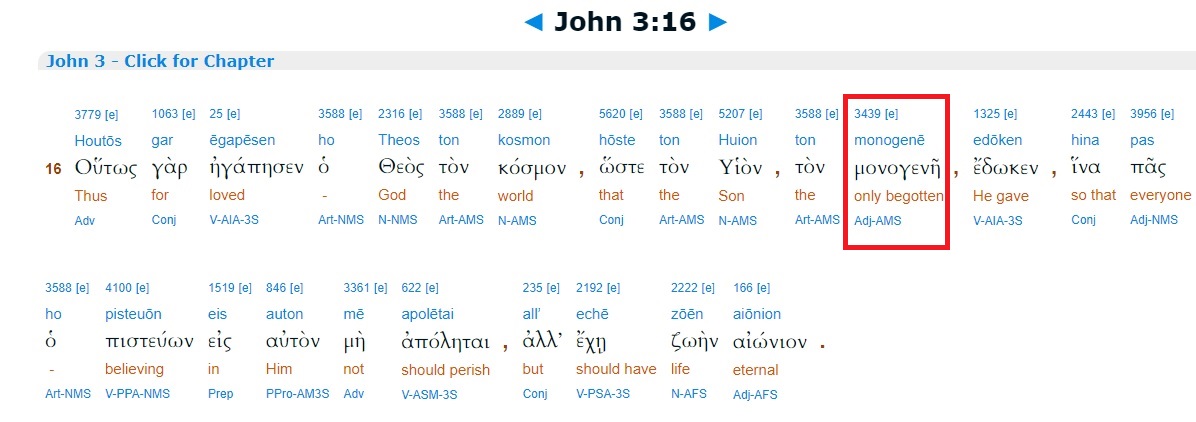
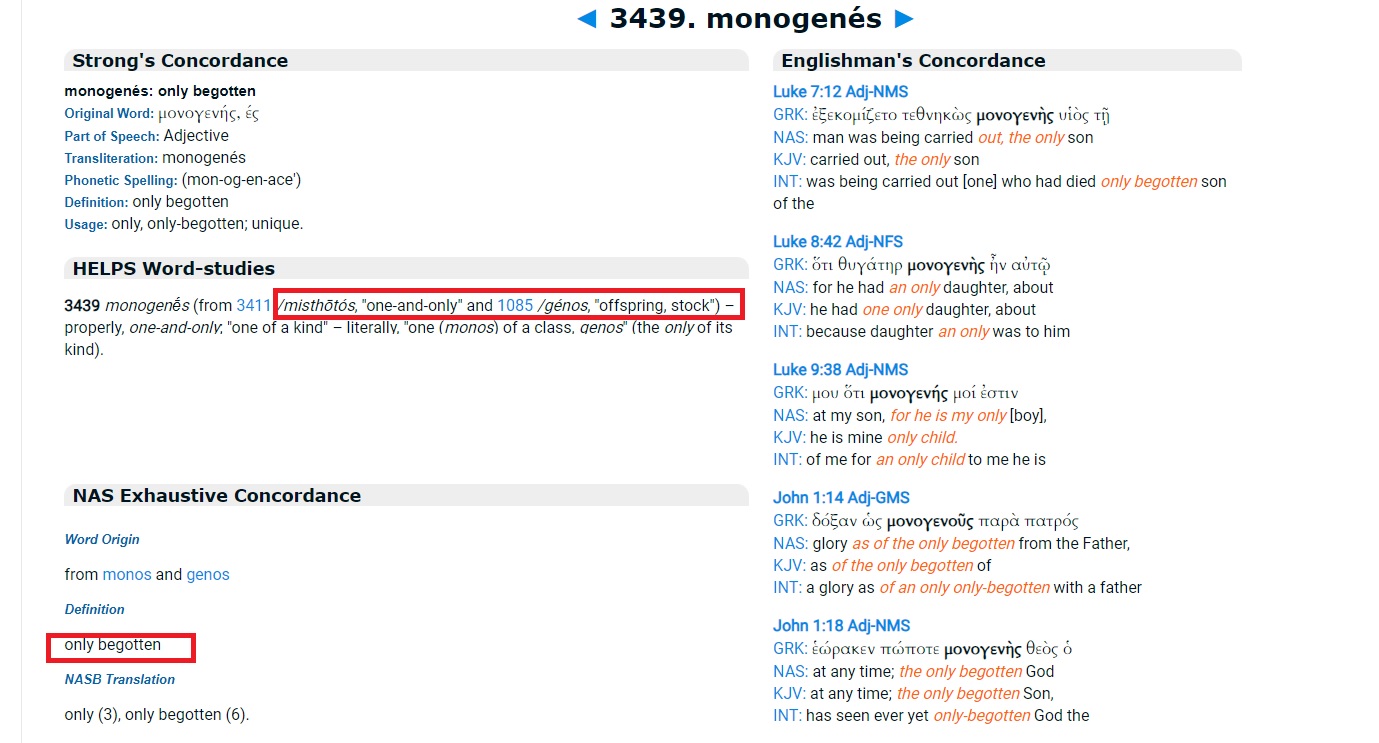
The references for both are as follows:
Source: (https://biblehub.com/greek/3439.htm)
Source: (https://biblehub.com/interlinear/john/3-16.htm)
Their own dictionaries describe Christ Jesus as God’s ‘offspring’ and ‘stock’.
We will now walk through the development of this all-important Christian concept. We will show conclusively how an innocuous expression ‘Son of God‘ became Jesus ‘The Son of God’ in the very theologically loaded sense that it is today.
This very belief latter transforms into ‘God the Son’ the second member of the ever infamous Tri-theistic Trinity of the Athanasian Creed.
SONS BY THE TONS
As Sheikh Ahmed Deedat used to say:
The terms ‘Son of God’ and ‘children of God’ are often used throughout the Bible.
EXAMPLES:
“You are children of the Lord your God” (Deuteronomy 14:1)
“He shall build a house for my name, and he shall be my son, and I will be his father.” (I Chronicles 22:10)
“Now there was a day when the sons of God came to present themselves before the Lord, and Satan came also among them.” (Job 1:6)
“I have said, you are gods; and all of you are children of the Most High” (Psalms 82:6-7)
“...For I am a father to Israel, and Ephraim is my firstborn.” (Jeremiah 31:9)
“Have we not one father?” “Has not one God created us?” (Malachi 2:10)
“Blessed are the peacemakers: for they shall be called the sons of God” (Matthew 5:9)
“For unto which of the angels, said he at any time, You are my Son, this day have I begotten you? And again, I will be to him A FATHER, and he shall be tome A SON?” (Hebrews 1:5)
Prima Qur’an Comments:
In none of the above quotations are the terms ‘children of God’ or ‘Son of God’ understood to be non-allegorical. So why in the case of Jesus is he understood to be the non-allegorical ‘Son of God’.
If you will pay special attention to the last quotation of Hebrews 1:5 you will see that Jesus is ‘A’ Son and God is ‘A’ Father unto him. It does not say Jesus is ‘THE’ Son and God is ‘THE’ father of Jesus.
The reason why Jesus is ‘a’ son and God is ‘a’ father has to do with adoptionist theology.
Jesus a righteous man or ‘son of God’?
When the centurion and those with him who were guarding Jesus saw the earthquake and all that had happened, they were terrified, and exclaimed, “Surely he was the Son of God!” (Matthew 27:54)
“The centurion, seeing what had happened, praised God and said, “Surely this was a righteous man.”(Luke 23:47)
So we can see that Matthew and Luke report the centurion saying two different things? So is this a contradiction or an acceptable allegory? We would say that this is not a contradiction it is an acceptable allegory. That ‘son of God’ simply meant a righteous servant, one near to God.
Son of God or Slave of God?
“And they say: The Beneficent has adopted a son. Glory be to Him! Nay, they are honored, slaves.“(Qur’an 21:26)
“Unto you first God, having raised up his Son Jesus, sent him to bless you, in turning away every one of you from his iniquities.” (Acts 3:26 King James Version)
“To you first, God, having raised up His Servant Jesus, sent Him to bless you, in turning away every one of you from your iniquities.” (Acts 3:26 New King James Version)
Notice that the King James Version calls Jesus “his Son”, Whereas the New King James Version calls Jesus “His Servant” and whenever you see that word “servant” in the New Testament, it means slave.
WHAT IS ADOPTIONIST THEOLOGY?
Adoptinonist theology:
Adoptionist refers to a person who believes that Jesus became the Son of God at his baptism, while adoptionism is the theological doctrine that Jesus was born a mere mortal and was later adopted as the Son of God.
What are the text used in the Bible to support this view held by early Christians?
“I will be to him a father, and he shall be to Me a son; so that when he goes astray I will chasten him with the rod of men, and with the stripes of the sons of Adam.” (2 Samuel 7:14)
Prima Qur’an comments:
- I am not currently his father but I will be.
- He is not currently my son but he will be.
- I will be to him ‘a’ father. Not ‘the’ father.
- He will be to me ‘a’ son. Not ‘the’ son.
- If he goes astray he will be chastened.
Here we have a concept of God appointing someone to be his son, or we may say a righteous servant.
This is also stated in Psalms 2:2 and Psalms 2:7 in a reference to King David.
“The kings of the earth set themselves, and the rulers take counsel together, against the Lord, and against his anointed.” (Psalms 2:2)
“I will declare the decree: the Lord has said unto me, You are my Son; This day have I begotten you.” (Psalms 2:7)
Note: It has this day I have begotten you. It is being said to King David while he is alive and a grown adult. David was appointed by adoption to be the ‘son of God’.
A THEOLOGY TAKES SHAPE
We will now show how ‘Son of God’ in New Testament theology takes a total and complete departure from how ‘Son of God’ was used in the Old Testament.
Now I will give you the proof text which shows how Jesus went from being the adopted ‘Son of God’ to the non-allegorical ‘Son of God’.
ADOPTIONIST THEOLOGY BEHIND THE BAPTISM OF JESUS
“And there came a voice from heaven, saying, YOU ARE my beloved Son, in whom I am well pleased.” (Mark 1:11)
Note: The voice from heaven addressed Jesus. The Greek for YOU is su (SU).
“And there came a voice from heaven, saying, “THIS IS my beloved Son, in whom I am well pleased.” (Mathew 3:17)
Note: The voice from heaven talks about Jesus. The Greek for THIS IS outos (HOUTOS).
Question: Why the change in voice?
Why would one writer deliberately alter the wording of the text?
Answer: The theology!
Mark’s theology held that Jesus became the ‘Son of God’ at baptism, much like David’s coronation in 2 Samuel 7:14
Matthew’s theology held that Jesus was already the ‘Son of God’ based on the virgin birth.
So Jesus does not need to know who he is. Thus, the voice is changed from “You are my son” to an announcement to the ignorant crowd: “This is my son.”
The Qur’an and the Gospel of Luke reject Matthew’s claim.
Note: Look at the Gospel of Luke and Qur’an say in response to Matthew’s claim about Jesus being the ‘son of God’ based upon the virgin birth.
“And they had no child because Elizabeth was barren, and they were now well stricken in years.” (Luke 1:7)
“And Zacharias said unto the angel, how shall I know this? I am an old man, and wife is well stricken in years. And the angel answered said to him, “I am Gabriel who stands in the presence of God; I am sent to speak unto you and to show you glad tidings.” (Luke 1:18-19)
(His prayer was answered): “O Zakariya!” We give you good news of a son: His name shall be Yahya: on none by that name have We conferred distinction before.” He said: “O my Lord”! How shall I have a son, when my wife is barren, and I have grown quite decrepit from old age?” He said: “So (it will be) your Lord says, ‘that is easy for Me: I did indeed create you before when you had been nothing!‘” (Qur’an 19:7-9)
Prima Qur’an Comment: Allah asks Zechariah to reflect upon the fact that he was created indeed before he was nothing
“Relate in the Book (the story of) Mary, when she withdrew from her family to a place in the East. She placed a screen (to screen herself) from them; then We sent her our angel, and he appeared before her as a man in all respects. She said: “I seek refuge from thee to (Allah) Most Gracious: (come not near) if thou dost fear Allah.” He said: ” I am only a messenger from your Lord, (to announce) to you the gift of a holy son. She said: “How shall I have a son, seeing that no man has touched me, and I am not unchaste?” He said: “So (it will be): Your Lord says, ‘that is easy for Me: and (We wish) to appoint him as a Sign unto men and a Mercy from Us’: It is a matter (so) decreed.” (Qur’an 19:16-21)
“The similitude of Jesus before Allah is as that of Adam; He created him from dust, then said to him: “Be”. And he was.” (Qur’an 3:59)
Prima Qur’an Comment: All glory to be to Allah! Allah explains things in a very simple manner for Christians. Allah says that Adam was made from dust(nothingness) and he was simply willed into being. Thus, as Allah (swt) made Adam from nothingness, likewise Christ Jesus, as the word of Allah, is the created word of Allah. Just as all of Allah’s words are created. Jesus, as the kalim of Allah, was created from nothingness.
THE CREATION OF 5 TYPES OF HUMAN BEINGS:
1) Adam was made without a man or a woman and not divine!
2) Eve made without a woman and not divine!
3) Jesus made without a man and not divine!
4) Isaac and John made while their parents were old, infertile, and not divine!
5) The rest of humanity is made of man and woman and not divine!
THE LUKE FACTOR…
Luke’s version of the baptism of Jesus:
“And the Holy Ghost descended in a bodily shape like a dove upon him, and a voice came from heaven, which said, YOU ARE my beloved Son; in you, I am well pleased.” (Luke 3:22)
Note:
1) Luke has the story of the virgin birth
2) Luke has Jesus addressed ‘you are’.
“A few MSS [“D”, “o”, “b”] and Patristic citations representing the “Western” text, have, instead of (You are my beloved Son, in you, I am well pleased), the words of Psalms 2:7, You are my son this day have I begotten you.
“Numerous expositors (e.g. W. Mason, Zahn, Klostermann, Harnack, Moffat, Streeter) accept this variant reading as the original. The majority then explain the alteration of the text from the fact that copyists regarded these words as a contradiction to the reality of the virgin birth.”
Source: [The New International Commentary on the New Testament: The Gospel of Luke by Norval Geldenhuys p. 148]
Prima Qur’an Comment: If we take the above evidence, then the baptism of Jesus (according to Luke) would look like this:
“And the Holy Ghost descended in a bodily shape like a dove upon him, and a voice came from heaven, which said, “You are my son, this day have I begotten you”. (Luke 3:22)
This would mean that Jesus became the ‘son of God’ at his baptism as an adult in the same way David became the ‘son of God’ as an adult.
Let’s continue…
“More important still is the fact that the heavenly voice which greeted Jesus at his baptism hailed him in the opening words of the decree of Psalms 2:7 ‘You are my Son’ Mark 1:11”
“Indeed, the “Western” text of Luke 3:22 represents the fuller wording from Psalms 2:7 which is quoted here by the author of Hebrews 1:5”
“For unto which of the angels said he at any time, You are my Son. “This day have I begotten you?” (Hebrews 1:5)
“The words were evidently in widespread use as a testimonial in the apostolic age, as Acts 13:33 bears witness, and not only these words but the other parts of psalms were given a messianic interpretation, as may be seen from the quotation and explanation of its first two verses in Acts 4:25.
Source: [The New International Commentary on the New Testament: The Epistle to the Hebrews FF. Bruce]
“God has fulfilled the same unto us, their children, in that he has raised Jesus again; as it is also written in the second psalms, You are my Son, this day have I begotten you.” (Acts 13:33)
“Why does the heathen rage, and people imagine a vain thing? “The kings of the earth set themselves, and the rulers take counsel together, against the Lord, and against his ANOINTED.” (Psalms 2:1-2)
“Who, by the mouth of your SERVANT David, has said, Why DID the heathen rage, and the people imagine vain things? “The kings of the earth stood up, and the rulers were gathered together against the Lord, and against his CHRIST.” (Acts 4:25-26)
Note: Some important points need to be made.
David was called ANOINTED (Christ). Also, Luke says David was a SERVANT (Slave) of God. This also means Jesus is like David: He is Anointed, meaning appointed by God. Jesus is also the Servant (slave) of God!
Let’s continue…
“Likewise, certain early manuscripts of Luke quote all of Psalms 2:7: Luke 3:22 in Codex Bezae, and certain old Latin Manuscripts used by Justin, Clement, Origen, and Augustine read, “You are my Son this day have I begotten you.”
But interestingly, Luke also used Psalms 2:7, in a speech composed for Paul.
In Paul’s theology, Jesus was “DECLARED to be the Son of God with power, according to the spirit of holiness, by the resurrection from the dead” (Romans 1:4)
“Luke apparently knew of this Pauline teaching for he has Paul quoting Psalms 2:7 as a speech uttered to Jesus at his resurrection, and not his baptism! Acts 13:32-33
“For Luke and Paul Psalms 2:7 is a RESURRECTION prophecy and not a BAPTISM prophecy.”
Source: (Gospel Fictions: Randel Helms pg. 32, 38)
LUKE: He sees the water Jesus is baptized in as ‘the grave’. When Jesus comes out of the water, it is his ‘resurrection.’ The water is symbolic: of ‘being washed by the blood’ of Jesus.
MARK: believed Jesus to be the adopted ‘Son of God’. In the same way, David was the adopted ‘Son of God’, Thus Jesus became the ‘Son of God’ at his baptism.
MATTHEW: believed Jesus was the non-allegorical ‘Son of God’ based on the virgin birth.
LUKE AND PAUL: believe Jesus was the non-allegorical ‘Son of God’ based on his resurrection from the dead.
Note: Paul said Jesus was ‘Declared’ to be the ‘Son of God’ not that HE WAS the ‘Son of God’
Source: Romans 1:3
What do Christians mean: Jesus is the ‘Son of God’?
Examination time!
We have already seen what begotten means. Not only this but every modern translation of the Bible does away with the term ‘begotten‘?
Why?
Answer:
1) Because David was called, ‘the begotten Son of God’: in Psalms (2:7). You cannot have Jesus be the ‘only-begotten’ when David is already begotten.
2) Hebrews 11:17
“By faith, Abraham, when he was tried, offered up Isaac; and he that had received the promise offered up his only-begotten son.”
- a) This is a flat contradiction because Ishmael was begotten before Isaac was.
- b) Or this is not to be understood as allegorical.
We know this is not understood literally. Isaac is not the only-begotten son; just as Jesus is not the non-allegorical ‘son of God’.
Question: Is Jesus ‘eternally begotten’ by the father?
Answer: No!
Hebrews 1:5
For unto which of the angels said he at any time, You are my Son?” This day have I begotten you?”
Prima Qur’an Comment: Jesus cannot be ‘eternally begotten’ by the father when this passage clearly states ‘This day’ have I begotten you. Indeed, one would wonder what day that is.
Tertullian did not believe in the eternality of the son.
For example, to me, it is very clear that Tertullian did not believe in the eternality of the son based upon the following:
“Because God is in like manner a Father, and He is also a Judge; but He has not always been Father and Judge, merely on the ground of His having always been God. For He could not have been the Father previous to the Son, nor a Judge previous to sin. There was, however, a time when neither sin existed with Him, nor the Son; the former of which was to constitute the Lord a Judge, and the latter a Father.”
Source: (https://www.newadvent.org/fathers/0313.htm)
When the Church decided upon the doctrine of Tri-theism they had to make Jesus co-equal and co-eternal with the father in so doing the doctrine of adoption created huge problems for them. Not only this but if Jesus was indeed begotten ‘this day’ he would not be co-eternal. This is why the Church called Jesus ‘eternally begotten’.
There is no Greek text to support the idea that Jesus is ‘eternally begotten‘ That is why to meet the strong arguments of Bishop Arius his fellow Christians could only respond with two things:
1. Violence.
2. Use an oxymoron ‘eternally begotten‘.
The Greek text is monogenes
How do other Bibles translate John 3:16
“For God so loved the world that he gave his only son (or the unique son of God), that whosoever believes in him shall not perish but have life eternal.” [The Living Bible] John 3:16
“For God so loved the world that he gave his one and only son, that whosoever shall believe in him shall not perish but have everlasting life.” [New International Version] John 3:16
“For God so loved the world that he gave his only son, that whosoever shall believe in him shall not perish but have eternal life.” [Revised Standard Version] John 3:16
“For God so loved the world that he gave his only son that whosoever shall believe in him shall not perish but have eternal life.” [The New American Bible] John 3:16
Note: All of the above translations say something like ‘Only Son’ or ‘Unique Son’.
- a) Either this is a flat contradiction because, as shown from Hebrews 1:5 Jesus is ‘A’ Son not ‘Thee’ Son of God.
- b) Or this is to be understood as allegorical!
We know this is not to be taken nonallegorically. Jesus is not the only son because, as already proven, God has many ‘sons’.
As far as the ‘Unique Son’ is concerned, every ‘Son of God’ is unique! So, once again, Christians are at a loss to explain how Jesus is the non-allegorical ‘Son of God’.
Remember that Jesus never once claimed to be the ‘only son’ of God!
Christians started to see the problem with John 3:16 translations. In a classic debate between Christian televangelist Jimmy Swaggart and Muslim debater Ahmed Deedat, Swaggart anticipated a possible question of Deedat by saying the following:
@ 8:53 minutes “Now I want to start this off tonight by quoting a passage of scripture that Mr. Deedat and myself disagree somewhat over. But which is one of if not the dearest passage in the word of God to the world of Christendom. Found in St. John 3:16
“For God so loved the world that he gave his only unique Son (Fooled you there Mr. Deedat), his only unique son that whosoever believeth in him should not perish but have everlasting life.”
Source: https://www.youtube.com/watch?v=IlA22NNFlDw
CONCLUSION:
The Christians should repent to Allah for every ascribing a non-allegorical son to him. Glory be to Allah who has not adopted a son or daughter! It can be seen how Jesus was called the ‘Son of God’ in the same way that previous people were called ‘Sons of God’.
However, this concept slowly evolved from being the adopted son of God into Jesus being the non-allegorical ‘Son of God’ and eventually led to him being ‘eternally begotten God’
May Allah bring the people out of the great darkness into the light. May Allah guide us to the truth!
“And when they hear what has been revealed to the Messenger, you see their eyes overflowing with tears because of what they have recognized of the truth. They say, “Our Lord, we have believed, so register us among the witnesses.”(Qur’an 5:83)
Back to main section: https://primaquran.com/christianity/
You may also be interested in reading:
https://primaquran.com/2022/10/04/does-allah-need-a-wife-to-have-a-son/
https://primaquran.com/2022/10/04/the-evidence-to-reject-the-virgin-birth-of-jesus/
https://primaquran.com/2022/10/04/the-case-for-the-virgin-birth-from-the-quran/
https://primaquran.com/2022/10/04/a-jewish-argument-against-the-quran/
May Allah Guide the Ummah.
May Allah Forgive the Ummah.


 Prima Quran
Dear Sir
A very slight correction. Arius of Alexandria was an ordained Priest, specifically of the Baucalis district. He was never raised to the dignity of Bishop.
Moreover Arius stated in his letter to Eusebius of Nicomedia: “the Son is not unbegotten, nor part of the unbegotten in any way, nor is he derived from any substance; but that by his own will and counsel he existed before times and ages fully God (pleres theos), only-begotten, unchangeable”.
Greetings Toby. Always appreciate your respectful tone.
I am always amenable to changing information that is in error. I never want to intentionally misrepresent any one person or their positions.
I just have some line of questions.
“He was never raised to the dignity of Bishop.” Would the people responsible for raising him to the status of Bishop be those who held him to have heterodox or orthodox views?
By that I mean we would not expect a church that found him to hold heretical views to promote his status.
“Moreover Arius stated in his letter to Eusebius of Nicomedia: “the Son is not unbegotten, nor part of the unbegotten in any way, nor is he derived from any substance; but that by his own will and counsel he existed before times and ages fully God (pleres theos), only-begotten, unchangeable”
Do you have a link for the source of this quote?
Has this letter be ever be challenged on the grounds of its authenticity?
Are you saying that these are views that Arius had
1) all along.
2) initially had and than abandoned.
3) Did not initially have but latter adopted (final manifesto of his creedal position)
Thank you.
Dear Sir
Thank you for your kind words. It fascinates me that the era surrounding Nicaea continiues to provoke conspiracy theories to this day.
Yet with regard to your questions:
1.Arius in many respects did not play a very significant role within the ‘Arian Controversy’ after Nicaea, and was never consecrated as a Bishop even by his episcopal supporters, such as Eusebius of Nicomedia. Indeed the clergy gathered at the First Council of Antioch (widely regarded as an Arian council) bristled at the statement that they were Arians, since “How could bishops such as we-follow a presbyter” (Athanasius: De Synodis).
2.With regard to the Letter of Arius to Eusebius of Nicomedia, this is an excellent website: https://www.roger-pearse.com/weblog/2019/06/29/arius-to-eusebius-of-nicomedia-the-son-is-fully-god/.
Moreover the doctrine described in the Letter matches with other written Creeds of Arius, such as his Letter to Alexander and the Confession of Faith to Constantine. These texts reflect the Arian view of Christ as God and Creator, yet lesser to the Father who created him: https://www.fourthcentury.com/urkunde-30/
Greetings,
Thank you for the links. I particularly noted the following from the first link. So the letter has the words: “only-begotten, unchangeable.”
Yet the very link you give we find:
The translation is in fact that of R. P. C. Hanson, The Search for the Christian Doctrine of God, 1988, as they make plain. Hanson page 6:
“And before he was begotten, or created or determined or established, he did not exist. For he was not unbegotten (or unoriginated).”
So this certainly does not come across as unchangeable.
I am open to including in the article that the title of Bishop is disputed , thus referring the reader to the comment section here. Though, it seems the thrust of Arius argument remains, even in accordance with the link. Jesus being time barred was not eternal.
The link concludes with:
“The old heretic definitely wrote “fully God”. What he actually meant by this, of course, was the subject of the Arian disputes. But he did not believe that the Son was not God.”
” Satan, who is the god of this world, has blinded the minds of those who don’t believe. They are unable to see the glorious light of the Good News. They don’t understand this message about the glory of Christ, who is the exact likeness of God.” (2 Corinthians 4:4)
Satan, who is the god of this world. Would he be fully god of this world or partially god of this world. Is there another god the author of Corinthians had in mind when it came to be the ‘god of this world’.
So fully God is one thing but a being that is fully God , time barred, and begotten now that merits reflection.
Dear Sir
Thank you for your informed reply. Arius and the broader movement that would come to be known as ‘Arianism’ would proclaim that the Word, though created by the Father, was the Creator of all else in creation. He was ‘created’ before the ages, and that may be seen as being in some sense eternal. In essence, since creation could not endure direct contact to the Father, the Father created the Son in order to form the world on his behalf. This belief was summarised by Auxentius of Durostorum in the following manner: “that the Father was Creator of the Creator, that the Son was truly Creator of all creation; and the Father was the God of the Lord, that the Son was then God of all creation”.
This vew is echoed in other ‘Arian’ proclemations of faith. Arius himself states in his Confession of faith to Constantine that he belived “in one God the Father Almighty, and in the Lord Jesus Christ his Son, who was begotten of him before all ages, God the Word through whom all things were made, both things in heaven and on earth”.
Ulfilas of Thrace, the Arian Bishop of the Goths, clearly stated that: “I believe in one God the Father, the only unbegotten and invisible, and in his only-begotten son, our Lord and God, the designer and maker of all creation, having none other like him”. Ulfilas stands particularly as a representative of the homoian Arian creedal position.
Arius, in all sources of his life that remain to us, is never refered to as having risen beyond the rank of Priest. Even with his brief return to Imperial favour after the Council of Tyre, Arius was never raise to be a Bishop of any see that we know of. As I have said before, he played only a comparativly small role in the Arian Crisis, with the prominent anti-Nicean leaders being individual such as Eusebius of Nicomedia, Valens of Mursa, Acacius of Caesarea and Demophilus of Constantinople.
As I said before, the Arian position never denid that the Word was the Creator of the World, yet they emphaised that he was, in effect, a lesser God to the Father. Thus whilst Satan is indeed refered to as the ‘god’ of the pagan world, the Arians would reason that Christ is ‘fully divine’ yet of a lesser divine order to the Father. Indeed it has been theorised that the expression “fully God” refers to something like, “The Son is fully God in the sense that He pre-existed implicitly in the will and council of the God (namely, God the Father)”.
You and I pre-existed implicitly in the will and council of God namely, God the Father) as well. As God does not increase in wisdom or knowledge. One of the attributes of God that in fact make God, God is the attribute of all knowledgeable.
In that attribute is the pre-existence of your goodself, myself, Jesus (as), Muhammed (saw), Satan, The angels and all existence.
When God chooses for this knowledge to become manifest in one form or the other is another topic altogether.
I have no problem at all in believing that Arius had some high Christology of Christ Jesus (as)
But that Arius held to one of the Trinitarian models extant among the various Churches today is not something I have grounds to believe.
The whole point of this article was to show how this doctrine developed in the innocent sense of being
adopted by God as a son. As was used in the TNCH and how the doctrine of the alleged sonship of Christ continued to develop.
The taste of Neoplatonist philosophy is unmistakable here.
Although, I am sure we can both agree that much of that development is done through the various debates
held among the various Christian communities.
Some high Christological views are the following:
“Through him all things were made; without him nothing was made that has been made.”
(John 1:3)
For by him all things were created, in heaven and on earth, visible and invisible, whether thrones or dominions or rulers or authorities — all things were created through him and for him
(Colossians 1:16)
Then we have the subordation of Christ to God.
“And when all things have been subjected unto him, then shall the Son also himself be subjected to him that did subject all things unto him, that God may be all in all.”
(1 Corinthians 15:28)
What usually termed ‘Orthodoxy today’ would be considered the heretical view of Dyophysitism.
As opposed to a more earlier mainstream Monophysitism.