
“And strive in His cause as ye ought to strive, (with sincerity and under discipline). He has chosen you, and has imposed no difficulties on you in religion; it is the cult of your father Abraham. It is He Who has named you Muslims, both before and in this (Revelation); that the Messenger may be a witness for you, and ye be witnesses for mankind! So establish regular Prayer, give regular Charity, and hold fast to Allah! He is your Protector – the Best to protect and the Best to help!” (Qur’an 22:78)

﷽
Did you know that the vast majority of Muslim layman and even some learned people believe that the Blessed Prophet (saw) said something along the following:
“My Ummah will be split into 73 groups and all of them will be in the hellfire except one, and that is ‘Ahl Sunnah Wal Jammah‘.
- This is absolutely not true. In fact, it is imputing a lie to the Blessed Prophet (saw).
There is absolutely no such statement of the Blessed Prophet (saw).
Does anyone know any verse in the Qur’an any sound Hadith that says that we as Muslims are to call ourselves: ourselves ‘Ahl Sunnah Wal Jammah‘?
I have been searching high n low, and coming up empty. I am not infallible or above reproach. So I think its best I consult with others.
Have you the readers found any clear statement from the Qur’an that we are to call ourselves: ‘Ahl Sunnah Wal Jammah‘?
Have you the readers found any clear statement from the Qur’an that the saved people on the day of judgement are: ‘Ahl Sunnah Wal Jammah‘?
Have you the readers found any sound hadith, (whose chain of narration was so spotless it was not disputed by any of the scholars) where the blessed Prophet Muhammed (saw) told us to call ourselves: ‘Ahl Sunnah Wal Jammah‘?
Have you the readers found any sound hadith, (whose chain of narration was so spotless it was not disputed by any of the scholars) where the blessed Prophet Muhammed (saw) said that the saved group are the: ‘Ahl Sunnah Wal Jammah‘?
Here is what I found.
I found that there has been some deception and sleight of hand to fool people into thinking words have meaning that they do not have.
jama’a literally denotes a group, a collective, a congregation.
jama’a does NOT mean largest group, largest collective, largest congregation.
If one searches through the history books, he will find the origin story of the ‘Jama’ah is the year in which Muawiyah seized the power. It was known as the “The Year of al- Jama’ah”.
It was called so, because the Ummah of the Blessed Prophet (saw) had already become divided into two factions after the death of Uthman: The Shia of Ali and the followers of Muawiyah. When Imam Ali was killed and Muawiyah took over the power, the year was called “al- Jama’ah”. Out of the many Jama’ah. The majority was being lead by Muawiyah, who usurped power and any other parties were considered as a dangerous rivals. Therefore the name of “Ahl al-Sunnah and al-Jama’ah” indicates a forged terminology between the Blessed Sunnah of the Prophet (saw) merged with the innovations by Muawiyah, and the agreement upon his leadership.
Source: (History of al-Tabari, English version, v10, p97) https://www.kalamullah.com/Books/The%20History%20Of%20Tabari/Tabari_Volume_10.pdf

Correction: The Muslim community did not come together in recognizing Mu’awiyah. There remained Muslims that up until today do not recognize Mu’awiyah usurping the Imamate of the Muslims.
MORE DECEPTION IN REGARD TO THE TERM JAMA’A
You may have heard a hadith along the lines of: “Allah’s hand is with the Jammah.”
However, as we have already noted jama’a literally denotes a group, a collective, a congregation.
So now watch some manipulation at work.
If we go to the following website islamqa we find the following: (https://islamqa.info/en/answers/147341/can-large-numbers-be-quoted-as-evidence-of-truth-and-the-meaning-of-the-hadith-my-ummah-will-not-agree-on-misguidance)
“Praise be to Allah.
At-Tirmidhi (2167) narrated from Ibn ‘Umar (may Allah be pleased with him) that the Messenger of Allah (blessings and peace of Allah be upon him) said: “Allah will not cause my ummah to agree on falsehood; the hand of Allah is with the jamaa‘ah (the main body of the Muslims).” Classed as hasan by al-Albaani.”
(the main body of the Muslims) is a bracketed insertion. It is not the meaning of the word jama’a.
Manipulation at work once again. Observe:
” ‘Arfajah ibn Shurayh reported: I saw the Prophet, peace and blessings be upon him, delivering a sermon to the people, saying, “Verily, the Hand of Allah is over the united community, for Satan is with one who secedes from the community, running after him.”
Source: Sunan al-Nasā’ī 4020
Grade: Sahih (authentic) according to Al-Albani.”
However, the Arabic text says no such thing. Observe how it (along with the fuller text) is translated here:
It was narrated that ‘Arfajah bin Shuraih Al-Ashja’I said:
“I saw the Prophet [SAW] on the Minbar addressing the people. He said: ‘After me there will be many calamities and much evil behavior. Whoever you see splitting away from the Jama’ah or trying to create division among the Ummah of Muhammed [SAW], then kill him, for the Hand of Allah is with the Jama’ah, and the Shaitan is with the one who splits away from the Ummah, running with him.'”
Source: (https://sunnah.com/nasai:4020)
Again, nothing about ‘united community’. Which would be problematic even if that were to be accepted. All the different group of Muslims are united with in themselves. When they become disunited on a matter they split and become another Jama’ah.
This is why the people over at islamqa inserted: the main body of the Muslims
WHAT I AND MY COMPANIONS ARE UPON.
Then we have the following:
Narrated ‘Abdullah bin ‘Amr:
that the Messenger of Allah (saw) said: “What befell the children of Isra’il will befall my Ummah, step by step, such that if there was one who had intercourse with his mother in the open, then there would be someone from my Ummah who would do that. Indeed the children of Isra’il split into seventy-two sects, and my Ummah will split into seventy-three sects. All of them are in the Fire Except one sect.” He said: “And which is it O Messenger of Allah?” He said: “What I am upon and my Companions.”
Source: (https://sunnah.com/tirmidhi:2641)
This hadith has been classified as weak. Not everyone is in agreement upon it’s authenticity.
Notice there is no mention of the theologically and politically loaded terminology jama’a
Certainly this hadith which has been classified as weak has to be tempered in light of the hadith that has been graded sound which states:
Narrated Anas:
The Prophet (saw) said, “Some of my companions will come to me at my Lake Fount, and after I recognize them, they will then be taken away from me, whereupon I will say, ‘My companions!’ Then it will be said, ‘You do not know what they innovated (new things) in the religion after you.“
Source: (https://sunnah.com/bukhari:6582)
or the following hadith:
Qais reported:
I said to ‘Ammar: What is your opinion about that which you have done in case (of your siding with Hadrat ‘Ali)? Is it your personal opinion or something you got from Allah’s Messenger (saw)? ‘Ammar said: We have got nothing from Allah’s Messenger (saw) which people at large did not get, but Hudhaifa told me that Allah’s Apostle (saw) had especially told him amongst his Companion, that there would be twelve hypocrites out of whom eight would not get into Paradise, until a camel would be able to pass through the needle hole. The ulcer would be itself sufficient (to kill) eight. So far as four are concerned, I do not remember what Shu’ba said about them
Source: (https://sunnah.com/muslim:2779a)
FOLLOW MY SUNNAH AND THE RIGHTLY GUIDED CALIPHS
Narrated Irbad ibn Sariyah:
AbdurRahman ibn Amr as-Sulami and Hujr ibn Hujr said: We came to Irbad ibn Sariyah who was among those about whom the following verse was revealed: “Nor (is there blame) on those who come to thee to be provided with mounts, and when thou saidst: “I can find no mounts for you.”
We greeted him and said: We have come to see you to give healing and obtain benefit from you.
Al-Irbad said: One day the Messenger of Allah (saw) led us in prayer, then faced us and gave us a lengthy exhortation at which the eyes shed tears and the hearts were afraid.
A man said: Messenger of Allah! It seems as if it were a farewell exhortation, so what injunction do you give us?
He then said: I enjoin you to fear Allah, and to hear and obey even if it be an Abyssinian slave, for those of you who live after me will see great disagreement. You must then follow my sunnah and that of the rightly-guided caliphs. Hold to it and stick fast to it. Avoid novelties, for every novelty is an innovation, and every innovation is an error.
Source: (https://sunnah.com/abudawud/42/12)
Even though this particular hadith is classified as sound I believe that it has been subject to mudraj (interpolated). In particular the phrase: “and that of my rightly -guided caliphs.”
The Arabic term: الْمَهْدِيِّينَ or almahdiiyn also could be translated as ‘The Mahdis’ is certainly problematic.
This hadith does not leave really any good options either for the Umayyad Sunni(s) or the Abbasid Sunni (s).
Why?
- There are just too many companions that fought against Imam Ali to have thought him to be (rightly guided) in all his actions.
- This means they heard this hadith and ignored it. Not good!
- It means that they never heard this hadith because it is mudraj (interpolated) i.e forged.
This extra addition: “and that of my rightly -guided caliphs.” seems cooked up after the fact. Most likely to counter opposition to a particular historical narrative.
If some groups are going to have rightly guided Imams why not rightly guided Caliphs?! Allah (swt) knows best!
THE POSSIBILITY OF NO JAMA’A OR NO IMAM? THEN WHAT?
Narrated Hudhaifa bin Al-Yaman:
The people used to ask Allah’s Messenger (saw) about the good but I used to ask him about the evil lest I should be overtaken by them. So I said, “O Allah’s Messenger (saw)! We were living in ignorance and in an (extremely) worst atmosphere, then Allah brought to us this good (i.e., Islam); will there be any evil after this good?” He said, “Yes.” I said, ‘Will there be any good after that evil?” He replied, “Yes, but it will be tainted (not pure.)” I asked, “What will be its taint?” He replied, “(There will be) some people who will guide others not according to my tradition? You will approve of some of their deeds and disapprove of some others.” I asked, “Will there be any evil after that good?” He replied, “Yes, (there will be) some people calling at the gates of the (Hell) Fire, and whoever will respond to their call, will be thrown by them into the (Hell) Fire.” I said, “O Allah s Apostle! Will you describe them to us?” He said, “They will be from our own people and will speak our language.” I said, “What do you order me to do if such a state should take place in my life?” He said, “Stick to the group of Muslims and their Imam (ruler).” I said, “If there is neither a group of Muslims nor an Imam (ruler)?” He said, “Then turn away from all those sects (al-firqa) even if you were to bite (eat) the roots of a tree till death overtakes you while you are in that state.”
Source: (https://sunnah.com/bukhari:7084)
Here this text addresses the possible scenario of there being no jama’a at all! In particular, no group of Muslims (jamaat al muslimin)
Also, it is hard to imagine that the Blessed Prophet (saw) is advocating for a ‘do it yourself’ Islam in the statement: Then turn away from all those sects (al-firqa)
So let us look at what has been clearly established. We have nothing from the Qur’an or the Sunna of the Blessed Prophet (saw) telling us to follow: Ahl al-Sunnah and al-Jama’ah
CLAIMS THAT THE COMPANIONS USED THE TERM: ‘AHL SUNNAH WAL JAMMAH’ ?
‘Amr ibn Maymun reported: Abdullah ibn Mas’ud, may Allah be pleased with him, said, “Verily, the majority of groups have left the united community. The united community is only the one that conforms to the obedience of Allah, even if you are by yourself.”
Source: Sharḥ Uṣūl I’tiqād Ahl al-Sunnah wal-Jamā’ah 160
From:
Now note somethings from the above site:
The title is: Ibn Mas’ud on Jama’ah: You are Ahl al-Sunnah even if you are alone
But Ibn Mas’ud (ra) did not say: “You Are Ahl al-Sunnah even if you are alone!”
What he is reported to have said is: “The jamaat is only the one that conforms to the obedience of Allah, even if you are by yourself
Remember this translator likes to translate jamaat as ‘united community’ and we already went over this.
The above transmission that is reported to have come from Ibn Mas’ud (ra) is quite eye opening because the truth has nothing to do with a group and especially not an overwhelming majority group. Rather, the truth is that which conforms to the obedience of Allah (swt).
Unfortunately some people will dismiss the above website: https://www.abuaminaelias.com/ because of it’s association with the Salafi sect or Ahl Hadith sect.
Well, if you are an acclaimed Sunni Muslim whom has an aversion for the Salafi you can chew on the following bit of information:
Imam an-Nablusi stated in his book al-Hadiqat an-Nadiyya (vol. 2, pg. 103)
“Jama’ah is rahma, that is, the union of Muslims on truth brings Allahu ta’ala’s Compassion. Tafriqa is adhab, that is, separation from the Community of Muslims brings about punishment from Allahu ta’ala. Hence, it is necessary for every Muslim to unite with those who are on the right path. He must join and believe like them even if they are only a small group. The right path is the path of as-Sahaba al-Kiram. Those who follow this path are called Ahl as-Sunnah Wa’l Jama’ah. It should not confuse us that many heretical groups appeared after the time of as-Sahaba al-Kiram. Al-Imam al-Bayhaqi (d. 458/1066; Rahimahullah) said, ‘When Muslims go astray, you should follow the right path of those who came before them! You should not give up that path even if you are left alone on the path!
Source: (https://masud.co.uk/who-are-the-ahl-as-sunnah-wal-jamaah/)
It is said that Ibn Mas’ud (ra) had a commentary on the following verse of the Qur’an:
“And hold fast, all of you together, to the Rope of Allah, and be not divided among yourselves.” (Qur’an 3:103). Where apparently he explains that the rope mentioned in the verse was the Jama’ah (group).
Insh’Allah when I get the source for this attributed statement I will share it. However, even if it checks out the term again is Jama’ah or simply ‘group’.
The closest you will get to any companion of the Blessed Prophet (saw) coining the phrase: “Ahl al-Sunnah and al-Jama’ah” is that which has been attributed to Abdullah Ibn Abbas (ra).
Commenting on the verse:
“On the Day when some faces will be (lit up with) white, and some faces will be (in the gloom of) black: To those whose faces will be black, (will be said): “Did you reject Faith after accepting it? Taste then the penalty for rejecting Faith.” (Qur’an 3:106)
Ibn Kathir in his commentary on the above verses attributes the following to Ibn Abbas (ra)
“This is when the faces of followers of the Sunnah and the Jama`ah will radiate with whiteness, and the faces of followers of Bid`ah (innovation) and division will be darkened, as has been reported from Ibn `Abbas.”
Source: (https://quranx.com/Tafsirs/3.106)
However, even this statement cannot be authentically attributed to Ibn Abbas (ra).
What I DO find interesting about this particular grouping of words being attributed to Ibn Abbas (ra) is that the Abbasids (from his name sake) are the real intellectual progenitors of what is now commonly known as: Ahl al-Sunnah and al-Jama’ah
Christopher Melchert, Professor of Arabic and Islamic studies at the University of Oxford’s Oriental Institute and fellow in Arabic at Pembroke College, Oxford had the following to say:
“The 9th-century hadith folk’s own preferred term for themselves was “Ahl al-sunna.” It is not convenient for us to call the hadith folk “Sunnis” because that term now calls to mind the great tripartite division of Sunnis, Shi’is, and Kharijis. At least for the 9th century and earlier, a mere tripartite division is simplistic and practically impossible to document. To begin with, 9th-century definitions of Shi’ism were considerably different from those of later times; for example, traditionalist rijal critics regularly distinguished between ‘tashayyu’, special regard for ‘Ali and his house that the hadith folk was willing to overlook, and rafid, the rejection of Abu Bakr and ‘Umar that they thought put one outside the Muslim community. With equal emphasis, the 9th-century hadith folk distinguished themselves from Qadariyya, Murji’a, Mu’tazila, and other theological parties not accounted for by a simple, anachronistic dichotomy between Sunnis and Shi’is. The polarity of Sunni and Shi’i was not strong until the mid-10th century, and full Sunni mutual recognition and self-awareness appeared only in the mid 10th century. Finally, modern scholars should avoid endorsing the hadith folk’s own estimate that they were the overwhelming majority, as calling them “Sunnis” might do.”
” The significance of their calling themselves ‘Ahl al-sunna’ is not that their views were identical to those of the later, great Sunni community, which they were not, but that the later community deliberately identified them as its forebears. We need to understand their piety. Their adversaries preferred not to call them ‘Ahl al-sunna’ and proposed various other terms.’ Al-Jahiz disparaged the nabita, those who sprouted up like weeds to extol the enemies of ‘Ali and to promulgate such crass ideas as assigning God an imaginable body (tajsim, taswfr). Other writers attributed similar errors to the hash- wiyya (vulgar). The hadith folk complained that the Murji’a called them shukkak (doubters) for saying, “I am a believer, God willing,” while the Qadariyya called them mujbira or jabriyya for upholding divine predestination. To use any of these terms for the hadith folk would mean taking sides as much as it would mean calling them ‘Ahl al-sunna’, which is needless for modern scholars.”
“The hadith folk emerged as a distinct group at about the end of the 8th century. They lost importance in the 10th century. Chroniclers usually refer to their 10th-century successors in Baghdad as the Hanabila or simply al-‘amma (the general), periodically rioting against the Shias. Meanwhile, their own name for themselves, ‘Ahl al-sunna’, was claimed by virtually all parties except the Shi’is. Even Mu’tazila called themselves Ahl al-sunna wa-al-jama’a, on the plea that if they were not actually the great majority, they ought to have been. (I have not compared the piety of the hadith folk with that of 9th-century Shi’is, rewarding though such a comparison would be. At least a wing of the Shi’ movement probably had something very close, which ought to show up in Shi’i hadith.)
Source: (The Piety of the Hadith Folk by Christopher Melchert)
Ahl al-Sunnah and al-Jama’ah is the biggest game in town and so they are upon the truth!
I have always found claims that the majority =truth to be quite dubious.
1st and foremost is that the Qur’an never indicates that the majority are upon the truth, quite the opposite.
Then when you actually look at those who claim: Ahl al-Sunnah and al-Jama’ah you begin to realize the difference between those who claim that title, and all the one’s that think the others have misappropriated the title.
As long as one goes to the Masjid and performs their prayers there seems to be a great deal of unity among those who call themselves: ‘Ahl Al-Sunnah And Al-Jama’ah‘. This actually happens any where in Muslim majority countries. It happens in Mecca where the Sunni, Shi’i and Ibadi all pray together, behind one Imam.
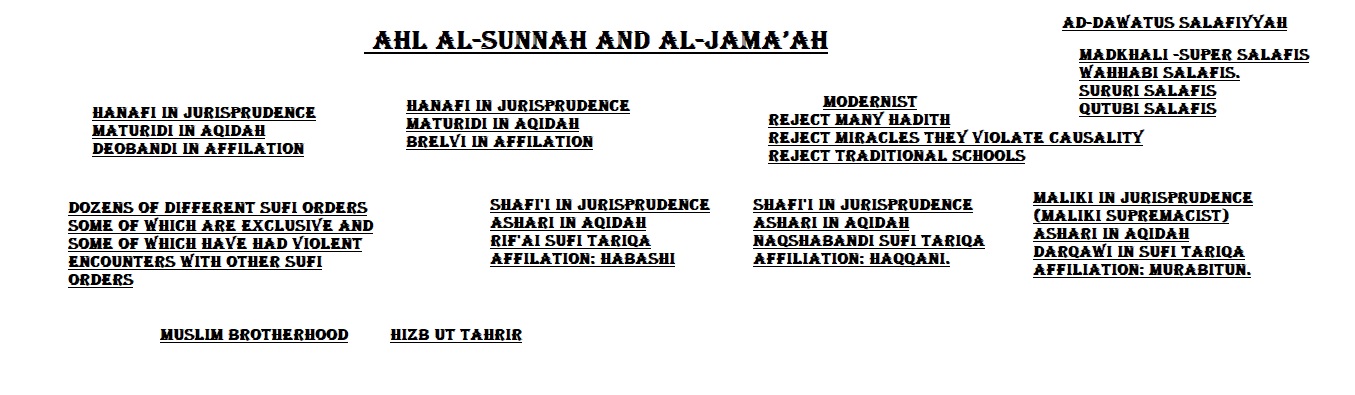
However, the secret to maintaining this outward unity is simply this: Be very very careful what you talk about. Because depending upon the topic, jurisprudence, theology, history, science, politics things could turn quite volatile.
The above image no where does justice to the very real divisions that exist among those who claim the title: ‘Ahl Al-Sunnah And Al-Jama’ah‘.
It seems this ahadith about the ‘jamaat’ or the ‘group’ can easily be interpreted by any group of any given sect of Muslims at any point in history as a reference to themselves.
If Sunni Muslims believe that the majority is correct then the whole lot of them should follow the Hanafi school of jurisprudence. That is because around 60% of Sunni Muslims follow this particular school.
The Abbasids, Mughal and Ottoman empires adopted it and promulgated it. The followers of other schools of Sunni jurisprudence would have to be considered shameful to hold on to to the Hanbali, Maliki and Shafi’i schools of jurisprudence in light of what looks like the apparent favour of Allah (swt) given to the Hanafi school.
Conclusion:
The term or phrase: “Ahl Al-Sunnah Wal-Jama’ah” cannot be authentically attributed to the Blessed Messenger (saw). This term is not in the Qur’an. This term is not from the Blessed Messenger (saw).
May Allah (swt) Guide the Ummah.
May Allah (swt) Forgive the Ummah.


 Prima Quran