“Indeed, We have made it (ja’alnahu) an Arabic Qur’an that you might understand.” (Qur’an 43:3)
﷽
The truth of the matter is that the entire Muslim Ummah are in agreement that some aspect of the Qur’an is created. What they differ and disagree about are the specifics.
This debate has been framed incorrectly. It has been framed as a debate between those who believe the Qur’an is created and those who believe the Qur’an is uncreated.
The reality: The debate is about to what degree and which aspects of the Qur’an are created.
For example:
1. The Mushaf. The pages that the ink is printed upon. All Muslims call this the Qur’an. There is etiquette in regard to it. We do not bring it to dirty places. The proper disposal is to burn it’s pages. Yet, this is called ‘Qur’an’. Everyone who can be called Muslim agrees to this. That is that the Mushaf of the Qur’an is created. If there is a person who disagrees with this and or is hesitant to affirm this then know that they are upon something very strange.
2. The ink and the words which are written. The words and letters on the pages that were placed there by ink or the printing press. All Muslims call this the Qur’an. Everyone who can be called Muslim agrees to this. That is that the ink and the words on the pages are created.If there is a person who disagrees with this or is hesitant to affirm this then know they upon something very strange.
3. The recitation of the words of the Qur’an. This is is what we will be discussing today.
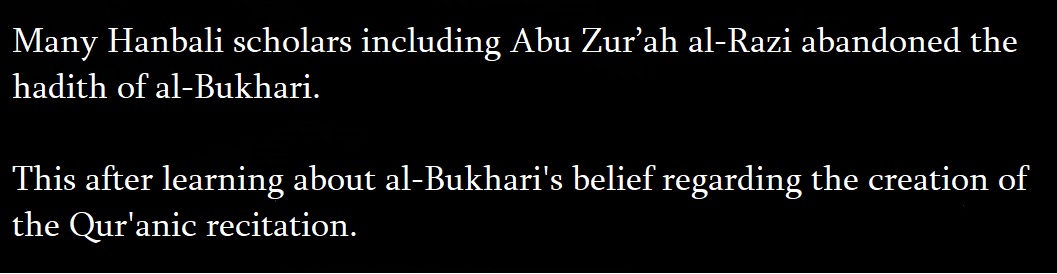
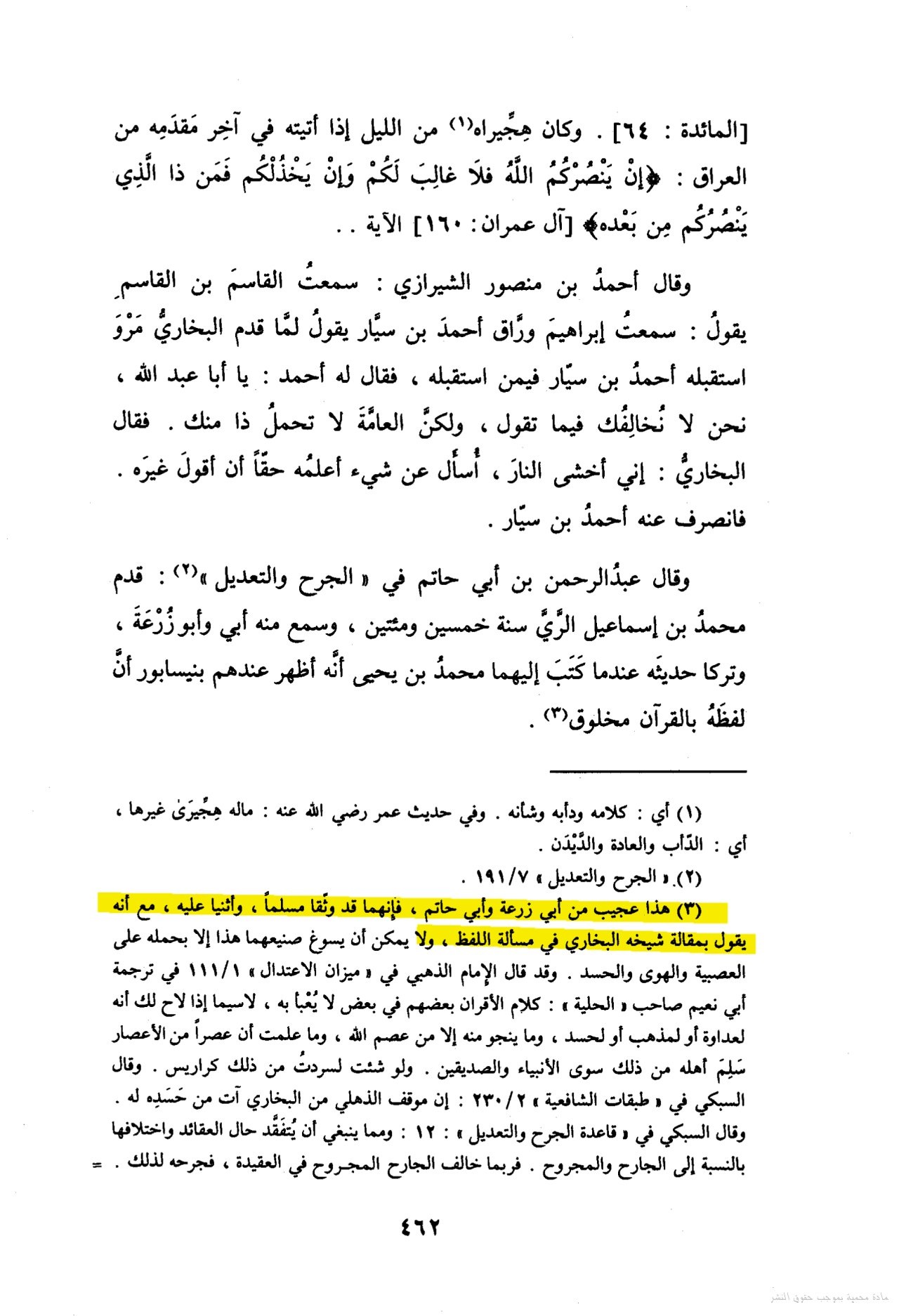
We will learn that the one who compiled ‘Sahih Bukhari’, whose full name is: Abū ʿAbd Allāh Muḥammed ibn Ismāʿīl ibn Ibrāhīm ibn al-Mughirah ibn Bardizbah al-Juʿfī al-Bukhārī and his supporter who compiled ‘Sahih Muslim’ . Both believed that their recitation of the Qur’an is created. This caused a boycott of Bukhari by major Hanbali scholars..
“Muhammed bin Yahya al-Nisaburi wrote to the people of Rayy, informing them of al-Bukhari’s position. The accusation was that al-Bukhari held “lafzi bil-Quran makhluq”. That his pronunciation/recitation of the Quran is created.”
“My father and Abu Zur’ah heard from him, then they both abandoned his hadith when Muhammed bin Yahya al-Nisaburi wrote to them that he [al-Bukhari] had made it apparent to them that his pronunciation of the Qur’an is created.”
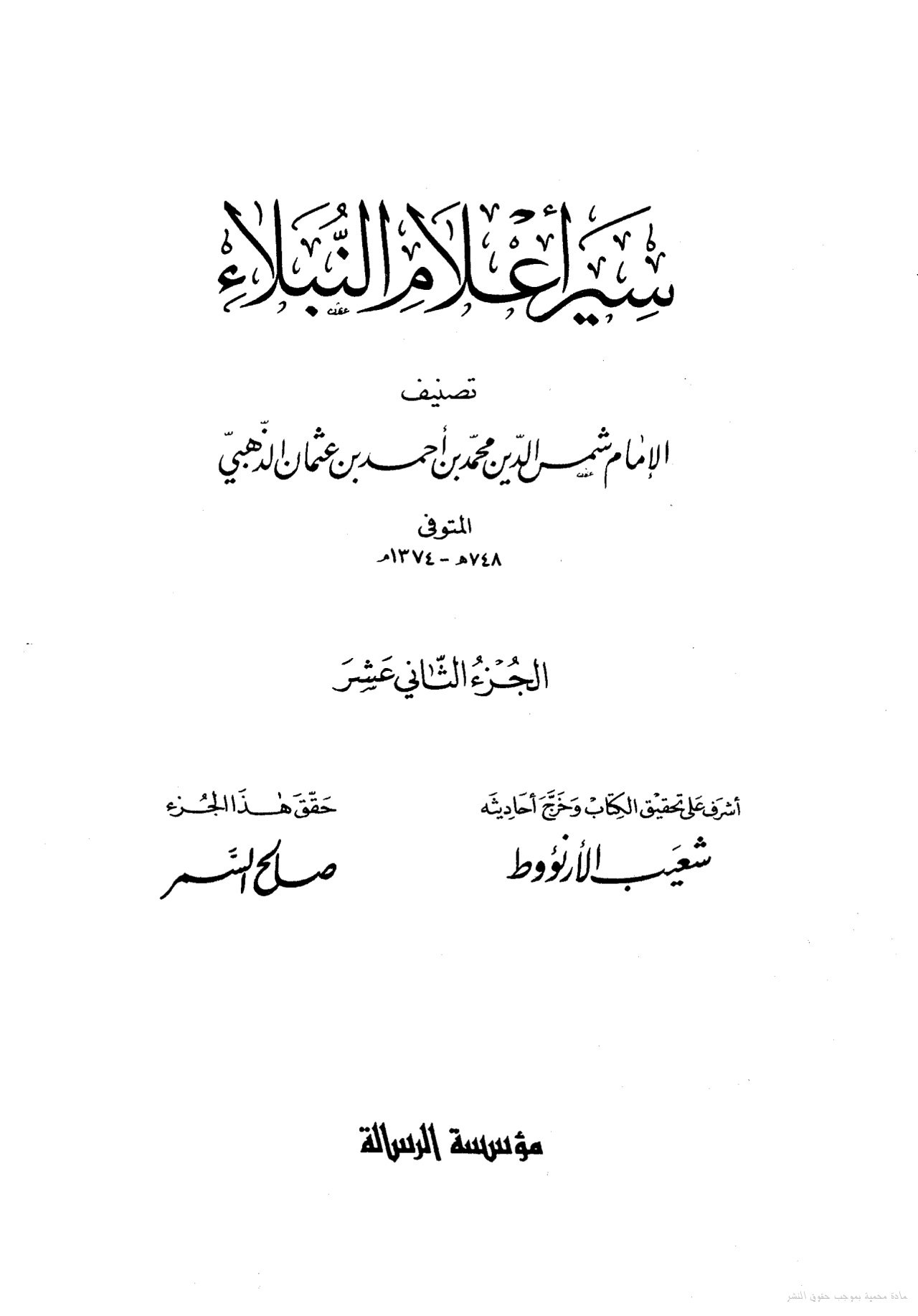
Source: (page 462 from Volume 12 of Siyar A’lam al-Nubala’ (Biographies of the Noble Scholars) by Imam al-Dhahabi, edited by Shu’ayb al-Arna’ut.)
“[Al-Ma’idah: 64]. And his emigration (hijrah)(1) was from Mecca. He came to Iraq at the end of the night… [Quranic verse]: “If Allah helps you, none can overcome you; and if He forsakes you, who is there after Him that can help you?” [Al Imran: 160].”
“And Ahmad bin Mansur al-Shirazi said: I heard al-Qasim bin al-Qasim say: I heard Ibrahim, the scribe of Ahmad bin Sayyar, say: When al-Bukhari arrived in Marw, Ahmad bin Sayyar met him. So he said to him: “O Abu Abdullah, we do not oppose you in what you say, but the common people cannot bear this from you.” He [al-Bukhari] said: “I only ask about something I know to be true, fearing the Fire, lest I say other than it.” So Ahmad bin Sayyar turned away from him.”
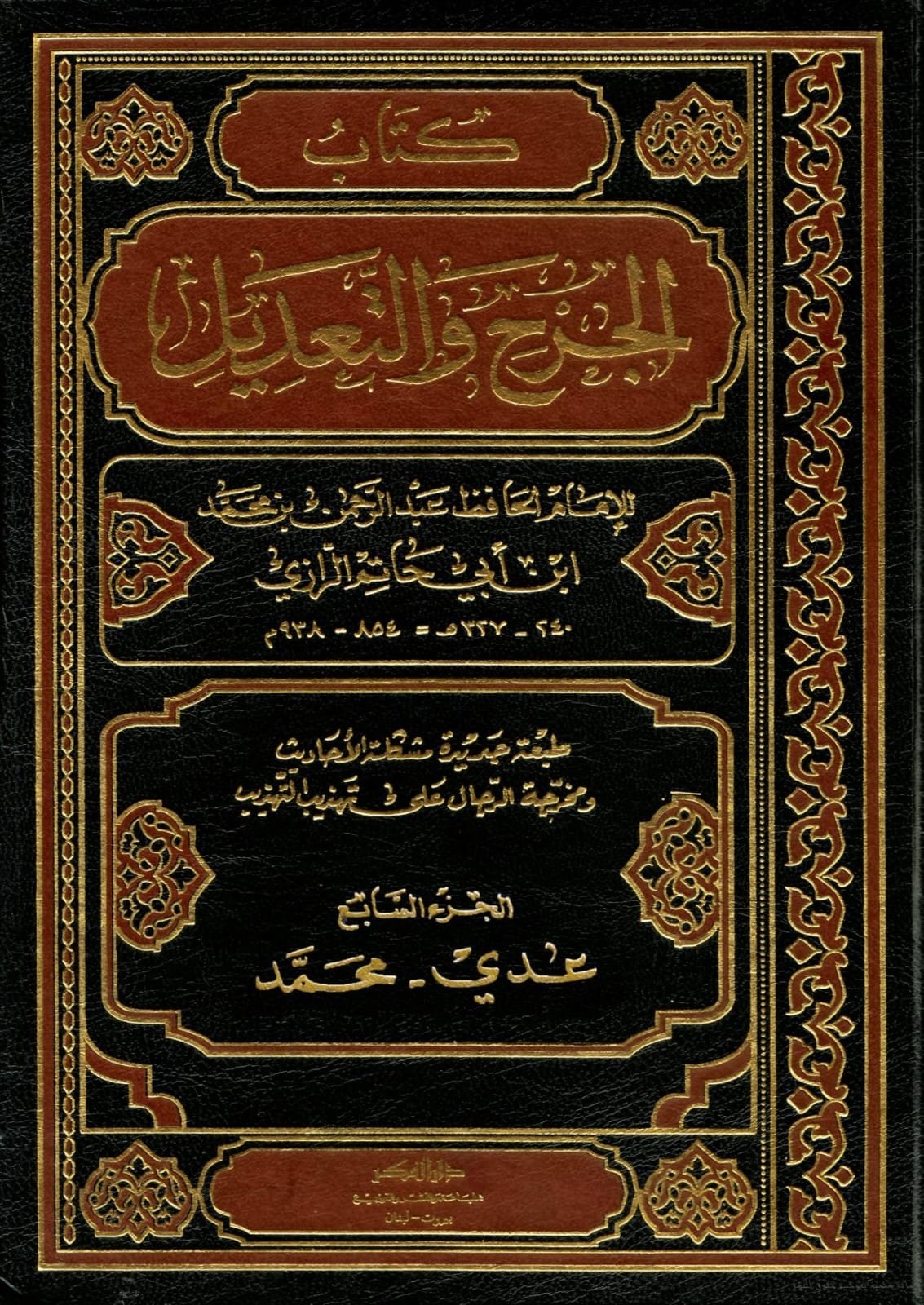
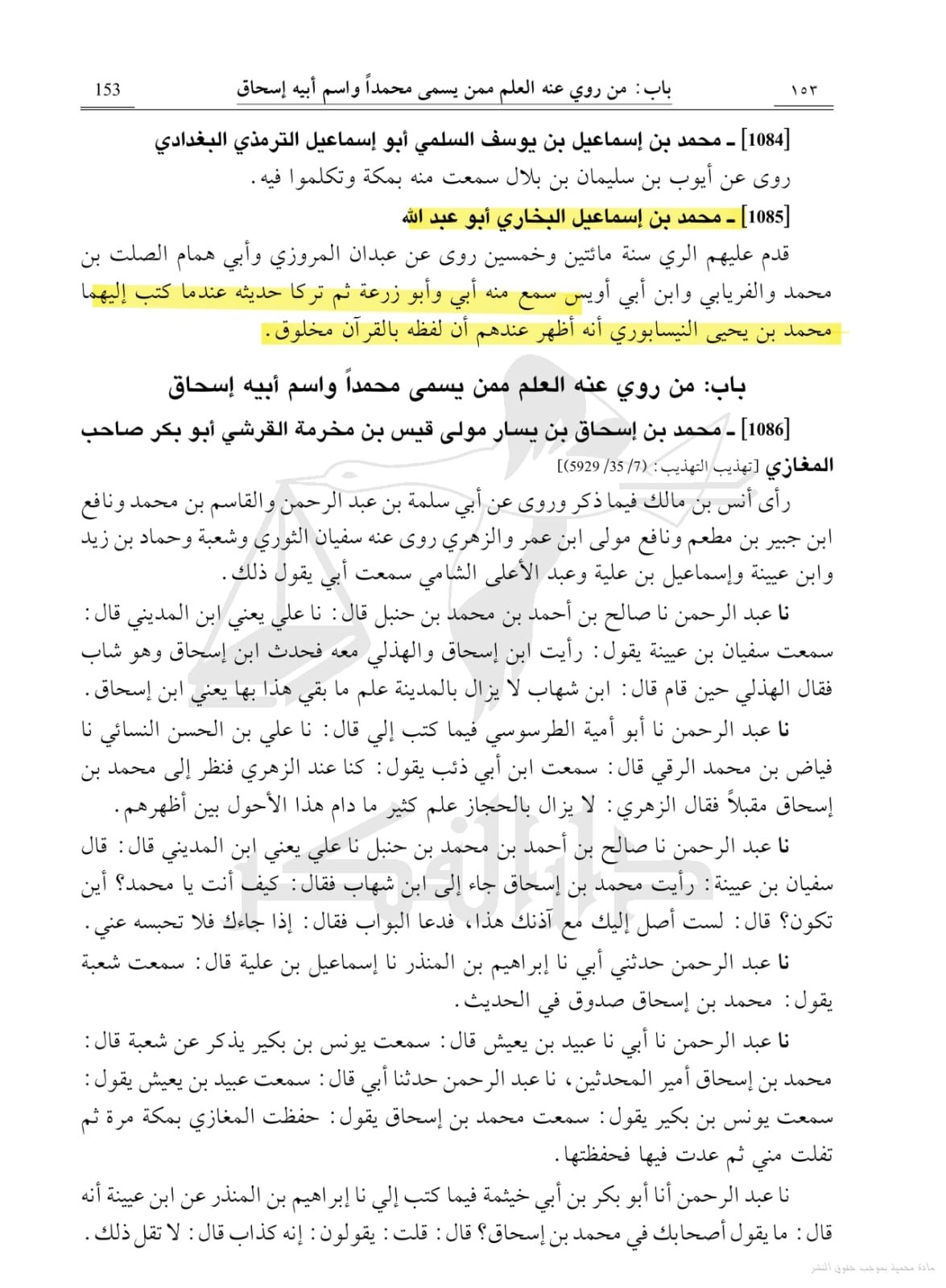
“And Abd al-Rahman bin Abi Hatim said in Al-Jarh wa al-Ta’dil (2): Muhammed bin Isma’il al-Rayy came in the year 210 AH, and my father and Abu Zur’ah heard from him. And they abandoned his hadith when Muhammed bin Yahya al-Nisaburi wrote to them that he [al-Bukhari] had made it apparent to them that his pronunciation of the Quran is created.“
Then Shu’ayb al-Arna’ut comments on this.
By the way for those not familiar when you see the name Shu’ayb al-Arna’ut it is a reference to Abū Usāmah Shuʿayb ibn Muḥarram ibn ʿAlī al-Albānī al-Arnāʾūṭ.
Most people in Salafi/Athari circles simply refer to him as: al-Albānī.
So al-Albānī (Shu’ayb al-Arna’ut) comments:
“This is strange from Abu Zur’ah and Abu Hatim, for they both had already heard from him [al-Bukhari] and narrated from him, and they did not abandon him except based on the statement of their teacher al-Bukhari regarding the issue of lafz [pronunciation]. And it is not permissible for them to act upon this, due to what it entails of sin, caprice, and envy. And Imam al-Dhahabi said in Mizan al-I’tidal 1/111 in the biography of Abu Nu’aym, the author of Al-Hilyah: “The words of some of them regarding others are not to be relied upon, especially if it becomes clear to him that it is due to partisanship for a madhhab or envy. And no one is safe from that except one whom Allah protects. And I do not know of an era from the eras that is safe from that except the era of the Prophets and the Rightly Guided Caliphs. And if you wish, I could list that in volumes.” And al-Subki said in Tabaqat al-Shafi’iyyah 2/230: “The position of al-Dhuhali [Muhammed bin Yahya] regarding al-Bukhari came from envy of him.” And al-Subki said in Qa’idah al-Jarh wa al-Ta’dil 12: “And from what should be examined is the state of beliefs and their differences in relation to the critic and the criticized. For perhaps the critic is wronged in creed, so his criticism of him is [invalid].”-Shaykh al-Albānī
Source: (page 462 from Volume 12 of Siyar A’lam al-Nubala’ (Biographies of the Noble Scholars) by Imam al-Dhahabi, edited by Shu’ayb al-Arna’ut.)
Examining Shaykh al-Albānī charge of envy for abandoning Bukhari for his position on the createdness of the Qur’an.
Shaykh Shaykh al-Albānī’s argument in the highlighted footnote is essentially this: Abu Zur’ah’s criticism cannot be sincere because he also narrated from Muslim, who shared al-Bukhari’s theological position.
If Abu Zur’ah was willing to accept hadith from Muslim, he should have accepted them from al-Bukhari on the same grounds. Unless his abandonment of al-Bukhari was motivated by petty jealousy, or partisanship.
We have to be fair here in saying that Shaykh al-Albānī’s claim has a very strong basis.
This reasoning has some historical traction, but it is not the whole picture:
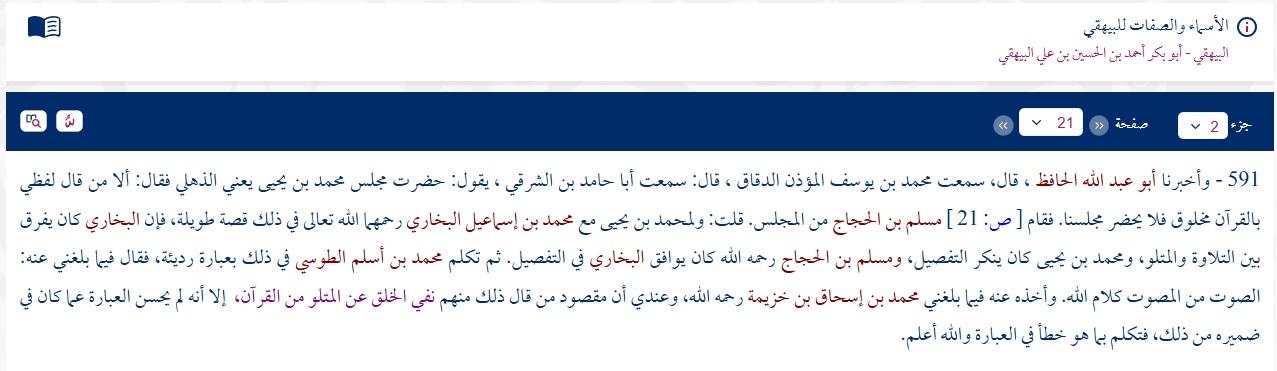
Muslim’s Position: It is well-established that Imam Muslim did agree with al-Bukhari on the lafz issue. Al-Bayhaqi explicitly stated that Muslim “was on the madhhab of al-Bukhari in the distinction” between recitation and the recited. Muslim also famously stood by al-Bukhari during the boycott, taking his written works back from al-Dhuhali and withdrawing from his circle.
Source: (Siyar A’lam al-Nubala’ 12/460, Huda al-Sari in the introduction to Fath al-Bari 2/264)
Imam Muslim was the only one who did not abandon Imam al-Bukhari, since they were upon the same creed. Their creed opposed that of the Hanbali who opposed them.
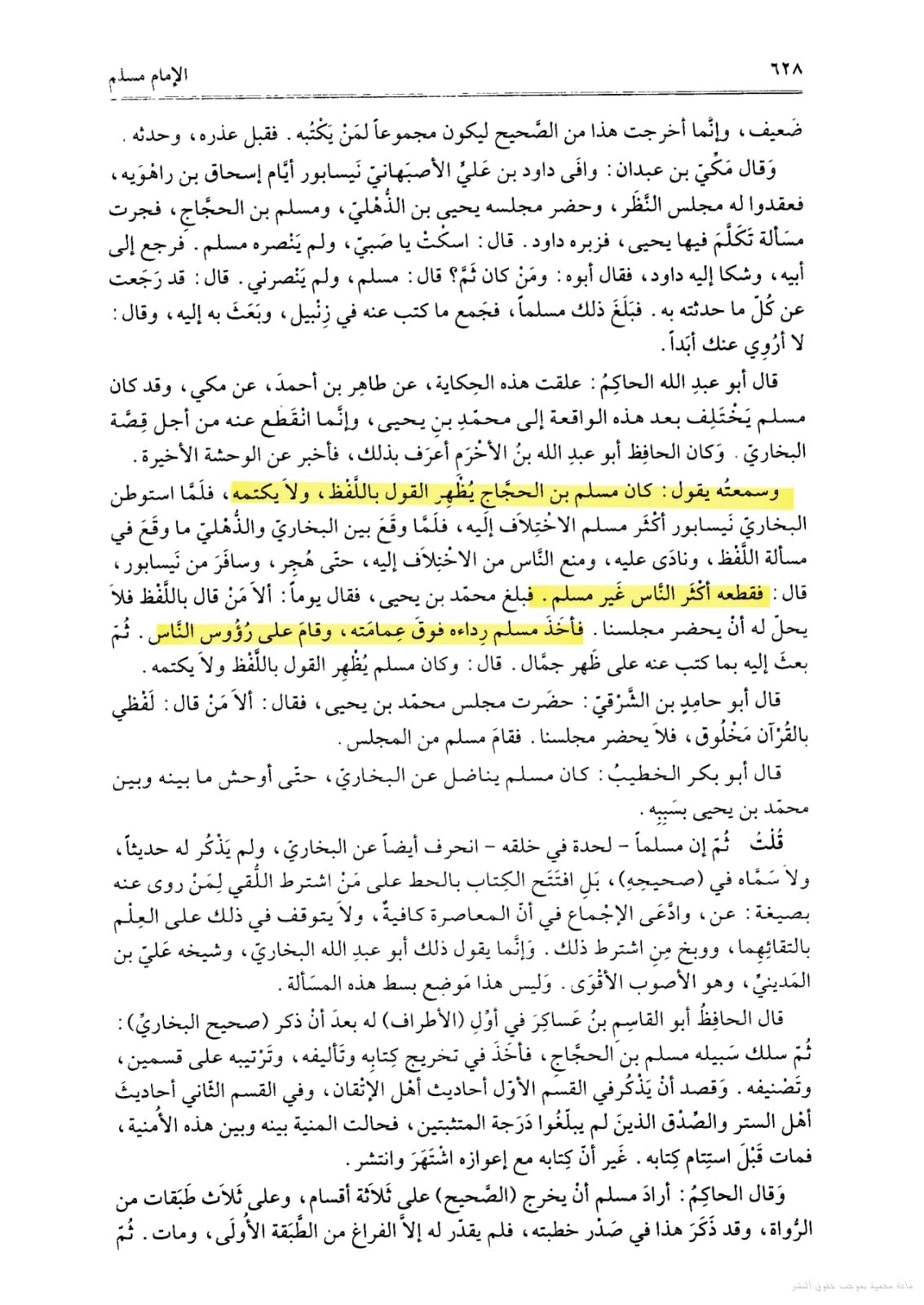
“And Makki bin Abdan said: Dawud bin Ali al-Asbahani came to Nisapur during the days of Ishaq bin Rahwayh. They held a session of debate for him, and he attended the circle of Yahya bin al-Dhuhali, and Muslim bin al-Hajjaj. A theological issue was discussed in which Yahya spoke, and he silenced him, saying: “Be quiet, O boy!” So Muslim did not support him. He returned to his father and complained to him. His father said: “Who was he?” He said: “Muslim.” He said: “You have returned from every single one of my hadiths!” [Meaning: you have ruined your standing with him]. When this reached Muslim, he gathered what he had written from him in a notebook, sent it to him, and said: “I will never narrate anything from you ever again.”
“Abu Abdullah al-Hakim said:I have noted this story from Tahir bin Ahmad, from Makki, and Muslim may have differed after this incident with Muhammed bin Yahya, but he only cut him off because of the issue of al-Bukhari. And al-Hafiz Abu Abdullah bin al-Akhram knew that, so he informed about the alienation [that occurred] later.”
“And I heard him [al-Hakim] saying:Muslim bin al-Hajjaj used to openly declare the statement regarding al-lafz [the pronunciation of the Quran], and he did not conceal it. When al-Bukhari settled in Nisapur, he openly declared more of the disagreement with him. When the issue of al-lafz occurred between al-Bukhari and al-Dhuhali, and the people of Nisapur were prevented from differing with him [al-Dhuhali], and he called to that, the majority of people cut off from Muslim, other than a few. It reached Muhammed bin Yahya, and he said one day: “Whoever says al-lafz is not created, it is not permissible for him to attend my circle.” So Muslim took his garment, placed it on his shoulder, stood up before the people, and sent to him what he had written from him, saying: “We only used to narrate from you because of al-lafz.” And Muslim used to openly declare the statement regarding al-lafz and not conceal it.“
“Abu Hamid bin al-Sharqi said: I attended the circle of Muhammed bin Yahya, and he said: “Whoever says: ‘My pronunciation of the Quran is created,’ let him not attend my circle.” So Muslim stood up from the circle.”
“Abu Bakr al-Khatib said: Muslim used to fight on behalf of al-Bukhari, until the relationship between him and Muhammed bin Yahya became estranged, due to his [al-Bukhari’s] reason.”
“I [al-Dhahabi] said:Then, [if] he was a Muslim due to his createdness [meaning: his stance on the creation of actions] he also turned away from al-Bukhari, and did not mention him as a narrator of hadith, nor did he name him in his Sahih. Rather, he began the book with the wording of those who stipulated al-lafz for whomever he narrated from, in a manner that claims consensus in the contemporary era is sufficient [to establish it], and he did not pause on that knowledge of the two of them, and he criticized whoever stipulated that. But rather, Abu Abdullah al-Bukhari said that, and his teacher Ali bin al-Madini, and it is the most correct and most sound [position]. And this is not the place to elaborate on this issue.”
“The Hafiz Abu al-Qasim bin Asakir said in Al-Atraf: It is after he mentioned [the Sahih of al-Bukhari]: Then he followed the path of Muslim bin al-Hajjaj, and he took the extraction of his book, its composition, and its arrangement into two parts. He intended to mention in the first part the hadiths of the reliable people of precision, and in the second part the hadiths of the people of covering and truthfulness, those who did not reach the rank of the firmly established. The death prevented him from completing this aspiration, and between him and this aspiration was the completion of his book. However, his book became famous and spread despite his need for it [to be completed].”
“And al-Hakim said: Muslim wanted to extract the Sahih into three categories, and upon three generations of narrators. He mentioned this at the beginning of his introduction, but he was not able to finish except the first category, and he died.”
Source: (page 628 from Volume 12 of Siyar A’lam al-Nubala’, in the biography of Imam Muslim)
The second point.
Abu Zur’ah’s Relationship with Muslim: Abu Zur’ah was not hostile to Muslim. In fact, Muslim submitted his Sahih to Abu Zur’ah for review, and Abu Zur’ah’s approval was seen as a mark of its authenticity. if Abu Zur’ah accepted Muslim’s Sahih despite his lafz views, why did he abandon al-Bukhari?
Insh’Allah we will update this page and provide an easily accessible online source when it becomes available.
If you would like to learn more about this specific subject please read the following:
“We certainly brought you the truth, but most of you, to the truth, were averse.” (Qur’an 43:78)
“And of the people is he who disputes concerning Allah without knowledge or guidance or an enlightening Book, twisting his neck to mislead from the way of Allah. For him in this world is disgrace, and We will make him taste on the Day of Resurrection the punishment of the Burning Fire.” (Qur’an 22:8-9)
﷽
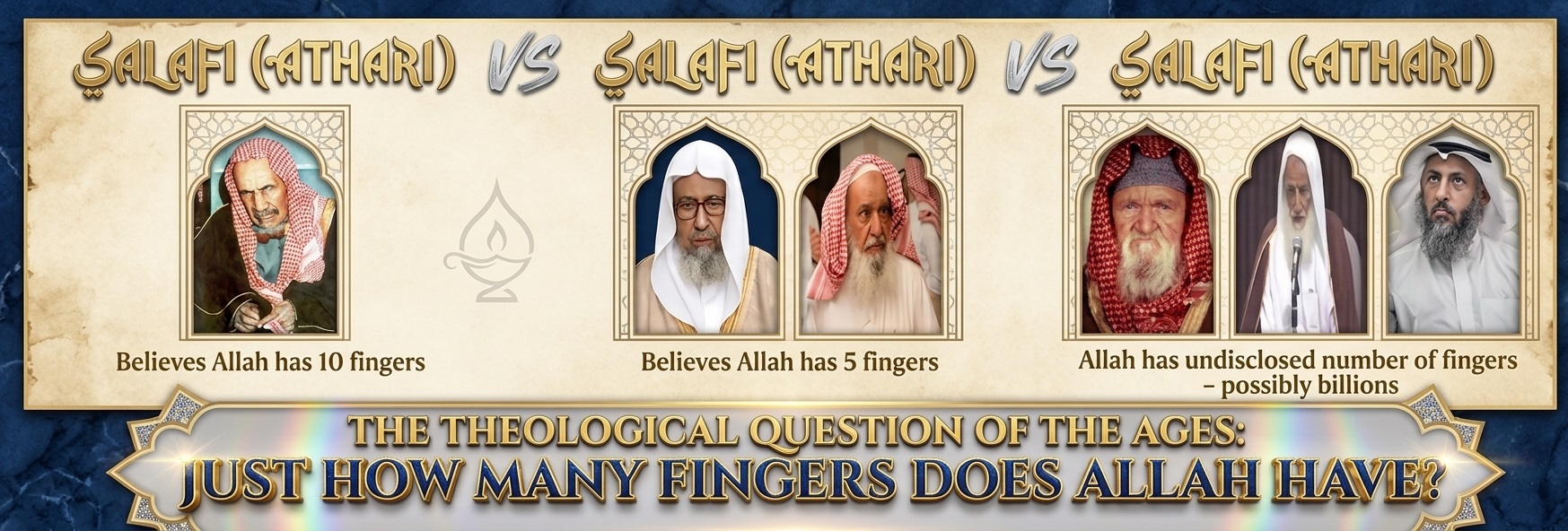
In this article we explore who has the correct aqidah? Which of the Salafi (Athari) are among the Mu’attilah and which are not?
Who is correct in regarding a theological matter of great importance: HOW MANY FINGERS DOES ALLAH HAVE?
A matter in which Muslims can be removed from Islam and a matter in which the blood of a believer may be considered permissible.
Just how many fingers does Allah have? The debate among the Athari/Salafi rages on!
First let it be said as regard the video we disavow the meme and the laughing emojis. We can make our points without appealing to such.
Shaykh Uthman al-Khamis:
فهل نثبت لله خمسه اصابع؟ نثبت لله الاصابع والحديث ما في خمسه اصابع. الحديث ما في خمسه اصابع وانما قال ان الله يحمل السماوات على اصبع والاراضين على اصبع والجبال على اصبع والشجر على اصبع ما في تحديد خمس اصابع فلا نحدد نقول لله اصابع تليق به ونسكت
English Translation: “So do we affirm five fingers for Allah? We affirm fingers for Allah, but the Hadith does not mention five fingers. The Hadith does not mention five fingers; rather, it states that Allah places the heavens on a finger, the earths on a finger, the mountains on a finger, and the trees on a finger. There is no specification of five fingers, so we do not specify. We say that Allah has fingers that befit Him, and we remain silent. -Shaykh Uthman al-Khamis.
احسن الله اليكم سائل يقول هل الاعتقاد الصحيح هو ان لله خمس اصابع فقط
English Translation: “May Allah be good to you, a questioner asks: Is the correct belief that Allah has only five fingers?”
Shaykh Abdul-Aziz Bin Baz:
يعني كل يد لها خمس اصابع ان الله جل وعلا له يدان ولكل يد دن اصابع وهذا من الكمال
English Translation: “Meaning, each hand has five fingers. Indeed, Allah, Majestic and Exalted, has two hands, and each hand has fingers, and this is a matter of perfection.” -Shaykh Abdul-Aziz Bin Baz
Shaykh Muhammed Nasir al-Din al-Albani says the hadith does not prove Allah (swt) has five fingers.
Al-Albani was asked directly: “The hadith counts five. Does this mean Allah has five fingers?” He replied: “No! We do not add to the hadith nor subtract from it.” When pressed that the five is a mafhūm (implied meaning), he said: “There is no harm in taking the mafhūm as long as it does not contradict an explicit text.”
So here we have Shaykh Muhammed Nasir al-Din al-Albani saying that implication has a basis in theology!
Shaykh Al Uthaymin says Allah has an undetermined number of fingers.
Uthaymin was even more explicit in warning against the question itself. In his lecture on al-ʿAqīdah al-Saffārīniyyah, he said:
“A questioner asked me: ‘What do you say about Allah’s fingers. How many?’ I said: ‘Do you have to know this? Affirm that Allah has fingers as the Prophet ﷺ said. As for how many? We cannot speak about this.’ By Allah, you are not more eager for knowledge of Allah than the Companions! When the Prophet ﷺ said ‘Allah places the heavens on a finger,’ did they say: ‘O Messenger of Allah, does Allah have more than three fingers?’ They did not. Because they were more complete in manners and more reverent toward Allah than those who came after them.”
Shaykh Abdul-Aziz al-Rajihi believes that Allah (swt) has five fingers.
في هذه الأحاديث إثبات الأصابع للرب عز وجل، وأن لله خمسة أصابع وهي صفات ذاتية تليق بالله، وأن الله تعالى يضع السموات على أصبع والأرضين على أصبع والشجر والثرى على أصبع وسائر خلقه على أصبع. في الحديث الأول: «يُمْسِكُ السَّمَوَاتِ عَلَى إِصْبَعٍ، وَالأَْرَضِينَ عَلَى إِصْبَعٍ، وَالْجِبَالَ عَلَى إِصْبَعٍ، وَالشَّجَرَ عَلَى إِصْبَعٍ» فهذه خمسة أصابع.
English translation:
“In these hadiths there is affirmation of fingers for the Lord, Mighty and Majestic, and that Allah has five fingers, which are attributes of His essence befitting Allah, and that Allah, the Most High, places the heavens upon a finger, the earths upon a finger, the trees and the soil upon a finger, and the rest of His creation upon a finger. In the first hadith: ‘He holds the heavens upon a finger, the earths upon a finger, the mountains upon a finger, and the trees upon a finger’ So these are five fingers.”- Shaykh Abdul-Aziz al-Rajihi
Shaykh Saleh al-Fawzan’ mentions that Allah has five fingers and he affirms this as the belief of Muhammed ibn Abd al-Wahhab in his ‘Book of Tawhid’.
“نعم، شوف في آخر كتاب التوحيد أن الله -جَلَّ وَعَلا- يطوي السماوات السبع، والأراضين السبع بيديه، أو يجعل البحار على أصبع، أو يجعل الجبال على أصبع، راجع آخر كتاب التوحيد في هذا… إلى أن ذكر خمسة أصابع… نعم، نثبت الأصابع لله عز وجل.”
English translation:
“Yes, look at the end of Kitab al-Tawhid. That Allah, Mighty and Majestic, rolls up the seven heavens and the seven earths with His two Hands, or places the seas upon a finger, or places the mountains upon a finger. Refer to the end of Kitab al-Tawhid on this… until he mentioned five fingers… Yes, we affirm the fingers for Allah, Mighty and Majestic.” -Shaykh Al-Fawzan’
What are the Salafi (Athari) basing their theology on?
They are basing upon the statement of a Jewish scholar (al-ḥabr), where the Blessed Prophet (saw) laughed at what he said and then quoted a verse from the Qur’an in rebuke. However, due to their bizarre theology that relies heavily upon statements from Jews they have taken it as an evidence in regard to a grave matter!
“And they have thereof no knowledge. They follow not except assumption (probablistic), and indeed, assumption avails not against the truth at all.” (Qur’an 53:28)
“O humanity! Eat from what is lawful and good on the earth and do not follow Satan’s footsteps. He is truly your sworn enemy. He only incites you to commit evil and indecency, and to claim against Allah what you do not know.” (Qur’an 2:168-169)
What is the source of this discord among the various shayks of this Salafi sect?
Dear readers this is crucial. Pay close attention to the following information. We want you to note the details.
Narrated `Abdullah:
A (Jewish) Rabbi came to Allah’s Messenger (ﷺ) and he said, “O Muhammed! We learn that Allah will put all the heavens on one finger, and the earths on one finger, and the trees on one finger, and the water and the dust on one finger, and all the other created beings on one finger. Then He will say, ‘I am the King.’ Thereupon the Prophet (ﷺ) smiled so that his pre-molar teeth became visible, and that was the confirmation of the Rabbi. Then Allah’s Messenger (ﷺ) recited: ‘They made not a just estimate of Allah such as is due to Him. And on the Day of Resurrection the whole of the earth will be grasped by His Hand and the heavens will be rolled up in His Right Hand. Glorified is He, and High is He above all that they associate as partners with Him.’ (39.67)
A man from the People of the Book came to the Prophet, may God bless him and grant him peace, and said: O Abu al-Qasim, God holds the heavens on one finger, the earths on one finger, the trees and the soil on one finger, and the creatures on one finger, then He says: I am the King, I am the King. I saw the Prophet, may God bless him and grant him peace, laugh until his molars were visible, then he recited: {They have not appraised God with true appraisal} [Al-An’am: 91]
The [الأنعام: 91] reference in the Qur’an in the above quoted text is an editorial insertion by dorar.net—not part of the hadith wording itself. It is the website’s own cross-reference, added to tell the reader where they think the verse comes from.
The discrepencies between the two reports.
The Questioner: Who came to the Blessed Prophet (saw)?
“A (Jewish) Rabbi” — حَبْرٌ مِنَ الأَحْبَارِ or “A man from the People of the Book” — رَجُلٌ مِنْ أَهْلِ الْكِتَابِ
How does the questioner address the Blessed Prophet (saw)?
“O Muhammed!” — يَا مُحَمَّدُ or “O Abu al-Qasim!” — يَا أَبَا الْقَاسِمِ
This is also reflected here:
“Muhammed, or Abu al-Qasim.” Showing the uncertainty of the transmitter as well as the fluidity of the text.
The description of Allah (swt) putting/holding the creation.
4811: Lists heavens → earths → trees → water and dust(combined) → all other created beings. Five categories.
7415: Lists heavens → earths → trees AND soil (combined) → creatures. Four categories.
2786a: Lists heavens → earths → mountains and trees (combined)→ water and moist soil (combined) → rest of creation. Five categories.
Minor difference in wording: “put” (4811) vs. “holds” (7415)
What does Allah (swt) actually say?
Then He will say, ‘I am the King.’” (once)
“Then He says: ‘I am the King, I am the King.’” (twice — repeated)
How Much of the Qur’anic verse was recited?
Full verse: “They made not a just estimate of Allah such as is due to Him. And on the Day of Resurrection the whole of the earth will be grasped by His Hand and the heavens will be rolled up in His Right Hand. Glorified is He, and High is He above all that they associate as partners with Him.”
Partial verse: “They have not appraised Allah with true appraisal” — {وَمَا قَدَرُوا اللَّهَ حَقَّ قَدْرِهِ}
Qur’an 39:67 (full verse)
Qur’an 6:91 (partial quote) ?
Both verses contain the phrase “وَمَا قَدَرُوا اللَّهَ حَقَّ قَدْرِهِ” — but they are in different surahs and have different full contexts. This could be a way that the narrators shortened the hadith.
The narrator’s framing.
“Thereupon the Prophet smiled… and that was the confirmation of the Rabbi. Then Allah’s Messenger recited…”
“I saw the Prophet laugh… then he recited…”
Analysis.
4811: The narrator inserts an interpretive comment (“that was the confirmation of the Rabbi”) before mentioning the recitation.
7415: The narrator simply reports what he saw and heard: the Prophet laughed, then recited. No interpretation.
The critical phrase: “In confirmation of the Rabbi.”
“and that was the confirmation of the Rabbi” — تَصْدِيقًا لِقَوْلِ الْحَبْرِ
NOT PRESENT — no equivalent phrase
Prima Qur’an comments:
This is a very crucial and important point.
Both websites are quoting from two different hadith in Sahih al-Bukhari. However sunnah.com also has the exact same transmission and wording as that found as the hadith used at dorar.net.
Narrated `Abdullah:
A man from the people of the scripture came to the Prophet (ﷺ) and said, “O Abal-Qasim! Allah will hold the Heavens upon a Finger, and the Earth on a Finger and the land on a Finger, and all the creation on a Finger, and will say, ‘I am the King! I am the King!’ ” I saw the Prophet (after hearing that), smiling till his premolar teeth became visible, and he then recited: — ‘No just estimate have they made of Allah such as due to him… (39.67)
A Jew came to the Prophet (ﷺ) and said, “O Muhammad! Allah will hold the heavens on a Finger, and the mountains on a Finger, and the trees on a Finger, and all the creation on a Finger, and then He will say, ‘I am the King.’ ” On that Allah’s Messenger (ﷺ) smiled till his premolar teeth became visible, and then recited:– ‘No just estimate have they made of Allah such as due to him….(39.67) `Abdullah added: Allah’s Apostle smiled (at the Jew’s statement) expressing his wonder and belief in what was said.
The crucial part of the Arabic text which is not translated into English:
قَالَ يَحْيَى بْنُ سَعِيدٍ وَزَادَ فِيهِ فُضَيْلُ بْنُ عِيَاضٍ عَنْ مَنْصُورٍ عَنْ إِبْرَاهِيمَ عَنْ عَبِيدَةَ عَنْ عَبْدِ اللَّهِ فَضَحِكَ رَسُولُ اللَّهِ صلى الله عليه وسلم تَعَجُّبًا وَتَصْدِيقًا لَهُ
English translation:
Yahya ibn Sa’id said: Fudail ibn ‘Iyad added to it, from Mansur, from Ibrahim, from ‘Abidah, from ‘Abdullah: “The Messenger of Allah (ﷺ) smiled out of amazement and in confirmation of him.”
The Blessed Prophet (saw) rejects the stament of the Jewish Man (Rabbi or not)
What is the evidence?
Now, without getting into the chains of transmission let us just take this phrase: “and that was the confirmation of the Rabbi“ as established.
What does this mean? That is not the statement of the Blessed Prophet (saw). That is the statement of a narrator or sub narrator.
The phrase “in confirmation of” claims to know why the Blessed Prophet (saw) laughed. It asserts that his inner intention was to confirm the rabbi’s statement.
This is a claim about the unseen (ghayb). No Companion, no narrator, and certainly no later transmitter has access to the Prophet’s (saw) internal thought process unless the Prophet (saw) himself stated it. The Prophet (saw) did not say “I am laughing to confirm what you said.” He simply laughed and then recited the verse.
The second evidence.
Narrated Abu Huraira:
The people of the Book used to read the Torah in Hebrew and then explain it in Arabic to the Muslims. Allah’s Messenger (ﷺ) said (to the Muslims). “Do not believe the people of the Book, nor disbelieve them, but say, ‘We believe in Allah and whatever is revealed to us, and whatever is revealed to you.’ “
This is a clear prohibition. The Prophet (saw) instructed his followers not to confirm what the People of the Book said. If the Prophet himself had then “confirmed” the rabbi’s statement, he would be doing the exact opposite of what he commanded his community to do. This is a logical contradiction that cannot stand.
The third evidence.
The verse itself says:
وَمَا قَدَرُوا اللَّهَ حَقَّ قَدْرِهِ-“And they did not appraise Allah with true appraisal”
“They have not appraised Allah with true appraisal, while the earth entirely will be [within] His grip on the Day of Resurrection, and the heavens will be folded in His right hand. Exalted is He and high above what they associate with Him” (Qur’an 39:67) –Sahih International (Athari’s fav translation after Muhammed Muhsin Khan & Muhammed Taqi-ud-Din al-Hilali)
This verse:
Rebukes those who fail to appraise Allah properly.
Replaces the rabbi’s finger-by-finger image with a total, simultaneous grasp.
Declares Allah exalted above what they associate with Him — which includes the anthropomorphic image the rabbi just presented.
So the Prophet’s recitation was a corrective, not a confirmation. The phrase taṣdīqan lahu (“in confirmation of him”) is a narrator’s insertion. One that those who fell victim to anthropomorphism sized upon.
They turned a rebuke into an endorsement!
The broader usage of the word “hand” in the Qur’an reinforces this:
“Be patient over what they say, and remember Our servant, David, the possessor of many hands; he was one who repeatedly turned back [to Us].” (Qur’an 38:17)
Plural in Arabic begins with three and not two! So, at the very least David had three hands. However, notice something from the following site:
It is unanimous that they all translate ‘many hands’ as strength! Even the Salafi/Athari/Saudi translations do! Even the translation that gives us the most literal word for word meaning possible was too shy to translate David as having many hands.
“Be patient over what they say and remember Our servant, David, the possessor of strength; indeed, he was one who repeatedly turned back [to Allah ].” (Qur’an 38:17 Sahih International)
“Be patient (O Muhammed SAW) of what they say, and remember Our slave Dawood (David), endued with power. Verily, he was ever oft-returning in all matters and in repentance (toward Allah).” (Qur’an 38:17 Muhsin Khan & Muhammed Al Hilal)
If you would like to explore more on issues in regard to aqidah(creed) and theology you may be interested in the following:
They will reply, ‘We used to worship Messiah, the son of Allah.’ It will be said, ‘You are liars, for Allah has neither a wife nor a son. What: do you want (now)?’ They will say, ‘We want You to provide us with water.’ It will be said to them, ‘Drink,’ and they will fall down in Hell (instead). When there remain only those who used to worship Allah (Alone), both the obedient ones and the mischievous ones, it will be said to them, ‘What keeps you here when all the people have gone?’ They will say, ‘We parted with them (in the world) when we were in greater need of them than we are today, we heard the call of one proclaiming, ‘Let every nation follow what they used to worship,’ and now we are waiting for our Lord.’ Then the Almighty will come to them in a shape other than the one which they saw the first time, and He will say, ‘I am your Lord,’ and they will say, ‘You are our Lord.’ And none will speak to Him then but the Prophets, and then it will be said to them, ‘Do you know any sign by which you can recognize Him?’ They will say. ‘The Shin,’ and so Allah will then uncover His Shin whereupon every believer will prostrate before Him and there will remain those who used to prostrate before Him just for showing off and for gaining good reputation. These people will try to prostrate but their backs will be rigid like one piece of a wood (and they will not be able to prostrate). Then the bridge will be laid across Hell.” We, the companions of the Prophet (ﷺ) said, “O Allah’s Messenger (ﷺ)! What is the bridge?’
“Also among the narrations that contradict the verses of the Qur’an is that on the Day of Resurrection, people will be gathered on one plain. Then it will be said: then every nation will be commanded to follow what it used to worship. So the worshippers of the sun will follow the sun.” -Shaykh Masoud bin Muhammed Al Miqbali
“I don’t know where she is, the sun?! To protect the sun? Because the sun will be rolled up, so I don’t know who will protect the sun a second time. But the worshippers of the sun will follow the sun, and the worshippers of the moon will follow the moon. So each will follow what he used to worship.” -Shaykh Masoud bin Muhammed Al Miqbali
And this nation will remain, among them its hypocrites. Then Allah will come to them in a form other than the one in which they saw Him the first time — and in another narration, the one by which they knew Him the first time — and He will say to them, “What are you waiting for?” They will say, “We are waiting for our Lord; we will not leave our place until our Lord comes to us.” -Shaykh Masoud bin Muhammed Al Miqbali
“Then He will say, “I am your Lord.” They will say, “We seek refuge in Allah from you; you are not our Lord. We will not leave until our Lord comes to us.” Then He will go away from them, then come to them in another form and say to them, “I am your Lord.” -Shaykh Masoud bin Muhammed Al Miqbali
“In another narration, He says to them, “Is there a sign between you and Him?” They say, “Yes, the shin, the shin.” So He will uncover His shin for them, and they will all fall prostrate except those who did not pray in this world, for they will be prevented from prostrating. And this is His saying, the Most High: “On the Day when the shin shall be uncovered and they shall be called to prostrate, but they shall not be able.” -Shaykh Masoud bin Muhammed Al Miqbali
“This hadith I mean, it is more invalid than to be invalidated. And defining the known is not from the unknown.” -Shaykh Masoud bin Muhammed Al Miqbali
“First, attributing coming and going invalidates the divinity of Allah entirely! Because Ibrahim what did he say when the star set and the sun set? He said, “I do not love those that set.” Every god that disappears and appears this cannot be a god. “I do not love those that set.” And a god in this hadith who disappears and appears is not a god. What is Allah?” -Shaykh Masoud bin Muhammed Al Miqbali
“Then He has parts . He uncovers a shin. If you did not know, it is enough hmm. “On the Day when the shin shall be uncovered.” Okay, what was the barrier between Him and the shin? Is it an attribute of Allah, or something other than Allah? This is an issue. I mean, a dialectical, philosophical, theological matter.”-Shaykh Masoud bin Muhammed Al Miqbali
“But this which was uncovered? He did not say “so the shin is uncovered” or “so His shin is uncovered” like this. Okay, this which was uncovered, is it from Allah, an attribute of Allah’s attributes, or something additional? What is this which was uncovered?” -Shaykh Masoud bin Muhammed Al Miqbali
“And the shin. This means they do not know His face, they know His shin? They did not know Him by His face, they know Him by His shin? Something strange, this. And they saw Him the first time. Where did they see Him the first time?”-Shaykh Masoud bin Muhammed Al Miqbali
“And in reality, Allah said, “No vision can grasp Him. No vision can grasp Him, but He grasps all vision, and He is the Subtle, the Aware.” And the discussion ended. The hadith is sealed on this topic — the topic of vision. It was cooked until it was done, until it burned. It needs no words about it. So it is impossible for Allah, glorified and exalted, to ever be seen, absolutely.”-Shaykh Masoud bin Muhammed Al Miqbali
The Shaykh’s Critique: Point by Point
The Shaykh is analyzing the famous “hadith of the shin” / حديث الرؤية) and showing how it contradicts the Qur’an on multiple levels. Here is the breakdown:
The Narration Itself (Summary of the Hadith Being Critiqued)
The hadith describes the Day of Resurrection as follows:
People are gathered on one plain.
Every nation is told to follow what it used to worship.
Sun-worshippers follow the sun; moon-worshippers follow the moon.
The Muslim nation remains, including its hypocrites.
Allah comes to them in a form other than the one they first saw Him in.
They reject Him, saying: “We seek refuge in Allah from you — you are not our Lord.”
He leaves, then returns in a second form.
He says: “I am your Lord.”
They ask for a sign; He uncovers His shin.
They all prostrate except those who never prayed, who are prevented.
This is then linked to Qur’an 68:42: “On the day when it befalleth in earnest, and they are ordered to prostrate themselves but are not able.”
Point 2: The Sun Being “Rolled Up” Contradicts the Narration
The Shaykh’s argument:
The hadith says sun-worshippers will follow the sun on Judgment Day.
But the Qur’an says the sun will be “rolled up” (كُوِّرَتْ) — Qur’an 81:1.
So how can anyone “follow” the sun if it has already been extinguished/collapsed?
This is an internal contradiction in the narration itself.
Point 3: Coming and Going Invalidates Divinity
The Shaykh’s argument:
The hadith describes Allah as coming, leaving, then coming again in different forms.
But Ibrahim (Abraham) said about the star, moon, and sun when they set: “I do not love those that set” (Qur’an 6:76).
A god who disappears and reappears cannot be God.
If Allah “goes away” and “comes back,” He is subject to change, absence, and limitation — all of which contradict divine perfection.
Therefore, the very structure of the narration destroys Allah’s divinity.
Point 4: The “Shin” (Sāq) A Philosophical and Theological Problem
The Shaykh’s argument:
The hadith says Allah will “uncover His shin” as a sign.
The Shaykh asks: What was the barrier between them and the shin? Was the shin hidden? If so, why?
If the shin is an attribute of Allah, then Allah has body parts. Which contradicts His transcendence.
If the shin is something other than Allah, then what is it? And why would uncovering it serve as a sign of identity?
The people couldn’t recognize Him by His face, but they recognize Him by His shin? This is absurd.
The Qur’an says: “No vision can grasp Him, but He grasps all vision; and He is the Subtle, the Aware”(Qur’an 6:103).
This verse definitively closes the door on seeing Allah in any form.
Point 5: “Where Did They See Him the First Time?”
The Shaykh’s argument:
The hadith assumes they saw Allah before — “in the form they first saw Him.”
But when did they see Him the first time?
If seeing Allah is impossible (Qur’an 6:103), then the entire premise of the hadith collapses.
The narration is built on an assumption that itself contradicts the Qur’an.
Point 6: The Topic of Ru’yah (Seeing Allah) Is Settled
The Shaykh’s conclusion:
The hadith has been “cooked until it burned” meaning: it has been analyzed to death.
The Qur’an is explicit: Allah cannot be seen, ever, absolutely.
No further discussion is needed on this point.
The hadith is “more invalid than to be invalidated” — i.e., it is so clearly false that it doesn’t even need a formal refutation.
Summary Table of Contradictions
#
The Hadith Says
The Qur’an / Reason Says
Contradiction
1
Sun-worshippers follow the sun
The sun will be rolled up (81:1)
How can they follow something already destroyed?
2
Allah comes, leaves, returns
“I do not love those that set” (6:76)
A god who disappears is not God
3
Allah uncovers His shin
“No vision can grasp Him” (6:103)
Allah has no body parts; He cannot be seen
4
They saw Him the first time
When? Seeing Allah is impossible
False premise
5
They recognize Him by His shin
They couldn’t recognize His face
Absurd and degrading
The Shaykh’s Core Thesis
The hadith of the shin (and similar narrations about seeing Allah) are fabricated or corrupted because:
They contradict explicit Qur’anic verses.
They describe Allah withhuman-like attributes(body parts, movement, change).
They undermine tawhid (the absolute oneness and transcendence of Allah).
The Qur’an’s statement “No vision can grasp Him” is final and definitive — no hadith can override it.
The Shaykh is pointing to four Qur’anic verses that he says the hadith contradicts:
1. Qur’an 81:1 (Sūrat al-Takwīr) — “When the sun is wrapped up”
This verse states that on the Day of Resurrection, the sun will be extinguished and folded away. The Shaykh argues this contradicts the hadith’s claim that sun-worshippers will “follow the sun.” If the sun is already destroyed, how can anyone follow it?
2. Qur’an 6:76 (Sūrat al-An’ām) — “I do not love those that set”
This is from the story of Ibrahim (Abraham), who declared that a god who disappears (sets) cannot be Allah. The Shaykh argues this directly contradicts the hadith’s description of Allah “coming and going” in different forms. A deity subject to absence and change is, by Ibrahim’s own criterion, not divine.
This verse states that eyes cannot perceive Allah, while He perceives all vision. The Shaykh argues this absolutely closes the door on any possibility of seeing Allah. Whether in this world or the next. The entire premise of the hadith (that people will see Allah, recognize Him by His shin, etc.) is therefore impossible.
4. Qur’an 68:42 (Sūrat al-Qalam) — “On the day when it befalleth in earnest, and they are ordered to prostrate themselves but are not able”
Look at how various disparate English translations render the text:
The hadith uses this verse to justify its claim that Allah will literally “uncover His shin.” The Shaykh argues this is a gross misinterpretation. The verse is an Arabic idiom meaning a day of extreme hardship and severity. It is not a description of Allah’s body parts.
Look at: https://corpus.quran.com/wordbyword.jsp?chapter=68&verse=42#(68:42:1) The original Arabic word ساق which some translations render as ‘shin’ is in indefinite noun form. an-nakirah (النَّكِرَة). That is that it is not even a reference to Allah! That cannont be underscored enough!
If you enjoyed this article you may find the following articles useful:
“And among those We created is a community which guides by truth and thereby establishes justice.” (Qur’an 7:181)
﷽
Al-Khalil ibn Ahmad al-Farahidi: The Ibadi Scholar Behind the Harakat
The next time someone dismisses Ibadis as Khawarij or claims we take nothing from the broader Islamic tradition, it is worth remembering a name that every Muslim who has ever read the Qur’an has benefited from. Whether they know it or not.
That name is Al-Khalil ibn Ahmad al-Farahidi. May Allah cover him in mercy.
Al-Farahidi was born in Oman around 718 CE and died in Basra around 791 CE. He was an Arab philologist, a polymath, and one of the most original minds in the history of Arabic letters. He was the first scholar to subject the prosody of Classical Arabic poetry to a detailed phonological analysis, founding the discipline of ʿarūḍ. He compiled Kitāb al-ʿAyn, widely regarded as the first Arabic dictionary. And he was the teacher of Sībawayh, who would go on to write al-Kitāb fī an-naḥw, the foundational text of Arabic grammar.
He is also, by the account of Ibadi tradition, an Ibadi. That is to say a member of the school of Ahl al-Haqq wa al-Istiqāmah.
His contribution to the Qur’anic text
In al-Farahidi’s time, Qur’anic manuscripts were equipped with two distinct systems of marking: naqṭ iʿrāb (vowel points indicating pronunciation) and naqṭ iʿjām (dots distinguishing consonants). These were written in different colours. Red for vowel points, black for letter points which made the writing process cumbersome and reading error-prone.
Al-Farahidi is credited with reforming the vowel-marking system into the shapes we recognize today: fatḥah as a small alif above the letter, kasrah as a small yāʾ below it, ḍammah as a small wāw above it, and tanwīn by doubling each sign. This system made the Qur’anic text far more legible and recitable, and it is the direct ancestor of the harakat used in every muṣḥaf printed today.
What al-Farahidi did was standardize and systematize the system into the forms that endured. That is a major contribution. Arguably the decisive one.
On his sect
The claim that al-Farahidi left Ibadism to join the Sunni school is not substantiated by any reliable historical data. Classical biographies outside Ibadi sources generally do not dwell on his sectarian affiliation at all; they simply present him as a Basran philologist. This is a classic pattern in the historiography of minority traditions: figures who become too foundational to reject are simply detached from their origins. His Ibadi identity is maintained in Ibadi tradition. To outsiders this is entirely plausible given his time, place, and family background. It is not an emphasized fact in non-Ibadi sources.
What is not in dispute is his stature. Al-Farahidi was the “shining star” of the Basran school of Arabic grammar, and his influence on how Muslims read, recite, and understand the Qur’an is immense.
Al-Khalili ibn Ahmad Al-Farahdi an Ibadi?
What follows is our proofs and evidences for this claim.
Al-Khalil ibn Ahmad al-Farahidi al-Azdi al-Omani was nothing other than an Ibadi, and in what follows, we will demonstrate the invalidity of attributing the linguist Al-Khalil ibn Ahmad to the Athari Sunnis among them.
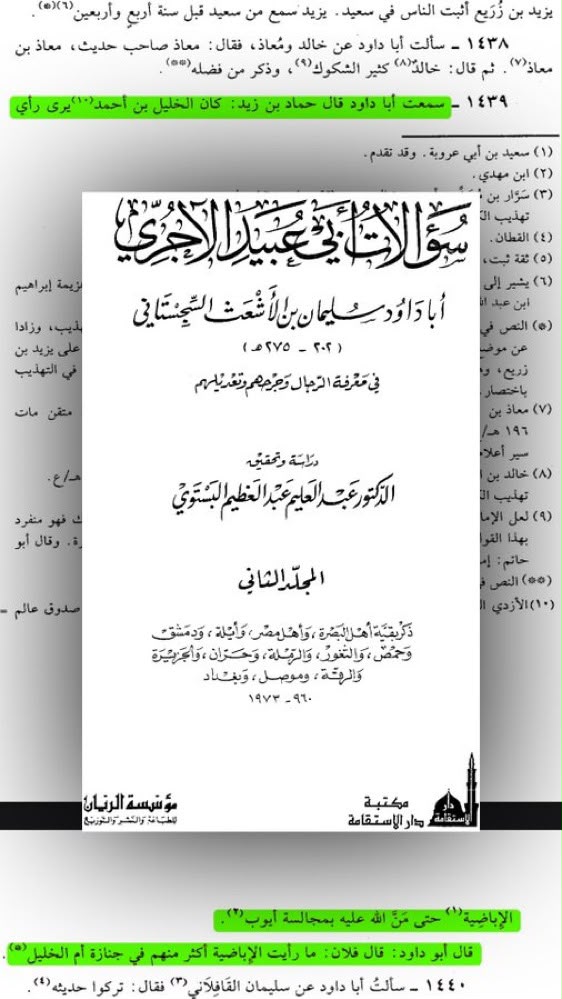
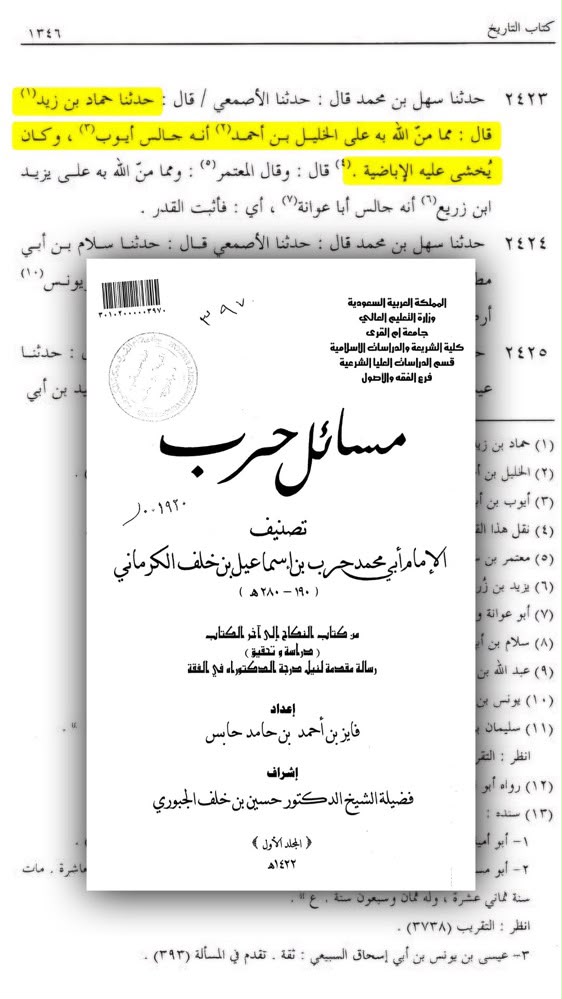
Some contemporary Salafis claim that Al-Khalil ibn Ahmad al-Farahidi was not an Ibadi, relying on what was narrated from Hammad ibn Zayd that he said: “Al-Khalil used to hold the view of the Ibadis until Allah blessed him with the company of Ayyub.” This statement is refuted from several aspects:
First Aspect: This phrase narrated from Hammad ibn Zayd has inconsistent wording (mudtarib). Some versions were transmitted with wording that does not indicate he abandoned Ibadism after sitting with Ayyub. Among them is the narration found in Masa’il Harb with a chain of transmission (isnad) in a better state than the aforementioned narration: “Among what Allah blessed Al-Khalil ibn Ahmad with is that he sat with Ayyub, and Ibadism was feared for him.” Thus, the text (matn) does not mention a change in Al-Khalil’s creed, unlike the popular narration; all it tells is that Al-Khalil benefited from Ayyub, and it separately reports that Ayyub feared Ibadism for him, nothing more.
Second Aspect: The narrator of the popular narration is Abu ‘Ubayd al-Ajurri from Abu Dawud from Hammad, which is a weak chain of transmission due to two flaws:
The first flaw: The obscurity (jahalah) of Abu ‘Ubayd, and some of his transmissions from Abu Dawud contradict the well-known, trustworthy companions of Abu Dawud.
The second flaw: The disconnection (inqita’) between Abu Dawud and Hammad; he did not meet him, but rather narrates from him in his Sunan through intermediaries.
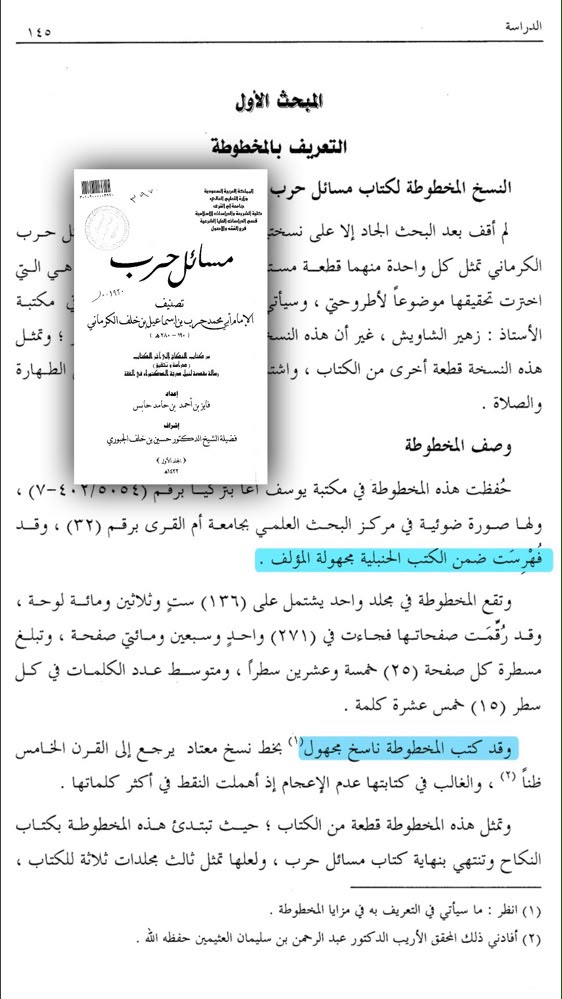
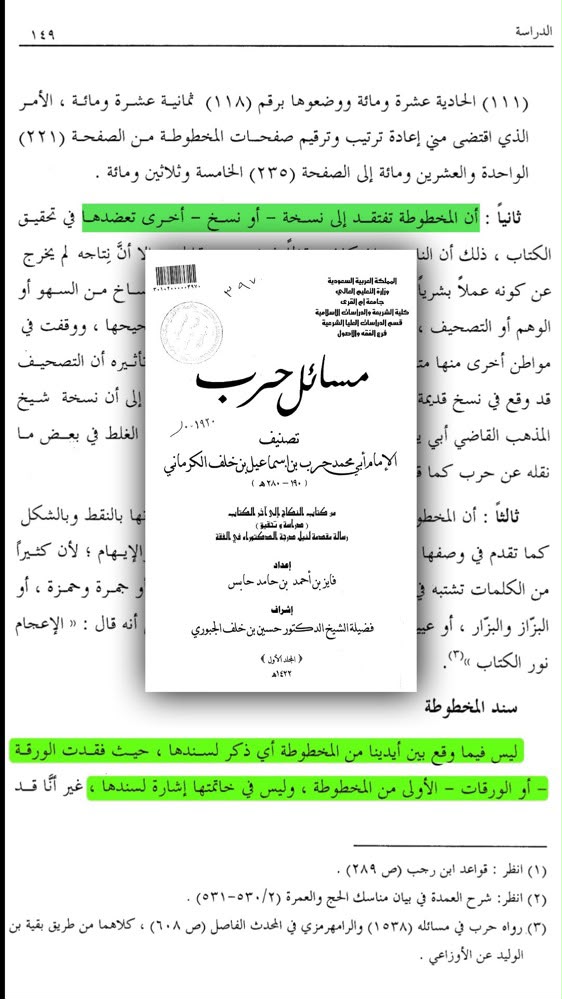
Even as for the narration of Harb al-Kirmani, even if its chain from Hammad were sound, the attribution of the narration to Harb itself is weak according to the methodology of the Ahl al-Athar. That is because the copyist of Masa’il Harb is unknown, the time of its copying is not known, and there is no second copy to match its sole manuscript. Furthermore, it lacks a chain of transmission leading to Harb, and we have found no supporting evidence or quotation establishing the authenticity of its issuance from Harb. Everyone who wrote a biography of Al-Khalil omitted the text attributed to Harb, whereas they repeatedly cited the narration of Abu ‘Ubayd al-Ajurri and the words of Ibn ‘Abd Rabbih al-Andalusi. This suggests the possibility of it being falsely attributed to him. Therefore, what is narrated from Hammad ibn Zayd is not authentic at all through any of its routes.
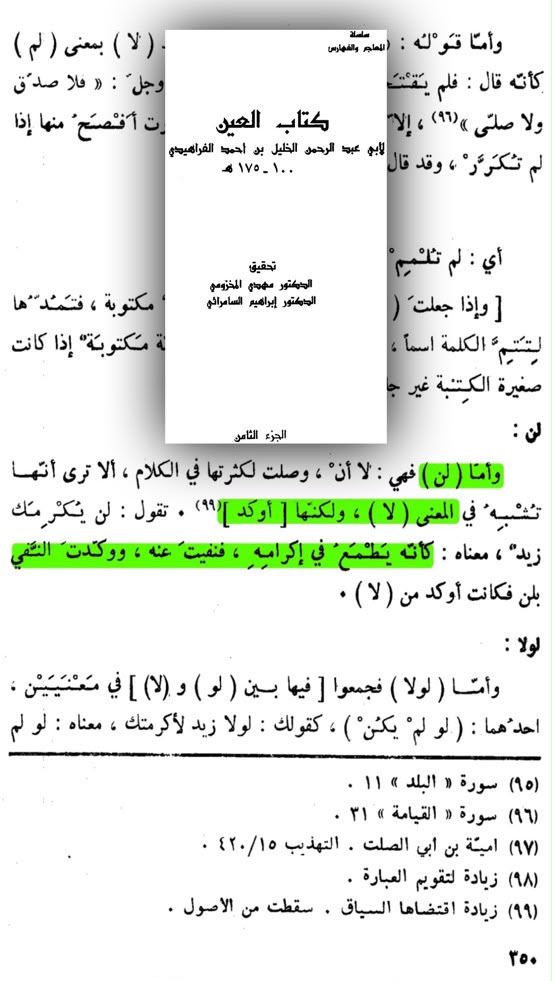
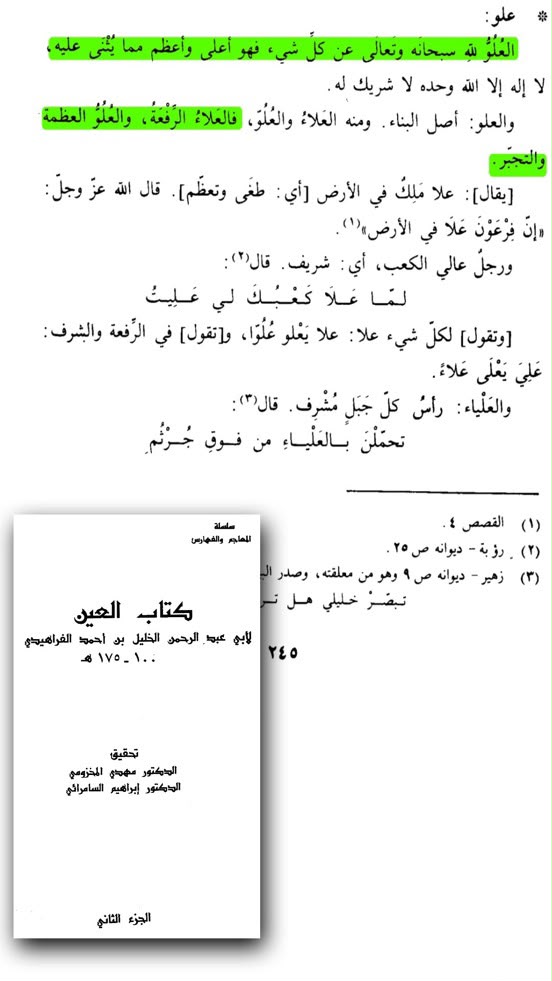
Third Aspect: The linguistic views of Al-Khalil ibn Ahmad al-Farahidi (d. 175 AH) prove his divergence from the Athari Salafi school. Among these is his metaphorical interpretation (ta’wil) of loftiness (‘uluww) attributed to Allah, as well as his view that “lan” (لن) denotes perpetual negation (ta’bid). These two principles form the core pillars of the Ibadis’ argument in exalting the Creator above spatial highness, as well as their argument in denying the vision of the Creator eternally, whether on the Day of Gathering or in Paradise.
What this proves: Al-Khalīl held theological views consistent with the Ibadi school.
There are other corroborative points besides these aspects: among them is Al-Khalil’s lineage tracing back to Farahid, a clan of Azd Oman, which has been a purely and steadfastly Ibadi tribe across long centuries. Another piece of circumstantial evidence which we do not view as an independent argument is the narration regarding the flocking of Ibadis to the funeral of Al-Khalil’s mother, serving as a testament to the strong connection he and his family maintained with Ibadism.
This is significant. Al-Dhahabī, himself a staunch Sunni is quoting Abū Dāwūd (a major hadith scholar) saying that the Ibadis attended the funeral of al-Khalīl’s mother in large numbers, and that they were the greatest of people in that regard. This is a strong piece of evidence: The Ibadis of Basra claimed al-Khalīl and his family as their own, and this was known well enough that Abū Dāwūd commented on it.
What this proves: The Ibadis had a public, recognized connection to al-Khalīl’s family.
It is well known that all schools of thought vie for this great figure, each claiming his affiliation to them; and how could they not! He is the father of the Arabic language and the master of Sibawayh and Al-Kisa’i, the founders of the Basra and Kufa schools! Indeed, out of his sharp intellect and vast knowledge, he founded an entire discipline from scratch: prosody (‘ilm al-‘arud), to the point that it was said he was the most intelligent of the Arabs after the Blessed Prophet (peace and blessings of Allah be upon him). Above and beyond all that, he was renowned for his asceticism, piety, and faith. Imam Sufyan ibn ‘Uyaynah said: “Whoever wishes to look at a man created from gold and musk, let him look at Al-Khalil ibn Ahmad al-Farahidi al-Azdi al-Omani.”
Why this matters
Every time a child learns to read the Qur’an with harakat or every tarāwīḥ prayer, every private recitation, every gathering where the Qur’an is read correctly that blessing is built on a system al-Farahidi standardized. An Ibadi scholar’s work sits at the foundation of one of the most universal practices in the Muslim world.
This is simply a reminder that the history of Islamic scholarship is more intertwined than polemics and sectarian bias often allow, and that dismissing an entire school as outside the tradition is harder to justify than it may first appear.
May Allah cover al-Khalil ibn Ahmad al-Farahidi in mercy.
“And whoever kills a believer intentionally, their reward will be Hell—where they will stay indefinitely.Allah will be displeased with them, condemn them, and will prepare for them a tremendous punishment.” (Qur’an 4:93)
﷽
The following article is a translation of the wonderful presentation by the respected Shaykh
In the name of Allah, the Most Merciful, the Most Compassionate.
Praise be to Allah, Lord of the worlds, and prayers and peace be upon the Seal of the Prophets and Messengers, our master Muhammed, and upon his family and his righteous, guided companions. To proceed:
Peace, mercy, and blessings of Allah be upon you.
Introduction: The Allegations Answered Once and For All.
My brothers, in this article we continue responding to a persistent allegation that the Ibadis declare the Companions to be disbelievers, that we excommunicate them from Islam. This accusation is repeated endlessly by those who either misunderstand our creed or deliberately misrepresent it.
As we have said before, this attack against the Ibadis is the result of these people’s ignorance regarding the principle of loyalty and disavowal (al-walāyah wa’l-barā’ah) among the Ibadis. Likewise, these people are trying to conceal what they themselves call the faults of some of the Companions. Namely, the events that occurred during the civil strife (fitnah). These events are what led those scholars to declare disavowal from some of the Companions.
These people are not only ignorant of the principle of loyalty and disavowal, but they are also trying to conceal and avoid discussing these events.
When these people throw this accusation at the Ibadis, they simply say directly: “The Ibadis declare the Companions disbelievers,” without discussing the reasons. There are reasons that led those scholars to declare disavowal regarding those Companions.
What Our Opponents Say: Documenting the Accusation
Let us document exactly what our opponents claim. Listen carefully to their own words:
“Look, regardless of my disagreement with them, they declare ʿUthmān ibn ʿAffān to be a disbeliever, and they declare ʿAlī ibn Abī Ṭālib, and Ḥasan ibn ʿAlī, and Ḥusayn ibn ʿAlī, and a group of the Prophet’s Companions to be disbelievers. Yet despite that, they do not openly state it. Rather, you find this in their major books. You find it in their books. They also have an element of taqiyyah (dissimulation). Even so, I do not know whether this expression will be understood properly or not, but I respect in them the absence of sectarianism. This is their creed: they declare the Prophet’s Companions disbelievers. This is their creed: they declare the Prophet’s Companions disbelievers. Yes, we declare Muʿāwiyah a disbeliever, but we still narrate from him. We declare Marwān a disbeliever, but we still narrate from him. We declare ʿUthmān a disbeliever, but we still narrate from him. We declare ʿAlī and al-Ḥasan and al-Ḥusayn disbelievers, but we still narrate from al-Ḥasan and al-Ḥusayn. This is the Ibadi belief.”
Another says:
“Therefore we are not surprised by this stance, for the position of the early Ibadis regarding the Companions—especially the two caliphs—is contrary to the methodology of Ahl al-Sunnah wa’l-Jamāʿah. It included criticism, takfīr, and false disavowal from the best of this nation. As for the other two Rightly Guided Caliphs, ʿUthmān ibn ʿAffān and ʿAlī ibn Abī Ṭālib, may Allah be pleased with them, the Khawārij, including the Ibadis, remained deeply astray concerning them, attributing to them things from which Allah declared them innocent, and speaking grievously against them.”
And another:
“They called themselves the people of truth and uprightness, but they are the people of falsehood and misguidance. Hatred toward Ahl al-Sunnah. Let me add even more: they declare ʿAlī ibn Abī Ṭālib and ʿUthmān disbelievers and also al-Ḥasan and al-Ḥusayn, of course. As for Muʿāwiyah ibn Abī Sufyān, he exited Islam through its widest gates.”
As you have heard, these people claim that the Ibadis declare ʿUthmān, ʿAlī ibn Abī Ṭālib, al-Ḥasan, al-Ḥusayn, and a group of the Prophet’s Companions to be disbelievers. Then they say that the Ibadis do not openly state this and that they practice a kind of taqiyyah. They say this is our creed.
The Reality: No Taqiyyah, No Doctrine of Takfīr
The reality is that this is not our creed, nor is there any taqiyyah. Rather, it is their ignorance. They are ignorant of the doctrine of loyalty, disavowal, and suspension (wuqūf) among the Ibadis.
One of these opponents commented on an interview with one of our shaykhs. The interviewer asked the shaykh about Sayyidunā Abū Bakr and Sayyidunā ʿUmar, then afterwards about Sayyidunā ʿUthmān. They claim that he stuttered. The reality is that the shaykh did not stutter. Rather, he was avoiding reopening the fitnah and the events that occurred among the Companions. He did not want to stir up these matters, so he avoided them. Yet they claim he hesitated and faltered.
The shaykh did not hesitate or stutter. He answered. The problem is not with the shaykh the problem is with them. They are ignorant of the doctrine of loyalty, disavowal, and suspension. Anyone who understands this doctrine would know that the shaykh did answer the question.
The shaykh did not want to bring out what is found in their own books regarding the events that occurred among the Companions. He was avoiding this issue.
The shaykh said according to the meaning of his words that there were those who had one opinion and others who had another opinion. This is the reality. The issue returns to the doctrine of loyalty, disavowal, and suspension. There are people with one opinion and others with another. That is the answer. The shaykh cannot specify which of those opinions is correct because the matter returns to our doctrine of loyalty, disavowal, and suspension.
They want the shaykh simply to say: “Disbeliever” or “not a disbeliever.” But the matter is not that simple. This black-and-white approach belongs to them. The shaykh is not obligated to adopt their methodology, nor are the Ibadis obligated to adopt their methodology in these issues. We Ibadis have our own methodology and doctrine: the doctrine of loyalty, disavowal, and suspension.
Now, these people claim that we declare ʿUthmān, ʿAlī ibn Abī Ṭālib, al-Ḥasan, al-Ḥusayn, and a group of the Prophet’s Companions to be disbelievers. Then they say we do not openly state it and that we practice taqiyyah. Then they say this is the creed of the Ibadis.
The reality is that there is neither taqiyyah nor a doctrine of declaring the Companions disbelievers. Declaring the Companions disbelievers is not a doctrine among the Ibadis. We do not have a chapter in our creed titled: “The Ibadi doctrine of declaring the Companions disbelievers.” This is their ignorance.
If we focus on their words and these responses and clips they produced, we find them constantly repeating the term takfīr, the term kufr. They say: “They declared disbelief,”“acts of disbelief,”“so-and-so is a disbeliever.”
One of them even distorted the shaykh’s words in that interview, lied, and played with expressions. Anyone who watches the interview and his commentary will find that he distorted the shaykh’s words and attributed to him statements he never made. The shaykh never uttered the term takfīr. Yet this man attributes to the Ibadis things they never said.
Did Ibadis invent using the term Kufr to apply to some of the companions actions??
Let us establish this. Let us speak and cite from the books that our opponents use themselves. We will not use Ibadi sources.
The Messenger is addressing whom in the above hadith? He is addressing the Companions.
If it is inconceivable that the companions would engage in acts that could be deemed kufr the Blessed Prophet (saw) would not have given them advise that would be redundant.
The Blessed Prophet (saw) also said:
al-Nabiyya ṣallallāhu ʿalayhi wa sallam qāla: “Sibābu al-muslimi fusūq, wa qitāluhu kufr.”
“Insulting a Muslim is wickedness, and fighting him is disbelief.” < Sunni translation.
“Insulting a Muslim is wickedness, and fighting him is ingratitude.” < Ibadi translation.
This is another ḥadīth proving the usage of the term kufr for actions committed by Muslims against other Muslims.
What Sunni Scholars Say About this Kufr
Now let us see what these people’s own scholars say regarding these ḥadīths and the term kufr.
Muhammed ibn Ṣāliḥ al-ʿUthaymīn
Muhammed ibn Ṣāliḥ al-ʿUthaymīn, one of the most revered contemporary Sunni scholars, says in his commentary on Riyāḍ al-Ṣāliḥīn, volume 4, page 70:
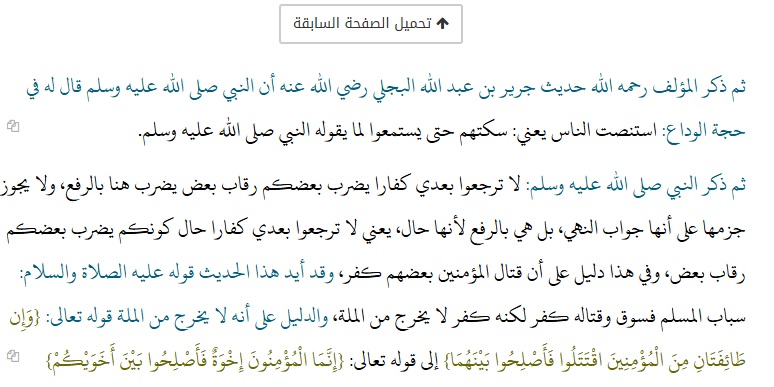
“Then the author may Allah have mercy on him mentioned the hadith of Jarīr ibn ʿAbdillāh al-Bajalī (may Allah be pleased with him), that the Prophet (peace and blessings be upon him) said to him during the Farewell Pilgrimage: “Make the people listen” meaning: silence them so that they may hear what the Prophet (peace and blessings be upon him) is saying.” -Muhammed ibn Ṣāliḥ al-ʿUthaymīn
“Then the Prophet (peace and blessings be upon him) mentioned: “Do not revert to disbelief after me, striking the necks of one another.” The word “striking” (yaḍribu) here is in the nominative case (marfūʿ), and it is not permissible to place it in the jussive case (majzūm) as though it were the answer to the prohibition; rather, it is in the nominative because it is a circumstantial clause (ḥāl). Meaning: do not revert to disbelief after me in the state of some of you striking the necks of others. And in this there is evidence that the fighting of believers against one another is disbelief (kufr).” -Muhammed ibn Ṣāliḥ al-ʿUthaymīn
“And this hadith is supported by his statement (peace and blessings be upon him): “Insulting a Muslim is wickedness (fusūq), and fighting him is disbelief (kufr).” However, it is a disbelief that does not expel one from the religion (millah). And the evidence that it does not expel one from the religion is the statement of Allah the Most High: “And if two parties of the believers fight one another, then make peace between them” up to His statement: “The believers are but brothers, so make peace between your brothers.” -Muhammed ibn Ṣāliḥ al-ʿUthaymīn
“And in this there is evidence that the fighting of believers against one another is disbelief (kufr)” -Muhammed ibn Ṣāliḥ al-ʿUthaymīn.
And notice he says:
“However, it is a disbelief that does not expel one from the religion (millah).” -Muhammed ibn Ṣāliḥ al-ʿUthaymīn.
So what exactly is your problem with some statements in some Ibadi sources? That such and such copmanions did actions that amount to kufr. This is for certain you will never find in any Ibadi sources where we have said that Ali, Uthman or Muaviya are mushrik or polytheist. Then this would be a problem.
However, you know what has happened to soften these Sunni positions in some English translations? They translate it as: “This indicates that believers fighting one constitutes some disbelief.”
Muhammed Nāṣir al-Dīn al-Albānī
In Al-Thamar al-Mustatāb fī Fiqh al-Sunnah wa al-Kitāb, page 53, al-Albānī says:
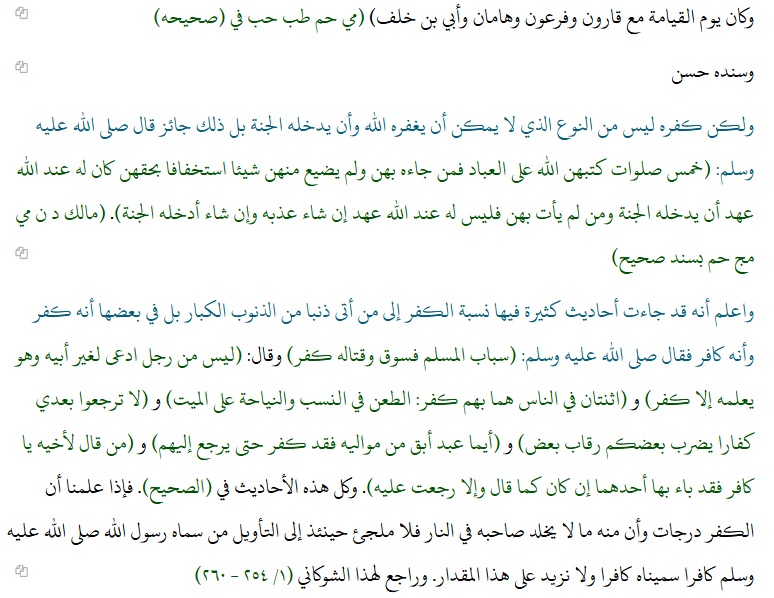
“And on the Day of Resurrection he will be with Qārūn, Firʿawn, Hāmān, and Ubayy ibn Khalaf) (Muslim, Aḥmad, al-Ṭabarānī, al-Ḥākim in his Ṣaḥīḥ) And its chain of narration is good (ḥasan)”- Muhammed Nāṣir al-Dīn al-Albānī
“But his disbelief is not of the type that Allah cannot forgive and admit him to Paradise; rather, that is possible. He (peace and blessings be upon him) said: “Five prayers Allah has prescribed upon the servants. Whoever comes with them, not wasting any of them out of disdain for their right, then he has a covenant with Allah that He will admit him to Paradise. And whoever does not come with them, then he has no covenant with Allah — if He wills He punishes him, and if He wills He admits him to Paradise.” (Mālik, Abū Dāwūd, al-Nasāʾī, Muslim, al-Majmūʿ, Aḥmad, with an authentic chain).” -Muhammed Nāṣir al-Dīn al-Albānī
“And know that many hadiths have come in which disbelief (kufr) is attributed to one who commits one of the major sins; indeed in some of them it is [called] disbelief and that he is a disbeliever. He (peace and blessings be upon him) said: “Insulting a Muslim is wickedness, and fighting him is disbelief.” And he said: “No man claims a father other than his own while knowing it, except that he has committed disbelief.” And: “Two things in people are disbelief in them: attacking lineage and wailing over the dead.” And: “Do not revert to disbelief after me, striking the necks of one another.” And: “Whichever slave flees from his masters has committed disbelief until he returns to them.” And: “Whoever says to his brother, ‘O disbeliever,’ it returns upon one of them. If it is as he said, then so; otherwise it returns upon him.” And all of these hadiths are in the Ṣaḥīḥ. So when we know that disbelief has degrees, and that some of it does not cause its doer to remain forever in the Fire, then there is no need at that point for reinterpretation from one whom the Messenger of Allah (peace and blessings be upon him) named.” -Muhammed Nāṣir al-Dīn al-Albānī
“Know that many ḥadīths have come attributing kufr to those who commit major sins … among them: ‘Insulting a Muslim is wickedness and fighting him is kufr’… and ‘Do not return after me as disbelievers, striking the necks of one another.’ All these ḥadīths are authentic. So if we know that kufr has levels (darajāt), and that some forms do not eternally condemn a person to Hell, then there is no need for reinterpretation.” –Muhammed Nāṣir al-Dīn al-Albānī
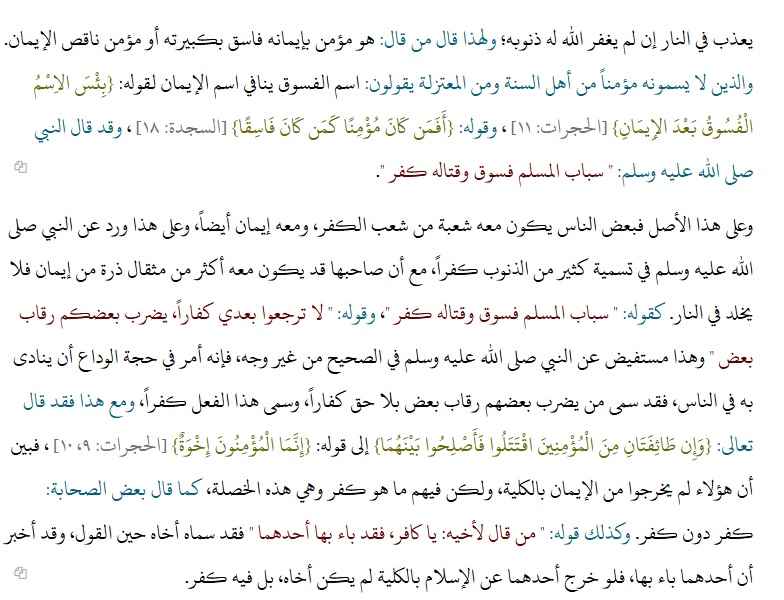
“He will be punished in the Fire if Allah does not forgive him his sins; and for this reason some said: he is a believer through his faith, a sinner through his grave sin, or a believer deficient in faith. And those among Ahl al-Sunnah and the Muʿtazilah who do not call him a believer say: the name of wickedness (fusūq) negates the name of faith, because of His saying: “How evil is the name of wickedness after faith” [al-Ḥujurāt: 11], and His saying: “Is one who is a believer like one who is a sinner?” [al-Sajdah: 18]. And the Prophet (peace and blessings be upon him) said: “Insulting a Muslim is wickedness, and fighting him is disbelief.” –Ibn Taymiyyah
“And upon this principle, some people have with them a branch of disbelief, and they also have faith. And upon this came reports from the Prophet (saw) in naming many sins as disbelief, even though the one doing them may have with him more than a speck of faith, so he will not remain forever in the Fire. Such as his saying: “Insulting a Muslim is wickedness, and fighting him is disbelief,” and his saying: “Do not revert to disbelief after me, striking the necks of one another.” And this is widely transmitted from the Prophet (saw) in the Ṣaḥīḥ through numerous chains. For he commanded during the Farewell Pilgrimage that it be proclaimed among the people. So he named those who strike the necks of one another without right as disbelievers, and he named this act disbelief. And despite this, Allah the Most High said: “And if two parties of the believers fight one another, then make peace between them” up to His saying: “The believers are but brothers” [al-Ḥujurāt: 9-10]. So He clarified that these did not exit from faith entirely, but there is in them what is disbelief namely this trait as some of the Companions said: disbelief below disbelief. Likewise his saying: “Whoever says to his brother, ‘O disbeliever,’ then it returns upon one of them.” For he called him his brother at the time of the saying, and he informed that one of them has incurred it. So if one of them had exited from Islam entirely, he would not be his brother; rather, there is in him disbelief.” –Ibn Taymiyyah
“If hatred is for worldly reasons only, then this is lesser disbelief and does not reach major disbelief. Hence the Prophet ﷺ said: ‘Do not return after me as disbelievers, striking the necks of one another.’”
Then on page 852 he says:
“The fact that some Companions fought other companions involves entering into traits of disbelief. Therefore he (saw) said: ‘Do not return after me as disbelievers.’” – Ṣāliḥ Āl al-Shaykh
ولهذا قال النبي عليه الصلاة والسلام: لا ترجعوا بعدي كفاراً يضرب بعضكم أعناق بعض. وكون بعض الصحابة قاتل بعضاً آخر هذا فيه دخول في خصال الكفار، لهذا قال: لا ترجعوا بعدي…
He then says this disbelief may be lesser or greater disbelief depending on the nature of the hatred.
«ولا شك أنه قد يكون الباعث على ذلك البغض والكره، لأن القتال يكون معه ما في النفس، لكن مع تقاتل الصحابة فإن بعضهم لم يسب بعضاً يعني بلسانه، والنفس قد يوجد فيها ما لا يسلم من البشر. فإذا الكفر هنا قد يكون كفراً أصغر وقد يكون كفراً أكبر بحسب نوع البغض…»
“And there is no doubt that the motive for that may be hatred and aversion, because fighting is accompanied by what is in the soul. However, despite the fighting among the Companions, some of them did not insult others. Meaning with their tongues. Though the soul may contain what no human being is free from. Thus, the disbelief here may be a lesser disbelief or may be a greater disbelief, according to the nature of their hatred.” -Ṣāliḥ Āl al-Shaykh
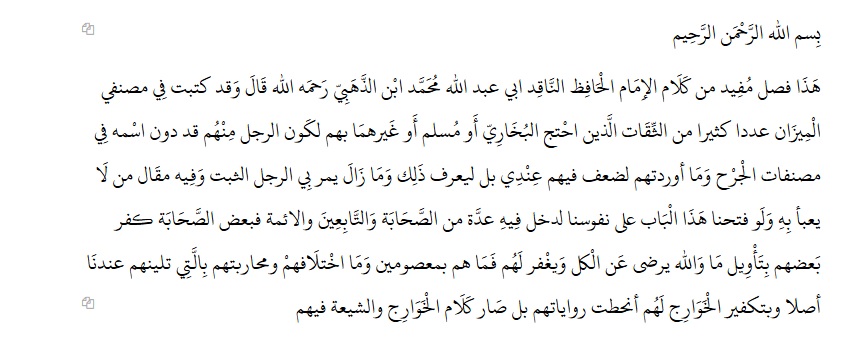
In his book: Al-Ruwāt al-Thiqāt al-Mutakallam Fīhim bimā Lā Yūjib Raddahum on page 23 he says:
“In the name of Allah, the Most Merciful, the Most Compassionate”
“This is a beneficial chapter from the words of the Imām, the Ḥāfiẓ, the critic Abū ʿAbdillāh Muḥammed Ibn al-Dhahabī may Allah have mercy on him. He said: I have written in my work al-Mīzān a large number of reliable narrators whom al-Bukhārī, Muslim, or others used as evidence, because the name of one of them had been recorded in the works of criticism (al-jarḥ). I did not include them due to any weakness in them according to me, but rather so that this may be known. And a reliable narrator concerning whom there is a statement from one who is not to be given any weight would still pass by me. And if we were to open this door upon ourselves, a number of the Companions, the Successors, and the Imāms would enter into it. For some of the Companions declared others disbelievers based on interpretation and Allah is pleased with all of them and forgives them for they are not infallible. And their disagreement and fighting did not diminish them in our eyes at all. And it was because of the Khawārij’s declaring them disbelievers that their narrations declined; indeed the speech of the Khawārij and the Shīʿah concerning them became [a mark against them].” –Al-Dhahabī
“If we opened this door for ourselves, many Companions, Followers, and imams would enter into it. Some Companions declared others disbelievers based on interpretation.”
Al-Dhahabī affirms takfīr occurring among the Companions themselves based on interpretive ijtihād, not because the target of takfīr had actually left Islam.
Prima Qur’an comments: In fact in a recent back and forth on Twitter (X) the Sunni (traditional) beat a hasty retreat when it was asked point blank of them:
What did Dhahabi mean by the companions called each other kafir? فَبَعْضُ الصَّحَابَةِ كَفَّرَ بَعْضُهُمْ بِتَأْوِيلٍ مَا
So if Dhahabi means when the companions called each other kafir that it did not entail expulsion from the millat of Islam you have to wonder what your real problem is with us? This is what is meant when you find this in Ibadi books. No one believes Ali or Uthman left Islam.
Imam al-Nawawī
Imam al-Nawawī said in his commentary on Sahih Muslim:
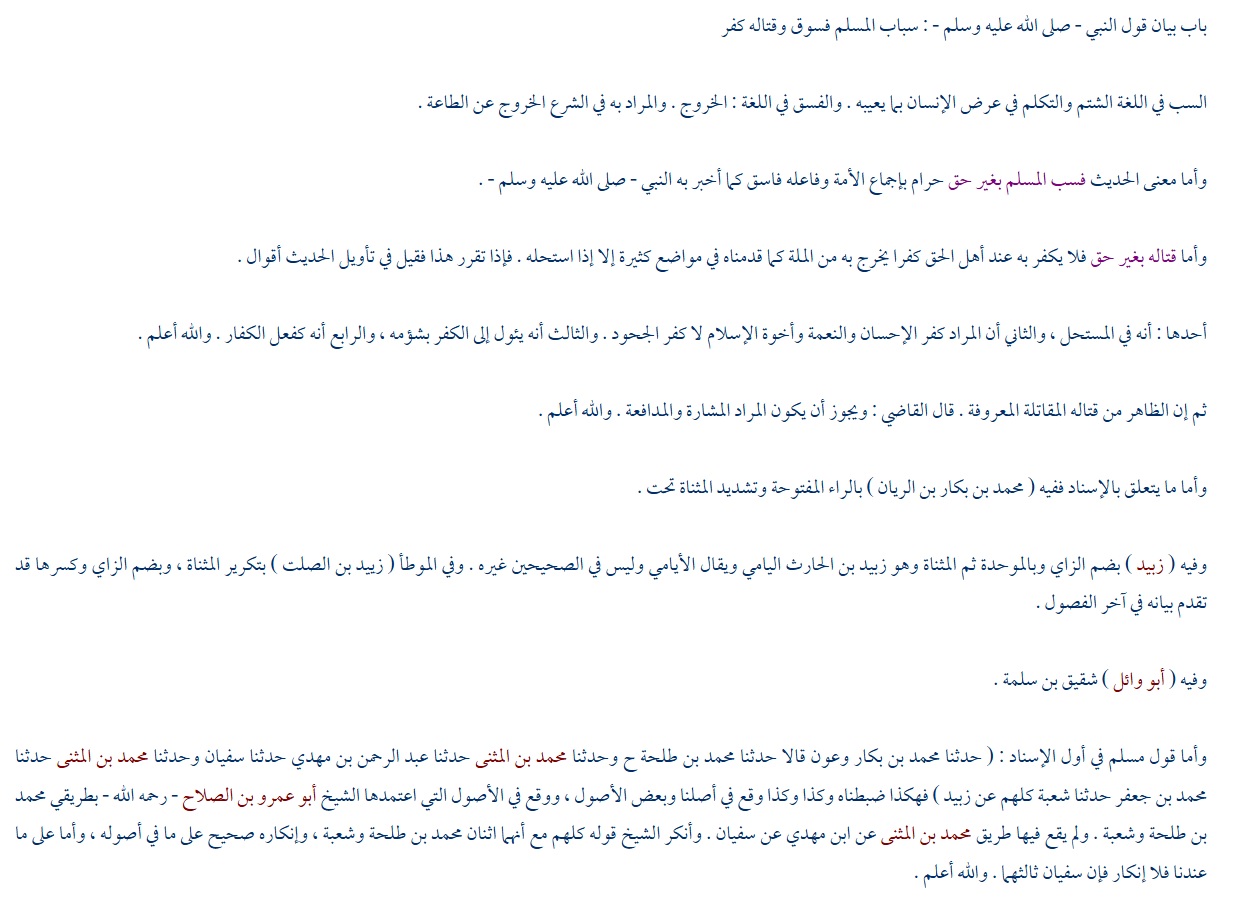
Chapter: Clarification of the statement of the Prophet (saw): “Insulting a Muslim is wickedness, and fighting him is disbelief”
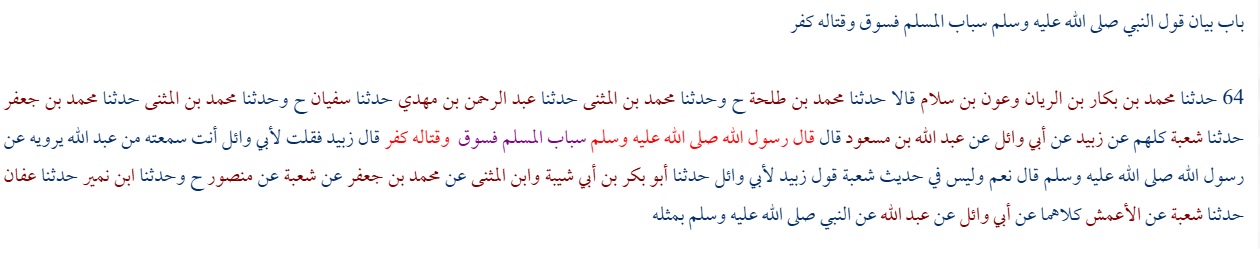
64 Muḥammed ibn Bakkār ibn al-Rayyān and ʿAwn ibn Sallām narrated to us, both saying: Muḥammed ibn Ṭalḥah narrated to us. And Muḥammed ibn al-Muthannā narrated to us: ʿAbd al-Raḥmān ibn Mahdī narrated to us: Sufyān narrated to us. And Muḥammed ibn al-Muthannā narrated to us: Muḥammed ibn Jaʿfar narrated to us: Shuʿbah narrated to us. All of them from Zubayd, from Abū Wāʾil, from ʿAbdullāh ibn Masʿūd, who said: The Messenger of Allah (saw) said: “Insulting a Muslim is wickedness, and fighting him is disbelief.” Zubayd said: So I said to Abū Wāʾil: Did you hear it from ʿAbdullāh narrating it from the Messenger of Allah, (saw)? He said: Yes. And in the hadith of Shuʿbah there is not the statement of Zubayd to Abū Wāʾil. Abū Bakr ibn Abī Shaybah and Ibn al-Muthannā narrated to us, from Muḥammed ibn Jaʿfar, from Shuʿbah, from Manṣūr. And Ibn Numayr narrated to us: ʿAffān narrated to us: Shuʿbah narrated to us, from al-Aʿmash, both of them from Abū Wāʾil, from ʿAbdullāh, from the Prophet, (saw) the like of it.
Imam al-Nawawī puts his Ash’ari (Murji’ah) spin. However, some important points come through.
Chapter: Clarification of the statement of the Prophet (saw) : “Insulting a Muslim is wickedness, and fighting him is disbelief.”
“Insult (sabb) in the language means reviling and speaking about a person’s honor in a way that faults him. And wickedness (fisq) in the language means going out. And what is meant by it in the religious law is going out from obedience. As for the meaning of the hadith, insulting a Muslim without right is forbidden by the consensus of the Ummah, and the one who does it is a sinner (fāsiq), as the Prophet (saw) himinformed.”-Imam al-Nawawī
“As for fighting him without right, it does not make one a disbeliever with a disbelief that takes him out of the religion according to the people of truth, as we have presented in many places, unless he considers it lawful. So when this is established, several statements have been said regarding the interpretation of the hadith.” -Imam al-Nawawī
“The first: that it is concerning the one who considers it lawful. The second: that what is meant is the disbelief of ingratitude and the denial of the blessing and the brotherhood of Islam, not the disbelief of outright rejection. The third: that it leads to disbelief through its ill omen. The fourth: that it is like the deed of the disbelievers. And Allah knows best. Then, the apparent meaning of “fighting him” is the well-known combat. The Qāḍī said: It is possible that what is meant is disputing and defending. And Allah knows best.” –Imam al-Nawawī
Prima Qur’an: We will comment on Imam al-Nawawī puts his Ash’ari (Murji’ah) spin.
The interpretation of the Murji’ah/Ash’ari is:
If you kill a fellow a Muslim but you don’t believe that it is lawful to do so then it is not kufr.
We wonder if the companions who killed each other thought that what they were doing was lawful or unlawful?
If it was unlawful then they participated in the unlawful in masse.
Second. It is meant as ingratitude for blessings and brotherhood in Islam, not as disbelief in Allah. Hence, kufr ni’ama. Welcome to the Ibadi view! Though we do not subscribe to the Murji’ah/Ash’ari misunderstanding and misguidance.
Third. It leads to disbelief due to its evil consequences.
Fourth. It resembles the actions of disbelievers.
Summary of Sunni Scholarly Consensus on the above matter.
Scholar
Affirmation
Ibn Taymiyyah
Kufr has levels; “kufr less than kufr” exists; a person can have a branch of kufr while still having faith.
Al-Dhahabī
Some Companions declared other Companions disbelievers based on interpretation (ta’wīl).
Al-ʿUthaymīn
Believers fighting one another is kufr—but they remain believers.
Al-Albānī
Kufr has levels (darajāt); some forms do not eternally condemn to Hell.
Ṣāliḥ Āl al-Shaykh
Lesser disbelief exists and does not reach major disbelief.
al-Nawawī
Meant as ingratitude for blessings and brotherhood in Islam, not as disbelief in Allah
The Sunni Understanding of Qur’anic Reconciliation vindicates the Ibadis
Now we do not share thier misunderstanding of the verse. We are simplly based upon their understanding it vindicates our perspective.
Now we return to the Qur’anic verse that seals this matter.
The Sunnis translate the verse as:
“And if two groups of the believers fight each other…” (Qur’an 49:9)
Allah did not say: “If two groups, one of which has left Islam…” He said: “of the believers.”
Therefore:
Statement
Implication
Allah calls fighting groups believers
They have not left the millah of Islam.
The Prophet calls fighting a Muslim kufr
The act is kufr in the lesser sense.
Conclusion
Kufr in the ḥadīth and in Ibadi usage does not mean expulsion from Islam.
This understanding of kufr that we Ibadis have did not come out of thin air. Rather, this term is established and has a basis in the explicit words of the Blessed Prophet (saw) and the explicit text of the Qur’an.
The Prophet said: “Insulting a Muslim is wickedness and fighting him is kufr.” And he also said: “Do not return after me as disbelievers, striking the necks of one another.”
The question is: did the Companions strike one another’s necks? No rational person can deny that this happened during the fitnah.
The Ibadi Doctrinal Framework: Walāyah, Barā’ah, and Wuqūf
Now that we have established the legitimacy of the term kufr in its lesser sense, let us explain the actual Ibadi doctrine. The framework our opponents either do not understand or deliberately misrepresent.
The issues related to the stance on historical events (the Great Fitnah) are among the most intricate topics in Ibadi theology, and they have witnessed significant methodological development while preserving their theoretical foundations.
First: The Three Doctrinal Concepts
These concepts represent a “system of analogy” that defines a Muslim’s relationship with others based on behavior and actions:
Walāyah (Loyalty): This is love for the sake of Allah, and it is obligatory for every Muslim whose outward conduct is in accordance with Allah’s commands. It is of two types: general walāyah (for all believers) and specific walāyah (for those known for their righteousness).
Barā’ah (Disavowal): This is hatred for the sake of Allah, and it is obligatory for anyone who openly commits a major sin, persists in a wrong, or introduces something into the religion that contradicts its fundamental principles (from the perspective of the school of thought). It is not a “curse” or “insult,” but rather a severing of religious allegiance from the action or innovation.
Wuqūf (Suspension): This refers to refraining from judging someone’s loyalty or innocence due to unclear evidence, conflicting reports, or because the person was unaware of the events and not legally obligated to pass judgment on them.
A Detailed Overview of Positions Throughout the Ages
Stage 1: The Prophetic Period.
Prevailing Position: Innocence of the events and those responsible for them. Early Ibadis did not hold the Companions (as a whole) responsible for the fitnah in a way that condemned them.
Estimated Percentage: Let us guestimate and say 95% innocence. The overwhelming majority of early Ibadi scholars maintained that the Companions (as a whole) were not to be held blameworthy for the civil strife.
Even if we granted a theoretical 5% Allowance for disavowal
The remaining 5% allows for the possibility that some Companions, as human beings, may have committed acts prior to the fitnah that deserved punishment under the Qur’an and Sunnah. This is not a blanket condemnation of any Companion, nor is it specific to the events of the fitnah. Rather, it is an acknowledgment that Companions like all humans were not infallible (ma’sūm) and could commit individual sins for which the Qur’an and Sunnah prescribe accountability. This is not unique to Ibadis; Sunni scholars also acknowledge that Companions were not infallible and could commit sins, though they are generally considered righteous overall.
Examples: What is mentioned in the letters of Imam Jābir ibn Zayd (although his letters are characterized by piety) and what biographers have reported about the position of the people of Nahrawān towards ʿUthmān (due to the issue of protected areas and positions) and towards ʿAlī (due to the arbitration).
Logic: The position was directly political and doctrinal. Early Ibadis considered certain actions during the fitnah to be innovations, but they did not translate that into condemning the Companions as individuals. Rather, their barā’ah (disavowal) was directed at the actions and innovations, not at the persons as polytheist or as having left the millah of Islam.
Stage 2: Establishing and Remaining Silent (5th–13th centuries AH)
Prevailing Stance: Expressions of “remaining silent” began to appear explicitly.
Estimated Ratio: Let us guestimate a 50% disavowal (in educational texts) and 50% wuqūf (in practical application).
A well-known saying: Imam Abū Saʿīd al-Kadāmī (one of the leading scholars of the 4th century AH) said: “We do not disavow ʿAlī ibn Abī Ṭālib or ʿUthmān ibn ʿAffān unless we have definitive proof that necessitates it, and silence is safer.”
Logic: The principle of “scholarly integrity” began to emerge, whereby statements of disavowal were transmitted as part of the heritage, but remaining silent was practiced out of respect for the status of these Companions.
Contemporary Phase (14th century AH – Present Day)
Prevailing Stance: Remaining silent and accepting (the principle of good faith).
Estimated Percentage: Let us guestimate 90% wuqūf and acceptance, 10% disavowal (historical transmission only).
Statements of Scholars:
Shaykh Nūr al-Dīn al-Sālimī: Despite his adherence to the fundamentals, he opened the door to wuqūf for those who were unaware of the fitnah, saying: “You may abstain from judgment regarding the people of the qiblah, for Allah will not question you about what they did.”
His Eminence Shaykh Aḥmad bin Ḥamad al-Khalīlī (Grand Mufti of Oman): He always emphasizes the unity of the Ummah and purity of heart. In his lessons and writings, he prays for mercy upon all the Companions and affirms that historical differences should not divide Muslims today.
The Principle of Purity of Heart: This is the principle adopted by the Ibadi school today, meaning that the contemporary Muslim is not obligated to investigate the bloodshed of the Companions, and it is safer for him to meet Allah with a pure heart towards everyone.
Why Do Classical Texts Continue to Contain Statements of Disavowal?
The continued presence of these statements in books does not necessarily mean they are being implemented today. Rather, it stems from methodological reasons:
Scholarly Integrity: Ibadi scholars consider the books of the early scholars an inheritance that should not be censored or deleted. Instead, it should be transmitted as is, with explanations within its historical context.
Preserving Historical Memory: Transmitting these statements aims to explain why the Ibadis differed from others initially (the political and legal reasons for the revival), not to incite hatred.
Distinguishing Between “Statement” and “Religious Practice”: The statement of disavowal exists “intellectually” in the books as an interpretation by earlier scholars, but wuqūf and acceptance are what are practiced “religiously” and as acts of worship today.
Should One Take a Doctrinal Stance Regarding the People of Nahrawān?
This is a fundamental question within the school of thought, and the answer can be summarized as follows:
The Ibadi position on their predecessors: The Ibadis believe that the people of Nahrawān were “people of righteousness” and that their disavowal of ʿUthmān and ʿAlī was based on a legitimate interpretation of Islamic law, which they considered justified in their time, to protect the core of the faith (as they perceived it).
Are you obligated to disavow them as they did? No. The principle among the Ibadis is: “There is no blame on one who remains neutral.” A contemporary Muslim who refrains from judging ʿUthmān and ʿAlī, while simultaneously respecting the people of Nahrawān as scholars and predecessors, is not considered an “innovator” or “outside the school.”
Conclusion of the Doctrinal Section
There is no religious obligation within the Ibadi school that compels you to disavow any of the Companions today. The required doctrinal stance is loyalty to the believers and hatred of oppressors in general. However, regarding specific historical events, the best and safest course is to remain neutral. (Wuqūf)
Accordingly, the Ibadi approach today is one of unity, not division, whereby the Companions (including ʿUthmān and ʿAlī) are treated with respect as a general virtue, while the interpretations of the early scholars who took strong stances are also respected, and this is considered part of the history of scholarly interpretation that does not preclude present-day harmony.
The early Muhakkima who fought at Nahrawān were responding to their historical moment with their ijtihād. There is no obligation for a Muslim 1,300 years later to inherit the same specific judgments, especially when the evidentiary record is disputed among Muslims.
Kufr in the Ibadi School Does Not Expel from the Millah
Let us state this as clearly as possible:
Kufr in the Ibadi school is not something that takes one out of the millah of Islam.
This is the fundamental distinction that our opponents either cannot grasp or deliberately conceal.
When early Ibadi scholars used the term kufr regarding certain actions during the fitnah, they did not mean:
That the person had left the millah of Islam.
That their shahādah was invalidated.
That they were forever condemned to Hell.
Rather, they meant precisely what Ibn Taymiyyah meant when he wrote “a person may possess a branch of disbelief while also possessing faith” and “kufr less than kufr.” They meant what al-Albānī meant when he wrote “kufr has levels.”
They meant that the action—fighting a fellow Muslim unjustly, or introducing innovation into the religion—is an act of kufr in the lesser sense: a grave violation that necessitates barā’ah (disavowal) but not the complete negation of faith.
Even in how we understand the word كفر or kufr in Arabic. This ensures us that we have a creed that is based upon the Qur’an, the primary source of Islam, the revelation Allah sent to his Blessed Prophet (saw). Allah (swt) never defined كفر as exit from the religion of Islam. This is concept is theologically superimposed upon the word. The proof of this is evident. In light of the clear text from the Prophetic Sunnah, Sunni scholars have provided an array of understandings and levels concering the word.
Why the Accusation of Taqiyyah for the Ibadi Is False
Our opponents also claim that we, the Ibadis practice taqiyyah—that we conceal our “true” belief that the Companions are disbelievers.
This is false for several reasons:
There is no concealment. We are explaining our doctrine openly in this very article, citing our sources and demonstrating our distinctions.
Wuqūf is not taqiyyah.Taqiyyah is concealing one’s true belief out of fear of harm. Wuqūf is a principled theological position: suspending judgment when evidence is unclear or when the matter does not affect one’s own religious obligation.
The accusation is ironic. Our opponents accuse us of taqiyyah while ignoring that we openly state: “We do not declare the Companions disbelievers in the sense of expulsion from Islam.” What are we supposedly concealing?
The burden of proof is on them. They claim we secretly believe something. But they provide no evidence—only misinterpretation of early texts that they refuse to read in light of their own understanding of Qur’an (49:9) and the distinction between lesser and major kufr.
The Rhetorical Question Our Opponents Cannot Answer
Let us conclude with a question for those who accuse the Ibadis of excommunicating the Companions:
According to their own undersatnding of Qur’an 49:9, when two groups of believers fight each other, are they still believers or not?
They cannot say “no” without contradicting the Qur’an.
And according to your own ḥadīth in Bukhārī and Muslim, fighting a Muslim is kufr. So how do you reconcile the Qur’an calling fighting believers ‘believers’ and the ḥadīth calling fighting ‘kufr’?
The only possible reconciliation is that kufr here does not mean apostasy. It means a lesser kufr, a grave sin, an act of major transgression but not expulsion from the millah of Islam.
That is exactly what we Ibadis have been saying all along.
This is not meant as a ‘gotcha’ for the Sunnis, but a call for sincere reflection, bridge-building, and moving forward as an Ummah
Final Summary
Accusation
Reality
“Ibadis declare Companions to be disbelievers (apostates).”
Ibadis use kufr in the lesser sense (kufr ni’ma), as affirmed by Ibn Taymiyyah, al-Albānī, al-ʿUthaymīn, and others.
“Ibadis declare companions to be mushrik (polytheist).”
Ibadis have not declared a single companion to be a mushrik.
“Ibadis practice taqiyyah to hide their true beliefs.”
There is no concealment. Wuqūf (suspension) is a principled theological position, not taqiyyah.
“Ibadis invented the term kufr for Muslims.”
The term comes from how Allah defined it in the Qur’an.
“Ibadis are Khawārij who excommunicate Muslims.”
Ibadis distinguish themselves from extremist Khawārij precisely by affirming that kufr does not always entail expulsion from the millah.
“Contemporary Ibadis still declare the Companions disbelievers.”
The contemporary Ibadi position is overwhelmingly wuqūf and acceptance, with scholars praying for mercy upon all Companions.
Conclusion and Call for Fairness
We Ibadis do not ask anyone to agree with our historical interpretations. We do not ask anyone to adopt our doctrine of barā’ah. What we ask for is fairness. That we be judged by what we actually believe, not by the distorted caricature our opponents present.
We ask that our accusers to read their own understasnding of Qur’an (49:9) and the authentic ḥadīth.
The inconsistency applied to the Ibadi school is real.
Sunni, Imami, and Zaydi traditions all maintain elaborate taxonomies of kufr.
Kufr al-ʿamal — disbelief of deed (action contradicting faith without denying it)
Kufr al-inkār — disbelief of denial
Kufr al-juhūd — disbelief of stubborn rejection after knowing
Kufr al-nifāq — disbelief of hypocrisy
Kufr bi’l-iʿrāḍ / al-irād — disbelief of turning away
Kufr al-niʿmah — disbelief of ingratitude for blessing
Kufr al-ʿinād — disbelief of obstinacy
Kufr al-takdhīb — disbelief of denial/contradiction
These categories are not fringe. They are taught in Sunni ʿaqīdah manuals, Imami kalām texts, and Zaydi uṣūl works. Even Ibn Taymiyyah’s Kitāb al-Īmān which we cited above is built on exactly this distinction. Al-Albānī’s “kufr has levels” is the same principle. Ṣāliḥ Āl al-Shaykh’s “lesser and greater kufr” is the same.
So the inconsistency is this:
When these same scholars encounter the term kufr applied to ʿAlī, ʿUthmān, or Muʿāwiyah in an Ibadi text, they immediately read it as kufr al-juhūd or kufr al-inkār and then declare the Ibadis to be Khawārij who excommunicate the Companions. But when their own scholars apply kufr to Muslims who fight each other, or to one who insults a Muslim, or to one who abandons prayer out of laziness, they read it as kufr al-niʿmah or kufr dūna kufr the lesser kufr. That which does not expel one form the millah kind.
The word is identical. The subject is different. The interpretive charity is applied inconsistently.
This is not a minor rhetorical point. It exposes that the accusation “Ibadis declare the Companions disbelievers” rests on a selective reading. The accusers are not applying their own taxonomy to Ibadi texts. If they did, they would have to ask: which kufr do the Ibadis mean? And the answer, as the article documents and as we have confirmed, is kufr al-niʿmah — ingratitude for blessing — not expulsion from the millah.
We ask that they stop accusing us of taqiyyah when we are explaining our doctrine openly.
If they insist that our definition of kufr means apostasy, they bear the burden of proof is upon the accuser—not us.
“And give full measure when you measure, and weigh with an even balance. That is the best [way] and best in result.” (Qur’an 17:35)
“It is He who has sent His Messenger with guidance and the world view that is based on the truth to manifest it over all other world views, although the mushrik make dislike it.” (Qur’an 9:33)
﷽
Mostly known in the West for the Sunni-on-Sunni confrontations between himself and Shaykh Saeed Fodeh, this claimed descendant of the Blessed Prophet (saw), Shaykh Dr. Adab Mahmoud Al-Hamsh himself is not a believer in the coming of any Mahdi figure.
In his critical hadith study: “Al-Mahdi al-Muntazar fi Riwayat Ahl al-Sunna wa al-Shi’a al-Imamiyya” (The Awaited Mahdi in the Narrations of Sunni and Imami Shi’i Islam), Shaykh Dr. Adab Mahmud al-Hamsh concludes that all the specific hadiths concerning the advent of a literal, awaited Mahdi whether marfu’ (attributed directly to the Prophet) or mawquf (attributed to companions) are weak (da’if) upon close critical examination.
Key Aspects of Al-Hamsh’s View
Flawed Transmission: He argues that what has been narrated about the Mahdi either lacks explicit authenticity in its wording or lacks clear attribution where the wording is authentic (ma swa sahha lam yakun sarihan, wa ma swa sarihan lam yakun sahihan).
Rejection of Consensus/Mutawatir Claims: Contrary to the mainstream traditional Sunni position which holds that Mahdi narrations reach the level of Tawatur Ma’nawi (mass-transmitted in meaning) Shaykh al-Hamsh contends that the proofs do not support a binding doctrinal belief (aqeedah) regarding a future awaited savior.
Critique of Shia Reports: He similarly devalues the Imami Shi’i reports concerning the specific birth, lineage, and occultation of Muhammed bin Hasan al-Askari, treating them as unproven through rigorous hadith-criticism standards
Published by Dar Al-Razi (Amman, 1422 AH – first edition). It comprises 553 pages in a large format and consists of six chapters. These chapters provide a general overview of most writings on the subject of the Mahdi. Both individually and within other contexts from Sunni and Shi’i perspectives. They also present the various conceptions of the Mahdi held by Sunnis and Shi’i, discuss the narrations related to him from both sides (those affirming and those rejecting them), and address other related topics, including the author’s own perspective on the issue. The hadith-based study of these narrations occupies 145 pages of the book.
His objective is to deny the negative effects of this doctrine on the development and behavior of Muslims (p. 532), both Sunni and Shi’i, with the latter being particularly egregious among Shi’i Muslims. This is because the failure to rely solely on authentic texts has led to an exaggeration of this doctrine among Sunnis, who believe the Mahdi is the savior and deliverer, thus negating the need for work and jihad.
They believe the Mahdi’s appearance will bring only a few years of happiness and prosperity followed by hardship. Meanwhile, Sufis portray the Mahdi as a pious, devout leader for whom Allah provides everything, and he has no say in the matter. Others see the Mahdi as an invincible warrior who fights infidels and hypocrites.
The Mahdi, according to the Shi’i, is part of the pillars of the religion because he is connected to the Imamate. However, he is different from the Mahdi of the Sunnis, as the Mahdi of the Sunnis is from the lineage of Al-Hasan ibn Ali. While according to the Shi’i he is from the lineage of Al-Husayn ibn Ali. Furthermore, the Mahdi of the Sunnis will come at the end of time, but the Mahdi of the Shi’i appeared between the years 252-260 AH, but he disappeared from that time in a minor occultation and then a major occultation, and he will appear at the end of time. Throughout this period, he is alive on earth but hidden from sight.
Based on the negative effects of the aforementioned Mahdi doctrine, the author studied the chains of transmission of the hadiths related to the Mahdi. He concluded that these hadiths are not authentic, and those that are authentic are not explicit on the subject of the Mahdi. Therefore, there is no need to link them to the Mahdi because the Mahdi is not authentic in the first place!
Therefore, Shaykh Dr. Adab Mahmud al-Hamsh believes that the Mahdi and the savior is the Messenger of Allah (saw). This is clear on pages (p. 212, p. 525), and that understanding the approach of the Messenger of Allah (saw) in calling for adherence to the religion of Allah Almighty is the only way to achieve happiness for Muslims throughout time, and not for a limited period as is the case with the Mahdi.
Because we have many articles that deal with Sunni scholars (from across the spectrum) that have rejected the hadiths concerning the Mahdi we will give special focus to Shaykh Dr. Adab Mahmud al-Hamsh repudiation of the Imami Shi’i concept.
That chapter is one of the most important chapters in the book for several reasons: The author is claims to descend from the family of the Prophet (saw) as He explained in (pp. 408, 539). The author narrates Shi’i books with chains of transmission. The author addressed the topic according to the Shi’i methodology in hadith, and did not cite any other books.The author is an advocate of rapprochement and cooperation between Sunnis and Shi’i, while disavowing what he disagrees with. A commendable approach as compared to others. As for the importance of the topic of the Mahdi to the Imami Shi’a, it is because it is one of the fundamentals of the religion, and whoever denies it is considered an infidel by them, and this includes the Shi’i declaring all Muslims other than themselves as infidels as he cites in his book in (pp. 411, 531)
Therefore, the author discussed with the Shi’i what they claim to be the fundamentals of religion; he found that they cite (5303) hadiths (p. 412), and these narrations relate to everything about the Mahdi. Because it is impossible to discuss this number of narrations, the author limited himself to discussing the narrations of his birth, so that if the narrations of his birth and existence are proven to be weak and invalid, then what is the value of the narrations of those who saw him, or spoke to him. He mentions this on (p. 412). This is a sound strategy. The author discussed the Shi’a approach to verifying historical accounts, revealing that they place no value on objectivity or scientific rigor; rather, emotion dictates their interpretation of events and history. He quoted the author of the ten-volume encyclopedia “History of the Minor Occultation,” Sayyid Muhammed Muhammed Sadiq al-Sadr (The father of Muqtada al-Sadr), who described his methodology as follows: “The historian is a mixture of emotions, instincts, mental predispositions, and habits. Reason and intellect represent only a part of this mixture. He does not write his history with his intellect and intellect, but rather with the sum of his emotions and all his other predispositions” (p. 414).
The author explains the Shi’i position on narrations; that they are divided into two groups: the Akhbari, who accept all transmitted narrations even if they are fictional, and the Usuli, who examine the narrations. He also explains that they did not exist before Ibn Tawus (d. 673 AH) or his student al-Hilli (d. 726 AH).But when the narrations that the fundamentalists corrected regarding the birth of the Mahdi were presented and criticized, it became clear that the fundamentalists also have no business in the science of Hadith at all!
The author’s method of critiquing the narratives of the Mahdi’s birth consisted of five steps.
The first step: Criticizing the narrations of the Imamate of Al-Hasan Al-Askari; because the previous Imam must specify be the Imam after him, so if the Imamate of Al-Hasan Al-Askari is not valid, then the Imamate of Al-Mahdi is not valid. Here he discussed what Al-Kulayni mentioned in his book “Al-Kafi”, the most important book of the Shi’i, in which he mentioned thirteen narrations (853-865), and it became clear that not one of them was authentic, neither according to the scale of Al-Khu’i, the late Shi’i reference and author of the encyclopedia “Men of Hadith”, nor according to the scale of Shaykh Al-Muzaffar Al-Shi’i, the investigator of Al-Kafi. If the original principle, which is the Imamate of Al-Hasan Al-Askari, is not valid, then how can the Imamate of Al-Mahdi be valid?
Step two: Discussing the story of the mother of the Mahdi: This is a funny issue; because the Mahdi must have a mother, so who is she? This is what the author researched in the second section of the fifth chapter, and he showed the falsehood of the story of Nargis, the mother of the Mahdi, which is contrary to reason and reality, and which contains many gaps. The problem is that this strange and long story has no fixed historical basis. Is it conceivable that the mother of the Mahdi, one of the foundations of faith, is not proven by a clear and correct basis?! Unless it is nonexistent, then it is conceivable. The author comments on this at the end of the discussion, saying: “It is unfortunate that a scholar like you Mr. Sadiq al-Sadr would build an encyclopedia in ten volumes about Imam al-Mahdi without having a single authentic historical account that proves his birth or that one of the trustworthy people saw him” (p. 470).
Step three : Did Al-Hasan Al-Askari explicitly designate Al-Mahdi as his successor as Imam? The author stated that the chapter narrations that Al-Kulayni included in “Al-Kafi” do not contain an explicit statement or reference to the Imamate of Al-Mahdi.Al-Kulayni included six hadiths in it, one of which was deemed weak by the Shi’i scholar of “Al-Kafi”, and he pointed out that two of them contained unknown narrators. The author discussed the remaining three narrations, and the result was that none of them are valid according to the standards of Shi’i biographical books.
Step four: Did the Mahdi see a human being? The author explained that Al-Kulayni included fifteen hadiths (872-886), one of which was deemed weak by the Shi’i investigator of Al-Kafi, another was judged to be disputed, eleven hadiths to be unknown, and only two hadiths were deemed authentic. The author reviewed the two authenticated hadiths and the disputed hadith, and the result was that none of them were authentic.
Step five: Has the Mahdi been born?It was mentioned that Al-Kulayni included 31 hadiths under this chapter (1362-1392). The Shi’i scholar Al-Muzaffar judged twenty of them to be unknown, two hadiths to be weak, one to be silent, and another to be good like the authentic, and he authenticated seven hadiths. When reviewing these remaining eight, none of them were safe. All of this was based on Al-Khu’i’s Encyclopedia of Hadith Men, even though he criticized what was less wrong than it in the books of hadith and terminology. It is clear that the Shi’i, while acknowledging that their books of fundamentals contain weak and fabricated hadiths, also authenticate these false narrations without a scientific basis.The author commented on these narrations about the Mahdi among the Shi’i, saying: “How I wished that one or several narrations from this huge collection of weak and unknown ones would be correct, so that I could excuse the Imami scholars for building an Islamic doctrine on the report of a single person” (p. 496).
After the invalidation of this Shi’i belief, which is the birth of the Mahdi, and that whoever does not believe in him is an infidel, it is incumbent upon the Shi’i to review their principles and books, and not to try to invite the Sunnis to enter their sect and spread propaganda books among the Sunnis such as the books of Al-Tijani and Al-Mawsawi. (pp. 535-537).
Conclusion: After these reflections on the book “The Awaited Mahdi” by Shaykh Dr. Adab Al-Hamsh, it should be emphasized that:The belief in the appearance of the Mahdi is a belief stated by a group of great scholars, and many scholars have stated that the hadiths concerning the Mahdi are transmitted through multiple chains of narration.- Some people exaggerating aspects of this doctrine without a legitimate basis and this is not permissible, but it does not invalidate belief in it.Belief is belief and people will go on believing irregardless of what is presented to them. That if one is to believe in the Mahdi then it should not become a reason for complacency and inaction.The Shi’i belief in the Mahdi is false and invalid, and they must retract it and stop declaring all Muslims as infidels. In the Shaykh’s assesment the Shi’i have no knowledge of the science of Hadith, and their books are full of fabrications, lies, and myths, and this is in the fundamentals of religion, not just in the branches.
We have uploaded Shaykh Dr. Adab Al-Hamsh book here:
This website will be one of the few places you may find this. May Allah (swt) aid the student of knowledge and the truth seekers among the Muslim and Non Muslim alike.
May Allah (swt) aid the student of knowledge among the Ibadi, the Shi’i and the Sunni and bless them and guide them in their sincere efforts.
The above article will be moved here where other prominent individiuals claim the hadiths of the Mahdi are not authetic.
“And abide in your houses and do not display yourselves as [was] the display of the former times of ignorance. And establish prayer and give zakah and obey Allah and His Messenger. Allah intends only to remove from you the impurity [of sin], O people of the [Prophet’s] household, and to purify you with [extensive] purification.” (Qur’an 33:33)
“Then whoever argues with you about it after [this] knowledge has come to you – say, “Come, let us call our sons and your sons, our women and your women, ourselves and yourselves, then supplicate earnestly [together] and invoke the curse of Allah upon the liars [among us].” (Qu’ran 3:61)
﷽
Today we are going to take a look at ‘The Hadith of the Cloak’.
Let us look at the stages of this hadith.
Stage 1. A simple observation about the Prophet (saw).
“A’isha reported that Allah’s Apostle (ﷺ) went out one morning wearing a blanket made of (camel’s or sheep’s) black hair with patterns of camel saddles upon it.”
That is it. The Blessed Prophet (saw) went out of his home and he was wearing a particular garment. Aisha (ra) asked to be clothed in one cloak and she was cloaked twice!
Stage 2. The Theological machination begins.
‘A’isha reported that Allah’s Apostle (ﷺ) went out one morning wearing a striped cloak of the black camel’s hair that there came Hasan b. ‘Ali. He wrapped him under it, then came Husain and he wrapped him under it along with the other one (Hasan). Then came Fatima and he took her under it, then came ‘Ali and he also took him under it and then said:
Allah only desires to take away any uncleanliness from you, O people of the household, and purify you (thorough purifying)
How do we go from plain ol frank to an ultra galactic mega hotdog?!
The plain ol frank.
“A’isha reported that Allah’s Apostle (ﷺ) went out one morning wearing a blanket made of (camel’s or sheep’s) black hair with patterns of camel saddles upon it.”
This is the hadith of the cloak. (Hadith al-kisa) before the Kufan spices and seasonings. Before the merchants of falsehood snatched it up and turned an innocent hotdog into something extra!
You will note that the above hadith appears under the heading:
Chapter: Humility In Dress/Clothing And Sticking To Coarse And Simple Clothes, Furnishings Etc., Permissibility Of Wearing Clothes Made From Camel Hair And Those On Which There Are Markings.
This hadith which comes to us by way of Mus’ab bin Shaybah himself originally rejected in hadith (munkar al-hadith) as he has rejected narrations. More on this latter insh’Allah.
The chain: So, on the authority of Mus’ab bin Shaybah, on the authority of Safiyyah bint Shaybah, on the authority of Aisha, who said: “The Prophet (saw) went out one morning wearing a striped cloak made of black hair.” End of point. That’s it. Nothing else. The hadith ended right there, just in the chapter of ‘Humility in Clothing.’ There is nothing else in it!
The ultra galactic mega hotdog.
So how did it develop? How did it become the ultra galatic mega hotdog that so many quote to us?
Now it is in The Book of the Merits of the Companions! With the subheading: Chapter: The Virtues Of The Household Of The Prophet (saw).
The exact same chain: Mus’ab bin Shaybah, on the authority of Safiyyah bint Shaybah, on the authority of Aisha. The same one, the exact same chain. With the exact same text: “The Prophet (saw) went out one morning wearing a striped cloak made of black hair.” Period. That’s it! It should have stopped there.
But the Kufans would not have it to be the case.
“Then Al-Hasan bin Ali came.” He was actually very small!
How could he come by himself when he was only three years old?
How did he know? Did he know that the Prophet (saw) had just gone out? I mean, what kind of coincidence brought Hasan’s exit together with the exit of the Prophet? And how did Aisha (ra) see this scene? How did she know about this scene?
‘”Then Al-Hasan bin Ali came, so he let him in…”
Okay, let him in where? Meaning, did he stand in the street and sit down, placing the blanket over his head? Where? Where did he go back to, the house? We don’t know.
فَجَاءَ الْحَسَنُ بْنُ عَلِيٍّ فَأَدْخَلَهُ
fa-jāʾa al-Ḥasan ibn ʿAlī fa-adkhalahu
“Then al-Hasan ibn Ali came, so he brought him inside.”
Notice that the Arabic does not explicitly say “inside the cloak” here. The object of أَدْخَلَهُ (adkhalahu, “he brought him inside”) is implicit from the context.
“Al-Hasan came, so he let him in. A little later, Al-Husayn came.”
ثُمَّ جَاءَ الْحُسَيْنُ فَدَخَلَ مَعَهُ
thumma jāʾa al-Ḥusayn fa-dakhala maʿahu
“Then al-Husayn came, and he entered with him.”
Here the wording changes. The Prophet (saw) is not explicitly said to have adkhalahu (“brought him inside”); rather:
فَدَخَلَ مَعَهُ — “and he entered with him.”
So up to this point the Prophet (saw) is just waiting around for Al-Husayn to arrive? Furthermore, how old was Al-Husayn? I mean, the Verse of the Cloak, which they say are in Surah Al Ahzab, was revealed in the year 5 or 6 AH (After Hijrah). Think about it! How old were these grandchildren when the Blessed Prophet (saw) passed away. So how old are they here? Coming out one by one?!
Al Hasan was around two to three years old. So how old was Al Husayn? Definitely less than two years old! How did he come?
Where was their mother? Is it believable, that a mother would leave her children to go out in the street like that? Because at this point in the narration, there is no mention of their mother. She hadn’t entered yet, May Allah be pleased with her.
It says:
‘”Then Fatima came, and he let her in. Then he (Ali) came.”
Okay, what brought Ali out? We can understand Fatima (ra) going out to catch up with her children—that makes sense, it’s a justified matter. But why did Ali bin Abi Talib come out?
“Then he said, after letting them in: “Allah intends only to remove from you the impurity [of sin], O people of the household, and to purify you with [extensive] purification.”‘
The Blessed Prophet (saw) did he only have one daughter named Fatima(ra)?
Where are the rest of his daughters?
Where is Um Kulthum (ra)? Where is Zainab (ra)? Zainab was definitely alive; she didn’t pass away until 9 AH. Zainab was absolutely present. This incident happened in 6 AH or let’s say 5 to 6 AH. Therefore, Zainab was definitely present, and her sister was present, may Allah be pleased with them both. Where is Um Kulthum (ra). Um Kulthum was alive. Ruqayyah had passed away before that, may Allah have mercy on her.
Why didn’t the Messenger of Allah (saw) purify them along with Fatima (ra)? Why did he purify Fatima and leave her sisters?
Why?
And why did he only purify his grandsons Hasan and Husayn, but did not purify Umamah bint Abi al-As bin al-Rabi’ (Ra). She was the daughter of Zainab, who is also his granddaughter! She is a grandchild too! And why didn’t he purify Zainab bint Ali (ra), the sister of Husayn? And why didn’t he purify Abdullah bin Uthman bin Affan (ra)?
The Absences Are Telling.
The story’s silence about Zaynab and Umm Kulthum. The Blessed Prophet’s other daughters who were alive at the time is difficult to explain if this were a spontaneous historical event. If the Prophet (saw) wanted to honor his family, why exclude his other daughters? The only coherent answer is that the story’s purpose was not to honor “his family” broadly, but to define a specific lineage. One that runs through Ali and Fatima. That is a Shi’i theological concern, not a general historical one.
The narrative reads like a carefully choreographed scene rather than anything that actually happened.
The arrival sequence:
The hadith has each person arrive one after another:
Hasan comes → wrapped
Husayn comes → wrapped
Fatima (ra) comes → wrapped
Ali comes → wrapped
This implies the Prophet (saw) was waiting under the cloak (or holding it) while each person independently walked to him.
How did Hasan and Husayn know to come?
Why would a 1–2 year old leave the house alone and find his grandfather?
If Fatima (ra) came after her children, was she not watching them? Did they wander off?
Why did Ali come last? Was he not with Fatima (ra)? Did he not see his children leave?
Where were Zaynab (ra) and Umm Kulthum (ra), the Prophet’s other daughters who were alive at the time? Their absence is conspicuous.
The ages:
The event is typically dated to around 5–6 AH, based on the association with Surah Al-Ahzab.
Hasan was born in 3 AH, so he would have been 2–3 years old.
Husayn was born in 4 AH, so he would have been 1–2 years old.
A 1–2 year old walking out on his own, knowing where his grandfather went, and arriving at the right moment to be wrapped under a cloak? This strains credulity.
A 2–3 year old doing the same is only slightly less implausible.
The Size of the Cloak
This is a genuinely under-discussed issue. The hadith describes the Blessed Prophet (saw) wrapping Hasan, Husayn, Fatima (ra), and Ali under a single cloak. In some versions, he himself is under it too.
A few observations:
The cloak is described as a “striped cloak of black camel’s hair” (kisa’ min sha’r aswad). These were typically rectangular wool or hair garments, not enormous tents. They were worn as outer wraps.
To cover five people (Ali was a grown man, Fatima (ra) was an adult woman) plus two small children under one such garment requires either:
A cloak ofexceptional size which is not indicated in the text.
The narrative detail that he went out wearing it, then let each person in one by one, suggests a staged, deliberate scene rather than a spontaneous moment. That raises the question: if he was standing outside, how did a cloak cover everyone?
The text as narrated doesn’t explain the mechanics and that’s a legitimate gap.
The Zayd ibn Arqam Contradiction in Sahih Muslim. One of which is certainly not like the other!
Exhibit A.
Yazid b. Hayyan reported, I went along with Husain b. Sabra and ‘Umar b. Muslim to Zaid b. Arqam and, as we sat by his side, Husain said to him:
Zaid. you have been able to acquire a great virtue that you saw Allah’s Messenger (ﷺ) listened to his talk, fought by his side in (different) battles, offered prayer behind me. Zaid, you have in fact earned a great virtue. Zaid, narrate to us what you heard from Allah’s Messenger (ﷺ). He said: I have grown old and have almost spent my age and I have forgotten some of the things which I remembered in connection with Allah’s Messenger (ﷺ), so accept whatever I narrate to you, and which I do not narrate do not compel me to do that. He then said: One day Allah’s Messenger (ﷺ) stood up to deliver sermon at a watering place known as Khumm situated between Mecca and Medina. He praised Allah, extolled Him and delivered the sermon and. exhorted (us) and said: Now to our purpose. O people, I am a human being. I am about to receive a messenger (the angel of death) from my Lord and I, in response to Allah’s call, (would bid good-bye to you), but I am leaving among you two weighty things: the one being the Book of Allah in which there is right guidance and light, so hold fast to the Book of Allah and adhere to it. He exhorted (us) (to hold fast) to the Book of Allah and then said: The second are the members of my household I remind you (of your duties) to the members of my family. He (Husain) said to Zaid: Who are the members of his household? Aren’t his wives the members of his family?Thereupon he said: His wives are the members of his family (but here) the members of his family are those for whom acceptance of Zakat is forbidden. And he said: Who are they? Thereupon he said: ‘Ali and the offspring of ‘Ali, ‘Aqil and the offspring of ‘Aqil and the offspring of Ja’far and the offspring of ‘Abbas. Husain said: These are those for whom the acceptance of Zakat is forbidden. Zaid said: Yes.
We went to him (Zaid b. Arqam) and said to him. You have found goodness (for you had the honour) to live in the company of Allah’s Messenger (ﷺ) and offered prayer behind him, and the rest of the hadith is the same but with this variation of wording that lie said: Behold, for I am leaving amongst you two weighty things, one of which is the Book of Allah, the Exalted and Glorious, and that is the rope of Allah. He who holds it fast would be on right guidance and he who abandons it would be in error, and in this (hadith) these words are also found: We said: Who are amongst the members of the household? Aren’t the wives (of the Holy Prophet) included amongst the members of his house hold? Thereupon he said: No, by Allah, a woman lives with a man (as his wife) for a certain period; he then divorces her and she goes back to her parents and to her people; the members of his household include his ownself and his kith and kin (who are related to him by blood) and for him the acceptance of Zakat is prohibited.
In Exhibit A, Zayd bin al-Arqam (ra) is asked by people. He says: “And his wives are among his household (Ahl al-Bayt)?’ He says: “Yes, his wives are among his household. And the family of Abbas, the family of Aqil, and the family of Ja’far.”
Yet, under the same people, the same narration, the same day, the same place, they ask him a second time: In Exhibit B“And his wives are among his household?” [And Zayd replies]: “By Allah, no! They are not of his household.”
Yet, Allah (swt) says in the Qur’an: “O wives of the Prophet!” (Qur’an 33:32)
So there is a problem. Either Muslim brought Exhibit B hadith to show its weakness, because The Blessed Prophet (saw) said: “Go to my household, I remind you of Allah concerning my household,” who are his wives in the first place!
His wives are originally his household, okay? So if you go to “I remind you of Allah…” in the same hadith… I am saying this just for the sake of public awareness, nothing more and nothing less. Because sometimes a Shi’i might come to you and make your head spin, saying to you: “Go to Muslim, you have Zayd bin al-Arqam saying: ‘No, by Allah [they are not].'” While the verse of the Qur’an is clear!
It says: “O wives of the Prophet,” (Qur’an 33:32) and “Allah intends only to remove from you the impurity [of sin], O people of the [Prophet’s] household (Ahl al-Bayt), and to purify you with [extensive] purification” (Qur’an 33:33)
Yet the detractors will say: “Yes, he divorces her and does this and that!” Did the Blessed Prophet (saw) divorce Aisha (ra). Did he permanently divorce any of his wives (May Allah be pleased with them all).
What are these scams? What are these lies?
The Blessed Prophet (saw) never permanently divorce a wife, sent her away from his household, or remained separated from her until death! Every blessed woman who truly lived with him as a wife in his household remained his wife until either her death! For example: Khadijah (ra) and Zaynab bint Khuzaymah(ra).
Hafsah (ra) he took her back immediately. The divorce was completely undone. For the women like hte one from Banu Jawn, the marriage contract (Nikah) was signed, but the marriage was never consummated.
So the hadith here: https://sunnah.com/muslim:2408d. Muslim brought it to show its weakness. Because if it were otherwise, then there is a blatant contradiction!
And let no one come and say to you: “Well, it is because charity is forbidden to them [the household],” because there is the following hadith:
“11016 – Waki’ narrated to us, from Muhammed bin Sharik, from Ibn Abi Mulaykah, that Khalid bin Sa’id sent a cow from the charity (Zakat) to Aisha, but she returned it and said: ‘We are the family (Aal) of Muhammed ﷺ; charity is not permissible for us.’”
“The second are the members of my household I remind you (of your duties) to the members of my household.”
Of course, the household, are the wives of the Blessed Prohet (saw). From the very start, they are the wives of the Prophet (saw). This house. Who are its inhabitants? The inhabitants of the house are the household who live in it. Not his cousin. Fatima (ra) is from the household of Ali bin Abi Talib, by the way.
For if there are others why not bring the whole family in?! The more the merrier! Why do we let some people in and exclude the others? The whole family: Aqil, the family of Ja’far, the family of Abu Talib, the daughters: Zainab, Ruqayyah, Um Kulthum.
Why the descrimination when dealing with the text? “I remind you (of your duties) to the members of my household.”
Narrated Anas:
A banquet of bread and meat was held on the occasion of the marriage of the Prophet (ﷺ) to Zainab bint Jahsh. I was sent to invite the people (to the banquet), and so the people started coming (in groups); They would eat and then leave. Another batch would come, eat and leave. So I kept on inviting the people till I found nobody to invite. Then I said, “O Allah’s Prophet! I do not find anybody to invite.” He said, “Carry away the remaining food.” Then a batch of three persons stayed in the house chatting. The Prophet (ﷺ) left and went towards the dwelling place of Aisha and said, “Peace and Allah’s Mercy be on you, O the people of the house!” She replied, “Peace and the mercy of Allah be on you too. How did you find your wife? May Allah bless you. Then he went to the dwelling places of all his other wives and said to them the same as he said to Aisha and they said to him the same as Aisha had said to him. Then the Prophet (ﷺ) returned and found a group of three persons still in the house chatting. The Prophet was a very shy person, so he went out (for the second time) and went towards the dwelling place of `Aisha. I do not remember whether I informed him that the people have gone away. So he returned and as soon as he entered the gate, he drew the curtain between me and him, and then the Verse of Al-Hijab was revealed.
Anas narrates the story of the Prophet’s wedding to Zaynab bint Jahsh. Three men overstay their welcome. The Prophet, being shy, leaves and goes to Aisha’s dwelling, saying:
“Peace and Allah’s Mercy be on you, O the people of the house (Ahl al-Bayt)!”
Aisha replies, and he does the same at the dwellings of all his other wives. Then he returns, finds the men still there, leaves again, and finally when he enters, he draws the curtain and the Verse of Al-Hijab (33:53) is revealed.
Key observations:
“Ahl al-Bayt” here explicitly refers to Aisha and the other wives. The Blessed Prophet (saw) addresses each wife’s dwelling with “Peace be upon you, O Ahl al-Bayt.” This is a direct, unambiguous Prophetic usage of the term for the wives.
The context is domestic and legal. The Verse of Al-Hijab (Qur’an 33:53) is about modesty, privacy, and boundaries in the Prophet’s household. It addresses the believers: “And when you ask [his wives] for something, ask them from behind a partition.” The entire passage is about the wives’ status and the sanctity of the Prophet’s home.
This is the same Surah (Al-Ahzab) that contains 33:33. That is the Verse of Purification used in the Hadith of the Cloak. The immediate context of 33:33 is:
33:28–34: Addresses to the wives of the Prophet.
33:33: “Allah intends only to remove from you the impurity, O Ahl al-Bayt, and to purify you.”
33:53: The Verse of Al-Hijab, again about the wives and the Prophet’s household.
So the Quranic usage of Ahl al-Bayt in this surah is consistently about the wives, with 33:33 embedded in a passage about them.
“To be, or not to be, that is the question” The Companion included and the Wife rejected.
Let us move to the next report.
Narrated ‘Umar bin Abi Salamah – the step-son of the Prophet (ﷺ):
“When these Ayat were revealed to the Prophet (ﷺ): ‘Allah only wishes to remove the Rijs from you, O members of the family, and to purify you with a thorough purification (33:33)’ in the home of Umm Salamah, he called for Fatimah, Hasan, Husain, and wrapped him in the cloak, and ‘Ali was behind him, so he wrapped him in the cloak, then he said: ‘O Allah! These are the people of my house, so remove the Rijs from them, and purify them with a thorough purification.’ So Umm Salamah said: ‘And I, Prophet of Allah?’ He said: ‘You are in your place (meaning you are already a member of my household), and you are goodness.’ (HERE WE TRANSLATE THE UNTRANSLATED ARABIC WHICH IS AS FOLLOWS: Tirmidhi says ” He [Imam at-Tirmidhi] said: ‘This hadith is Gharib (scarce/unfamiliar) from this route, from the narration of ‘Ata from ‘Umar bin Abi Salamah.'”
*note* the comment: (meaning you are already a member of my household) is not in the Arabic text. It is an editorial comment in English.
Fāṭimah went to the Messenger of Allah ﷺ calling him until he came. He said: The Messenger of Allah ﷺ came and entered, and I entered with them. The Messenger of Allah ﷺ called Ḥasan and Ḥusayn and seated each one of them on his thigh, drew Fāṭimah near to his lap, then wrapped his garment over them while I was leaning back. Then he said, {Allah only intends to remove from you impurity, O people of the household, and to purify you thoroughly.} Then he said, “These are my family.” Wāthilah said, “I said, ‘O Messenger of Allah, and am I of your family?’ He said, ‘And you are of my family.’” Wāthilah said, “It is indeed the most hope I have.”
So what is going on here? Umm Salamah (ra) gets excluded while Wāthilah (ra) gets included?
To be, or not be, that is the question. Imagine a scenario where Umm Salamah (ra), the wife of the Blessed Prophet (saw) gets rejected where she witnesses this companion, Wāthilah get accepted!
Ahl al-Kisa’ are Al-‘Abbas and his descendants?
Narrated Ibn ‘Abbas:
“The Messenger of Allah (ﷺ) said to Al-‘Abbas: ‘On the night of Monday, come to me, you and your offspring, so that I may supplicate for them with a supplication that Allah will benefit you and your children by.’ So he went, and we went with at night, so he (ﷺ) covered us in a Kisah (shawl), then said: ‘O Allah, forgive Al-‘Abbas and his offspring, for what is open and what is secret, with a forgiveness that does not leave any sins. O Allah! Take care of him concerning the affair of his offspring.‘” (HERE WE TRANSLATE THE UNTRANSLATED ARABIC WHICH IS AS FOLLOWS: Tirmidhi says: “This is a good but scarce (Hasan Gharib) hadith; we do not know it except from this path.”
He reported Allah’s messenger as saying to al-`Abbas, “When Monday morning comes come to me with your children so that I may make for you a supplication by which Allah may benefit you and your children.” He and they came in the morning, and when he had put his cloak over them he said, “O Allah, grant al-`Abbas and his children such forgiveness without and within as will not leave a sin. O Allah, guard him in his children.” Tirmidhi transmitted it, and Razin added, “And cause the Caliphate to remain among his descendants.” Tirmidhi said this is a gharib tradition.
The political intrigue here is too obvious not to see it. Razin added, “And cause the Caliphate to remain among his descendants.”
This Hadith of the Cloak does not even exist with an authentic chain of narration.
Al-Bukhari did not narrate it. It is not in the Muwatta. It is not in the Musnad al-Rabi’ ibn Habib and Muslim narrated it via Mus’ab bin Shaybah.
The primary chain (Aisha → Safiyya bint Shaybah → Mus’ab bin Shaybah → Zakariyya) runs through Kufa, a city with strong early Shi’i sympathies. The key narrator, Mus’ab bin Shaybah, is criticized by multiple hadith critics (Ahmad, Abu Hatim, al-Nasa’i, al-Daraqutni) as weak or having “rejected” narrations.
The tradition’s common link is Zakariyya ibn Abi Za’ida, a Kufan with Banu Hamdan tribal ties again, a milieu associated with proto-Shi’i sentiment.
The Abbasid Sunnis* turn to Ikrima (ra) for help!
*Abbasid Sunnis is a reference to the vast majority of those who consider themselves: Ahl al-Sunnah wa-l-Jamāʿah today. We do not mean that the Abbasids of the past turned to Ikrima (ra).
During the Abbasid era a Shi’a-fication of the Proto-Sunni Umayyads takes place.
Ibn Abi Hatim recorded that Ibn `Abbas said concerning the Ayah: “Allah wishes only to remove Ar-Rijs from you, O members of the family. “It was revealed solely concerning the wives of the Prophet .”
Ibn Jarir recorded that ‘Ikrimah used to call out in the marketplace: إِنَّمَا يُرِيدُ اللَّهُ لِيُذْهِبَ عَنْكُمُ الرِّجْسَ أَهْلَ الْبَيْتِ وَيُطَهِّرَكُمْ تَطْهِيرًا ( Allah wishes only to remove Ar-Rijs from you, O members of the family, and to purify you with a thorough purification. ) “This was revealed solely concerning the wives of the Prophet.” Ibn Abi Hatim recorded that Ibn ‘Abbas said concerning the Ayah: إِنَّمَا يُرِيدُ اللَّهُ لِيُذْهِبَ عَنْكُمُ الرِّجْسَ أَهْلَ الْبَيْتِ ( Allah wishes only to remove Ar-Rijs from you, O members of the family, ) “It was revealed solely concerning the wives of the Prophet ﷺ.” ‘Ikrimah said: “Whoever disagrees with me that it was revealed solely concerning the wives of the Prophet ﷺ, I am prepared to meet with him and pray and invoke the curse of Allah upon those who are lying.”
Having Aisha(the wife of the Prophet) also narrate this is doubly suspicious. After all one side says Aisha is part of the Ahl Bayt (which the Qur’an explitily affirms) and the other side says no she’s not.
The Logical Problem and how the Abbasid Sunnis attempt to reconcile reports.
If Aisha (ra) is the narrator of the Hadith of the Cloak, and the hadith’s function is to exclude the wives from Ahl al-Bayt, then Aisha is narrating her own exclusion.
Why would she do that?
If she agreed with the exclusion, she is narrating something that diminishes her own status. Possible, but unusual.
If she disagreed with the exclusion, why narrate it at all? Why preserve a tradition that undercuts your own position?
The most common answer given is: she narrated what she saw, regardless of its implications. That’s a pious answer, but it doesn’t resolve the literary problem. It assumes Aisha (ra) understood the event the same way later Shi’i interpreters did. This is as an act of exclusion. But nothing in her narration says she saw it that way. The exclusion is an interpretation imposed on the event by later readers, not something Aisha (ra) herself states.
The Deeper Suspicion
Here’s where it gets more interesting. If the tradition was shaped in proto-Shi’i circles to establish the exclusive Ahl al-Bayt, why attribute it to Aisha at all?
There are several reasons:
Authority laundering. A tradition attributed to Aisha carries weight with Sunni audiences. If you want a Sunni to accept a Shi’i-leaning theological point, you attribute it to a figure they trust. Aisha is the perfect vehicle. She is a wife, she was in the household, and she is highly respected in Sunni Islam.
Plausible deniability. If Aisha narrates it, it can’t be dismissed as a “Shi’i fabrication”. It’s in the most trusted Sunni collection, narrated by the Mother of the Believers herself.
The irony is the point. Some have argued that the tradition’s power lies precisely in the fact that Aisha narrates her own exclusion. It makes the exclusion appear undeniable. If even Aisha reports it, who can argue?
But this creates a theological trap for the Sunni reader:
The Quran addresses the wives as Ahl al-Bayt (33:33 in context).
Aisha, a wife, narrates a hadith that seems to exclude the wives from Ahl al-Bayt.
Zayd ibn Arqam, in the same Sahih Muslim, gives contradictory answers on whether the wives are included.
What Aisha’s Narration Actually Says
If you strip away the later theological framing, Aisha’s narration says:
The Prophet went out one morning wearing a cloak.
Hasan, Husayn, Fatima, and Ali came and were gathered under it.
He recited the purification verse.
That’s it. It does not say:
“These are the only Ahl al-Bayt.”
“My wives are not included.”
“This verse is exclusively about these five.”
Those are interpretations added by later communities. Aisha’s narration is descriptive, not prescriptive. The prescriptive reading, the one that makes it a boundary-setting document, is a later Shi’i development.
So Why Is It Suspicious?
It’s suspicious because the tradition functions as a boundary-setting document in its fully developed form, but it is narrated by someone whose inclusion in Ahl al-Bayt is precisely what’s being debated. That’s not how organic historical memory usually works. It’s how contested traditions get shaped: they are attributed to authoritative figures on both sides of a debate to lend them weight.
Aisha narrating her own exclusion is either:
A sign of her incredible objectivity (the pious reading), or
A sign that the tradition was crafted by people who wanted to use her authority to settle a debate she may not have even known was happening (the critical reading).
The second is more consistent with what we know about how sectarian traditions developed in the first two centuries of Islam.
The attempt to trick and swindle the Muslim Ummah.
The blatant contradiction between the hadith of Umm Salamah (ra) and Aisha (ra).
Narrated ‘Umar bin Abi Salamah – the step-son of the Prophet (صلى الله عليه وسلم):”When these Ayat were revealed to the Prophet (صلى الله عليه وسلم): ‘Allah only wishes to remove the Rijs from you, O members of the family, and to purify you with a thorough purification (33:33)’ in the home of Umm Salamah, he called for Fatimah, Hasan, Husain, and wrapped him in the cloak, and ‘Ali was behind him, so he wrapped him in the cloak, then he said: ‘O Allah! These are the people of my house, so remove the Rijs from them, and purify them with a thorough purification.’ So Umm Salamah said: ‘And I, Prophet of Allah?’ He said: ‘You are in your place (meaning you are already a member of my household), and you are goodness.’ (HERE WE TRANSLATE THE UNTRANSLATED ARABIC WHICH IS AS FOLLOWS: Tirmidhi says ” He [Imam at-Tirmidhi] said: ‘This hadith is Gharib (scarce/unfamiliar) from this route, from the narration of ‘Ata from ‘Umar bin Abi Salamah.'”
A’isha reported that Allah’s Apostle (صلى الله عليه وسلم) went out one morning wearing a striped cloak of the black camel’s hair that there came Hasan b. ‘Ali. He wrapped him under it, then came Husain and he wrapped him under it along with the other one (Hasan). Then came Fatima and he took her under it, then came ‘Ali and he also took him under it and then said: Allah only desires to take away any uncleanliness from you, O people of the household, and purify you (thorough purifying)
The Blatant Contradictions Between the Two Narrations. Matn Analysis.
A strict textual comparison reveals these primary contradictions:
Feature
Umm Salamah’s Narration (Tirmidhi 3205) [1]
Aisha’s Narration (Sahih Muslim 2424) [2]
The Location
Indoors: Specifically inside the (Bayt) of Umm Salamah.
Outdoors: The Prophet ﷺ “went out one morning” (kharaja… ghadatan).
The Catalyst
The Revelation of the Quran: The event is triggered instantly because Verse 33:33 just came down.
A Spontaneous Gathering: No mention of a sudden revelation; the family members just walk up to him one by one.
The Order of People
Simultaneous/Grouped: He calls Fatimah, Hasan, and Husayn together, then wraps Ali.
Sequential/One-by-One: Hasan arrives first, then Husayn, then Fatimah, then Ali.
The Prophet’s Action
An Active Supplication: The Prophet ﷺ explicitly begs Allah: “O Allah! These are the people of my house, so remove the Rijs…”
A Passive Recitation: The Prophet ﷺ simply recites the verse aloud after they are gathered.
The Exclusion of Wives
Explicitly Addressed: Umm Salamah tries to enter, and the Prophet ﷺ stops her, saying, “You remain in your place.”
Entirely Absent: No one asks to join, and no exclusion is voiced.
One event takes place inside a house and another takes place outside of the house.
These are certainly not the same. You can smell the polemic here. Because ahl bayt (literaly means people of the house) so you have to have it take place inside a house right?! So Umm Salamah’s house it is!
The issue with the chain of Umm Salamah (and why usually the learned among the Shi’i prefer to go directly to the hadith in Muslim)
Imam At-TIrmidhi from Qutaybah bin Sa’id al-Balkhi from Muhammed bin Sulayman al-Asbahani from Yahya bin ‘Ubayd Allah from ‘Ata bin Abi Rabah from ‘Umar bin Abi Salamah.
Yahya bin ‘Ubayd Allah bin Mihsan al-Khazraji al-Madani
He is the primary critical flaw in this specific chain.
The Consensus: He is universally rejected by classical hadith critics.
Specific Critiques:
Imam Ahmad ibn Hanbal and Yahya ibn Ma’in (two of the greatest critics) stated that his narrations are Munkar (denied/unacceptable) and that he is Da’if (weak).
Imam al-Bukhari explicitly wrote in Al-Tarikh al-Kabir: “He is Munkar al-Hadith” (his hadiths are rejected), and added elsewhere that he is “Matruk” (abandoned).
Imam an-Nasa’i also declared him Matruk.
Verdict: Because of Yahya bin ‘Ubayd Allah, this specific line of transmission in Jami` at-Tirmidhi is considered highly weak (Da’if Jiddan). This is why Imam at-Tirmidhi himself flagged the route as Gharib (unfamiliar/isolated).
Final verdict. Ahl al-Kisa’ The Hadith of the Cloakor Cruel Joke?
This hadith is a cruel joke foisted upon the Ummah of Muhammed (saw). Many have unfortunately fallen for it. Our detailed demolition of the hadith’s narrative coherence shows that the tradition is not a reliable historical report, and therefore cannot bear the weight of the doctrine built upon it.
“That Allah may forgive (liyaghfira) for you (Oh Muhammed) what preceded of your (dhanbika) sins and what will follow and complete His favor upon you and guide you to a straight path.” (Qur’an 48:2)
﷽
Title: Are the prophets and messengers infallible and protected from error?
Attribution: His Eminence Shaykh Kahlan bin Nabhan al-Kharusi
The translation is from the following video.
Brother Badr asks: “Are the prophets and messengers infallible and protected from error? Adam (as), as he says, made a mistake by eating from the tree. Moses (as) made a mistake by killing the Coptic man. Jonah (as) made a mistake by leaving his village without Allah’s permission. So how do we reconcile what we hear? Namely that the prophets are infallible with these mistakes?”
Shaykh Kahlan bin Nabhan al-Kharusi: What was the original question?
Questioner: Are the prophets and messengers infallible and protected from error?
Shaykh al-Kharusi: Yes.
Shaykh al-Kharusi: Regarding clarification of certain matters: what one finds among scholars on the issue of prophetic infallibility is that their intent in this matter pertains to sins and transgressions, not to mistakes in general.
Questioner: Yes.
Shaykh al-Kharusi: Sometimes some scholars use the word “mistake,” but they mean sins and transgressions. This must be clear. The discussion on prophetic infallibility relates to committing sins and transgressions.
Questioner: Yes.
Shaykh al-Kharusi: This is the first point.
The second point:
There is agreement among Muslim scholars, or the majority of Muslim scholars on the issue of prophetic infallibility from sins and transgressions. Regarding anything connected to revelation and conveying the message, they are infallible and protected from error or mistake in that.
Questioner: Yes.
Shaykh al-Kharusi: And anything that could involve shirk (associating partners with Allah), whether apparent or hidden, they are infallible from it. Likewise, they are unanimously protected from major sins.
Questioner: Yes.
Shaykh al-Kharusi: These matters are points of agreement among all scholars.
Questioner: Yes.
Shaykh al-Kharusi: Among the vast majority of scholars, any opinions to the contrary are anomalous and not given weight.
Questioner: Yes.
Shaykh al-Kharusi: The remaining discussion concerns minor sins. Scholars have differing views.
Some hold that minor sins could occur from prophets.
Others say minor sins could occur before prophethood but not after;
Questioner: Yes.
Shaykh al-Kharusi: 3. And some deny the occurrence of minor sins from them altogether.
Questioner: Yes.
Shaykh al-Kharusi: May Allah’s prayers and peace be upon them all. These are the various positions. According to our scholars, they are free from minor sins both before and after prophethood.
Questioner: Yes.
Shaykh al-Kharusi: However, the view that minor sins could possibly occur from them without persistence in them and without them being left unaddressed is also a well-known view. Some even report that this is the position of the majority of scholars.
Questioner: Yes.
Shaykh al-Kharusi: Regarding minor sins without persistence and without being left unaddressed.
Questioner: Yes.
Shaykh al-Kharusi: So they do not persist in them, nor do they remain upon them, nor are they left unrebuked. And no sin or punishment results from them.
Questioner: Yes.
Shaykh al-Kharusi: As for those who hold that minor sins are impossible for prophets, both before and after prophethood, how do they interpret what is mentioned in the Book of Allah or authentically reported in the Sunnah of the Messenger of Allah (peace and blessings be upon him and his family) that appears to involve a sin? They interpret it as doing what is contrary to what is better and more appropriate for the station of prophethood. This station is the highest and most perfect of stations. Therefore, something that is contrary to what is better is inconsistent with the station of prophethood but this could occur from them. This is a good interpretation, as it shows proper etiquette toward the prophets of Allah (may Allah’s prayers and peace be upon them all) and interprets their actions in a good and acceptable manner.
Now we come to some examples that scholars mention: what occurred from Adam (as), what happened with Moses in that incident when he struck the Coptic man and killed him.
Questioner: Yes.
Shaykh al-Kharusi: and what happened with Dhul-Nun (Jonah) when he fled to the laden ship.
Questioner: Yes.
Shaykh al-Kharusi: and some other examples. I say that each of these has an interpretation.
Questioner: Yes.
Shaykh al-Kharusi: Regarding Adam and his wife eating from the tree, the correct view is that that stage was not a stage of religious obligation (taklif). Yes.
Prima Qur’an comments: By this Shaykh al-Kharusi means taklīf, تَكْلِيف or religious duty, obligation, or moral responsibility assigned to a them by Allah. This was not assigned during the time of Adam (as).
The honourable Shaykh continues:
Shaykh al-Kharusi: This has been reported by several exegetes, and it was greatly relied upon by Imam al-Tahir ibn Ashur in Al-Tahrir wa al-Tanwir. He reported it, as did others before him, and they mentioned that it is the view of the majority: that stage in Adam’s preparation, training, and upbringing was not a stage of religious obligation but rather a stage of discipline.
Questioner: Yes.
Shaykh al-Kharusi: Therefore, what occurred from him that appears to be error and disobedience was actually a violation of the discipline of training. Violating what was required for his preparation and development. Ibn Ashur gave an example: like the head of a household training his children. When they disobey his command even if the act itself is not inherently sinful or described as a sin.
Questioner: Yet it is disobedience to the head of the household’s command, a deviation from his path.
Shaykh al-Kharusi: For example, he tells them, “Do not enter this room,” and they enter.
Questioner: Yes.
Shaykh al-Kharusi: So this falls under violation of discipline because it was not a stage of religious obligation. That was not a stage of legal responsibility.
Questioner: Yes.
Shaykh al-Kharusi: This is a good interpretation that brings together various points made about the story of Adam and his eating from the tree. Moreover, the noble Qur’an explicitly describes Adam as having forgotten “And Adam disobeyed his Lord and erred” (Qur’an 20:121) & “but he forgot, and no firm resolve was found in him.” (Qur’an 20:115) So it occurred as an oversight and forgetfulness on his part, not as a deliberate intention to disobey Allah’s command.
Questioner: Yes.
Prima Qur’an comments:
“And We had already taken a promise from Adam before, but he forgot (fanasiya); and We found not in him determination.” (Qur’an 20:115)
In Arabic Nisyan (نِسْيَان) is of two types. Unintentional human lapses of memory and abandonment/neglect.
Human Memory Lapse
Examples:
Moses (as) says:
“He replied, “Do you remember when we rested by the rock? (nasiytu al-ḥūta)I forgot the fish. None made me forget (ansānīhu) to mention this except Satan. And the fish made its way into the sea miraculously.” (Qur’an 18:63)
When Joseph asked a fellow inmate who was being released to mention him to the king, the inmate experienced a lapse of memory.
“And he said to the one whom he knew would be saved along with him, ‘Mention me before your master.’ But Satan made him forget (fa-ansāhu al-shayṭānu) mentioning it to his master, so Joseph remained in prison for several years.” (Qur’an 12:42)
Conscious Disregard / Abandonment
“On the Day of Judgment, those who ignored the afterlife will face spiritual isolation. “And it will be said, ‘Today We will forget you as you forgot (nasītum) the meeting of this Day of yours, and your refuge is the Fire, and for you there are no helpers.'” (Qur’an 45:34)
“Do you order righteousness of the people and forget yourselves (wa-tansawna anfusakum) while you recite the Scripture? Then will you not reason?” (Qur’an 2:44)
The above verse admonishes people who preach goodness to others but entirely neglect their own moral obligations.
The honourable Shaykh continues:
Shaykh al-Kharusi: As for what occurred with Moses (as) for you asked about it.
Questioner: Yes.
Shaykh al-Kharusi: That was not a sin on Moses’ part but rather an error.
Questioner: Yes.
Shaykh al-Kharusi: He intended to defend the Israelite from the Coptic man because the Coptic man was transgressing. He was an aggressor.
Questioner: Yes.
Shaykh al-Kharusi: So Moses intended to push him away, and he struck him. But Allah decreed that he died from that blow.
Questioner: Yes.
Shaykh al-Kharusi: This is accidental killing. Therefore, it is not described as a sin. However, due to the station of prophethood, Moses sought forgiveness from his Lord and said,
“My Lord, indeed I have wronged myself” (Qur’an 28:16). He sought forgiveness from his Lord because he did not intend that, nor did he want it to happen. It occurred from him while his intention was to forbid evil. But Allah decreed what happened.
Questioner: Yes
Shaykh al-Kharusi: This is what is mentioned in the Book of Allah or the Sunnah of the Messenger of Allah(saw) regarding this matter is interpreted in this way.
In summary, it is important to pay attention to the following: matters related to conveying revelation, shirk (whether apparent or hidden), as well as major sins the prophets are infallible in these.
Questioner: Infallible.
Shaykh al-Kharusi: Infallible, peace be upon them.
As for minor sins, there is a difference of opinion, and the various views have been mentioned. As for errors, those things that are not sins and not within the scope of religious obligations, their situation in this regard is like that of all human beings: they may make a mistake in some matter that is not a sin, for which no legal obligation had been established. And Allah knows best.
Questioner: Or for which no obligation had previously existed.
Shaykh al-Kharusi: Yes. This, as I said, is interpreted as doing what is contrary to what is better.
for example. [ When Allah says to the Prophet-peace be upon him] “May Allah pardon you. Why did you give them permission?” (Qur’an 9:43)
Questioner: Yes.
Shaykh al-Kharusi: This is a matter of proper etiquette. It has been said that it was left to their own judgment, and they exercised ijtihad. So the matter is clear. As for those who hold that an error occurred, they describe it as doing what is contrary to what is better. And Allah knows best.
Prima Qur’an comments.
On the last point that Shaykh al-Kharusi mentioned:
for example. [ When Allah says to the Prophet-peace be upon him] “May Allah pardon you. Why did you give them permission?” (Qur’an 9:43)
This would be known as: Khilaf al-awla (خلاف الأولى)which in Islamic legal term meaning “contrary to what is best” or “opposing the preferred action”
Thus, on prophetic infallibility there are four points.
The discussion on prophetic infallibility relates to committing sins and transgressions.
Regarding anything connected to revelation and conveying the message, they are infallible and protected from error or mistake in that.
And anything that could involve shirk (associating partners with Allah), whether apparent or hidden, they are infallible from it.
As for errors, those things that are not sins and not within the scope of religious obligations, their situation in this regard is like that of all human beings: they may make a mistake in some matter that is not a sin, for which no legal obligation had been established. And Allah knows best
Likewise, they are unanimously protected from major sins.
Summary:
They are protected from making any mistakes or errors in conveying the revelation.
They do not do anything that involves shirk.
They are not protected from making errors or mistakes in personal ijtihad like all human beings.
They do not commit major sins.
An example of point 3.
Musa b. Talha reported:
I and Allah’s Messenger (saw) happened to pass by people near the date-palm trees. He (the Holy Prophet) said: What are these people doing? They said: They are grafting, i. e. they combine the male with the female (tree) and thus they yield more fruit. Thereupon Allah’s Messenger (saw) said: I do not find it to be of any use. The people were informed about it and they abandoned this practice. Allah’s Messenger (saw) (was later) on informed (that the yield had dwindled), whereupon he said: If there is any use of it, then they should do it, for it was just a personal opinion of mine, and do not go after my personal opinion; but when I say to you anything on behalf of Allah, then do accept it, for I do not attribute lie to Allah, the Exalted and Glorious.
The discussion concerns minor sins. There are three views.
Some hold that minor sins could occur from prophets.
Others say minor sins could occur before prophethood but not after.
Some deny the occurence of minor sins from them altogether.
Shaykh al-Kharusi pauses and corrects himself.
He says: “According to our scholars, they are free from minor sins both before and after prophethood.”
Then he corrects himself: “However, the view that minor sins could possibly occur from them without persistence in them and without them being left unaddressed is also a well-known view. Some even report that this is the position of the majority of scholars.”
Some examples from the Qur’an.
Adam-alayhi salam
“And We had already taken a promise from Adam before, but he (fanasiya) forgot; and We found not in him determination.” (Qur’an 20:115)
فَنَسِيَ (fa-nasiya) = “but he forgot” (or “then he forgot”)
This word for forget or negligence is the wording used to describe the Christians who received the wrath of Allah (swt). However, notice the verse above says: ‘We found not in him determination.’ Meaning persistence in his sin.
“And from those who say, “We are Christians” We took their covenant; but they (fanasu)forgot a portion of that of which they were reminded. So We caused among them animosity and hatred until the Day of Resurrection. And Allah is going to inform them about what they used to do.” (Qur’an 5:14)
The injustice of “Dhu’n-Nun” (the Man of the Whale) and “Sahib al-Hut” (the Companion of the Fish) or Jonah.
“And [mention] the man of the fish, when he went off in anger and thought that We would not decree [anything] upon him. And he called out within the darknesses, “There is no deity except You; exalted are You. Indeed, I have been of the (l-ẓālimīna) wrongdoers.” (Qur’an 21:87)
“Then the fish swallowed him, while he was (mulīmun)blameworthy.” (Qur’an 37:142)
That same word is used in the Qur’an to describe the state of Pharaoh when he was cast into the sea.
“So We took him and his soldiers and cast them into the sea, and he was (mulīmun) blameworthy.” (Qur’an 51:40)
It should be noted that Pharoah is in the barā’ah ḥaqīqah. One truly cut off from Allah (swt).
So how do we understand this?
There are three types of Ẓulm.
Ẓulm Against Allah (Shirk / Polytheism).
“And [remember] when Luqman said to his son while he was advising him, ‘O my son, do not associate [anything] with Allah. Indeed, association [with Him] is great injustice (ẓulmun ‘aẓīm).‘” (Qur’an 31:13)
We do not even find this among the noble companions much less the Prophets!
Ẓulm Against Others (Oppression of People or Creatures)
This involves violating the rights, property, physical safety, or dignity of fellow human beings and other living things. Allah does not forgive this type of injustice unless the victim first forgives the oppressor or the oppressor does his/her level best to make things right with the one oppressed.
“The blame is only against those who wrong the people (yaẓlimūna-nās) and tyrannize upon the earth without right. For those there will be a painful punishment.” (Qur’an42:42)
Ẓulm Against Oneself (Committing Sins)
“And those who, when they commit an immorality or wrong themselves (ẓalamū anfusahum), remember Allah and seek forgiveness for their sins and who can forgive sins except Allah?” (Qur’an 3:135)
“Then We caused to inherit the Book those We have chosen of Our servants; and among them is he who wrongs (ẓālimun)himself, and among them is he who is moderate, and among them is he who is foremost in good deeds by permission of Allah. That is what is the great bounty.” (Qur’an 35:32)
So coming back to “Dhu’n-Nun” (the Man of the Whale) and “Sahib al-Hut” (the Companion of the Fish) how would we understand him as being among those who commit Ẓulm?
And indeed, Jonah was among the messengers. When he ran to the laden ship, he cast lots and was among those who lost. Then the fish swallowed him while he was blameworthy. And had he not been of those who exalt Allah, he would have remained inside its belly until the Day they are resurrected. (Qur’an 37:139–144)
&
And [mention] the man of the fish, when he went off in anger and thought that We would not decree [anything] upon him. And he called out within the darknesses, “There is no deity except You; exalted are You. Indeed, I have been of the wrongdoers.” So We responded to him and saved him from the distress. And thus do We save the believers. (Qur’an 21:88)
The Qur’an does not state that Allah explicitly forbade Jonah (Prophet Yunus) from leaving in these specific verses. Instead, the text focuses on the manner of his departure and the fact that he left without receiving Divine permission.
So this is an example of Khilaf al-awla (خلاف الأولى)
The example of Moses.
“And he entered the city at a time of unawareness of its people, and he found there two men fighting. One of the men being from his party and one of his enemy. And the one of his party appealed to him against his enemy, so Moses struck him and killed him. He said, “This is from the work of Satan. Indeed, he is a manifest, misleading enemy.” He said, “My Lord, indeed I have wronged myself, so forgive me,” and He forgave him. Indeed, He is the Forgiving, the Merciful. He said, “My Lord, for the favor You bestowed upon me, I will never be an assistant to the criminals.” And he became inside the city fearful and anticipating, when suddenly the one who sought his help the previous day cried out to him once again. Moses said to him, “Indeed, you are an evident, misled one.” And when he wanted to strike the one who was an enemy to both of them, he said, “O Moses, do you intend to kill me as you killed someone yesterday? You want only to be a tyrant in the land and do not want to be of the amenders.” And a man came from the farthest end of the city, running. He said, “O Moses, indeed the eminent ones are conferring over you to kill you, so leave. Indeed, I am to you of the sincere advisors.” So he left it, fearful and anticipating. He said, “My Lord, save me from the wrongdoing people.”
“And you did that deed of yours which you did, and you are one of the (l-kāfirīna)ungrateful. He said, “I did it then, when I was of those who are ( l-ḍālīna) astray.” (Qur’an 26:19-20)
We as Muslims ask Allah to guide us and keep us away from the l-dalina.
“The path of those upon whom You have bestowed favor, not of those who have evoked [Your] anger or of those who are (l-ḍālīna) astray.” (Qur’an 1:7)
It is used of the Prophet (saw) before divine guidance.
“And He found you lost (ḍāllan), and He gave you guidance.” (Qur’an 93:7)
Thus, the the “accident” label is an interpretive conclusion drawn by scholars, not a direct statement of the Quranic text itself. However, what is clear is that there are no verses in the Qur’an that address Moses (as) as a prophet before the incident where he killed the man.
In fact, his divine comission starts here: Qur’an 20:11–24 and Qur’an 28:29–35.
What is also clear is that Musa (as) prayed: “My Lord, indeed I have wronged myself, so forgive me,”
Which is followed by: “and He forgave him.” So in that sense you can say that Moses (as) was sinless as he did not begin his comission as a Prophet. The one whose sin is forgiven is like the one who never sinned.
Then there is this verse where Allah (swt) addresses the Blessed Prophet (saw).
“That Allah may forgive (liyaghfira)for you what preceded of your (dhanbika) sins and what will follow and complete His favor upon you and guide you to a straight path.” (Qur’an 48:2)
When addressing Pharaoh a word from the same Arabic root is used.
“[Theirs is] like the custom of the people of Pharaoh and those before them. They denied Our signs, so Allah seized them for their (bidhunūbihim)sins. And Allah is severe in penalty.” (Qur’an 3:11)
In classical Arabic, Dhanb literally means:
A fault or shortcoming like human oversight or “leaving the better option” Khilaf al-awla (خلاف الأولى)
A sin, crime, or offense
Also note that the verse above says: That Allah may forgive (liyaghfira)Forgiveness is only for that which needs forgiveness. Which doesn’t necessarily entail a moral sin.
Some Muslim translators were embarassed by this because the text is a direct assault upon their contrived beliefs.
This is why as Muslims we follow the evidence. We do not follow our desires.
*Mohammed Tahir-ul-Qadri*has translated the above as:
“So that Allah forgives, for your sake, all the earlier and later sins (of all those people) of your Umma ([Community]* who struggled, fought and sacrificed by your command), and (this way) may complete His blessing on you (outwardly and inwardly) in the form of Islam’s victory and forgiveness for your Umma (Community), and may keep (your Umma) firm-footed on the straight path (through your mediation).”
* Note*We understand the claimants of Sufism to be lovers of Al-Haqq (The Truth) and not people who manipulate the religion.
It is rather obvious why people would interpret the text like this. Because when you have a Pir-Murid (master-disciple) culture where people are expected to pledge fealty to the Pir, then it becomes impossible for the Pir to commit even the smallest infraction or mistake.
All acts of kufr (ingratitude) are sins. However, not all sins are acts of kufr (ingratitude).
All acts of shirk are acts of kufr but not all acts of kufr are acts of shirk.
There is no verse in the Qur’an where Allah (swt) forgives an act of kufr without repentance.
Major sins committed with persistence and unrepentance that are acts of kufr, yet it is evident to you the reader that it is impossible for any Prophets (peace and blessings upon them) to persist in commiting a sin. Furthermore, we do not pass judgement of disbelief or disavowal regarding those who possess true *walayah* (spiritual sanctitiy/freindship with Allah), yet we do not condone sin on anyone’s part.
A case in point is the story of the brothers of Joseph (peace be upon him) ” we attest to their *walaya* and their place in Paradise, while simultaenously disavowing before Allah the sins they committed against their brother Joseph and their father Jacob (peace be upon them both).
The following lecure by Shaykh Hilal Al Wardi (h) is also very eye opening:
The methodology of the Prophets in dealing with sins. Shaykh Hilal Al Wardi.
“Indeed, Allah was pleased with the believers when they pledged allegiance to you ˹O Prophet˺ under the tree. He knew what was in their hearts, so He sent down serenity upon them and rewarded them with a victory at hand..” (Qur’an 48:18)
﷽
“The noble verse was not phrased as: “Allah was pleased with those who pledged allegience to you under the tree”-which might imply that the pledge itself necessitated *walayah al-haqiqah* (affilation and guardianship based on inner spritual reality)-but rather qualified that pleasure with faith: “Allah was pleased with the believers when they pledged allegiance to you.” Thus, Allah’s pleasure applies to those believers whom He knew would remain steadfast in piety. The verse does not specify any particular individual. Neither Ali, nor Abu Bakr (ra), nor anyone else; it is general in nature, and its application to specific individuals is a matter of probability rather than certainty.” -Shaykh Abu Hamed Al Sawafi
“Consequently, while is is certain that there were believers among those who pledeged allegiance, the question remains: Who exactly were they? For this reason, the rulings applicable to them are those of *walayah al-zahir* (affiliation and guardianship based on outward status) rather than *walayah al-haqiqa*. And Allah knows best.”-Shaykh Abu Hamed Al Sawafi
One of our teachers had informed us the following in regard to the above verse.
“There are accounts that indicate that Imam Ali-May Allah honour his face, in light of this verse (Qur’an 48:18) repented to Allah of his sins. For this reason, some of our scholars do not subscribe to the view of disavowing Imam Ali -May Allah honour his face.” -Shaykh Rashid Al Miskiri
What is also interesting is the exact same verse is used to show the outrage at the killing of the companions at Nahrawan.
And a large majority of those killed from Ahl Nahrawan were companions and thousands of Muslims and the majority of those killed from Ahl Nahrawan that day were from the best of people on the earth that day and the most ascetic. Amongst them were those who fought the battle of Badr; those who gave allegiance under that tree and reciters and the best of the tabi’un.
“Indeed, Allah was pleased with the believers when they pledged allegiance to you ˹O Prophet˺ under the tree. He knew what was in their hearts, so He sent down serenity upon them and rewarded them with a victory at hand..” (Qur’an 48:18)
And it is a known position that whomever Allah purifies becomes among the people of walayah (divine allegiance/guardianship). So how is it that, in the end, they label the Ibadiyya as Kharijites, as if they are challenging Allah by passing a judgment upon them that is contrary to Allah’s judgment?!
Prima Qur’an comments: For us Shaykh Abu Hamed Al Sawafi’s point is very strong. For even if we knew for certain that Abu Bakr (ra), Ali, or the companions of Ahl Nahrawan were present by name the verse is clear that Allah (swt) is pleased with the believers. He does not indicate who present at the pledge were believers.
Evidence used by the Ibadi school to show that Ali Ibn Abu Talib had repented for his sins.
That is repentance for the sin of arbitration and for the slaughter of the people of Nahrawan. That he felt remorse in his heart and realized that killing the people of Nahrawan was a greave mistake. Thus, by extension is reasoned that he would not feel that way if he did not see them as being in the right. ipso facto-the arbitration was a colossal mistake.
In other words there came a point in which he felt the walls closing in around him and saw the great loss the chain of events that befell him. These Ibadis are those who hold Ali Ibn Abu Talib in walayah. They do not hold him in bara’ah. Nor do they practice wuquoof. They will often say Karram Allahu Wajhahū (Allah honoured his face). Though it is unlikely they will say Radeyallāhu ′Anhu (May Allah pleased with him). As this is exclusively reserved for those companions who were not known to do any open sins against Allah (swt). However, the act of repentance is certainly the most pleasing forms of worship.
Narrated from Ikrimah, The client of Ibn Abbas, from Abdullah ibn Abbas, who narrated to him from Qunbur – the client of Ali – that when Ali had killed the people of Al-Nahr, he and I turned our faces toward the river to wash off. While we were doing so, Ali began to cry, and he cried for a long time. Then I asked him: “Why these tears, O Amir al-Mu’minin?” He said: “Woe to you, O Qunbur! Do you know whom we have just fought and killed here? We fought and killed the best of this Ummah and its reciters!” I then said: “Indeed! By Allah, it is as you say, O Amir al-Mu’minin.” I too then began to cry. Ali then said again: “Woe to you, O Qunbur,” scrunching his nose and frowning. He then cried for a long time again, and his regret for his action of killing them. The people of Al-Nahr became apparent, and we could see this from the state he had entered.
And it was told to me that after killing the people of Al-Nahr, Ali’s companions walked around surveying the dead so they could bury them. Then one of them passed by his brother’s corpse and said: “This is my brother so-and-so.” He then threw dust over his head and fled the army in anger. And those who fled the army on that very day alone numbered 12,000. They would search among the dead, see their own relatives, bury them, then flee from Ali’s army and desert him.
Source: (Al-Jawahir Al-Muntaqah – The Selected Gems – by Abul-Qasem Ibn Ibrahim Al-Barradi, may Allah have mercy on him, pp. 155–156)
Because of this, some Ibadi scholars do not advocate disavowing (bara’ah) Ali. This shows that the Ibadi position on Ali is not uniform. There is room for walayah (loyalty) and recognition of his repentance.
“Imām ‘Alī ibn Abī Tālib (may Allah honor his face) said in describing the Prophet (peace and blessings be upon him): “Whoever saw him suddenly stood in awe of him, and whoever mixed with him came to know him and loved him.” -Ustadh Zahir Al Abdissalam
“Yes. Whoever saw the Prophet (peace and blessings be upon him) at first glance, without any prior acquaintance, was filled with awe. An awe of reverence, honor, respect, and veneration. But when one mixed with him, he would come to know him. Whether in the mosque, or in the market, or on the battlefield, or on the road. He would mix with him in war and in peace; he would see his interaction with events; he would see how he mixed with people; he would see how he spoke; he would see how he scattered his pearls of wisdom—how, how, and how. He could not help but love him.” -Ustadh Zahir Al Abdissalam
“And ‘Alī (may Allah be pleased with him) spoke the truth. That presence which those noble Companions attained, those who were around the Prophet (peace and blessings be upon him). No human being can match their station; no one can reach that exalted honor, that lofty glory, that sublime rank. No one.” -Ustadh Zahir Al Abdissalam
“But that presence was not confined to the lifetime of the Prophet (peace and blessings be upon him). Whoever comes to know the Prophet (peace and blessings be upon him) through the verses of the Book of Allah—for Allah described him with those magnificent, splendid, and sublime attributes and whoever looks at what has been transmitted to us by those noble men who recorded the biography (sīrah) of the Prophet (peace and blessings be upon him), and they reached the highest level in transmitting and documenting it. He knows and realizes that that presence remains. Whether the Prophet (peace and blessings be upon him) was alive upon the earth or beneath the soil. May my father and mother be sacrificed for him, peace and blessings be upon him.” -Ustadh Zahir Al Abdissalam
“O beloved ones! In consecutive and successive sessions of a program that was previously held in the Great Mosque of Banī ‘Ubaydah in the south of Wilāyat al-Sīb.. This program is called “Malādh” and will be hosted next Thursday, starting from Thursday afternoon until the sunrise of Friday, if Allah wills. And in this edition, if Allah wills, which will be after a break. All of this by the grace of Allah. Our discussion will be about the Chosen Prophet, the Venerated, the Honored (peace and blessings be upon him). We will speak about his character, his conduct, his contemplation, some scenes from his life, and his daily routine. May the best of prayers and peace be upon him.” -Ustadh Zahir Al Abdissalam
“So whoever would like to join us, by the permission of Allah, I will attach some details to this clip for those who wish to participate. And may Allah grant us success, facilitate for us, make things easy for us, and enable us to broadcast the episodes in a live stream, if Allah wills, on the mosque’s platforms or any platform that will be announced at that time, if Allah wills. About the Prophet (peace and blessings be upon him). So that we may achieve or reach that station—the station of one who tasted and knew, and one who knew and drew, and one who drew and attained honor.” -Ustadh Zahir Al Abdissalam
Summary and Conclusion.
Qur’an 48:18 is indeterminate (open to interpretation) and can be used to support different positions.
The verse speaks generally about “the believers” who pledged allegiance. It does not name any individual. Therefore, we cannot say with certainty that it applies to any particular person. Whether Ali, Abu Bakr (ra), or the people of Nahrawan. However, it has been used to sanctify Ali, Abu Bakr (ra) and the people of Nahrawan.
This highlights the interpretive indeterminacy: the verse can be cited both to defend Ali and to condemn his actions against the Nahrawanites.
We hope this information is helpful for those seeking the truth.
As the two recording-angel sitting to the right, and the left—note, not a word does a person utter without having a observer ready.” (Qur’an 50:17-18)
“While you are certainly observed by vigilant, honourable angels, recording. They know whatever you do. (Qur’an 82:10-12)
﷽
Three categories on the day of judgement.
And you shall be three kinds (three groups) on that day. the people of the right, how will they be; the people of the left, how will they be; and the foremost will be the foremost ˹in Paradise˺.They are the ones nearest, in the Gardens of Bliss. A multitude from earlier generations. and a few from later generations. (Qur’an 56:8-14)
The people of the right
The people of the left.
The foremost.
The foremost are understood to be the Prophets of Allah (swt) and the martyrs.
A multitude from earlier generations. and a few from later generations.
The multitude from previous generations and later generations is a reference to those who came before the Blessed Prophet Muhammed (saw) and those who came after him.
The Righteous: Given their record in the right hand.
As for those given their records in their right hand, they will cry happily, ‘Here, everyone! Read my record!'””I truly believed I would face my reckoning.””So they will be in a life of bliss,””In a lofty Paradise,””With clusters of fruit hanging low and near at hand.” “It will be said to them, ‘Eat and drink joyfully for what you did in the days past.'” (Qur’an 69:19-24)
The Wicked: Given their record in the left hand.
“But as for him who is given his record in his left hand, he will say, ‘Oh, I wish I had not been given my record!'” “And that I had never known how my account turned out!” “Oh, I wish my death had been the final one!””My wealth has not availed me at all.” “Gone from me is my power and authority.” (Qur’an 69:25-29)
The Punishment
“Seize him and shackle him!” “Then cast him into the blazing Fire.” “Then fasten him with a chain seventy cubits long.” (Qur’an 69:30-32)
The Reasons for Punishment
“For he never had (yu’minu) faith in Allah, the Greatest,” (Qur’an 69:33)
“And then being among those who believed and advised one another to patience and advised one another to compassion.” “Those are the Companions of the Right.” “But those who (kafarū) disbelieve in Our signs, they are the Companions of the Left.” (Qur’an 90:17-19)
The Two Fates
Those Given their Record in the Right Hand
“As for those who are given their record in their right hand, they will have an easy reckoning, and will return to their people joyfully.” (Qur’an 84:7-9)
Those Given their Record Behind their Backs
“And as for those who are given their record from behind their backs, they will cry for destruction, and will burn in the blazing Fire. For they used to be prideful among their people, thinking they would never return.” (Qur’an 84:10-14)
You can see trusted Sunni tafsir telling us that ‘behind their back’ also is meant by receiving with their left hands.
It was narrated that Safwan bin Muhriz Al-Mazini said:
“We were with ‘Abdullah bin ‘Umar when he was circumambulating the House; a man came up to him and said: ‘O Ibn ‘Umar, what did you hear the Messenger of Allah say about the Najwa?’ He said: ‘I heard the Messenger of Allah say: ‘On the Day of Resurrection, the believer will be brought close to his Lord until He will cover him with His screen, then He will make him confess his sins. He will ask him: “Do you confess?” He will say: “O Lord, I confess.” This will continue as long as Allah wills, then He will say: “I concealed them for you in the world, and I forgive you for them today.” Then he will be given the scroll of his good deeds, or his record, in his right hand. But as for the (alkafir ‘aw almunafiq) disbeliever or the hypocrite, (his sins) will be announced before the witnesses.’ ” (One of the narrators) Khalid said: “At: ‘before the witnesses’ there is something missing.” “These are the ones who lied against their Lord!’ No doubt! The curse of Allah is on the wrongdoers.”
The question is asked: How will the sinful Muslim take his book of deeds on the day of Resurrection?
“As for the sinners among those who believed in Tawheed, who will enter Hell and then be brought forth from it, there is a difference of scholarly opinion concerning them. Some scholars say that they will take their books in their right hands and some say that they will take their books in their left hands.”
“Al-Safaareeni (may Allah have mercy on him) said: The kaafir will be given his book in his left hand from behind his back, and the sinful believer will be given his book in his left hand from in front of him, and the obedient believer will be given his book in his right hand from in front of him. Al-Maawirdi was certain that what is well known is that the (Muslim) evildoer who dies without having repented from his evildoing will take his book in his right hand, then he narrated an opinion which suggests that we should not discuss this matter and said: No one says that he will take it in his left hand.”
“Yoosuf ibn ‘Umar narrated that the Maalikis differed concerning sinners among those who believe in Tawheed. It was said that they will take their books in their right hands, and it was said that they will take them in their left hands.”
“With regard to the view that they will take their books in their right hands, it was said that they will take them before they enter the Fire, and that will be a sign that they will not abide therein forever. And it was said that they will take them after they are brought out of the Fire. And Allah knows best.”(Lawaami’ al-Anwaar al-Bahiyyah, 2/183 )”
“Shaykh Ibn ‘Uthaymeen (may Allah have mercy on him) was asked: With regard to a believer who sins, will he take his book in his right hand or in his left hand? He replied: He will take it in his right hand.”(Al-As’ilah al-Mulhaqah bi Sharh al-Safaareeniyyah, p. 500).”
“It seems – and Allah knows best – that no one will take his book in his left hand except the kaafir, as is apparent from the verses quoted above.”
“What the Muslim should do is to strive hard to do acts of obedience and worship, and to do good deeds, so that he will be among those who are given their books in their right hands. May Allah make us among them.”
“And Allah knows best.”
Prima Qur’an comments:
We are not keen on what Al-Saffārīnī or ‘Uthaymeen of the Hanbali school say. We are not keen on what al-Mawardi, and the Shafi’i or the Maliki schools say. All of what has been stated by them is a far cry from the truth. It goes against the clear text of the Qur’an.
So let us look at what is claimed by Muhammed bin Ahmad al-Saffarini al-Hanbali.
“The kaafir will be given his book in his left hand from behind his back, and the sinful believer will be given his book in his left hand from in front of him, and the obedient believer will be given his book in his right hand from in front of him.”
However, the article itself says:
“These verses indicate that the believer who is destined for Paradise will take his book in his right hand, and that the kaafir who is doomed to Hell will take his book in his left hand, from behind his back.
The evidence that those who take their books in their left hands are the kaafirs is the verses in which Allah says:
“Verily, he used not to believe in Allah, the Most Great” [Al-Haaqqah 69:33]
“Verily, he thought that he would never come back (to Us)!” [Al-Inshiqaaq 84:14]
i.e., he thought that he would never return to Allah.
This is also indicated by the verse in which Allah says (interpretation of the meaning):
“But those who disbelieved in Our Ayaat (proofs, evidences, verses, lessons, signs, revelations, etc.), they are those on the Left Hand (the dwellers of Hell)” [Al-Balad 90:19]
So the sinful believer cannot be the one who takes his book in his left hand from in front of him.
Let us look what is claimed by Alī ibn Muḥammed ibn Ḥabīb of the Shafi’i.
“Al-Maawirdi was certain that what is well known is that the (Muslim) evildoer who dies without having repented from his evildoing will take his book in his right hand, then he narrated an opinion which suggests that we should not discuss this matter and said: No one says that he will take it in his left hand.”
You say what we highlighted in red? Why should no one discuss this matter? Because it is a red flag that is why. Not is not known that the (Muslim) evildoer who dies without having repenting takes his book in his right hand. That is not what the Qur’an says at all!
Of course no one will say left hand because it is established that those who take the book in the left hand are the kufar (ungrateful).
Muḥammed bin Ṣāliḥ al-‘Uthaymīn of the Hanbali school states:
“Shaykh Ibn ‘Uthaymeen (may Allah have mercy on him) was asked: With regard to a believer who sins, will he take his book in his right hand or in his left hand? He replied: He will take it in his right hand.“(Al-As’ilah al-Mulhaqah bi Sharh al-Safaareeniyyah, p. 500).”
Let us see how Allah (swt) describes the people of the right hand?
As for those given their records in their right hand, they will cry happily, ‘Here, everyone! Read my record!'””I truly believed I would face my reckoning.””So they will be in a life of bliss,””In a lofty Paradise,””With clusters of fruit hanging low and near at hand.” “It will be said to them, ‘Eat and drink joyfully for what you did in the days past.'” (Qur’an 69:19-24)
Does the above verse describe someone who knows they will burn in hellfire for an undisclosed period of time?
“As for those who are given their record in their right hand, they will have an easy reckoning, and will return to their people joyfully.” (Qur’an 84:7-9)
Can it truly be said of the one who is burned in hellfire for an undisclosed period of time that they will ‘have an easy reckoning’ ?
“(Then as for him who will be given his Record in his right hand, he surely, will receive an easy reckoning,) (84:7-8) meaning, easy without any difficulty. This means that he will not be investigated for all the minute details of his deeds. For verily, whoever is reckoned like that, he will certainly be destroyed.” –Ibn Kathir
“Then as for him who is given his book in his right hand,! he will receive an easy reckoning,That is, He forgives his sins and does not take him to account for them. Similarly it is related in a tradition that Allah, Exalted is He, if He wishes to conceal [the sins] of a servant on the Day of Resurrection, will show him only those sins which are known to Him and His servant, and then forgive him for them.”-Al Tustari.
Once again the position of the Ibadi school is clear.
There is not a single verse anywhere in the Qur’an that believers (mumin) enter the hellfire.
There is not a single verse anywhere in the Qur’an that the ungrateful (kafir) enter heaven.
The most sensible statement from the article above is the following:
“What the Muslim should do is to strive hard to do acts of obedience and worship, and to do good deeds, so that he will be among those who are given their books in their right hands. May Allah make us among them.”
Today we can only say: “Amin!” For this is what the Allah (swt) commanded of us.
The mainstream Sunni doctrine of temporary Hell for sinful Muslims relies on aḥādīth (e.g., intercession, removal of sinners from Hell) and interpretations that do their level best to harmonize aḥādīth with the Qur’an. But as we’ve demonstrated, the Qur’anic text itself makes no such provision.
Our conclusion is sound: the only safe course is to strive for the right hand, seek Allah’s forgiveness. Schools of thought can have thier disagreements However, the Qur’an’s clarity on the two fates is unmistakable.