
“Believe then in Allah and His Messenger, and in the light which We have sent down. Allah is fully aware of all that you do.”(Qur’an 64:8)
﷽
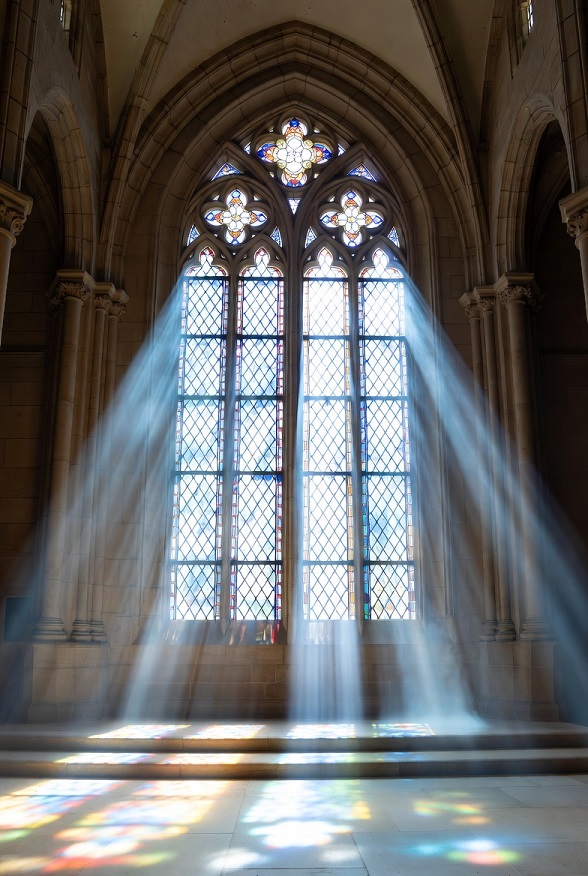
There is no denying the light that cascades across the floor. Indeed, many cathedrals are beautiful and breathtaking. Yet, no Muslim would deny that the teachings that take place in such buildings are teachings that mix light with darkness. It mixes haqq with batil. It mixes truth with falsehood.
“Do not mix truth with falsehood or hide the truth knowingly.” (Qur’an 2:42)
“They say, The Most Compassionate has offspring. You have certainly made an atrociousclaim, by which the heavens are about to burst, the earth to split apart, and the mountains to crumble to pieces. in protest of attributing children to the Most Compassionate.” (Qur’an 19:88-91)
There is a shared conceptual structure between Christian Logos theology, Neo-Platonic emanationism and the Sufi/Shi’i doctrines of Nūr i Muḥammed.
This is something alien to Islam.
Nūr i Muḥammed is a concept primarily within Sufi and some Shi’i traditions, designating Prophet Muhammed (saw) as the first creation and the primordial light from which the universe was created. It represents his inner, transcendent reality and spiritual essence rather than his physical humanity.
We see in the sacred text of the Christians the following beliefs.
Part of the Nicene Creed reads as follows:
“God from God, Light from Light, true God from true God, begotten not made, one in being with the Father. Through him all things were made. For us and for our salvation he came down from heaven.”
“For in him all things were created: things in heaven and on earth, visible and invisible, whether thrones or powers or rulers or authorities; all things have been created through him and for him. 17 He is before all things, and in him all things hold together.” (Colossians 2:16-17)
“In the beginning was the Word, and the Word was with God, and the Word was God. 2 He was with God in the beginning. 3 Through him all things were made; without him nothing was made that has been made. 4 In him was life, and that life was the light of all mankind. 5 The light shines in the darkness, and the darkness has not overcome it. There was a man sent from God whose name was John. 7 He came as a witness to testify concerning that light, so that through him all might believe. 8 He himself was not the light; he came only as a witness to the light. (John 1:1-8)
Contrary to what people think that the Qur’an being created is from Greek philsophy far from it. It is quite the opposite.
The position of the Sunni/Neo-Platonists. The Monad & the Logos
An uncreated ‘Kun’ by which everything else is created. The ‘kun’ acts as the intermediary between Allah, the transcendant and the material world.
However, the Sunnis believe that this uncreated ‘kun’ is not identical to the essence of Allah nor other than Allah’s essence. In our view, this is a step away from monotheism and a bridge towards Christology and logos theology.
“In the beginning was the Word, and the Word was with God, and the Word was God.” (John 1:1)
“Through him all things were made; without him nothing was made that has been made.” (John 1:3)
In our article here, we have shown that Jesus is not the eternal word of Allah. Jesus is the created word of Allah. Created from nothing “dust” and that which is created from dust or nothingness is not an attribute of Allah at all.
It is historically accurate to say that Christian theology has been heavily influenced by Platonic philosophy. We know this was the downward road in regard to their creed. So we now want to look at how such beliefs influenced certain strands of Islam.
As a reminder, our aqidah needs to be built upon the verses of the Qur’an. Those that are clear. Or it needs to be built upon the tawatur from the hadith.
And it dazzles the mind how those Muslims get accosted who say that Muhammed (saw) is only a man. They get accosted by those who hold fast to batini and esoteric doctrines. Well, if Muhammed (saw) is not only a man, then what is he? An angel? A demigod? A deity?
The same people do not seem to mind when we say about Jesus (as) that he is only a man. Even though Jesus (as) was born without a father.
“Say, “I am only a (basharun) man (mith’lukum)like you, to whom has been revealed that your god is one God. So whoever would hope for the meeting with his Lord – let him do righteous work and not associate in the worship of his Lord anyone.” (Qur’an 18:110)
“But now you seek to kill me, a man (anthropos) who has told you the truth which I heard from.” (John 8:40)
Question: What does the word Anthropos mean?
Answer: It means a mortal human being, full man. It distinguishes man from the animal kingdom on one hand and distinguishes man from a deity and divine essence on the other.
Source: (https://biblehub.com/greek/444.htm)
Anthropos is where we get the word anthropology, which means the study of man.
So this has not deterred those who wanted to bring Platonic Philosophy into Islam. In fact, it emboldens them. They reason well, Jesus (as) is anthropos, but he pre-existed as the word. So they reason that even if Muhammed (saw) is bashar, they can make him pre-exist as some eternal light.
What is interesting to note here is that nowhere in the New Testament does Jesus (as) say: “I am a man like you.” However, the text of the Qur’an is explicit. Muhammed (saw) is a man like us.
“And We sent not before you except (rijalan) men to whom We revealed [Our message]. So ask the people of the message if you do not know.” (Qur’an 16:43)
And We sent not before you, except men(rijalan) to whom We revealed [the message], so ask the people of the message if you do not know. We gave them not bodies that would not eat food, nor were they (khālidīna)immortals. (Qur’an 21:7-8)
khālidīna -this also means eternal. Jesus (as) is not the eternal word. Muhammed (saw) is not eternal light. Neither of them is eternal.
“The Messiah, son of Mary, was no more than a messenger. messengers had gone before him. His mother was a woman of truth. They both ate food. See how We make the signs clear to them, yet see how they are deluded!” (Qur’an 5:75)
“And they say, “What is this messenger that eats food and walks in the markets? Why was there not sent down to him an angel so he would be with him a warner?” (Qur’an 25:7)
In fact, if we do not accept the fact that Muhammed (saw) is a man like us, then we are accepting the belief of the Mushriks, who are surprised that Allah (swt) sends a man that eats food and walks among them.
“They say, “Why has no angel come with him?” Had We sent down an angel, the matter would have certainly been settled, and they would have never been given more time. And if We had sent an angel, We would have certainly made it a man—leaving them more confused than they already are.” (Qur’an 6:8-9)
The verse above has the Mushrik asking why no angel was sent with Muhammed (saw). So they are making a contrast between the two.
If Allah (swt) sent an angel, there would be no more room to debate about anything. This clearly tells us that Muhammed (saw) is not an angel. Angels are those beings which are created from light.
And nothing has prevented people from believing when guidance comes to them except their protest: “Has Allah sent a (basharan) human as a messenger?” (Qur’an 17:94)
“They challenge, “We will never believe in you until you cause a spring to gush forth from the earth for us, or until you have a garden of palm trees and vineyards, and cause rivers to flow abundantly in it. Or you should cause the heaven to come down upon us in pieces as you think, or bring Allah and the angels face to face (with us). Or you have a house of gold or you ascend into the sky. And [even then], we will not believe in your ascension until you bring down to us a book we may read.” Say, “Exalted is my Lord! Was I ever but a human messenger?” (Qur’an 17:90-93)
They asked Muhammed (saw) the following:
- Bring a spring to gush forth from the earth.
- Bring forth gardens, palm trees and vineyards.
- Cause rivers to flow.
- Bring the heavens down.
- Bring Allah and the angels face to face.
- Have a house made of guild.
- Ascend into the sky. -it is clear that Jesus did not do this either.
- Bring us down a book.
Muhammed (saw) replied to this by saying: He was only a human (basharan) messenger.
“Say: I am no (bid’an)new thing among the messengers (of Allah), nor know I what will be done with me or with you. I do but follow that which is inspired in me, and I am but a plain warner.”(Qur’an 46:9)
If Muhammed (saw) is the first creation and primordial light, then he certainly is a new thing among the messengers, as this cannot be said about any of the messengers who have come before him.
Verses from the Qur’an that are used to try and prove Nūr Muḥammed.
“O People of the Scripture, there has come to you Our Messenger making clear to you much of what you used to conceal of the Scripture and overlooking much. There has come to you from Allah a light and a clear Book.” (Qur’an 5:15)
mina l-lahi nurun wakitabun mubinun yahydi bihi
from Allah a light and a book clear guides with it
The Qur’an is the light and a clear book. Allah guides with it, not with them(plural)
You may see how disparate translations render the Arabic into English.
https://www.islamawakened.com/quran/5/16/translations/
“O mankind, there has come to you a conclusive proof from your Lord, and We have sent down to you a clear light.” (Qur’an 4:174)
bur’hanum min rabbikum wa-anzalna ilaykum nuran mubinan
convincing proof from your Lord sent down to you a light clear
The Qur’an never references nazzala (sending down) to a human being ever! For example:
“Indeed, We have anzalna sent down to you the Book, in truth. So worship Allah , [being] sincere to Him in religion.” (Qur’an 39:2)
Rather, when speaking about prophets as messengers, Allah (swt) uses the word arsala (sent).
See: Qur’an 21:07 Qur’an 33:45 and Qur’an 47:2
Allah (swt) tells us that the Qur’an is that light from Allah.
“And thus We have revealed to you an inspiration of Our command. You did not know what is the Book or [what is] faith, but We have made it a light by which We guide whom We will of Our servants. And indeed, you guide to a (siratin mus’taqimin) straight path.”(Qur’an 42:52)
“Believe then in Allah and His Messenger, and in the light which We have sent down. Allah is fully aware of all that you do.”(Qur’an 64:8)
faāminū bil-lahi warasūlihi wal-nūri alladhī anzalnā wal-lahu bimā taʿmalūna khabīru
Notice the text says believe in Allah and his Messenger and in the light. The text does not say believe in Allah and his Messenger, who is the light! Just as the wa distinguishes the Messenger from Allah, the wa also distinguishes the nur from the Messenger!
There is no escape!
You can see all the disparate translations of the above here: https://www.islamawakened.com/quran/64/8/translations/
Evidences from the hadith.
First it should be said that the Qur’an is sufficient in this regard. Anything that one would bring from the hadith would come to clash with the overwhelming flood of evidence that the Qur’an has established.
Secondly, it should also be stated that none of the evidence brought from the hadith amounts to tawatur and, therefore, it cannot be established as an aqidah point.
Nonetheless, we will look at the evidence one tries to establish from the hadith for Nur-Muhammed. The idea of Muhammed (saw) as the first creation and/or the primordial light from which the universe was created.
It would also clash with other lone narrator reports.
Umm Salamah narrated that the Messenger of Allah (saw) said:
“Indeed you come to me with your disputes, and I am only a human being, perhaps one of you is more eloquent at presenting his argument than the other. If I judge for one of you, giving him something from the rights of his brother, then it is only a piece of the Fire that I am giving him, so do not take anything from it.”
Source: (https://sunnah.com/tirmidhi:1339)
‘Abdullah (b. Mas’ud) reported:
The Messenger of Allah (saw) said prayer and he omitted or committed (something). Ibrahim (one of the narrators of this hadith) said: It is my doubt, and it was said: Messenger of Allah, has there been any addition to the prayer? He (the Holy Prophet) said: Verily I am a human being like you. I forget just as you forget so when any one of you forgets, he must perform two prostrations, and he (the Holy Prophet) was sitting and then the Messenger of Allah (saw) turned (his face towards the Qibla) and performed two prostrations.
Source: (https://sunnah.com/muslim:572l)
It also contradicts other information from the Blessed Prophet (saw) about what was the first created thing.
Abdul-Wahid bin Sulaim narrated:
“I arrived in Makkah and met ‘Ata bin Abi Rabah. I said to him: ‘O Abu Muhammed! The people of Al-Basrah speak about Al-Qadar.’ He said: ‘O my son! Do you recite the Quran?’ I said: ‘Yes.’ He said: ‘Then recite Az-Zukhruf to me.’” He said: ‘So I recited: Ha Mim. By the manifest Book. Verily, We have made it a Qur’an in Arabic that you may be able to understand. And verily, it is in the Mother of Book with Us, indeed exalted, full of wisdom. Then he said: ‘Do you know what Mother of Books is?’ I said: ‘Allah and His Messenger know better.’ He said:’It is a book that Allah wrote before He created the Heavens, and before He created the earth. In it, it is (written): Fir’awn is among the inhabitants of the Fire, and in it is: Perish the two hands of Abu Lahab, and perish he!’Ata said: ‘I met Al-Walid the son of ‘Ubadah bin As-Samit the Companion of the Messenger of Allah (saw) and asked him:’What was your father’s admonition when he died?” He said:”He called me and said: ‘O my son ! Have Taqwa of Allah, and know that you will never have Taqwa of Allah until you believe in Allah, and you believe in Al-Qadar- all of it-its good and its bad. If you die upon other than this you shall enter the Fire. Indeed I heard the Messenger of Allah (saw) saying: “Verily the first of what Allah created was the Pen. So He said: ‘Write.’ It said : ‘What shall I write?’ He said : ‘Write Al-Qadar, what it is , and what shall be, until the end.’”
Source: (https://sunnah.com/tirmidhi:2155)
Nowhere in this hadith is there mention of:
- Muhammed
- Light
- The Intellect (al-ʿaql)
- Or any connection to a “Muhammedan Reality”
The Pen is presented as a created instrument for recording destiny. That is all.
The very first of what Allah created was the Pen.
None of the information that has been supplied mentions anything about spatiality.
So this leaves us with some points of discussion.
If spatiality is not a creation but something that co-exists with Allah. Then who or what creates spatiality? How do we square this with the belief that Allah creates all things?
If spatiality is a creation and the first thing that was created before spatiality was either the Pen or the Throne. This means that the Pen or the Throne existed prior to spatiality. Since we do not posit a place for Allah (swt), then one could conclude the Pen is like Allah (swt) in existing without a place.
The unresolvable tension in Neo-Platonic emanationism.
Neo-Platonic emanationism: The One is absolutely transcendent, beyond being, beyond space, beyond time. The first emanation (the Nous/Intellect) is the first thing that has being, but it exists in a framework of emanation that presupposes the One’s transcendence.
The Islamic doctrine of tawhid: “There is nothing like unto Him” (Qur’an42:11). Allah alone is eternal, uncreated, without beginning. Everything else—everything—is created, contingent, and shares no attributes of divinity.
If the Muhammedan Light or the Pen was created before space and time, then:
It exists in a state of non-spatial, non-temporal existence.
This is precisely the definition of divine transcendence—existing without being located in space or time.
Something now shares this attribute with Allah.
“There is nothing like unto Him” is compromised.
When the Nūr Muḥammed doctrine claims:
“The first thing Allah created was the light of Muhammed”
It must then answer: Where did this light exist before space and time?
There are three possible responses, all of them problematic.
- It existed in Allah. Something created existed within the divine.
- It existed in a place. Which mean space is either uncreated (co-eternal with Allah)
or the light created its own container (nonsensical). - It existed in no place and no time.
The light shares with Allah the attribute of existing without spatial or temporal location.
There is nothing like unto him now has an exception.
The light is, in this crucial respect, like Allah.
There is no escape.
The Neo-Platonic Framework Collapses Under Islamic Premises
Neo-Platonism works because:
The One is beyond being, beyond even the category of “existence”
The Nous is the first being—but being is already a category that the One transcends.
The Nous is divine, and the system is not radically monotheistic.
But Islam does not allow:
- Degrees of divinity.
- A hierarchy of being where the first emanation shares in transcendence with that which is beyond being.
- Anything that shares attributes with Allah.
When Sufi metaphysicians attempted to import the Neo-Platonic structure while claiming to preserve tawhid, they created an unstable hybrid.
Evidences from the hadith that are used to try and prove Nūr Muḥammed.
The first hadith evidence that is used.
Narrated Abu Hurairah:
“They said: ‘O Messenger of Allah (saw)! When was the Prophethood established for you?’ He said: ‘While Adam was between (being) soul and body.'”
https://sunnah.com/tirmidhi:3609
This above hadith mentions nothing about when the Prophet (saw) was created or what he was created from. It simply establishes that the office of Prophethood was ordained for him.You are right. Th is the more straightforward and textually responsible reading. The plain sense of the text is about foreknowledge and divine decree, not ontological pre-existence.
The second hadith that is used.
He relates from Jabir ibn Abdullah who stated:“I said, ‘O Messenger of Allah (saw)! May my mother and father be sacrificed for you, tell us of the first creation which Allah created before everything?’ The Prophet saw answered, ‘O Jabir! Indeed Allah created before everything the light of your Prophet from His light.”
Source: (Al-Musannaf Abdur Razzaq, pp. 63, Hadith 18)
This hadith is fabricated (mawḍūʿ)
The consensus is that it has no sound chain of transmission (sanad) and was falsely attributed to the Prophet (saw).
Bring us an authentic chain for this hadith.
The most dangerous aspect of the above hadith is the wording, “from His light” (min nūrihī). This can be dangerously understood to imply that the Prophet (saw) is a part of Allah or that Allah’s essence is divisible—a concept fundamentally opposed to Islamic monotheism (tawhid).
It is challenging to take seriously the claims of anyone who says they defend (tawhid) and expresses the above view.
Such groups who advocate this are like the mysterion cults. They hold that such sacred truths are revealed but cannot be fully understood by reason. They need esoteric (obscure) explanations or can only be explained via esoteric rituals that are not within the grasp of the uninitiated. The contradictory nature is laid bare for all to see. If that is the case, then you do need recourse to proof text. You simply need aprior convictions.
One of our team members was introduced to a Sufi Tariqa in which one of its members approached them asking about how they understood Nur i Muhammed. The follower of this Tariqa said: “The light of Allah is Allah!”
So how does this Nur of Muhammed (saw) actually work?
If you are involved in Sufism or Sufi Metaphysics, it is usually taught that this light enters into Adam.
Then it is passed from Adam to his son Seth. It goes all the way to Nuh. Then, at this point, something crucial happens. The light is passed onto Nuh’s son Sam (Shem). The Semetic people and his other son, Ham (Hamitic) people, receive a curse—physically portrayed by being black-skinned.
It continues until it reaches Abrahams son (Isma’il). Now we get into a conundrum here. It cannot go through the son Ishaq because this line stops at Jesus (as) who had no children.
So it now passes through (Isma’il). But now we face another problem.
Historically speaking, there is a span of approximately 2,500 to 2,700 years between Isma’il, peace be upon him (born c. 2000s B.C.E.) and Muhammad, peace and blessings be upon him(born 570 C.E.). While Islamic tradition holds that Muhammed is a direct descendant of Isma’il, historians and early genealogists note that there is no continuous, verified, or documented written record for this connection.
Also, on top of that, it must be affirmed that for that span of 2,500 years, that entire line maintained a belief in perfect monotheism.
Critique of Esoteric Cults and Genealogy
Where this becomes a source for cults and manipulation. If you continue to hold that this nur i muhammed travels through his descendants, then not only are the descendants superior to you via bloodline, but they are metaphysically superior to you based upon this esoteric reality.
This has become a source of manipulation and abuse in many circles. A person who is claimed to possess such attributes becomes a deity in their circle. Unchallenged and unquestioned. The least infraction can bring wrath and damnation down upon one. If the Imam, Qutb (or Ghawth) is caught up in sexual impropriety, molestation, physical abuse and or squandering of funds, any whistleblowers would be shamed into silence.
The Ibadi school shuts the doors to these esoteric beliefs which have no firm basis in the Qur’an and Sunnah. Exploitation of people cannot come about through presumed superior metaphysical personages.
Put yourself for a moment in the position of a 7th century Bedouin hearer, the idea that Muhammed (saw) pre-existed as a cosmic light, or that there exists a “Muhammedan Reality” that is the first emanation and the instrument of creation, would have sounded unfamiliar—perhaps dangerously close to what they had just been taught to reject about Arab polytheism (where lesser deities mediated between the high God and the world) and Christianity (where the Logos became flesh).
In the end, what is needed for the Muslims is a return to purity in creed. A creed based upon the firm and clear text of the Qur’an and the mass transmitted testimony of the Blessed Prophet (saw).
You may also be interested in reading the following:
May Allah Guide the Ummah.
May Allah Forgive the Ummah.


 Prima Quran