
“And say to the believing women that they are lower their gaze and guard their sexual organs; and that they are not to display their ornaments except for what appears thereof. And let them draw their head coverings (bikhumurihinna) over their bosoms.” (Qur’an 24:31)
“O Prophet! Say to your wives, your daughters, and the women of the believers that they are to cast their over-garments (jalābībihinna) over them. That is more convenient, that they be recognized, so that they won’t be molested.” (Qur’an 33:59)
﷽
“And say to the believing women that they are lower their gaze and guard their sexual organs; and that they are not to display their ornaments except for what appears thereof. And let them draw their head coverings (bikhumurihinna) over their bosoms.” (Qur’an 24:31)
Quite often some would point to the fact that the word ḥijāb (حجاب) is not used in Qur’an 24:31 in connection to the head scarf. Thus this lead them to the mistaken notion that woman are not commanded to cover thier hair.
The Qur’ān itself uses the word khimār (خمار) in Sūrah an-Nūr 24:31, where women are instructed to draw their khimār over their bosoms. In classical Arabic, khimār means a cloth or covering that drapes from the head, often covering the hair and neck.
The word ḥijāb (حجاب), on the other hand, literally means a barrier, partition, or veil. In the Qur’ān, it is used in this more general sense (e.g., 33:53, 42:51), not specifically for a head covering. Over time, however, Muslim societies began to use hijab as a broader term for modest dress, especially the headscarf.
“Verily, such (behaviour) annoys the Prophet, and he is shy of (asking) you (to go), but Allah is not shy of (telling you) the truth. And when you ask (his wives) for anything you want, ask them from behind a screen (ḥijābin), that is purer for your hearts and for their hearts.”
“It is not fitting for a man that Allah should speak to him except by inspiration, or from behind a veil(ḥijābin), or by the sending of a messenger to reveal, with Allah’s permission, what Allah wills: for He is Most High, Most Wise.” (Qu’ran 42:51)
There is a hijab between Allah and the creation. The black cloth that is put over the Kaaba in Mecca is a hijab. Men wear a hijab.
Most countries today have a hijab that is enforceable by law.
In most countries, public nudity is an offense that can garner either a fine or jail time. Hudud means: boundaries, limits or restrictions. What those boundaries and limits are can differ from country to country.
There are only a few remote places in the world where there are tribes in which full nudity takes place.
Even countries that allow full nudity at what are known as nudist colonies or nudist resorts these are select places. If you go outside those areas nude, you can and will be either fined or jailed.
That which the Muslim covers herself with is the Khimār.
So, technically:
- Khimār = the headscarf covering the hair, neck, and often the shoulders.
- Hijab = the general concept of modesty and barrier; in modern usage, often synonymous with headscarf.
Another mistake today is that people believe that wearing a khimar is enough. In the context of the verse, women are, by default, wearing khimar. They are being instructed to pull it down over their bosoms. Both men and women are expected to dress modestly. It is quite possible to find a woman who is not wearing a headscarf dressing more modestly than a woman who, for example, wears a headscarf and tight fitted jeans.
We believe that the Blessed Messenger (saw) explained the Qur’an to his people.
“And obey Allah and obey the Messenger. But if you turn away, then Our Messenger is responsible only for conveying the message clearly. (Qur’an 64:12)
The Muslim woman wearing the Khimār may vary according to custom and culture. Yet this is a transmitted practices that has reached us from the Blessed Prophet (saw).
It has reached us as Muslims across the sectarian divide that a Muslim woman covers all but the hands and face.
That is to say, the Shi’a, the Sunni, and Ibadi have all concurred on this. In fact, the only debate within the community is whether she should cover more than this, meaning — the face veil.
Islam does not oblige a person to wear specific type of clothing as long as it fulfils the purpose of modesty. Rather, this depends on the customs of society, so long as those customs do not contradict the guidelines of Islam.
In a world of nihilism and postmodernism, there can be a lot of pressure upon any faith tradition to amalgamate and transform their faith into something ‘more acceptable’ to an increasingly secularized world.
We feel the issue of women’s Khimār is one such issue. It seems to us that many struggle with this.
Where we feel Muslims do not ponder deeply enough is on the ‘default dress’. When this verse above was being revealed, what was the ‘default dress’ of the people of that time? What was the basic ‘skeleton’ if you will?
This is what has led many who are ignorant of the Arabic language as well as the context of the revelation will leave open the possibility of wearing tight and revealing clothing, or even skirts. It really seems that we could offer a better response than to simply cave in completely to postmodernism. It may be cliché, but a saying comes to mind, ‘If you do not stand for something you will fall for anything.’
There is a real disdain for Muslim women who choose to continue to observe the Khimār as explained by the Blessed Messenger (saw) and preserved in the mass transmitted Sunnah.
Examples where the dress code can be relaxed.
Such elderly women are past the prospect of marriage, there is no blame on them if they lay aside their (outer) garments(thiyābahunna), provided they do not display their beauty/adornment. But it is best for them to modestly refrain: “And God is One Who sees and knows all things” (Qur’an 24:60)
It can be a normal garment and an outer garment. (11:5; 24:58).
In verse Q 24:60, we clearly note that an older woman is permitted to remove this ‘thobe’ without wanton display of her beauty. This cannot refer to her normal garments, as if these were to be removed she would be left exposed.
“The women may relax (their dress code) around their fathers, their sons, their brothers, the sons of their brothers, the sons of their sisters, the other women, and their (female) servants. They shall reverence Allah. Allah witnesses all things.” (Qur’an 33:55)
Remember the five essential objectives of the Sharīʿah (maqāṣid al-sharīʿah). These objectives are:
- Protection of religion (ḥifẓ al-dīn)
- Protection of life (ḥifẓ al-nafs)
- Protection of intellect (ḥifẓ al-ʿaql)
- Protection of lineage/progeny (ḥifẓ al-nasl)
- Protection of wealth (ḥifẓ al-māl)
“O Prophet! Say to your wives, your daughters, and the women of the believers that they are to cast their over-garments over them. That is more convenient, that they be recognized so that they won’t be molested.” (Qur’an 33:59)
In this case if you stand out in a way that directly identifies you as a Muslim the purpose of this guidance is defeated. You will be recognized and you will be molested. You might even be killed.
There is a principle in Shari’a law
لا ضرر ولا ضرار
“Lā ḍarar wa lā ḍirār”
= No harm and no reciprocating harm.
Abu Sa‘īd al-Khudri reported: The Messenger of Allah (saw) said:
“There should be no harm or reciprocal harm. Whoever causes harm, Allah harms him, and whoever makes things difficult, Allah makes things difficult for him.
Source: (https://hadeethenc.com/en/browse/hadith/4711)
So there are two examples.
a) A woman who chooses Islam as her faith. If she outwardly dresses or identifies as a Muslim, she could be assaulted or attacked. She does not wear the Khimār. She can dress modestly and, as Allah (swt) cautions us: Do not transgress the limits. A relaxing of outward garb is not an invitation to abandon modesty altogether. That woman lives as such until she can travel to a place where Muslims are numerous, and she can fulfill the commands.
b) A woman who was born and raised a Muslim. Suddenly there is news that Muslims are getting attacked and killed wherever they are found. This woman also does not need to outwardly identify nor dress as a Muslim until she can reach a place where Muslims are numerous, and she can fulfill the commands.
You can read more about this here:
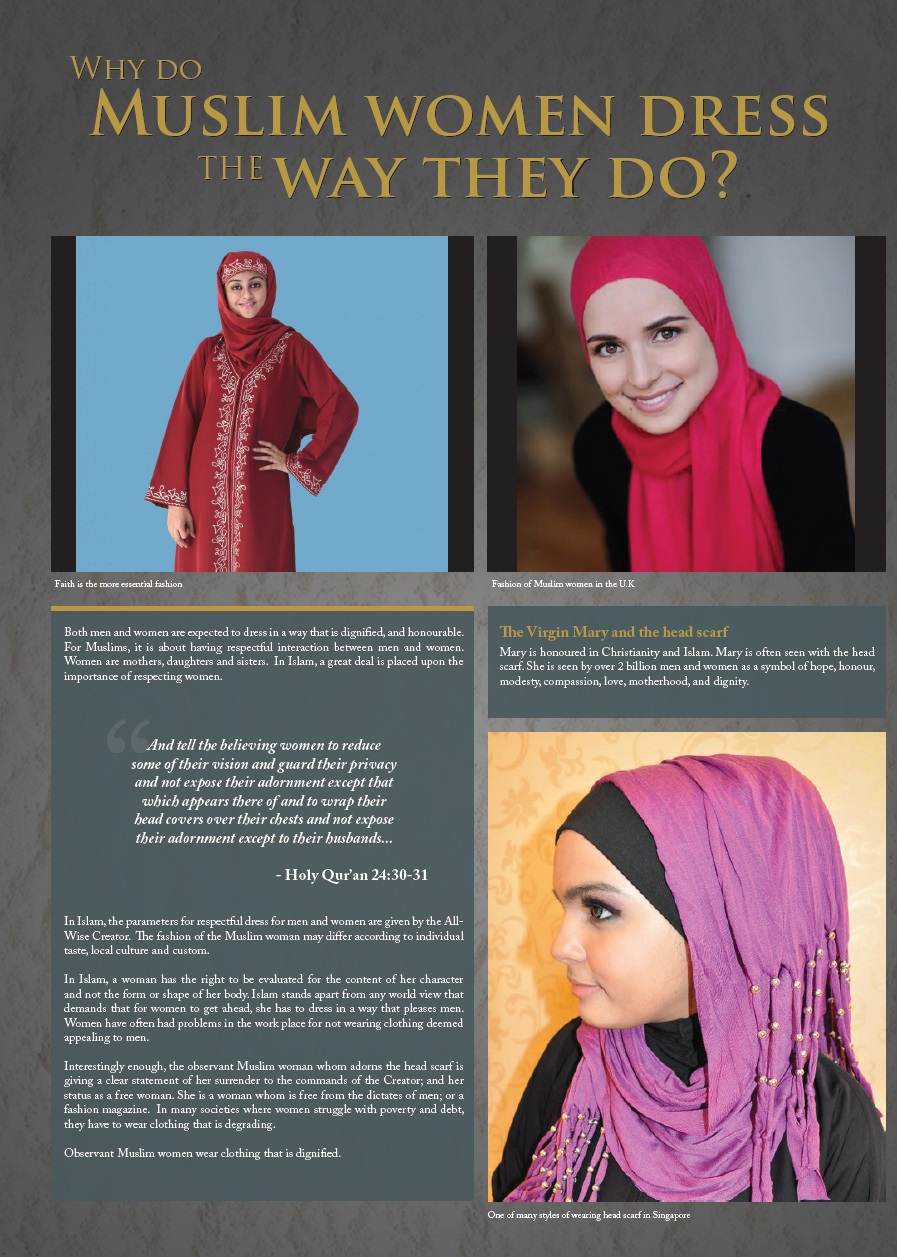
This was a panel that Allah (swt) graced our brother to do for the Sultan Masjid ‘mini-gallery’ in Singapore. It is the first ‘mini-gallery’ in any masjid anywhere. Al hamdulilah.
We would encourage readers to read this very excellent and brief over view of the topic here:
http://www.lamppostproductions.com/the-matter-of-hijab-the-headscarf-abdullah-bin-hamid-ali/
We would also encourage sisters and brothers to check out the excellent work the sisters are doing over here:
May Allah (swt) guide the Ummah.
May Allah (swt) forgive the Ummah.


 Prima Quran