
“Oh my Lord advance me in knowledge.” (Qur’an 20:14)

﷽
The Differences between Ibadis and Khawarij
Written by: Shaykh (Abu Is’haq) Ibrahim Attfayish (hafidhullah)
To know more about this great Shaykh please see the write up our sister, Bint Ibadh.
https://bintibadh.blogspot.com/2021/05/a-brief-review-of-biography-and.html
“The Khawarij [Kharijites] were groups of people who appeared at the time of Al-Tabieen and those who came after them. Their leaders were Nafi’a bin Al Azraq, Najdah bin Aamir, Abdul-Allah bin Al-Asfer and their followers. They were given this name because of their radical approach of accusing others of unbelief, which set them apart from the truth and the Muslim community. For Khawarij, a sinner was a heretic whom it was permissible to kill and whose properties could be despoiled. This false accusation was all based on their misinterpretation of the A1mighty’s words: “If you were to obey them, you would indeed be heretics”, (Qur’an 6:121).“
“They claimed that this verse meant if you obey heretics in eating carrion, you will be deemed one of them. However, the correct understanding of this verse is that those who make carrion lawful are heretics.”
“When the news reached Imam Al-Rabi bin Habeeb bin Amr Al-Basri Al-Farahidi Al-Ibadhi, the author of Al-Musnad As-Sahih, (r), he said: “Leave them until they apply what they say. If they do so, we will apply Allah’s ruling on them”. Thus, when their wrong innovations [bid’ah] became apparent, and they applied their incorrect and dangerous doctrines, and started killing Muslims, the Ibadis declared their dissociation from them, expelled them from their meetings and fought them in different places. Ibadis announced, based on clear and assertive verses from the Qur’an, that Khawarij were Kufaar [unbelievers] for they permitted what Allah forbade.“
“Omanis, for example, stood with Al-Muhalab to confront the Khawarij armies. (For more information see Al-Kamil written by Al-Mubarad). The famous Umayyad Azdi Omani warrior, Al-Muhallab bin Abi Sufrah, took the responsibility of suppressing this group and motivating people to fight them. However, to give a stronger motive for fighting the Khawarij, Al-Muhallab started creating fabricated hadith against the Khawarij. This doubled the crisis of the Khawarij as not only many Muslims were killed, but also, fabricated hadiths were made up. Because these groups of Khawarij were against arbitration, Ibadis who were against it as well were falsely and unjustly attached to them.”

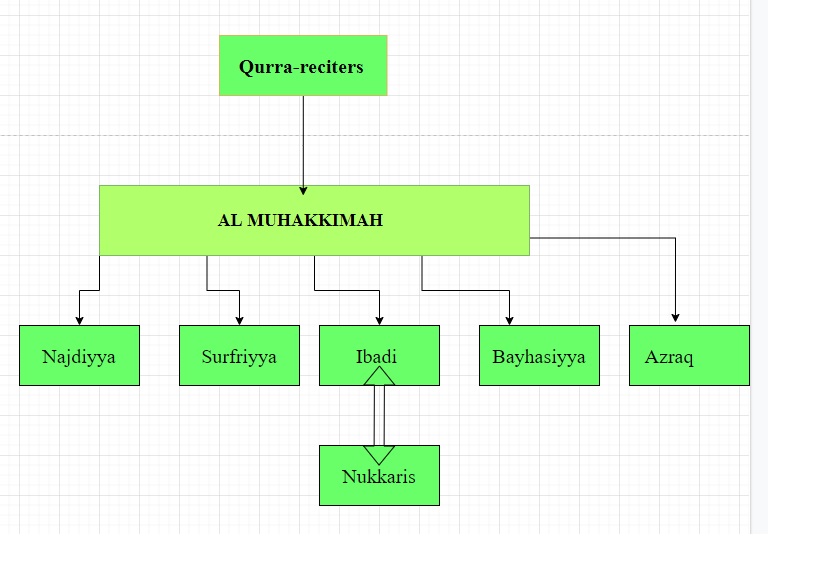
However, this unjust attachment can be refuted as follows:
“Ibadis do not approve of the ruling of tyrant kings. For them, it is a must that the Caliph should follow the steps of the rightly guided Caliphs, among them Abu Bakr and Umar. This was clearly stated by the Prophet (saw) as he said in an authentic hadith, “Follow the examples of those who came after me, Abu Baker and Umar.” When the hadith was narrated concerning Ammar bin Yasir, (r), “you’ll be killed by the transgressing party”, it was used by the opponents of arbitration as well as the other party. Although its authenticity was confirmed by both parties, Mu’awiyah’s group interpreted it in a way that twists the reality in their favor.”
Prima Qur’an comments: See our article:
“Second, driven by their desires, many people claim that the people of Al-Nahrwan rebelled against Ali. This is an unsound claim, for Ibadis had insisted that Ali should stay as the Caliph of the Muslims.”
“However, when he accepted arbitration, they freed themselves from the allegiance because they didn’t see any point in negotiating his right as an elected Caliph by Muslims. His concession to the arbitration with Mu’awiyah’s group means that his election was questioned; therefore, they elected their own Caliph.“
“The Caliph they chose was among the most pious companions of the Prophet (saw). This person was none other than Abdul-Allah bin Wahab Ar-Rasbi Al-Azdi. When Wahab was elected, Ibadis asked their brothers, including Imam Ali, to give allegiance to the newly chosen Imam. However, Ali bin Abi Talib saw that allegiance was given to Azdi, a non-Qurashi, so he fought them before they could get any stronger and thus, the Quraish would lose the Imamate. This was the only reason for the Battle of Al-Nahrawan. Ali’s attack upon the people of Nahrawan was politically motivated.”
“In Dawmat Al-Jandel, Mu’awiyah took the Caliphate after the negotiation of the two arbitrators, Amr bin Alas and Abu Musa Al’Ash’ari. Consequently, Ali debated with and asked Wahab’s group to fight Mu’awiyah and his followers once more, but by this time it was too late as they were free from their allegiance to him. Ibadis didn’t elect a new Caliph, until the result of arbitration appeared. What they warned against happened, for arbitration was hatched by Al’Ash’ath bin Qais, who was put into Ali’s group by Mu’awiyah.”
Prima Qur’an comments: For those who do not know, Abu Bakr (ra) made the following statement:
But the three things I did not do and wish I had: the first is that when Al-Ash’ath bin Qais was brought to me in captivity, I wish I had struck his neck, because I suspect he will enforce evil wherever he finds it; and the other one is that I wish when I sent Khalid Bin Waleed to the battle of the apostates I had remained at Zil Qissah so that I could help the army if they were defeated; and the third one, I wish that when I delegated Khalid to Sham I had sent Omar to Iraq so that I had opened my two hands in the cause of Allah.
Then he opened his hands and added:
I wish I had asked the Messenger of Allah (saw)that to whom the caliphate belonged, so that nobody would go to war on it; and I wish I had asked him did Ansar have any right in this matter; and I wish I had asked him if the the brother’s daughter and the father’s sister would inherit anything [from the deceased], because I’m not sure about it.
Source: (Târîkh Tabarî, v 3 p 429 ; Târîkh Ya’qûbî, v 2 p 137)
Shaykh Attfayish continues…
“Thus, it is not as claimed by falsifiers of history and extreme sectarians that the Battle of Al-Nahrawan happened because of a rebellion against Ali. On the contrary, they did not leave his group when his allegiance was valid. Therefore, people looking for the truth should be aware of making a mistake in this regard, as it is apparent that desires are pervasive among such people.”
“Third, the name Khawarij didn’t appear until the spread of Azariqah’s movement. Thus, the people of Al-Nahrwan were not described as Khawarij. We challenge such claimants to bring forth their evidence.”
“The first use of this name was by Mu’awiyah, using it against one of his visitors from the people of Mu’awiyah, Al-Ahnaf bin Qais. He said to him, “Why do people admire you when they know that you are from Khawarij?” Al-Ahnaf replied, “If people had found water bad, they wouldn’t have drunk it.” Mu’awiyah meant here those who refused to accept him as Caliph (see Al-Amali by Abdu Ali Al-Qali).”
“Was Mu’awiyah’s accusation of Al-Ahnaf as being Khariji because Al-Ahnaf was with the people fought by Ali in the Battle of Al-Nahrwan? Or was it because he did not pledge allegiance to Mu’awiyah? If it were because of the former reason, Mu’awiyah’s party would have been more eligible for this description as he was the one who fought against Ali on the Day of Siffin and freed himself of Ali’s allegiance, knowing that he was given allegiance by prominent companions and his allegiance must be followed by all Muslims.”
“Fourth, Ibadis have never fought against any monotheists [Muslims], even when AI-Hajjaj and Ziyad bin Abeeh got tough on Muslims based on their own doubts. However, they were rebelled against by a group called At-Tawwabun (The Penitents) headed by great scholars like Saeed bin Jubair and Ibrahim A’Nakh’i. Later, Al-Hajjaj killed Saeed bin Jubair, who was a scholar in the interpretation of the Qur’an. What was surprising was that this big group of scholars who took up the sword against the horrible injustice done by Al-Hajjaj were not called Khawarij, but they were called At-Tawaboon [the people of repentance]. They were all carriers of knowledge who died in the fighting. Certainly, a mind is stunned because of such a tragedy, yet many readers overlook it.”
“However, those who scrutinize history objectively will find out that the word Khawarij was unjustly given to Ibadis because they only believed that the Imamate [Caliphate] should not be restricted to the tribe of Quraish.”
“This position is the right of whoever is elected by Muslims to lead them, because it is clearly unwise to accept that Allah places the leadership of all humankind in the hands of only one tribe irrespective of whether it does right or wrong. Common sense supports what Ibadis believe on this issue, and how they have used this belief to interpret the hadith that “the Imams are from Quraish.” It is a kind of arrogance and avoidance of the truth to claim that leadership is restricted to the Quraish.”
“Even the supporters [Ansar] of the Blessed Prophet (saw), who understood his teachings, said to Abu Bakr, “A leader from us and a leader from you.” With the same token, the reply of Abu Bakr was as follows: “Leaders are from us, and ministers are from you as Arabs are subservient to this tribe” does not support the restriction of the Caliphate Quraish. He justified it with Arabs being subservient to the Quraish but not for any other reason as claimed by people of political and sectarian desires. Would nations of different races accept being driven by a man from Quraish only because of his tribe?! It is unlikely.”
“Fifth: Ibadis desire justice to disseminate the application of the Quran and Sunna, and to follow the political paradigm of rightly guided Caliphs whether the person in charge is Qurashi, Habashi [Ethiopian], Arab, or non-Arab, as it was narrated in sound hadiths.“
Prima Qur’an comments: For more on this please see our article:
“This is why they accepted the leadership of Umar bin Abdul-Aziz, and they sent a group of six great Ibadi scholars, J’afer bin A’Simak, Abu AlHur Ali bin AlHusain Al’Anbri, AlHattat bin Kateb, AlHabab bin Kulaib, Abu Suyan Qanber AlBasri, and Salim bin Thakwan among other unnamed scholars, but these were the names I came across, may Allah have his mercy upon them all. “
“Non-Ibadi historians mentioned these delegates to Umar bin Abdul-Aziz, though they said with their usual insinuation: “The Khawarij sent him a delegation.” However, they did not mention what happened between them and the Caliph Umar and his acceptance of all their suggestions about spreading justice and purging the country of the Umayyad tradition of cursing Ali from the pulpit. The Ibadi delegation said to Umar, “Muslims are cursing from pulpits in mosques, so this evil tradition must be changed.” Thus, Umar replaced it with the words of Allah: “Indeed, Allah orders justice and good conduct and giving to relatives and forbids immorality and bad conduct and oppression. He admonishes you that you remember.” (Qur’an 16: 90)“
Prima Qur’an comments: For more on this please see our article here:
Often we hear this in our Friday Prayers during the Khutbah. At the council of these Ibadi luminaries in place of cursing Ali at the pulpit we get the following:
“Indeed, Allah orders justice and good conduct and giving to relatives and forbids immorality and bad conduct and oppression. He admonishes you that you remember.” (Qur’an 16: 90)“
- What it Orders:
- Al-‘Adl (Justice): This is the foundation of all social interactions, governance, and even personal conduct. It means giving everyone their due rights and being fair.
- Al-Ihsan (Goodness/Excellence): This goes beyond mere justice. It is to do good, to be kind, generous, and to perform acts of excellence in worship and dealings with others, as if you are seeing Allah.
- Ita’i Dhi al-Qurba (Giving to Relatives): This emphasizes maintaining family ties, fulfilling the rights of kin, and treating them with extra kindness and financial support if needed.
- What it Forbids:
- Al-Fahsha’ (Immorality/Shameful Deeds): This includes all major sins and lewd behavior.
- Al-Munkar (Bad Conduct/Evil): All that is recognized by sound human nature and scripture as wrong and objectionable.
- Al-Baghy (Oppression/Transgression): Wronging others, tyranny, and exceeding the limits set by Allah.
Shaykh Attfayish continues…
“Despite this, many historians still do not admit the good that Ibadis have done to this Ummah [Muslim nation]. Blindly, they overlook many incidents that prove how Ibadis were always there defending justice and truth and fighting injustice with words not swords, as was done by Abdul-Allah bin Ibadh, with Abdul-Malik bin Marwan and Abu Bilal Mirdas bin Hudair as well as Ziyad bin Abeeh.”
“They have never accepted that it is permissible to shed blood among Muslims or lawful to despoil their properties. Ibadis have always believed in freedom of choice and opinions, as everyone is accountable for what he/ she has. They were unlike others who used the sword to establish their states or to force people to follow their sects. Ibadis gave people the freedom of expression and the freedom to choose their sects, for there is no compulsion in religion. For Ibadis, truth is acceptable from whoever brings it, and falsehood is returned to whoever brings it.”
“Thus, Ibadism is the only sect that grants a slave freedom once he/ she agrees with his/her lord, even if s/he does not pay the full price of his/her freedom. The remaining amount is a debt the slave must pay later. This shows how Ibadis were ahead of others in understanding the essence of Shari’ah [Islamic Law].”
Prima Qur’an comments: Let us elaborate more on this point.
The Ibadi Position vs. Other Schools
- The Ibadi View: The Ibadi school holds that the mere agreement between the master and the slave on the terms of the kitabah is sufficient to enact the contract and grant the slave a new legal status as a mukatab. The payment of the money is not a precondition for the contract’s validity but becomes a debt to be paid afterwards. This means freedom begins with the agreement, not with the final payment.
- The Majority Sunni View (Hanafi, Maliki, Shafi’i, Hanbali): The prevailing view in the four major Sunni schools is that the contract is not binding until the first installment is paid. They argue that the kitabah is a contract of sale (of one’s freedom) and, like any sale, requires an exchange of value at the time of agreement to be valid. Therefore, if the slave has no money to make an initial payment, the master is under no obligation to grant the contract.
Why This Difference Matters: “Ahead in Understanding the Essence of Shari’ah”
Ibadis were ahead in understanding the essence of Shari’ah is astute. Here’s why this legal opinion is considered so progressive and aligned with the spirit of Islamic law:
- Primacy of Freedom: The Ibadi position places the ultimate objective—freeing a human being—above the commercial formalities of the contract. It prioritizes a person’s liberty immediately upon mutual agreement.
- Practicality and Empowerment: It provides a practical path to freedom for those who have no means to make a down payment. By allowing the debt to be incurred after the fact, it empowers the enslaved person to go out, work, and earn the money as a free person, which is psychologically and economically much more feasible than trying to save while still enslaved.
- Reducing Barriers: The majority view creates a significant barrier for the poorest slaves. The Ibadi interpretation removes this barrier, making the Islamic directive of facilitating freedom more accessible to all, regardless of their current financial state.
- Emphasis on Goodwill and Trust: The ruling is built on the principle of trust and goodwill (husn al-dhann) between the master and the slave, encouraging a merciful and cooperative relationship rather than a purely transactional one.
Shaykh Attfayish continues…
“By mentioning Khawarij’s hideous actions, it has become clear that Ibadis do not have any connection with Khawarij. These differences between Ibadis and Khawarij have become clear for just those non-Ibadi intellectuals who realized the truth and admitted it, for returning to the truth is an obligation and a great virtue.”
“Sixth, Ibadis allow intermarriages between them and all other monotheists, while Khawarij do not because the Khawarij see others as polytheists [heretics] — as explained before. Based on this, they also do not allow inheritance between them and those who disagree with them because heresy that prevents intermarriage prevents inheritance as well. So, did the falsifiers of history turn a blind eye to these differences?”
Prima Qur’an comments:
Please see our article here:
“That is what a person sees when turning the pages of history in the records and books of other Muslims [non-Ibadis] who have not learned from what Allah says in the Holy Quran: “And those who annoy believing men and women undeservedly, bear on themselves the crime of slander and plain sin” (Qur’an 33: 58).“
“Allah says: “O you who believe! Stand out firmly for Allah, as witnesses to fair dealing, and let not the hatred of others to you make you swerve to wrong and depart from justice. Be just: that is next to piety and fear Allah. For Allah is well-acquainted with all that you do”, (Qur’an 5:8).“
“Indeed, a Muslim gets bewildered by those calumniators on the People of Truth and Straightness, (The lbadis). How dare they say those things for no other reason than for their hidden desires. We seek refuge with Allah from following desires and denying the truth. Do they not know that they would meet Allah with this slander? Or is it their belief that leaving Hell Fire has eased everything for the sake of following desires?”
“Seventh, Ibadis have turned their efforts to serve Islam through knowledge and practice since the Fitnah started. They were the first to write down the hadith of the Prophet; our Imam, Jabir bin Zaid (ra), was the first to write down the hadith and the Blessed Prophet (saw) of the companions’ sayings in his Diwan [volumes of books] which was described to be as large as a load of a camel. Then after him, his students, carriers of knowledge to the east and the west, followed his steps.”
“The Khawarij practiced bloodshed, terrified the people and abolished the rulings of Islam. None of the Khawarij were known to have written a book and those who are attributing books to Khawarij mean Ibadis. Undoubtedly, they want to distort the Ibadis’ repute through this obfuscation.”
“The same thing is said about the Sufriya, Azariqah, and Najdiyah; they did not care about the narrations of the Blessed Prophet (saw) or writing down hadith except a narration by Najdah bin Amer who narrated one hadith and Nafe bin Al-Azraq who had questions addressed to Ibn Abbas, yet this is not the place to mention them. Rather, the Khawarij were concerned about warring rather than the compilation and narration of knowledge. All those who were mentioned as scholars of Khawarij by other non-Ibadi Muslims were in fact Ibadi scholars!”
“Our ancestors [Ibadis] came with wonders in recording knowledge, and they were well known for their piety, trustworthiness, and honesty to a status none but them attained. Therefore, some non-Ibadi Muslim writers resorted to distorting the facts with false and promiscuous propaganda when they were shocked by those bright lights. They did not mix Ibadis with Khawarij except to blur the lines of truth in envy.”
“How would a person who has taken distortions as his principles and whose insight has gone blind admit to the truth?! You find that those false writers would never mention our companions [Ibadis] with any good virtue even when they were to be mentioned. Rather, they would ignore their greatness in knowledge and religious perfection. Indeed, I have come across some books on history and literature in which there must have been a mention of our companions [Ibadis] as to what they have contributed. Yet, with no piety, those authors ignored them as if they did not exist. This is a transgression and indulgence in blurring the truth that you never find with our companions [Ibadis]. Praise be to Allah, the Most High, the Most Great.”
“Eighth, when our Muslim brothers [non-Ibadis] recorded history, and they mentioned our companions [Ibadis], they failed to tell the truth. Instead, they mixed Ibadis with Khawarij. Sometimes, they attribute Ibadis to Khawarij, while other times they attribute Khawarij to Ibadis, as done by many authors in Usul [the Fundamentals of Islamic Law] attribute the sayings of Mutazilah to Ibadis and vice versa. This resulted in mixing things up and distortion, because those authors who depended on copying from these sources fell in the same mistake. To me, they do not have any excuse, for the one who spreads the truth should request it from its source and not forge it as he wants.”
“We find those who claim that Abu Bilal bin Mirdas bin Hudair was among the Khawarij and Qatri bin Al-fuja’a was among the Ibadis! Yet, the reality is the opposite. Another confuses that Imam Talib Al-Haq Abdu-Allah bin Yahya Al-Kindi was Imam Abdu-Allah bin Ibadh, but that was not right. Imam Abdul-Allah bin Ibadh died in the last days of Abdul-Malik bin Marwan, while Talib Al-Haq Abdul-Allah bin Yahya appeared during the time of Marwan Al-Himar [Marwan the donkey] in l30H. This is how those authors mix facts up to distort the Ibadis’ reputation. Looking at the history of Andalusia, you will not see a mention of Ibadis. The truth is that lbadis have attained in Andalusia a great status in knowledge and wealth. Ibiza island in Andalusia was fully inhabited by Ibadis until the sixth century, Hijri, or even further until the fall of Andalusia.”
“When reading Tabakat Ibn S’ad, there is no mention of Ibadis except for Imam Jabir bin Zaid, who had to be mentioned as he was too famous to be ignored.”
“The indisputable truth is that important figures are closer to [well known by] their people and history is better known by its people than others. Allah says the truth, and He guides us to the right path.”
“The innovations of the Khawarij necessitated Islamic guidelines against them. Muslims said that there must be a distinction between major sins, so Muslims do not fall into the crimes of Khawarij. Major sins are of two types: sins of heresy [shirk], and sins of hypocrisy [nifaq].”
“Major sins of heresy [shirk] include every sin that violates Islamic creed, like allowing what Allah forbids, forbidding what Allah allows, rejecting what must be known about religion, or rejecting Islamic rulings such as stoning. The sins of hypocrisy are sins of ingratitude to Allah’s bounties. This is what scholars of hadith call a deviation without unbelief [kufr duna kufr]; they are the major sins of corruption [fisq] to non-lbadis. These sins include committing adultery, anal intercourse, eating unlawful food, perjury, disobedience of parents, and other similar acts and deeds. More examples include ceasing the performance of obligatory orders of Allah without believing that they are non-obligatory.”
Prima Qur’an comments: Kufa duna kufr is an understanding that is attributed to Ibn Abbas (ra)
https://fitrahtawheed.com/kufr-duna-kufr
“Ibadis call all these sins major sins of hypocrisy [nifaq] and ingratitude to Allah’s bounties [kufr ne’mah]. When Ibadis call a sin ‘kufr’, this would lead to the next question: does it affect the major belief [creed] or is it part of doing acts of worship or not? Accordingly, the type of disbelief [kufr] can be recognized whether it is kufr of hypocrisy or kufr of shirk. Our Ibadi companions do not call others kuffar [unbelievers] without a legitimate reason, and they do not call the people of Qibla [Muslims] kuffar [disbelievers] if they are under the word of sincerity [ikhlas].“
“The truth is that they are distinguished by this method even if it is claimed by other Islamic schools of thought. If you realize this, you will know that there is a marked distinction between Ibadis and Khawarij and nothing links them together except rejecting the arbitration, which is the truth that is supported by the Qur’an, Sunnah, the path of Omarein and the consensus of Muslims. So, hold firmly to the truth as anyone who depends on Allah will be guided to the straight path.”
“Some of our scholars and other non-Ibadi scholars said that Khawarij deny stoning. In my opinion, this is not true unless we consider their ruling that a person who commits a major sin is an unbeliever whose blood is lawful. In this case, the one who commits adultery is killed because he is considered a non-believer, not killed as a punishment for adultery; therefore, there is no need to deny stoning.”
“This matter, according to me, is not as many think it is; some non-Ibadi Muslims’ claim that Khawarij reject stoning is an insinuation. This claim backfires on them because they narrated a verse that states “if an old man and old woman commit adultery, stone them as a punishment from Allah and Allah is Almighty All-Wise” was recited in the Holy Quran in Al-Ahzab but was eaten by a goat. Based on this false narration, an imperfection has occurred in the Qur’an. This terrible error will always accompany them despite their claims that its recitation is being abrogated while its ruling remains in effect! However, our Ibadi scholars say that stoning is not prescribed in the Holy Qur’an but in the hadith. Imam Al-Hafidh Al-Hujjah Ar-Rabi bin Habeeb narrated in his Sahih that Imam Jabir bin Zaid said, “Istinja, circumcision, witr and stoning are obligatory Sunnah.”
Praise be to Allah Who has protected our companions from error and may Allah bless our Prophet Muhammed, his righteous family, followers and his companions.
Abu Is’haq Ibrahim Attfayish
________________________________________________
1 This book hopes to clear out some misconceptions that many people hold about Ibadis based on other inaccurate or biased sources written long time ago.
2 Two ways of spelling the same word.
3 Those who met the companions of the Prophet but did not see him.
4 Carrion means here a dead animal meat that is not slaughtered in the lawful way.
5 Once, while Allah’s Messenger, peace be upon him, was reciting the above verse, ‘Adi bin Hatim said, “O Allah’s Prophet! They do not worship them (rabbis and monks).’ Allah’s Messenger said, “They certainly do. They (i.e., rabbis and monks) made legal things illegal, and illegal things legal, and they (i.e., Jews and Christians) followed them; and by doing so they really worshiped them”. Narrated by Ahmed, At-Tirmidhi, and Ibn Jarir. (Tafsai AT-Tabari, Vol. 10, p.114)
6 Died in 175H.
7 A book that has very authentic Prophet’s tradition because the narrators are described as golden chain.
8 This is the author’s note within the original text.
9 Hadiths: The Prophet’s traditions, his sayings and practices and sometimes called ‘the Sunnah of the Prophet’.
10 Arbitration was a trick used by Amr bin Alas, who was in Mu’awiyah’s side, to take the Caliphate from Ali during the Battle of Siffin in 37H/ 657G.
11 They were the first two successors after the Prophet peace be upon him.
12 An authentic hadith narrated by Al-Hakim, and At-Tirmidhi.
13 He was one of the loyal companions who accepted Islam early and was killed in Siffin in 37H.
14 Mu’awiyah claimed that Ali killed Ammar because he brought him and threw him at Mu’awiyah’s lances (or swords)
15 A Place in Iraq, in the southeast of Baghdad
16 The fourth Caliph elected by Muslims and the cousin and son-in-law of the Prophet.
17 He was a companion of the Prophet described as a knowledgeable brave person and one of the reciters of the Qur’an. He supported Imam Ali in his battles, and he participated in the conquest of Iraq with S’ad bin Abi Waqas. He died in 38AH.
18 Azdi is an attribution to a person who belongs a famous Arabic tribe called Azd.
l9 Qurashi is an attribution to a person who belongs a famous Arabic tribe called Quraish from Meccah.
20 Some Ibadi scholars question the validity of this claim.
21 A place 1n the far north of current Saudi Arabia.
22 Falsifiers of history.
23 Died in 67H.
24 A note by the author.
25 Khariji: a singular form of the plural form of Khawarij.
26 An Umayyad Caliph who followed the way of the rightly guided Caliphs. He died in l0lH/ 720CE.
27 He was the political spokesman of a group of Muslims who were attributed to his name, Ibn Ibadh. He lived during the time of Umayyad.
28 He was with Imam Ali’s group then after the arbitration, he was one of the main leaders in Al-Nahrawan and among the few who survived the Battle of Al-Nahrawan. Later, he became the closet companion of Jabir bin Zaid and was killed in 61H.
29 Fitnah, an Arabic word, refers to the time when Muslims split into political groups and fought each other in 37H/ 657CE.
30 of Khawarij.
31 He was the founder of An-Najdat’s group, a group of Khawarij, and took over Bahrain during Umayyad’s era and he was killed in 73H.
32 He was the founder of Azariqah’s group.
33 A metaphor means great scholars.
34 A school of Islamic theology based on rational thought. It emerged in the Umayyad Era, and flourished in the Abbasid period.
35 There are many explanations why he was called the donkey.
36 Al-Andalus was the old Arabic name for the land conquered by Arabs including Spain and Portugal.
37 Hijri refers to the Islamic calendar starting from the emigration of the Prophet from Mecca to Madinah in 622CE.
38 Ibn S’ad was born in 168 AH / 784CE and died in 230 AH/ 845CE. This book is an eight-volume work that included the biographies of outstanding Islamic personalities.
39 This is one level of disbelief. It means a person is insisting on committing sins, but he is still a Muslim.
40 Unbeliever or non-believer is outside the faith, either by choice or because they haven’t been told. Disbeliever implies a deliberate and definite rejection of the belief, ideas, concepts in a religion.
41 The word of sincerity means that people witness that there is no God but Allah and Muhammed is His messenger.
42 The first two rightly guided Caliphs after the Prophet peace be upon him.
43 Chapter 33 in the Holy Qur’an.
44 These names are titles given to Ar-Rabi and many other great scholars as they are distinguished in their field of knowledge.
45 Cleaning private parts by water.
46 An Islamic prayer performed at night after Isha’a (night-time prayer (or before Fajr (dawn prayer)
47 The sayings and practices prescribed by the Prophet Muhammed; (peace be upon him).
48 Ibadi scholars.
Reference:
The Differences between Ibadis and Khawarij, written by: Shaykh Ibrahim Attfayish, translation and commentary by: Muneer Al-Hadhrami and Abdullah Al-Rawahi. May Allah bless them both.
May Allah Guide the Ummah.
May Allah Forgive the Ummah.


 Prima Quran