“Believe, then, in Allah and His apostles, and do not say, “Three” Desist from this assertion for your own good. Allah is but One God; far exalted is He above having a son; unto Him belongs all that is in the heavens and all that is on earth, and none is as worthy of trust as Allah.’ (Qur’an 4:171)
“Indeed, they are ungrateful deniers of the truth Who say, “Behold, Allah is a third of three” – seeing that there is no deity whatever save the One God. And unless they desist from this their assertion, grievous suffering is bound to befall such of them as are bent on denying the truth.” (Qur’an 5:73)
“And Behold! Allah said: O Jesus, son of Mary! Did you say unto men, `Worship me and my mother as deities besides Allah’?” Jesus answered: “Limitless are You in Your glory! It would not have been possible for me to say what I had no right to! Had I said this, You would indeed have known it! You know all that is within me, whereas I know not what is in Thy Self. Verily, it is You alone who fully know all the things.” (Qur’an 5:116)
﷽
The above are the three texts that is used by Christian and Orientalist polemicists to assert that the Qur’an inaccurately describes ‘The Trinity‘.
The Third of Three?
If indeed they co-exist eternally all ‘persons‘ of the Triad are the third of three at any given time.
First point.
Why would the Qur’an describe ‘The Trinity’ when the Bible does not even describe ‘The Trinity‘?
Trinity [N]
a word not found in Scripture, but used to express the doctrine of the unity of God as subsisting in three distinct Persons. This word is derived from the Gr. trias, first used by Theophilus (A.D. 168-183), or from the Lat. trinitas, first used by Tertullian (A.D. 220), to express this doctrine. The propositions involved in the doctrine are these:That God is one, and that there is but one God (Deuteronomy ; 1 Kings 8:60; Isaiah 44:6; Mark 12:39; Mark 12:32; John 10:30) That the Father is a distinct divine Person (hypostasis, subsistentia, persona, suppositum intellectuale), distinct from the Son and the Holy Spirit. That Jesus Christ was truly God, and yet was a Person distinct from the Father and the Holy Spirit. That the Holy Spirit is also a distinct divine Person.
Source: https://www.biblestudytools.com/dictionaries/eastons-bible-dictionary/trinity.html
“The New Testament contains no explicit trinitarian doctrine. However, many Christian theologians, apologists, and philosophers hold that the doctrine can be inferred from what the New Testament does teach about God. But how may it be inferred? Is the inference deductive, or is it an inference to the best explanation? And is it based on what is implicitly taught there, or on what is merely assumed there? Many Christian theologians and apologists seem to hold it is a deductive inference.”
Source: https://plato.stanford.edu/entries/trinity/trinity-history.html
Prima Qur’an comments: No reasonable or learned Christian will dispute these points. The word ‘Trinity‘ or the doctrine of ‘The Trinity’ is not explicitly stated in the Bible. Given this, why would we expect the Qur’an to define it?
Second Point.
Why would Allah (swt) expand upon something that is simply not true, to begin with?
It would be akin to expecting the Qur’an to expand upon or explain the idea that a circle has three corners. A person can assert that a circle has three corners but it does not make the claim true.
And say, “Truth has come, and falsehood has departed. Indeed is falsehood, [by nature], ever bound to depart.” (Qur’an 17:81)
Third Point.
Look at the Latin word ‘trinitas‘ and the Greek word ‘trias‘. Trinitas means triad and not tri-unity! Trias means triad. Triad means a group of three.
Note that Allah (swt) instructs us as Muslims in the following verse:
“And they say, “None will enter Paradise except one who is a Jew or a Christian.” That is [merely] their wishful thinking, Say, “Produce your proof, if you should be truthful.” (Qur’an 2:111)
Imagine Allah (swt) has told us to ask Christians: “Produce their proofs.”
What do you think they will produce? They will give us their theological arguments.
Which means further investigation on our behalf as regards the Christian claims.
We also note that Allah (swt) says, ‘Christians‘ without defining a particular group of Christians. Christians is a reference in the Qur’an to whole range of those who would identify themselves as Christians. No single or particular group of Christians is singled out in the Qur’an.
Allah (swt) is of course cognizant of the fact that the Christians are in schism.
The following verse is in recognition that Christians themselves have split into various theological camps.
“Indeed, those who have divided their religion and become sects – you, are not associated with them in anything. Their affair is only left to Allah; then He will inform them about what they used to do.” (Qur’an 6:159)
Thus in one’s research what will we fine?
We will find that those Christians who believe in the Athanasian Creed which states:
That we worship one God in trinity (triad) and the trinity (triad) in unity,
neither blending their persons nor dividing their essence.
The Father was neither made nor created nor begotten from anyone.
The Son was neither made nor created; he was begotten from the Father alone. The Holy Spirit was neither made nor created nor begotten;
he proceeds from the Father and the Son.
nothing is greater or smaller; in their entirety, the three persons are coeternal and coequal with each other.
Fourth Point. Which Trinity?
There is no such thing as ‘The Trinity’. That is just like saying there is only one understanding of Christianity or one understanding of Islam. It is simply fallacious.
When one researches into the various doctrines held among Christians it is not long until we find out about Sabellianism. Which is the belief that ‘The Father’, ‘The Son’, and ‘Holy Spirit‘ are three different modes or aspects of God, as opposed to the Athanasian view of three distinct persons within the ‘Godhead‘.
To appreciate the full scope of Christian theological diversity on this subject, it is helpful to set aside the labels of “orthodox” and “heretical” and simply catalog the distinct frameworks that different Christian groups have historically proposed to understand the so-called Triune God:
- Social Trinitarianism. This model proposes Three distinct centers of consciousness united in one divine family/community. This view is defended by modern philosophers like William Lane Craig.
- Latin (or Classical) Trinitarianism . This model proposes One single divine essence with three subsistences/relations. This is the dominant model in Western Catholicism and Protestantism, associated with Augustine and Thomas Aquinas.
- Modalistic Monarchianism (Sabellianism). This model proposes One God who manifests in three sequential modes or roles (Father in creation, Son in redemption, Spirit in sanctification). This persists today in movements like Oneness Pentecostalism.
- Economic Trinitarianism. This model Focuses on God’s threefold activity in history without necessarily defining His internal ontology. This is often used as a pragmatic or minimalist approach, emphasizing what God does rather than speculating on His inner nature.
This diversity of models none of which are explicitly stated in the Bible demonstrates that when Christians speak of “The Trinity,” they are not referring to a single, universally agreed-upon concept but rather to a range of competing interpretations.
So on the third point, Allah (swt) doesn’t choose sides with the Christians and their contrived machinations about the divine nature.
Allah (swt) simply says,
“And do not say, “Three” Desist from this assertion, for your own good.” (Qur’an 4:171).
What we find is that Athanasian Christians and Sabellian Christians both need to define God with ‘Three‘ when speaking about Allah.
You will see that in the creeds of the Christians there are many differences.
A major difference between Protestants, Catholics, and Orthodox is the following:
“The Holy Spirit was neither made nor created nor begotten; he proceeds from the Father and the Son.”
This is the statement of Protestants and Catholics whereas the Orthodox Christians say the following:
“At this point also it is necessary to note that the Roman and Protestant churches differ in their credal statement about God by adding that the Holy Spirit proceeds from the Father “and the Son” (filioque)—a doctrinal addition unacceptable to Orthodoxy since it is both unscriptural and inconsistent with the Orthodox vision of God.”
Source: https://www.oca.org/orthodoxy/the-orthodox-faith/doctrine-scripture/the-symbol-of-faith/holy-spirit
Imagine if Allah (swt) stated that the Holy Spirit proceeded from Jesus. The Orthodox Christians would claim it is a misrepresentation of their beliefs.
Now let us go back to the idea of a triad. Triad meaning a group of three.
“Indeed, they are ungrateful deniers of the truth Who say, “Behold, Allah is a third of three” – seeing that there is no deity whatever save the One God. And unless they desist from this their assertion, grievous suffering is bound to befall such of them as are bent on denying the truth.” (Qur’an 5:73)
We found this to be quite a remarkable statement. If as the Athanasian creed states that God is a triad he has always existed as a group.
In fact the following is telling.
“The unity of God is not something we can grasp completely, yet it is woven into the fabric of the gospel. In order to understand, discuss, and preach the gospel, we need to have an understanding of the Trinity. The simplest way to explain it is to say that God is a Divine Team—Father, Son, and Holy Spirit. They work together in all of God’s works, but now particularly through the gospel for the salvation and sanctification of us needy sinners.”
Source: https://www.christianitytoday.com/biblestudies/bible-answers/theology/what-does-it-mean-that-god-is-three-in-one.html
So what We find interesting about ‘a third of three‘ is that it certainly is true that Christians believe that about God. They may not claim that with their mouths, however, Allah (swt) Is asserting the reality of their belief system.
They have yet to refute the fact that if Jesus is God in essence, and the Father is God in essence, and the Holy Spirit is God in essence, any one ‘person‘ of this Godhead would be a third of three at any given time.
It would be incorrect if the claim was that God was the first of three or that God was the second of three. God has always been in community, according to this particular theological persuasion. This is because Trinitarians reject Modalism.
Trinitarians cannot define the nature of God without asserting that God is one being who is three persons. The Father, The Son and the Holy Spirit. Because these three persons are not identical to one another, God has always been the third of three.
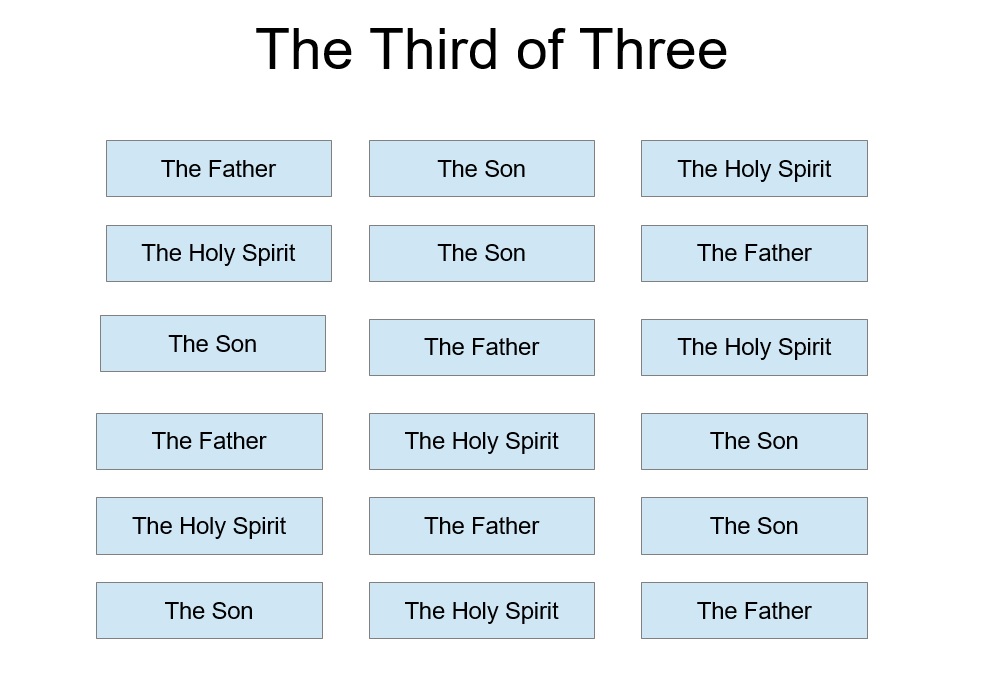
“Indeed, they are ungrateful deniers of the truth Who say, “Behold, Allah is a third of three” – seeing that there is no deity whatever save the One God. And unless they desist from this their assertion, grievous suffering is bound to befall such of them as are bent on denying the truth.” (Qur’an 5:73)
Also note that Allah (swt) says of those who claim that Allah is the third of three will go to hell.
No perennialism. No, let’s hug and be friends. Absolutely uncompromising.
What We find interesting is the phrase ‘a third of three‘ rather than ‘a second of three’ or a ‘first of three’, because if God is a triad he would never be a first of three or a second of three ever.
We also believe upon further reflection of this text that it draws subtle attention and a very clever critique of the devastating schisms in Christian theology.
Namely, issues regarding the ‘economic trinity’.
The controversy of the procession of the Holy Spirit.
The idea of Jesus being born in time to which Christians can only reply by a saying ‘with their mouths‘ stating oxymoron’s such as, Jesus being the ‘eternally begotten‘.
Issues relating to subordination and hierarchy in the Trinity.
One of our colleagues once asked a Christian pastor if they could be baptized in the name of the ‘Holy Spirit‘ and ‘Father‘ and the ‘Son‘.
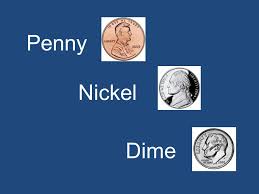
If a person bought a piece of candy and it cost sixteen cents as long as the person has a penny, a nickel and a dime, it shouldn’t matter the order they hand the currency to the cashier.
Remember the Athanasian creed states:
“Nothing is greater or smaller; in their entirety the three persons are coeternal and coequal with each other .”
The ‘ontological trinity‘ and the ‘economic trinity‘ are very much in conflict.
“Father, if you are willing, take this cup from me; yet not my will, but yours be done.” (Luke 22:42)
Is the will of the Son the same in essence as the will of the Father? If the answer is yes they are not distinct persons.
If the will of the Son is distinct or different in essence from the will of the Father than the are not the same being.
Remember the Athanasian creed states:
That we worship one God in trinity (triad) and the trinity (triad) in unity, neither blending their persons nor dividing their essence.
Saying that this isn’t Tri-theism doesn’t make it not Tri-theism.
Just as Allah (swt) tells us:
“That is their saying with their mouths.” – (Qur’an 9:30)
Simply making an assertion and repeating an assertion doesn’t make the assertion true.
Only a person who would ask a Christian for their evidence as per (Qur’an 2:111) would pick up on these things.
A perennialist like Frijoth Schuon, for example wouldn’t approach the Qur’an in that way.
MARY AS A PART OF THE TRINITY IN THE QUR’AN?
Now let us come to this powerful verse.
“And Behold! Allah said: O Jesus, son of Mary! Did you say unto men, `Worship me and my mother as deities besides Allah’?” Jesus answered: “Limitless are You in Your glory! It would not have been possible for me to say what I had no right to! Had I said this, You would indeed have known it! You know all that is within me, whereas I know not what is in Thy Self. Verily, it is You alone who fully know all the things.” (Qur’an 5:116)
The Arabic words rendered as ‘three’, ‘Trinity’ or ‘Triad‘ from the word thalāthah appears twice in different case endings: thalathatun and thalathatin in the Qur’an.
In both verses where (thalathatun and thalathatin) is used, Mary is not mentioned at all!
Likewise, in the verse above neither do we find the terms ‘thalathatun‘ or ‘thalathatin‘ in the Arabic text.
It is incredible to suggest that this verse interacts with the so-called ‘Trinity’ at all.
There is not even a modicum of truth to this.
“Worship me and my mother as deities (ilāhayni) besides God (Allah).”
ilāhayni is the dual form (meaning “two gods”) of the root ilah which means a deity, a source of reverent worship to or other than Allah (swt).
From the sense of the Semitic root, ELH means something with power (i.e. a potential to control affairs, something to seek the help of).
Two examples from the Qur’an below:
“Have you seen he who has taken as his god (ilahahu) his own desire, and Allah has sent him astray due to knowledge and has set a seal upon his hearing and his heart and put over his vision a veil? So who will guide him after Allah? Then will you not be reminded?” (Qur’an 45:23)
“Have you seen the one who takes as his god (ilahahu) his own desire? Then would you be responsible for him?” (Qur’an 25:43)
In fact, let us assume that in some bizarre universe that the Qur’an was attempting to identify members of the Athanasian triad.
Let us say that instead of Mary it said, ‘The Holy Spirit’. Would this be satisfactory? No, it wouldn’t. It wouldn’t be satisfactory because the Christians influenced by the Athanasian triad would say, “We don’t worship the Holy Spirit, and Jesus as deities besides, Allah. That is because they are all Allah.”
Not only this but the Christians in general will never accept this verse as truthful because of the claim that Jesus is rejecting worship. Christians in general, believe that Jesus is to be worshiped.
No Muslim, academic, perennialist, or otherwise that is to be taken seriously is going to try to isolate this verse from the response of Jesus:
He will answer, “Glory be to You! How could I ever say what I had no right to say? If I had said such a thing, you would have certainly known it. You know what is ˹hidden˺ within me, but I do not know what is within You. Indeed, You ˹alone˺ are the Knower of all unseen.
Allah (swt) is proving a powerful point that Jesus and Mary are not to be worshiped. That worship is directed only to Allah (swt) and to Allah (swt) alone!
In that sense, this verse is arguing with the belief of somewhere in the order of about 1.3 billion of the world’s 2 billion Christians.
“Oh!”, but they say, “Catholics didn’t worship Mary until recent history!“.’
Is that true?
Let us consider the Sub Tuum Praesidium (Beneath Your Compassion), a prayer still used in Catholic and Orthodox liturgy that has existed since 250CE, at least.
“Beneath your compassion, We take refuge, O Mother of God: do not despise our petitions in time of trouble: but rescue us from dangers, only pure, only blessed one.”
Source: https://aleteia.org/2016/07/08/let-us-pray-the-earliest-known-marian-prayer/
The famous perennialist and author Frithjof Schuon made this huge blunder when he had the following to say:
“A consideration which calls for mention here, since we are speaking of parallels and of opposition, is the following: the Koran has been reproached for bringing the Virgin Mary into the Christian Trinity; we will answer this objection here, not only to explain the intention of the Koran, but also, at the same time, to clarify the problem of the Trinity by means of a particular metaphysical accentuation. According to the interpretation which is not theological in fact, but is so by right and finds support in the Scripturas, the “Father” is God in Himself, that is, as Meta-cosm; the “Son” is God insofar as He is manifested in the world, that is, in the Macrocosm; and the “Holy Ghost” is God insofar as He is manifested in the soul, that is, in the Microcosm. From another point of view, the Macrocosm itself is the “Son”, and the Microcosm itself in its primordial perfection is identified with the “Holy Ghost”; Jesus is equal to the Macrocosm, to the entire Creation as divine manifestation, and Mary is equal to the “pneumatic” Microcosm; and let us note in this connection the equation that has sometimes been made between the Holy Ghost and the divine Virgin, an equation which is linked to the feminization, in certain ancient texts, of the divine Pneuma.”
Source: (Page 95 Christianity/Islam Essays on Esoteric Ecumenicism)
He then quotes:
“The Hebrew word Ruah,”Spirit is feminine Let us likewise note that one finds in the Epistle to the Hebrews the expression “My Mother the Holy Ghost” (Mētēr mou tò Hagion Pneuma)”
Source: (Page 95 Christianity/Islam Essays on Esoteric Ecumenicism)
As we have already proven, these statements by Frithjof Schuon or anyone else are statements given by people who show such monstrous negligence of the Arabic text.
Not only that but there is not a single statement attributed to the Blessed Messenger (saw) where he equated Mary with being a part of any Trinitarian formulation.
Conclusion:
The Qur’an does not attempt to expand upon the idea that a circle has three corners because such a concept is false, to begin with.
The Qur’an advises us not to say ‘three’ when talking about the divine nature.
Instead, the Qur’an uses the one word that is common to the Torah of the Jews, the New Testament of the Christians and the Qur’an, that word being ‘one’.
Allah (swt) negates the idea of his essence or nature being a triad by negating that he is ‘a third of three’.
Allah (swt) negates the idea that Jesus asked anyone to worship him or his mother.
The Qur’an nowhere identifies Mary with the Athanasian Trinity, Sabellianism, or any creedal formula of the Christians.
You may be interested in reading the following:
Those who make such statements either seem to have an agenda to misrepresent or malign Islam, have completely neglected the text; or have run out of arguments against Islam so they have to pull some of the most desperate and far fetched arguments in their arsenal.
“And when they hear what has been revealed to the Messenger, you see their eyes overflowing with tears because of what they have recognized of the truth. They say, “Our Lord, we have believed, so register us among the witnesses.”(Qur’an 5:83)
May Allah guide the Christians to the truth so that they do not burn in the hellfire.
May Allah guide the Ummah.
May Allah forgive the Ummah.


 Prima Quran