
“And among those We created is a community which guides by truth and thereby establishes justice.” (Qur’an 7:181)
﷽
Al-Khalil ibn Ahmad al-Farahidi: The Ibadi Scholar Behind the Harakat
The next time someone dismisses Ibadis as Khawarij or claims we take nothing from the broader Islamic tradition, it is worth remembering a name that every Muslim who has ever read the Qur’an has benefited from. Whether they know it or not.
That name is Al-Khalil ibn Ahmad al-Farahidi. May Allah cover him in mercy.
Al-Farahidi was born in Oman around 718 CE and died in Basra around 791 CE. He was an Arab philologist, a polymath, and one of the most original minds in the history of Arabic letters. He was the first scholar to subject the prosody of Classical Arabic poetry to a detailed phonological analysis, founding the discipline of ʿarūḍ. He compiled Kitāb al-ʿAyn, widely regarded as the first Arabic dictionary. And he was the teacher of Sībawayh, who would go on to write al-Kitāb fī an-naḥw, the foundational text of Arabic grammar.
He is also, by the account of Ibadi tradition, an Ibadi. That is to say a member of the school of Ahl al-Haqq wa al-Istiqāmah.
His contribution to the Qur’anic text
In al-Farahidi’s time, Qur’anic manuscripts were equipped with two distinct systems of marking: naqṭ iʿrāb (vowel points indicating pronunciation) and naqṭ iʿjām (dots distinguishing consonants). These were written in different colours. Red for vowel points, black for letter points which made the writing process cumbersome and reading error-prone.
Al-Farahidi is credited with reforming the vowel-marking system into the shapes we recognize today: fatḥah as a small alif above the letter, kasrah as a small yāʾ below it, ḍammah as a small wāw above it, and tanwīn by doubling each sign. This system made the Qur’anic text far more legible and recitable, and it is the direct ancestor of the harakat used in every muṣḥaf printed today.
What al-Farahidi did was standardize and systematize the system into the forms that endured. That is a major contribution. Arguably the decisive one.
On his sect
The claim that al-Farahidi left Ibadism to join the Sunni school is not substantiated by any reliable historical data. Classical biographies outside Ibadi sources generally do not dwell on his sectarian affiliation at all; they simply present him as a Basran philologist. This is a classic pattern in the historiography of minority traditions: figures who become too foundational to reject are simply detached from their origins. His Ibadi identity is maintained in Ibadi tradition. To outsiders this is entirely plausible given his time, place, and family background. It is not an emphasized fact in non-Ibadi sources.
What is not in dispute is his stature. Al-Farahidi was the “shining star” of the Basran school of Arabic grammar, and his influence on how Muslims read, recite, and understand the Qur’an is immense.
Al-Khalili ibn Ahmad Al-Farahdi an Ibadi?
What follows is our proofs and evidences for this claim.
Al-Khalil ibn Ahmad al-Farahidi al-Azdi al-Omani was nothing other than an Ibadi, and in what follows, we will demonstrate the invalidity of attributing the linguist Al-Khalil ibn Ahmad to the Athari Sunnis among them.
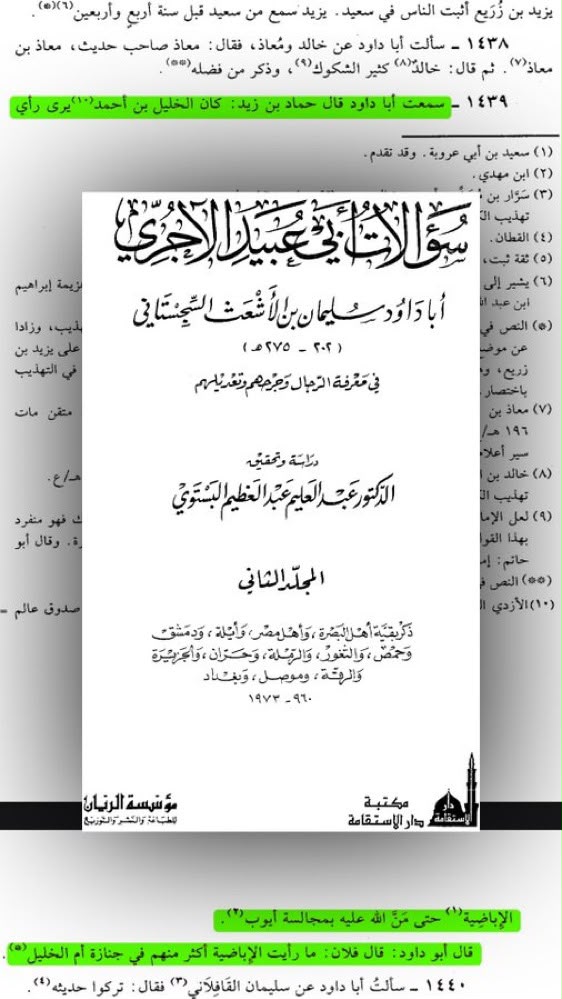
Some contemporary Salafis claim that Al-Khalil ibn Ahmad al-Farahidi was not an Ibadi, relying on what was narrated from Hammad ibn Zayd that he said: “Al-Khalil used to hold the view of the Ibadis until Allah blessed him with the company of Ayyub.” This statement is refuted from several aspects:
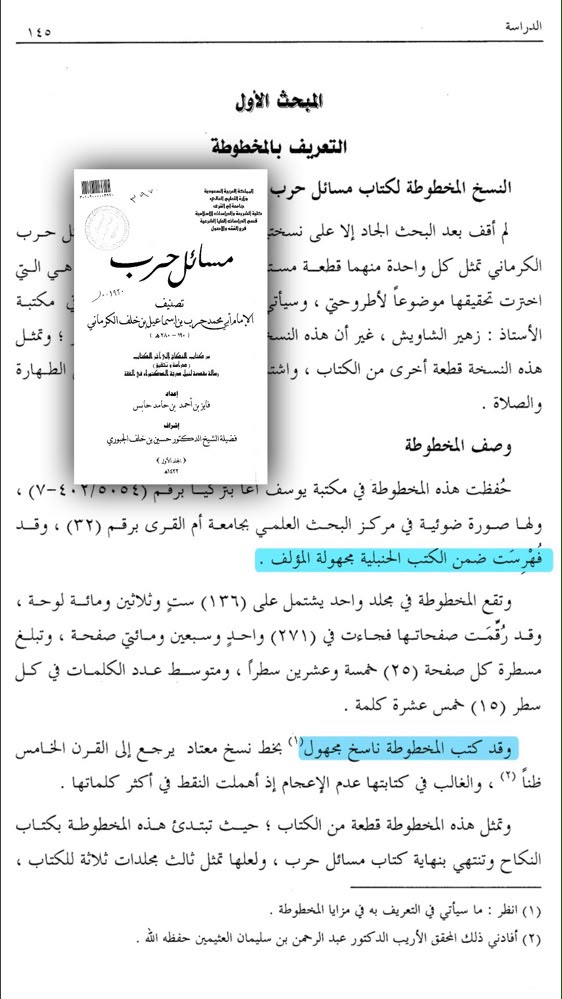
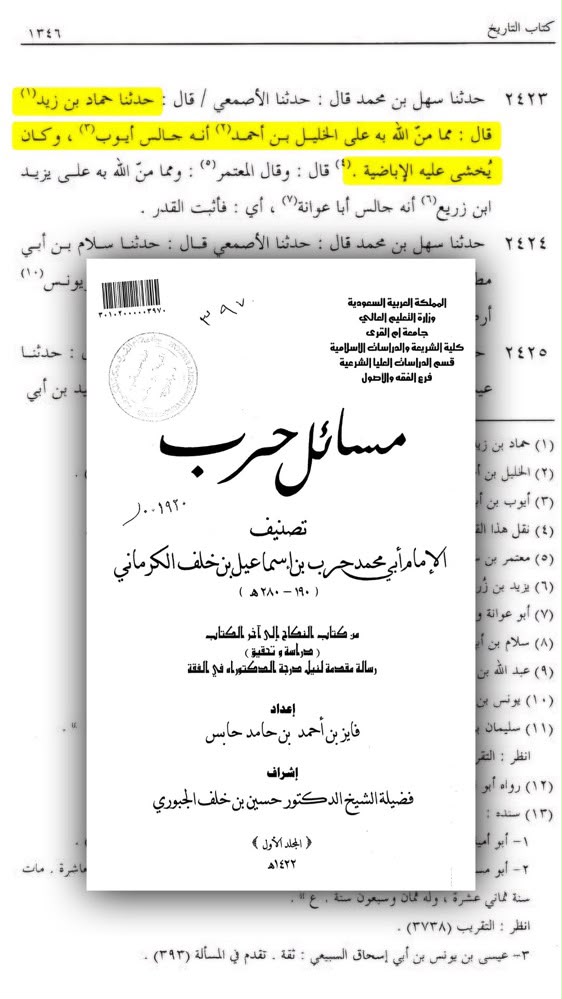
First Aspect: This phrase narrated from Hammad ibn Zayd has inconsistent wording (mudtarib). Some versions were transmitted with wording that does not indicate he abandoned Ibadism after sitting with Ayyub. Among them is the narration found in Masa’il Harb with a chain of transmission (isnad) in a better state than the aforementioned narration: “Among what Allah blessed Al-Khalil ibn Ahmad with is that he sat with Ayyub, and Ibadism was feared for him.” Thus, the text (matn) does not mention a change in Al-Khalil’s creed, unlike the popular narration; all it tells is that Al-Khalil benefited from Ayyub, and it separately reports that Ayyub feared Ibadism for him, nothing more.
Second Aspect: The narrator of the popular narration is Abu ‘Ubayd al-Ajurri from Abu Dawud from Hammad, which is a weak chain of transmission due to two flaws:
The first flaw: The obscurity (jahalah) of Abu ‘Ubayd, and some of his transmissions from Abu Dawud contradict the well-known, trustworthy companions of Abu Dawud.
The second flaw: The disconnection (inqita’) between Abu Dawud and Hammad; he did not meet him, but rather narrates from him in his Sunan through intermediaries.
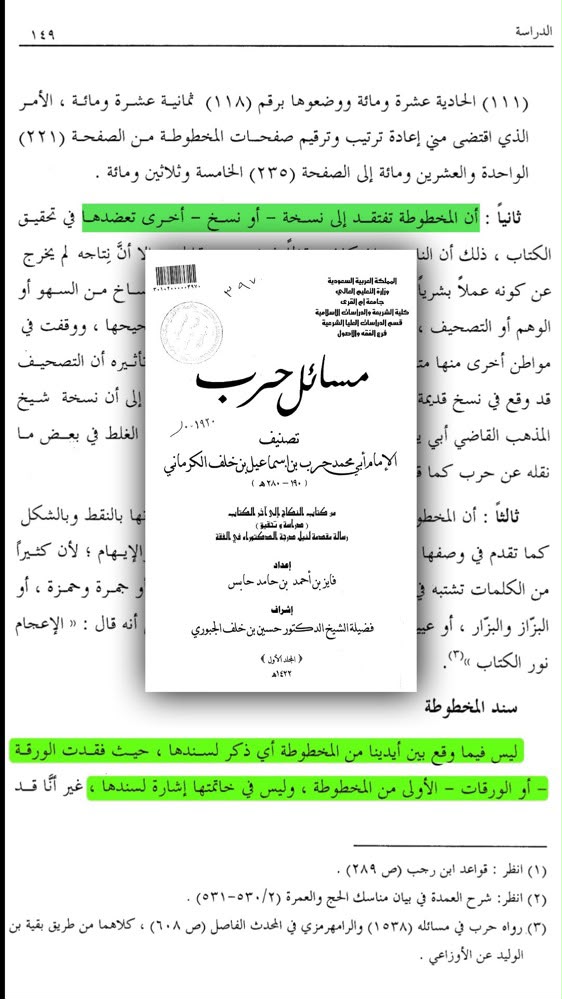
Even as for the narration of Harb al-Kirmani, even if its chain from Hammad were sound, the attribution of the narration to Harb itself is weak according to the methodology of the Ahl al-Athar. That is because the copyist of Masa’il Harb is unknown, the time of its copying is not known, and there is no second copy to match its sole manuscript. Furthermore, it lacks a chain of transmission leading to Harb, and we have found no supporting evidence or quotation establishing the authenticity of its issuance from Harb. Everyone who wrote a biography of Al-Khalil omitted the text attributed to Harb, whereas they repeatedly cited the narration of Abu ‘Ubayd al-Ajurri and the words of Ibn ‘Abd Rabbih al-Andalusi. This suggests the possibility of it being falsely attributed to him. Therefore, what is narrated from Hammad ibn Zayd is not authentic at all through any of its routes.
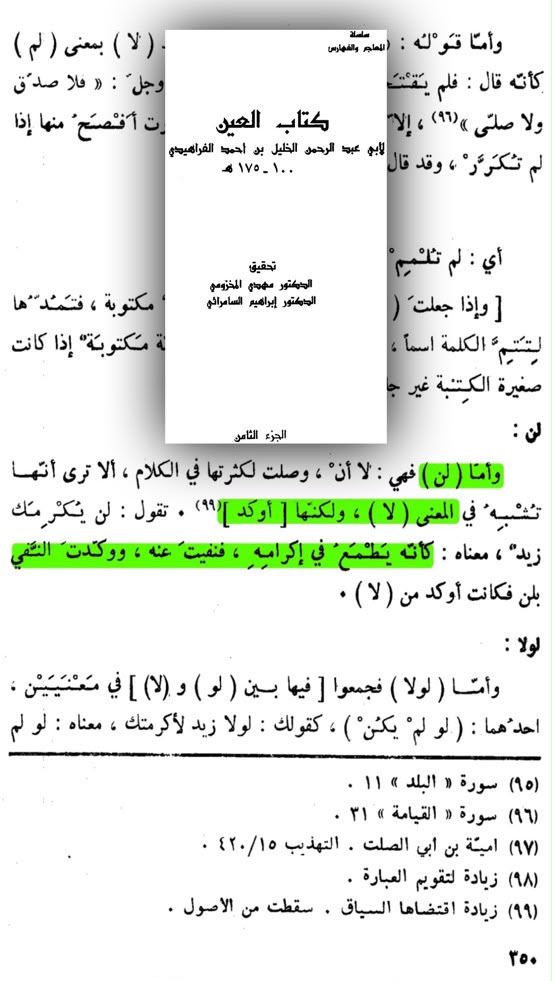
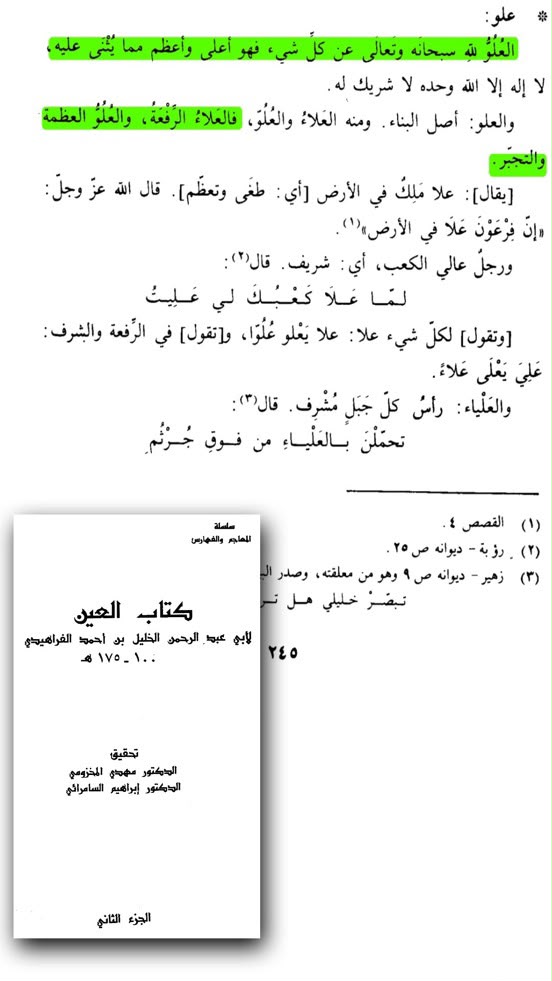
Third Aspect: The linguistic views of Al-Khalil ibn Ahmad al-Farahidi (d. 175 AH) prove his divergence from the Athari Salafi school. Among these is his metaphorical interpretation (ta’wil) of loftiness (‘uluww) attributed to Allah, as well as his view that “lan” (لن) denotes perpetual negation (ta’bid). These two principles form the core pillars of the Ibadis’ argument in exalting the Creator above spatial highness, as well as their argument in denying the vision of the Creator eternally, whether on the Day of Gathering or in Paradise.
What this proves: Al-Khalīl held theological views consistent with the Ibadi school.
There are other corroborative points besides these aspects: among them is Al-Khalil’s lineage tracing back to Farahid, a clan of Azd Oman, which has been a purely and steadfastly Ibadi tribe across long centuries. Another piece of circumstantial evidence which we do not view as an independent argument is the narration regarding the flocking of Ibadis to the funeral of Al-Khalil’s mother, serving as a testament to the strong connection he and his family maintained with Ibadism.
This is significant. Al-Dhahabī, himself a staunch Sunni is quoting Abū Dāwūd (a major hadith scholar) saying that the Ibadis attended the funeral of al-Khalīl’s mother in large numbers, and that they were the greatest of people in that regard. This is a strong piece of evidence: The Ibadis of Basra claimed al-Khalīl and his family as their own, and this was known well enough that Abū Dāwūd commented on it.
What this proves: The Ibadis had a public, recognized connection to al-Khalīl’s family.
It is well known that all schools of thought vie for this great figure, each claiming his affiliation to them; and how could they not! He is the father of the Arabic language and the master of Sibawayh and Al-Kisa’i, the founders of the Basra and Kufa schools! Indeed, out of his sharp intellect and vast knowledge, he founded an entire discipline from scratch: prosody (‘ilm al-‘arud), to the point that it was said he was the most intelligent of the Arabs after the Blessed Prophet (peace and blessings of Allah be upon him). Above and beyond all that, he was renowned for his asceticism, piety, and faith. Imam Sufyan ibn ‘Uyaynah said: “Whoever wishes to look at a man created from gold and musk, let him look at Al-Khalil ibn Ahmad al-Farahidi al-Azdi al-Omani.”
Why this matters
Every time a child learns to read the Qur’an with harakat or every tarāwīḥ prayer, every private recitation, every gathering where the Qur’an is read correctly that blessing is built on a system al-Farahidi standardized. An Ibadi scholar’s work sits at the foundation of one of the most universal practices in the Muslim world.
This is simply a reminder that the history of Islamic scholarship is more intertwined than polemics and sectarian bias often allow, and that dismissing an entire school as outside the tradition is harder to justify than it may first appear.
May Allah cover al-Khalil ibn Ahmad al-Farahidi in mercy.
Sources:
May Allah Guide the Ummah.
May Allah Forgive the Ummah.


If someone gives knowledge of something that does not in any way means that he is right in everything.
If khalili was an ibadi scholar that does not make ibadism haq
Please give some source that he lived and died as ibadi before claiming it
Please give me some “primary” sources that ibadi accept in hadith (with isnad) and history
“If khalili was an ibadi scholar that does not make ibadism haq.”
This I am in agreement. Islam is a not a religion of passions and emotions.
Haq is known on it’s own without regard to affiliations. Truth is truth.
“Please give some source that he lived and died as ibadi before claiming it.”
Insh’Allah it is a fair request do give me some time to source you that information.
Previously on this link: https://primaquran.com/2022/10/05/the-ibadi-perspective-rebellion-and-oppression-a-middle-way/comment-page-1/#comment-8375
You made the following comment:
““if like ibn masud saying that Qur’an does not have al falaq and an nas some scholars say that he has this opinion but changed it.”
Do you have a reference for the great Sahaba Ibn Masud (ra) making the claim that the Qur’an does not have al falaq and al nas?
“Please give me some “primary” sources that ibadi accept in hadith (with isnad) and history.”
This is from the book: Towards Understanding the Hadith from Shaykh Juma Al Mazrui.
Click to access towards-understanding-hadiths.pdf
The standards and criteria for accepting and rejecting a hadith in the Ibadhi
School are not different from those laid down by the four schools commonly
known as the Sunni Schools – they are the same and common. But the fact
that a little attention has been paid to the implantation of those principles,
explains why we sometimes come into a strong clash of opinions as to
whether a particular hadith is authentic or not. We, in the Ibadhi School,
though regard the genuineness of sanad (chain of narrators) of a hadith as
one basic condition for its acceptability, yet do not strictly authenticate it on
the basis of appealing and sound sanad only, an extensive study of its matn
(text) must be run to avoid four major contradictions in the following areas:
1) The contradiction between the hadith and the Quran.
2) The contradiction between two hadiths, one of which is authentic or
more authentic.
3) The contradiction between the hadith and the consensus held by all
Islamic denominations.
4) The contradiction between the hadith and the human logic.
As you seem very interested in the Ibadi school and you are wanting to know more if you know send me your e-mail address you can be added to an Arabic group where you can sit with teachers and have access to scholars.
That is if you are keen to know more. You are Most Welcome.