
“O you who have believed, do not take the disbelievers as allies instead of the believers. Do you wish to give Allāh against yourselves a clear case?” (Qur’an 4:144)

﷽
Who is Wilferd Madelung?
For those not familiar with Wilferd Madelung. He has had a deep engagement with Islamic scholarship, in particular the Shia tradition. He was a highly respected scholar of Islamic and Iranian studies. He dedicated his career to studying Islamic history and theology, including the nuances of different Islamic sects like Twelver, Ismaili, and Zaydi Islam. He was honoured as an Iranian dignitary and received praise for his works supporting the Shia view on the succession to the Prophet Muhammed (saw).
Curriculum Vitae-
Wilferd was educated in Stuttgart (Eberhard Ludwig Gymnasium), Washington DC (Woodrow Wilson High school, Georgetown University), Cairo (Fuad I University), Göttingen, and Hamburg, where he obtained his PhD in 1957. Between 1958 and 1960, he served as cultural attaché at the West-German Embassy in Baghdad, followed by a visiting professorship at the University of Austin, Texas (1963). Following his Habilitation in Hamburg, he taught as Privatdozent in Hamburg during the academic year 1963-64. Since 1964, Madelung has taught at Chicago University as Assistant professor (Associate Prof., 1966; Professor of Islamic History, 1969). Between 1978 and 1998, Madelung taught as Laudian Professor of Arabic at Oxford University. Between 1999 and 2021, Wilferd Madelung was affiliated with The Institute of Ismaili Studies as a Senior Research Fellow. Wilferd Madelung passed away on 9 May 2023 in Oxford.
Rumors of conversion to Imami Ismaili Nizari Shi’ism.
What fuled the rumors and speculation?
His relationship with the Aga Khan, Madelung’s rigorous and sympathetic work, earned him immense respect within the Ismaili community. He was appointed as the Head of the Department of Academic Research and Publications at The Institute of Ismaili Studies (IIS) in London, an institution established by His Highness the Aga Khan IV (the current Imam of the Nizari Ismailis). This close association with the spiritual leader of the Ismailis fueled speculation.
To outsiders, the combination of deep, sympathetic understanding and a high-ranking position within an Ismaili institution seemed to suggest something more than academic interest. The conclusion some jumped to was that he must have converted.
The counter to the rumor.
No public declaration or evidence: There has never been a public statement from Madelung, his family, the IIS, or the Ismaili community claiming he converted. In the absence of any evidence, the claim remains a baseless rumor.
Paragraph 1
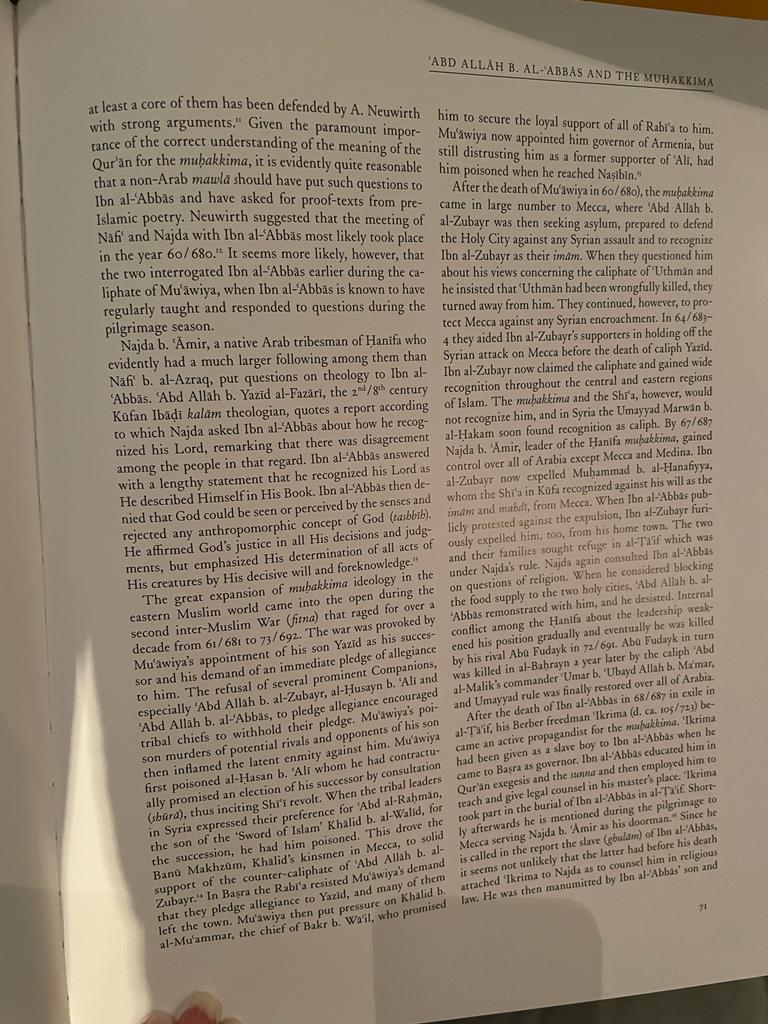
“Among the prominent Companions of the Prophet Muhammed, ‘Abd Alla b. Al-Abbas (d. 68/687), paternal cousin of Muhammed and of ‘Ali b. Abi Talib, became the primary religious teacher of the muhakkima who after the slaying of the caliph Uthman had been vigorous supporters of Ali, but then deserted him in protest against his arbitration agreement with Mu’awiya. Ibn al-‘Abbas evidently had been well known to them, and highly regarded by them, long before their revolt against ‘Ali. Born three years before the hijra and still a minor at the time of the death of the Prophet, he had first been drawn into a political role by the caliph ‘Umar, who took him into his intimate confidence as a representative of the Banu Hashim, the kin of Muhammed. The caliph Uthman, while besieged by rebels from Egypt in his place in Medina, appointed him a leader of the pilgrimage to Mecca and entrusted him with reading a lengthy message to the assembled pilgrims in which ‘Uthman defended his conduct in office and appealed for their help. Ibn al-Abbas read the message to the Mecca pilgrims on 7 Dhu-l-Hijja 35/6 June 656, just eleven day before the caliph was killed. He then became a close adviser of ‘Ali and was appointed by him governor of Basra after the Battle of the Camel. Like ‘Ali, he did not view the rebels against ‘Uthman as culpable in his death.”-Wilferd Madelung
Paragraph 2
“When after ‘Ali’s arbitration agreement with Mu’awiya some 12,000 muhakkima seceded in protest from his army and camped at Harura outside Kufa in Rabi’ I 37/Aug-Sept, 657. ‘Ali first sent Ibn al-‘Abbas to them as a mediator. The majority of the seceders, however, rejected his unsound argument that arbitration was generally allowed by the Qur’an and only a few of them returned to Kufa. ‘Ali then was able to persuade all of them to return by promising them to resume the war against Mu’awiya in six months. He evidently expected the arbitration attempts to have failed by then. Quarrelling between the muhakkima and the supporters of arbitration in Kufa delayed ‘Ali’s expedition of his arbitrator, Abu Musa l-Ash’ari, beyond the six months, and when Abu Musa left for the site of arbitration in Dumat al-Jandal accompanied by Ibn al-‘Abbas and an escort of 400 Kufan warriors, the muhakkima decided to leave Kufa secretly and to assemble in al-Nahrawan near al-Mada’in. This time they chose ‘Abd Allah b’ Wahb al-Rasibi as their chief and asked their muhakkima brethren in Basra to join them. Some 2,000 men thus gathered in al-Nahrawan while the meeting of the two arbitrators took place in Dumat al-Jundal in Shawwal-Dhu l-Qa’da 37/March-April 658.“--Wilferd Madelung
Paragraph 3
“After the breakup of the arbitration meetings in failure to resolve the conflict, ‘Ali immediately denounced the arbitrators and ordered his army to mobilize for a new campaign against Mu’awiya. He wrote to the muhakkima in al-Nahrawan inviting them to join. Their position, however, had now hardened and they demanded that ‘Ali publicly repents of his earlier agreement to arbitration. As ‘Ali led the Kufan army northward toward al-Anbar, some of the muhakkima vented their frustration in wanton murder of Muslims, including ‘Abd Allah, the son of the Companion Khabib b al-Aratt, his pregnant wife and an envoy sent by ‘Ali to them. ‘Ali saw himself forced to abandon his campaign against Mu’awiya and to deal with the muhakkima rebels. In the battle of al-Nahrawan in Dhu l-Hijja 37/ May 658u more than 1,000 of them were killed.”--Wilferd Madelung
Paragraph 4
“‘Abd Allah b al-‘Abbas, it should be noted, was not present at the Battle of al-Nahrawan, as ‘Ali had deputed him to lead the pilgrimage to Mecca for the year. Ibn al-‘Abbas evidently regretted the assault on the rebels collectively and the resulting massacre. Had he been present, he would no doubt have counseled to restrict any punishment to the actual perpetrators of criminal violence and to leave the others alone, whatever their incendiary rhetoric. As it were, he soon advised ‘Ali, when the latter bitterly complained about the lack of support he had from his men for his campaign against Mu’awiya, to treat them kindly in patience, since they might change their mind in the future. His different attitude toward the seceders soon turned Basra into a safe haven for the muhakkima. While they were unable to establish themselves as a dissident community in the extremely hostile environment of Kufa under the rule of ‘Ali, they found refuge as a tolerated opposition party in Basra under the governorship of Ibn al-‘Abbas, who would not interfere with their activity as long as they abstained from acts of violence and breach of the peace in the city. The muhakkima in Basra fully appreciated the policy of Ibn al-Abbas and looked to him as their trustworthy religious teacher, even though he had defended the legitimacy of ‘Ali’s agreement to arbitration. The bulk of them were tribesmen of Tamim, and they kept the peace with the majority of Tamim and the other tribes in the arbitration.”--Wilferd Madelung
Paragraph 5
“When Mu’awiya, after the surrender of al-Hasan b ‘Ali in the year 41/661, claimed the rule of Basra, the muhakkima, who had declared him an infidel (kafir), refused to pledge allegiance to him. Mu’awiya then appointed Ziyad b Abih, his bastard paternal brother, who had been Ibn al-‘Abbas trusted assistant in the government of Basra, governor of the town. Although personally less sympathetic to the muhakkma, Ziyad prudently treated them as Ibn al-Abbas had done. They were now led by the Tamimi Abu Bilal Mirdas b Udayya, the brother of ‘Urwa b Udayya who was reputed to have been the first in the army of Ali to proclaim the takhaim: “la hukma illa li-illlah-No rule but God’s”. Abu Bilal continued to keep the peace in the town for two decades during the Caliphate of Mu’awiya. In his later years of leadership he befriended Abu l-Sha’tha Jabir b. Zayd, a pupil of Ibn al-‘Abbas ,and accepted him as his adviser in matters of religion.”--Wilferd Madelung
Paragraph 6
“Mu’awiya’s professed policy of seeking revenge for the slaying of the caliph ‘Uthman on all of his opponents and even on neutrals who had failed to rally to his defense, as well as his affirmation of the exclusive right of the Qurash to the caliphate in Islam drove many Muslims in Iraq and the eastern provinces, who had not objected to the arbitration or had even supported it, to join the ranks of the seceders. During Mu’awiya’s divisive caliphate, the muhakkima became a widespread, nonviolent opposition movement in the eastern Islamic world. Especially the eastern Arabian tribes of Rabi’a were now attracted to the ideology of the muhakkima. The seceders basic dogma that Islam implied the sovereign rule of God rather than any human being, be he of Quraysh or not, and the recognition that the rule of God meant to obey the Qur’an to the letter, appealed to them. Rabi’a, especially Bakr b Wa’il, had made up the backbone of ‘Ali’s army at Siffin and he thwarted Mu’awiya’s hope for outright victory in the battle. After the surrender of al-Hasan b ‘Ali, Mu’awiya sought to humiliate them by seizing from them the sword of the caliph ‘Umar, called Dhu-l-Wishah, which they had acquired as war booty after killing Umar’s son, Ubayd Allah at Siffin. The bulk of Rabi’a would not pledge allegiance to Mu’awiya and remained in opposition to his caliphate.”-Wilferd Madelung
Paragraph 7
“Special was the case of the Banu Hanifa, a sub-tribe of Bakr b. Wa’il mostly sedentary in al-Yamama. Their grievance against the pretention of the Quraysh was long standing. Their king Hawdha had offered Muhammed to accept the religion of Islam if the Prophet allowed him to share in the political rule of his people. His negotiations with Muhammed, however, failed and when he died, his successor Musaylima claimed to be a prophet to his people, presumably as a rival to Muhammed, not a denier of his prophethood. Only a small group of Hanifa at the time opposed Musaylima and accepted Muhammed as their prophet.”--Wilferd Madelung
Paragraph 8
“After the death of Muhammed and the establishment of the caliphate of Quraysh, the Muslims viewed Hanifa as apostates and followers of a false prophet. In the Battle of al-‘Aqraba, they subdued them breaking fierce resistance. While many companions of the Prophet fell, the Banu Hanifa were decimated and some of their women and children enslaved. They were excluded form the wars of conquest under ‘Umar, stayed neutral in the revolt against ‘Uthman, and unlike the bulk of Rabi’a, did not join the army of ‘Ali. There were no tribesmen of Hanifa among the original muhakkima. Busr b Abi Artah, Mu’awiya’s general sent to subdue Arabian towns and countryside, and to punish former supporters of ‘Ali and neutrals alike, carried off the son of the former chief of Hanifa, Mujja’a b Murara, as a captive to Mu’awiya and recommended that the caliph kill him as a punishment. Mu’awiya, however, accepted the pledge of allegiance of the captive and confirmed him as chief of his people. He then claimed the agricultural land of Hanifa in al-Yamama as crown property and had it cultivated by his slaves. The majority of the Banu Hanifa joined the muhakkima movement evidently early during the caliphate of Mu’awiya.”--Wilferd Madelung
Paragraph 9
“Two of the leaders of the Hanifa muhakkima, Nafi b al-Azraq and Najda b ‘Amir, are known to have had ‘Abd Allah b al-‘Abbas as their authoritative teacher in religion. They are described as rivals for the leadership in their community and as seeking to bolster their own authority by relying on religious verdicts of the cousin of the Prophet. Nafi’ b. Al-Azraq al-Hanifa-Hanzali, who later became the chief of the most radical sect of the Kharijis, was the son of a freedman of Greek origin. He put questions to Ibn al-‘Abbas, presumably in Mecca during the pilgrimage season, about the meaning of Qur’anic terms and then asked him for confirmation of that meaning by their use by Arab pre-Islamic poets. Numerous such masa’il were later transmitted and collected by Sunni scholars. While western scholars following J. Wansbrough have viewed all reports of Masa’il Nafi’ b. Al-Azraq as entirely fictitious, the authenticity of at least a core of them has been defended by A. Neuwirth with strong arguments. Given the paramount importance of the correct understanding of the meaning of the Qur’an for the muhakkima, it is evidently quite reasonable that a non-Arab mawla should have put such questions to Ibn al-‘Abbas and have asked for proof-text form Islamic poetry. Neuwirth suggested that the meeting of Nafi’ and Najda with Ibn al-‘Abbas most likely took place in the year 60/680. It seems more likely, however, that the two interrogated Ibn al-‘Abbas earlier during the caliphate of Mu’awiya, when Ibn al-‘Abbas is known to have regularly taught and responded to questions during the pilgrimage season.”-–Wilferd Madelung
Paragraph 10
“Najda b ‘Amir, a native Arab tribesman of Hanifa who evidently had a much larger following among them than Nafi’ b. Al-Azraq, put question on theology to Ibn al-‘Abbas. ‘Abd Allah b. Yazid al-Fazari, the 2nd/8th century Kufan Ibadi kalam theologian, quotes a report according to which Najda asked Ibn al-‘Abbas about how he recognized his Lord remarking that there was disagreement among the people in that regard. Ibn al-‘Abbas answered with a lengthy statement that he recognized his Lord as He described Himself in His Book. Ibn al-‘Abbas then denied that God could be seen or perceived by the senses and rejected any anthropomorphic concept of God (tashbih). He affirmed God’s justice in all His decisions and judgement, but emphasized His determination of all acts of His creatures by His decisive will and foreknowledge.”-–Wilferd Madelung
Paragraph 11
“The great expansion of muhakkima ideology in the eastern Muslim world came into the open during the second inter-Muslim War (fitna) that raged for over a decade from 61/681 to 73/692. The war was provoked by Mu’awiya’s appointment of his son Yazid as his successor and his demand for an immediate pledge of allegiance to him. The refusal of several prominent Companions, especially ‘Abd Allah b. Al-Zubayr, al-Husayn b ‘Ali and ‘Abd Allah b. Al’Abbas, to pledge allegiance encouraged tribal chiefs to withhold their pledge. Mu’awiya’s poisoned murders of potential rivals and opponents of his son then inflamed the latent enmity against him. Mu’awiya first poisoned al-Hasan b. Ali whom he had contractually promised an election of his successor by consultation (shura), thus inciting Shi’i revolt. When the tribal leaders in Syria expressed their preference for ‘Abd al-Rahman, the son of the ‘Sword of Islam’ Khalid b. Al-Walid, for the succession, he had him poisoned. This drove the Banu Makhzum, Khalid’s kinsmen in Mecca to solid support of the counter-caliphate of ‘Abd Allah b. Al-Zubayr. In Basra the Rabi’a resisted Mu’awiya’s demand that they pledge allegiance to Yazid, and many of them left the town. Mu’awia then put pressure on Khaild b al-Mu’ammar, the chief of Bakr b. Wa’il, who promised him to secure the loyal support of Rabi’a to him. Mu’awiya now appointed him governor of Armenia, but still distrusting him as a former supporter of ‘Ali, he had him poisoned when he reached Nasibin.”--Wilferd Madelung
Paragraph 12
“After the death of Mu’awiya in 60/680, the muhakkima came in large number to Mecca, where ‘Abd Allah b. Al-Zubayr was then seeking asylum, preparing to defend the Holy City against any Syrian assault and to recognize Ibn al-Zubayr as their imam. When they questioned about his views concerning the caliphate of ‘Uthman and he insisted that ‘Uthman had been wrongfully killed, they turned away from him. They continued, however, to protect Mecca against any Syrian encroachment. In 64/683-4 they aided Ibn al-Zubayr’s supporters in holding off the Syrian attack on Mecca before the death of caliph Yazid. Ibn al-Zubayr now claimed the caliphate and gained wide recognition throughout the central and eastern regions of Islam. The muhakkima and the Shi’a, however, would not recognize him, and in Syria the Umayyad Marwan b. Al-Hakam soon found recognition as caliph. By 67/687 Najda b. ‘Amir, the leader of the Hanifa muhakkima, gained control over all of Arabia except Mecca and Medina. Ibn al-Zubayr now expelled Muhammed b. Al-Hanafiyya, whom the Shi’a in Kufa recognized against his will as the imam and mahdi from Mecca. When Ibn al-‘Abbas publicly protested the expulsion, Ibn al-Zubayr furiously expelled him, too, from his home town. The two and their families sought refuge in al-Ta’if which was under Najda’s rule. Najda again consulted Ibn al ‘Abbas on questions of religion. When he considered blocking the food supply to the two holy cities, ‘Abd Allah b. Al-‘Abbas remonstrated with him, and he desisted. Internal conflict among the Hanifa about the leadership weakened his position gradually and eventually he was killed by his rival Abu Fudayks in 72/691. Abu Fudayk in turn was killed in al-Bahrayn a year later by the Caliph ‘Abd al-Malik’s commander ‘Umar b ‘Ubayd Allah b. Ma’mar, and Ummayad rule was finally restored over all of Arabia.”-–Wilferd Madelung
Paragraph 13
“After the death of Ibn al-‘Abbas in 68’687 in exile in al-Ta’if, his Berber freedman ‘Ikrima d. ca. 105/723) became an active propagandist for the muhakkima, ‘Ikrma had been given a slave boy to Ibn al-‘Abbas when he came to Basra as governor. Ibn al-‘Abbas educated him in Qur’an exegesis and the sunna and then employed him to teach and give legal counsel in his master’s place. ‘Ikrima took part in the burial of Ibn al-‘Abbas in al-Ta’if. Shortly afterward he is mentioned during the pilgrimage to Mecca serving Najda b ‘amir as his doorman. Since he is called in the report the slave (ghulam) of Ibn al-‘Abbas, it seems not unlikely that the latter had before his death attached ‘Ikrima to Najda to counsel him in religious law He was then manumitted by Ibn al-‘Abbas son and heir ‘Ali b. ‘Abd Allah. In any case, ‘Ikrima became widely recognized as the foremost and best informed transmitter of the Qur’an exegesis of Ibn Al-‘Abbas, but was also accused of falsifying his master’s teaching in promoting muhakkima doctrine. He is described as traveling throughout the Muslim world spreading Khariji ideology. His teaching now became radically anti-Shi’i. Thus he proclaimed that the ahl al-bayt whom according to the Qur’an 33:33 God wanted to purify meant specially the wives of the Prophet, excluding his kin, daughter and grandsons. This was entirely contrary to the view of Ibn al-‘Abbas, who ever upheld the divinely privileged religious rank of the Prophet’s kin and progeny, and ‘Ikrima could not have asserted it during his life-time. ‘Ikrima is further described as coming jointly with an Ibadi missionary sent by Abu ‘Ubayda to the Maghrib in the early 2nd/8th century where he summoned to the Sufriyya. It was at this time that the muhakkima expanded widely in the Maghrib as they had expanded a generation earlier throughout the eastern Muslim world and Arabia. The Sufriyya are known to have constituted a substantial community in the far western Maghrib for some time, but later the Ibadiyya prevailed.”--Wilferd Madelung
Paragraph 14
“The long term impact of Ibn al-‘Abbas’s teaching on the muhakimma and the Ibadiyya in particular has been significant. In theology they have consistently repudiated the tendencies to anthropomorphism apparent in the Sunni traditionalist doctrine including the dogma of the visio beatifica of God in the hereafter. Against Murj’i tendencies they have vigorously upheld the eternal punishment of Muslim wrongdoers by God. Against Mu’tazili rationalist doctrine divine justice entailing free will, they have mostly affirmed the determining effectiveness of God’s eternal will and foreknowledge. There were, however, significant groups in the 1st/7th and 2nd/8th centuries who inclined the Mu’tazili position on divine justice.”-–Wilferd Madelung
Paragraph 15
“In religious law and ritual, the muhakkima were in general less influenced by the teaching of Ibn al-‘Abbas than the Shi’a. Fully supporting the caliphate of ‘Umar, they, unlike the Shi’a, did not question the legitimacy of ‘Umar’s religious reforms, such as the change of the wording of the call to prayer and the prohibition of the mut’ah temporary marriage. However, in the question of the permissibility of al-mash ‘ala l-khuffayn, the rubbing of the footwear instead of washing the feet for ritual purification, they sided with the Shi’a denying it against the Sunni consensus. While there was apparently no ruling of the caliph ‘Umar concerning al-mash ‘ala l-khuffayn, it was definitely declared impermissible by Ibn al-‘Abbas.”=–Wilferd Madelung
Source: (‘Abd Allah b. al-‘Abbas and the Muhakkima by Wildred Madelung pgs 69-73)




Our thoughts on what Professor Wilferd Madelung has stated.
You will notice there are basically two source materials thath Madelung draws upon.
Al Baladhuri – 9th century Sunni historian
Al-Tabari 9th – 10 century Sunni historian

Reading this we did not feel that there were any new discoveries or any particular breakthroughs. There did not seem to be any original thoughts, ideas or contributions. Perhaps the readers could glean something from the material that we could not.
For example, you could read the above information and make the horrible mistake that Madelung is sharing his own personal thoughts. In reality, in today’s world we call this copypasta.
Interacting with the material in Paragraph 2
Madelung states: “The majority of the seceders, however, rejected his unsound argument that arbitration was generally allowed by the Qur’an and only a few of them returned to Kufa.”
Prima-Qur’an comments: Where does Madelung get this information from? Is this truly their position? Who is reporting that this is their position? Where do they get this information from or base this information on?
Madelung states: “Ali then was able to persuade all of them to return by promising them to resume the war against Mu’awiya in six months.”
Prima-Qur’an comments: Source for this?
Interacting with the material in Paragraph 3
Madelung also curiously states:
“As ‘Ali led the Kufan army northward toward al-Anbar, some of the muhakkima vented their frustration in wanton murder of Muslims, including ‘Abd Allah, the son of the Companion Khabib b al-Aratt, his pregnant wife and an envoy sent by ‘Ali to them.”
Prima-Qur’an comments: Wanton killing of Muslims (plural) who?
Which of the muhakkima vented these frustrations?
We thought the point of academics and historians was not to embellish accounts.
Madelung: “Hey guys, I am feeling very frustrated about what happened.”
Bob: “Me too, Wilferd.”
Madelung: “Not only am I very frustrated, I am also quite bored.”
Bob: “Yeah, what can we do with all this pent-up frustration?”
Madelung: “Well, we could always go ambush someone, and if we happen upon a pregnant woman we could just gut her and take her child out.”
Bob: “Wil my man sounds like a plan!”
Nevermind this very interesting piece of information from At Tabari.
Ali heard that the men were saying among themselves, “If only he would go with us against these Haruriyyah (Ahl Nahrawan) , and we dealt with them first and then, having finished with them, we turned our attention to the profaners of Allah’s law (al-mu1 illin-Syrians)!” So Ali addressed them, and after praising Allah and extolling Him, said, “I have heard what you have been saying : ‘If only the Commander of the Faithful would go with us against this group of Kharijites that has rebelled against him, and we dealt with them first and then, having finished with them, we turned to the profaners of Allah law.’ But others are more important for us than these Kharijites. Stop talking about them and march instead against a people who are fighting you so that they may be tyrants and kings and take the servants of Allah as chattel .” And the men shouted from every side, “Commander of the Faithful, lead us wherever you wish!”
Source: (https://www.kalamullah.com/Books/The%20History%20Of%20Tabari/Tabari_Volume_17.pdf
So these sources which are not Kharijite sources admit to the fact that there were people (agitators) who wanted to go and fight the Haruriyyah (Ahl Nahrawn) first!
Interacting with the material in Paragraph 4
Madelung states: “‘Abd Allah b al-‘Abbas, it should be noted, was not present at the Battle of al-Nahrawan, as ‘Ali had deputed him to lead the pilgrimage to Mecca for the year. Ibn al-‘Abbas evidently regretted the assault on the rebels collectively and the resulting massacre. Had he been present, he would no doubt have counseled to restrict any punishment to the actual perpetrators of criminal violence and to leave the others alone, whatever their incendiary rhetoric.”
Prima-Qur’an comments: The implication here by Madelung is that Ibn ‘Abbas would have participated in the battle of al-Nahrawan.
Interacting with the material in Paragraph 6
Madelung states: “as well as his affirmation of the exclusive right of the Qurash to the caliphate in Islam drove many Muslims in Iraq and the eastern provinces, who had not objected to the arbitration or had even supported it, to join the ranks of the seceders.“
Prima Qur’an comments: Seems like the idea that the Qurash or a particular family of the Qurash was certainly not embedded among the Muslim masses.
Note that Madelung states:
“During Mu’awiya’s divisive caliphate, the muhakkima became a widespread, nonviolent opposition movement in the eastern Islamic world.”
Prima-Qur’an comments: That certainly really does not sound like the crazed, sword-wielding Kharijites declaring all who differ with them infidels that we hear all too often from the Sunni and Shi’i.
Interacting with the material in Paragraph 12
Madelung states: “When they questioned about his views concerning the caliphate of ‘Uthman and he insisted that ‘Uthman had been wrongfully killed, they turned away from him.”
He also states: “When he considered blocking the food supply to the two holy cities, ‘Abd Allah b. Al-‘Abbas remonstrated with him, and he desisted.”
Prima Qur’an comments: So, Ibn al-Zubayr would not denouce Uthman they kill him? They cut him into tiny pieces? They stuffed him in a donkey and burned him? No! “They turned away from him.” When they considered blocking the food supply to the two holy cities they considered ‘Abd Allah b. A’-‘Abbas advise and headed it. Seems these people are capable of reason.
Interacting with the material in Paragraph 13
Madelung states: “but was also accused of falsifying his master’s teaching in promoting muhakkima doctrine. He is described as traveling throughout the Muslim world spreading Khariji ideology.”
Prima-Qur’an comments: In what way did Ikrima (ra) falsify his master’s teaching in promoting the muhakkima doctrine? Do tell us.
Madelung states: “His teaching now became radically anti-Shi’i. Thus he proclaimed that the ahl al-bayt whom according to the Qur’an 33:33 God wanted to purify meant specially the wives of the Prophet, excluding his kin, daughter and grandsons. This was entirely contrary to the view of Ibn al-‘Abbas, who ever upheld the divinely privileged religious rank of the Prophet’s kin and progeny, and ‘Ikrima could not have asserted it during his life-time.“
Prima-Qur’an comments: This is due to the poor reading or gross misunderstanding that Madelung has. Madelung, nor any other historian or orientalist will bring any evidence of ‘Ikrima stating it “excludes his kin, daughter and grandsons.” This is lazy. What Ikrima (ra) is saying is that concerning the Asbab an-Nuzool (the occasion for the revelation) it was due soley to the wives of the Prophet (saw).
Ikrima (ra) simply taught what the Qur’an teaches. Alas, it is what Ibn Abbas (ra) taught as well.
Ibn Abi Hatim recorded that Ibn `Abbas said concerning the Ayah: ( Allah wishes only to remove Ar-Rijs from you, O members of the family, ) “It was revealed solely concerning the wives of the Prophet .”
Source: (https://surahquran.com/tafsir-english-aya-33-sora-33.html)
https://primaquran.com/2022/10/04/purification-of-the-ahl-bayt/
You also have to wonder why Ikrima (ra) transmits instances where Ibn Abbas (ra) admonishes him (Ikrima).
Narrated `Ikrima:
I prayed behind a Sheikh at Mecca and he said twenty two Takbirs (during the prayer). I told Ibn `Abbas that he (i.e. that Sheikh) was foolish. Ibn `Abbas admonished me and said, “This is the tradition of Abul-Qasim.”
Source: (https://sunnah.com/bukhari:788)
Interacting with the material in Paragraph 14
Madelung states: “Against Mu’tazili rationalist doctrine divine justice entailing free will, they have mostly affirmed the determining effectiveness of God’s eternal will and foreknowledge.”
Prima-Qur’an comments:
We believe the reason why Madelung makes such claims is that in his mind he sees the Muhakkima as people who leave all matters up to Allah (swt) in the sense that no human element is involved in anything related to the laws of Allah (swt).
We can see this where he states above:
“The majority of the seceders, however, rejected his unsound argument that arbitration was generally allowed by the Qur’an and only a few of them returned to Kufa.”
At the very least Magdelung states in the very next sentence:
“There were, however, significant groups in the 1st/7th and 2nd/8th centuries who inclined the Mu’tazili position on divine justice.”
Again, just to reiterate a small irritation we have with people who use Orientalist is this. An example. So someone writing a paper wanting to discredit Ikrima as a narrator may have a section that states: “He is described as traveling throughout the Muslim world spreading Khariji ideology. His teaching became radically anti-Shi’i. ” They will quote Magdelung.
O.K. so now what are we supposed to do with that information? It must be true because Magdelung said so! No, based upon what? Give us some examples. Let us explore this further.
We say this not only about Orientalists, but the same standard applies to Muslim historians. It is obvious that we question historical narratives, or we would be following the majoritarian narrative concerning Siffin.
Many on our team are people who are converts who had to go through a process of inquiry to arrive at the conclusions they did.
We leave it to you the respected reader to do the research and come to your conclusions.
May Allah (swt) guide us to what is beloved to Allah (swt).
You may wish to read the following:
May Allah Guide the Ummah.
May Allah Forgive the Ummah.


 Prima Quran