“The faculties of seeing (tudriku) cannot grasp Him, and He grasp all–seeing (yudriku), He is the All-Subtle and All-Aware.” (Qur’an 6:103)
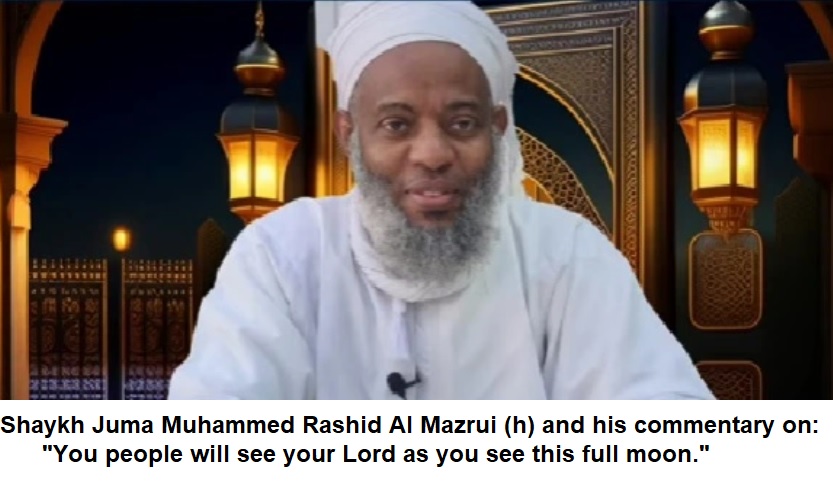
May Allah (swt) bless our teacher, Shaykh Juma Muhammed Rashid Al-Mazrui.
These are notes I have taken from our Aqidah class on the subject: On the visibility of Allah (swt).
In the class we look at the proofs that other schools give to prove the visibility of Allah (swt). We go through each ayat of the Qur’an that is used. We go through the ahadith that are used. We than go through our proofs and evidences to show that Allah (swt) will not be seen in the life to come.
The hadith in question:
Narrated Jarir:
We were sitting with the Prophet (saw) and he looked at the moon on the night of the full-moon and said, “You people will see your Lord as you see this full moon, and you will have no trouble in seeing Him, so if you can avoid missing (through sleep or business, etc.) a prayer before sunrise (Fajr) and a prayer before sunset (`Asr) you must do so.” (See Hadith No. 529, Vol. 1)
Source: https://sunnah.com/bukhari:7434
Shaykh Juma was going to show the weakness in the chain of the transmitters in the sanad as well as problems with the matn. However, in this class there was a change of pace.
Of course we reject the hadith “That we shall see our Lord in the like manner as we see the full moon.”
So Shaykh Juma mentioned that next time (which has already passed and that lesson was recent) that there are many contradictions in the matn and the hadith is not logical and it is not acceptable.
HOWEVER…
For the sake of argument let us agree with those who say it is authentic.
What is our interpretation of this hadith?
In the science and fundamentals -we have a principle -reconciliation between the text are apparently in conflict or contradictory to one another.
A verse that apparently contradicts another verse for example.
What is really intended by this verse. An example:
“Wherever you may be, death will overcome you—even if you were in fortified towers.” When something good befalls them, they say, “This is from Allah,” but when something evil befalls them, they say, “This is from you.” Say, ˹O Prophet,˺ “Both have been destined by Allah.” So what is the matter with these people? They can hardly comprehend anything!” (Qur’an 4:78)
Then immediately verse 79:
“Whatever good befalls you is from Allah and whatever evil befalls you is from yourself. We have sent you ˹O Prophet˺ as a messenger to ˹all˺ people. And Allah is sufficient as a Witness.” (Qu’ran 4:79)
“Good is from Allah and what ever misfortunes is from yourself.” or the “Good and the misfortunate are both from Allah”
So, apparently this looks like a conflict.
So what is the interpretaton here? Here we apply the principle of reconcilation.
When Allah says everything is from Allah, he determines everything from his limitless, eternal knowledge. The second verse that says only good is from Allah and the bad from ourselves, that we are the real cause of those bad things.
The best thing to use to understand the Qur’an is the Qur’an itself.
“And if not that a disaster should strike them for what their hands put forth [of sins] and they would say, “Our Lord, why did You not send us a messenger so we could have followed Your verses and been among the believers?” (Qur’an 28:47)
“If We give people a taste of mercy, they become prideful ˹because˺ of it. But if they are afflicted with an evil for what their hands have done, they instantly fall into despair.” (Qur’an 30:36)
Something inflicts them because of their own actions and their own sins
Now when we read the same chapter:
“Corruption has spread on land and sea as a result of what people’s hands have done, so that Allah may cause them to taste ˹the consequences of˺ some of their deeds and perhaps they might return ˹to the Right Path˺.” (Qur’an 30:41)
So we have seen how this principle works.
Now to the subject: Is Allah visible? Will Allah be seen in the hereafter or not?
We reject it based upon the matn, but we say for the sake of the argument for those who say it is authentic, what is interpretation. Rueya is the word used.
You see or you will see, rueya , it also means to know or knowledge.
In other words you will have certainty of Allah (swt). That we will know Allah (swt).
Where do we get this interpretation of seeing to mean knowing?
“Have you not seen ˹O Prophet˺ how your Lord dealt with the Army of the Elephant?” (Qur’an 105:1)
So it is logical to ask someone this question if he did not see those people. That is if you interpret and understand optical seeing. This means that Allah (swt) would ask the Prophet (saw) about something that is not logical.
“Have not those who are ungrateful disbelievers seen how Heaven and Earth were once one solid mass which We ripped apart? ” (Qur’an 21:30)
Have not they seen?
“Have you not seen what your Lord did deal with ‘Aad?” (Qur’an 89:6)
So we use this method to understand and reconcile text.
“Did they not see how many generations we destroyed before them.” (Qur’an 36:31)
Did they not see: This means to know. They are aware about something to some degree or another.
“The heart did not lie about what it saw.” (Qur’an 53:11)
(The Prophet’s) heart did not deny what he (Muhammed) saw. His heart did not lie about what he saw. His (the prophet’s) heart/mind did not deny what he saw. His heart didn’t deny what he saw.
The poet says, “I have seen Allah is greater than anything in power and he has most soldiers.”
The Poet saw Allah (swt) ?
Another poet says: “I have seen Allah destroyed the people of aad, thamud and Noah as well.”
So we need to use methodological principles that are also acceptable to the other schools so that they can see the point.
So the hadith about seeing Allah like the moon.
We have to interpret it since the Qur’an is clear.
“The faculties of seeing (tudriku) cannot grasp Him, and He grasp all–seeing (yudriku), He is the All-Subtle and All-Aware.” (Qur’an 6:103)
That no eyes will see Allah (swt), no optical vision.
Next week we will look at the sanads (chains of transmission)
May Allah (swt) guide us to what is beloved to Allah (swt).
For further articles on this subject kindly read the following:
May Allah Guide the Ummah.
May Allah Forgive the Ummah.


 Prima Quran