
“Blessed is the One Who sent down the Decisive Authority to His servant, so that he may be a warner to the whole world.” (Qur’an 25:1)
﷽
“Blessed is the One Who sent down the Decisive Authority to His servant, so that he may be a warner to the whole world. (Qur’an 25:1)
The Qur’an is the primary source of guidance for Muslims. It is the revelation sent by Allah (swt) to his Blessed Messenger (saw). The Qur’an calls itself, the Furqan -which has been translated above as the Decisive Authority.
It is this decisive authority that the Ibadi school uses to determine it’s stance and matters on issues of jurisprudence, belief and all matters in relation to Islam.
The second authority is the Sunnah of the Blessed Messenger (saw). The sunnah are the words, deeds, actions and treaties of the Blessed Messenger (saw). This than often gets captured in sound bites which we call the hadith. Some times a particular sound bite contains all the relevant information one needs to be informed on in a particular matter. However, what the scholars of Islam in situations where there are many sound bites (lone narrator reports) that speak on the same or similar topic is to bring them altogether and compare them. Having more data often gives one a bigger picture.
Now when it comes to this second body of legislation or guidance. The Sunnah of the Blessed Messenger (saw) encapsulated in these sound bites. The Ibadi school arguably is among the most zealous and fiercest in regards to preserving the authentic sunnah of the Blessed Messenger (saw). Thus, we are arguably among the strictest in the decision making process of passes as an acceptable sound bite (lone narrator report), also known as hadith.
- The chain of narrators has to check out. This is called the sanad. This itself is subject to various criteria. Everyone in the chain needs to name their source, have met the person they received the information from, have been noted for honesty and piety.
- The information the chain presents has to undergo rigorous scrutiny. The information the reporters give is called the matn. An analysis of the speech of the Blessed Messenger (saw). He had the most eloquent speech and if the report words things in a way that betrays this it would be rejected. That information cannot first and foremost conflict with the Qur’an. It cannot contradict a hadith that is stronger than it. It cannot go against reason. It cannot contradict reality, for example: 100% established scientific fact.
“The worst of living creatures before Allah are the deaf and dumb, those who do not use their reason.” (Qur’an 8:22)
So as highlighted above: That information cannot first and foremost conflict with the Qur’an.
This is what brings us to our first objection to this belief. Not only do we not find any evidence for the some second coming of Jesus (as) in the Qur’an. The idea of a second coming of Jesus (as) would conflict with information in the Qur’an.
We are quite confident that the situation among Muslims would be very different when approaching the hadith on this matter if we could sort out the misunderstanding and misgivings that some Muslims have in relation to text of the Qur’an concerning the following:
- Proper understanding of Qur’an 4:153-159
- Proper understanding of Qur’an 43:61
- Consistency with the word tawaffā throughout the Qur’an.
We will have links to articles dealing with these at the end of this article:
“The Messiah, son of Mary, is no more than a messenger, certainly the messengers before him have passed away. And his mother was a saintly woman. And they both used to eat (earthly) food. See how We make the revelations clear for them, and see how they are turned away!” (Qur’an 5:75)
This text is in reference to prophet ‘Isa, -Christ-Jesus. If you read this text it does not occur in your mind to think that Moses, David, and Solomon are alive. You have no reason to think that. The text is explicit in that it says, the messengers before him have passed away.
There is no reason to believe that Idris commonly identified as Enoch [Akhnukh] in the Judeo-Christian tradition is alive.
There is no reason to believe that Khidr has been alive since the time of Moses. The above text indicates the opposite of it. That is to say that Jesus is not divine, expect him to pass away like those before have.
However, if Jesus did not pass away like those before him then perhaps the people of that time have credible evidence to suggest divine-like qualities.
“And Muhammed is no more than a messenger; certainly the messengers before him have passed away; if then he dies or is killed will you turn back upon your heels? And whoever turns back upon his heels! he will by no means do harm to Allah in the least and Allah will reward the grateful”. (Qur’an 3:144)
This same text that is used of Jesus above is also used of the Blessed Messenger (swt).
In fact, if Jesus had not already passed away this text would make little to no sense. It could be objected that, ‘Jesus, Khidr, and Idris are still alive; and we expect the same for Muhammed‘.
Why would the All-Wise Creator open himself up to such an obvious counter-argument?
If an objection is raised that this means ‘some prophets and not all prophets‘ the text would lose the thrust of its argument. “is no more than a messenger“.
How does it argue that he is no more than a messenger? It does this by asserting the fact that those before him have died. Thus, we should expect the same of the Blessed Prophet Muhammed (saw).
In fact, if those before him have not died then it can be argued that they [Khidr, Idris, and Jesus] are something other than just prophets.
Again if the objection is raised that this means ‘some prophets and not all prophets‘ than think about the emotional state of the loss of the Blessed Messenger (saw) and Abu Bakr (ra) had quoted from the Qur’an. No one raised any objections to Abu bakr (ra) saying, “Well what about Khidr what about Jesus, what about Idris?”
Further proofs.
“Muhammed is not the father of any man among you, but he is the messenger of Allah and the Seal of the Prophets, and Allah is ever Aware of all things.” (Qur’an 33:40)
wakhatama l-nabiyina This seal is a barrier in which nothing can penetrate or go beyond. The term alone completely turns to ash any argument that prophets come non-sequentially.
The non-sequential argument is often used by Sunni Muslims. Though they have dissenting voices in their community.
Not only that but all messengers were prophets but not all prophets were messengers. If the term used here was messenger than one could have scope to argue that more prophets would come. However, as the term used here is prophet it is inclusive and final.
Not only this but often the crucial statement ‘not the father of any man among you‘ is overlooked.
There are many Father-Son prophets that have come and gone. Abraham was the father of Ishmael and Isaac. Isaac was the father of Jacob. Nathan was the father of David and David was the father of Solomon.
Even though being a son of a Prophet does not guarantee that one will become a prophet. An example of this is Adam’s son Cain.
However, the fact that the Blessed Messenger (swt)has not left behind any sons and the phrase ‘not the father of any man among you‘ make it abundantly clear that he (swt) is the last.
The Blessed Messenger (swt) message is not meant for one tribe or nation but to the whole of mankind. His message is universal in scope.
“Blessed is He who has revealed the criteria (for discerning truth from falsehood) to His servant so that He could warn all beings.” (Qur’an 25:1)
Verses 33:40 and 25:1 form a powerful one-two combination that knocks out any concept or idea that any prophet will come after the Blessed Messenger (swt). This includes the prophet Jesus or any misguided sects that have claimed prophets after the Blessed Messenger [saw].
“And therefore uh we can say that the Quran strongly suggests the Quran seems to have a very strong indication that Isa is coming. However, it is not definitive and it is not conclusive in and of itself. Just from the language of the Quran and just from the context of the Quran, we give it the presumption but not the certainty. And that’s the first evidence, the Quran.” – Shaykh Yasir Qadhi
Why do the Christians need Jesus to return?
The reason Christians need a second coming is that he (Jesus) really didn’t do much the first time he came.
That is the truth.
Imagine your mother called the store and confirmed that they had the following items in stock: eggs, bread, milk, flour, cheese, spaghetti sauce, broccoli, avocados and mangoes. So Jesus goes to the store and upon his return home, it was found that he had only brought back the Avocados. Mom would be very disappointed.
These are the things the Jews claim the Messiah was to bring about.
1. World Peace.
2. Universal Knowledge of God.
3. The gathering of the exiles.
4. The building of the temple.
In the time of Jesus, there was no temple built. It was destroyed. There was no peace, there was war.
There was no gathering of the children of Israel. There was exile.
“Now, fellow Israelites, I know that you acted in ignorance, as did your leaders. But this is how God fulfilled what he had foretold through all the prophets, saying that his Messiah would suffer. Repent, then, and turn to God, so that your sins may be wiped out, that times of refreshing may come from the Lord, and that he may send the Messiah, who has been appointed for you even Jesus. Heaven must receive him until the time comes for God to restore everything, as he promised long ago through his holy prophets. For Moses said, ‘The Lord your God will raise up for you a prophet like me from among your own people; you must listen to everything he tells you. Anyone who does not listen to him will be completely cut off from their people.’ (Acts 3:17-23)
When he returns he has anyone who does not accept him to be executed.
“But those mine enemies, who would not that I should reign over them, bring them hither and slay them before me.” (Luke 19:27)
By the way, according to Acts 3:17-23, the Prophecy of Deuteronomy 18:18 awaits fulfillment.
The building of the temple. <<< This is very important for Zionists. Both Zionist Jews and Zionist Christians. So many Christians who hold what is known as the Dispensational View held by Evangelicals, Pentecostals, and Baptists hate Muslims becuase they believe we are ‘holding up the lunch line‘ so to speak.
As regard the view of the early companions on the return of Jesus.
In Al-Muḥallā bi’l-Āthār Ibn Ḥazm mentioned the following:
“إلا أنهم اختلفوا في عيسى عليه السلام أيأتي قبل يوم القيامة أم لا”
(“except that they differed concerning Jesus, peace be upon him, whether he will come before the Day of Resurrection or not.”)
Source: (https://shamela.ws/book/12446/162#p1)
Given that the book is about scholarly consensus (ijmā’) and the preceding discussion is about what the ulamā’ (scholars) have agreed upon it refers to the scholars (the jurists and theologians of the early generations). He is not specifically saying the Companions (ṣaḥābah) differed on this point, but rather that the body of authoritative scholars (which would include the Companions, their successors, and later jurists) held differing opinions on whether Jesus would return before the Day of Resurrection.
This is historically and theologically significant for several reasons:
- Evidence of Early Disagreement: It confirms that among the early generations of Muslims (the Companions and their followers), there was not a unanimous consensus on the specific issue of Jesus’s second coming. This nuance is often overlooked in later, more standardized theological formulations.
- Ibn Ḥazm’s Methodology: Ibn Ḥazm is famous for his strict and literalist approach to consensus. He only counts something as ijmā’ (consensus) if he can verify that all early scholars agreed upon it without any reported difference. By stating they “differed,” he is demonstrating that this particular point does not meet his rigorous criteria for consensus.
- Contrast with Later Sunni Orthodoxy: While the belief in Jesus’s return later became a widely accepted and mainstream Sunni doctrine, Ibn Ḥazm’s report shows that its status as a universally agreed-upon tenet was not absolute in the earliest centuries of Islam.
From Al-Muḥallā bi’l-Āthār Ibn Ḥazm states:
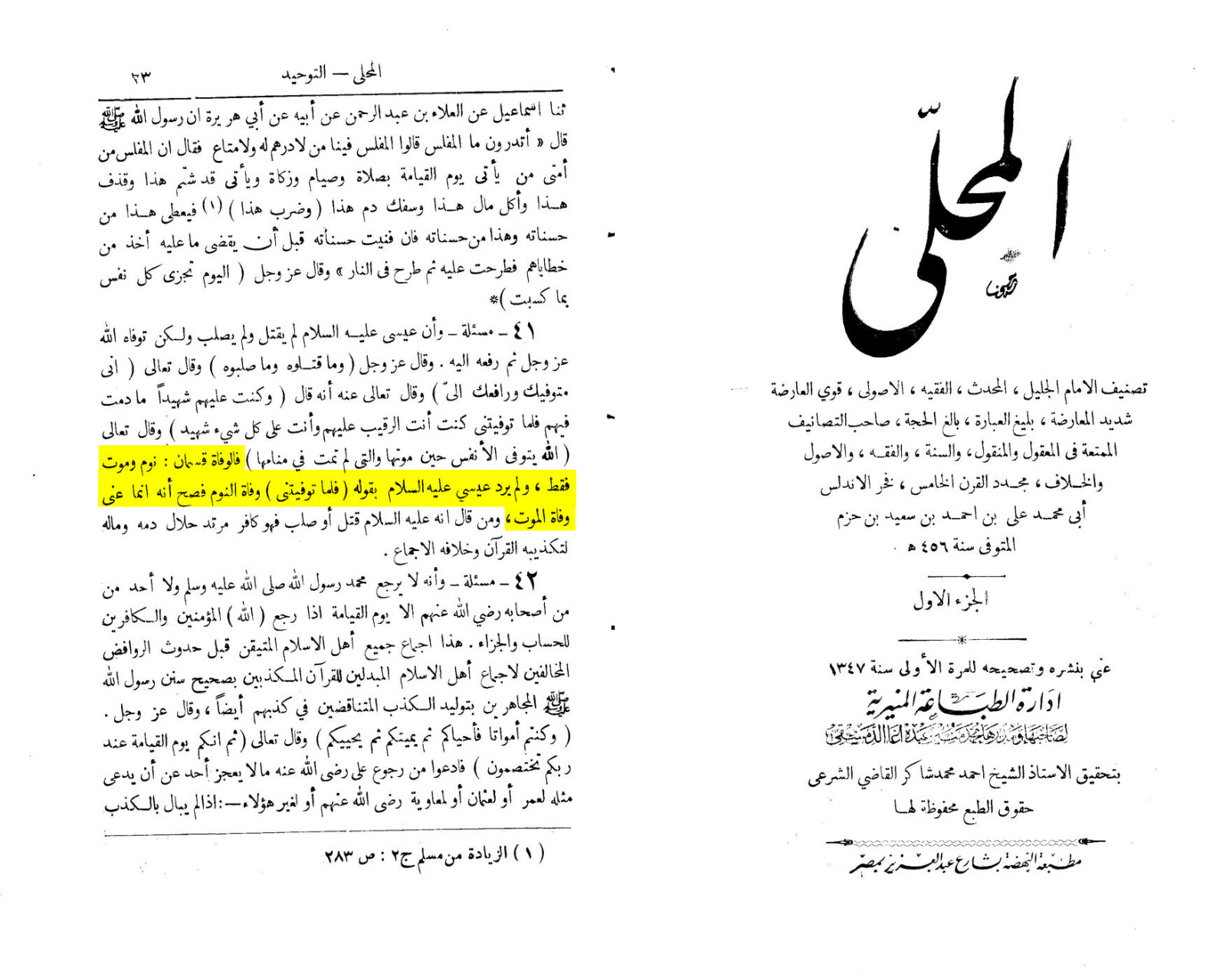
The translation of the above text is:
2. Issue (Mas’alah): “And that Jesus (peace be upon him) was not killed nor crucified, but Allah Almighty caused him to die (tawaffāhu) and then raised him up to Himself. And Allah Almighty said: “And they did not kill him nor impailed him…” [Qur’an 4:157], and “O Jesus, I will cause you to die (mutawaffīka) and raise you to Myself…” [Qur’an 3:55], and He said about him [Jesus] that he said: “And I was a witness over them as long as I remained among them; but when You caused me to die (tawaffaytanī), You were the Watcher over them…” [Qur’an 5:117]. And Allah Almighty said: “Allah takes the souls (yatawaffā) at the time of their death, and those that do not die during their sleep…” [Qur’an 39:42]. So wafāh (death/dying) in our language means sleep and death only. And the word of Jesus (peace be upon him) — “When You caused me to die” — does not mean the death of [ordinary] dying, so it is established that he was made to die a true death [i.e., he died a natural death]. And whoever says that he (peace be upon him) was killed or crucified is a disbeliever, an apostate, whose blood and property are deemed lawful [to take], due to his falsification of the Qur’an and his contravention of the consensus (ijmā’).”- Ibn Ḥazm
3. Issue (Mas’alah): “And that Muhammed, the Messenger of Allah (saw), will not return [to this world], nor will any of his Companions (may Allah be pleased with them), except on the Day of Resurrection, when Allah brings the believers and the disbelievers for reckoning and recompense. This [view] is agreed upon by all the people of Islam, with certainty, before the emergence of the Rāfiḍah [Shi’ah] — those who oppose the people of Islam, who reject the Qur’an, who deny the authentic Sunnah of the Messenger of Allah (saw), who fabricate lies, and who are contradictory even in their falsehood. And Allah Almighty said: “And you were dead, and He gave you life; then He will cause you to die; then He will give you life [again]; then to Him you will be returned” [Qur’an 2:28]. And He said: “Then indeed, on the Day of Resurrection, you will be brought to dispute before your Lord” [Qur’an 39:31]. So whoever claims a return for ‘Ali (may Allah be pleased with him) — or makes a similar claim for ‘Umar, or for ‘Uthman, or for anyone else, may Allah be pleased with them, or for others — then such a claim is no more than falsehood.”-Ibn Ḥazm
Prima Qur’an comments: Just a note for the readers. The quotes from Ibn Ḥazm contradict the claims made by the Qadiani movement, (either split among them) as well as contradicts the claims made by Todd Lawson and/or the Nizari Ismaili.
“And whoever says that he (peace be upon him) was killed or crucified is a disbeliever, an apostate.”
The hadith evidence.
Let us look at the hadith evidence that justifies our position. Muhammed (saw) is the last and final prophet. He is the seal of all prophets and no one will come after him.
Narrated ‘Aisha:
(the wife of the Prophet) Allah’s Messenger (saw) died while Abu Bakr was at a place called As-Sunah (Al-‘Aliya) ‘Umar stood up and said, “By Allah! Allah’s Messenger (saw) is not dead!” ‘Umar (later on) said, “By Allah! Nothing occurred to my mind except that.” He said, “Verily! Allah will resurrect him and he will cut the hands and legs of some men.” Then Abu Bakr came and uncovered the face of Allah’s Messenger (saw), kissed him and said, “Let my mother and father be sacrificed for you, (O Allah’s Messenger (saw), you are good in life and in death. By Allah in Whose Hands my life is, Allah will never make you taste death twice.” Then he went out and said, “O oath-taker! Don’t be hasty.” When Abu Bakr spoke, ‘Umar sat down. Abu Bakr praised and glorified Allah and said, No doubt! Whoever worshipped Muhammed, then Muhammed is dead, but whoever worshipped Allah, then Allah is Alive and shall never die.” Then he recited Allah’s Statement.:– “(O Muhammed) Verily you will die, and they also will die.” (39.30) He also recited:
“And Muhammed is no more than a messenger; certainly the messengers before him have passed away; if then he dies or is killed will you turn back upon your heels? And whoever turns back upon his heels! he will by no means do harm to Allah in the least and Allah will reward the grateful.” (Qur’an 3:144)
Source: (https://sunnah.com/bukhari:3667)
Narrated Abu Huraira:
Allah’s Messenger (saw) said, “My similitude in comparison with the other prophets before me, is that of a man who has built a house nicely and beautifully, except for a place of one brick in a corner. The people go about it and wonder at its beauty, but say: ‘Would that this brick be put in its place!’ So I am that brick, and I am the last of the Prophets.”
Source: (https://sunnah.com/bukhari:3535)
* Note* that the Blessed Messenger (saw) is the completion of the house and the final brick. That would not be so if Jesus (as) was to come again in the future. In fact if any other Prophet were to come than the Blessed Messenger (saw) would not be that final brick. More work would need to be done.
Narrated Abu Huraira:
The Prophet (saw) said, “The Israelis used to be ruled and guided by prophets: Whenever a prophet died, another would take over his place. There will be no prophet after me, but there will be Caliphs who will increase in number.” The people asked, “O Allah’s Messenger (saw)! What do you order us (to do)?” He said, “Obey the one who will be given the pledge of allegiance first. Fulfil their (i.e. the Caliphs) rights, for Allah will ask them about (any shortcoming) in ruling those Allah has put under their guardianship.”
Source: (https://sunnah.com/bukhari:3455)
Narrated ‘Uqbah bin ‘Amir:
That the Messenger of Allah (saw) said: “If there was to have a Prophet after me, it would have been ‘Umar bin Al-Khattab.”
Source: https://sunnah.com/tirmidhi:3686
Thawban narrated that the Messenger of Allah(saw) said:
“The Hour shall not be established until tribes of my Ummah unite with the idolaters, and until they worship idols. And indeed there shall be thirty imposters in my Ummah, each of them claiming that he is a Prophet. And I am the last of the Prophets, there is no Prophet after me.”
Source: https://sunnah.com/tirmidhi:2219
Narrated Jubair bin Mut`im:
“Allah’s Messenger (saw) said, “I have five names: I am Muhammed and Ahmed; I am Al-Mahi through whom Allah will eliminate infidelity; I am Al-Hashir who will be the first to be resurrected, the people being resurrected there after; and I am also Al-`Aqib (i.e. There will be no prophet after me).”
Source: (https://sunnah.com/bukhari:3532)
“Blessed is the One Who sent down the Decisive Authority to His servant, so that he may be a warner to the whole world.” (Qur’an 25:1)
Due to our belief that the Qur’an is the divine revelation from Allah (swt) and the belief that it is the decisive authority that is sufficient for us.
We are a Muhammedan faith.
Our testification of faith is: I bear witness that there is no god but Allah and Muhammed is the Messenger of Allah. This is what a person says to enter into Islam. If we lived in the time of Jesus (as) we replace Muhammed (saw) with Jesus (as).
In our call to prayer we say: I bear witness that Muhammed is the Messenger of Allah.
Our The Tashahhud in the prayer itself contains invocation of Muhammed (saw) and the sending of blessings and peace upon him.
Sunni Muslims have a very challenging time with the statements of the Qur’an and wrestle with the text. So how do they try and convince people that Muhammed (saw) is the last prophet and yet another prophet will come after him?
We cannot count the times that we have encountered people of incredible intelligence and with formidable intellects that will look you straight in the face and tell you that Muhammed (saw) is the last Prophet and yet Jesus (as) is a Prophet that will come after Muhammed (saw).
The red line below represents Jesus (as). The green line below represents Muhammed (saw).
According to the majority Sunni view (with dissenting voices) Jesus (as) was taken bodily alive to heave where he remains. That means he was there during the time of the Blessed Prophet Muhammed (saw).
After the Prophet Muhammed (saw) has died, Jesus (as) as represented by the red line endures. He lives on. It is clear that this belief is that Jesus (as) is the last Prophet and not Muhammed (saw).
The non sequential argument. Basically Jesus (as) is A in the diagram below and the Muhammed (saw) is B in the diagram below.
It is clear that if A comes before B and comes again after B that A is last in the sequence, and thus the last Prophet. The haqq, the truth on this is so clear that we could ask a small child. Which of the letters appears last. A or B?

Others try to work around this by saying that what it means is that Muhammed (saw) is the last Prophet, but Jesus (as) was granted the title of Prophet before the coming of Muhammed (saw) and not after. Some have even claim that Jesus (as) is stripped of his title of Prophet when he returns. This should show you the utterly desperate situation they find themselves in.
The fact that they have to come up with these various interpretative devices shows you the weakness of their position. These interpretative devices help them to keep the falsehood alive. Repeat it enough and it becomes true.
You will be surprised at the multitudes of people that will accept this line of convoluted thinking. We believe many people realizing all the explaining away does not resolve the glaring contradiction but to be accepted they will silently nod their heads and move on.
Now what has sufficed for us is sufficient. As mentioned the hadith cannot clash with the Qur’an. In our school we do not come up with various scenarios to try and see how we can makes the masses accept the hadith concerning the coming of Jesus (as) conform with the clear teachings of the Prophet (saw) being the last prophet.
So let us recap something that was stated earlier:
Not only do we not find any evidence for the some second coming of Jesus (as) in the Qur’an. The idea of a second coming of Jesus (as) would conflict with information in the Qur’an.
So now let us share with you the view of the overwhelming vast majority of Muslims. Yes, the vast majority of Muslims believe what we are about to share with you. Remember truth is not a democracy. Alas, the majority of people across the world believe what they do as this is what they were taught to believe.
- The vast majority believe that the Qur’an 4:157 teaches that Jesus (as) was not put on an ecclesiastical Cross and that instead Allah (swt) made another person look like Jesus (as) and that person was put to death on the ecclesiastical Cross.
- The vast majority believe that the Qur’an 4:158 teaches that Jesus ascended in his body into the heavens.
- The vast majority believe that Jesus (as) will descend in that body at some point in the future.
To be clear points 1 & 2 have absolutely no proof in the Qur’an. Not only this but we do not have a hadith of the Prophet (saw) that categorically state either belief 1 or 2 above.
Now let us look at the evidences from the Qur’an that are used to advance this idea that Jesus (as) will come back at some unspecified time in the future.
You will see that these so called evidences are inconclusive, weak and require some imaginative reading into the text in many cases.
“When Allah will say, “O Jesus, Son of Mary, remember My favor upon you and upon your mother when I supported you with the Pure Spirit and you spoke to the people in the cradle and in maturity.” (Qur’an 5:110)
This was responded to here:
“And there is none from the People of the Scripture but that he will surely believe in Jesus before his death. And on the Day of Resurrection he will be against them a witness.” (Qur’an 4:159)
This was responded to here:
“And indeed, it surely is a knowledge of the Hour. So do not be in doubt about it, and follow Me. This is the Path Straight.” (Qur’an 43:61)
This was responded to here:
The inconsistency in relation to the word tawaffā we look at that here:
Who has the correct understanding of Qur’an 4:157?
After looking at the arguments from the Qur’an that are used as a justification to try and say that Jesus (as) is coming back in the second article we will be looking at the ahadith that are used. Again, as mentioned in the article before this one concerning the JuJ(Gog) and Majuj (Magog) our scholars are clear that we do not accept that those hadith are tawatur nor are they a proof for us. Nonetheless we will have an article with some discussion concerning it.
In the meantime for those interested you may wish to read:
Insh’Allah we will be posting: What about all the hadith on the return of Jesus (as)? Part 2.
May Allah Guide the Ummah.
May Allah Forgive the Ummah.


