
“He it is Who has sent down the Book upon thee; therein are signs determined; they are the Mother of the Book, and others symbolic. As for those whose hearts are given to swerving, they follow that of it which is symbolic, seeking temptation and seeking its interpretation. And none know its interpretation save Allah and those firmly rooted in knowledge. They say, “We believe in it; all is from our Lord.” And none remember, save those who possess intellect.” (Qur’an 3:7) -The Study Qur’an.
“It is He who has sent down to you, [O Muhammed], the Book; in it are verses [that are] precise – they are the foundation of the Book – and others unspecific. As for those in whose hearts is deviation [from truth], they will follow that of it which is unspecific, seeking discord and seeking an interpretation [suitable to them]. And no one knows its [true] interpretation except Allah . But those firm in knowledge say, “We believe in it. All [of it] is from our Lord.” And no one will be reminded except those of understanding.” (Qur’an 3:7) -(Sahih International)
﷽
By the grace of Allah (swt) we have finally got around to writing this article. This is something we have been meaning to write about for some time now.
We asked some brothers to write their experiences of why they chose the Ibadi school or what drew them to the school. We were quite surprised at the re-telling of one story when we read the following:
“I read Ibadis take Qur’an seriously and don’t make tafsir of it to validate their personal prejudices. They believe only Allah knows the Qur’ans true meaning.”
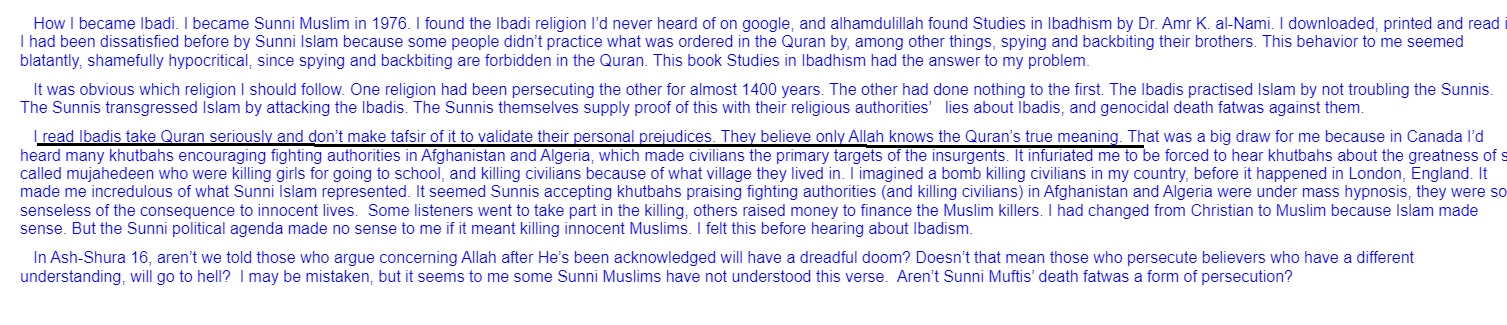
We were really quite shocked and surprised by this. When we tried to correct the brother on this misunderstanding, he was rather recalcitrant. So we simply asked him where he got this information from.
To his credit, he cited the Qur’an 3:7. That is fine and good, but he did not cite any Ibadi sources, saying that only Allah knows the Qur’an’s true meaning. The reason he did not cite them is that none exist! There are no Ibadi sources stating this.
Second, simply using logic, we asked him what was the point of sending a revelation that no one will understand? That is an exercise in futility at best.
Finally, we pointed out to him that his contention (which is certainly not from the Ibadi) was in relation to the mutashabih.
For example, as we read to him the following:
“He it is Who has revealed the Book to you; some of its verses are(muḥ’kamātun) decisive, they are the basis of the Book), and others are allegorical…” (Shakir’s translation)
muḥ’kamātun -which actually can be translated as clear. Or that which does not require further elaboration.
So, even then, we informed him that the muḥ’kamātun verses are certainly not verses in which anyone says that only Allah (swt) knows them. The dispute is rather about the mutashābihātun.
Mutashābihātun is often translated as unspecific, symbolic, allegorical, subject to more than one interpretation or understanding. So the center of dispute is around such verses.
The importance of punctuation.
So here we have two sentences:
I take great pleasure in eating my dog and my plants.
I take great pleasure in eating, my dog, and my plants.
The first sentence would leave the reader with the impression that a person takes great pleasure in eating their dog and their plants.
The second sentence would leave the reader with the impression that the person takes great pleasure in eating, as well as finding pleasure in having a dog and having plants.
The importance of punctuation.
So to try and bring as many of you along as we can, we would encourage you to use the following resource: https://www.islamawakened.com/quran/3/7/default.htm
This will give you an exhaustive list of different translations. The keen eye will note the following:
Translations that state that Allah and people grounded in knowledge know the meaning of the mutashabiha, such as:
“He it is Who has sent down the Book upon thee; therein are signs determined; they are the Mother of the Book, and others symbolic. As for those whose hearts are given to swerving, they follow that of it which is symbolic, seeking temptation and seeking its interpretation. And none know its interpretation save God and those firmly rooted in knowledge. They say, “We believe in it; all is from our Lord.” And none remember, save those who possess intellect.” (Qur’an 3:7) The Study Qur’an.
Translations that state that only Allah knows the meaning of the mutashabiha such as:
“It is He who has sent down to you, [O Muhammed], the Book; in it are verses [that are] precise – they are the foundation of the Book – and others unspecific. As for those in whose hearts is deviation [from truth], they will follow that of it which is unspecific, seeking discord and seeking an interpretation [suitable to them]. And no one knows its [true] interpretation except Allah . But those firm in knowledge say, “We believe in it. All [of it] is from our Lord.” And no one will be reminded except those of understanding.” (Qur’an 3:7) (Sahih International)
Translations that seem to be ambiguous on the matter due to their punctuation.
“He it is Who has revealed the Book to you; some of its verses are decisive, they are the basis of the Book, and others are allegorical; then as for those in whose hearts there is perversity they follow the part of it which is allegorical, seeking to mislead and seeking to give it (their own) interpretation. but none knows its interpretation except Allah, and those who are firmly rooted in knowledge say: We believe in it, it is all from our Lord; and none do mind except those having understanding.” (Shakir)
“It is He who revealed to you the Scripture. Some of its verses are definitive—they are the foundation of the Book—while others are allegorical. Those with deviant hearts pursue the allegorical, seeking discord and seeking its interpretation. However, none knows its interpretation except God and those firmly grounded in knowledge say, “We believe in it; all of it is from our Lord.” Only those endowed with understanding take heed.” (Talal Itani & AI 2024)
“It is God who has revealed the Book to you in which some verses are clear statements (which accept no interpretation) and these are the fundamental ideas of the Book, while other verses may have several possibilities. Those whose hearts are perverse, follow the unclear statements in pursuit of their own mischievous goals by interpreting them in a way that will suit their own purpose. No one knows its true interpretations except God and those who have a firm grounding in knowledge say, “We believe in it. All its verses are from our Lord.” No one can grasp this fact except the people of reason.” (Muhammed Sarwar)
So what is going on here?
Note that the verse states about the people who are firmly grounded/rooted in knowledge will say that: “We believe in it; all of it is from our Lord.”
Note that the verse talks about some people who are hyper-fixated upon the mutashabiha.
“Then, as for those in whose hearts there is perversity, they follow the part of it which is allegorical, seeking to mislead and seeking to give it (their own) interpretation.”
Note that these people are not described as people of knowledge.
The first principle of interpreting the Qur’an is: Tafsir al-Quran bi-l-Quran. (Interpreting the Qur’an by the Qur’an)
The second principle is interpreting the mutashabi (unspecific, allegorical, subject to several interpretations) is to establish its meaning by that which is muḥ’kam (foundational, not requiring further clarity).
For example, the Blessed Prophet (saw) can bring elaboration and elucidation.
“With clear proofs and divine Books. And We have sent down to you the Reminder, so that you may explain to people what has been revealed for them, and perhaps they will reflect.” (Qur’an 16:44)
So, when it comes to our faith, we do not base it upon that which is mutashabi. In fact, the beautiful point of this whole verse is not to muddy the waters but to give the believers a clear sign concerning the people of schism and aberrant doctrines. You will more often than not find misguided sects that will base their framework upon a verse(s) that is/are mutashabi. They base theological doctrines upon such.
The people of sound doctrine interpret the mutashabi in light of the muh’kam. Thus, those firmly grounded and rooted in knowledge of the muh’kam are the best capable of extrapolating the meaning of the mutashabi. Chief among them is the Noble Messenger (saw).
Which brings us to our first point.
If we are to understand Qur’an 3:7 as regarding the mutashbi verses that ‘no one can understand except Allah’ then it means those who hold such a position believe that Muhammed (saw), to whom the Qur’an was revealed did not even know the meaning of such verses.
This notion is refuted by the verse already mentioned:
“With clear proofs and divine Books. And We have sent down to you the Reminder, so that you may explain to people what has been revealed for them, and perhaps they will reflect.” (Qur’an 16:44)
The Blessed Prophet (saw) would explain what has been revealed to them. What has been revealed to them is the Qur’an. If the Blessed Prophet (saw) did not understand it, no one ever would. Thus, we would be given a Qur’an in which much of it is concealed from us.
Also, this verse shows that the Blessed Prophet (saw) comprehended what was revealed to him:
“Exalted is Allah, The True King! Do not rush to recite the Quran before it is (yuq’da) conveyed as revelation (waḥyuhu) , and pray, “My Lord! Increase me in knowledge.”
Is it possible that the Qur’an can be concealed from us?
The answer to that is yes. The Qur’an itself mentions that, due to the sinful and/or arrogant nature of some human hearts, they will never be able to penetrate the Qur’an.
“And We place a covering on their hearts so that they do not comprehend it, and We cause a heaviness in their ears; and when you mention your Lord, the Only True Lord, in the Qur’an, they turn their backs in aversion” (Qur’an 17:46)
“And who is more unjust than one who is reminded of the verses of his Lord but turns away from them and forgets what his hands have put forth? Indeed, We have placed over their hearts coverings, lest they understand it, and in their ears deafness. And if you invite them to guidance – they will never be guided, then – ever.” (Qur’an 18:57)
“Will they then not (yatadabbarūna)meditate on the Qur’an, or are there locks on the hearts?” (Qur’an 47:24)
“This is a Book which We have sent down to you, full of blessings that they may (liyaddabbarū) ponder over its Verses, and that (ulu l-albabi)men of understanding may remember.” (Qur’an 38:29)
It is also our contention that the muh’kam verses could have a mutashabi aspect to them which is brought about through tabbadur (reflection, pondering) and using the methods of sound tafsir that are available to us.
An example:
“None touch (yamassuhu) it except the (l-muṭaharūna) purified.” (Qur’an 56:79)
This verse is generally understood by the fuqaha (people of jurisprudence) as a reference to being clean when touching and handling the mushaf of the Qur’an. This makes sense, as reverence towards the sacred text is the obvious meaning.
However, we also know that there are people who are not clean who pick up and touch the Qur’an. Muslims who are not in a state of ablution and people like the demented Christian polemists that ate pages of the Qur’an or the U.S. military that would put the Qur’an into the toilet. (Surely they incurred the curse of Allah, and it remains upon them until they repent).
muṭaharūna-is also understood to mean angels.
Another way to understand the text of Qur’an 56:79 is to understand that yamassuhu is not like ‘yalmasuhu’.
So, for example, in the Qur’an we have:
“If something good ‘tamasakum’ (comes your way), it grieves them.” (Qur’an 3:120) This does not necessarily mean only to physically touch.
Also, in the preceding verse we have:
“In a well-preserved Record.” (Qur’an 56:78)
- In this context, the purified (mataharuna) are indeed the angels and this refers to the Tablet in paradise.
- That when it comes to the believers, there is an adaab (mannerism) in how we handle the sacred text.
- That only those who are sincere and have purity of intention will be moved by this Qur’an and able, by Allah’s grace, find such meanings via reflection.
Point 3 describes such a state or condition of truth seekers among Christians.
“And when they hear what has been revealed to the Messenger, you see their eyes overflowing with tears because of what they have recognized of the truth. They say, “Our Lord, we have believed, so register us among the witnesses.”(Qur’an 5:83)
So when it comes to the reading of the Qur’an 3:7 there are two opinions on the matter.
One opinion says that the reader of the Qur’an should stop at: “But none knows its interpretation except Allah.” Then (after a brief pause) continue reading: “and those who are firmly rooted in knowledge say.”
The second opinion is that one does not pause, but one should continue reading: “But none knows its interpretation except Allah and those who are firmly rooted in knowledge. They say,”
So how did this difference come about?
- Punctuation marks or (Rumuz al-Awqaf) were added by the scholars after the death of the Blessed Prophet (saw).
- Diacritical marks (Tashkeel) to distinguish words or grammatical structures were added by scholars after the death of the Blessed Prophet (saw).
Rumuz al-Awqaf (Punctuation Marks)
The following is from http://www.as-sidq.org/durusulQuran/articles/mariful.html#Rumuz
May Allah (swt) bless them for their work.

From the above source we find:
ﻡ “This letter mim is an abbreviation of al-waqf al-lazim. It means if a stop is not made here, an outrageous distortion in the meaning of the verse is possible. So, it is better to stop here. Some phoneticians of the Qur’an have also called this al-waqf al-wajib or the obligatory stop. But this is not ‘wajib’ of fiqh, which brings sin if abandoned. In fact, the purpose is to stress that making a stop here is the most preferable of all stops (al-Nashr, 1/231).”
We find this al-waqf al-lazim in Qur’an 3:7 after “except Allah.” This was done with the intention of making the recitation of the Qur’an easier. These additional punctuations, though welcomed for ease of recitation, were neither given by Allah (swt) nor his Blessed Messenger (saw).
This is also something that follow the ‘Qur’an Only religion’ fail to grasp. That is the very textual history and transmission of the Qur’an.
“A. L. R. (This is) a Book, with verses that give judgement (uḥ’kimat) and these are expounded upon (fuṣṣilat) – from One Who is Wise and Well-acquainted (with all things).” (Qur’an 11:1)
An objection based upon improper understanding of the Arabic grammar and syntax.
Beyond the importance of punctuation.
The importance of understanding Arabic grammar and syntax and language!
One objection that is raised is usually by those who do not have a sound grasp of Arabic grammar, or syntax. That objection is as follows:
“But none knows its interpretation except Allah and those who are firmly rooted in knowledge. They say, “We believe in this it is all from our Lord.”
So the objection is based upon their misunderstanding that Allah (swt) would not say: “We believe in this it is all from our Lord.”
But this is not the proper understanding at all. The verse: “We believe in this it is all from our Lord.” Is a reference to : “Those who are firmly rooted in knowledge.” and not to Allah (swt).
This was a conversation with a brother from the Zaydi school, and we pointed out to him a similar example to this in (Qur’an 18:80) but he has never replied to that point.
What point is that?
Let us give context to the verse:
“As for the ship, it belonged to some poor people, working at sea. So I intended to damage it, for there was a king ahead of them who seizes every ship by force. “And as for the boy, his parents were believers, and we feared that he would pressure them into defiance and disbelief. So we hoped that their Lord would give them another, more virtuous and caring in his place. And as for the wall, it belonged to two orphan boys in the city, and there was beneath it a treasure for them, and their father had been righteous. So your Lord intended that they reach maturity and extract their treasure, as a mercy from your Lord. And I did it not of my own accord. That is the interpretation of that about which you could not have patience.”(Qur’an 18:79-82)
There are three points here:
- Causing damage to the boat fa-aradttu (I intended)
- The killing of the child and the subsequent replacement of fakhashina (we disliked) fa-aradna (we intended). A. Killing the child (he returns to himself)B. Allah replaces the child with another one. Killing is from Khidr and the Replacing is from Allah.
- Causing the boys to reach maturity. Fa-arada rabbuka (Your Lord intended)
fa-aradttu 1st person singular
fakhashina 1st person plural perfect verb
fa-aradna 1st person plural
fa-arada 3rd person masculine singular
Not really having the depth of Arabic grammar or syntax, one can make these types of mistakes or rely upon this type of misunderstanding. May Allah help us.
A faulty argument used by our side against the other.
There has been a faulty argument that has been used by those of us who believe Qur’an 3:7 should be understood as: Allah and people grounded in knowledge know the meaning of the mutashabiha.
It is used to assail those who believe Qur’an 3:7 should be understood as: only Allah knows the meaning of the mutashabiha.
That argument goes like this.
To say that we believe in it, but we do not know what it means would be like saying
we do not know what we believe.
This is not a fair argument against the other side. The reason being is that first, and foremost, there is no group among the Muslims that feel that they are unncertain about what they believe. We may dispute this. However, every group of Muslims are confident and certain about what the core tenets of their belief are.
Secondly, Allah (swt) could have such verses to leave us gobsmacked. Also, to humble us.
“But above those ranking in knowledge is the One All-Knowing.” (Qur’an 12:76)
Prima Qur’an concluding remarks.
- It is not the position of the Ibadis school that only Allah knows the meaning of the Qur’an. You are not going to find this in any of the books by the Ibadi.
- The difference in understanding of Qur’an 3:7 has to do with the Rumuz al-Awqaf (punctuation marks).
- The dispute is not over the muh’kam but rather over who understands the mutashabi.
- As the Blessed Prophet (saw) understood the whole of the Qur’an, it is not possible to render the reading as only Allah knows.
- The people firmly rooted in knowledge are those who base their understanding upon the muh’kam.
- The people whose hearts are given to perversity and deviation go straight to mutashabi.
- The irony is that the understanding of this verse must fall under the category of muh’kam or else it would be mutashabi and thus all who give an understanding of it would be among the perverse. The self-refuting nature of this is evident.
- With reflection and understanding that which is mutashabi can become muh’kam.
May Allah (swt) guide us to what is beloved to him.
May Allah (swt) guide the Ummah.
May Allah (swt) forgive the Ummah.


 Prima Quran