Tag Archives: tafsir

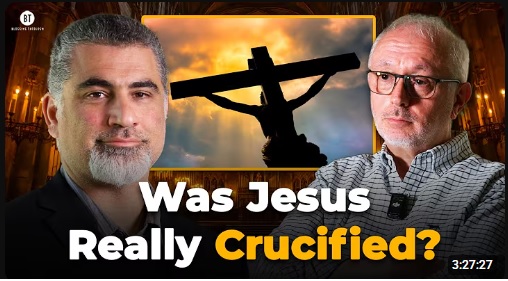
Jesus was not crucified: the evidence with Dr. Ali Ataie

“And for their saying, “Indeed, we have killed the Messiah, Jesus, the son of Mary, the Messenger of Allah.” And they did not kill him nor did they impale (ṣalabūhu) him; (وَمَا قَتَلُوهُ وَمَا صَلَبُوهُ وَلَٰكِنْ شُبِّهَ لَهُمْ)but it was made to appear to them so. Those who differ therein are full of doubts. They have no certain knowledge of it, but only follow conjecture. For certainly, they did not kill him.”  (Qur’an 4:157)

﷽ 

These are some of our thoughts after an attentive listen of all 3 hours 36 minutes and 33 seconds on the Blogging Theology video entitled: ‘Jesus was not crucified: the evidence with Dr. Ali Ataie.’

You may see this here:

Paul Williams and Blogging Theology are still our number one favourite youtube channel.W

e also feel (for our interest) the most relevant in the English language.

Our thoughts are that Dr. Ali Ataie is almost there. The stand out from this, the absolutely commendable point is that Dr. Ataie is challenging what is considered to be a historical ‘fact,’ namely that Jesus of Nazareth was Crucified to death by the Roman Imperium.

That in and of itself is refreshing. We have been saying this for years. After looking at the so called “evidence” both biblical and extra biblical we haven’t found it convincing at all.

As we have pointed out in a previous article here: how does anyone read Qur’an 4:157 and walk away with the understanding that it is talking about Romans, Crucifixion or Cross at all?

It is simply bizarre to us.

Dr. Ataie has a good opening preface that when it comes to issues like resurrection, and other miracles those are simply things that history cannot attest to. There could be a natural and supra natural explanation. Miracles are not considered by modern historians when looking at the past. That being said miracles are not unhistorical it’s just that being in the realm of the supranatural historians do not consider it.

This is a very fair and reasonable point raised by Dr. Ataie.

Again another reason why Muslims should not be too excitable over claims by historians and /or orientalist. At the heart of research are simply different epistemology.


Paul Of Tarsus conversion story for example, is non historical.

“I trust Allah and his Messenger.”-Dr. Ataie

We can only say that: “Ditto.”


@17:55 “If that man said that Jesus wasn’t crucified then I believe him. And I don’t care what Bart Ehrman…..”-Dr. Ataie

Prima Qur’an comments: You see dear reader for some reason Dr.Ataie, Dr. Shabir Ally, Dr. Fatoohi, all think the Qur’an is engaging with something called “crucifixion”

The Qur’an is neither affirming nor denying any crucifixion. The Qur’an is interacting with claims made by Jews about Jesus (as).

As regard to an event that is commonly called ‘The Crucifixion’ the Qur’an is simply indifferent. It simpy neither denies nor affirms it.

Please see:

@19:34 Why in the world did he (Muhammed) deny the crucifixion of Jesus? -Dr. Ataie

Prima Qur’an comments: Again we have read the same Qur’an Dr. Ataie is reading and we simply do not see crucifixion any where in the Qur’an at all.

“The historical case for the crucifixion is not nearly as strong as what we have been lead to believe.” -Dr. Ataie.


@22:36 “It is axiomatic for Westerns that it has happened.”

@24:09 Dr. Ataie goes into the various theories Muslims have in regards to the “crucifixion” of Jesus.

Dr. Ataie is closet to the truth out of them all (Has he been reading Prima-Qur’an?).

@30:17 Dr. Ali Ataie comments that “Crucified victims were left on their crosses long after they expired.”

Dr. Ali Ataie still struggles with Divine Rapture Theory. As he does not find it to be in agreement with the Qur’an and/or historically plausible.


@32:26 Dr. Ali Ataie addresses the issue of Supranatural identity transference.
@32:50 Dr. Ali says that most Muslim exegetes go with this idea that “Jesus was no where near a cross.”

A common trope that we hear from some atheist is that secular historians are objective, unbiased and inductive.

@34:12 objective, unbiased, inductive. -Historians?

Dr. Ataie does an excellent job of going into an analysis of this. How historians have come up with different perspectives and have contradicted each other and how they may not be as objective or unbiased or even as inductive as they may lead themselves to believe.

Dr. Ataie, We owe you lunch! Well said. May Allah (swt) elevate him.

@40:28 Dr. Ataie states: “But I do believe that myth and legend has probably soo permeated the gospel accounts of Jesus passion narratives that it is not at all beyond reason to dismiss them completely as historical fiction!”

Prima-Qur’an comments: Allahu Akbar! There you go Dr. Ataie now that is the ticket!
Than the idea that someone was “crucified” is likely based upon what? Myth and legend.

Dr. Ataie gets into his understanding of: Qur’an 4:157 “It was made to appear to them so.

@53:38 “They did not have information. It did not come from a reliable source.”
@54:11 “Jews and Christians ended up following hearsay reports about some crucifixion event from non eye-witnesses….”

Prima-Qur’an comments: This is exactly what shubbiha lahum means. It is not shubi ha alayhim!

In fact because we love you the readers insh’Allah we will give you a sneak peak at one of the slides that Shaykh Hilal and those of us at Prima Qur’an have been working on.

  1. Disagreements.
  2. They are in doubt.
  3. They have no knowledge about it.
  4. They are following dhan (assumption or conjecture).

These are not things that we would describe eye witnesses to an event with.


@54:25 “When you say it was made to appear to them that it was so who is the implied actor there? Who made it appear to them it was so. Is this referencing God or some other-who is applied in that if you see what I mean?” -Paul Williams.

Prima Qur’an comments: Brother Paul asked a very great question. Very insightful. This is what was answered above. The whole event in which by the way is Allah (swt) addressing Jews and claims made by Jews is that they killed Jesus and impailed him.

This is based upon Jewish claims that were in orally in circulation in the time of the Prophet (saw).

There is absolutely nothing in Qur’an 4:157 about Romans, or about a cross or about a crucifixion which we will come to Insh’Allah

@1:00:53 “Is there any material evidence of any Jew who was ever crucified by the Romans in ancient Palestine? Apparently tens of thousands of Jews were crucified and all archeologist have ever found was a single heel bone of a man with a nail driven through it, they call him Yohanan. I don’t know how they know his name but that’s what they call him.” -Dr. Ataie.

@1:12:24Paul was the first one in recorded history to claim that Jesus was crucified.”- Dr. Ataie.

Prima-Qur’an comments: This is a genius point not because its clever but because it’s true and it is overlooked by way too many.

Paul lays down his theology in 1 Corinthians 15:3-8.

In fact, Allah-willing we will go ahead and lay out the systematic destruction of this group of text

“If the foundation is destroyed what shall the righteous do?” (Psalms 11:3)

Question: Just how important is the theology in 1 Corinthians 15:3-8?

Answer:

“Now if Christ be preached that he rose from the dead, how say some among you that there is no resurrection of the dead? But if there be no resurrection of the dead, then is Christ not risen: And if Christ be not risen, then is our preaching vain, and your faith is also vain. And if Christ be not raised, your faith is vain; you are still in your sins.” (1st Corinthians 15: 12-14, and 17)

Prima Qur’an Comment: Two major points need to be deduced from the above proof text.

1) If Christ Jesus did not raise from the dead, Christianity is a fruitless endeavor in every respect. Muslims do not say that, the Bible says it.

2) If Christ Jesus is not raised from the dead, Christians are still in their sins; and the whole of Christian theology is fruitless. Muslims do not say that, the Bible does.

Note: (Paul does not try and prove his case on an emptied tomb.)

“For I determine not to know anything among you, save Jesus Christ, and him crucified.” (1st Corinthians 2:2)

Note: Paul is not interested in the historical Christ.

In fact Paul never met the historical Jesus in his lifetime! He only claims to have met Jesus in a vision in Acts 9 , 22 and 26 and each and everyone of those text if juxtaposed contradict and conflict with one another.

“If the foundation is destroyed what shall the righteous do?” (Psalms 11:3)

How sound is that first account of the crucifixion that Paul is relating to us and the whole of Christian theology is hinging on?

How sound is it? Is the foundation solid?

Analyzing the foundation of Christian theology.

(1 Corinthians 15:3-8) <<< The Foundation of Christianity is built upon this text.

“For I delivered unto you first of all that which I also received, how Christ died for our sins according to the scriptures.” (1st Corinthians 15:3)

Prima Qur’an Comment:

Paul is referring to the Hebrew Scriptures because there were no New Testament writings at that time. However the fault in this text is that there is no place in the Hebrew scriptures that says a Messiah will die for our sins! Nowhere from Genesis to Malachi! There are allegories about other things.

“And that he was buried, and that he rose again the third day according to the scriptures.” (1st Corinthians 15:4)

Prima Qur’an Comment:

Again, nowhere in the Hebrew scriptures from Genesis to Malachi does it say that a Messiah will rise from the dead on the third day!

“For as yet they knew not the scripture that he must rise again from the dead.” (John 20:9)

Prima Qur’an Comment:

Even Jesus disciples did not know any scriptures about a Messiah rising from the dead.

There is a major contradiction in this narrative as well.

A Contradiction

“And although THEY found no cause of death in him, yet desired THEY Pilate that he should be slain. And when THEY had fulfilled all that was written of him THEY took him down from the tree, and laid him in a sepulcher.” (Acts 13:28-29)

Note: (They the Jews who desired his death put him in the tomb, which is contradicted point blank by the Gospel of Mark.)

“And HE brought fine linen, and took him down, and wrapped him in the linen, and laid him in a sepulcher which was hewn out of a rock, and rolled a stone unto the door of the sepulcher.” (Mark 15:46)

Note: (Joseph himself put Jesus in the tomb not the Jews who desired his death as in Acts.)

Also, if they fulfilled all that was written of him there would be no “rose again the third day according to the scriptures.”

“And that he was seen of Cephas, then of the Twelve.” (Ist Corinthians 15:5)

Prima Qur’an Comment:

There the Greek word for seen is Opthe, and is used for spiritual seeing as in a vision. No where in the Bible does it say Peter had an independent sighting of Jesus n this order that Paul is giving?

Question: What does ‘opthe’ mean?

Answer: spiritual seeing a vision

Also “ appearing to the twelve” is wrong because Judas committed suicide. To say that twelve is just a terminology is not true! Jesus called them the 12 apostles and when Judas died the terminology changes to 11 until the election of Mathias in Acts 6:2!

Catholics, however, got it right. The Douay-Rheims which was diligently compared with the original Greek’ text they say 11! So Somebody’s Greek text is wrong!

Source: (The Douay-Rheims New Testament (published by Tan Books and Publishers, INC. P.O. box424 Rockford, Illinois 61105)

“After that, he was seen of above five hundred brethren at once; of whom the greater part remain unto the present, but some are fallen asleep.” (1st Corinthians 15:6)

This is contradicted by the following text.

“This man God raised on the third day and granted that he be visible, not to all the people, but to us, the witnesses chosen by God in advance, who ate and drank with him after he rose from the dead.” (Acts 10:40-41)

From Emmaus to Jerusalem Paul wedges in 500 people who he says saw Jesus, and then Jesus ascends up into heaven that day.

“And it came to pass, while he blessed them, he was parted from them, and carried up into heaven.” (Luke 24:51)

This is in contrast to the following

“Until the day in which he was taken up, after that he through the Holy Ghost had given commandments unto the apostles whom he had chosen: To whom also he showed himself alive after his passion by many infallible proofs, being seen of them forty days, and speaking of the things pertaining to the kingdom of God” (Acts 1:2-3)

The “Third Coming of Jesus”?

So if Jesus really did go up into heaven after he was raised again and then ‘beamed’ back down to hang around for 40 more days only to ‘beam’ back up this would mean that Christians are awaiting the 3rd coming of Jesus, and that just doesn’t sound too illustrious.

“After that he was seen of James; then of all the apostles.” (1st Corinthians 15:7)

Prima Qur’an Comment:

No where in the Bible does it say James had an independent sighting of Jesus in this order Paul is projecting. The Epistle of James has no account of a risen lord. What an encounter to leave out!

Again when all the apostles are mentioned are there 11 or 12? Which Greek text?

“And, last of all, he was seen of me also, as one born out of due time.” (1st Corinthians 15:8)

Prima Qur’an Comment:

Finally, Paul insert himself in the picture!

Note: Paul has been using that same word seen in Greek (OPTHE) all the way through to apply to all the apostles. Paul did not have a physical encounter with Jesus.

Paul also believes that the disciples did not have a physical encounter with Jesus as he uses the Greek word Opthe-seen all the way through 1 Corinthians 15:3-8.

Paul’s First account is thus discredited and the ‘foundation has been destroyed’.

We can stop right here and disregard everything else since the source of this crucifixion business is found to be incredible. However, we will pursue this in hopes that some people who did not grasp the argumentation above will find other evidence, Insha’Allah, conclusive.

Our apologies dear reader for the detour; we will continue with Dr. Ataie’s presentation.

Dr. Ataie continues also building his case upon what Paul has presented.

Namely that Paul says:

 I want you to know, brothers and sisters, that the gospel I preached is not of human origin.  I did not receive it from any man, nor was I taught it; rather, I received it by revelation from Jesus Christ.” (Galatians 1:11)

The isnaad-the chain of transmission of the Christian account of the crucifixion it begins with Paul.

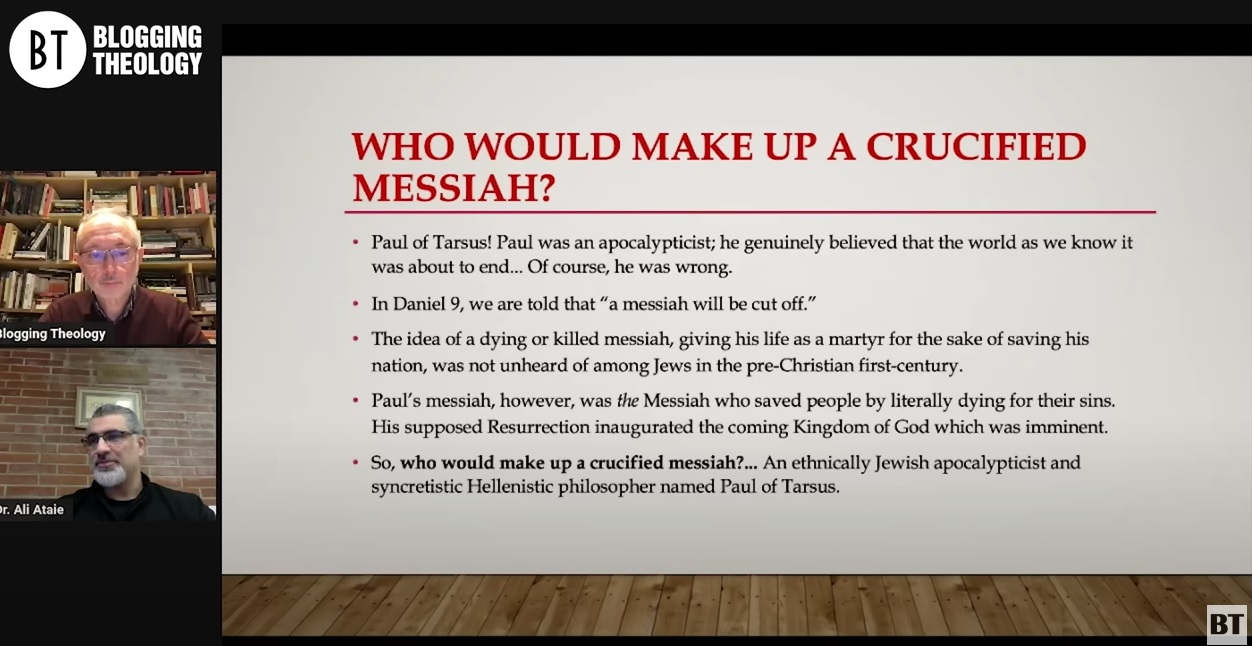
@1:30:34 Dr. Ataie is quoting a statement of Bart Ehrman which is “Who would make up a crucified Messiah?”

Dr. Ali Ataie makes some good points butwe are not sold on the idea of the Jews expecting a Crucified Messiah. We do believe that the gospels are literary fiction to create a counter-Jesus narrative.

Also, important to note that the Qur’an no where states that no one killed Jesus. There is however, a specific text addressed to a group of Jews who claimed to have either killed or impailed Jesus.

Allow us to share with you a very interesting text from the Qur’an.

The Injil or Gospel is mentioned 12 times in 12 verses of the Qur’an. In one of those verses we have the following:

Indeed, Allah has purchased from the believers their lives and their properties [in exchange] for that they will have  Paradise. They fight in the cause of Allah, so they kill and are killed. [It is] a true promise [binding] upon Him in the Torah and the Gospel and the Qur’an. And who is truer to his covenant than Allah? So rejoice in your transaction which you have contracted. And it is that which is the great attainment. [Qur’an 9:111]

Qur’an Comment: Out of all the teachings that Allah could inform us about concerning what Jesus taught in the Injil, why did Allah mention the teaching concerning martyrdom? Why would Jesus teach about ‘killing and being killed’ if he was simply a pacifist?

To read more the Ibadi view please read:

https://primaquran.com/2022/10/04/what-happened-to-jesus-and-how-did-he-die/

@1:34:38 “The Qur’an says there was ikhtilaaf among the Christians?” -Dr. Ataie

Prima-Qur’an comment: Wait what??!

Can Dr. Ataie show us in the Qur’an 4:157 where there is mention of Christians? There is no mention of Christians. Allah (swt) is clearly addressing claims made by some Jews.

Dr. Ataie please be more careful in your handling of the text!

Dr. Ataie makes an interesting point that Q: The Sayings Gospel has no passion narrative or resurrection narratives.

Dr. Ataie twice during the presentation used language of obfuscation.

@2:04:09 “impailed on the cross” -Dr. Ataie

Prima-Qur’an comment: crucifixion and Impailment are suspension punishments but they are not the same thing. It is possible that Prima Qur’an is gaininig traction and that some people want to use language that obfuscates the issue.

A) Impailment is a punishment where a pike/spike or other sharpened object is shoved through the loins/lubmus region of the body. The spine is used to hoist the individual. Depending upon the technique used it is designed to be a quick death struggle after. After the hapless victim cannot use their feet or hands to keep the impale device from reaching vital organs due to exhaustion. The impale device pierces vital organs and the victim dies an excruciating death.

B) Crucifixion is a punishment where an individual is put on a patibulum which is than affixed to a crux (a pole or beam). There is no nothing driven through the spine and the spinal column is relatively left intact. This suspension punishment focuses on putting nails through the hands and feet and meant to be a prolonged death struggle. Death is usually from asphyxiations. No vital organs are pierced. In fact people could survive being crucified for days. Hence, Christians make a huge ordeal about Jesus being scourged before Crucifixion.

@2:39:11 Dr. Ataie is quoting the Sefer Toledoth Yeshu, the Aramaic version and yet quotes the following to us in English:

“The Rabbi says Jesus was executed for sorcery by stoning and then crucified his body was than removed from the cross and dragged through the streets.” -Dr. Ataie

Prima-Qur’an comment: We are very curious to know the source that Dr. Ataie is quoting from.We are very doubtful that the Aramaic words are cross and crucify just as we know that the Qur’an 4:157 does not say crucify or cross.

In fact, Jews do not crucify anyone either. But they do impail!

The Sefer Toledoth Yeshu (The Book of the History of Jesus)

You could read other versions that would describe how the Romans convicted him; how he died a charlatan’s death (hanging not even on a tree, but on a cabbage stalk); and suffered a criminal’s burial.

@2:49:21 Dr. Ali Ataie gives his version of events that he thinks happens.

Prima-Qur’an comments: Dr. Alie believes that Jesus Barabbas is crucified instead of Jesus by the Romans. A different take to the substitution theory with the key differences being that no miracles happened and no one was made to look like Jesus. Jesus miraculously ascended into heaven where it is presumed here is there even until this day.

@2:58:44 “wa lakun shuba lahum” Was made to appear to them so by the evangelist it was precisely their passion narratives that made people to think that Jesus was crucified.

“For we did not follow cleverly contrived myths when we made known to you the power and coming of our Lord Jesus Christ; we were eyewitnesses of his majesty.” (2 Peter 1:16)

@3:23:50 “Perhaps what Paul meant is that the Jews killed him by Crucifixion but historically and legally how would the Jews have executed Jesus? If he was found guilty of blasphemy or sorcery which is actually what the Toledoth Yeshu and Qur’an suggest the charges were. “This is evidence sorcery.” If that’s the case they would have stoned him and than crucified his body post mortem.” and thus the Qur’an says wama qataluhu wama salabuhu nor crucify him post mortem.”

Prima-Qur’an comments: Oh Dr. Ataie so close so close. If Dr. Ataie would have simply consulted Jewish legal works he would have found the answer to his question. A very good question btw.

but historically and legally how would the Jews have executed Jesus?”

Once you figure that out Dr. Ataie welcome to the Ibadi position on Qur’an 4:157. Welcome home!

It is not crucifixion it is impalement.

And for their saying, “Indeed, we have killed the Messiah, Jesus, the son of Mary, the Messenger of Allah.” And they did not kill him nor did they impale (ṣalabūhu) him; (وَمَا قَتَلُوهُ وَمَا صَلَبُوهُ وَلَٰكِنْ شُبِّهَ لَهُمْ)but it was made to appear to them so. Those who differ therein are full of doubts. They have no certain knowledge of it, but only follow conjecture. For certainly, they did not kill him.”  (Qur’an 4:157)

  1. Notice that the context Qur’an 4:157 is speaking about Jews. There is no mention of Romans in the text. You may start at Qur’an 4:154 for context.
  2. There is a double denial. They did not kill him nor did they (ṣalabūhu) him.
  3. Why the seemingly redundant text? Is it not sufficient to say “And they did not kill him?” Surely that covers everything?
  4. Why would Allah (swt) deny that Jews “Crucified” Jesus? Especially if Allah (swt) is aware of Jewish laws?
  5. Jews do not crucify anyone nor do they put people on crosses.
  6. Jews do however impale people. So translating (ṣalabūhu) as impale makes complete sense.
  7. The phrase “but it was made to appear to them” does not indicate that this was something Allah (swt) did.

Now what happens is for some reason Muslims look at Qur’an 4:157 and they see Romans! The whole context of the text is that Allah (swt) is talking about Jews.

If Allah (swt) wanted to say Romans he certainly he could have. Yet, Qur’an 4:157 mentions nothing about the Romans.

“The Romans have been defeated.” (Qur’an 30:20)

So where than do Muslims gets Romans or Crucifixion or Cross in Qur’an 4:157 ?? 🤷

Other articles about Dr. Ataie.

May Allah Guide the Christians so that they do not burn in the hellfire.

May Allah (swt) guide us to what is beloved to Allah (swt).

May Allah Forgive the Ummah.

May Allah Guide the Ummah.

3 Comments

Filed under Uncategorized

Tafsīr al-Quran bi-l-Quran: The text in context.

“Do they not consider (yatadabbarūna)the Qur’an (with care)? Had it been from other Than Allah, they would surely have found therein Much discrepancy.” (Qur’an 4:82)

“Then do they not reflect (yatadabbarūna) upon the Qur’an, or are there locks upon [their] hearts?” (Qur’an 47:24)

﷽ 

Today we ask the question. Does it make sense to interpret one verse in light of 10 verses or to interpret 10 verses in the light of one verse? 

In general, it makes more sense makes more sense to understand one verse in light of ten verses — that is, to interpret a smaller unit in view of the larger context — rather than the reverse.

Here’s why:

  1. Context gives meaning. A single verse can be ambiguous or even misleading when read in isolation. The surrounding verses (the immediate context, the chapter, the book, and the broader canon) provide the framework that clarifies the author’s intended meaning.
  2. Scripture interprets Scripture. Interpreting obscure or condensed passages in light of clearer, more developed passages elsewhere is a longstanding hermeneutical principle. The “ten verses” (a larger passage) often help explain the “one verse” (a smaller or more difficult unit).
  3. Authorial intent. The author of a text intended the whole discourse to be understood as a unified argument or narrative. Isolating one verse can distort that intent; understanding it within the larger flow respects the author’s design.

As a Hermeneutical Principle

The rule that “the part should be interpreted in light of the whole” is classically a hermeneutical principle. This is often called in Latin contextus regit intellectum (context rules interpretation).

Hermeneutics deals with the methodology of interpretation—the “how” of deriving meaning from a text. So when we say “understand one verse in light of ten,” we are articulating a procedural rule for correct interpretation. It assumes that meaning is discovered by attending to context, authorial intent, and textual unity.

The Epistemological Underpinning

Why should context govern meaning? That’s where epistemology enters.

The principle assumes certain epistemological claims:

  • Coherence theory of meaning: Meaning is not atomistic (self-contained in isolated units) but is determined by relationships within a larger system. A proposition’s meaning is shaped by its place in a network of propositions.
  • Authorial intent as knowable: It assumes that a text has a unified communicative purpose and that readers can, through careful attention to the whole, approximate the author’s intended meaning.
  • Holism in interpretation: Epistemologically, this reflects a kind of hermeneutical holism—the idea that we understand parts only through a tentative grasp of the whole, and revise our understanding of the whole through scrutiny of parts (the hermeneutical circle).

So while the “part–whole” rule is taught as a method (hermeneutics), it is grounded in an epistemological view that understanding is holistic, contextual, and coherence-oriented rather than atomistic.

To ignore the ten verses in favor of the one isn’t just poor method; it’s a misunderstanding of how language and texts convey meaning in the first place.

This becomes evident in how the Ibadi school approaches the Qur’an and why we have such strong foundation in creed.

You can see this in our position on the eternality of those who enter hellfire:


You can see this in the consistent way in which we understand صلب in the greater context of the Qur’an.

Or even in how we understand the word كفر or kufr in Arabic. This ensures us that we have a creed that is based upon the Qur’an, the primary source of Islam, the revelation Allah sent to his Blessed Prophet (saw). Allah (swt) never defined كفر as exit from the religion of Islam.

Rather than a creed that says if you sin and the text defines that sin as kufr, it is not kufr as long as you believe the sin you are doing is wrong. This seems more theologically imposed. A make things up as you go along approach.

May Allah Guide the Ummah.

May Allah Forgive the Ummah.

Leave a comment

Filed under Uncategorized

For those Shi’a who do slander Aisha (ra)

“And hold not to the ties of marriage of unbelieving women.”(Qur’an 60:10)

﷽ .

Muslims believe that the Blessed Prophet Muhammed (saw) was guided in every way. This should also include his choice of wife. If the Blessed Messenger (saw) chose Aisha (ra) as his wife, then this choice had to be a blessed and correct decision. Or even more so if Allah (swt) chose her as his wife.

“Concerning verse Qur’an 24:26 (Vile women are for vile men and vile men are for vile women. Good women are for good men and good men are for good women… Majmaʿ al-bayān says: There are a few interpretations proposed for this verse… The third meaning is: “The vile among women belongs to the vile among men, and the vile among men belongs to the vile among women.” This is narrated from Abū Muslim and al-Jubbāʾī. It is also narrated by Imams al-Bāqir and al-Ṣādiq…”

Source: (Tafsir Al Mizan pg 142 https://almizan.org/vol/29/129-154)

First, the Ibadi scholars have already shown the flaws in the Shi’i Imams and their misunderstanding of such verses. 

You can read about that here:

Dealing with a report accepted in the Sunni tradition.

Before we move on to the Shi’i narrations concerning the event, we have to deal with a report accepted in the Sunni tradition. The Blessed Messenger (saw), calls `Ali bin Abi Talib and Usama bin Zaid to consult with them. In this narration, Usama bin Zaid (ra) was quick to still the heart of the Blessed Prophet (saw). Whereas the narrators have `Ali bin Abi Talib being a source of waswas. 

For those of our readers unfamilar with waswas. 

Waswas (Arabic: وَسْوَاس) in Islam refers to whispering doubts, intrusive thoughts, or temptations placed in a person’s mind—especially by Shaytan—to cause confusion, doubt, sin, or anxiety.

“When the Divine Inspiration was delayed. Allah’s Messenger (saw) called `Ali bin Abi Talib and Usama bin Zaid to ask and consult them about divorcing me. Usama bin Zaid said what he knew of my innocence, and the respect he preserved in himself for me. Usama said, ‘(O Allah’s Messenger (saw)!) She is your wife, and we do not know anything except good about her.’ `Ali bin Abi Talib said, ‘O Allah’s Messenger (saw)! Allah does not put you in difficulty and there are plenty of women other than she, yet, ask the maid-servant who will tell you the truth.’ On that Allah’s Messenger (saw) called Barira (i.e. the maid-servant) and said, ‘O Barira! Did you ever see anything which aroused your suspicion?” Barira said to him, ‘By Him Who has sent you with the Truth. I have never seen anything in her (i.e. Aisha) which I would conceal, except that she is a young girl who sleeps leaving the dough of her family exposed so that the domestic goats come and eat it.’

Source: (https://sunnah.com/bukhari:4141)

Dealing with reports accepted in the Shi’i tradition.

Some Shi’i, in their frustration that Allah (swt) had cleared Aisha (ra) of false accusations and honored her, decided that they would fabricate their own vicious story. In doing so, they became people who hold lightly that they will indeed meet Allah (swt) and that Allah (swt) is severe in taking into account.

In their fabrication of Hadith, rather than Aisha (ra) becoming the victim of a vicious rumor, she becomes someone who spreads a vicious rumor.

Yet, these fabricators are not very clever at all. By creating this story, what they are in effect doing is saying that any rumors regarding the chastity of Aisha (ra) are false. There is no basis for them. If so, on what grounds?

“According to Shi’i narrations, this was revealed about Māriyah al-Qibṭiyyah, who was accused [of indecency] by Aisha. Then it narrates from Zurārah: I heard Imam al-Bāqir say: The Messenger of Allah was extremely bereaved upon the death of his son Ibrāhim [from Māriyah]. Aisha told him, “Why are you so upset with him? He was the son of Jarīḥ.” Thus, the Messenger of Allah charged Ali to go after him [Jarīḥ] and kill him. Ali took his sword and went after him. At the time, Jarīḥ al-Qibṭī (the Coptic) was in a garden. Alī knocked on the garden’s door. Jarīḥ went to open the door, but when he saw Alī [from behind the door] he recognized anger in his face. Thus, he went back and did not open the door. Alī jumped over the wall into the garden and followed him. Jarīḥ started running for his life, and when he felt that Alī is about to catch him, he climbed up a palm tree. Alī climbed behind him, and when he got very close to him, Jarīḥ threw himself down from the tree. As he fell down, his private part was revealed, and Alī saw that he had neither the male nor the female organ. Alī returned to the Prophet and told him, “O Messenger of Allah! When you charge me with a task, should I be like a hot iron spike rubbed against fur, or should I verify the matter?” He replied, “Rather, you should verify.” He said, “By the One Who has sent you with truth, he is devoid of what men have, and he is devoid of what women have.” Thus, the Prophet said, “Praise be to Allah Who diverted evil from us Ahl al-Bayt.”

Source: (Tafsir Al Mizan pg 137 https://almizan.org/vol/29/129-154)

Prima Qur’an comments:

Now, dear readers, we want you to reflect on the story that you just read. Instead of making Aisha look (ra) bad, these people from among the Shi’i have insulted the Blessed Prophet Muhammed (saw) as well as Ali.

Now let’s think about the rationality of someone like Aisha (ra) who knows that the Blessed Prophet (saw) is aware of the unseen, and receives revelation about the unseen concocting a story like this, to begin with.

Was she not aware that Allah reveals the unseen to the Blessed Prophet (saw) or not?

Are we really to believe the Prophet Muhammed (saw) didn’t know that Aisha (ra) was allegedly lying?

Are we really to believe that Ali would go chase down a non-Muslim without a chance for the man to be charged, tried, and found guilty?

There were people not comfortable with the idea of the justice of Islam being portrayed as some ill-tempered man charging at a non-Muslim with a sword in hand without even taking the time to explain the charges to him or give him a chance to prove his innocence.

That the poor soul Ibn Jarih wasn’t compensated for his ordeal?

Why would Aisha (ra) choose Mariyah (ra) over any other wife?

These people who fabricated this hadith have insulted the intelligence of the Blessed Messenger (saw).

Aisha(ra) obviously knew IF she concocted such a story that it would have to be something believable. This means there would have had to be an occasion for Mariyah and Ibn Jarih to be together.

This would mean that the Blessed Prophet Muhammed (saw) was negligent of his wife, and was unaware of the condition of Ibn Jarih. The one who narrates this story is one who believes that it is possible for the Blessed Messenger (saw) to be duped by such simple lies.

Certainly, after creating this fabrication, what is very revealing is that all of them seemed to be comfortable with the idea of Ali studiously fixated on a man’s crotch as he fell from a tree. Obviously, if a man’s private area is exposed, the pure of heart averts their gaze right away, whereas the diseased heart would have tarried there for a moment.

Are we really to believe that Ali, instead of averting his gaze, took it upon himself to gawk at another man’s privates?

“Tell the believing men to lower their gaze and guard their chastity. That is purer for them. Surely Allah is All-Aware of what they do.” (Qur’an 24:30)

Are we really to believe that Ali had very harsh words towards the Prophet Muhammed (saw)?

There were certainly more honorable and noble people among the Shi’i who were uncomfortable with Ali having the following terse words for the Messenger of Allah (saw).

“O Messenger of Allah! When you charge me with a task, should I be like a hot iron spike rubbed against fur, or should I verify the matter?”

What we end up finding out from the commentators is that the story is a fabrication all along.

Now, obviously, there are among the Shi’i thinking people who are looking at this story and realizing things are not adding up.

Just look at how the commentators have to try and salvage this story:

“Abd-Allāh b. Bukayr said: I asked Imam al-Sadiq, “May I be your ransom! When the Messenger of Allah ordered the killing of the Coptic man, did he know that he had been lied to or not? Because it was only through Alī’s verification that Allah spared the Coptic man.” He answered, “No! By Allah, he knew [that he had been lied to]. If that was the real intention of the Messenger of Allah[that the Coptic man should be killed], then Alī would not have returned before killing the man. However, the Messenger of Allah only said this apparently so that she Aisha may drop her sin [of false allegation], but she did not drop it and did not mind the killing of a Muslim man [innocently].”

Source: (Tafsir Al Mizan page 138 https://almizan.org/vol/29/129-154)

Prima Qur’an comments:

So what we learn is that the commentators come along and try and salvage this half-baked story.

The student who questions Imam Al Sadiq is either literary fiction invented by Al Sadiq to seemingly give answers to some very obvious holes in the narration. One’s that Al Sadiq saw himself. Or it is an honest objection and line of inquiry that Al Sadiq does his best to answer.

However, it gets even worse!

“Tafsīr al-Qummī, on the authority of Muḥammed b. Jaʿfar, on the authority of Muḥammed b. Īsā, on the authority of al-Ḥasan b. Alī b. Faḍḍāl, on the authority of ʿAbd-Allāh b. Bukayr means that the Prophet pretended to be serious in his command, but between himself and Alī they knew that he does not really mean it.” (Trans.)”

Source: (Tafsir Al Mizan page 138 note 2 https://almizan.org/vol/29/129-154)

Prima Qur’an comments:

Obviously it now raises questions about Ali’s knowledge of the unseen. Because the student (if they are real and not a literary device) when asking Al Sadiq didn’t stop to think about Ali’s knowledge of the unseen. So the commentators have: means that the Prophet pretended to be serious in his command, but between himself and Alī they knew that he does not really mean it.

But that is not what the narration reflects at all! We have Ali asking: “O Messenger of Allah! When you charge me with a task, should I be like a hot iron spike rubbed against fur, or should I verify the matter?”

So we are supposed to believe that the man behind nahjul balagha just speaks redundantly?

What makes this very devestating is that it makes both Imams al-Bāqir and Al Sadiq as people who attributes false reasoning and false shenanigans to the Blessed Prophet (saw)!

Look what the narration states! Go back and read it and see the lies oh Muslim readers!

“the Messenger of Allah only said this apparently so that she Aisha may drop her sin [of false allegation], but she did not drop it and did not mind the killing of a Muslim man [innocently].”

So if Aisha (ra) is allegedly that wicked that she would lie about a wife of the Prophet (saw) and she didn’t mind the killing of a Muslim man [innocently] then surely the Prophet (saw) knew this?! Which in case makes the whole excercise of sending Ali after Jarīḥ (ra)!

If these things can be authentically attributed to Imams al-Bāqir and Al Sadiq then we can only hope they repented before they died and that Allah (swt) saved them from the hellfire.

If these things are not true, then may Allah deal with those Shi’i who unjustly attributed such things to their Imams.


In the end, none of these stories are true or really happened. Ultimately, we know it’s not true because nothing came of the whole story.

The Prophet Muhammed (saw) did nothing to Aisha (ra).

He didn’t divorce her.

You would think that the dignity and the honour and the justice of the Blessed Messenger (saw), who had his son Ibrahim (May Allah cover him in mercy),honour disparaged, and an innocent man’s life put at risk, that the Blessed Messenger (saw) would have done something in regard to Aisha (ra).

He didn’t!

“Moreover, one of His signs is that He created mates for you from yourselves that you may find tranquility in them, and He ordained between you love and compassion.” (Qur’an 30:21)

“And hold not to the ties of marriage of unbelieving women.”(Qur’an 60:10)

The Shi’i will use weak arguments stating that Noah and Lut (peace be upon them) did not divorce their wives.

“Allah presents an example of those who disbelieved: the wife of Noah and the wife of Lot. They were under two of Our righteous servants but betrayed them, so they did not avail them from Allah at all, and it was said, ‘Enter the Fire with those who enter.’” (Qur’an 66:10)

  1. We have no evidence to show that they did not divorce their wives neither do we have evidence to show that they did.
  2. It is possible that the the command not to hold to the ties of disbelieving women was not revealed at that time.

“The Prophet is more worthy of the believers than themselves, and his wives are their mothers…” (Qur’an 33:6)

This is a death blow to Shi’i aqidah. Because the guardianship of Allah (swt) does not change, and, likewise, Allah’s enmity does not change. That is because He is the All-Knowing, nothing is hidden from Him. Therefore, whoever is a friend of Allah is His Friend. Even if sins and grave offenses appear from the person, that person will not die except after repenting from them. And whoever is an enemy of Allah is his enemy, even if piety and acts of righteousness appear from them, that one will certainly die persisting in sinning against Allah the Almighty.

Thus, since Allah (swt) called Aisha (ra) the mother of the believers, she cannot, as Shi’i claim, be a person of the hellfire. This would indicate a change in guardianship and thus a change within Allah (swt).

If what is narrated is authentically attributed to Imams al-Bāqir and Al Sadiq then what we see is that some of these Shi’I scholars and their wicked hearts became a playground for Iblis. They were so vile as to use the Blessed Prophet (saw) ‘s own son, Ibrahim (May Allah cover him in mercy,) as a plot device to disparage Aisha (ra).

How twisted and dark can one’s heart become?

So the sober-minded among the Shi’i commentators also point out other problems with this fabrication here:

“There are also certain problems with these narrations: First, the story suggested by these narrations does not match the verses, especially verses like: “Surely they who concocted the slander”…(24:11),” Why did not the believing men and the believing women, when you heard it, think well of their own people.”(24:12), and “When you received it with your tongues and spoke with your mouths what you had no knowledge of.” (24:15). These verses indicate that: This was a collaborative plot by a connected network of individuals, who spread the story in order to disrepute the Prophet. That the people were passing the news by their tongues, to the point that it widely diffused among them, and this continued for some time. That they did not respect the Prophet’s divine honor and sanctity in doing so. The story depicted by these narrations is far from these points. The only possible explanation is to say that these narrations have been abridged in their portrayal of the story. Second, the story would necessitate that the legal penalty [of eighty lashes]should be applied to the accuser, but that did not happen. The only possible response to this objection is to say that the verse outlining the penalty for the accusation of adultery [24:4] was revealed quite a while after this story. Not applying the legal penalty for accusation right away poses a problem for both accounts. To dodge this problem, we should conclude that the verses about the story of slander were revealed before the verse about the accusation of adultery (qaḍf).

This means that the only laws that were revealed in the story of slander were the following:

(1) the accused person is innocent as long as no evidence is shown for the accusation; and

(2) accusation of adultery [without evidence] is forbidden [but no legal penalty was decreed for it]. Had the legal penalty for unwarranted accusation been legislated before the story of slander, there would have been no room [for the Prophet] to delay the penalty for such a considerable time or to wait for revelation about it. Also, no accuser would have been spared the penalty in that case. Similarly, if all of the above verses [including both the legal penalty and the story of slander] were revealed together, then there would have been some reference made to their penalty in the verses about the story, at least by having the story come right after the verse about accusation [24:4]. Those who know about the theme and flow of speech would not doubt that verses 24:11—26, “Surely they who concocted the slander…”—are disconnected from their previous verses. In addition, if the legal penalty of those who accuse the Prophet’s wives with adultery were twice, then it would have been mentioned in the verses about the slander. That would have perfectly fit in the verses given their harsh treatment of the accusers with curse and threat of punishment. One may answer the above by saying that perhaps the verses of slander[24:11ff] and accusation [24:4] were revealed together. However, this will only add a further problem to the last one, because it entails that there was a need for two laws but only one was revealed.”

Source: (Tafsir Al Mizan pg 139 https://almizan.org/vol/29/129-154)

Prima-Qur’an comments:

Obviously, they are grasping at straws.

The only possible explanation is to say that these narrations have been abridged in their portrayal of the story.”

Notice they don’t bring all these narrations together? Because you, the reader, will find even more holes in these fabrications.

The only possible response to this objection is to say that the verse outlining the penalty for the accusation of adultery [24:4] was revealed quite a while after this story.

So do tell us what the occasion was of 24:4 then? To say that this ayat has been chopped up into two occasions is a real stretch.

Also, tell us who the male architect is here?

“Indeed, those who came with falsehood are a group among you. Do not think it is bad for you; rather it is good for you. For every person among them is what [punishment] he has earned from the sin, and he who took upon himself the greater portion thereof – for him is a great punishment.”(Qur’an 24:11)

In the end, such people are described by Allah (swt).“There is a sickness in their hearts, and Allah only lets their sickness increase. They will suffer a painful punishment for their lies.” (Qur’an 2:10)

May Allah (swt) bless our mother Aisha (ra). May Allah (swt) instill in our hearts love for her. May Allah (swt) bless those sincere and righteous Shi’i who defend her honour against the diseased among them.

For those interested, you may also wish to read the following articles:

May Allah (swt) guide the Ummah!

May Allah (swt) forgive the Ummah!

4 Comments

Filed under Uncategorized

“We Shi’i believe the Prophets are Masoom however Aisha…..”

“And hold not to the ties of marriage of unbelieving women.” (Qur’an 60:10)

“The Prophet has a stronger affinity to the believers than they do themselves. And his wives are their mothers. As ordained by Allah, blood relatives are more entitled than believers and immigrants, unless you show kindness to your associates. This is decreed in the Record.” (Qur’an 33:6)

﷽ 

If the Shi’i believe that the Blessed Prophet Muhammed (saw) was infallible in every way, this should also include his choice of wives. Rather or not, the Blessed Messenger (saw) chose Aisha (ra) as his wife or Allah (swt) chose her as his wife.

Indeed, those who falsely accuse chaste, unaware and believing women are cursed in this world and the Hereafter; and they will have a great punishment.” (Qur’an 24:23)


These verses above were revealed on an occasion in which some of the companions made insinuations about the noble wife Aisha(ra). Allah (swt) cleared Aisha(ra) of the insinuations and has clearly questioned the faith of those who would repeat such allegations.

However, if some want to assume that this verse exonerates Maria Al-Qibtiyya (ra) and not Aisha (ra) you would have to wonder why the Blessed Messenger (saw) remained married to Aisha(ra).

Even the Shi’i admit that the Blessed Messenger (saw) never divorced Aisha (ra).

“Moreover, one of His signs is that He created mates for you from yourselves that you may find tranquility in them, and He ordained between you love and compassion.” (Qura’n 30:21

“And hold not to the ties of marriage of unbelieving women.” (Qur’an 60:10)


Now, if the Shi’i want to say the Blessed Messenger (saw) didn’t know, we should ask on what basis they know then? On what basis are they better informed about the wife of the Blessed Messenger (saw) than the Blessed Messenger (saw) is himself!

Even still, the Shi’i will often bring up the following verse and ask if the wives of Lot and Noah (May Allah’s peace be upon his prophets), were either made pure simply by their marriage to these noble prophets or were the best choice for them.

What is interesting about them doing this is that there is not a denial that Aisha(ra) was indeed the wife of the Blessed Messenger (saw).

“Allah sets forth an example to those who disbelieve: the wife of Noah and the wife of Lot. They were both two of our righteous servants, but they acted treacherously towards them, so they availed nothing against Allah, and it was said: Enter the fire with those who enter.” (Quran 66:10)

Let us see how a member of the Ahl Bayt has explained this verse.

“Allah warned ‘A’ishah and Hafsah because they hurt the Prophet (saw). By mentioning the example of the wives of Noah and Lot, saying: Allah explains (an example) a trait (for those who disbelieve) by mentioning the two disbelieving women: (the wife of Noah) Wahilah (and the wife of Lot) Wa’ilah, (who were under two of our righteous slaves) messengers (yet betrayed them) yet opposed them in religion, displaying belief outwardly while hiding their disbelief inwardly, such that they kept their hypocrisy in their hearts; but they did not betray their husbands in the sense that they committed adultery, for no wife of a prophet had ever done this, (so that they the husbands availed them naught) benefited them naught (against Allah) against the chastisement of Allah; i.e. the righteousness of their husbands did not benefit them while they were disbelievers (and it was said (unto them): Enter the Fire) in the Hereafter (along with those who enter) the Fire.”

Source: Tanwir Al-Miqbas min Tafsir Ibn Abbas https://quranx.com/Tafsirs/66.10

Unless someone wants to say that Ibn Abbas (ra) made a flaw in his commentary of the verse, this is what the great scholar has had to say.

If someone says that they do not accept the Tafsir of Ibn Abbas (ra), then this should be noted.

However, the person should be reminded that the verse in the Qur’an does not specify what the betrayal of the wives was.

The other point is this. In the case of Lot (as) and Noah (as), we do not know if their wives were apart of some arranged marriage.

Whereas we know that the Blessed Messenger (saw) chose Aisha (ra) as his wife.

Narrated by ‘Aisha:

Allah’s Messenger (saw) said (to me), “You were shown to me in a dream. An angel brought you to me, wrapped in a piece of silken cloth, and said to me, ‘This is your wife.’ I removed the piece of cloth from your face, and there you were. I said to myself. ‘If it is from Allah, then it will surely be.’ “

Source: https://sunnah.com/bukhari:5125

So the point still stands against those of the Shi’i who hold bad things in their heart towards Aisha (ra).

Was the Blessed Messenger (saw) exercising sound decision-making when choosing Aisha (ra) as a wife?

“O you who believe! Truly, your wives and your children are enemies to yourselves: so beware of them! But if you forgive and overlook, and cover up their faults, truly Allah is Oft-Forgiving, Most Merciful.” (Quran 64:14)

Let us see how a member of the Ahl Bayt has explained this verse.

“O you who believe! Indeed, among your wives and children there are enemies for you, so beware of them of obeying them in neglecting the performance of good deeds such as struggling or emigrating — because the reason why this verse was revealed was precisely their obedience of them in such matters. And if you pardon them for their impeding you from such good deeds, justifying it on account of the distress that parting with you causes them, and overlook such enmity and forgive them, then assuredly, Allah is Forgiving Merciful.

Source: Tanwir Al-Miqbas min Tafsir Ibn Abbas https://quranx.com/Tafsirs/64.14

Prima Qur’an comments

This statement, explained by Ibn Abbas(ra), is made specifically (khāṣṣ) to the people that migrated from Mecca to Medina. However, if someone wants to make this verse (ʿāmm) or general, it now applies to anyone who has a wife or children.

By that it COULD mean that Fatima (ra) is an adversary of Ali.

By that, it COULD mean that the children of Ali are an adversary to him. If you are going to take a general meaning of it.

Not only this but the verse COULD imply something that is not as grave as it sounds. Especially as it encourages forgiveness, covering up and overlooking faults.

The Children of Fatima (ra) and Ali are described as a fitna by the Blessed Prophet (saw).

“Beautified for men is the love of things they covet; women children, Qanatir Al-Muqantarah of gold and silver, branded beautiful horses, cattle and well-tilled land. This is the pleasure of the present world’s life, but Allah has the excellent return with him.)” (Qur’an 3:14) and the Ayah after it. Imam Ahmad recorded that Buraydah said, “The Messenger of Allah was giving a speech and Al-Hasan and Husayn came in wearing red shirts, walking and tripping. The Messenger descended from the Minbar, held them and placed them in front of them and said,

«صَدَقَ اللهُ وَرَسُولُهُ إِنَّمَا أَمْوَالُكُمْ وَأَوْلَادُكُمْ فِتْنَةٌ، نَظَرْتُ إِلَى هَذَيْنِ الصَّبِيَّيْنِ يَمْشِيَانِ وَيَعْثُرَانِ، فَلَمْ أَصْبِرْ حَتْى قَطَعْتُ حَدِيثِي وَرَفَعْتُهُمَا (Allah and His Messenger said the truth,` Truly, your wealth and your children are a Fitnah.’ I saw these two boys walking and tripping and could not be patient until I stopped my speech and picked them up.)” This was recorded by the Sunan compilers, and At-Tirmidhi said, “Hasan Gharib.”

Narrated by Buraydah ibn al-Hasib:

The Messenger of Allah (saw) delivered a speech to us; meanwhile, al-Hasan and al-Husayn came upon there stumbling, wearing red shirts. He came down from the pulpit, took them and ascended it with them. He then said: Allah truly said: “Your property and your children are only (fitnat) trial” (Ixiv.15). I saw both of them, and I could not wait. Afterwards, he resumed the speech.

Source: (https://sunnah.com/abudawud:1109)

So what are we to make of the Blessed Messenger (saw) calling the children of Ali and Fatima (ra) a fitna?

Fitna never has pleasant connotations in the Qur’an.

So this COULD be understood as something not so severe as in the usual sense of understanding the word fitna.

In the end, we can say that the Blessed Prophet Muhammed (saw) was Masoom in the choice of his wives, including chief among them the Mother of the Believers, Aisha(ra). She is included among the ‘Ahl Bayt’ and those purified by Allah (swt). The Creator of the universe came to her defense in a revelation of the Qur’an.

As our Creator, who is both merciful and severe in punishment, has reminded us:

Indeed, those who falsely accuse chaste, unaware and believing women are cursed in this world and the Hereafter; and they will have a great punishment.(Qur’an 24:23)

You might be interested in reading the following articles:

May Allah Forgive the Ummah.

May Allah Guide the Ummah.

8 Comments

Filed under Uncategorized

Is the Qur’an clear?

“It is He who caused the Book to descend to you. In it are verses, that are (muḥkamāt) definitive. They are the essence of the Book and others, ones that are (mutashābihāt) unspecific. Then, those whose hearts are swerving, they follow what was unspecific in it, seeking discord (l-fit’nati) and seeking its interpretation. And none know its interpretation save Allah and those firmly rooted in knowledge. They say, “We believe in it; all is from our Lord.” And none remember, save those who possess intellect.” (Qur’an 3:7).” 

﷽ 

“Biologists as well as philosophers have suggested that the universe, and the living forms it contains, are based on chance, but not accident. To put it another way, forces of chance and of antichance coexist in a complementary relationship. The random element is called entropy, the agent of chaos, which tends to mix up the unmixed, to destroy meaning. The nonrandom element is information which exploits the uncertainty inherent in the entropy principle to generate new structures, to inform the world in novel ways.

Source: (Grammatical Man—Information, Entropy, Language, and Life by Jeremy Campbell. Page 15)

The intent of this entry is so that those who are among the Muslims who come into contact with adherents of the Hafs Qur’an Only religion can have some introspection with regard to their own position.

It is hoped that people may be able to look beyond the oversimplification of issues.

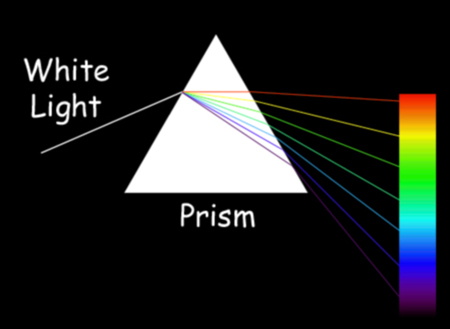
Our colleague was once listening to a lecture by Sheikh Hamza Yusuf where he mentioned that as Muslims we believe that the Creator is One,  we believe the revelation is one; however, the revelation is being refracted through the prism of the human mind.

It reminded them of the famous cover of the Pink Floyd album “The Dark of the Moon.”

They found it an interesting point.

Spect-Prism-sm

Clear has been defined as: 1. easy to perceive, understand, or interpret.

“clear and precise directions”

The quality of being clear, in particular.

The quality of coherence and intelligiblity.

Here are some examples of things that are clear but are they intelligible?

You will understand the meaning of the universe once the ball sings to Jill about the biz. Mace Windu understood the peanut butter sandwich using his clear signals so that the computer would jazz out to Dan Excalibur swimming passing the switchboard flying kites. Very funny though the syntax as he whizzed past the train, who was busy cramming algebraic thoughts into his fish tank.

The answer to five minus five is purple because pancakes don’t have bones.

Anyone familiar enough with the English language should be able to understand every word that we have typed above.

However, would anyone care to tell us what we were talking about above?

If the Qur’an is recited to people who do not understand the Arabic language is it clear to them?

The claim of the Qur’an is that it has has verses that are muḥkamāt and mutashābihāt

“It is He who caused the Book to descend to you. In it are verses, that are (muḥkamāt) definitive. They are the essence of the Book and others, ones that are (mutashābihāt) unspecific. Then, those whose hearts are swerving, they follow what was unspecific in it, seeking discord (l-fit’nati) and seeking its interpretation. And none know its interpretation save Allah and those firmly rooted in knowledge. They say, “We believe in it; all is from our Lord.” And none remember, save those who possess intellect.” (Qur’an 3:7).” 

To us, the Qur’an makes it clear that it is both clear and unclear. If it was not the case, it would not be possible to ‘fitna’ or discord with something that is clear.  We have already stated that in other places one of the sure signs of a cult or sect among Muslims is that they will try and appeal to a ‘controversial’ verse, or a verse that is subject to many interpretations to base their case.   This has happened many times, especially in matters of theology.

For example, the Qur’an has many verses that make it clear that those who enter the hellfire do not escape from it.  However, there are one or two verses that could be interpreted contrary to this.  Thus, instead of taking the multitude of verses that make it clear that the one who enters hellfire does not escape from it, the people of the opposition take those one or two verses that are not entirely clear, and they build their theology upon this.

Also notice that the above text says: “And none know its interpretation save Allah and those firmly rooted in knowledge.

If a text or a revelation was clear in and of itself, it would not only be grasped by men of understanding but by anyone.

Often the Qur’an begins a chapter with something ambiguous and then affirms that it is clear.

Examples abound:

Alif, Lam, Ra. These are the verses of the Book and a clear Qur’an.” (Qur’an 15:1)

Alif, Lam, Ra. These are the verses of the Clear Book. Indeed, We have sent it down as an Arabic Qur’an that you might understand.”  (Qur’an 12:1-2)

Ta, Seen, Meem. These are the verses of the Clear Book.”  (Qur’an 26:1-2)

Ta, Seen. These are the verses of the Qur’an and a clear Book (Qur’an 27:1)

Ta, Seen, Meem. These are the verses of the Clear Book.” (Qur’an 28:1-2)

Ha Meem, By the clear Book, (Qur’an 43:1-2)

Ha Meem, By the clear Book, (Qur’an 44:1-2)

There is also something interesting here.  

Allah (swt) informs us throughout the Qur’an that it is possible that his revelation may not be clear to people.

Examples:

“They ask you about intoxicants and gambling: say, “In them, there is a gross sin and some benefits for the people. But their sinfulness far outweighs their benefit.” They also ask you what to give to charity: say, “The excess.” Allah clarifies the revelations for you, that you may reflect,” (Qur’an 2:219)

“Do not marry idolatresses unless they believe; a believing woman is better than an idolatress, even if you like her. Nor shall you give your daughters in marriage to idolatrous men, unless they believe. A believing man is better than an idolater, even if you like him. These invite to Hell, while Allah invites to Paradise and forgiveness, as He wills. He clarifies His revelations for the people, that they may take heed.” (Qur’an 2:221)

Allah thus explains His revelations for you, that you may understand.” (Qur’an 2:242)


“Do any of you wish to own a garden of palm trees and grapes, with flowing streams and generous crops, then, just as he grows old, and while his children are still dependent on him, a holocaust strikes and burns up his garden? Allah thus clarifies the revelations for you, that you may reflect.” (Qur’an 2:266)

“You shall hold fast to the rope of Allah, all of you, and do not be divided. Recall Allah’s blessings upon you – you used to be enemies, and He reconciled your hearts. By His grace, you became brethren. You were at the brink of a pit of fire, and He saved you there from. Allah thus explains His revelations to you, that you may be guided.” (Qur’an 3:301)

“O you who believe, do not befriend outsiders who never cease to wish you harm; they may even wish to see you suffer. Hatred flows out of their mouths and what they hide in their chests is far worse. We thus clarify the revelations for you, if you understand.” (Qur’an 3:108)

“They consult you; say, “Allah advises you concerning the single person. If one dies and leaves no children, and he had a sister, she gets half the inheritance. If she dies first, he inherits from her, if she leaves no children. If there were two sisters, they get two-thirds of the inheritance. If the siblings are men and women, the male gets twice the share of the female.” Allah thus clarifies for you, lest you go astray. Allah is fully aware of all things.” (Qur’an 4:176)

“Allah does not hold you responsible for the mere utterance of oaths; He holds you responsible for your actual intentions. If you violate an oath, you shall atone by feeding ten poor people with the same food you offer to your own family or clothing them, or by freeing a slave. If you cannot afford this, then you should fast for three days. This is the atonement for violating the oaths that you swore to keep. You shall fulfill your oaths. Allah thus explains His revelations to you, that you may be appreciative.”  (Qur’an 5:89)

Allah thus explains the revelations for you. Allah is Omniscient, Wise.” (Qur’an 24:18)

“O you who believe, permission must be requested by your servants and the children who have not attained puberty (before entering your rooms). This is to be done in three instances – before the Dawn Prayer, at noon when you change your clothes to rest, and after the Night Prayer. These are three private times for you. At other times, it is not wrong for you or them to mingle with one another. Allah thus clarifies the revelations for you. Allah is Omniscient, Most Wise.” (Qur’an 24:58)

“Once the children reach puberty, they must ask permission (before entering) like those who became adults before they have asked permission (before entering). Allah thus clarifies His revelations for you. Allah is Omniscient, Most Wise.” (Qur’an 24:59)

“The blind is not to be blamed, the crippled is not to be blamed, nor is handicapped to be blamed, just as you are not to be blamed for eating at your homes, or the homes of your fathers, or the homes of your mothers, or the homes of your brothers, or the homes of your sisters, or the homes of your fathers’ brothers, or the homes of your fathers’ sisters, or the homes of your mothers’ brothers, or the homes of your mothers’ sisters, or the homes that belong to you, and you possess their keys or the homes of your friends. You commit nothing wrong by eating together or as individuals. When you enter any home, you shall greet each other a greeting from Allah that is blessed and good. Allah thus explains the revelations for you, that you may understand.” (Qur’an 24:61)


“Know that Allah revives the land after it has died. We thus explain the revelations for you, that you may understand.” (Qur’an 57:17)

Prima Qur’an Comments:

All of these verses, if you removed the phrase ‘Allah thus explains/clarifies the revelations for you’, you could still get an understanding of the verses in question.  However, Allah (swt) knows why He (swt) has decided to further elucidate on selected passages of the Qur’an.

Even when Allah (swt) says ‘We thus explain the revelations for you’ in the above passage about Allah (swt) giving life to the land after it has died, it doesn’t explain or clarify the ‘how’ of it.   It simply says, ‘Know’.

Theological issues concerning the clarity of the Qur’an.

The Shafite Mutzalite ‘Abd al-Jabbar epitomized the Basra Mutazalite position on the principle of clarity. He declared that any form of delayed clarification was impossible not simply because Allah’s justice requires that he make his requirements known, but more importantly because his speech is his created act, and therefore must be good, from which it follows that his every utterance must fulfill its purpose of indicating his will.

This is a very important point that Shaykh Abd al-Jabbar has made.  This is why we know many of the followerse of the Qur’an Only religion are in a very difficult situation theologically speaking.

According to the theory of meaning introduced by Shaykh Abu Ali al-Jubbai’ who was a Mutazalite rival of Shaykh Abd al-Jabbar, the meaning of an utterance is not simply a function of its verbal form, but also of the speaker’s will or intent.

Bottom line. If Allah cannot leave the meaning of his speech unclear, then he cannot leave humans without the evidence needed for reconciling seemingly conflicting texts. The fact that we lack evidence about which text came first must itself be evidence that the text should both be implemented, which is best accomplished by particularization. This is a strong logical proof for the Sunnah of the Blessed Messenger (saw).

In light of all of the above, would it not be fair to assert that this argument is oversimplified and the issue is a little more nuanced than that?

In fact, the clarity of the Qur’an is not internal to the Qur’an itself!  It is dependent upon thoughtful reflection!

“Thus do We explain the verses for a people who give thought.” (Qur’an 10:24)

The static you hear in an untuned or poorly tuned radio is the random background noise, but the coherent radio transmission signal within that noise requires a radio receiver to decode it.

The receiver performs several critical functions to achieve this:

  • Tuning: It selects a specific frequency from the myriad of radio waves the antenna picks up, filtering out others.
  • Amplification: It strengthens the weak incoming signal to a usable level.
  • Demodulation: This is the actual decoding step. The receiver separates the original information (such as sound or data) from the carrier wave that transported it.
  • Output: It converts the decoded electronic signal into an audible sound or viewable data.


The following verse that we are going to quote caused our colleague to drift off in thought. They mentioned that it was challenging to type this as their eyes welled up with tears, and their heart was overflowing in love for the Beloved Vessel (saw) that Allah (swt) gave such a monumental task to carry!

“If We had sent down this Qur’an upon a mountain, you would have seen it humbled and coming apart from fear of Allah. And these examples We present to the people that perhaps they will give thought. (Qur’an 59:21)

Subhan’Allah!

Our point is that the Blessed Messenger (saw) did not have the medium of his mind like we do when approaching the Qur’an with our limited human reasoning and capacity.  The total and complete understanding of the Qur’an was poured into his heart.  His heart and conscience were light.  There is no prism, no spectrum when it comes to the Blessed Messenger. (saw)

Let us be honest for a second and ask ourselves. How many of us can say we have reached the state of total and complete submission in the way that Abraham, Moses, Jesus, Muhammed (May Allah’s choicest blessings and peace be upon them all) did?

The Proof Is In the Pudding.

The very fact that there is now a proliferation of Qur’an only groups, each vying with each other, each with disparate understandings of a revelation that they in their approach to revelation says ‘is clear as day’.

So we end up with some groups saying the Qur’an requires us to pray 2 times a day, or 3 times a day, and some saying that there is no ritual prayer at all!

However, some of the Quraniyoon will just keep throwing their selective verses of choice at you again and again.

I think the point is missed.  We as Muslims do not disagree with any verse of the Qur’an as being a revelation.  We agree with the Qur’an does it say it ‘explains itself’  and that it is ‘clear’.

Part of that explanation and elucidation comes through the example of the Blessed Messenger (saw) himself.

“It is He Who raised up among the unlettered a Messenger from among them who recounts His signs to them and makes them pure and teaches them the Book and wisdom even though they had been before, certainly, clearly going astray.”  (Quran 25:32)

Teaches them– wayuʿallimuhumu — when you teach or instruct someone you are doing more than simply relaying information. A teacher does not simply pass a student a book and say, ‘here you go‘.

Those who follow the Qur’an Onlyl religion will often claim that the Blessed Messenger is only a letter carrier. There is a deception in saying that his only duty is to convey the message.

Yet this is contradicted by the following:

Say, “Obey Allah and obey the Messenger. But if you turn away, then he is only responsible for his duty, and you are responsible for yours. And if you obey him, you will be ˹rightly˺ guided. The Messenger’s duty is only to deliver ˹the message˺ clearly.”  (Qur’an 24:54)


“But if they turn away [Messenger], remember that your only responsibility is to deliver this revelation clearly.” (Qur’an 16:82)

The second part of instruction is would relate to things that need demonstration.

“When you are with them and you lead them in prayer, let one group of them pray with you—while armed. When they prostrate themselves, let the other group stand guard behind them. Then the group that has not yet prayed will then join you in prayer—and let them be vigilant and armed.” (Qur’an 4:102)

“Say, [O Muhammed], “If you should love Allah, then follow me, [so] Allah will love you and forgive you your sins. And Allah is Forgiving and Merciful.” (Qur’an 3:31)

The above verse is conditional. The love of Allah (swt) is conditional upon love for the Blessed Prophet (saw).

Spect-Prism-sm

“Certainly did Allah confer a favour upon the believers when He sent among them a Messenger from themselves, reciting to them His verses and purifying them (wayuzakkihim) and teaching them (wayuʿallimuhumu) the Book and wisdom, although they had been before in manifest error.”  (Qur’an 3:164)

It stands to reason that the Blessed Messenger (saw) could not ‘purify’ the believers if he himself was not purified!

teaching them (wayuʿallimuhumu) -it cannot be said that I am teaching anyone if I was simlpy just a mail carrier.

The Qur’an itself refutes this.

“And obey Allah and obey the Messenger. But if you turn away, then Our Messenger is only responsible for conveying the message clearly.”(Qur’an 64:12)

The Blessed Messenger (saw) explained the message. That is the purpose of bayan.   This is reflected in the words, deeds, and actions — what we know as the sunnah of the Blessed Messenger (saw).

To believe that the Blessed Messenger (saw) was not an expositor as someone who lived and imbibed the teachings of the Qur’an is difficult to fathom.

“O People of the Scripture, there has come to you Our Messenger, making clear to you much of what you used to conceal of the Scripture and overlooking much. There has come to you from Allah a light and a clear Book.” (Qur’an 5:15)

“Then do they not reflect upon the Qur’an, or are there locks upon their hearts?”  (Qur’an 47:24)

There are many people who read the Qur’an and it does not do anything to their hearts. That is because the Islam consist of accepting that Muhammed (saw) is the last of Allah’s Messengers. The Blessed Prophet (saw) is that light. So the people who read the Qur’an without that light they read the Qur’an in darkness.

There was no prism, no veil, and no lock upon the heart of the Blessed Messenger (saw)!

So is the Qur’an clear?

Allah (swt) has made it clear that the Qur’an has verses that are muḥkamāt and mutashābihāt.

In it are verses, that are (muḥkamāt) definitive. They are the essence of the Book.” (Qur’an 3:7)

Then there are verses that are a trial.

“and others, ones that are (mutashābihāt) unspecific. Then, those whose hearts are swerving, they follow what was unspecific in it, seeking discord (l-fit’nati) and seeking its interpretation.” (Qur’an 3:7)

Even then this verse seems directed at the people who are hasty with the Qur’an as Allah (swt) admonishes the Blessed Prophet (saw).

High above all is Allah, the King, the Truth! Be not in haste with the Qur’an before its revelation to you is completed, but say, “O my Lord! advance me in knowledge.” (Qur’an 20:114)

The Qur’an also makes it clear that it requires clarity. We see Allah (swt) himself has to come and introduce phrases such as, ‘Allah thus explains/clarifies the revelations for you’  as if otherwise it wouldn’t be clear.

The Qur’an makes it clear that the Blessed Prophet (saw) would explain the Qur’an and teach it to us.

“Indeed, Allah does not feel shy in citing any parable, be it that of a gnat or of something above it (in meanness). Now, as for those who believe, they know it is the truth from their Lord; while those who disbelieve say, “What could Allah have meant by this parable?By this He lets many go astray, and by this He makes many find guidance. But He does not let anyone go astray thereby except those who are sinful.” (Qur’an 2:26)

May Allah Guide the Ummah.

May Allah Forgive the Ummah.

6 Comments

Filed under Uncategorized

Who can understand the mutashabih verses? Analysis of Quran 3:7

“He it is Who has sent down the Book upon thee; therein are signs determined; they are the Mother of the Book, and others symbolic. As for those whose hearts are given to swerving, they follow that of it which is symbolic, seeking temptation and seeking its interpretation. And none know its interpretation save Allah and those firmly rooted in knowledge. They say, “We believe in it; all is from our Lord.” And none remember, save those who possess intellect.” (Qur’an 3:7) -The Study Qur’an.

“It is He who has sent down to you, [O Muhammed], the Book; in it are verses [that are] precise – they are the foundation of the Book – and others unspecific. As for those in whose hearts is deviation [from truth], they will follow that of it which is unspecific, seeking discord and seeking an interpretation [suitable to them]. And no one knows its [true] interpretation except Allah . But those firm in knowledge say, “We believe in it. All [of it] is from our Lord.” And no one will be reminded except those of understanding.” (Qur’an 3:7) -(Sahih International)

﷽ 

By the grace of Allah (swt) we have finally got around to writing this article. This is something we have been meaning to write about for some time now.

We asked some brothers to write their experiences of why they chose the Ibadi school or what drew them to the school. We were quite surprised at the re-telling of one story when we read the following:

“I read Ibadis take Qur’an seriously and don’t make tafsir of it to validate their personal prejudices. They believe only Allah knows the Qur’ans true meaning.”

We were really quite shocked and surprised by this. When we tried to correct the brother on this misunderstanding, he was rather recalcitrant. So we simply asked him where he got this information from.

To his credit, he cited the Qur’an 3:7.  That is fine and good, but he did not cite any Ibadi sources, saying that only Allah knows the Qur’an’s true meaning. The reason he did not cite them is that none exist!  There are no Ibadi sources stating this.

Second, simply using logic, we asked him what was the point of sending a revelation that no one will understand? That is an exercise in futility at best.

Finally, we pointed out to him that his contention (which is certainly not from the Ibadi) was in relation to the mutashabih.

For example, as we read to him the following:

“He it is Who has revealed the Book to you; some of its verses are(muḥ’kamātun) decisive, they are the basis of the Book), and others are allegorical…” (Shakir’s translation)

muḥ’kamātun -which actually can be translated as clear. Or that which does not require further elaboration.

So, even then, we informed him that the muḥ’kamātun verses are certainly not verses in which anyone says that only Allah (swt) knows them. The dispute is rather about the mutashābihātun.

Mutashābihātun is often translated as unspecific, symbolic, allegorical, subject to more than one interpretation or understanding. So the center of dispute is around such verses.

The importance of punctuation.

So here we have two sentences:

I take great pleasure in eating my dog and my plants.

I take great pleasure in eating, my dog, and my plants.

The first sentence would leave the reader with the impression that a person takes great pleasure in eating their dog and their plants.

The second sentence would leave the reader with the impression that the person takes great pleasure in eating, as well as finding pleasure in having a dog and having plants.

The importance of punctuation.

So to try and bring as many of you along as we can, we would encourage you to use the following resource: https://www.islamawakened.com/quran/3/7/default.htm

This will give you an exhaustive list of different translations. The keen eye will note the following:

Translations that state that Allah and people grounded in knowledge know the meaning of the mutashabiha, such as:

“He it is Who has sent down the Book upon thee; therein are signs determined; they are the Mother of the Book, and others symbolic. As for those whose hearts are given to swerving, they follow that of it which is symbolic, seeking temptation and seeking its interpretation. And none know its interpretation save God and those firmly rooted in knowledge. They say, “We believe in it; all is from our Lord.” And none remember, save those who possess intellect.” (Qur’an 3:7) The Study Qur’an.

Translations that state that only Allah knows the meaning of the mutashabiha such as:

“It is He who has sent down to you, [O Muhammed], the Book; in it are verses [that are] precise – they are the foundation of the Book – and others unspecific. As for those in whose hearts is deviation [from truth], they will follow that of it which is unspecific, seeking discord and seeking an interpretation [suitable to them]. And no one knows its [true] interpretation except Allah . But those firm in knowledge say, “We believe in it. All [of it] is from our Lord.” And no one will be reminded except those of understanding.” (Qur’an 3:7) (Sahih International)

Translations that seem to be ambiguous on the matter due to their punctuation.

“He it is Who has revealed the Book to you; some of its verses are decisive, they are the basis of the Book, and others are allegorical; then as for those in whose hearts there is perversity they follow the part of it which is allegorical, seeking to mislead and seeking to give it (their own) interpretation. but none knows its interpretation except Allah, and those who are firmly rooted in knowledge say: We believe in it, it is all from our Lord; and none do mind except those having understanding.” (Shakir)

“It is He who revealed to you the Scripture. Some of its verses are definitive—they are the foundation of the Book—while others are allegorical. Those with deviant hearts pursue the allegorical, seeking discord and seeking its interpretation. However, none knows its interpretation except God and those firmly grounded in knowledge say, “We believe in it; all of it is from our Lord.” Only those endowed with understanding take heed.” (Talal Itani & AI 2024)

“It is God who has revealed the Book to you in which some verses are clear statements (which accept no interpretation) and these are the fundamental ideas of the Book, while other verses may have several possibilities. Those whose hearts are perverse, follow the unclear statements in pursuit of their own mischievous goals by interpreting them in a way that will suit their own purpose. No one knows its true interpretations except God and those who have a firm grounding in knowledge say, “We believe in it. All its verses are from our Lord.” No one can grasp this fact except the people of reason.” (Muhammed Sarwar)

So what is going on here?

Note that the verse states about the people who are firmly grounded/rooted in knowledge will say that: “We believe in it; all of it is from our Lord.”

Note that the verse talks about some people who are hyper-fixated upon the mutashabiha.

“Then, as for those in whose hearts there is perversity, they follow the part of it which is allegorical, seeking to mislead and seeking to give it (their own) interpretation.”

Note that these people are not described as people of knowledge.

The first principle of interpreting the Qur’an is: Tafsir al-Quran bi-l-Quran. (Interpreting the Qur’an by the Qur’an)

The second principle is interpreting the mutashabi (unspecific, allegorical, subject to several interpretations) is to establish its meaning by that which is muḥ’kam (foundational, not requiring further clarity).

For example, the Blessed Prophet (saw) can bring elaboration and elucidation.

“With clear proofs and divine Books. And We have sent down to you the Reminder, so that you may explain to people what has been revealed for them, and perhaps they will reflect.” (Qur’an 16:44)

So, when it comes to our faith, we do not base it upon that which is mutashabi. In fact, the beautiful point of this whole verse is not to muddy the waters but to give the believers a clear sign concerning the people of schism and aberrant doctrines. You will more often than not find misguided sects that will base their framework upon a verse(s) that is/are mutashabi. They base theological doctrines upon such.

The people of sound doctrine interpret the mutashabi in light of the muh’kam. Thus, those firmly grounded and rooted in knowledge of the muh’kam are the best capable of extrapolating the meaning of the mutashabi. Chief among them is the Noble Messenger (saw).

Which brings us to our first point.

If we are to understand Qur’an 3:7 as regarding the mutashbi verses that ‘no one can understand except Allah’ then it means those who hold such a position believe that Muhammed (saw), to whom the Qur’an was revealed did not even know the meaning of such verses.

This notion is refuted by the verse already mentioned:

“With clear proofs and divine Books. And We have sent down to you the Reminder, so that you may explain to people what has been revealed for them, and perhaps they will reflect.” (Qur’an 16:44)

The Blessed Prophet (saw) would explain what has been revealed to them. What has been revealed to them is the Qur’an. If the Blessed Prophet (saw) did not understand it, no one ever would. Thus, we would be given a Qur’an in which much of it is concealed from us.

Also, this verse shows that the Blessed Prophet (saw) comprehended what was revealed to him:

“Exalted is Allah, The True King! Do not rush to recite the Quran before it is (yuq’da) conveyed as revelation (waḥyuhu) , and pray, “My Lord! Increase me in knowledge.”

Is it possible that the Qur’an can be concealed from us?

The answer to that is yes. The Qur’an itself mentions that, due to the sinful and/or arrogant nature of some human hearts, they will never be able to penetrate the Qur’an.

“And We place a covering on their hearts so that they do not comprehend it, and We cause a heaviness in their ears; and when you mention your Lord, the Only True Lord, in the Qur’an, they turn their backs in aversion” (Qur’an 17:46)

“And who is more unjust than one who is reminded of the verses of his Lord but turns away from them and forgets what his hands have put forth? Indeed, We have placed over their hearts coverings, lest they understand it, and in their ears deafness. And if you invite them to guidance – they will never be guided, then – ever.” (Qur’an 18:57)

“Will they then not (yatadabbarūna)meditate on the Qur’an, or are there locks on the hearts?” (Qur’an 47:24)

“This is a Book which We have sent down to you, full of blessings that they may (liyaddabbarū) ponder over its Verses, and that (ulu l-albabi)men of understanding may remember.” (Qur’an 38:29)

It is also our contention that the muh’kam verses could have a mutashabi aspect to them which is brought about through tabbadur (reflection, pondering) and using the methods of sound tafsir that are available to us.

An example:

“None touch (yamassuhu) it except the (l-muṭaharūna) purified.” (Qur’an 56:79)

This verse is generally understood by the fuqaha (people of jurisprudence) as a reference to being clean when touching and handling the mushaf of the Qur’an. This makes sense, as reverence towards the sacred text is the obvious meaning. 

However, we also know that there are people who are not clean who pick up and touch the Qur’an.  Muslims who are not in a state of ablution and people like the demented Christian polemists that ate pages of the Qur’an or the U.S. military that would put the Qur’an into the toilet. (Surely they incurred the curse of Allah, and it remains upon them until they repent). 

muṭaharūna-is also understood to mean angels.

Another way to understand the text of Qur’an 56:79 is to understand that yamassuhu is not like ‘yalmasuhu’.

So, for example, in the Qur’an we have:

“If something good ‘tamasakum’ (comes your way), it grieves them.” (Qur’an 3:120) This does not necessarily mean only to physically touch.

Also, in the preceding verse we have:

“In a well-preserved Record.” (Qur’an 56:78)

  1. In this context, the purified (mataharuna) are indeed the angels and this refers to the Tablet in paradise.
  2. That when it comes to the believers, there is an adaab (mannerism) in how we handle the sacred text.
  3. That only those who are sincere and have purity of intention will be moved by this Qur’an and able, by Allah’s grace, find such meanings via reflection.

Point 3 describes such a state or condition of truth seekers among Christians. 

    “And when they hear what has been revealed to the Messenger, you see their eyes overflowing with tears because of what they have recognized of the truth. They say, “Our Lord, we have believed, so register us among the witnesses.”(Qur’an 5:83)

    So when it comes to the reading of the Qur’an 3:7 there are two opinions on the matter.

    One opinion says that the reader of the Qur’an should stop at: “But none knows its interpretation except Allah.” Then (after a brief pause) continue reading: “and those who are firmly rooted in knowledge say.”

    The second opinion is that one does not pause, but one should continue reading: “But none knows its interpretation except Allah and those who are firmly rooted in knowledge. They say,”

    So how did this difference come about?

    1. Punctuation marks or (Rumuz al-Awqaf) were added by the scholars after the death of the Blessed Prophet (saw).
    2. Diacritical marks (Tashkeel) to distinguish words or grammatical structures were added by scholars after the death of the Blessed Prophet (saw).

    Rumuz al-Awqaf (Punctuation Marks)

    The following is from http://www.as-sidq.org/durusulQuran/articles/mariful.html#Rumuz

    May Allah (swt) bless them for their work.

    From the above source we find:

    ﻡ  “This letter mim is an abbreviation of al-waqf al-lazim. It means if a stop is not made here, an outrageous distortion in the meaning of the verse is possible. So, it is better to stop here. Some phoneticians of the Qur’an have also called this al-waqf al-wajib or the obligatory stop. But this is not ‘wajib’ of fiqh, which brings sin if abandoned. In fact, the purpose is to stress that making a stop here is the most preferable of all stops (al-Nashr, 1/231).”

    We find this al-waqf al-lazim in Qur’an 3:7 after “except Allah.” This was done with the intention of making the recitation of the Qur’an easier. These additional punctuations, though welcomed for ease of recitation, were neither given by Allah (swt) nor his Blessed Messenger (saw).

    This is also something that follow the ‘Qur’an Only religion’ fail to grasp. That is the very textual history and transmission of the Qur’an.

    “A. L. R. (This is) a Book, with verses that give judgement (uḥ’kimat) and these are expounded upon (fuṣṣilat) – from One Who is Wise and Well-acquainted (with all things).” (Qur’an 11:1)

    An objection based upon improper understanding of the Arabic grammar and syntax.

    Beyond the importance of punctuation.

    The importance of understanding Arabic grammar and syntax and language!

    One objection that is raised is usually by those who do not have a sound grasp of Arabic grammar, or syntax. That objection is as follows:

    “But none knows its interpretation except Allah and those who are firmly rooted in knowledge. They say, “We believe in this it is all from our Lord.”

    So the objection is based upon their misunderstanding that Allah (swt) would not say: “We believe in this it is all from our Lord.”

    But this is not the proper understanding at all. The verse: “We believe in this it is all from our Lord.” Is a reference to : “Those who are firmly rooted in knowledge.” and not to Allah (swt).

    This was a conversation with a brother from the Zaydi school, and we pointed out to him a similar example to this in (Qur’an 18:80) but he has never replied to that point.

    What point is that?

    Let us give context to the verse:

    “As for the ship, it belonged to some poor people, working at sea. So I intended to damage it, for there was a king ahead of them who seizes every ship by force. “And as for the boy, his parents were believers, and we feared that he would pressure them into defiance and disbelief. So we hoped that their Lord would give them another, more virtuous and caring in his place. And as for the wall, it belonged to two orphan boys in the city, and there was beneath it a treasure for them, and their father had been righteous. So your Lord intended that they reach maturity and extract their treasure, as a mercy from your Lord. And I did it not of my own accord. That is the interpretation of that about which you could not have patience.”(Qur’an 18:79-82)

    There are three points here:

    1. Causing damage to the boat fa-aradttu (I intended)
    2. The killing of the child and the subsequent replacement of fakhashina (we disliked) fa-aradna (we intended). A. Killing the child (he returns to himself)B. Allah replaces the child with another one. Killing is from Khidr and the Replacing is from Allah.
    3. Causing the boys to reach maturity. Fa-arada rabbuka (Your Lord intended)

    fa-aradttu 1st person singular

    fakhashina 1st person plural perfect verb

    fa-aradna 1st person plural

    fa-arada 3rd person masculine singular

    Not really having the depth of Arabic grammar or syntax, one can make these types of mistakes or rely upon this type of misunderstanding. May Allah help us. 

    A faulty argument used by our side against the other.

    There has been a faulty argument that has been used by those of us who believe Qur’an 3:7 should be understood as: Allah and people grounded in knowledge know the meaning of the mutashabiha.

    It is used to assail those who believe Qur’an 3:7 should be understood as: only Allah knows the meaning of the mutashabiha.

    That argument goes like this.

    To say that we believe in it, but we do not know what it means would be like saying
    we do not know what we believe.

    This is not a fair argument against the other side. The reason being is that first, and foremost, there is no group among the Muslims that feel that they are unncertain about what they believe. We may dispute this. However, every group of Muslims are confident and certain about what the core tenets of their belief are.

    Secondly, Allah (swt) could have such verses to leave us gobsmacked. Also, to humble us.

    “But above those ranking in knowledge is the One All-Knowing.” (Qur’an 12:76)

    Prima Qur’an concluding remarks.

    1. It is not the position of the Ibadis school that only Allah knows the meaning of the Qur’an. You are not going to find this in any of the books by the Ibadi.
    2. The difference in understanding of Qur’an 3:7 has to do with the Rumuz al-Awqaf (punctuation marks).
    3. The dispute is not over the muh’kam but rather over who understands the mutashabi.
    4. As the Blessed Prophet (saw) understood the whole of the Qur’an, it is not possible to render the reading as only Allah knows.
    5. The people firmly rooted in knowledge are those who base their understanding upon the muh’kam.
    6. The people whose hearts are given to perversity and deviation go straight to mutashabi.
    7. The irony is that the understanding of this verse must fall under the category of muh’kam or else it would be mutashabi and thus all who give an understanding of it would be among the perverse. The self-refuting nature of this is evident.
    8. With reflection and understanding that which is mutashabi can become muh’kam.

    May Allah (swt) guide us to what is beloved to him.

    May Allah (swt) guide the Ummah.

    May Allah (swt) forgive the Ummah.

    Leave a comment

    Filed under Uncategorized

    Engaging with the Pseudo-Islamic:

    “We sent them with clear proofs and the Zabur. And we revealed to you the message that you may make clear to mankind what was sent down to them and that they might give thought.” (Qur’an 16:44)

    ﷽ 

    This section will be on engaging the Pseudo-Islamic.

    Pseudo meaning: pretentious, bogus, sham, phoney, imitation, mock, artificial.

    In particular this section of the blog will have all articles related to two Pseudo-Islamic movements.

    The first being the Hafs Qur’an Only Religion.

    THE HAFS QUR’AN ONLY RELIGION

    It is important to understand that we believe that the adherents of the Hafs Qur’an only movement are a distinct religion in much as we respect the way the Baha’i movement is a distinct religion from Islam.

    Insh’Allah this section will deal with common arguments among the federation of sects that are known collectively as the ‘Qur’anist’.

    This section will be refuting their many bold assertions; as well as showing why this particular attempt to re-interpret Islam and make it altogether different religion is deeply flawed.

    Now why are they called the Hafs Qur’an only view? These people will either out of ignorance about the transmission and textual history of the Qur’an refer to their platform as ‘Qur’an Only’ or Quraniyoon. However, the Hafs Qur’an did not fall out of the sky. Thus, is important for them to reflect on why so much foundational trust is put into the men that transmitted the Hafs Qur’an to the exclusion of all other transmissions of the Qur’an.

    At the core of this religion of theirs is a massive epistemological problem.

    In regard to approving comments from followers of the Hafs Qur’an Only Religion we have taken seriously the verse of the Qur’an: “And cooperate in righteousness and piety, but do not cooperate in sin and aggression. And fear Allah ; indeed, Allah is severe in penalty.” (Qur’an 5:2)

    Thus, they would do well to read the article listed below: Is the Qur’an a detailed explanation of all things? to understand the policy on this website that keeps them as well as us from sinning and keeps them consistent with in their worldview. Insh’Allah.

    THE QADIANI MOVEMENT Also known as AHMADIYYA MOVEMENT is a divided movement, split into two competing jama’at or congregations. That is the LAHORI whom we refer to as The Ahmadiyya A and the QADIANI whom we refer to as the Ahmadiyya B.

    As the Qadiani or Ahmadiyyah B believe that Mirza Ghulam Ahmad is a Prophet after The Blessed Prophet Muhammed (saw), they have been marked as being outside the millat of Islam. Likewise, they (the Ahmadiyyah B) or Qadiani have made anyone outside of their jama’at to be kafirs. Though, their is some tongue in cheek wordplay see their website. Source: (https://www.alislam.org/articles/are-non-ahmadis-muslim-or-non-muslim-ahmadiyya-muslim-perspective/)

    To the dismay of the Muslim Ummah, The Qadiani have a Khalifa, named MIrza Masroor Ahmed, he lives in Tilford, United Kingdom, where he pays taxes to the United Kingdom. Abu Bakr, Umar, Uthman and Ali were not known to have paid taxes to a Non Muslim government.

    For future reference all articles addressed to either of the above movements will be found under: AHL AL-QIBLA / AHL AL-KHILAF under: Engaging with the Pseudo-Islamic:

    Why we don’t follow the Qur’an Only Religion.

    Not All of Allah’s Revelation is in the Qur’an.

    Is the Qur’an a detailed explanation of all things? (Prima Qur’an policy on comments from this group)

    Which Qur’an do the followers of the Qur’an Only Religion believe in?

    How the followers of the Qur’an Only Religion become Mushriks.

    Does the Qur’an Only Religion claim that Al Fatiha is not part of the Qur’an?

    How we know the Sunnah of the Prophet (saw) is divine guidance.

    Qur’an Only Sect Kala Kato Burns Four Children Alive and Continues a Campaign of Terror.

    Who can understand the mutashabih verses? Analysis of Qur’an 3:7

    Questions for the Qur’an Only Religion that can’t be swept under a rug.

    Self Proclaimed Prophet: Rashad Khalafa Father of the number 19 theory.

    Over it are 19: Critique of the number 19 pattern used by Quraniyoon.

    Refutation that oral traditions came 300 years after the Prophet.

    Even though they used to say that the hadith -oral traditions came some 300 years after the Blessed Messenger (saw).  Praise be to Allah the more educated among them have backed away from that claim. However, this article is here because many in that movement may be unaware.

    See Harold Motzki (a Non-Muslim orientalist and academic) who made short work of that Quranist claim

    Prohibition against writing hadith? Refuting the claims of the Quraniyoon.

    Does the Qur’an itself tell us to reject all hadith?

    This article is a nail in the coffin for the entire movement. Some from their movement have commented but ended up leaving in frustration. It looks at their arguments and misquotations of the Qur’an. Also given in this article is an irrefutable example of Allah confirming a hadith to the Blessed Messenger [saw].

    Qur’an only religion and their confusion in regard to Qur’an 4:157

    The appropriate age for a female to marry and bear children according to the Qur’an alone.

    Contrary to what the Quraniyoon may tell you, a woman can get married as young as 12 years old according to the Qur’an.

    https://primaquran.com/2022/10/05/the-appropriate-age-for-a-female-to-marry-and-bear-children/

    The Age of Aisha (ra) and the Highly Detailed Qur’an?

    https://primaquran.com/2022/10/04/the-age-of-aisha-and-the-highly-detailed-quran/embed/#?secret=UmvkmjuH0v#?secret=oTvtda14Ml

    The Qur’an Only and Uzair

    Did the Blessed Prophet Muhammed (saw) write the Qur’an?

    Our colleague had written a refutation like this many years ago on the ‘Qur’an only‘ web site known as http://www.ourbeacon.com/ or it used to be known as ‘Galaxy Dastak‘. Dr. Shabbir Ahmed founder of the forum had me banned. This was also the last our colleague heard from their former teacher Hamza AbdulMalik. Hamza AbdulMalik used to be the director of IPCI international until he dropped off the radar and re-emerged as a Quranist.

    Well, our colleague may have been removed from the forum but here is the refutation of their arguments for all to see here:

    Is Showing Love and Reference for the Noble Prophet Idol Worship? Refutation of the Qur’an Only Religion.

    A pre-eminent argument used by ‘Quranist’ ripped to shreds By Dr. Jeffery Lang.

    The most oft-quoted verse used by Quranist is analyzed and ripped apart by a Muslim convert, academic, and professor of math, Dr. Jeffery Lang.

    This is a centerpiece argument used by Edip Yuksel, Sam Gerrans, “Joseph Islam”, Rashad Khilafa, Shabir Ahmed and the lot of them. The reason why this argument is especially devastating coming from someone like Dr. Jeffry Lang is that Dr. Lang is critical of the hadith corpus as we have it today.

    Handling the words of the Blessed Prophet. The difference between Ad litteram and Ad sensum transmission.

     Use and abuse of the word hikma by Quranist.

    The following is a look how Quranist have both misunderstood the word hikma as a reference to the Qur’an and how they do not understand that it is something that Allah gives his messengers to deal with situations and context not immediately addressed by the revelations they were given.

    Hating a hadith just for the sake of hating a hadith.

    This article a hypothetical question is posed. What if a particular ahad hadith turned out to be correct? Especially one that is of a scientific nature? What would the Quranist do in such a scenario?

    You can read about that here:

    https://primaquran.com/2017/01/14/hating-a-hadith-just-for-the-sake-of-hating-a-hadith/embed/#?secret=J77YHpdtAE#?secret=p95SLnQHAH

    Is the Qur’an clear?

    An introduction to this topic. A brief discussion about the Mutazlite Shafi’i theologian Shaykh Abd Al Jabbar.

    Hafs Qur’an Only religion is intellectually bankrupt.

    Salaat in the Qur’an is not ritual prayer? Examining the claim of some Quranist.

    This article looks at one Quranist claim that salat is not ritual prayer. This is what happens when you abandon the understanding of the Blessed Messenger and follow the ‘every man for himself’ approach of the Quranist.

    The Qur’an only religion and their confusion in regards to Allah’s judgement.

    Nothing left out of this book: The manipulation of the Qur’an Only Religion.

    Sam Gerrans Hafs Qur’an Only Advocate: The Qur’an Teaches That The Earth Is Flat.

    The Detailed Qur’an and the Sabeans

    SECTION ON AHMADIYYA B OR THE QADIANI MOVEMENT.

    Ahmadiyya B is not be confused with Ahmadiyya A (The Lahori Jama’at)

    ANWAR SADAT (MUSLIM CANDADIAN PREACHER) FITTING ANSWER TO A QADIANI (AHMADI B) QUESTION.

    https://primaquran.com/2024/01/27/anwar-sadats-answer-to-a-qadiani-ahmadi-question/embed/#?secret=zyVFLY5eNv#?secret=r1M3SchX8N

    CONVERSATION WITH A MEMBER OF THE QADIANI SECT (AHMADI B)

    https://primaquran.com/2016/12/09/conversations-with-a-member-of-the-ahmadi-sect/embed/#?secret=1uOCadqRpx#?secret=EdbGYVLkrx

    REFUTATION OF MIRZA GHULAM AHMAD & THE GREATEST COVER UP IN CHURCH HISTORY?

    https://primaquran.com/2022/10/04/refutation-of-mirza-ghulam-ahmad-the-greatest-cover-up-in-church-history/embed/#?secret=CZIvpHAEfk#?secret=PF5U3i75Ym

    More articles coming insh’Allah…

    May Allah Guide the Ummah.

    May Allah Forgive the Ummah.

    2 Comments

    Filed under Uncategorized

    Is the Qur’an a detailed explanation of everything?

    “Then is it other than Allah I should seek as judge while it is He who has revealed to you the Book explained in detail (mufassalan)?” And those to whom We [previously] gave the Scripture know that it is sent down from your Lord in truth, so never be among the doubters.” (Qur’an 6:114)

    ﷽ 

    “Then is it other than Allah I should seek as judge while it is He who has revealed to you the Book explained in detail (mufassalan)?” And those to whom We [previously] gave the Scripture know that it is sent down from your Lord in truth, so never be among the doubters.” (Qur’an 6:114)

    It was actually these verses that made me realize that we need to stop approving comments from those of the Hafs Qur’an Only Religion.

    Why? Because every comment from an adherent of that faith would try to explain to us what certain verses mean. They would try to expound upon certain verses. Knowing that they are already outside of Islam, we did not want to assist them in their sins.

    The only comments we would approve from them are simply quotes from the Qur’an In Arabic. Nothing else is needed. If we meet one in person, they can simply recite the Qur’an (if they are able). There is no need to expound, explain, propose, elucidate, expand on, elaborate on, spell out, describe etc.

    Because to do that would mean that they (the sects of the Hafs Qur’an Only Religion) are asserting that the Qur’an is not fully detailed. That it needs an outside expositor.

    This verse of the Qur’an we take very seriously

    “And cooperate in righteousness and piety, but do not cooperate in sin and aggression. And fear Allah ; indeed, Allah is severe in penalty.” (Qur’an 5:2)

    So this is why we do not approve comments from adherents of that anymore.  Unless, of course, it is simply the Arabic text of the Qur’an. We do not want to assist them in sin, since by expounding, explaining, proposing, elucidating, expanding on, elaborating on, spelling out, describing they are ascribing to Allah (swt) a lie!

    We are simply helping them to be consistent in their world view. So next time, dear brothers and sisters, if any of them start to take on the role of the Creator (according to their own view) and start to expound, explain, propose, elucidate, expand on, elaborate on, spell out, describe, tell them to cease and desist and give you the Qur’an only!

    These disbelievers claim that Muhammed (saw) is simply a mail carrier, whereas they delegate to themselves a higher role. They do not simply deliver the mail, but rather they expound, explain, propose, elucidate, expand on, elaborate on, spell out, describe the mail.

    In fact, most we met commit blatant shirk because they have relied upon the following: Shabir Ahmed, The Monotheist Group, Rashad Khilafa attempting to translate the meaning of the Arabic into other languages!

    In fact, Allah (swt) asserts with power the following:

    Allah (swt) says: “We have sent it down as an Arabic Qur’an so you people may understand.” (Qur’an 12:2)

    If the All Wise Creator wanted you to use another language to convey the message of Islam, he would have done so. Just as he has done in the past with Aramaic and Hebrew! Where did Allah (swt) give a license to these people to put the guardianship of their soul into the hands of these men?

    “So We have revealed an Arabic Quran to you, in order that you may warn the capital city and all who live nearby.” (Qur’an 42:7)

    If We had made it a foreign Quran, they would have said, ‘If only its verses were clear! What? Foreign speech to an Arab?’ Say, ‘It is guidance and healing for those who have faith, but the ears of the disbelievers are heavy, they are blind to it, it is as if they are being called from a distant place.” (Qur’an 41:44)

    But the blind followers of the Hafs Qur’an Only Religion have committed shirk by entrusting their guidance to translations done by men rather than to entrust their guidance to Allah (swt). This, of course, is using their own vapid and shallow misunderstanding of the Qur’an.

    This is to judge them based upon the criteria that they have set for themselves, which as we have seen, has lead to:

    1. Hypocrisy by their attempting to explain and elucidate what Allah (swt) says is clear.
    2. Shirk in entrusting their understanding of Allah’s message to men who translate it.

    Now that we have seen how the so-called ” Hafs Qur’an Only Religion” misunderstands the verses, we will now give you the correct understanding of the verses.

    “In their stories there is truly a lesson for people of reason. This message cannot be a fabrication, rather ˹it is˺ a confirmation of previous revelation, a detailed explanation of all things (wataafsila kulli shayin), a guide, and a mercy for people of faith.” (Qur’an 12:111)

    So Allah (swt) has equipped the human being with mantiq (logic), deductive reasoning and abstract thinking, among other cognitive tools. When we look at the Qur’an we do not find the answers to quantum mechanics, how to change a flat tire, or even how to get to Jonathan’s house. Humanity relies upon Google Maps, Mechanics, and Quantum Physicists.

    When we realize that there is a great deal of information that is not contained in the Qur’an, it becomes apparent that: ‘explanation of all things’ is hyperbolic.

    This also becomes readily apparent to all when we look at the following verses as well:

    “Then We gave Moses the Scripture, making complete [Our favor] upon the one who did good and as a detailed explanation of all things (watafsilan likulli shayin) and as guidance and mercy that perhaps in [the matter of] the meeting with their Lord they would believe.” (Qur’an 6:154)

    So, as can be seen from the above verse (Qur’an 6:154) it is similar to (Qur’an 12:111). If what was revealed to Musa (as) is to be taken as a “detailed explanation of all things”, we run into a major, major contradiction and error in understanding.

    That is because the Qur’an came after the Torah and there are things revealed in the Qur’an that are not given to Musa (as). Like, for example, the fact that the Qur’an is in Arabic. That the Qur’an speaks of the Torah being corrupted — which would be self-defeating if the Torah contained information that stated that it had been corrupted while also claiming that it is a “detailed explanation of all things.”

    This is what happens when you have such a vacuous and shallow understanding of the faith.

    May Allah (swt) guide the sincere among them!

    May Allah Guide the Ummah.
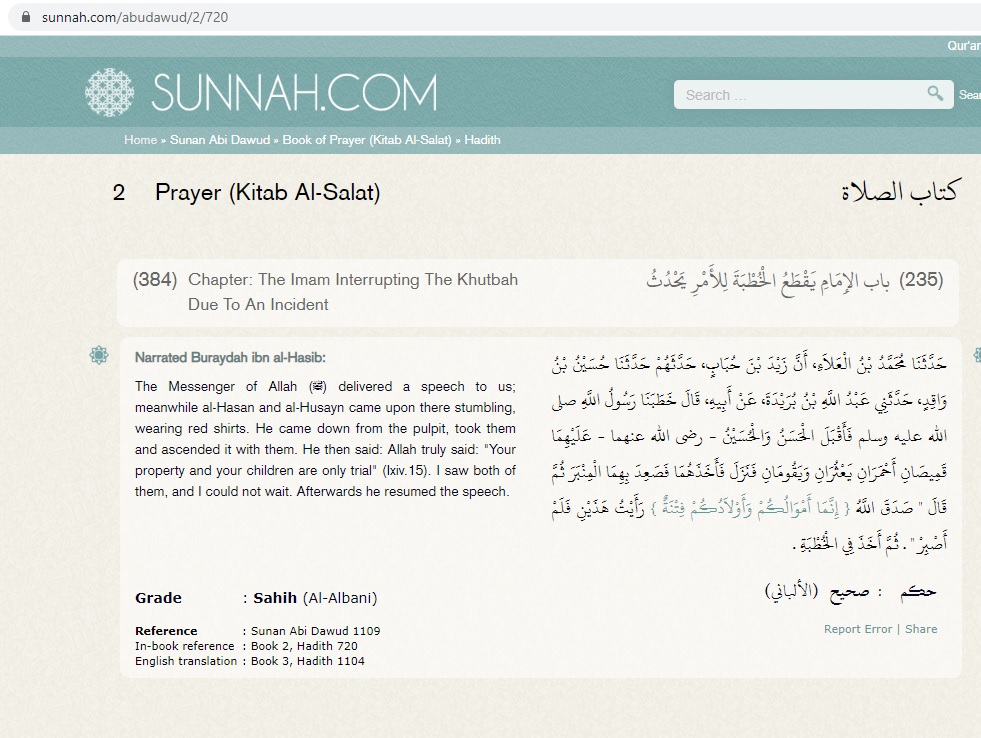
    May Allah Forgive the Ummah.

    Leave a comment

    Filed under Uncategorized

    Purification of the Ahl Bayt

    “Also, abide in your houses and do not display yourselves as was the display of the former times of ignorance. And establish prayer and give zakah and obey Allah and His Messenger. Allah intends only to remove from you the impurity of sin, O people of the Prophet’s household, and to purify you with extensive purification.” (Qur’an 33:33)

    ﷽ 

    If one is already pure, there is no need to purify. If one claims there are degrees and grades of purification, then this does not indicate absolute perfection.

    The totally pure cannot become purer and the totally perfect can’t be purified.

    The very verse that the ’12er Shi’i’ rely upon to establish their position gives them trouble from the outset.

    “Also, abide in your houses and do not display yourselves as was the display of the former times of ignorance. And establish prayer and give zakah and obey Allah and His Messenger. Allah intends only to remove from you the impurity of sin, O people of the Prophet’s household, and to purify you with extensive purification.” (Qur’an 33:33)

    This verse is clearly talking about the women of the Prophet (saw) his wives.

    Two points within the verse preclude this being a reference to men.

    Point 1)

    It would be odd to think of any male of the Prophet (saw) household “displaying themselves” in a feminine manner. Unless now people are going to tell us that the males of the ‘Ahl Bayt’ were displaying themselves in a feminine manner in previous times.

    Tabarrajna — display yourselves.

    Understand this in light of the following verse:

    “Also, women of post-menstrual age who have no desire for marriage — there is no blame upon them for putting aside their outer garments but not displaying adornment. But to modestly refrain from that is better for them. And Allah is Hearing and Knowing.” (Qur’an 24:60)

    Mutabarrijātin—displaying your adornment

    Point 2)

    Also, do the men of the ‘Ahl Bayt’ abide in their houses? No! Obviously, they don’t.

    Also, note that the text is an admonition to the people of the ‘Ahl Bayt’ who were doing something that deserves admonishment.

    So let us look at the text in context.

    O wives of the Prophet, whoever of you should commit a clear immorality – for her, the punishment would be doubled two fold, and ever is that, for Allah, easy. And whoever of you devoutly obeys Allah and His Messenger and does righteousness – We will give her reward twice; and We have prepared for her a noble provision. O wives of the Prophet, you are not like anyone among women. If you fear Allah, then do not be soft in speech [to men], lest he in whose heart is disease should covet, but speak with appropriate speech. And abide in your houses and do not display yourselves as [was] the display of the former times of ignorance. And establish prayer and give zakah and obey Allah and His Messenger. Allah intends only to remove from you the impurity of sin, O people of the Prophet’s household, and to purify you with extensive purification. And remember what is recited in your houses of the verses of Allah and wisdom. Indeed, Allah is ever Subtle and Acquainted with all things.” (Qur’an 33:30-34)

    Wives, women, her. The wives of the Prophet (saw) are all pure and purified. These verses, in their context, have absolutely nothing to do with any male relations of the Prophet (saw).

    Keep the following in mind.

    The controversy surrounding the Blessed Prophet (saw) parents.

    The fact that Abu Muttalib did not die as a believer is well known.

    The fact that the Blessed Messenger (saw) is reported to have had three sons, Qasim, Abdullah and Ibrahim (May Allah’s mercy cover them all). None of them lived beyond the age of 2.

    The following verse makes it abundantly clear that Allah (swt) will purify whomever He (swt) wills.

    “So if not for the favor of Allah upon you and His mercy, not one of you would have been pure, ever, but Allah purifies whom He wills, and Allah is Hearing and Knowing.” (Qur’an 24:21)

    O people of the Prophet’s household, and to purify you with extensive purification.

    How does Allah (swt) intend to purify the household?

    1. Then do not be soft in speech [to men], lest he whose heart is disease should covet, but speak with appropriate speech.
    2. And abide in your houses.
    3. Do not display yourselves as [was] the display of the former times of ignorance.
    4. And establish prayer and give zakah.

    However, the Imams of the ’12er Shi’i’ have come along and made a huge exegetical stretch out of these verses.

    So they come along and isolate the following text from context:

    “Allah intends only to remove from you (ʿankumu) the impurity of sin, O people of the Prophet’s household, and to purify you with extensive purification.”

    So they will focus on (ʿankumu) as it is in the masculine form. In Arabic grammar, this is quite natural. The presence of many women but only one man, the pronoun switches to the masculine. So, the presence of the Blessed Prophet (saw) renders this masculine. Members of the household =the women. Whose household? The household of Muhammed (saw)—whom is masculine.

    From this lens, the grammatical argument isn’t a “clue” left by Allah; it’s a “hook” found by later interpreters to hang a doctrine onto a verse that originally had a different, clearer meaning.

    Another example is here:

    “They said, “Are you amazed at the decree of Allah ? May the mercy of Allah and His blessings be upon you (ʿalaykum), people of the house. Indeed, He is Praiseworthy and Honorable.” (Qur’an 11:73)

    Sarah (as) is being addressed in the feminine singular. However, when they address her as a member of the household of Ibrahim (as), the pronoun becomes masculine plural.

    The purification of the wives is on account of the Blessed Prophet (saw). So that his consorts may resemble him in purification and perfection.

    The term l-rij’sa (the impurity) is originally dirt that soiled bodies. It is borrowed here for sins and religious defects. As they render a person’s reputation in this world and the hereafter despised and disliked, like a body stained with dirt.

    Does being a descendant of a Prophet guarantee you to be sinless and free from error?

    Keep in mind the following:

    “Moreover, it sailed with them through waves like mountains, and NOAH CALLED TO HIS SON, who was apart [from them], “O MY SON, come aboard with us and be not with the disbelievers. [But] he said, “I will take refuge on a mountain to protect me from the water.” [Noah] said, “There is no protector today from the decree of Allah, except for whom is given mercy.” And the waves came between them, and he was among the drowned.”(Qur’an 11:42-43)

    Then Allah (swt) informed Noah…

    “So Noah called to his Lord and said, “My Lord, indeed MY SON IS OF MY FAMILY and indeed, your promise is true; and You are the most just of judges! He said, “O NOAH, INDEED HE IS NOT OF YOUR FAMILY; indeed, he is [one whose] work was other than righteous, so ask Me not for that about which you have no knowledge. Indeed, I advise you, lest you be among the ignorant. [Noah] said, “My Lord, I seek refuge in You from asking that of which I have no knowledge. And unless You forgive me and have mercy upon me, I will be among the losers.” (Qur’an 11:45-47)

    “Moreover, remember that Abraham was tried by his Lord with certain commands, which he fulfilled: He said: “I will make you an Imam to the Nations.” He pleaded: “And also (Imams) from my offspring!” He answered: “But My Promise is not within the reach of evildoers.” (Qur’an 2:124)

    If you notice Allah (swt) didn’t write a blank check for the descendants of Abraham. If you were made virtuous by being a descendant of a prophet, then Allah(swt) would have simply granted Abraham’s du’a; however, he did not. He made a caveat, “My promise is not within reach of the evildoers.”

    Is this not interesting? Make Imams of me and my offspring!

    In other words, I will grant your du’a to those who hold on to my commands and strive their utmost to be righteous servants.

    Cain killed his brother Abel. Both were descendants of the Prophet Adam (upon whom be peace). Yet, one was righteous and the other became the ‘first’ murderer. Such that Allah (swt) made an example of this particular incident throughout time.

    “So his soul permitted to him the murder of his brother, so he killed him and became among the losers.” (Qur’an 5:30)

    In reality, if you want to be technical, from the perspective that we all came from Adam, or are ‘Bani Adam’—the children of Adam, we are in reality all descendants of the Prophets.

    Is this not interesting? He murdered his own brother. Both had the blood of a Prophet in their veins.

    We love, and we honour the noble Prophet Muhammed (saw) and his family. However, we have no evidence from the Qur’an to substantiate the position that they were infallible or beyond reproach. No one can establish this from the Qur’an. 

    “Look how We make the signs clear; then look at how deluded they are.” (Qur’an 5:75)

    May Allah Guide the Ummah.
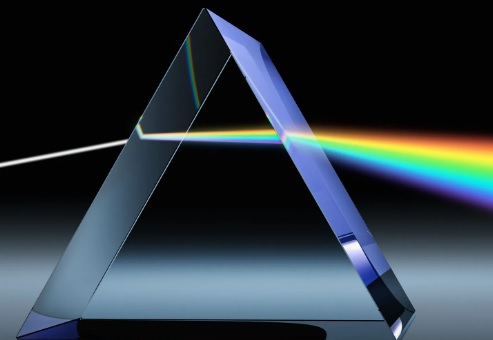
    May Allah Forgive the Ummah.

    Leave a comment

    Filed under Uncategorized

    A Jewish Argument against the Qur’an.

    “Also, mention when the angels said, “O Mary, indeed Allah gives you good news of a word from Him, whose name will be the Messiah, Jesus, the son of Mary – distinguished in this world and the Hereafter and among those brought near to Allah. He will speak to the people in the cradle and in maturity and will be of the righteous. “She said, “My Lord, how will I have a child when no man has touched me?” The angel said, “Such is Allah; He creates what He wills. When He decrees a matter, He only says to it, ‘Be,’ and it is. (Qur’an 3:45-47)

    ﷽ 

    “Also, mention, in the book the story of Mary, when she withdrew from her family to a place toward the east and she took, in seclusion from them, a screen. Then We sent to her Our Angel, and he represented himself to her as a well-proportioned man. She said, “Indeed, I seek refuge in the Most Merciful from you, so leave me, if you should be fearing of Allah. He said, “I am only the messenger of your Lord to give you news of a pure boy. “She said, “How can I have a boy while no man has touched me and I have not been unchaste? “He said, “Thus it will be; your Lord says, ‘it is easy for Me, and We will make him a sign to the people and a mercy from Us. And it is a matter already decreed.” (Qur’an 19:16-21)

    As Shaykh Ahmed Deedat (r) has mentioned in his Pamphlet “Is the Bible God’s Word?” page 11:

    We do not have the time and space to go into the tens of thousands of — grave or minor —defects that the authors of the Revised Standard Version (RSV) have attempted to revise. We leave that privilege to the Christian scholars of the Bible. Here I will endeavor to cast just a cursory glance at a “half-a-dozen” or so of those “minor” changes.


    1. “Therefore the Lord himself shall give you a sign: Behold, a VIRGIN shall conceive, and bear a son, and shall call his name Immanuel.” (Isaiah 7:14 – AV)
    The indispensable “VIRGIN” in the above verse has now been replaced in the RSV with the phrase “a young woman,” which is the correct translation of the Hebrew word almah. Almah is the word that has occurred all along in the Hebrew text and NOT bethulah, which means VIRGIN. This correction is only to be found in the English language translation, as the RSV is only published in this tongue. For the African and the Afrikaner, the Arab and the Zulu, in fact, in the 1500 other languages of the world, Christians are made to continue to swallow the misnomer “VIRGIN.”

    The argument goes (from the Jews) and the atheists, for that matter, that if the Gospel writer ‘Matthew’ had been inspired and directed by the Holy Spirit, then he (Matthew) would not have relied upon the Jewish Septuagint for the source of his quote.

    Technically, the word almah more than not was used for a young woman that could be married. Being a young, unmarried woman, it was often understood that she was not married and thus, a virgin.

    However, those who argue against this state that the word ‘bethulah’, which actually does mean virgin, should have been used in place of ‘almah’, which has the possibility of being a virgin.

    The website: Jews for Jesus has the following to say:

    https://jewsforjesus.org/publications/issues/issues-v09-n01/almah-virgin-or-young-maiden/

    Whereas the web site Jews for Judaism as this short entry:

    https://jewsforjudaism.org/knowledge/articles/almah-virgin-and-parthenos

    We as Muslims could agree with our Christian apologist and say look, ‘almah’likely means ‘virgin’ and that is good enough.

    The reason that it is not good enough is that the author of the ‘Gospel According to Matthew’ had made some huge blunders when being reliant upon the Greek Septuagint.

    We will give a clear example: Believe us, there are many!

    “When they drew near Jerusalem and came to Bethphage on the Mount of Olives, Jesus sent two disciples, saying to them, “Go into the village opposite you, and immediately you will find an ass tethered, and a colt with her. Untie them and bring them here to me. And if anyone should say anything to you, reply, ‘The master has need of them.’ Then he will send them at once. “This happened so that what had been spoken through the prophet might be fulfilled: Say to daughter Zion, ‘Behold, your king comes to you, meek and riding on an ass, and on a colt, the foal of a beast of burden.’ “The disciples went and did as Jesus had ordered them. They brought the ass and the colt and laid their cloaks over them, and he sat upon them. The huge crowd spread their cloaks on the road, while others cut branches from the trees and strewed them on the road. The crowds preceding him and those following kept crying out and saying: “Hosanna to the Son of David; blessed is he who comes in the name of the Lord; hosanna in the highest.” And when he entered Jerusalem the whole city was shaken and asked, “Who is this? “And the crowds replied, “This is Jesus the prophet, from Nazareth in Galilee.” (Matthew 21:1-11)

    This is disastrous. It is disastrous on several accounts. Whoever wrote the Gospel according to Matthew couldn’t have known the original Hebrew text. Instead, the Greek Septuagint was relied upon resulting in the mistaken belief that the so-called “prophecy” was about Jesus riding upon two donkeys!

    Again, look at what Christian scholars have had to say about the matter.

    4-5] The prophet: this fulfillment citation is actually composed of two distinct Old Testament texts, Isaiah 62:11 (Say to daughter Zion) and Zechariah 9:9. The ass and the colt are the same animal in the prophecy, mentioned twice in different ways, the common Hebrew literary device of poetic parallelism. Matthew takes them as two is one of the reasons why some scholars think that he was a Gentile rather than a Jewish Christian who would presumably not make that mistake (see Introduction).

    7] Upon them: upon the two animals; an awkward picture resulting from Matthew’s misunderstanding of the prophecy.

    The source is from: (http://www.usccb.org/nab/bible/matthew/matthew28.htm)

    So why could this be a Jewish contention against the Qur’an?

    The Core of the Critique.

    The criticism, as we’ve laid out, follows this logic:

    The Christian Doctrine is Based on a Mistranslation: The Christian belief in a virgin birth prophecy in Isaiah 7:14 relies on the Greek Septuagint’s translation of the Hebrew word almah (young woman) as parthenos (virgin), rather than the more precise Hebrew word for virgin, bethulah.

    Matthew’s Error Demonstrates Human Authorship: The author of the Gospel of Matthew (who used the Septuagint) further demonstrates his human fallibility by misreading Zechariah 9:9, thinking it describes two animals (an ass and a colt) instead of one animal described with poetic parallelism.

    The Qur’an is Therefore Derivative and Human: Since the Qur’an also affirms the virgin birth, the critic argues that its author simply borrowed this “mistaken” Christian doctrine, which itself is based on a Greek mistranslation of a Hebrew text. This, they claim, proves the Qur’an is a human document from the 7th century, not a divine revelation.

    The assumption that the Jew could make is that because Muslims believe in the virgin birth of Mary (May Allah honour her) that the “author of the Qur’an” simply copied the Christian doctrine — which in turn is based upon the Greek Septuagint and has no knowledge of the Hebrew text. Presumably, this makes the Qur’an all too human and not of divine authorship.

    The Qur’an is Independent and Authoritative, Not Derivative.
    This is the most critical point. The Qur’an does not seek to prove the virgin birth by referencing the Hebrew Bible. It does not say, “And this happened to fulfill what was said by the prophet Isaiah…” as Matthew does.

    Instead, the Qur’an narrates the event as a direct, fact revealed by Allah.

    We as Muslims have a straightforward response to this. That is that whoever wrote the ‘Gospel according to Matthew’ was quote-mining the Jewish sacred text to get legitimacy for Jesus as the Messiah. Whereas, for us as Muslims, the Qur’an stands independent of any justification for the miraculous birth of Christ Jesus.

    Muslims could agree with Christian apologists that almah can imply virginity. However, the Islamic position is stronger: We have no theological need to enter that debate. Our belief is not contingent on the interpretation of a single word in a text that could have been altered. Our belief is based solely on the clear, unambiguous words of the Qur’an:

    “She said, ‘How can I have a boy while no man has touched me and I have not been unchaste?’ He said, ‘Thus [it will be]; your Lord says, ‘It is easy for Me…”” (Qur’an 19:20-21)

    The Qur’an uses the phrase “while no man has touched me” (وَلَمْ يَمْسَسْنِي بَشَرٌ), which is an explicit, clear statement of virginity that avoids the ambiguity of the Hebrew almah altogether

    In other words, Christ Jesus was born of the Virgin Mary. This is our belief as Muslims who believe in the words of the Qur’an.

    This was a real event that took place. Where we part with the Christians is this:

    The Christians in particular whoever wrote the ‘Gospel according to Matthew’ felt a need to justify this event by reference to the Hebrew scriptures albeit reliance upon the Greek Septuagint.

    Conclusion:

    The mistakes of Matthew highlight the human process of trying to fit Jesus into Old Testament prophecies, sometimes through forced interpretations and errors from using a translation.

    The Qur’an, by contrast, displays none of this. It is entirely self-contained and authoritative. It does not make interpretive errors about Zechariah or Isaiah because it does not reference them in the first place. It simply states the truth of the event as revealed by Allah.

    Therefore, the argument that the Qur’an “copied” a mistake actually proves the opposite: its independence from the textual corruptions and human errors that affected the previous scriptures. The Qur’an’s account of the virgin birth is not evidence of its human origin but rather of its divine origin, as it provides a pristine, uncorrupted narrative free from the dilemmas of biblical scholarship.

    As Muslims, our belief in this stands apart from needing any proof text or citation from previous scriptures. With Allah is the success!

    May Allah (swt) guide the sincere among them so that they do not perish in ever lasting hellfire!

    May Allah Guide the Ummah.
    May Allah Forgive the Ummah.

    Leave a comment

    Filed under Uncategorized