
“O believers! Stand firm for justice as witnesses for Allah even if it is against yourselves, your parents, or close relatives. Be they rich or poor, Allah is best to ensure their interests. So do not let your desires cause you to deviate . If you distort the testimony or refuse to give it, then Allah is certainly All-Aware of what you do.” (Qur’an 4:135)

﷽
Imagine you happend upon someone calling Ali Ibn Abu Talib a sinful treacherous deceitful liar what would cross your mind? Would we call this person a Nasibi? Would we call this person a hypocrite? A vile sinner?
Well, where we come from we call such a person, a member of Banu Hashim, Uncle to the Prophet, thaer of Ibn Abbas the scholar of the Qur’an, none other than Al Abbas (ra).
It is reported by Zuhri that this tradition was narrated to him by Malik b. Aus who said:
Umar b. al-Khattab sent for me and I came to him when the day had advanced. I found him in his house sitting on his bare bed-stead, reclining on a leather pillow. He said (to me): Malik, some people of your tribe have hastened to me (with a request for help). I have ordered a little money for them. Take it and distribute it among them. I said: I wish you had ordered somebody else to do this job. He said: Malik, take it (and do what you have been told). At this moment (his man-servant) Yarfa’ came in and said: Commander of the Faithful, what do you say about Uthman, Abd al-Rabman b. ‘Auf, Zubair and Sa’d (who have come to seek an audience with you)? He said: Yes, and permitted them. so they entered. Then he (Yarfa’) came again and said: What do you say about ‘Ali and Abbas (who are present at the door)? He said: Yes, and permitted them to enter. Abbas said: Commander of the Faithful, decide (the dispute) between me and this sinful, treacherous, dishonest liar. The people (who were present) also said: Yes. Commander of the Faithful, do decide (the dispute) and have mercy on them. Malik b. Aus said: I could well imagine that they had sent them in advance for this purpose (by ‘Ali and Abbas). ‘Umar said: Wait and be patient. I adjure you by Allah by Whose order the heavens and the earth are sustained, don’t you know that the Messenger of Allah (ﷺ) said:” We (prophets) do not have any heirs; what we leave behind is (to be given in) charity”? They said: Yes. Then he turned to Abbas and ‘Ali and said: I adjure you both by Allah by Whose order the heavens and earth are sustained, don’t you know that the Messenger of Allah (ﷺ) said:” We do not have any heirs; what we leave behind is (to be given in) charity”? They (too) said: Yes. (Then) Umar said: Allah, the Glorious and Exalted, had done to His Messenger (ﷺ) a special favour that He has not done to anyone else except him. He quoted the Qur’anic verse:” What Allah has bestowed upon His Apostle from (the properties) of the people of township is for Allah and His Messenger”. The narrator said: I do not know whether he also recited the previous verse or not. Umar continued: The Messenger of Allah (ﷺ) distrbuted among you the properties abandoned by Banu Nadir. By Allah, he never preferred himself over you and never appropriated anything to your exclusion. (After a fair distribution in this way) this property was left over. The Messenger of Allah (ﷺ) would meet from its income his annual expenditure, and what remained would be deposited in the Bait-ul-Mal. (Continuing further) he said: I adjure you by Allah by Whose order the heavens and the earth are sustained. Do you know this? They said: Yes. Then he adjured Abbas and ‘All as he had adjured the other persons and asked: Do you both know this? They said: Yes. He said: When the Messenger of Allah (ﷺ) passed away, Abu Bakr said:” I am the successor of the Messenger of Allah (ﷺ).” Both of you came to demand your shares from the property (left behind by the Messenger of Allah). (Referring to Hadrat ‘Abbas), he said: You demanded your share from the property of your nephew, and he (referring to ‘Ali) demanded a share on behalf of his wife from the property of her father. Abu Bakr (Allah be pleased with him) said: The Messenger of Allah (ﷺ) had said:” We do not have any heirs; what we leave behind is (to be given in) charity.” So both of you thought him to be a liar, sinful, treacherous and dishonest. And Allah knows that he was true, virtuous, well-guided and a follower of truth. When Abu Bakr passed away and (I have become) the successor of the Messenger of Allah (ﷺ) and Abu Bakr (Allah be pleased with him), you thought me to be a liar, sinful, treacherous and dishonest. And Allah knows that I am true, virtuous, well-guided and a follower of truth. I became the guardian of this property. Then you as well as he came to me. Both of you have come and your purpose is identical. You said: Entrust the property to us. I said: If you wish that I should entrust it to you, it will be on the condition that both of you will undertake to abide by a pledge made with Allah that you will use it in the same way as the Messenger of Allah (ﷺ) used it. So both of you got it. He said: Wasn’t it like this? They said: Yes. He said: Then you have (again) come to me with the request that I should adjudge between you. No, by Allah. I will not give any other judgment except this until the arrival of the Doomsday. If you are unable to hold the property on this condition, return it to me.
Source: (https://sunnah.com/muslim:1757c)
The above hadith is an indication that the companions were people just like anyone else. They could be petty and had disputes with each other, called each other names and as we all know at one point in history killed one another.
فَقَالَ عَبَّاسٌ: يَا أَمِيرَ الْمُؤْمِنِينَ اقْضِ بَيْنِي وَبَيْنَ هَذَا – الْكَاذِبِ الآثِمِ الْغَادِرِ الْخَائِنِ.
So Al Abbas said: “O Commander of the Faithful, judge between me and this one – the liar, the sinful, the treacherous, the deceitful.”
Umar Ibn Al Khattab (ra) did not object to this statement. Others that were said to be present:
Uthman ibn Affan. Abd Al-Rahman ibn Awf & Al-Zubayr ibn al-Awwan.
The Abbasid Sunni Muslims who are the bulk of the Sunni Muslims today are those who underwent a Shi’ification. Go bring this narration to your teachers and watch how they react! They panic out over such statements. Whereas the original Sunni Muslims, the Umayyad Sunnis had no problems with such narrations. The proof of this is that this is one of the narrations of al-Zuhri, who was an Umayyad and one of the elders of the Umayyad court.The Abbasid Sunnis, the bulk of the Sunni Muslims today, will say about the statement of Al Abbas. “The statement is not befitting of him.” However, the chain is sound, and thus elaborate interpretative measures are deployed. They even go so far as to admit that the people of the past would remove such statements from the copies of their books. It has nothing to do with the truth and everything to do with the doctrine they contrived: Adalah al-Sahabah.
If only we could be honest with ourselves and honest with our history.
In the Khutba the Khatib says:
…وَعَلَى آلِهِ وَصَحْبِهِ أَجْمَعِينَ
…wa ‘ala aalihi wa sahbihi ajma’een.
Which means upon the people of Muhammed (saw) and companions. So to this we say amin. Because it is generic and general.
This is exactly the position of the angels.
“Those (angels) who bear the Throne and those around it glorify the praises of their Lord, and believe in Him, and ask forgiveness for those who believe (saying): ‘Our Lord! You comprehend all things in mercy and knowledge, so forgive those who repent and follow Your Way, and save them from the torment of the blazing Fire! Our Lord! And make them enter the Paradise which you have promised them, and to the righteous among their fathers, their wives, and their offspring! Verily, You are the All-Mighty, the All-Wise. And save them from the sins, and whomsoever You save from the sins that Day, him verily, You have taken into mercy.” And that is the supreme success.’” (Qur’an 40: 7-9)
Those. Those. Them. Them. Their. Their. Their. Them. Whomsoever. All very generic and general. Because at the end of the day Allah (swt) knows best who dies upon Islam.
We can apply this in every situation and absolutely safeguard our faith. This goes for those of you who are Muslim converts or those of you who are looking into Islam. The testimony of faith is to bear witness that Allah is the one and only God. That Muhammed (peace be upon him) is his last and final messenger.
As regards to the politics and the events of the past.
“That was a community that had already gone before. For them is what they earned and for you is what you have earned. And you will not be accountable for what they have done.” (Qur’an 2:141)
From the questions one will be asked in the grave:
- The Questions:
- Rabbu-ka? (Who is your Lord?)
- Ma Deenu-ka? (What is your religion?)
- Man Nabiyyu-ka? (Who is your Prophet? / Or what did you say about Muhammed?)
The angels are not asking you about the companions and your affiliation or dissociation with any of them.
Then the day of judgement. That awesome and terrifying day.
You will then be presented ˹before Him for judgment˺, and none of your secrets will stay hidden. (Qur’an 69:18)
One thing Allah (swt) already exhonerated us from is about what people in the past did. Al hamdulillah! Allah is the Most Merciful!
“That was a community that had already gone before. For them is what they earned and for you is what you have earned. And you will not be accountable for what they have done.” (Qur’an 2:141)
Today there are is much writing about what are claimed to be Nasibi tendencies in our books of history and even in the hadith narrations. Yet, no one speaks about on the censorship and the injustice did to the umayyad clan. Surely they did injustice themselves by the Abbasids were no angels.
“Fight in the cause of Allah ˹only˺ against those who wage war against you, but do not exceed the limits. Allah does not like transgressors.” (Qur’an 2:190)
Systematically wiping out entire bloodlines is certainly exceeding the limits.
Abd al-Rahman ibn Mu’awiya the founder of the Umayyad dynasty in Al-Andalus was helped in his escape by the friendly Ibadi Nafza Berber tribes. This inspite of the conflict the Ibadis had with the Umayyads. However, Ibadis are not people who go beyond the limits. No Muslim should go beyond thelimits. In fact, he (Abd-al Rahman ibn Mu’awiya) received support from the Ibadis. Beyond the help from these village communities.
Our school simply does not like bullies. Whoever they are and whatever form they take at the time. Yesterday’s monster is now today’s vulnerable individual.
“Non-Ibadi historians mentioned these delegates to Umar bin Abdul-Aziz, though they said with their usual insinuation: “The Khawarij sent him a delegation.” However, they did not mention what happened between them and the Caliph Umar and his acceptance of all their suggestions about spreading justice and purging the country of the Umayyad tradition of cursing Ali from the pulpit. The Ibadi delegation said to Umar, “Muslims are cursing from pulpits in mosques, so this evil tradition must be changed.” Thus, Umar replaced it with the words of Allah: ‘
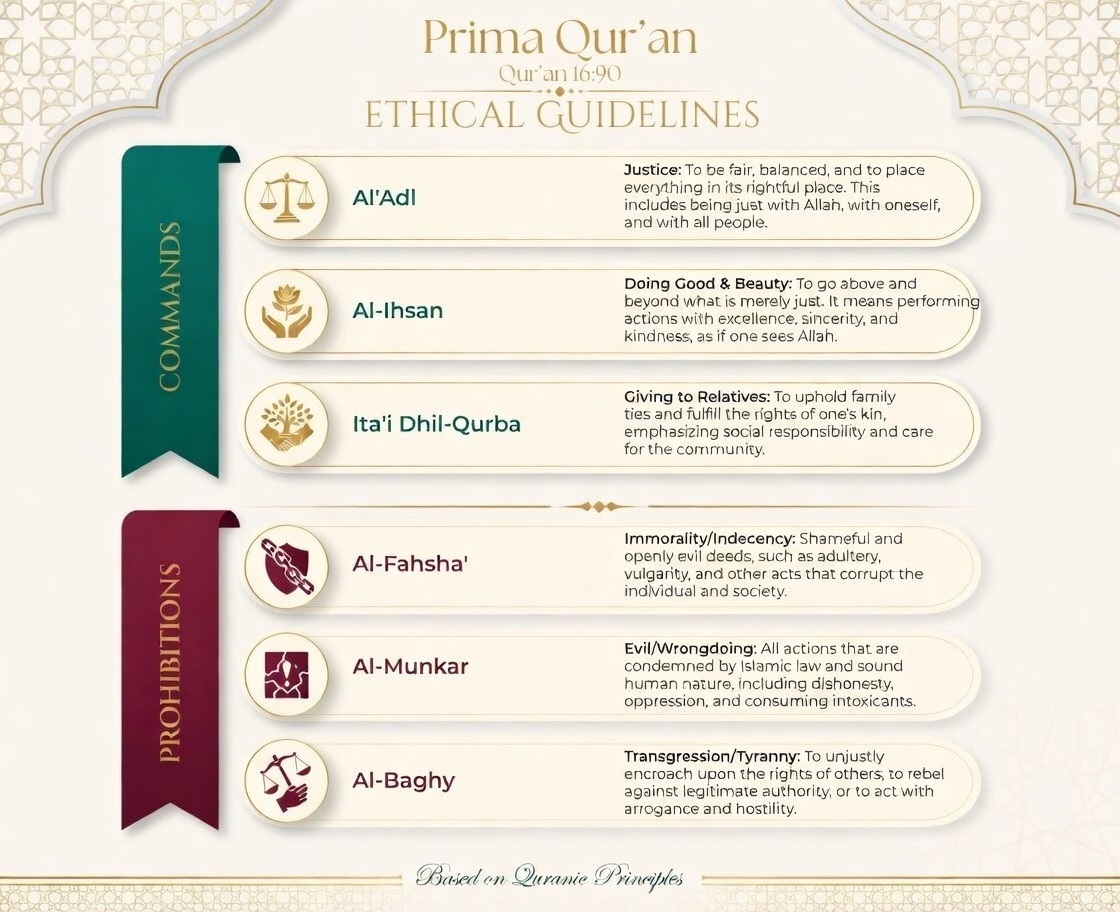
“Indeed, Allah orders justice and good conduct and giving to relatives and forbids immorality and bad conduct and oppression. He admonishes you that you remember.” (Qur’an 16: 90)
This is a legacy of the Ibadi school that is found in a Friday Khutba in Sunni Masjids all over the world.
A powerful verse and a reminder to the entire Ummah.
May Allah Forgive the Ummah.
May Allah Guide the Ummah.


 Prima Quran