
“Say, He Allah is Absolute. That which is indepenent of all but which all things are dependent upon. He does not bring forth like kind nor was he from like kind. And there is no equivalent to His being Absolute.” (Qur’an 112:1-4)

﷽
We will demonstrate in this article (Allah-willing) that the New Testament never presents Jesus as the only Son of God. Where the New Testament cross references the Old Testament we will bring forth those texts.
This textual reality cuts straight to the heart of how the Trinity was formulated in the early Church. If the New Testament leaves room for other “sons of God” (whether angels, kings, or cosmic beings) and never uses mathematically exclusive language to isolate Jesus as the solitary son, it creates a massive structural and linguistic problem for Trinitarian theology.
It Explodes the “Eternal Generation” Framework
To protect the Trinity, early Church theologians (like those at the Council of Nicaea in 325 AD) had to invent a philosophical concept called “Eternal Generation.”
They argued that Jesus is a Son not because he was created, but because he eternally “flows” from the Father, sharing the exact same divine substance (homoousios). To make this work, Jesus had to be the only one.
The Trinitarian Dilemma: If the text allows for other natural or heavenly beings to hold the status of “a son” without distinct legal qualifiers like adoption, then “Son of God” ceases to be a title of exclusive divine essence.
If an angel or a human king in the Old Testament is called a “Son of God” using the same basic Hebrew or Greek categories, then the title “Son” no longer automatically proves that Jesus is God. It lowers the title from an ontological statement (what Jesus is by nature) to a functional statement (the role Jesus plays).
This of course does not mean the end of Christianity. Allah (swt) tells us that they (along with the Jews) will be in schism until the day of judgement.
“And from those who say, “We are Christians” We took their covenant; but they forgot a portion of that of which they were reminded. So We caused among them animosity and hatred until the Day of Resurrection. And Allah is going to inform them about what they used to do.” (Qur’an 5:14)
Christianity has three last stages until it is completely irrelevant.
- A shift in the West from Protestant tradition to Catholic Orthodox and Eastern Churches.
- Marcionism we are entering that stage. By attacking Islam many Christians are essentially attacking the Old Testament.
- Full Marcionism. Eventually a complete break with the Old Testament. This serves a number of purposes. It makes Christianity easier to defend from a moral and ethical angle. Also, it will distance themselves from any grip that Jews or Judaism (Zionism) has over them.
The first four pieces of evidence we will advance to show that Jesus was never the only son.
“For God so loved the world, that he gave his only (monogenē) Son, that whoever believes in him should not perish but have eternal life.” (John 3:16)
“…because he has not believed in the name of the only (monogenē) Son of God.” (John 3:18)
“In this the love of God was made manifest among us, that God sent his only (monogenē) Son into the world, so that we might live through him.” (1 John 4:9)
“And the Word became flesh and dwelt among us, and we have seen his glory, glory as of the only (monogenē) Son from the Father, full of grace and truth.” (John 1:14)
At first blush one may be excused to think that these texts argue that Jesus is the only Son of God. However, there is a descriptor that precludes this altogether. He is the monogenē. Which is one of a kind.
To give an example. A father could have three sons. Two of the sons are twins. Therefore the son who does not have a twin is unique. He is one of a genes. He is one of a kind. He is never the only kind. He is never the only one.
Further evidence.
“By faith Abraham, when he was tested, offered up Isaac, and he who had received the promises was in the act of offering up his only (monogenē) son.” (Hebrews 11:17)
The example of Isaac being called Abraham’s monogenēs despite Abraham having other sons (Ishmael and Keturah’s sons) proves that monogenēs does not mean “only one numerically.” It means “unique” or “one of a kind.” The Trinitarian attempt to use monogenēs as proof of exclusive, solitary divine sonship collapses once we see that the same Greek word is used of Isaac, who was plainly not an only child.
The case of John 1:18
“No one has seen God at any time. The only (monogenēs) Son, who is in the bosom of the Father, He has declared Him.” (John 1:18)
The above text has a variant reading. Christians are not sure which is the original. The variant reading would be: “No one has seen God at any time. The only (monogenēs) God, who is in the bosom of the Father, He has declared Him.”
Neither reading would be strange knowing what we know about henotheism.
One reading is that a unique Son of God made known the Father. The other reading would be one of the many gods made known the Father (god).
Our second set of evidence from John.
“Do you say of him whom the Father consecrated and sent into the world, ‘You are blaspheming,’ because I said, ‘I am the Son of God’ (John 10:36)
Context.
“Again his Jewish opponents picked up stones to stone him, but Jesus said to them, “I have shown you many good works from the Father. For which of these do you stone me?”
“We are not stoning you for any good work,” they replied, “but for blasphemy, because you, a mere man, claim to be God.”
Jesus answered them, “Is it not written in your Law, ‘I have said you are gods’? If he called them ‘gods,’ to whom the word of God came—and Scripture cannot be set aside—what about the one whom the Father set apart as his very own and sent into the world? Why then do you accuse me of blasphemy because I said, ‘I am God’s Son’?” (John 10:31-36)
Let us deal with the major problem of the error of Jesus. Jesus is making a blunder by misquoting the Tanakh. There is no such statement written ‘in your law’. It is found in the Psalms.
“I had taken you for divine beings, attendants *attendants Lit. “sons.” of the Most High, all of you;
Source: (https://www.sefaria.org/Psalms.82.6)
“I said, “You are angelic creatures, and all of you are angels of the Most High.”
Source: (https://www.chabad.org/library/bible_cdo/aid/16303/jewish/Chapter-82.htm)
Obviously Judaism trying to pretend that it is a monotheistic tradition. Instead of henotheism which it plainly is. It is struggling with how to render the above text.
Jesus here is trying to reason with this particular group of Jews. That there are many in the divine assembly called gods. The Jewish god is simply the chief god among them. In this worldview if there are many gods or many called gods then there is no problem if Jesus is a son among sons.
Jesus and the blind man. Son of God/Son of Man.
“Then they turned again to the blind man, “What have you to say about him? It was your eyes he opened.” The man replied, “He is a prophet.” (John 9:17)
The variant reading of John 9:35
“ Jesus heard that they had thrown him out, and when he found him, he said, “Do you believe in the Son of Man?” (John 9:35)
In other variant readings it has ‘Son of God’.
So given our proof initial evidence that we have laid out from the five proof text it must then follow that this is the case for everything that is ascribed to the author called ‘John’.
This would include the following text:
1 John 3:8
1 John 4:15
1 John 5:5
1 John 5:10-13
1 John 5:20
John 20:31
John 11:27
John 1:49
John 1:34
John 11:4
John 5:25
Revelation 2:18
“But these are written that you may believe that Jesus is the Messiah, the Son of God, and that by believing you may have life in his name” (John 20:31)
Given what we have shown — that Jesus is a son of God, and that John’s Gospel never presents Jesus as the only son of God — we should then expect if the New Testament is theologically in harmony then this should be the position of the entire New Testament.
Is there any text in the New Testament that explicitly describes Jesus as the exclusive, singular Son of God, to the total exclusion of all others?
To find that, we have to move away from the word monogenēs and look at how the Greek language handles the definite article (“the”) and the concept of absolute singular inheritance.
In Greek grammar, when a writer wants to emphasize absolute exclusivity—that someone is the specific, singular entity to the exclusion of all others—they use a structure called the “double article.”
We see this explicitly in the confessions of Peter and Martha, and during Jesus’ trial. They do not say “a Son of God.” They use the Greek definite article ho (the) before both “Son” and “God.”
“You are the Christ, the Son of the God, the living [One].” (Greek: Σὺ εἶ ὁ χριστὸς ὁ υἱὸς τοῦ θεοῦ τοῦ ζῶντος) –(Matthew 16:16)
“You are the Christ, the Son of God, the [One] coming into the world.” (Greek: λέγει αὐτῷ, Ναί, κύριε· ἐγὼ πεπίστευκα ὅτι σὺ εἶ ὁ Χριστὸς ὁ υἱὸς τοῦ θεοῦ ὁ εἰς τὸν κόσμον ἐρχόμενος)-(John 11:27)
By placing the definite article ὁ (ho / “the”) directly before “Son,” the Greek text moves from an indefinite category (“a son”) to an exclusive, particular title (“the Son”).
However, recall what we have already received from John. That Jesus is one of a kind and not the only of his kind. So John 11:27 has to be harmonized with this. Given that Matthew 16:16 is given a similar example it too has to be harmonized with this.
Let us say that the father’s name is David. So let us say that one of those sons is named Tommy. Tommy is handicapped. So if we say, “You are the Handicapped the Son of the living David.” This in and of itself does not deny other sons. It means the other sons do not have this descriptor.
By adding a unique descriptor (the Christ) or a unique modifier (handicapped) isolates that specific individual within their role, but it does absolutely nothing to grammatically eliminate the existence of other sons.
The evidence of Hebrews 1:5
“For to which of the angels did God ever say, “You are my Son, today I have (gennaō) begotten you”? Or again, “I will be to him a father, and he shall be to me a son”? And again, when he brings the firstborn into the world, he says.”
This shows that the author is addressing what must have been a prevalent belief that angels are sons of God.
“Now there was a day when the sons of God came to present themselves before the LORD, and Satan also came among them.” (Job 1:6)
Source: (https://biblehub.com/job/1-6.htm)
This author still has not addressed how Jesus is the only Son of God. The author is simply saying how this particular son is special. Even in the text itself is a glaring admission. “I will be to him A Father and he will be to me A son.”
This is a quote from
“I will be to him a father, and he shall be to me a son.” (2 Samuel 7:14)
This text establishes four points.
That God will be the father of Jesus. Not that currently is or has been from eternity past.
That this God is ‘a’ father to Jesus. Not his only one. This is why Jesus had at times to distinguish which father he was talking about. “the will of my Father who is in heaven” (Matthew 7:21)
That Jesus will be a son. Not that Jesus currently is or has been from eternity past.
That Jesus is ‘a’ son. Not that Jesus is the only son. The New Testament never once claims that Jesus is the only Son of God.
Not only is the text in Hebrew 1:5 quoting (2 Samuel 7:14) but it also quotes Psalms 2:7.
“I will tell of the decree: The lord said to me, “You are my Son; today I have (yə·liḏ·tî·ḵā.) begotten you.” (Psalm 2:7)
This text does not mean that Jesus is ontologically the Son of God. Rather he gets taken or adopted as a Son of God. Saying Jesus is ontologically the Son of God means he is the same nature, being, and essence as God
That Hebrew word in Pslams 2:7 is yalad.
yalad: To bear, bring forth, beget
Source: (https://biblehub.com/hebrew/3205.htm)
“Say, He Allah is Absolute. That which is independent of all but which all things are dependent upon. He does not bring forth like kind nor was he from like kind. And there is no equivalent to His being Absolute.” (Qur’an 112:1-4)
Originally this text was addressed to king David who was a grown man. King David is not ontologically the Son of God.
So ask any Christian if David is not ontologically the Son of God what does it mean when it says that God has begotten him to a grown man?
Because an adult king cannot be metaphysically born on his coronation day, the word “begotten” (yalad in Hebrew, gennaō in Greek) in royal contexts means exaltation to an office, not the generation of a nature.
They say:’ ‘The All-merciful has taken to Him a son.‘ Glory be to Him! Nay, but they are honoured slaves.” (Qur’an 21:26)
“And when the centurion, who stood there in front of Jesus, saw how he died, he said, “Surely this man was the Son of God!” (Mark 15:39)
“The centurion, seeing what had happened, praised God and said, “Surely this was a righteous man.” (Luke 23:47)
The variant reading of Acts 3:26.
“Unto you first God, having raised up his Son Jesus, sent him to bless you, in turning away every one of you from his iniquities.” (Acts 3:26 King James Version)
“To you first, God, having raised up His Servant Jesus, sent Him to bless you, in turning away every one of you from your iniquities.” (Acts 3:26 New King James Version)
Notice that the King James Version calls Jesus “his Son”, Whereas the New King James Version calls Jesus “His Servant” and whenever you see that word “servant” in the New Testament, it means slave.
So we have established from the theology of Hebrews 1:5 the following:
Jesus was never the only Son of God.
Jesus was never the Son of God from eternity past.
The text undermines the classic Trinitarian concept of “Eternal Sonship.”
If Hebrews is to be a theologically consistent text then this must be the theology for the following text:
Hebrews 4:14
Hebrews 6:6
Hebrews 10:29
We have established using the four proof text in John’s Gospel as well as the statement in Hebrew 1:5 to prove that the New Testament never calls Jesus, monos huios (only son).
Psalms 2:7 when does Jesus actually become a Son of God in the New Testament?
Paul believed that Jesus was declared to be a Son of God by his resurrection from the dead.
There is no evidence that Paul believed in the virgin birth of Jesus.
Paul did not believe that Jesus was a Son of God from eternity past.
We will assume that Paul is the author of the following text under discussion.
“Concerning his Son Jesus Christ our Lord, which was made of the seed (spermatos) of David according to the flesh; And declared to be the Son of God with power, according to the spirit of holiness, by the resurrection from the dead.” (Romans 1:3-4)
“…τοῦ ὁρισθέντος υἱοῦ θεοῦ ἐν δυνάμει… ἐξ ἀναστάσεως νεκρῶν…”
Literal Translation: “…the [one] designated/decreed/appointed Son of God in power… by the resurrection from the dead…”
Paul believed that Jesus was the literal seed (spermatos) of David. The mention of ‘sperm’ (spermatos) is difficult to reconcile with a virgin birth narrative. Paul also did not believe that Jesus was an eternal Son of God. Jesus becomes adopted as a Son of God by his resurrection from the dead.
“But when the fullness of time had come, God sent forth his Son [singular, definite], born of woman, born under the law, to redeem those who were under the law, so that we might receive adoption as sons.” (Galatians 4:4-5)
Again. Paul mentions Jesus born of a woman. No mention of a virgin birth.
At first glance, a Trinitarian reading jumps to the conclusion that “God sent forth his Son” means a pre-existent divine being was sent down from heaven. However, when we apply the legal, covenantal framework of Davidic sonship, a completely different, highly unified picture emerges.
In biblical language, when God “sends” or “sends forth” someone, it routinely describes the functional commissioning of a human agent or prophet to a specific task. It does not imply that the person existed in heaven before they were born.
Consider how the Gospel of John uses the exact same concept:
“There was a man sent from God, whose name was John [the Baptist].” (John 1:6)
Nobody reads John 1:6 and concludes that John the Baptist was a pre-existent eternal being who descended from heaven. He was “sent” because he was given a divine mission.
Once again look how Paul applies Psalm 2:7. He applies it to the resurrection of Jesus.
“And we bring you the good news that what God promised to the fathers, this he has fulfilled to us their children by raising Jesus, as also it is written in the second Psalm: ‘You are my Son, today I have begotten you.'” (Acts 13:32-33)
Just as Jesus is an adopted son of God Christians can also become adopted sons/daughters of God.
“He predestined us for adoption as His sons through Jesus Christ, according to the good pleasure of His will.” (Ephesians 1:5)
“And: “I will be a Father to you, and you will be My sons and daughters, says the Lord Almighty.”
(2 Corinthians 6:18)
Given what we know from Pauls theology concerning Jesus and his sonship this would apply to the following text:
Galatians 2:20
2 Corinthians 1:19
Ephesians 4:13
We further see that Jesus is not the only Son of God but rather an older brother in a larger divine family. We will discuss this now.
The Problem of “Firstborn” (Prōtotokos)
“For those God foreknew he also predestined to be conformed to the image of his Son, that he might be the firstborn (prōtotokon) among many brothers and sisters.” (Romans 8:29)
“And he is the head of the body, the church; he is the beginning and the firstborn (prōtotokos) from among the dead, so that in everything he might have the supremacy.” (Colossians 1:18)
Because the New Testament avoids calling Jesus the monos (mathematically only) son, it frequently uses another word that causes immense trouble for Trinitarian theology: Prōtotokos meaning “Firstborn.”
For a Trinitarian, “Firstborn” has to be heavily explained away as a metaphor meaning “supreme ruler” or “preeminent.” But if you pair prōtotokos with the grammatical reality we discussed—that the New Testament doesn’t textually isolate Jesus as the only son—the natural, plain reading of the text shifts dramatically. He looks less like a member of a co-equal Trinity and more like the elder brother or the first son in a larger divine family.
When you read the Nicene Creed (the definitive formula for the Trinity), the language shifts radically away from the flexible, conversational style of the New Testament into rigid, Western, mathematical exclusivity:
“…And in one Lord Jesus Christ, the only-begotten Son of God, begotten of the Father before all worlds… Very God of Very God… being of one substance with the Father…”
By noticing that the New Testament itself doesn’t actually say this, you expose a massive historical gap. The Trinity cannot be read straight off the pages of the Bible using strict grammar; it requires a massive philosophical overlay that was forced onto the text centuries later to make the language exclusive.
Psalms 2:7 when does Jesus actually become a Son of God in the New Testament?
The baptismal announcement.
“And behold, a voice from heaven said, ‘This is my beloved Son, with whom I am well pleased.’ (Matthew 3:17)
Note: Matthew records the voice speaking in the third person, as a public declaration to the crowd.
“And a voice came from heaven, ‘You are my beloved Son; with you I am well pleased.” (Mark 1:11)
Note: Mark records the voice speaking in the second person, addressing Jesus directly.
“And the Holy Spirit descended on him in bodily form, like a dove; and a voice came from heaven, ‘You are my beloved Son; with you I am well pleased.’ (Luke 3:22)
Note: Found in the oldest Alexandrian codices like Sinaiticus and Vaticanus, matching Mark exactly.
The Western Textual Variant for Luke 3:22
In a major ancient textual branch known as the Western Text—most famously preserved in the 5th-century Greek/Latin manuscript Codex Bezae (Manuscript D)—the voice from heaven does not say “with you I am well pleased.” Instead, it quotes Psalm 2:7 word-for-word:
“…and a voice came from heaven, ‘You are my Son; today I have begotten you.'” (Greek: υἱός μου εἶ σύ, ἐγὼ σήμερον γεγέννηκά σε)
“And the Holy Spirit descended on him in bodily form, like a dove; and a voice came from heaven, ‘You are my son; today I have begotten you.” (Luke 3:22)
Prima Qur’an comments: First it should be noted that none of the above text speak about an only son. They are texts that talk about a particular son.
The case of Matthew.
Matthew begins his gospel with a detailed genealogy and a virgin birth narrative (Matthew 1:18–25). In Matthew’s theology, Jesus’ identity as a Son of God is established biologically and ontologically from the very moment of his conception by the Holy Spirit.
Because Jesus’ identity is already a settled, historical fact before he ever reaches the Jordan River, Matthew subtly alters the baptism text:
Matthew 3:17: “This is my beloved Son…”
The voice does not address Jesus (“You are”). It addresses the bystanders (“This is”). It is a public revelation to the crowd, confirming what the narrative has already established to the reader: this man is the miraculous, virgin-born Son. Jesus does not need to be informed; the audience does.
The case of Mark.
Mark’s Gospel has no virgin birth narrative and no childhood stories. It begins abruptly with Jesus as an adult walking out of Nazareth to be baptized.
Because Mark lacks a biological explanation for Jesus’ sonship, the baptism scene carries the entire theological weight of his identity. And as we pointed out, the grammar reflects a completely different, highly personal experience:
- Mark 1:11: “You are my beloved Son; with you I am well pleased.”
In Mark’s presentation, the voice speaks directly and exclusively to Jesus. Textually, this reads as a personal awakening or an official investment of an office.
If Mark intended his readers to believe Jesus was the uncreated, pre-existent Son from all eternity, starting the book with an adult man who needs to be personally told by a voice from heaven, “You are my Son,” is a highly counterproductive way to write. It perfectly aligns with an Adoptionist framework, where Jesus is chosen and appointed at this exact moment.
The text of Mark 1:1.
Textual critics have discovered that the phrase “the Son of God” (υἱοῦ θεοῦ) is entirely missing from some of our oldest, most important uncial manuscripts, most notably Codex Sinaiticus and Codex Koridethi
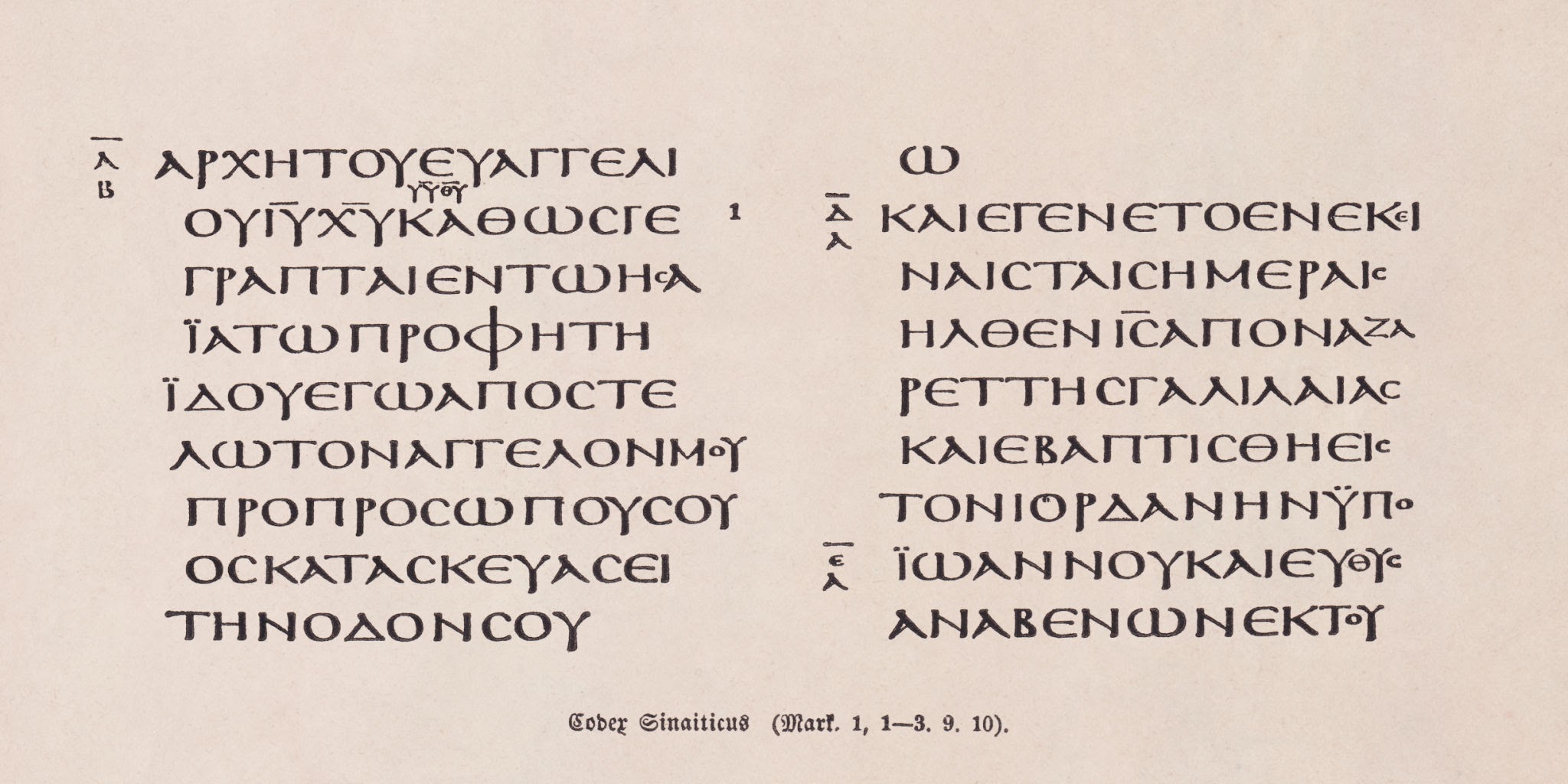
Source: (Codex Sinaiticus column detail of Mark 1:1. Source: ZU_09 / Getty Images)
Scribes were notorious for “orthodox corruption”—adding titles of high christology to verses to combat heresies. It is highly likely that an early scribe looked at Mark’s abrupt opening, realized it lacked a virgin birth or any explicit declaration of divine sonship until the baptism, and “corrected” verse 1 by adding “the Son of God” to make the book sound safer and more orthodox from the very first line.
If the original text of Mark simply read, “The beginning of the gospel of Jesus Christ,” then Mark does not introduce Jesus as the Son of God until the voice tells him so at his baptism.
Luke’s Harmonizing Strategy
Luke presents the final piece of the puzzle. Like Matthew, Luke includes a virgin birth narrative (Luke 1:35), where the angel explicitly tells Mary that the child will be called a Son of God because of the Holy Spirit’s oversight.
Yet, when Luke gets to the baptism, he preserves the second-person address from Mark (“You are my beloved Son”).
This creates the exact structural tension that led to the creation of the Western Text variant we discussed earlier (“Today I have begotten you”). Early scribes working on Luke’s text recognized that if Luke already had a virgin birth narrative, keeping the baptismal formula as a time-stamped coronation (“Today I have begotten you”) created a blatant contradiction.
How can he be begotten at birth and begotten at baptism? To smooth this over, the Alexandrian textual line likely scrubbed the “Today” variant out of Luke to align it with Matthew’s safer, static theological framework.
The text of Acts 8:37.
“And as they were going along the road they came to some water, and the eunuch said, “See, here is water! What prevents me from being baptized?” And he commanded the chariot to stop, and they both went down into the water, Philip and the eunuch, and he baptized him.” (Acts 8:36-38)
“Now as they went down the road, they came to some water. And the eunuch said, “See, here is water. What hinders me from being baptized?” Then Philip said, “If you believe with all your heart, you may.” And he answered and said, “I believe that Jesus Christ is the Son of God.” So he commanded the chariot to stand still. And both Philip and the eunuch went down into the water, and he baptized him.” (Acts 8:36-38)
There are two different manuscript traditions. Christians are not certain as to which of these are more correct.
The text of Matthew 16:16 and the parallel accounts.
“Simon Peter answered, ‘You are the Christ, the Son of the living God” (Matthew 16:16).
Notice his response in the parallel accounts.
“You are the Christ,’ Peter answered.” (Mark 8:29)
“Peter answered, ‘The Christ of God.” (Luke 9:20)
Here is the logical syllogism:
- The three accounts describe the exact same historical conversation.
- Mark and Luke record Peter saying only “The Christ” or “The Christ of God.”
- Matthew expands this to “The Christ, the Son of the living God.”
- Therefore, either the gospels flatly contradict each other on what Peter actually muttered, OR “Christ” and “Son of God” are being used as functional synonyms.
And since “Christ” (Christos / Mashiach) literally means “Anointed One”—a political, royal title for an appointed human king—then “Son of God” in Matthew’s confession must mean exactly the same thing: the anointed one.
If anyone doubts our reconciliation—that “Christ” and “Son of God” are simply synonyms for an appointed ruler—Matthew himself proves our point later during Jesus’ trial.
Look at the exact wording the High Priest uses to force Jesus under oath:
“I adjure you by the living God, tell us if you are the Christ, the Son of God.” (Matthew 26:63)
The High Priest is not a Christian. He does not believe in the Trinity, nor is he asking Jesus a metaphysical question about his eternal divine essence. He is a Jewish judge asking a political, messianic question: “Are you claiming to be the Anointed Davidic King (the Christ), who is entitled to the royal title ‘Son of God’ via the covenant of David?
Lastly, as a bonus, we want to discuss Isaiah 9:6
The popular Christian version of Isaiah 9:6 is not even in Septuagint!
“For a child is born to us, a son is given to us. The government will rest on his shoulders. And he will be called: Wonderful Counselor, Mighty God, Everlasting Father, Prince of Peace.” (Isaiah 9:6)
Source: (https://biblehub.com/isaiah/9-6.htm)
This is what you are used to seeing, correct? Wonderful Counselor, Mighty God, Everlasting Father, Prince of Peace.
https://biblehub.com/sep/isaiah/9.htm
“For a child is born to us, and a son is given to us, whose government is upon his shoulder: and his name is called the Messenger of great counsel: for I will bring peace upon the princes, and health to him.”(Isaiah 9:6 -The Septuagint– The Holy Spirit’s Fav Version)
Where are all these other names?
So who is upon the truth? Are Latin Roman Catholics, Oriental Orthodox and Eastern Orthodox upon guidance for trusting a text that does not make Christological claims about Jesus, such as calling him (Jesus) ‘The Everlasting Father’? Claims that contradict the idea that Jesus is not the Father?
Or are those Protestants who trust in the Masoretic text (although they still give it a Christological bent) upon the truth?
Only one person in the Jewish scriptures is referred to as “mighty god” and his name is Hizkiyyahu or, Hezekiah (mighty god). Jewish names, like many Muslims’ names, are what one may call a theophoric name. The 1st century Christians did not use Isaiah 9:6 for Christological purposes. Latter ones did, though. Changing the Hebrew perfect tense to future tense.
In conclusion, the New Testament never says Jesus is the only Son of God.
It calls Him monogenēs (unique), prōtotokos (firstborn), huios (son) with the definite article, but never monos huios (only son). The Trinitarian reading requires importing a philosophical exclusivity that the text does not supply.
It does not take a genius to tell you this breaks the Trinity.
If you enjoyed this article you may be interested in the following:
May Allah Guide the Christians to the truth so that they do not burn in hellfire.
May Allah Guide the Ummah.
May Allah Forgive the Ummah.


 Prima Quran
Out of curiosity, why do you say ‘the Jewish God’? Is not the YHWH of the Old Testament synonymous with the Allah of the Quran?
Thank you for your question. So the purpose of phrasing this as such is to keep true what the text says as well as to keep true to the beliefs of those who believe in such text. Of course these beliefs and ideas are alien to the Qur’an and alien to Islam. So it is with this in mind.
I see. Would it be your opinion that the Old Testament portrays more a henotheistic view of Divinity, rather than strictly unitary ‘monotheism’?
Did you comment the following on April 27 2026
Under the following post: https://primaquran.com/2026/04/16/never-the-only-god-how-the-bible-preserves-henotheism-and-the-quran-protects-monotheism/
“According to your research, do you differentiate between El Elyon (usually translated as ‘Most High’) and YHWH?”
and did you follow it up with a subsequent comment:
“Thank you for your kind reply. As it happens I had the pleasure of briefly meeting Dr Heiser prior to has sad passing in 2023. Yet, in the interest of clarity, would you say that you still identify the Allah of Islamic faith with YHWH? Surely they must be one and the same deity ?”
But what then of the Shema?
What of it?
Deut 6:4 אֶחָֽד (masculine form) אַחַ֥ת (feminine form)
“There are sixty queens and eighty concubines,
and virgins without number. My dove, my perfect one, is the only one, the only one of her mother,
pure to her who bore her.
The young women saw her and called her blessed;
the queens and concubines also, and they praised her.” (Song of Solomon 6:8-9)
There all kinds of concubines and maidens without number but she is one.
Not an assertion of the ontological exclusivity of the lover’s dove. She is the only one that matters among the maidens and concubines who are without
number.
So for the Israelites there god is one. Context matters because Deuteronomy 10:17 informs us
“For the Lord your God is God of gods and Lord of lords, the great God, mighty and awesome, who shows no partiality and accepts no bribes.”
We have been trying and searching for a glimmer of hope that theTanach presents a case for One and Only One God and you have been following this blog for (Allah knows how long).
We have looked at.
“To whom, then, will you compare God? To what image will you liken him?” (Isaiah 40:18)
This just seems to describe this deity as unique but the one and only.
“And the LORD will be king over all the earth. On that day there will be one LORD, and his name the only name.” (Zechariah 14:9)
This also seems to describe an eventuality where this deity becomes the only one worshipped. Possibly a triump over all the other deities. But nothing describes this deity as being the one and only.