Tag Archives: bible

Miscellaneous Subjects

“Alif-Lãm-Mĩm” (Qur’an 2:1)

﷽ 

This section will be miscellaneous information on a wide range of topics. This section does not necessarily reflect the views or attitudes of either the Ibadi school or adherents of the school.

Do note some links are broken. We are in the process of restoring those links.

Allah willing we will continue to update this section and organize it accordingly as well:

THE MERCY, LOVE AND FORGIVENSS OF ALLAH

INSPIRATIONAL SHORT CLIPS ABOUT ISLAM TO INSPIRE, MOTIVATE AND CAUSE REFLECTION

MINI GALLERY AT SULTAN MASJID SINGAPORE

https://primaquran.com/2024/01/24/mini-gallery-at-sultan-mosque-singapore/

THE QUR’AN NEVER INDICATES THAT THE MAJORITY ARE UPON THE TRUTH-EVER.

ADVISE TO NEW MUSLIM CONVERTS/REVERTS

WHY DO WE AS MUSLIMS FACE TOWARDS THE KAABA?

https://primaquran.com/2023/04/01/why-do-we-as-muslims-face-towards-the-kaaba

KHIMAR (HEAD COVERING) IS AN INJUNCTION WITH IN THE QUR’AN

WHERE IN THE QUR’AN DOES THE TESTIMONY OF A WOMAN OVER RULE THAT OF A MAN?

https://primaquran.com/2024/06/24/where-in-the-quran-does-the-testimony-of-a-woman-over-rule-that-of-a-man

BLOWING ON KNOTS: SAVING MUSLM MARRIAGES.

REDUNDANT REVELATION? THE QUESTION OF POLYGYNY IN ISLAM

THE HYPOCRISY OF BID’I TALAQ: INNOVATED DIVORCES WEIGHED AGAINST THE WISDOM OF THE QUR’AN

https://primaquran.com/2022/10/05/the-hypocrisy-of-bidi-talaq-innovated-divorces-weighed-against-the-wisdom-of-the-quran

ISLAM TEACHES JUSTICE NOT EGALITARIANISM

https://primaquran.com/2022/10/04/islam-teaches-justice-not-egalitarianism/

SAME SEX MARRIAGES IN LIGHT OF THE QUR’AN

APOSTASY.

WILL OIL EVER REALLY RUN OUT?

THE DINOSAURS NEVER EXISTED?

https://primaquran.com/2022/10/04/the-dinosaurs-never-existed

THE MEN WHO NEVER BECAME MUSLIMS: THE CASES OF DR. KEITH MOORE & DR. MAURICE BUCAILLE.

https://primaquran.com/2023/01/19/the-men-who-never-became-muslims-the-cases-of-dr-keith-moore-dr-maurice-bucaille/

SUNNISM, IMAMI SHI’I, ZAYDI ARE THEIR PROMOTION OF SUPERIOR BLOOD LINES, CLANS, AND TRIBES BASED UPON THE QUR’AN AND SUNNAH?

TRIBALISM AND ISLAM

BUT THEY ARE DESCENDANTS OF PROPHETS

THE IBADI VIEW: BEING FROM THE QURAYSH IS NOT NECESSARY FOR LEADERSHIP

THE IBADI SCHOOL REFUTES THE CLAIMS OF ARAB SUPERIORITY.

AFTAB MALIK: THE BROKEN CHAIN-PREPERATION FOR ARAB RACIAL SUPERIORITY IN ISLAM?

https://primaquran.com/2025/01/23/aftab-malik-the-broken-chain-preparation-for-arab-racial-superiority-in-islam/

SOME SHI’A VIWES ON THE ORIGINS OF BLACK PEOPLE

WHO EVER SAYS THE PROPHET IS BLACK KILL HIM

DOGS ARE PURE IN ISLAM, ACCORDING TO THE QUR’AN

DASTARDLY BOWL LICKING DOGS AND THE THOUGHT PROCESS OF SOME MUSLIMS

https://primaquran.com/2020/09/12/dastardly-bowl-licking-dogs-and-the-thought-process-of-some-muslim

MATTER: THE OTHER NAME FOR ILLUSION.

https://primaquran.com/2022/10/05/matter-the-other-name-for-illusion/

ATHEISM BETWEEN LAWRENCE KRAUSS AND ELON MUSK.

https://primaquran.com/2022/10/04/atheism-between-lawrence-krauss-and-elon-musk/

KETO, PRIMAL, VEGAN, VEGETARIANISM & ISLAM

https://primaquran.com/2023/05/04/keto-primal-vegan-vegetarianism-islam/

ALIENS, UFO’s, THE JINN & ISLAM

THE OTTOMAN EMPIRE WAS BETRAYED BY DESCENDANTS OF PROPHET MUHAMMED (SAW)

COLLECTION OF ARTICLES ON SUFISM

SHAYKH HAMZA YUSUF: COLLECTION OF ARTICLES

https://primaquran.com/2022/10/04/shaykh-hamza-yusuf-collection-of-articles/

THE QUR’AN IS SUBLIME.

DHUL AL-QARNAYN: THE NOTHINGBURGER

THE QUR’AN AND THE SETTING OF THE SUN IN A MURKY SPRING

NOTHING CAN CHANGE THE WORDS OF ALLAH.

THE SO CALLED SATANIC VERSES: (QISSA GHARANIQ-THE STORY OF THE INTERMEIDARY CRANES)

https://primaquran.com/2024/10/26/the-so-called-satanic-verses-qissa-gharaniq-the-story-of-intermediary-cranes/

CLAIMS OF APOCRYPHAL SOURCES IN THE QUR’AN?

QUR’AN CONTRADICITON? WHAT BURDENS DO WE BEAR?

ABU LAHAB: WEAK ARGUMENT UESD BY MUSLIMS TO PROVE ISLAM

https://primaquran.com/2024/05/24/abu-lahab-weak-argument-used-by-muslims-to-prove-islam/

WILL THE DAJJAL BE A PERSON?

https://primaquran.com/2024/10/28/will-the-dajjal-be-a-person/

THE MUSLIM WORLD LEAGUE DAJJAL LOGO: IN NEED OF BETTER OPTICS?

https://primaquran.com/2024/08/14/the-muslim-world-league-dajjal-logo-in-need-of-better-optics/

DO WE THINK ITS WEIRD THAT SAUDI ARABIA PUT A STATUE (IDOL) OF THE MORNING STAR (VENUS) OR SATAN JUST NORTH OF MEDINA?

https://primaquran.com/2024/09/29/do-i-think-its-weird-that-saudi-arabia-put-a-statue-idol-of-the-morning-star-venus-or-satan-just-north-of-medina/

OUR THOUGHTS ON PUBLIC DEBATES

IBADI TRADERS OF BILAD AL-SUDAN -JASON VAN RIEL

AL-ISTIQAMA INSTITUTION FOR QUR’AN & ITS SCIENCES IN LIBYA

ISTIQAAMA MUSLIM ORGANISATION GHANA

https://primaquran.com/2025/01/05/istiqaama-muslim-organisation-ghana/

NEITHER SHIA NOR SUNNI: AN INERVIEW WITH A MOZABITE

https://primaquran.com/2024/02/05/neither-shia-nor-sunni-an-interview-with-a-mozabite-anthony-t-fiscella/

DR. KHALID ABDULLAH TARIQ AL-MANSOUR: INTELLECTUAL JUGGERNAUT AND TREASURE OF THE UMMAH.

https://primaquran.com/2024/12/29/dr-khalid-abdullah-tariq-al-mansour-intellectual-juggernaut-and-treasure-of-the-ummah/

SULAYMAN IBN DAWUD IBN BASAID IBN YUSUF A PAN ISLAMIST IBADI SCHOLAR.

https://primaquran.com/2024/11/13/sulayman-ibn-dawud-ibn-basaid-ibn-yusuf-a-pan-islamist-ibadi-scholar/

THE SCHOLARS OF ISLAM: BETWEEN BLIND ALLEGIANCE AND UNGAURDED DISDAIN

https://primaquran.com/2025/01/07/the-scholars-of-islam-between-blind-allegiance-and-unguarded-disdain/

G.I JOE A REAL AMERICAN HERO

https://primaquran.com/2023/09/27/g-i-joe-a-real-american-hero/

ACCORDING TO THE IBADI SCHOOL: SMOKING IS HARAM

PRAGMATIC VIEW ON MUSLIM UNITY IN THE FACE OF A COMMON FOE- BY USTADH SHIBLI ZAMAN

https://primaquran.com/2024/01/11/pragmatic-view-on-muslim-unity-in-the-face-of-a-common-foe-shibli-zaman/

MUSLIMS SHOULD BOYCOTT STARBUCKS IN SPITE OF PALESTINE (INCLUDING MADHKALIS)

https://primaquran.com/2023/11/16/muslims-should-boycott-starbucks-in-spite-of-palestine-including-madhkalis/

4D CHESS? SHOULD PALESTINE JOIN THE ZIONIST ENTITY?

https://primaquran.com/2023/11/14/4d-chess-should-palestine-join-the-zionist-entity/

WHAT ARE THE SIGNS THAT WE HAVE FAITH?

TWO AI BOTS HAVE A CONVERSATION ABOUT THE IBADI SCHOOL.

Insh’Allah this will continue to be updated. Allah-willing.

THE FOUR TYPES OF PUNISHMENTS EVERY MUSLIM SOULD BE AWARE OF.

WHAT DOES SHAYKH UTHMAN IBN FAROOQ REALLY BELIEVE? MURDERERS AND RAPIST GOING TO HEAVEN?

MONOTHEISM (TAWHID) ALONE IS NOT SUFFICIENT FOR HIS DEEDS TO BE ACCEPTED.

HEAVEN IS FOR THE RIGHTEOUS SOLEY! -HIS EMINENCE SHAYKH MASOUD AL-MIQBALI.

WHO KNEW THE DREAM BETTER? IBN AL-ARABI VS PROPHET IBRAHIM (AS) -AND WHY MUSTAFA AKYOL GETS IT WRONG.

THE QUESTION OF SLAVERY & MILK AL YAMIN IN ISLAM.

WHY HAJJ IS SO IMPORTANT IN ISLAM. WHY MUSLIMS SHOULD NOT DELAY THE HAJJ. SHAYKH HATIM & FIRDAUS AZIZ.

THE VIRTUE OF THE FIRST TEN DAYS OF DHU AL-HIJJAH.

ARE MUSLIMS TO DRINK CAMEL URINE?

The WAY OF LIFE THAT EXISTED BEFORE CHRISTIANITY AND JUDAISM.

May Allah Forgive the Ummah.

May Allah Guide the Ummah.

Leave a comment

Filed under Uncategorized

The amazing historicity and eyewitness testimony of the Christian faith.

“The Jews and Christians each claim that none will enter Paradise except those of their own faith. These are their desires. Reply, “Produuce your proof if what you say is true.” (Qur’an 2:111)

﷽ 

In this blog post we look into the fascinating eyewitness testimony of the Christian faith as well as its historical corraboration.

First we start with what Christians call the apostle Paul.

“This is the third time I am coming to you. “In the mouth of two or three witnesses shall every word be established.” (2 Corinthians 13:1)

“One witness is not enough to convict anyone accused of any crime or offense they may have committed. A matter must be established by the testimony of two or three witnesses.” (Deuteronomy 19:15)

The context and intention behind his application are specific:

  • The Original Context: In Deuteronomy, this law was designed to protect the accused in an Israelite court from false accusations, requiring physical or corroborating human witnesses for a criminal conviction.
  • Paul’s Application: Paul is applying this principle to establish the validity of his apostolic authority.

Paul’s biodata.

He has no provable biography.

We have no idea who Paul’s parents are.

Was Paul recorded in a Roman census?

We have no record of this.

Paul has no provable connection to Prophet Abraham alayhi s-salām 

Paul has no provable connection to the tribe of Benjamin.

 I ask then: Did God reject his people? By no means! I am an Israelite myself, a descendant of Abraham, from the tribe of Benjamin.” (Romans 11:1)

“Circumcised on the eighth day, of the people of Israel, of the tribe of Benjamin, a Hebrew of Hebrews; in regard to the law, a Pharisee.” (Philippians 3:5)

This is a claim without evidence.

  • No genealogy is provided.
  • No Benjaminite registry exists to verify it.
  • No contemporary document outside his letters corroborates it.

In the Hebrew Bible, tribal identity was patrilineal and documented. Paul gives no father’s name, no clan, no ancestral town in Benjaminite territory (e.g., Gibeah, Mizpah). It is an unverifiable claim.

Ask a Christian, Oriental Orthodox, Eastern Orthodox, Roman Catholic, Presbyterian, Anglican to give you Paul’s genealogy traceable back to Benjamin. They can’t!

Paul and his name.

 Then Saul, who was also called Paul, filled with the Holy Spirit, looked straight at Elymas and said,…” (Acts 13:9)

If we say, “Paul says his name is Paul,” that proves nothing. Anyone can name themselves. Without external verification (e.g., Roman census records, contemporary letters from others, a tombstone, etc.), it’s just self-testimony.

“Studied under Gamaliel” – no evidence from Gamaliel.

“I am a Jew, born in Tarsus of Cilicia, but brought up in this city. I studied under Gamaliel and was thoroughly trained in the law of our ancestors. I was just as zealous for God as any of you are today.” (Acts 22:3)

Gamaliel was a famous rabbi (Acts 5:34–40). He is mentioned in later Jewish tradition (Mishnah). But:

  • Gamaliel never mentions Paul.
  • No rabbinic text lists Paul as a student of Gamaliel.
  • No contemporary records from Gamaliel’s academy name Paul.

Acts 22:3 is the only source for this claim. Again, Paul (or Luke writing for Paul) is the sole witness. By the legal principle Paul cited, this is inadmissible.

What is the proof that anyone met the ‘historical’ Paul?

Paul mentioned outside of his own writings?

“Bear in mind that our Lord’s patience means salvation, just as our dear brother Paul also wrote you with the wisdom that God gave him. He writes the same way in all his letters, speaking in them of these matters. His letters contain some things that are hard to understand, which ignorant and unstable people distort, as they do the other Scriptures, to their own destruction.” (2 Peter 3:15-16)

Beyond the fact that the authorship of 2 Peter is highly disputed there is no mention about meeting Paul here.

If we grant that it was indeed written by Peter, the passage doesn’t mention anything about meeting Paul in person, it just mentions Paul’s letters. So it’s a possible witness that Peter believed a person named Paul wrote some letters.

Then we have the following claim in Acts.

“When he came to Jerusalem, he tried to join the disciples, but they were all afraid of him, not believing that he really was a disciple. But Barnabas took him and brought him to the apostles. He told them how Saul on his journey had seen the Lord and that the Lord had spoken to him, and how in Damascus he had preached fearlessly in the name of Jesus.” (Acts 9:26-27)

This is contradicted by the following:

I did not go up to Jerusalem to see those who were apostles before I was, but I went into Arabia. Later I returned to Damascus.” (Galatians 1:17)

So in this instance you have Paul’s own testimony versus a statement made about him some many years later.

Christianity demands I bet my soul on ONE guy, who claims to have met Jesus on the road to Damascus, with an undisclosed number of anonymous witnesses, witnesses who never wrote anything. That is a hard pass!

Paul’s own letters—which are our primary sources—never mention the Damascus road experience with companions present at all. He speaks of his encounter in intensely personal terms, and the elaborate narrative with Ananias, the blinding, and the companions only appears in Acts, written by someone else decades later.

No one witnessed Paul’s “vision”.

In Acts 9, the men traveling with Paul heard a voice but saw no one (Acts 9:7). In Acts 22, Paul says they saw the light but did not hear the voice (Acts 22:9). These are contradictory accounts of what the witnesses experienced. But crucially:

  • None of those men saw Jesus.
  • None of them testified to Paul’s claim that Jesus appeared to Paul.
  • They never wrote anything, and we don’t even know their names.

Who witnessed Paul receiving revelation from Jesus Christ?

“I did not receive it from any man, nor was I taught it; rather, I received it by revelation from Jesus Christ.” (Galatians 1:12)

Paul claims that he is receiving his revelation direct from Jesus rather than from human teachers who actually knew Jesus.

Who witnessed this?

Who witnessed Paul receving his revelation?

What condition did these witnesses describe?

1 Corinthians 15:3–8 :The testimony of Paul under the microscope.

3 For what I received I passed on to you as of first importance: that Christ died for our sins according to the Scriptures,
4 that he was buried, that he was raised on the third day according to the Scriptures,
5 and that he appeared (ōphthē – ὤφθη) to Cephas, and then to the Twelve.
6 After that, he appeared (ōphthē) to more than five hundred of the brothers and sisters at the same time, most of whom are still living, though some have fallen asleep.
7 Then he appeared (ōphthē) to James, then to all the apostles,
8 and last of all he appeared (ōphthē) to me also, as to one abnormally born.

Christians often quote this section of the New Testament as if it is some impressive tour de force, about historical Christianity often do not realize how historically weak the following claims are.

Paul claims “That he was buried, that he was raised on the third day according to the Scriptures.” That is not eye witness testimony. That is an appeal to contested interpretations of the Tanakh.

Paul claims “and that he appeared (ōphthē) to Cephas (Peter), then to the twelve.” The New Testament contains two letters attributed to Peter (1 Peter and 2 Peter). In these writings, he (Peter) does not explicitly claim to have seen the resurrected Jesus.

Then to the twelve.

Douay-Rheims (Catholic): “And that he was seen by Cephas, and after that by the eleven.” (Note: eleven, not twelve)

King James Version: “And that he was seen of Cephas, then of the twelve.”

Codex Bezae & some Old Latin manuscripts: Also read “eleven” instead of “twelve.”

then to the twelve” is also incorrect. There was no living group called “the Twelve” at that time. After Judas’s suicide and before Matthias, they were eleven. after Judas died and before Matthias was chosen (Acts 1:15–26), the group was technically eleven.

Some manuscripts (Codex Bezae, some Old Latin) -Douay Rheims says eleven. So if you are Catholic we can let you off the hook (this time).

After that, he (ōphthē) appeared to more than five hundred of the brothers and sisters at the same time, most of whom are still living, though some have fallen asleep”

More than 500! Most of whom are still living?!!

What are their names Paul?

What did they write?

Where is their testimony?

Ask a Christian, Oriental Orthodox, Eastern Orthodox, Roman Catholic, Presbyterian, Anglican to give you the names of these 500. Ask them to tell what those 500 wrote?

No early church father ever cites a single one of these 500 by name.

No hostile witness (e.g., Celsus, Porphyry, Lucian) ever says: “I checked with those 500 and they denied it.”

It’s an unfalsifiable claim, not a verifiable one. In any court of law, “I have 500 witnesses but I won’t tell you who they are” would be laughed out of the room.

Then he (ōphthē)appeared to James, then to all the apostles, 8 and last of all he appeared to me also, as to one abnormally born.”

Where does James claim in his book to have seen the resurrected Jesus?

and last of all he (ōphthē) appeared to me also, as to one abnormally born” Paul uses that same word “ὤφθη (ōphthē) Paul uses the same verb for his own “vision” on Damascus road (1 Cor 15:8 – “as to one abnormally born”) and for the appearances to Peter, the Twelve, 500, James.

Paul uses the identical verb for his own visionary experience and for the others he mentioned. In Greek, no distinction is made in the text between a physical, bodily resurrection appearance and a visionary one. That is a theological inference, not a linguistic one.

Seeing that Paul did not meet the historical Jesus but only claimed to have saw him in a vision then Paul had no way of distinguishing his vision from theirs, so we cannot trust that theirs was physical either!

If Paul’s appearance was visionary, and he uses the same verb for the others, the burden is on the apologist to prove theirs was physical—not on us to prove it wasn’t. And they cannot, because no independent witness describes what Peter or James or the 500 saw in physical terms!

We have no independent attestation from any of those 500, no names, no writings. Paul’s appeal to “most are still alive” is rhetorically powerful but historically unverifiable!

There are no independent witnesses to the resurrection appearance Paul claims. Paul is bearing witness for himself — which Deuteronomy 19:15 and 2 Corinthians 13:1 explicitly forbid as sufficient evidence.

After wading through the works of apologists like Gary Habermas, Josh McDowell, William Lane Craig, Norman Geisler, Lee Strobel, and Gleason Archer, one comes to realize that the entire enterprise is nothing but gobbledygook.

Major Premise (Paul’s own stated rule).

“A matter must be established by the testimony of two or three witnesses.” (Deuteronomy 19:15, quoted by Paul in 2 Corinthians 13:1)

Formalized:
For any claim to be accepted as legally or factually established, there must be at least two independent, corroborating witnesses who are not the accused or the sole interested party.

Minor Premise (Paul’s claim)

Paul claims that Jesus appeared to him (1 Corinthians 15:8), that he received his gospel by revelation from Jesus (Galatians 1:12), and that this establishes his apostolic authority and the truth of Jesus’ resurrection.

Formalized:
Paul’s core claims (resurrection appearance, divine revelation, apostolic authority) rest entirely on:

  1. His own self-testimony (his letters).
  2. Anonymous, later, internally contradictory accounts (Acts).
  3. Unnamed, unverifiable “500” witnesses (1 Corinthians 15:6) who left no written testimony.
  4. No independent, identifiable, contemporaneous witness who saw what Paul claims.

(Applying the rule to Paul’s case)

RequirementDoes Paul meet it?
Two or more witnessesNo. Paul is the primary witness for his own vision/revelation.
Witnesses not identical with the accusedNo. The accused (Paul) is testifying for himself.
Witnesses who can be named, examined, or cross-referencedNo. The 500 are unnamed. Acts’ author is anonymous and not contemporaneous.
Independent corroboration of the claimed eventNo. No one else claims to have seen Jesus appear to Paul.
Testimony consistent across witnessesNo. Acts 9 vs. Acts 22 disagree on what the companions heard/saw. Galatians contradicts Acts on the Jerusalem visit.

Conclusion.

P1: According to Paul (citing Deuteronomy 19:15 and 2 Corinthians 13:1), no matter is to be established except on the evidence of two or three witnesses.

P2: A witness, to be valid, must be independent of the person making the claim, identifiable, and capable of providing corroborating testimony.

P3: Paul’s claim to have received revelation from the risen Jesus is supported only by:

  • His own self-testimony (letters),
  • Anonymous, later, contradictory narratives (Acts),
  • Unnamed, unverifiable, non-testifying “500” (1 Corinthians 15:6).

P4: None of these constitute two or three independent, identifiable, corroborating witnesses under the standard Paul himself invokes.

C: Therefore, by Paul’s own stated legal principle, his testimony is insufficient to establish the matter of Jesus’ resurrection appearance to him, his divine revelation, or his apostolic authority.

This is the historicity and eye witness testimony that the Christian faith hinges upon.

The belief in Paul and his testimony hinges upon self claims. Christians inform us that Jesus is reported to have said:

“If I alone bear witness about myself, my testimony is not true.” (John 5:31)

The theological trap for Christians.

If a Christian accepts John 5:31 as Scripture they now face an insoluble problem:

  • Either John 5:31 applies universally (including to Paul), in which case Paul’s self-witness is invalid.
  • Or John 5:31 does not apply universally, in which case Jesus’ own saying is not a binding principle—undermining the authority of the Gospel of John itself!

There is no consistent position where:

  • John 5:31 is true,
  • Paul’s self-witness is sufficient,
  • And the standard is applied fairly.

If Christianity’s central resurrection claim depends on Paul’s testimony, and Paul’s testimony fails his own test, then the honest inquirer cannot be faulted for rejecting Christianity outright.

You may also be interested in reading the following:

May Allah Guide the Christians to the truth so that they do not burn in the hellfire.

May Allah Guide the Ummah.

May Allah Forgive the Ummah.
Leave a comment

Filed under Uncategorized

Claims of apocryphal sources in the Qur’an?

“That is from the news of the unseen which We reveal to you. And you were not with them when they cast their pens as to which of them should be responsible for Mary. Nor were you with them when they disputed.”(Qur’an 3:44)

﷽ 

“This is the Book in which there is no doubt, a guide for the righteous. Those who believe in the unseen, and perform the prayers, and give from what We have provided for them. And those who believe in what was revealed to you, and in what was revealed before you, and are certain of the Hereafter.” (Qur’an 2:3-4)

The Qur’an is a book of which there is no doubt. It is for those who believe in the unseen. It is for those who are certain in the life to come. It is for those who believe in what was revealed before the Blessed Prophet (saw).

Those who are skeptical of those points will quite naturally arrive at different conclusions. So that is of no consequence for the believer.

“As for those who persist in disbelief, it is the same whether you warn them or not—they will never believe. Allah has sealed their hearts and their hearing, and their sight is covered. They will suffer a tremendous punishment.” (Qur’an 2:6-7)

Now, historians and orientalists cannot speak of the supernatural as these are matters of belief. They are beyond their point of historical investigation. However, we are always thrilled when we find historians and Orientalists corroborating the testimony of narratives in the Qur’an by finding manuscripts or parchments of information that, though not verbatim, closely mimic what Allah (swt) has revealed before. This is the understanding of the believer.

Do we find some information from various cultures that preceded the coming of the Blessed Prophet (saw) that seems to corroborate the beliefs of Islam? Yes! That is not scary! That is exciting! 

Recall what Allah (swt) himself informed us of:

We surely sent a messenger to every community, saying, “Worship Allah and shun false gods.” But some of them were guided by Allah, while others were destined to stray. So travel throughout the land and see the fate of the deniers!” (Qur’an 16:36)

Remember we are not responsible for the conclusions or perceptions of others.

If we look at the above graph. We can see that in block B the apparent (the dhahir) is that there are parchments, manuscripts, scrolls, oral traditions, inscriptions etc. that come before the Qur’an. However, when we look at block B, the haqiqah (the reality) is that Allah’s knowledge of what really happened precedes the information in B. Because of that reality, what is in C (The Qur’an) actually precedes the information in B. This is precisely why this hobbyhorse of orientalist and those who use the historical critical method is of absolutely no consequence for the believing Muslim.

We Muslims have been the first critics of our own sources. The clash of historical narratives between the Ibadi, Sunni and Shi’a is proof positive of this. The grading of the ahadith and the mention of variants in the transmission of the Qur’an have not come from people who lost faith, agnostics or atheists. They came from us, as believers. Subhan’Allah!

These other Johnny Come Lately types, HCM, etc., welcome to the party! 

History and Miracles.

We don’t believe that miracles are historical. This does not mean that we do not believe that miracles did not happen. We just don’t believe that history can capture them. 

Case in point: An Indian king, Cheraman Perumal, was reported to have seen the moon split. History can report such data, but it does not necessarily confirm nor interpret the data. 

This particular entry is directed towards Christians. It is rather shameful that they have taken the approach that they have in these matters. Given that they too claim to believe in the unseen. They claim to believe in a Creator that can narrate past events that present people were not privy to.

“Then she brought him to her people, carrying him. They said, “O Mary, you have certainly done a thing unprecedented. O sister of Aaron, your father was not a man of evil, nor was your mother unchaste.”But she pointed to the babe. They said: “How can we talk to one who is a child in the cradle?” He said: “I am indeed a servant of Allah: He has given me revelation and made me a prophet; And He hath made me blessed wheresoever I will be and has enjoined on me Prayer and Charity as long as I live; He has made me kind to my mother, and not overbearing or miserable; So peace is on me the day I was born, the day that I die, and the day that I shall be raised up to life (again)”! Such (was) Jesus the son of Mary: (it is) a statement of truth, about which they (vainly) dispute.”(Qur’an 19:27-34)

“When Allah will say, “O Jesus, Son of Mary, remember My favor upon you and upon your mother when I supported you with the Pure Spirit and you spoke to the people in the cradle and in maturity; and [remember] when I taught you writing and wisdom and the Torah and the Gospel; and when you designed from clay like the form of a bird with My permission, then you breathed into it, and it became a bird with My permission, and you healed the blind and the leper with My permission; and when you brought forth the dead with My permission; and when I restrained the Children of Israel from [killing] you when you came to them with clear proofs and those who disbelieved among them said, “This is not but obvious magic.” (Qur’an 5:110)

“And a messenger to the Children of Israel, who will say, Indeed I have come to you with a sign from your Lord in that I design for you from clay like the form of a bird, then I breathe into it and it becomes a bird by permission of Allah. And I cure the blind and the leper, and I give life to the dead – by permission of Allah. And I inform you of what you eat and what you store in your houses. Indeed in that is a sign for you, if you are believers.” (Qur’an 3:49)

Prima Qur’an comments:

In this article, we will give a response to those Christians who use as a polemic against Muslims the claim that the Qur’an contains apocryphal material in it and therefore cannot be a revelation from Allah (swt).

Now, of course, they will claim that there are more than the three verses of the Qur’an we quoted above as being from apocryphal material. However, we have chosen to focus on these three, as they are most often used by Christian polemicists in debates with Muslims.

Now, personally, we find this particular line of Christian attack against Islam amusing. However, they have to eventually come up with something, right?

Now let’s look at and listen carefully to what these Christians are actually disputing with us about.

*Note*

  1. They are not raising the issue of “healing the blind.“
  2. They are not raising issues against “curing people affected by leprosy.”
  3. They are not raising issues against “give life to the dead.”

They are not disputing these points because they are miracles attributed to Christ Jesus that they find in their accepted canonical text. We will come to the term canonical in a moment.

What they are disputing is:

  1. Jesus speaking as an infant
  2. Jesus creating birds out of clay

Why do they dispute about these miracles?

Because they are not in what they accept to be their canonical text.

So what do the terms apocryphal and canonical mean?

Canonical in relation to Christian scriptures means:

A biblical canon or canon of scripture is a set of texts (or “books”) which a particular religious community regards as authoritative scripture. … Believers consider canonical books as inspired by God or as expressive of the authoritative history of the relationship between God and his people.”

Apocryphal in relation to Christian scriptures means:

“Biblical or related writings not forming part of the accepted canon of Scripture; or writings or reports not considered genuine.”

So, if a Christian were to come to us and say that these statements in the Qur’an are found in apocryphal sources, the first thing you have to keep in mind that what they are actually saying is that it is apocryphal according to their particular sect of Christianity!

The reason that is important is as follows: As we write this to you on 11/4/2024, Christendom has still not settled the issue of what is and is not apocryphal for the whole of Christianity.

Glaring examples are the following:

Depending on how you want to word it, you could say that the Protestants have 7 fewer books in their version of the Old Testament. Or you could say that the Roman Catholics have 7 extra books in their Old Testament that they accept to be inspired and not apocryphal.

You can read a short write-up about that here:

https://www.catholic.com/magazine/print-edition/how-to-defend-the-deuterocanonicals

The same can be said for the Orthodox Church.

https://www.oca.org/questions/scripture/canon-of-scripture

Yet the Orthodox Church has additional Old Testament texts (or if you want to be neutral, the Protestants and Catholics have less). The same can be said for the Ethiopian Orthodox Church.

The same goes for the New Testament.

What is canonical is an issue that is still not settled among them.

The Chaldean Syrian Church does not accept the following as canon:

2 Peter, 2 John, 3 John, Jude, & Revelation of John.

In fact, many Protestant Christians have declared Mark 16:8-20, & John 7:53–8:11 to not be canonical.

You have to wonder about the Protestant Christian theologians like John Calvin, Martin Luther, and others who most likely held such passages to be canonical. Yet there are Christians who do not agree with the idea that such passages are non-canonical. These Christians very much believe that Mark 16:8-20, & John 7:53–8:11 are inspired scripture.

So what is the point that is being made?

The point is that when a Christian says to us that those verses in the Qur’an are allegedly taken from apocryphal sources, it is important to understand that:

  1. That though it may be apocryphal for that particular Christian, we can’t say for certain that it was apocryphal for the other Christians.
  2. To keep in mind that what is and is not apocryphal has been and continues to be an internal dispute among Christians.

If the Christian is to counter by saying, “Can you name for me any Christian denomination today that accepts such and such text as canonical?”

The answer to that is: “No we can’t.” Many Christian sects and denominations over time have long perished. Most often the information we do have about them comes from their opponents.

What is also interesting, and we hope Muslims reading this bear in mind, is that no Christian committed to a consistent world view in which the supernatural happens can tell us that:

  1. Jesus did not speak as an infant.
  2. Jesus did not create birds out of clay.

This assertion is also supported by the text they accept as canon. Namely, the following:

And Jesus did many other miracles in the presence of his disciples which are not written in this book: But these are written that you might believe that Jesus is the Christ, the Son of God; and that believing you might have life through his name” (John 20:30-31).

Prima Qur’an comments:

Now this writer, apparently inspired by Allah, felt that it was necessary to inform his readers that Jesus did many other miracles that are not contained within this book.

There are many more things that Jesus did. If all of them were written down, I suppose that not even the world itself would have space for the books that would be written.” (John 21:25)

Prima Qur’an comments: Though we can all agree this statement is hyperbole, yet it is obvious that the writer knew that there was much more information about Jesus that could be shared.

Now, a possible Christian objection to our understanding of John 20:30-31 is that ‘the many other miracles that are not present in this book‘ could only be a reference to the miracles listed in Matthew, Mark, Luke that are not in the Gospel according to John.

The response to this is that it is simply an assumption.

It could be that:

  1. It could be a reference only to the miracles present in Matthew, Mark, Luke that are not in the Gospel, according to John.
  2. It could be a reference to miracles that are not present in any of those Gospel accounts.
  3. It could be a reference to miracles present in Matthew, Mark, Luke as well as those not present in any Gospel accounts.

Christians could well ask: “Why wouldn’t these accounts of Jesus speaking as an infant or making birds out of clay make it into any of the Four Gospels commonly accepted among all of Christendom?”

Well, we have a clue about that from a text we have already mentioned.

“And Jesus did many other miracles in the presence of his disciples, which are not written in this book: But these are written, that you might believe that Jesus is the Christ, the Son of God; and that believing you might have life through his name” (John 20:30-31).

Prima Qur’an comments: This Gospel writer is telling us that he is informed about other miracles, but the seven particular miracles that he has selected is so that we may believe that Jesus is:

  1. The Christ
  2. The Son of God
  3. Having eternal life through his name.

So, in the example of this Gospel writer, we have the reasons plainly stated why some miracles were chosen over others. Whereas for the other Gospels it’s hard to discern why they may have left out certain miracles.

For example, John’s Gospel includes the story of Lazarus rising from the dead. I’m puzzled why such an awesome event is not recorded by the other Gospels. Or Jesus turning water into wine is only included in the Gospel, according to John.

Equally puzzling is the following awesome account, which is not recorded by any ancient documents outside of Matthew itself.

“And behold, the curtain of the temple was torn in two, from top to bottom. And the earth shook, and the rocks were split. The tombs also were opened. And many bodies of the saints who had fallen asleep were raised, and coming out of the tombs after his resurrection they went into the holy city and appeared to many. When the centurion and those who were with him, keeping watch over Jesus, saw the earthquake and what took place, they were filled with awe and said, ‘Truly this was the Son of God’” (Matthew. 27:51-54).

There are no extra-biblical sources that mention this awesome event. Surely witnessing such an event would have been worthy of mention somewhere. In fact, this particular text created controversy even among conservative Christians when New Testament scholar and associate professor of theology Michael Licona raised questions about this text.

You can read about where Christians have done some damage control concerning this at the following:

http://www.evidenceunseen.com/theology/scripture/is-matthew-2751-53-historical/

So, again, going back to the Christian inquiry into why some awesome and miraculous events are recorded by some sources and not others, we can only surmise as to the motives behind this.

  1. Why is it that Jesus speaking as an infant is recorded in some sources and not others?
  2. Why is that Jesus making birds out of clay recorded in some sources and not others?
  3. Why is it that the Gospel of Mark is now considered not to have a resurrection narrative, but other sources have it?
  4. Why is it that Jesus raised Lazarus from the dead from some sources and not others?
  5. Why is it that Jesus turned water into wine from some sources and not others?
  6. Why is that only the Gospel of Matthew has this narrative about the mass resurrections of people appearing to many in the city?

Another interesting point to note is that, in the case of the Christian tradition that many of us will encounter today, Roman Catholics, Orthodox, and Protestants of many types, we have 30 years of the life of Christ Jesus that is completely missing altogether!

“Now Jesus himself was about thirty years old when he began his ministry. He was the son, so it was thought, of Joseph, the son of Heli.” (Luke 3:23)

So imagine all the people who needed to be healed, those who needed salvation, and what does the current Christian canon tell us about the early life of Jesus? Its silence about the early life of Jesus is awkward, to say the least.

It is honestly both shocking and disappointing that Christians would use these types of arguments against the Qur’an. It absolutely reeks of atheism, smacks of radical skepticism, and is stepped in a worldview bereft of the supernatural.

For us, as Muslims, we are informed about what happened concerning Jesus through divine revelation. As Allah (swt) says to the Blessed Messenger (saw):

“That is from the news of the unseen which We reveal to you. And you were not with them when they cast their pens as to which of them should be responsible for Mary. Nor were you with them when they disputed.” (Qur’an 3:44)

Also, notice that when the Christians make their particular claim about the Qur’an, they more often than not do present the sources which they claim the Qur’an takes the following from:

  1. Speaking as an infant.
  2. Creating birds out of clay.

We also find it interesting that Muslims don’t ask them for their sources.

The Christian polemicist usually has two sources in mind for this:

Those sources are: The Infancy Gospel of Thomas & The Protoevangelium of James.

“This little child Jesus when he was five years old was playing at the ford of a brook: and he gathered together the waters that flowed there into pools, and made them straightway clean, and commanded them by his word alone. 2 And having made soft clay, he fashioned thereof twelve sparrows. And it was the Sabbath when he did these things (or made them). And there were also many other little children playing with him.

“And a certain Jew when he saw what Jesus did, playing upon the Sabbath day, departed straightway and told his father Joseph: Lo, your child is at the brook, and he has taken clay and fashioned twelve little birds and has polluted the Sabbath day. 4 And Joseph came to the place and saw: and cried out to him, saying: Why are you doing these things on the Sabbath, which it is not lawful to do? But Jesus clapped his hands together and cried out to the sparrows and said to them: Go! and the sparrows took their flight and went away chirping. 5 And when the Jews saw it they were amazed, and departed and told their chief men that which they had seen Jesus do.”

Source: (Infancy Gospel of Thomas Chapter 2:1-5)

Prima Qur’an Comments:

This narrative speaks about Jesus creating 12 birds. The emphasis on the number 12 is there twice. This must relate to the 12 disciples. Whereas in the Qur’an we find no mention of this.

Indeed I have come to you with a sign from your Lord in that I design for you from clay like the form of a bird, then I breathe into it and it becomes a bird by permission of Allah.” (Qur’an 3:49)

There is no mention of Jesus doing this act on the Sabbath Day. There is no mention of Jesus creating 12 birds. It is interesting to note that the Qur’an does not name the number of Jesus’ disciples. Christians have not addressed this.

It would be interesting to know where the writer(s) of the Infancy Gospel of Thomas’ got their information from. The earliest possible date of authorship is 80 A. D to 250 A. D. This is also roughly the time that the date of authorship is ascribed to ‘The Epistle to Titus‘, which is considered canonical by Christians today. These scholars date the epistle from the 80 A. D up to the end of the 250 A. D.

Source: (Raymond E. Brown, An Introduction to the New Testament. New York: Anchor Bible, p. 662)

“And when Jesus was five years old, there fell a great rain upon the earth, and the boy Jesus walked up and down through it. And there was a terrible rain, and He collected it into a fish-pond, and ordered it by His word to become clear. And immediately it became so. Again He took of the clay which was of that fish-pond, and made of it to the number of twelve sparrows. And it was the Sabbath when Jesus did this among the boys of the Jews. And the boys of the Jews went away and said to Joseph His father: Behold, thy son was playing along with us, and he took clay and made sparrows, which it was not lawful to do on the Sabbath; and he has broken it. And Joseph went away to the boy Jesus, and said to Him: Why have you done this, which is not lawful to do on the Sabbath? And Jesus opened His hands, and ordered the sparrows, saying: Go up into the air and fly; nobody shall kill you. And they flew, and began to cry out, and praise God Almighty. And the Jews seeing what had happened, wondered, and went away and told the miracles which Jesus had done.”

Source: (Infancy Gospel of Thomas Chapter 4)

Prima Qur’an Comments:

This story is very similar to the one in the Infancy Gospel of Thomas’. What becomes apparent is that both of these sources are relying upon some oral tradition–one in which does not have a chain of transmission.

Now here is what is interesting about the Protoevangelion Jacobi or Infancy Gospel of James. One of the Christian polemicists that used this type of attack upon the Qur’an was himself put in a difficult position in relation to this text.

Observe:

https://ehrmanblog.org/video-bart-ehrman-vs-james-white-debate

@19:20 Ehrman asks: “What other documents are found in P72 as this is a document that resonates with you?”


James responds, “There are some non-canonical documents in P72 …


Ehrman replies, “Right, so I am just wondering about you resonating with this document”. Do you think that the scribe thought what he was copying was scripture?


James, “Well, I don’t think you can simply jump to the conclusion that, because scribes included books in a single codex that they believed that everything within that codex was necessarily scripture.” There are sorts of works that were considered to be beneficial to people that were included in codices that were not necessarily canonical.”


Ehrman, “Yeah, I just think that it was odd that that particular manuscript was one that you resonated with because it’s the earliest attestation that we have of the protoevangelium jacobi.” (The Infancy Gospel of James) ..

Prima Qur’an Comments:

In other words, you can’t know for certain if the scribe who was copying this text (obviously from an even earlier source) was transcribing what he thought was divine writing! Especially in light of the fact that it is in the same genre of manuscripts that are generally described as “the most significant” papyrus of the New Testament to be discovered so far.

“Now, when the Lord Jesus had completed seven years from His birth, on a certain day He was occupied with boys of His own age. For they were playing among clay, from which they were making images of asses, oxen, birds, and other animals; and each one boasting of his skill, was praising his own work. Then the Lord Jesus said to the boys: The images that I have made I will order to walk. The boys asked Him whether then he was the son of the Creator, and the Lord Jesus made them walk. And they immediately began to leap; and then, when He had given them leave, they again stood still. And He had made figures of birds and sparrows, which flew when He told them to fly, and stood still when He told them to stand, and ate and drank when He handed them food and drink. After the boys had gone away and told this to their parents, their fathers said to them: My sons, take care not to keep company with him again, for he is a wizard: flee from him, therefore, and avoid him, and do not play with him again after this.”

Source: (The Arabic Infancy Gospel of Jesus)

Prima Qur’an Comments:

This text has Jesus not only making birds but apparently donkeys, oxen, and other (undisclosed) animals out of clay. There is an inquiry about him being the son of the Creator. There is no mention of the sabbath or any mention of the animals being of any number.

It’s thought that this Gospel has its origins in Syriac sources in the 5th or 6th century.

“We find what follows in the book of Joseph the high priest, who lived in the time of Christ. Some say that he is Caiaphas. He has said that Jesus spoke, and, indeed, when he was lying in His cradle, said to Mary His mother: “I am Jesus, the Son of God, the Logos, whom you have brought forth, as the Angel Gabriel announced to you; and my Father has sent me for the salvation of the world.”

Source: (The Arabic Infancy Gospel of Jesus).

Prima Qur’an Comments:

There is no mention of Mary carrying Jesus as a baby. There is no mention of the people asking Mary where this baby came from. This text has Jesus addressing his mother, the Qur’an has him addressing the people. The text above is filled with Christian doctrine: Jesus is the Son of God, he has a ‘Father’ and he was sent for the salvation of the world.

None of this is found in the account of the Qur’an.

Conclusion:

The attacks that Christian polemicists have leveled towards the Qur’an are the kind one would expect from radical skepticism, and a worldview bereft of the supernatural.

We can see that these sources the Christians point to have important details and radically different theological statements that we do not find at all within the Qur’an.

More telling is that Christians do not even quote these sources, or give the details of the accounts. Many of the people they speak to will not go and double-check the sources for themselves.

The fact that some Christians find these sources apocryphal is of no concern to us as Muslims. We as Muslims do not rely upon them or accept them as revelation either. Our acceptance of what is stated in the Qur’an comes from our faith in it as divine revelation and in what Allah (swt) himself has stated:

“That is from the news of the unseen which We reveal to you. And you were not with them when they cast their pens as to which of them should be responsible for Mary. Nor were you with them when they disputed.” (Qur’an 3:44)

Just as our faith in Jesus as the Messiah, the Word of Allah, and the Son of Mary are not dependent upon any book of the New Testament (even if the whole of Christendom) accepts it as canonical.

Christians themselves cannot totally rule out the possibility of Jesus having spoken as an infant or having given life to the clay birds based upon the following evidence:

“And Jesus did many other miracles in the presence of his disciples, which are not written in this book: But these are written, that you might believe that Jesus is the Christ, the Son of God; and that believing you might have life through his name” (John 20:30-31).

As well as the fact that the Gospel writers themselves have admitted to leaving out particular miracles that did not suit their desired goals.

“The truth is from your Lord, so never be among the doubters.”(Qur’an 2:147)

“And when they hear what has been revealed to the Messenger, you see their eyes overflowing with tears because of what they have recognized of the truth. They say, “Our Lord, we have believed, so register us among the witnesses.” (Qur’an 5:83)

May Allah (swt) guide the truth seekers!

If you enjoyed this article you may enjoy the following:

May Allah Guide the Ummah.

May Allah Forgive the Ummah.
1 Comment

Filed under Uncategorized

The evidence to reject the virgin birth of Jesus.

“Allah who created the heavens and the earth! How can God have a child, when He did not have a wife?” (Qur’an 6:101) 

“Allah who created the heavens and the earth! How can Allah have a child, when He did not have a companion (Qur’an 6:101)  

﷽ 

Ultimately the rejection of the Virgin birth of Christ Jesus is not due to any plain reading of the Qur’an. It is due to aprior belief that some how miracles violate laws of causality. 

Muhammed Asad was of this view. Notice how he deals with the text of the Qur’an that talks about Jesus creating the clay birds.

“And [will make him] an apostle unto the children of Israel.” “I have come unto you with a message from your Sustainer. I shall create for you out of clay, as it were, the shape of [your] destiny, and then breathe into it, so that it might become [your] destiny by God’s leave; and I shall heal the blind and the leper, and bring the dead back to life by God’s leave; and I shall let you know what you may eat and what you should store up in your houses. Behold, in all this there is indeed a message for you, if you are [truly] believers.” (Qur’an 3:49)

One may think he mentioned healing the blind, the leper and bringing the dead back to life. However, in this frame work Jesus heals the spiritually blind, and the spiritually sick and spiritually brings dead hearts back to life.

“The sunnah of Allah with those who passed on before; and you will not find in the sunnah of Allah any change.” (Qur’an 33:62) 

“No change will you find in Allah’s Sunnah, and no turning off will you find in Allah’s Sunnah.” (Qur’an 35:43)

The above verses are often appealed to at the very least ground the argument in something textual. Which is certainly appreciated.  However, these same people believe that Allah (swt) created the first thing he created directly. Yet, after that they have two options. 


Option 1: Allah Creates Everything Directly.Meaning he has willed what the state of any given thing will be at any particular time.
If Allah’s Sunnah requires that every effect has a prior physical cause, then the first created thing had no prior physical cause. This means Allah willed what state a particular thing would be at any given time.

But if Allah can create the first thing directly—violating the supposed “rule” that every effect needs a prior physical cause—then He can create anything directly at any time.

This includes:

Creating Jesus without a father.

Creating a snake from a staff.

Creating life from clay.

Conclusion: Miracles are not violations of Allah’s Sunnah. They are direct acts of Allah, just like the original creation.

Option 2: Allah Creates Through an Intermediary Chain.
If you insist that Allah never creates directly but always through a chain of causes and effects, then you face an infinite regress:

Who created the first cause?

And who created the cause of that cause?

To avoid infinite regress, you must eventually arrive at a first cause that creates directly—which is Option 1.

Alternatively, if you say the chain is eternal (no first cause), that is philosophical nonsense (and shirk, as it implies an uncreated universe alongside Allah).

The Neoplatontonic Trap.
If miracle-deniers insist that Allah never creates directly but only through intermediaries, they fall into a Neoplatonic emanationist framework:

A series of intelligences or spheres that mediate creation.

The “First Intellect” emanates from Allah, then creates the next, and so on.

This effectively creates demi-gods—intermediary creators.

This is shirk because it attributes creative power to beings other than Allah. The Qur’an is clear:

“Allah is the Creator of all things, and He is, over all things, Disposer of affairs.” (Qur’an 39:62)

“Is there any creator other than Allah who provides for you from the heaven and earth?” (Qur’an 35:3)


Allah created the first thing directly, without any prior cause. This act of direct creation is itself the origin of Allah’s Sunnah, not a violation of it. Allah may choose what state or conditoin anything will be in at any given time-what are called miracles. They do not change Allah’s Sunnah; they are expressions of His absolute power to create as He wills.

The verse that our opponents use (Qur’an 35:43) actually proves our position.

The verse speaks of Allah’s sunnah in dealing with arrogant nations—His pattern of sending messengers, giving them time to repent, and then punishing them if they persist in evil. This has nothing to do with physical causality.

They are committing category error by taking a verse about divine justice and applying it to physics. The “no change” in Allah’s Sunnah refers to His moral and historical patterns—not to whether He can create a fatherless child.

This article will be addressing points that Mufti Abu Layth made in regards to the ‘Virgin birth of Jesus’. We should say that, for the most part, We disagree with Mufti Abu Layth on few issues. He was willing to make himself accessible to the general public and found favour among some Muslim youth. Many of those Muslim youth were reconsidering their own convictions about Islam. For that effort and ijtihad, surely his reward is with Allah.

However, We don’t really feel that this article is a refutation of points raised by Mufti Abu Layth at all. That is because to those who pay attention to detail will find that these are in reality not arguments presented by Mufti Abu Layth.

Another article that We wrote was in agreement with Mufti Abu Layth on the issue of the ‘Second coming of Jesus’. Yet, even in that article We pointed out that perhaps Mufti Abu Layth may have some misgivings about the Christian tradition.

For example here: https://www.youtube.com/watch?v=NHzYu3BKBWE

@40:12 ” The second coming of Jesus is so important in Christianity. It perhaps is the second most important belief in Christianity. It is on the back of this belief that Christianity rose. If you don’t believe me go do your research. Because…the…believe it or not things like the virgin birth…Jesus uh uh Mary having a virgin birth are actually not that important in Christianity. Contrary to what many people think. They’re actually not, hence many early Christians did not even believe in that. The Gospel of Matthew doesn’t accept the virgin birth. The uh St. Paul didn’t even accept things like that. It was only 2-300 years after Jesus that the Christian Church made the virgin birth as part of its belief. But this, Jesus coming back was so important for Christianity.”

There are in our opinion some problematic statements in the aforementioned.

Mufti Abu Layth has said: “It perhaps is the second most important belief in Christianity.” Not even close. In fairness he did say, “perhaps.”

Mufti Abu Layth has said: ”It is on the back of this belief that Christianity rose.

Perhaps he misspoke here. Or perhaps We misunderstood him.

We have to believe that he did, because it doesn’t even make any sense. How does an belief in the second coming of Jesus become the bedrock and foundation of Christianity?

Christianity would have to be established first before you could even know what its basic doctrines even are! In other words Jesus has to be credible the first time around before We can even start talking about him returning. We have to believe he misspoke here. Or perhaps We misunderstood his point.

Mufti Abu Layth has said: “Things like the virgin birth…Jesus uh uh Mary having a virgin birth are actually not that important in Christianity.

Mufti Abu Layth couldn’t make this claim to any reputable Christian scholar, without being taken to task for it. The immaculate conception of Christ Jesus, his nature, the nature of his birth, the prophecies concerning his birth are of utmost importance to the Christian faith tradition.

Mufti Abu Layth has said: “Contrary to what many people think. They’re actually not, hence many early Christians did not even believe in that.

From that it follows We may inquire:

Which early Christians didn’t believe in the virgin birth?

What are your sources?

Whom are you relying upon for this information?

Mufti Abu Layth has said: “The Gospel of Matthew doesn’t accept the virgin birth.

The response to that is: “Behold, a virgin shall be with child and shall bring forth a son, and they shall call his name Emmanuel, which being interpreted is, God with us.” (Matthew 1:23)

Mufti Abu Layth has said: “ The uh St. Paul didn’t even accept things like that.”

This claim is being made on the basis of what?

What text?

What source?

We would be willing to respectfully suggest to him that Perhaps he had Galatians 4:4 or Romans 1:3 in mind?

Mufti Abu Layth has said: It was only 200-300 years after Jesus that the Christian Church made the virgin birth as part of its belief.”

Ourresponse: That is not accurate. Not even close. In fact, it is a belief of Muslims as well.

You can see the evidence for it being a belief of Muslims here:

The actual evidences that are brought to reject the virgin birth of Christ Jesus.

Now, let us turn our attention to his statements concerning the Qur’an and this matter.

So please see what Mufti Abu Layth has said on the subject here:

So this is the video that is titled: “Does the Qur’an Mention a Virgin Birth for Jesus?” Mufti Abu Layth lays out his view, his proofs and justifications.

So where do We begin with the 20 minutes and 21 seconds that have been allotted to this subject by Mufti Abu Layth?

Well, the beginning of course!

Allow us to preface by saying that We do not think that people are unbelievers for saying that Jesus the son of Mary was conceived through a father and mother. We certainly don’t believe that.

We will say this though, something has to be said about combing through the mountain of scholarship that exists across the Shia/Sunni/Ibadi communities and coming up with two names; both of whom which are anonymous and not given to us.

Now, just because We may not have heard of these people does that mean anything bad? No, it is simply a demonstration of my ignorance and those of us who have never heard of them. However, the absolute, overwhelming, tsunami of scholarship across sectarian lines in Islam is that Jesus the son of Mary was born of a virgin. That being said We agree with Mufti Abu Layth that truth is not a democracy.

Truth is truth and it stands or falls based upon the veracity and scrutiny of it’s own claims.

We would also add that it is the theological view of Mufti Abu Layth in denying miracles that is what drives him to impose this view upon the text. After all, if you are going to deny miracles taking place you are either all in or all out.

That has been a particular view held by some Muslims in Islamic history, namely that miracles violate the laws of causality.

An interesting thought experiment in regards to the available text.

What would be interesting as a social experiment would be to find a group of people, who are not Muslims and who are not privy to these discussions in Islam and give them all the relevant text on the subject and after they read the text to ask them the following:

  1. Based upon the available data in the text you read do you believe that the text teaches that Jesus was born miraculously and/or from a virgin birth?
  2. Based upon the available data in the text you read do you believe that the text teaches that Mary got married and she conceived Jesus through a natural process?

That would be most intriguing.

Mufti Abu Layth @0:35 makes an astonishing claim in the beginning. He says that the language of the Qur’an is quite interesting and that it is styled in a way that no Muslim believes about Jesus the son of Mary.

Our response: We certainly believe that Jesus is a word proceeding from Allah (swt). We certainly believe that Jesus is a spirit proceeding from Allah (swt).

Mufti Abu Layth claims that ‘That it is styled in a way that no Muslim believes about Jesus’ that claim of his is patently false.

Certainly what our respected brother Mufti Abu Layth has said is factually incorrect.

In fact, We are telling you in all our years and exposure to Islam and Muslims, and an array of opinions and perspectives this is the very first time We are seeing any Muslim raise an objection. So it is quite the opposite of what he claimed.

@0:38 Mufti Abu Layth says, “For example, Jesus is referred to on more than one occasion in the Qur’an as ‘The word of God’, now that doesn’t resonate with Muslims.”

Again, this is absolute news to us. That it does not resonate with Muslims?

Yet, it is a curiosity that he chose to render the text as ‘The word of God?

@0:56 Mufti Abu Layth We feel he meant to quote Qur’an 3:45 and not 3:43 but he quotes:

“Allah says, when giving glad tidings to Mary that she had received bi kalimatin min’hu (of the word coming from God) us’muhu l-masīḥu ʿīsā ub’nu maryama (the Messiah, Jesus the son of Mary).”

Comment: Notice that Mufti Abu Layth himself translates as “the word coming from God.” We didn’t tell him to do that. No one else told him to do that either.

@1:20 Mufti Abu Layth continues: “In another verse surah al Nisa 170 (4:170) innamā l-masīḥu ʿīsā ub’nu maryama rasūlu l-lahi wakali (that Jesus is the messenger of God and his Word which he sent down or threw down onto Mary, and the Spirit of God)warūḥun min (once again what are these words. No Muslim really believes this about Jesus. If you want to accept literal no Muslim believes that.”

Comment: Notice that Mufti Abu Layth himself translates “his word which he sent down.” We didn’t tell him to do that. No one else told him to do that either.

@1:54 Mufti Abu Layth continues: “You see this is very very like in the Gospel of John that in the beginning there was the you know the the in the beginning there was the word, and the word was with God and the word was God.”

Mufti Abu Layth has stated: @0:38 “For example Jesus is referred to on more than one occasion in the Qur’an as ‘the word of God‘, now that doesn’t resonate with Muslims.”

He says that the Qur’an says on more than one occasion Jesus is called, ‘the word of God’ but he himself didn’t give us one example of this. Instead, he himself translated the text as ‘his word sent down’ and ‘word coming from God.’

If Mufti Abu Layth doesn’t know the vast theological difference between the Qur’anic concept of Jesus as ‘a word proceeding from Allah’ (swt) and the Christian idea of the Word being the Logos than he might want to take some time to read up on and research these matters.

Kalimatullah is an honorific title given most likely by the Sunni Muslim tradition to Jesus the son of Mary. However, We haven’t personally seen the Qur’an refer to Jesus as ‘The Word of Allah’. We have no idea where Mufti Abu Layth derived that from.

The concept put forth in the prologue of the Gospel according to John, the Christian understanding of Jesus as the Logos is understood by the following text:

“He is the image of the invisible God, the firstborn over all creation. For by him all things were created: things in heaven and on earth, visible and invisible, whether thrones or powers or rulers or authorities; all things were created by him and for him.”—(Colossians 1:15–16)

There is no theological school among Muslims (that We are aware of) that comes even remotely close to such an understanding of Jesus role as ‘word’.

However, if Jesus is not understood as the Created word of Allah than this indeed is problematic. If this is the point that Mufti Abu Layth is driving home than he and us are of one accord.

For example is statement here @2:03 with:

“And as Muslims, IF you believe that ‘the word of God’ is uncreated than by that it follows almost ties into Jesus being uncreated.”

This point Mufti Abu Layth is echoing comes from those of us who do not believe that the Qur’an is uncreated. The Qur’an is created.

We do recall a brother sending us a clip of Mufti Abu Layth claiming that this theological controversy surrounding the Qur’an was a non-issue. However, We can see by the point that he has raised by those us who do not believe the Qur’an to be eternal, that it is an issue.

In fact, We think it would be great if Mufti Abu Layth cleared up for us what his position is on this issue. Does Mufti Abu Layth believe that the Qur’an is eternal and uncreated or does he believe it is created? He certainly hasn’t been shy from controversy in the past so why not make this stance clear?

Mufti Abu Layth says, @2:17, “Now Muslims will say oh by ‘the word of God’ here We just mean he was a miracle. No, but that word of God isn’t used for any other prophet.”

Our comments:

We think Mufti Abu Layth is making a non-argument. We are certainly not in the habit of calling Jesus, ‘the word of God.’

The Holy Spirit.

Mufti Abu Layth continues @2:42 “And than the word ‘The Holy Spirit’ is used with no other prophet. We mean it’s used as revelation coming down with the ‘Holy Spirit’ but otherwise it’s used on three occasions just for Jesus. So you have for example Allah says in Surah al Baqarah verse 87, wa-ayyadnāhu birūḥi l-qudusi (We assistedWe gave him assistance, help with the Holy Spirit)”

He continues @3:12 “In Surah Baqarah verse 253, waātaynā ʿīsā ib’na maryama l-bayināti (We gave him the clear signs) wa-ayyadnāhu birūḥi l-qudus (and We helped him with the Holy Spirit).”

He continues @3:23 “In Surah Maidah verse 115 Allah says,” idh qāla l-lahu yāʿīsā ib’na maryama (and when God said oh Jesus the son of Mary) udh’kur niʿ’matī ʿalayka (remember my blessing upon you and your mother) wālidatika idh ayyadttuka birūḥi l-qudusi (when I helped you with the Holy Spirit).”

Mufti Abu Layth continues @ 3:43 “What is this Holy Spirit? This isn’t mentioned with any other prophet generally you don’t get any of the…So there’s allot of rhetoric being used that when it comes to Jesus was generally the kind of Christian rhetoric that is used in the Qur’an perhaps in a sense of building bridges; between the Muslims and the Christian communities and to maybe A) Find an ally in them. And B) maybe for many of them to convert and come closer. Find themselves in greater proximity to Islam and thereby embrace the message.”

Perhaps We are misunderstanding Mufti Abu Layth’s summary. Although, his language suggests someone who views the Qur’an as a product of the Prophet’s mind (saw) rather than divine revelation.

In other words, rather than the Qur’an being a divine revelation, in which common points of theology are discussed, it is simply a strategy or a device used to win over Christians. We would expect that train of thought from an Orientalist who sees the Qur’an as the product of the Prophet Muhammed’s mind. (saw).

Again maybe We are reading too much into what he is trying to convey; However, the language is concerning.

The Virgin Birth

So now we finally come to this section. Mufti Abu Layth starts off with making some rather bizarre statements.

He says, @6:22 “Now when it comes to the virgin birth, first of all, it’s a different topic that even in the Bible right, now, with the exception of the Gospel of Luke and Matthew, generally the Bible never really referred to in essence the virgin birth. I mean this wasn’t a the early Christians it’s not it’s most likely that the early Christians did not believe in a virgin birth.”

Our comments: We thought this statement was bizarre because the central theme of the Bible is about God acting in history to save his people (The Children of Israel). The central theme is a lost humanity that needs to be reconciled back with God. Thus the theme of salvation and redemption are central. So We thought it was a bizarre statement to imply that just because the Bible (New Testament) refers the virgin birth only twice We could somehow be dismissive of it.

He continues @6:59 “and the prophecy that they are referring to in the Old Testament even Biblical scholars highlight that word does not say, ‘betul’ (virgin) it says ‘almah’ (which meant a young girl); as in like a young maiden. Uh which most likely was a virgin, but didn’t have to be. So the same word is used with Solomon and the same word is used on a certain occasion ‘almah’ who had a child. So it’s one of the prophecies that they mentioned in the old testament that they kind of fall back on. But you will see before the Gospels are written, So any of the letters of the Apostles of the letters for example Paul and all of these there is never a mention of a miraculous birth of Jesus. And this comes much later, definitely by the second century, after Jesus. This becomes doctrine.”

Our comments: We feel that some Muslims most likely are deeply affected and moved by Western Orientalists. So the thinking here is that whoever wrote the virgin birth narrative wanted to justify this by appealing to text in the Old Testament.

The reliance of this author upon the Greek Septuagint could be a mistranslation error. So the Muslim thinking is, “Wouldn’t be odd if We incorporated into our faith (The Qur’an) something that turned out to be a simple translation error?”

We have addressed this line of thinking here: https://primaquran.wordpress.com/2019/05/17/a-jewish-argument-against-the-quran/

I’m happy to see that Mufti Abu Layth has acknowledged that Matthew does mention the virgin birth, whereas before he made an error in saying that it didn’t.

Mufti Abu Layth’s train of thought on the writings of Paul is that he didn’t explicitly mention any narrative of the virgin birth and thus he does not believe it. However, this belies a few points.

1) Is it the task for Paul to reacquaint Christians with beliefs they already held?

2) Luke (who did indeed write about the virgin birth) was a companion of Paul.

3) Paul didn’t even mention Mary not a single time ever. So are We to assume that Paul didn’t believe that Mary existed?

We believe that Mufti Abu Layth is making some solid points but he needs to be prepared for what the other side will say.

Where Mufti Abu Layth really tries to force the points is where We can see that in this video he decries the fact that Muslims hold beliefs that are similar to Christians and yet tries to convince us that Christians themselves didn’t believe in the virgin birth!

The point here is that the text of the Qur’an is not beholden to what 1st, 2nd, or 3rd century Christians believed or did not believe.

That was the point of my article: https://primaquran.wordpress.com/2019/05/17/a-jewish-argument-against-the-quran/

The Qur’an doesn’t quote from Isaiah.

@8:15 Mufti Abu Layth says, Mary was definitely married and she was most likely definitely not a virgin.

Our comments: What proof do you have Mufti Abu Layth that Mary was married and was ‘most likely definitely not’ a virgin?

@8:28 Mufti Abu Layth asserts, “Jesus had brothers and sisters. In fact, the Gospel of Mark and definitely Matthew 13 mention James, Joses, Jude, Simeon, and unnamed sisters were the children of Mary.”

Our comments: No where does the text of Matthew assert that the brothers of Jesus were the children of Mary. That is an open challenge to anyone; and not just Mufti Abu Layth.

We believe the text that Mufti Abu Layth had in mind is:

“When Jesus had finished these parables, he moved on from there. Coming to his hometown, he began teaching the people in their synagogue, and they were amazed. “Where did this man get this wisdom and these miraculous powers?” they asked. “Isn’t this the carpenter’s son? Isn’t his mother’s name Mary, and aren’t his brothers James, Joseph, Simon and Judas? Aren’t all his sisters with us? Where then did this man get all these things?” And they took offense at him.” (Matthew 13:54-57)

We do not know from memory what reference he had in mind for the Gospel of Mark.

So let’s unpack this further. Why do the ‘brothers of Jesus’ have to have come from Mary and not simply from another marriage of Joseph? The text not once calls any of them the children of Mary. That is an assumption.

Second, you have to understand that the name Mary itself was just as common as John is among English speakers today.

“Among whom were Mary Magdalene, and Mary the mother of James and Joseph, and the mother of the sons of Zebedee” (Matthew 27:56); “There were also women looking on from afar, among whom were Mary Magdalene, and Mary the mother of James the younger and of Joses, and Salome” (Mark 15:40).“But standing by the cross of Jesus were his mother, and his mother’s sister, Mary the wife of Clopas, and Mary Magdalene(John 19:25)

Ahmed Deedat used to say, ‘sons by the tons’ now We have ‘Marys by the millions’.

Remember the difficulty Christians and Orientalist would give us over the following text in the Qur’an:

“At length she brought the (babe) to her people, carrying him (in her arms). They said: “O Mary! truly an amazing thing hast thou brought! “O sister of Aaron! Thy father was not a man of evil, nor thy mother a woman unchaste!” (Qur’an 19:27-28)

Today no one understands that Mary the mother of Jesus is the literal sister of Aaron the brother of Moses. This was certainly due to them not understanding Arabic and the context of how the language was used than.

@9:16 Mufti Abu Layth says, “Although no verse in the Qur’an says that she had a virgin birth.”

My response: The Qur’an nowhere says that Mary was married to Joseph or anyone. The Qur’an nowhere calls him, ‘ Jesus the son of Joseph’ or the son of any man.

The Qur’an taken as a whole conclusively proves that Jesus was born of the Virgin Mary.

@10:00 minutes into the video Mufti Abu Layth mentions the name of only two scholars that state that the birth of Jesus was from a mother and a father.

What would be nice is to have the references or citations from these two anonymous men so that one could look at what they said.

Now, all We have to go on is what Mufti Abu Layth relates from these two anonymous scholars. However, if what he relates from them is as he says then it is simply not grounded in anything concrete.

Mufti Abu Layth continues…

“What these people said that it was a natural birth and that’s not the case. The miracle they highlighted is that when she got married to Joseph that Joseph would abstain and he was not interested in any kind of intimacy. And hence when the angel came and she, ‘But how can I have a child when I haven’t even been touched.’ That after that she did conceive. She conceived naturally. Just as Ibrahim (as) wife said How can I have a child when the angel came to her and she said I’ve reached menopause I’m an old lady. And they said and the angel said its the decree of God. It doesn’t mean she had a natural somehow kind of non sexual birth. It didn’t mean that. Just as the wife of Zachariah in the Qur’an who says that uh she was barren. She says, ‘How can I have a child.’ And the angel says, It is the decree of God. It doesn’t’ mean she just conceived just like that. She had a husband Zechariah. So these people who have argued this point have gone with just those two prophets before them. They said, well the same thing was said to them. Same thing was said to Mary. Every body accepts Mary had a husband at the time Joseph. The difference however was was that birth a virgin birth. Muslims do not believe she remained a virgin throughout her life.”

Comments: So let us pause here and unpack what brother Mufti Abu Layth presented to us.

  1. Mufti Abu Layth and/or these two scholars tell us that “She got married to Joseph and that Joseph would abstain” Where do We find this statement in the Qur’an or the Sunnah? Remember Mufti Abu Layth likes to say, “Quran wa Sunnah”, “Quran wa Sunnah.”
  2. Mufti Abu Layth and/or these two scholars tell us that “How can I have a child when the angel came to her and she said I’ve reached menopause I’m an old lady.”

This is the part in the article where We step away from the keyboard and hand it over to my mother or sister…

“Dear Mufti Abu Layth did you just say this woman reached menopause?”

“Dear Mufti Abu Layth did you know that during menopause ovulation ceases and a woman is unable to have children naturally?”

Now, this is the point where We can proclaim a checkmate on Mufti Abu Layth on three points.

The first is that he actually believes in a miraculous conception after all. A woman giving birth when she is no longer producing eggs is quite the miracle indeed!

Second, since this woman is having miraculous birth without eggs We can no longer discount the virgin birth of Christ Jesus.

The Third is that Mufti Abu Layth admits to angels being sent to break the natural laws. Why? Nothing in the text indicates that these women would have had children otherwise if not that an angel had appeared to them.

Why send an angel in the first place?

So this concept that Mufti Abu Layth doesn’t believe that the divine violates the natural laws has been brought into disrepute.

If Allah hadn’t intervened Ibrahim’s wife wouldn’t conceive after menopause, Zechariah’s wife would still be barren, and presumably, Joseph’s libido would be abysmal.

One last point on what Mufti Abu Layth said before We move on.

He rendered the Arabic text of Mary’s response as, “And hence when the angel came and she said, ‘But how can I have a child when I haven’t even been touched.”

Now Ustadh We have to say that was clever, clever indeed. You sir, naugty, naughty.

Again, We would like to ask you when you say, “Everybody accepts Mary had a husband at the time Joseph” and when you say, “Muslims do not believe she remained a virgin throughout her life.”

Where did you get this from?

We thought it was, “Quran wa Sunnah” Quran wa Sunnah” or do We take our beliefs from the Christians now?

Mufti Abu Layth continues @11:31

“And here’s another verse. Now this is an interesting one. Now Shaykh Yasir Qadhi who is saying, ‘No We only must go with literal readings of the Qur’an’, in Surah Al-Tahrim verse 12 you have the verse about Mary, wamaryama ib’nata ʿim’rāna allatī aḥṣanat farjahā (And Mary who had been chased and safeguarded her private parts) and ‘ahsana‘ by the way is a verb that is used often in Arabic to do wife safe guarding through marriage. So hence they say somebody is in trouble for adultery were they ‘wahsan’. As Allah says in the Qur’an, ‘Waalmuhsanatu mina alnnisa’. Which is the beginning of the fifth Juz. Is referring to those women who were married. Who are chased through marriage. O.K? ‘nata ʿim’rāna allatī aḥṣanat farjahā fanafakhnā fīhi min rūḥinā’ You see this verse reads, ‘And Maryam the daughter of Imran who safeguarded her genitals her private parts We breathed into that, into it. Says, ‘ fanafakhnā fīhi’ (into her private parts) min rūḥinā (of our spirit) Now that’s in Surat Al Tahrim. As far as I’m aware no Muslim would generally believe that to be literal.”

My response: Yet, it doesn’t occur to Mufti Abu Layth, Allah (swt) using quite a literal language to get a point across?

No one else in the Qur’an is described with this type of language.

This language was not used of either Zecharia’s wife or Ibrahim’s wife. Allah (swt) again and again and again, addresses Jesus as ‘The son of Mary’, Jesus is called ‘A Spirit Proceeding from Him’ and even very strong literal language that shocked Muslim commentators is employed.

Are We really to believe as Mufti Abu Layth wants us to believe so that We as Muslims can believe that Jesus was born to a father named Joseph who is not even mentioned in the Qur’an, or Sunnah so that We can eventually adopt the Christian belief that Joseph is the father of Jesus? That is really quite something isn’t it.

@15:47 Mufti Abu Layth says, “Yes Allah could have clearly said and Yes Jesus didn’t have a dad but Allah doesn’t say that once in the Qur’an. He does not say that.”

My response: Yes and Allah could have clearly said and Yes Jesus does have a dad. But Allah doesn’t once say that Jesus had a dad.

In fact, what does Allah (swt) tell us?

There is a proof from the Qur’an that weighs in on this.

Allah (swt) tell us the following:

“Call them by the names of their fathers; it is more just in the sight of Allah.” (Qur’an 33:5)

So why doesn’t Allah (swt) do this when it comes to Jesus if he had a father?

Wouldn’t it be more just in the sight of Allah (swt) to call Jesus the son of (X) rather than Jesus the son of Mary?

Doesn’t’ this pique your interest at all brother Mufti Abu Layth? You don’t find it a bit odd that Allah (swt) calls Jesus the son of Mary over and over and over again?

With all due respect, you have resorted to incorporating Christian beliefs into Islam!

There is no mention of Joseph being the husband of Mary or the father of Jesus in the Qur’an.

There is no mention from the Blessed Prophet (saw) about Joseph being the husband of Mary or the father of Jesus from the lips of the Blessed Prophet (saw).

On what consistent basis do you tell us to guard against the idea of the second coming of Jesus as a belief that ‘crept into Islam’ when you have stormed the front gate with this? On what consistent basis can you do this?

@16:18 In fact, what does Allah (swt) tell us? is going to bring us the arguments of the two scholars he mentioned earlier. These supposedly rock-solid arguments against the idea that Jesus was born of a virgin. They are supposed to be arguments that Jesus was born of a natural father. So let us have at it.

Argument #1

And Zechariah and John and Jesus and Elias – and all were of the righteous. And Ishmael and Elisha and Jonah and Lot – and all of them We preferred over the worlds. And some among their fathers and their descendants and their brothers – and We chose them and We guided them to a straight path. (Qur’an 6:85-87)

Comments: So for those who may not follow the argument, basically the line of thinking here is that it mentions a whole grouping of Prophets and mentions in this context their fathers. So somehow Mufti Abu Layth and his scholars use this to advocate that all the prophets had fathers.

We will give you our understanding of this verse and We will show you why our understanding is valid and Mufti Abu Layth’s understanding is not.

Our understanding is that when it says, “their fathers and their descendants and their brothers” that this doesn’t mean that all of the prophets had fathers and children and brothers. Our understanding is that this verse addresses those who did have ‘fathers, descendants and brothers’.

Whereas if Mufti Abu Layth is going to be consistent and assert that ‘their fathers’ means ‘they all had fathers’ than the text that reads ‘their descendants’ if We are to be consistent must mean ‘they all had descendants.’

This would make Mufti Abu Layth the first Muslim to my knowledge to assert that John the Baptist and Jesus had children. That verse no more ‘weighs in on the side’ that Jesus had a father than it does ‘weigh in on the side’ that Jesus had children.

So that argument fails.

Argument #2

@17:40 Mufti Abu Layth brings the other argument that these scholars use. Mufti Abu Layth thinks that this is a very ‘powerful verse’ that they use!

“Allah who created the heavens and the earth! How can God have a child, when He did not have a wife or a companion” (Qur’an 6:101)

A whole post dedicated to this “powerful verse” right here: https://primaquran.com/2019/10/31/putting-to-bed-the-big-verse-against-the-virgin-birth/

First We find it interesting that Mufti Abu Layth has decided to translate the Arabic term ‘sahibatun’ as ‘wife’ or a ‘companion’. The Arabic termzawja it is not used in this context. Whereas We would have translated it as ‘companion’ and for good reason. Whereas Mufti Abu Layth focuses on the term ‘wife’.

Mufti Abu Layth and his two scholars’ understanding of this verse is both theologically unsound and outright egregious.

The way they understand the text, We must either choose between a Creator that is impotent (May Allah forgive us and guide us) or a Creator that is like his creation (May Allah forgive us and guide us).

Some questions that Mufti Abu Layth and his scholars would need to reflect on in order to come to the proper understanding of the verse would be:

Why can’t Allah (swt) have a son without a wife?

If you understand it the way that Mufti Abu Layth and his two scholars do, it makes Allah (swt) imply that he would need to have a wife. On what consistent basis could you make this claim if taking the verse as a whole?

Would they be opposed to the idea of Allah (swt) having a wife or a son based upon their logic? In other words do they or do they not find it a theological impossibility for Allah (swt) to have a wife and/or a son? So could Allah (swt) have a wife or a son? (May Allah forgive us and guide us).

Why do they (Mufti Abu Layth) and his two scholars assert that Allah (swt) would need to be like his creation or unlike his creation in the process of bringing a son into being?

“There is nothing like unto Him.” (Qur’an 42:11)

@19:26 Mufti Abu Layth makes what has to be the most incoherent statement thatWe are aware of since making You-Tube videos. “God doesn’t need to. God could just make a child without having a female. That’s an argument, that’s an argument against God, for using that as an argument. The only way that verse can make sense is if all births follow a natural law of order.”

How about We actually look at the whole verse, and not just a section of the verse? Why not look at the whole verse? Is that fair?

Originator of the heavens and the earth. How could He have a child when He does not have a companion and He created all things? And He is, of all things, Knowing.”(Qur’an 6:101)

Allah (swt) is the originator of the heavens and the earth. Does Mufti Abu Layth and/or his two scholars believe that there was a wife or an associate, or a partner or a companion that helped Allah (swt) in this?

Could Mufti Abu Layth and/or his two scholars tell us what natural laws did Allah (swt) follow or was beholden to when creating our reality and our existence?

The verse says, “He created all things.” In other words, if He Allah (swt) had a companion it would have to be a peer (a an equal to God). So Allah (swt) does not have a companion to begin with.

What is meant by having a companion?

Why do people seek out companionship/friendship/associates and peers?

Anything that human beings can receive from companions/friends/peers and associates stems from needs, and Allah (swt) is free from needs. Whatever people get from having associates and companions Allah (swt) can simply create it.

“There is nothing like unto Him.” (Qur’an 42:11)

If Allah (swt) had a companion /associate/ or peer it would entail being of the exact divine nature of Allah (swt). Allah (swt) crushes that notion with the following ‘He created ALL things’.

It is only logical that you can’t have two uncreated beings.

It is only logical that you can’t have two originators. This would also entail having a walad (a child)

Mufti Abu Layth is adamant that Allah (swt) is showing them their reasoning.

Mufti Abu Layth is focused on the issue of ‘walad’ whereas Allah (swt) is saying he doesn’t have a ‘sahibatun’ or a companion to begin with!

She said, “How can I have a boy while no man has touched me and I have not been unchaste?” (Qur’an 19:20)

So according to Mufti Abu Layth and his select scholars, they understand this as Mary saying, “But I’ll have a child when I get pregnant by my husband.”

“How can God have a child, when He did not have a wife or a companion” (Qur’an 6:101)

So according to Mufti Abu Layth and his two scholars, they understand Allah as saying, “But if I had a wife I could have a child.”

Which is simply theologically unsound.Their interpretation of the text ignores the whole of the verse; and worse yet, it doesn’t negate for Allah (swt) the possibility of having a companion! (May Allah pardon us).

If anything in this article is good and beneficial, all praise be to Allah (swt). If there are any mistakes then surely this is from us. May Allah (swt) continue to guide and bless us. We seek the help of Allah (swt) and the help of Allah (swt) is sought.

May Allah (swt) bless Mufti Abu Layth for what he has brought that is good and May Allah (swt) forgive him and forgive us. May Allah (swt) guide him and guide us.

For those interested you may wish to read the following articles:

May Allah Guide the Ummah.

May Allah Forgive the Ummah.

18 Comments

Filed under Uncategorized

Dismantling the Trinity: Jesus was never the only son.

“Say, He Allah is Absolute. That which is indepenent of all but which all things are dependent upon. He does not bring forth like kind nor was he from like kind. And there is no equivalent to His being Absolute.” (Qur’an 112:1-4)

﷽ 

We will demonstrate in this article (Allah-willing) that the New Testament never presents Jesus as the only Son of God. Where the New Testament cross references the Old Testament we will bring forth those texts.

This textual reality cuts straight to the heart of how the Trinity was formulated in the early Church. If the New Testament leaves room for other “sons of God” (whether angels, kings, or cosmic beings) and never uses mathematically exclusive language to isolate Jesus as the solitary son, it creates a massive structural and linguistic problem for Trinitarian theology.

It Explodes the “Eternal Generation” Framework

To protect the Trinity, early Church theologians (like those at the Council of Nicaea in 325 AD) had to invent a philosophical concept called “Eternal Generation.”

They argued that Jesus is a Son not because he was created, but because he eternally “flows” from the Father, sharing the exact same divine substance (homoousios). To make this work, Jesus had to be the only one.

The Trinitarian Dilemma: If the text allows for other natural or heavenly beings to hold the status of “a son” without distinct legal qualifiers like adoption, then “Son of God” ceases to be a title of exclusive divine essence.

If an angel or a human king in the Old Testament is called a “Son of God” using the same basic Hebrew or Greek categories, then the title “Son” no longer automatically proves that Jesus is God. It lowers the title from an ontological statement (what Jesus is by nature) to a functional statement (the role Jesus plays).

This of course does not mean the end of Christianity. Allah (swt) tells us that they (along with the Jews) will be in schism until the day of judgement.

“And from those who say, “We are Christians” We took their covenant; but they forgot a portion of that of which they were reminded. So We caused among them animosity and hatred until the Day of Resurrection. And Allah is going to inform them about what they used to do.” (Qur’an 5:14)

Christianity has three last stages until it is completely irrelevant.

  1. A shift in the West from Protestant tradition to Catholic Orthodox and Eastern Churches.
  2. Marcionism we are entering that stage. By attacking Islam many Christians are essentially attacking the Old Testament.
  3. Full Marcionism. Eventually a complete break with the Old Testament. This serves a number of purposes. It makes Christianity easier to defend from a moral and ethical angle. Also, it will distance themselves from any grip that Jews or Judaism (Zionism) has over them.

The first four pieces of evidence we will advance to show that Jesus was never the only son.

“For God so loved the world, that he gave his only (monogenē) Son, that whoever believes in him should not perish but have eternal life.” (John 3:16)

“…because he has not believed in the name of the only (monogenē) Son of God.” (John 3:18)

“In this the love of God was made manifest among us, that God sent his only (monogenē) Son into the world, so that we might live through him.” (1 John 4:9)

“And the Word became flesh and dwelt among us, and we have seen his glory, glory as of the only (monogenē) Son from the Father, full of grace and truth.” (John 1:14)

At first blush one may be excused to think that these texts argue that Jesus is the only Son of God. However, there is a descriptor that precludes this altogether. He is the monogenē. Which is one of a kind.

To give an example. A father could have three sons. Two of the sons are twins. Therefore the son who does not have a twin is unique. He is one of a genes. He is one of a kind. He is never the only kind. He is never the only one.

Further evidence.

“By faith Abraham, when he was tested, offered up Isaac, and he who had received the promises was in the act of offering up his only (monogenē) son.” (Hebrews 11:17)

The example of Isaac being called Abraham’s monogenēs despite Abraham having other sons (Ishmael and Keturah’s sons) proves that monogenēs does not mean “only one numerically.” It means “unique” or “one of a kind.” The Trinitarian attempt to use monogenēs as proof of exclusive, solitary divine sonship collapses once we see that the same Greek word is used of Isaac, who was plainly not an only child.

The case of John 1:18

“No one has seen God at any time. The only (monogenēs) Son, who is in the bosom of the Father, He has declared Him.(John 1:18)

The above text has a variant reading. Christians are not sure which is the original. The variant reading would be: “No one has seen God at any time. The only (monogenēs) God, who is in the bosom of the Father, He has declared Him.

Neither reading would be strange knowing what we know about henotheism.

One reading is that a unique Son of God made known the Father. The other reading would be one of the many gods made known the Father (god).

Our second set of evidence from John.

“Do you say of him whom the Father consecrated and sent into the world, ‘You are blaspheming,’ because I said, ‘I am the Son of God’ (John 10:36)

Context.

“Again his Jewish opponents picked up stones to stone him, but Jesus said to them, “I have shown you many good works from the Father. For which of these do you stone me?”

“We are not stoning you for any good work,” they replied, “but for blasphemy, because you, a mere man, claim to be God.”

Jesus answered them, “Is it not written in your Law, ‘I have said you are gods’? If he called them ‘gods,’ to whom the word of God came—and Scripture cannot be set aside—what about the one whom the Father set apart as his very own and sent into the world? Why then do you accuse me of blasphemy because I said, ‘I am God’s Son’?” (John 10:31-36)

Let us deal with the major problem of the error of Jesus. Jesus is making a blunder by misquoting the Tanakh. There is no such statement written ‘in your law’. It is found in the Psalms.

“I had taken you for divine beings, attendants *attendants Lit. “sons.” of the Most High, all of you;

Source: (https://www.sefaria.org/Psalms.82.6)

“I said, “You are angelic creatures, and all of you are angels of the Most High.”

Source: (https://www.chabad.org/library/bible_cdo/aid/16303/jewish/Chapter-82.htm)

Obviously Judaism trying to pretend that it is a monotheistic tradition. Instead of henotheism which it plainly is. It is struggling with how to render the above text.

Jesus here is trying to reason with this particular group of Jews. That there are many in the divine assembly called gods. The Jewish god is simply the chief god among them. In this worldview if there are many gods or many called gods then there is no problem if Jesus is a son among sons.

Jesus and the blind man. Son of God/Son of Man.

“Then they turned again to the blind man, “What have you to say about him? It was your eyes he opened.” The man replied, “He is a prophet.” (John 9:17)

The variant reading of John 9:35

 Jesus heard that they had thrown him out, and when he found him, he said, “Do you believe in the Son of Man?” (John 9:35)

In other variant readings it has ‘Son of God’.

So given our proof initial evidence that we have laid out from the five proof text it must then follow that this is the case for everything that is ascribed to the author called ‘John’.

This would include the following text:

1 John 3:8
1 John 4:15
1 John 5:5
1 John 5:10-13
1 John 5:20
John 20:31
John 11:27
John 1:49
John 1:34
John 11:4
John 5:25
Revelation 2:18

“But these are written that you may believe that Jesus is the Messiah, the Son of God, and that by believing you may have life in his name” (John 20:31)

Given what we have shown — that Jesus is a son of God, and that John’s Gospel never presents Jesus as the only son of God — we should then expect if the New Testament is theologically in harmony then this should be the position of the entire New Testament.

Is there any text in the New Testament that explicitly describes Jesus as the exclusive, singular Son of God, to the total exclusion of all others?

To find that, we have to move away from the word monogenēs and look at how the Greek language handles the definite article (“the”) and the concept of absolute singular inheritance.

In Greek grammar, when a writer wants to emphasize absolute exclusivity—that someone is the specific, singular entity to the exclusion of all others—they use a structure called the “double article.”

We see this explicitly in the confessions of Peter and Martha, and during Jesus’ trial. They do not say “a Son of God.” They use the Greek definite article ho (the) before both “Son” and “God.”

“You are the Christ, the Son of the God, the living [One].” (Greek: Σὺ εἶ ὁ χριστὸς ὁ υἱὸς τοῦ θεοῦ τοῦ ζῶντος) –(Matthew 16:16)

“You are the Christ, the Son of God, the [One] coming into the world.” (Greek: λέγει αὐτῷ, Ναί, κύριε· ἐγὼ πεπίστευκα ὅτι σὺ εἶ ὁ Χριστὸς ὁ υἱὸς τοῦ θεοῦ ὁ εἰς τὸν κόσμον ἐρχόμενος)-(John 11:27)

By placing the definite article (ho / “the”) directly before “Son,” the Greek text moves from an indefinite category (“a son”) to an exclusive, particular title (“the Son”).

However, recall what we have already received from John. That Jesus is one of a kind and not the only of his kind. So John 11:27 has to be harmonized with this. Given that Matthew 16:16 is given a similar example it too has to be harmonized with this.

Let us say that the father’s name is David. So let us say that one of those sons is named Tommy. Tommy is handicapped. So if we say, “You are the Handicapped the Son of the living David.” This in and of itself does not deny other sons. It means the other sons do not have this descriptor.

By adding a unique descriptor (the Christ) or a unique modifier (handicapped) isolates that specific individual within their role, but it does absolutely nothing to grammatically eliminate the existence of other sons.

The evidence of Hebrews 1:5

“For to which of the angels did God ever say, “You are my Son, today I have (gennaō) begotten you”? Or again, “I will be to him a father, and he shall be to me a son”? And again, when he brings the firstborn into the world, he says.”

This shows that the author is addressing what must have been a prevalent belief that angels are sons of God.

“Now there was a day when the sons of God came to present themselves before the LORD, and Satan also came among them.” (Job 1:6)

Source: (https://biblehub.com/job/1-6.htm)

This author still has not addressed how Jesus is the only Son of God. The author is simply saying how this particular son is special. Even in the text itself is a glaring admission. “I will be to him A Father and he will be to me A son.”

This is a quote from

“I will be to him a father, and he shall be to me a son.” (2 Samuel 7:14)

This text establishes four points.

That God will be the father of Jesus. Not that currently is or has been from eternity past.

That this God is ‘a’ father to Jesus. Not his only one. This is why Jesus had at times to distinguish which father he was talking about. “the will of my Father who is in heaven” (Matthew 7:21)

That Jesus will be a son. Not that Jesus currently is or has been from eternity past.

That Jesus is ‘a’ son. Not that Jesus is the only son. The New Testament never once claims that Jesus is the only Son of God.

Not only is the text in Hebrew 1:5 quoting (2 Samuel 7:14) but it also quotes Psalms 2:7.

“I will tell of the decree: The lord said to me, “You are my Son; today I have (yə·liḏ·tî·ḵā.) begotten you.” (Psalm 2:7)

This text does not mean that Jesus is ontologically the Son of God. Rather he gets taken or adopted as a Son of God. Saying Jesus is ontologically the Son of God means he is the same nature, being, and essence as God

That Hebrew word in Pslams 2:7 is yalad.

yalad: To bear, bring forth, beget

Source: (https://biblehub.com/hebrew/3205.htm)

“Say, He Allah is Absolute. That which is independent of all but which all things are dependent upon. He does not bring forth like kind nor was he from like kind. And there is no equivalent to His being Absolute.” (Qur’an 112:1-4)

Originally this text was addressed to king David who was a grown man. King David is not ontologically the Son of God.

So ask any Christian if David is not ontologically the Son of God what does it mean when it says that God has begotten him to a grown man?

Because an adult king cannot be metaphysically born on his coronation day, the word “begotten” (yalad in Hebrew, gennaō in Greek) in royal contexts means exaltation to an office, not the generation of a nature.

They say:’ ‘The All-merciful has taken to Him a son.‘ Glory be to Him! Nay, but they are honoured slaves.” (Qur’an 21:26)

“And when the centurion, who stood there in front of Jesus, saw how he died, he said, “Surely this man was the Son of God!” (Mark 15:39)

“The centurion, seeing what had happened, praised God and said, “Surely this was a righteous man.(Luke 23:47)

The variant reading of Acts 3:26.

“Unto you first God, having raised up his Son Jesus, sent him to bless you, in turning away every one of you from his iniquities.” (Acts 3:26 King James Version)

“To you first, God, having raised up His Servant Jesus, sent Him to bless you, in turning away every one of you from your iniquities.” (Acts 3:26 New King James Version)

Notice that the King James Version calls Jesus “his Son”,Whereas the New King James Version calls Jesus “His Servant” and whenever you see that word “servant” in the New Testament, it means slave.

So we have established from the theology of Hebrews 1:5 the following:

Jesus was never the only Son of God.

Jesus was never the Son of God from eternity past.

The text undermines the classic Trinitarian concept of “Eternal Sonship.”

If Hebrews is to be a theologically consistent text then this must be the theology for the following text:

Hebrews 4:14
Hebrews 6:6
Hebrews 10:29

We have established using the four proof text in John’s Gospel as well as the statement in Hebrew 1:5 to prove that the New Testament never calls Jesus, monos huios (only son).

Psalms 2:7 when does Jesus actually become a Son of God in the New Testament?

Paul believed that Jesus was declared to be a Son of God by his resurrection from the dead.

There is no evidence that Paul believed in the virgin birth of Jesus.

Paul did not believe that Jesus was a Son of God from eternity past.

We will assume that Paul is the author of the following text under discussion.

“Concerning his Son Jesus Christ our Lord, which was made of the seed (spermatos) of David according to the flesh; And declared to be the Son of God with power, according to the spirit of holiness, by the resurrection from the dead.” (Romans 1:3-4)

“…τοῦ ὁρισθέντος υἱοῦ θεοῦ ἐν δυνάμει… ἐξ ἀναστάσεως νεκρῶν…”

Literal Translation: “…the [one] designated/decreed/appointed Son of God in power… by the resurrection from the dead…”

Paul believed that Jesus was the literal seed (spermatos) of David. The mention of ‘sperm’ (spermatos) is difficult to reconcile with a virgin birth narrative. Paul also did not believe that Jesus was an eternal Son of God. Jesus becomes adopted as a Son of God by his resurrection from the dead.

“But when the fullness of time had come, God sent forth his Son [singular, definite], born of woman, born under the law, to redeem those who were under the law, so that we might receive adoption as sons.” (Galatians 4:4-5)

Again. Paul mentions Jesus born of a woman. No mention of a virgin birth.

At first glance, a Trinitarian reading jumps to the conclusion that “God sent forth his Son” means a pre-existent divine being was sent down from heaven. However, when we apply the legal, covenantal framework of Davidic sonship, a completely different, highly unified picture emerges.

In biblical language, when God “sends” or “sends forth” someone, it routinely describes the functional commissioning of a human agent or prophet to a specific task. It does not imply that the person existed in heaven before they were born.

Consider how the Gospel of John uses the exact same concept:

“There was a man sent from God, whose name was John [the Baptist].” (John 1:6)

Nobody reads John 1:6 and concludes that John the Baptist was a pre-existent eternal being who descended from heaven. He was “sent” because he was given a divine mission.

Once again look how Paul applies Psalm 2:7. He applies it to the resurrection of Jesus.

“And we bring you the good news that what God promised to the fathers, this he has fulfilled to us their children by raising Jesus, as also it is written in the second Psalm: ‘You are my Son, today I have begotten you.'” (Acts 13:32-33)

Just as Jesus is an adopted son of God Christians can also become adopted sons/daughters of God.

“He predestined us for adoption as His sons through Jesus Christ, according to the good pleasure of His will.” (Ephesians 1:5)

“And: “I will be a Father to you, and you will be My sons and daughters, says the Lord Almighty.”
(2 Corinthians 6:18)

Given what we know from Pauls theology concerning Jesus and his sonship this would apply to the following text:

Galatians 2:20
2 Corinthians 1:19
Ephesians 4:13

We further see that Jesus is not the only Son of God but rather an older brother in a larger divine family. We will discuss this now.

The Problem of “Firstborn” (Prōtotokos)

“For those God foreknew he also predestined to be conformed to the image of his Son, that he might be the firstborn (prōtotokonamong many brothers and sisters.” (Romans 8:29)

“And he is the head of the body, the church; he is the beginning and the firstborn (prōtotokosfrom among the dead, so that in everything he might have the supremacy.” (Colossians 1:18)

Because the New Testament avoids calling Jesus the monos (mathematically only) son, it frequently uses another word that causes immense trouble for Trinitarian theology: Prōtotokos meaning “Firstborn.”

For a Trinitarian, “Firstborn” has to be heavily explained away as a metaphor meaning “supreme ruler” or “preeminent.” But if you pair prōtotokos with the grammatical reality we discussed—that the New Testament doesn’t textually isolate Jesus as the only son—the natural, plain reading of the text shifts dramatically. He looks less like a member of a co-equal Trinity and more like the elder brother or the first son in a larger divine family.

When you read the Nicene Creed (the definitive formula for the Trinity), the language shifts radically away from the flexible, conversational style of the New Testament into rigid, Western, mathematical exclusivity:

“…And in one Lord Jesus Christ, the only-begotten Son of God, begotten of the Father before all worlds… Very God of Very God… being of one substance with the Father…”

By noticing that the New Testament itself doesn’t actually say this, you expose a massive historical gap. The Trinity cannot be read straight off the pages of the Bible using strict grammar; it requires a massive philosophical overlay that was forced onto the text centuries later to make the language exclusive.

Psalms 2:7 when does Jesus actually become a Son of God in the New Testament?

The baptismal announcement.

“And behold, a voice from heaven said, ‘This is my beloved Son, with whom I am well pleased.’ (Matthew 3:17)

Note: Matthew records the voice speaking in the third person, as a public declaration to the crowd.

“And a voice came from heaven, ‘You are my beloved Son; with you I am well pleased.” (Mark 1:11)

Note: Mark records the voice speaking in the second person, addressing Jesus directly.

“And the Holy Spirit descended on him in bodily form, like a dove; and a voice came from heaven, ‘You are my beloved Son; with you I am well pleased.’ (Luke 3:22)

Note: Found in the oldest Alexandrian codices like Sinaiticus and Vaticanus, matching Mark exactly.

The Western Textual Variant for Luke 3:22

In a major ancient textual branch known as the Western Text—most famously preserved in the 5th-century Greek/Latin manuscript Codex Bezae (Manuscript D)—the voice from heaven does not say “with you I am well pleased.” Instead, it quotes Psalm 2:7 word-for-word:

“…and a voice came from heaven, ‘You are my Son; today I have begotten you.'” (Greek: υἱός μου εἶ σύ, ἐγὼ σήμερον γεγέννηκά σε)

“And the Holy Spirit descended on him in bodily form, like a dove; and a voice came from heaven, ‘You are my son; today I have begotten you.” (Luke 3:22)

Prima Qur’an comments: First it should be noted that none of the above text speak about an only son. They are texts that talk about a particular son.

The case of Matthew.

Matthew begins his gospel with a detailed genealogy and a virgin birth narrative (Matthew 1:18–25). In Matthew’s theology, Jesus’ identity as a Son of God is established biologically and ontologically from the very moment of his conception by the Holy Spirit.

Because Jesus’ identity is already a settled, historical fact before he ever reaches the Jordan River, Matthew subtly alters the baptism text:

Matthew 3:17: “This is my beloved Son…”

The voice does not address Jesus (“You are”). It addresses the bystanders (“This is”). It is a public revelation to the crowd, confirming what the narrative has already established to the reader: this man is the miraculous, virgin-born Son. Jesus does not need to be informed; the audience does.

The case of Mark.

Mark’s Gospel has no virgin birth narrative and no childhood stories. It begins abruptly with Jesus as an adult walking out of Nazareth to be baptized.

Because Mark lacks a biological explanation for Jesus’ sonship, the baptism scene carries the entire theological weight of his identity. And as we pointed out, the grammar reflects a completely different, highly personal experience:

  • Mark 1:11: You are my beloved Son; with you I am well pleased.”

In Mark’s presentation, the voice speaks directly and exclusively to Jesus. Textually, this reads as a personal awakening or an official investment of an office.

If Mark intended his readers to believe Jesus was the uncreated, pre-existent Son from all eternity, starting the book with an adult man who needs to be personally told by a voice from heaven, “You are my Son,” is a highly counterproductive way to write. It perfectly aligns with an Adoptionist framework, where Jesus is chosen and appointed at this exact moment.

The text of Mark 1:1.

Textual critics have discovered that the phrase “the Son of God” (υἱοῦ θεοῦ) is entirely missing from some of our oldest, most important uncial manuscripts, most notably Codex Sinaiticus and Codex Koridethi

Source: (Codex Sinaiticus column detail of Mark 1:1. Source: ZU_09 / Getty Images)

Scribes were notorious for “orthodox corruption”—adding titles of high christology to verses to combat heresies. It is highly likely that an early scribe looked at Mark’s abrupt opening, realized it lacked a virgin birth or any explicit declaration of divine sonship until the baptism, and “corrected” verse 1 by adding “the Son of God” to make the book sound safer and more orthodox from the very first line.

If the original text of Mark simply read, “The beginning of the gospel of Jesus Christ,” then Mark does not introduce Jesus as the Son of God until the voice tells him so at his baptism.

Luke’s Harmonizing Strategy

Luke presents the final piece of the puzzle. Like Matthew, Luke includes a virgin birth narrative (Luke 1:35), where the angel explicitly tells Mary that the child will be called a Son of God because of the Holy Spirit’s oversight.

Yet, when Luke gets to the baptism, he preserves the second-person address from Mark (“You are my beloved Son”).

This creates the exact structural tension that led to the creation of the Western Text variant we discussed earlier (“Today I have begotten you”). Early scribes working on Luke’s text recognized that if Luke already had a virgin birth narrative, keeping the baptismal formula as a time-stamped coronation (“Today I have begotten you”) created a blatant contradiction.

How can he be begotten at birth and begotten at baptism? To smooth this over, the Alexandrian textual line likely scrubbed the “Today” variant out of Luke to align it with Matthew’s safer, static theological framework.

The text of Acts 8:37.

“And as they were going along the road they came to some water, and the eunuch said, “See, here is water! What prevents me from being baptized?” And he commanded the chariot to stop, and they both went down into the water, Philip and the eunuch, and he baptized him.” (Acts 8:36-38)

“Now as they went down the road, they came to some water. And the eunuch said, “See, here is water. What hinders me from being baptized?”  Then Philip said, “If you believe with all your heart, you may.” And he answered and said, “I believe that Jesus Christ is the Son of God.” So he commanded the chariot to stand still. And both Philip and the eunuch went down into the water, and he baptized him.” (Acts 8:36-38)

There are two different manuscript traditions. Christians are not certain as to which of these are more correct.

The text of Matthew 16:16 and the parallel accounts.

“Simon Peter answered, ‘You are the Christ, the Son of the living God(Matthew 16:16).

Notice his response in the parallel accounts.

“You are the Christ,’ Peter answered.” (Mark 8:29)

“Peter answered, ‘The Christ of God.” (Luke 9:20)

Here is the logical syllogism:

  1. The three accounts describe the exact same historical conversation.
  2. Mark and Luke record Peter saying only “The Christ” or “The Christ of God.”
  3. Matthew expands this to “The Christ, the Son of the living God.”
  4. Therefore, either the gospels flatly contradict each other on what Peter actually muttered, OR “Christ” and “Son of God” are being used as functional synonyms.

And since “Christ” (Christos / Mashiach) literally means “Anointed One”—a political, royal title for an appointed human king—then “Son of God” in Matthew’s confession must mean exactly the same thing: the anointed one.

If anyone doubts our reconciliation—that “Christ” and “Son of God” are simply synonyms for an appointed ruler—Matthew himself proves our point later during Jesus’ trial.

Look at the exact wording the High Priest uses to force Jesus under oath:

“I adjure you by the living God, tell us if you are the Christ, the Son of God.” (Matthew 26:63)

The High Priest is not a Christian. He does not believe in the Trinity, nor is he asking Jesus a metaphysical question about his eternal divine essence. He is a Jewish judge asking a political, messianic question: “Are you claiming to be the Anointed Davidic King (the Christ), who is entitled to the royal title ‘Son of God’ via the covenant of David?

Lastly, as a bonus, we want to discuss Isaiah 9:6 

The popular Christian version of Isaiah 9:6 is not even in Septuagint!

“For a child is born to us, a son is given to us. The government will rest on his shoulders. And he will be called: Wonderful Counselor, Mighty God, Everlasting Father, Prince of Peace.” (Isaiah 9:6)

Source: (https://biblehub.com/isaiah/9-6.htm)

This is what you are used to seeing, correct? Wonderful Counselor, Mighty God, Everlasting Father, Prince of Peace.

https://biblehub.com/sep/isaiah/9.htm

“For a child is born to us, and a son is given to us, whose government is upon his shoulder: and his name is called the Messenger of great counsel: for I will bring peace upon the princes, and health to him.”(Isaiah 9:6 -The Septuagint The Holy Spirit’s Fav Version)

Where are all these other names?

So who is upon the truth? Are Latin Roman Catholics, Oriental Orthodox and Eastern Orthodox upon guidance for trusting a text that does not make Christological claims about Jesus, such as calling him (Jesus) ‘The Everlasting Father’? Claims that contradict the idea that Jesus is not the Father?

Or are those Protestants who trust in the Masoretic text (although they still give it a Christological bent) upon the truth?

Only one person in the Jewish scriptures is referred to as “mighty god” and his name is Hizkiyyahu or, Hezekiah (mighty god). Jewish names, like many Muslims’ names, are what one may call a theophoric name.   The 1st century Christians did not use Isaiah 9:6 for Christological purposes. Latter ones did, though. Changing the Hebrew perfect tense to future tense. 

In conclusion, the New Testament never says Jesus is the only Son of God.

It calls Him monogenēs (unique), prōtotokos (firstborn), huios (son) with the definite article, but never monos huios (only son). The Trinitarian reading requires importing a philosophical exclusivity that the text does not supply.

It does not take a genius to tell you this breaks the Trinity.

If you enjoyed this article you may be interested in the following:

May Allah Guide the Christians to the truth so that they do not burn in hellfire.

May Allah Guide the Ummah.

May Allah Forgive the Ummah.

6 Comments

Filed under Uncategorized

The Old Testament’s Framework for Child Rape: A Property Crime Against the Father, Remedied by Bride-Price and Forced Child Marriage.

“So marry them with the permission of their people ahlihinna (of their people/family)and give them their due compensation according to what is acceptable. They should be (muh’sanatin ghayra musafihatin) chaste not those who commit immorality, nor those who take lovers (akhdanin). (Qur’an 4:25)

Perhaps the single biggest polemic or attack directed towards Islam has to do with the claim that the Blessed Prophet (saw) married his wife Aisha (ra) at a very young age. 

For modern Christians, this represents the height of moral repugnance.  Even when it is pointed out to Christians that what makes a female a woman is puberty.  Even when it is pointed out that there is no definitive age given for marriage in the Bible, they still persist.

But here comes the problem. The Bible that Christians have in their hands today portrays the Christian Jesus as giving a law in which a 6 or 9-year-old was raped (not given in marriage) but raped, her rapist would pay 50 shekels of silver to her father. The man can never divorce her.

So, by this reasoning, if a person should never even consider Islam because of this, on what consistent basis should one become a Christian or remain a Christian given this shocking text?

Are Christians out to create more atheists than believers?

So let us look at the text in context. Let us look at the various ways Christian apologist try and soften the text.

The law that the Christians Jesus gave.

“If a man is found sleeping with another man’s wife, both the man who slept with her and the woman must die. You must purge the evil from Israel.  If a man happens to meet in a town a virgin pledged to be married and he sleeps with her, you shall take both of them to the gate of that town and stone them to death—the young woman because she was in a town and did not scream for help, and the man because he violated another man’s wife. You must purge the evil from among you.But if out in the country a man happens to meet a young woman pledged to be married and rapes her, only the man who has done this shall die.  Do nothing to the woman; she has committed no sin deserving death. This case is like that of someone who attacks and murders a neighbor, for the man found the young woman out in the country, and though the betrothed woman screamed, there was no one to rescue her. If a man happens to meet a virgin who is not pledged to be married and rapes her and they are discovered, he shall pay her father fifty shekels of silver. He must marry the young woman, for he has violated her. He can never divorce her as long as he lives.” (Deuteronomy 22:22-28)

So let us analyze the text.

Case 1. “If a man is found sleeping with another man’s wife, both the man who slept with her and the woman must die. You must purge the evil from Israel.”

Prima Qur’an comments: The plain reading here is that a man (married or unmarried) sleeps with a woman (married) and they are found they are both to be killed. The text indicates both parties consent.

Case 2. “If a man happens to meet in a town a virgin pledged to be married and he sleeps with her, you shall take both of them to the gate of that town and stone them to death—the young woman because she was in a town and did not scream for help, and the man because he violated another man’s wife. You must purge the evil from among you.” The text indicates both parties consent.

Prima Qur’an comments: The plain reading here is that a man (married or unmarried) sleeps with a woman (not married but engaged) and they are found they are both to be killed.

Case 3. “But if out in the country a man happens to meet a young woman pledged to be married and rapes her, only the man who has done this shall die.  Do nothing to the woman; she has committed no sin deserving death. This case is like that of someone who attacks and murders a neighbor, for the man found the young woman out in the country, and though the betrothed woman screamed, there was no one to rescue her.”

Prima Qur’an comments: The plain reading of the text is if the man rapes a woman in the countryside the man is to be killed and the woman is to be spared. The reasoning being is that it is presumed that even if she did cry out for help no one could help her. This text does not indicate that the parties consent.

Case. 4 “If a man happens to meet a virgin who is not pledged to be married and rapes her and they are discovered, he shall pay her father fifty shekels of silver. He must marry the young woman, for he has violated her. He can never divorce her as long as he lives.” This text does not indicate that the parties consent.

Prima Qur’an comments: The plain reading of the text is that if a man rapes a virgin who is not engaged and they are discovered he must pay the father 50 shekels of silver. He cannot divorce the young woman.

Analaytical breakdown of Deuteronomy 22:28-29.

We can translate the text as:

“If a man happens to meet a virgin (betulah) who is not pledged to be married and rapes her and they are discovered, he shall pay her father fifty shekels of silver. He must marry the ((na’arah) young woman, for he has violated her. He can never divorce her as long as he lives.”

or

“If a man finds a young woman (na’arah) who is a virgin (betulah), not betrothed, and seizes her and lies with her, and they are found, then the man who lay with her shall give to the young woman’s father fifty shekels of silver, and she shall become his wife because he violated her. He may not divorce her all his days.”

The definition of na’arah here is:

a girl (from infancy to adolescence).

Source: https://biblehub.com/hebrew/5291.htm

What becomes immediately shocking is the law treats it as a property and marital crime against the father, not a violent assault on a child! In fact, the agency of the child is not considered at all.

Few points of clarification.

  1. This text is not endorsing rape of children.
  2. The text is informing us of what happens if a child is raped.
  3. This text is not saying that he must marry that child.
  4. The female child has no agency in this at all.

This is bloodcurdling evil. It represents a malevolence in its absolute, horrifying, and nightmarish form. Especially from the perspective of the female.

 On a plain reading, this law applies to any virgin female under her father’s authority who is not betrothed, regardless of age. The remedy is marriage to her rapist and no divorce.

The Purpose of the Law: This law served two purposes:

  • Financial penalty to the father (who lost the bride-price a virgin daughter would command).
  • Social protection for the woman, who would otherwise be “damaged goods” and unmarriageable. Forcing the rapist to marry her and never divorce her provided her with lifelong financial and social security. (This is abhorrent to modern ethics, but it was intended as a protection for the woman in that ancient patriarchal context.)

Notice the law treates this as a property and marital crime against the father and not a violent assault on a child!

That’s it. No age. No consent requirement. No exception for young children. No minimum threshold.

People (including scholars, pastors, and apologists) claim the Bible clearly excludes children from laws like Deuteronomy 22:28-29, they are adding to the text, not reading from it. The text says what it says. The rest is tradition, inference, or moral discomfort dressed up as exegesis.

Jews and Christians panic. This is not rape at all! It’s a case of seduction!

These are many different translations of the text into English.

https://www.biblestudytools.com/deuteronomy/22-28-compare.html

One thing that Jews and Christians will do is to say that the text is not talking about rape at all but seduction!

There are many reasons why this does not hold water and they know they are being decietful.

Notice the text says:

“He must marry the (na’arah) young woman, for he has violated her.”

“and she shall become his wife because he violated her”

“Humbled” / “violated” — does the punishment fits the crime

The word translated here as “violated” is also translated “afflicted” and “humbled”.

If it’s consensual, why can he never divorce her because he “violated/humbled” her?

If it’s consensual, there was no humbling or violation involved but she was an enthusiastic participant.

How do the Jews and Christians reconcile their idea that Deuteronomy 22:28 is consensual sex when the man is told he can never divorce the woman because he has humbled her?

Consensual sex doesn’t humble or disgrace a woman in that culture — marriage does not humble her. The humiliation is the forced nature of the act, the loss of her virginity by violence, the public shame. The permanent marriage without divorce is not a reward; it is a lifelong penalty to him (he cannot rid himself of her) and a provision for her (she would otherwise be unmarriageable and destitute). But that provision does not negate that the act was rape.

Exodus 22:16 vs. Deuteronomy 22:28-29 — different verbs, different meanings

Some Jews and Christians while trying to obfuscate the discussion quickly bring up Exodus 22:16.

Look at what it says:

“If a man seduces (patah) a virgin who is not pledged to be married and sleeps with her, he must pay the bride-price, and she shall be his wife. If her father absolutely refuses to give her to him, he must still pay the bride-price for virgins.” (Exodus 22:16)

“If a man finds a young woman (na’arah) who is a virgin (betulah), not betrothed, and seizes (taphas)her and lies with her, and they are found, then the man who lay with her shall give to the young woman’s father fifty shekels of silver, and she shall become his wife because he (anah)violated her. He may not divorce her all his days.” (Deuteronomy 22:28-29)

Terms.

patah. Meaning: allure, deceive, enlarge, entice, flatter, persuade, silly one

Source: (https://biblehub.com/hebrew/6601.htm)

anah. Meaning: To afflict, oppress, humble, answer, respond

Source: (https://biblehub.com/hebrew/6031.htm)

taphas. Meaning: To seize, capture, grasp, take hold of

Source: (https://biblehub.com/hebrew/8610.htm)

There’s a difference between a man who has sex with a woman and then marries her and a man who seizes a woman, has sex with her, and then marries her. In the first case, he can divorce her. In the second case, he cannot. It only makes sense if he has done some unusual harm to her.

Notice in both cases the man still pays the fifty shekels of silver to the father. In the case that is consensual the marriage is at up to the father. The woman has no agency. In the case that it is non consensual the marriage must take place. The woman has no agency.

Note that Exodus 22:16 uses language of seduction (patah — to entice, persuade), while Deuteronomy 22:28 uses taphas (seize, overpower, force) and anah (afflict, humble, violate).

Examples of taphas.

“She caught him by his cloak and said, ‘Come to bed with me!’ But he left his cloak in her hand and ran out of the house.” (Genesis 39:12)

“Caught” = taphas (תָּפַשׂ) — Potiphar’s wife seizes/grabs hold of Joseph’s garment. The verb implies physical force or grasping, not a gentle or seductive touch.

“He took Agag king of the Amalekites alive, and all his people he totally destroyed with the sword.” (1 Samuel 15:8)

“Took” = taphas (תָּפַשׂ) — Saul captures/seizes King Agag. This is the language of military capture and physical restraint.

“Then Elijah commanded them, ‘Seize the prophets of Baal. Don’t let anyone get away!’ They seized them, and Elijah had them brought down to the Kishon Valley and slaughtered there.” (1 Kings 18:40)

First “Seize” and second “seized” = taphas (תָּפַשׂ) — Elijah commands the people to physically capture/restrain the prophets of Baal. Again, forceful taking of persons.

Example of anah.

“But when she brought it to him to eat, he took hold of her and said, “Come to bed with me, my sister.” “No, my brother!” she said to him. “Don’t force me! (tə·‘an·nê·nî) This thing should not be done in Israel. Don’t do this wicked thing. What about me? Where could I get rid of my disgrace? And what about you? You would be like one of the wicked fools in Israel. Please speak to the king; he will not keep me from being married to you.” But he refused to listen to her, and since he was stronger than she, he (way·‘an·ne·hā) raped her.” (2 Samuel 13:11-14)

Both of the words translated as: Don’t force me! and raped her are verb forms of the word anah.

You know what context the word (anah) never appears in the Bible? Where a woman has consensual sex.

Christian apologist dig deep to obfuscate the matter one last time.

So one Christian wanted to show that anah only means humbled and not rape.

So here the Bible god gives the people two choices. Submit to forced labour (which includes your men, women, and animals) or we fight kill the men and which result sin forced labour (minus the men).

“When you march up to attack a city, make its people an offer of peace.  If they accept and open their gates, all the people in it shall be subject to forced labor and shall work for you.  If they refuse to make peace and they engage you in battle, lay siege to that city. When the Lord your God delivers it into your hand, put to the sword all the men in it. As for the women, the children, the livestock and everything else in the city, you may take these as plunder for yourselves. And you may use the plunder the Lord your God gives you from your enemies. This is how you are to treat all the cities that are at a distance from you and do not belong to the nations nearby.” (Deuteronomy 20:10-15)

So this Christian cited the following text:

“When you go to war against your enemies and the Lord your God delivers them into your hands and you take captives, if you notice among the captives a beautiful woman and are attracted to her, you may take her as your wife. Bring her into your home and have her shave her head, trim her nails  and put aside the clothes she was wearing when captured. After she has lived in your house and mourned her father and mother for a full month, then you may go to her and be her husband and she shall be your wife.  If you are not pleased with her, let her go wherever she wishes. You must not sell her or treat her as a slave, since you have (‘in·nî·ṯāh)dishonored her.” (Deuteronomy 21:10-14)

Such Christians are truly dark individuals.

So this Christian believes that once a man goes into a village, kills a woman’s entire family, takes her prisoner, brings her home, and “marries” her after she mourns her dead family (mother and father) for a mere month that this ‘marriage’ was consensual?

One last plead by the Christian apologist. The phrase: ‘They are discovered’ and the ‘no cry for help.’

  • The phrase “they are discovered” (wə·nim·ṣā·’ū) does not imply consent. It implies the act became known—whether through pregnancy, witness, rumor, or later discovery. A raped girl might well be silent out of fear, shame, or trauma (as Tamar was—she “put ashes on her head” and went away desolate, but she did not immediately run to report it).

Imagine a woman who walking on her way to work and she sees man holding a woman at knife point. She discovers them. Does that make the encounter mutual or consensual no it doesn’t.

This causes us to go back and look at case 2 above.

Case 2. “If a man happens to meet in a town a virgin pledged to be married and he sleeps with her, you shall take both of them to the gate of that town and stone them to death—the young woman because she was in a town and did not scream for help, and the man because he violated another man’s wife. You must purge the evil from among you.”

This law given to us by the Christian Jesus is very legally crude by modern standards. It also shows us to us that the Christian Jesus cannot be Almighty God becuase his logic is flawed. When the Christian Jesus teaches us: “cry = rape” / “no cry = consent” we must object on moral and logical grounds.

Here the seeker of truth and the Christian who is distraught over these teaches of Christiain Jesus is comforted by the Muslim who says to these text given by the Christiain Jesus. “You are out of line sir!” and “It doesn’t work like that at all!”

Any of these would explain why a raped girl — especially a child of 6 or 9 — might not cry out:

  • Gagged — physically unable to scream
  • Weapon held to throat — silent or die
  • Threats against her family — “I’ll kill your father if you scream”
  • Threats against her livelihood — “I’ll make sure you and your family starve”
  • Fear-induced paralysis — freeze response is documented, common, and not consent
  • Authority figure — if the man is her employer, a relative, or someone with power over her family
  • Shame or confusion — especially in a child who may not fully understand what is happening
  • Previous threats — “No one will believe you”

A Muslim would never attribute such sick and deperaved reasoning to Jesus (upon whom be peace). Let alone attribute this to God Almighty!

Context of (Deuteronomy 22:22-28) shows that verse 28-29 is non consensual.

Notice that Deuteronomy 22:22-28 is split into two sections.

Case 1 and Case 2 which indicate consent. and Case 3 and 4 which showcase cohercision.

“But if out in the country a man happens to meet a young woman pledged to be married and rapes her, only the man who has done this shall die.” The word translated ‘rapes her’ in verse 25 is the Hebrew word

The word translated “rapes her” in verse 25 is the Hebrew (wə·he·ḥĕ·zîq).

chazaq means:  To be strong, to strengthen, to harden, to prevail, to take hold of

Source: (https://biblehub.com/hebrew/2388.htm)

“If a man happens to meet a virgin who is not pledged to be married and rapes her and they are discovered.”

The word translated as “rapes her” in verse 28 is the Hebrew (ū·ṯə·p̄ā·śāh)

taphas. Meaning: To seize, capture, grasp, take hold of

Source: (https://biblehub.com/hebrew/8610.htm)

So it is very clear that verse is speaking of cohercision as it comes under the section dealing with cohercision.

Betrothed vs. unbetrothed — the father’s property distinction

The only reason the rapist is punished is in the previous text is because she belongs to another man.

In Deuteronomy 22:22-27, if a betrothed virgin is raped in the city and does not cry out, she is executed alongside the rapist (presumed consent). See Case 2 mentioned above.

If a betrothed virgin is raped in the field, only the man dies (she is presumed innocent). See Case 3 mentioned above.

The difference is property rights — a betrothed woman belongs to another man. An unbetrothed virgin belongs to her father. The rape of an unbetrothed virgin is a property crime against the father (hence the fine paid to him), not primarily a crime against the person of the girl.

That is why:

  • A betrothed woman’s rape is adultery against the husband (death penalty)
  • An unbetrothed woman’s rape is theft from the father (50 shekels + marriage)

The woman herself is not the primary rights-holder in either case.

That is precisely why the law given to us by the Christian Jesus is abhorrent by modern standards: it treats the rape of a child or unmarried woman as a financial and marital offense against her male guardian, not as a violent crime against her. It’s this dehumanization of women by the Christian Jesus that has left many Christians devesated and soul searching.

The Septuagint — biasamenos (by force)

The Greek translation (LXX) uses βιασάμενος  biasamenos — from biazō, meaning “to use force, to compel, to rape.” There is no ambiguity. The translators of the Septuagint (Jewish scholars centuries before Christianity) understood the Hebrew to mean forcible rape.

Source: (https://www.septuagint.bible/-/deuteronomion-kephalaio-22)

Source: (https://biblehub.com/greek/971.htm)

There is no Christian case to be made against the Blessed Prophet Muhammed (saw) based upon reports of him marrying Ayesha (ra). That is to say there is no consistent case. If one is to reject Islam because of the hadith reports that he married Ayesha (ra) at the age of 9, then the Christian is asking the Muslim to reject Christianity altogether.  There is no way the two models are morally equal.

One is a claim not based upon the Qur’an but upon Islamic secondary sources that the Blessed Prophet Muhammed (saw) consensually married Ayesha (ra) at the age of 9. An source which is questioned by Islamic scholars.

The other is a claim that the Christian Jesus gave us a law where a man who rapes a young female virgin at the age of 6 or 9 pays 50 shekels of silver to her father and then marries the young female virgin. This was done without her consent. Such a law is not found in the oral tradition but in the very heart of the sacred text of the Christians and Jews.

No morally sound person could ever consider Christianity knowing that the Christian Jesus gave such scuzzy and crummy laws.

You may also be interested in reading the following:

May Allah Guide the Ummah.

May Allah Forgive the Ummah.
Leave a comment

Filed under Uncategorized

Ishmael the Sacrifice: Resolving the Biblical Contradictions Through the Qur’anic Narrative

“Also mention in the Book (the story of) Isma’il: He was (strictly) true to what he promised l-waʿdi), and he was a messenger (and) a prophet.” (Qur’an 19:54)

“Then do they not reflect (yatadabbarūna) upon the Qur’an, or are there locks upon [their] hearts?” (Qur’an 47:24)

﷽ 

Allah describes Isma’il as one who was true to what he promised.

We want to give credit first and foremost to Muhammed b. Yusuf b. ‘Isa b. Salih Atfayyish, the luminary of Islam and Shaykh in the Ibadi school. May Allah have mercy on him.

The following is taken from Taysir al-tafsir volume 12, pages 131 to 142 and volume 6 pages 447 to 449.

Every time the Qur’an mentions prophets in a sequence and Ishaq (Isaac) and Isma’il (Ishmael)are mentioned, Isma’il always comes before ishaq.

” Or were you witnesses when death approached Jacob, when he said to his sons, “What will you worship after me?” They said, “We will worship your God and the God of your fathers, Abraham and Ishmael and Isaac one God. And we are Muslims to Him.” (Qur’an 2:133)

“Say, “We have believed in Allah and what has been revealed to us and what has been revealed to Abraham and Ishmael and Isaac and Jacob and the Descendants and what was given to Moses and Jesus and what was given to the prophets from their Lord. We make no distinction between any of them, and we are Muslims to Him.” (Qur’an 2:136)

“Or do you say that Abraham and Ishmael and Isaac and Jacob and the Descendants were  Jews or Christians? Say, “Are you more knowing or is Allah ?” And who is more unjust than one who conceals a testimony he has from Allah ? And Allah is not unaware of what you do.” (Qur’an 2:140)

“Say, “We have believed in Allah and in what was revealed to us and what was revealed to Abraham, Ishmael, Isaac, Jacob, and the Descendants, and in what was given to Moses and Jesus and to the prophets from their Lord. We make no distinction between any of them, and we are Muslims to Him.” (Qur’an 3:84)

“Indeed, We have revealed to you, as We revealed to Noah and the prophets after him. And we revealed to Abraham, Ishmael, Isaac, Jacob, the Descendants, Jesus, Job, Jonah, Aaron, and Solomon, and to David We gave the Zabur.” (Qur’an 4:163)

“Praise to Allah, who has granted to me in old age Ishmael and Isaac. Indeed, my Lord is the Hearer of supplication.” (Qur’an 14:39)

“So We gave him good news of a forbearing son. And when he reached the age to work with him, he said, ‘O my dear son, I have seen in a dream that I must sacrifice you. So tell me what you think.’ He said, ‘O my father, do as you are commanded. You will find me, if Allah wills, among the patient.’ So when they had both submitted themselves, and he laid him on his forehead, We called out to him, ‘O Abraham, you have already fulfilled the vision.’ Indeed, this is how We reward the good-doers. That was truly a revealing test. And We ransomed him with a great sacrifice. And We left for him among later generations [the salutation], ‘Peace be upon Abraham.’ This is how We reward the good-doers. He was truly one of Our faithful servants. We gave him good news of Isaac—a prophet, and one of the righteous.” (Qur’an 37:101-112)

“And surely Our messenger-angels came to Abraham with good news. They greeted him with ‘Peace!’ And he replied, ‘Peace be upon you!’ Then it was not long before he brought them a roasted calf. But when he saw their hands not reaching for it, he found them strange and felt fear of them. They said, ‘Fear not. We have been sent to the people of Lot.’ And his wife was standing by, and she laughed. Then We gave her good news of Isaac, and after Isaac, Jacob. She said, ‘Woe to me! Shall I give birth while I am an old woman and this, my husband, is an old man? Indeed, this is an astonishing thing!’ They said, ‘Are you astonished at the command of Allah? May the mercy of Allah and His blessings be upon you, people of the house. Indeed, He is Praiseworthy, Glorious.'” (Qur’an 11:69-73)

“And [mention] when Abraham said, ‘My Lord, make this city [Mecca] secure and keep me and my sons away from worshipping idols. My Lord, indeed they have led astray many among the people. So whoever follows me, then he is of me; and whoever disobeys me – indeed, You are Forgiving and Merciful. Our Lord, I have settled some of my descendants in an uncultivated valley near Your sacred House, our Lord, that they may establish prayer. So make hearts among the people incline toward them and provide for them from the fruits that they might be grateful.'” (Qur’an 14:35-37)

“And [mention] when We made the House a place of return for the people and a place of security. And take, [O believers], from the standing place of Abraham a place of prayer. And We charged Abraham and Ishmael, [saying], ‘Purify My House for those who perform Tawaf and those who are staying [there] for worship and those who bow and prostrate [in prayer].’ And [mention] when Abraham said, ‘My Lord, make this a secure city and provide its people with fruits – whoever among them believes in Allah and the Last Day.’ [Allah] said, ‘And whoever disbelieves – I will grant him enjoyment for a little then I will force him to the punishment of the Fire, and wretched is the destination.’ And [mention] when Abraham was raising the foundations of the House and [with him] Ishmael, [saying], ‘Our Lord, accept [this] from us. Indeed You are the All-Hearing, the All-Knowing. Our Lord! Make us both submissive to You and [raise] from our descendants a nation submissive to You. Teach us our ways of worship and turn to us mercifully. Indeed, You are the Most-Relenting, the All-Merciful.'” (Qur’an 2:125-128)

“Has the story reached you of the honored guests of Abraham? When they entered upon him and said, ‘Peace.’ He answered, ‘Peace, [you are] a people unknown.’ Then he turned to his family and came with a fat [roasted] calf. And he placed it near them; he said, ‘Will you not eat?’ Then he felt from them a sense of fear. They said, ‘Fear not,’ and gave him good news of a knowledgeable boy. Then his wife approached with a loud cry, and she struck her face and said, ‘A barren old woman!’ They said, ‘Thus has said your Lord. Indeed, He is the Wise, the Knowing.'” (Qur’an 51:24-30)

Prima Qur’an comments: Based upon the above data, the following points can be made.

The narrative of the Qur’an.

  1. The son is a child, but old enough to walk, talk, and reason with his father (“O my dear son, I have seen in a dream that I must sacrifice you. So tell me what you think.’ He said, ‘O my father, do as you are commanded. You will find me, if Allah wills, among the patient).
  2. Isaac’s birth announcement (Qur’an 11:69-73) comes after the sacrifice narrative in the textual order, implying the sacrifice occurred before Isaac was even conceived or was born.
  3. Every time the Qur’an mentions prophets in a sequence and Isaac and Isma’il are mentioned Isma’il always comes before Isaac.
  4. The Messengers who came to Abraham did not eat the food offered to them.
  5. Sarah laughs in astonishment that the messengers will not eat the food offered to them.
  6. There are no contradictory accounts about who laughs.
  7. There are no conflicting narratives about Ishmael being a teenager or a toddler.
  8. Abraham settles some of his descendants in Mecca. He accompanies those descendants. There is no story of Abraham abandoning his wife and son to the desert due to rivalry and jealousy.

There is a maze of contradictions in the biblical narrative.

The Eviction of Ishmael: A Teenager or a Baby?

The most prominent contradiction occurs in Genesis 21, when Sarah demands that Abraham evict Hagar and Ishmael. If we follow the ages explicitly stated in the text up to this point, the math creates a bizarre visual picture.

The Explicit Timeline Math

  • Genesis 16:16 – Abraham is 86 years old when Ishmael is born.
  • Genesis 21:5 – Abraham is 100 years old when Isaac is born. (Ishmael is now 14 years old).
  • Genesis 21:8 – Isaac grows and is weaned. In the ancient Near East, infants were typically weaned between the ages of 2 and 4.

Therefore, by the explicit chronology of the text, Ishmael must be between 16 and 18 years old when he and his mother are cast out into the wilderness of Beersheba.

The Narrative Contradiction

Despite Ishmael mathematically being a grown teenager, the vocabulary and imagery used by the author in Genesis 21 paint him as a tiny, helpless infant or toddler:

  • Genesis 21:14: Abraham takes bread and a skin of water, gives them to Hagar, “putting them on her shoulder, along with the child” (yeled in Hebrew).” A mother does not carry a 17-year-old young man on her shoulder alongside supplies.
  • Genesis 21:15: When the water runs out, Hagar “cast the child under one of the bushes.” The Hebrew verb tashlekh implies throwing, dropping, or gently placing down a helpless child, not a teenager who is physically larger than his mother.
  • Genesis 21:16: She walks away because she cannot bear to watch the child die.
  • Genesis 21:19-20: God opens her eyes to a well, and she goes to “fill the skin with water and give the boy a drink.” God then promises to protect the lad, and he “grew up.”

The Discrepancy: The theological timeline demands Ishmael be an adult/teenager so Isaac can be the younger miraculous child. But the narrative imagery in Genesis 21 completely breaks down unless Ishmael is a small child or infant. Scholars argue that Genesis 21 originally belonged to a source where Ishmael was born much later, or where Isaac’s birth happened much sooner.

Who is the “Only Son”?

Another major narrative contradiction appears during the binding of Isaac (the Akedah) in Genesis 22.

God commands Abraham:

“Take your son, your only son Isaac, whom you love, and go to the land of Moriah…” (Genesis 22:2)

Later in the New Testament we have:

“By faith Abraham, when he was tested, offered up Isaac, and he who had received the promises was in the act of offering up his only son, of whom it was said, ‘Through Isaac shall your offspring be named.'” (Hebrews 11:17-18)

Critical scholars do not believe that Paul wrote Hebrews.

“For it is written that Abraham had two sons, one by the slave woman and the other by the free woman.” (Galatians 4:22)

The Contradiction

  • By this point in the text, Ishmael is alive and well. Even though he was sent away into the desert, he is still Abraham’s biological firstborn son.
  • Later in Genesis 25:9, Ishmael returns to join Isaac in burying their father Abraham, proving they remained in contact and Ishmael was recognized as a son.

His sons Isaac and Ishmael buried him in the cave of Machpelah near Mamre, in the field of Ephron son of Zohar the Hittite,” (Genesis 25:9)

The “Laughing” accounts

This is a thematic contradiction regarding who laughs at the promise of Isaac’s birth, which alters the character dynamics. The name Isaac (Yitzhak) literally means “he laughs” or “laughter.”

  • Genesis 17:17 (Abraham Laughs): When God tells Abraham that 90-year-old Sarah will bear a son, Abraham falls on his face and laughs to himself in disbelief. God tells him, “No, Sarah your wife shall bear you a son, and you shall call his name Isaac.”
  • Genesis 18:12 (Sarah Laughs): Soon after, three visitors reiterate the promise. This time, Sarah laughs to herself in disbelief. God asks, “Why did Sarah laugh?” Sarah denies it out of fear. But God says, “Yes you did laugh!”
  • Genesis 21:6 (Joyful Laughter): After Isaac is born, Sarah shifts the meaning of the laugh entirely: “God has brought me laughter, and everyone who hears about this will laugh with me.”

God also said to Abraham, “As for Sarai your wife, you are no longer to call her Sarai; her name will be Sarah. I will bless her and will surely give you a son by her. I will bless her so that she will be the mother of nations; kings of peoples will come from her.”Abraham fell facedown; he laughed and said to himself, “Will a son be born to a man a hundred years old? Will Sarah bear a child at the age of ninety?” (Genesis 17:15-17)


“Then one of them said, “I will surely return to you about this time next year, and Sarah your wife will have a son.” Now Sarah was listening at the entrance to the tent, which was behind him. Abraham and Sarah were already very old, and Sarah was past the age of childbearing. So Sarah laughed to herself as she thought, “After I am worn out and my lord is old, will I now have this pleasure?”  Then the Lord said to Abraham, “Why did Sarah laugh and say, ‘Will I really have a child, now that I am old?’ Is anything too hard for the Lord? I will return to you at the appointed time next year, and Sarah will have a son.”  Sarah was afraid, so she lied and said, “I did not laugh.” But he( God) said, “Yes, you did laugh.” (Genesis 18: 10-15)

“Sarah said, “God has brought me laughter, and everyone who hears about this will laugh with me.”  And she added, “Who would have said to Abraham that Sarah would nurse children? Yet I have borne him a son in his old age.” (Genesis 21:6-7)

Proving from the Qur’an that Ishmael was to be sacrificed and not Isaac.

It all comes down to the placement of (Qur’an 11:69-73).

We will place (Qur’an 11:69-73) before narrative of the sacrifice. Then we will place (Qur’an 11:69-73) after the narrative of the sacrifice.

In the standard arrangement of the Qur’anic surahs (not chronological revelation but canonical order), Surah 37 (the sacrifice narrative) appears before Surah 11 (the announcement of Isaac). However, even in the chronological order of revelation, the narrative logic demands that the sacrifice comes first.

So let us place (Qur’an 11:69-73) before sacrifice narrative.

We have a couple of choices.

There was ishmael and isaac. This is the Jewish, and Christian narrative.

There was only ishmael. This is the Islamic narrative.

There was only isaac. No one holds this position.

The Premise (granted for argument)

Isaac is the only son. There is no Ishmael.

The Problem

In Surah 11:69–73, the angels announce to Abraham:

  1. You will have a son named Isaac.
  2. After Isaac, you will have Jacob (Isaac’s descendant).

The Test in Surah 37

God commands Abraham to sacrifice his son.

The Logical Consequence

If the announcement of Isaac and Jacob comes before the sacrifice.Then this entails.
Abraham knows that Isaac will have a son named Jacob.Abraham also knows that if he sacrifices Isaac now, Isaac will die childless.
Therefore, Jacob will never be born.The promise of Jacob becomes impossible if Isaac dies before fathering him.
The two promises contradict each other:(a) “You will have Isaac and his descendant Jacob” vs. (b) “Sacrifice Isaac”

The Only Resolution

The announcement of Isaac and Jacob in Surah 11:69–73 MUST come AFTER the sacrifice event in Surah 37.

Because:

  • If the announcement comes after, then Abraham passed the test without knowing that his lineage would continue.
  • The test was maximal: he was willing to lose his only son and with him, any future lineage.
  • After the test is passed, God then announces Isaac and Jacob as a reward and confirmation of the promise.

Therefore

The son sacrificed in Surah 37 cannot be Isaac, because Isaac is not yet announced at the time of the sacrifice. If the son were Isaac, the announcement of Isaac and Jacob would have to come before the sacrifice—which creates a logical contradiction (a son cannot both be promised to have a descendant and be commanded to be sacrificed before that descendant can be born).

The sacrificed son is Ishmael.

“Then do they not reflect (yatadabbarūna) upon the Qur’an, or are there locks upon [their] hearts?” (Qur’an 47:24)

The second major proof.

“We gave him good news of Isaac—a prophet, and one of the righteous.” (Qur’an 37:112)

This clearly indicates that Isaac is not the mentioned son intended to be sacrificed (Al-Dhabih). Rather, it is Ishmael. For if Isaac were [the intended one], or if the intention was a general, non-specific statement, He would have said: “And We gave him the glad tidings that he would be a prophet from among the righteous.” But since He explicitly distinguished Isaac by his name, it is fitting that he is a different son than the one previously mentioned [the one to be sacrificed].

The words “a prophet” and “from among the righteous” function as circumstantial qualifiers (Hāl) that are predetermined/destined (Muqaddarah) regarding Isaac. This means that he would exist externally as a prophet firmly rooted in righteousness, though that state was not yet present at the exact moment the glad tidings were given.

Muslims are not dependent upon the Bible for anything at all!

The Qur’an’s source is Almighty Allah

We simply point out the errors and the conflict contained in that upon which the Jews and Christians rely upon.

From the theological perspective of the Muslim, the Qur’an is not changing or altering anything. The Qur’an, as a revelation of Almighty God, comes to restore not alter the narrative.

Some important points for Jews and Christians to reflect upon.

God’s continued interest in Ishmael even after he was removed from Sarah’s camp.

“God was with the boy as he grew up. He lived in the desert and became an archer. While he was living in the Desert of Paran, his mother got a wife for him from Egypt.” (Genesis 21:20-21)

That which is claimed as the ‘Torah’ among the Jews and Christians never portrays Ishmael as a polytheist. In fact, after he and his mother were asked to leave God was still involved in the life of Ishmael. It stands to reason that Ishmael taught his people what he (Ishmael) was taught by his father (Abraham) about God.

Christians and Jews never really bothered to explore when and if that relationship became severed. Nor have they explored if or when God was no longer interested with the descendants and affairs of Ishmael.

The Christian claim that Muhammed (saw) is not a descendant of Isma’il.

Wathila b. al-Asqa’ reported:

I heard Allah’s Messenger (ﷺ) as saying: Verily Allah granted eminence to Kinana from amongst the descendants of Isma’il, and he granted eminence to the Quraish amongst Kinana, and he granted eminence to Banu Hashim amonsgst the Quraish, and he granted me eminence from the tribe of Banu Hashim.

Source: (https://sunnah.com/muslim:2276)

Those who claim descent from Qahţān were called al-‘Arab al-Āribah (The Arabizing Arabs) while the descendants of Ismā’īl were called Al-‘Arab al-Musta’ribah (The Arabized Arabs). The Quraysh, the tribe of the Blessed Prophet Muhammed (saw) belonged to the class of Arabized Arabs and they were the Northern Arabs.

The Blessed Prophet (saw) comes from Ismail (as) whom is the progenitor of the musta’rab. This means they became Arab via adoption of the language and customs.

One thing that Christians cannot do is to say with 100% certainty that Muhammed (saw) is not a descendant of Isma’il.

What is certain is that Isma’il is of the seed of Abraham. This is something that Jews nor Christians deny. We are not dependent upon their genealogical records. In the case of Christianity this is especially so because until today they cannot get right the genealogical records of Christ Jesus.

Mecca seems so far for Abraham to have traveled to?

Based on the biblical itinerary, the total journey from Ur to Canaan by way of Haran would have been approximately 1,050 miles (1,690 km). So why is it that Abraham can travel this far but not to Mecca?

Keep in mind the Muslim tradition about Abraham, Ismā’īl and the Kabba is not dependent upon the Jewish or Christian tradition.

The Pentateuch tself is not relied upon by historians as an accurate telling of events.

The Pentateuch (first five books of the Bible) itself does not explicitly claim that Moses wrote the entire five-book collection. These are claims made by tradition. So if Moses did not write it who did? It would also have to be aware of the debates surrounding whether or not the Pentateuch is considered a verbal or written inspiration.


1. Centuries removed from the source.
2. Compiled by multiple sources.
3. Lack of external corroboration. For example, the scale of the exodus has no external corroboration. Nothing from Egyptian, Canaanite, or Mesopotamian historical archeological records.
4. Post Mosaic additions. Passages such as the account of Moses’ death.

Based upon the Bible who has the superior genetic line? Abraham’s child with Hagar or Abraham’s child with Sarah?

“So after Abram had been living in Canaan ten years, Sarai his wife took her Egyptian slave Hagar and gave her to her husband to be his wife.” (Genesis 16:3)

Abraham is said to reveal that his wife Sarah is his sister. They share the same father but not the same mother.

Abraham says:

“Besides, she really is my sister, the daughter of my father though not of my mother; and she became my wife.” (Genesis 20:12)

Accordingly the god of the Bible found no other partner suitable for Abraham. Even though later this god revealed the following:

“‘If a man marries his sister, the daughter of either his father or his mother, and they have sexual relations, it is a disgrace. They are to be publicly removed from their people. He has dishonored his sister and will be held responsible.” (Leviticus 20:17)

Cursed is anyone who sleeps with his sister, whether the daughter of his father or the daughter of his mother.” (Deuteronomy 27:22)

“I will bless those who bless you, and whoever curses you I will curse; and all peoples on earth will be blessed through you.” (Genesis 12:3)

So now will this god curse himself? Will the god of the Bible curse himself since he says cursed is anyone who sleeps with his sister and the Bible claims Sarah is Abrahams sister?

All this talk about nothing.

Here we go. Here is the secret sauce that Christians scholars would prefer their people not to think about.

The prophecy of being blessed through Abraham’s offspring has not yet been fulfilled during Christ time on Earth!

“Repent, then, and turn to God, so that your sins may be wiped out, that times of refreshing may come from the Lord, and that he may send the Messiah, who has been appointed for you—even Jesus. Heaven must receive him until the time comes for God to restore everything, as he promised long ago through his holy prophets. For Moses said, ‘The Lord your God will raise up for you a prophet like me from among your own people; you must listen to everything he tells you. Anyone who does not listen to him will be completely cut off from their people.’ Indeed, beginning with Samuel, all the prophets who have spoken have foretold these days. And you are heirs of the prophets and of the covenant God made with your fathers. He said to Abraham, ‘Through your offspring all peoples on earth will be blessed.’” (Acts 3:19-25)

We would encourage you to see how the various Christian sects interpret the above text. Especially the phrase: ‘times of refreshing‘. What you will find out is that accordingly, the prophecy was partially fulfiled in Jesus and is only completely fulfilled when he returns and starts to kill everyone who does not believe in him!

Also, notice the word ‘offspring’ and not specifically the line of Issac.

“But those enemies of mine who did not want me to be king over them—bring them here and kill them in front of me.’ (Luke 19:27)

How are all the people of the earth to be blessed when Jesus comes back and starts slaughtering a good number of those who will not accept him as king?

Textual corruption of Genesis 16:12. Defaming of Ishmael.

The Hebrew Text Compared

VersionGenesis 16:12 Hebrew TextLiteral Word-for-Word Translation
Masoretic (MT)וְהוּא יִהְיֶה פֶּרֶא אָדָם יָדוֹ בַכֹּל וְיַד כֹּל בּוֹ“And he will be a wild-ass of a man, his hand in all, and the hand of all in him
Samaritan (SP)וְהוּא יִהְיֶה פָּרָה אָדָם יָדוֹ בַכֹּל וְיַד כֹּל בּוֹ“And he will be a fruitful man, his hand in all, and the hand of all in him

The Preposition Pivot: “Against” vs. “With”

Notice that for the second half of the phrase (yado vakol veyad kol bo), the Hebrew words are identical in both texts.

The entire difference in English translations comes down to the Hebrew preposition בּ (Bēth / “ba-” or “bo”). This preposition is highly fluid and can mean “in,” “with,” “against,” or “by” depending on the context:

  1. The “Against” Interpretation: When a text pairs a “hand” coming into or upon someone (yado ba…), it is standard Hebrew idiom for opposition or striking (similar to the English phrase “to lay a hand on someone”). Because the Masoretic text starts with “wild ass” (a creature of conflict), translators render the preposition as “against.”
  2. The “With” Interpretation: If you read the Samaritan variant where the verse starts with “fruitful man,” rendering the preposition as “against” creates a jarring contradiction. A “fruitful, blessed man” wouldn’t logically be in constant warfare. Therefore, translators smoothing out the Samaritan text interpret the exact same preposition as “with” or “engaged with” to maintain internal consistency.

However, look how the Christians have tampered with the text in their translations here:

https://biblehub.com/genesis/16-12.htm

“He will be a wild donkey of a man; his hand will be against everyone and everyone’s hand against him, and he will live in hostility toward all his brothers.” (New International Version).

However, even in the above link there is an admission of a textual variant that changes the meaning.

“And he will be a wild man; his hand will be against every man, and every man’s hand against him; and he shall dwell in the presence of all his brethren.” (KIng James Bible and New King James Version)

““He will be a wild donkey of a man, His hand will be against everyone, And everyone’s hand will be against him; And he will live to the east of all his brothers.” (NASB 1995 NASB 1997. )

The New International version quoted above also has: Or live to the east / of

“He will be fertile of man. His hand will be with everyone. And everyone’s hand will be with him. And he will live among all his brothers.” (Genesis 16:12)

Source: (The Israelite Samaritan Version of the Torah: First English Translation Compared with the Masoretic Version (Edited and Translated by Benyamim Tsedaka and Sharon Sullivan, Eerdmans Publishing, 2013) page 34)

You may also be interested in reading the following:

May Allah Guide the Ummah.

May Allah Forgive the Ummah.
2 Comments

Filed under Uncategorized

90% Silent: Why the Christian Case Against Muhammed Depends on a Jesus Who Barely Speaks

“And give full measure when you measure out, and weigh with a true balance; this is fair and better in the end.” (Qur’an 17:35)

﷽ 

The Asymmetry No One Talks About

When Christian apologists attack the Blessed Prophet Muhammed (saw), they have an enormous body of material to work with. They cite the sīrah (biography), the ḥadīth (sayings and actions), and the maghāzī (campaign literature). From his first revelation at age 40 to his death at approximately 63, that is roughly 23 years of public prophetic activity. Even if one includes his life before prophethood, from age 25 (his first marriage to Khadījah-ra) to 40, that adds another 15 years of documented context. In total, critics have 35+ years of recorded material to analyze, critique, and polemicize.

But what about Jesus?

Most Christians have never stopped to ask a simple question: How many actual words attributed to Jesus are even in the New Testament? And more importantly: How much of Jesus’s life is actually recorded?

This article is not an argument for Islam. It is an argument for intellectual honesty. The comparison Christian apologists make between Jesus(as) and Muhammed (saw) is not balanced — not because Islam/Christianity is true/false, but because the evidentiary basis for each figure is radically different.

The Raw Data – How Many Words of Jesus Actually Exist?

According to a detailed analysis from synopticgospel.com, the total number of words attributed to Jesus Christ in the four canonical Gospels (Matthew, Mark, Luke, John) is 31,426.

But that number includes duplicate material. The same speeches and parables appear in multiple Gospels. Once you exclude the duplication of Jesus’s speeches across the Synoptic Gospels (Matthew, Mark, Luke), the total unique words drop significantly.

If you enter 31,426 words into a standard “Convert Words to Minutes” speech calculator, you find that it would take approximately 242 minutes — or about 4 hours — to read all of Jesus’s words aloud.

That is the sum total. Four hours of reading. That is everything Jesus is recorded as saying in the four Gospels.

Beyond the Gospels – Jesus’s Words in the Rest of the New Testament

Most Christians assume the Gospels are where Jesus speaks. That is correct. But what about the rest of the 27-book New Testament canon (the one accepted by Latin Roman Catholics, Eastern Orthodox, and most Protestants)?

Here is the complete inventory of words attributed to Jesus outside the four Gospels.

Acts of the Apostles

Acts 1:4-8 – The risen Jesus commands the apostles to wait for the Holy Spirit.

Acts 9:4-16 – Jesus appears to Saul (Paul) on the road to Damascus: “Saul, Saul, why do you persecute me?” and subsequent instructions to Ananias.

Acts 11:16 – Peter recalls Jesus’s words: “John baptized with water, but you will be baptized with the Holy Spirit.”

Acts 18:9-10 – Jesus speaks to Paul in a vision at Corinth: “Do not be afraid; keep on speaking… I am with you.”

Acts 20:35 – Paul recalls a saying of Jesus not found in the Gospels: “It is more blessed to give than to receive.”

Acts 22:7-10 – Paul’s retelling of the Damascus road experience.

Acts 22:18-21 – Jesus tells Paul to leave Jerusalem: “Go; I will send you far away to the Gentiles.”

Acts 23:11 – Jesus stands by Paul: “Take courage! As you have testified about me in Jerusalem, so you must also testify in Rome.”

Acts 26:14-18 – Paul’s third retelling, with additional detail: “It is hard for you to kick against the goads.”

1 Corinthians

1 Corinthians 11:24-25 – The institution of the Eucharist: “This is my body… This cup is the new covenant in my blood.”

2 Corinthians

2 Corinthians 12:9 – A saying of Jesus to Paul: “My grace is sufficient for you, for my power is made perfect in weakness.”

Revelation

Revelation 1–3 – The risen Christ speaks to the seven churches: “I am the Alpha and the Omega… Write to the angel of the church in Ephesus…” (approximately 20-30 verses of direct speech).

The Rest – Complete Silence

The following New Testament books contain zero direct words attributed to Jesus:

  • Romans
  • Galatians
  • Colossians
  • Ephesians
  • Philippians
  • 1 Thessalonians
  • 2 Thessalonians
  • 1 Timothy
  • 2 Timothy
  • Titus
  • Philemon
  • Hebrews
  • James
  • 1 Peter
  • 2 Peter
  • 1 John
  • 2 John
  • 3 John
  • Jude

That is 19 books out of 27 with absolutely no direct quotation of Jesus.

The 27-Book Canon – A Closer Look

It is worth remembering that the 27-book New Testament was not the only canon in early Christianity. There were rival Christian communities with 22-book New Testaments and others with 35-book New Testaments. The canon we have today is the result of debates, disputes, and eventual ecclesiastical decisions.

But even granting the 27-book canon as authoritative, the fact remains:

  • Only 8 books contain any direct words of Jesus: Matthew, Mark, Luke, John, Acts, 1 Corinthians, 2 Corinthians, and Revelation.
  • 19 books (70% of the New Testament by book count) have no words of Jesus in them at all.

Most Christians never stop to think about this. They assume the New Testament is full of Jesus speaking. In reality, the vast majority of the New Testament is written about Jesus — not by him, and not quoting him.

The 90% Problem – Jesus Lived 33 Years. We Have 3.

According to Luke 3:23, Jesus began his public ministry when he was “about thirty years old.” Traditional dating places his birth at approximately 4 BC and his crucifixion around AD 30 or 33. That gives him a lifespan of roughly 33 years.

His public ministry — the period from which we have any recorded words at all — lasted approximately 3 years.

3 years out of 33 = approximately 9% of his life.

That means 91% of Jesus’s life is completely silent in the New Testament.

  • From birth to age 12: one brief episode in the temple (Luke 2:41-52).
  • From age 12 to age 30: absolute silence. Nothing. No words. No actions. No teachings.
  • From age 30 to 33: roughly 4 hours of unique sayings (after excluding Synoptic duplicates).

Think about that. God incarnate, according to Christian theology, walked the earth for 33 years. The Christian record gives us only a handful of episodes from a 3-year window. The rest is silence.

Christian theology has an answer for this: the “hidden years” demonstrate Jesus’s full humanity, his ordinary life, his obedience. But that answer does not solve the historical or polemical problem. It simply explains why the silence is theologically acceptable.

For the purpose of comparing Jesus (as) to Muhammed (saw), the silence is not a theological virtue. It is an evidentiary void.

Age and Life Experience: The Unasked Question

There is another layer to this asymmetry that is almost never discussed: age. Jesus (as) died at approximately 33 years old. Muhammed (saw) died at approximately 63 years old. That is a 30-year difference. A full generation.

Now ask yourself: If Jesus had lived to 63 — if his public ministry had continued for another three decades beyond the brief three years recorded in the Gospels — how much more material would the New Testament contain? How many more sermons? How many more parables? How many more interactions with political authorities, with families, with enemies, with disciples who failed him? How many more decisions under pressure, more moments of moral complexity, more spoken words?

We cannot know, of course. The New Testament does not tell us. But that is precisely the point.

The Christian apologist who contrasts 23 years of prophetic activity (or 35+ years of documented adult life) with Jesus’s 3 years of public ministry is not comparing like with like. They are comparing a life cut short in its early thirties — a life whose longest documented period is measured in hours of speech — with a life that spanned more than six decades and produced enough literature to fill multiple volumes of hadith, sīrah, and tafsīr.

It is entirely possible that a 63-year-old Jesus would have said and done things that a 33-year-old Jesus did not. Perhaps he would have married. Perhaps he would have wielded political power. Perhaps he would have led what looked like military campaigns. Perhaps he would have said more things that later generations found morally uncomfortable. More so even than what we find today. We will never know. Because the claim is he died young. And the Gospels, as they exist, give us almost nothing from the first 30 years of his life and only a sliver from his final three.

To pretend that the silence of the New Testament is a moral or theological victory for Christianity — is to mistake absence of evidence for evidence of moral superiority. That is not scholarship. That is polemics dressed up as piety.

4 Hours vs. 35 Years – The Evidentiary Chasm

Now let us put the two figures side by side.

The dataJesus (canonical NT)Muhammed (sīrah, ḥadīth, maghāzī)
Public prophetic ministry~3 years~23 years (610-632 CE)
Total documented life~9% (3 of 33 years)~100% of prophetic period
Unique spoken words~4 hours of reading aloud possibly 2 hours without repetitions from the synoptics.Hundreds of thousands of ḥadīth (of various grades of authenticity)
Types of materialSayings, parables, miracles, passion narrativeSayings, actions, legal rulings, military campaigns, marriages, treaties, sermons, letters, economic decisions
Historical contextNarrow: rural Galilee, Jerusalem, Roman occupationBroad: Medinan state, marraiges, diplomacy, law, economics, community governance

When Christian apologists attack the Blessed Prophet Muhammed (saw), they have an enormous dataset. They can point to specific battles, specific marriages, specific political decisions, specific legal rulings, and specific moments of apparent moral failure — all dated, documented, and debated within Islamic tradition itself.

When Muslims (or anyone) try to respond symmetrically, they cannot. Not because Jesus was morally superior/inferior, but because the New Testament gives us almost nothing to work with outside a handful of sayings and a short public ministry.

The Christian Apologist’s Blind Spot

Here is the uncomfortable question this raises:

If your case against Muhammed (saw) depends on comparing his documented actions to Jesus’s silence, are you truly making a fair argument?

The Christian apologist will often say: “Jesus never married multiple women. Jesus never led raids. Jesus never owned slaves. Jesus never wielded political power.”

All of that is true — if we limit ourselves to the 3 years and 4 hours of material we have.

But the apologist rarely adds the necessary caveat: “And we have almost no information about what Jesus did or said for the other 30 years of his life.”

The comparison is not between two equally documented figures. It is between:

  • A man with 35+ years of dense, varied, politically and militarily detailed documentation (Muhammed), and
  • A man whose recorded words can be read aloud in an afternoon, and whose entire public ministry fits into a 3-year window (Jesus).

That is not a level playing field. It is not a fair comparison. And the Christian apologist who pretends it is has either not thought about the asymmetry or is deliberately ignoring it.

Conclusion – Not a Win, Just an Asymmetry

This article is not arguing that Christianity is false. It is not arguing that Islam is true. It is not even arguing that the Blessed Prophet Muhammwd was a better or worse prophet than Jesus.

It is arguing something much simpler — and much more uncomfortable for the Christian polemicist:

You cannot build a fair case against Muhammed (saw) by relying on a Jesus who barely speaks.

The New Testament is 90% silent about Jesus’s life. He spoke for approximately 4 hours of unique material over a 3-year public ministry. The rest of his 33 years are a blank slate.

The Islamic sources for the life of the Blessed Prophet Muhammed (saw) are vastly more detailed, more diverse, and more extensive. That gives the Christian apologist more material. It gives them more material because there is simply more material.

If the Gospels had recorded Jesus from age 12 to 30 — his words, his actions, his relationships, his work, his political views, his family life — the Christian polemic against the Blessed Prophet Muhammed (saw) might look very different. Or it might collapse entirely. We will never know.

Because the New Testament is silent.

And that silence is not the Christian apologist’s ace in the hole. It is the very thing that makes the comparison impossible from the start.

A Note to Christian Readers

If you are a Christian reading this and feeling defensive, ask yourself honestly:

Would you want your case for Jesus to rest on a comparison with the Prophet Muhammed (saw) that requires ignoring 30 years of Jesus’s life and the thinness of the Gospel record?

Or would you rather admit: “We don’t have much from Jesus outside a short ministry. That doesn’t prove Christianity false. But it does mean comparing him to Muhammed (saw) on deeds and sayings is apples to oranges.”

That is all this article asks. Honesty about the data. Just a recognition that the scales are not balanced — and they never were.

May Allah Guide the Jews and the Chrisitians to the truth!

May Allah Guide the Ummah.

May Allah Forgive the Ummah.
Leave a comment

Filed under Uncategorized

Genesis 11, the Qur’an, and the Anthropology of Language.

“And one of His signs is the creation of the heavens and the earth, and the diversity of your languages and colours. Surely in this are signs for those of knowledge.” (Qur’an 30:22)

﷽ 

When a Muslim reads the Qur’an they find that the diversity of human languages is a sign for people of knowledge.

The Tower of Babel: Genesis chapter 11

“Now the whole world had one language and a common speech.  As people moved eastward, they found a plain in Shinar and settled there.”


“They said to each other, “Come, let’s make bricks and bake them thoroughly.” They used brick instead of stone, and tar for mortar. Then they said, “Come, let us build ourselves a city, with a tower that reaches to the heavens, so that we may make a name for ourselves; otherwise we will be scattered over the face of the whole earth.”

“But the Lord came down to see the city and the tower the people were building. The Lord said, “If as one people speaking the same language they have begun to do this, then nothing they plan to do will be impossible for them. Come, let us go down and confuse their language so they will not understand each other.”

“So the Lord scattered them from there over all the earth, and they stopped building the city. That is why it was called Babel[c]—because there the Lord confused the language of the whole world. From there the Lord scattered them over the face of the whole earth.” (Genesis 11:1-9)

When a Muslim reads the Biblical account found in Genesis 11 concerning the origin of the various languages the Muslim walks away very dissapointed.

The motive of the god of Genesis 11 to confuse human language.

The people say: “Then they said, “Come, let us build ourselves a city, with a tower that reaches to the heavens, so that we may make a name for ourselves.”

Then the god of Genesis 11 states: The Lord said, “If as one people speaking the same language they have begun to do this, then nothing they plan to do will be impossible for them.”

If that is the case, why has the god in Genesis 11 allowed for even greater achievements? For example, the Statue of Liberty, the pyramids, the Sears Tower in Chicago, the Empire State Building, the Buruj in Dubai. Why allow humans eventually to travel into space even exceeding the height of any human-made structure?

The origin of the different languages of humanity.

“Now the whole world had one language and a common speech.”

Come, let us go down and confuse their language so they will not understand each other.”

“So the Lord scattered them from there over all the earth, and they stopped building the city. That is why it was called Babel[c]because there the Lord confused the language of the whole world.”

Does this not go against what modern anthropology has taught us about the origin of language? This text seems to imply that the god of Genesis 11 confused their language. In fact, it directly states that is why the tower is called Babel, which is also an etymological error. As babel means gate of the god(s).

Does Genesis 11 contradict modern anthropology on language origins?

Language diversity is natural, developing through geographic isolation, migration, cultural drift, and time—not from a single divine punitive act.

The world’s language families (Indo-European, Sino-Tibetan, Afroasiatic, etc.) diverged over tens of thousands of years, not in a single generation.

The etymological error about “Babel”

Biblical claimLinguistic reality
“Babel” (בָּבֶל – Bavel) means “confusion” (balal – בָּלַל, “to mix”) because Elyon and his gods in Genesis 11 confused language there.In Akkadian (the actual language of Babylon), Bāb-ilim means “Gate of God” (Bāb = gate, ilim = gods).


The god of Gensis 11 has no foresight.

“If, as one people speaking the same language, they have begun to do this, then nothing they plan to do will be impossible for them. Come, let us go down and confuse their language so they will not understand each other.”

This does not show appropriate foresight for a deity that is claimed to be all knowing and knows the future. Why? What is to stop people from learning foreign languages? In fact, we learn foreign languages today with ease. When it says scattered, it does not say permanently scattered. Humans from diverse ethnic groups and tribes frequently travel to diverse regions of the world. If the goal was to keep humans from repeating this mistake by making their languages diverse and scattering them, what is to stop them from learning each other’s languages, meeting up and attempting the whole thing all over again?

If the god of Genesis 11 had the goal to permanently prevent unified human rebellion by confusing language and scattering people, then the intervention fails spectacularly because:

  1. Humans learn foreign languages – Babel didn’t create permanent barriers. It created a temporary inconvenience. People have been learning each other’s languages for millennia. Translators, diplomats, traders, and travelers exist.
  2. Humans reunite across distances – Scattering didn’t prevent migration, trade, conquest, or global communication. The Roman Empire, the Silk Road, the internet, and international air travel prove that scattering is not permanent.
  3. Humans could simply rebuild – Nothing in the text says the god of Genesis 11 will intervene again if they try. Nothing stops future generations from agreeing on a common language (like English as a global lingua franca) and building another tower.

So a literal reading forces this absurd conclusion: Either the god of Genesis 11 didn’t foresee that humans would learn languages and reunite, or the god of Genesis 11 did foresee it and the intervention was pointless.

Possible Christian Responses (and Why They Fail)

Defense 1.

“God confused language permanently by creating irreducible differences.”

Prima Qur’an response:

No. Humans learn second languages constantly. Linguistic difference is a barrier, not an impossibility.

Defense 2.

“God scattered them too far to ever reunite.”

Prima Qur’an response:

History proves otherwise. Humans have circled the globe.

Defense 3.

“God’s goal was not permanent prevention but to slow them down or teach a lesson.”

Prima Qur’an response:

Then the text’s reasoning (“nothing they plan will be impossible”) is overblown. A temporary slowdown doesn’t solve the problem.

Defense 4.

““God was being merciful—scattering prevented worse sin, not the same sin again.”

Prima Qur’an response:

Then why not just say that? And why wouldn’t they just try again later?

Defense 5.

“Learning languages is hard work, and God knew they wouldn’t bother.”

Prima Qur’an response:

They built a giant brick tower with tar mortar. Learning another language is easier than that.

Defense 6.

““This is not a literal history; it’s a story about why the world is divided.”

Prima Qur’an response:

This works! But it abandons literal divine action.

If the god of Genesis 11 is all-knowing (knows the future perfectly) and all-powerful (can do anything), then:

The god of Genesis 11 would have known that confusing language and scattering people would not permanently stop them from reuniting.

Therefore, either:

The god of Genesis 11 was not trying to permanently stop them (so the text’s stated reason is misleading or incomplete), OR

The text is not a reliable account of what an all-knowing deity would actually do (so it’s a human-authored story projecting human concerns onto God), OR

The deity in this story is not the all-knowing, all-powerful God of later theology (but a more limited, anthropomorphic divine being who can be surprised and must improvise).

The last option is actually quite consistent with early Genesis. In Genesis 6, this god regrets making humans and is grieved. In Genesis 11, this god says “Come, let us go down and see” and then “If they have begun this, then nothing will be impossible.” This deity learns, observes, and responds—it does not act with perfect foreknowledge of future human behavior.

If you read Genesis 11 as literal history describing an all-knowing God’s actions, the plan makes no sense. It’s like locking a door but leaving the key in the lock, then being surprised when people open it again.

The Muslim who reads the Qur’an does not need to be at loggerheads with anthropology. Especially when it comes to the study of languages.

“And one of His signs is the creation of the heavens and the earth, and the diversity of your languages and colours. Surely in this are signs for those of knowledge.” (Qur’an 30:22)

The diversity of human languages is not some half-concocted obstacle that was sudden divine punitive act. Rather the diversity of our languages is something to celebrate, and to investigate. It is a sign of Allah (swt).

May Allah (swt) guide the Jews and Christians so they do not end up in the hellfire.

May Allah Guide the Ummah.

May Allah Forgive the Ummah.
Leave a comment

Filed under Uncategorized

Muslims read Genesis chapter 6. The flood of Noah.

“Whosoever is rightly guided is only rightly guided for the sake of his own soul, and whosoever is astray is only astray to its detriment. None shall bear the burden of another. And never do We punish till We have sent a messenger. And when We desire to destroy a town, We command those who live a life of luxury within it; yet they commit iniquity therein. Thus the Word comes due against it and We annihilate it completely. How many generations have We destroyed since Noah’s time? Sufficient is your Lord to note and see the sins of His servants” (Qur’an 17:15-17)

﷽ 

When a Muslim reads Genesis chapter 6 we cannot help but to feel empathy and pity for the Agnostic or the Atheist. The presentation of God on this one page of the Bible has been enough to cast severe doubt into the hearts and minds of many Christians.

Before we look at the contents of Genesis chapter 6 it is helpful to look at what some of the luminaries of Christianity thought on the matter.

Chrisitans believe that the Holy Spirit has guided their learned people concerning the truth about these matters.

“But when he, the Spirit of truth, comes, he will guide you into all the truth. He will not speak on his own; he will speak only what he hears, and he will tell you what is yet to come.” (John 16:13)

The Church Father Justin Martyr says:

But the whole earth, as the Scripture says, was inundated, and the water rose in height fifteen cubits above all the mountains: so that it is evident this was not spoken to the land, but to the people who obeyed Him: for whom also He had before prepared a resting-place in Jerusalem, as was previously demonstrated by all the symbols of the deluge; I mean, that by water, faith, and wood, those who are afore-prepared, and who repent of the sins which they have committed, shall escape from the impending judgment of God.”

Source: (https://www.newadvent.org/fathers/01289.htm) chapter 138.

St. Theophilus of Antioch says:

And Moses showed that the flood lasted forty days and forty nights, torrents pouring from heaven, and from the fountains of the deep breaking up, so that the water overtopped every high hill 15 cubits. And thus the race of all the men that then were was destroyed, and those only who were protected in the ark were saved; and these, we have already said, were eight. And of the ark, the remains are to this day to be seen in the Arabian mountains. This, then, is in sum the history of the deluge.”

Source: (https://www.newadvent.org/fathers/02043.htm) chapter 19.

St. Augustine of Hippo answering some objections to the universal flood says the following:

“They say, too, that the area of that ark could not contain so many kinds of animals of both sexes, two of the unclean and seven of the clean. But they seem to me to reckon only one area of 300 cubits long and 50 broad, and not to remember that there was another similar in the story above, and yet another as large in the story above that again; and that there was consequently an area of 900 cubits by 150. And if we accept what Origin has with some appropriateness suggested, that Moses the man of God, being, as it is written, learned in all the wisdom of the Egyptians, Acts 7:22 who delighted in geometry, may have meant geometrical cubits, of which they say that one is equal to six of our cubits, then who does not see what a capacity these dimensions give to the ark? For as to their objection that an ark of such size could not be built, it is a very silly calumny; for they are aware that huge cities have been built, and they should remember that the ark was an hundred years in building. Or, perhaps, though stone can adhere to stone when cemented with nothing but lime, so that a wall of several miles may be constructed, yet plank cannot be riveted to plank by mortices, bolts, nails, and pitch-glue, so as to construct an ark which was not made with curved ribs but straight timbers, which was not to be launched by its builders, but to be lifted by the natural pressure of the water when it reached it, and which was to be preserved from shipwreck as it floated about rather by divine oversight than by human skill.”

“As to another customary inquiry of the scrupulous about the very minute creatures, not only such as mice and lizards, but also locusts, beetles, flies, fleas, and so forth, whether there were not in the ark a larger number of them than was determined by God in His command, those persons who are moved by this difficulty are to be reminded that the words every creeping thing of the earth only indicate that it was not needful to preserve in the ark the animals that can live in the water, whether the fishes that live submerged in it, or the sea-birds that swim on its surface. Then, when it is said male and female, no doubt reference is made to the repairing of the races, and consequently there was no need for those creatures being in the ark which are born without the union of the sexes from inanimate things, or from their corruption; or if they were in the ark, they might be there as they commonly are in houses, not in any determinate numbers; or if it was necessary that there should be a definite number of all those animals that cannot naturally live in the water, that so the most sacred mystery. which was being enacted might be bodied forth and perfectly figured in actual realities, still this was not the care of Noah or his sons, but of God. For Noah did not catch the animals and put them into the ark, but gave them entrance as they came seeking it. For this is the force of the words, They shall come unto you, Genesis 6:19-20 — not, that is to say, by man’s effort, but by God’s will. But certainly we are not required to believe that those which have no sex also came; for it is expressly and definitely said, They shall be male and female. For there are some animals which are born out of corruption, but yet afterwards they themselves copulate and produce offspring, as flies; but others, which have no sex, like bees. Then, as to those animals which have sex, but without ability to propagate their kind, like mules and she-mules, it is probable that they were not in the ark, but that it was counted sufficient to preserve their parents, to wit, the horse and the ass; and this applies to all hybrids. Yet, if it was necessary for the completeness of the mystery, they were there; for even this species has male and female.

“Another question is commonly raised regarding the food of the carnivorous animals — whether, without transgressing the command which fixed the number to be preserved, there were necessarily others included in the ark for their sustenance; or, as is more probable, there might be some food which was not flesh, and which yet suited all. For we know how many animals whose food is flesh eat also vegetable products and fruits, especially figs and chestnuts. What wonder is it, therefore, if that wise and just man was instructed by God what would suit each, so that without flesh he prepared and stored provision fit for every species? And what is there which hunger would not make animals eat? Or what could not be made sweet and wholesome by God, who, with a divine facility, might have enabled them to do without food at all, had it not been requisite to the completeness of so great a mystery that they should be fed? But none but a contentious man can suppose that there was no prefiguring of the church in so manifold and circumstantial a detail. For the nations have already so filled the church, and are comprehended in the framework of its unity, the clean and unclean together, until the appointed end, that this one very manifest fulfillment leaves no doubt how we should interpret even those others which are somewhat more obscure, and which cannot so readily be discerned. And since this is so, if not even the most audacious will presume to assert that these things were written without a purpose, or that though the events really happened they mean nothing, or that they did not really happen, but are only allegory, or that at all events they are far from having any figurative reference to the church; if it has been made out that, on the other hand, we must rather believe that there was a wise purpose in their being committed to memory and to writing, and that they did happen, and have a significance, and that this significance has a prophetic reference to the church, then this book, having served this purpose, may now be closed, that we may go on to trace in the history subsequent to the deluge the courses of the two cities — the earthly, that lives according to men, and the heavenly, that lives according to God.”

Source: (https://www.newadvent.org/fathers/120115.htm-chapter 27)

Some people also point to the following text to also prove the flood was universal.

“To me this is like the days of Noah, when I swore that the waters of Noah would never again cover the earth. So now I have sworn not to be angry with you, never to rebuke you again.” (Isaiah 54:9)

Such a promise can only happen if the flood was universal (covered the whole Earth) as regional floods happen all the time.

Genesis chapter 6: What the Bible actually says.

Wickendess in the World

“When human beings began to increase in number on the earth and daughters were born to them, the sons of God saw that the daughters of humans were beautiful, and they married any of them they chose.  Then the Lord said, “My Spirit will not contend with humans forever, for they are mortal; their days will be a hundred and twenty years.”

“The Nephilim were on the earth in those days—and also afterward—when the sons of God went to the daughters of humans and had children by them. They were the heroes of old, men of renown.”

“The Lord saw how great the wickedness of the human race had become on the earth, and that every inclination of the thoughts of the human heart was only evil all the time. The Lord regretted that he had made human beings on the earth, and his heart was deeply troubled. So the Lord said, “I will wipe from the face of the earth the human race I have created—and with them the animals, the birds and the creatures that move along the ground—for I regret that I have made them.”  But Noah found favor in the eyes of the Lord.”

Noah and the Flood

“This is the account of Noah and his family.”

“Noah was a righteous man, blameless among the people of his time, and he walked faithfully with God. Noah had three sons: Shem, Ham and Japheth.”

“Now the earth was corrupt in God’s sight and was full of violence. God saw how corrupt the earth had become, for all the people on earth had corrupted their ways. So God said to Noah, “I am going to put an end to all people, for the earth is filled with violence because of them. I am surely going to destroy both them and the earth. So make yourself an ark of cypress wood; make rooms in it and coat it with pitch inside and out. This is how you are to build it: The ark is to be three hundred cubits long, fifty cubits wide and thirty cubits high. Make a roof for it, leaving below the roof an opening one cubit high all around. Put a door in the side of the ark and make lower, middle and upper decks. I am going to bring floodwaters on the earth to destroy all life under the heavens, every creature that has the breath of life in it. Everything on earth will perish.  But I will establish my covenant with you, and you will enter the ark—you and your sons and your wife and your sons’ wives with you. You are to bring into the ark two of all living creatures, male and female, to keep them alive with you. Two of every kind of bird, of every kind of animal and of every kind of creature that moves along the ground will come to you to be kept alive. You are to take every kind of food that is to be eaten and store it away as food for you and for them.”

“Noah did everything just as God commanded him.”

Prima Qur’an comments: We have lots of questions concerning this Biblical account in Genesis 3.

The god of Genesis chapter 3 says:

” their days will be a hundred and twenty years.”

The Muslim is surprised by this because the very same Bible says:

“Noah lived a total of 950 years, and then he died.” (Genesis 9:29)

It also contradicts information found in the Qur’an.

“Indeed, We sent Noah to his people, and he remained among them for a thousand years, less fifty. Then the Flood overtook them, while they persisted in wrongdoing.” (Qur’an 29:14)

Allah knows the future. Allah’s creation and plan are perfect.

Allah informs the believing Muslims the following in the Qur’an.

The Qur’an says: “Surely, Allah is All-Knowing, All-Wise.” (Qur’an 9:28)

“Who has perfected everything He created.” (Qur’an 32:7)

“Who created seven heavens, one above the other. You will never see any imperfection in the creation of the Most Compassionate. So look again: do you see any flaws?” (Qur’an 67:3)

However, the Bible tells us the following about it’s god.

The Lord regretted that he had made human beings on the earth, and his heart was deeply troubled. ” “for I regret that I have made them

This goes against the idea that Allah (swt) is all knowing and that his Creation and plan are perfect.

The above depiction in Genesis 6 cannot be the description of The one and only God.

In Islam we have the Ad-Dooriyyat Al-Khams: -The Five Basic Necessities that are protected and recognized by Islamic law-Shari’ah.

  1. Life.
  2. Religion.
  3. Wealth.
  4. Lineage.
  5. Mind (intellect).

Here as Muslims we are concerned with the Mind (intellect) here.

Indeed, religion calls for reflection and contemplation, And addresses the mind before it settles in the heart, So that faith becomes steadfast, rooted in understanding and certainty.

This account as is narrated from the Bible in Genesis chapter 3 is an assault on the Mind (intellect).

“Verily, the vilest of all creatures in the sight of Allah are those deaf, those dumb ones who do not use their reason.” (Qur’an 8:22)

“They will further say: “Had we but listened or used our intelligence, we should not (now) be among the Companions of the Blazing Fire!” (Qur’an 67:10)

The Logic of the God of Genesis Chapter 3 does not add up.

Cause of the flood in Genesis chapter 6.

We are given the following information from Genesis chapter 6.

“The Lord saw how great the wickedness of the human race had become on the earth, and that every inclination of the thoughts of the human heart was only evil all the time.”

&

“Now the earth was corrupt in God’s sight and was full of violence. God saw how corrupt the earth had become, for all the people on earth had corrupted their ways.”

However, we are also informed:

“So the Lord said, “I will wipe from the face of the earth the human race I have created—and with them the animals, the birds and the creatures that move along the ground—for I regret that I have made them.”

&

“I am going to bring floodwaters on the earth to destroy all life under the heavens, every creature that has the breath of life in it. Everything on earth will perish.”

This god’s logic for the end of humanity on the Earth is due to their wickedness and violence. However, why must the animals and birds and creatures that move along the ground be punished? Surely they cannot be attributed with wickedness?

Even if this god wanted to attribute violence to some of these creatures surely that is the mechanism by which this god ordained the very survival of a great many species?

The Logic of the god of Gesnsis Chapter 3 gets even worse!

“I am going to bring floodwaters on the earth to destroy all life under the heavens, every creature that has the breath of life in it. Everything on earth will perish.”

Aren’t fish (and sea creatures in general) creatures that have the breath of life in them?

And if we are going to reason as Christian apologist may reason what is the wickedness and violence that the animals and birds and creatures that move along the ground do that the creatures of the sea do not due that spare them from total obliteration?

What about freshwater species?

A global flood would be a catastrophic event for freshwater life.

In Saltwater: If a freshwater fish is placed in saltwater, the opposite happens. The saltier ocean water pulls water out of the fish’s body through osmosis. Simultaneously, salt from the ocean rushes into its body.

Result: The fish would rapidly become severely dehydrated, suffer organ failure from salt toxicity, and die within minutes or hours. They cannot simply “swim and adapt.”

The tens of thousands of unique species like Bass, Trout, Catfish, Cichlids, Carp, and Guppies—along with all the frogs, salamanders, river turtles, and freshwater insects—would almost certainly go completely extinct. 

On what consistsent and logical basis does the god of Genesis chapter 3 damn the Tuna but save the Trout?

The dimensions of the ark and the the keeping of two of every kind of living creature.

“This is how you are to build it: The ark is to be three hundred cubits long, fifty cubits wide and thirty cubits high. Make a roof for it, leaving below the roof an opening one cubit high all around. Put a door in the side of the ark and make lower, middle and upper decks.”

“You are to bring into the ark two of all living creatures, male and female, to keep them alive with you. Two of every kind of bird, of every kind of animal and of every kind of creature that moves along the ground will come to you to be kept alive. You are to take every kind of food that is to be eaten and store it away as food for you and for them.”

Keep in mind that the estimates of all living creatures on the Earth are as follows:

Animal GroupNumber of Known/Described Species
Insects~1,000,000 (the largest group) *
Reptiles~12,568 *
Mammals~6,759 *
Spiders & Arachnids~120,000 *
Birds~11,000 *
Amphibians~8,000 *

*Feel free to obtain your own independent data on these figures. There are many from among these species that have gone extinct as well. Which means there would have been more in the time of Noah.

You can see above where St. Augustine of Hippo (bless his little pagan heart) had tried to justify the objections that people in his day had as well.

The Ship’s Actual Livable Space

First, the ship’s dimensions:

  • Length: 450 ft (135 m)
  • Width: 75 ft (23 m)
  • Height: 45 ft (14 m)

The total enclosed volume is roughly 1.5 million cubic feet (about 43,000 cubic meters). That sounds like a lot, but it’s roughly the size of a medium-sized office building or a large warehouse.

However, much of that space is structural (walls, decks, support beams). The actual livable, cage-accessible floor space is far less. A reasonable estimate for usable deck area across, say, 4 internal decks is about 100,000–120,000 square feet (approx. 10,000 square meters).

That’s about the size of two NFL American football fields (including end zones).

Now, let’s see what you need to put on those two football fields.

We need to house at least two of each species (male/female) for breeding. That’s 3 million individual animals just for the named species. And for many social species (like insects or birds), you’d need far more to maintain a viable colony.

Let’s look at the space just for the larger animals, ignoring insects for a moment:

GroupNumber of SpeciesMinimum Pair Space Needed (very cramped)Total Space Required
Mammals6,759Avg. 20 sq ft per pair (e.g., a mouse vs. an elephant)135,180 sq ft
Birds11,000Avg. 5 sq ft per pair (cage space)55,000 sq ft
Reptiles12,568Avg. 4 sq ft per pair50,272 sq ft
Amphibians8,000Avg. 1 sq ft per pair (small terrarium)8,000 sq ft
Arachnids120,000Avg. 0.1 sq ft per pair (a small jar)12,000 sq ft
Subtotal (just these groups)158,327 species~260,000 sq ft

That’s already more than double the entire ship’s usable floor space (~120,000 sq ft). And we haven’t added a single insect yet!

Now add the 1 million known insect species (2 million individuals). Even if you put 100 insect pairs into a single 1 sq ft container (which would be a horrific, cannibalistic nightmare), that’s still 20,000 sq ft just for their containers. But realistically, insects need space, air, food plants, and separation (ants need colonies, beetles need logs, butterflies need flight space). You’d need a dedicated warehouse the size of the ship itself just for the insects.

This becomes more problematic when you factor the following:

“The Lord then said to Noah, “Go into the ark, you and your whole family, because I have found you righteous in this generation. Take with you seven pairs of every kind of clean animal, a male and its mate, and one pair of every kind of unclean animal, a male and its mate, and also seven pairs of every kind of bird, male and female, to keep their various kinds alive throughout the earth. ” (Gensis 7:1-3)

How long where Noah his family and all the entourage of Animals on that boat?

Genesis chapter 6 does not supply us with that information.

“And the waters prevailed on the earth one hundred and fifty days.” (Genesis 7:24)

“And the waters receded continually from the earth. At the end of the hundred and fifty days the waters decreased.” (Genesis 8:3)

 For after seven more days I will cause it to rain on the earth forty days and forty nights, and I will destroy from the face of the earth all living things that I have made.” (Genesis 7:4)

“And the rain was on the earth forty days and forty nights.” (Genesis 7:12)

“Now the flood was on the earth forty days. The waters increased and lifted up the ark, and it rose high above the earth.” (Genesis 7:17)

So rather it be 150 days or 371 as some Christian apologist suggest this brings us to another set of complications.

The Real Problems Are Worse Than Space

Space is just the first problem. The other three are insurmountable:

A) Food and Water

  • A single pair of elephants needs hundreds of pounds of fresh vegetation daily. Where is that grown? How is it stored for a flood lasting weeks or months?
  • Freshwater fish would need massive, separate aquariums with circulating fresh water. A single 10-gallon tank per fish species? That’s 23,000 tanks just for known fish species. Noah’s ship doesn’t have the weight capacity or plumbing for that.
  • Insectivores (anteaters, many birds, spiders) need thousands of live insects per day. You’d need to be farming insects onboard just to feed the other animals.

B) Waste

Three million animals produce an astonishing amount of manure, urine, and dead bodies. On a ship this size, the ammonia from waste alone would poison the air within days. You’d need a dedicated industrial composting and ventilation system the size of a second ship.

C) Climate and Environment

  • Reptiles need heat lamps (90°F+).
  • Polar bears need freezing temperatures.
  • Amphibians need 100% humidity.
  • Desert spiders need bone-dry sand.

You cannot maintain these vastly different climates within a few feet of each other on a single, small ship. The energy and equipment required would fill the vessel.

As we saw above St. Augustine of Hippo is filled with statements that only an ignoramous would make. He tried to resolve some of these issues.

Examples like:

God in His command, those persons who are moved by this difficulty are to be reminded that the words every creeping thing of the earth only indicate that it was not needful to preserve in the ark the animals that can live in the water, whether the fishes that live submerged in it, or the sea-birds that swim on its surface.

Which shows his ignorance of the fresh water species.

But certainly we are not required to believe that those which have no sex also came; for it is expressly and definitely said, They shall be male and female. For there are some animals which are born out of corruption, but yet afterwards they themselves copulate and produce offspring, as flies; but others, which have no sex, like bees.

Which shows his ignorance concerning the distinction of sex among bees.

This also then circles back to the question of on what consistent logic and basis is this god of Genesis chapter 6 making these decisions.

So are we to assume that land snails whom are hermaphrodites that don’t enter the boat don’t get absolutely wrecked by the salinity of the oceans? This is a far cry from reality.

What is also interesting is that hetrosexual species need to get on the boat to be saved. Yet some how this god of Genesis chapter 6 gives special abililties to the hermaphrodites of the Earth to not be bothered by it! So who is being favoured here?

St. Augustine of Hipp does appeal to the following text of Genesis 6 to suggest how all these different species are gathered. “Two of every kind of bird, of every kind of animal and of every kind of creature that moves along the ground will come to you to be kept alive.”

So somehow these species animals, birds, reptiles made the journey from South America, North America (via the Bering Strait) then they cross what is now Russia, China, India, Pakistan, Iran, enter Iraq and reach Mesopotamia.

So those distinctive species of millipedes from what is now called Argentina and Chile which have an average speed of roughly 0.005 mph (8 meters per hour). For reference, a garden snail moves at about 0.03 mph, making a millipede nearly 6 times slower than a snail.

While a real millipede would never attempt such a journey, we can calculate a “best-case” travel time using the math of its very slow pace. Assuming the millipede could move continuously without stopping to eat, sleep, or avoid hazards, the trip would take approximately 244 million years!!!

The hetrosexual millipede has to make an arduous journey; meanwhile the hermaphroditic snail gets to chill…

The Qur’an, Noah and the Flood

We have already quoted the verses that show that Allah (swt) knows the future and that regret is not something befitting to Allah.

The Qur’an mentions Noah-alayi salam 43 times.

When Muslims read the account of Noah (as) and the flood we do not find any of the following information.

  1. The duration of this flood.
  2. The geographical location of the flood.
  3. The geographical location of Noah.
  4. The actual number of people who went on the boat.

This is what we do find.

Noah (as) a messenger to his people not the whole of mankind.

It mentions that Noah was a prophet to his people and not the whole world.

“We had certainly sent Noah (Nuh) to his people, and he said, “O my people, worship Allah; you have no deity other than Him. Indeed, I fear for you the punishment of a tremendous Day.” (Qur’an 7:59)

“And We sent not a Messenger except with the language of his people, in order that he might make (the Message) clear for them.” (Qur’an 14:4)

The Qur’an categorically denies that the flood was over the whole Earth.

“And the people of Noah,- when they rejected the messengers, We drowned them, and We made them as a Sign for mankind; and We have prepared for (all) wrong-doers a grievous Penalty.” (Qur’an 25:37)

“And they denied him, so We saved him and those with him in the ship and made them successors, and We drowned those who denied Our signs. Then see how was the end of those who were warned.” (Qur’an 10:73)

The flood itself did not destroy all the people. Only those who denied the signs of Allah were drowned.

“Then We drowned the others.” (Qur’an 37:82)

“Then afterwards We drowned the rest.” (Qur’an 26:120)

The others and the rest are a reference to ‘those who denied Our signs.’

“But they denied him, so We saved him and those who were with him in the ship. And We drowned those who denied Our signs. Indeed, they were a blind people.” (Qur’an 7:64)

Noah (as) and his family were saved from the hardship that the flood certainly would have brought those around them.

Text from the Qur’an that are used to suggest the flood was universal as in the Genesis 6 account.

“My Lord! Do not leave a single disbeliever on (l-arḍi) earth.” (Qur’an 71:26)

This seems very clear when you read some translations of the Qur’an. However, the (l-arḍi) can mean land or the land.

“And Nuh said: My Lord! leave not upon the land any dweller from among the unbelievers.” (Qur’an 71:26 -Shakir translation)

You may see for yourself here: https://islamawakened.com/quran/71/26/translations/

Another example from the Qur’an.

“O my people! Enter the holy (l-arḍi) land which Allah hath assigned unto you, and turn not back ignominiously, for then will ye be overthrown, to your own ruin.” (Qur’an 5:21)

In this case if l-arḍi always means Earth in it’s totality then where is Allah (swt) addressing these people? Are they in space?

What about the Ark of Noah(as) resting on El Judi?

“And it was said, ‘Earth (yāarḍu), swallow the waters; and, heaven, abate!’ And the waters subsided, the affair was accomplished, and the Ark settled on El-Judi, and it was said: ‘Away with the people of the evildoers!'” (Qur’an 11:44)

Few quick points.

  1. Earth again does not mean whole Earth. Notice the Arabic word has the same etymological root.
  2. Settled on El Judi does not mean it’s peak. A boat can settle at the base of a mountain.

The animals that went on the boat with Noah.

“Our command came the and the baked Oven gushed forth with water. We said: “Load on it every (kullin) pair two, and your family, except him against whom the Word has already gone forth, and those who believe. And none believed with him, except a few.” (Qur’an 11:40)

“We then revealed our instructions to him: “Build the Ark under Our supervision and revealed instructions. And when, at Our command, the surface of the baked Oven gushed forth with water, put into it every(kullin) pair two, and members of your family, except those among them against whom the Word (Allah’s decree) has already been issued. And do not plead with Me on behalf of those who are cruel. They shall indeed be drowned.” (Qur’an 23:27)

There are things that we can definitively say about the above two verses and things we cannot definitively say about the above two verses.

It cannot mean every animal in their totality because those species that would naturally survive a flood are not included.

The word every kulli does not necessarily mean all in the sense of total without exception.

“Indeed, I found [there] a woman ruling them, and she has been given of all (kulli) things, and she has a great throne.” (Qur’an 27:23)

The word dābbatin is not in either of the above text.

Dābbatin (دَآبَّةٍ) in Arabic generally means a moving creature, animal, or beast.

“Indeed, I have relied upon Allah , my Lord and your Lord. There is no creature (dābbatin) but that He holds its forelock. Indeed, my Lord is on a path straight.” (Qur’an 11:56)

“And there is no (dābbatin)creature on [or within] the earth or bird that flies with its wings except [that they are] communities like you. We have not neglected in the Register a thing. Then unto their Lord they will be gathered.” (Qur’an 6:38)

So in the absense of time and duration of this flood it would make sense for Prophet Noah (as) to take that which would give his family provision once the deluge subsided.

We cannot say which pairs Noah was instructed to take because the text (Qur’an 11:40 & Qur’an 23:27) does not specify this.

However, it was clear to Noah what he was to take. An example could be the following:

“Eight pairs; of the sheep two (male and female), and of the goats two (male and female). Say: “Has He forbidden the two males or the two females, or (the young) which the wombs of the two females enclose? Inform me with knowledge if you are truthful.” (Qur’an 6:143)

“And of the camels two (male and female), and of oxen two (male and female). Say: “Has He forbidden the two males or the two females or (the young) which the wombs of the two females enclose? Or were you present when Allah ordered you such a thing? Then who does more wrong than one who invents a lie against Allah, to lead mankind astray without knowledge. Certainly Allah guides not the people who are wrongdoers.” (Qur’an 6:144)

ONE OF THE MOST UNDERRATED POINTS CONCERNING THE FLOOD.

“And rain fell on the earth forty days and forty nights.” (Genesis 7:12)

The Genesis 6 account coupled with it’s informative verses outside the chapter present us with major and massive problems.

  1. The Prerequisite Drought & Mass Extinction

To get 40 days of global rain, you first need to fill the atmosphere with an impossible amount of water vapor. The only way to do that is through massive, planet-wide evaporation.

Solar radiation would have to heat the oceans to near-boiling levels to evaporate that much water. Before a single drop of rain fell, the continents would experience a catastrophic, years-long drought. All rivers, lakes, and soil moisture would evaporate into the super-humid air. All terrestrial plants would dessicate and die within months. No seeds would survive the prolonged heat and lack of liquid water. With dead, dried vegetation covering every continent, lightning strikes would ignite global firestorms. The atmospheric oxygen levels would plummet, and the sky would turn black with soot long before the rain started. All land animals would die of thirst during the drought before the floodwaters even arrived. The ark would be collecting corpses, not living creatures.

2. Can Clouds Hold That Much Precipitation?

This is a fundamental limit of atmospheric physics. The air cannot hold an infinite amount of water.

Even at 100% humidity and scorching temperatures (100°F / 38°C), a cubic meter of air can hold at most ~40 grams of water vapor.

The Math for a Global Flood: To cover Mount Everest (29,000 ft / 8,800 m) in 40 days, you need roughly 220 meters (720 feet) of rain per hour across the entire planet.

The Impossibility: The atmosphere simply does not contain enough water. To deliver that much rain, the air would need to hold thousands of times more water vapor than physically possible before it condenses into liquid. Clouds would have to be denser than liquid water itself, which is impossible.

Think of it this way: You cannot wring a gallon of water out of a sponge that only holds a cup. The global atmosphere is that sponge.

3. The “Constants” Problem (Energy & Heat)

This is the killer. The Earth must radiate heat back into space to maintain a stable temperature. Rain releases heat.

Latent Heat Release: When water vapor condenses into rain, it releases massive amounts of energy (the same energy that heated the water to evaporate it). 40 days of global rain would release the energy equivalent of millions of hydrogen bombs detonating every second.

The Resulting Temperature: This energy would superheat the atmosphere. The rain wouldn’t be cool; it would be scalding hot (likely exceeding the boiling point of water at sea level). The flood would be a planet-wide steam bath, cooking everything alive.

The Constants Broken: The Earth’s ability to radiate heat (the Stefan-Boltzmann law) would be completely overwhelmed. The planet would not return to a normal climate for thousands of years, and the oceans would remain near boiling.

THE QUR’AN OFFERS A BETTER ALTERNATIVE.

There is only one place in the Qur’an that mentions the sky pouring rain in connection with the flood.

Rainwater is treated as more of an after thought. There is no mention of 40 days and nights of rainfall.

“So We opened the gates of the sky with pouring rain, and caused the earth to burst with springs, so the waters met for a fate already set.” (Qur’an 54:11-12)

Coupled with the above:

baked Oven gushed forth with water (Qur’an 11:40)

the surface of the baked Oven gushed forth with water, (Qur’an 23:27)

This points to a larger geological phenomena that is not connected with rainfall.

The Qur’an offers a very clean account of the phenomena that was conntect to Noah and the building of his boat. It does not have the problems and outright bizarre outburst of the god of Genesis chapter 6.

It doesn’t offer the fuzzy logic of the god of Genesis chapter 6. A capracious deity that offers no consistent logic on what basis something lives or dies.

You have to wonder that if the Qur’an was a copy from Genesis 6 (which in reality is a transcribing of events that happened before it was put to text) why not mention the location of Noah or his people?

Why not attempt to mention how long they were on their boat?

The Bible says:

“To those who were disobedient long ago when God waited patiently in the days of Noah while the ark was being built. In it only a few people, eight in all, were saved through water.” (1 Peter 3:20)

Why doesn’t the Qur’an attempt to number the people who were on the boat?

You may be interested to read the following:

Found! Hidden Ocean Locked Up Deep in Earth’s Mantle.

https://www.livescience.com/46292-hidden-ocean-locked-in-earth-mantle.html

 This article is more than 11 years old

Earth may have underground ‘ocean’ three times that on surface

https://www.theguardian.com/science/2014/jun/13/earth-may-have-underground-ocean-three-times-that-on-surface

Rare mineral points to vast ‘oceans’ beneath the Earth

https://www.ualberta.ca/en/folio/2014/03/rare-mineral-points-to-vast-oceans-beneath-the-earth.html

May Allah guide the Jews and Christians so that they do not enter the hellfire.

May Allah Guide the Ummah.

May Allah Forgive the Ummah.
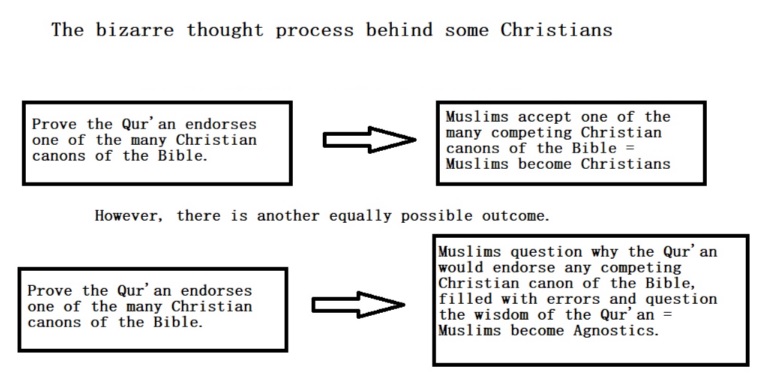
4 Comments

Filed under Uncategorized