“My Lord, increase me in knowledge.” (Qur’an 20:114)
﷽
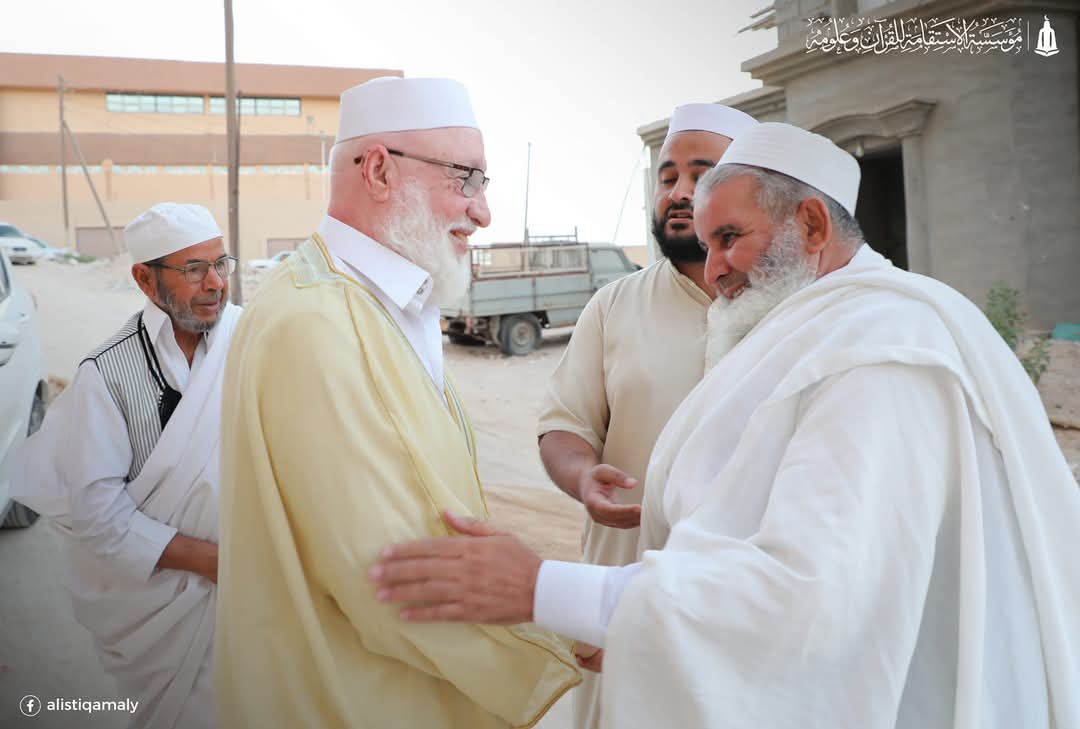
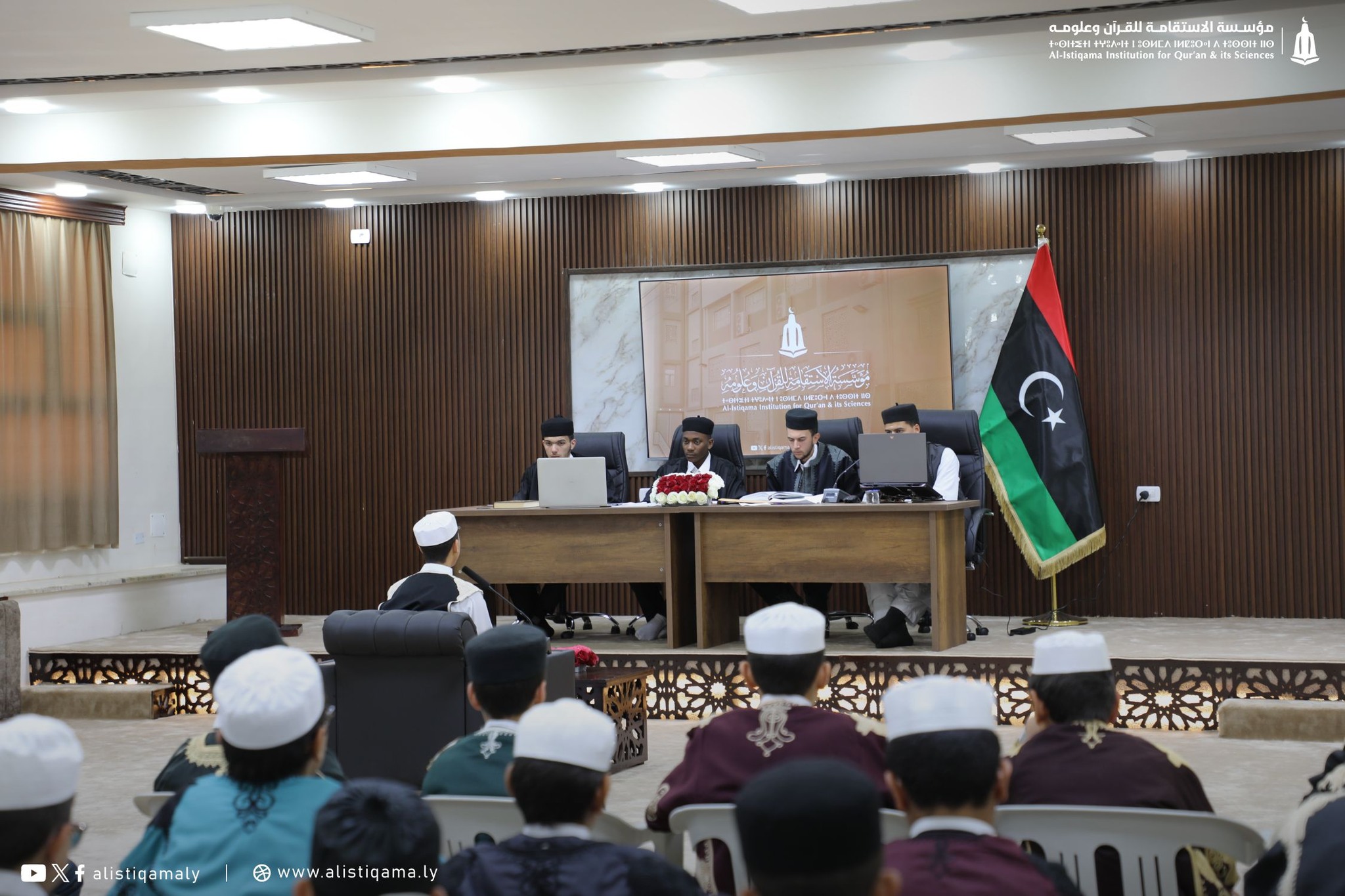
This post is to congratulate the graduates of the Istiqama community in Libya and to ask for Allah (swt) to continue to send his blessings down upon the people of Nafusa for their warmth, hospitality and continued guidance and beacon of light for the Ummah.
Those brothers who came from different regions and countries in the region to dedicate themselves to this path and to the deen of Allah (swt). May Allah (swt) bless them!
Brothers from all over the great continent of Africa, from Libya, Tunisia, Sudan, Chad, Burkina Faso, Mali, Egypt, Algeria, Ghana they come to learn and pass on what they learn to those in their homelands.
Children are often mentored by their peers, and helped along by children a few years older than them as a way of encouragement and to let those children see themselves in those who inspire them.
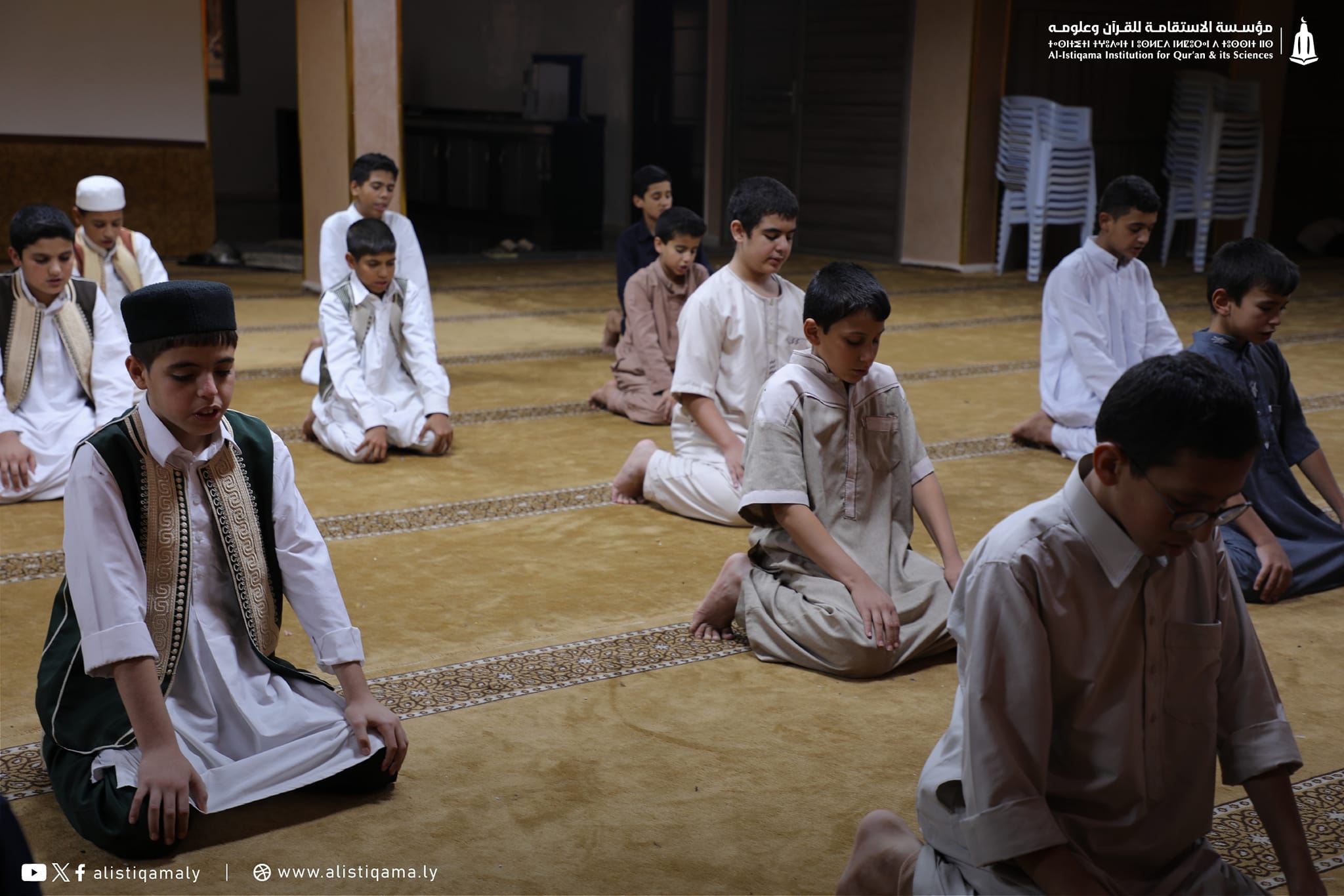
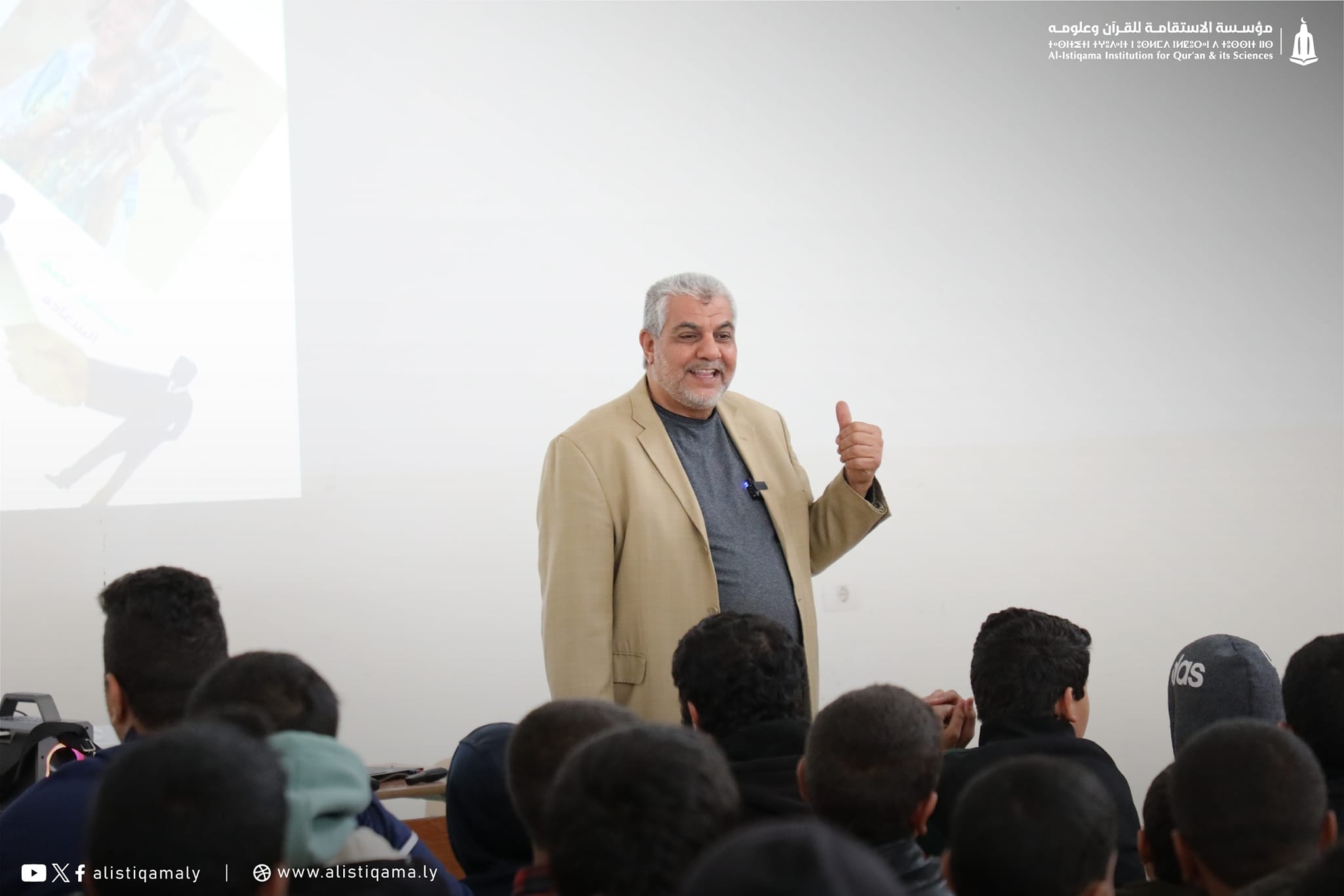
Youth attentively listen to lessons.
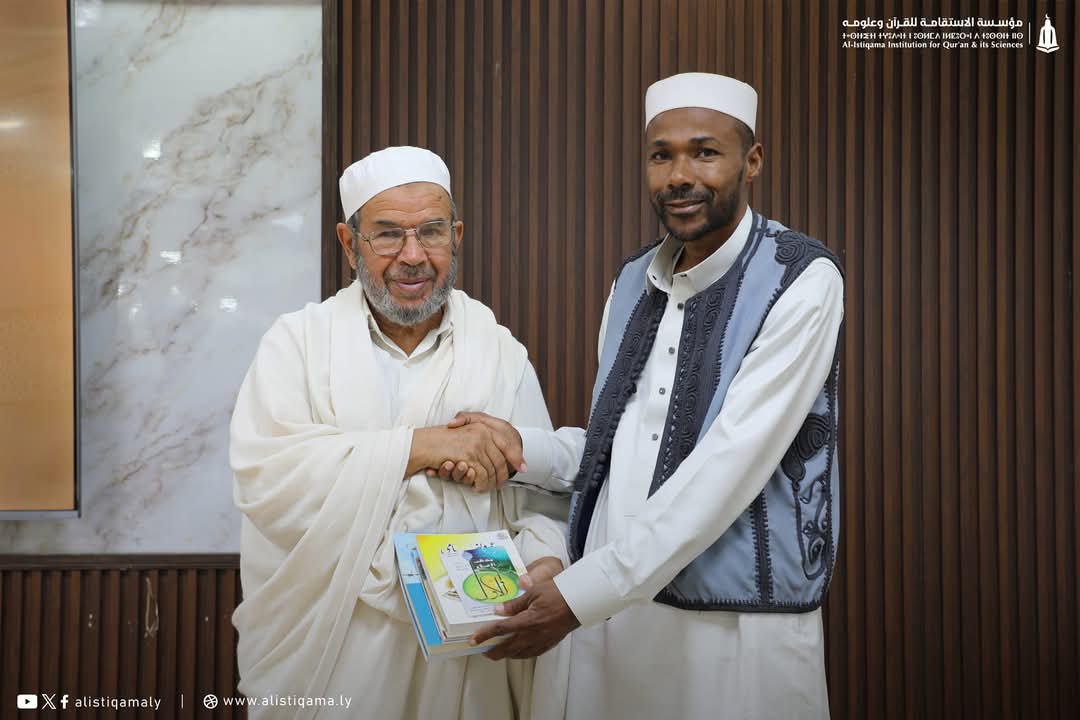
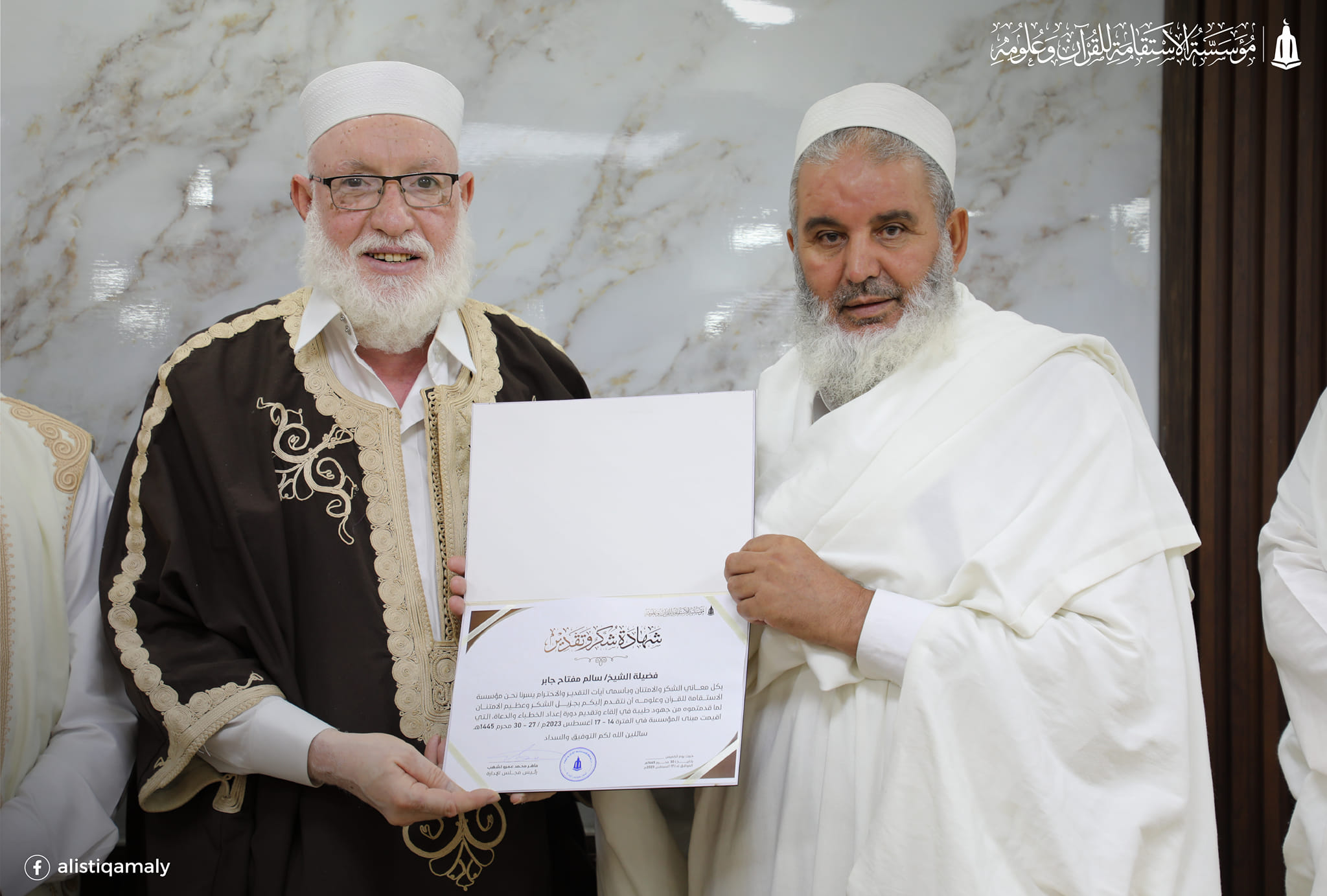
There are award ceremonies in which ijaza certificates are given by the Shyookh. The students are honoured with gifts and other accolades for being the future bearers of knowledge and light.
Time for brotherhood and being in the company of the people of knowledge.
May Allah (swt) continue to bless this school and bless its teachers and bless its students. May Allah (swt) grant them strong conviction and resolute faith. May Allah (swt) fortify them from all evil and may Allah (swt) continue to bless and assist them to be beacons of light for all of North, West Africa and beyond!
Do they not then reflect on the Qur’an? Had it been from anyone other than Allah, they would have certainly found in it many inconsistencies.” (Qur’an 4:82)
﷽
The Qur’an calls Jesus the “son of Mary” (Ibn Maryam) 23 times. For a person who had no physical human father this is the most sensible and straightfoward appellation. No one else in the Qur’an has a title the ‘son of their mother’.
Jesus received his humanity and his flesh and blood via Mary (May Allah’s abundant blessings and peace be upon her).
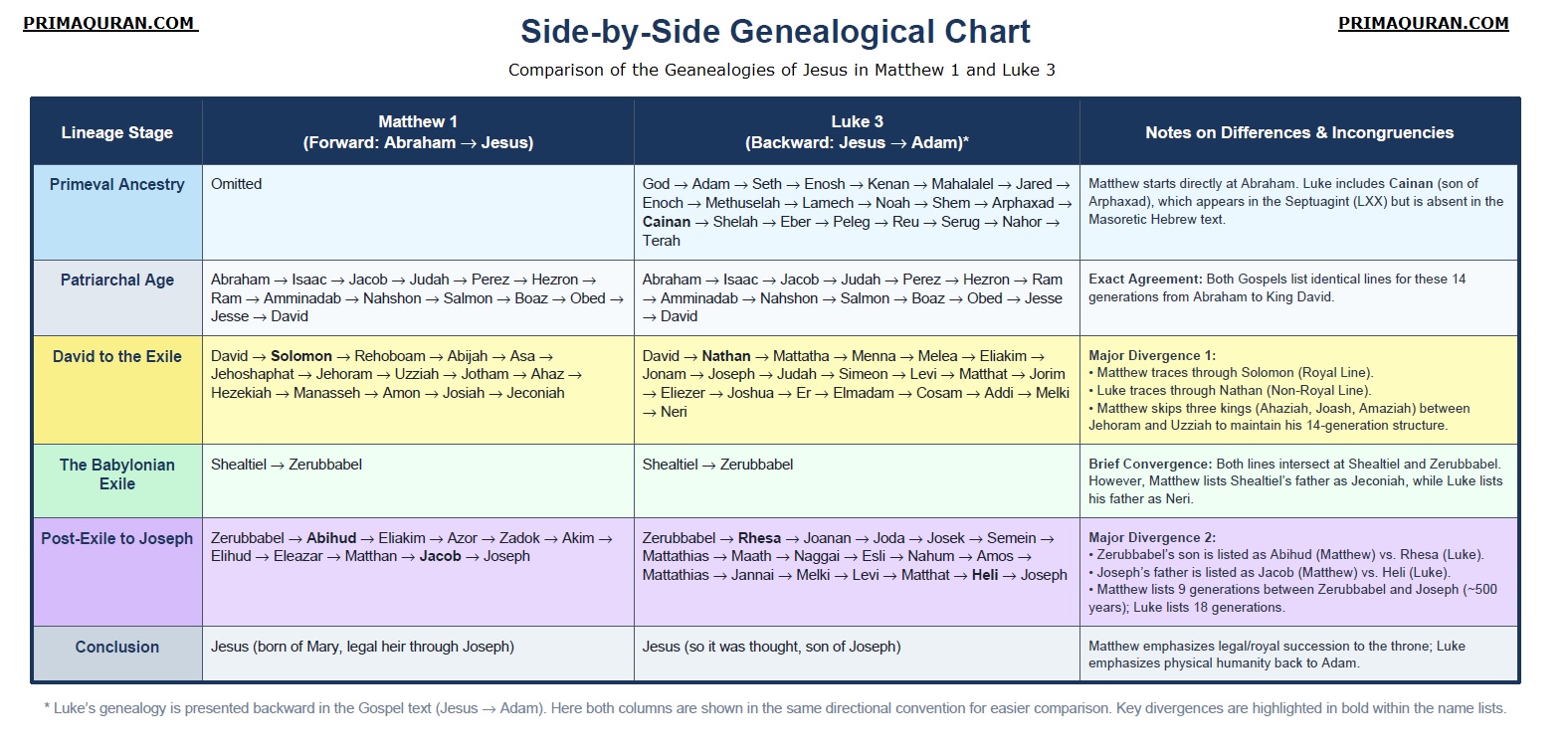
The New Testament in some desperate attempt to try and frame Jesus as the Davidic Messiah forge two contradictory genalogies to a man (Jesus) who had no genetic imput from his father.
“This is how the birth of Jesus the Messiah came about. His mother Mary was pledged to be married to Joseph, but before they came together, she was found to be pregnant through the Holy Spirit. Because Joseph her husband was faithful to the law, and yet did not want to expose her to public disgrace, he had in mind to divorce her quietly. But after he had considered this, an angel of the Lord appeared to him in a dream and said, “Joseph son of David, do not be afraid to take Mary home as your wife, because what is conceived in her is from the Holy Spirit. She will give birth to a son, and you are to give him the name Jesus, because he will save his people from sins.” (Matthew 1:18-21)
“How will this be,” Mary asked the angel, “since I am a virgin?” The angel answered, “The Holy Spirit will come on you, and the power of the Most High will overshadow you. So the holy one to be born will be called the Son of God. Even Elizabeth your relative is going to have a child in her old age, and she who was said to be unable to conceive is in her sixth month.For no word from God will ever fail.” (Luke 1:34-36)
[Click on the image above. Then right click that image and select open image in new tab. Ctrl and mouse wheel or Ctrl and +,- to zoom in/out.] Voila!
Christians try and deal with this conflict by saying that one is a genealogy through Joseph and the other is a genealogy via Mary. However, neither of the text say that it represents a genealogy through Mary.
Even then you cannot get a consistent answer from Christians. Some will claim that Matthew is giving Mary’s lineage. Some will claim that Luke is giving Mary’s lineage.
Those who try and advocate a lineage via Mary do so by claiming that Matthew ends with Mary and not Joseph.
So let us look at what the text says:
and Jacob the father of Joseph, the husband of Mary, and Mary was the mother of Jesus who is called the Messiah. (Matthew 1:16)
What does this text say about Mary?
She is the mother of Jesus.
She is the wife of Joseph.
It says nothing of her lineage.
Christians are seeing things that simply aren’t there. Who can be a Christian with this level of cope and dishonesty. Matthew 1:16 clearly ends with Joseph.
Who is the husband of Mary. Since Mary is introduced we get info about her.
Mary is Jesus mother.
What we do notget is Mary’s genealogy.
Who is Mary’s Mother in Matthew 1:16?
Who is Mary’s Father in Matthew 1:16?
If we truly love and honout God we need to love and honour truth.
The Grammatical Shift in the Greek Text
There is a vital detail in the original Greek text of Matthew 1:16 that gets lost in English translation, which reinforces our earlier point that Mary is the only physical parent.
Throughout Matthew 1, the English translation uses “was the father of” or “begat.” In the original Greek, this is the active verb egennēsen ἐγέννησεν (masculine: “he fathered”).
But in verse 16, the grammar completely changes:
“…and Jacob fathered Joseph, the husband of Mary, of whom was born Jesus…”
The phrase “of whom” in Greek is hēs, which is strictly feminine singular.
The verb “was born” is (ἐγεννήθη) egennēthē, which is passive.
Grammatically, Matthew is explicitly stating that Jesus was physically born out of Mary alone, deliberately breaking the “he fathered” pattern used for every other man in the list. This confirms exactly what we stated: Jesus’ physical humanity and flesh come solely from Mary, while Joseph’s biological seed is entirely absent.
Luke also does not give us a genealogy via Mary.
“Now Jesus himself was about thirty years old when he began his ministry. He was the son, so it was thought, of Joseph, the son of Heli.” (Luke 3:23)
“So it was thought” or “as was supposed” in some translations. Luke 3:23 is simply acknowledging the public perception of the time. That to the average observer in Nazareth, Jesus was just a normal child born to Joseph and Mary.
Another observation. ‘was about thirty years old’. hōsei (ὡσεὶ)
So you know this person is not writing under inspiration of any Holy Spirit. The Holy Spirit cannot even supply us with the information when Jesus began preaching. It’s as if the Holy Spirit is guessing. The Holy Spirit is giving us a ‘ball park figure’ a ‘guesstimation’.
Does the Gospel of Luke dismiss Matthew’s Genealogy?
It is important to note that the sequence of the Gospel order was not always uniform in Christian history.
Clement of Alexandria.Matthew and Luke are grouped together as being written before Mark, but Matthew is still traditionally listed first in that pair. The pair of Luke and Matthew.
The Western Order. The sequence is Matthew, John, Luke, Mark. Meaning Matthew remains the very first Gospel, while Luke is third.
So according to the most dominant and surviving Church tradition by all accounts Matthew is before Luke.
Luke exsposes all!
“Many have undertaken to draw up an account of the things that have been fulfilled[a] among us,just as they were handed down to us by those who from the first were eyewitnesses and servants of the word. With this in mind, since I myself have carefully investigated everything from the beginning, I too decided to write an orderly account for you, most excellent Theophilus, so that you may know the certainty of the things you have been taught.” (Luke 1:1–4)
There are four powerful points provided to us by Luke. These four points shatter the popular, clean narrative of flawless textual transmission and reveal the messy reality of early Christian record-keeping.
1. No Claim to Inspiration
The author of Luke never says, “The Holy Spirit moved me to write these words,” nor does he claim to have received this information via a divine vision or revelation. Instead, he treats his work as a human, academic endeavor. He explicitly frames his authority around human methodology: he “carefully investigated everything” like a standard ancient historian or investigative journalist.
2. Not an Eyewitness / Anonymous Sources
The text explicitly states: “just as they were handed down to us by those who from the first were eyewitnesses.”
By using the word “us,” the author explicitly excludes himself from being an eyewitness.
He admits he is a second- or possibly even a third- transmitter. Relying on a chain of custody (“handed down”).
Crucially, when it comes to the complex, divergent genealogy in Luke 3, he never names his source. He doesn’t say he got it from Mary, or from an official temple archive; it is pulled from an entirely anonymous stream of tradition.
3. Rejecting Matthew’s Order
If we grant the traditional Church view that Matthew was written first and was widely circulated, Luke’s opening sentence becomes a direct, polite critique of Matthew.
Luke acknowledges that “many have undertaken to draw up an account.” Matthew would be chief among them.
Luke then says,“I too decided to write an orderly account.“
The undeniable logical implication is that Luke found the existing accounts which would presumably include Matthew’s to be disorderly, incomplete, or structurally flawed. If Matthew’s genealogy and narrative were already perfect and “orderly,” Luke’s self-appointed mission to fix the record would be completely redundant.
4. Conflicting Information in the Early Strata
The very fact that Luke felt compelled to launch a major investigation and draft a brand-new timeline proves that the “data” about Jesus in currency between 60–90 AD was already heavily conflicting.
Even in the earliest layers of the Christian movement, there was no single, unified, locked-in story. You had:
One community (Matthew’s) circulating a list that went through Solomon, Jeconiah, and Jacob.
Another community (Luke’s source) circulating a list that went through Nathan, Neri, and Heli.
The author of Luke stepped into this chaotic environment of competing oral traditions and picked the data he deemed most reliable or “orderly,” and wrote his version. The result is the flat, un-harmonised contradictions we see on the page today.
The blood curse dilemma for Chrisitians.
“and Josiah the father of Jeconiah or spelled as Jehoiachin and his brothers at the time of the exile to Babylon.” (Matthew 1:11)
The inclusion of King Jeconiah (also known as Jehoiachin) in Matthew 1:11 introduces what theologians call the “Blood Curse” dilemma, which stems from a severe prophecy in the Book of Jeremiah.
The Prophetic Dilemma (Jeremiah’s Curse).
During the Babylonian exile, King Jeconiah rebelled against God. In response, God pronounced a permanent curse on his biological bloodline.
““As surely as I live,” declares the Lord, “even if you, Jehoiachin son of Jehoiakim king of Judah, were a signet ring on my right hand, I would still pull you off. I will deliver you into the hands of those who want to kill you, those you fear such as the Nebuchadnezzar king of Babylon and the Babylonians. I will hurl you and the mother who gave you birth into another country, where neither of you was born, and there you both will die. You will never come back to the land you long to return to.” Is this man Jehoiachin a despised, broken pot, an object no one wants? Why will he and his children be hurled out, cast into a land they do not know? O land, land, land, hear the word of the Lord! This is what the Lord says: “Record this man as if childless, a man who will not prosper in his lifetime, for none of his offspring will prosper, none will sit on the throne of David or rule anymore in Judah.” (Jeremiah 22:24-30)
This created a massive legal and prophetic paradox for the Jewish expectation of the Messiah:
The Requirement: The Messiah had to be a descendant of King David and King Solomon to claim the legal rights to the royal throne.
The Problem:Jeconiah was part of that royal line. Because of the curse, any biological child born from Jeconiah’s bloodline was strictly disqualified from ever sitting on the throne of David.
If Jesus was the biological son of Joseph (who carried Jeconiah’s bloodline in Matthew), Jesus would be legally disqualified from being the Messiah King!
If Jesus has absolutely no biological connection to Joseph. So then tracking Joseph’s genealogy whether cursed or not does not give Jesus a drop of Davidic blood.
Neither Matthew or Luke state that they are giving Mary’s genealogy. In fact, they are not even giving us Jesus genealogy. What we are getting are genealogies of Joseph.
The Unresolved Reality
By sticking strictly to the text, we are left with the exact dilemma that was raised earlier:
Matthew traces Joseph’s ancestry to David.
Luke traces Joseph’s ancestry to David.
Jesus has no biological connection to Joseph.
The texts do not explicitly provide Mary’s ancestry.
Further contradictions and errors in Matthew Genealogy.
“After the exile to Babylon: Jeconiah was the father of Shealtiel, Shealtiel the father of Zerubbabel,“(Matthew 1:12)
“The descendants of Jehoiachin the captive: Shealtiel his son, Malkiram, Pedaiah, Shenazzar, Jekamiah, Hoshama and Nedabiah. The sons of Pedaiah: Zerubbabel and Shimei. The sons of Zerubbabel: Meshullam and Hananiah. Shelomith was their sister.” (1 Chronicles 3:17-19)
To get around this error it is often propsed that a Leveriate marriage was involved. The claim is Shealtiel died childless. This information is completely absent from the text. It is a fabricated premise required to make the Levirate marriage theory function.
Why theis silence destroys any attempt at harmonization.
Once again, stacking this theory against the rest of scripture reveals a new contradiction:
If Shealtiel died childless and Pedaiah raised up an heir for him: By Torah law (Deuteronomy 25:6), Pedaiah’s firstborn son would legally belong to Shealtiel to carry on his name.
The Chronological Contradiction: If the Levirate law was successfully fulfilled, the official temple archives in 1 Chronicles should have recorded Zerubbabel as the son of Shealtiel. Instead, the Chronicler flatly records Zerubbabel as the son of Pedaiah.
By recording Zerubbabel under Pedaiah’s name, the text indicates that Zerubbabel carried Pedaiah’s legal identity and inheritance, not Shealtiel’s.
The flat textual discrepancy remains.
Rather than the text supporting a Levirate framework, we are left with a direct clash between different books of the Bible:
1 Chronicles 3:19 says Zerubbabel is the son of Pedaiah.
(Ezra 3:2), (Nehemiah 12:1), (Haggai 1:1), (Mathew 1:12), (Luke 3:27) all flatly call him the son of Shealtiel.
The narrative of a childless death is a defensive theory constructed after the fact to patch over an explicit contradictions.
The Ultimate Historical Trap for Matthew.
If it was a Levirate marriage: The child legally belongs to the dead brother (Shealtiel). Therefore, the official genealogical records of Israel should have listed Zerubbabel under Shealtiel.
The Chronicler’s Rejection: But the author of 1 Chronicles explicitly rejects that. He prints Zerubbabel as the biological and legal son of Pedaiah.
Matthew’s Error: By writing that Shealtiel fathered Zerubbabel, Matthew is directly contradicting the primary historical source material of the Hebrew Bible.
Why This Destroys Matthew’s Objective.
Matthew’s entire purpose in Chapter 1 is to present a neat, unquestionable, legally airtight royal lineage to prove Jesus is the Messiah to a Jewish audience.
However, by printing a line that flatly contradicts the official priestly and royal archives of 1 Chronicles 3, Matthew’s genealogy fails the very audience he is writing for. Any first-century scribe or scholar reading Matthew 1:12 alongside the scroll of Chronicles would immediately see the discrepancy and flag it as a disqualifying error!
Yes! Even more contradictions and errors in Matthew Genealogy.
“Zerubbabel the father of Abihud, Abihud the father of Eliakim, Eliakim the father of Azor,” (Matthew 1:13)
“The sons of Zerubbabel: Meshullam and Hananiah, and Shelomith was their sister. There were also five others: Hashubah, Ohel, Berekiah, Hasadiah and Jushab-Hesed.” (1 Chronicles 3:19–20)
1 Chronicles explicitly lists seven sons and one daughter for Zerubbabel. Abiud is completely absent from the list.
Furthermore, Luke 3:27 also lists a son for Zerubbabel, but he calls him ‘Rhesa‘
Neither Matthew’s “Abiud” nor Luke’s “Rhesa” appear anywhere in the official Old Testament list of Zerubbabel’s children.
Matthew’s list here cannot be verified by any Hebrew scripture. Historians note that after the Babylonian exile, official, centralized royal records in Israel largely disintegrated or became heavily fragmented.
Matthew wanting to connect the historic post-exilic hero Zerubbabel to Joseph’s family either used a flawed, unverified local family oral tradition or simply inserted names (like Abiud) to bridge a multi-century historical gap and maintain his rigid structure of exactly 14 generations.
Matthew 1:13 directly invents or inserts a son for Zerubbabel that the chronicler of Israel’s royal line explicitly omitted.
The massive gap of generations between Zerubbabel and Joseph!
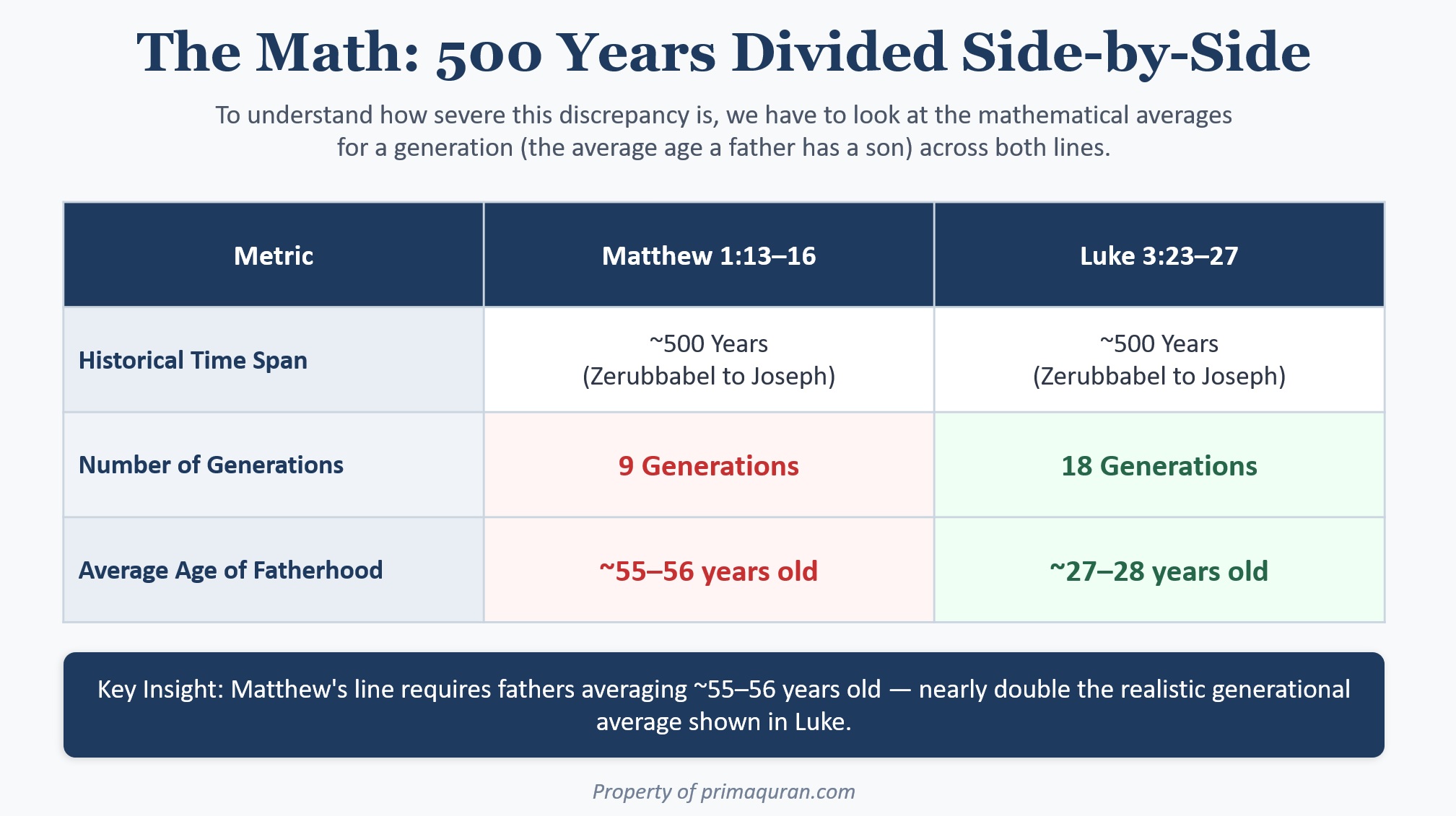
(Where Matthew covers over 500 years of history using only 9 names, while Luke uses 18.)
When we look at the final stretch of history from the Babylonian exile (around 586 BC) to the birth of Jesus, we encounter a massive, chronological black hole in Matthew’s genealogy.
By comparing the number of generations Matthew and Luke use to cover this 500-year historical gap, the numbers reveal a stark biological impossibility in Matthew’s list.
Why Matthew’s Line is Biologically Impossible
In the ancient world, the average age of fatherhood was typically between 20 and 30 years old.
Luke’s timeline is completely realistic. An average of 27–28 years per generation fits perfectly with historical realities, standard human biology, and ancient demographics. Over 500 years, you should have around 17 to 20 generations.
Matthew’s timeline requires a miracle per generation. For 9 men to stretch across 500 years, every single father in Matthew’s line would have to be roughly 55 to 60 years old when their listed son was born. While biologically possible for an isolated individual, it is mathematically and historically impossible for an entire ancestral line to maintain this average consecutively for half a millennium.
Why Did Matthew Do This?
Matthew explicitly tells us why.
“Thus there were fourteen generations in all from Abraham to David, fourteen from David to the exile to Babylon, and fourteen from the exile to the Messiah.” (Matthew 1:17)
Matthew was completely bound to the number 14. For whatever reason. Was it due to numerology, gematria or demonology is anyone’s guess.
What is clear is that Matthew intentionally deleted at least 8 to 10 historical generations from the post-exilic era. He compressed 500 years of history into a completely artificial framework.
By sticking strictly to the text, we see that Luke records a realistic human lineage, while Matthew prints a heavily redacted, structurally forced list.
Because Matthew chopped out massive chunks of history to make his “14 generations” pattern work, his list ceases to be an accurate historical record of Joseph’s actual ancestors. It is a literary device, not a historical document.
This is perhaps why we have Luke who claims:
“With this in mind, since I myself have carefully investigated everything from the beginning, I too decided to write an orderly account for you.”
Further Christian and so called “Hebrew Israelite’ defenses.
In this section we will look at further Christian and/or “Hebrew Isrealite” defenses of these contradictions.
Joseph: The son of Jacob or the son of Heli?
“and Jacob the father of Joseph, the husband of Mary, and Mary was the mother of Jesus who is called the Messiah.” (Matthew 1:16)
“Now Jesus himself was about thirty years old when he began his ministry. He was the son, so it was thought, of Joseph, the son of Heli.” (Luke 3:23)
Here the ‘Levirate marriage theory’ is introduced.
“If brothers are living together and one of them dies without a son, his widow must not marry outside the family. Her husband’s brother shall take her and marry her and fulfill the duty of a brother-in-law to her. The first son she bears shall carry on the name of the dead brother so that his name will not be blotted out from Israel.” (Deuteronomy 25:5-6)
Levirate marriage is a traditional practice where a man is required or encouraged to marry his deceased brother’s widow. The main goal is to produce an heir to carry on the dead brother’s name and protect family property.
Since both Gospels explicitly record that Jesus was miraculously conceived through the Holy Spirit, trying to engineer complex biological or legal loopholes for Joseph’s lineage becomes an unnecessary distraction from the text’s primary claim.
When you break down the actual rules of Levirate marriage, the traditional apologetic explanation completely falls apart under its own weight.
The Self-Contradiction of the Theory
The traditional harmonization (popularized by the early church historian Africanus) claims the following scenario:
Heli and Jacob are maternal half-brothers.
Heli dies childless.
Jacob steps in and performs the Levirate marriage with Heli’s widow to raise up an heir for his dead brother.
Jacob biologically fathers Joseph.
By the absolute law of Levirate marriage, the child belongs legally to the dead brother, not the living one.
The Law’s Explicit Goal: Deuteronomy states that the firstborn child of a Levirate marriage “shall carry on the name of the dead brother so that his name will not be blotted out from Israel.”
The Contradiction: If this was a true Levirate marriage, Heli is the legal father, and Jacob’s name is legally erased from the lineage.
The Textual Reality: If Jacob’s name is erased from the legal line, Matthew would never have written “Jacob fathered Joseph.” Matthew’s genealogy would have had to list Heli. Conversely, if Jacob is listed because he is the physical father, it violates the entire point of a Levirate marriage, which was to attribute the child to the dead man.
A Levirate marriage only happens after a man is dead.
Therefore, Heli is completely out of the picture physically. He did not provide seed, he did not raise the child, and he did not father Joseph.
For Luke to flatly write that “Joseph was the son of Heli” while Matthew flatly writes “Jacob fathered Joseph,” they are describing two completely mutually exclusive realities.
To make the Levirate theory work, apologists have to invent a completely fabricated hybrid system where Joseph somehow holds a “dual sonship” that the text of the Gospels never hints at, and that ancient Jewish legal records would not support in the way it is presented.
By applying strict logical consistency to the definitions of the law, the Levirate explanation doesn’t solve the problem. It just creates a new contradiction.
Since the legal and biological loopholes fail to bridge the gap, it leaves us right back at our earlier point: these are two completely separate, conflicting traditions circulating in the early Church strata.
Why the Levirate Explanation Fails Logically
The theory (originally proposed by the 3rd-century historian Julius Africanus) claims that Helidied childless, so his brother Jacob married the widow. Jacob physically fathered Joseph, but legally, Joseph belonged to the deceased Heli.
This fails for three fatal reasons:
1. It Completely Erases Matthew’s Genealogy
According to the Torah (Deuteronomy 25:6), the absolute legal purpose of a Levirate marriage is that the child “shall carry on the name of the dead brother so that his name will not be blotted out.”
Legally, Jacob’s name is completely out of the picture. Joseph is legally the son of Heli alone.
Therefore, Matthew’s legal genealogy tracking the line of kings could not say “Jacob fathered Joseph.” If Matthew was tracking the legal line, he would have been required to write “Heli.”
2. It Makes Matthew Track an Irrelevant Bloodline
If apologists argue that Matthew is tracking the physical bloodline (“according to the flesh”) via Jacob, the genealogy becomes messianically useless. If Joseph is legally Heli’s son, then Jacob’s physical lineage through Solomon and the kings means absolutely nothing to Joseph.
3. It Invents a Speculative “Dual Lineage”
The text of the Gospels gives no hint of this complexity. Matthew says “Jacob fathered Joseph.” Luke says Joseph was “the son of Heli.” To force a Levirate marriage onto the text requires inventing a massive legal loophole that violates how ancient Jewish records actually handled names.
How This Complicates and Ruins Messianic Claims in Judaism
In the Tanakh and rabbinic Judaism, the Levirate explanation does not save the narrative. It completely breaks the requirements for the Messiah.
1. The Legal vs. Physical Contradiction in Jewish Law
To inherit the throne of King David, the Messiah must fulfill two distinct criteria simultaneously under the Tanakh:
Tribal/Royal Lineage is Paternal Only: Tribal affiliation (Judah) and royal succession (Davidic) are passed exclusively through the biological father’s seed(Numbers 1:18). Adoption or step-parenting does not transfer tribal identity or royal blood rights in Jewish law.
“and they called the whole community together on the first day of the second month. The people registered their ancestry by their clans and families, and the men twenty years old or more were listed by name, one by one,” (Numbers 1:18)
The Biological Dilemma: If Joseph’s physical father is Jacob (Matthew) but his legal father is Heli (Luke), Jesus’ lineage is fractured. If you claim Jesus gets his right through Joseph’s legal line (Heli), Judaism rejects it because Heli’s line goes through Nathan, not Solomon. The Tanakh explicitly states the royal throne belongs exclusively to the physical seed of Solomon(1 Chronicles 22:9-10).
“Behold, a son shall be born to you, who shall be a man of rest; and I will give him rest from all his enemies all around. His name shall be Solomon, for I will give peace and quietness to Israel in his days. He shall build a house for My name, and he shall be My son, and I will be his Father; and I will establish the throne of his kingdom over Israel forever.’ (1 Chronicles 22:9-10)
2. The Levirate Law Disqualifies the Royal Line
If Joseph is the product of a Levirate marriage to raise up seed for Heli, Joseph’s legal identity belongs to Heli’s line (the line of Nathan).
Because Nathan was never a king, Heli’s line has no royal claim to the throne.
By asserting that Joseph is legally Heli’s son, apologists accidentally strip Joseph (and by extension, Jesus) of the legal right to the throne of Solomon.
3. The Ultimate Jewish Objection: The Virgin Birth
From the perspective of Judaism and the Tanakh, the entire genealogical debate is rendered moot by the claim of the Virgin Birth.
If Joseph is not the biological father of Jesus (no sperm/seed involved), then Jesus has 0% tribal connection to Judah and 0% royal connection to David through Joseph, regardless of whether Joseph’s father was Jacob or Heli.
The Jeconiah Blood Curse solution and the Levirate Marriage solutution. When resolutions clash.
When you stack the Jeconiah Blood Curse solution right next to the Levirate Marriage solution, the two arguments completely collide and destroy each other. You cannot hold both views simultaneously without creating a massive logical paradox.
Here is the exact step-by-step breakdown of the trap that traditional harmonizations fall into:
The Contradiction Stack: How They Destroy Each Other
The “Solution” Offered
The Mechanics of the Solution
The Hidden Conflict Created
1. The Levirate Solution(To fix the Jacob vs. Heli contradiction)
Apologists claim Jacob (Matthew’s line) is the physical/biological father of Joseph, while Heli (Luke’s line) is the legal father.
This means Joseph’s true, binding legal identity belongs entirely to Heli (the non-royal line of Nathan).
2. The Adoption Solution(To fix the Jeconiah Blood Curse)
Apologists claim Jesus inherits the royal, kingly right to the throne from Joseph via legal adoption.
In ancient law, you can only adopt a child into your own legal lineage. You cannot pass down a legal inheritance that you do not legally possess.
The Ultimate Breakdown of Logic
If we accept both traditional claims, the entire messianic argument collapses under its own weight for two reasons:
1. Joseph Has No Royal Legal Line to Pass Down
If Joseph is the legal son of Heli via Levirate law, then Joseph’s legal ancestry is Luke’s genealogy. Luke’s genealogy goes through Nathan, who was never a king. Joseph completely loses his legal connection to Solomon and the royal line of kings in Matthew.
Therefore, when Joseph “legally adopts” Jesus, he can only pass down his own legal lineage. That is the non-royal line of Heli and Nathan. The adoption completely fails to give Jesus a claim to the royal throne.
2. The Physical Line is Cursed and Messianically Useless
If apologists argue that Joseph still carries the royal line of Solomon through his physical father Jacob, that physical line is precisely the one carrying the blood curse of Jeconiah (Jeremiah 22:30) that we mentioned earlier.
But the entire point of the adoption theory was to avoid the physical line because it was cursed! Furthermore, as established by Torah law, a Levirate child has no legal rights to his physical father’s (Jacob’s) royal estate anyway.
The Conclusion: A Complete Logical Checkmate
By trying to patch up two separate problems with two different fabricated legal loopholes, traditional apologetics creates an impossible situation:
To fix the name discrepancy, they strip Joseph of his legal royal heritage (making him legally Heli’s son).
To fix the blood curse, they rely on Joseph’s legal royal heritage via adoption to make Jesus a king.
This is an absolute, massive contradiction. The moment you use the Levirate theory to explain away the different fathers for Joseph, you automatically disqualify Joseph from being able to pass down the royal throne to Jesus through adoption.
The two texts simply remain what we identified as earlier: two entirely separate, conflicting, and un-harmonized traditions from the early strata of Christianity.
The Flaw in the “Legal Right” Claim: For Joseph to pass down the royal “legal right” to Jesus via adoption, Joseph himself must hold that legal right.
The Levirate Collateral Damage: If Joseph’s legal father is Heli (as the Levirate theory demands to fix the Matthew/Luke contradiction), then Joseph’s legal inheritance is non-royal. He cannot pass a royal legal right to Jesus that he legally surrendered to Heli’s lineage.
The Logical Trap: When presented with the adoption argument as a clean solution to the curse, and then you introduce the Levirate framework to fix the other discrepancies, the foundation of that adoption argument completely dissolves.
The traditional attempts at harmonisation end up chasing their own tails. You cannot use the Levirate law to change Joseph’s legal father to Heli, and then turn around and use Matthew’s line to claim Joseph passes down a legal right from Jacob.
Also, if you want to see how the New Testament portrays Jesus as a super ultra ignorant individual when it comes to levirate marriage and human reproduction you may see our article here:
Apologetic claim: Matthew skips generations while Luke meticuulously lists every person.
When apologists claim that Matthew intentionally “skips” generations while Luke meticulously lists every single person “line-by-line” to capture the pure maternal bloodline, they run straight into a massive wall erected by Luke himself.
Here is exactly how the actual data in Luke exposes this argument as a total fabrication:
1. Luke Explicitly Connects the Line to Joseph, Not Mary
If Luke was writing a strict “line-by-line” biological genealogy of Mary to patch up Matthew’s omissions, he would have stated so. Instead, Luke 1:27 tells us exactly who belongs to the house of David:
“…to a virgin pledged to be married to a man named Joseph, of the house of David. The virgin’s name was Mary.”
Luke explicitly anchors the Davidic lineage to Joseph, not Mary. He repeats this in Luke 2:4: “So Joseph also went up from the town of Nazareth… to Bethlehem the town of David, because he [Joseph] belonged to the house and line of David.”
Luke never says Mary belongs to the line of David. The “all-male line-by-line Mary defense” is entirely invented; Luke flatly states he is tracking Joseph’s ancestry.
2. Luke Fabricates the Ultimate “Skip” (The Post-Exile Void)
The claim that Luke is a reliable, exhaustive “line-by-line” historical record completely falls apart when we look at the historical timeline.
As we established, Luke lists 18 generations between Zerubbabel (500 BC) and Joseph (0 BC). While 18 generations is far more mathematically realistic than Matthew’s 9 generations, it is still an incomplete historical record.
In historical reality, 500 years of history at a normal human generational pace requires roughly 20 to 25 generations.
To make Luke a flawless “line-by-line” document, apologists have to claim that every single man in Luke’s post-exilic line waited until they were nearly 30 years old to have a child, without a single premature death, war, or disruption over half a millennium.
3. The Textual Reality: Both are Theological, Not Historical
When you look at the raw data, the “Luke is strict, Matthew is skipping” argument is just another artificial patch.
Matthew openly admits he is skipping names to force an artificial structural template of 3 sets of 14 generations.
Luke rearranges his list to end on a theological climax: tracing Jesus all the way back to Adam.
“Adam, the son of God” (Luke 3:38).
By forcing the text of Luke to stand on its own two feet, we have correctly shown that the “line-by-line Mary” theory completely contradicts what Luke actually wrote in his opening chapters.
How does Numbers 27:8-11 destroy the claims of the adoptionist theory?
“Say to the Israelites, ‘If a man dies and leaves no son, give his inheritance to his daughter. If he has no daughter, give his inheritance to his brothers. If he has no brothers, give his inheritance to his father’s brothers. If his father had no brothers, give his inheritance to the nearest relative in his clan, that he may possess it. This is to have the force of law for the Israelites, as the Lord commanded Moses.’” (Numbers 27:8-11 )
This completely destroys the adoptionist theory because it establishes an exhaustive, legally binding, closed-loop system of inheritance that leaves absolutely no legal mechanism for an adopted child or stepson to inherit a tribal or royal patrimony.
Under the strict letter of Torah law, when a man dies, his inheritance follows a precise, mandatory chain of custody. By applying this exact statute to Joseph and Jesus, the adoptionist framework collapses for three reasons:
The text of Numbers 27 outlines a strict hierarchy of who has legal right to a man’s property, title, and estate:
The Biological Son (assumed in verse 8 as the default primary heir)
The Daughter (if there is no son)
The Deceased Man’s Brothers (if there are no children)
The Paternal Uncles (if there are no brothers)
The Nearest Blood Relative in the Clan
Adoption is completely missing from this statutory list. In the legal framework of the Torah, a man cannot simply invent or appoint an unrelated heir to bypass this divine command.
The law commands: “This is to have the force of law for the Israelites.” If Joseph has no biological sons, his legal estate and royal Davidic titles do not pass to a stepson; they are legally mandated by God to go to Joseph’s brothers or his nearest paternal blood relatives.
To inherit the throne of David, a person must belong to the tribe of Judah and be of the literal, physical line of David and Solomon.
According to Numbers 27, if Joseph dies without physical seed, his branch of the Davidic line effectively closes. The title moves sideways to his biological brothers (such as any physical brothers Joseph might have had from Jacob’s line). Because Jesus has zero biological input from Joseph’s sperm, Jesus is legally outside this chain of custody. Joseph had no legal authority under Torah law to transfer a tribal, patriarchal inheritance to a child who was not his physical seed.
The Ultimate Legal Checkmate
The adoptionist theory tries to argue that “legal fatherhood” is enough to pass down the covenantal promises made to David. However, Numbers 27 proves that biblical legal fatherhood is explicitly tied to biological realities. The law only moves to non-children (brothers and uncles) when biological children do not exist.
If apologists argue that Jesus is Joseph’s legal son through adoption, they are inventing a Hellenistic or Roman legal concept (where adoption granted full estate rights) and forcing it onto Hebrew law. The Torah recognizes no such mechanism for tribal or royal succession.
The Theological Fallout
By applying Numbers 27:8–11 strictly:
If Joseph is not the biological father, he cannot pass the rights of Judah and David to Jesus.
The inheritance is legally forced by the Torah to go to Joseph’s brothers or closer blood kin.
Jesus is left with no legal or scriptural mechanism to claim the royal throne of David through Joseph.
Final Thoughts.
If the goal is to honor God through truth, then the truth is: the New Testament presents a virgin-born Messiah whose Davidic lineage is not documented in the genealogies it provides. That is a real theological and historical problem, and pretending it isn’t there does not serve the text, the tradition, or the seeker of truth.
The Gospels present two conflicting genealogies.
Both are Joseph’s.
Neither is Mary’s.
Jesus has no biological connection to Joseph.
Therefore, the New Testament does not provide a genealogy of Jesus. It provides genealogies of Joseph, which serve no biological or legal function for a virgin-born Messiah.
Any attempt to make one of these genealogies “Mary’s” or to claim that Joseph’s line “counts” for Jesus through adoption or Levirate marriage is reading into the text, not reading from it.
May Allah guide the sincere Christian into the truth.
May Allah guide those who call themselves, ‘Hebrew Israelites’ into the truth.
“(We take our) colour from Allah, and who is better than Allah at colouring. We are His worshippers.” (Qur’an 2:138) -Pickthall
“(Our religion is) the Baptism of Allah: And who can baptize better than Allah? And it is He Whom we worship.” (Qur’an 2:138)-Yusuf Ali
“Indeed, those who have believed (amanu) and those who were Jews and the Sabeans and the Christians and the Magians and all those who associated (ashraku) with Allah – Allah will judge between them on the Day of Resurrection. Indeed Allah is, over all things, Witness.” (Qur’an 22:17)
﷽
INTRODUCTION AND FRAMEWORK
I. Introduction: The Silence of the Apologists
If you were to tune into the Christian apologetic scene, they really seem to be on a tare about how Islam somehow is not in continuity with the Bible. At least that is their claim. Yet, they are awfully quiet about the biggest ritual in all of Christianity, namely the rite of baptism.
This fundamental ritual has been a matter of dispute among Christians until today. Does one get baptized in the name of Jesus only or in the name of the Father, the Son and the Holy Spirit?
At what age does one get baptized? Can babies get baptized or not? Does a Church less Christian have authority to baptize? Can any self-professed Christian baptize any other self-professed Christian?
Is baptism required for salvation? What happens when there is no water available? Is it enough to be baptized in water? What is baptism by the Holy Spirit?
In our view this is not discussed enough in apologetic spaces.
Baptism. That quirky ritual found neither in Judaism or Islam.
The Qur’an addresses this matter directly:
“(We take our) colour from Allah, and who is better than Allah at colouring. We are His worshippers.” (Qur’an 2:138) -Pickthall
“(Our religion is) the Baptism of Allah: And who can baptize better than Allah? And it is He Whom we worship.” (Qur’an 2:138)-Yusuf Ali
“Indeed, those who have believed (amanu) and those who were Jews and the Sabeans and the Christians and the Magians and all those who associated (ashraku) with Allah – Allah will judge between them on the Day of Resurrection. Indeed Allah is, over all things, Witness.” (Qur’an 22:17)
This article argues that Christian baptism, the central rite of Christianity, has no foundation in the Hebrew Bible, no clear authorization from Jesus, and no consistent theological meaning across Christian traditions. In contrast, the Qur’anic concept of “the dye of Allah” (ṣib’ghat Allāh) offers a superior framework for spiritual purification rooted in the primordial constitution (fiṭra) upon which Allah created humanity.
II. The Qur’anic Framework: Understanding “The Dye of Allah”
We have two English translations of Qur’an 2:138 as seen above. They are both sound in their meaning.
The Word sib’ghata: Literally translates to “dye” or “color”
The great scholar of tafsir Shaykh Muḥammed b. Yūsuf Aṭfayyish (r) has the following to say:
“{The dye of Allah (ṣibghat Allāh)} is the fiṭra of Allah, the primordial constitution upon which He created mankind. It is Islam, or divine enabling (tawfīq), or the conclusive proof (ḥujja); or it is the purification of the heart from unbelief and disobedience. It is likened to a dye in that it is outwardly manifest. As a dye is manifest. And an ornament; and in that it permeates the very depths of what is dyed, being firmly rooted therein; and in that by it man is set apart from all other animate creatures, and from the unbelievers, as a dyed garment is set apart. This is an explicit metaphor (istiʿāra taṣrīḥiyya), original (aṣliyya) and realized (taḥqīqiyya).”
“Alternatively, it was termed a “dye” by way of mushākala (assimilative phrasing) since it occurs adjacent to an elided expression, namely the Christians’ dyeing of their children in the water of baptism so that their Christianity might be confirmed. This is a yellow water, originally the water with which Jesus (peace be upon him) was washed on the third day after his birth; whenever it is depleted they add water to it, and they hold it to be a purification. It is said to be an Arabized rendering of maʿmūdhīnā. With a dotted dhāl. Meaning purity: water sanctified by what is recited over it from the Gospel, in which pregnant women then bathe.”
“Allah commanded the believers to say to the Christians: Say, we have believed in Allah, and Allah has dyed us with faith. A dye unlike the dye of baptism. {And who is better than Allah in dyeing?}. None is better than the dye of Allah, nor is any its equal, for it is Islam, which delivers from disgrace in this world and the next and bequeaths the good of both. {And we are His}. His alone, and no other’s, unlike your associating others with Him in worship, O company of Jews and Christian.”
Key Understanding: The “dye of Allah” is not an external ritual but the primordial constitution (fiṭra) upon which Allah created humanity. This stands in direct contrast to human-invented rituals like baptism. Shaykh Aṭfayyish’s commentary illuminates that the “dye of Allah” is not an external ritual but an internal purification of the heart from unbelief and disobedience. This presents a profound critique. While Christians debate the mechanics of baptism, the Qur’an directs attention to the spiritual transformation itself.
THE ETYMOLOGY AND ORIGINS OF BAPTISM
III. What is the Etymology of Baptism?
[B-1,Verb,G907, baptizo] “to baptize,” primarily a frequentative form of bapto, “to dip,” was used among the Greeks to signify the dyeing of a garment, or the drawing of water by dipping a vessel into another, etc. Plutarchus uses it of the drawing of wine by dipping the cup into the bowl (Alexis, 67) and Plato, metaphorically, of being overwhelmed with questions (Euthydemus, 277 D).
βάπτω to dip in water Dodson: βάπτω I dip, dye (a) I dip, (b) I dye. Strong’s: βάπτω to whelm, i.e. cover wholly with a fluid; in the New Testament only in a qualified or special sense, i.e. (literally) to moisten (a part of one’s person), or (by implication) to stain (as with dye)
This linguistic connection is significant. The Greek word from which “baptism” derives is fundamentally about dyeing, or immersing something in a liquid to change its color. This connects directly to the Qur’anic concept of ṣib’ghat Allāh (the dye/color of Allah). What the Qur’an presents as a spiritual metaphor, the New Testament makes into a physical ritual, and even its linguistic roots betray this connection to the very concept the Qur’an uses.
IV. The Historical Problem: Baptism’s Absence from the Hebrew Bible
The first place baptism is ever mentioned in the New Testament is as follows:
“In those days John the Baptist came preaching in the wilderness of Judea, and saying, “Repent, for the kingdom of heaven is at hand!” For this is he who was spoken of by the prophet Isaiah, saying: “The voice of one crying in the wilderness: ‘Prepare the way of the Lord; Make His paths straight.’ ” Now John himself was clothed in camel’s hair, with a leather belt around his waist; and his food was locusts and wild honey. Then Jerusalem, all Judea, and all the region around the Jordan went out to him and were baptized by him in the Jordan, confessing their sins.” (Matthew 3:1-6).
There are a number of issues with this text.
It quotes from Isaiah 40:3. It is a quote mine. There is nothing anywhere in Isaiah that talks about the ritual of baptism. This brings us to our most devastating observation.
There is no mention of a baptism ritual anywhere in the Hebrew Bible. None of the Prophets ever preached it or practiced it or participated in it. None.
With this information in mind the following text is highly unlikely:
“Then Jerusalem, all Judea, and all the region around the Jordan went out to him and were baptized by him in the Jordan, confessing their sins”
In fact, this whole issue is unresolved in the New Testament. It leads to a showdown between Jesus and the Jewish scholars with the matter apparently being unresolved.
“They arrived again in Jerusalem, and while Jesus was walking in the temple courts, the chief priests, the teachers of the law and the elders came to him. “By what authority are you doing these things?” they asked. “And who gave you authority to do this?” Jesus replied, “I will ask you one question. Answer me, and I will tell you by what authority I am doing these things. John’s baptism was it from heaven, or of human origin? Tell me!” They discussed it among themselves and said, “If we say, ‘From heaven,’ he will ask, ‘Then why didn’t you believe him?’ But if we say, ‘Of human origin’…” (They feared the people, for everyone held that John really was a prophet.) So they answered Jesus, “We don’t know.” Jesus said, “Neither will I tell you by what authority I am doing these things.” (Mark 11:27-33).
You can find the same in Matthew 21:23-32 and Luke 20:1-8.
John’s baptism: Was it from heaven, or of human origin? <<< This is the smoking gun.
If the ritual of baptism was practiced, preached or participated in by any of the Prophets of the Hebrew Bible we would not have this type of confrontation. Now, we are reading what is claimed to be the thoughts of the Jewish leadership.
“They discussed it among themselves and said, “If we say, ‘From heaven,’ he will ask, ‘Then why didn’t you believe him?’ But if we say, ‘Of human origin’…” (They feared the people, for everyone held that John really was a prophet.)
This begs the question. If the people really thought that John was a prophet then how can they flock to a person who is introducing a practice that is clearly not in continuity with Judaism?
How do we square these confrontations with the Jewish learned people when Jesus himself says the following:
“Then Jesus said to the crowds and to his disciples: “The teachers of the law and the Pharisees sit in Moses’ seat. So you must be careful to do everything they tell you. But do not do what they do, for they do not practice what they preach.” (Matthew 23:1-3)
So then what happens when they go to the teachers of the law and the Pharisees and ask them about baptism?
Matthew 21:23-32 has some additional information that Luke 20:1-8 and Mark 11:27-33 do not have.
Apparently not happy with the stalemate the writer of Matthew has Jesus try to one up the Jewish leadership.
“Then he said, “Neither will I tell you by what authority I am doing these things. “What do you think? There was a man who had two sons. He went to the first and said, ‘Son, go and work today in the vineyard.’ ‘I will not,’ he answered, but later he changed his mind and went. Then the father went to the other son and said the same thing. He answered, ‘I will, sir,’ but he did not go. Which of the two did what his father wanted?” “The first,” they answered. Jesus said to them, “Truly I tell you, the tax collectors and the prostitutes are entering the kingdom of God ahead of you. For John came to you to show you the way of righteousness, and you did not believe him, but the tax collectors and the prostitutes did. And even after you saw this, you did not repent and believe him.” (Matthew 21:28–32)
However, this is nothing remarkable about what Jesus says here at all. It is not a rejoinder to the issue of where John got the authority to baptize.
Summary: No prophet in the Hebrew Bible ever preached, practiced, or participated in baptism. This is devastating to claims of continuity. This is not a minor detail. If baptism were essential for salvation, why would none of the prophets mention it or participate in it?
The Torah contains extensive legislation about purification rituals, sacrifices, and cleansing. Yet nothing resembling Christian baptism. The prophets called for repentance and turning to God, not ritual immersion in water for the forgiveness of sins.
V. Facts About John’s Baptism
Jesus replied:
“I will ask you one question. Answer me, and I will tell you by what authority I am doing these things. John’s baptism was it from heaven, or of human origin? Tell me!”
Facts about John’s baptism:
Jesus claims what John is doing has heavenly approval.
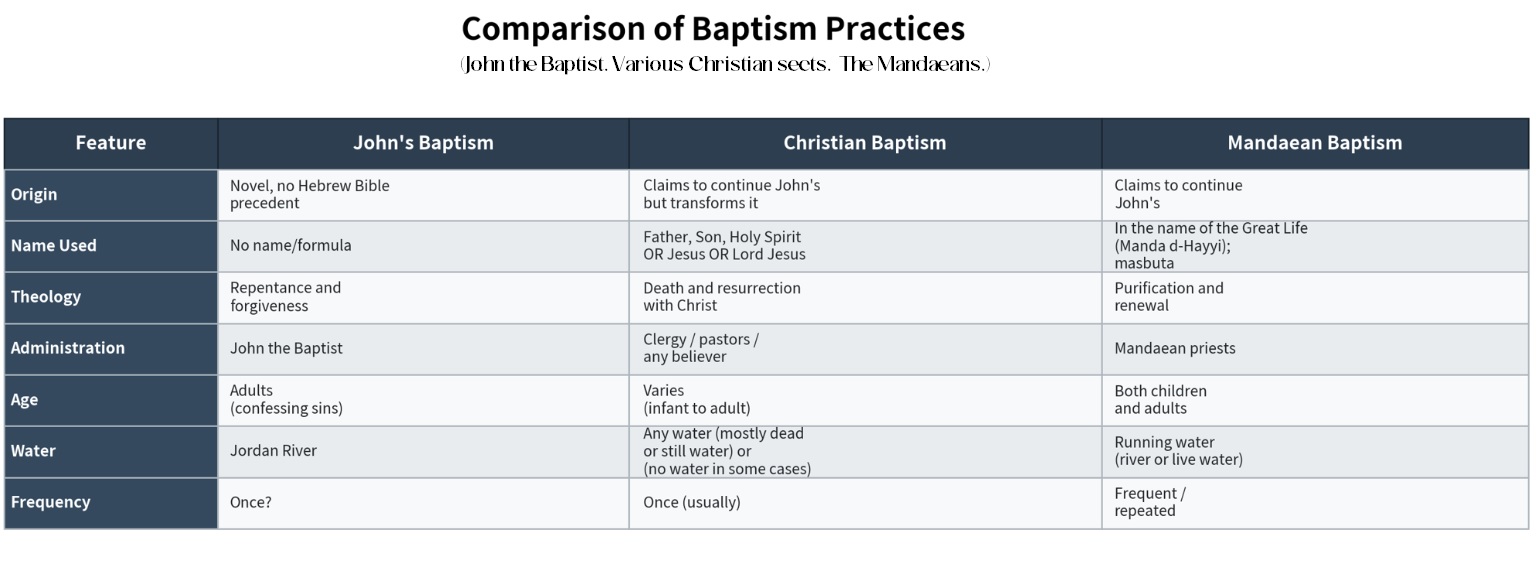
John wasn’t baptizing anyone in the name of Jesus.
John wasn’t baptizing anyone in the name of the Father, the Son, and the Holy Spirit.
John was baptizing people for the forgiveness of sins.
John’s baptizing involved no sacrifice or blood ritual.
Point 4 is explicitly stated in the following:
“And so John the Baptist appeared in the wilderness, preaching a baptism of repentance for the forgiveness of sins.” (Mark 1:4)
“He went into all the country around the Jordan, preaching a baptism of repentance for the forgiveness of sins.” (Luke 3:3)
VI. The Disconnect Between John’s Baptism and Christian Baptism
The question that has to be asked in regard to John’s baptism.
For Christians today the ritual of baptism carries the following significance:
Death and Resurrection.
Going under water: Represents dying with Christ and being buried.
Coming up from water: Signifies rising to a new life, mirroring Jesus’ resurrection.
The baptism of John could not possibly have meant those things to him or his followers as John was not even aware of Jesus (in fact he-John had to inquire about him-Jesus) and Jesus at that point hasn’t even died on a cross. So it is not possible that baptism has that theologically loaded understanding.
THE PROBLEM OF JOHN THE BAPTIST.
VII. The Tension Between Jesus and John the Baptist
What the New Testament text reveal is that there is a tension between Jesus and John the Baptist. In many places the New Testament writers go out of their way to belittle John the Baptist. As if he was a rival to Jesus.
The New Testament has Jesus have a dig at John the Baptist.
“Truly I tell you, among those born of women there has not risen anyone greater than John the Baptist; yet whoever is least in the kingdom of heaven is greater than he.” (Matthew 11:11)
“I tell you, among those born of women there is no one greater than John; yet the one who is least in the kingdom of God is greater than he.” (Luke 7:28)
In fact, this is a dig at all the Old Testament Prophets. That among all born among women there is none greater than John the Baptist. However, even the one who has the status of the ‘least’ in the kingdom of God/heaven is greater than John!
“Therefore anyone who sets aside one of the least of these commands and teaches others accordingly will be called least in the kingdom of heaven, but whoever practices and teaches these commands will be called great in the kingdom of heaven.” (Matthew 5:19)
“John answered them all, “I baptize you with water. But one who is more powerful than I will come, the straps of whose sandals I am not worthy to untie. He will baptize you with the Holy Spirit and fire.” (Luke 3:16)
What do you mean untie his sandals? You are not even worthy to carry them much less untie them!
“I baptize you with water for repentance. But after me comes one who is more powerful than I, whose sandals I am not worthy to carry. He will baptize you with the Holy Spirit and fire.” (Matthew 3:11)
So whether John said he was unworthy to carry Jesus’ sandals or untie the straps of his sandals is beside the point. The point is that Jesus is greater than John the Baptist.
VIII. John’s Uncertainty: The Decisive Problem
The New Testament records a very difficult and strange interaction between prophet Jesus and prophet John.
“For he will be great in the sight of the Lord. He is never to take wine or other fermented drink, and he will be filled with the Holy Spirit even before he is born.” (Luke 1:15)
“After Jesus had finished instructing his twelve disciples, he went on from there to teach and preach in the towns of Galilee. When John, who was in prison, heard about the deeds of the Messiah, he sent his disciples to ask him, “Are you the one who is to come, or should we expect someone else?” Jesus replied, “Go back and report to John what you hear and see: The blind receive sight, the lame walk, those who have leprosy are cleansed, the deaf hear, the dead are raised, and the good news is proclaimed to the poor.” (Matthew 11:1-5)
There are lots of issues with this:
John is a Prophet. He is filled with the Holy Spirit (even before he is born). Why does the Holy Spirit not know who Jesus is? How can a Prophet from God not recognize another Prophet from God?
Why does Jesus inform John about things he (John) already heard?
It is like this: John was informed Jesus performed a light show. So John wants to know if Jesus is a Prophet of God. So Jesus says, ‘Tell him I performed a light show’. Isn’t John already aware of this?
“When John, who was in prison, heard about the deeds of the Messiah.”
“Jesus replied, “Go back and report to John what you hear and see: The blind receive sight, the lame walk, those who have leprosy are cleansed, the deaf hear, the dead are raised, and the good news is proclaimed to the poor.”
Basically go back and inform John about things John is already informed about! What?
Why does Jesus give information to John that could also be true of a false messiah?
“For false messiahs and false prophets will appear and perform great signs and wonders to deceive, if possible, even the elect.” (Matthew 24:24)
How does Jesus feel that this information would be convincing to John?
Jesus is essentially saying to John: “I am the Messiah because I perform miracles.” But Jesus also warns that false messiahs will perform miracles. Therefore, miracles are not a reliable test of prophetic authenticity. John, being a prophet, should have known this. Why would Jesus offer a test that even Jesus himself says is unreliable?
It is very obvious that much to keen eyes that much of the information in the New Testament is convoluted.
John dies without ever knowing or declaring that Jesus is the Messiah.
There is not a single text anywhere in the New Testament that records John the Baptist explicitly uttering a statement of final, settled belief in Jesus before he (John) dies.
His final recorded words or actions regarding Jesus are a question of intense uncertainty from a prison cell, followed shortly by his sudden execution. Source: (Matthew 11:2-3) & (Matthew 14:10)
Since the Holy Spirit never guided John concerning Jesus how will he guide in the future?
“Then an angel of the Lord appeared to him, standing at the right side of the altar of incense. When Zechariah saw him, he was startled and was gripped with fear. But the angel said to him: “Do not be afraid, Zechariah; your prayer has been heard. Your wife Elizabeth will bear you a son, and you are to call him John. He will be a joy and delight to you, and many will rejoice because of his birth, for he will be great in the sight of the Lord. He is never to take wine or other fermented drink, and he will be filled with the Holy Spirit even before he is born.” (Luke 1:11-15)
Question: How can the Holy Spirit be expected to guide into ‘all truth’ in the future if we have demonstrable evidence he hasn’t done so in the past?
Question: How can Muslims fault Christians for not seeing the Blessed Prophet Muhammed (saw) in their scriptures when John the Baptist (a Prophet filled with the Holy Spirit) who saw Jesus, touched Jesus (he baptized him) and witnessed a voice from heaven STILL didn’t know that Jesus was the Messiah?
Are we Muslims being harsh with the Christians in light of this evidence?
According to the New Testament and the witness of John the Baptist, the title ‘Son of God’ had no special meaning that marked out Jesus from others.
Think about this. John the Baptist himself baptized Jesus. John the Baptist hears the voice from heaven saying:
“This is my Son, whom I love; with him I am well pleased.” – Matthew’s version the voice addresses other than Jesus.
“You are my Son, whom I love; with you I am well pleased.” – Mark’s version the voice addresses Jesus.
John the Baptist, a Prophet, filled with the Holy Spirit was sitting in prison and asked about Jesus:
“Are you the one who is to come, or should we expect someone else?”
This is devastating. This shows us clear as day that this title ‘Son of God’ addressed from heaven itself was not enough to deter John from further inquiry!
This proves that the appellation, ‘Son of God‘ was nothing remarkable to John.
We discussed the idea that the Bible never presents God has having ‘only one son’ here:
IX. John the Baptist Does Not Quote a Single Reference in the Hebrew Bible to Validate Jesus
John the Baptist does not quote a single reference in the Hebrew Bible to validate Jesus. He is uncertain about who Jesus is.
The only reference that Christian apologist can think of is the following:
Then they said to him, “Who are you, that we may give an answer to those who sent us? What do you say about yourself?” He said: “I am ‘The voice of one crying in the wilderness: Make straight the way of the Lord,’ as the prophet Isaiah said.” (John 1:22-23)
If someone reads the above text, the name “Jesus” is nowhere to be found.
John is quoting Isaiah 40:3, which talks about preparing the way for “the Lord” (Yahweh in the original Hebrew). The connection to Jesus is an inference made by the author of the Gospel and later Christian theology, not a literal statement by John in that verse.
X. Jesus Validates John by Misquoting the Hebrew Bible
Jesus validates John by quoting references in the Hebrew Bible that he (Jesus) says is about John.
What is interesting about the gospels having Jesus testify to John is that this is actually a self-serving agenda. It is well known at this point that John precedes Jesus. So the Gospel writers have Jesus mention John being in the Hebrew scriptures because all the text that Jesus does quote end up quickly brushing John aside to point to Jesus.
“This is the one about whom it is written: “I will send my messenger ahead of you, who will prepare your way before you.” (Matthew 11:10)
“This is the one about whom it is written: “I will send my messenger ahead of you, who will prepare your way before you.” (Luke 7:27)
These are actually misquotes of Malachi 3:1
“Behold, I am sending My messenger to clear the way before Me, and the Sovereign you seek shall come to the temple suddenly. As for the angel of the covenant that you desire, he is already coming.” (Malachi 3:1) – Source: (https://www.sefaria.org/Malachi.3.1)
“Behold I send My angel, and he will clear a way before Me. And suddenly, the Lord Whom you seek will come to His Temple. And behold! The angel of the covenant, whom you desire, is coming, says the Lord of Hosts.” Source: (https://www.chabad.org/ Translation of Malachi 3:1)
The New Testament misquotations are a shift in pronouns.
When Matthew and Luke quote this verse (Matthew 11:10 and Luke 7:27), they make a significant change: they render the pronouns in the second-person.
“Behold, I send My messenger before your face, who will prepare your way before you.”
The “your” here refers to Jesus. The New Testament authors are not citing the LXX or MT directly but are adapting the text to apply it to Jesus as the Messiah.
The infamous misattribution of Mark 1:2-3:
Mark’s use of this passage has a unique, and more famous, textual issue. Mark 1:2-3 is a composite quotation, weaving together Malachi 3:1 and Isaiah 40:3.
“as it is written in Isaiah the prophet: ‘Behold, I send my messenger before your face, who will prepare your way,’ ‘the voice of one crying in the wilderness: Prepare the way of the Lord, make his paths straight,'” (Mark 1:2-3).
The problem is that the first quotation is from Malachi, while only the second is from Isaiah. This raises a question: why is the entire quotation attributed to Isaiah?
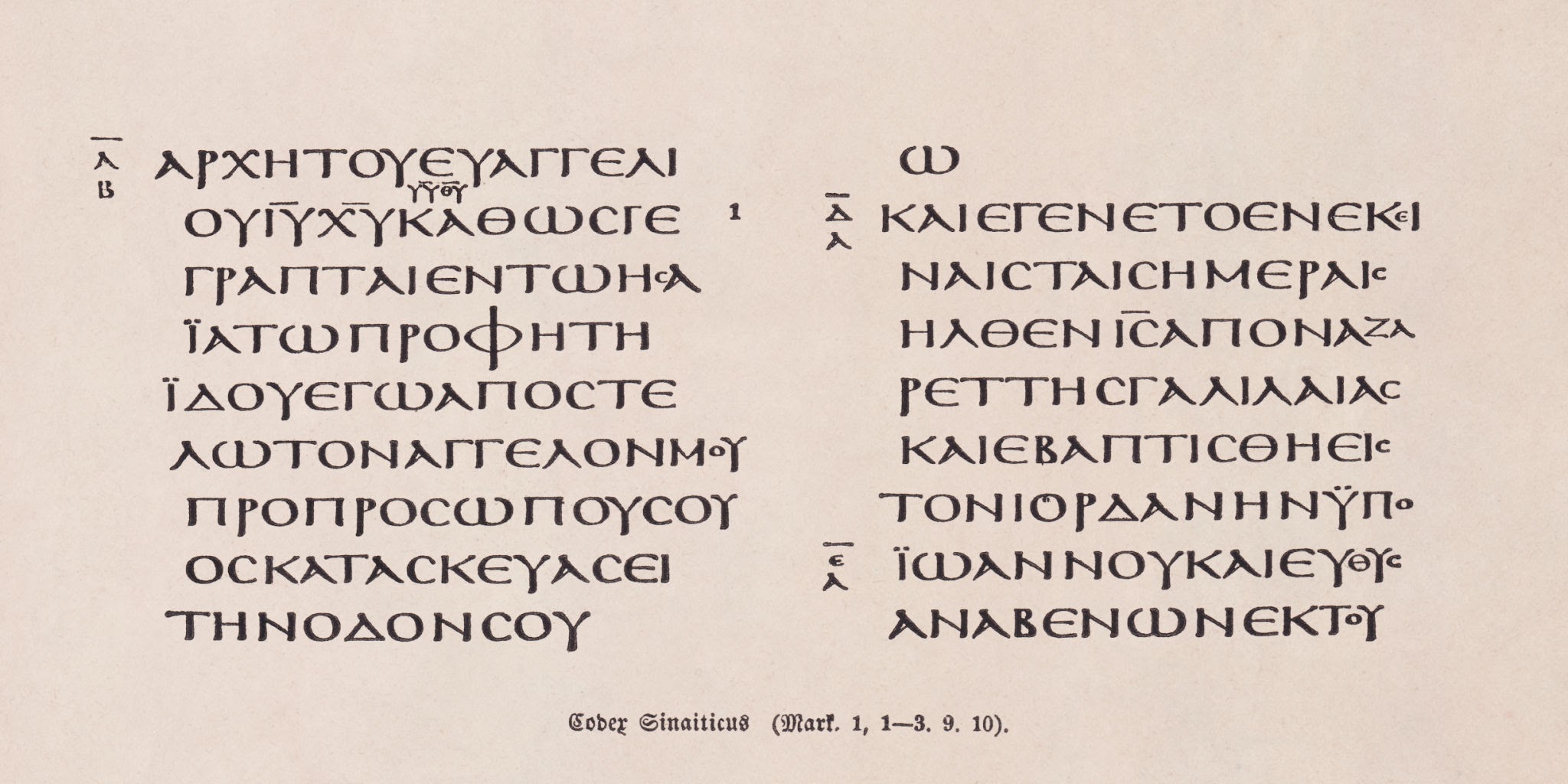
A Well-Attested Reading: The phrase “in Isaiah the prophet” has the support of the earliest and most important manuscripts (Codex Sinaiticus, Codex Vaticanus, and others). This is almost certainly Mark’s original wording.
A Later “Correction”: Some later manuscripts change the wording to “in the prophets” (as seen in the King James Version). This is widely considered a scribal correction to resolve the apparent conflict of attributing a Malachi quote to Isaiah.
“And if you are willing to receive it, he is Elijah who is to come.” (Matthew 11:14)
So here Jesus validates John by claiming he is the return of Elijah and is thought to be a reference to the following text:
“See, I will send the prophet Elijah to you before that great and dreadful day of the Lord comes.” (Malachi 4:5).
THE TIMING PROBLEM
XI. John in Prison Before Jesus’s Baptism
Look at the following text.
“John answered them all, “I baptize you with water. But one who is more powerful than I will come, the straps of whose sandals I am not worthy to untie. He will baptize you with the Holy Spirit and fire. His winnowing fork is in his hand to clear his threshing floor and to gather the wheat into his barn, but he will burn up the chaff with unquenchable fire.” And with many other words John exhorted the people and proclaimed the good news to them. But when John rebuked Herod the tetrarch because of his marriage to Herodias, his brother’s wife, and all the other evil things he had done, Herod added this to them all: He locked John up in prison. When all the people were being baptized, Jesus was baptized too. And as he was praying, heaven was opened and the Holy Spirit descended on him in bodily form like a dove. And a voice came from heaven: “You are my Son, whom I love; with you I am well pleased.”” (Luke 3:16–22)
“At that time Herod the tetrarch heard the reports about Jesus, and he said to his attendants, “This is John the Baptist; he has risen from the dead! That is why miraculous powers are at work in him.” Now Herod had arrested John and bound him and put him in prison because of Herodias, his brother Philip’s wife, for John had been saying to him: “It is not lawful for you to have her.” Herod wanted to kill John, but he was afraid of the people, because they considered John a prophet. On Herod’s birthday the daughter of Herodias danced for the guests and pleased Herod so much that he promised with an oath to give her whatever she asked. Prompted by her mother, she said, “Give me here on a platter the head of John the Baptist.” The king was distressed, but because of his oaths and his dinner guests, he ordered that her request be granted and had John beheaded in the prison. His head was brought in on a platter and given to the girl, who carried it to her mother. John’s disciples came and took his body and buried it. Then they went and told Jesus.” (Matthew 14:12)
“But when John rebuked Herod the tetrarch because of his marriage to Herodias, his brother’s wife, and all the other evil things he had done, Herod added this to them all: He locked John up in prison.”
This happens before Jesus is baptized.
This is a problem because it never says that John was released from prison. According to Matthew, John is beheaded in prison. However, Matthew has it that John has already baptized Jesus.
“I baptize you with water for repentance. But after me comes one who is more powerful than I, whose sandals I am not worthy to carry. He will baptize you with the Holy Spirit and fire. His winnowing fork is in his hand, and he will clear his threshing floor, gathering his wheat into the barn and burning up the chaff with unquenchable fire.” Then Jesus came from Galilee to the Jordan to be baptized by John. But John tried to deter him, saying, “I need to be baptized by you, and do you come to me?” Jesus replied, “Let it be so now; it is proper for us to do this to fulfill all righteousness.” Then John consented. As soon as Jesus was baptized, he went up out of the water. At that moment heaven was opened, and he saw the Spirit of God descending like a dove and alighting on him. And a voice from heaven said, “This is my Son, whom I love; with him I am well pleased.“” (Matthew 3:11-17)
Now, Christian apologists will point to the following text in Luke:
“When all the people were being baptized, Jesus was baptized.”
It uses a passive participle. This specific grammatical structure can describe an action that happened prior.
To which we reply: “Yes, correct this is what the text indicates. However, it can still read that way and appear before Luke 3:19-20.”
Especially if this is written under the inspiration of the Holy Spirit and it is preserved and passed down to us unadulterated.
Notice that Mark mentions John being in prison immediately after the baptism.
“John wore clothing made of camel’s hair, with a leather belt around his waist, and he ate locusts and wild honey. And this was his message: “After me comes the one more powerful than I, the straps of whose sandals I am not worthy to stoop down and untie. I baptize you with water, but he will baptize you with the Holy Spirit.” At that time Jesus came from Nazareth in Galilee and was baptized by John in the Jordan. Just as Jesus was coming up out of the water, he saw heaven being torn open and the Spirit descending on him like a dove. And a voice came from heaven: “You are my Son, whom I love; with you I am well pleased.” At once the Spirit sent him out into the wilderness, and he was in the wilderness forty days, being tempted by Satan. He was with the wild animals, and angels attended him. After John was put in prison, Jesus went into Galilee, proclaiming the good news of God. “The time has come,” he said. “The kingdom of God has come near. Repent and believe the good news!”” (Mark 1:6-15)
All of the previous texts lead the sincere Christian truth seeker into some very uncomfortable conclusions.
JESUS AND BAPTISM
XII. Jesus Never Baptized Anyone (Or Did He?)
“After this, Jesus and his disciples went out into the Judean countryside, where he spent some time with them, and baptized.” (John 3:22)
ἐβάπτιζεν the verb ebaptizen (was baptizing) is imperfect active, meaning it was a continuous, ongoing action physically attributed to Jesus.
“Now Jesus learned that the Pharisees had heard that he was gaining and baptizing more disciples than John. (although in fact it was not Jesus who baptized, but his disciples.) So he left Judea and went back once more to Galilee.” (John 4:1-3)
Notice the parenthetical clarification: “although in fact it was not Jesus who baptized, but his disciples.” This is unique to John’s Gospel.
The text says that it was not Jesus who baptized but his disciples. This raises the curious question: Who baptized Jesus’ disciples? The New Testament does not record a single instance of any of Jesus’ disciples getting baptized. It is simply assumed.
If Jesus gave this command to his disciples we wouldn’t have the following controversy:
“While Peter was still speaking these words, the Holy Spirit came on all who heard the message. The circumcised believers who had come with Peter were astonished that the gift of the Holy Spirit had been poured out even on Gentiles. For they heard them speaking in tongues and praising God. Then Peter said, “Surely no one can stand in the way of their being baptized with water. They have received the Holy Spirit just as we have.” So he ordered that they be baptized in the name of Jesus Christ. Then they asked Peter to stay with them for a few days.” (Acts 10:44-48)
Why would people object to gentiles being baptized if Jesus instructed his 12 disciples to do exactly that?
If Jesus instructed elders and hierarchy for his church how could people question Peter and what he was doing?
Also note that these people received the Holy Spirit before being baptized.
XIII. The Baptism of the Holy Spirit
“I baptize you with water for repentance. But after me comes one who is more powerful than I, whose sandals I am not worthy to carry. He will baptize you with the Holy Spirit and fire.” (Matthew 3:11)
“John answered them all, “I baptize you with water. But one who is more powerful than I will come, the straps of whose sandals I am not worthy to untie. He will baptize you with the Holy Spirit and fire.”” (Luke 3:16)
Jesus never did any such thing. That is why the Christians say this ‘baptism’ is symbolic or spiritual. It refers to the outpouring of the Holy Spirit. The “baptism of the Holy Spirit” becomes a spiritualized concept that cannot be empirically verified. Insh’Allah we will revisit this later in the article.
XIV. The So-Called Great Commission is a Forgery and a Contradiction
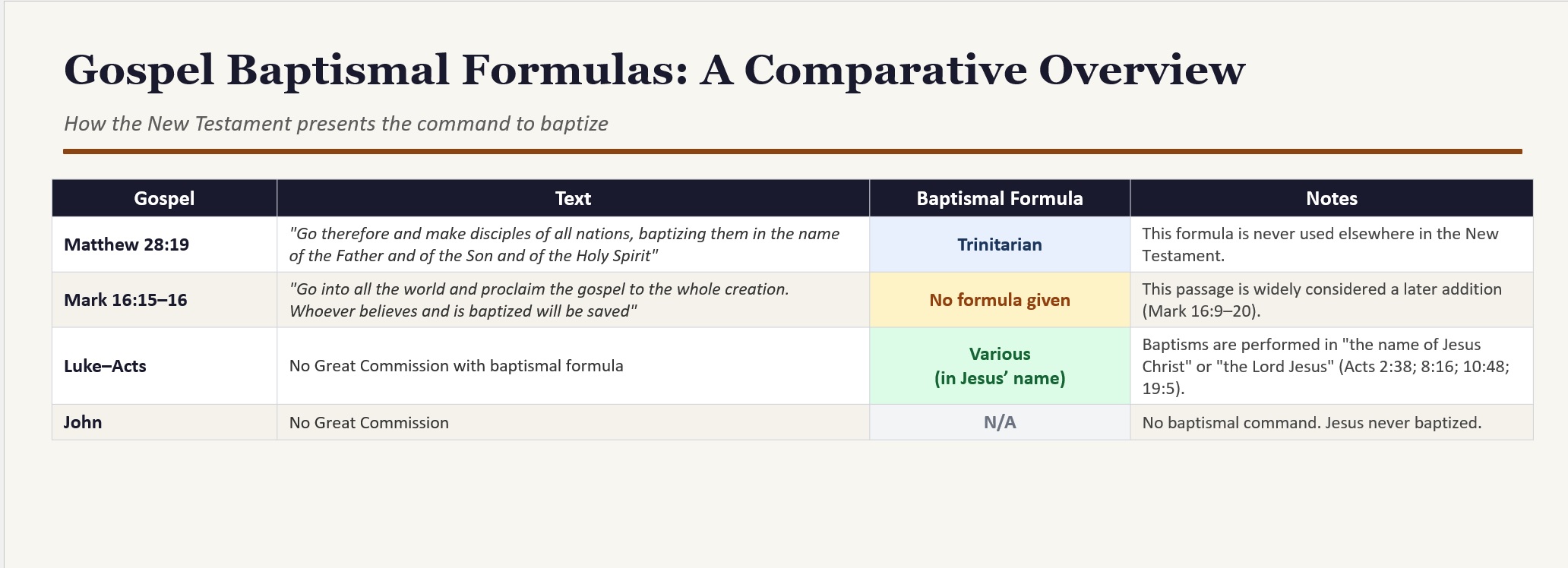
Note that in Mark 16:15-16 there is no baptismal formula given.
“And he said unto them, Go you into all the world, and preach the gospel to every creature. He that believes and is baptized shall be saved, but he that believes not shall be damned.” (Mark 16:15-16)
Notice the baptism formula given.
“Therefore go and make disciples of all nations, baptizing them in the name of the Father and of the Son and of the Holy Spirit.” (Matthew 28:19)
How are the unbaptized going to go and baptize others?
A missed opportunity: What the New Testament should have done is had Jesus rise from the dead and then in his glorified body baptize all his disciples and baptize them with fire.
Most critical scholars acknowledge that Mark 16:9-20 is not original to the Gospel of Mark. It is absent from the earliest and most important manuscripts (Codex Sinaiticus and Codex Vaticanus). The fourth-century church fathers Eusebius and Jerome noted that it was absent from most Greek manuscripts. This is widely considered a later addition to resolve the abrupt ending at Mark 16:8 with ‘for they were afraid.'”
“Other ancient authorities omit verses 9–20. Some ancient authorities conclude Mark instead with the following: But they reported briefly to Peter and those with him all that they had been told. And after this, Jesus himself sent out by means of them, from east to west, the sacred and imperishable proclamation of eternal salvation.”
“This passage is regarded as inspired and canonical scripture even if not written by Mark. As it is missing from some important manuscripts, it is possible that Mark did not write it. On the other hand, he would hardly have left his Gospel unfinished at verse 8. Many think that the original ending was lost at a very early date and that this ending was composed at the end of the apostolic period to take its place.”
1. The ancient authorities had no problem with Jesus sending out his disciples with no mention of baptism.
2. The Church is the authority. Even if Mark did not write it. The Church has already read it as authoritative.
3. The Church admits that the original ending may have been lost, and this ending was composed. It does not say by whom.
BAPTISM IN EARLY CHRISTIAN PRACTICE
XV. The Evidence from Acts: Contradictions and Developments
“Meanwhile a Jew named Apollos, a native of Alexandria, came to Ephesus. He was a learned man, with a thorough knowledge of the Scriptures. He had been instructed in the way of the Lord, and he spoke with great fervor and taught about Jesus accurately, though he knew only the baptism of John. He began to speak boldly in the synagogue. When Priscilla and Aquila heard him, they invited him to their home and explained to him the way of God more adequately.” (Acts 18:24-26)
Look at what Paul does when Apollos is away.
“While Apollos was at Corinth, Paul took the road through the interior and arrived at Ephesus. There he found some disciples and asked them, “Did you receive the Holy Spirit when you believed?” They answered, “No, we have not even heard that there is a Holy Spirit.” So Paul asked, “Then what baptism did you receive?” “John’s baptism,” they replied. Paul said, “John’s baptism was a baptism of repentance. He told the people to believe in the one coming after him, that is, in Jesus.” On hearing this, they were baptized in the name of the Lord Jesus. When Paul placed his hands on them, the Holy Spirit came on them, and they spoke in tongues and prophesied. There were about twelve men in all.” (Acts 19:1-7)
The above text is striking.
These people who were baptized by John apparently never heard that there is a Holy Spirit. You have to wonder what type of teaching they actually received.
Also note that the above text says they received the Holy Spirit after being baptized. This is contrasted with (Acts 10:44-48) where they received the Holy Spirit before being baptized.
Here this text blatantly shows that John’s baptism is inadequate. Paul had them all baptized in the name of the Lord Jesus!
THE MANDAEAN CONNECTION
XVII. Enter the Mandeans: The Other Religion That Practices Baptism
“Indeed, those who have believed (amanu) and those who were Jews and the Sabeans and the Christians and the Magians and all those who associated (ashraku) with Allah. Allah will judge between them on the Day of Resurrection. Indeed Allah is, over all things, Witness.” (Qur’an 22:17)
In Arabic, the Mandaeans are commonly known as aṣ-Ṣābiʾūn (الصابئون) or colloquially as al-Ṣubba (صُبَّة)
The Mandaean book of John also hints at historical tensions with other religions of the region. Specifically Christianity and Judaism. Parts of the book try to discredit both of these traditions. Mandaeans believe the mother of Jesus was Mandaean and became pregnant by witchcraft or some other source other than her husband. The book portrays her son Jesus as a deceiver who abandons his Mandaean heritage.
Ruha, the mother of darkness is sometimes called the holy spirit, a possible dig against the Christian holy spirit. The book of John (Draša d-Yaḥyā) also refers to the Jewish god as Adonai, called ‘Adunay’ in Mandaean. It characterizes him as an evil figure as well as his book, the Torah as a book of falsehoods.
In the Mandaean book of John when Jesus is baptized the voice/letter from heaven informs John: “You baptize the deceiver” and then the ruha, or the spirit makes an appearance. This spirit is a malevolent figure according to the Mandaeans.
For John the Baptist and for the Mandaeans baptism is not a death and resurrection ritual!
The Mandaean Parallel is Illuminating:
The Mandaeans also practice baptism as a central ritual.
They view Jesus as a deceiver and John the Baptist as their true prophet.
Their rituals and understanding of baptism differ radically from Christian theology.
This demonstrates that baptism was a contested practice in the ancient Near East, not a clear, divinely-mandated ritual unique to Christianity.
XVI. The “Evil Jesus” Problem
There could be some truth to what the Mandaeans say.
The New Testament itself mentions an evil Jesus.
“And when they had gone through the isle unto Paphos, they found a certain sorcerer, a false prophet, a Jew, whose name was Barjesus:” (Acts 13:6)
There is no power in the name Jesus. Jesus was a common name at that time. It could refer to an evil doer. This is why it is quite possible that the New Testament is talking about a Jesus entirely different from what we as Muslims believe.
“For if a person comes and preaches another Jesus, whom we did not preach, or you receive a different spirit, which you had not received, or a different gospel, which you had not accepted, you put up with it splendidly!” (2 Corinthians 11:4)
Just so Christians could be clear that they were not being baptized in the name of evil Jesus there was always a modifier.
Observe!
“Then Peter said unto them, Repent, and be baptized every one of you in the name of Jesus Christ for the remission of sins, and ye shall receive the gift of the Holy Ghost.” (Acts 2:38)
“(For as yet he was fallen upon none of them: only they were baptized in the name of the Lord Jesus.)” (Acts 8:16)
“And he commanded them to be baptized in the name of the Lord. Then prayed they him to tarry certain days.” (Acts 10:48)
“When they heard this, they were baptized in the name of the Lord Jesus.” (Acts 19:5)
In Acts 19:5, a number of “Western” textual witnesses add Χριστοῦ εἰς ἄφεσιν ἁμαρτιῶν. translated as: ‘Christ for the forgiveness of sins’.
All of this to prevent Christians from being baptized into generic Jesus or evil Jesus.
Jesus Christ or Lord Jesus.
‘Lord’ and ‘Christ’ are identifiers and modifiers so the people are not confused about which Jesus they are being baptized in. (Good Jesus or Evil Jesus).
THE THEOLOGY OF BAPTISM
XVIII. For the Christians the Meaning Behind Baptism
For the Christians the meaning behind baptism is spelled out for them.
“Or don’t you know that all of us who were baptized into Christ Jesus were baptized into his death? We were therefore buried with him through baptism into death in order that, just as Christ was raised from the dead through the glory of the Father, we too may live a new life.” (Romans 6:3–4)
As we mentioned earlier in this article the baptism of John could not possibly have meant those things to him or his followers as John was not even aware of Jesus (in fact he-John had to inquire about him-Jesus) and Jesus at that point hasn’t even died on a cross. So it is not possible that baptism has that theologically loaded understanding.
With the Mandaeans recognizing Jesus as a deceiver and a disciple who betrayed John the Baptist, then their frequent baptisms also cannot have the theologically loaded understanding that Christians have.
XIX. Baptism by the Holy Spirit and Other Christian Disputes Over Baptism
Recall that in our article earlier we mentioned: The “baptism of the Holy Spirit” becomes a spiritualized concept that cannot be empirically verified.
“Peter replied, ‘Repent and be baptized, every one of you, in the name of Jesus Christ for the forgiveness of your sins. And you will receive the gift of the Holy Spirit.'” (Acts 2:38)
This is a promise, not a suggestion. It is addressed to everyone. Not just apostles, not just first-century believers. It is unconditional: repent → be baptized → receive the Spirit.
The question is: do we take this promise seriously? If so, then:
Every believer should expect to receive the Holy Spirit in a real, experiential way
The Spirit’s presence should be discernible. Whether through tongues, prophecy, healing, or other manifestations
The historic churches’ lack of these manifestations is not a sign of faithfulness, but a sign of loss or quenching of the Spirit
A Hard Question For the Historic Churches:
If the Holy Spirit is given to every believer at baptism (or confirmation/chrismation), then:
Why do believers in those traditions not consistently experience the Spirit’s power?
Why are the gifts of 1 Corinthians 12 (tongues, prophecy, healing, miracles) not active in their congregations?
Why did the Pentecostal movement have to emerge in the 20th century to recover what the New Testament presents as normal?
The honest answer, from many within those traditions, is:
Cessationism – the belief that the miraculous gifts ceased with the apostles.
Sacramentalism – the belief that the Spirit is given through the ritual itself, regardless of experience.
Loss of expectation – generations of Christians have not been taught to expect the Spirit’s manifest presence.
But the New Testament does not teach cessationism. It does not separate the Spirit from experience. And it does not promise a Spirit whose presence is invisible and undetectable.
XX. Charismatic-Pentecostal-Holy Roller Churches Don’t Get the Full Hot Dog
Even those who argue that the baptism of the Holy Spirit is alive and well are very selective on what aspects of the Holy Spirit are seen and heard.
Examples.
“When the day of Pentecost came, they were all together in one place. Suddenly a sound like the blowing of a violent wind came from heaven and filled the whole house where they were sitting. They saw what seemed to be tongues of fire that separated and came to rest on each of them. All of them were filled with the Holy Spirit and began to speak in other tongues as the Spirit enabled them.” (Acts 2:1-4)
Who hears this rushing violent wind from heaven these days? Who witnesses tongues of fire upon the heads of Christians?
XXI. Baptism – Full Water Immersion and Christians Being Overly Ritualistic
How do these Christians deal with people who suffer from ablutophobia?
One Christian mentions that his seminary professor instructed him that if the one being baptized came up out of the water with their head dry, then they would need to be immersed again!
One Christian retells a story about a member in their church who was disabled and could not go under water. So after discussion the elders arranged for this person to be lifted into a hot tub where the baptism was given by pouring water over their head.
What about situations in the desert when you have no water? The person is dying and they want to convert and be baptized?
These practical problems expose the human origin of the ritual.
SUMMARY AND CONCLUSION
XXII. Summary of Findings
1. Baptism Has No Hebrew Bible Foundation
No prophet preached, practiced, or participated in baptism.
The Torah is silent on this ritual.
The Isaiah 40:3 quotation is a “quote mine” about preparation, not baptism.
2. John’s Baptism Was Novel and Unresolved
The Mark 11:27-33 confrontation proves this.
Jewish religious leaders could not determine its source.
Jesus refused to answer the question.
If it had scriptural basis, the leaders would have known.
3. The Timing and Chronology Problems
John was apparently in prison before Jesus’s baptism.
A beheaded John cannot baptize Jesus.
The passive participle in Luke doesn’t resolve the problem.
4. John’s Baptism Could Not Mean What Christians Claim
John baptized before Jesus’s death/resurrection.
No death/resurrection symbolism was possible.
John’s baptism was merely for repentance and forgiveness.
This contradicts Paul’s theology of baptism.
5. Jesus Never Baptized Anyone
John 4:1-3 explicitly says Jesus didn’t baptize.
His disciples baptized, but we never learn who baptized them.
This raises serious questions about the ritual’s importance.
6. Jesus Failed to Baptize with the Holy Spirit
John prophesied this (Matthew 3:11).
It never happened as described.
It becomes a spiritualized, unverifiable concept.
7. The Great Commission Has Textual Problems
Two different versions (Mark and Matthew).
Mark’s version has no baptismal formula.
The Trinitarian formula appears only in Matthew 28:19.
The longer ending of Mark is a later addition.
8. The “Evil Jesus” Problem
Acts mentions Bar-Jesus (a sorcerer).
Paul warns about “another Jesus” (2 Corinthians 11:4).
Christians use modifiers to distinguish (“Lord Jesus,” “Jesus Christ”).
This suggests confusion about which Jesus was being preached.
9. Mandaeans Provide Historical Parallels
They practice baptism but view Jesus as a deceiver.
Their Book of John calls Jesus a “deceiver” at baptism.
This shows baptism was a contested practice.
10. John’s Uncertainty Is the Decisive Argument
John was filled with the Holy Spirit from birth.
He witnessed the heavens open and heard the divine voice.
Yet he still asked: “Are you the one who is to come?”
If John could be uncertain, why trust Christian interpretations?
Muslims are not being harsh with Christians; John’s failure proves the point.
XXIII. The Qur’anic Alternative
The opening verse (Qur’an 22:17) highlights that Allah alone will judge between the various religious communities. This is a reminder that ultimate authority rests with Allah, not human traditions.
“The dye of Allah (ṣib’ghata Allāh)” is a powerful metaphor for the natural constitution (fiṭra) upon which Allah created humanity. This stands in direct contrast to human-invented rituals like baptism.
Shaykh Aṭfayyish’s commentary illuminates: the “dye of Allah” is not an external ritual but an internal purification of the heart from unbelief and disobedience. This presents a profound critique. While Christians debate the mechanics of baptism, the Qur’an directs attention to the spiritual transformation itself.
XXIV. Conclusion: The Crux of the Matter
Our analysis demonstrates that baptism is a ritual without clear biblical foundation, differently understood across Christian and Mandaean traditions, and historically disconnected from the practice of the Hebrew prophets.
The most powerful observation is this: If the Jewish religious leaders, who sat in Moses’ seat and were experts in the Torah, could not determine the source of John’s baptism, how can Christians today be certain of its divine origin?
The most profound observation concerns John the Baptist’s lack of certainty about Jesus:
“Are you the one who is to come, or should we expect someone else?” (Matthew 11:2-3)
John who is filled with the Holy Spirit even before birth (Luke 1:15) could be uncertain despite:
Being Jesus’s cousin
Baptizing Jesus
Witnessing the heavens open
Hearing the divine voice declaring Jesus as the Son
Are we Muslims too harsh on Christians?
How can we Muslims be overly critical with Christians for not finding Muhammed (saw) in their scriptures when John himself, who had direct experience of Jesus, remained uncertain as to who Jesus was?
If John the Baptist who was the greatest man born of a woman according to Jesus himself (Matthew 11:11), could have direct contact with Jesus and still not be certain of his identity, then how can we as Muslims think that Christians will recognize Muhammed (saw) in their scriptures?
If the Holy Spirit who was supposed to guide into all truth left John in a state of confusion about Jesus, then:
Why should Christians believe the Holy Spirit will guide them into all truth regarding their own scriptures?
Why should Muslims accept Christian interpretations of ambiguous Old Testament prophecies when the very prophet who baptized Jesus couldn’t figure out who Jesus was?
XXV. Final Appeal
The Qur’an offers a superior alternative. The “dye of Allah” is not an external ritual but the primordial constitution (fiṭra) upon which Allah created humanity. True purification comes from turning to Allah, not from immersion in water, regardless of who performs it or with what formula.
As the Qur’an states:
“Indeed Allah is, over all things, Witness.” (Qur’an 22:17)
Allah alone knows the hearts. It is He who will judge between the communities, not just on the basis of their rituals, but on the basis of their sincerity, intentions, faith and actions.
“The Jews and Christians each claim that none will enter Paradise except those of their own faith. These are their desires. Reply, “Produce your proof if what you say is true.” (Qur’an 2:111)
﷽
This above verse encapsulates the Qur’anic approach to interfaith debate, which is not limited to textual proofs, but reasoned proof. This is sensible considering huge swathes of the population were illiterate. Illiteracy does not mean one could not reason or one could not think.
What is striking and deeply ironic is that the ‘Islamic Dilemma’ is not merely a Protestant argument against Islam. It is a veiled attack on traditional Christianity itself. Roman Catholics, Eastern Orthodox, Oriental Orthodox, and Assyrian Christians who adopt this argument are unwittingly fighting on Protestant ground, using Protestant weapons, against their own ecclesial principles.
The “Islamic Dilemma” is a very specific form of argument. It is a logical, text-based trap: if it is assumed that the Qur’an says the Bible is true, and the Bible contraditcts Islam, then Islam is false. However, If the Bible is unreliable and corrupted, then it is assumed that Islam is still false because of the claim that the Qur’an repeatedly affirms the divine authority, inspiration, and preservation of the very same scriptures.
The trap is clever, but it rests on a fatal assumption: that the Qur’an is referring to the Protestant canon, and that it commands the laity to consult it directly. Neither assumption is true.
For the Protestant this is a debate about the accuracy and authority of written texts.
For a Catholic, Orthodox, or Assyrian Christian, this framing is a false start as well as a betrayal of their own tradition. The ‘dilemma’ demands that the Bible be treated the way Protestants imagine Muslims treat the Qur’an: as a direct, self-interpreting, accessible text for the laity. Yet this is a caricature of both traditions.
Muslims have always had direct access to the Qur’an through recitation and prayer. It is memorized, recited, and heard. Yet like Christians before the Reformation, they have never approached it as a text for private interpretation. The Shi’i have their Imams; the Sunni and Ibadi have their scholars and jurists. The Church, not the text, is the pillar of truth for traditional Christians. And the community of scholars, not the individual, is the pillar of interpretation for Muslims. Both traditions are built on communal, mediated authority. Only Protestantism is built on the chaos of the individual.
The Protestant ‘Islamic Dilemma’ is demonstrablyhistorically fallacious.
It posits that Christians in the 7th century engaged with their scriptures rather than defer to Church authority.
It posits that Muslims in the 7th century accept books that Protestants themselves today do not accept.
It posits that Muslims and Christians engaged in cross referencing Bible canons with the Qur’an.
It posits that people in the 7th century have a high degree of literacy.
It posits that Bible canons were widely availabe to every Christian household.
The Qur’an engages communities and their learned.
“We did not send before you except as men to whom We revealed. Ask the People of the Reminder if you do not know.” (Qur’an 16:43)
(And We sent not (as Our messengers) before thee other than men whom We inspired…) [16:43]. This verse was revealed about the idolaters of Mecca who denied the prophethood of Muhammed, Allah bless him and give him peace. They said: “Allah is too great to have a human being as His messenger; could He not have sent an angel?”
Notice that the people are being told to ask the people. They are not being told to consult the gospel or the torah.
“So “if you are in doubt concerning that which We have revealed unto you, then ask those who are reciting the Book before you. Verily, the truth has come to you from your Lord. So be not of those who doubt (it).” (Qur’an 10:94)
Notice it says ask those who are reciting the book. The one(s) being addressed are not being told to consult the gospel or the torah.
As regard the ‘if’ Arabic grammar has conditionals that are similar to what we find in English.
The zero conditional is used for universal truths or general facts. Example: If water reaches 100°C, it boils.
The second conditional is used for unlikely or hypothetical scenarios. Example: If I won a million dollars, I would travel the world.
So the example used above is the conditional used for universal truths and general facts.
The zero conditional in Arabic (as in English) is not a genuine hypothetical. When the Qur’an says ‘If you are in doubt…’ it is not suggesting that doubt is possible. Rather, it is establishing a universal principle: when in doubt (and the Prophet -peace be upon him, was not), the remedy is to ask the learned. The ‘if’ is rhetorical. To make a point, not to suggest a real possibility.
Examples in the Qur’an:
“Say, “If The Most Merciful had a son, I would certainly have been the first one to worship him.” Exalted is the Lord of the heavens and the earth, Lord of the Throne, above what they describe.”(Qur’an 43:81-82)
The if here is not one of a hypothetical but rather a universal truth. Allah does not have a son.
“Say, “If there had been with Him gods, as they say, then they would have sought to the Owner of the Throne a way.” (Qur’an 17:42)
The if here is not one of a hypothetical but rather a universal truth. There are no other gods.
Also, let us take a look at a key part of the text. “Ask those who are reciting the book.” It doesn’t say ask the Jews or Samaritans. It doesn’t say ask the Oriental Orthodox, the Assyrian Christian, or the Eastern Orthodox. It says, ‘those who are reciting the book‘. So, if Muhammed (saw) asked ‘those who are reciting the book, he would receive some common themes but also a cacophony of discordant voices.
This confirms the following:
“Do not be like those who became divided and differed after the clear proofs had come to them.” (Qur’an 3:105)
“The Jews and Christians each claim that none will enter Paradise except those of their own faith. These are their desires. Reply, “Produce your proof if what you say is true.” (Qur’an 2:1111)
Notice the text says ‘produce your proof’ it does not say ‘let us consult the torah and the gospel’.
Another example.
“Or have they taken gods besides Him? Say, “Produce your proof. This is the message for those with me and the message of those before me.” But most of them do not know the truth, so they are turning away.” (Qur’an 21:24)
In both examples with the idolaters of mecca, the jews and the christians all are being told to ‘produce their proofs’ what are your arguments.
Why do the rabbis (l-rabaniyuna) and religious scholars (ahbaru) not forbid them from saying what is sinful and devouring what is unlawful? How wretched is what they have been practicing.” (Qur’an 5:63)
This is a clear appeal to authority. The rabbis and scholars could only be faulted if it was known that they had authority over thier people. The verse presupposes that the religious leaders have authority and that they are failing in their duty. This is a direct parallel to the traditional Christian model, where bishops and councils, not laypeople, are the authority.
This is not accidental. The Protestant project has always sought to undermine ecclesiastical authority. By recruiting traditional Christians to fight the ‘Islamic Dilemma,’ Protestants are achieving what centuries of polemics could not: getting Catholics and Orthodox to abandon their own ecclesial principles and adopt the Protestant method of direct textual engagement.
It is bad enough that Protestant Evangelicals are ignorant of the context of 7th century Arabia, as well as the reality of the Pagan Arabs, as well as the Jewish and Christian communities.
What is extremely shocking is that representatives of traditional churches are willingy to drink from the same cup of ignorance.
Sola Scriptura (scripture alone) has never been the position of any traditional church.
Jesus claims that neither he nor the Bible guide you into all truth.
“I have many things to say unto you, but you cannot bear them now. Howbeit when HE, the Spirit (Pneuma)Πνεῦμα of truth comes HE will guide you into all truth: (HOW?) For HE shall not speak of HIMSELF; But whatsoever HE shall hear (from God) that shall HE speak: and HE will show you things to come.” (John 16:12-13)
The problem for the Protestant: If the Spirit guides into all truth, then the Scripture can’t be the only infallible authority. This means The Bible alone does not contain all truth. It is only a partial revelation at bests and awaiting the Spirit of Truth and his guidance.
The problem for Catholics/Orthodox: If the Church (tradition) is the vehicle of the Spirit’s guidance, then the Church’s authority is self-referential and circular.
This is circular because:
The Church’s authority depends on the Bible The Bible’s authority depends on the Church Neither can independently validate the other.
So here we are. The real issue is we were promised someone who would SPEAK but in reality all we have are church councils (EO/Catholic) or private interpretations (1001 Protestant denominations). Stalemate.
The problem for the Catholics/Orthodox is that Protestants have unwittingly recruited them into an argument that undermines them and their authority.
The layman did not go directly to the text in the 7th century Arabia.
There are number of reasons historically why this is not the case.
1) Literacy, one cannot assume that the average person could read and write, Arabic, Amharic, Ge’ez, Aramaic, Greek. For example the reference in Qur’an 10:94. This has to obviously be a reference to those who can read. This brings us to the next point.
2) Not only does Qur’an 10:94 have to be a reference to those who can read but those who would have access to a text. So this brings us to the lack of accessibility to the text. Today a Bible can be found in your average hotel. In that time people were not walking around with full canons.
3) It is a Protestant approach to go direct to the scripture and not a Traditional Church perspective. If one was Oriental Orthodox, Eastern Orthodox or Assyrian Church of the East, it was not the habit of laypeople to go directly to the text.
Thus, the Qur’anic command to ‘judge by what Allah has revealed’ cannot mean ‘read the Bible for yourself.’ It would have been historically impossible for the vast majority of Christians to comply. The command must mean something else entirely something consistent with both the traditional model of authority and the lived reality on the ground.
The Protestant use of the Islamic Dilemma is actually a full frontal attack on traditional Christianity (be it Eastern Orthodox, Oriental Orthodox, Roman Catholic, Assyrian Church of the East). Imagine Protestants telling Muslims to go direct to the Torah or the Injeel without the medium of the Holy Spirit or the guidance of the Church!! This is very mischievous and very cunning proposition propagated by the Protestants (esp evangelicals).
There were no Protestant churches nor a Protestant canon in the 7th century.
*Note*
The Roman Catholic and Eastern Orthodox Church did not split until 1054. Therefore the above graph should have them united as: Orthodox Catholic Church.
The following verse is often used by Protestant Christians.
“Do you believe in some of the book and reject the rest? Is there any reward for those who do so among you other than disgrace in this worldly life and being subjected to the harshest punishment on the Day of Judgment? For Allah is never unaware of what you do.” (Qur’an 2:285)
For the sake of argument let us say that Muslims understand this verse in the way that Protestants do.
What objective basis do the Protestants have for determing what is part of the book and what is not?
What objective basis do the Protestants have for determing what is scripture and what is not?
If a Muslim in the 7th or 8th century were to listen to the children of Israel, in particular the tribes of the tribes of Ephraim and Manasseh what would the Samaritans advise in regard to following which scriptures?
The Muslim would find that the Samaritans reject all parts of the Bible except what they consider the Torah. That is to say they only accept Genesis, Exodus, Leviticus, Numbers and Deuteronomy. They reject the rest.
If a Muslim in the 7th or 8th century were to listen to the children of Israel, in particular those who are called Jews, what would be the advise in terms of scripture?
The Muslims would find that the bulk of Jews follow more than the five books that the Samaritans follow. They also follow an oral torah.
If a Muslim in the 7th or 8th century were to embrace Christianity they would join any number of traditional churches that accepted the following books: Tobit, Judith, Wisdom, Sirach, Baruch, 1 & 2 Maccabees.
The Protestant canon of 66 books did not exist in the 7th century. It was a 16th-century invention. The Qur’an could not possibly be endorsing a canon that did not yet exist. This alone destroys the ‘Islamic Dilemma’.
If a Muslim in the 7th or 8th century were to embrace Christianity they would join any number of traditional churches that differ on the canon of the New Testament as well.
“By the beginning of the 5th century, or slightly earlier, the Syrian Church’s version of the Bible, the Peshitta (‘simple’ translation) was formed. For the New Testament it represented an accommodation of the Syrian canon with that of the Greeks. It contains 22 books – all of the present New Testament except:
II Peter, II John, III John, Jude, Revelation of John.”
“For the eastern part of the Syrian Church this constituted the closing of the canon, for after the Council of Ephesus (431 CE) the East Syrians separated themselves as the Nestorians. There are many surviving manuscripts of the Peshitta, the oldest of which bears the date 442. For much more on Peshitta history, see the article at The Encyclopedia of New Testament Textual Criticism. It is noteworthy that exactly these 22 books are cited by John Chrystosom (~347-407) and Theodoret(393-466) from the School of Antioch. For a visual summary of these 22 books see the Cross Reference Table.”
Thus, even if we assume the Qur’an is endorsing the Peshitta canon, it would be endorsing a Bible that lacks five books the Protestant considers canonical. Which canon did the Qur’an endorse? The answer: none. The Qur’an does not endorse any canon. It endorses the original revelation, which is now lost or corrupted.
The Protestants imagine that the Qur’an is somehow endorsing a tangible canon.
What tangible canon would that be? Especially seeing that the Christians themselves were/are in dispute over it?
This is the same question that Christians who follow a traditional Church pose to those who espouse ‘anti-Islamianity’. That is why their whole preaching is against Islam, but they don’t have anywhere for Muslims to go after they apostate from Islam. It’s just anti-Islam teaching, but they (those preachers) do not reveal which church they are affiliated with. That is if they are affiliated with one at all.
This is also known as ‘churchless apologetic’.
This is why the ‘Islamic Dilemma’ is promoted primarily by ‘churchless apologists’. Grifters and independent evangelicals with no affiliation to any traditional Church. They have no stake in defending a particular ecclesiastical tradition. They simply want to tear down Islam, with no thought to where the Muslim convert would go. They are a law unto themselves, accountable to no one but their own whims and private interpretations. And this, ironically, is precisely what the traditional Churches have always warned against i.e The chaos of sola scriptura without the anchor of ecclesiastical authority.
Let us reflect on what Pope Benedict XVI said in his ‘What Is Christianity?’
“All of this means that the Christian faith is not a religion of the Book (see Catechism of the Catholic Church n. 108 and the Post Synodal Apostolic Exhortation Verbum Domini of 2008). Holy Scripture speaks only in the living community of the Church. There is a double exchange here, a relationship of subordination and superordination. On the one hand, the Church clearly submits to the Word of God, always having to let itself be guided and judged by it, on the other hand, however, Scripture, starting from its whole, can only be adequately interpreted in the living Church. This position, adopted by the whole Church until the 16th century, was rejected in the Reformation with the principle of sola scriptura . Christianity now appears as a religion of the Book.
Source: (Benedetto XVI Che Cos’e il Cristianesimo quasi un testamento spirituale).
Here we have the Pope himself affirming that the Catholic Church does not treat the Bible as a self-interpreting text. The Qur’an says the same thing: ‘Ask the People of the Reminder.’ The Protestant ‘Islamic Dilemma’ is not just unhistorical it is anti-Catholic, anti-Orthodox, and anti-Assyrian.
Holy Scripture speaks only in the living community of the Church. -Pope Benedict.
Example.
The doctrine of Invincible Ignorance.
The Roman Catholic Church teaches that not everyone necessarily needs to confess Jesus Christ as their lord and saviour simply becuase not everyone is able to do so.
“Salvation is found in no one else, for there is no other name under heaven given to mankind by which we must be saved.” (Acts 4:12)
“But what does it say? “The word is near you, in your mouth and in your heart” (that is, the word of faith which we preach): That if you confess with your mouth the Lord Jesus and believe in your heart that God has raised Him from the dead, you will be saved.” (Romans 10:8-9)
“Whoever believes in him is not condemned, but whoever does not believe stands condemned already.” (John 3:18)
These text seem very clear that one needs to confess their faith in Jesus to be saved. However, the Roman Catholic Church via it’s doctrine of ‘Invincible Ignorance’ says not so fast.
The concept of invincible ignorance allows for the salvation of young children, the mentally disabled, and others who never heard the gospel.
St Augustine has a whole chapter title called: Chapter 2 [II.]— Faith in Christ Not Necessary to Salvation, If a Man Without It Can Lead a Righteous Life.
He states:
“Therefore the nature of the human race, generated from the flesh of the one transgressor, if it is self-sufficient for fulfilling the law and for perfecting righteousness, ought to be sure of its reward, that is, of everlasting life, even if in any nation or at any former time faith in the blood of Christ was unknown to it. For God is not so unjust as to defraud righteous persons of the reward of righteousness, because there has not been announced to them the mystery of Christ’s divinity and humanity, which was manifested in the flesh. 1 Timonty 3:16 For how could they believe what they had not heard of; or how could they hear without a preacher? Romans 10:14 For faith comes by hearing, and hearing by the word of Christ. But I say (adds he): Have they not heard? Yea, verily; their sound went out into all the earth, and their words unto the ends of the world. Romans 10:17-18. Before, however, all this had been accomplished, before the actual preaching of the gospel reaches the ends of all the earth — because there are some remote nations still (although it is said they are very few)”
The doctrine of invincible ignorance even allows for pagans who persecuted and killed Christians to enter heaven if the Pope prays for their deliverance. There is no need for the person to confess Christ even if they are able.
John of Damascus said that God freed Trajan from Hell after the prayers of Saint Gregory the Great.
“Further, the Damascene in the same sermon relates that Gregory, while praying for Trajan, heard a voice from heaven saying to him: “I have heard thy voice, and I pardon Trajan; : and of this fact the Damascene adds in the same sermon, “the whole East and West are witnesses. ” Yet it is clear that Trajan was in hell, since “he put many martyrs to a cruel death” [De his qui fide dormierunt]. Therefore the suffrages of the Church avail even for those who are in hell.”
The Roman Catholic Church can appeal to scripture but it is not necessay.
“And Jesus said, “Father, forgive them, for they know not what they do.” (Luke 23:34)
“In the past God overlooked such ignorance, but now he commands all people everywhere to repent.” (Acts 17:30)
So Catholics argue that God cannot issue commands that people can’t obey.
If the Catholic Church can interpret away the seemingly clear words of Acts 4:12 and Romans 10:9, then on what basis do Protestants claim that the Bible is self-iexplanatory? The very existence of the doctrine of invincible ignorance proves that the Church and not the text is the final authority.
Catholics like Sam Shamoun and Cameron Bertuzzi stand ready to debate Protestants like Anthony Rogers and Samuel Green on Invincible Ignorance.
The Protestant project has always sought to undermine church authority.
In Mainz, Germany, in the mid-1450s, Johann Gutenberg and his partner Johann Fust published more than 150 large-format copies of the Bible in Latin. This is the book known today as the Gutenberg Bible. That was in the 1450s, and there were 150 copies.
Up until that point, imagine all the Christian souls scattered throughout the Earth; they lived and died without once having or holding an individual Bible in their possession. Hopefully, some Christians will be more appreciative of this fact.
For over a millennium, Christians had no personal Bibles. They relied on the Church. They relied upon its liturgy, its priests, its bishops, its councils. The Protestant idea that the Bible is for the laity is a 16th-century invention. The Qur’an, revealed in the 7th century, could not have been commanding Christians to do what was historically impossible.
Books in those times were luxury items reserved exclusively for the ultra-wealthy, ruling elites, and church communities.
Ordinary Christians experienced the scriptures orally. They would gather together at church services to hear a literate priest or bishop read the letters and gospels aloud.
That Christian laity did not rely upon the Bible to receive their guidance. They relied upon their respective church, whether it was the Latin Roman Catholic, Assyrian Church, Oriental or Eastern Orthodox Church. The Church, and not scripture, was the source of guidance and inspiration for the average Christian.
We can clearly see that the Qur’an has never endorsed the entirety of any Biblical canon or text.
The Protestant ‘Islamic Dilemma’ has two horns both of which rest on an assumption. The assumption is that the Qur’an claims the Bible is true.
Does the Qur’an claim the Bible is true?
The word Bible has its etymological root in the Greek ta biblia, which means “small books”.
Possibly the closest equivalent would be the following:
“The Messenger believes in what has been revealed to him from his Lord, and so do the believers. They believe in Allah, His angels, His Books (kutubihi), and His messengers.” (Qur’an 2:285)
This particular verse does not clarify which books are to be believed. Only that Muslims are to believe in ‘His Books’.
As we have demonstrated that historically speaking, Protestants cannot prove that the Qur’an 2:285 is identical to a 66 book canon.
One thing is certain. The Gospel is not included in the text of Qur’an 2:285. Hoever, Jesus is included in Qur’an 2:285.
The Qur’an never describes the Gospel as a book given to Jesus.
“And He will teach him the Scripture and wisdom, and the Torah and the Gospel.” (Qur’an 3:48)
An interesting note on the above. If the Torah was intact there would be no need for Allah to teach the Torah to Jesus.
“And We sent, following in their footsteps, Jesus , the son of Mary, (ma bayna yadayhi) having authority over the Torah; and We gave him the Gospel, in which was guidance and light and having authority over that which preceded it of the Torah as guidance and instruction for the righteous.” (Qur’an 5:46)
“So let the people of the Gospel judgeby what Allah has revealed in it. And those who do not judge by what Allah has revealed are the rebellious.” (Qur’an 5:47)
If the Gospel was in pristine condition the verse would have simply stated:
“And let the Christians judge by the Gospel.”
Yet, it is drawing attention to the ‘People of the Gospel’ (ahlul l’injili) to judge by what Allah has revealed therein.
The people who have the nomenclature ‘People of the Gospel’ are to judge.
Again keep in mind this is not a call for Christian laity to engage directly with their text.
Recall that we have already established two unassailable points. 1. Literacy was not widespread among all people. 2. Even it were not everyone had access to a text.
“Those who follow the Messenger, the unlettered prophet, whom they find written in the Torah and the Gospel (which are) with them(ʿindahum).” (Qur’an 7:157)
If a person possesses a heavily edited or condensed version of a historical document, it is still legally and conversationally “with them” (ʿindahum).
Example.
“And those who disbelieve say, ‘Why was the Qur’an not revealed to him all at once?” (Qur’an 25:32)
This is a reference to the Qur’an but the entirety of the Qur’an was not revealed at this time. Yet the text is still calling it the Qur’an.
The Qur’an debunks the Protestant claim of preservation.
“There are some among them who distort what is in the Book(bil-kitabi) with their tongues to make you think this is from (l-kitabi) the Book but it is not what the (l-kitabi) Book says. They say, “It is from Allah”—but it is not from Allah. And they attribute lies to Allah knowingly.” (Qur’an 3:78)
The Protestants sweep this accusation aside by affirming that the text doesn’t say anything about textual corruption. It is about people who twist the words and meanings of their sacred text. However, as pointed out in a society where illiteracy was common place, the laity did not go directly to the text and many of them did not have the requisite language skills to acces it. This was already quite poisonous.
However, the next text are not so easily swept aside.
“Have you any hope that they will be true to you when a party of them used to listen(yasma’una) to the word of Allah, then used to (yuharrifunahu)change it, after they had understood(‘aqaluhu) it, knowingly.” (Qur’an 2:75)
This verse is quite explicit in the damnation of these people. That they actually would listen to the words of Allah (auditory hearing), they understood it, confirmed it and knowingly changed it during the oral transmission process!
Received the revelation from Allah.
Understood it.
Knowingly distorted it during the oral transmission process.
One would have to be extremely vile to do such a thing.
‘Then woe to those who write the Book (l-kitaba) with their own hands, and then say: “This is from Allah,” to traffic with it for miserable price!- Woe to them for what their hands do write, and for the gain they make thereby.’ (Qur’an 2:79)
This is what we find “with them” (ʿindahum).
“How can you say, ‘We are wise, and the (תּוֹרַת יְהֹוָהTorat YHWH) law of the LORD is with us’? But behold, the lying pen of the scribes has made it into a lie. (Jeremiah 8:8)
Notice the text of Qur’an 2:79 says they make gain by what they wrote.
The following says that Jews can give interest to non-Jews but not to one another.
“Unto a foreigner you may lend interest; but not unto your brother you shall not lend interest, that Jehovah your God may bless you in all that you put your hand on, in the land wherever you go into possess it. When you shall vow a vow unto Jehovah your God, you shall not be slack to pay it: For Jehovah your God will surely require it of you; and it would be sin in you.” (Deuteronomy 23:20-21)
The Protestant ‘Islamic Dilemma’ uno verse card.
The Qur’an claims that the Gospel, Zabur and Torah are revelation from Allah. If one claims they have the Gospel, Zabur or Torah and those contents do not claim it is from Allah then it should be rejected.
For example, let us imagine that the Gospel is equivalent to any number of competing New Tesatament canons (35 books, 22 books or 27 books) this in and of itself raises questions how one objectively comes to the correct number of books.
However, is there anywhere where the New Testament claims that it is from God?
Many Christians will point to 2 Timothy 3:16.
Let us examine the text.
“Every writing inspired by God is profitable for teaching, for reproof, for correction, and for instruction which is in righteousness.”
Well, this doesn’t say much. Every writing (graphé)inspired by God is profitable. This begs the question. On what objective basis does the Protestant determine which writings are inspired by God?
Predicative: All scripture (as a category) is inspired
ASV / RSV / NEB
“Every writing inspired by God is also profitable…”
Restrictive: Only inspired scripture is profitable
The Grammatical Issue
The Greek construction πᾶσα γραφὴ θεόπνευστος (pasa graphē theopneustos) is ambiguous:
Predicative Reading: “All writing is God-breathed” (the adjective describes the entire category)
Restrictive Reading: “Every writing that is God-breathed” (the adjective limits the category)
The Critical Point:
The absence of the verb “is” (ἐστιν – estin) in the Greek makes the translation a matter of interpretation. There is no explicit “is” in the text. The translator must decide whether to supply it as a predicative or a restrictive statement.
By the way, most of your translations will translate graphé as ‘scripture’ to give you the indication that it is somehow sacred.
Look how the various translations render the Greek into English.
The restrictive reading makes the most sense. That is because there is no Christian on Earth that believes that every writing is God -breathed. That would also make the Qur’an God-breathed and we would not be having this conversation.
The problem for the Protestant. (Every Christian must ask this in reality).
If only some writings are God-breathed, then:
Who determines which writings are inspired?
What is the criterion for inspiration?
How do we know which graphē are God-breathed?
This leads to the question of canon.
The Circular Problem:
Protestant Claim: 2 Timothy 3:16 proves that all Scripture is inspired.
Problem: The verse does not tell us which writings are Scripture.
Result: We must have a canon to know which writings are inspired.
But: The canon is determined different competing apostolic Churches, not by the text itself.
This is circular because:
The Church’s authority depends on the Bible. The Bible’s authority depends on the Church. Neither can independently validate the other.
So here we are. In reality all we have are church councils (EO/Catholic) or private interpretations (1001 Protestant denominations). Stalemate.
The Protestant ‘Islamic Dilemma’ undermines Jesus teachings and becomes a Satanic Dilemma for themselves.
“If Satan drives out Satan, he is divided against himself. “How then will his kingdom stand?” (Matthew 12:26)
The context of Matthew 12:26 is Jesus’ response to the Pharisees, who accused him of driving out demons by the power of Beelzebul (Satan). Jesus used logical reasoning to expose the flaw in their claim, explaining that a divided kingdom or household cannot survive. Therefore, it would make no sense for Satan to cast out his own demons, as that would mean working against himself and destroying his own kingdom
The Protestant claim is that the spiritual force behind the Qur’an is none other than Satan.
If Satan inspired the Qur’an, why would he command people to follow the Torah and Gospel?
The Bible says Satan is the father of lies.
“You belong to your father, the devil, and you want to carry out your father’s desires. He was a murderer from the beginning, not holding to the truth, for there is no truth in him. When he lies, he speaks his native language, for he is a liar and the father of lies.” (John 8:44).
If he is the father of lies, he would not inspire a book that tells people to follow the truth (the Bible).
Therefore, the Qur’an cannot be from Satan. It must be from God.
The Christian cannot escape this without admitting that the Qur’an is either:
A) From God (which they deny), or
B) A bizarre, self-defeating satanic book that commands people to follow the very scripture that would lead them to Jesus and save them from Satan. This ultimately debunks Jesus logic given in Matthew 12:26.
C) The Christian must admit that the Qur’an does not confirm the totality of what Christians call the Gospel and what Jews call the Torah. This would mean the Qur’an’s confirmation is selective, conditional, and discriminatory. But this undermines the entire foundation of the ‘Islamic Dilemma’.
The Christian cannot say the Qur’an is entirely false (because it commands people to follow the Bible) and cannot say it’s entirely true (because that would mean accepting Islam). The only logical exits are:
Admit the Qur’an is from God (conversion).
Admit that Satan sometimes commands people to follow God (which is theologically absurd)
Admit the Muslim position is true (the Qur’an does not confirm the totality of what Christians call the Gospel and what the Jews call the Torah -which undermines both faiths.) < This would be what Satan would do. Satan would obfuscate a matter not lead people to God.
This is why traditional Christian Churches such as the Eastern Orthodox, Oriental Orthodox, Roman Catholic, Assyrian Church of the East did not use these type of arguments against Islam.
They recognized the logical fallacy of such arguments. However, many catechumens of both the Roman Catholic and Eastern Orthodox tradition have fallen for the Protestant approach. They have brought shame and disrepute towards their respective churches.
The ‘Islamic Dilemma’ is a Protestant invention. It is historically ignorant, theologically shallow, and logically self-defeating. It betrays the very traditions it purports to defend. Traditional Christians who embrace it are unwittingly abandoning their own principles and fighting a battle on Protestant ground. The Qur’an invites a different approach: reasoned argument, consultation with the learned, and a return to the original revelation that it confirms and clarifies. The question is not ‘Which text is true?’ but ‘Where is the truth?’ And the Qur’an answers: it is in the Reminder that Allah has sent down. It is clear, preserved, and accessible to all who seek it.
To fully appreciate the Qur’anic message, we must imagine the religious landscape of the 7th century. it was a world of competing factions, warring sects, and conflicting claims to truth.
Consider the scene. The Jews and Samaritans were at odds with one another. The Samaritans accepted only the Pentateuch, rejected the Prophets and Writings, and worshipped on Mount Gerizim. The Jews accepted the entire Tanakh and worshipped in Jerusalem. Both claimed to be the true heirs of Abraham. Both anathematized the other neither accepting Jesus as the Messiah, each claiming to possess the true Torah. The Samaritans had their own version of the Torah, their own Mount Gerizim, their own priesthood. The Jews had their own Torah, their own Temple Mount, their own rabbinic traditions.
Then you had the Christians. But which Christians? The Oriental Orthodox, the Assyrian Christians, the Eastern Orthodox all arguing with one another over the nature of Christ, the number of his natures, the proper way to calculate Easter, the veneration of icons. Each claimed to be the true Church. Each claimed to have the true faith. Each anathematized the others.
These Christians practiced baptism as a death and resurrection ritual.
Then you had the Sabeans, also known as the Mandeans. They accepted John the Baptist but not Jesus. They practiced ritual baptism, but it carried a different meaning than what the Christians claimed. They had their own scriptures, their own prophets, their own traditions. They were a living witness to the fact that baptism was not the exclusive property of Christianity.
And among all these groups, there was no unified voice. The Pope in Rome claimed authority over the West. The Patriarch of Constantinople claimed authority over the East. The Patriarch of Alexandria claimed authority over Egypt and Ethiopia. The Patriarch of Antioch claimed authority over Syria and beyond. Each claimed to be the successor of Peter, the guardian of the true faith.
There was no single Bible. There were multiple canons: the 27-book canon of the West, the 22-book canon of the Syrian Church, the longer canons of the Ethiopian and Coptic Churches. There were multiple languages: Greek, Syriac, Coptic, Ge’ez, Armenian. There were multiple traditions: the Latin Rite, the Byzantine Rite, the Syriac Rite, the Alexandrian Rite.
Into this chaos came Muhammed, peace be upon him, with a single, powerful, unifying voice. He did not claim to bring a new religion. He came to restore the ancient faith of Abraham. The faith that all the prophets had taught. He did not speak from his own authority. He recited what was revealed to him by Allah, through the Angel Gabriel. He did not claim to be a new pope or patriarch. He claimed to be the final Messenger, confirming what was true in the previous revelations and correcting what had been corrupted.
The message was simple, clear, and cohesive:
There is no god but Allah, and Muhammed (saw) is His Messenger.
Allah is One. Not three, not incarnate.
All the prophets from Adam to Jesus (upon them be peace) taught the same message: submission to the One God.
The Qur’an is the final, preserved, and clarifying revelation.
Judgment is coming. Believe and do good. Or reject it and face the consequences.
For a truth-seeker in the 7th century, the choice was clear. On one side, a cacophony of competing sects, conflicting canons, and anathematizing councils. On the other side, a single, powerful, unifying voice calling all people to submit to the One God. Which message was more cohesive? Which message was more compelling? Which message would you follow?
Allah/God addresses this very scene:
‘So He has made the religion straight and simple. And do not be divided over it.’ (Qur’an 42:13)
‘And hold firmly to the rope of Allah all together and do not become divided.’ (Qur’an 3:103)
‘And those who have been given the Book did not differ except after knowledge had come to them—out of jealousy among themselves.’ (Qur’an 42:14)
The Qur’anic message of unity was not just theological it was a lived reality. It offered clarity in a world of confusion. It offered authority in a world of division. It offered access to revelation in a world where the layperson was excluded from the text. And it offered a single, unified community in a world of warring sects.
“O humanity! What has emboldened you against your Lord, the Most Generous?” (Qur’an 82:6)
May Allah guide the sincere Christians who are longing for the truth. Those who have a hunger in their heart for guidance.
“And when Jesus, son of Mary, said: O’ children of Israel, surely I am the messenger of Allah to you, verifying that which is before me of the Torah and giving the good news of a Messenger who will come after me, his name being AHMAD. But when he came to them with clear arguments, they said: This is clear enchantment.”(Qur’an 61:6)
﷽
This text of the Qur’an has either been a means where Christians have tripped themselves up; or it has been a huge eye opener, one that has led many of them to embracing Islam.
So when dealing with Christians concerning this text you will find those who fall into one of two categories.
A) Those who are insincere and think this text of the Qur’an is some how a problem for Muslims.
B) Those whom are sincerely inquiring into the matter and willing to ponder over the justifications that are given.
The first very obvious point is that this text of the Qur’an no where said that Ahmad is written in any competing number of Christian New Testament canons. The text states: “And when Jesus, son of Mary, said:
Often those Christians antagonistic to Islam read the above text of the Qur’an and think that a Muslim should reply: “Oh yes that is in Matthew chapter so and so verse so and so.”
There is nothing in Qur’an 61:6 that would indicate that the name ‘Ahmad’ would be captured in any of the competing Christian New Testament canons
This would be similar to the text of the New Testament:
“And he went and lived in a city called Nazareth, that what was spoken by the prophets might be fulfilled: “He shall be called a Nazarene.” (Matthew 2:23)
The reason why Christians have not been able to find that particular prophecy is because the above text said it was: ‘spoken’ by the prophets not necessarily that it was written by the prophets.
Archbishop of Constantinople John Chrysostom offers a possible perspective.
This Archbishop of the Latin Roman Catholics/Eastern Orthodox Christians offers an interesting perspective.
“We see here the cause why the angel also, putting them at ease for the future, restores them to their home. And not even this simply, but he adds to it a prophecy, That it might be fulfilled, says he, which was spoken by the prophets, He shall be called a Nazarene.Matthew 2:23.”
“And what manner of prophet said this? Be not curious, nor overbusy. For many of the prophetic writings have been lost; and this one may see from the history of the Chronicles. For being negligent, and continually falling into ungodliness, some they suffered to perish, others they themselves burnt up and cut to pieces. The latter fact Jeremiah relates; Jeremiah 36:23 the former, he who composed the fourth book of Kings, saying, that after a long time the book of Deuteronomy was hardly found, buried somewhere and lost. But if, when there was no barbarian there, they so betrayed their books, much more when the barbarians had overrun them. For as to the fact, that the prophet had foretold it, the apostles themselves in many places call Him a Nazarene.” -Archbishop of Constantinople John Chrysostom
Thus, if what Archbishop of Constantinople John Chrysostom says of ‘The Nazarene’ is true than it is likewise that this could be the case for ‘Ahmad’. Namely:
“For many of the prophetic writings have been lost; and this one may see from the history of the Chronicles. For being negligent, and continually falling into ungodliness, some they suffered to perish, others they themselves burnt up and cut to pieces.”
This argument merely demonstrates that the absence of “Ahmad” from any competing New Testament canon does not disprove the Qur’anic claim.
Did Jesus ever write anything?
They were using this question as a trap, in order to have a basis for accusing him. But Jesus bent down and started to write on the ground with his finger. When they kept on questioning him, he straightened up and said to them, “Let any one of you who is without sin be the first to throw a stone at her.” Again he stooped down and wrote on the ground. (John 8:6-8)
The assumption is that Jesus (as) wrote what he spoke: “Let any one of you who is without sin be the first to throw a stone at her.” Yet, we have no idea what he wrote the second time.
Not only this but may Allah (swt) reward brother Ammar in the comments section. He had reminded us that even the text that alleges Jesus (as) wrote something in the sands is considered a forgery.
The story is a clear forgery. Wasn’t found in the 4th century manuscripts.
The New Testament also mentions that Jesus said things that were not recorded.
“After the festival was over, while his parents were returning home, the boy Jesus stayed behind in Jerusalem, but they were unaware of it. Thinking he was in their company, they traveled on for a day. Then they began looking for him among their relatives and friends. When they did not find him, they went back to Jerusalem to look for him. After three days they found him in the temple courts, sitting among the teachers, listening to them and asking them questions. ” (Luke 2:43-46)
Luke does not record any questions that Jesus asked! So this is clear evidence that there are indeed things that Jesus said that are not captured nor recorded by the New Testament.
Since Jesus (as) didn’t really write anything it makes sense we wouldn’t find anything written concerning “Ahmad”. And even if he did write something, we have no evidence it was preserved.
However, note the above text does state that Jesus (as) said:
“Oh children of Israel, surely I am the messenger of Allah to you, verifying that which is before me of the Torah and giving the good news of a Messenger who will come after me, his name being Ahmad.” (Qur’an 61:6)
This is more than sufficient for those who believe. Allah (swt) said that Jesus (as) said it and that is enough for the Muslims.
We are not required to go beyond this. ⬆️⬆️⬆️
Though, for those Christians who are sincere we will endeavor to give them some things to reflect over.
What you are about to read is simply food for thought for those inquiring into the matter.
The New Testament teaches that Jesus never claimed to be the last Prophet.
Jesus (as) never claimed to be the last prophet. That admission in and of itself already is an argument in favour of our proposition. It does not necessarily prove it. However it is a point in favour of our proposition.
Think about this.
When other Christian denominations get into debates and discussions with Mormons (The Church of Jesus Christ of the Latter Day Saints) they never shut down the Mormons with saying: “Well, Joseph Smith can’t be a Prophet because Jesus said there would be no more.” If that were so the matter would be an open and shut case.
This is a significant point in favour of the Islamic position.
If Jesus never claimed to be the last prophet, then:
There is no theological barrier to another prophet coming after him. Nothing in Jesus’s teaching rules this out.
First, Jesus himself didn’t shut down the possiblity of true prophets or even other messiahs coming!
“For false messiahs and false prophets will appear and perform great signs and wonders to deceive, if possible, even the elect.” (Matthew 24:24)
Jesus could have closed the door by stating, “There will be no Messiah after me”. He didn’t. He could have said, “There will be no prophet after me.” He didn’t.
The New Testament gives many examples of prophets who came after Jesus.
“Now there were in the church at Antioch prophets and teachers, Barnabas, Simeon who was called Niger, Lucius of Cyrene, Manaen a lifelong friend of Herod the tetrarch, and Saul.” (Acts 13:1)
“And Judas and Silas, who were themselves prophets, encouraged and strengthened the brothers with many words.” (Acts 15:32)
“And as we tarried there many days, there came down from Judaea a certain prophet, named Agabus.” (Acts 21:10)
What has passed is more than sufficient to answer the objections of those who attack the Qur’an 61:6. We can see that the Qur’an says that it was something that Jesus (as) spoke and it doesn’t say it was written. We can also see that the New Testament does not have a definite statement about Jesus (as) being the last prophet.
However, for those Christians who like to reflect we will present more information to reflect upon.
Discussing the Identiy and the Prophecy of the Comforter/Advocate.
Why does the identify of the Comforter need clarification?
[Click on the image above. Then right click that image and select open image in new tab. Ctrl and mouse wheel or Ctrl and +,- to zoom in/out.] Voila!
Now notice something about this text in John 14:26. Notice that the identity of The Comforter seems to be a matter of ambiguity. This ambiguity is followed up by the clarification: ‘Which is the Holy Spirit‘
Now to be clear, of the Greek manuscripts that we currently know about, John 14:26 is read as: “The Comforter, Which is the Holy Spirit.” We are saying this in the interest of transparency and not to over state the case.
However, the very presence of this clarification suggests that the identity of the Paraclete was not self-evident to the original readers. If the meaning were obvious, no clarification would be needed.
What we are going to present is justification to show that this is a scribal insertion.
As you can read the text on the left is quite intelligible without the addition ‘Which is the Holy Spirit‘.
Some Early Church Fathers saw the possibility of the Paraclete being a reference to a human being.
The Montanists professed to be prophets and to speak under divine inspiration. Their founder, Montanus, claimed to be the Paraclete, the “Comforter,” or Helper, of John, chapter 14. Tertullian became a Montanist before he died.”
Source: (Edgar J Goodspeed How Came The Bible pg. 67.)
Eusebius explicitly states that some “boasted that Montanus was the Paraclete”
Prima Qur’an Comment: Tertullian and Monatanus were early church fathers who played a crucial role in the development of the New Testament text Christians have today. So if such learned men saw the possibility of the Paraclete referring to a human being then who are we to say?
The Christians will claim thath Montanist did not claim that Montanus himself was the Paraclete. Instead, they believed the Holy Spirit spoke through Montanus and his prophetesses.
As one can see from the comments section of this post our engagement with a Christian below reveals there are debates on ratherMontanist theology was monolithic.
Sources note distinctions between Monarchian and non-Monarchian Montanist.
“The enemy of God’s Church, who is emphatically a hater of good and a lover of evil, and leaves untried no manner of craft against men, was again active in causing strange heresies spring up against the Church. For some persons, like venomous reptiles, crawled over Asia and Phrygia, boasting that Montanus was the Paraclete, and that the women that followed him, Priscilla and Maximilla, were prophetesses of Montanus.”
Source: Eusebius, Ecclesiastical History volume 5 chapter 14
“Christian tradition has identified this figure (Paraclete) as the Holy Spirit, but scholars like Spitta, Delafosse, Sasse, Bultmann, and Betz have doubted whether this identification is true to the original picture and have suggested that the Paraclete was once an independent salvific figure, later confused with the Holy Spirit.”
Source: (The Anchor Bible, 1970, Volume 29A, p.1135)
“The Paraclete is a parallel figure to Jesus himself; and this conclusion is confirmed in the fact that the title is suitable for both. It is clear from 14:16 that the source thought there were sending of two Paracletes, Jesus and his successor, the one following the other”
Source: (The Gospel of John a Commentary, Rudolf Bultmann, p. 567)
The word Paraclete is used in the New Testament to refer to a human being
“My little children, these things write I unto you, that you sin not and if any man sin, we have an advocate (Parakleton) Παράκλητον with the Father, Jesus Christ the righteous) (1st John 2:1)
Note: The first time the word Paraclete is used is in reference to a man, Jesus.
Jesus (as) mentions that the Paraklete will be like him -and not unlike him.
“If you love me, keep my commandments, and I will pray for the Father, and he shall give you another Comforter (allon Parakleton) ἄλλον Παράκλητον, that HE may abide with you forever.” (John 14:15-16)
‘Another‘- the Greek word Allon means another of the same kind.
The ‘allon Parakleton‘ means in addition to himself another messenger, not heteros, another of a different kind!
If Jesus (as) meant a comforter of a different kind he would have used the Greek word heteron meaning-another of a different kind. The Greek word heteron is where we get the word heterosexual.
An example of the Greek word heteros being used.
“I marvel that you are so soon removed from him that called you into the grace of Christ another (heteron) ἕτερον gospel.” (Galatians 1:6-9)
(Here the Greek word another (heteron) is another of a different kind.)
A derivative of the word Paraclete is also used to reference a human being.
“Joseph, a Levite from Cyprus, whom the apostles called Barnabas (which is translated as “son of encouragement (parakleseos)” (Acts 4:36)
This is such a very curious text that is full of obfuscation. So we have an individual named Joseph, which is being called ‘Barnabas’ by the apostles. Which in turn is being translated as: The son of encouragement [Parakleseos].
Does the Holy Spirit hear and speak?
“I have many things to say unto you, but you cannot bear them now. Howbeit when HE, the Spirit (Pneuma)Πνεῦμα of truth comes HE will guide you into all truth: (HOW?) For HE shall not speak of HIMSELF; But whatsoever HE shall hear (akousei) ἀκούσει that shall HE speak (lalesei) λαλήσει and HE will show you things to come.” (John 16:12-13)
HEAR– The Greek verb (akousei) means to perceive audible sounds.
SPEAK-The Greek verb ; (lalesei) means to speak, to emit sounds.
So this HE has to be able to hear audibly and tell verbally.
The two Greek words Akousei and Lalesei refer to a concrete being with speech organs.
Recall the following text:
” But the Spirit itself (auto) αὐτὸ itself makes intercession for us with groanings which cannot be uttered.” (Romans 8:26)
Ask a Christiain does the Holy Spirit speak? Ask him (The Holy Spirit) to speak then!
Does (John 16:12-13) apply to the Holy Spirit? No!
A) Shall not speak of Himself.
B) Whatso ever He shall here is what he will speak.
This cannot be a reference to the Holy Spirit as Christians understand it.
The Qur’an is the created speech of Allah and and the Blessed Prophet (saw) is the mouthpiece of this created speech.
“By the star when it goes down your companion is neither astray nor being misled, nor does he say of his own desire. It is no less than an inspiration sent down to him: He was taught by one mighty in power.” (Qur’an 53:1-5)
Another point is if we reflect upon the above text it presents problems for Christian theology.
“For HE shall not speak of HIMSELF; But whatsoever HE shall hear (akousei) ἀκούσει that shall HE speak (lalesei) λαλήσει and HE will show you things to come.”
How would the speech of the Spirit be different than the speech of the Father in essence?
Why would the Holy Spirit need to be told what to say when his knowledge is the same as the knowledge of the father in essence?
Remember, Christians cannot use the fully deity/full man argument like they can for Jesus. The Holy Spirit does not have two natures as the Dyophysitist (majority of Christianity) claim about Jesus.
So the text of (John 16:12-13) does not necessarily need to be about a man. However, it is equally not possible for it to be about the Holy Spirit-at least not as Christians today understand it.
Say, “Whoever is an enemy of Gabriel should know that he revealed this to your heart by Allah’s Will, confirming what came before it—a guide and good news for the believers.” (Qur’an 2:97)
Angel Gabriel hears from Allah and speaks to the prophets. This is exactly what angels do. They receive and deliver messages. Gabriel is a created being who hears the command of Allah.
The Christian doctrine of the Trinity has historically struggled with the subordination question. The text of John 16:13 seems to imply a subordinate figure. A figure who hears and speaks, who receives rather than originates. This fits Gabriel perfectly.
Jesus (as) constantly refers to the Paraclete as ‘He’ and not ‘It’.
When one goes back and looks at all the text Jesus consistently used the masculine pronoun ‘He’, however, Spirit in Greek is used in the neuter gender which could be he, she or simply it.
lLet us look at various translations of John 1:32.
Notice that the King James version translates the neutral gender as ‘it’ where as in the New King James version they switch it to ‘He’. The other versions also make it masculine gender as ‘He’, or ‘himself’. The New International Version is the best translation remaining non committal in the gender specification.
“Likewise the Spirit also keeps our infirmities: For we know not what we should pray for as we ought: But the Spirit itself (auto) αὐτὸ itself makes intercession for us with groanings which cannot be uttered.” (Romans 8:26)
The above passages show the Holy Spirit as neuter gender which means passages can translate the Holy Spirit as She, He, It. Whereas it is clear that the Paraklete is only referenced as ‘He’.
Recall the point about Jesus calling the Paraklete as (allon Parakleton) ἄλλον Παράκλητον
Another of the same kind, the same genus. The Holy Spirit can be her, him, or it. Jesus is not reference as ‘her’ or it’.
Another reason why (The Comforter, Which is the Holy Spirit) is a scribal insertion.
The New Testament claims Jesus must go away in order for the Holy Spirit to come.
Jesus (as) is reported to make the following claim:
“Nevertheless I tell you the truth; it is expedient for you that I go away: for if I go not away, The Comforter (Parakletos)Παράκλητος will not come to you; but if I depart, I will send HIM unto you.” (John 16:7)
Yet, the same New Testament clearly shows The Holy Spirit concurrent with Jesus.
So Jesus has to depart in order for this Paraklete to come. Based upon this admission the Paraklete cannot be not the Holy Spirit!
The reason why the Paraklete cannot be the Holy Spirit is because Jesus (as) was around when the Holy Spirit was around.
We have ample proof text that make this abundantly clear.
“And the Holy Spirit descended in a bodily shape like a dove upon him.” (Luke 3:23)
(Jesus didn’t have to go anywhere!)
“And Jesus being full of the Holy Spirit returned from Jordan, and was led by the Spirit into the wilderness.” (Luke 4:1)
(Again Jesus and Holy Spirit are present together.)
“Jesus said to them again, “Peace be with you. As the Father sent me, So I send you.” And when he had said this, he breathed on them and said to them, Receive the Holy Spirit.” (John 20:21-22)
(Jesus didn’t go anywhere!)
“For he will be great in the sight of the Lord. He is never to take wine or other fermented drink, and he will be filled with the Holy Spirit even before he is born.” (Luke 1:15)
John was filled with the Holy Spirit before he was even born, which is unlike Jesus who had to receive the Holy Spirit after baptism. The point being John (being filled with the Holy Spirit) was around Jesus.
(Jesus didn’t go anywhere!)
So all these text prove that this Paraklete cannot by the Holy Spirit as Jesus (as) has been around when the Paraklete has been around.
However, Jesus (as) mentions that he needs to go in order to come. This is also an indirect proof that Jesus (as) is dead and not like some have imagined that he is alive in the heavens.
Conclusion.
Jesus departing. These texts are explicit and have proven to be a problem for Christians. The only thing the Christian can do is to say that the Muslims do not understand these texts. Then the Christian only offers an interpretation of what is obviously clear text.
If the Paraclete is the Holy Spirit, then Jesus was wrong to say the Paraclete would only come after his departure. Either the text is inconsistent, or the identification is incorrect.
John 16:12-13 Does this refer to a Prophet to come or the Spirit of Truth?
“I have many things to say unto you, but you cannot bear them now. Howbeit when HE, the Spirit (Pneuma)Πνεῦμα of truth comes HE will guide you into all truth: (HOW?) For HE shall not speak of HIMSELF; But whatsoever HE shall hear (from God) that shall HE speak: and HE will show you things to come.” (John 16:12-13)
So a Christian may object that this can be a reference to a Prophet because the word spirit is clearly used. However, that is because the word ‘spirit’ is being used as a metonymy for a Prophet. It has been used in the following verse in such a way:
“Beloved believe not every SPIRIT (pneumati) πνεύματι , but try the SPIRITS (pneumata) πνεύματα whether they are of God: Because many false PROPHETS are gone out into the world. Hereby know you the SPIRIT of God: Every SPIRIT that confessed that Jesus Christ has come in the flesh is of God:” (1 John 4:1-6)
So you can see that Spirits/Prophets are used interchangeably. So that objection is answered.
However, Muslims can be charitable and agree that this does indeed refer to the Holy Spirit.
Al-Rūḥ Al-Amīn (Trustworthy Spirit)mentioned in the Qur’an.
“‘Which the trustworthy spirit brought down into your heart so that you may be one of the warners.” (Qur’an 26:193-194)
“Say, “The holy spirit has brought it down from your Lord with the truthto reassure the believers, and as a guide and good news for those who submit.” (Qur’an 16:102)
Jesus claims that neither he nor the Bible guide you into all truth.
“I have many things to say unto you, but you cannot bear them now. Howbeit when HE, the Spirit (Pneuma)Πνεῦμα of truth comes HE will guide you into all truth: (HOW?) For HE shall not speak of HIMSELF; But whatsoever HE shall hear (from God) that shall HE speak: and HE will show you things to come.” (John 16:12-13)
This means The Bible alone does not contain all truth. It is only a partial revelation at bests and is awaiting the Spirit of Truth and his guidance.
By admission Jesus is not guiding you into all truth. There is one who comes after him that does this.
This creates a problem for the Protestant: If the Spirit guides into all truth, then the Scripture can’t be the only infallible authority.
This creates a problem for Catholics/Orthodox: If the Church (tradition) is the vehicle of the Spirit’s guidance, then the Church’s authority is self-referential and circular.
This is circular because:
The Church’s authority depends on the Bible
The Bible’s authority depends on the Church
Neither can independently validate the other
One thing that the Holy Spirit has never guided the Church on.
Here is a major point that the according to the Oriental Orthodox, the Eastern Orthodox, The Roman Catholics, the Anglicans, the Presbyterians, the Baptist that the Holy Spirit has never guided any of them on.
You see the above Christian groups will tell you that God is one being in three persons. That these three persons are the Father, the Son and the Holy Spirit. They will tell you that the name of the son is Jesus. They will tell you that the name of the Father is Yahweh. But they will never tell you what the name of the Holy Spirit is. Why is that?
Why can they give us the name of the Father and the name of the Son but not the name of the Holy Spirit?
We can put Christian claims to the test in real time.
“Ask, and it shall be given you; seek, and you shall find; knock, and it shall be opened unto you: For every one that ask receives; and he that seeks shall find; and to him that knocks it shall be opened.” (Matthew 7:7-8)
So we can ask any Christian on Earth from any denomination to ask the Holy Spirit to reveal his name to them. There is not justifiable reason why he shouldn’t.
Christian objections to some Muslim claims.
Now given that some Muslims use (John 16:12-13) as a reference to the coming of the Blessed Prophet Muhammed (saw) we will look and see what is a sound Christiain objection and what is not a sound objection.
1st Christian objection.
“The Spirit of truth. The world cannot accept him, because it neither sees him nor knows him. But you know him, for he lives with you and will be in you.” (John 14:17)
It cannot be said that Prophet Muhammed (saw) will live inside anyone. This is unless we use some strained metaphor about his teachings living inside of us. However, it is best not to be like the Christians who use truly strained readings of their text. So this is a sound Christiain objection.
However, the above text is contradicted by the following:
“Nevertheless I tell you the truth; it is expedient for you that I go away: for if I go not away, The Comforter (Parakletos)Παράκλητος will not come to you; but if I depart, I will send HIMunto you.” (John 16:7)
The Holy Spirit can’t both live with the disciples and be present in their midst and Jesus also needs to depart from the disciples in order to send the Holy Spirit. This is not adding up.
The New Testament does not record Jesus baptizing any of his disciples.
““I baptize you with water for repentance. But after me comes one who is more powerful than I, whose sandals I am not worthy to carry. He will baptize you with the Holy Spirit and fire.” (Matthew 3:11)
Again, Jesus can’t be baptizing anyone with the Holy Spirit especially if it is expedient that he (Jesus) goes away.
The text of the Bible contradict the position of the Orthodox Church.
“In the Mystery of Chrismation (Gr. chrismatis,“anointing”), the newly baptized Orthodox Christian receives the Holy Spirit through anointing with oil by the bishop or priest. From the earliest times, the Church practiced Holy Chrismation immediately following Baptism. This same practice held, whether the newly baptized was an adult or an infant. Western churches (like Roman Catholics and Anglicans), in contrast, usually reserve Baptism and Chrismation for those who reach “the age of reason”.
“Now Jesus learned that the Pharisees had heard that he was gaining and baptizing more disciples than John although in fact it was not Jesus who baptized, but his disciples. (John 4:1-2)
So were these disciples unbaptized and performing baptism?
If they were baptized why didn’t they receive the Holy Spirit then and there?
Not only this but why isn’t anyone asking the obvious. Where in the hell did the idea of baptism even come from? None of the Old Testament prophets were ever baptized for the forgiveness of sins. The practice is completely alien to the Tanach. Christianity is not in continuity with the Old Testament teachings at all.
2nd Christian objection.
“But the Comforter, which is the Holy Spirit, whom the Father will send in my name, will teach you everything and remind you of all (πάντα καὶ ὑπομνήσει ὑμᾶς πάντα) that I have told you.” (John 14:26)
First notice the need for clarity. The Comforter, the Holy Spirit. So would we know that the Comforter is the Holy Spirit without the text giving this clarifying remark?
That being said Muhammed (saw) did not come in the name of Jesus. Why would he? So that part is problematic.
What is not problematic is that this Comforter will remind them of what Jesus told them.
This means that there would be some lapse in regard to what Jesus taught. Ironically that would include this very passages (John 14:26) as well as (John 14:16-17) & (John 16:7) & (John 15:26) in which Jesus is supposed to clarify the role of the Comforter as well as it’s identify.
πάντα καὶ ὑπομνήσει ὑμᾶς πάντα
The Greek word hypomnēskō unequivocally means “to remind.” It presupposes a lapse in memory.
A reminder is only necessary if something has been forgotten. If the disciples perfectly remembered everything Jesus taught, the Comforter’s role of “reminding” them would be redundant. Therefore, the text logically implies that:
Some of Jesus’s teachings were lost or forgotten. (Including the identify and role of the Paraclete)
The Comforter would come to restore or bring back what was lost.
If the Comforter needed to “remind” the disciples, then some teachings were at risk of being lost. This undermines the idea of a perfectly preserved tradition.
The Gospel of John itself (John 21:25) states: “There are also many other things which Jesus did, which if they were written one by one, I suppose that even the world itself could not contain the books that would be written.”
This is a clear admission that the Gospel accounts are selective, not comprehensive.
If the Gospel writers themselves admit that they did not record everything Jesus did or said, then the Comforter’s role of “reminding” becomes even more significant: the Comforter will restore what was not recorded, ensuring the essential teachings were not lost.
The text of John 14:26 is an admission that:
Jesus taught more than what is recorded.
The disciples were at risk of forgetting what he taught.
The Comforter would bring back what was lost.
This is exactly what Allah (swt) says:
“And from those who say, “We are Christians” We took their covenant; but they forgot a portion of that which they were reminded. So we caused amonghtem animosity and hatred until the Day of Resurrection. And Allah is going to inform them about what they used to do.” (Qur’an 5:14)
3rd. Christian objection.
“Nevertheless, I tell you the truth: it is to your advantage that I go away, for if I do not go away, the Comforter will not come to you. But if I go, I will send him to you.” (John 16:7)
“But when the Comforter is come, whom I will send unto you from the Father, even the Spirit of truth, which proceedeth from the Father, he shall testify of me: (John 15:26)
The Christian objection is sound. Why would Jesus be the one to send the Blessed Prophet Muhammed (saw). However, as we saw from (John 14:26) it is the father who will send not Jesus. So which is it?
4th Chrisitan objection.
“And I will ask the Father, and he will give you another advocate to help you and be with you forever.” (John 14:16)
The problem comes from the word ‘forever’. The Christian will object and ask if the advocate is a reference to the Blessed Prophet Muhammed (saw) how is he with the believers forever?
This is answered by a number of ways.
“To the roots of the mountains I went down, to the land whose bars closed upon me forever. Yet you brought up my life from the pit, O Lord my God.” (Jonah 2:6)
Jonah was not literally in the land of the dead forever; “forever” means for an extended, indefinite period.
“I am with you always, even unto the end of the world.” (Matthew 28:20)
Jesus is not physically present but Christians could say they feel his presence or that his teachings live on with them. The same can be said of the Blessed Prophet Muhammed (saw).
It seems rather strange that the other Gospel writers have no mention about this coming Paraklete. Lastly, their remains some curiosity in the retention of the word Paraclete in the Hebrew and Aramaic translations.
The Qur’an 61:6 and the use of a type of literary device to that would be akin to an enthymeme.
“And when Jesus, son of Mary, said: O’ children of Israel, surely I am the messenger of Allah to you, verifying that which is before me of the Torah and giving the good news of a Messenger who will come after me, his name being AHMAD.” (Qur’an 61:6)
Do you ever wonder why the verse does not say: ”Giving the good news of a Messenger who will come after me, his name being MUHAMMED?”
Muhammed comes from the triconsonantal Semitic root H-M-D.
The spelling of the word is different but the meaning is the same.
Jesus (as) did not speak Arabic and so what ever he did say would be in Hebrew or Aramaic and not Greek nor Arabic.
What ever prophecy Jesus (as) made would either be ‘Ahmad’ or the equivalent of it’s meaning.
Allah (swt) by using the word ‘Ahmad’ instead of the word ‘Muhammed’ has given us a type of enthymeme by which those interested can investigate the matter. That is to say it is possible that the scribes
“But on account of their breaking their covenant We cursed them and made their hearts hard; they altered the words from their places (yuharifuna l-kaima ‘an mawadi’ihi) and they neglected a portion of what they were reminded of; and you shall always discover treachery in them excepting a few of them; so pardon them and turn away; surely Allah loves those who do good (to others).” (Qur’an 5:13)
What may have been the word in Hebrew or Aramaic?
In the above text we can see the word transliterated as: Mahamaddim. They have translated the word as description ‘lovely.
In the Orthodox Jewish Bible they have put the transliterated word as: Machamaddim and have translated it as: (altogether desirable)
Again a different translation this time we get: “wholly desirable” and we can see that the is a masculine noun pronounced as Machmad. The word origin for this is chamad.
By the way do yourself a favour and copy those Hebrew words and put them in Safari/Google translate and listen to how they sound.
Notice that the word in Hebrew is to be desired, delighted in, to covet, to be pleased with, and than look at the Arabic equivalent that they give! With its meaning to praise to eulogize.
Look at the Arabic word that they give.
This in and of itself is not a proof, but it is an intriguing piece of evidence that may point to a preserved remnant of the original prophecy.
May Allah (swt) open the eyes and hearts of those who are sincere.
For further reading on topics in relation to Christianity you may want to read the following:
The above article shows us how Islam is a very cohesive, coherent and robust understanding of dealing with those people (that are claimed) not to receive a Messenger/Prophet.
We also have shown that Allah (swt) clearly mentioned that he set rites up for all peoples and that he has indeed sent a Prophet to all peoples.
Christianity, the religion that has a vision of God wherein Prophets and Messengers were not sent to all mankind has very often struggled to deal with this.
They have no concept of the fitra, instead all mankind is fallen, (We know you are not on board with this interpretation Church of Christ-Campbellites) so, We will make the exception.
To us this very question exposes the theological and philosophical mess of Christianity.
As regards Christianity. Is this a huge theological problem for Christianity?
Well, this would depend on the type of Christian that you ask. Not Surprising many Christians have a very straight forward response to this. That is that if God wanted the message of the Gospel of Christ Jesus to reach those people he would have. Therefore if they are damned to eternity in hellfire this is the will of God.
Mostly Christians of the Calvinist persuasion are quite o.k with the idea of people in hellfire forever for never even hearing about Jesus. When Christians ask these questions to their teachers it is because they are struggling with the justice of God in such scenarios.
For example:
John MacArthur whom is a believer in hard determinism was very to the point. You can’t receive salvation except through the name of Christ. Yet he goes on to describe the self evident nature of God, but stops short of telling us how exactly this connects a person to the Gospel?
Let’s think for example people who lived all over the world con-current to the first 15 minutes after the alleged death of Jesus on a Patibulum. It is not conceivable that the gospel reached these people.
Than John MacArthur goes on to categorically rebuke other Christian views that would try to claim such people are saved (a part from Christ Jesus) in the same way people were in the TNCH (Christians call it -the Old Testament).
McArthur also quoted the following text:
“In the past God overlooked such ignorance, but now he commands all people everywhere to repent. For he has set a day when he will judge the world with justice by the man he has appointed. He has given proof of this to everyone by raising him from the dead.” (Acts 17:30-31)
So now we will see how top Christian Apologist William Lane Craig deals with this question.
Now for those who do not know William Lane Craig does not believe that God wills and makes people to do evil (like Calvinist do); rather, he is a Molinist.
We will link to Dr. Craig’s article so you can get an understanding of this view:
Skip to 0:10 seconds to avoid hearing music in the intro.
“Now that does not mean that someone can be saved apart from the work of Christ. What it would mean is that the benefits of Christ death could be applied to someone without his conscious knowledge of Christ.” -William Lane Craig
Prima Qur’an comments: So just let that sink in! WoW! You really wonder how this camp will deal with things like:
“If you declare with your mouth, “Jesus is Lord,” and believe in your heart that God raised him from the dead, you will be saved.” (Romans 10:9)
Now, we could counter by mentioning the mute. However, even than it can be seen that this is a conscious choice.
Than William Lane Craig gives the store away to atheist when he proclaims:
“Rather than live up to his moral law they plunge themselves into immorality and degeneracy and so find themselves condemned before God just on the basis of his general revelation in nature and conscious.” -William Lane Craig
No Craig, stop trying to sell Sam Harris’ book, the Moral Landscape. God is known via reason but moral code and moral law is not known except via revelation! -i.e revealed scriptures, prophets, messengers. Tell us do you believe that morality is known a part from these?
Natural revelation never tells them that God came as a man, lived a sinless perfect life and fulfilled all the righteous demands of the Law, died upon a cross to atone for His people’s sins, and rose from the dead three days later for their justification.
“For God’s wrath is revealed from heaven against all godlessness and unrighteousness of people who by their unrighteousness suppress the truth, since what can be known about God is evident among them, because God has shown it to them. For his invisible attributes, that is, his eternal power and divine nature, have been clearly seen since the creation of the world, being understood through what he has made. As a result, people are without excuse.” (Romans 1:18-20)
So Craig did not really answer that woman’s question at all. He waffled. It is possible but in reality not likely at all.
So the question of God’s justice in regard to the Ahl Al Fatrah remains.
We have heard a pastor once say, “If someone can get into heaven without knowing Christ, then the worst thing you can do to them is tell them about Jesus.”
This same logic applies to the Ash’ari creed who believe that people who never heard about Islam enter into heaven no questions asked.
The last thing on Earth we would want would be the spread of the teachings of Islam, if that were the case!
In one conference of Calvinist it seems one of the Pastors had a heightened sense of the racial distributions of God’s mercy.
In other words why are certain demographics seemingly favoured by God to hear the truth?
People groups , Native Americans, Polynesian peoples, Sub Sahara Africans, Chinese pretty much most of them died not knowing Christ Jesus at all. So surely God has shown great mercy to Hebrews, Caucasians, and People of the Middle East in general.
We could have titled this article: The Scandal of Christian Exclusivism: God’s Favor or Geographic Lottery?
Calvinists have no satisfying answer for why God’s sovereign will seems to align so neatly with geography and ethnicity.
“I have no answer to the question why uh vast numbers and not just in very definable people groups that we mentioned in this question but there are people in your street who’ve actually never heard of Christ. Never heard a presentation of the Gospel. It’s not just people groups. There are people who live in contemporary America.”
@7:03 “And I think we need to be very careful about approaching any issue and in particularly this one with a premise that God must act in this way. God is not bound to show mercy to any individual or any collection of individuals. So.So God is not bound to show mercy to an individual but he’s not bound to show mercy to a particular people group either.”
As Muslims we can agree that God is not bound to show mercy to anyone for that matter but what Muslims would assert is that God has asserted that he sent a messenger to every people.
Muslims would also assert that God would not expect every to make a fist with their hand and than punish someone born without hands for failing to do so. This is essentially the Christian view. The Christian view is essentially God creating goats with no wings and than cursed them for not flying.
Christians do have text like the following:
“Who will have all men to be saved, and to come unto the knowledge of the truth.” (1 Timothy 2:4)
Well it would stand to reason he would have some type of system to deliver on this. Eventually to deal with this dilemma some Christians had to come up with a belief in God having three different wills.
Decretive will: What God actually decrees (not all saved)
Prescriptive will: What God commands (all should believe)
Permissive will: What God allows (people to reject)
Such a doctrine is not Sola scriptura. It is theological gymnastics to avoid the plain meaning of the text.
This is theological gymnastics to avoid the plain meaning of the text.
“Indeed, Allah does not wrong the people at all, but it is the people who are wronging themselves.” (Qur’an 10:44)
“Indeed, Allah does not do injustice, [even] as much as an atom’s weight; while if there is a good deed, He multiplies it and gives from Himself a great reward.” (Qur’an 4:40)
So, as we have seen Christians will quote their sources to support their various positions.
“Whoever believes in him is not condemned, but whoever does not believe stands condemned already because they have not believed in the name of God’s one and only Son.” (John 3:18)
“Jesus said to him, “I am the way, and the truth, and the life. No one comes to the Father except through me.” (John 14:6)
“As the Lord said to Nicodemus, Truly I say to you, unless one is born of water and the spirit, a person will not enter into the kingdom of heaven.” (John 3:5)
Or is the above statement not so true?
Because this is flatly contradicted by the information we receive in Luke:
“Jesus answered him, “Truly I tell you, today you will be with me in paradise.” (Luke 23:43)
So some would argue that an exception is made, or there are situations where there are exceptions. So which one is truly the truth?
But than you have to wonder about the debate around unbaptized babies?
The Catholic Church had to go into a full retreat on this issue, because after further reflection the doctrine is quite dark. Secondly Islam was absolutely demolishing the Catholic Church and continues to do so in the Philippines and in South America over this very doctrine!
The Catholic Church & The Doctrine of Invincible Ignorance. Jesus is not the only way to heaven.
As such it is defined as:
“Invincible ignorance” is a state in which people — such as pagans, non-Christians and children — are ignorant of Christ’s message as laid out in the Gospels not because they refuse to believe, but rather because they’ve not yet had an opportunity to hear and experience it
The Position of the Catholic Church?
847 This affirmation is not aimed at those who, through no fault of their own, do not know Christ and his Church: Those who, through no fault of their own, do not know the Gospel of Christ or his Church, but who nevertheless seek God with a sincere heart, and, moved by grace, try in their actions to do his will as they know it through the dictates of their conscience – those too may achieve eternal salvation.
This teaching is crystal clear that Jesus is not the only way to heaven!
This is extremely devestating in two ways.
First it contradicts much of their sacred text or writings.
It Contradicts Jesus’ Own Words
“I am the way, and the truth, and the life. No one comes to the Father except through me.” (John 14:6)
“Whoever believes in him is not condemned, but whoever does not believe stands condemned already.” (John 3:18)
Second it makes mission work dangerous.
If people can be saved through “invincible ignorance,” then:
Those who never hear the Gospel are safer than those who do.
Missionaries are potentially damning people by removing their ignorance.
The Great Commission (Matthew 28:19-20) becomes a curse rather than a blessing.
It definitely contradicts what Augustine had stated on the matter.
Right under the section that explitly states:
Chapter 2 [II.] Faith in Christ Not Necessary to Salvation, If a Man Without It Can Lead a Righteous Life
…before the actual preaching of the gospel reaches the ends of all the earth — because there are some remote nations still (although it is said they are very few) to whom the preached gospel has not found its way — what must human nature do…but believe in God who made heaven and earth, by whom also it perceived by nature that it had been itself created, and lead a right life, and thus accomplish His will, uninstructed with any faith in the death and resurrection of Christ? Well, if this could have been done, or can still be done, then for my part I have to say what the apostle said in regard to the law: Then Christ died in vain. Galatians 2:21 For if he said this about the law, which only the nation of the Jews received, how much more justly may it be said of the law of nature, which the whole human race has received, If righteousness come by nature, then Christ died in vain. If, however, Christ did not die in vain, then human nature cannot by any means be justified and redeemed from God’s most righteous wrath— in a word, from punishment — except by faith and the sacrament of the blood of Christ (St Augustine, On Nature and Grace, Chapter 2).
There are very deep divides in the Orthodox Church on the issue of people being saved a part from the redeeming nature of Jesus.
God is not the author of confusion, but of peace” (1 Corinthians 14:33)
Some will argue that no one is saved by “ignorance”, meaning that they will be harmed by the additional knowledge of Christ Jesus, or some how saved by the law of nature.
“No one is condemned on the ground of not believing in something they never heard, but on the ground of their sinfulness.”
To which we reply on what consistent basis of justice are they not given the same opportunity to hear the saving gospel?
Indeed why are entire tribes and ethnic groups given over to ruin because of this?
Even than those advocates in the Orthodox Church make exception to this so called “Law of Nature.” Those against Invincible Ignorance will make exception when it comes to the Theotokos (Mother of God) whom they mean to be Mary the Mother of Jesus. The Roman Catholics are with them on the sinless nature of Mary.
They do this to avoid the issue of sin being inherited. Protestants do not make Mary an exception. But then we get into an infinite loop issue that if Mary did not inherit sin, than why not make her father sinless for her to escape the conundrum in the same way Mary is made sinless to escape the conundrum for Jesus.
Protestants have avoided this altogether; namely because little baby fetus Jesus was receiving nourishment from a ‘sinful’ woman. It was her ‘sinful’ body that providing for his sinless body.
The Belief of Jesus descending into hell to save the Old Testament prophets.
“After being made alive, he went and made proclamation to the imprisoned spirits-to those who were disobedient long ago when God waited patiently in the days of Noah while the ark was being built. In it only a few people, eight in all, were saved through water.” (1 Peter 3:19-20)
Peter once wrote of Paul’s letters:
“There are some things in them that are hard to understand” (2 Peter 3:16).
Meaning Jesus did not keep good on his promise.
“But when he, the Spirit of truth, comes, he will guide you into all the truth. He will not speak on his own; he will speak only what he hears, and he will tell you what is yet to come.” (John 16:13)
Meaning that the Holy Spirit did not make these scriptures clear.
However, we can say the same thing of Peter’s letters and especially the above text.
This rather ambiguous text of ((1 Peter 3:19-20) is used by many to say that this is how the Old Testament Prophets eventually were saved. In spite of what you heard about the Prophets in the Old Testament they all went to hell. They have to if everyone who does not believe in Jesus is to be saved. So this doctrine came about.
Even though we have many other text that would contradict this point blank.
“Noah was a righteous man, blameless among the people of his time, and he walked with God” (Genesis 6:9)
Roman Catholics and Eastern Orthodox believe a Non Christian who never confessed faith in Jesus Christ is saved!
John of Damascus said that God freed Trajan from Hell after the prayers of Saint Gregory the Great!
“Further, the Damascene in the same sermon relates that Gregory, while praying for Trajan, heard a voice from heaven saying to him: “I have heard thy voice, and I pardon Trajan; : and of this fact the Damascene adds in the same sermon, “the whole East and West are witnesses. ” Yet it is clear that Trajan was in hell, since “he put many martyrs to a cruel death” [De his qui fide dormierunt]. Therefore the suffrages of the Church avail even for those who are in hell.”
This particular incident comes to us by different ways with some interesting omissions and additions. In one rendition Trajan is physically resurrected since without physical baptism, one who lived after Christ can be saved.
Another view is that a soul can be in hell and be quit of all pain (maybe just roaming around watching everyone else suffer for their sins) who knows what he does in his spare time).
There is a whole book one can read about this idea of Christians saints that could pray for people to be released from hell!
To us it is clear that Christianity does not have a cohesive position on this very important question. The Orthodox, Catholics, & Protestants each seem to have views that once probed ends up causing problems for other doctrinal positions.
The morewe explore and look into the disparate views of the Christian tradition we can’t help but to see how chillingly distant and dark their vision of the divine truly is.
We would not be surprised if one of them ever wrote a treaties entitled: “The Unloved Parts of God.”
“Or like the darkness in a deep sea, covered by waves upon waves, topped by clouds. Darkness upon darkness! If one stretches out their hand, they can hardly see it. And whoever Allah does not bless with light will have no light!” (Qur’an 24:40)
If you think the above is a mess wait until you read how much of a mess their doctrine of salvation is!
“The Jews and Christians each claim that none will enter Paradise except those of their own faith. These are their desires. Reply, “Produuce your proof if what you say is true.” (Qur’an 2:111)
﷽
In this blog post we look into the fascinating eyewitness testimony of the Christian faith as well as its historical corraboration.
First we start with what Christians call the apostle Paul.
“This is the third time I am coming to you. “In the mouth of two or three witnesses shall every word be established.” (2 Corinthians13:1)
“One witness is not enough to convict anyone accused of any crime or offense they may have committed. A matter must be established by the testimony of two or three witnesses.” (Deuteronomy 19:15)
The context and intention behind his application are specific:
The Original Context: In Deuteronomy, this law was designed to protect the accused in an Israelite court from false accusations, requiring physical or corroborating human witnesses for a criminal conviction.
Paul’s Application: Paul is applying this principle to establish the validity of his apostolic authority.
Paul’s biodata.
He has no provable biography.
We have no idea who Paul’s parents are.
Was Paul recorded in a Roman census?
We have no record of this.
Paul has no provable connection to Prophet Abraham alayhi s-salām
Paul has no provable connection to the tribe of Benjamin.
“I ask then: Did God reject his people? By no means! I am an Israelite myself, a descendant of Abraham, from the tribe of Benjamin.” (Romans 11:1)
“Circumcised on the eighth day, of the people of Israel, of the tribe of Benjamin, a Hebrew of Hebrews; in regard to the law, a Pharisee.” (Philippians 3:5)
This is a claim without evidence.
No genealogy is provided.
No Benjaminite registry exists to verify it.
No contemporary document outside his letters corroborates it.
In the Hebrew Bible, tribal identity was patrilineal and documented. Paul gives no father’s name, no clan, no ancestral town in Benjaminite territory (e.g., Gibeah, Mizpah). It is an unverifiable claim.
Ask a Christian, Oriental Orthodox, Eastern Orthodox, Roman Catholic, Presbyterian, Anglican to give you Paul’s genealogy traceable back to Benjamin. They can’t!
Paul and his name.
“Then Saul, who was also called Paul, filled with the Holy Spirit, looked straight at Elymas and said,…” (Acts 13:9)
If we say, “Paul says his name is Paul,” that proves nothing. Anyone can name themselves. Without external verification (e.g., Roman census records, contemporary letters from others, a tombstone, etc.), it’s just self-testimony.
“Studied under Gamaliel” – no evidence from Gamaliel.
“I am a Jew, born in Tarsus of Cilicia, but brought up in this city. I studied under Gamaliel and was thoroughly trained in the law of our ancestors. I was just as zealous for God as any of you are today.” (Acts 22:3)
Gamaliel was a famous rabbi (Acts 5:34–40). He is mentioned in later Jewish tradition (Mishnah). But:
Gamaliel never mentions Paul.
No rabbinic text lists Paul as a student of Gamaliel.
No contemporary records from Gamaliel’s academy name Paul.
Acts 22:3 is the only source for this claim. Again, Paul (or Luke writing for Paul) is the sole witness. By the legal principle Paul cited, this is inadmissible.
What is the proof that anyone met the ‘historical’ Paul?
Paul mentioned outside of his own writings?
“Bear in mind that our Lord’s patience means salvation, just as our dear brother Paul also wrote you with the wisdom that God gave him. He writes the same way in all his letters, speaking in them of these matters. His letters contain some things that are hard to understand, which ignorant and unstable people distort, as they do the other Scriptures, to their own destruction.” (2 Peter 3:15-16)
Beyond the fact that the authorship of 2 Peter is highly disputed there is no mention about meeting Paul here.
If we grant that it was indeed written by Peter, the passage doesn’t mention anything about meeting Paul in person, it just mentions Paul’s letters. So it’s a possible witness that Peter believed a person named Paul wrote some letters.
Then we have the following claim in Acts.
“When he came to Jerusalem, he tried to join the disciples, but they were all afraid of him, not believing that he really was a disciple. But Barnabas took him and brought him to the apostles. He told them how Saul on his journey had seen the Lord and that the Lord had spoken to him, and how in Damascus he had preached fearlessly in the name of Jesus.” (Acts 9:26-27)
This is contradicted by the following:
“I did not go up to Jerusalem to see those who were apostles before I was, but I went into Arabia. Later I returned to Damascus.” (Galatians 1:17)
So in this instance you have Paul’s own testimony versus a statement made about him some many years later.
Christianity demands I bet my soul on ONE guy, who claims to have met Jesus on the road to Damascus, with an undisclosed number of anonymous witnesses, witnesses who never wrote anything. That is a hard pass!
Paul’s own letters—which are our primary sources—never mention the Damascus road experience with companions present at all. He speaks of his encounter in intensely personal terms, and the elaborate narrative with Ananias, the blinding, and the companions only appears in Acts, written by someone else decades later.
No one witnessed Paul’s “vision”.
In Acts 9, the men traveling with Paul heard a voice but saw no one (Acts 9:7). In Acts 22, Paul says they saw the light but did not hear the voice (Acts 22:9). These are contradictory accounts of what the witnesses experienced. But crucially:
None of those men saw Jesus.
None of them testified to Paul’s claim that Jesus appeared to Paul.
They never wrote anything, and we don’t even know their names.
Who witnessed Paul receiving revelation from Jesus Christ?
“I did not receive it from any man, nor was I taught it; rather, I received it by revelation from Jesus Christ.” (Galatians 1:12)
Paul claims that he is receiving his revelation direct from Jesus rather than from human teachers who actually knew Jesus.
Who witnessed this?
Who witnessed Paul receving his revelation?
What condition did these witnesses describe?
1 Corinthians 15:3–8 :The testimony of Paul under the microscope.
3 For what I received I passed on to you as of first importance: that Christ died for our sins according to the Scriptures, 4 that he was buried, that he was raised on the third day according to the Scriptures, 5 and that he appeared (ōphthē – ὤφθη) to Cephas, and then to the Twelve. 6 After that, he appeared (ōphthē) to more than five hundred of the brothers and sisters at the same time, most of whom are still living, though some have fallen asleep. 7 Then he appeared (ōphthē) to James, then to all the apostles, 8 and last of all he appeared (ōphthē) to me also, as to one abnormally born.
Christians often quote this section of the New Testament as if it is some impressive tour de force, about historical Christianity often do not realize how historically weak the following claims are.
Paul claims“That he was buried, that he was raised on the third day according to the Scriptures.” That is not eye witness testimony. That is an appeal to contested interpretations of the Tanakh.
Paul claims “and that he appeared (ōphthē) to Cephas (Peter), then to the twelve.” The New Testament contains two letters attributed to Peter (1 Peter and 2 Peter). In these writings, he (Peter) does not explicitly claim to have seen the resurrected Jesus.
Then to the twelve.
Douay-Rheims (Catholic): “And that he was seen by Cephas, and after that by the eleven.” (Note: eleven, not twelve)
King James Version: “And that he was seen of Cephas, then of the twelve.”
Codex Bezae & some Old Latin manuscripts: Also read “eleven” instead of “twelve.”
“then to the twelve” is also incorrect. There was no living group called “the Twelve” at that time. After Judas’s suicide and before Matthias, they were eleven. after Judas died and before Matthias was chosen (Acts 1:15–26), the group was technically eleven.
Some manuscripts (Codex Bezae, some Old Latin) -Douay Rheims says eleven. So if you are Catholic we can let you off the hook (this time).
“After that, he (ōphthē) appeared to more than five hundred of the brothers and sisters at the same time, most of whom are still living, though some have fallen asleep”
More than 500! Most of whom are still living?!!
What are their names Paul?
What did they write?
Where is their testimony?
Ask a Christian, Oriental Orthodox, Eastern Orthodox, Roman Catholic, Presbyterian, Anglican to give you the names of these 500. Ask them to tell what those 500 wrote?
No early church father ever cites a single one of these 500 by name.
No hostile witness (e.g., Celsus, Porphyry, Lucian) ever says: “I checked with those 500 and they denied it.”
It’s an unfalsifiable claim, not a verifiable one. In any court of law, “I have 500 witnesses but I won’t tell you who they are” would be laughed out of the room.
“Then he (ōphthē)appeared to James, then to all the apostles, 8 and last of all he appeared to me also, as to one abnormally born.”
Where does James claim in his book to have seen the resurrected Jesus?
“and last of all he (ōphthē) appeared to me also, as to one abnormally born” Paul uses that same word “ὤφθη (ōphthē) Paul uses the same verb for his own “vision” on Damascus road (1 Cor 15:8 – “as to one abnormally born”) and for the appearances to Peter, the Twelve, 500, James.
Paul uses the identical verb for his own visionary experience and for the others he mentioned. In Greek, no distinction is made in the text between a physical, bodily resurrection appearance and a visionary one. That is a theological inference, not a linguistic one.
Seeing that Paul did not meet the historical Jesus but only claimed to have saw him in a vision then Paul had no way of distinguishing his vision from theirs, so we cannot trust that theirs was physical either!
If Paul’s appearance was visionary, and he uses the same verb for the others, the burden is on the apologist to prove theirs was physical—not on us to prove it wasn’t. And they cannot, because no independent witness describes what Peter or James or the 500 saw in physical terms!
We have no independent attestation from any of those 500, no names, no writings. Paul’s appeal to “most are still alive” is rhetorically powerful but historically unverifiable!
There are no independent witnesses to the resurrection appearance Paul claims. Paul is bearing witness for himself — which Deuteronomy 19:15 and 2 Corinthians 13:1 explicitly forbid as sufficient evidence.
After wading through the works of apologists like Gary Habermas, Josh McDowell, William Lane Craig, Norman Geisler, Lee Strobel, and Gleason Archer, one comes to realize that the entire enterprise is nothing but gobbledygook.
Major Premise (Paul’s own stated rule).
“A matter must be established by the testimony of two or three witnesses.” (Deuteronomy 19:15, quoted by Paul in 2 Corinthians 13:1)
Formalized: For any claim to be accepted as legally or factually established, there must be at least two independent, corroborating witnesses who are not the accused or the sole interested party.
Minor Premise (Paul’s claim)
Paul claims that Jesus appeared to him (1 Corinthians 15:8), that he received his gospel by revelation from Jesus (Galatians 1:12), and that this establishes his apostolic authority and the truth of Jesus’ resurrection.
Unnamed, unverifiable “500” witnesses (1 Corinthians 15:6) who left no written testimony.
No independent, identifiable, contemporaneous witness who saw what Paul claims.
(Applying the rule to Paul’s case)
Requirement
Does Paul meet it?
Two or more witnesses
No. Paul is the primary witness for his own vision/revelation.
Witnesses not identical with the accused
No. The accused (Paul) is testifying for himself.
Witnesses who can be named, examined, or cross-referenced
No. The 500 are unnamed. Acts’ author is anonymous and not contemporaneous.
Independent corroboration of the claimed event
No. No one else claims to have seen Jesus appear to Paul.
Testimony consistent across witnesses
No. Acts 9 vs. Acts 22 disagree on what the companions heard/saw. Galatians contradicts Acts on the Jerusalem visit.
Conclusion.
P1: According to Paul (citing Deuteronomy 19:15 and 2 Corinthians 13:1), no matter is to be established except on the evidence of two or three witnesses.
P2: A witness, to be valid, must be independent of the person making the claim, identifiable, and capable of providing corroborating testimony.
P3: Paul’s claim to have received revelation from the risen Jesus is supported only by:
P4: None of these constitute two or three independent, identifiable, corroborating witnesses under the standard Paul himself invokes.
C: Therefore, by Paul’s own stated legal principle, his testimony is insufficient to establish the matter of Jesus’ resurrection appearance to him, his divine revelation, or his apostolic authority.
This is the historicity and eye witness testimony that the Christian faith hinges upon.
The belief in Paul and his testimony hinges upon self claims. Christians inform us that Jesus is reported to have said:
“If I alone bear witness about myself, my testimony is not true.” (John 5:31)
The theological trap for Christians.
If a Christian accepts John 5:31 as Scripture they now face an insoluble problem:
Either John 5:31 applies universally (including to Paul), in which case Paul’s self-witness is invalid.
Or John 5:31 does not apply universally, in which case Jesus’ own saying is not a binding principle—undermining the authority of the Gospel of John itself!
There is no consistent position where:
John 5:31 is true,
Paul’s self-witness is sufficient,
And the standard is applied fairly.
If Christianity’s central resurrection claim depends on Paul’s testimony, and Paul’s testimony fails his own test, then the honest inquirer cannot be faulted for rejecting Christianity outright.
You may also be interested in reading the following:
“That is from the news of the unseen which We reveal to you. And you were not with them when they cast their pens as to which of them should be responsible for Mary. Nor were you with them when they disputed.”(Qur’an 3:44)
﷽
“This is the Book in which there is no doubt, a guide for the righteous. Those who believe in the unseen, and perform the prayers, and give from what We have provided for them. And those who believe in what was revealed to you, and in what was revealed before you, and are certain of the Hereafter.” (Qur’an 2:3-4)
The Qur’an is a book of which there is no doubt. It is for those who believe in the unseen. It is for those who are certain in the life to come. It is for those who believe in what was revealed before the Blessed Prophet (saw).
Those who are skeptical of those points will quite naturally arrive at different conclusions. So that is of no consequence for the believer.
“As for those who persist in disbelief, it is the same whether you warn them or not—they will never believe. Allah has sealed their hearts and their hearing, and their sight is covered. They will suffer a tremendous punishment.” (Qur’an 2:6-7)
Now, historians and orientalists cannot speak of the supernatural as these are matters of belief. They are beyond their point of historical investigation. However, we are always thrilled when we find historians and Orientalists corroborating the testimony of narratives in the Qur’an by finding manuscripts or parchments of information that, though not verbatim, closely mimic what Allah (swt) has revealed before. This is the understanding of the believer.
Do we find some information from various cultures that preceded the coming of the Blessed Prophet (saw) that seems to corroborate the beliefs of Islam? Yes! That is not scary! That is exciting!
Recall what Allah (swt) himself informed us of:
“We surely sent a messenger to every community, saying, “Worship Allah and shun false gods.” But some of them were guided by Allah, while others were destined to stray. So travel throughout the land and see the fate of the deniers!” (Qur’an 16:36)
Remember we are not responsible for the conclusions or perceptions of others.
If we look at the above graph. We can see that in block B the apparent (the dhahir) is that there are parchments, manuscripts, scrolls, oral traditions, inscriptions etc. that come before the Qur’an. However, when we look at block B, the haqiqah (the reality) is that Allah’s knowledge of what really happened precedes the information in B.Because of that reality, what is in C (The Qur’an) actually precedes the information in B. This is precisely why this hobbyhorse of orientalist and those who use the historical critical method is of absolutely no consequence for the believing Muslim.
We Muslims have been the first critics of our own sources. The clash of historical narratives between the Ibadi, Sunni and Shi’a is proof positive of this. The grading of the ahadith and the mention of variants in the transmission of the Qur’an have not come from people who lost faith, agnostics or atheists. They came from us, as believers. Subhan’Allah!
These other Johnny Come Lately types, HCM, etc., welcome to the party!
History and Miracles.
We don’t believe that miracles are historical. This does not mean that we do not believe that miracles did not happen. We just don’t believe that history can capture them.
Case in point: An Indian king, Cheraman Perumal, was reported to have seen the moon split. History can report such data, but it does not necessarily confirm nor interpret the data.
This particular entry is directed towards Christians. It is rather shameful that they have taken the approach that they have in these matters. Given that they too claim to believe in the unseen. They claim to believe in a Creator that can narrate past events that present people were not privy to.
“Then she brought him to her people, carrying him. They said, “O Mary, you have certainly done a thing unprecedented. O sister of Aaron, your father was not a man of evil, nor was your mother unchaste.”But she pointed to the babe. They said: “How can we talk to one who is a child in the cradle?” He said: “I am indeed a servant of Allah: He has given me revelation and made me a prophet; And He hath made me blessed wheresoever I will be and has enjoined on me Prayer and Charity as long as I live; He has made me kind to my mother, and not overbearing or miserable; So peace is on me the day I was born, the day that I die, and the day that I shall be raised up to life (again)”! Such (was) Jesus the son of Mary: (it is) a statement of truth, about which they (vainly) dispute.”(Qur’an 19:27-34)
“When Allah will say, “O Jesus, Son of Mary, remember My favor upon you and upon your mother when I supported you with the Pure Spirit and you spoke to the people in the cradle and in maturity; and [remember] when I taught you writing and wisdom and the Torah and the Gospel; and when you designed from clay like the form of a bird with My permission, then you breathed into it, and it became a bird with My permission, and you healed the blind and the leper with My permission; and when you brought forth the dead with My permission; and when I restrained the Children of Israel from [killing] you when you came to them with clear proofs and those who disbelieved among them said, “This is not but obvious magic.”(Qur’an 5:110)
“And a messenger to the Children of Israel, who will say, ‘Indeed I have come to you with a sign from your Lord in that I design for you from clay like the form of a bird, then I breathe into it and it becomes a bird by permission of Allah. And I cure the blind and the leper, and I give life to the dead – by permission of Allah. And I inform you of what you eat and what you store in your houses. Indeed in that is a sign for you, if you are believers.” (Qur’an 3:49)
Prima Qur’an comments:
In this article, we will give a response to those Christians who use as a polemic against Muslims the claim that the Qur’an contains apocryphal material in it and therefore cannot be a revelation from Allah (swt).
Now, of course, they will claim that there are more than the three verses of the Qur’an we quoted above as being from apocryphal material. However, we have chosen to focus on these three, as they are most often used by Christian polemicists in debates with Muslims.
Now, personally, we find this particular line of Christian attack against Islam amusing. However, they have to eventually come up with something, right?
Now let’s look at and listen carefully to what these Christians are actually disputing with us about.
*Note*
They are not raising the issue of “healing the blind.“
They are not raising issues against “curing people affected by leprosy.”
They are not raising issues against “give life to the dead.”
They are not disputing these points because they are miracles attributed to Christ Jesus that they find in their accepted canonical text. We will come to the term canonical in a moment.
What they are disputing is:
Jesus speaking as an infant
Jesus creating birds out of clay
Why do they dispute about these miracles?
Because they are not in what they accept to be their canonical text.
So what do the terms apocryphal and canonical mean?
Canonical in relation to Christian scriptures means:
“A biblical canon or canon of scripture is a set of texts (or “books”) which a particular religious community regards as authoritative scripture. … Believers consider canonical books as inspired by God or as expressive of the authoritative history of the relationship between God and his people.”
Apocryphal in relation to Christian scriptures means:
“Biblical or related writings not forming part of the accepted canon of Scripture; or writings or reports not considered genuine.”
So, if a Christian were to come to us and say that these statements in the Qur’an are found in apocryphal sources, the first thing you have to keep in mind that what they are actually saying isthat it is apocryphal according to their particular sect of Christianity!
The reason that is important is as follows: As we write this to you on 11/4/2024, Christendom has still not settled the issue of what is and is not apocryphal for the whole of Christianity.
Glaring examples are the following:
Depending on how you want to word it, you could say that the Protestants have 7 fewer books in their version of the Old Testament. Or you could say that the Roman Catholics have 7 extra books in their Old Testament that they accept to be inspired and not apocryphal.
Yet the Orthodox Church has additional Old Testament texts (or if you want to be neutral, the Protestants and Catholics have less). The same can be said for the Ethiopian Orthodox Church.
The same goes for the New Testament.
What is canonical is an issue that is still not settled among them.
The Chaldean Syrian Church does not accept the following as canon:
In fact, many Protestant Christians have declared Mark 16:8-20, & John 7:53–8:11 to not be canonical.
You have to wonder about the Protestant Christian theologians like John Calvin, Martin Luther, and others who most likely held such passages to be canonical. Yet there are Christians who do not agree with the idea that such passages are non-canonical. These Christians very much believe that Mark 16:8-20, &John 7:53–8:11 are inspired scripture.
So what is the point that is being made?
The point is that when a Christian says to us that those verses in the Qur’an are allegedly taken from apocryphal sources, it is important to understand that:
That though it may be apocryphal for that particular Christian, we can’t say for certain that it was apocryphal for the other Christians.
To keep in mind that what is and is not apocryphal has been and continues to be an internal dispute among Christians.
If the Christian is to counter by saying, “Can you name for me any Christian denomination today that accepts such and such text as canonical?”
The answer to that is: “No we can’t.” Many Christian sects and denominations over time have long perished. Most often the information we do have about them comes from their opponents.
What is also interesting, and we hope Muslims reading this bear in mind, is that no Christian committed to a consistent world view in which the supernatural happens can tell us that:
Jesus did not speak as an infant.
Jesus did not create birds out of clay.
This assertion is also supported by the text they accept as canon. Namely, the following:
“And Jesus did many other miracles in the presence of his disciples which are not written in this book: But these are written that you might believe that Jesus is the Christ, the Son of God; and that believing you might have life through his name” (John 20:30-31).
Prima Qur’an comments:
Now this writer, apparently inspired by Allah, felt that it was necessary to inform his readers that Jesus did many other miracles that are not contained within this book.
“There are many more things that Jesus did. If all of them were written down, I suppose that not even the world itself would have space for the books that would be written.” (John 21:25)
Prima Qur’an comments: Though we can all agree this statement is hyperbole, yet it is obvious that the writer knew that there was much more information about Jesus that could be shared.
Now, a possible Christian objection to our understanding of John 20:30-31 is that ‘the many other miracles that are not present in this book‘ could only be a reference to the miracles listed in Matthew, Mark, Luke that are not in the Gospel according to John.
The response to this is that it is simply an assumption.
It could be that:
It could be a reference only to the miracles present in Matthew, Mark, Luke that are not in the Gospel, according to John.
It could be a reference to miracles that are not present in any of those Gospel accounts.
It could be a reference to miracles present in Matthew, Mark, Luke as well as those not present in any Gospel accounts.
Christians could well ask: “Why wouldn’t these accounts of Jesus speaking as an infant or making birds out of clay make it into any of the Four Gospels commonly accepted among all of Christendom?”
Well, we have a clue about that from a text we have already mentioned.
“And Jesus did many other miracles in the presence of his disciples, which are not written in this book: But these are written, that you might believe that Jesus is the Christ, the Son of God; and that believing you might have life through his name” (John 20:30-31).
Prima Qur’an comments: This Gospel writer is telling us that he is informed about other miracles, but the seven particular miracles that he has selected is so that we may believe that Jesus is:
The Christ
The Son of God
Having eternal life through his name.
So, in the example of this Gospel writer, we have the reasons plainly stated why some miracles were chosen over others. Whereas for the other Gospels it’s hard to discern why they may have left out certain miracles.
For example, John’s Gospel includes the story of Lazarus rising from the dead. I’m puzzled why such an awesome event is not recorded by the other Gospels. Or Jesus turning water into wine is only included in the Gospel, according to John.
Equally puzzling is the following awesome account, which is not recorded by any ancient documents outside of Matthew itself.
“And behold, the curtain of the temple was torn in two, from top to bottom. And the earth shook, and the rocks were split. The tombs also were opened. And many bodies of the saints who had fallen asleep were raised, and coming out of the tombs after his resurrection they went into the holy city and appeared to many. When the centurion and those who were with him, keeping watch over Jesus, saw the earthquake and what took place, they were filled with awe and said, ‘Truly this was the Son of God’” (Matthew. 27:51-54).
There are no extra-biblical sources that mention this awesome event. Surely witnessing such an event would have been worthy of mention somewhere. In fact, this particular text created controversy even among conservative Christians when New Testament scholar and associate professor of theology Michael Licona raised questions about this text.
You can read about where Christians have done some damage control concerning this at the following:
So, again, going back to the Christian inquiry into why some awesome and miraculous events are recorded by some sources and not others, we can only surmise as to the motives behind this.
Why is it that Jesus speaking as an infant is recorded in some sources and not others?
Why is that Jesus making birds out of clay recorded in some sources and not others?
Why is it that the Gospel of Mark is now considered not to have a resurrection narrative, but other sources have it?
Why is it that Jesus raised Lazarus from the dead from some sources and not others?
Why is it that Jesus turned water into wine from some sources and not others?
Why is that only the Gospel of Matthew has this narrative about the mass resurrections of people appearing to many in the city?
Another interesting point to note is that, in the case of the Christian tradition that many of us will encounter today, Roman Catholics, Orthodox, and Protestants of many types, we have 30 years of the life of Christ Jesus that is completely missing altogether!
“Now Jesus himself was about thirty years old when he began his ministry. He was the son, so it was thought, of Joseph, the son of Heli.” (Luke 3:23)
So imagine all the people who needed to be healed, those who needed salvation, and what does the current Christian canon tell us about the early life of Jesus? Its silence about the early life of Jesus is awkward, to say the least.
It is honestly both shocking and disappointing that Christians would use these types of arguments against the Qur’an. It absolutely reeks of atheism, smacks of radical skepticism, and is stepped in a worldview bereft of the supernatural.
For us, as Muslims, we are informed about what happened concerning Jesus through divine revelation. As Allah (swt) says to the Blessed Messenger (saw):
“That is from the news of the unseen which We reveal to you. And you were not with them when they cast their pens as to which of them should be responsible for Mary. Nor were you with them when they disputed.” (Qur’an 3:44)
Also, notice that when the Christians make their particular claim about the Qur’an, they more often than not do present the sources which they claim the Qur’an takes the following from:
Speaking as an infant.
Creating birds out of clay.
We also find it interesting that Muslims don’t ask them for their sources.
The Christian polemicist usually has two sources in mind for this:
Those sources are: The Infancy Gospel of Thomas & The Protoevangelium of James.
“This little child Jesus when he was five years old was playing at the ford of a brook: and he gathered together the waters that flowed there into pools, and made them straightway clean, and commanded them by his word alone. 2 And having made soft clay, he fashioned thereof twelve sparrows. And it was the Sabbath when he did these things (or made them). And there were also many other little children playing with him.
“And a certain Jew when he saw what Jesus did, playing upon the Sabbath day, departed straightway and told his father Joseph: Lo, your child is at the brook, and he has taken clay and fashioned twelve little birds and has polluted the Sabbath day. 4 And Joseph came to the place and saw: and cried out to him, saying: Why are you doing these things on the Sabbath, which it is not lawful to do? But Jesus clapped his hands together and cried out to the sparrows and said to them: Go! and the sparrows took their flight and went away chirping. 5 And when the Jews saw it they were amazed, and departed and told their chief men that which they had seen Jesus do.”
Source: (Infancy Gospel of Thomas Chapter 2:1-5)
Prima Qur’an Comments:
This narrative speaks about Jesus creating 12 birds. The emphasis on the number 12 is there twice. This must relate to the 12 disciples. Whereas in the Qur’an we find no mention of this.
“Indeed I have come to you with a sign from your Lord in that I design for you from clay like the form of a bird, then I breathe into it and it becomes a bird by permission of Allah.” (Qur’an 3:49)
There is no mention of Jesus doing this act on the Sabbath Day. There is no mention of Jesus creating 12 birds. It is interesting to note that the Qur’andoes not name the number of Jesus’ disciples. Christians have not addressed this.
It would be interesting to know where the writer(s) of the ‘Infancy Gospel of Thomas’ got their information from. The earliest possible date of authorship is 80 A. D to 250 A. D. This is also roughly the time that the date of authorship is ascribed to ‘The Epistle to Titus‘, which is considered canonical by Christians today. These scholars date the epistle from the 80 A. D up to the end of the 250 A. D.
Source: (Raymond E. Brown, An Introduction to the New Testament. New York: Anchor Bible, p. 662)
“And when Jesus was five years old, there fell a great rain upon the earth, and the boy Jesus walked up and down through it. And there was a terrible rain, and He collected it into a fish-pond, and ordered it by His word to become clear. And immediately it became so. Again He took of the clay which was of that fish-pond, and made of it to the number of twelve sparrows. And it was the Sabbath when Jesus did this among the boys of the Jews. And the boys of the Jews went away and said to Joseph His father: Behold, thy son was playing along with us, and he took clay and made sparrows, which it was not lawful to do on the Sabbath; and he has broken it. And Joseph went away to the boy Jesus, and said to Him: Why have you done this, which is not lawful to do on the Sabbath? And Jesus opened His hands, and ordered the sparrows, saying: Go up into the air and fly; nobody shall kill you. And they flew, and began to cry out, and praise God Almighty. And the Jews seeing what had happened, wondered, and went away and told the miracles which Jesus had done.”
Source: (Infancy Gospel of Thomas Chapter 4)
Prima Qur’an Comments:
This story is very similar to the one in the ‘Infancy Gospel of Thomas’. What becomes apparent is that both of these sources are relying upon some oral tradition–one in which does not have a chain of transmission.
Now here is what is interesting about the Protoevangelion Jacobi or Infancy Gospel of James. One of the Christian polemicists that used this type of attack upon the Qur’anwas himself put in a difficult position in relation to this text.
@19:20 Ehrman asks: “What other documents are found in P72 as this is a document that resonates with you?”
James responds, “There are some non-canonical documents in P72 …
Ehrman replies, “Right, so I am just wondering about you resonating with this document”. Do you think that the scribe thought what he was copying was scripture?“
James, “Well, I don’t think you can simply jump to the conclusion that, because scribes included books in a single codex that they believed that everything within that codex was necessarily scripture.” There are sorts of works that were considered to be beneficial to people that were included in codices that were not necessarily canonical.”
Ehrman, “Yeah, I just think that it was odd that that particular manuscript was one that you resonated with because it’s the earliest attestation that we have of the protoevangelium jacobi.” (The Infancy Gospel of James) ..
Prima Qur’an Comments:
In other words, you can’t know for certain if the scribe who was copying this text (obviously from an even earlier source) was transcribing what he thought was divine writing! Especially in light of the fact that it is in the same genre of manuscripts that are generally described as “the most significant” papyrus of the New Testament to be discovered so far.
“Now, when the Lord Jesus had completed seven years from His birth, on a certain day He was occupied with boys of His own age. For they were playing among clay, from which they were making images of asses, oxen, birds, and other animals; and each one boasting of his skill, was praising his own work. Then the Lord Jesus said to the boys: The images that I have made I will order to walk. The boys asked Him whether then he was the son of the Creator, and the Lord Jesus made them walk. And they immediately began to leap; and then, when He had given them leave, they again stood still. And He had made figures of birds and sparrows, which flew when He told them to fly, and stood still when He told them to stand, and ate and drank when He handed them food and drink. After the boys had gone away and told this to their parents, their fathers said to them: My sons, take care not to keep company with him again, for he is a wizard: flee from him, therefore, and avoid him, and do not play with him again after this.”
Source: (The Arabic Infancy Gospel of Jesus)
Prima Qur’an Comments:
This text has Jesus not only making birdsbut apparently donkeys, oxen, and other (undisclosed) animals out of clay. There is an inquiry about him being the son of the Creator. There is no mention of the sabbath or any mention of the animals being of any number.
It’s thought that this Gospel has its origins in Syriac sources in the 5th or 6th century.
“We find what follows in the book of Joseph the high priest, who lived in the time of Christ. Some say that he is Caiaphas. He has said that Jesus spoke, and, indeed, when he was lying in His cradle, said to Mary His mother: “I am Jesus, the Son of God, the Logos, whom you have brought forth, as the Angel Gabriel announced to you; and my Father has sent me for the salvation of the world.”
Source: (The Arabic Infancy Gospel of Jesus).
Prima Qur’an Comments:
There is no mention of Mary carrying Jesus as a baby. There is no mention of the people asking Mary where this baby came from. This text has Jesus addressing his mother, the Qur’an has him addressing the people. The text above is filled with Christian doctrine: Jesus is the Son of God, he has a ‘Father’ and he was sent for the salvation of the world.
None of this is found in the account of the Qur’an.
Conclusion:
The attacks that Christian polemicists have leveled towards the Qur’anare the kind one would expect from radical skepticism, and a worldview bereft of the supernatural.
We can see that these sources the Christians point to have important details and radically different theological statements that we do not find at all within the Qur’an.
More telling is that Christians do not even quote these sources, or give the details of the accounts. Many of the people they speak to will not go and double-check the sources for themselves.
The fact that some Christians find these sources apocryphal is of no concern to us as Muslims. We as Muslims do not rely upon them or accept them as revelation either. Our acceptance of what is stated in the Qur’an comes from our faith in it as divine revelation and in what Allah (swt) himself has stated:
“That is from the news of the unseen which We reveal to you. And you were not with them when they cast their pens as to which of them should be responsible for Mary. Nor were you with them when they disputed.” (Qur’an 3:44)
Just as our faith in Jesus as the Messiah, the Word of Allah, and the Son of Mary are not dependent upon any book of the New Testament (even if the whole of Christendom) accepts it as canonical.
Christians themselves cannot totally rule out the possibility of Jesus having spoken as an infant or having given life to the clay birds based upon the following evidence:
“And Jesus did many other miracles in the presence of his disciples, which are not written in this book: But these are written, that you might believe that Jesus is the Christ, the Son of God; and that believing you might have life through his name” (John 20:30-31).
As well as the fact that the Gospel writers themselves have admitted to leaving out particular miracles that did not suit their desired goals.
“The truth is from your Lord, so never be among the doubters.”(Qur’an 2:147)
“And when they hear what has been revealed to the Messenger, you see their eyes overflowing with tears because of what they have recognized of the truth. They say, “Our Lord, we have believed, so register us among the witnesses.” (Qur’an 5:83)
May Allah (swt) guide the truth seekers!
If you enjoyed this article you may enjoy the following:
“O humanity, indeed We have created you from male and female and made you peoples and tribes that you may know one another. Indeed, the most noble of you in the sight of Allah is the most righteous of you. Indeed, Allah is Knowing, Well Acquainted.” (Qur’an 49:13)
“And do not approach unlawful sexual intercourse. Indeed, it is ever an immorality and is evil as a way.” (Qur’an 17:32)
“Allah (swt) reminded us of the promise of Satan where he said: And I will command them so they will change the creation of Allah.” (Qur’an 4:119)
﷽
All of human existence that is observable and known has come through the pairing of a male with a female. Every single person in existence today who claims to be a part of LGBT+ is the result of heterosexual reproduction.
So set thy face to the way of life that is upright and in harmony with nature, the pattern which He originated mankind. There is no changing Allah’s creation. That is the upright way of life; but most men know it not. (Qur’an 30:30)
The exceptions to this have come through supernatural means. Adam being the first of the creation was created without a mother and a father. Eve being created without a female. Christ Jesus being created without a father.
This entry is to address whether or not the Qur’an (the foundation of Islam) allows for or makes room for same sex marriage. We will also likewise be addressing the issue of LGBT in particular transsexuals and people who inject hormones and have physical operations to change their gender.
First We would like to share a personal story of a friend of one of our colleagues (who will remain anonymous). This friend of theirs would see attend the Friday prayer on a regular basis. At that time they actually were not friends; however as Muslims they were brothers in faith.
He approached our colleague and asked them about the work (giving guided tours to tourists) at the Masjid. They became good friends and went out for lunch. Our colleague believes that they understood from his mannerisms that our colleague knew he was homosexual or “gay”. So he confided in our colleague and our colleague told him that they knew that he had those inclinations.
So he asked our colleague, “So what do you think? Where am I going when I die?” Our colleague told him, “My brother and my friend, if you were to reach your hand into my pocket you will not find a ticket with my name on it that says seat number 7 aisle 10 guaranteed paradise. If that is the case for myself, who am I to say about you or anyone else? You should know that to act upon your desire is sinful in the same way that if an unmarried man or woman acted upon their desire it is a sin.”
Al hamdulillah, this brother goes to the masjid. Accordingly, our colleague has never known him to intentionally miss prayers. They known that he does his best to support his mother and sister in Malaysia. He has compassion and love for others in his heart. Allah (swt), the All-Wise, the Just, and the Compassionate is his judge, not me.
Sowe feel the first thing to do is look at the following verse of the Qur’an again.
“So set thy face to the religion that is upright and in harmony with nature, the pattern which He originated mankind. There is no changing Allah’s creation. That is the upright religion; but most men know it not.” (Qur’an 30:29)
As Islam is a worldview and a way of life that is in harmony and balance with nature, the first question should be: Does Allah (swt) disallow or absolutely abhor the idea of any species changing its sex?
The answer to that would be an emphatic No! The proof of that is that the majority of snails are hermaphrodites — that is, they carry both sexual organs and need only one other snail to procreate their species.
The purpose of this in nature is to allow proliferation of their species.
*Note* Snails do not undergo any physical operating procedures; this is their fitra.
There are also species of fish that will change from male into female and female into male. Our colleague used to keep a reef tank and learned quite a bit about corals, inverts, and the various fish species that they desired to keep and learn about.
One such gorgeous species is the Anthias.
“Harem groups usually consist of several females, their young (both male and female), and a single dominant male. Parrotfishes, wrasses, anemonefishes, and anthias form harem groups, but harems are not unique to reef fishes. Elephant seals, common pheasants, and several species of baboons also use this reproductive strategy. The single dominant male defends his group of females, and he may reproduce with one or several of his choosing. The advantages are for the females to reproduce with the strongest male and for the male to produce many offspring. The single largest disadvantage is that reproductive success for the females may be seriously jeopardized in the absence of the male. It is such a disadvantage that most families of reef fishes that practice this form of social behavior have evolved an interesting solution to the lack of a reproductive partner; the largest female will turn into a male and assume harem control and reproductive responsibilities. This reproductive strategy, whereby an individual begins life as one sex and switches to the opposite sex at some point in their life, is called sequential hermaphroditism. In the case of females turning into males, it is called protandrous hermaphroditism, or protandry.” see link: https://coraltriangleadventures.com/sex-changing-anthias/
The purpose of this in nature is to allow proliferation of their species.
*Note* Anthias do not undergo any physical operating procedures; this is their fitra.
Another example is the Ocellaris ‘Clown Fish’. Our colleague witnessed this first hand. Our colleague had two small male clownfish and over time one of them became larger than the other and this one actually became a female.
“Clownfish are all born males and the dominant male of a group will turn female when the female of that group dies.”
“Clownfish, also known as anemonefish, are sequential hermaphrodites that first develop into males. In fact, they live in regimented schools made up of all males and just one female — the lone female being the dominant and generally the largest fish in a given group. The second in command of the school is usually the largest, and most aggressive, male of the group. Due to his dominance of the other males, he’ll tend to ensure they stay small via taking the best food opportunities for himself and the like. Besides the perks of more food, he’s also the only one that gets to breed with the female.” see link: http://www.todayifoundout.com/index.php/2011/08/clownfish-are-all-born-male-a-dominant-male-will-turn-female-when-the-current-female-of-the-group-dies/
The purpose of this in nature is to allow proliferation of their species.
*Note* Clownfish do not undergo any physical operating procedures; this is their fitra.
These three examples will suffice. It should be noted in all these examples there are no physical operations or physical procedures being done to these species. These are all built-in mechanisms. These are all done with the purpose and drive to proliferate their species. All of this is permitted and allowed by Allah (swt). Allah (swt) deemed it an appropriate mechanism for their proliferation and survival of their species.
However, Allah (swt) has not allowed this for humans. This is not the strategy that Allah (swt) has devised for human proliferation.
There has never been a recorded case in human history of a situation where a male or female human being has undergone or experienced sequential hermaphroditism. Even in all-male prisons or all-female prisons or in other cases where males/females have been more numerous than the other.
We should also be aware that just as there are genetic disorders in animals (a subject that is still vastly under-researched), there are also genetic disorders among humans. There is also a whole field of science called abnormal psychology, among them is gender dysphoria. This is a branch of science that studies unusual patterns of behavior, emotion and thought, which may or may not be understood as precipitating a mental disorder.
In conclusion, transgender marriage, or even changing one’s sexuality through outside physical operations, is something that goes against the natural order and is against the fitra as prescribed by Allah (swt).
What about same sex marriage between gays and lesbians?
Before we get into the Qur’an on this issue we would also like to take the time to post a video that we highly recommend from Professor Richard Dawkins. Professor Richard Dawkins is a well-known evolutionary biologist who is no friend to religion.
Watch in the first video how Professor Richard Dawkins struggles to make the case for the ‘gay gene’.
“The gay gene was passed on in the bodies of the children that were being protected by the gay uncles.” — Professor Richard Dawkins
It is highly astonishing that someone of Oxford education could even make a statement like this. It begs the question: where did the ‘gay uncle’ come from? How was the ‘gay gene’ passed on in the bodies of the children? That could only come from ‘bisexual’ uncles, not from purely homosexual men.
He then proceeds to his “Sneaky Fucker Theory”.
Listen carefully to what he says:
“Which is the idea that the males who possess the gay gene — many of them may not have been wholly homosexual, they may be bisexual. In that case, go back to our scenario of the dominant males going off hunting and leaving behind the women and children in the charge of other males — and if there were other males who were known to be homosexual, then the dominant males would have trusted them not to mate with the females.” — Professor Richard Dawkins
“Being gay would have been a pretty good certificate that you can safely leave your women with me.” “If they were bisexual, that would have been the first assumption. We now have a way in which the gay gene would have been passed on.” — Professor Richard Dawkins
Once again this is not addressing the ‘gay gene’ at all. He’s still on the topic of men who have a sexual predilection towards females and males. There is no ‘gay gene’ being passed on. What we do have here are opportunistic men sleeping with women and children when their fathers/husbands were away hunting.
Notice that the homosexual man (whom Professor Dawkins was actually throwing a life vest) actually discarded Professor Dawkins’ theory altogether! He said from experience:
He says:
“I don’t know that, but it seems to be that a lot more women are bisexual. I can’t think of too many guys who start out as bisexual and then usually come out as gay later. Now there are men who are bisexual. I just think it’s a smaller percentage than people might think, just from my experience having met and been in the gay community, running organizations or meeting thousands of people over the years. I can’t think of too many people that hop back and forth.” — From the interview
Also notice the facial expression as the man begins to realize that Professor Dawkins hasn’t made a case for the ‘gay gene’ at all. At best he made a case for the ‘bisexual gene’.
We feel that Professor Richard Dawkins, with all his intelligence, also like many of us, doesn’t like being rebuffed. You can see this in his third response, in which he actually says “there really is no such thing as the gay gene.”
In the third attempt, Professor Richard Dawkins gives his weakest example yet, suggesting that this ‘gay gene’ manifests differently in different environments. He almost seemed to suggest that the homosexual in his scenario manifests in a world where we move away from breast feeding to bottle feeding.
The suggestion here is that at a very young age we moved away from the natural breast feeding to sucking on bottles — this carries heavy innuendo for those able to read between the lines. Finally, Professor Richard Dawkins submits: “There really is no such thing as the gay gene.” This may not go over very well with many in the LGBT+ community because what Professor Dawkins is saying is that environmental conditions, triggers, or learned behavior cause this to be expressed.
We think at this point the wise thing for Muslims who are trained in biology, Darwinian and Lamarckian evolution and so forth, is to be courageous enough to put forth the question:
“What is the Darwinian reason for possessing non-beneficial traits for reproduction and survival?”
For example, why are people born with achondroplasia or ‘dwarfism’? What about people who are born with poor eyesight? What about people who are born with genes that cause Down Syndrome, Hemophilia, Muscular Dystrophy, or Sickle Cell Anemia?
In what way does evolution favor such things?
“And we will surely test you with something of fear and hunger and a loss of wealth and lives and fruits, but give good tidings to the patient, Who, when under any condition say, “Indeed we belong to Allah, and indeed to Him we will return.” (Qur’an 2:155-156)
In other words, why can’t it be possible that being ‘gay’ or being ‘lesbian’ is either a genetic or psychological disorder? My understanding is that science is to be neutral and free of our societal pressures, as well as our own presuppositions.
Now what does the Qur’an say about same sex marriage?
“And do not approach unlawful sexual intercourse. Indeed, it is ever an immorality and is evil as a way.“ (Qur’an 17:32)
So two things to note here:
We are obviously not to do unlawful sexual intercourse.
We are not to even approach unlawful sexual intercourse.
The first one is very obvious. The second, however, has been governed by a whole set of ethos guided by the respective culture that one lives in. So not only is the act of unlawful sexual intercourse forbidden but any and all acts that lead up to it as well.
This is something that doesn’t have to be spelled out in minutiae. Human beings are intelligent, and that is why in Islam we are judged by the intentions behind every single action.
However, you can see guidance given by the Qur’an on this matter again:
“Tell the believing men to reduce some of their vision and guard their private parts. That is purer for them. Indeed, Allah is Acquainted with what they do. And tell the believing women to reduce some of their vision and guard their private parts.” (Qur’an 24:30-31)
This is a clear command not to look upon with lust those to whom we are not married, cannot marry, or have no intention of marrying. What is interesting is that men are told to reduce some of their vision but it is not said exclusively in reference to women, and women are told to reduce some of their vision and it is not said exclusively as a reference to men.
It is said as a general injunction and gives a strong indicator when the Almighty tells us ‘do not approach unlawful sexual intercourse’.
We feel it is worth mentioning here the following statement attributed to Christ Jesus in the Gospel according to Matthew.
“You have heard that it was said to those of old, ‘You shall not commit adultery.’ But I say to you that whoever looks at a woman to lust for her has already committed adultery with her in his heart.” (Matthew 5:27-28)
So what is unlawful sexual intercourse as defined by the Qur’an?
“And do not marry those women whom your fathers married, except what has already occurred. Indeed, it was an immorality and vile, indeed it was evil as a way. Prohibited to you for marriage are your mothers, your daughters, your sisters, your father’s sisters, your mother’s sisters, your brother’s daughters, your sister’s daughters, your milk mothers who nursed you, your sisters through nursing, your wives’ mothers and your step-daughters under your guardianship from your wives, unto whom you have gone in. But if you have not gone in unto them, there is no sin upon you. And also prohibited are the wives of your sons who are from your own loins, and that you take in marriage two sisters simultaneously, except for what has already occurred. Indeed, Allah is ever Forgiving and Merciful.” (Qur’an 4:22-23)
You cannot marry women your fathers married.
You cannot marry your mothers.
You cannot marry your daughters.
You cannot marry your sisters.
You cannot marry your aunts from either your mother or father’s side.
You cannot marry your nieces.
You cannot marry milk nurses who nursed you.
You cannot marry your maternal grandmother.
You cannot marry step-daughters that come under your ward from women who were previously married, widowed, etc.
You cannot marry the wives of your sons.
You cannot marry sisters. You have to marry one or the other.
Prima Qur’an Comments: One cannot fail to notice that the address is to men as to what type of women they cannot marry. Although no mention in the Qur’an at all about who the women can marry, in this text by inference or istidlal one can deduce that the reverse applies to women as well.
Examples:
You cannot marry brothers (because women have only one husband).
You cannot marry the husband of your daughter.
You cannot marry step-sons that come under your ward from men who were previously married or widowed.
You cannot marry your nephews.
You cannot marry uncles from either your mother or father’s side.
You cannot marry your maternal grandfather.
You cannot marry your brothers.
You cannot marry your sons.
You cannot marry your fathers.
You cannot marry men your mothers married.
Prima Qur’an comments: Likewise, the text did not explicitly mention not marrying one’s paternal grandmother or one’s paternal grandfather. However, through istidlal or inference we can deduce that it is similarly forbidden.
The above text is also not explicitly forbidding the following types of marriage.
The text above is not forbidding same sex marriage.We are not saying same sex marriage is not forbidden; We are simply saying the above text does not address it.
The above text does not address the issue of bestiality or humans who have a desire or inclination towards performing sexual acts towards animals.
The above text does not address necrophilia — the desire or inclination to perform sexual acts with the dead or dead bodies.
“And We had sent Lot when he said to his people, ‘Do you approach such sexual immorality as no one has preceded you with from among the worlds? Indeed, you approach men with desire, along with and other than women. Rather, you are a transgressing people.'” (Qur’an 7:80-81)
The Arabic word ‘duni’ means that they had desire for both men and women as well as simply just men. This means both bisexual and homosexual desire.
Also note ‘latatuna’ — approach.
Now notice what this text is and is not saying. This text is addressing people who were ‘caught in the act’. There is no mention of anyone penetrating anyone. In fact it is much stronger than this. The text is giving strong condemnation of both bisexual and homosexual men who even approach men with the desire and passion to be with them.
Even in classical Shafi’i books of jurisprudence, it is disliked for a man to return or initiate a greeting of ‘as salamu ‘alikum’ to a boy youth who was considered to have effeminate characteristics or voice. This was done to avoid any passions being stirred.
“And mention Lot, when he said to his people, ‘Do you approach sexual immorality while you are seeing? Do you indeed approach men with desire other than/along with that of women? Rather, you are a people behaving ignorantly.'” (Qur’an 27:54-55)
Prima Qur’an Comments: Again notice the Arabic words: Do you approach (atatuna) and latatuna (approach). duni (instead of/along with) addressing bisexual men and homosexual men. It is very important to keep this in mind because if you are not allowed to approach men with sexual passion, then it stands to reason you are not allowed to engage in sexual acts with other men, and by that would mean to marry them.
Marriage in Islam serves three very basic objectives:
To have sex legally in a way that is blessed by the Creator.
To procreate the species.
To have a family unit that supports one another and shapes the next generation of human beings.
This does not mean that marriage cannot encompass companionship and objectives other than sex, procreation, or having a family.
As two men cannot have sex that is recognized as sacred in Islamic law, nor have any two men in the history of humanity ever produced another human being, they do not meet the basic objectives for a marriage.
What is also important as mentioned before is atatuna and latatuna — to approach.
The reason this is important is that often critics will focus on the act of ‘penetration‘ for men, and the reason for that is because where there is no penetration where women are concerned, there is no harm done. Yet, we can see that the two texts above mention simply approaching men with the intention and desire of lust for them.
As mentioned above when giving the categories of women that men cannot marry, it was also understood that similar categories applied to men that women cannot marry.
Likewise, as men are not to approach sexual immorality with men, it is understood that women are not to approach sexual immorality with women. This is through the principle of istidlal. Likewise, in any case, same sex marriage among women would not be able to meet the basic objectives of marriage:
To have sex legally
To procreate the species
To have a family unit that supports one another and shapes the next generation of human beings
Punishment for Homosexuality in The Qur’an?
As can be seen in the cases of the Prophet Lut (upon him be peace), in both cases Allah (swt) is fully capable of meting out punishment.
The punishment for any type of sexual immorality is mentioned here:
“The woman and the man guilty of adultery or fornication — flog each of them with a hundred stripes. Let not compassion move you in their case, in a matter prescribed by Allah, if ye believe in Allah and the Last Day; and let a party of the Believers witness their punishment.” (Qur’an 24:2)
There is no death penalty for homosexual acts in the Qur’an meted out by human beings. If four witnesses are produced and a man was found with a man or a woman with a woman or a man and woman who are unmarried, then the above prescribed punishment would be meted out.
Note The Qur’an does not condemn men living together with men, or women living together with women. What it does condemn is sexual immorality. What people do in the privacy of their own homes is between them and their Rabb.
Holding hands of the same sex.
It should be noted here that men who desire men and women who desire women are allowed to hold hands. This is because the punitive measures of Islam are only meted out based on the apparent and the obvious, whereas men and women who desire — or do not desire — each other of the opposite sex are to avoid unnecessary physical contact altogether, unless they are mahram.
This is a cultural practice that you commonly find throughout India, the Arab lands, and European nations influenced by Latin culture. Men holding hands with men is not something the Germanic and Nordic cultures in general embrace.
Other thoughts on the subject.
Possible wisdom/hikma in all of this?
Again keep in mind this is (the author of Prima-Quran) personal thoughts. They are based upon reason — which often can be flawed. It is possible that as a countermeasure to overpopulation, Allah (swt) in His wisdom allowed people to be born with such inclinations as a countermeasure to overpopulation. This is so the homosexual will not reproduce and thus prevent the species from being overpopulated.
It could be reasoned that without this trait, heterosexuals alone could put an enormous strain on the ecosystem, leading to species-wide extinction. Thus, species that are able to curb their reproduction to manageable levels are better able to survive.
What about the alleged injustice of this?
A person with gay/lesbian inclinations may argue, “It is not fair. Heterosexuals are allowed an outlet to express their sexuality and we are not.”
First of all, as mentioned above, there are people who are born into this world with all kinds of physical and psychological challenges. There are mothers who die in childbirth and children who are born with leukemia.
There are heterosexual people who cannot get married because of their financial challenges, or other restrictions imposed on them by parents, culture, and society.
There are heterosexual people who are divorcees or advanced in years — often society is not kind to them.
There are heterosexuals who get married and do not feel sexual gratification from their respective partners.
Likewise, being homosexual doesn’t guarantee one a partner or sexual gratification either. There are very many people in the homosexual LGBT+ community who are lonely and depressed. Like heterosexuals, they face the same stigma of being divorced, aged, and so forth.
As regards to what is just and what is not just, Allah (swt) reminds us in the revelation:
“He is not questioned about what He does, but they will be questioned.” (Qur’an 21:23)
So ultimately it is about filling our lives with those things which are meaningful, fruitful, and give us joy and bring joy to others within the parameters of Allah’s guidance.
It should also be remembered that the following promise is also true of all believers (even those believers who have inclinations towards the same sex).
So whoever you are, wherever you are right now, We would advise you to take solace in knowing that beings of light, the holy angels, are praying for your protection and your salvation by Allah’s permission.
“Those who bear the power and those around Him celebrate the praise of their Lord and believe in Him and ask protection for those who believe: Our Lord! You embrace all things in mercy and knowledge, therefore grant protection to those who turn (to You) and follow Your way, and save them from the punishment of hell.” (Qur’an 40:7)
What should be the attitude of Heterosexual Muslims towards Homosexuals (both Muslim and Non Muslim)?
First, keep in mind the following verses:
“If Allah were to punish men according to what they deserve, He would not leave on the back of the (earth) a single living creature: but He gives them respite for a stated Term: when their Term expires, verily Allah has in His sight all His Servants.” (Qur’an 35:45)
So this verse includes both heterosexual and homosexual. When it rains outside, it rains on all of us. We should always have mercy and compassion towards all human beings. We should call each other towards piety and patience. We should ourselves strive to be patient and upright.
As one shaykh said, “Do not look down upon people because their sins are different than yours.” In other words, we are all struggling. The highest struggle of them all is jihad an nafs (struggling with the inner self and one’s desires).
Perhaps we as Muslims also push people to sin because of our attitude towards them. Perhaps if more people in our community were not stigmatized for having various psychological disorders like bipolar, depression, or even certain sexual inclinations (homosexuality), these people would likely be more fruitful, productive members of the Muslim community, as well as living more wholesome lives in general if there wasn’t always condemnation waiting at the door.
People, human beings, have a desire to belong and be a part of something bigger than themselves.
So we feel as Muslims and as a community we need to make it abundantly clear. We do not embrace same sex marriages. We do not embrace the LGBT+ agenda.Marriage in Islam was, is, and always will be between a man and a woman. Those in our communities who force this upon us should be debated and repudiated with the utmost of intellectual vigor.
What about men and women with same sex inclination — should they be forced or pressured to marry the opposite sex?
The answer to that is absolutely not! This is part of the problem as mentioned above. You have people in the Indo-Pak, Arab, Malay, Turkish, and other Muslim communities who think the solution is to get their homosexual son or daughter married off! That is the worst possible thing they can do.
They are now forcing that person towards an inclination that they do not feel. Not only this, but it is totally unfair to the man or woman they are being married off to. Because believe us when we tell you, you are dooming such marriages to failure. You will have a partner who spiritually will be crushed and depressed and the other who will never feel sexual gratification because their partner is simply ‘not into it’.
First off, as a parent you should actually say, ‘Al hamdulillah.’ Why? Al hamdulillah that you have done such an amazing job as a parent that your son/daughter has felt comforted and confident enough to confide in you their inclination and their immense struggle with opposite sex partnership. Then you should encourage your son/daughter to be the best Muslim that they can be, enjoining the good and forbidding the wrong. To be healthy, happy, productive members of both the Muslim community and the larger communities to which they may belong.
Allah (swt) knows best, and the help of Allah (swt) is always sought.
Our Noble Shaykh and Teacher, Ahmed bin Hamad al-Khalili (hafidhahullah) has given a live telecast as well as publishing a book on the dangers of LGBT. This among other insidious trends of liberalism aims to destroy the family and go against the fitra.
May Allah (swt) safe guard the family. May Allah (swt) grant us strong families. May Allah (swt) help us to have strong family bonds and to impart good character and conduct to our children! Amin!
“And we will surely test you with something of fear and hunger and a loss of wealth and lives and fruits, but give good tidings to the patient, Who, when under any condition say, “Indeed we belong to Allah, and indeed to Him we will return.” (Qur’an 2:155-156)
“Say, He Allah is Absolute. That which is indepenent of all but which all things are dependent upon. He does not bring forth like kind nor was he from like kind. And there is no equivalent to His being Absolute.” (Qur’an 112:1-4)
﷽
We will demonstrate in this article (Allah-willing) that the New Testament never presents Jesus as the only Son of God. Where the New Testament cross references the Old Testament we will bring forth those texts.
This textual reality cuts straight to the heart of how the Trinity was formulated in the early Church. If the New Testament leaves room for other “sons of God” (whether angels, kings, or cosmic beings) and never uses mathematically exclusive language to isolate Jesus as the solitary son, it creates a massive structural and linguistic problem for Trinitarian theology.
It Explodes the “Eternal Generation” Framework
To protect the Trinity, early Church theologians (like those at the Council of Nicaea in 325 AD) had to invent a philosophical concept called “Eternal Generation.”
They argued that Jesus is a Son not because he was created, but because he eternally “flows” from the Father, sharing the exact same divine substance (homoousios). To make this work, Jesus had to be the only one.
The Trinitarian Dilemma: If the text allows for other natural or heavenly beings to hold the status of “a son” without distinct legal qualifiers like adoption, then “Son of God” ceases to be a title of exclusive divine essence.
If an angel or a human king in the Old Testament is called a “Son of God” using the same basic Hebrew or Greek categories, then the title “Son” no longer automatically proves that Jesus is God. It lowers the title from an ontological statement (what Jesus is by nature) to a functional statement (the role Jesus plays).
This of course does not mean the end of Christianity. Allah (swt) tells us that they (along with the Jews) will be in schism until the day of judgement.
“And from those who say, “We are Christians” We took their covenant; but they forgot a portion of that of which they were reminded. So We caused among them animosity and hatred until the Day of Resurrection. And Allah is going to inform them about what they used to do.” (Qur’an 5:14)
Christianity has three last stages until it is completely irrelevant.
A shift in the West from Protestant tradition to Catholic Orthodox and Eastern Churches.
Marcionism we are entering that stage. By attacking Islam many Christians are essentially attacking the Old Testament.
Full Marcionism. Eventually a complete break with the Old Testament. This serves a number of purposes. It makes Christianity easier to defend from a moral and ethical angle. Also, it will distance themselves from any grip that Jews or Judaism (Zionism) has over them.
The first four pieces of evidence we will advance to show that Jesus was never the only son.
“For God so loved the world, that he gave his only (monogenē) Son, that whoever believes in him should not perish but have eternal life.” (John 3:16)
“…because he has not believed in the name of the only (monogenē) Son of God.” (John 3:18)
“In this the love of God was made manifest among us, that God sent his only (monogenē) Son into the world, so that we might live through him.” (1 John 4:9)
“And the Word became flesh and dwelt among us, and we have seen his glory, glory as of the only (monogenē) Son from the Father, full of grace and truth.” (John 1:14)
At first blush one may be excused to think that these texts argue that Jesus is the only Son of God. However, there is a descriptor that precludes this altogether. He is the monogenē. Which is one of a kind.
To give an example. A father could have three sons. Two of the sons are twins. Therefore the son who does not have a twin is unique. He is one of a genes. He is one of a kind. He is never the only kind. He is never the only one.
Further evidence.
“By faith Abraham, when he was tested, offered up Isaac, and he who had received the promises was in the act of offering up his only (monogenē) son.” (Hebrews 11:17)
The example of Isaac being called Abraham’s monogenēs despite Abraham having other sons (Ishmael and Keturah’s sons) proves that monogenēs does not mean “only one numerically.” It means “unique” or “one of a kind.” The Trinitarian attempt to use monogenēs as proof of exclusive, solitary divine sonship collapses once we see that the same Greek word is used of Isaac, who was plainly not an only child.
The case of John 1:18
“No one has seen God at any time. The only (monogenēs) Son, who is in the bosom of the Father, He has declared Him.” (John 1:18)
The above text has a variant reading. Christians are not sure which is the original. The variant reading would be: “No one has seen God at any time. The only (monogenēs) God, who is in the bosom of the Father, He has declared Him.”
Neither reading would be strange knowing what we know about henotheism.
One reading is that a unique Son of God made known the Father. The other reading would be one of the many gods made known the Father (god).
Our second set of evidence from John.
“Do you say of him whom the Father consecrated and sent into the world, ‘You are blaspheming,’ because I said, ‘I am the Son of God’ (John 10:36)
Context.
“Again his Jewish opponents picked up stones to stone him, but Jesus said to them, “I have shown you many good works from the Father. For which of these do you stone me?”
“We are not stoning you for any good work,” they replied, “but for blasphemy, because you, a mere man, claim to be God.”
Jesus answered them, “Is it not written in your Law, ‘I have said you are gods’? If he called them ‘gods,’ to whom the word of God came—and Scripture cannot be set aside—what about the one whom the Father set apart as his very own and sent into the world? Why then do you accuse me of blasphemy because I said, ‘I am God’s Son’?” (John 10:31-36)
Let us deal with the major problem of the error of Jesus. Jesus is making a blunder by misquoting the Tanakh. There is no such statement written ‘in your law’. It is found in the Psalms.
“I had taken you for divine beings, attendants *attendants Lit. “sons.” of the Most High, all of you;
Obviously Judaism trying to pretend that it is a monotheistic tradition. Instead of henotheism which it plainly is. It is struggling with how to render the above text.
Jesus here is trying to reason with this particular group of Jews. That there are many in the divine assembly called gods. The Jewish god is simply the chief god among them. In this worldview if there are many gods or many called gods then there is no problem if Jesus is a son among sons.
Jesus and the blind man. Son of God/Son of Man.
“Then they turned again to the blind man, “What have you to say about him? It was your eyes he opened.” The man replied, “He is a prophet.” (John 9:17)
The variant reading of John 9:35
“Jesus heard that they had thrown him out, and when he found him, he said, “Do you believe in the Son of Man?” (John 9:35)
In other variant readings it has ‘Son of God’.
So given our proof initial evidence that we have laid out from the five proof text it must then follow that this is the case for everything that is ascribed to the author called ‘John’.
This would include the following text:
1 John 3:8 1 John 4:15 1 John 5:5 1 John 5:10-13 1 John 5:20 John 20:31 John 11:27 John 1:49 John 1:34 John 11:4 John 5:25 Revelation 2:18
“But these are written that you may believe that Jesus is the Messiah, the Son of God, and that by believing you may have life in his name” (John 20:31)
Given what we have shown — that Jesus is a son of God, and that John’s Gospel never presents Jesus as the only son of God — we should then expect if the New Testament is theologically in harmony then this should be the position of the entire New Testament.
Is there any text in the New Testament that explicitly describes Jesus as the exclusive, singular Son of God, to the total exclusion of all others?
To find that, we have to move away from the word monogenēs and look at how the Greek language handles the definite article (“the”) and the concept of absolute singular inheritance.
In Greek grammar, when a writer wants to emphasize absolute exclusivity—that someone is the specific, singular entity to the exclusion of all others—they use a structure called the “double article.”
We see this explicitly in the confessions of Peter and Martha, and during Jesus’ trial. They do not say “a Son of God.” They use the Greek definite article ho (the) before both “Son” and “God.”
“You are the Christ, the Son of the God, the living [One].” (Greek: Σὺ εἶ ὁ χριστὸς ὁ υἱὸς τοῦ θεοῦ τοῦ ζῶντος) –(Matthew 16:16)
“You are the Christ, the Son of God, the [One] coming into the world.” (Greek: λέγει αὐτῷ, Ναί, κύριε· ἐγὼ πεπίστευκα ὅτι σὺ εἶ ὁ Χριστὸς ὁ υἱὸς τοῦ θεοῦ ὁ εἰς τὸν κόσμον ἐρχόμενος)-(John 11:27)
By placing the definite article ὁ (ho / “the”) directly before “Son,” the Greek text moves from an indefinite category (“a son”) to an exclusive, particular title (“the Son”).
However, recall what we have already received from John. That Jesus is one of a kind and not the only of his kind. So John 11:27 has to be harmonized with this. Given that Matthew 16:16 is given a similar example it too has to be harmonized with this.
Let us say that the father’s name is David. So let us say that one of those sons is named Tommy. Tommy is handicapped. So if we say, “You are the Handicapped the Son of the living David.” This in and of itself does not deny other sons. It means the other sons do not have this descriptor.
By adding a unique descriptor (the Christ) or a unique modifier (handicapped) isolates that specific individual within their role, but it does absolutely nothing to grammatically eliminate the existence of other sons.
The evidence of Hebrews 1:5
“For to which of the angels did God ever say, “You are my Son, today I have (gennaō) begotten you”? Or again, “I will be to him a father, and he shall be to me a son”? And again, when he brings the firstborn into the world, he says.”
This shows that the author is addressing what must have been a prevalent belief that angels are sons of God.
“Now there was a day when the sons of God came to present themselves before the LORD, and Satan also came among them.” (Job 1:6)
This author still has not addressed how Jesus is the only Son of God. The author is simply saying how this particular son is special. Even in the text itself is a glaring admission. “I will be to him A Father and he will be to me A son.”
This is a quote from
“I will be to him a father, and he shall be to me a son.” (2 Samuel 7:14)
This text establishes four points.
That God will be the father of Jesus. Not that currently is or has been from eternity past.
That this God is ‘a’ father to Jesus. Not his only one. This is why Jesus had at times to distinguish which father he was talking about. “the will of my Father who is in heaven” (Matthew 7:21)
That Jesus will be a son. Not that Jesus currently is or has been from eternity past.
That Jesus is ‘a’ son. Not that Jesus is the only son. The New Testament never once claims that Jesus is the only Son of God.
Not only is the text in Hebrew 1:5 quoting (2 Samuel 7:14) but it also quotes Psalms2:7.
“I will tell of the decree: The lord said to me, “You are my Son; today I have (yə·liḏ·tî·ḵā.) begotten you.” (Psalm 2:7)
This text does not mean that Jesus is ontologically the Son of God. Rather he gets taken or adopted as a Son of God. Saying Jesus is ontologically the Son of God means he is the same nature, being, and essence as God
“Say, He Allah is Absolute. That which is independent of all but which all things are dependent upon. He does not bring forth like kind nor was he from like kind. And there is no equivalent to His being Absolute.” (Qur’an 112:1-4)
Originally this text was addressed to king David who was a grown man. King David is not ontologically the Son of God.
So ask any Christian if David is not ontologically the Son of God what does it mean when it says that God has begotten him to a grown man?
Because an adult king cannot be metaphysically born on his coronation day, the word “begotten” (yalad in Hebrew, gennaō in Greek) in royal contexts means exaltation to an office, not the generation of a nature.
They say:’ ‘The All-merciful has taken to Him a son.‘ Glory be to Him! Nay, but they are honoured slaves.” (Qur’an 21:26)
“And when the centurion, who stood there in front of Jesus, saw how he died, he said, “Surely this man was the Son of God!” (Mark 15:39)
“The centurion, seeing what had happened, praised God and said, “Surely this was a righteous man.” (Luke 23:47)
The variant reading of Acts 3:26.
“Unto you first God, having raised up his Son Jesus, sent him to bless you, in turning away every one of you from his iniquities.” (Acts 3:26 King James Version)
“To you first, God, having raised up His Servant Jesus, sent Him to bless you, in turning away every one of you from your iniquities.” (Acts 3:26 New King James Version)
Notice that the King James Version calls Jesus “his Son”,Whereas the New King James Version calls Jesus “His Servant” and whenever you see that word “servant” in the New Testament, it means slave.
So we have established from the theology of Hebrews 1:5 the following:
Jesus was never the only Son of God.
Jesus was never the Son of God from eternity past.
The text undermines the classic Trinitarian concept of “Eternal Sonship.”
If Hebrews is to be a theologically consistent text then this must be the theology for the following text:
Hebrews 4:14 Hebrews 6:6 Hebrews 10:29
We have established using the four proof text in John’s Gospel as well as the statement in Hebrew 1:5 to prove that the New Testament never calls Jesus, monos huios (only son).
Psalms2:7 when does Jesus actuallybecome a Son of God in the New Testament?
Paul believed that Jesus was declared to be a Son of God by his resurrection from the dead.
There is no evidence that Paul believed in the virgin birth of Jesus.
Paul did not believe that Jesus was a Son of God from eternity past.
We will assume that Paul is the author of the following text under discussion.
“Concerning his Son Jesus Christ our Lord, which was made of the seed (spermatos) of David according to the flesh; And declared to be the Son of God with power, according to the spirit of holiness, by the resurrection from the dead.” (Romans 1:3-4)
Literal Translation: “…the [one] designated/decreed/appointed Son of God in power… by the resurrection from the dead…”
Paul believed that Jesus was the literal seed (spermatos) of David. The mention of ‘sperm’ (spermatos) is difficult to reconcile with a virgin birth narrative. Paul also did not believe that Jesus was an eternal Son of God. Jesus becomes adopted as a Son of God by his resurrection from the dead.
“But when the fullness of time had come, God sent forth his Son [singular, definite], born of woman, born under the law, to redeem those who were under the law, so that we might receive adoption as sons.” (Galatians 4:4-5)
Again. Paul mentions Jesus born of a woman. No mention of a virgin birth.
At first glance, a Trinitarian reading jumps to the conclusion that “God sent forth his Son” means a pre-existent divine being was sent down from heaven. However, when we apply the legal, covenantal framework of Davidic sonship, a completely different, highly unified picture emerges.
In biblical language, when God “sends” or “sends forth” someone, it routinely describes the functional commissioning of a human agent or prophet to a specific task. It does not imply that the person existed in heaven before they were born.
Consider how the Gospel of John uses the exact same concept:
“There was a man sent from God, whose name was John [the Baptist].” (John 1:6)
Nobody reads John 1:6 and concludes that John the Baptist was a pre-existent eternal being who descended from heaven. He was “sent” because he was given a divine mission.
Once again look how Paul applies Psalm2:7. He applies it to the resurrection of Jesus.
“And we bring you the good news that what God promised to the fathers, this he has fulfilled to us their children by raising Jesus, as also it is written in the second Psalm: ‘You are my Son, today I have begotten you.'” (Acts 13:32-33)
Just as Jesus is an adopted son of God Christians can also become adopted sons/daughters of God.
“He predestined us for adoption as His sons through Jesus Christ, according to the good pleasure of His will.” (Ephesians 1:5)
“And: “I will bea Father to you, and you will be My sons and daughters, says the Lord Almighty.” (2 Corinthians 6:18)
Given what we know from Pauls theology concerning Jesus and his sonship this would apply to the following text:
Galatians 2:20 2 Corinthians 1:19 Ephesians 4:13
We further see that Jesus is not the only Son of God but rather an older brother in a larger divine family. We will discuss this now.
The Problem of “Firstborn” (Prōtotokos)
“For those God foreknew he also predestined to be conformed to the image of his Son, that he might be the firstborn (prōtotokon) among many brothers and sisters.” (Romans 8:29)
“And he is the head of the body, the church; he is the beginning and the firstborn (prōtotokos) from among the dead, so that in everything he might have the supremacy.” (Colossians 1:18)
Because the New Testament avoids calling Jesus the monos (mathematically only) son, it frequently uses another word that causes immense trouble for Trinitarian theology: Prōtotokos meaning “Firstborn.”
For a Trinitarian, “Firstborn” has to be heavily explained away as a metaphor meaning “supreme ruler” or “preeminent.” But if you pair prōtotokos with the grammatical reality we discussed—that the New Testament doesn’t textually isolate Jesus as the only son—the natural, plain reading of the text shifts dramatically. He looks less like a member of a co-equal Trinity and more like the elder brother or the first son in a larger divine family.
When you read the Nicene Creed (the definitive formula for the Trinity), the language shifts radically away from the flexible, conversational style of the New Testament into rigid, Western, mathematical exclusivity:
“…And in one Lord Jesus Christ, the only-begotten Son of God, begotten of the Father before all worlds… Very God of Very God… being of one substance with the Father…”
By noticing that the New Testament itself doesn’t actually say this, you expose a massive historical gap. The Trinity cannot be read straight off the pages of the Bible using strict grammar; it requires a massive philosophical overlay that was forced onto the text centuries later to make the language exclusive.
Psalms2:7 when does Jesus actuallybecome a Son of God in the New Testament?
The baptismal announcement.
“And behold, a voice from heaven said, ‘This is my beloved Son, with whom I am well pleased.’ (Matthew 3:17)
Note: Matthew records the voice speaking in the third person, as a public declaration to the crowd.
“And a voice came from heaven, ‘You are my beloved Son; with you I am well pleased.” (Mark 1:11)
Note: Mark records the voice speaking in the second person, addressing Jesus directly.
“And the Holy Spirit descended on him in bodily form, like a dove; and a voice came from heaven, ‘You are my beloved Son; with you I am well pleased.’ (Luke 3:22)
Note: Found in the oldest Alexandrian codices like Sinaiticus and Vaticanus, matching Mark exactly.
The Western Textual Variant for Luke 3:22
In a major ancient textual branch known as the Western Text—most famously preserved in the 5th-century Greek/Latin manuscript Codex Bezae (Manuscript D)—the voice from heaven does not say “with you I am well pleased.” Instead, it quotes Psalm 2:7 word-for-word:
“…and a voice came from heaven, ‘You are my Son; today I have begotten you.'”(Greek: υἱός μου εἶ σύ, ἐγὼ σήμερον γεγέννηκά σε)
“And the Holy Spirit descended on him in bodily form, like a dove; and a voice came from heaven, ‘You are my son; today I have begotten you.” (Luke 3:22)
Prima Qur’an comments: First it should be noted that none of the above text speak about an only son. They are texts that talk about a particular son.
The case of Matthew.
Matthew begins his gospel with a detailed genealogy and a virgin birth narrative (Matthew 1:18–25). In Matthew’s theology, Jesus’ identity as a Son of God is established biologically and ontologically from the very moment of his conception by the Holy Spirit.
Because Jesus’ identity is already a settled, historical fact before he ever reaches the Jordan River, Matthew subtly alters the baptism text:
Matthew 3:17:“This is my beloved Son…”
The voice does not address Jesus (“You are”). It addresses the bystanders (“This is”). It is a public revelation to the crowd, confirming what the narrative has already established to the reader: this man is the miraculous, virgin-born Son. Jesus does not need to be informed; the audience does.
The case of Mark.
Mark’s Gospel has no virgin birth narrative and no childhood stories. It begins abruptly with Jesus as an adult walking out of Nazareth to be baptized.
Because Mark lacks a biological explanation for Jesus’ sonship, the baptism scene carries the entire theological weight of his identity. And as we pointed out, the grammar reflects a completely different, highly personal experience:
Mark 1:11:“You are my beloved Son; with you I am well pleased.”
In Mark’s presentation, the voice speaks directly and exclusively to Jesus. Textually, this reads as a personal awakening or an official investment of an office.
If Mark intended his readers to believe Jesus was the uncreated, pre-existent Son from all eternity, starting the book with an adult man who needs to be personally told by a voice from heaven, “You are my Son,” is a highly counterproductive way to write. It perfectly aligns with an Adoptionist framework, where Jesus is chosen and appointed at this exact moment.
The text of Mark 1:1.
Textual critics have discovered that the phrase “the Son of God” (υἱοῦ θεοῦ) is entirely missing from some of our oldest, most important uncial manuscripts, most notably Codex Sinaiticus and Codex Koridethi
Sample of a Greek Bible manuscript, Codex Sinaiticus (4th century AD), Mark 1, 1 – 3 and 9 – 10. Facsimile, published in 1862.
Source: (Codex Sinaiticus column detail of Mark 1:1. Source: ZU_09 / Getty Images)
Scribes were notorious for “orthodox corruption”—adding titles of high christology to verses to combat heresies. It is highly likely that an early scribe looked at Mark’s abrupt opening, realized it lacked a virgin birth or any explicit declaration of divine sonship until the baptism, and “corrected” verse 1 by adding “the Son of God” to make the book sound safer and more orthodox from the very first line.
If the original text of Mark simply read, “The beginning of the gospel of Jesus Christ,” then Mark does not introduce Jesus as the Son of God until the voice tells him so at his baptism.
Luke’s Harmonizing Strategy
Luke presents the final piece of the puzzle. Like Matthew, Luke includes a virgin birth narrative(Luke 1:35), where the angel explicitly tells Mary that the child will be called a Son of God because of the Holy Spirit’s oversight.
Yet, when Luke gets to the baptism, he preserves the second-person address from Mark (“You are my beloved Son”).
This creates the exact structural tension that led to the creation of the Western Text variant we discussed earlier (“Today I have begotten you”). Early scribes working on Luke’s text recognized that if Luke already had a virgin birth narrative, keeping the baptismal formula as a time-stamped coronation (“Today I have begotten you”) created a blatant contradiction.
How can he be begotten at birth and begotten at baptism? To smooth this over, the Alexandrian textual line likely scrubbed the “Today” variant out of Luke to align it with Matthew’s safer, static theological framework.
The text of Acts 8:37.
“And as they were going along the road they came to some water, and the eunuch said, “See, here is water! What prevents me from being baptized?” And he commanded the chariot to stop, and they both went down into the water, Philip and the eunuch, and he baptized him.” (Acts 8:36-38)
“Now as they went down the road, they came to some water. And the eunuch said, “See, here is water. What hinders me from being baptized?” Then Philip said, “If you believe with all your heart, you may.” And he answered and said, “I believe that Jesus Christ is the Son of God.” So he commanded the chariot to stand still. And both Philip and the eunuch went down into the water, and he baptized him.” (Acts 8:36-38)
There are two different manuscript traditions. Christians are not certain as to which of these are more correct.
The text of Matthew 16:16 and the parallel accounts.
“Simon Peter answered, ‘You are the Christ, the Son of the living God” (Matthew 16:16).
Notice his response in the parallel accounts.
“You are the Christ,’ Peter answered.” (Mark 8:29)
“Peter answered, ‘The Christ of God.” (Luke 9:20)
Here is the logical syllogism:
The three accounts describe the exact same historical conversation.
Mark and Luke record Peter saying only “The Christ” or “The Christ of God.”
Matthew expands this to “The Christ, the Son of the living God.”
Therefore, either the gospels flatly contradict each other on what Peter actually muttered, OR “Christ” and “Son of God” are being used as functional synonyms.
And since “Christ” (Christos / Mashiach) literally means “Anointed One”—a political, royal title for an appointed human king—then “Son of God” in Matthew’s confession must mean exactly the same thing: the anointed one.
If anyone doubts our reconciliation—that “Christ” and “Son of God” are simply synonyms for an appointed ruler—Matthew himself proves our point later during Jesus’ trial.
Look at the exact wording the High Priest uses to force Jesus under oath:
“I adjure you by the living God, tell us if you are the Christ, the Son of God.” (Matthew 26:63)
The High Priest is not a Christian. He does not believe in the Trinity, nor is he asking Jesus a metaphysical question about his eternal divine essence. He is a Jewish judge asking a political, messianic question: “Are you claiming to be the Anointed Davidic King (the Christ), who is entitled to the royal title ‘Son of God’ via the covenant of David?
Lastly, as a bonus, we want to discuss Isaiah 9:6
The popular Christian version of Isaiah 9:6 is not even in Septuagint!
“For a child is born to us, a son is given to us. The government will rest on his shoulders. And he will be called: Wonderful Counselor, Mighty God, Everlasting Father, Prince of Peace.” (Isaiah 9:6)
“For a child is born to us, and a son is given to us, whose government is upon his shoulder: and his name is called the Messenger of great counsel: for I will bring peace upon the princes, and health to him.”(Isaiah 9:6 -The Septuagint– The Holy Spirit’s Fav Version)
Where are all these other names?
So who is upon the truth? Are Latin Roman Catholics, Oriental Orthodox and Eastern Orthodox upon guidance for trusting a text that does not make Christological claims about Jesus, such as calling him (Jesus) ‘The Everlasting Father’? Claims that contradict the idea that Jesus is not the Father?
Or are those Protestants who trust in the Masoretic text (although they still give it a Christological bent) upon the truth?
Only one person in the Jewish scriptures is referred to as “mighty god” and his name is Hizkiyyahu or, Hezekiah (mighty god). Jewish names, like many Muslims’ names, are what one may call a theophoric name. The 1st century Christians did not use Isaiah 9:6 for Christological purposes. Latter ones did, though. Changing the Hebrew perfect tense to future tense.
In conclusion, the New Testament never says Jesus is the only Son of God.
It calls Him monogenēs (unique), prōtotokos (firstborn), huios (son) with the definite article, but never monos huios (only son). The Trinitarian reading requires importing a philosophical exclusivity that the text does not supply.
It does not take a genius to tell you this breaks the Trinity.
If you enjoyed this article you may be interested in the following: