
“O you who have believed, if there comes to you a disobedient one with information, investigate, lest you harm a people out of ignorance and become, over what you have done, regretful.” (Qur’an 49:6)
﷽
Perhaps one of the biggest accusations against Ali Ibn Abi Talib by his opponents is the claim that he killed his wife Fatima bint Muhammed (ra).
The opponets of Ali Ibn Abi Talib claim that Ali was a Nasibi who had hatred for the Ahl Bayt, meaning in this case Aisha (ra). Some say this because his army aimed arrows at Aisha (ra) while she rode upon the camel.
Likewise, it is claimed Ali impugned the honor of the Mother of the Believers Aisha (ra) in the incident of the slander.
It cannot be denied that based upon the reports we have that Usama bin Zaid had consoled the heart of the Prophet (saw), whereas Ali had goaded him to inquire further.
“When the Divine Inspiration was delayed. Allah’s Messenger (saw) called `Ali bin Abi Talib and Usama bin Zaid to ask and consult them about divorcing me. Usama bin Zaid said what he knew of my innocence, and the respect he preserved in himself for me. Usama said, ‘(O Allah’s Messenger (saw)!) She is your wife, and we do not know anything except good about her.’ `Ali bin Abi Talib said, ‘O Allah’s Messenger (saw)! Allah does not put you in difficulty and there are plenty of women other than she, yet, ask the maid-servant who will tell you the truth.’ On that Allah’s Messenger (saw) called Barira (i.e. the maid-servant) and said, ‘O Barira! Did you ever see anything which aroused your suspicion?” Barira said to him, ‘By Him Who has sent you with the Truth. I have never seen anything in her (i.e. Aisha) which I would conceal, except that she is a young girl who sleeps leaving the dough of her family exposed so that the domestic goats come and eat it.’
Source: (https://sunnah.com/bukhari:4141)
The opponents reason that if Ali Ibn Abu Talib had no problem with his army raining arrows down upon the howdah of Aisha (ra), then killing Fatima (ra) would be a small matter.
First, we need to remove the emotive rhetoric behind and ask ourselves: In theory is it plausible that someone who is related to a Prophet of Allah can commit something so heinous as cold blooded murder?
“And recite to them the story of the two sons of Adam in truth, when they both offered a sacrifice, and it was accepted from one of them but was not accepted from the other. He said, “I will surely kill you.” He said, “Indeed, Allah only accepts from the righteous. If you should raise your hand against me to kill me, I shall not raise my hand against you to kill you. Indeed, I fear Allah, Lord of the worlds. Indeed, I want you to bear my sin and your sin and become among the companions of the Fire, and that is the recompense of the wrongdoers.” So his soul prompted him to kill his brother, and he killed him, and he became among the losers. Then Allah sent a crow searching in the ground to show him how to hide the shame of his brother. He said, “O woe to me! Have I failed to be like this crow and hide the shame of my brother?” And he became among the regretful.” (Qur’an 5:27-31)
This claim hinges on several factors.
- That Ali Ibn Abi Talib had a motive for killing her.
- That there were no witnesses other than Ali in regard to what actually happened to her.
- That Ali Ibn Abi Talib burried her at night preventing the people of the city of light, Al Madina to pray over her.
Examining the motives for Ali Ibn Abi Talib’s alleged killing of Fatima (ra).
- She prevented him from marrying other wives.
- He found out that she was giving information to Umar (ra) about Ali’s dealings.
- In relation to point 1. He killed Fatima (ra) to marry Umama bint Abi al-As ibn al-Rabi’ and eventually prevent Muawiya from marry her and having offspring from her, so they would become descendants of the Messenger of Allah (saw).
She prevented him from marrying other wives.
This is perhaps the strongest motive with the strongest evidence.
Narrated Al-Miswar bin Makhrama:
I heard Allah’s Messenger (ﷺ) who was on the pulpit, saying, “Banu Hisham bin Al-Mughira have requested me to allow them to marry their daughter to `Ali bin Abu Talib, but I don’t give permission, and will not give permission unless `Ali bin Abi Talib divorces my daughter in order to marry their daughter, because Fatima is a part of my body, and I hate what she hates to see, and what hurts her, hurts me.”
Source: (https://sunnah.com/bukhari:5230)
Miswar b. Makhramali reported that he heard Allah’s Messenger (ﷺ) say, as he sat on the pulpit:
The sons of Hisham b. Mughira have asked my permission to marry their daughter with ‘Ali b. Abi Talib (that refers to the daughter of Abu Jahl for whom ‘All had sent a proposal for marriage). But I would not allow them, I would not allow them, I would not allow them (and the only alternative possible is) that ‘Ali should divorce my daughter (and then marry their daughter), for my daughter is part of me. He who disturbs her in fact disturbs me and he who offends her offends me.
Source: (https://sunnah.com/muslim:2449)
So we some interesting information from the above hadith.
Had the matter not been serious, the Messenger of Allah (saw), would not have ascended the pulpit and said: “I will not permit it, then I will not permit it, then I will not permit it.” The Messenger of Allah (saw), made it clear that if Abu Talib’s son wanted to marry Abu Jahl’s daughter, he would have to “divorce my daughter Fatima.”
Then he could marry whomever he wished.
What is striking is that it was the Banu Hisham ibn al-Mughira who informed the Messenger of Allah (saw) of Ali’s proposal to their daughter, Which indicates that Ali did not inform Fatima (ra)!
And he did not seek the Messenger of Allah’s (saw) permission for this proposal! Fatima was hurt by Ali, so the Messenger of Allah (saw) said: “Fatima is a part of me; what troubles her troubles me, “and what hurts her hurts me.”
Thus, if Fatima (ra) is dead nothing prevents Ali from getting remarried.
Summary of the above hadith.
- Ali was not content with being married to Fatima (ra) alone. He entertained the idea. He could have simply said, ‘not interested’.
- Ali did not inform Fatma (ra) of the proposal.
- Ali did not inform the Prophet (saw) of the proposal.
- Ali by hurting Fatima (ra) hurt the Prophet (saw).
- The Prophet (saw) ascended the pulpit. Which shows the gravity of the matter. The Prophet (saw) could have simpy advised and told Ali directly. However, ascending the pulpit shows how upset the Prophet (saw) himself was over the matter.
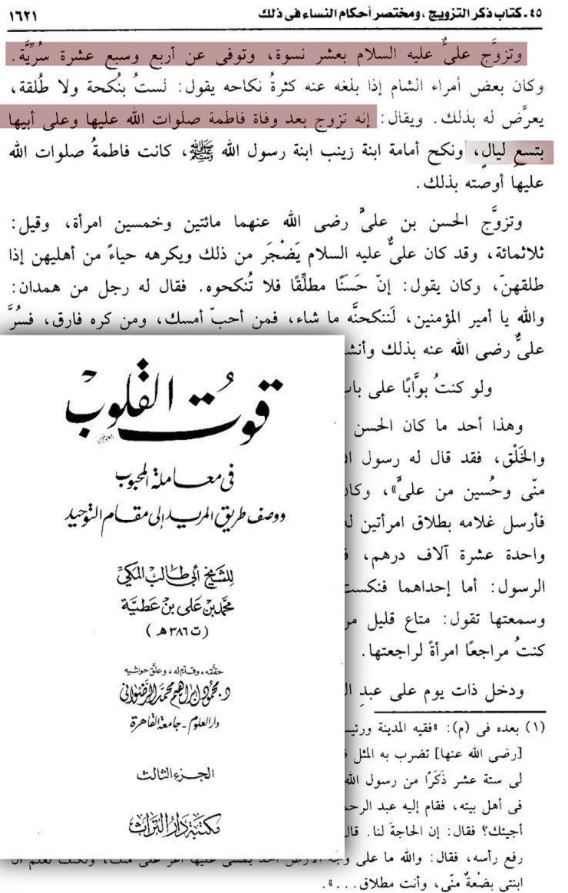
The above text we translate it as follows:
“And Ali (peace be upon him) married eleven women, and died leaving four free women and seven concubines.“
“And one of the princes of Syria, if he heard of his numerous marriages, would say: “She is neither a divorcee nor a widow,” hinting at that. And it is said: He married after the death of Fatimah (peace and blessings of Allah be upon her and her father) nine [women] in total, and he married Umamah bint Zaynab, the daughter of the Messenger of Allah, for Fatimah (peace and blessings of Allah be upon her) had recommended that to him.”
“Some of the rulers of Syria, upon hearing of his numerous marriages, would say, ‘It’s neither a marriage nor a divorce,’ alluding to this. It is said that he married nine nights after the death of Fatimah, peace be upon her and her father. He married Umamah, the daughter of Zaynab, the daughter of the Messenger of Allah (ﷺ) as Fatimah, peace be upon her, had instructed him to do so.
It is said that he married nine nights after the death of Fatimah, peace be upon her and her father.
“And Al-Hasan bin Ali (may Allah be pleased with them both) married two hundred and fifty women, and it is said: three hundred. And Ali (peace be upon him) used to forbid him from that and disliked it out of jealousy for his family. If he divorced [them], he would say: “Indeed, Hasan is a divorcer, so do not marry him.” So a man from Hamdan said: “O Commander of the Faithful, let us marry him whomever you wish. Whoever you love, we will keep, and whoever you hate, we will separate [divorce].”
Source: (“Qūt al-qulūb fi Mu’amalat al-Mahbub wa Wasf Tariq al-Murid ila Maqam al-Tawhid” (Nourishment of Hearts in Dealing with the Beloved and Describing the Seeker’s Path to the Station of Monotheism volume 3 page number 1621) written by the Sufi scholar, the mystic and Shafi’i hadith scholar, Abū Ṭālib Muhammed ibn Ali ibn Atiyya al-Harithi al-Makkī
The key themes of the book are as follows:
- Strictly following the Sunnah of the Prophet Muhammed (saw).
- Cultivating sincere intention (ikhlas).
- Striving for spiritual excellence (ihsan).
- Purifying the heart from blameworthy traits.
This is also quoted by: Muhammed-Baqir al-Majlisi in Bihar al-Anwar
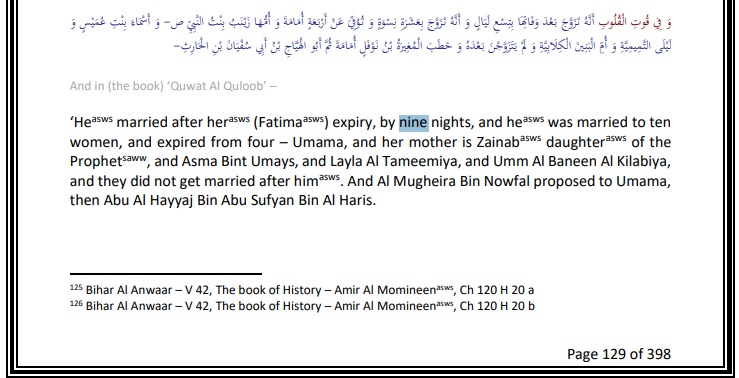
Source: (https://tinyurl.com/4xh34ed5)
Some may say how can one love again after having loved and been loved by Fatima (ra)? How can Ali after 10 years of marriage and having children move on so quickly?
This only increases the suspicion of murder. However, this suspicion is easily answered. Ali had children who were still quite small. Even if he re-married rather quickly it doesn’t mean he ‘moved on’ so to speak.
Also, this report does not have an authentic chain. It is something that has been handed down by tradition without anything solid to back it up. However, the same can be said about intervals (meaning when Ali actually remarried) after the passing of Fatima (ra). It is all based upon speculation.
Some pay point out what seemingly is a flippant attitude towards women by Ali in the hadith concerning Aisha (ra) above: ‘there are plenty of women other than she‘ Ali is actually addressing a stark reality. People are replaceable.
After all, there is a beautiful and powerful saying attributed to Ali ibn Abi Talib: Attachment is not that you dot own anything but rather nothing owns you.
Then there is Explanation of Sahih Al Bukari by Ahmad ibn Ali ibn Hajar al-Asqalani concerning what triggered the ‘Ghadir Khum’ incident.
This is the summary:
Khalid bin Al-Walid and Buraidah Al-Aslami were in Yemen to fight in the way of Allah and to call people to Islam, so the Messenger of Allah (saw), sent Ali to them to “seize the spoils.” Ali came and took the spoils, and his eyes fell on a Yemeni girl whom he liked, so he took her into the tent, after he fufilled what he did with her, and went out to the companions, his head dripping with water.
This is from our article here:
Conclusion: That Ali Killed Fatima (ra) in order to marry other women is not sound.
In the Sunni tradition according to Ibn Hajar’s commentary and Sunni hadith Ali certainly had access to other women. Just not as wives. These are the type of reports that those who attack Ali rely upon to begin with. So their whole premise is destroyed.
Fatima (ra) found out about Ali’s plans to overthrow the caliphate.
The second motive that is given by the opponets of Ali ibn Abu Talib is that it is alleged that when Umar (ra) went to the house of Fatima (ra), Umar (ra) informed her: “Tell Ali not to meet with those trying to overthrow the caliphate and to stop their plots.” Thus it is alleged that she then kept an eye on Ali and saw that her husband was indeed meeting people to gather support. And when Fatima (ra) discovered this, Ali killed her.
We can say based upon our research that we have not come across a shred of evidence for this. Not in the books of the Sunni nor in the books of the Shi’i.
Conclusion: That Ali killed Fatima (ra) because he found out that she was leaking his plans is certainly pure speculation.
Fatima (ra) was an obstacle for Ali to marry Umama bint Abi al-As ibn al-Rabi’ who could possibly marry Muawiya
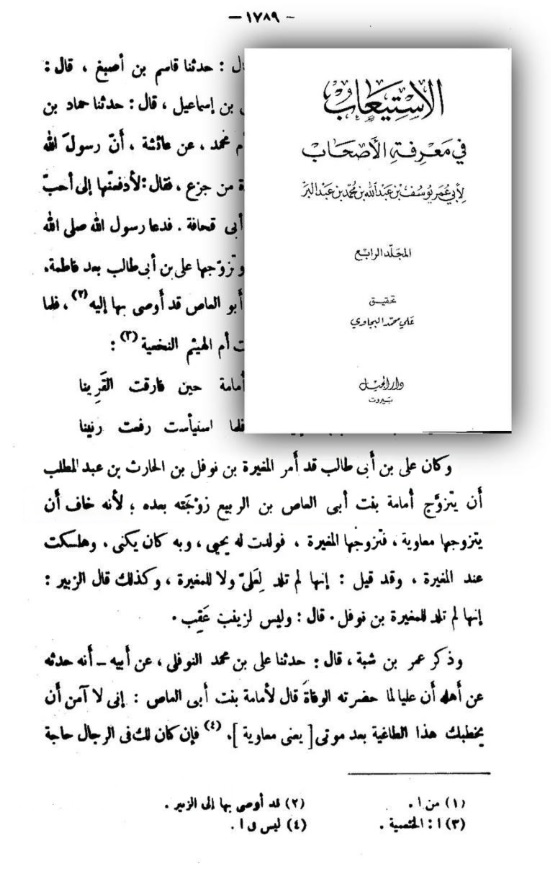
Translation from above:
“From Qasim ibn Asbagh, who said: [narrated] to us Ismail, who said: [narrated] to us Hammad ibn Zayd, from Aisha, that the Messenger of Allah (ﷺ) … [when] he gathered [them], he said: “Shall I not inform you of the most…?” … loyalty. So the Messenger of Allah (ﷺ) … and he married her to Ali ibn Abi Talib after Fatimah, and Abu al-As had recommended her [in marriage] to him. And her mother is Umm al-Haytham al-Nakha’iyyah: “Ummamah, when she departed from the loved ones, made my forelocks grey and humbled my support. She circles around him for her need to him, and when she despaired, she raised a wailing cry.”
“And Ali ibn Abi Talib had ordered al-Mughirah ibn Nawfal ibn al-Harith ibn Abd al-Muttalib to marry Ummamah bint Abi al-As ibn al-Rabi’, his wife after him, because he feared that Mu’awiyah would marry her. So al-Mughirah married her, and she gave birth to Yahya, and by him he was given the kunyah. And she died while with al-Mughirah.”
“And it has been said: She did not give birth to [a child] for Ali nor for al-Mughirah. Likewise, al-Zubayr said: She did not give birth to [a child] for al-Mughirah ibn Nawfal. He said: And Zaynab has no offspring.”
“And Umar ibn Shabbah mentioned, saying: [narrated] to us Ali ibn Muhammad al-Nawfali, from his father that he narrated to him from his family that Ali, when death approached him, said to Ummamah bint Abi al-As: “I do not feel safe that this tyrant will propose to you after my death, meaning Mu’awiyah. So if you have a need among men, I have approved al-Mughirah ibn Nawfal as a husband for you.”
Source: (Al-Istiʿāb fī Maʿrifat al-Āṣḥāb (Comprehensive Knowledge of the Names of the Companions) by Ibn Abd al-Barr Volume 4, Page 1789)
This theory proposes that Ali killed Fatima (ra) as she was an obstacle for him to marry another wife. Ali needed to do this to marry Umama bint Abi al-As ibn al-Rabi’ (ra) whom was eventually given to al-Mughirah ibn Nawfal. This was to prevent Muawiya from marry her and having offspring from her, so they would become descendants of the Messenger of Allah (saw).
We can say based upon our research that there is no historical basis that Ali had al-Mughirah ibn Nawfal(ra) marry Mughirah ibn Nawfal to prevent Muawiya from marrying her.
Conclusion: This theory is proven to be false.
How old was Fatima (ra) at the time of her death?
The most common view in the Shi’i tradition is that she was 18 at the time of her death.
The most common view in the Sunni tradition is that she was 27-29 at the time of her death.
The point being here is that no matter what tradition you wish to go with in regard to her age at the time of death she was by all accounts a healthy young woman.
The manner of her death: The clash of historical perspectives.
Some late Shi’i sources Fatima (ra) dies as the result of Umar Ibn Al Khattab (ra) and his alleged assault on the house.
Many Shi’i scholars and researchers reject this account.
Ahmad al-Katib mentions its absence in early Shi’i text. Foundational compilations like Al-Kulayni’s Al Kafi and Nahj al-Balagha do not contain it. The absence of its mention by Shaykh al-Mufid.
Sayyid Muhammed Hussein Fadlallah believes the Muslims of that era would not assault the daughter of the Prophet (saw) so soon after his death. That a warrior like Ali would not remain passive while his wife was physicallly beaten.
He douts details such as the actual burning of the house, the breaking of Fatima’s (ra) ribs or her misscarriage.
We went over more of this here:
‘Ahl Sunnah Wal Jammah’ a project of the Abbasids, will claim she died of grief and some kind of ‘natural illness‘. Whils this is plausible, it still leaves the matter ambiguous.
The secret burial of Fatima bint Muhammed (ra). It raises more questions then it answers.
The following are from Sunni sources:
The Messenger of Allah (ﷺ) said:” We (prophets) do not have any heirs; what we leave behind is (to be given in) charity.” The household of the Messenger of Allah (ﷺ) will live on the income from these properties, but, by Allah, I will not change the charity of the Messenger of Allah (ﷺ) from the condition in which it was in his own time. I will do the same with it as the Messenger of Allah (may peace be upun him) himself used to do. So Abu Bakr refused to hand over anything from it to Fatima who got angry with Abu Bakr for this reason. She forsook him and did not talk to him until the end of her life. She lived for six months after the death of the Messenger of Allah (ﷺ). When she died, her husband. ‘Ali b. Abu Talib, buried her at night. He did not inform Abu Bakr about her death and offered the funeral prayer over her himself. During the lifetime of Fatima, ‘All received (special) regard from the people. After she had died, he felt estrangement in the faces of the people towards him. So he sought to make peace with Abu Bakr and offer his allegiance to him. He had not yet owed allegiance to him as Caliph during these months. He sent a person to Abu Bakr requesting him to visit him unaccompanied by anyone (disapproving the presence of Umar). ‘Umar said to Abu Bakr: BY Allah, you will not visit them alone. Abu Bakr said: What will they do to me? By Allah, I will visit them. And he did pay them a visit alone. ‘All recited Tashahhud (as it is done in the beginning of a religious sermon) ; then said: We recognise your moral excellence and what Allah has bestowed upon you. We do not envy the favour (i. e. the Catiphate) which Allah nas conferred upon you; but you have done it (assumed the position of Caliph) alone (without consulting us), and we thought we had a right (to be consulted) on account of our kinship with the Messenger of Allah (ﷺ). He continued to talk to Abu Bakr (in this vein) until the latter’s eyes welled up with tears. Then Abd Bakr spoke and said: By Allah, in Whose Hand is my life, the kinship of the Messenger of Allah (ﷺ) is dearer to me than the kinship of my own people. As regards the dispute that has arisen between you and me about these properties, I have not deviated from the right course and I have not given up doing about them what the Messenger of Allah (ﷺ) used to do. So ‘Ali said to Abu Bakr: This aftetnoon is (fixed) for (swearing) allegiance (to you). So when Abu Bakr had finished his Zuhr prayer, he ascended the pulpit and recited Tashahhud, and described the status of ‘Ali, his delay in swearing allegiance and the excuse which lie had offered to him (for this delay). (After this) he asked for God’s forgiveness. Then ‘Ali b. Abu Talib recited the Tashahhud. extolled the merits of Abu Bakr and (said that) his action was nott prompted by any jealousy of Abu Bakr on his part or his refusal to accept the high position which Allah had conferred upon him, (adding: ) But we were of the opinion that we should have a share in the government, but the matter had been decided without taking us into confidence, and this displeased us. (Hence the delay in offering allegiance. The Muslims were pleased with this (explanation) and they said: You have done the right thing. The Muslims were (again) favourably inclined to ‘Ali since he adopted the proper course of action.
Source: (https://sunnah.com/muslim:1759a)
Narrated `Aisha:
Fatima the daughter of the Prophet (ﷺ) sent someone to Abu Bakr (when he was a caliph), asking for her inheritance of what Allah’s Messenger (ﷺ) had left of the property bestowed on him by Allah from the Fai (i.e. booty gained without fighting) in Medina, and Fadak, and what remained of the Khumus of the Khaibar booty. On that, Abu Bakr said, “Allah’s Messenger (ﷺ) said, “Our property is not inherited. Whatever we leave, is Sadaqa, but the family of (the Prophet) Muhammad can eat of this property.’ By Allah, I will not make any change in the state of the Sadaqa of Allah’s Messenger (ﷺ) and will leave it as it was during the lifetime of Allah’s Messenger (ﷺ), and will dispose of it as Allah’s Messenger (ﷺ) used to do.” So Abu Bakr refused to give anything of that to Fatima. So she became angry with Abu Bakr and kept away from him, and did not task to him till she died. She remained alive for six months after the death of the Prophet. When she died, her husband `Ali, buried her at night without informing Abu Bakr and he said the funeral prayer by himself. When Fatima was alive, the people used to respect `Ali much, but after her death, `Ali noticed a change in the people’s attitude towards him. So `Ali sought reconciliation with Abu Bakr and gave him an oath of allegiance. `Ali had not given the oath of allegiance during those months (i.e. the period between the Prophet’s death and Fatima’s death). `Ali sent someone to Abu Bakr saying, “Come to us, but let nobody come with you,” as he disliked that `Umar should come, `Umar said (to Abu Bakr), “No, by Allah, you shall not enter upon them alone ” Abu Bakr said, “What do you think they will do to me? By Allah, I will go to them’ So Abu Bakr entered upon them, and then `Ali uttered Tashah-hud and said (to Abu Bakr), “We know well your superiority and what Allah has given you, and we are not jealous of the good what Allah has bestowed upon you, but you did not consult us in the question of the rule and we thought that we have got a right in it because of our near relationship to Allah’s Messenger (ﷺ) .” Thereupon Abu Bakr’s eyes flowed with tears. And when Abu Bakr spoke, he said, “By Him in Whose Hand my soul is to keep good relations with the relatives of Allah’s Messenger (ﷺ) is dearer to me than to keep good relations with my own relatives. But as for the trouble which arose between me and you about his property, I will do my best to spend it according to what is good, and will not leave any rule or regulation which I saw Allah’s Messenger (ﷺ) following, in disposing of it, but I will follow.” On that `Ali said to Abu Bakr, “I promise to give you the oath of allegiance in this after noon.” So when Abu Bakr had offered the Zuhr prayer, he ascended the pulpit and uttered the Tashah-hud and then mentioned the story of `Ali and his failure to give the oath of allegiance, and excused him, accepting what excuses he had offered; Then `Ali (got up) and praying (to Allah) for forgiveness, he uttered Tashah-hud, praised Abu Bakr’s right, and said, that he had not done what he had done because of jealousy of Abu Bakr or as a protest of that Allah had favored him with. `Ali added, “But we used to consider that we too had some right in this affair (of rulership) and that he (i.e. Abu Bakr) did not consult us in this matter, and therefore caused us to feel sorry.” On that all the Muslims became happy and said, “You have done the right thing.” The Muslims then became friendly with `Ali as he returned to what the people had done (i.e. giving the oath of allegiance to Abu Bakr).
Source: (https://sunnah.com/bukhari:4240)
Prima Qur’an comments: It is quite clear that these companions had very strong difference of opinion in regard to the inheritence of the Blessed Prophet (saw). This hadith tells us that Fatima (ra) did not wish to speak to Abu Bakr (ra) for the rest of her life. The death of Fatima (ra) is mentioned in passing. We are not told the reason for her death. It simply states that Ali buried her at night and he prayed over her himself. What follows is interesting: During the lifetime of Fatima, ‘Ali received (special) regard from the people. After she had died, he felt estrangement in the faces of the people towards him.
So this either means. That ‘Ali was nothing without his connection to Fatima (ra). Or, that Ali’s actions of praying over the daughter of the Messenger of Allah (saw) alone made people feel scorn towards him.
What is unresolved. The ‘how’ Fatima (ra) dies.
The following are from Shi’i sources.
“And Hasan and Husayn (peace be upon them), along with a group from Banu Hashim and some of the close companions of Amir al-Mu’minin (peace be upon him), buried her in the depth of the night, concealed her grave, and Ali (peace be upon him) leveled around it approximately seven false graves so that her grave would not be known, and he leveled her grave with the ground to hide its location [1]. And it is narrated that he (peace be upon him) sprinkled forty graves so that her grave would not be distinguishable from other graves and they would not pray over her [2].
Ibn Abbas was asked: When did you bury Fatimah (peace be upon her)? He said: We buried her at night after the night had quieted. It was said: So who prayed over her? He said: Ali (peace be upon him.”
Source: (https://tinyurl.com/bdh536rm)
“And in the narration: Voices of weeping rose from the house of Ali (peace be upon him), so the people of Medina let out a single cry, and the women of Banu Hashim gathered in her house and let out a single scream that almost made Medina tremble. And the people came like the mane of a horse to Ali (peace be upon him), while he was sitting, and Hasan and Husayn were before him weeping. And Umm Kulthum came out saying: “O my father, O Messenger of Allah, now we have truly lost you, a loss after which there is no meeting ever again.” And the people gathered and sat, clamoring, waiting outside the funeral to pray over her. And Abu Dharr came out and said: “Disperse, for the daughter of the Messenger of Allah has had her burial delayed until the evening.”
“And Abu Bakr and Umar came to offer condolences to Ali (peace be upon him), saying to him: “O Abu al-Hasan, do not precede us in praying over the daughter of the Messenger of Allah (may Allah’s peace and blessings be upon him and his family).” But Ali (peace be upon him) washed her and shrouded her... Then Ali prayed over the funeral, and it was accompanied by Hasan, Husayn, Aqil, Salman, Abu Dharr, Miqdad, Ammar, Buraydah, al-Abbas, and Ibnat al-Fadl. When the voices quieted and eyes slept and a portion of the night passed, the Commander of the Faithful (peace be upon him) brought her out and buried her secretly and poured earth over her, while the mourners around him kept watch lest the people know and the hypocrites prevent them. So they buried her and effaced the earth of her grave.”
From Ibn Nubatah, who said: The Commander of the Faithful (peace be upon him) was asked about the reason for his burying Fatimah, daughter of the Messenger of Allah (may Allah’s peace and blessings be upon him and his family), at night. He said: “She was angry with a people and disliked their attendance at her funeral, and it is forbidden.”
Source: (https://tinyurl.com/3rm5bfck)
[Bihar al-Anwar: 43/201, at the end of hadith 30].
107 Misbah al-Anwar: From Abu Ja’far (peace be upon him), who said: The Commander of the Faithful (peace be upon him) buried Fatimah bint Muhammad (may Allah’s blessings be upon them) in al-Baqi’, and he sprinkled water around those graves so that the grave would not be known. And it reached Abu Bakr and Umar that Ali had buried her at night, so they said to him: “Why did you not inform us?” He said: “It was night, and I disliked to summon you!” So Umar said to him: “This is not [the reason], rather it is rancor in your chest!” So the Commander of the Faithful (peace be upon him) said: “As for this, since you two refuse, she made me swear by the right of Allah and the sanctity of His Messenger and by her right upon me that you two should not attend her funeral.”
[Bihar al-Anwar: 81/255, hadith 15].
108 In al-Kashf: From the paths of the common people (Ahl al-Sunnah); that Abu Bakr and Umar reproached Ali (peace be upon him) for not having informed them to pray over her, so he excused himself that she had instructed him to do so, and he swore an oath to them, so they believed him and accepted his excuse.
[Bihar al-Anwar: 43/190, hadith 19, from Kashf al-Ghummah 2/68.
Prima Qur’an comments: Folks! There are more contradictions here than you can shake a stick at!
Get that scuba gear on, here comes the deep dive!
Contradiction 1: Who Was Present at the Burial and Who Prayed Over Her?
Report A (first source): Ibn Abbas-ra says, “We buried her at night… Ali prayed over her.” This implies a small, private burial with Ali leading the prayer.
Report B (second source): Lists a detailed roster of attendees at the funeral prayer: Ali, Hasan, Husayn, Aqil, Salman, Abu Dharr, Miqdad, Ammar, Buraydah, al-Abbas, and Ibnat al-Fadl eleven named individuals. It also says “the mourners around him kept watch” (plural), suggesting a larger group.
Contradiction: Report A implies a tiny, secret burial (Ibn Abbas -ra says “we”), while Report B describes a structured funeral prayer with a specific list of attendees and guards. If the burial was truly secret and concealed from the people of Medina, how did this many people attend without word spreading? Conversely, if eleven prominent Companions attended, how was it kept secret from Abu Bakr-ra and Umar-ra (who, in Report D, only learn of it afterward)?
Further tension: Report B says Ali “washed her and shrouded her” and then “prayed over the funeral” but Report A has Ibn Abbas-ra saying “we buried her,” which could imply Ibn Abbas-ra was present at the burial. Yet Report B’s attendee list does not include Ibn Abbas. So either Ibn Abbas-ra was present (and omitted from the list), or he was not present (and his “we” is rhetorical/imprecise). This is never reconciled.
Contradiction 2: Was the Grave Made Unrecognizable, or Was It in al-Baqi’?
Report A: Ali “leveled around it approximately seven false graves” and “leveled her grave with the ground to hide its location.” A second narration says he “sprinkled forty graves.”
Report C (Misbah al-Anwar): Ali “buried Fatimah (ra)… in al-Baqi’, and he sprinkled water around those graves so that the grave would not be known.”
Contradiction: Report A describes the grave as being leveled to the ground and surrounded by false graves (7 or 40). Report C says she was buried in al-Baqi’ (the known cemetery) and that water was sprinkled around “those graves” (plural) to obscure which one was hers. These are two different concealment methods:
- Report A: false graves + leveling the actual grave to the ground (i.e., no identifiable mound at all).
- Report C: burial in the public cemetery of al-Baqi’ + sprinkling water around multiple graves (i.e., the grave exists but is indistinguishable).
If the grave was leveled to the ground (Report A), there would be no need to sprinkle water around “those graves” (Report C). The leveling itself would conceal it. If she was buried in al-Baqi’ among other graves (Report C), then the “seven false graves” and “forty graves” narrations (Report A) describe a different scenario entirely. The reports are not harmonized.
Also: The number of false graves is itself inconsistent: seven in one narration, forty in another. This is a numerical discrepancy within Report A itself.
Contradiction 3: Did Abu Bakr (ra) and Umar (ra) Know Before or After the Burial?
Report B: “Abu Bakr (ra) and Umar (ra) came to offer condolences to Ali… saying: ‘O Abu al-Hasan, do not precede us in praying over the daughter of the Messenger of Allah.'” This implies they arrived before the funeral prayer and asked to participate. Ali then washed and shrouded her, prayed over her, and buried her at night with the implication that Abu Bakr (ra) and Umar (ra) were excluded despite their request.
Report D (Bihar 81/255): “And it reached Abu Bakr (ra) and Umar (ra) that Ali had buried her at night, so they said to him: ‘Why did you not inform us?'” This implies they learned of the burial after the fact and were not present beforehand.
Contradiction: In Report B, Abu Bakr (ra) and Umar (ra) are present at the house before the funeral, explicitly asking to pray over her. In Report D, they only learn after the burial that it happened at night. These are mutually exclusive timelines. If they were at the house asking to join the prayer (Report B), they would have known the burial was imminent and would not later be surprised that it happened at night (Report D).
Possible harmonization attempt: One could argue Report B’s “do not precede us” happened, then Ali delayed the burial until night specifically to avoid them, and then Report D’s “it reached them” describes their reaction the next morning. But Report B says Ali “brought her out and buried her secretly” while the mourners kept watch lest the people know and the hypocrites prevent them . If Abu Bakr (ra) and Umar (ra) had already been at the house asking to join, the “secret” was already partially compromised. The reports do not explicitly reconcile this.
Contradiction 4: Was the Funeral Prayer Public or Private?
Report B: “The people gathered and sat, clamoring, waiting outside the funeral to pray over her.” Abu Dharr comes out and tells them to disperse because the burial has been delayed until evening. Then Ali prays over her with the named attendees. So there was a public expectation of a funeral prayer, which was deliberately thwarted.
Report A: Ibn Abbas (ra) says “we buried her at night”. Here there is no mention of a public gathering or Abu Dharr dispersing anyone.
Report C: No mention of a public gathering or dispersal. It is just Ali burying her in al-Baqi’ and sprinkling water.
Discrepancy: Report B describes a significant public event. The people of Medina gathering, women of Banu Hashim screaming, Abu Dharr dispersing the crowd which is entirely absent from Reports A and C. If such a public commotion occurred (Report B says the scream “almost made Medina tremble”), it is difficult to understand how the burial could remain secret from Abu Bakr(ra) and Umar (ra) until afterward (Report D). The reports describe vastly different scales of public awareness.
Unresolved Question: Why Would Ali Level the Grave If He Buried Her in al-Baqi’?
Report C says she was buried in al-Baqi’ The well-known public cemetery. Report A says Ali leveled seven (or forty) false graves and leveled her actual grave with the ground so it would not be known.
Question: If she was buried in al-Baqi’ (Report C), a public cemetery with many graves, why would Ali need to create seven or forty false graves (Report A)? The existing graves of al-Baqi’ would already provide camouflage. Conversely, if he created forty false graves (Report A), where did he put them? In al-Baqi’ or elsewhere? The reports do not specify the location of the false graves relative to al-Baqi’. This is a geographic and logistical inconsistency.
Unresolved Question: The Role of Ibn Abbas (ra)
Report A has Ibn Abbas (ra) saying “We buried her at night” implying he was part of the burial party. But Report B‘s detailed attendee list does not include Ibn Abbas (ra). Report C and Report D do not mention him either.
Question: Was Ibn Abbas (ra)present at the burial or not? If he was (Report A), why is he omitted from the only detailed attendee list (Report B)? If he was not, why does he say “we”? This is never addressed.
Contradiction 5: The Nature of the Concealment — Leveling vs. Sprinkling Water
Report A: Ali “leveled her grave with the ground” and “sprinkled forty graves” (i.e., created forty mounds or marked forty spots).
Report C: Ali “sprinkled water around those graves so that the grave would not be known.”
Discrepancy: Report A says he leveled the grave (made it flat, indistinguishable from the ground) and separately sprinkled forty graves (implying mounds or markers). Report C says he sprinkled water around graves (implying the graves were visible but the water obscured which was fresh). These are three different concealment techniques:
- Leveling the grave to the ground (Report A).
- Creating 7 or 40 false graves (Report A).
- Sprinkling water around existing graves in al-Baqi’ (Report C).
They are not mutually exclusive in principle, but the reports present them as alternative explanations without acknowledging each other. A reader trying to reconstruct the event cannot determine which method was actually used, or whether all three were used simultaneously (which would be logistically quite odd. Why level the grave and create forty false graves and sprinkle water around them?).
Contradiction 6: Did Fatima (ra) Make Ali Swear an Oath, or Did Ali Act on His Own Initiative?
Report B: Ali says: “She was angry with a people and disliked their attendance at her funeral, and it is forbidden.” This frames the exclusion as Fatima’s-ra dislike/anger, which Ali honors.
Report D: Ali says: “She made me swear by the right of Allah… that you two should not attend her funeral.” This frames it as an explicit oath Fatima (ra) imposed on Ali.
Report E: Ali “excused himself that she had instructed him to do so, and he swore an oath to them” meaning Ali swore an oath to Abu Bakr (ra) and Umar (ra) that Fatima (ra) had instructed him.
Contradiction: In Report B, there is no mention of an oath. It is simply just Fatima’s-ra anger and dislike. In Report D, Fatima (ra) made Ali swear an oath to her (or by Allah) to exclude them. In Report E, Ali swore an oath to Abu Bakr (ra) and Umar (ra) confirming Fatima’s-ra instruction. These are three different oath-scenarios:
- No oath (Report B).
- Fatima (ra) extracts an oath from Ali (Report D).
- Ali swears an oath to Abu Bakr (ra) and Umar (ra) (Report E).
The reports are not harmonized on this central legal/religious point.
Unresolved Question: Why Did the Women of Banu Hashim Scream If the Burial Was Secret?
Report B: “The women of Banu Hashim gathered in her house and let out a single scream that almost made Medina tremble.” This is a very public, loud event. Yet the same report says Ali buried her “secretly” and the mourners kept watch “lest the people know.”
Question: How can a scream that “almost made Medina tremble” be reconciled with a burial so secret that Abu Bakr (ra) and Umar (ra) only learn of it afterward (Report D)? If the whole city heard the screaming, the fact of her death was public knowledge. The “secret” was only the timing and location of the burial. However, Report B also says the people gathered outside “waiting… to pray over her,” meaning they knew she had died and expected a funeral. So what exactly was secret? The reports use “secret” in different senses without clarifying:
- Secret = hidden from Abu Bakr (ra) and Umar (ra) specifically?
- Secret = hidden from the general public?
- Secret = the grave’s location concealed?
Report B implies the public knew she died (they gathered for the funeral) but did not know when/where the burial would occur. Report D implies Abu Bakr (ra) and Umar (ra) did not know the burial had happened until afterward. These are compatible in a narrow sense, but the dramatic language (“almost made Medina tremble,” “the people came like the mane of a horse”) sits awkwardly with the claim that the burial was concealed from the two most powerful men in Medina.
Contradiction 7: The Number of False Graves — Seven vs. Forty
Report A: “approximately seven false graves” in one narration; “forty graves” in another.
Discrepancy: This is a straightforward numerical contradiction within the same source cluster. Seven vs. forty is not a minor variation. It changes the scale of the concealment effort. No attempt is made to reconcile them (e.g., “seven around the grave and forty in the cemetery” or “seven initially, then forty later”). They are presented as alternative narrations of the same act.
Unresolved Question: Where Was Fatima (ra) Buried?
- Report A: Grave leveled to the ground, surrounded by 7 (or 40) false graves. Location not specified.
- Report C: Buried in al-Baqi’.
- Report B: Buried “secretly”. The location not specified, but the mourners kept watch “lest the people know.”
- Report D: Buried at night. The location not specified.
- Report E: Buried at night. The location not specified.
Question: If she was buried in al-Baqi’ (Report C), why do Reports A, B, D, and E not mention al-Baqi’? And if the grave was leveled to the ground and surrounded by false graves (Report A), how could it be “in al-Baqi'” in any identifiable sense? The reports leave the actual location ambiguous. Which is ironic given that the entire point of the concealment narratives is that the location was deliberately hidden. But the narrators themselves disagree on whether it was in the public cemetery or in an unmarked location outside it.
BUT WAIT THERE’S MORE!
Shi’i Claim A (the “aggression” narrative): Umar (ra) & Abu Bakr (ra) attacked Fatima’s (ra) house, threatened to burn it, caused her injury (including the miscarriage of Muhsin in the more developed versions), and were responsible for her death. This is the dominant Shi’i narrative of the events between the Saqifa and Fatima’s (ra) death.
Shi’i Claim B (the “exclusion” narrative): Fatima (ra) was so angry with Abu Bakr (ra) and Umar (ra) that she made Ali swear an oath to prevent them from attending her funeral and, in some reports, the grave was concealed specifically so they could not visit it or pray at it.
Our question is: if Claim A is true, why would Claim B be necessary? If Umar (ra) had just burned her house and ultimately killed her, why would anyone expect him to want to visit her grave? Why would concealing the grave be the mechanism to stop him? The concealment implies a man who wants to show up and pay respects, which sits awkwardly with a man who allegedly just committed violence against her.
Why This Is a Genuine Problem Within the Shi’i Sources
This isn’t just some polemical jab or cheap shot. The reports themselves create the tension:
- Report B has Abu Bakr (ra) and Umar (ra) coming to offer condolences and asking to join the funeral prayer. Which is a posture of respect and reconciliation, not aggression. This is the same report that says Fatima (ra) was “angry with a people and disliked their attendance.”
- Report D has Umar (ra) saying “this is rancor in your chest!” a hostile exchange, but still one in which Umar (ra) is engaging with Ali about attending the funeral. He wants to be there!
- Report E has Abu Bakr (ra) and Umar (ra) reproaching Ali for not informing them, then believing his excuse and accepting it again, a posture of wanting to participate and then being reconciled.
So the reports themselves portray Abu Bakr (ra) and Umar (ra) as wanting to attend the funeral and visit the grave. That is the premise the concealment is responding to. The concealment only makes narrative sense if the expectation was that they would come.
If we take the aggression narrative seriously, the following questions arise:
- Why would Umar (ra) want to pray over her or visit her grave? If he had assaulted her and caused her death, attending her funeral would be either (a) a cynical public-relations move, (b) an act of hypocrisy, or (c) evidence that the aggression narrative is overstated or later polemical development. The reports don’t explore any of these possibilities . They simply assume he wanted to attend.
- Why would concealing the grave be the effective mechanism? If Umar (ra) was willing to burn down her house and assault her, concealing a grave would hardly stop a determined man from finding it or from making a public issue of it. The concealment narrative treats Umar (ra) as someone who respects the grave’s sanctity enough to be deterred by not knowing its location which is a strange characterization of a man who (in the same narratives) allegedly desecrated her home.
- Why would Fatima (ra) need to extract an oath from Ali? If the relationship was as hostile as the aggression narrative suggests, an oath would be superfluous. Ali would naturally exclude them. The oath narrative implies that without the oath, Ali might have allowed them to attend, which implies a baseline of normal social relations, not mortal enmity.
The concealment rationale reads as retrofit. The most natural reading of the reports is:
- Fatima’s grave was concealed for some reason.
- Later narrators, operating within a framework where Abu Bakr (ra) and Umar (ra) were already cast as usurpers and aggressors, needed to explain why the grave was concealed specifically from them.
- The explanation chosen “she made Ali swear they would not attend” which serves to retroactively justify the exclusion while simultaneously implying they wanted to attend, which inadvertently softens their image.
In other words, the polemical need to have Fatima(ra) reject Abu Bakr (ra) and Umar (ra) required them to be present and asking to participate (otherwise the rejection has no object). But this creates the awkward implication that they were eager to honor her. This itself cuts against the aggression narrative.
The fact that the reports disagree on why the burial was secret is itself telling:
- Report B: Fatima (ra) was angry at “a people” and disliked their attendance. (No mention of house-burning here.)
- Report D: Umar (ra) accuses Ali of rancor; Ali says Fatima (ra) made him swear to exclude them specifically. (Hostile, but they still wanted to attend.)
- Report E: They reproach Ali, he swears an oath, they believe him and accept his excuse. (Reconciled. Which is hard to square with the aggression narrative.)
These are three different rationales, and none of them mentions the house-burning, the miscarriage, or the assault. The concealment narratives operate in a different register from the aggression narratives. They presuppose ordinary political tension and wounded feelings, not lethal violence. That gap is exactly the inconsistency we are pointing to!
Prima Qur’an conclusion and summary.
The title of the article: Investigating the allegations that Ali ibn Abi Talib was responsible for the death and nocturnal burial of Fatima bint Muhammed
We looked at three possible motives and we feel we have given strong rebuttal to all three. Two of which really had no basis to stand on to begin with.
Question: Does this rule out the possiblity of Ali having killed Fatima bint Muhammed (ra)?
Answer: No, it does not. Accidents also happen. However, the three motives do not tally with our findings. Alas, in Islam you need strong evidence for such charges!
However, It is just simply odd that neither the Sunni nor the Shi’i sources mention the cause of her death. The sudden death of a presumably healthy young woman who was 18 according to the Shi’i sources and 27 to 29 according to the Sunni sources.
Ali Ibn Abi Talib burried Fatima(ra) the daughter of the Messenger of Allah (saw) in the middle of the night. It looks like he alone washed her and he aloned prayed over her and it is also very plausible that he alone buried her. No one know to this day knows where her noble resting place is!
Brothers and sisters, dear readers we ask you the following. By today’s standards be it in China, or India, England or the United States, South Africa or Argentina what would happen?
What would happen if a man burried his wife in the middle of the night after she died? Would this be allowed? Would the passing of a man’s wife be treated like an open/shut case?
We cannot say for certain, but it is likely we are the first among the Ibadi to write about these things. That is because as a rule, our school in general has no interest in these matters.
In the books of the Ibadi you do not find things like Iblis loves Imam Ali and narrates from the Prophet (saw) concerning him.
We do not have in our books that Ali would slosh his words about in prayer while intoxicated and thus became the occasion for some verses form the Qur’an.
What our school ask of the Ummah is in reality what Allah (swt) ask of us in the Qur’an.
“Indeed, the Muslim men and Muslim women, the believing men and believing women, the obedient men and obedient women, the truthful men and truthful women, the patient men and patient women, the humble men and humble women, the charitable men and charitable women, the fasting men and fasting women, the men who guard their private parts and the women who do so, and the men who remember Allah often and the women who do so – for them Allah has prepared forgiveness and a great reward.” (Qur’an 33:35)
May Allah Forgive the Ummah.
May Allah Guide the Ummah.


