
“Creator of the heavens and the earth. He has made for you from yourselves, mates, and among the cattle, mates; He multiplies you thereby. There is nothing like unto Him, and He is the Hearing, the Seeing.” (Qur’an 42:11)

﷽
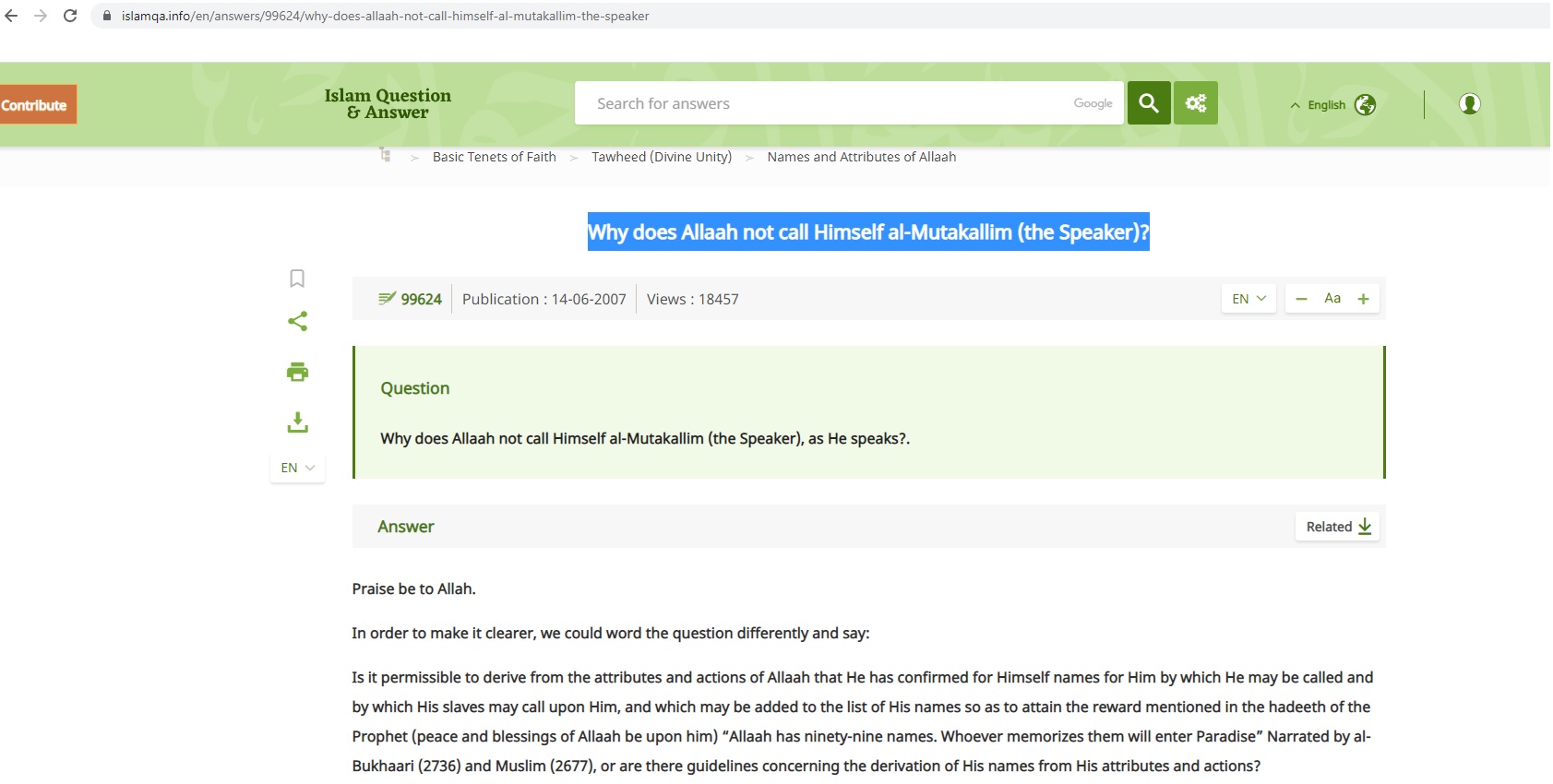
Why does Allah not call Himself al-Mutakallim (the Speaker)?
This was a question that was sent to a Salafi Q & A and the response was quite shocking. Not only do the Salafi use logic and reasoning to reject attributes of Allah (swt) they use flawed logic and reasoning to do so.
You may find this article very eye opening: https://islamqa.info/en/answers/99624/why-does-allaah-not-call-himself-al-mutakallim-the-speaker
Praise be to Allah.
In order to make it clearer, we could word the question differently and say:
Is it permissible to derive from the attributes and actions of Allaah that He has confirmed for Himself names for Him by which He may be called and by which His slaves may call upon Him, and which may be added to the list of His names so as to attain the reward mentioned in the hadeeth of the Prophet (peace and blessings of Allaah be upon him) “Allaah has ninety-nine names. Whoever memorizes them will enter Paradise” Narrated by al-Bukhaari (2736) and Muslim (2677), or are there guidelines concerning the derivation of His names from His attributes and actions?
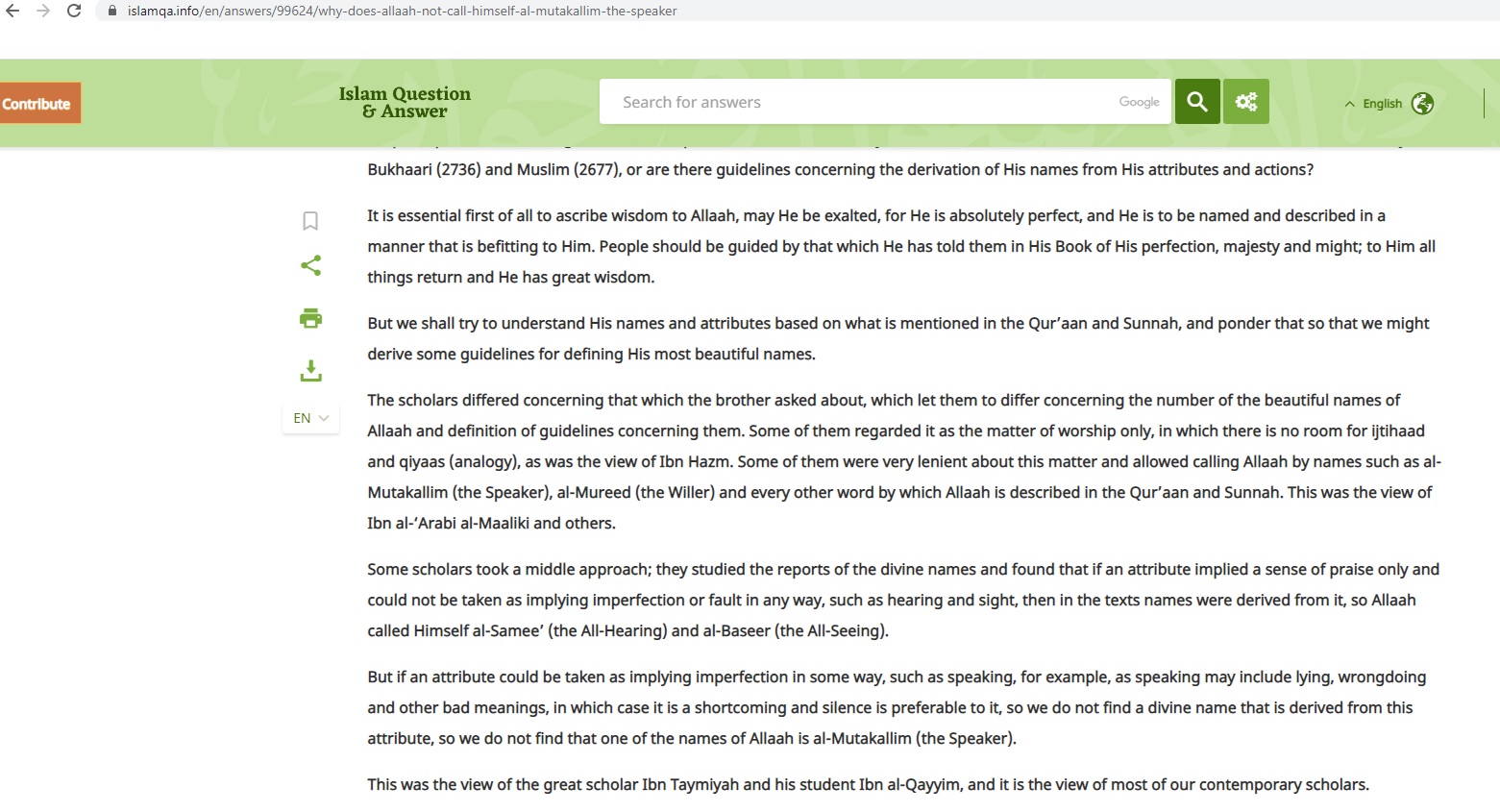
It is essential first of all to ascribe wisdom to Allaah, may He be exalted, for He is absolutely perfect, and He is to be named and described in a manner that is befitting to Him. People should be guided by that which He has told them in His Book of His perfection, majesty and might; to Him all things return and He has great wisdom.
But we shall try to understand His names and attributes based on what is mentioned in the Qur’aan and Sunnah, and ponder that so that we might derive some guidelines for defining His most beautiful names.
The scholars differed concerning that which the brother asked about, which let them to differ concerning the number of the beautiful names of Allaah and definition of guidelines concerning them. Some of them regarded it as the matter of worship only, in which there is no room for ijtihaad and qiyaas (analogy), as was the view of Ibn Hazm. Some of them were very lenient about this matter and allowed calling Allaah by names such as al-Mutakallim (the Speaker), al-Mureed (the Willer) and every other word by which Allaah is described in the Qur’aan and Sunnah. This was the view of Ibn al-‘Arabi al-Maaliki and others.
Some scholars took a middle approach; they studied the reports of the divine names and found that if an attribute implied a sense of praise only and could not be taken as implying imperfection or fault in any way, such as hearing and sight, then in the texts names were derived from it, so Allaah called Himself al-Samee’ (the All-Hearing) and al-Baseer (the All-Seeing).
But if an attribute could be taken as implying imperfection in some way, such as speaking, for example, as speaking may include lying, wrongdoing and other bad meanings, in which case it is a shortcoming and silence is preferable to it, so we do not find a divine name that is derived from this attribute, so we do not find that one of the names of Allaah is al-Mutakallim (the Speaker).
This was the view of the great scholar Ibn Taymiyah and his student Ibn al-Qayyim, and it is the view of most of our contemporary scholars.

Ibn Taymiyah (may Allaah have mercy on him) said in Sharh al-‘Aqeedah al-Isfahaaniyyah (1/19-20):
As for calling Allaah, may He be exalted, Mureed (Willer) and Mutakallim (Speaker),
These two names are not mentioned in the Qur’aan, or among the well known divine names. Their meanings are true, but the well known divine names are those by which Allaah may be called upon, and are mentioned in the Qur’aan and Sunnah, and which imply perfection and praise in and of themselves.
Knowledge, power, mercy and so on are in and of themselves praiseworthy attributes, and the names which point to them are praiseworthy names.
As for speech and will, they may be divided into praiseworthy types such as truthfulness and justice, and blameworthy types such as wrongdoing and lying. Allaah can only be described in praiseworthy terms, not blameworthy ones, hence His names do not include al-Mutakallim (the Speaker) or al-Mureed (the Willer). End quote.
He also (may Allaah have mercy on him) said in Bayaan Talbees al-Jahamiyyah (2/10-11):
Allaah has the most beautiful names, by which He has called Himself, and has revealed them in His Book and taught to whomever He willed among His creation, such as al-Haqq (the Truth), al-‘Aleem (the All-Knowing), al-Raheem (the Most Merciful), al-Hakeem (the Most Wise), al-Awwaal (the First), al-Aakhir (the last), al-‘Aliy (the Most High), al-‘Azeem (the Almighty), al-Kabeer (the Most Great) and so on.
All of these names are names of praise which indicate praiseworthy meaning, and have no blameworthy meaning. To Allaah belong the most beautiful names, and He is perfect in all ways. Names which are more general in meaning and may be applied to both good and bad things are not found among the beautiful names of Allaah. End quote.
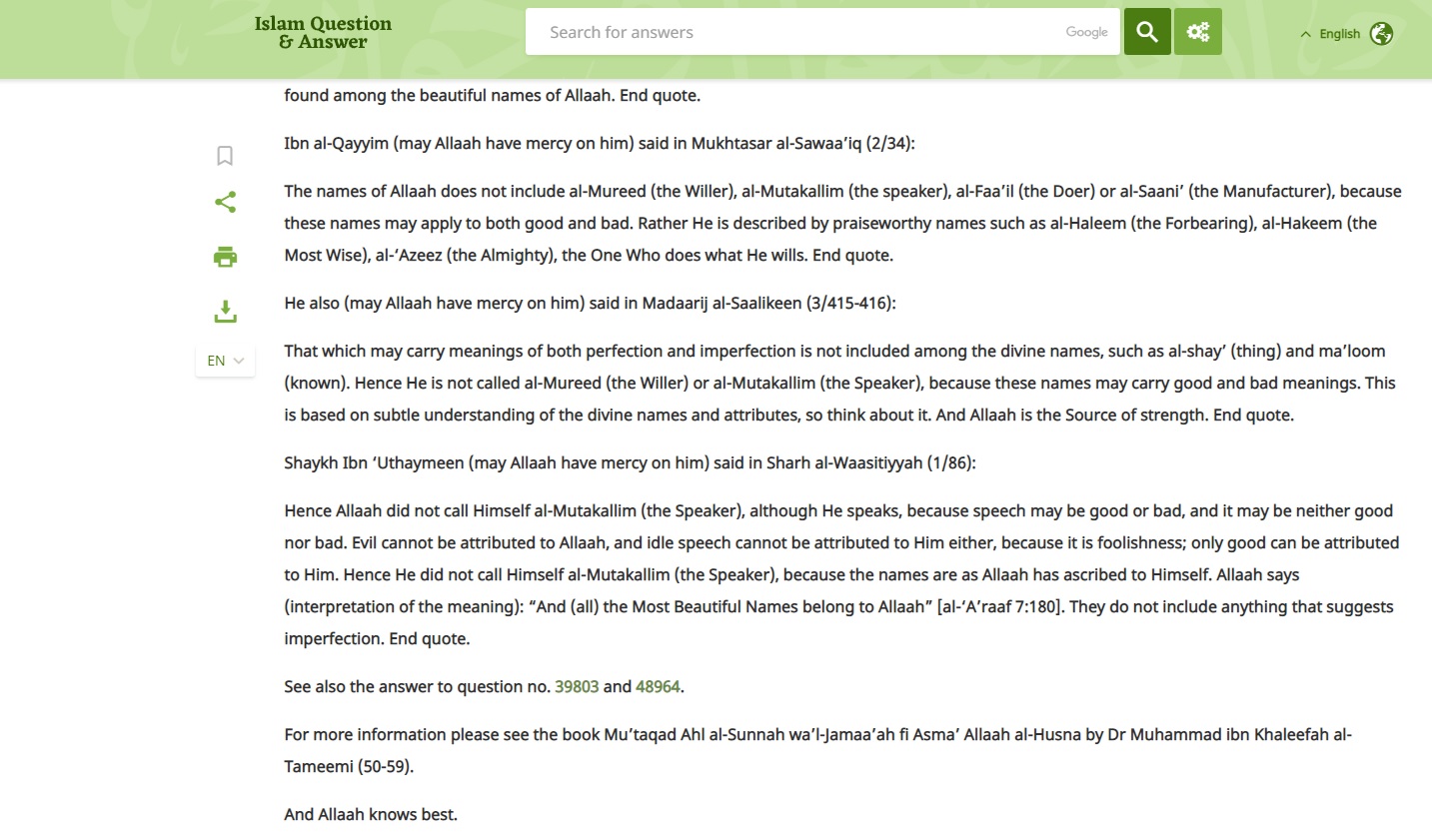
Ibn al-Qayyim (may Allaah have mercy on him) said in Mukhtasar al-Sawaa’iq (2/34):
The names of Allaah does not include al-Mureed (the Willer), al-Mutakallim (the speaker), al-Faa’il (the Doer) or al-Saani’ (the Manufacturer), because these names may apply to both good and bad. Rather He is described by praiseworthy names such as al-Haleem (the Forbearing), al-Hakeem (the Most Wise), al-‘Azeez (the Almighty), the One Who does what He wills. End quote.
He also (may Allaah have mercy on him) said in Madaarij al-Saalikeen (3/415-416):
That which may carry meanings of both perfection and imperfection is not included among the divine names, such as al-shay’ (thing) and ma’loom (known). Hence He is not called al-Mureed (the Willer) or al-Mutakallim (the Speaker), because these names may carry good and bad meanings. This is based on subtle understanding of the divine names and attributes, so think about it. And Allaah is the Source of strength. End quote.
Shaykh Ibn ‘Uthaymeen (may Allaah have mercy on him) said in Sharh al-Waasitiyyah (1/86):
Hence Allaah did not call Himself al-Mutakallim (the Speaker), although He speaks, because speech may be good or bad, and it may be neither good nor bad. Evil cannot be attributed to Allaah, and idle speech cannot be attributed to Him either, because it is foolishness; only good can be attributed to Him. Hence He did not call Himself al-Mutakallim (the Speaker), because the names are as Allaah has ascribed to Himself. Allaah says (interpretation of the meaning): “And (all) the Most Beautiful Names belong to Allaah” [al-‘A’raaf 7:180]. They do not include anything that suggests imperfection. End quote.
See also the answer to question no. 39803 and 48964.
For more information please see the book Mu’taqad Ahl al-Sunnah wa’l-Jamaa’ah fi Asma’ Allaah al-Husna by Dr Muhammad ibn Khaleefah al-Tameemi (50-59).
And Allaah knows best.
PRIMA QUR’AN COMMENTS:
Well, can you imagine the Athari/ Salafiyyah making a big fuss about the Qur’an being the speech of Allah (swt) and than claiming that speech is an attribute of Allah (swt) and than turning around and admitting that Allah (swt) never called Himself “Al-Mutakallim”.
Then, saying that this is not appropriate to call Allah (swt) as Al-Mutakallim because speech may be good or bad! Yet they claim evil cannot be attributed to Allah (swt).
Pardon me for being more Athari than the Athari, but if your basic principle is that Allah (swt) cannot lie and that Allah (swt) does no evil than attributing the name of Al Mutakallim to Allah (swt) based upon that alone is not problematic.
Likewise simple logic. If the basic principle is that Allah (swt) cannot lie and that Allah (swt) does no evil and wills no evil than there is no harm in attributing the name of Al-Mureed. How can it be imagined that Allah (swt) wills evil?
In fact by the logic and the reasoning that the Athari/Salafi use in the above article you could reject the names of All Seeing and All Hearing.
Why? Because it is possible to hear gossip, and vile things. It is possible to witness and see vile and evil things.
Certainly Allah (swt) hears (perceives) and sees (knows) that which we as believers are forbidden to listen to and see. Allah (swt) has full grasp of all knowledge.
So the reasoning and logic given by the Athari/Salafi for rejecting the names of Al-Mureed or Al Mutakallim are not sound nor consistent.
“That which may carry meanings of both perfection and imperfection is not included among the divine names, such as al-shay’ (thing) and ma’loom (known)“
Notice that they do not believe it is appropriate to call Allah (swt) al-shay (The Thing). Not a thing (one among many) but The Thing.
Things brings them directly in conformity with Mu’tazilite/Ashari/Māturīdī theology.
Why?
Qur’an 42:11 the verse quoted in the beginning of the article the Arabic text states:
“laysa kamith’lihi shayon” (There is not like Him anything).
So, there is even a textual evidence that someone could come along and say, “We say Allah (swt) is a thing unlike other things.” Yet, this is not a good descriptor of The Divine.
There are no two things alike. Even things we deem identical have different properties and/or attributes.
Look what they quote from Ibn Al Qayyim above:
“That which may carry meanings of both perfection and imperfection is not included among the divine names, such as al-shay’ (thing) and ma’loom (known). Hence He is not called al-Mureed (the Willer) or al-Mutakallim (the Speaker), because these names may carry good and bad meanings. This is based on subtle understanding of the divine names and attributes, so think about it.”
“This is based on subtle understanding of the divine names and attributes, so think about it“-Ibn Al Qayyim
Mash’Allah now only if our Athari/Salafi friends would think about it!
May Allah (swt) guide the to the haqq!
May Allah (swt) Forgive the Ummah! May Allah (swt) Guide the Ummah!


 Prima Quran