
“So for their breaking of the covenant We cursed them and made their hearts hard. They distort (yuḥarrifūna) words upon delivery (mawāḍiʿihi) and have forgotten(wanasu) a portion of that of which they were (dhukkiru) reminded. And you will still observe deceit among them, except a few of them. But pardon them and overlook [their misdeeds]. Indeed, Allah loves the doers of good.” (Qur’an 5:13)

﷽
This article we will discuss the forceful argument of the Qur’an about the corruption of the previous revelations during the oral transmission process.
“Have you any hope that they will be true to you when a party of them used to listen(yasma’una) to the word of Allah, then used to (yuharrifunahu)change it, after they had understood(‘aqaluhu) it, knowingly.” (Qur’an 2:75)
This verse is quite explicit in the damnation of these people. That they actually would listen to the words of Allah (auditory hearing), they understood it, confirmed it and knowingly changed it — during the oral transmission process!
- Received the revelation from Allah.
- Understood it.
- Knowingly distorted it during the oral transmission process.
One would have to be extremely vile to do such a thing.
Those Christians who accept the following text to be canon (approved by the Church as acceptable) — have something interesting in the following:
“ I warn everyone who hears the words of the prophecy of this scroll: If anyone adds anything to them, God will add to that person the plagues described in this scroll. And if anyone takes words away from this scroll of prophecy, God will take away from that person any share in the tree of life and in the Holy City, which are described in this scroll.” (Revelation 22:18-19)
*note* keep in mind that there are Christian sects who do not accept the above as canon. As their particular Church did not approve of the book of Revelation as authoritative.
” Among the Jews are those who distort(yuḥarrifūna) words upon their delivery (mawadi’ihi) and say, “We hear and disobey” and “Hear but be not heard” and “Ra’ina,” twisting their tongues and defaming the religion. And if they had said [instead], “We hear and obey” and “Wait for us [to understand],” it would have been better for them and more suitable. But Allah has cursed them for their ingratitude, so they believe not, except for a few.” (Qur’an 4:46)
Again Allah (swt) says he has cursed them for their ingratitude. By use of their tongues, they change the truth during the oral transmission process.
“O Messenger, let them not grieve you who hasten into disbelief of those who say, “We believe” with their mouths, but their hearts believe not, and from among the Jews. [They are] avid listeners (sammāʿūna) to falsehood(lil’kadhibi), listening (sammāʿūna) to another people who have not come to you. They distort (yuharrifuna)words upon their delivery (mawadi’ihi), saying “If you are given this, take it; but if you are not given it, then beware.” But he for whom Allah intends fitnah – never will you possess [power to do] for him a thing against Allah. Those are the ones for whom Allah does not intend to purify their hearts. For them in this world is disgrace, and for them in the Hereafter is a great punishment.” (Qur’an 5:41)
Because of their disbelief, Allah (swt) caused them to be in fitnah. There can be no greater fitnah than not having certainty about what Allah (swt) revealed. Note the above text states that they will claim belief by their tongues, because in their hearts there is no belief. That they already listen to those who lie. They take from people who lie. That in turn also distorts the oral transmission.
“So for their breaking of the covenant We cursed them and made their hearts hard. They distort (yuḥarrifūna) words upon delivery (mawāḍiʿihi) and have forgotten(wanasu) a portion of that of which they were (dhukkiru) reminded. And you will still observe deceit among them, except a few of them. But pardon them and overlook [their misdeeds]. Indeed, Allah loves the doers of good.” (Qur’an 5:13)
People think that the above text is speaking about scribal alterations to a text. Not at all! The text speaks about something more sinister. The above text is speaking about the oral corruption of the revelation before it becomes committed to text.
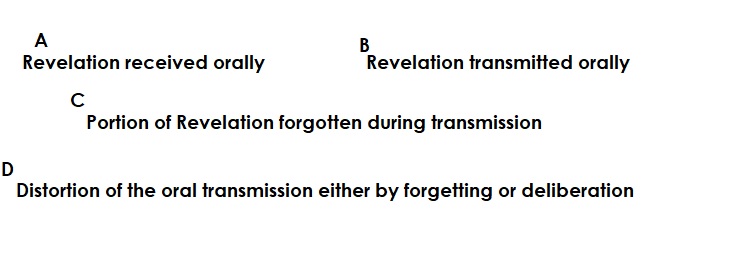
So what we can see from the Qur’an 2:75 is that they received revelation and knowingly distorted it during the oral transmission process. We can also see from the Qur’an 5:13 that many of them forgot (wanasu) through the oral transmission process.
We see this same charge directed pointedly towards the Christians.
“And with those who say ‘We are Christians’ We took a covenant; and they have forgotten (fanasū) a portion(ḥaẓẓan) of that they were reminded of. So We have stirred up among them enmity and hatred, till the Day of Resurrection; and Allah will assuredly tell them of the things they wrought.” (Qur’an 5:14)
You can see that the Christians forgot (fanasu) similar to the Jews (wanasu) through the oral transmission process. In fact, it says immediately after, “So we have stirred up among them enmity and hatred.” — The Christians, due to these errors in their transmission process, became a point of strife among them.
For example:
“See to it that no one takes you captive through hollow and deceptive philosophy, which depends on human tradition and the cosmic spirits of this world rather than on Christ.” (Colossians 2:8)
So, in what has passed, there is nothing in those texts that would even remotely suggest to Muslims that the Jews or Christians possess sacred scripture that would not have been free from this. Every text (including the Qur’an) starts as an oral transmission.
ORAL TRANSMISSION IN THE NEW TESTAMENT.
“Many have undertaken to draw up an account of the things that have been fulfilled[a] among us, just as they were handed down to us by those who from the first were eyewitnesses and servants of the word. With this in mind, since I myself have carefully investigated everything from the beginning, I too decided to write an orderly account for you, most excellent Theophilus, so that you may know the certainty of the things you have been taught. (Luke 1:1-4)
There are a few things to unpack here.
- This writer (whom tradition says is Luke) does not claim to be an eyewitness to said events that he is about to write about.
- His book was based upon oral transmission that was given to him from those who were eyewitnesses.
- He does not state if he is receiving information directly from the eyewitnesses or how many links there are in the chains of transmission. In Islam, such a person who transmitted oral reports from the Blessed Prophet (saw) would be known as Mudallas.
- This individual, “Luke”, is aware of other written reports, of which he claims his will be ‘orderly’.
- This individual, ‘Luke’, feels that his task in writing his document is to give an orderly account that will let this individual (Theophilus) to have certainty.
- Most striking of all, this person is not making any claim to write under the inspiration or authority of God.
Mudallas
For brief summary please see:
https://www.islamic-awareness.org/hadith/ulum/asb4.html
“Different ways of reporting, e.g. (he narrated to us), (he informed us), (I heard), and (on the authority of) are used by the reporters of hadith. The first three indicate that the reporter personally heard from his shaikh , whereas the fourth mode can denote either hearing in person or through another reporter.”
Keep in mind that the type of attack against Islam on whether the Qur’an affirms the scriptures of Judaism or any number of competing Christian canons is an attack born of the Protestant tradition.Catholics and Orthodox Christians did not develop this line of attack. Nor do they employ them unless they are among the useful ‘idiots’.
Do note the position of the Roman Catholic Church.
“It is not from sacred Scripture alone that the Church draws her certainty about everything which has been revealed. Therefore both sacred Tradition and sacred Scripture are to be accepted and venerated with the same sense of devotion and reverence” (Dei Verbum 9)
Orthodox Christians hold a similar perspective.
http://theorthodoxfaith.com/article/tradition-in-the-scriptures/
In fact, in the link above note what is said:
“The first objection creates more questions than it answers. However, nowhere in scripture does Jesus command that all or part of what He said should be written down. Jesus Himself never wrote anything down, except in the sand.”
“Nor do the Scriptures make clear what was transmitted orally, so we have no way to know if some or anything of what was said was ever written down. John, at the end of his Gospel, makes the statement the world could not contain all the books that could be written about Jesus (John 21:25). Surely, there is much that was passed down orally that was never written down. Our Bible is simply too small to contain it all!”
except in the sand
“This they said to test him, that they might have some charge to bring against him. Jesus bent down and wrote with his finger on the ground. And as they continued to ask him, he stood up and said to them, “Let him who is without sin among you be the first to throw a stone at her.” And once more he bent down and wrote on the ground.” (John 8:6-8)
What is striking and fascinating to Muslims is that the one place where Christ Jesus is said to have written anything is in a text that Christians now dispute as being an interpolation!
Your Bible likely has brackets around this story with a note that says something like “The earliest manuscripts do not include 7:53-8:11.” The majority of scholars believe a later Christian scribe inserted the passage into John’s Gospel at John 8:1-8:11
This is also interesting considering the following text:
“Heaven and earth will pass away, but my words will never pass away.” (Matthew 24:35)
So Christians have had to come up with alterative ways of understanding the above text beyond the obvious and apparent meaning.
Also, keep in mind that, according to Christians, Jesus, who is supposed to be God in the Human Flesh, was walking around on Earth for 30 years and the New Testament has very little to say about it at all.
“Now Jesus himself was about thirty years old when he began his ministry. He was the son, so it was thought, of Joseph, the son of Heli.” (Luke 3:23)
So can you imagine that the Holy Spirit (God the Third of Three) is inspiring someone to write like this? That Jesus was ‘about’. That he was the son ‘so it was thought’.
What percent of 33 is 30? The answer: 90.91. So the New Testament leaves out approximately 91% of the life of Christ Jesus!
The New Testament holds oral traditions both in a positive light and not in a positive light. It seems to distinguish between those traditions given by men and those approved of by God.
“In the name of the Lord Jesus Christ, we command you, brothers and sisters, to keep away from every believer who is idle and disruptive and does not live according to the traditions you received from us.” (2 Thessalonians 3:6)
So, here a command is given to this particular audience to actually ostracize and keep away from those people who do not hold fast to the traditions.
“Concerning the coming of our Lord Jesus Christ and our being gathered to him, we ask you, brothers and sisters, not to become easily unsettled or alarmed by the teaching allegedly from us—whether by a prophecy or by word of mouth or by letter—asserting that the day of the Lord has already come.” (2 Thessalonians 2:1-2)
So, here the early community is being warned to be careful of letters falsely penned in Paul’s name or oral transmissions that claim to come from authority but are not.
“So then, brothers and sisters, stand firm and hold fast to the traditions we passed on to you, either by our spoken word of mouth or by letter.” (2 Thessalonians 2:15)
“And we also thank God continually because, when you received the word of God, which you heard from us, you accepted it not as a human word, but as it actually is, the word of God, which is indeed at work in you who believe.” (1 Thessalonians 2:13)
“I praise you for remembering me in everything and for holding to the traditions just as I passed them on to you.” (1 Corinthians 11:2)
“And the things you have heard me say in the presence of many witnesses entrust to reliable people who will also be qualified to teach others.” (2 Timothy 2:2)
“That what was spoken by the prophets might be fulfilled, ‘He shall be called a Nazarene.’” (Matthew 2:23)
There is no such prophecy written any where in the TNCH (what Christians call the Old Testament). Christians have tried and failed to deal with this. The most successful response is what the text says, spoken. In other words this came from an oral tradition.
There are examples where the oral tradition is not held in high esteem.
“They are not to ‘honor their father or mother’ with it. Thus you nullify the word of God for the sake of your tradition.” (Matthew 15:6)
“You have let go of the commands of God and are holding on to human traditions.” And he continued, “You have a fine way of setting aside the commands of God in order to observe your own traditions!” (Mark 7:8-9)
“Their worship is a farce, for they teach man-made ideas as commands from God.”
(Mathew 15:9)
So, for example, in the Qur’an we are told concerning the Christian tradition of celibacy and becoming Monks and Nuns.
“Then in the footsteps of these, We sent Our messengers, and We sent Jesus, son of Mary, and granted him the Gospel, and instilled compassion and mercy into the hearts of his followers. As for monasticism, they made it up—We never ordained it for them—only seeking to please Allah, yet they did not observe it strictly. So We rewarded those of them who were faithful. But most of them are rebellious.” (Qur’an 57:27)
- This teaching is self-destructive, because if the whole of Christianity was to embrace it, it is quite conceivable that their numbers would diminish.
- We can see the destructive cost of having low populations in places like Japan and the alarm bells are ringing in many countries to encourage their people to populate.
- This goes against an earlier teaching that they claim is from God, namely: “God blessed them and said to them, “Be fruitful and increase in number; fill the earth and subdue it.” (Genesis 1:28)
- Allah says, ‘yet they did not observe it strictly’ and we know this because when suppressing one’s natural sexual urges they end up violating small children, being involved in homosexual relationships etc.
So, when we hear that this is a teaching attributed to Jesus (as) we categorically reject it.
“For there are eunuchs who have been so from birth, and there are eunuchs who have been made eunuchs by men, and there are eunuchs who have made themselves eunuchs for the sake of the kingdom of heaven. Let the one who is able to receive this receive it.” (Matthew 19:12)
“Are you pledged to a woman? Do not seek to be released. Are you free from such a commitment? Do not look for a wife. But if you do marry, you have not sinned; and if a virgin marries, she has not sinned. But those who marry will face many troubles in this life, and I want to spare you this. What I mean, brothers and sisters, is that the time is short. From now on those who have wives should live as if they do not” (1 Corinthians 7:27-29)
“These are they which were not defiled with women; for they are virgins. These are they which follow the Lamb whithersoever he goes. These were redeemed from among men, being the first-fruits unto God and to the Lamb” (Revelations 14:4)
You see how the above verse makes women and sexuality something of the flesh, dirty and vile. Most unfortunate.
How did this tampering of the oral tradition start?
This is a rather straightforward in that tradition itself asserts that John the Baptist (Yahya) and Christ Jesus (Isa ibn Maryam) were killed.
Thus, those that, from the perspective of Muslims (The Prophets themselves) that could exercise authority over the process of what is /is not the Injeel were eliminated.
So, relying upon the oral tradition of which the Qur’an mentioned, there was faulty memory involved. This cannot be a ground upon which one places certainty and /or eternal security.
So, relying upon oral tradition, the Gospels, according to Mark and Luke, say some very embarrassing things about why women went to the tomb of Jesus (as).
“When the Sabbath was over, Mary Magdalene, Mary the mother of James, and Salome bought spices so that they might go to anoint Jesus’ body.” (Mark 16:1)
“On the first day of the week, very early in the morning, the women took the spices they had prepared and went to the tomb.” (Luke 24:1)
Why do Jewish women bring spices to anoint a dead body? This is absolute nonsense.
- In Islam and in Judaism, men wash the bodies of men (even your own wife does not wash your body) and women wash the bodies of women (even your own husband does not wash your body).
- That being said, the idea that women would be coming to anoint the dead body of Jesus (as) is ludicrous.
- Bodies are not anointed or bound AFTER they have been buried or entombed! Bodies are anointed with spice BEFORE they are buried, in order to mask the smell during display.
- Can you think of any example in history when a body was anointed with spice or fragrance after burial or entombment?
This is total and utter nonsense.
The TNCH itself gives an example of this:
“They buried him in the tomb that he had cut out for himself in the City of David. They laid him on a bier covered with spices and various blended perfumes, and they made a huge fire in his honor.” (2 Chronicles 16:14)
“And with those who say ‘We are Christians’ We took a covenant; and they have forgotten (fanasū) a portion(ḥaẓẓan) of that they were reminded of. So We have stirred up among them enmity and hatred, till the Day of Resurrection; and Allah will assuredly tell them of the things they wrought.” (Qur’an 5:14)
“And do not be like those who forgot Allah, so He made them forget themselves. It is they who are rebellious.” (Qur’an 59:19)
This word, fanasu -forgotten, comes to us by two meanings:
- A type of forgetfulness—like when Adam ate from the tree.
- An intentional neglect where you want to avoid something so you pretend to forget.
- Those who forgot Allah. They forgot who he really is, did not appraise him with a proper appraisal, so Allah made them forget the straight path.
The Qur’an tells us that the Christians, because of his second type of fanasu in relating the revelation, it became a point of strife and hatred among them.
How many actual words attributed to Jesus are even in the New Testament?
Next you have to take into account, that according to the document of the New Testament (27 book canon and not the 22 book New Testament or the 35 book New Testament that rival Christians hold as canon; that the actual number of words attributed to Christ Jesus are (once you exclude the duplication of Jesus’s speeches in the four accepted gospels), the total number of words spoken by Jesus is 31,426.
Source: (https://synopticgospel.com/blog/how-many-words-of-jesus-christ-are-red/)
Then, if you enter this number into Convert Words to Minutes – Speech Calculator (Free), you find that it would take 242 minutes, or about 4 hours, to read all of Jesus’ words aloud.
So we have about 4 hours of reading the words attributed to Jesus.
In the 27 New Testament book canon accepted by Latin Roman Catholics, the Eastern Orthodox and most Protestants, the following words are attributed to Jesus outside the Four Gospels.
Acts
1:4 And, being assembled together with them, commanded them that they should not depart from Jerusalem, but wait for the promise of the Father, which, saith he, ye have heard of me. 1:5 For John truly baptized with water; but ye shall be baptized with the Holy Ghost not many days hence. 1:6 When they therefore were come together, they asked of him, saying, Lord, wilt thou at this time restore again the kingdom to Israel?1:7 And he said unto them, It is not for you to know the times or the seasons, which the Father hath put in his own power.1:8 But ye shall receive power, after that the Holy Ghost is come upon you: and ye shall be witnesses unto me both in Jerusalem, and in all Judaea, and in Samaria, and unto the uttermost part of the earth.
9:4 And he fell to the earth, and heard a voice saying unto him, Saul, Saul, why persecutest thou me? 9:5 And he said, Who art thou, Lord? And the Lord said, I am Jesus whom thou persecutest: it is hard for thee to kick against the pricks.9:6 And he trembling and astonished said, Lord, what wilt thou have me to do? And the Lord said unto him, Arise, and go into the city, and it shall be told thee what thou must do. 9:7 And the men which journeyed with him stood speechless, hearing a voice, but seeing no man. 9:8 And Saul arose from the earth; and when his eyes were opened, he saw no man: but they led him by the hand, and brought him into Damascus. 9:9 And he was three days without sight, and neither did eat nor drink. 9:10 And there was a certain disciple at Damascus, named Ananias; and to him said the Lord in a vision, Ananias. And he said, Behold, I am here, Lord. 9:11 And the Lord said unto him, Arise, and go into the street which is called Straight, and inquire in the house of Judas for one called Saul, of Tarsus: for, behold, he prayeth, 9:12 And hath seen in a vision a man named Ananias coming in, and putting his hand on him, that he might receive his sight. 9:13 Then Ananias answered, Lord, I have heard by many of this man, how much evil he hath done to thy saints at Jerusalem: 9:14 And here he hath authority from the chief priests to bind all that call on thy name. 9:15 But the Lord said unto him, Go thy way: for he is a chosen vessel unto me, to bear my name before the Gentiles, and kings, and the children of Israel: 9:16 For I will shew him how great things he must suffer for my name’s sake.
11:16 Then remembered I the word of the Lord, how that he said, John indeed baptized with water; but ye shall be baptized with the Holy Ghost.
18:9 Then spake the Lord to Paul in the night by a vision, Be not afraid, but speak, and hold not thy peace: 18:10 For I am with thee, and no man shall set on thee to hurt thee: for I have much people in this city.
20:35 I have shewed you all things, how that so labouring ye ought to support the weak, and to remember the words of the Lord Jesus, how he said, It is more blessed to give than to receive.
22:7 And I fell unto the ground, and heard a voice saying unto me, Saul, Saul, why persecutest thou me? 22:8 And I answered, Who art thou, Lord? And he said unto me, I am Jesus of Nazareth, whom thou persecutest. 22:9 And they that were with me saw indeed the light, and were afraid; but they heard not the voice of him that spake to me. 22:10 And I said, What shall I do, Lord? And the Lord said unto me, Arise, and go into Damascus; and there it shall be told thee of all things which are appointed for thee to do.
22:18 And saw him saying unto me, Make haste, and get thee quickly out of Jerusalem: for they will not receive thy testimony concerning me. 22:19 And I said, Lord, they know that I imprisoned and beat in every synagogue them that believed on thee: 22:20 And when the blood of thy martyr Stephen was shed, I also was standing by, and consenting unto his death, and kept the raiment of them that slew him.22:21 And he said unto me, Depart: for I will send thee far hence unto the Gentiles.
23:11 And the night following the Lord stood by him, and said, Be of good cheer, Paul: for as thou hast testified of me in Jerusalem, so must thou bear witness also at Rome.
26:14 And when we were all fallen to the earth, I heard a voice speaking unto me, and saying in the Hebrew tongue, Saul, Saul, why persecutest thou me? it is hard for thee to kick against the pricks. 26:15 And I said, Who art thou, Lord? And he said, I am Jesus whom thou persecutest. 26:16 But rise, and stand upon thy feet: for I have appeared unto thee for this purpose, to make thee a minister and a witness both of these things which thou hast seen, and of those things in the which I will appear unto thee; 26:17 Delivering thee from the people, and from the Gentiles, unto whom now I send thee, 26:18 To open their eyes, and to turn them from darkness to light, and from the power of Satan unto God, that they may receive forgiveness of sins, and inheritance among them which are sanctified by faith that is in me.
1 Corinthians
11:24 And when he had given thanks, he brake it, and said, Take, eat: this is my body, which is broken for you: this do in remembrance of me. 11:25 After the same manner also he took the cup, when he had supped, saying, This cup is the new testament in my blood: this do ye, as oft as ye drink it, in remembrance of me.
2 Corinthians
12:9 And he said unto me, My grace is sufficient for thee: for my strength is made perfect in weakness. Most gladly therefore will I rather glory in my infirmities, that the power of Christ may rest upon me.
Romans (no words of Jesus)
Galatians (no words of Jesus)
Colossians (no words of Jesus)
1 Timothy (no words of Jesus)
2 Timothy (no words of Jesus)
Ephesians (no words of Jesus)
Philippians (no words of Jesus)
1 Thessalonians (no words of Jesus)
2 Thessalonians (no words of Jesus)
Hebrews (no words of Jesus)
James (no words of Jesus)
Titus (no words of Jesus)
Philemon (no words of Jesus)
1 John (no words of Jesus)
2 John (no words of Jesus)
3 John (no words of Jesus)
Jude (no words of Jesus)
1 Peter (no words of Jesus)
2 Peter (no words of Jesus)
Revelation
If we are to grant a 27 NT Canon as opposed to the 22 or 35 book New Testaments that were in dispute among Christians in the time of the Blessed Prophet (saw). 19/27 have absolutely no words of Jesus in them at all! 1 Cor 11:24 & 2 Cor 12:9 The rest of these two letters nothing.
This means only the Four traditional Gospels, the Apocalypse of John, and the Book of Acts are the only NT books that have words attributed to Jesus in them! (other than the 2 Corinthians citations) Most Christians do not stop to think about this.
So Muslims have very little to work with in terms of what is actually attributed to Christ Jesus. This becomes compounded by the fact that what we have to work with presents us with a plethora of contradictions and errors. The corruption of the revelation that took place during the oral tradition becomes evident.
“Then do they not reflect upon the Qur’an? If it had been from [any] other than Allah , they would have found within it much contradiction.” (Qur’an 4:82)
So how do we know what is from Allah or not? Is to apply for this test. A test that Christians often wish to quickly escape from or divert the topic away from.
We are personally not bothered by the issue of preservation. In the sense that if Christians want to imagine that their text has been preserved intact, we will offer little push back against such a claim.
Christian Circular Reasoning. Where is authority derived from?
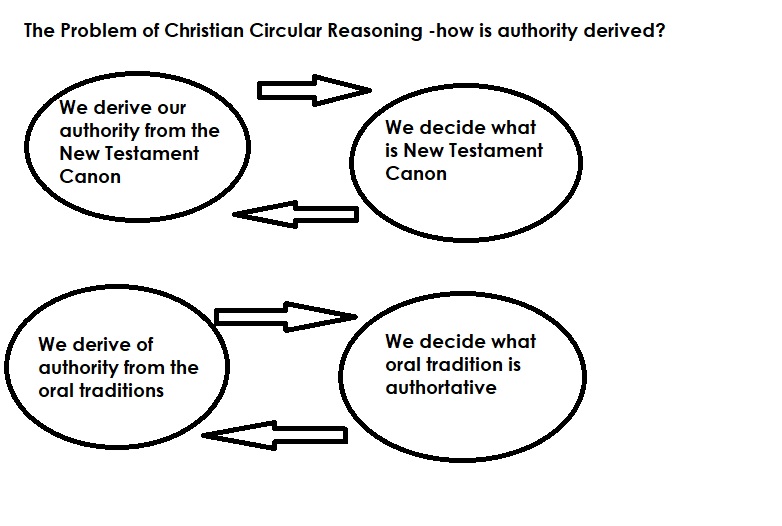
Our first contention is that a certain text is actually a revelation to begin with.
“And how from infancy you have known the Holy Scriptures, which are able to make you wise for salvation through faith in Christ Jesus. All Scripture God-breathed and is useful for teaching, rebuking, correcting and training in righteousness, so that the servant of God may be thoroughly equipped for every good work.” (2 Timothy 3:15-17)
Most translations are dishonest and will say something like the following:
“All Scripture is God-breathed.” However, this is not in the Greek text at all.
https://biblehub.com/text/2_timothy/3-16.htm Not only that, but the word γραφὴ graphe simply means writing, and not necessarily divine writing.
Lastly, how from infancy you have known the Holy Scriptures or the ἱερὰ -heira γράμματα grammata, could only be a reference to the TNCH. Because there were no New Testament writings when Timothy was an infant.
None of that substantiates the New Testament as authoritatively from God. Not only this, but one of the documents called ‘Hebrews’ the authorship is in dispute, (among Christians themselves!)
Of the 27 books of the New Testament (according to the West), not the 22 books of the New Testament (according to Churches in the East) nor the 35 books of the New Testament (according to the Oriental Orthodox Ethiopian Church), Paul wrote 13/14 of them.
So, according to the 27-book New Testament canon, Paul wrote 48% of the New Testament. According to the 22 book New Testament canon, Paul wrote 59% of the New Testament.
Paul’s Unconfirmed “Conversion”.
Question: Did Paul convert to the teachings of Jesus?
Answer: No!
The only testimony we have that Paul is a ‘disciple’ of Jesus is Paul’s own contradictory accounts in Acts chapters 9, 22 and 26.
Acts 9:7 says:
“The men which journeyed with him stood speechless, hearing a voice, but seeing no man.”
Acts 22:9 says:
“And they that were with me saw indeed the light, and were afraid; but they heard not the voice of him that spoke to me.”
Acts 26:14 says:
“And when we were all fallen to the earth, I heard a voice speaking unto me, and saying in the Hebrew tongue, Saul Saul why persecute me? It is hard for you to kick against the pricks.”
Prima Qur’an Comment: All these instances in which Paul speaks about Jesus speaking to him for the first time are obviously flat lies.
Not only that but in Acts 22:9 it says the same people traveling with him “saw indeed the light“.
This is very strange because Paul also says in Acts 26:23
“At midday, O King, I saw in the way a light from heaven, Above the brightness of the sun, shining around me and Them which journeyed WITH me.”
Besides the above contradictions, Paul said this light was brighter than the sun and that those with him “saw indeed the light“ yet read the following:
“And Saul arose from the earth; and when his eyes were opened he saw no man, but they led him by the hand, and brought him into Damascus. And he was three days without sight, and neither did eat nor drink.” (Acts 9:8-9)
Prima Qur’an Comment: Now this light was “brighter than the sun,” yet his companions were fine! Paul’s whole “conversion” story is a fabrication.
Establishing testimony for yourself according to Christ Jesus.
“But if he will not hear thee, then take with thee one or two more that in the mouth of two or three witness every word may be established.” (Matthew 18:16)
Prima Qur’an Comment: According to the criteria set by Christ Jesus, Paul’s testimony of conversion is blatantly false. The only record we have of Paul’s so-called conversion is from the writer Luke. There is no testimonial of the men who traveled with Paul.
The above contradictory accounts of Paul’s conversion in Acts chapters 9,22 and 26 render his account baseless!
Two important points about Paul.
1) Paul never met the historical Jesus.
2) Paul only claimed to have met Jesus in a vision of light.
Paul’s ‘vision of light’ was none other than Satan?
“For such are false apostles, deceitful workers, transforming themselves into the apostles of Christ And little wonder; for Satan himself is transformed into an angel of light” (2 Corinthians 11:13-14)
Ponder these text:
I must go on boasting. Although there is nothing to be gained, I will go on to visions and revelations from the Lord. I know a man in Christ who fourteen years ago was caught up to the third heaven. Whether it was in the body or out of the body I do not know—God knows. And I know that this man—whether in the body or apart from the body I do not know, but God knows—was caught up to paradise and heard inexpressible things, things that no one is permitted to tell. “I will boast about a man like that, but I will not boast about myself, except about my weaknesses. Even if I should choose to boast, I would not be a fool, because I would be speaking the truth. But I refrain, so no one will think more of me than is warranted by what I do or say or because of these surpassingly great revelations. Therefore, in order to keep me from becoming conceited, I was given a thorn in my flesh, a messenger of Satan, to torment me Three times I pleaded with the Lord to take it away from me. But he said to me, “My grace is sufficient for you, for my power is made perfect in weakness.” Therefore I will boast all the more gladly about my weaknesses, so that Christ’s power may rest on me. (2 Corinthians 12:1-9)
“For I received from the Lord what I also passed on to you.” (1 Corinthians 11:23)
“ I want you to know, brothers and sisters, that the gospel I preached is not of human origin. I did not receive it from any man, nor was I taught it; rather, I received it by revelation from Jesus Christ.” (Galatians 1:1-12)
So here Paul has bypassed the disciples and the eyewitnesses. He is claiming direct revelation from Jesus!
Muslims have good grounds to question these assertions of Paul.
My second contention is that what they have that is claimed to be preserved is filled with the errors and contradictions that obviously came from the oral tradition that was relied upon.
The Four Canonical Gospels are works of literary fiction
They are derived from disparate oral traditions, embellishments and outright errors.
Allah (swt) has opened the eyes of some Christians to this. Of recent memory was a Christian who debated many Muslims and skeptics and defended the Christian faith tradition. I am speaking of none other than Mike Licona.
“At that moment the curtain of the temple was torn in two from top to bottom. The earth shook, the rocks split and the tombs broke open. The bodies of many holy people who had died were raised to life. They came out of the tombs after Jesus’ resurrection and went into the holy city and appeared to many people. When the centurion and those with him who were guarding Jesus saw the earthquake and all that had happened, they were terrified, and exclaimed, “Surely he was the Son of God!” (Matthew 27:51-54)
The fact that no one else (outside the New Testament) records this has certainly raised eyebrows. Because Dr. Licona was honest and wrote that he thought that this was basically fiction. His fellow Christians hammered him for it!
Source: (https://normangeisler.com/mike-licona-on-inerrancy-its-worse-than-we-originally-thought/)
What were the last words of Christ Jesus?
“Jesus called out with a loud voice, “Father, into your hands I commit my spirit.” When he had said this, he breathed his last.” (Luke 23:46)
“When Jesus had received the sour wine, he said, “It is finished,” and he bowed his head and gave up his spirit.” (John 19:30)
We cannot know the so-called dying words of Jesus or, in light of these contradictions, that there were any at all.
Who was the father of Joseph, husband of Mary?
“And Jacob begat Joseph the husband of Mary, of whom was born Jesus, who is called Christ.” (Matthew 1:16)
“Now Jesus himself was about thirty years old when he began his ministry. He was the son, so it was thought, of Joseph, the son of Heli.” (Luke 3:23)
Jesus descended from which son of David?
“And Jesse the father of King David. David was the father of Solomon, whose mother had been Uriah’s wife, (Matthew 1:6)
“The son of Melea, the son of Menna, the son of Mattatha, the son of Nathan, the son of David.” (Luke 3:31)
“When the evening came, they brought unto him MANY that were possessed with devils: and he cast out the spirits with his word, and healed ALL that were sick.” (Matthew 8:16)
“And at evening, when the sun did set, they brought unto him ALL that were diseased and them that were possessed with devils. And ALL the city was gathered together at the door. And he healed MANY that were sick of diverse diseases, and cast out MANY devils; and suffered not the devils to speak, because they knew him.” (Mark 1:32-34)
Prima Qur’an Comment: The Greek word for many is (pantas) and the Greek word for all is (pollous).
Matthew saw some deficiency in a Jesus that only healed many, so he switched the Greek words around. A Jesus who can heal all is better than a Jesus that can only heal many.
Another example:
“And there came a voice from heaven, saying YOU ARE my beloved Son, in whom I am well pleased.” (Mark 1:11)
“And lo a voice from heaven, saying, THIS IS my beloved Son, in whom I am well pleased.” (Matthew 3:17)
Prima Qur’an Comment: The Greek word for you is su and the Greek word for this is would be (outos). Mark held that Jesus was the adopted son of God, called adoptionist theology. Matthew felt Jesus already knew who he was because he was the son of God based on the Virgin birth and therefore did not need to be told who he was. He changes the wording of the voice, so the people are addressed.
Another example:
“While he spoke these things unto them, behold, there came a certain ruler, and worshipped him, saying, My daughter is EVEN NOW DEAD: but come and lay thy hand upon her, and she shall live.” (Matthew 9:18)
“And sought him greatly, saying, My little daughter LIES AT THE POINT OF DEATH: I pray thee, come and lay hands on her, that she may be healed; and she shall live.” (Mark 5:23)
Prima Qur’an Comment:
The Greek term for the deceased is (teleute). Again, Matthew thought that a Jesus who could save a dead person was going to be more illustrious than a Jesus who merely saved a dying person. So this contradiction is the result of the developing theology surrounding the person of Jesus.
Another example:
“And when he knew it of the Centurion, he gave the body to JOSEPH. And HE brought fine linen, and took him down, and wrapped him in the linen, and laid him in a sepulcher which was hewn out of a rock, and rolled a stone unto the door of the sepulcher.” (Mark 15:45-46)
“And though THEY found no cause of death in him, yet desired THEY Pilate that he should be slain. And when THEY had fulfilled all that was written of him, THEY took him down from the tree, and laid him in a sepulcher.” (Acts 13:28-29)
Prima Qur’an comment: This goes back to the conflict on whether Jesus killed and was impailed on a tree or rather he was nailed to a Patibulum (T tau or + cross-shaped fixture)-while alive. Here it says the same Jews who desired his death put him in the tomb and not Joseph.
Another example:
“And when Jesus was entered into Capernaum, there came unto him A CENTURION, beseeching him,” (Matthew 8:5)
“And a certain centurion’s servant, who was dear unto him, was sick, and ready to die. And when he heard of Jesus, HE SENT UNTO THEM ELDERS OF THE JEWS, beseeching him that he would come and heal his servant.” (Luke 7:2-3)
Prima Qur’an Comment:
The Greek phrase for older men is (presbuteros). The Greek word for centurion is (hekatontarchos) The reason this exists has more to do with oral tradition than ideas either of the writers had.
“In the prophet Isaiah it stands written: “Here is my herald whom I send on ahead of you, and he will prepare your way. A voice crying aloud in the wilderness, ‘ Prepare a way for the Lord; clear a straight path for him.'” (Mark. 1:2·3)
This quote is not directly the text of Isaiah, for he is clearly unaware that half his quotation, supposedly from lsaiah 40:3, is not from Isaiah at all, but is a misquotation of Malachi 3:1, which actually reads, “I am sending my messenger who will clear a path before me.”
These mistakes are typical for drawling from oral traditions.
On and on and on this goes. It is very clear that what Allah (swt) said about oral transmission being the cause of distortion is factual and indisputable.
If you are interested in reading more, we would recommend:
https://primaquran.com/2024/04/16/is-the-bible-the-unadulterated-word-of-god/
https://primaquran.com/2024/04/15/does-the-quran-teach-that-the-bible-was-corrupted/
May Allah Guide the Christians to the truth so that they do not burn in hellfire.


 Prima Quran