
“Your only friends (waliy) are Allah, His Messenger, and fellow believers—who establish prayer and pay alms-tax with humility.” (Qur’an 5:55)

﷽
While many in our Ummah talk about the importance of ʿaqīdah (correct belief), one of the most important—and neglected—topics is the one we are about to address, in shā’ Allāh.
It is the lack of proper understanding and application of these principles that has left the Muslim Ummah, as well as many Muslim communities and individuals, in ruin.
Encouraging and inviting others to good is the hallmark of true believers in any sincere faith, while obstinate rebellion and persistence in it portend a ruinous end.
“You are the best community ever raised for humanity—you encourage good, forbid evil, and believe in Allah. Had the People of the Book believed, it would have been better for them. Some of them are faithful, but most are rebellious.” (Qur’an 3:110)
In many instances, we have become people who abandon the call to encourage good out of fear of ridicule and mockery. Yet, one should welcome such trials, for patience in the face of ridicule and mockery is the Sunnah of the Prophets (upon them all be peace).
On the other side of the spectrum are Muslims who mean well but whose approach is often filled with vitriol. Through their lack of manners, they end up pushing people away from the truth. May Allāh guide us.
Perhaps the English-speaking world’s first encounter with these concepts was through Professor Valerie J. Hoffman’s notable translation work, The Essentials of Ibāḍī Islam. I found the section on Walāyah & Barā’ah to be more suited for an advanced audience. Her choice to begin with Al-ʿAqīdah al-Wahbiyyah—by the esteemed scholar and Sufi Shaykh Nāṣir b. Sālim b. ʿUdayyam al-Rawāḥī (raḥimahullāh)—was an interesting one.
However, more than a decade has now passed, and as I am sure Professor Hoffman realized while in Oman, views are shifting. Thus, when one reads The Essentials of Ibāḍī Islam, the impression is that since the book quotes authoritative sources, it must represent current trends—though this is not necessarily the case.
Moreover, many of these teachings are ingrained in children from a young age. In fact, it is wājib (obligatory) upon reaching maturity to learn these matters. Nevertheless, Allāh (subḥānahu wa taʿālā) does not let any good deed be lost. Surely, she has her reward with her Lord.
The objective of this article, then, is to provide an overview of this fundamental teaching, so deeply ingrained in our school of Islam. Everything we do should be for the sake of Allāh (swt).
The Blessed Prophet (saw) said:
“If anyone loves for Allāh’s sake, hates for Allāh’s sake, gives for Allāh’s sake, and withholds for Allāh’s sake, he will have perfected his faith.”
Source: (https://sunnah.com/abudawud:4681)
The English say: “Blood is thicker than water.”
In Islam, we could say: “Faith is thicker than blood.”
Walayah, Bara’ah, and Wuqoof
What Do These Terminologies Mean?
Walayah (Affiliation):
To befriend someone for the sake of Allah—by following the Qur’an and Sunnah. This includes:
- Praying for their entry into Paradise.
- Speaking well of them.
- Taking an interest in their well-being.
- Maintaining contact, assisting them, and upholding friendship.
Proofs for Walayah from the Qur’an:
- “The believers, men and women, are allies (awliyā’) of one another. They enjoin good, forbid evil, establish prayer, give zakāh, and obey Allah and His Messenger. It is they who will receive Allah’s mercy. Surely, Allah is Almighty, All-Wise.” (Qur’an 9:71)
- “Know that there is no deity except Allah, and seek forgiveness for your sins and for the believing men and women.” (Qur’an 47:19)
- “Muḥammed is the Messenger of Allah, and those with him are firm against the disbelievers yet compassionate among themselves.” (Qur’an 48:29)
- “Cooperate in righteousness and piety, but do not cooperate in sin and aggression. And fear Allah; indeed, Allah is severe in punishment.” (Qur’an 5:2)
- “Believers, do not take your fathers and brothers as allies (awliyā’) if they prefer disbelief over faith. Whoever does so is unjust.” (Qur’an 9:23)
- “Ibrāhīm’s plea for his father’s forgiveness was only because of a promise he had made. But when it became clear that his father was an enemy of Allah, he disassociated from him. Indeed, Ibrāhīm was tender-hearted and forbearing.” (Qur’an 9:114)
- “You will not find those who believe in Allah and the Hereafter loving/showing affection to (yuwadduna) those who oppose Allah and His Messenger—even if they are their fathers, sons, brothers, or kin. For such believers, Allah has inscribed faith in their hearts and strengthened them with His spirit. He will admit them into Gardens beneath which rivers flow, where they will abide forever. Allah is pleased with them, and they are pleased with Him. They are the party of Allah, and it is they who will succeed.” (Qur’an 58:22)
Bara’ah (Dissociation):
To disassociate from someone for the sake of Allah—due to their major sins, persistence in minor sins, or ingratitude toward Allah through their actions or negligence. This means:
- Distancing oneself from such a person.
- Being released from the obligations owed to them as a believer (similar to being freed from a debt).
Proofs for Bara’ah from the Qur’an:
- “Whoever allies themselves with them (disbelievers) is indeed one of them.” (Qur’an 5:51)
- This indicates that whoever befriends a disbeliever (mushrik) or hypocrite becomes like them.
- “Do not ally yourselves with a people with whom Allah is angry.” (Qur’an 60:13)
- Major sinners are among those with whom Allah is angry.
- “Let not the believers take disbelievers as allies instead of believers.” (Qur’an 3:28)
- “Those who believed, emigrated, and struggled in Allah’s cause with their wealth and lives—and those who sheltered and aided them—are allies to one another. But as for those who believed yet did not emigrate, you owe them no alliance unless they emigrate. However, if they seek your help in religious matters, you must assist them—except against a people with whom you have a treaty. Allah is All-Seeing of what you do.” (Qur’an 8:72)
- This verse shows that even believers who failed to emigrate were denied full walāyah until they corrected their stance.
- “This is a declaration of disassociation from Allah and His Messenger to the polytheists with whom you had treaties.” (Qur’an 9:1)
General Guidelines for Bara’ah:
Bara’ah applies to individuals whose misdeeds are known, falling into two categories:
- (A) Those who commit major sins (kabā’ir).
- (B) Those who persist in minor sins.
Conditions for Applying Bara’ah:
- Confession: The person admits to their sin.
- Personal Witness: You see them commit major sins or persist in minor sins.
- Testimony of Two Just Witnesses.
Wuqoof (Reservation/Suspension of Judgment):
To pause, evaluate, and refrain from hasty judgment. It means:
- Slowing down.
- Assessing carefully.
- Remaining ambivalent when uncertain.
Evidence for Wuqoof:
- Ḥadīth: Mu‘ādh ibn Jabal reported that the Blessed Prophet (saw) said when sending him to Yemen:
“Do not judge or decide except based on what you know. If you are uncertain about a matter, wait until you understand it fully, or write to me concerning it.” - Source: (https://sunnah.com/ibnmajah:55)
- Although some scholars consider this ḥadīth weak, it is supported by the Qur’an.
- “Do not follow what you have no knowledge of. Indeed, the hearing, sight, and heart—all will be questioned.” (Qur’an 17:36)
Human Affairs Fall into Three Categories:
- Clearly Right: Follow it.
- Clearly Wrong: Avoid it.
- Unclear/Doubtful: Leave it to Allah.
The Three Types of Walayah
- Walayah al-Haqiqah – The real friendship. This is a matter of theology.
- Walayah al-Dhahir – The apparent friendship. This is a matter of jurisprudence.
- Walayah al-Jumlah – The general or common friendship. This is a matter of jurisprudence.
The Three Types of Bara’ah
- Bara’ah al-Haqiqah – The real dissociation. This is a matter of theology.
- Bara’ah al-Dhahir – The apparent dissociation. This is a matter of jurisprudence.
- Bara’ah al-Jumlah – The general or common dissociation. This is a matter of jurisprudence.
Walayah al-Haqiqah – The Real Friendship with Allah
What does it mean to have real walayah with Allah ?
It means Allah (swt) is the ultimate Judge and knows the innermost details of every human being. He knows best who will die upon true faith. The only forms of walayah we as human beings can have with each other are dhahir (apparent) and jumlah (general).
Is There Any Proof from the Qur’an for This?
“Invite to the way of your Lord with wisdom and good instruction, and argue with them in a way that is best. Indeed, your Lord is most knowing of who has strayed from His way, and He is most knowing of who is [rightly] guided.” (Qur’an 16:125)
“The decision is only for Allah, He declares the truth, and He is the Best of judges.” (Qur’an 6:57)
Is there any other proofs?
‘Abdullah bin ‘Utbah bin Mas’ud reported:
I heard ‘Umar bin Al- Khattab (ra) reported saying: “In the lifetime of Messenger of Allah (saw) some people were called to account through Revelation. Now Revelation has discontinued and we shall judge you by your apparent acts. Whoever displays to us good, we shall grant him peace and security, and treat him as a near one. We have nothing to do with his insight. Allah will call him to account for that. But whosoever shows evil to us, we shall not grant him security nor shall we believe him, even if he professed that his intention is good.”
Source: (https://sunnah.com/riyadussalihin:395)
Walayah al-Haqiqah – Those in the Real Friendship with Allah are as follows:
The first and most obvious examples are those preserved from sin or died having all sins forgiven:
- Angels
- Prophets
- Messengers of Allah
1. Eve & Adam (upon them peace), the Mother & Father of Mankind
“They said, ‘Our Lord, we have wronged ourselves, and if You do not forgive us and have mercy upon us, we will surely be among the losers.'” (Qur’an 7:23)
2. Aisha (ra), the Mother of the Believers
“The Prophet is more worthy of the believers than themselves, and his wives are their mothers…” (Qur’an 33:6)
3. The Angels
“O you who have believed, protect yourselves and your families from a Fire whose fuel is people and stones, over which are [appointed] angels, harsh and severe; they do not disobey Allah in what He commands them but do what they are commanded.” (Qur’an 66:6)
4. The Believers Persecuted by the People of the Trench
“Indeed, those who have believed and done righteous deeds will have gardens beneath which rivers flow. That is the great attainment.” (Qur’an 85:11)
5. The People of Jonah
“Then has there not been a [single] city that believed so its faith benefited it except the people of Jonah? When they believed, We removed from them the punishment of disgrace in worldly life and gave them enjoyment for a time.” (Qur’an 10:98)
6. Those Who Repented from Sorcery in the Time of Musa (as)
“But whoever comes to Him as a believer, having done righteous deeds—for them will be the highest ranks: the Gardens of Eternity, beneath which rivers flow, wherein they will abide forever. And that is the reward of one who purifies himself.” (Qur’an 20:75-76)
7. Habib the Carpenter
“Because of this, Allah has forgiven me and placed me among the honored ones.” (Qur’an 36:27)
8. The Unnamed Believer from Pharaoh’s Family
“And a believing man from Pharaoh’s family, who concealed his faith, said, ‘Would you kill a man for saying, “My Lord is Allah,” while he has brought you clear proofs from your Lord? If he is lying, then upon him is [the consequence of] his lie; but if he is truthful, there will strike you some of what he promises you. Indeed, Allah does not guide one who is a transgressor and a liar.'” (Qur’an 40:28)
9. Those Whose Eyes Overflowed with Tears
“And when they hear what has been revealed to the Messenger, you see their eyes overflowing with tears because of what they have recognized of the truth. They say, ‘Our Lord, we have believed, so register us among the witnesses. And why should we not believe in Allah and what has come to us of the truth? And we aspire that our Lord will admit us [to Paradise] with the righteous people.'” (Qur’an 5:83-84)
There are many other examples. What is required of us is to show walayah to those whom Allah (swt) has described in the Qur’an as righteous—those who follow His commands and are among the people of happiness—whether they are mentioned by name, by kunya, or by their attributes.
Barā’ah al-Ḥaqīqah – The Real Dissociation
What does the real barā’ah with Allah (swt) mean?
This means Allah (SWT) is the ultimate Judge and knows the minutiae of every human being. He knows best those who will die as mushrikūn (polytheists) or as ingrates. The only possible barā’ah (dissociation) we, as human beings, can have with one another is ẓāhir (apparent) and jumla (general).
Are There Any Proofs from the Qur’an for This?
“Call unto the way of thy Lord with wisdom and fair exhortation, and reason with them in the better way. Lo! Thy Lord is Best Aware of him who strays from His way, and He is Best Aware of those who go aright.” (Qur’an 16:125)
“The decision is only for Allah, He declares the truth, and He is the Best of judges.” (Qur’an 6:57)
Is there any other proofs?
‘Abdullah bin ‘Utbah bin Mas’ud reported:
I heard ‘Umar bin Al- Khattab (ra) reported saying: “In the lifetime of Messenger of Allah (saw) some people were called to account through Revelation. Now Revelation has discontinued and we shall judge you by your apparent acts. Whoever displays to us good, we shall grant him peace and security, and treat him as a near one. We have nothing to do with his insight. Allah will call him to account for that. But whosoever shows evil to us, we shall not grant him security nor shall we believe him, even if he professed that his intention is good.”
Source: (https://sunnah.com/riyadussalihin:395)
– The Real Dissociation: Those Truly Cut Off from Allah (swt).
1. Iblis, The Open Enemy of Mankind.
“Satan is indeed a sword enemy to humankind.” (Qur’an 17:53)
2. Hāmān, The Supporter of Pharaoh:
“So We seized him and his hosts, and cast them into the sea, while he was blameworthy.” (Qur’an 51:40)
3. Qārūn (Korah):
“So We caused the earth to swallow him and his dwelling-place. Then he had no host to help him against Allah, nor was he of those who can save themselves.” (Qur’an 28:81)
4. Pharaoh:
“Go you to Pharaoh, for he has indeed transgressed all bounds.” (Qur’an 20:24)
5. Al-Namrūd (Nimrod):
“Have you not considered the one who argued with Abraham about his Lord [merely] because Allah had given him kingship? When Abraham said, ‘My Lord is the One who gives life and causes death,’ he said, ‘I give life and cause death.’ Abraham said, ‘Indeed, Allah brings up the sun from the east, so bring it up from the west.’ So the disbeliever was overwhelmed [by astonishment], and Allah does not guide the wrongdoing people.“ (Qur’an 2:258)
6. The wives of Noah and Lot:
“Allah presents an example of those who disbelieved: the wife of Noah and the wife of Lot. They were under two of Our righteous servants but betrayed them, so they did not avail them from Allah at all, and it was said, ‘Enter the Fire with those who enter.'” (Qur’an 66:10)
Even if any of these individuals appeared to do good in the eyes of people, Allah (swt) knew their ultimate fate. Thus, this is barā’ah ḥaqīqah (the true dissociation).
The example of Abu Lahab Flawed Argument Regarding Abu Lahab
Some Muslims use a flawed argument about Abu Lahab to prove the truth of the Qur’an, saying: “If Abu Lahab had taken the shahādah, it would have made the Qur’an false.”
This is incorrect. The words of Allah (swt) are absolute truth, whereas Abu Lahab’s actions (if he had ever claimed faith) would have been deception. Allah (swt) has already decreed his fate. He is the very definition of one being in barā’ah ḥaqīqah (the true dissociation), being truly cut off.
The inverse is also true: If Allah (swt) states in the Qur’an that someone will enter Paradise, and that person commits sins, it is because Allah knows they will sincerely repent. Thus, their ending is good.
The established principle regarding spiritual guardianship (wilayah) is that one who possesses true guardianship never loses it regardless of sins committed – we are certain they will die repentant. Thus, we reject their wrong actions while maintaining connection to their essential spiritual station.
This is why Imam Abu Sa’id al-Kudmi (May Allah have mercy on him) said: ‘We accept no falsehood from the blessed, nor reject any truth from the wretched.’
The examples of Adam (as) and Ayesha (ra)
The case of Adam (as).
We believe in the true spiritual guardianship (Walayah al-Haqiqah) of our father Adam (as), while Allah explicitly states in Scripture that he disobeyed and erred, then sought forgiveness and repented. We affirm his true guardianship while disassociating from his wrong action – his expulsion from Paradise being the consequence of his sin, constituting a divine punishment.
“And Adam and his wife ate of it, and their private parts became apparent to them, and they began to fasten over themselves from the leaves of Paradise. And Adam disobeyed his Lord and erred.” (Qur’an 20:121)
The case of the mother of the believers (Ayesha).
Ayesha (ra) fought against Ali. Ali is regarded as the Imam of the Muslims. This is true for the Imami Shi’i, Zaydi, Ibadi and most of Sunni Islam. Only a small (and rising faction) among them bring it into question.
“And if two groups from among the believers fight, effect reconciliation between them, but if one of them wrongfully oppresses the other then fight against the one which has wrongfully oppressed, till it returns to Allah’s command, then if it returns effect reconciliation between them with justice and act equitably, Allah certainly likes those who are equitable.” (Qur’an 49:9)
The amr of Allah belonged with Ali. Ayesha (ra) opposed him and later repented. We also know this because she (Ayesha) -may Allah be pleased with her is in the real spiritual guardianship (wilayat al-haqiqah).
Narrated Abu Maryam `Abdullah bin Ziyad Al-Aasadi:
“When Talha, AzZubair and `Aisha moved to Basra, `Ali sent `Ammar bin Yasir and Hasan bin `Ali who came to us at Kufa and ascended the pulpit. Al-Hasan bin `Ali was at the top of the pulpit and `Ammar was below Al-Hasan. We all gathered before him. I heard `Ammar saying, “`Aisha has moved to Al-Busra. By Allah! She is the wife of your Prophet in this world and in the Hereafter. But Allah has put you to test whether you obey Him (Allah) or her (`Aisha).”
Source: (https://sunnah.com/bukhari:7100)
So even though Aisha (ra) is acknowledged by Ammar bin Yasir (ra) to be the ‘wife of the Prophet in this world and in the Hereafter‘ he was not about to leave the commands of Allah (swt).
Whoever violates these divine limits must face the prescribed punishment, even if they possess true spiritual guardianship (wilayat al-haqiqah).
“The Prophet is more worthy of the believers than themselves, and his wives are their mothers…” (Qur’an 33:6)
This is a death blow to Shi’i aqidah. Because the guardianship of Allah (swt) does not change, and, likewise, Allah’s enmity does not change. That is because He is the All-Knowing, nothing is hidden from Him. Therefore, whoever is a friend of Allah is His Friend. Even if sins and grave offenses appear from the person, that person will not die except after repenting from them. And whoever is an enemy of Allah is his enemy, even if piety and acts of righteousness appear from them, that one will certainly die persisting in sinning against Allah the Almighty.
Thus, since Allah (swt) called Aisha (ra) the mother of the believers, she cannot, as Shi’i claim, be a person of the hellfire. This would indicate a change in guardianship and thus a change within Allah (swt).
The Believers’ Stance Toward Those in Barā’ah Ḥaqīqah
The believers must dissociate from those whom Allah (swt) has mentioned in the Qur’an as sinners or those promised punishment—whether they are mentioned by name, kunya, or attribute (e.g., Iblīs, Abu Lahab, his wife, etc.).
A Point of Reflection: Islam’s Theological Consistency Over Christianity in This Matter
Christians believe they are saved from Hellfire simply by uttering a confessional statement, being baptized, performing miracles, or doing meritorious acts. Yet, Christians from every denomination have seen members of their own churches abandon faith, convert to other religions, or reject Allah altogether.
This proves their salvation is ẓāhir (apparent), not al-ḥaqīqah (the true reality). True salvation is known only to Allah (swt).
Walayah al-Dhahir – The Apparent Friendship
These are the six basic rights that a Muslim owes to another Muslim.
Abu Hurairah reported Allah’s Messenger (saw) as saying:
“Six are the rights of a Muslim over another Muslim.”
It was said to him: “O Allah’s Messenger, what are these?”
He replied:
- When you meet him, greet him.
- When he invites you, accept his invitation.
- When he seeks your counsel, advise him.
- When he sneezes and says, ‘Alhamdulillah,’ respond with ‘Yarhamuk Allah’ (May Allah have mercy on you).
- When he falls ill, visit him.
- When he dies, accompany his funeral.
Source: (Sahih Muslim 2162b)
There are, of course, other obligations Muslims have toward one another.
It was narrated that ‘Abdullah bin ‘Amr said:
“I heard the Messenger of Allah (saw) say: ‘The Muslim is the one from whose tongue and hand the Muslims are safe, and the Muhajir is the one who forsakes (Hajara) what Allah has forbidden.’”
Source: (Sunan an-Nasa’i 4996)
Walayah al-Dhahir
This means to show walayah (loyalty/friendship) to anyone you see following the commandments of Allah—whether from the Qur’an or Sunnah—regardless of whether:
- You have personally observed their piety, or
- They are widely known for their piety.
(This applies only if there is no contradiction in their reputation. For example, if you visit two towns and find that in the first, he is known for piety, but in the second, he is known for dishonesty in business, then you must pause and withhold judgment—perform wuqoof (reservation, assessment)—or make a decision based on the testimony of two just witnesses.)
Conditions for Accepting Testimony (Shahada) in Walayah
For a walayah testimony to be valid:
- The two just witnesses must be in walayah with each other.
- The questioner must be in their walayah.
- They must be in the walayah of the questioner.
- The person in question must be in their walayah.
- Their testimonies must agree.
(If one witness says, “He is in my walayah,” while the other says, “He is in my bara’ah (disassociation),” then you must perform wuqoof—pause, reevaluate, and withhold judgment.)
Important Points: What If a Wali Commits a Sin?
Is there any sin worse than shirk (worshipping other than Allah)?
Yes—one can imagine a sin graver than polytheism, worse than all major sins: despairing of Allah’s mercy and forgiveness.
Allah says:
“Say, ‘O My servants who have transgressed against themselves [by sinning], do not despair of Allah’s mercy. Indeed, Allah forgives all sins. Truly, He is the Forgiving, the Merciful.’” (Qur’an 39:53)
“Never give up hope of Allah’s mercy, for none despairs of Allah’s mercy except the disbelieving people.” (Qur’an 12:87)
According to al-Diya’:
- If one person calls a wali to repent, and he does so, then everyone else should maintain their affiliation with him.
- It is unjust to dissociate from someone who has repented, as the door of repentance is always open.
No one has the right to say:
- “Allah did not accept his repentance” (because this is unknowable),
- “I do not accept it” (as no one can arrogate Allah’s role),
- “When he sinned, his immorality was clear, so I assume he will sin again” (because dissociation cannot be based on mere speculation).
So be careful!
Bara’ah al-Dhahir
Bara’ah al-Dhahir is to disassociate from whoever you see disobeying the commandments of his Lord—whether from the Quran or Sunnah. If a waliy (ally) commits a major sin, he must be asked to repent. This applies if:
- You witness the sin yourself,
- The person admits to it,
- The sin is infamous (without khilaf, i.e., no legitimate dispute—e.g., Epstein), or
- There is testimony (shahada) from two just individuals confirming the sin.
Conditions for Accepting the Testimony (Shahada) of Bara’ah:
- The two just witnesses must be in walayah (loyalty) to each other.
- The questioner must be in their walayah.
- They must be in the walayah of the questioner.
- The one being asked about must be in their bara’ah (disavowal).
- The testimony must be in agreement.
If there is khilaf (dispute), then one must practice wuqoof (reservation—stopping, evaluating, suspending judgment, and remaining ambivalent).
What Should You Do If You Witness a Major Sin?
(Note: Not all major sins are equally known; ignorance is not an excuse for well-known sins.)
Example: Someone eats during Ramadan while it is still daytime.
- First, make excuses for them—perhaps they were sick, excessively hungry (fearing death), etc.
- “O you who have believed, avoid much [negative] assumption. Indeed, some assumption is sin. And do not spy or backbite each other. Would one of you like to eat the flesh of his brother when dead? You would detest it. And fear Allah; indeed, Allah is Accepting of repentance and Merciful.” (Quran 49:12)
- If they repeat the sin, investigate privately and remind them gently.
- “And remind, for indeed, the reminder benefits the believers.” (Quran 51:55)
- If they have no excuse, teach them with proofs.
- It is obligatory to call all sinners to repentance.
- Failure to do so:
- For a major sin: Makes one a hypocrite.
- For a minor or unclear sin: Is itself a sin (according to the strongest opinion in our school).
- If they refuse to repent, ask them to make tawba (repentance).
- There is khilaf on how many times:
- Some say once,
- Others say three times in three days,
- Others say five times after each obligatory prayer (fareeda).
- During this period, the person is in wuqoof with you personally—neither in walayah nor bara’ah (if they were in walayah, it would be general loyalty; if in bara’ah, general disavowal).
- There is khilaf on how many times:
- Declaring Bara’ah:
- There is khilaf on whether to declare bara’ah directly:
- Some say you must,
- Some say no,
- Some say it depends on whether it will deter them from sinning.
- Example: You say, “You are in the bara’ah of the Muslims, and whoever is in the bara’ah of the Muslims is also in the bara’ah of Allah (swt and His Messenger (saw).”
- If they respond dismissively (“What does that mean?” or “So what?”), explain the severity.
- If you believe declaring bara’ah will not stop them, you are not obligated to declare it.
- There is khilaf on whether to declare bara’ah directly:
Only after completing these steps do you perform bara’ah upon them.
Walayah al-Jumlah
Walayah al-Jumlah: General Wilayah (guardianship/loyalty) with mankind, jinn, angels, and all believers—past, present, and future—until the Day of Judgment. In other words, you maintain walayah (allegiance) toward all those who are in the walayah of Allah (swt). And those who are in Allah’s (swt) walayah are those whom Allah knows as the people of Jannah (Paradise).
Bara’ah al-Jumlah
Bara’ah al-Jumlah: General disassociation (bara’ah) from mankind, jinn, and all disbelievers—past, present, and future—until the Day of Judgment. In other words, you disassociate from whoever is in the bara’ah of Allah (swt), meaning those whom Allah (swt) knows as the people of the Hellfire.
Point of Difference Regarding Bara’ah al-Jumlah / Walayah al-Jumlah in Relation to Angels and Jinn
As previously mentioned in the discussion on Walayah al-Haqiqah, the angels are believers and do not rebel against Allah (unlike what Christians believe).
When it comes to the jinn, we must remember the following:
“Say: It has been revealed to me that a group of the jinn listened and said, ‘We have heard a wonderful recitation, guiding to the right way, so we have believed in it, and we will not associate anyone with our Lord.’” (Qur’an 72:1-2)
Whoever completely disassociates from all jinn is a munafiq (hypocrite), and whoever disassociates from all jinn is an unbeliever, because he has rejected those whom Allah (swt) has affirmed as believers.
Wuqoof
Wuqoof means to stop, pause, slow down, assess, evaluate, suspend judgment, or remain ambivalent. It applies to everyone you do not know—you should not judge them to be in walayah (allegiance) or bara’ah (disavowal).
It is obligatory because walayah and bara’ah are matters of aqidah (creed), so they cannot be based on doubts or probabilities. They must be founded on certain evidence.
The Rulings and Conditions for Wuqoof
- Wuqoof applies to a person in your walayah who does something ambiguous. It does not apply to those in your bara’ah—there is no wuqoof for them.
- Wuqoof is temporary, lasting only until the individual’s status becomes clear. This is for the living.
- Wuqoof that is permanent. This can be for past individuals that you don’t have access to enough information from them. Their condition has not been estabished.
- We do not declare walayah based on a single good deed. However, we do declare bara’ah based on a single sin—after presenting the evidence to the person, calling them to repentance (istitaba), and declaring bara’ah if they persist.
Types of Wuqoof
- Wuqoof in Religion (Wuqoof Deen)
- This applies to someone whose condition is unknown.
- It is obligatory and a religious duty because it is impermissible to declare walayah or bara’ah for them without certainty.
- Wuqoof of Opinion (Opinion Wuqoof)
- This applies to someone in your walayah who does something you are unsure how to judge.
- It also applies if it is confirmed that they did something that would necessitate bara’ah.
- You pause judgment until you fulfill the conditions for declaring bara’ah (as mentioned above).
- Wuqoof Due to Uncertainty (Questionable Wuqoof)
- This occurs when someone does something whose ruling you do not know.
- You pause judgment until you research the ruling of their action.
- Once you know the ruling, you first fulfill the conditions for bara’ah (if applicable).
- Wuqoof in Conflict (Problematic Wuqoof)
- This applies when two people in your walayah do something, and you cannot determine who is right or wrong.
- You pause judgment on both until the truth becomes clear.
- Wuqoof Due to Doubt (Doubtful Wuqoof)
- This occurs when you doubt the walayah of someone who is already in your walayah, while others do not share this doubt.
- Removing them from walayah based solely on this doubt is forbidden according to Imam Al-Salimy (may Allah have mercy on him), because it is based on uncertainty.
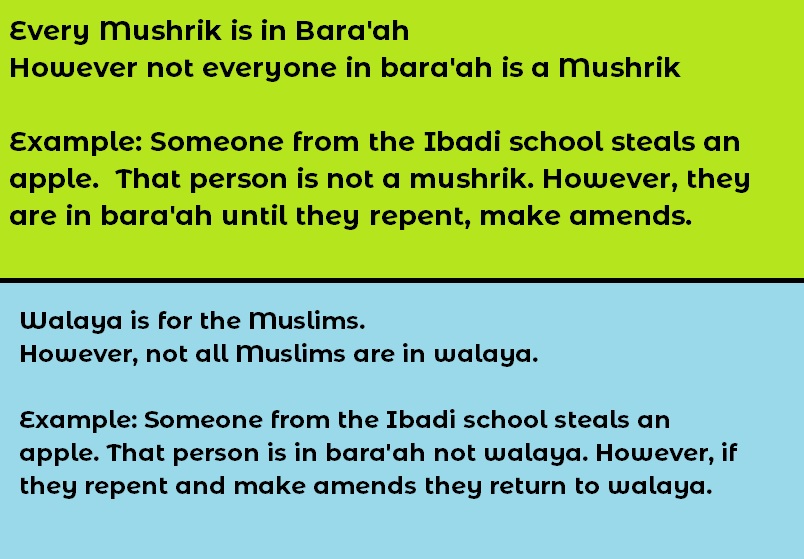
ʿilm al-ẓāhir & ʿilm al-ghayb
Why it is important to differentiate between ʿilm al-ẓāhir (the knowledge of the seen) and ʿilm al-ghayb (the knowledge of the unseen).
The former is what we, as human beings, are required to base our judgments upon, whereas the latter is exclusively attributed to Allah. On this basis, if a person commits a wrongful act but his intention was good, we—as people limited to knowledge that does not extend beyond the visible world—are commanded to judge based on what is apparent.
This is why you can have courts that give a verdict that a person is guilty but latter found to be innocent. In the afterlife such errors in judgement are impossible.
The Messenger of Allah (saw) said: “I have not been commanded by Allah to search the hearts of people or to cut open their bellies.”
Source: (Sahih al-Bukhari 4351)
So, unless Allah (swt) informs the Blessed Prophet (saw) about a matter he too judges based upon the apparent.
Furthermore, it was narrated that ʿUmar ibn al-Khaṭṭāb (ra) said:
The Messenger of Allah (saw) said:
“Actions are but by intentions, and every person will have only what they intended. Whoever emigrated for the sake of Allah and His Messenger, then his emigration was for Allah and His Messenger. But whoever emigrated to attain some worldly benefit or to marry a woman, then his emigration was for that which he intended.”
Source: (Sunan an-Nasa’i 3437)
Again this should be a clear reminder to all of us that our judgement is based upon the Dhahir or apparent. Where as the judgement of Allah (swt) is based upon the Ḥaqīqah or reality.
The Companions – The Sahaba
We affirm our allegiance to all the Companions except those who clearly committed grave sins during the turmoil (al-fitan) that arose among them. We also affirm our allegiance to those who suspend judgment concerning them because they are unable to discern the truth, as it is obligatory for those who lack understanding to withhold judgment—unless it becomes clear that someone is capriciously suspending judgment after having recognized the truth.
We do not suspend judgment concerning those who were aware of the actions of ‘Uthman and ‘Ali and were present when they committed reprehensible acts—unless they considered wrong to be right or right to be wrong, for such a stance is intolerable.
Walayah with Allah
Regarding our friendship and guardianship with our Creator, it consists of willing surrender—obeying His commands and avoiding what He has forbidden.
Allah’s Walayah with Us
What do we receive in return for our willing surrender? In reality, Allah (swt) owes us nothing. Yet, by His grace, we are granted His promise of guidance, support, and protection:
“As for those who accept guidance, Allah increases them in guidance and blesses them with righteousness.” (Qur’an 47:17)
“So, surely with hardship comes ease. Surely with hardship comes ease. So when you have finished, strive, and to your Lord direct your longing.” (Qur’an 94:5-8)
“Say, ‘Nothing will befall us except what Allah has decreed for us. He is our Protector.’ So in Allah let the believers put their trust.” (Qur’an 9:51)
“Do not grieve or despair; Allah is certainly with us.” So Allah sent down His serenity upon the Prophet, supported him with unseen forces, and made the word of the disbelievers inferior while the Word of Allah remained supreme. And Allah is Almighty, All-Wise.” (Qur’an 9:40)
It is astonishing that some outsiders believe our faith is solely about flogging, stoning, and amputations. In truth, we have a tightly integrated system of disavowal and reconciliation, of repentance and restored bonds, of friendship and necessary detachment.
When Muslims apply this to their lives, it becomes the spiritual equivalent of Japanese minimalism. You should seek the company of those who prioritize obedience to Allah and His Messenger—those aligned with devotion, not rebellion.
Once we realize that walayah (loyalty) and bara’ah (disavowal) extend beyond humans to the Jinn and the unseen world, we will step back and declutter our lives. We will recognize darkness—and its temptations—for what they truly are.
For example: The desire to go to a particular concert—but wait, who or what is truly inviting me? What forces are pulling me in that direction? Are they forces I should align with—those that nurture my spiritual growth—or forces I must reject?
As our Creator reminds us:
“Surely Satan is your enemy, so treat him as an enemy. He only invites his followers to become dwellers of the Blaze.” (Qur’an 35:6)
Satan has already declared bara’ah against us. The question is: Have we declared it against him and his minions?
You are encouraged to read the following entries:
May Allah guide the Ummah!
May Allah forgive the Ummah!


 Prima Quran