“And whoever kills a believer intentionally, their reward will be Hell—where they will stay indefinitely.Allah will be displeased with them, condemn them, and will prepare for them a tremendous punishment.” (Qur’an 4:93)

﷽
The following article is a translation of the wonderful presentation by the respected Shaykh
In the name of Allah, the Most Merciful, the Most Compassionate.
Praise be to Allah, Lord of the worlds, and prayers and peace be upon the Seal of the Prophets and Messengers, our master Muhammed, and upon his family and his righteous, guided companions. To proceed:
Peace, mercy, and blessings of Allah be upon you.
Introduction: The Allegations Answered Once and For All.
My brothers, in this article we continue responding to a persistent allegation that the Ibadis declare the Companions to be disbelievers, that we excommunicate them from Islam. This accusation is repeated endlessly by those who either misunderstand our creed or deliberately misrepresent it.
As we have said before, this attack against the Ibadis is the result of these people’s ignorance regarding the principle of loyalty and disavowal (al-walāyah wa’l-barā’ah) among the Ibadis. Likewise, these people are trying to conceal what they themselves call the faults of some of the Companions. Namely, the events that occurred during the civil strife (fitnah). These events are what led those scholars to declare disavowal from some of the Companions.
These people are not only ignorant of the principle of loyalty and disavowal, but they are also trying to conceal and avoid discussing these events.
When these people throw this accusation at the Ibadis, they simply say directly: “The Ibadis declare the Companions disbelievers,” without discussing the reasons. There are reasons that led those scholars to declare disavowal regarding those Companions.
What Our Opponents Say: Documenting the Accusation
Let us document exactly what our opponents claim. Listen carefully to their own words:
“Look, regardless of my disagreement with them, they declare ʿUthmān ibn ʿAffān to be a disbeliever, and they declare ʿAlī ibn Abī Ṭālib, and Ḥasan ibn ʿAlī, and Ḥusayn ibn ʿAlī, and a group of the Prophet’s Companions to be disbelievers. Yet despite that, they do not openly state it. Rather, you find this in their major books. You find it in their books. They also have an element of taqiyyah (dissimulation). Even so, I do not know whether this expression will be understood properly or not, but I respect in them the absence of sectarianism. This is their creed: they declare the Prophet’s Companions disbelievers. This is their creed: they declare the Prophet’s Companions disbelievers. Yes, we declare Muʿāwiyah a disbeliever, but we still narrate from him. We declare Marwān a disbeliever, but we still narrate from him. We declare ʿUthmān a disbeliever, but we still narrate from him. We declare ʿAlī and al-Ḥasan and al-Ḥusayn disbelievers, but we still narrate from al-Ḥasan and al-Ḥusayn. This is the Ibadi belief.”
Another says:
“Therefore we are not surprised by this stance, for the position of the early Ibadis regarding the Companions—especially the two caliphs—is contrary to the methodology of Ahl al-Sunnah wa’l-Jamāʿah. It included criticism, takfīr, and false disavowal from the best of this nation. As for the other two Rightly Guided Caliphs, ʿUthmān ibn ʿAffān and ʿAlī ibn Abī Ṭālib, may Allah be pleased with them, the Khawārij, including the Ibadis, remained deeply astray concerning them, attributing to them things from which Allah declared them innocent, and speaking grievously against them.”
And another:
“They called themselves the people of truth and uprightness, but they are the people of falsehood and misguidance. Hatred toward Ahl al-Sunnah. Let me add even more: they declare ʿAlī ibn Abī Ṭālib and ʿUthmān disbelievers and also al-Ḥasan and al-Ḥusayn, of course. As for Muʿāwiyah ibn Abī Sufyān, he exited Islam through its widest gates.”
As you have heard, these people claim that the Ibadis declare ʿUthmān, ʿAlī ibn Abī Ṭālib, al-Ḥasan, al-Ḥusayn, and a group of the Prophet’s Companions to be disbelievers. Then they say that the Ibadis do not openly state this and that they practice a kind of taqiyyah. They say this is our creed.
The Reality: No Taqiyyah, No Doctrine of Takfīr
The reality is that this is not our creed, nor is there any taqiyyah. Rather, it is their ignorance. They are ignorant of the doctrine of loyalty, disavowal, and suspension (wuqūf) among the Ibadis.
One of these opponents commented on an interview with one of our shaykhs. The interviewer asked the shaykh about Sayyidunā Abū Bakr and Sayyidunā ʿUmar, then afterwards about Sayyidunā ʿUthmān. They claim that he stuttered. The reality is that the shaykh did not stutter. Rather, he was avoiding reopening the fitnah and the events that occurred among the Companions. He did not want to stir up these matters, so he avoided them. Yet they claim he hesitated and faltered.
The shaykh did not hesitate or stutter. He answered. The problem is not with the shaykh the problem is with them. They are ignorant of the doctrine of loyalty, disavowal, and suspension. Anyone who understands this doctrine would know that the shaykh did answer the question.
The shaykh did not want to bring out what is found in their own books regarding the events that occurred among the Companions. He was avoiding this issue.
The shaykh said according to the meaning of his words that there were those who had one opinion and others who had another opinion. This is the reality. The issue returns to the doctrine of loyalty, disavowal, and suspension. There are people with one opinion and others with another. That is the answer. The shaykh cannot specify which of those opinions is correct because the matter returns to our doctrine of loyalty, disavowal, and suspension.
They want the shaykh simply to say: “Disbeliever” or “not a disbeliever.” But the matter is not that simple. This black-and-white approach belongs to them. The shaykh is not obligated to adopt their methodology, nor are the Ibadis obligated to adopt their methodology in these issues. We Ibadis have our own methodology and doctrine: the doctrine of loyalty, disavowal, and suspension.
Now, these people claim that we declare ʿUthmān, ʿAlī ibn Abī Ṭālib, al-Ḥasan, al-Ḥusayn, and a group of the Prophet’s Companions to be disbelievers. Then they say we do not openly state it and that we practice taqiyyah. Then they say this is the creed of the Ibadis.
The reality is that there is neither taqiyyah nor a doctrine of declaring the Companions disbelievers. Declaring the Companions disbelievers is not a doctrine among the Ibadis. We do not have a chapter in our creed titled: “The Ibadi doctrine of declaring the Companions disbelievers.” This is their ignorance.
If we focus on their words and these responses and clips they produced, we find them constantly repeating the term takfīr, the term kufr. They say: “They declared disbelief,” “acts of disbelief,” “so-and-so is a disbeliever.”
One of them even distorted the shaykh’s words in that interview, lied, and played with expressions. Anyone who watches the interview and his commentary will find that he distorted the shaykh’s words and attributed to him statements he never made. The shaykh never uttered the term takfīr. Yet this man attributes to the Ibadis things they never said.
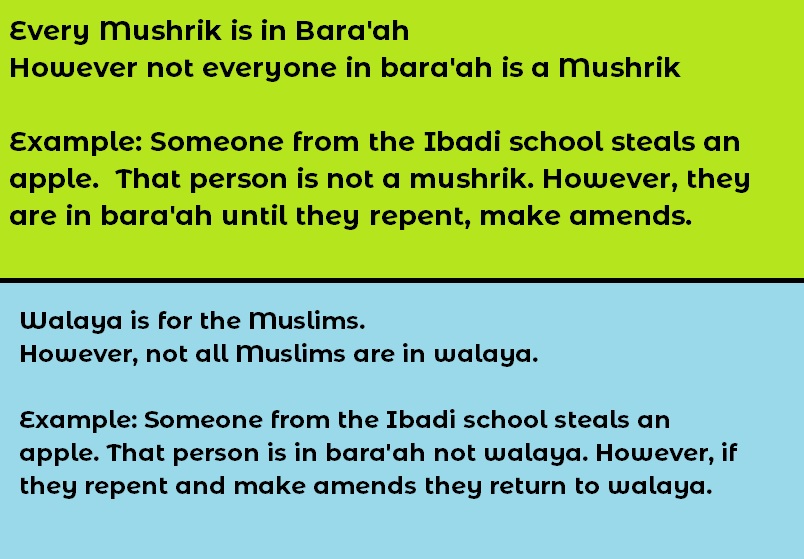
Did Ibadis invent using the term Kufr to apply to some of the companions actions??
Let us establish this. Let us speak and cite from the books that our opponents use themselves. We will not use Ibadi sources.
The Prophetic Evidence
annahu samiʿa al-Nabiyya ṣallallāhu ʿalayhi wa sallam yaqūlu: “Lā tarjiʿū baʿdī kuffāran, yaḍribu baʿḍukum riqāba baʿḍ
In Ṣaḥīḥ al-Bukhārī, the most authentic book after the Qur’an according to Ahl al-Sunnah, the Messenger of Allah ﷺ said:
“Do not revert after me as disbelievers, striking the necks of one another.” < Sunni translation.
“Do not revert after me as ungrateful ones by striking the necks of one another.” < Ibadi translation.
Source: (https://sunnah.com/bukhari:7077)
And in another narration:
al-Nabiyyu ṣallallāhu ʿalayhi wa sallam fī Ḥajjat al-Wadāʿ: “Istānṣiti al-nās.” Thumma qāla: “Lā tarjiʿū baʿdī kuffāran, yaḍribu baʿḍukum riqāba baʿḍ.”
“Do not return after me as disbelievers, striking the necks of one another.” < Sunni translation.
“Do not return after me as ungrateful ones, by striking the necks of one another. < Ibadi translation.
Source: (https://sunnah.com/muslim:65)
The Messenger is addressing whom in the above hadith? He is addressing the Companions.
If it is inconceivable that the companions would engage in acts that could be deemed kufr the Blessed Prophet (saw) would not have given them advise that would be redundant.
The Blessed Prophet (saw) also said:
al-Nabiyya ṣallallāhu ʿalayhi wa sallam qāla: “Sibābu al-muslimi fusūq, wa qitāluhu kufr.”
“Insulting a Muslim is wickedness, and fighting him is disbelief.” < Sunni translation.
“Insulting a Muslim is wickedness, and fighting him is ingratitude.” < Ibadi translation.
Source: (https://sunnah.com/bukhari:48)
This is another ḥadīth proving the usage of the term kufr for actions committed by Muslims against other Muslims.
What Sunni Scholars Say About this Kufr
Now let us see what these people’s own scholars say regarding these ḥadīths and the term kufr.
Muhammed ibn Ṣāliḥ al-ʿUthaymīn
Muhammed ibn Ṣāliḥ al-ʿUthaymīn, one of the most revered contemporary Sunni scholars, says in his commentary on Riyāḍ al-Ṣāliḥīn, volume 4, page 70:
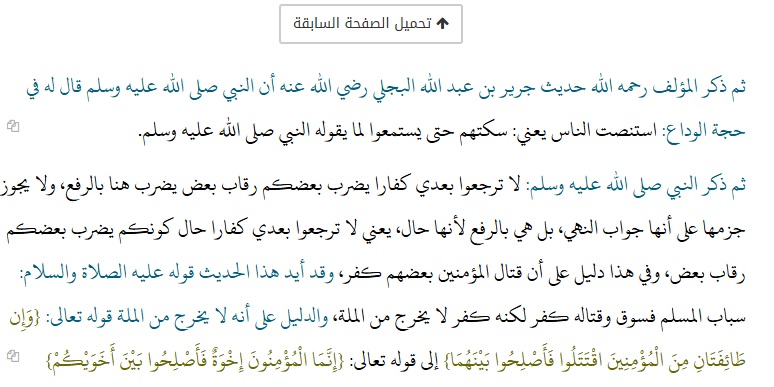
“Then the author may Allah have mercy on him mentioned the hadith of Jarīr ibn ʿAbdillāh al-Bajalī (may Allah be pleased with him), that the Prophet (peace and blessings be upon him) said to him during the Farewell Pilgrimage: “Make the people listen” meaning: silence them so that they may hear what the Prophet (peace and blessings be upon him) is saying.” -Muhammed ibn Ṣāliḥ al-ʿUthaymīn
“Then the Prophet (peace and blessings be upon him) mentioned: “Do not revert to disbelief after me, striking the necks of one another.” The word “striking” (yaḍribu) here is in the nominative case (marfūʿ), and it is not permissible to place it in the jussive case (majzūm) as though it were the answer to the prohibition; rather, it is in the nominative because it is a circumstantial clause (ḥāl). Meaning: do not revert to disbelief after me in the state of some of you striking the necks of others. And in this there is evidence that the fighting of believers against one another is disbelief (kufr).” -Muhammed ibn Ṣāliḥ al-ʿUthaymīn
“And this hadith is supported by his statement (peace and blessings be upon him): “Insulting a Muslim is wickedness (fusūq), and fighting him is disbelief (kufr).” However, it is a disbelief that does not expel one from the religion (millah). And the evidence that it does not expel one from the religion is the statement of Allah the Most High: “And if two parties of the believers fight one another, then make peace between them” up to His statement: “The believers are but brothers, so make peace between your brothers.” -Muhammed ibn Ṣāliḥ al-ʿUthaymīn
Source: (https://shamela.ws/book/9260/1936)
“And in this there is evidence that the fighting of believers against one another is disbelief (kufr)” -Muhammed ibn Ṣāliḥ al-ʿUthaymīn.
And notice he says:
“However, it is a disbelief that does not expel one from the religion (millah).” -Muhammed ibn Ṣāliḥ al-ʿUthaymīn.
So what exactly is your problem with some statements in some Ibadi sources? That such and such copmanions did actions that amount to kufr. This is for certain you will never find in any Ibadi sources where we have said that Ali, Uthman or Muaviya are mushrik or polytheist. Then this would be a problem.
However, you know what has happened to soften these Sunni positions in some English translations? They translate it as: “This indicates that believers fighting one constitutes some disbelief.”
Muhammed Nāṣir al-Dīn al-Albānī
In Al-Thamar al-Mustatāb fī Fiqh al-Sunnah wa al-Kitāb, page 53, al-Albānī says:
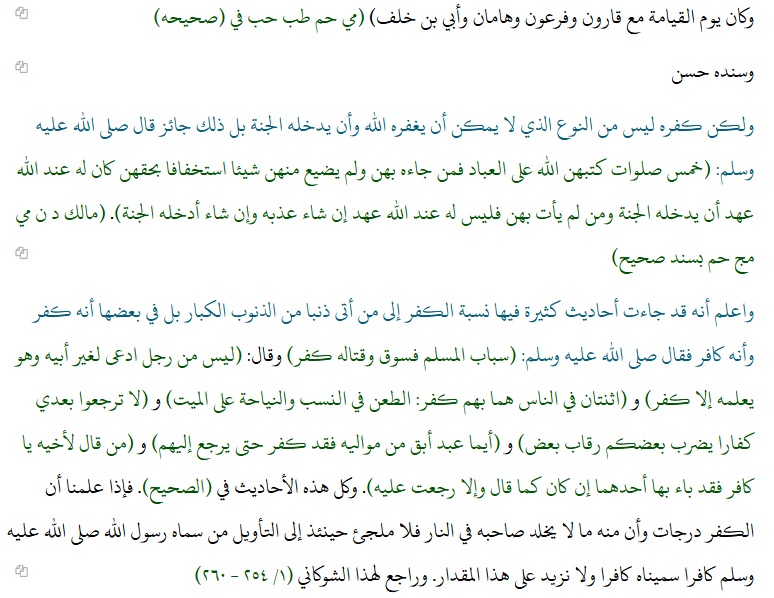
“And on the Day of Resurrection he will be with Qārūn, Firʿawn, Hāmān, and Ubayy ibn Khalaf) (Muslim, Aḥmad, al-Ṭabarānī, al-Ḥākim in his Ṣaḥīḥ) And its chain of narration is good (ḥasan)”- Muhammed Nāṣir al-Dīn al-Albānī
“But his disbelief is not of the type that Allah cannot forgive and admit him to Paradise; rather, that is possible. He (peace and blessings be upon him) said: “Five prayers Allah has prescribed upon the servants. Whoever comes with them, not wasting any of them out of disdain for their right, then he has a covenant with Allah that He will admit him to Paradise. And whoever does not come with them, then he has no covenant with Allah — if He wills He punishes him, and if He wills He admits him to Paradise.” (Mālik, Abū Dāwūd, al-Nasāʾī, Muslim, al-Majmūʿ, Aḥmad, with an authentic chain).” -Muhammed Nāṣir al-Dīn al-Albānī
“And know that many hadiths have come in which disbelief (kufr) is attributed to one who commits one of the major sins; indeed in some of them it is [called] disbelief and that he is a disbeliever. He (peace and blessings be upon him) said: “Insulting a Muslim is wickedness, and fighting him is disbelief.” And he said: “No man claims a father other than his own while knowing it, except that he has committed disbelief.” And: “Two things in people are disbelief in them: attacking lineage and wailing over the dead.” And: “Do not revert to disbelief after me, striking the necks of one another.” And: “Whichever slave flees from his masters has committed disbelief until he returns to them.” And: “Whoever says to his brother, ‘O disbeliever,’ it returns upon one of them. If it is as he said, then so; otherwise it returns upon him.” And all of these hadiths are in the Ṣaḥīḥ. So when we know that disbelief has degrees, and that some of it does not cause its doer to remain forever in the Fire, then there is no need at that point for reinterpretation from one whom the Messenger of Allah (peace and blessings be upon him) named.” -Muhammed Nāṣir al-Dīn al-Albānī
“Know that many ḥadīths have come attributing kufr to those who commit major sins … among them: ‘Insulting a Muslim is wickedness and fighting him is kufr’… and ‘Do not return after me as disbelievers, striking the necks of one another.’ All these ḥadīths are authentic. So if we know that kufr has levels (darajāt), and that some forms do not eternally condemn a person to Hell, then there is no need for reinterpretation.” –Muhammed Nāṣir al-Dīn al-Albānī
Source: (https://shamela.ws/book/306/54)
Al-Albānī explicitly affirms a crucial point.
Kufr has degrees (darajat).
Ibn Taymiyyah
In Kitāb al-Īmān, page 279, Ibn Taymiyyah says:
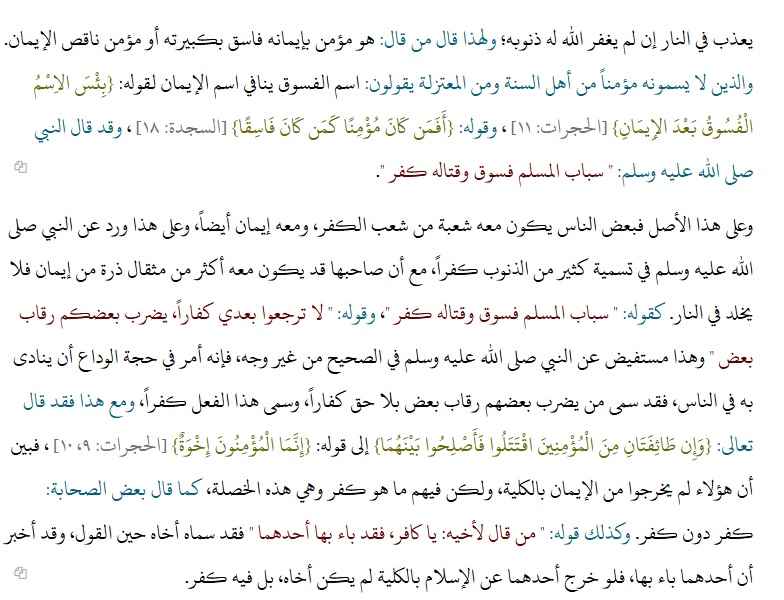
“He will be punished in the Fire if Allah does not forgive him his sins; and for this reason some said: he is a believer through his faith, a sinner through his grave sin, or a believer deficient in faith. And those among Ahl al-Sunnah and the Muʿtazilah who do not call him a believer say: the name of wickedness (fusūq) negates the name of faith, because of His saying: “How evil is the name of wickedness after faith” [al-Ḥujurāt: 11], and His saying: “Is one who is a believer like one who is a sinner?” [al-Sajdah: 18]. And the Prophet (peace and blessings be upon him) said: “Insulting a Muslim is wickedness, and fighting him is disbelief.” –Ibn Taymiyyah
“And upon this principle, some people have with them a branch of disbelief, and they also have faith. And upon this came reports from the Prophet (saw) in naming many sins as disbelief, even though the one doing them may have with him more than a speck of faith, so he will not remain forever in the Fire. Such as his saying: “Insulting a Muslim is wickedness, and fighting him is disbelief,” and his saying: “Do not revert to disbelief after me, striking the necks of one another.” And this is widely transmitted from the Prophet (saw) in the Ṣaḥīḥ through numerous chains. For he commanded during the Farewell Pilgrimage that it be proclaimed among the people. So he named those who strike the necks of one another without right as disbelievers, and he named this act disbelief. And despite this, Allah the Most High said: “And if two parties of the believers fight one another, then make peace between them” up to His saying: “The believers are but brothers” [al-Ḥujurāt: 9-10]. So He clarified that these did not exit from faith entirely, but there is in them what is disbelief namely this trait as some of the Companions said: disbelief below disbelief. Likewise his saying: “Whoever says to his brother, ‘O disbeliever,’ then it returns upon one of them.” For he called him his brother at the time of the saying, and he informed that one of them has incurred it. So if one of them had exited from Islam entirely, he would not be his brother; rather, there is in him disbelief.” –Ibn Taymiyyah
Source: (https://shamela.ws/book/7564/272)
This is extraordinary. Ibn Taymiyyah the scholar revered by many of our opponents explicitly affirms:
- A person can have “a branch of disbelief” while still possessing faith.
- The Prophet called certain sins kufr.
- This kufr does not necessarily mean eternal damnation.
- Some Companions themselves called this “kufr less than kufr.”
This is precisely the Ibadi position. So what are we being attacked for? These people need to learn their religion and the position of their scholars.
Ṣāliḥ Āl al-Shaykh
In Sharḥ al-ʿAqīdah al-Ṭaḥāwiyyah, volume 2, pages 851–852, Ṣāliḥ Āl al-Shaykh says:
“If hatred is for worldly reasons only, then this is lesser disbelief and does not reach major disbelief. Hence the Prophet ﷺ said: ‘Do not return after me as disbelievers, striking the necks of one another.’”
Then on page 852 he says:
“The fact that some Companions fought other companions involves entering into traits of disbelief. Therefore he (saw) said: ‘Do not return after me as disbelievers.’” – Ṣāliḥ Āl al-Shaykh
ولهذا قال النبي عليه الصلاة والسلام: لا ترجعوا بعدي كفاراً يضرب بعضكم أعناق بعض. وكون بعض الصحابة قاتل بعضاً آخر هذا فيه دخول في خصال الكفار، لهذا قال: لا ترجعوا بعدي…
He then says this disbelief may be lesser or greater disbelief depending on the nature of the hatred.
«ولا شك أنه قد يكون الباعث على ذلك البغض والكره، لأن القتال يكون معه ما في النفس، لكن مع تقاتل الصحابة فإن بعضهم لم يسب بعضاً يعني بلسانه، والنفس قد يوجد فيها ما لا يسلم من البشر. فإذا الكفر هنا قد يكون كفراً أصغر وقد يكون كفراً أكبر بحسب نوع البغض…»
“And there is no doubt that the motive for that may be hatred and aversion, because fighting is accompanied by what is in the soul. However, despite the fighting among the Companions, some of them did not insult others. Meaning with their tongues. Though the soul may contain what no human being is free from. Thus, the disbelief here may be a lesser disbelief or may be a greater disbelief, according to the nature of their hatred.” -Ṣāliḥ Āl al-Shaykh
Sources: (https://www.youtube.com/watch?v=540H8EuMm0E) You can start @1:05:24
Al-Dhahabī
In his book: Al-Ruwāt al-Thiqāt al-Mutakallam Fīhim bimā Lā Yūjib Raddahum on page 23 he says:
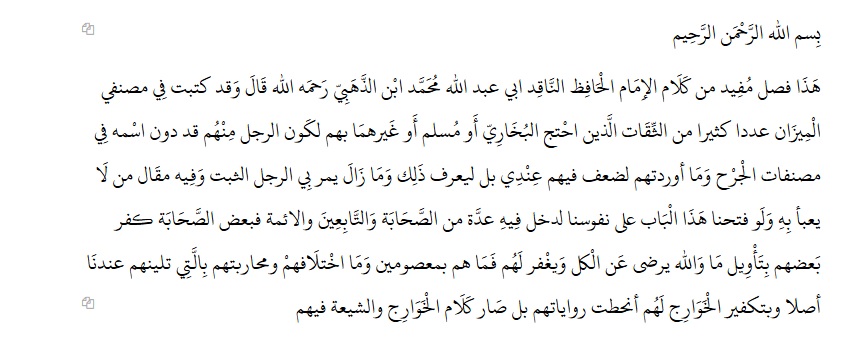
“In the name of Allah, the Most Merciful, the Most Compassionate”
“This is a beneficial chapter from the words of the Imām, the Ḥāfiẓ, the critic Abū ʿAbdillāh Muḥammed Ibn al-Dhahabī may Allah have mercy on him. He said: I have written in my work al-Mīzān a large number of reliable narrators whom al-Bukhārī, Muslim, or others used as evidence, because the name of one of them had been recorded in the works of criticism (al-jarḥ). I did not include them due to any weakness in them according to me, but rather so that this may be known. And a reliable narrator concerning whom there is a statement from one who is not to be given any weight would still pass by me. And if we were to open this door upon ourselves, a number of the Companions, the Successors, and the Imāms would enter into it. For some of the Companions declared others disbelievers based on interpretation and Allah is pleased with all of them and forgives them for they are not infallible. And their disagreement and fighting did not diminish them in our eyes at all. And it was because of the Khawārij’s declaring them disbelievers that their narrations declined; indeed the speech of the Khawārij and the Shīʿah concerning them became [a mark against them].” –Al-Dhahabī
“If we opened this door for ourselves, many Companions, Followers, and imams would enter into it. Some Companions declared others disbelievers based on interpretation.”
Al-Dhahabī affirms takfīr occurring among the Companions themselves based on interpretive ijtihād, not because the target of takfīr had actually left Islam.
Source: (https://shamela.ws/book/5817/1#p1)
Prima Qur’an comments: In fact in a recent back and forth on Twitter (X) the Sunni (traditional) beat a hasty retreat when it was asked point blank of them:
What did Dhahabi mean by the companions called each other kafir?
فَبَعْضُ الصَّحَابَةِ كَفَّرَ بَعْضُهُمْ بِتَأْوِيلٍ مَا
So if Dhahabi means when the companions called each other kafir that it did not entail expulsion from the millat of Islam you have to wonder what your real problem is with us? This is what is meant when you find this in Ibadi books. No one believes Ali or Uthman left Islam.
Imam al-Nawawī
Imam al-Nawawī said in his commentary on Sahih Muslim:
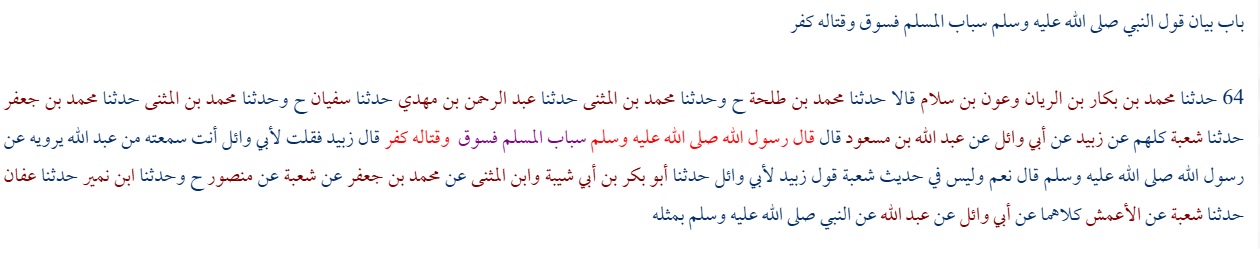
Chapter: Clarification of the statement of the Prophet (saw): “Insulting a Muslim is wickedness, and fighting him is disbelief”
64 Muḥammed ibn Bakkār ibn al-Rayyān and ʿAwn ibn Sallām narrated to us, both saying: Muḥammed ibn Ṭalḥah narrated to us. And Muḥammed ibn al-Muthannā narrated to us: ʿAbd al-Raḥmān ibn Mahdī narrated to us: Sufyān narrated to us. And Muḥammed ibn al-Muthannā narrated to us: Muḥammed ibn Jaʿfar narrated to us: Shuʿbah narrated to us. All of them from Zubayd, from Abū Wāʾil, from ʿAbdullāh ibn Masʿūd, who said: The Messenger of Allah (saw) said: “Insulting a Muslim is wickedness, and fighting him is disbelief.” Zubayd said: So I said to Abū Wāʾil: Did you hear it from ʿAbdullāh narrating it from the Messenger of Allah, (saw)? He said: Yes. And in the hadith of Shuʿbah there is not the statement of Zubayd to Abū Wāʾil. Abū Bakr ibn Abī Shaybah and Ibn al-Muthannā narrated to us, from Muḥammed ibn Jaʿfar, from Shuʿbah, from Manṣūr. And Ibn Numayr narrated to us: ʿAffān narrated to us: Shuʿbah narrated to us, from al-Aʿmash, both of them from Abū Wāʾil, from ʿAbdullāh, from the Prophet, (saw) the like of it.
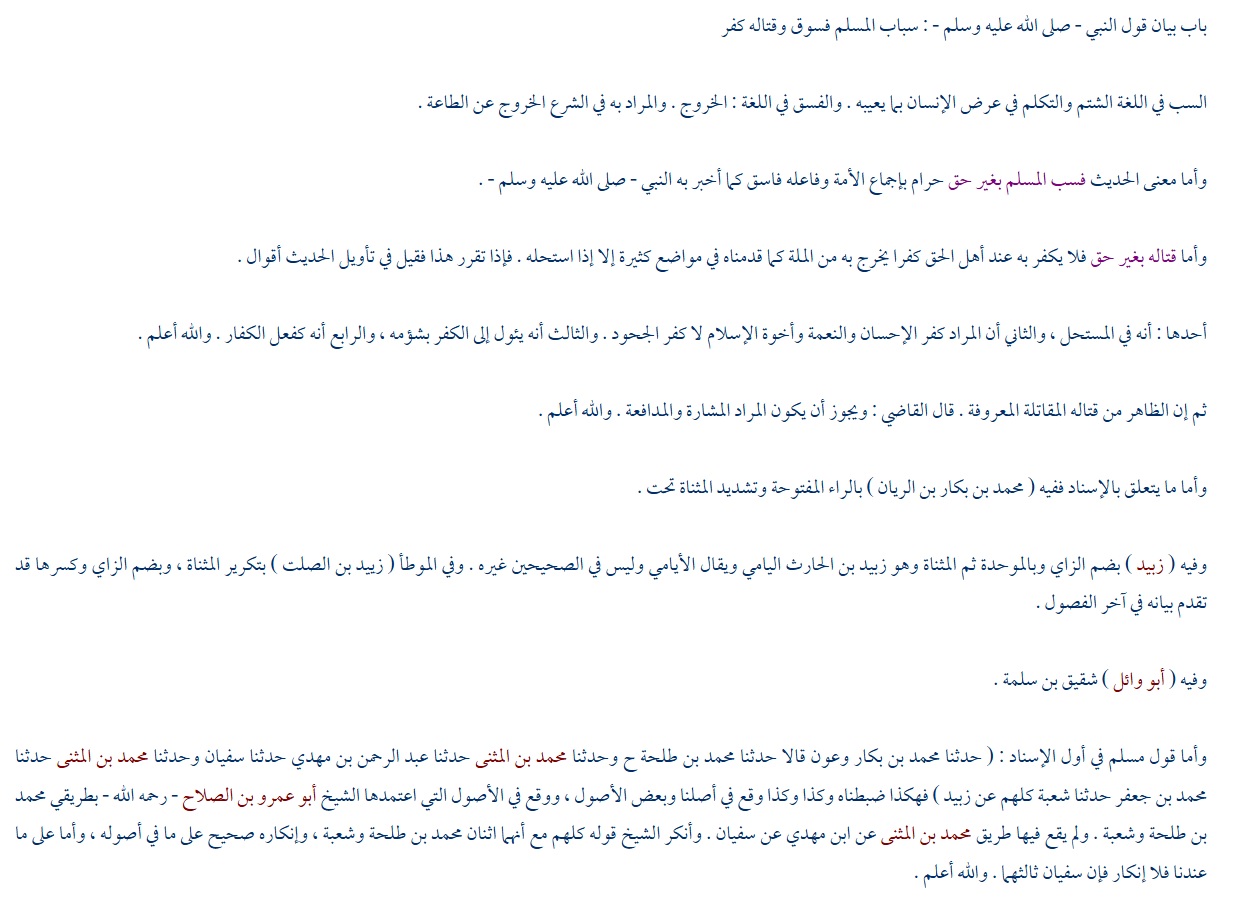
Imam al-Nawawī puts his Ash’ari (Murji’ah) spin. However, some important points come through.
Chapter: Clarification of the statement of the Prophet (saw) : “Insulting a Muslim is wickedness, and fighting him is disbelief.”
“Insult (sabb) in the language means reviling and speaking about a person’s honor in a way that faults him. And wickedness (fisq) in the language means going out. And what is meant by it in the religious law is going out from obedience. As for the meaning of the hadith, insulting a Muslim without right is forbidden by the consensus of the Ummah, and the one who does it is a sinner (fāsiq), as the Prophet (saw) himinformed.”-Imam al-Nawawī
“As for fighting him without right, it does not make one a disbeliever with a disbelief that takes him out of the religion according to the people of truth, as we have presented in many places, unless he considers it lawful. So when this is established, several statements have been said regarding the interpretation of the hadith.” -Imam al-Nawawī
“The first: that it is concerning the one who considers it lawful. The second: that what is meant is the disbelief of ingratitude and the denial of the blessing and the brotherhood of Islam, not the disbelief of outright rejection. The third: that it leads to disbelief through its ill omen. The fourth: that it is like the deed of the disbelievers. And Allah knows best. Then, the apparent meaning of “fighting him” is the well-known combat. The Qāḍī said: It is possible that what is meant is disputing and defending. And Allah knows best.” –Imam al-Nawawī
Source: (https://www.islamweb.net/ar/library/content/53/242)
Prima Qur’an: We will comment on Imam al-Nawawī puts his Ash’ari (Murji’ah) spin.
The interpretation of the Murji’ah/Ash’ari is:
If you kill a fellow a Muslim but you don’t believe that it is lawful to do so then it is not kufr.
We wonder if the companions who killed each other thought that what they were doing was lawful or unlawful?
If it was unlawful then they participated in the unlawful in masse.
Second. It is meant as ingratitude for blessings and brotherhood in Islam, not as disbelief in Allah. Hence, kufr ni’ama. Welcome to the Ibadi view! Though we do not subscribe to the Murji’ah/Ash’ari misunderstanding and misguidance.
Third. It leads to disbelief due to its evil consequences.
Fourth. It resembles the actions of disbelievers.
Summary of Sunni Scholarly Consensus on the above matter.
| Scholar | Affirmation |
|---|---|
| Ibn Taymiyyah | Kufr has levels; “kufr less than kufr” exists; a person can have a branch of kufr while still having faith. |
| Al-Dhahabī | Some Companions declared other Companions disbelievers based on interpretation (ta’wīl). |
| Al-ʿUthaymīn | Believers fighting one another is kufr—but they remain believers. |
| Al-Albānī | Kufr has levels (darajāt); some forms do not eternally condemn to Hell. |
| Ṣāliḥ Āl al-Shaykh | Lesser disbelief exists and does not reach major disbelief. |
| al-Nawawī | Meant as ingratitude for blessings and brotherhood in Islam, not as disbelief in Allah |
The Sunni Understanding of Qur’anic Reconciliation vindicates the Ibadis
Now we do not share thier misunderstanding of the verse. We are simplly based upon their understanding it vindicates our perspective.
Now we return to the Qur’anic verse that seals this matter.
The Sunnis translate the verse as:
“And if two groups of the believers fight each other…” (Qur’an 49:9)
Allah did not say: “If two groups, one of which has left Islam…” He said: “of the believers.”
Therefore:
| Statement | Implication |
|---|---|
| Allah calls fighting groups believers | They have not left the millah of Islam. |
| The Prophet calls fighting a Muslim kufr | The act is kufr in the lesser sense. |
| Conclusion | Kufr in the ḥadīth and in Ibadi usage does not mean expulsion from Islam. |
This understanding of kufr that we Ibadis have did not come out of thin air. Rather, this term is established and has a basis in the explicit words of the Blessed Prophet (saw) and the explicit text of the Qur’an.
The Prophet said: “Insulting a Muslim is wickedness and fighting him is kufr.” And he also said: “Do not return after me as disbelievers, striking the necks of one another.”
The question is: did the Companions strike one another’s necks? No rational person can deny that this happened during the fitnah.
The Ibadi Doctrinal Framework: Walāyah, Barā’ah, and Wuqūf
Now that we have established the legitimacy of the term kufr in its lesser sense, let us explain the actual Ibadi doctrine. The framework our opponents either do not understand or deliberately misrepresent.
The issues related to the stance on historical events (the Great Fitnah) are among the most intricate topics in Ibadi theology, and they have witnessed significant methodological development while preserving their theoretical foundations.
First: The Three Doctrinal Concepts
These concepts represent a “system of analogy” that defines a Muslim’s relationship with others based on behavior and actions:
Walāyah (Loyalty): This is love for the sake of Allah, and it is obligatory for every Muslim whose outward conduct is in accordance with Allah’s commands. It is of two types: general walāyah (for all believers) and specific walāyah (for those known for their righteousness).
Barā’ah (Disavowal): This is hatred for the sake of Allah, and it is obligatory for anyone who openly commits a major sin, persists in a wrong, or introduces something into the religion that contradicts its fundamental principles (from the perspective of the school of thought). It is not a “curse” or “insult,” but rather a severing of religious allegiance from the action or innovation.
Wuqūf (Suspension): This refers to refraining from judging someone’s loyalty or innocence due to unclear evidence, conflicting reports, or because the person was unaware of the events and not legally obligated to pass judgment on them.
A Detailed Overview of Positions Throughout the Ages
Stage 1: The Prophetic Period.
Prevailing Position: Innocence of the events and those responsible for them. Early Ibadis did not hold the Companions (as a whole) responsible for the fitnah in a way that condemned them.
Estimated Percentage: Let us guestimate and say 95% innocence. The overwhelming majority of early Ibadi scholars maintained that the Companions (as a whole) were not to be held blameworthy for the civil strife.
Even if we granted a theoretical 5% Allowance for disavowal
The remaining 5% allows for the possibility that some Companions, as human beings, may have committed acts prior to the fitnah that deserved punishment under the Qur’an and Sunnah. This is not a blanket condemnation of any Companion, nor is it specific to the events of the fitnah. Rather, it is an acknowledgment that Companions like all humans were not infallible (ma’sūm) and could commit individual sins for which the Qur’an and Sunnah prescribe accountability. This is not unique to Ibadis; Sunni scholars also acknowledge that Companions were not infallible and could commit sins, though they are generally considered righteous overall.
Examples: What is mentioned in the letters of Imam Jābir ibn Zayd (although his letters are characterized by piety) and what biographers have reported about the position of the people of Nahrawān towards ʿUthmān (due to the issue of protected areas and positions) and towards ʿAlī (due to the arbitration).
Logic: The position was directly political and doctrinal. Early Ibadis considered certain actions during the fitnah to be innovations, but they did not translate that into condemning the Companions as individuals. Rather, their barā’ah (disavowal) was directed at the actions and innovations, not at the persons as polytheist or as having left the millah of Islam.
Stage 2: Establishing and Remaining Silent (5th–13th centuries AH)
Prevailing Stance: Expressions of “remaining silent” began to appear explicitly.
Estimated Ratio: Let us guestimate a 50% disavowal (in educational texts) and 50% wuqūf (in practical application).
A well-known saying: Imam Abū Saʿīd al-Kadāmī (one of the leading scholars of the 4th century AH) said: “We do not disavow ʿAlī ibn Abī Ṭālib or ʿUthmān ibn ʿAffān unless we have definitive proof that necessitates it, and silence is safer.”
Logic: The principle of “scholarly integrity” began to emerge, whereby statements of disavowal were transmitted as part of the heritage, but remaining silent was practiced out of respect for the status of these Companions.
Contemporary Phase (14th century AH – Present Day)
Prevailing Stance: Remaining silent and accepting (the principle of good faith).
Estimated Percentage: Let us guestimate 90% wuqūf and acceptance, 10% disavowal (historical transmission only).
Statements of Scholars:
Shaykh Nūr al-Dīn al-Sālimī: Despite his adherence to the fundamentals, he opened the door to wuqūf for those who were unaware of the fitnah, saying: “You may abstain from judgment regarding the people of the qiblah, for Allah will not question you about what they did.”
His Eminence Shaykh Aḥmad bin Ḥamad al-Khalīlī (Grand Mufti of Oman): He always emphasizes the unity of the Ummah and purity of heart. In his lessons and writings, he prays for mercy upon all the Companions and affirms that historical differences should not divide Muslims today.
The Principle of Purity of Heart: This is the principle adopted by the Ibadi school today, meaning that the contemporary Muslim is not obligated to investigate the bloodshed of the Companions, and it is safer for him to meet Allah with a pure heart towards everyone.
Why Do Classical Texts Continue to Contain Statements of Disavowal?
The continued presence of these statements in books does not necessarily mean they are being implemented today. Rather, it stems from methodological reasons:
- Scholarly Integrity: Ibadi scholars consider the books of the early scholars an inheritance that should not be censored or deleted. Instead, it should be transmitted as is, with explanations within its historical context.
- Preserving Historical Memory: Transmitting these statements aims to explain why the Ibadis differed from others initially (the political and legal reasons for the revival), not to incite hatred.
- Distinguishing Between “Statement” and “Religious Practice”: The statement of disavowal exists “intellectually” in the books as an interpretation by earlier scholars, but wuqūf and acceptance are what are practiced “religiously” and as acts of worship today.
Should One Take a Doctrinal Stance Regarding the People of Nahrawān?
This is a fundamental question within the school of thought, and the answer can be summarized as follows:
The Ibadi position on their predecessors: The Ibadis believe that the people of Nahrawān were “people of righteousness” and that their disavowal of ʿUthmān and ʿAlī was based on a legitimate interpretation of Islamic law, which they considered justified in their time, to protect the core of the faith (as they perceived it).
Are you obligated to disavow them as they did? No. The principle among the Ibadis is: “There is no blame on one who remains neutral.” A contemporary Muslim who refrains from judging ʿUthmān and ʿAlī, while simultaneously respecting the people of Nahrawān as scholars and predecessors, is not considered an “innovator” or “outside the school.”
Conclusion of the Doctrinal Section
There is no religious obligation within the Ibadi school that compels you to disavow any of the Companions today. The required doctrinal stance is loyalty to the believers and hatred of oppressors in general. However, regarding specific historical events, the best and safest course is to remain neutral. (Wuqūf)
Accordingly, the Ibadi approach today is one of unity, not division, whereby the Companions (including ʿUthmān and ʿAlī) are treated with respect as a general virtue, while the interpretations of the early scholars who took strong stances are also respected, and this is considered part of the history of scholarly interpretation that does not preclude present-day harmony.
The early Muhakkima who fought at Nahrawān were responding to their historical moment with their ijtihād. There is no obligation for a Muslim 1,300 years later to inherit the same specific judgments, especially when the evidentiary record is disputed among Muslims.
Kufr in the Ibadi School Does Not Expel from the Millah
Let us state this as clearly as possible:
Kufr in the Ibadi school is not something that takes one out of the millah of Islam.
This is the fundamental distinction that our opponents either cannot grasp or deliberately conceal.
When early Ibadi scholars used the term kufr regarding certain actions during the fitnah, they did not mean:
- That the person had left the millah of Islam.
- That their shahādah was invalidated.
- That they were forever condemned to Hell.
Rather, they meant precisely what Ibn Taymiyyah meant when he wrote “a person may possess a branch of disbelief while also possessing faith” and “kufr less than kufr.” They meant what al-Albānī meant when he wrote “kufr has levels.”
They meant that the action—fighting a fellow Muslim unjustly, or introducing innovation into the religion—is an act of kufr in the lesser sense: a grave violation that necessitates barā’ah (disavowal) but not the complete negation of faith.
Even in how we understand the word كفر or kufr in Arabic. This ensures us that we have a creed that is based upon the Qur’an, the primary source of Islam, the revelation Allah sent to his Blessed Prophet (saw). Allah (swt) never defined كفر as exit from the religion of Islam. This is concept is theologically superimposed upon the word. The proof of this is evident. In light of the clear text from the Prophetic Sunnah, Sunni scholars have provided an array of understandings and levels concering the word.
Why the Accusation of Taqiyyah for the Ibadi Is False
Our opponents also claim that we, the Ibadis practice taqiyyah—that we conceal our “true” belief that the Companions are disbelievers.
This is false for several reasons:
- There is no concealment. We are explaining our doctrine openly in this very article, citing our sources and demonstrating our distinctions.
- Wuqūf is not taqiyyah. Taqiyyah is concealing one’s true belief out of fear of harm. Wuqūf is a principled theological position: suspending judgment when evidence is unclear or when the matter does not affect one’s own religious obligation.
- The accusation is ironic. Our opponents accuse us of taqiyyah while ignoring that we openly state: “We do not declare the Companions disbelievers in the sense of expulsion from Islam.” What are we supposedly concealing?
- The burden of proof is on them. They claim we secretly believe something. But they provide no evidence—only misinterpretation of early texts that they refuse to read in light of their own understanding of Qur’an (49:9) and the distinction between lesser and major kufr.
The Rhetorical Question Our Opponents Cannot Answer
Let us conclude with a question for those who accuse the Ibadis of excommunicating the Companions:
According to their own undersatnding of Qur’an 49:9, when two groups of believers fight each other, are they still believers or not?
They cannot say “no” without contradicting the Qur’an.
And according to your own ḥadīth in Bukhārī and Muslim, fighting a Muslim is kufr. So how do you reconcile the Qur’an calling fighting believers ‘believers’ and the ḥadīth calling fighting ‘kufr’?
The only possible reconciliation is that kufr here does not mean apostasy. It means a lesser kufr, a grave sin, an act of major transgression but not expulsion from the millah of Islam.
That is exactly what we Ibadis have been saying all along.
This is not meant as a ‘gotcha’ for the Sunnis, but a call for sincere reflection, bridge-building, and moving forward as an Ummah
Final Summary
| Accusation | Reality |
|---|---|
| “Ibadis declare Companions to be disbelievers (apostates).” | Ibadis use kufr in the lesser sense (kufr ni’ma), as affirmed by Ibn Taymiyyah, al-Albānī, al-ʿUthaymīn, and others. |
| “Ibadis declare companions to be mushrik (polytheist).” | Ibadis have not declared a single companion to be a mushrik. |
| “Ibadis practice taqiyyah to hide their true beliefs.” | There is no concealment. Wuqūf (suspension) is a principled theological position, not taqiyyah. |
| “Ibadis invented the term kufr for Muslims.” | The term comes from how Allah defined it in the Qur’an. |
| “Ibadis are Khawārij who excommunicate Muslims.” | Ibadis distinguish themselves from extremist Khawārij precisely by affirming that kufr does not always entail expulsion from the millah. |
| “Contemporary Ibadis still declare the Companions disbelievers.” | The contemporary Ibadi position is overwhelmingly wuqūf and acceptance, with scholars praying for mercy upon all Companions. |
Conclusion and Call for Fairness
We Ibadis do not ask anyone to agree with our historical interpretations. We do not ask anyone to adopt our doctrine of barā’ah. What we ask for is fairness. That we be judged by what we actually believe, not by the distorted caricature our opponents present.
We ask that our accusers to read their own understasnding of Qur’an (49:9) and the authentic ḥadīth.
The inconsistency applied to the Ibadi school is real.
Sunni, Imami, and Zaydi traditions all maintain elaborate taxonomies of kufr.
- Kufr al-ʿamal — disbelief of deed (action contradicting faith without denying it)
- Kufr al-inkār — disbelief of denial
- Kufr al-juhūd — disbelief of stubborn rejection after knowing
- Kufr al-nifāq — disbelief of hypocrisy
- Kufr bi’l-iʿrāḍ / al-irād — disbelief of turning away
- Kufr al-niʿmah — disbelief of ingratitude for blessing
- Kufr al-ʿinād — disbelief of obstinacy
- Kufr al-takdhīb — disbelief of denial/contradiction
These categories are not fringe. They are taught in Sunni ʿaqīdah manuals, Imami kalām texts, and Zaydi uṣūl works. Even Ibn Taymiyyah’s Kitāb al-Īmān which we cited above is built on exactly this distinction. Al-Albānī’s “kufr has levels” is the same principle. Ṣāliḥ Āl al-Shaykh’s “lesser and greater kufr” is the same.
So the inconsistency is this:
When these same scholars encounter the term kufr applied to ʿAlī, ʿUthmān, or Muʿāwiyah in an Ibadi text, they immediately read it as kufr al-juhūd or kufr al-inkār and then declare the Ibadis to be Khawārij who excommunicate the Companions. But when their own scholars apply kufr to Muslims who fight each other, or to one who insults a Muslim, or to one who abandons prayer out of laziness, they read it as kufr al-niʿmah or kufr dūna kufr the lesser kufr. That which does not expel one form the millah kind.
The word is identical. The subject is different. The interpretive charity is applied inconsistently.
This is not a minor rhetorical point. It exposes that the accusation “Ibadis declare the Companions disbelievers” rests on a selective reading. The accusers are not applying their own taxonomy to Ibadi texts. If they did, they would have to ask: which kufr do the Ibadis mean? And the answer, as the article documents and as we have confirmed, is kufr al-niʿmah — ingratitude for blessing — not expulsion from the millah.
We ask that they stop accusing us of taqiyyah when we are explaining our doctrine openly.
If they insist that our definition of kufr means apostasy, they bear the burden of proof is upon the accuser—not us.
“And give full measure when you measure, and weigh with an even balance. That is the best [way] and best in result.” (Qur’an 17:35)
You may also wish to read the following:
May Allah Guide the Ummah.
May Allah Forgive the Ummah.