“Because of that, We decreed upon the Children of Israel that whoever kills a soul unless for a soul or for corruption [done] in the land – it is as if he had slain mankind entirely.” (Qur’an 5:32)
﷽
Please excuse the tired clichés (khawārij). Nevertheless, this material may still be of value to researchers and interested readers.
Summary
Sālim ibn Ḥammūd ibn Shāmis al-Siyābī (1908–1993) was an Omani scholar, poet, historian, and judge. He was born in Ghāla, in the ولاية of Bawshār in eastern Oman. A largely self-taught scholar, al-Siyābī memorized the Qur’an at the age of seven and later studied classical Arabic works, including the Alfiyyah of Ibn Malik, a renowned 1,000-line poem on Arabic grammar.
Al-Siyābī was a prolific author, credited with as many as 84 works. According to Sultān ibn Mubārak al-Shaybānī, his writings can be categorized into prose and treatises, poetry and versified compositions, and research and correspondence.
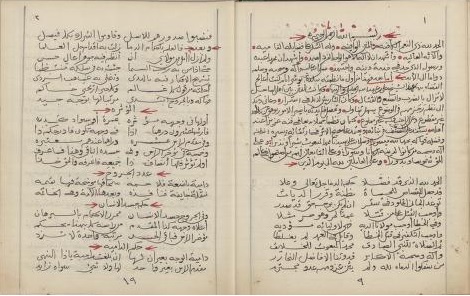
This manuscript was copied by Yūsuf ibn Sāʻid al-Zakwānī in 1386 AH (1966 CE). Written in black ink with rubricated headings, it contains two works by al-Siyābī.
The first is a theological treatise defending Ibadism against accusations made by other Muslim scholars. The second, titled Wahb al-Samāʾ fī Aḥkām al-Dimāʾ (“The Gift from Heaven on the Rulings of Bloodshed”), is primarily composed in verse and addresses the jurisprudence of bodily injuries. It is organized into short sections, each outlining the legal ruling for injury to a specific part of the body.
In the first work, Aṣdaq al-Manāhij fī Tamyīz al-Ibāḍiyya min al-Khawārij(“The Most Truthful Method for Distinguishing the Ibāḍīs from the Khārijites”), al-Siyābī critiques the prejudices held by some scholars against the Ibāḍīs. Writing in a question-and-answer format, he argues that Ibāḍīs should be understood within the broader Sunni tradition rather than as Khārijites.
In the introduction, he explains that he composed the treatise after consulting numerous works of Islamic theology in which certain scholars expressed outrage at the claim that the Ibāḍīs were responsible for the killings of Ali ibn Abi Talib and Uthman ibn Affan.
This claim relates to the early political conflicts that followed the death of the Prophet (saw) and contributed to divisions within the Muslim community. The Khārijites initially supported ʿAlī but later rejected his leadership after he agreed to arbitration during his conflict with Muawiyah I. Declaring both sides illegitimate, they rebelled and became known as khawārij (“those who seceded” or “rebels”).
A subsequent internal split among the Khārijites—particularly regarding methods of political opposition—led to the emergence of the Ibāḍī movement. Today, Ibāḍī communities are found primarily in Oman, as well as in parts of North and East Africa.
“Oh my Lord, increase me in knowledge.” (Qur’an 20:114)
﷽
RECLAIMING THE HISTORICAL NARRATIVE FROM THE ORIENTALIST AND FROM THE DETRACTORS OF TRUTH.
One thing that you will often hear from Orientalist as well as from our fellow Muslim brothers are two mistaken ideas.
#1) That Ibadi are Khawarij.
#2) That Ibadi grew out of the Khawarij.
Let’s address the first point.
The definition of Khawarij
Khawarij = “The ones that have gone out or have come out.”
In the Arabic language, it has no negative connotation in and of itself.
One of the largest Muslim daw’ah groups in the world our brothers” The Tablighi Jamaat” go out on Khuruj -going out in the path of Allah for 40 days.
“So from wherever you go out (kharajta)turn your face toward al- Masjid al-haram, and indeed, it is the truth from your Lord. And Allah is not unaware of what you do.” (Quran 2:149)
The Day they will hear the blast in truth. That is the(yawmu-khuruji) Day of Emergence.” (Qur’an 50:42)
The other point is that this term has is a polemical term used to disparage certain groups of Muslims. If we examine the polemical usage of the word than all the qualities that are used to say this particular sect is khawarij are equally applicable to all other factions and sects.
Unless, suddenly, we are going to pretend that we don’t have people saying that if you claim the Qur’an is created you should be killed.
In fact, for those who are genuinely interested in this subject, I highly recommend you read this 47 page PDF file. That has a nice big font and easy to read. Straight to the point. Al-Khawarij
The points that are made in the above article are sound.
#1 Ask your people to define the term Khawarij.
What is the Arabic etymological root of the word and what does it mean in the Arabic language. Once this is done please proceed to point 2.
#2 Now with that definition in mind ask on what consistent basis is this not applied to Talha and Zubhair?
Why are Talha and Zubhair not called Khawarij for opposing Ali?
Ali Ibn Abu Talib was the rightful amir of Muslims at that time was he not?
#3 Now with that definition in mind ask on what consistent basis is this not applied to Mu’awiya or Amr ibn Al ‘As?
Why is not Mu’awiya and Amr ibn al as not called a Khawarij for opposing Ali?
Ali Ibn Abu Talib was the rightful amir of the Muslims at that time was he not?
This in and of itself shows the supreme bias and inconsistency when the narrative is being told by certain historical narratives.
In fact did you know in Al Tabari Ali calls Mu’awiya as khawarij?
Ali identifies Mu’awiya as the Khawarij!
‘Ali told one of his followers named Al-Ashtar: “I told you that I assigned to Muhammed bin Abi Bakr the governorship (of Egypt); (but) these Khawarij have revolted against him.” Thus, according to ‘Ali, Mu’awiya and his followers were the Khawarij.
Sources: (Al-Tabari Al-Taarikh Vol. 6, p. 31.)
Abu Sa’id Al-Khudri’s hadith about Khawarij point to Mu’awiya and his Syrian forces.
Al-Hakim in his Al-Mustadrak narrates on the authority of Abu Sa’id Al-Khudri that when asked about the Khawarij, Abu Said’s answer pointed to Mu’awiya and his Syrian followers as being the Khawarij. That was why, in his answer, he quoted the Blessed Prophet (saw) as saying: “Ammaar (bin Yasir) would be killed by a rebellious group” and he was, as a matter of fact, killed by the Syrian forces who were under the leadership of Mu’awiya. This can be taken to show that the Khawarij, in the view of Abu Sa’id, were Mu’awiya and his followers otherwise he would need not to have mentioned them as his answer to the question of “Who were the Khawarij
Sources: (Refer to Al-Hakim Al-Mustadrak Vol. 2, p. 162-163. tradition no. 2653. Ibn Abdi Rabih Al-Iqdu Al-Farid Vol)
*Note* some publications have began to remove the reference in Al-Hakim!
The group that orientalist and the Shi’i and Ahl Sunnah as “Khawarij” believed that the blood of other Muslims who simply differ with them is permissible to take. They often make takfir of other Muslims -whereas we Ibadi Muslims do not do this.
Those other groups do not recognize Uthman and Ali as rightful Amir’s of the Muslims whereas we Ibadi Muslims recognize them. We simply admit that the latter part of Uthman’s reign suffered from nepotism and other issues. With Ali’s reign, It was his decision to abandon the Qurra as well as the clear guidance that Allah (swt) gave in the Qur’an. His killing of the companions at Nahrawan was not just.
Now while we are on the subject of taking the life of a fellow Muslim being a small matter let us take a look at something interesting.
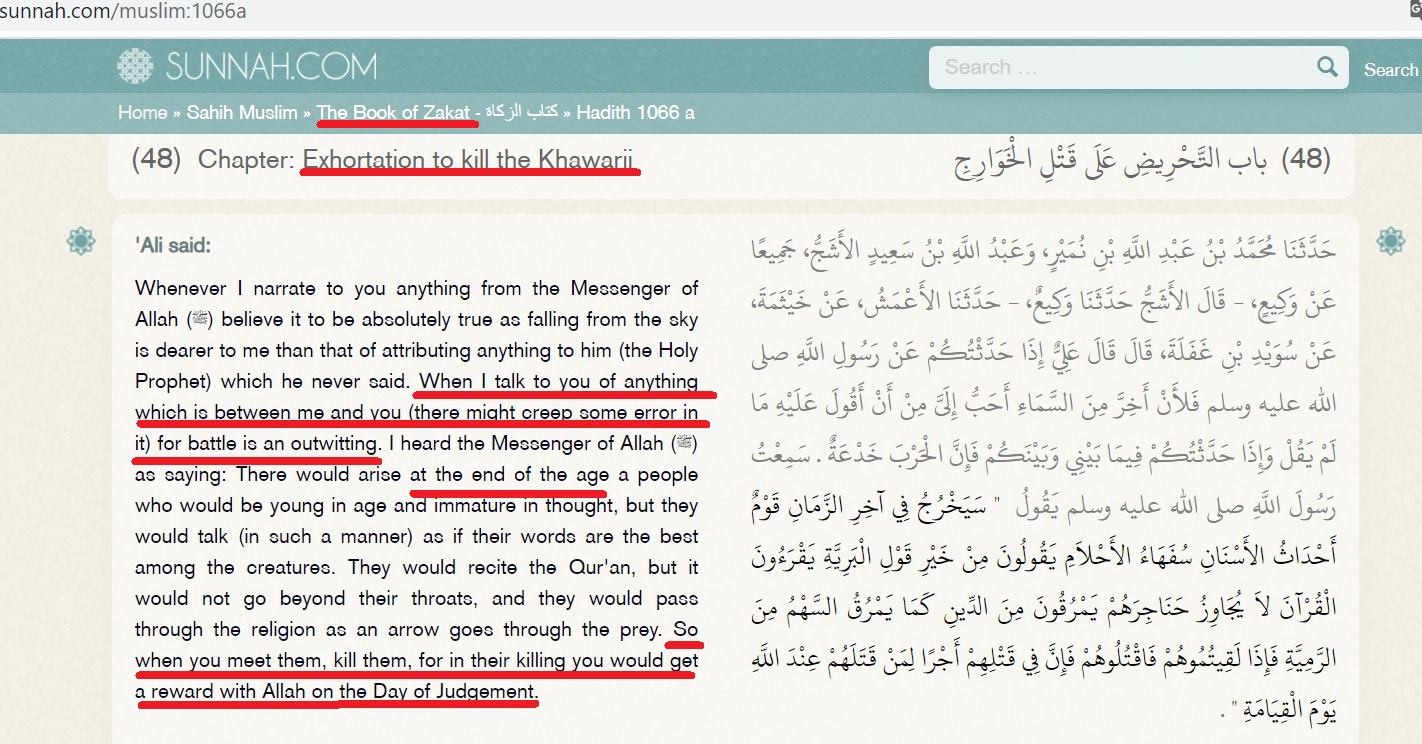
Ali said:
“Whenever I narrate to you anything from the Messenger of Allah (ﷺ) believe it to be absolutely true as falling from the sky is dearer to me than that of attributing anything to him (the Holy Prophet) which he never said. When I talk to you of anything which is between me and you (there might creep some error in it) for the battle is an outwitting. I heard the Messenger of Allah (saw) as saying: There would arise at the end of the age a people who would be young in age and immature in thought, but they would talk (in such a manner) as if their words are the best among the creatures. They would recite the Qur’an, but it would not go beyond their throats, and they would pass through the religion as an arrow goes through the prey. So when you meet them, kill them, for in their killing you would get a reward with Allah on the Day of Judgement.”
Now my dear fellow Muslims, and researchers of truth. The very wording of this hadith is bizarre. First, the way that Ali Ibn Abu Talib words the hadith as if he is saying, “By the way, I know you people may have some doubts in me but trust me I won’t lie about the Prophet.”
The way that Ali prefaced the hadith merits some sober reflection.
So what does this particular hadith suggest that you do with these extremists? Does it suggest you try and reason with them? Does it suggest that you capture them? No. It tells you that you should kill them and that in fact, Allah will give you a reward for it. That sounds quite extreme indeed.
Let us now address the second point:
Ibadi did not come from the so-called “Khawarij” nor are we a branch of them. It is more appropriate and truthful to say that this polemical term has been used about us Ibadi’s as well as those from the Azraqi, Najdi, and Surfriya. The major point that we, the Ibadi, hold in common with them is that all three of these groups are in AGREEMENT on ONE FINE POINT history.
In the sense that all these groups are in agreement that Ali was in error in his decision to make arbitration with Muaviya.
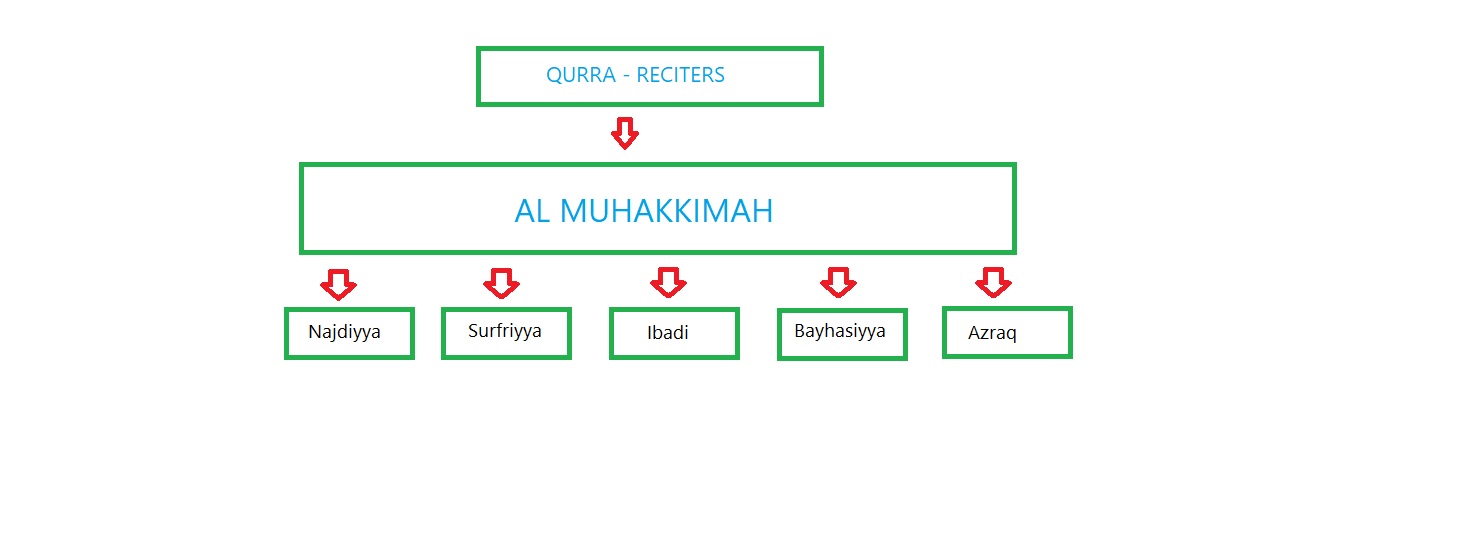
Thus, in that sense, we are all known previously as (Al Muhakkimah), or those who adopt Quranic verses for resolving any issue or quarrel, it is just what Allah (swt) told us we should do. Please refer to the Qur’an (5:50 & 4:65, in the least)
The above graph has been taken and modified by some youtubers.
With the coming of Abdullah ibn Ibadh al-Murri al-Tamimi (r) this is when the Al Muhakkimah already became subgroups.
All that can be said about the above groups is that are in agreement that Ali should not have made arbitration with Muaviya. Just like all Muslims are in agreement that Allah (swt) is one. Logically this does not mean that all Muslims have the same ideas about everything else.
The Nukkaris broke away from the Ibadi’s briefly than came back to the Ibadi. The Surfriyya eventually became absorbed into the Ibadi school in North Africa. The Najdiyya, Azraqi, Bayhasiyya, and whomever else did not survive until today.
Some groups are known as the Azraqi, Najdi, and others, these are the people whom the Shi’i, Sunni, and Orientalists refer to as “Khawarij”. It is these groups that became quite extreme in their views. For anyone who has studied history knows that Ibadi’s directed polemical writings towards these other groups, especially the Azraqi and the Surfriyya.
For those of you who understand and speak Arabic, we would highly recommend this lecture.
Insh’Allah may your eyes be opened wide!
For those who do not speak or understand Arabic see the excellent write up by sister Bint Ibadh here:
The Ibadi after Abdullah ibn Ibadh (raheemullah). -They believe in peaceful existence and dialogue with other Muslims. They marry other Muslims and perform the funeral prayers for them as well. One brother from Saudi Arabia recently said to a friend of ours, “You Ibadi are Khawarij, Shi’a, you support Iran!”
To which my friend replied, “We don’t support Iran, or Saudi Arabia or anyone. We support the Muslims. Who is doing to killing in Yemen? It is Sunni and Shi’a. Who is doing the fighting in Iraq? It is Sunni and Shi’a. Who is doing the killing in Syria? It is Sunni and Shi’a not us. You will not find a single Ibadi scholar anywhere giving a fatwa in support of any side of these conflicts.”
In fact, the only struggle that we know of that we areaware of that Ibadi scholar support is the struggle of the Palestinians (Muslims) against the (Zionist). It seems that these other sectarian wars are a diversion to distract from this!
We would like to imagine that if we Ibadi had a powerful state today that we would come to the aid of Muslims anywhere, no matter if they are Sunni, Shi’i, Salafi, or Sufi, as they are all the ummah of Muhammed (saw)!!
In fact, the proof is in the example of the Ibadi community in Oman. We marry both Sunni and Shi’i and we have a beautiful and fruitful relationship with them. In fact, out of all the Arab nations, there is not a single representative in ISIS from Oman! Al hamdulillah!
We would also like to add that in this world of chaos and turmoil it is more important than ever not to intentionally misrepresent one another. It is very important that we cooperate and work together as much as possible.
For example, Our brothers among the Sunni have actually mocked their own intellectual giants, Imam Ahmed and Imam Abu Hanifa while in the process of mocking others. The following article is demonstrative of that. By mocking the beliefs of others it shows that these two giants among our brothers from Ahl Sunnah are people who are ignorant of the views of their interlocutors.
This certainly is embarrassing and not the way forward dear Muslims and fellow truth seekers.
The most glaring example used by our brothers from Ahl Sunnah as well as uniformed orientalist is that we Ibadi’s do not believe in arbitration.
Please see the following article to understand what we are talking about.



 Prima Quran