
“We do not abrogate an ayat or cause it to be forgotten except that We bring forth better than it or similar to it. Do you not know that Allah is over all things competent?” (Qur’an 2:106)
“And when We substitute an ayat in place of an ayat – and Allah is most knowing of what He sends down – they say, “You, [O Muhammed], are but an inventor [of lies].” But most of them do not know.” (Qur’an 16:101)
﷽
One of the major differences in aqidah (creed) between the Ibadi school and those from ‘Ahl Sunnah’ is on the issue of the preservation of the Qur’an.
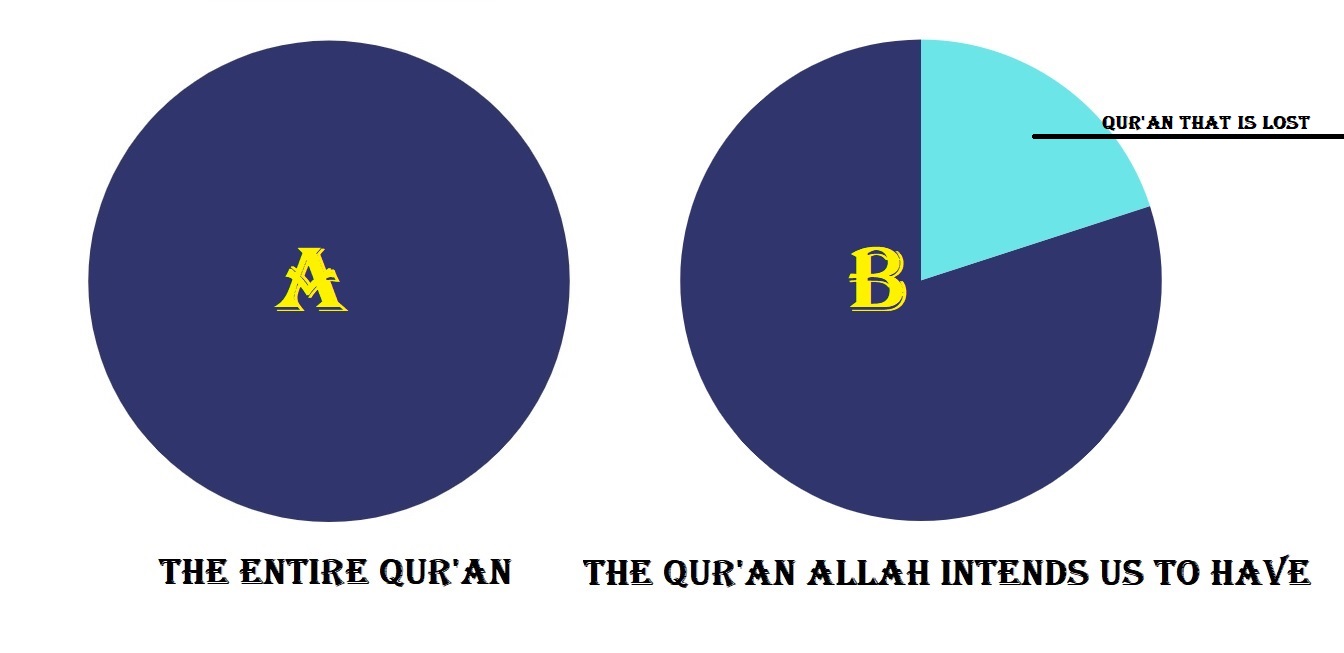
The Ibadi position is this:
- We have the entire Qur’an. (Chart A)
- We have the Qur’an that Allah (swt) intended for us to have which is Chart A
The Sunni position is this:
- We have the Qur’an that Allah (swt) intended for us to have. Chart B
- We do not have the entire Qur’an.* Chart B
*Note. This is not an outlier or strange position. This is the major position with in what is called ‘Ahl Sunnah Wal Jammah‘. You may be surprised at those who call themselves Sunni who are simply ignorant of this. However; as with any school of theology, jurisprudence or approach taken it is always possible to have minority voices and or those that dissent from the mashur (majority view).
The previous entry discussed this here:
https://primaquran.com/2023/11/24/are-sunni-sources-correct-we-dont-have-the-entire-quran-with-us
This entry will discuss some observations by a Sunni apologist whom is replying to what is commonly referenced on internet culture as team: “Atheist-Christ*” . In this particular response to 1/2 of team Atheist-Christ an enterprising Sunni apologist gives what he feels is a robust response.
*Note: For those not familiar, an Atheist-Christ is a Christian unbothered by an unsaved Atheist among them. He (the Christian) teams up with the Atheist and they jointly attack Islam.
Thus, 1/2 of team Atheist-Christ is an apologist whom has taken issue with the idea of the Qur’an having lost and/or forgotten chapters/verses/words and so forth.
When it comes to the idea or concept of abrogation the only consensus that the Sunni Muslims seem to have is that such a concept exist. What actually abrogates what is anyone’s guess.
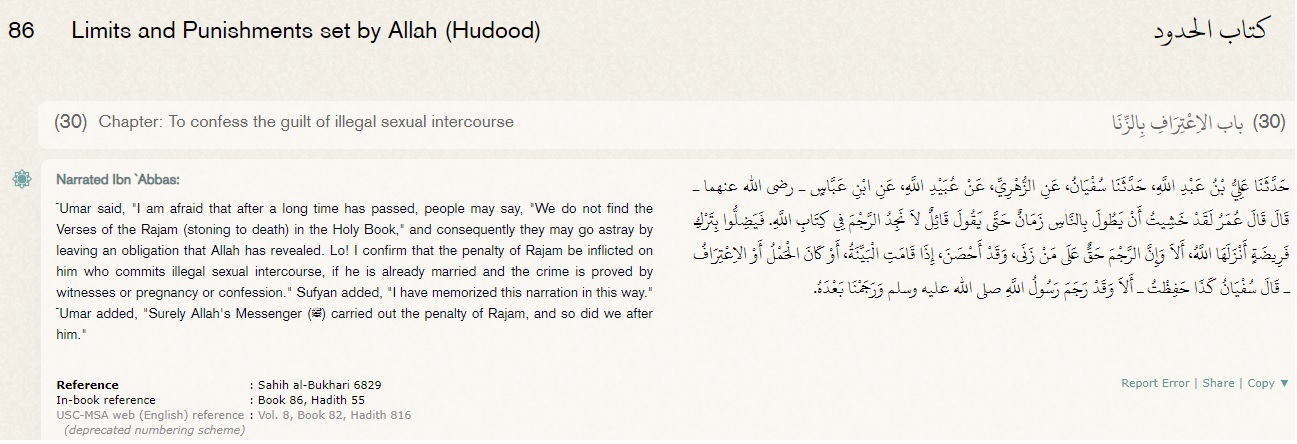
Some of them even believe in scenarios such as that the Qur’an used to have verses that explicitly mention stoning adulterers to death and that the verses were abrogated/lost/forgotten/eaten by a goat. However, the ruling remains! In our school this concept is one in which refuge in Allah (swt) is sought.
You get into issues such as the Qur’an abrogating the Qur’an. The Sunnah abrogating the Sunnah. Or even the Sunnah abrogating the Qur’an. The last one being the most dangerous of all, as the sunnah is primarily preserved and transmitted via lone narrator reports. It is an excellent opportunity for something that is dhan (uncertain) to overrule or overwrite something that is qati (decisive) such as the Qur’an.
The basis for this belief is the following text from the Qur’an.
“We do not abrogate an ayat or cause it to be forgotten except that We bring forth better than it or similar to it. Do you not know that Allah is over all things competent?” (Qur’an 2:106)
The assumption here is that the word ayat is referencing a verse in the Qur’an. It is not assumed for example that is a reference to miracles, that are no longer witnessed or tangible. or that it a reference to even the previous revelations. Now there are so many things to be said about this in and of itself. Notice that it does not say the word surah (chapter). For example in the following verse:
“And if you are in doubt about what We have sent down upon Our Slave, then produce a Surah (chapter) the like thereof and call upon your witnesses other than Allah , if you should be truthful.” (Qur’an 2:23)
This part also deserves pensive reflection on the part of those who believe the Qur’an is eternal and uncreated.
“We bring forth better than it or similar to it“
Abrogation is omission, removal and it is impossible for that which is eternal. The idea that some part of Allah’s sifat of attribute of ‘speech‘ would be ‘better‘ or “improved upon” over other parts merits pensive reflection.
“We bring forth better than it or similar to it”
If a person believes that this statement is a reference to the Qur’an than it creates a circular reasoning. If you no longer have the original source to compare it with than you have no way of knowing in what way that which was brought was improved upon.
An example:
As mentioned there is the view among a great many Sunni scholars that there used to be verses of stoning the adulterers in the Qur’an and that was abrogated/lost/forgotten/eaten by a goat. Recall the verse they base their belief on states: “We bring forth better than it or similar to it.” So which verse in the Qur’an now is now similar to it or better than it?
Why are Christians scolded for forgetting the revelation where as for Muslims it becomes a proof and a miracle for Islam? So much so that for the Christians hate and enmity was stirred up between them?!
“And with those who say ‘We are Christians’ We took compact; and they have forgotten (fanasu)a portion of that they were reminded of. So We have stirred up among them enmity and hatred, till the Day of Resurrection; and Allah will assuredly tell them of the things they wrought.” (Qur’an 5: 14)
In fact because I can anticipate how these people think. I can almost guarantee you the immediate response will be something akin to the following: “The difference here is that Allah made the companions forget where as the Christians forgot from negligence.”
Which also baffles me. The Creator causes you to forget his revelation = something meritorious.
The Arabic word Insan is derived from the Arabic nasiya meaning to forget. In fact you can see that in the very text of Q 5:14 above.
So allow me to share with you the video from a Sunni apologist who goes by the name of Farid. I think he means well and over all he some good material.
Insh’Allah will link to his YouTube channel as well. I believe this is his YouTube channel: https://www.youtube.com/@FaridResponds
So after listening to 1/2 of team Atheist-Christ put up his objections against the Qur’an Farid had the following to say:
“”Alright. So Firstly the common answer to this which is the answer I adopt
is that this this chapter was abrogated. That’s what that’s the classical position. So
the argument for that is really simple. Uh basically this specific verse. This specific verse that speaks of the son of Adam having valleys of gold or valleys of wealth, this specific
uh verse was memorized and documented by um according to Sayuti 15 companions. That’s quite a high number. and yet it never got into the Qur’an.” -Farid
Prima Qur’an comments:
Actually, it is very surprising that Farid says this. Perhaps to give him the benefit of the doubt what he means is the Uthmanic codex; because to say that it was never part of the Qur’an is to totally misread what was plainly stated.
Look again:
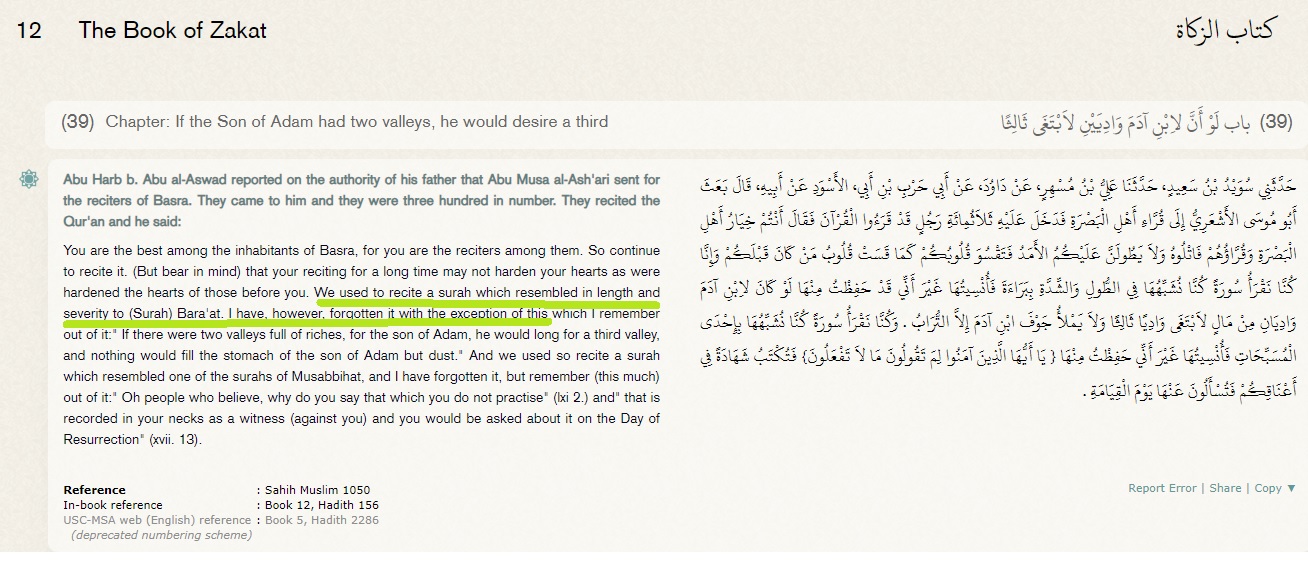
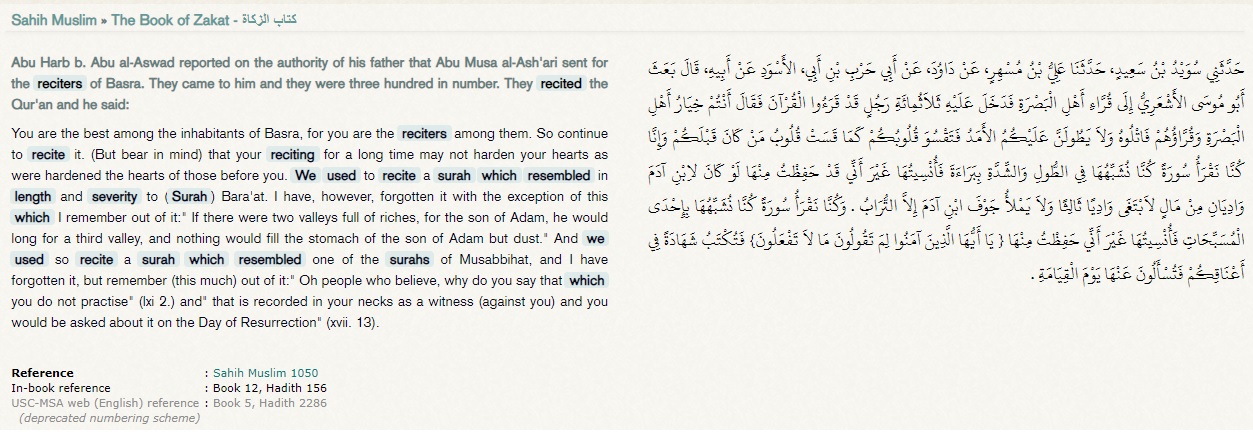
“We used to recite a surah which resembled in length and severity to (Surah) Bara’at. I have, however, forgotten it with the exception of this…..”
It is clear that was considered part of the Qur’an. We do not call du’a and invocations surah. So the more correct perspective here (if it were true at all) is that it was part of the Qur’an. It just doesn’t become part of the Uthmanic codex.
Farid continues:
“Now there is nothing controversial about the verse. There’s no reason for someone to hide the verse away or anything like that. So yes the traditional Islamic answer is this verse EXCUSE ME THIS CHAPTER was abrogated. And that itself will be convincing to any Muslim.”-Farid
Prima Qur’an comments:
Well, I am a Muslim and I am not the only one that doesn’t buy this at all. The Mufti of Oman, learned scholar and Shaykh, has this to say:
“Abrogation is never permitted in the reports of the Law-Maker because His Knowledge is not refreshed and He is not ignorant of anything that happens, and He does not reveal but the truth.”-Shaykh Ahmed Al Khalili (h)
Notice that Farid does a kind of bait and switch. In the above paragraph he uses the word ‘verse’ twice and the third time finally says, “Excuse me This CHAPTER.” Because that is what is being discussed. Recall “We used to recite a surah which resembled in length and severity to (Surah) Bara’at. I have, however, forgotten it with the exception of this…..”
So since the entirety of the chapter(surah) was lost or forgotten Farid is in no position to say that nothing controversial was in its contents. The reason he cannot say that is accordingly the chapter (surah) as a whole was lost/forgotten. However, the portion the chapter that was remembered was: “If there were two valleys full of riches, for the son of Adam, he would long for a third valley, and nothing would fill the stomach of the son of Adam but dust.”
Also, recall the verse in the Qur’an that is the basis for this belief.
“We bring forth better than it or similar to it”
So what verse did Allah (swt) bring that was better than or equivalent to the one of the two valleys full of riches?
Farid continues.
“Now before getting to my arguments I want you to be aware that the concept of abrogation is not something that is specific to Islam. It’s something that existed in Christianity previously you have the laws of Christianity abrogating the laws of Judaism. Right? Umm You even have specific examples of works that were abrogated because they were not important um in Judaism. So this is again this is not something that’s exclusive to Islam.”-Farid
Prima Qur’an comments:
It would have been great if Farid would have given an example of a law in Christianity abrogating a law of Judaism. If he done that perhaps we could see even how problematic such a concept was in their traditions as well. For example:
Jesus replied, “Moses permitted you to divorce your wives because your hearts were hard. But it was not this way from the beginning. I tell you that anyone who divorces his wife, except for sexual immorality, and marries another woman commits adultery.” (Matthew 19:8-9)
“If a man marries a woman who becomes displeasing to him because he finds something indecent about her, and he writes her a certificate of divorce, gives it to her and sends her from his house, and if after she leaves his house she becomes the wife of another man, and her second husband dislikes her and writes her a certificate of divorce, gives it to her and sends her from his house, or if he dies, then her first husband, who divorced her, is not allowed to marry her again after she has been defiled. That would be detestable in the eyes of the Lord. Do not bring sin upon the land the Lord your God is giving you as an inheritance.” (Deuteronomy 24:1-4)
So initially Jesus (whom is God the Son) according to the Athanasian Trinity gave Moses this command that it was o.k to divorce a woman if he found something displeasing or indecent about her. After she marries another man and he too divorces her or dies she cannot go back to the first husband as that would be ‘detestable’ in the eyes of the Lord. Yet, this same Jesus (whom is God the Son) than tries to say it was Moses who gave such a law because “your hearts’ were hard”
Christian damage control
“Jesus now answers that Moses allowed divorce because of the hardness of the Israelites’ hearts. This means that God created a set of rules limiting the damage which divorce might cause. Jesus adds that it was not so from the beginning. In other words, God’s intention in creation was that all human marriage between man and woman should be lifelong. To separate what God had joined was a violation of God’s design. Under Moses, however, Israel was allowed to break the design because of the sin-hardened hearts of the people—providing limits and restraints on the practice.”
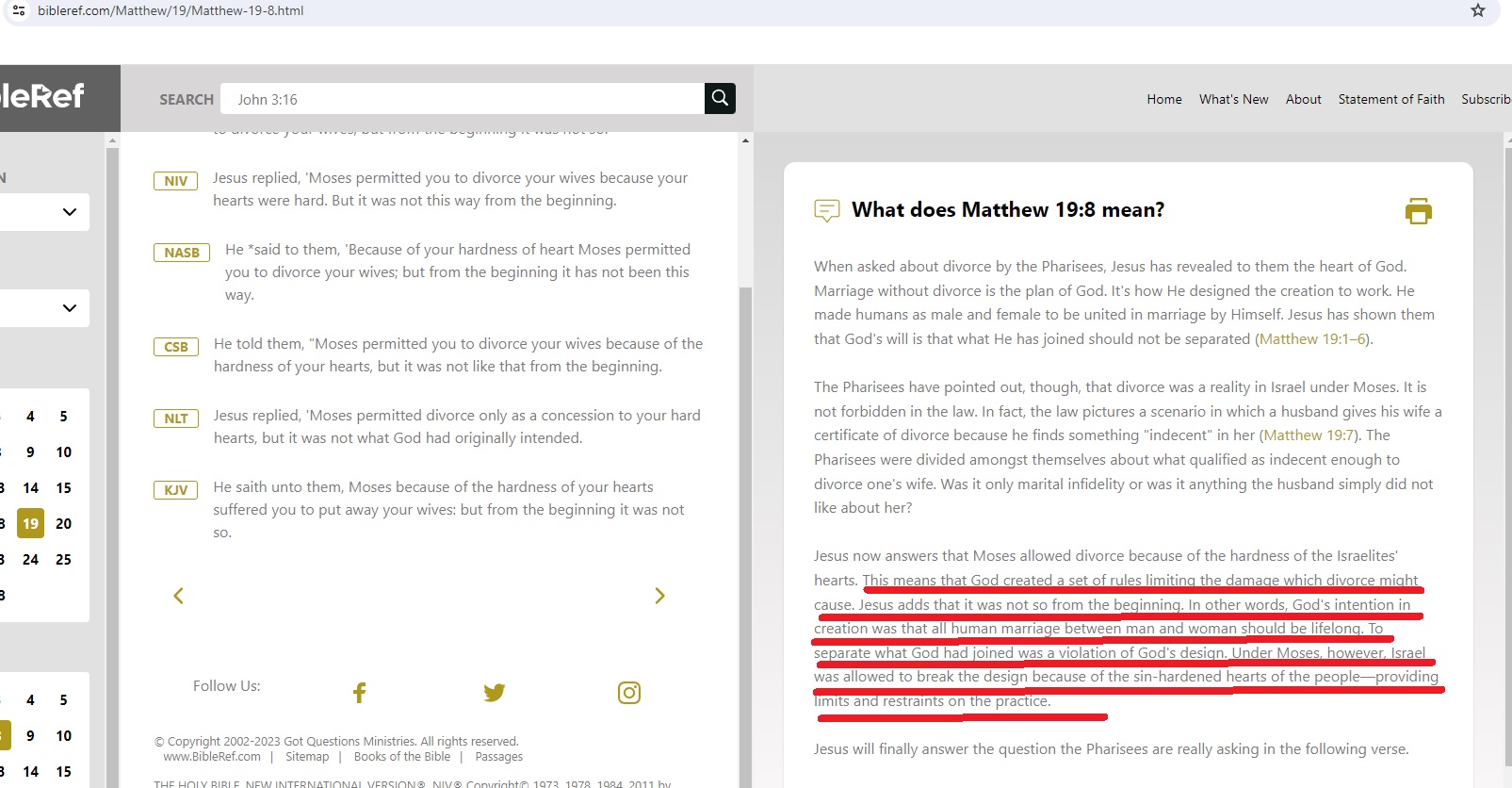
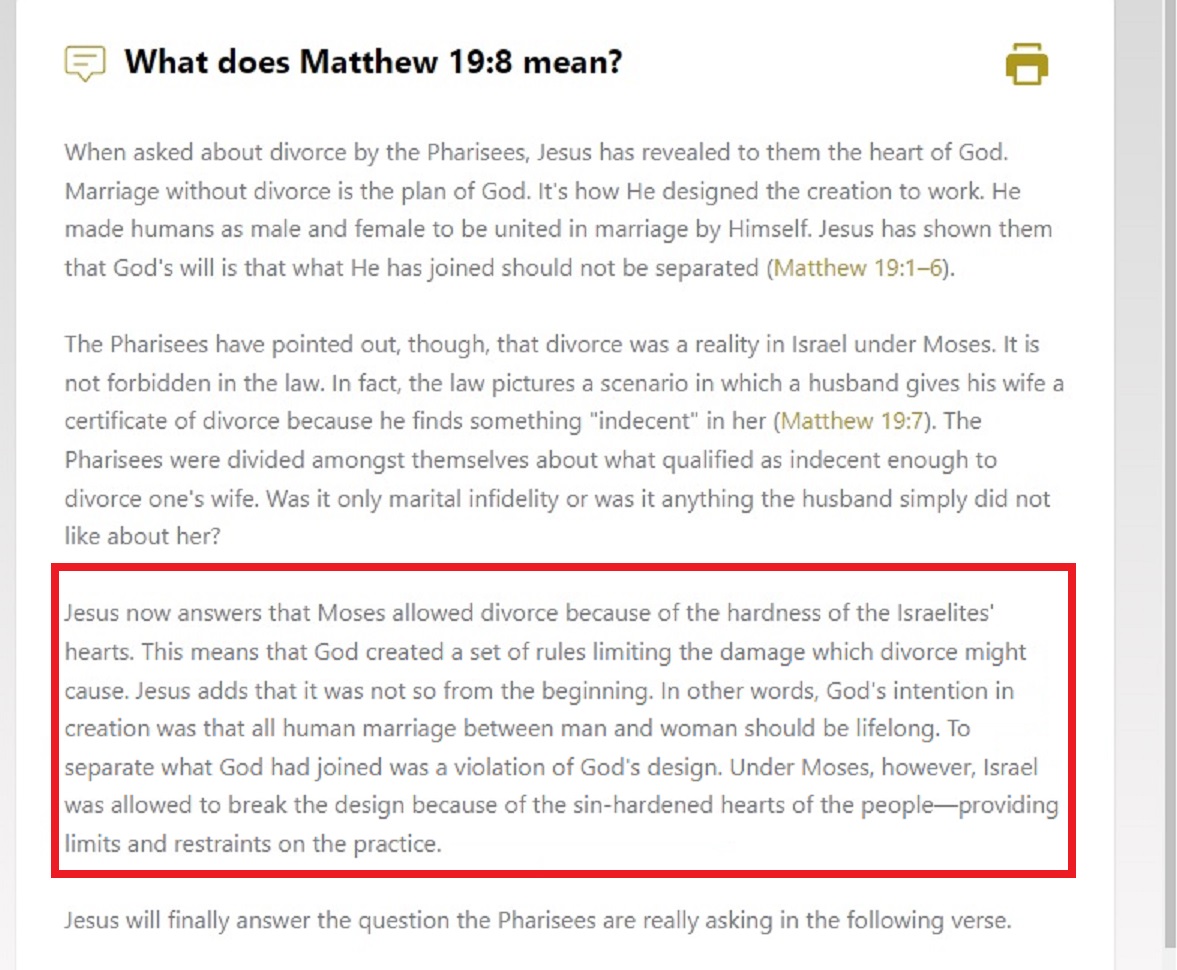
God (Jesus as God the Son) first allowed this type of divorce even though it was a violation of his (Jesus) design. Mostly because of the recognition that people’s hearts were hard. However, he suddenly changes that. Umm why? Aren’t the hearts still hard? You mean to say that human hearts are not hard anymore?
Do you know the irony of all this dear readers?
Religious Jews will see this a proof against Christianity and the capricious nature of how they perceive God.
Religious Christians will see this a proof for Jesus divinity because: Who else can give laws that they personally dislike, and violate the very intended pattern hey have planned for human beings (but not yet cause their hearts are hard) but some time 2000 years ago (possibly their hearts were not as hard) and yes you know what that was not adultery than but it is now: who can do that but God?
Religious Muslims who are involved in polemic with Christians (people like brother Farid) would possibly use arguments like this against the Christian faith and yet see things like this as a case for Islam.
This doesn’t become about being consistent and defending the haqq (truth). It’s about the football jersey that I wear and yours doesn’t’ match mine!
Farid continues.
“Now in regards to this specific matter what I find really interesting here this is referring to Abu Musa Al Ashari; who taught the Qur’an in Basra who taught the Qur’an in Yemen he was seen as one of the main reciters of the Qur’an. We rely upon Abu Musa for our Qir’aat today however, however, interestingly Abu Musa forgot a complete chapter of the Qur’an And what’s really interesting about that specific chapter is like we have no information about it.”-Farid
Prima-Qur’an comments:
These statements by Farid prove my previous points. Namely,
A) We can’t say that the chapter contained anything controversial because as he stated, “We have no information about it.”
B) Farid stated earlier that “and yet it never got into the Qur’an.” Than he says, “Abu Musa forgot a complete chapter of the Qur’an” This is why I give him the benefit of the doubt that what he means is the Uthmanic codex. Not that it was never part of the Qur’an ever.
Farid continues.
“Now in this specific hadith we find Abu Musa not saying not saying I forgot this chapter. He says, I was made to forget this chapter. Where do we find this concept? Well we find it in the Qur’an in verse 106 in Surat al Baqarah mā nansakh min āyatin aw nunsihā nati bikhayrin min’hā aw mith’lihā (We do not abrogate a verse or cause it to be forgotten except
that We bring forth [one] better than it or similar to it.”-Farid
Prima Qur’an comments:
Actually, Abu Musa does not say, “I was made to forget this chapter.” He says, “I have, however, forgotten it with the exception of this.” Thus, he did not forget the whole chapter. He forgot all of it with the exception of a certain portion. A portion which Farid admits was recited as the Qur’an and it is still there (as it is in the hadith) but it not recited as part of the Qur’an today.
Is this really what Qur’an 2:106 is saying?
Does it say, “We do not abrogate an entire chapter, with the exception of some verses that will remain but will not be in the final version of this Qur’an, or cause it to be forgotten except that We bring forth [one] better than it or similar to it, except for the two valleys verse which will remain and not be included in the final compilation.”
This is absolutely bizarre.
Farid continues.
“Now I want you to focus on the words cause it to be forgotten. That is what Abu Musa is saying I was made to forget this. That’s what Abu Musa is saying. Now, how can that even be proven right? I mean that’s the concept is very strange in itself, but is there any precedence for this? Now what really blew my mind was this specific narration That is narrated by Abu Umamah ibn Sahl in which he says, One night a man tried to read a chapter of the Qur’an that he had but he could not. Another man tried to read it but he also could not. Another man also tried to read it but failed. In the morning they went to the Messenger of Allah and gathered there. One of them said: “O Messenger of Allah! Yesterday night I tried to read chapter so-and-so but I could not.” The other said: “I have come for this very reason.” The third man said: “Me too.” The Messenger (saw) said: “It was abrogated yesterday.” Uh this specific hadith is narrated in nasikh wal mansukh by Abi Obaid; it was also narrated in other works like (I did not catch this part) Um it was also narrated by Tabarani in his Mu’jam al-Kabir in which he says that the Ansar that actually go to recite this verse only managed to recite the words bismillah ir rahman ir raheem, in the name of Allah, The Most Gracious, Most Merciful, and than they just freeze. Not knowing forgetting the rest of the chapter. Which is just it’s really interesting. Basically, what happened was you have this collective amnesia that occurred. Now, now I don’t have the answers in regards to why this occurred. I have no idea what was in that chapter. I have no idea what was in the chapter that abu musa narrated. Um it may even be the same chapter; but for some reason God in his infinite wisdom decided to abrogate that chapter in the same way he decided to abrogate the laws of the old testament and the..(pause) and other books in the old testament as well.”
Prima Qur’an comments:
Al hamdulillah. At least Farid realizes that this whole thing does seem “very strange'”
Farid proposes that there was some how this “collective amnesia” that occurred.
Now neither Farid or myself (to my knowledge) are medical doctors. However, what I can see is that there are considered to be three types of amnesia.
Types of Amnesia
- Retrograde amnesia. Having retrograde amnesia means you’ve lost your ability to recall events that happened just before the event that caused your amnesia. …
- Anterograde amnesia. …
- Transient global amnesia (TGA).
You may read more the distinction between Anterograde Amnesia VS. Retrograde Amnesia here:
I was not satisfied that what Farid describes really fits into any of these categories. At first I thought that maybe Transient global amnesia (TGA) would fit the description. Yet this seems temporary with the memories coming back. So than I thought I would search selective amnesia. This seems to fall under a type of dissociative psychiatric disorder. I do not believe that Farid attributes that to the companions at all.
Farid quotes an example of a few people not being able to remember a particular surah (chapter) and than the Blessed Messenger (saw) is attributed with saying that it was abrogated the night before.
Farid than quotes two other sources but does not bring the references.
“ it was also narrated in other works like (I did not catch this part) Um it was also narrated by Tabarani in his Mu’jam al-Kabir.”
So for example we do not know the type of “amnesia” they had. Was it temporary?
There seems to be temporary memory loss. Where did I place those car keys? There seem to be permanent memory loss, associated above with one of the types of amnesia.
There seems to be forgetfulness of something tangible and non tangible. There seems to be a situation where you were forgetful of what you are forgetful of. Another is something tangible.
So again this creates a type of circular reasoning where if you do not really recall a particular chapter or verse it is possible that you did not forget it at all but just think that you did. You could misplace or forget where you put your car keys. Yet, you know the item in question is tangible, they are car keys. But where did you place them? However, if you think about something obscure like a passage from a book and you think you forgot how to recollect it, it is very possible that actually didn’t commit it to memory to begin with. A type of paradox.
Farid continues.
“Now the Non-Muslim that’s watching this video naturally will be skeptical. Um will probably say, but you see this hadith of Abu Musa it’s speaking about a miracle why should I believe this narration that’s speaking about a miracle there’s no reason for me to believe this. Now I understand where you’re coming from. But that’s why the hadith of Abu Musa that David{1/2 of Atheist-Christ} is quoting is really interesting; and the reason is because again it’s narrated by around 15 people um at least of course at least that’s what we have received. Right? Now none of those 15 actually provide um any context to this. They simply say stuff like oh I heard Rasulullah (saw) recite this verse that speaks of the son of Adam having two valleys of wealth right? Um and you have them narrating this and it’s preserved arbitrarily. It’s narrated at different times at different places. So, yes you have Abu Musa narrating this in Basra. Uh Ibn Abbas, Ibn Zubair narrating this in Mecca. You have Zaid bin Arqam narrating this in Kufa; and of course you have the rest of the sahaba um narrating this in Medina. That’s really interesting. Their narrating this without a context. No one, none of them are arguing that there is a um collective amnesia going on. However, there is absolutely no trace of this chapter. We don’t know anything about this chapter; except for this one verse. Subhan’Allah. Now, there’s one last thing that comes to mind, which is why does this verse exist. Why do they all remember this verse? And why have they all forgotten the rest of the chapter? Now it seems to me like wallahu’alim that Allah (swt) has left this as a trace to point to there being something there once, and now it’s all gone. Subhan’Allah. And Subhan’Allah I mean I wouldn’t have even come across this if it weren’t for our good friend David Wood {1/2 of Atheist-Christ} Um so thank you David {1/2 of Atheist-Christ} I really appreciate this one. Um trust me I wouldn’t have come across this if not for your video. So please keep it up I’m enjoying, I’m learning I’m hoping that everyone else is enjoying the show as well.” -Farid
Prima-Qur’an comments:
Notice that Farid says, “it’s narrated by around 15 people” latter on he states: “Why do they all remember this verse? And why have they all forgotten the rest of the chapter?“
Now I know that English may not be brother Farid’s native language. May Allah (swt) bless him for doing his level best to combat the false narratives about Islam. However, for an English speaker following along the way Farid words things it gives the impression that these 15 narrators all made comments similar to Abu Musa Al Ashari above; namely, “We used to recite a surah which resembled in length and severity to (Surah) Bara’at. I have, however, forgotten it with the exception of this.” However, that is simply not the case at all. This is why it is important to double check sources and to have those sources available for everyone to scrutinize. Source “Trust me bro” is not helpful. For example:
Anas reported Allah’s Messenger (saw) as saying: قَالَ قَالَ رَسُولُ اللَّهِ
If the son of Adam were to possess two valleys of riches. he would long for the third one. And the stomach of the son of Adam is not filled but with dust. And Allah returns to him who repents.
Source: https://sunnah.com/muslim:1048a
Note: Allahs’ Messenger saying not reciting.
Ibn Abbas reported Allah’s Messenger (saw) as saying:
If there were for the son of Adam a valley full of riches, he would long to possess another one like it. and Ibn Adam does not feel satiated but with dust. And Allah returns to him who returns (to Him). Ibn Abbas said: I do not know whether it is from the Qur’an or not; and in the narration transmitted by Zuhair it was said: I do not know whether it is from the Qur’an, and he made no mention of Ibn Abbas.
Source: (https://sunnah.com/muslim:1049)
Now it is not possible for the companions to not know the difference between a saying or statement of the Blessed Messenger (saw) and the Qur’an.
Narrated Sahl bin Sa`d:
I heard Ibn Az-Zubair who was on the pulpit at Mecca, delivering a sermon, saying, “O men! The Prophet (saw) used to say, “If the son of Adam were given a valley full of gold, he would love to have a second one; and if he were given the second one, he would love to have a third, for nothing fills the belly of Adam’s son except dust. And Allah forgives he who repents to Him.” Ubai said, “We considered this as a saying from the Qur’an till the Sura (beginning with) ‘The mutual rivalry for piling up of worldly things diverts you..’ (102.1) was revealed.”
Source: https://sunnah.com/bukhari:6438
If anything is correct about this it is most likely of a similar nature to the Qudsi hadith. That is the content being attributed to Allah (swt) but actually the words of the Blessed Messenger (saw).
Now there is something that Farid said above that sounds sensible when it comes to his point about a trace of something. However, trying to make a connection between 15 narrators and the exact statements of Abu Musa Al Ashari is not something he established. Nonetheless when he says, “Now it seems to me like wallahu’alim that Allah (swt) has left this as a trace to point to there being something there once, and now it’s all gone.“
That is how you avoid the paradox I mentioned earlier. You have to be able to recall that you forgot something and having a trace of that can help to establish something was forgotten(temporarily, forever) that is not established. The point that I made above:
“So again this creates a type of circular reasoning where if you do not really recall a particular chapter or verse it is possible that you did not forget it at all but just think that you did.”
Prima-Qur’an Conclusion:
I do not think that anything presented by Farid presents any type of proof or miracle for Islam and/or the preservation of the Qur’an. Not being able to know if a particular thing forgotten was temporary or permanent is important.
The very hadith cited that kicked off the conversation could very well fall into the genre of Qudsi hadith. There is evidence that the companions felt this was a saying of the Blessed Messenger (saw).
The statement from At Tabarani was not given the source or actual quote. You would think something this phenomena would be more wide spread as well. The concept of abrogation as mentioned in my other entry here: https://primaquran.com/2022/10/04/why-abrogation-in-the-quran-is-a-false-doctrine/ is an absolute train wreck of a doctrine!
Sunni Muslims (with dissenting voices) believe things like there used to be verses about stoning in the Qur’an and it was removed (abrogated) and yet the ruling remains! Why?
Than as Farid states apparently one companion is made to forget an entire chapter of the Qur’an (with the exception of one verse) and even that verse does not end up in the Qur’an we have today.
The idea that Allah’s verses (his eternal speech) and sifat is superseded by (other eternal speech) better than before merits pensive reflection.
When it comes to our school, Ahl Haqq Wal Istiqama we believe the following:
A) We have the whole of the Qur’an with us.
B) We have the Qur’an that Allah (swt) intended for us to have.
Sunni Muslims (with dissenting voices) for the most part hold to position B. They do not hold position A, as they believe whole chapters, verses etc. were lost/forgotten/ etc.
I am motivated to write articles like this because I imagine there is someone persuaded by the depth, comfort, beauty and cohesiveness of Islam. That person than becomes deterred by others telling them, have you seen this video by Atheist-Christ? Than that well intentioned person watches that video and in fairness watches Farid’s video. That person maybe driven further into doubt because Farid’s video could come across as massive copium. In fact that video response could be what drives that person away from embracing the faith!
I want individuals to find responses like this so that they may know that yes Islam is cogent, beautiful, comforting and has depth. If you find certain presentations of Islam disheartening that is not an aspersion on Islam, it is an aspersion on that particular presentation of Islam.
May Allah (swt) guide us to what is beloved to Allah (swt). May Allah (swt) grant victory to our brothers in Palestine amin!
For those interested I also have some entries on abrogation here:
https://primaquran.com/2022/10/04/why-abrogation-in-the-quran-is-a-false-doctrine
This was in response to statements by Dr. Abdullah Bin Hamid Ali of Lamppost productions and affiliate of Zaytuna Institute in the United States. He is a Sunni Maliki Ashari’i Islamic scholar.
May Allah Forgive the Ummah.
May Allah Guide the Ummah.




 Prima Quran