
“Wherever you are, turn your face towards the Sacred Mosque. And wherever you are, face towards it, so that people will have no argument against you, except the wrongdoers among them. Do not fear them; fear Me, so that I may perfect My favour upon you and so you may be guided.” (Qur’an 2:150)

﷽
“That was a community that had already gone before. For them is what they earned and for you is what you have earned. And you will not be accountable for what they have done.” (Qur’an 2:141)
The verse from the Qur’an should be very important for us. Sometimes, when reading these reports about what happened among the companions, people’s faith can be shaken. It shouldn’t. What can be shaken are false doctrines likeʿadālah aṣ-ṣaḥābah’. What we can say is that the companions of the Blessed Messenger (saw) did their job and Islam is here. None of them worshiped a golden calf. None of them declared Muhammed (saw) the son of Allah or even worshiped the Blessed Prophet (saw).
In general, the issue of the Caliphate of Uthman is historical, though a controversial one, but should not be the cause of discord in the Muslim community today. It is irrelevant because none of the existing sects took part in it. But enemies of Islamic unity keep recalling it repeatedly and putting the blame on the Ibadis as if they were the ones who killed him. The Ibadis recognizes the Caliphate of Uthman and have no dispute with him in the matter of religion. In fact, in the collection of hadiths by Imam Rabi’ which Ibadis rely on has recorded several traditions narrated by Uthman.
Uthman, like Ali and Muawiyah, are narrators of hadith in the Al-Jami’i Al-Sahih (Musnad Al- Imam Al-Rabii).
Despite these political dissociations (which are a matter of barā’ah, or disassociation), we do not equate a political error with being a liar in religious matters. This allows us to accept a hadith from Ali or Uthman if its chain of transmission is sound byour own standards .
In short, the Sunnis find it strange because their ilm al-rijal (science of narrators) methodology is more intertwined with a narrator’s political and theological affiliations, whereas the Ibadi approach is to judge a hadith’s authenticity based on a separate set of criteria that can accept narrations from figures we politically disagree with.
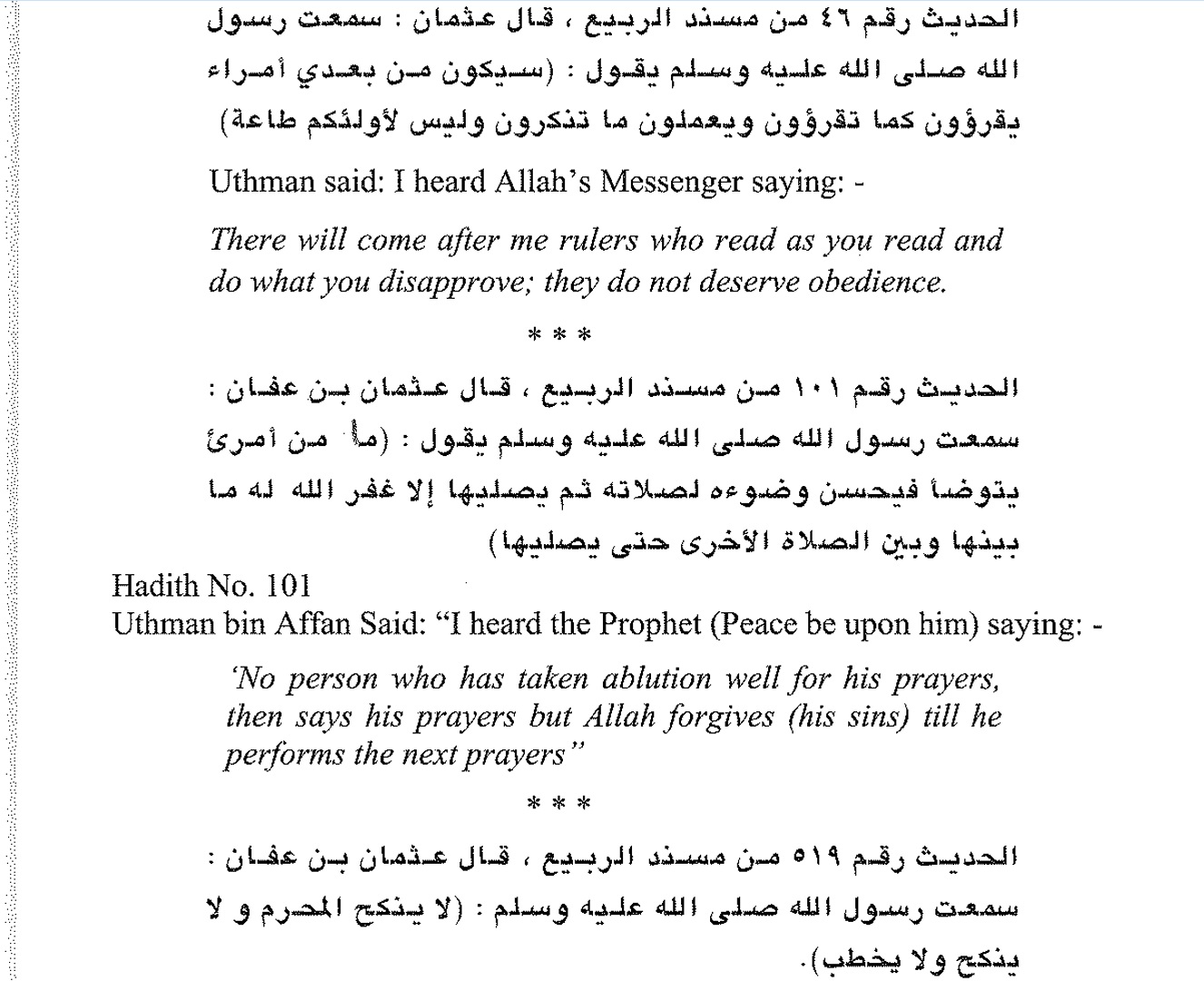
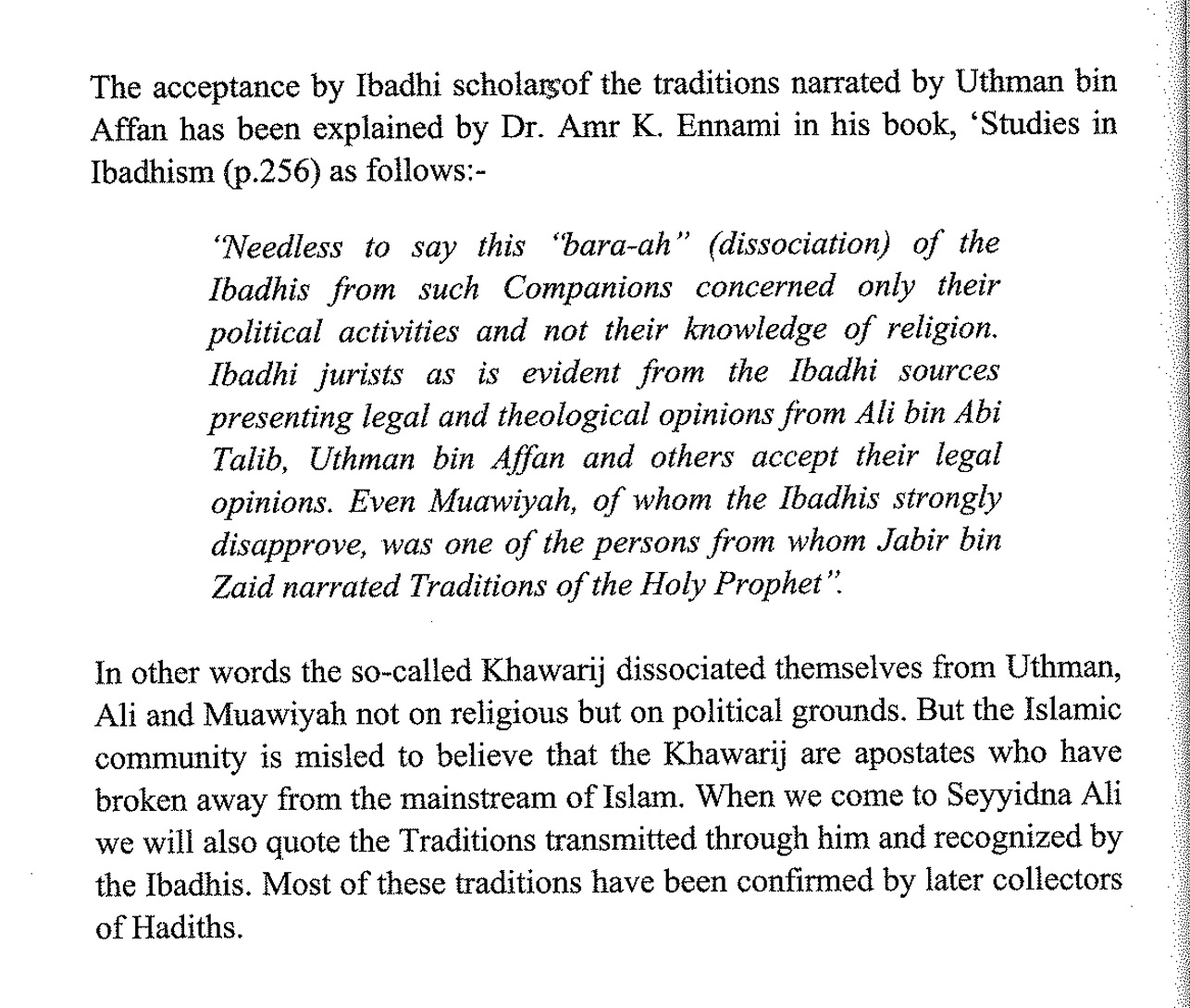
As Shaykh Soud H. Al Ma’awaly (May Allah continue to benefit us by him) mentioned above that Uthman, Ali and Muawaiyah are dissociated on political grounds, not theological grounds. So you will find transmissions from them.
The above are taken from Shaykh’s book: Ibadhism: The Cinderella Story of Islam.
https://primaquran.com/wp-content/uploads/2020/06/ibadhism-the-cinderella-of-islam.pdf
So, in regard to Uthman, there are two positions held among the Ibadi.
- Wuqoof. Suspend judgement. That is not to put Uthman in wilayah or bara’ah. To leave his matter to Allah.
- Bara’ah al-Dhahir – The apparent dissociation. This is a matter of jurisprudence. Uthman committed kufr ni’ma and there is no indication that he repented of his sins.
The Ibadi position on Uthman is that during the first part of his reign he was upon guidance, and it was good. However, gradually Uthman gave way to nepotism and corruption. Uthman was counseled many times by the believers.
The believers felt that he, as commander of the faithful, was duty-bound to be in service. From the perspective of those who revolted, so tone-deaf was Uthman to the cries of those who were suffering, those who were calling out inconsistencies in his administration that everything came to a head.
What started off as a protest became a full-blown insurrection. Once seen as a commander and servant of the faithful, Uthman, now a despot in the eyes of his companions, was violently deposed.
Ibadi authoritiesbased upon their research have report divergent attitudes held by companions concerning Uthman.
- Those who held that Uthman deserved to be killed by Muslims for his innovations. The Muslims tried for six years to make him change and keep the path of his predecessors or resign. When he refused to agree with them they kliled him. Among this group were the companions: Abdullah bin Masud, Ammar bin yasir, Abu Dharr, Al-Ghifari, Abdul Rahman bin Awf, Amr bin Muhammed bin Maslamah, and Zaid bin Thabit as well as most of the Ansaris. (Bara’ah al-Dhahir)
- Those who held that the question of civil war (fitna) was a matter of personal judgement (ijtihad) some even say that both sides were correct. (Wuqoof)
- Those who say that Uthman had repented for his innovations, and that he was killed after he repented, therefore his opponets were wrong. This was the opinion of the companions Talha, Al-Zubair and A’isha. (Walayah al-Dhahir)
- Those who reserved their opinion on the civil war and refused to take part in it. Among (Wuqoof) those were Sa’ad bin Abi Waqqas, Abdullah bin Umar, Muhammed bin Maslamah and others.
- Finally, the attitude of Mu’awiya and Amr bin Al’As who held that Uthman was right all the way and claimed revenge for his death. In fact, one thing you are not told is that those who went to fight Ali felt that he (Ali) had a hand in the death of Uthman. (Walayah al-Dhahir)
It is important to note there are no Khawarij at this time. The Ibadi school did not come about until much later.
A person has to be truly lacking in intelligence to think anyone alive today took part in that revolution. That was 1400 years ago. Which person alive today is that age? Secondly, what of the people who convert to Islam and adopt the school? What possible part did their non-Muslim ancestors play?
In the case of the Caliph Uthman, there were no sects when he was killed; but there had been general complaints from all the spectrum of society in the Islamic state. The Ibadi historians reiterated what those complaints were, which happened to be shared by many of the companions.
One of the secrets of the history of the people of truth and integrity is that if they appointed an imam after the advice of the people of the solution and the contract, the imam was their servant, and if he erred, they replaced him with another imam, and they never sanctified him and did not put him before the command of Allah.
This certainly seems to be the attitude of the sahabah, the first generation of Muslims.
First and foremost, it should be understood that the office of the Imamate or Caliphate has never been proven to be a position or post (for life).
For us, the office of the Imamate or Caliphate is like being the CEO of a company. If the CEO does well and manages the company well, it is good for everyone. If the CEO mismanages the company, it is unfortunate for everyone.
Part of our faith is an-naseehah (sincere advice). It is to be given to all Muslims, including the leadership. Thus, in the case of the CEO, he is advised by his board members, senior members and if he changes course, that is a good thing. It has khayer (goodness) and baraka (blessings) in it.
If he, the CEO, does not change course, he is asked to step down (peacefully) and if he does, no harm comes to him nor his family. Why should it?
Lastly, if the CEO does not change course after advice and after being asked to step down, then he is forcefully removed from office.
Two points of consideration and refutation of the lies said against this school.
Ibadis do not encourage revolts against the Imams. This is in order to avoid the obvious bloodshed that could result from such an undertaking.
The proof of the above is that the Ibadis had the third-longest running continuity of leadership in the history of the Muslims.
Which are the top 3 longest lasting Muslim empires/dynasties in terms of longevity & stability?
1. 1299-1922 Ottoman/Sunni/Hanafi = 623 years
2. 750-1258 Abbasid/Sunni/Hanafi = 508 years
3. 1154-1624 Nabhani/Ibadi = 470 years
The massive lie that Uthman was not removed by the companions of the Blessed Prophet (saw).
Do not be fooled by those who would lead you to think that Uthman was killed by some secret clan of ninjas, or delta force etc. It was the very companions of the Prophet (saw) that removed him.
In fact, one famous Salafi—Athari Shaykh—had choice words for a companion that stabbed Uthman in the chest 9 times. When that same Salafi-Athari Shaykh was informed that it was a companion who stabbed Uthman, he walked back his words!
(May Allah be pleased with them all) is the doctrine. At least of the Abbasid Sunnis, not so the Umayyad Sunnis.
Ibadis are the first group among the Muslims to accept the following as the first four caliphs: Abu Bakr-Umar-Uthman-Ali.
For the proto-Sunni -Umayyads, the first four caliphs are Abu Bakr-Umar-Uthman-Muaviya. None of the Umayyads put anyone after Uthman other than Muaviya. The proto-Sunnis kept the original Tashahhud, which did not include sending blessings upon the household of Ali.
The Abbasid Sunnis (those who are the majority today) the caliphs are: Abu Bakr-Umar-Uthman-Ali (in line with the Ibadis). These latter Sunnis accepted a modified Tashahhud which includes sending blessings upon the household of Ali.
Narrated by Ibn Mas`ud:
Allah’s Messenger (saw) taught me the Tashah-hud as he taught me a Sura from the Qur’an, while my hand was between his hands. (Tashah-hud was) all the best compliments and the prayers and the good things are for Allah. Peace and Allah’s Mercy and Blessings be on you, O Prophet! Peace be on us and on the pious slaves of Allah. I testify that none has the right to be worshipped but Allah, and I also testify that Muhammed is Allah’s slave and His Apostle. (We used to recite this in the prayer) during the lifetime of the Prophet (saw) , but when he had died, we used to say, “Peace be on the Prophet.”
Source: (https://sunnah.com/bukhari:6265)
The same happened over the meaning of the Āl Muḥammed
| Interpretation | Meaning |
|---|---|
| Broad / General | Āl Muḥammed refers to all believers, the ummah (community) of the Prophet. This interpretation is sometimes supported by the idea that the “family” of a prophet includes his followers in a spiritual sense. Thus, they are covered. |
| Specific / Narrow | Āl Muḥammed refers specifically to the Prophet’s blood relatives: ʿAlī, Fāṭimah, and their descendants (Ali’s children), often excluding those who were not part of the household, such as the Umayyad branch. This usually intends to exclude the Prophet’s descendants through his other daughters. |
You can imagine which version the Abbasis favoured.
Uthman was besieged by his companions.
Abu ‘Abdur-Rahman narrated:
When ‘Uthman (ra) was circled (by the rebels), he looked upon them from above and said, “Ias you by Allah, I ask nobody but the Companions of the Prophet (saw), dont you know that Allah’s Messenger (saw) said, ‘Whoever will (buy and) dig the well of Ruma will be granted Paradise,’ and I (bought and) dug it? Don’t you know that he said. ‘Whoever equips the army of ‘Usra (i.e., Tabuk’s Ghazwa) will be granted Paradise,’ and I equipped it ?” They attested whatever he said. When ‘Umar founded his endowment, he said, “Its administrator can eat from it.” The management of the endowment can be taken over by the founder himself or any other person, for both cases are permissible.
Source: (https://sunnah.com/bukhari:2778)
Dear readers. These words that you see in red: (by the rebels) are not in the Arabic text at all! The people who translate this are trying to deflect the fact that those who are besieging Uthman were the companions of the Prophet (saw). Think about it. He (Uthman) was alive. He is speaking to his companions.
It was narrated by Nafi` from Ibn `Umar, that Uthman (رضي الله عنه) looked out at his companions when he was under siege and said:
Why do you want to kill me? I heard the Messenger of Allah (saw) say: `It is not permissible to shed the blood of a Muslim man except in one of three cases; a man who commits zina after being married, so he is to be stoned, or a man who killed deliberately (committed murder), so he is to be killed in retaliation, or a man who apostatised after having become Muslim, so he is to be executed.” By Allah, I never committed zina either during the Jahiliyyah or in Islam, I never killed anyone such that my life should be taken in retaliation; and I never apostatised since [became Muslim bear witness that there is no god but Allah and that Muhammed is His slave and His Messenger,
Source: (https://sunnah.com/ahmad:452)
It is a wonder that Uthman did not shout from his house: “Oh, people who here remembered the Hadith of the ten promised paradise?” Think about it, dear reader. If there was such a narration and the Blessed Prophet (saw) said that you were one of the ten promised paradise, would you not carry this in your pocket everywhere you went?
This is the same situation with many of the conflated hadiths concerning Ali as well. See our article here:
Some of the historical collections have been very careful in how they try to narrate events. Observe the following:
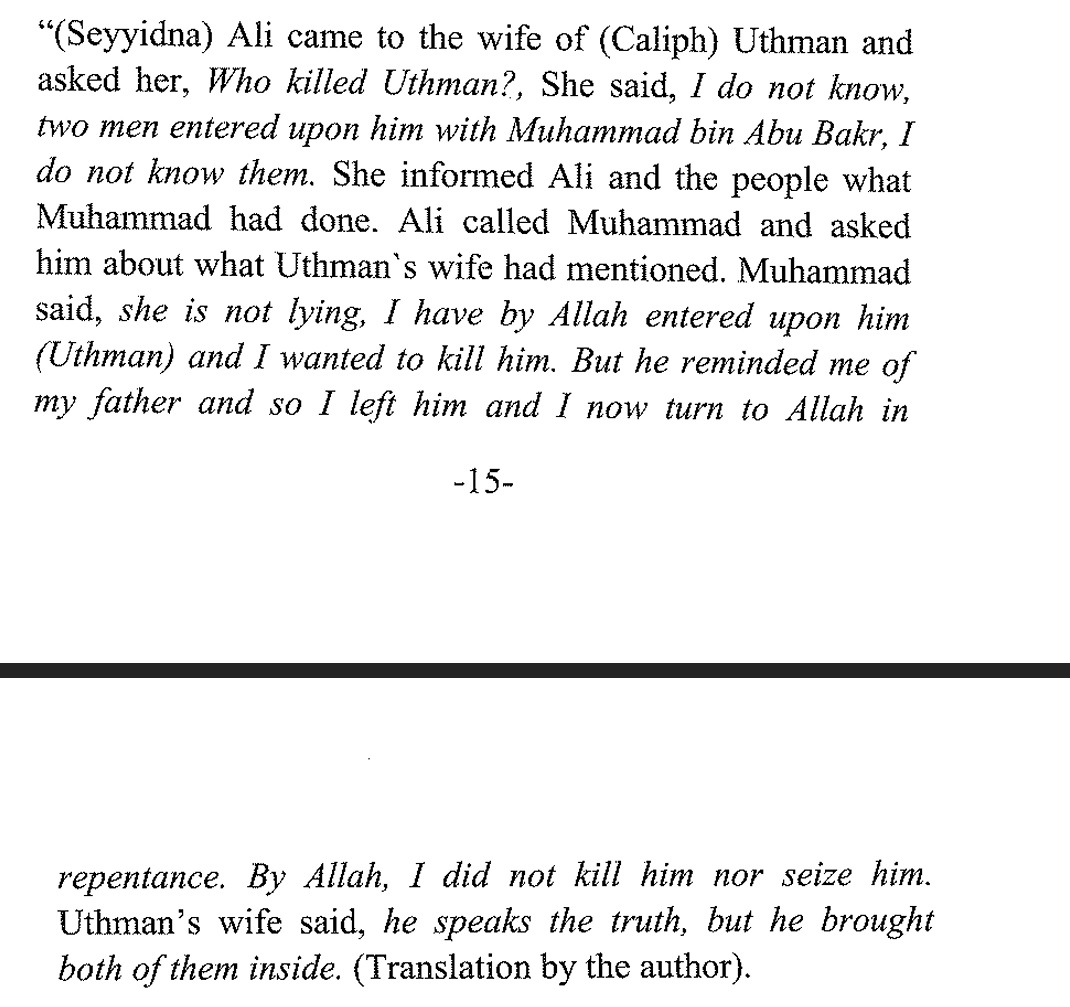
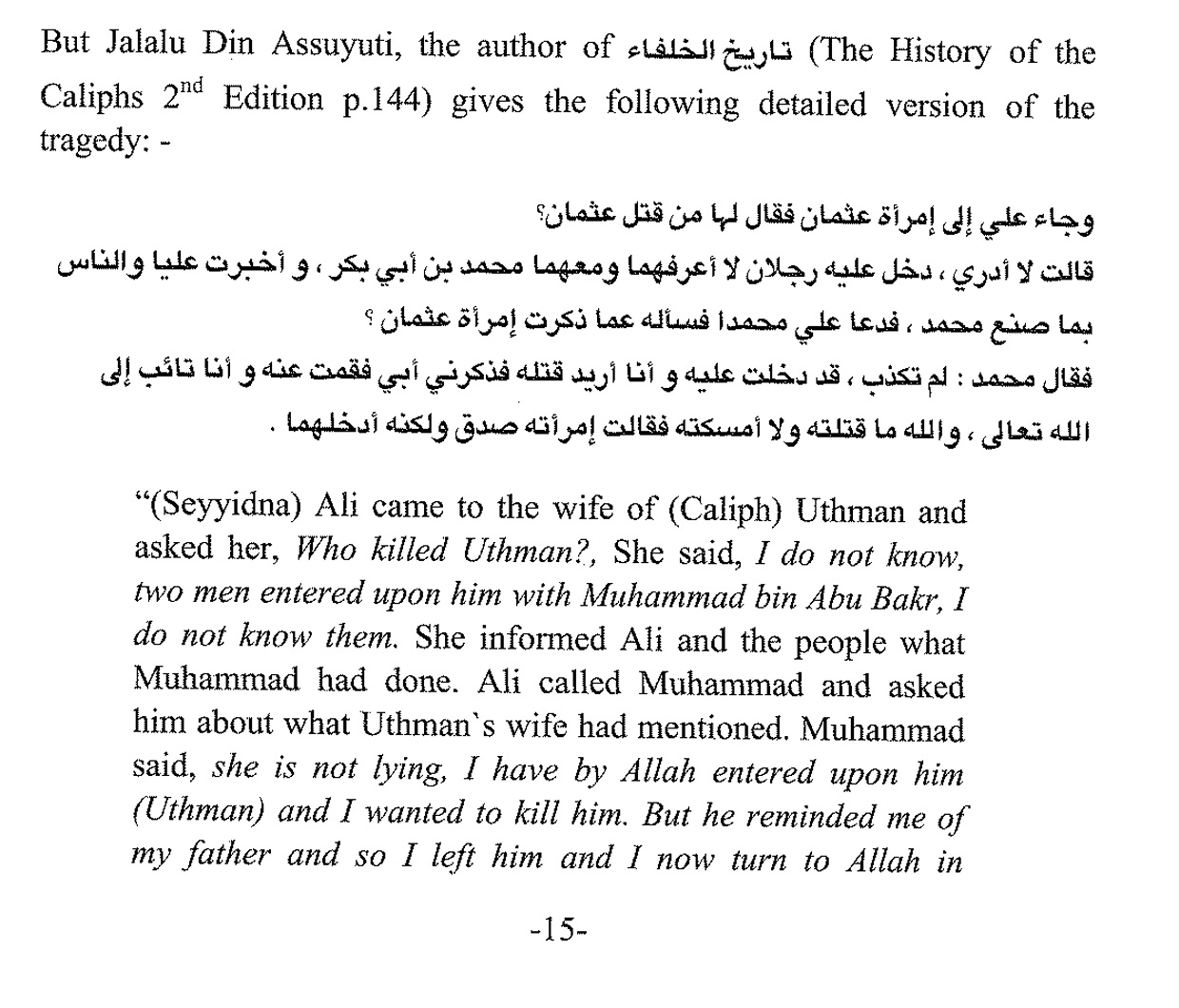
Source: Jalal al-Din al-Suyuti’s Tarikh al-Khulafa’ (تاريخ الخلفاء) History of the Caliphs
The Most Shocking Account of Historical Events.
“Ibn Asakir narrated by another route that az-Zuhri said: I said to Sacid ibn al-Musayyab, ‘Can you tell me how was the killing of Uthman? What were people up to and what was he up to? And why did the Companions of Muhammed (saw), fail to help him? Ibn al-Musayyab said, ‘Uthman was killed unjustly, whoever killed him was wrongdoing, and whoever failed to help him is free of blame.’ I said, ‘How was that?’ He said, ‘When Uthman was appointed, a group of the Companions disliked his appointment, because Uthman used to love his people. He ruled people for twelve years. He used to appoint people from Bani Umayyah who had not kept company with the Prophet (saw). His amirs used to produce matters which the Companions of Muhammed (saw) would repudiate. Uthman used to ask people to have good will for them and he would not remove them.”
“In the year 35 AH. During the six last years he chose in preference the tribe of his paternal uncle. He appointed them and did not let anyone share with them. He ordered them to fear Allah, he appointed Abdullah ibn Abi Sarh in charge of Egypt and he remained in control there for years. The people of Egypt came to complain of him and to complain of his wrongdoing. There had been slights before from Uthman to Abdullah ibn Masud, Abu Dharr and Ammar ibn Yasir. Banu Hudhayl and Banu Zuhrah had what they had in their hearts because of the state of Ibn Masud. Banu Ghifar, their allies and whoever was angry because of Abu Dharr, had in their hearts what they had in them. Banu Makhzum were furious at Uthman because of the condition of Ammar ibn Yasir. ‘The people of Egypt came to complain of Ibn Abi Sarh, so he wrote a letter to him in which he threatened him, but Ibn Abi Sarh refused to accept what Uthman forbade him, he struck one of those of the people of Egypt who came to him from Uthman, one of those who had gone to Uthman, and he killed him. Seven hundred men left Egypt and dwelt in the mosque (of Madinah). They complained to the Companions at the times of the prayers about what Ibn Abi Sarh had done. Talhah ibn Ubaydullah stood and addressed Uthman very severely. A’ishah (ra) sent a message to him saying, “The Companions of Muhammed (saw) came to you and they asked you to remove this man and you refused? This one has killed a man from among them so treat them with justice (in their complaint) against your governor.”
“Ali ibn Abi Talib came to him and said, “They are only asking you for a man in place of (in retaliation for) a man and they have claimed from him (retaliation for the spilling of) blood. Remove him from over them and give a (just) decision between them. If there is anything due against him, be just to them.” He (Uthman) said to them (the Egyptians), “Choose from amongst yourselves a man whom I shall appoint over you in his (Ibn Abi Sarh’s) place.” The people indicated to him Muhammed ibn Abi Bakr. They said, “Appoint Muhammed ibn Abi Bakr over us.” He wrote his covenant and appointed him. A number of the Muhajirun and Ansar went with them to look into that (dispute) which was between the people of Egypt and Ibn Abi Sarh. Muhammed went and those with him. When they were about three days’ journey from Madinah they came upon a black slave on a camel beating the camel so much that it was as if he was pursuing or being pursued. The Companions of Muhammed (saw), said to him, “What is your story? What is your business? It is as if you were fleeing or pursuing someone.” He said to them, “I am the slave of the Amir al-Mu’minin and he has directed me to the governor of Egypt.” A man said to him, “This (Muhammed ibn Abi Bakr) is the governor of Egypt.” He said, “It is not this one I want.” Muhammed ibn Abi Bakr was told of his affair and so he sent a man in search of him who took him and brought him to him. He said, “Slave, who are you?” He began to say, one time, “I am the slave of the Amir al- Mu’minin,” and another time, “I am the slave of Marwan,” until one man recognised that he was the slave of Uthman.”
“Muhammed said to him, “To whom are you sent?” He said, “To the governor of Egypt.” He said, “With what?” He said, “With a message.” He said, “Do you have a letter with you?” He said, “No.” They searched him and didn’t find a letter with him. He had with him an ewer which was dry, in which was something which moved about, so they moved it about to bring it out but it didn’t come out. They broke the ewer and there was a letter in it from Uthman to Ibn Abi Sarh. Muhammed gathered those with them of the Muhajirun, the Ansar and others, then he opened the letter in their presence. There was in it, “When Muhammed, so-and-so, and so-and-so come to you, then find a way to kill them, and declare this letter to be false. Uthman ibn Afan ( Consider yourself confirmed in your governorship until my advice on it comes to you, and imprison whoever tries to come to me to accuse you of wrongdoing. My advice on that will certainly come to you, if Allah wills.” ‘When they read the letter they were terrified. Then they became resolved and returned to Madinah. Muhammed sealed the letter with the signet rings of the group who were with him, and then entrusted the letter to a man who was with them.”
“Then they went to Madinah. There they gathered together Talhah, az-Zubayr, Ali, Sa’d, and whoever there was of the Companions of Muhammed (saw). He broke (the seals of) the letter in their presence, and told them of the story of the slave. They read out the letter to them, and none of the people of Madinah was left who was not enraged at Uthman. It only increased those who were angry because of Ibn Masud, Abu Dharr and Ammar ibn Yasir in fury and rage. The Companions of Muhammed rose and kept to their houses. There was no-one among them who was not incoherent when he read the letter. The people besieged Uthman in the year 35 AH, and Muhammed ibn Abi Bakr raised Bani Taym and others against him.”
“When Ali saw that, he sent for Talhah, az-Zubayr, Sa’d, Ammar and a group of the Companions, all of whom were at Badr. Then he went in to Uthman, with him the letter, the slave and the camel. Ali said to him, “This slave is your slave?” He said, “Yes.” He said, “And the camel is your camel?” He said, “Yes.” He said, “Then you wrote this letter?” He said, “No,” and he swore an oath, “By Allah I did not write this letter, I did not order it, and I had no knowledge of it.” Ali said, “The seal is your seal?” He said, “Yes.” He said, “How does your slave go out on your camel, with a letter upon which is your seal, and you know nothing about it?” He swore again, “By Allah, I did not write this letter, I didn’t order it, and I never directed this slave to go to Egypt.” As for the handwriting, they recognised that it was that of Marwan, and they came to doubt as to Uthman. They demanded that he should give them Marwan and he refused, while Marwan was with him in the house. The Companions of Muhammed (saw) left him in anger, and in doubt about his affair. They knew that Uthman would not swear an oath that was false, but people said, “Uthman will never be free of guilt in our hearts unless he hands Marwan over to us for questioning, so that we know the situation of the letter, and how he could order the killing of a man of the Companions of Muhammed (saw) without right. If ‘Uthman wrote it, we will remove him from office. If Marwan wrote it as if it had been written by Uthman, then we will have to look seriously at what we shall do in the case of Marwan.”
“They stuck to their houses, and Uthman refused to send Marwan out to them, for he feared that he would be killed. People continued laying siege to Uthman, and they prevented water (from reaching him). He looked over the people (from an upper floor) and said, “Is Ali among you?” They said, “No.” He said, “Is Sa’d among you?” They said, “No.” He was silent and then he said, “Will no-one reach Ali and ask him to get us water to drink?” That reached Ali, so he sent him three water-skins full of water, but they almost didn’t reach him. Because of them a number of the freed slaves of Banu Hashim and Banu Umayyah were wounded in the course of the water getting to him. ‘It reached Ali that it was intended to kill Uthman, and he said, “We only want Marwan from him. As for the killing of Uthman, no!” He said to al-Hasan and al-Hussein, “Go with your two swords and stand at the door of Uthman and allow no-one to reach him.” | Then az-Zubayr sent his son, Talhah sent his son and a number of the Companions of the Prophet (saw) sent their sons to prevent people getting to Uthman, and to demand the surrender of Marwan.”
“When people saw that, they shot arrows against the door of Uthman until al-Hasan ibn ‘ Ali was reddened with blood at his door, an arrow struck Marwan while he was in the house. Muhammed ibn Talhah was smeared with blood and also Qanbar, the freed slave of Ali, was wounded in the head. ‘Muhammed ibn Abi Bakr was afraid that Banu Hashim would become angry because of the state of al-Hasan and al-Hussein and provoke a tumult. He took the hands of two men and said to them, “If Banu Hashim come and see blood on the face of al-Hasan they will remove these people from around Uthman and what we wanted will be rendered useless. Let us go and scale the wall of the house and kill him, without anyone knowing about it.” Muhammed and his two men got over the wall from the house of a man of the Ansar and entered Uthman’s house, without any of those who were with him (Uthman) knowing, because everyone with him was up above the houses (on the roofs). There was no-one with him but his wife. Muhammed said to the two of them, “Stay where you are, because his wife is with him, until I first enter. When I have taken hold of him, then you come in and strike him until you have killed him.” Muhammed went in and took hold of his beard, and Uthman said to him, “By Allah, if your father could see you, your behaviour to me would cause him great distress,” and so his hand slackened (and he held back), and then the two men entered and struck him until they had killed him. ‘They went out in flight by the same way that they had come in, and his wife cried out, but her cry was not heard in the house because of the commotion in the house. His wife went up to the people and said, “The Amir al-Mu’minin has been killed!” The people entered and they found him slaughtered. The news reached Ali, Talhah, az- Zubayr, Sa’d and whoever was in Madinah and they went out – and their intellects had gone, because of the news which had come to them — until they came in to Uthman and found him killed. They repeated again and again, “Truly we belong to Allah and truly we are returning to Him.” Ali said to his two sons, “How was the Amir al-Muminin killed while you two were at the door?” He raised his hand and slapped al-Hasan, struck the chest of al-Hussein, abused Muhammad ibn Talhah and Abdullah ibn az-Zubayr, and went out – enraged – until he came to his house.”
Source: (The History of the Khalifahs who took the right way by Jalal ad-Din as-Suyuti translated by Abdassamad Clarke pgs 167 to 173)
Prima Qur’an comments: First take a deep breath. Take time to process what you just read. It certainly is a very creative piece of narrative writing. Especially given that this is done in retrospect. Keep in mind we have to protect the doctrine of ʿadālah aṣ-ṣaḥābah‘. Marwan ibn al-Hakam becomes the fall guy, and of course, he gets removed from the list of companions. All too convenient. Fits very nicely and dovetails into ʿadālah aṣ-ṣaḥābah‘. With the Umayyads out of the picture, using Marwan ibn al-Hakam as a plot device makes perfect sense.
However, we would like to draw the reader’s attention to some all too revealing points in the above account.
The first plot device.
The mysterious letter.
“When Muhammed, so-and-so, and so-and-so come to you, then find a way to kill them, and declare this letter to be false. Uthman ibn Afan (Consider yourself confirmed in your governorship until my advice on it comes to you, and imprison whoever tries to come to me to accuse you of wrongdoing.“
Notice: and declare this letter to be false? That doesn’t seem like thinking ahead. It’s as if the person knows the letter will be discovered. Notice that the letter is to the governor, Ibn Abi Sarh. So the letter instructs Ibn Abi Sarh to deny the letter after he receives it, which would be pointless. Simply destroy the letter duh! Also, if Ibn Abi Sarh is the type of person to just kill those under his rule, why the hell would he need to explain a letter to anyone?
Second plot device.
Forensic science.
“As for the handwriting, they recognised that it was that of Marwan, and they came to doubt as to Uthman.” As if they are forensic scientist!
Then just a little further down.
“If ‘Uthman wrote it, we will remove him from office. If Marwan wrote it as if it had been written by Uthman, then we will have to look seriously at what we shall do in the case of Marwan.”
So which is it? Did these forensic scientist recognize that the handwriting was that of Marwan or are they still wrangling over the possibility that Uthman really did write the letter and was lying. Really shows you what some of them thought of Uthman!
Third plot device.
Who are the two that killed Uthman?
“He said to al-Hasan and al-Hussein, “Go with your two swords and stand at the door of Uthman and allow no-one to reach him.”
“Muhammed ibn Abi Bakr was afraid that Banu Hashim would become angry because of the state of al-Hasan and al-Hussein and provoke a tumult. He took the hands of two men.“
“Muhammed and his two men got over the wall from the house of a man of the Ansar and entered Uthman’s house.“
“Muhammed said to the two of them.”
“Then the two men entered and struck him until they had killed him.“
“Ali said to his two sons, “How was the Amir al-Muminin killed while you two were at the door?” He raised his hand and slapped al-Hasan, struck the chest of al-Hussein.”
Now does it become clear to you who these two anonymous men were? It is right there in the text, and they are not even hiding it from you.
Dear readers, this Ummah has been besieged by the ongoing conflicts between Ali’s kids and the Banu Umayya. Both sides are sanctimonious hypocrites. If it was up to them, they would have some far off Amazonian tribe join Islam and then swear fealty to bloodlines, and this or that Arab tribe.
People come to Islam because it gives them clarity. It tells them who Allah is. It brings peace to their lives. It brings order out of chaos. The sunnah of the Blessed Prophet (saw) is blessing and light. The Qur’an is guidance and healing. So we say to the Banu Umayya and to the Banu Hashim, Enough! You can both stick it where the sun doesn’t shine!
We are thankful to our teacher, Shaykh Masoud bin Muhammed Al Miqbali (hafidullah) for explaining the truth to the people!
TRANSCRIPT FROM THE SHAYKH.
“Moreover, before this there was manifest evil from Uthman towards Abdullah bin Masoud, Abi Thar, and Ammar bin Yasir.” “The people of Uthail and the people of Zuhra had in their hearts grieved concerning the condition of Ibn Masoud.” “And the tribe of Ghifar and it’s allies and all of them had rage in their hearts for what happened to Abu Thar.” “And the tribe of Makhzum were enraged against Uthman for the condition of Ammar bin Yasir.” –Shaykh Masoud bin Muhammed Al Miqbali (h)
“It says, “Uthman remained for three days not buried and then Hakim ibn Hizam Al Qurashi and Jubayr ibn Muṭʽim talked to Ali to allow his burial and he allowed it.” So the final decision was with Ali. And Hakim ibn Hizam and Jubayr ibn Mut’im talked to Ali to allow his burial. “And Hakim ibn Huzam and Jubayr ibn Mu’tim went and talked to allow, “allow”, his burial. What does this phrase mean? “Allow?!”-Shaykh Masoud bin Muhammed Al Miqbali (h)
What do you understand from their act of talking to Ali to allow his burial so he allowed? What do you understand from that?
Food for thought.
Ali did not wash Uthman for burial nor did he pray the funeral prayer over him.
“When those seeking him (Uthman) heard that, they stood along the way with rocks [to throw at his janaza] and few family members of Uthman accompanied his body. The people of Medina didn’t leave for his janaza, the people of Medina, the armies of which flattened the Persians and the Romans in the life of the Prophet (saw) and the life of the two Caliphs before, they were completely unconcerned with the burial of Uthman!” –Shaykh Masoud bin Muhammed Al Miqbali (h)
“This is what your books say Oh Dr., this is not an Ibadi book. This is a book from the books which you trust and depend on. ” –Shaykh Masoud bin Muhammed Al Miqbali (h)
“And from those who did not bother with the burial is Al Zubayr, and Al Hassan and Abu Jahm and Hudaifa and Marwan, between Maghrib and Isha, and they brought him to a wall from the walls of Madina called, ‘Hash Kawkab’ and it’s outside of Baqee’ and Jubayr bin Mut’im prayed over him.” –Shaykh Masoud bin Muhammed Al Miqbali (h)
Ali bin Abi Talib did not wash the dead body of Uthman nor did he pray over him.
Ali bin Abi Talib didn’t pray over him, Ali didn’t pray the janaza over Uthman, even though he exists.
“And it was said Hakim ibn Hizam and it was said that Marwan, and the people from the Ansar, Al Andar which the Prophet (saw) advised us concerning: “And people from the Ansar approached to stop them from praying the janaza, then they let them be for fear of fitnah.” –Shaykh Masoud bin Muhammed Al Miqbali (h)
“There were people from the Ansar who wanted to stop them from praying on him.
And Ali went to those sitting on the way wanting to throw stones at Uthman’s body and he stopped them. “And he was buried in Hash Kawkab’ “Meaning that he wasn’t buried in Al Baqee’. They were stopped from burying him in Al Baqee’.” “And when Muawiyah bin Abi Sufyan was in charge he ordered that the wall be crushed and so it was. And he was entered into Al Baqee.” “And he ordered the people, so they buried the dead near his grave till the grave eventually connected to the graves of Muslims.” –Shaykh Masoud bin Muhammed Al Miqbali (h)
“And it was said that he was buried in Al Baqee’ near Hash Kawkab and it was said that his Janaza was attended by Ali and Talha and Zaid bin Thaib and Ka’b bin Malik, the general population and then from his companions. “And it was said that they didn’t perform ghusl on him and he as shrouded in his clothes.” “These are your books which testify to and speak about that.” -Shaykh Masoud bin Muhammed Al Miqbali (h)
“These are the stances of the sahaba. And in the book: “Tarikh Al-Khulafa” for Al Sayuti: “and narrated from Abi Al Tufayl Amr bin Wa’ila the companion that he entered on Muawiya, so Muawiya asked him: “Are you not from the killers of Uthman? He said: No, but I’m from those who were present but didn’t support him.” He said: “And what stopped you from helping him? He said: “The Muhajiroon and the Ansar didn’t support him.” -Shaykh Masoud bin Muhammed Al Miqbali (h)
“So the list is long. “If I wanted to narrate to you all those who stopped on Uthman. From them is Ammar bin Yasir. Ammar bin Yasir, the one who’s stomach was stomped on by Uthman’s leg, causing him severe pain. And a whole bunch of sahabah, I can narrate you a list with those that your books mention. For example: al-Isaba from Ibn Hajar and al-Usd al-ghābah from Ibn al-Athir, and at-Tabaqat from Ibn Sa’d and many other books which you trust and depend upon. They mentioned who did Khuruj on Uthman and who faced him and declared his deviance and so on.” -Shaykh Masoud bin Muhammed Al Miqbali (h)
The Case of the Governor of Egypt: Abdullah bin Abi Al Sarh
Let’s talk about this Abdullah bin Abi Al Sarh for a moment. Uthman in his prudent wisdom, gave control of the governorship to Abdullah bin Abi Al Sarh.
Abdullah bin Abi Al Sarh. This companion embraced Islam than left Islam and claimed that he was actually a Prophet! So not only was this a matter of leaving Islam, the man was clearly involved in the sedition of the highest magnitude for the fledgling community.
Source: (Abd al-Ghani al-Ghanimi al-Maydani, Sharh al-‘Aqida al-Tahawiya. Damascus: Dar al-Fikr, 1988, p. 124)
Narrated Sa’d:
“On the day when Mecca was conquered, the Messenger of Allah (saw) gave protection to the People except for four men and two women, and he named them. Ibn Abi Sarh was one of them. He then narrated the tradition. He said: Ibn Abi Sarh hid himself with Uthman ibn Affan. When the Messenger of Allah (saw) called the people to take the oath of allegiance, he brought him and made him stand before the Messenger of Allah (saw). He said: Messenger of Allah, receive the oath of allegiance from him. He raised his head and looked at him three times, denying him every time. After the third time he received his oath. He then turned to his Companions and said: Is not there any intelligent man among you who would stand to this (man) when he saw me desisting from receiving the oath of allegiance, and kill him? They replied: We do not know, Messenger of Allah, what lies in your heart; did you not give us a hint with your eye? He said: It is not proper for a Prophet to have a treacherous eye.”
Source: (https://sunnah.com/abudawud:2683)
So out of all the people that Uthman ibn Affan could have appointed governor of Egypt he appointed his own brother (Abdullah bin Abi Al Sarh) (through breast feeding), and one whom the Blessed Messenger (saw) would not have minded at all if he was killed for his treachery.
The Case of Al-Walid ibn Uqba.
He is also the half brother of Uthman ibn Affan. Al-Walid ibn Uqba converted to Islam only after the Blessed Messenger (saw) conquered Mecca. When it was obvious that Islam was the victor over the polytheist.
Uthman appointed al-Walid bin Uqba b bi Mua’ayt over Kufa Al-Walid led the people in the morning prayer while drunk, making four prostrations; then he vomited in the mihrab and turned to those praying behind him and said, Shall I give you more?”
“When al-Walid arrived (in Medina) , Uthman said, “Who will flog him?” The people held back due to al-Walid’s kinship. He was Uthman’s half-brother on his mother’s side. ‘Ali then rose up and flogged him. Later Uthman sent al-Walid to be in charge of collecting the alms payments (sadaqat) from the tribes of Kalb and Balqayn.”
Source: (The works of Ibn Wadih Al-Yaqubi An English Translation volume 3 pg. 800-801)
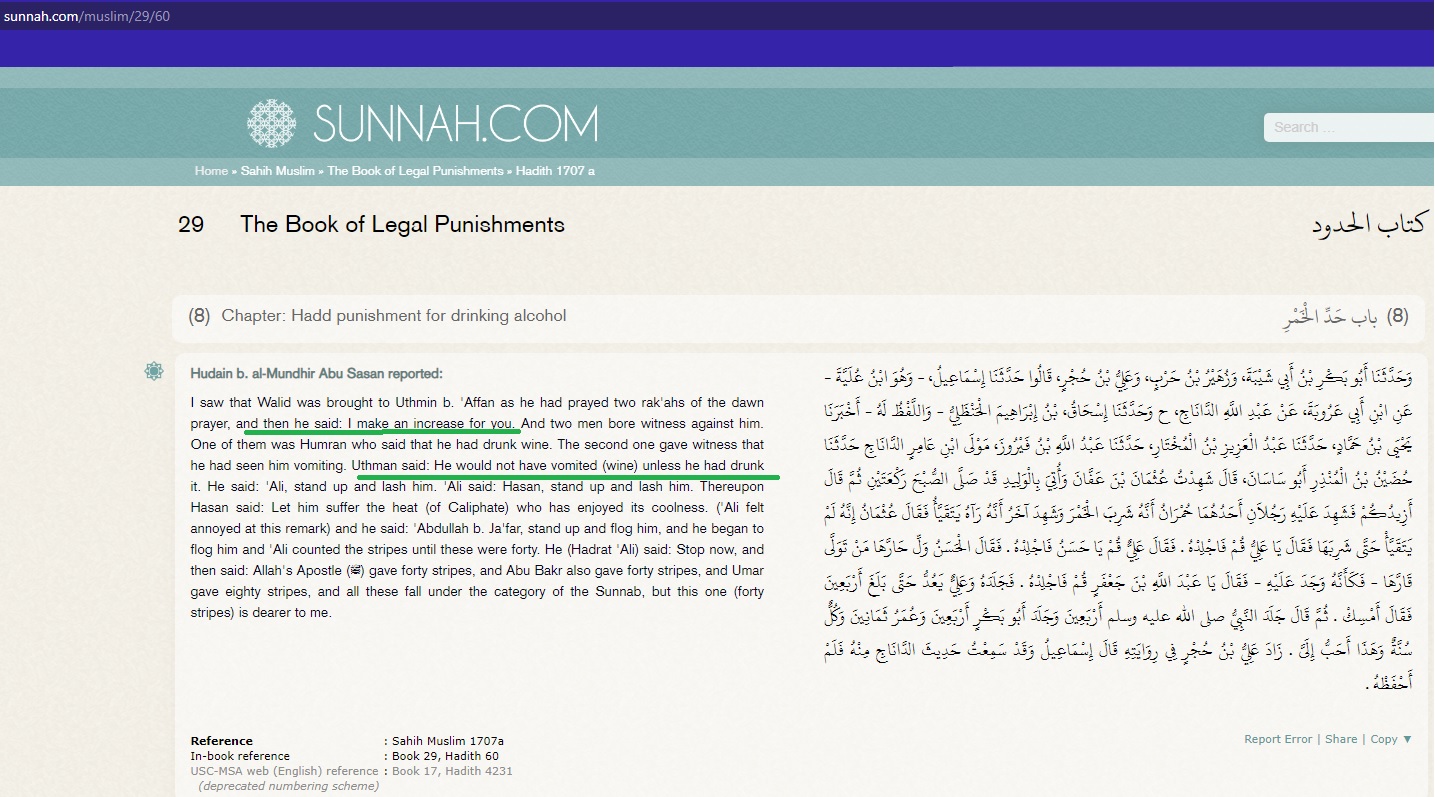
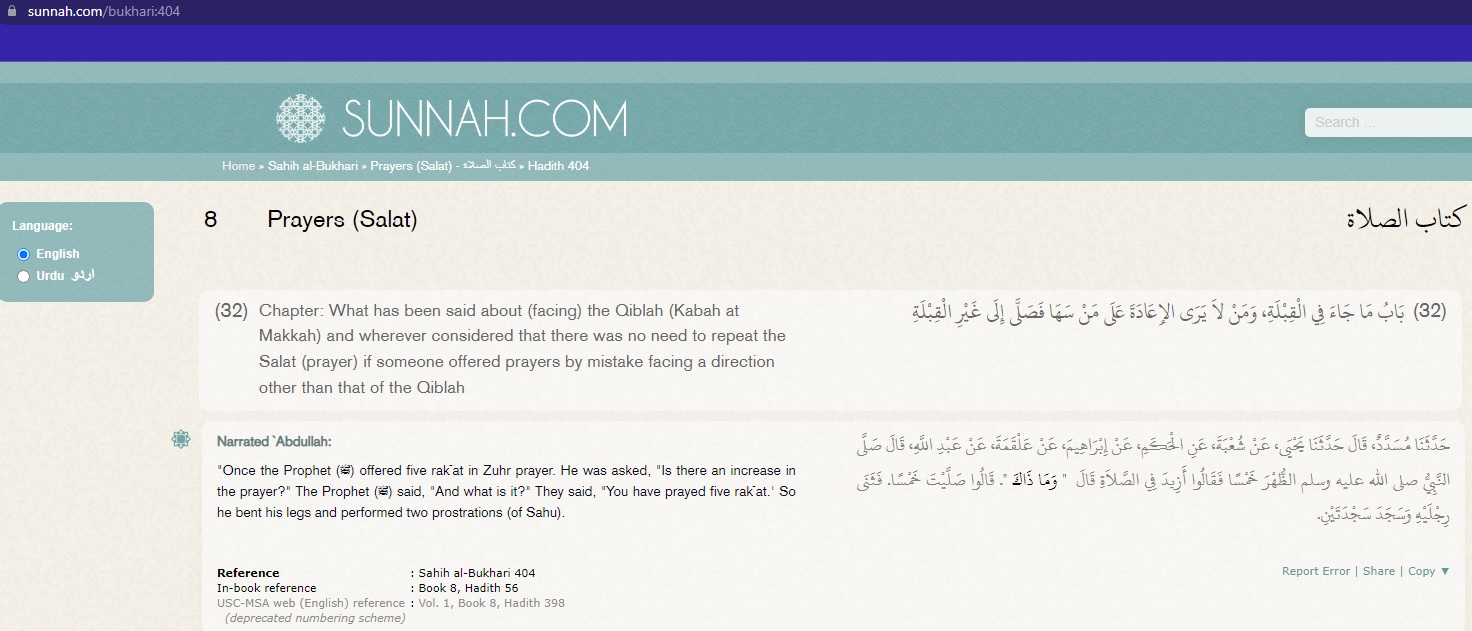
Source: (https://sunnah.com/muslim:1707a) Source: (https://sunnah.com/bukhari:404)
Prima Qur’an Comments:
What is interesting is the report from Al-Yaqubi, a Shi’i historian, as well as the hadith in Bukhari (a Sunni hadith collection).
Now, of course, a big difference is the chains of transmission.
Woefully absent from Yaqubi’s telling. In Yaqubi’s telling, Ali is decisive and doesn’t hesitate to whip Uthman’s brother. Whereas in the Hadith, Ali refuses a direct order from the commander of the faithful. Ali passes the order to his eldest son Hasan, who refuses the order of his father (this annoys Ali), until finally Ali instructs Abd Allah ibn Ja’far (Ali’s nephew) to flog him.
In Yaqubi’s telling, Al-Walid ibn Uqba increases the rakats to 4, whereas in the hadith transmission the number is not disclosed, if any. Also, the way Al Walid presents himself is as if he is mocking the well-known occasion where the Blessed Messenger (saw) accidently performed an extra rakat in prayer.
The Shi’i don’t narrate this because it comes back to damage to their doctrines.
The case of Al Hurmazan and Ubayd Allah ibn Umar
“The people talked much about the blood of al-Hurmuzan and Uthman’s withholding of Ubaydallah b Umar. Uthman therefore ascended the pulpit and addressed the people. He said: I am indeed the guardian (wali) of al-Hurmuzan’s blood: I have granted it to Allah and to ‘Umar, and have relinquished it for ‘Umar’s blood.”
Al-Miqdad Bin Amr rose up and said: “Al-Hurmuzan was a client (mawla) of Allah and His Messenger. it is not up to you to grant that which belongs to Allah and His Messenger.” Uthman said, “We see things our way and you see things your way.” Uthman then sent Ubayd Allah ibn Umar out of Medina to Kufa and settled him in a residence; the place came to be called: “Kuwayfat Ibn Umar” after him.
This became a huge grievance against Uthman Ibn Affan. Al-Hurmuzan was killed without judicial process and he was a Muslim!
By withholding of Ubayd Allah ibn Umar from punishment for having killed al-Hurmuzan, the Persian general who been granted protection as a Muslim. Ubayd Allah ibn Umar killed al-Hurmuzan because he suspected him of involvement with his father’s assassin. Because al-Hurmuzan’s involvement was not proved, and because he had no heirs to take vengeance on his behalf, the onus fell on Uthman as head of the community. Uthman’s decision not to exact blood vengeance by killing Umar’s soon, and to accept blood money (which he paid himself) caused controversy.
It is also little wonder that Ubayd Allah ibn Umar fought on the side of Muaviyah at Siffin, against Ali. Rather or not, that was loyalty/treachery for Uthman, sparing him depends on whose side you were on and how you look at it.
Sources: (al-Tabari, Tarikh,1:2795-2797 & Al-Baladhuri Ansab, IV/1, 510 (where Ali is mentioned as explicitly demanding the death of Ubayd Allah ibn Umar via qisas.).
Apparently it’s O.K. for Al Miqdad Bin Amr to say to Caliph Uthman: “Al-Hurmuzan was a client (mawla) of Allah and His Messenger. It is not up to you to grant that which belongs to Allah and His Messenger.“
However, for some reason, it’s not O.K. for the Sahaba to say to Caliph Ali: “It is not up to you to grant which belongs to Allah,” at the battle of Siffin. Double standards much?
Al-Miqdad bin Amr also had a famous Qira’at of the Qur’an that is attributed to him. The Qira’at of Miqdad! He married Duba’ah Bint Al-Zubayr, the relative of the Blessed Messenger (saw), the daughter of his (saw) paternal uncle.
Al-Miqdad Bin Amr is the companion that Ali used to speak about concerning a condition some consider to be: Urethritis.
Urethritis is a bacterial infection that is sexually transmitted and causes frequent urination and/or discharge. In fact, there are so many reports from Al-Miqdad with regard to Ali’s frequent release of madhi.
They have been used in a polemical sense. One being that Ali really had no control over himself at all. The counter to that is that he (Ali) had a high amount of testosterone.
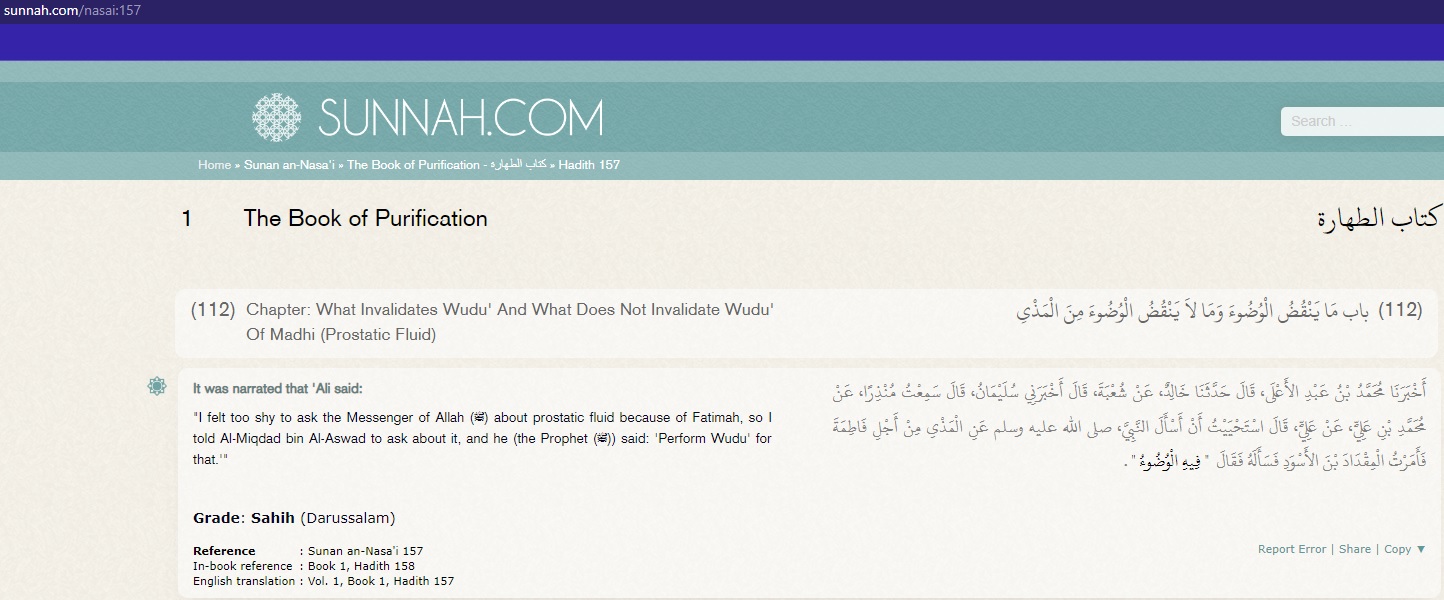
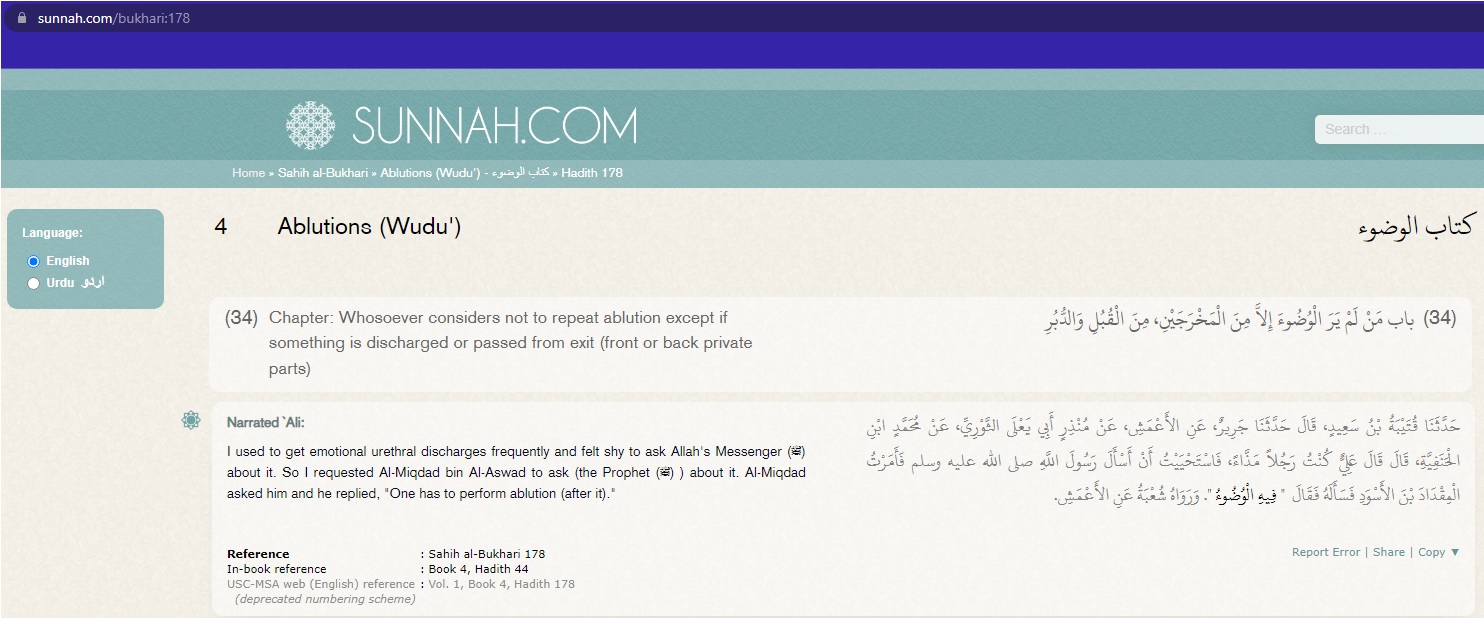
Source: (https://sunnah.com/nasai:157) Source: (https://sunnah.com/bukhari:178)
The case of Abdullah Ibn Mas’ud
Of the tribe of Hudhayl. This is the companion whom the Blessed Messenger (saw) spoke about when he said:
Narrated Masriq:
`Abdullah bin `Amr mentioned `Abdullah bin Masud and said, “I shall ever love that man, for I heard the Prophet (saw) saying, ‘Take (learn) the Qur’an from four: `Abdullah bin Mas’ud, Salim, Mu`adh and Ubai bin Ka`b.’ “
Source: (Sahih al-Bukhari 4999)
Uthman Ibn Affan withheld the pension and salary of Abdullah Ibn Mas’ud for two years.
Source: (History of Ibn Kathir 7/163 and al- Mustadrak 3/13)
“Abdullah Ibn Mas’ud entered the mosque while Uthman was giving the sermon. Uthman said, “Truly an evil beast has come to you!” When Ibn Mas’ud spoke harshly to Uthman, Uthman gave orders, and he was dragged away by his foot, so that two of his ribs were broken. When A’isha spoke up and said many things, Uthman sent her to the Ansar.”
Source: (al-Baladhuri, Ansab, IV/1, 524-526, and The Works of Ibn Wadih Al Ya’qubi volume 3, pages 810-811)
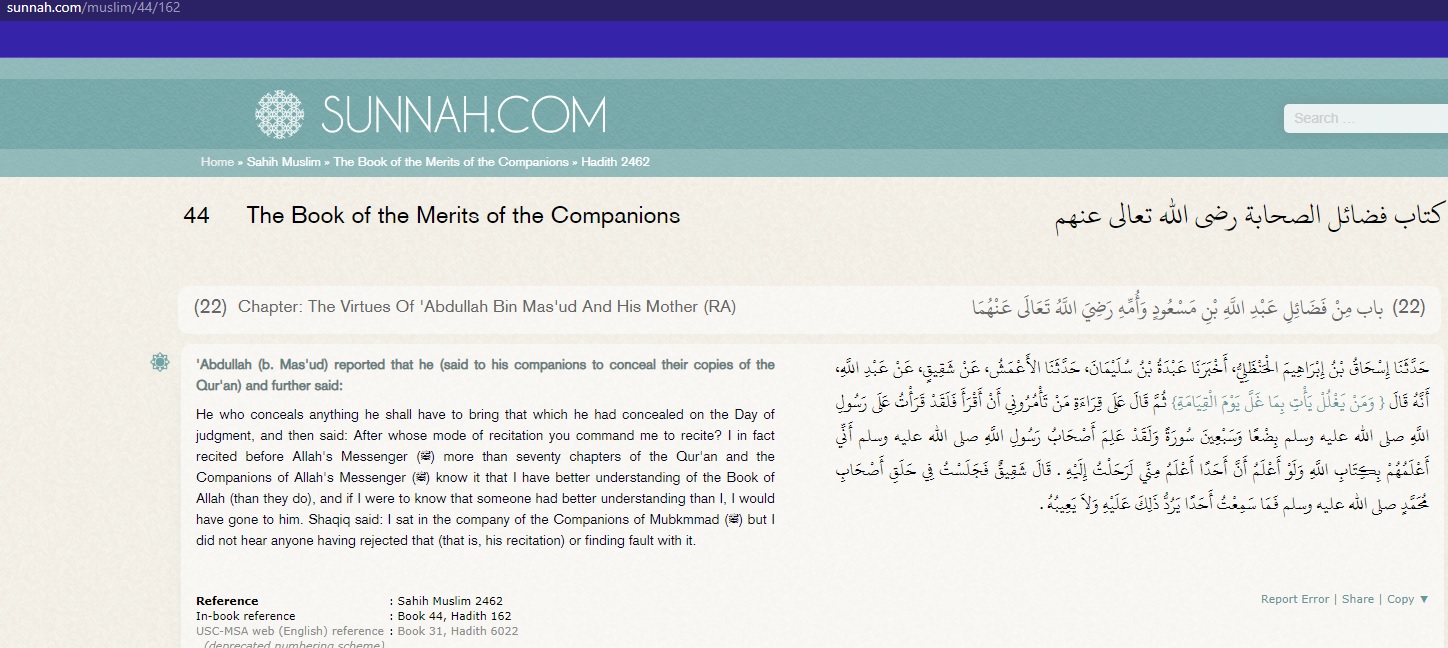
Source:(https://sunnah.com/muslim:2462)
The case of Abi Thar/Abu Dharr
From the tribe of Ghifar
Narrated ‘Abdullah bin ‘Amr:
That the Messenger of Allah (saw) said: “There is no one more truthful, that the sky has shaded, and the earth has carried, than Abu Dharr.”
Source: (https://sunnah.com/tirmidhi:3801)
Abu Dharr had begun his agitation in Medina after Uthman had given 500,000 dirhams to Marwan I, 300,000 to al-Harith ibn al-Hakam, and 100,000 to the Medinan Zayd ibn Thabit from the khums of the booty seized in Africa in 27/647. He then quoted relevant Qur’anic passages threatening the hoarders of riches with hell-fire. Marwan complained to Uthman, who sent his servant Natil to warn Abu Dharr, but to no avail. Uthman displayed patience for some time until, in the presence of the caliph, Abu Dharr launched an angry verbal attack on Ka’ab al-Ahbar, who had backed Uthman’s free use of public money. Uthman now chided Abu Dharr and sent him to Damascus.
Historians have recorded Uthman’s letter to Mu’awiya. When Mu’awiya sent a report against Abu Dharr from Syria, Uthman wrote to him, “Send Jundub (Abu Dharr) to me on an unsaddled camel, alone, with a harsh man driving it day and night.” When he reached Medina, Abu Dharr’s legs were bruised and bleeding.
Sources: (Ibn Sa’d, in his Tabaqat, Volume IV, page 168 & Ibn Athir’s al-Nihayah fi Garib al-Hadith wa al-Athar)
“Words were exchanged between Ali and Uthman on account of this, so much so that Uthman said, As far as I am concerned, you are no better than he!” -and they spoke coarse words to each other. People criticized what Uthman had said and intervened between the two until they made peace.”
Source: (Al-Baladhuri, Ansab, IV/1, 544)
“When Uthman learned of Abu Dharr’s death, he said: “May Allah have mercy on Abu Dharr.”
Ammar b Yasir replied: “Yes, may Allah have mercy on Abu Dharr more than us!” This annoyed Uthman.
Source: (Al-Baladhuri Ansab, IV/1,545)
Was Abu Dharr subtly accused of being a deviant by Mu’awiya?
Notice Abu Dharr’s ingenious way he deals with it. So Mu’awiya asked Abu Dharr to list down the deviants in Damascus. Abu Dharr knows that the only people who know them are those who associate with them. Hence, his reply: “What do I have to do with the deviants of Damascus and how would I know them?”
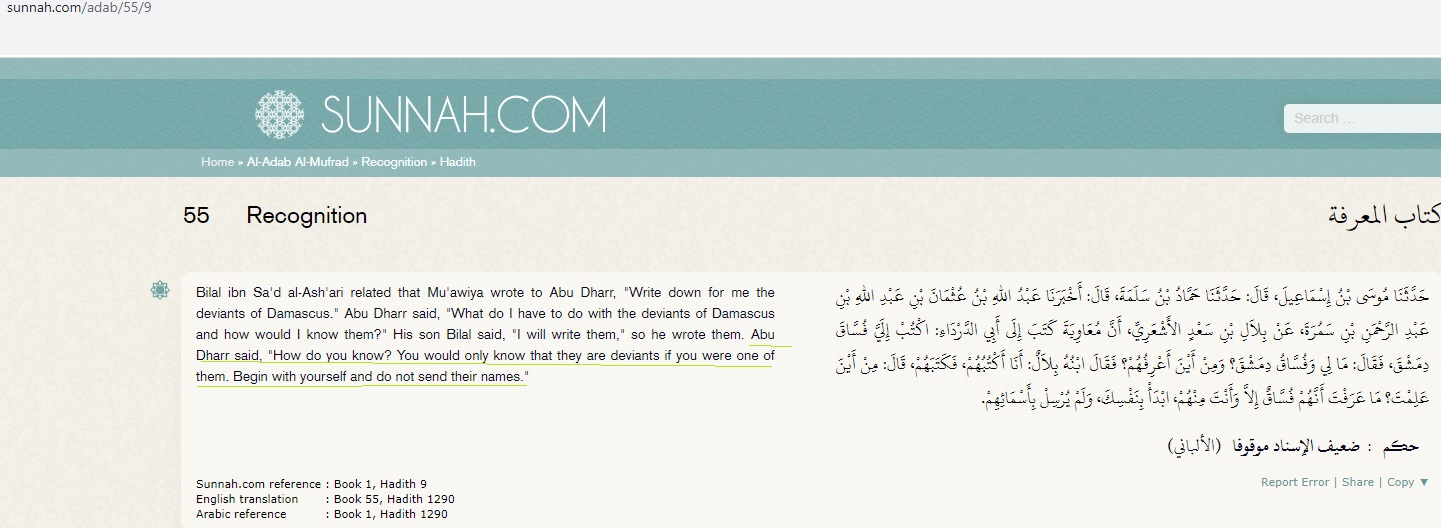
Source: (https://sunnah.com/adab/55/9)
Hadith reports where Abu Dharr chided Uthman and those who hoard wealth.
Narrated Zaid bin Wahab:
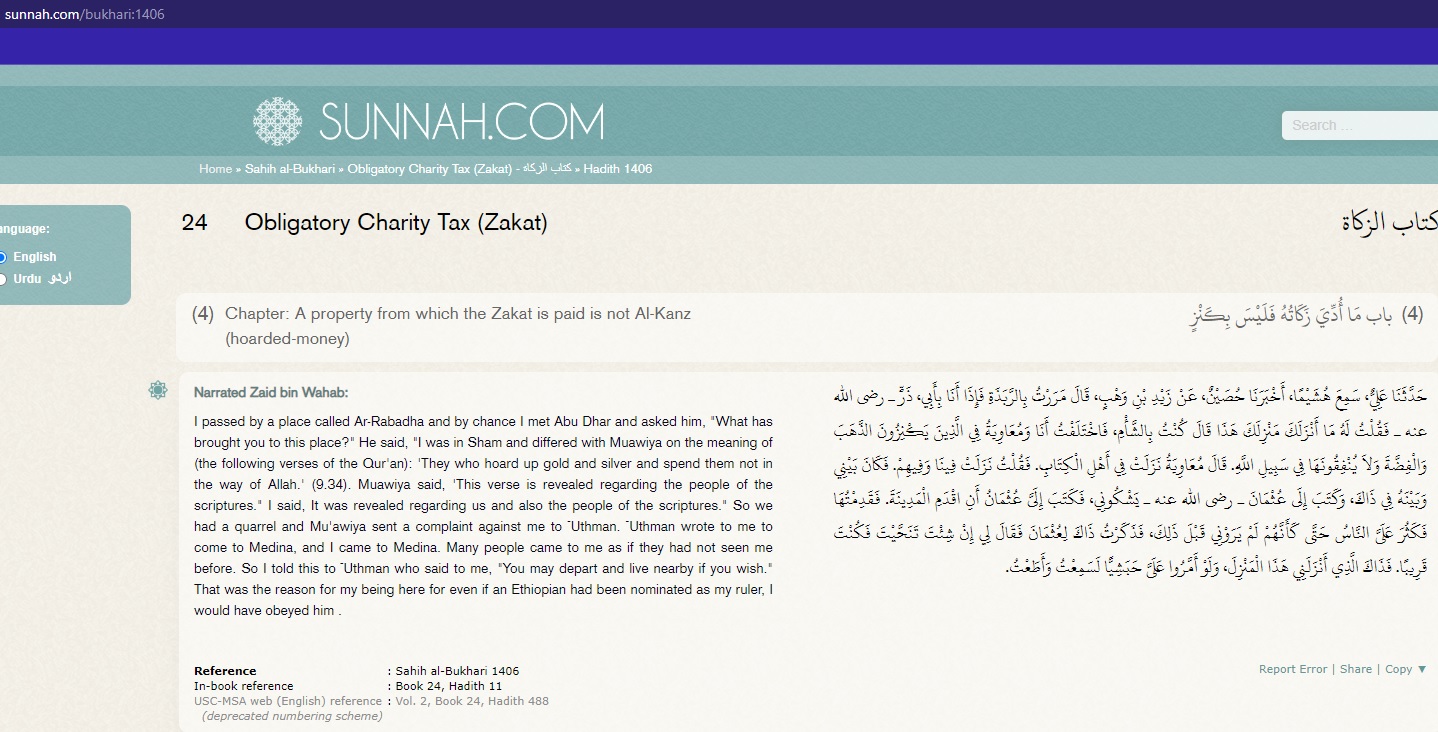
I passed by a place called Ar-Rabadha and by chance I met Abu Dharr and asked him, “What has brought you to this place?” He said, “I was in Sham and differed with Mu’awiya on the meaning of (the following verses of the Qur’an): ‘They who hoard up gold and silver and spend them not in the way of Allah.’ (9.34). Mu’awiya said, ‘This verse is revealed regarding the people of the scriptures.” I said, It was revealed regarding us and also the people of the scriptures.” So we had a quarrel and Mu’awiya sent a complaint against me to `Uthman. `Uthman wrote to me to come to Medina, and I came to Medina. Many people came to me as if they had not seen me before. So I told this to `Uthman who said to me, “You may depart and live nearby if you wish.” That was the reason for my being here because even if an Ethiopian had been nominated as my ruler, I would have obeyed him.
Source: (https://sunnah.com/bukhari:1406)
Narrated Al-Ahnaf bin Qais:
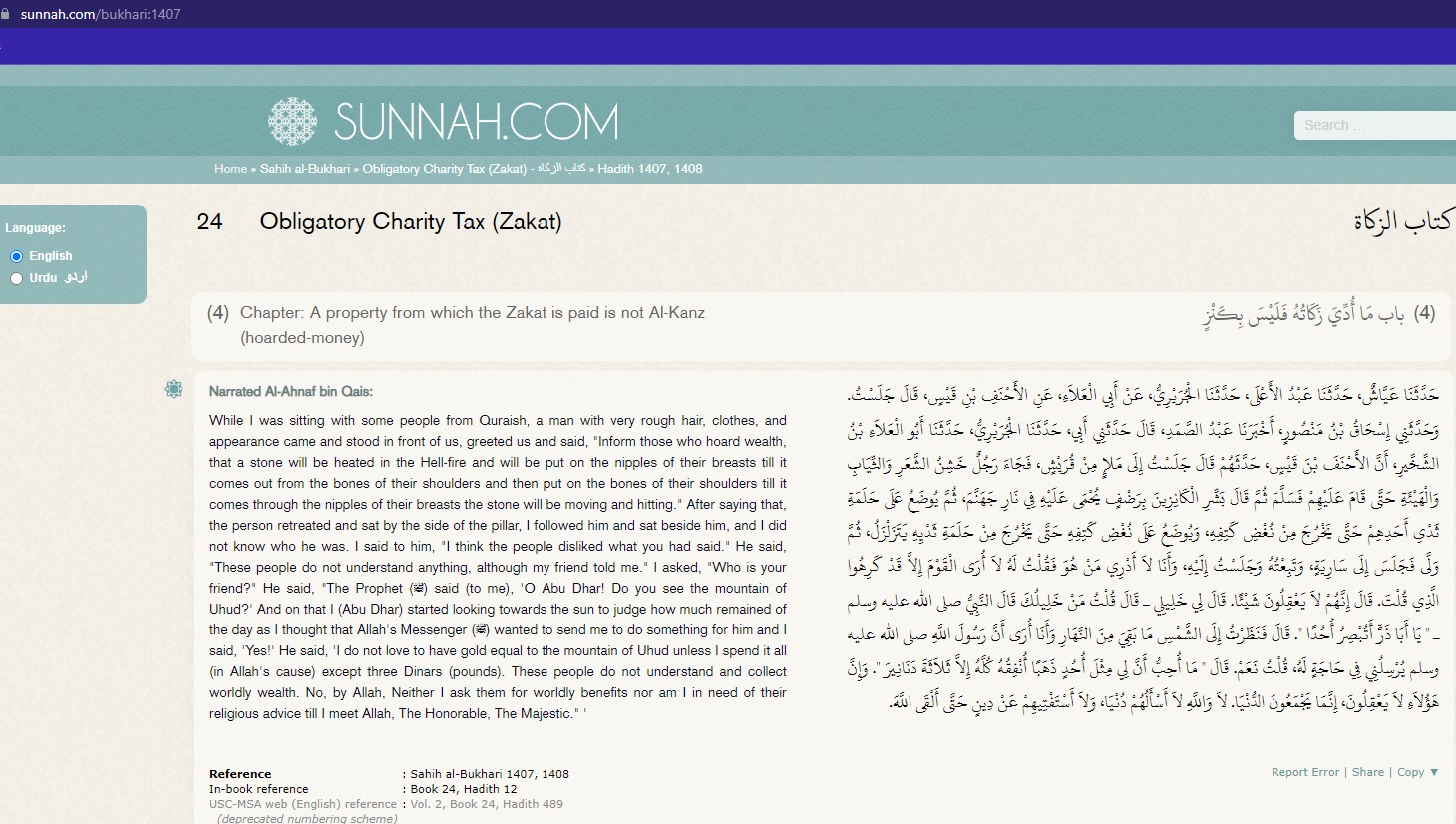
While I was sitting with some people from Quraish, a man with very rough hair, clothes, and appearance came and stood in front of us, greeted us and said, “Inform those who hoard wealth, that a stone will be heated in the Hell-fire and will be put on the nipples of their breasts till it comes out from the bones of their shoulders and then put on the bones of their shoulders till it comes through the nipples of their breasts the stone will be moving and hitting.” After saying that, the person retreated and sat by the side of the pillar, I followed him and sat beside him, and I did not know who he was. I said to him, “I think the people disliked what you had said.” He said, “These people do not understand anything, although my friend told me.” I asked, “Who is your friend?” He said, “The Prophet (saw) said (to me), ‘O Abu Dharr! Do you see the mountain of Uhud?’ And on that I (Abu Dharr) started looking towards the sun to judge how much remained of the day as I thought that Allah’s Messenger (saw) wanted to send me to do something for him and I said, ‘Yes!’ He said, ‘I do not love to have gold equal to the mountain of Uhud unless I spend it all (in Allah’s cause) except three Dinars (pounds). These people do not understand and collect worldly wealth. No, by Allah, Neither I ask them for worldly benefits nor am I in need of their religious advice till I meet Allah, The Honorable, The Majestic.”
Source: (https://sunnah.com/bukhari:1407)
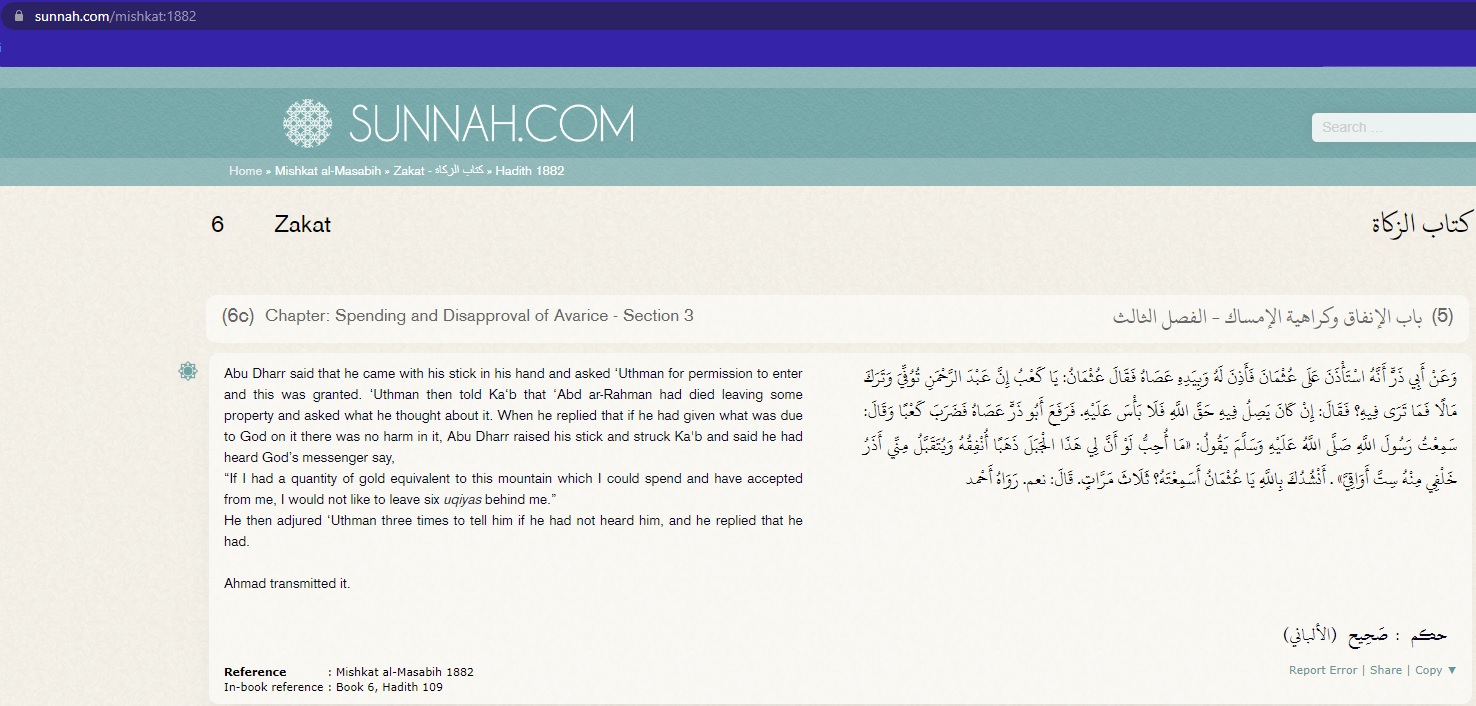
Abu Dharr said that he came with his stick in his hand and asked ‘Uthman for permission to enter and this was granted. ‘Uthman then told Ka‘b that ‘Abd ar-Rahman had died leaving some property and asked what he thought about it. When he replied that if he had given what was due to God on it there was no harm in it, Abu Dharr raised his stick and struck Ka’b and said he had heard God’s messenger say, “If I had a quantity of gold equivalent to this mountain which I could spend and have accepted from me, I would not like to leave six uqiyas behind me.” He then adjured ‘Uthman three times to tell him if he had not heard him, and he replied that he had. Ahmad transmitted it.
Source: (Mishkat al-Masabih 1882)
Al Hakam (Uthman’s paternal uncle)
“Uthman wrote to al-Hakam b [Abi]l-As that he should come to him. Al-Hakam had been a man expelled by Allah’s messenger. When Abu Bakr came to power, Uthman and a group of the Banu Umayya came to Abu Bakr and petitioned him concerned al-Hakam, but Abu Bakr would not grant permission for him to return. When Umar came to power, they did the same thing, but Umar would not grant him permission. Therefore the people disapproved of Uthman’s permission to al-Hakam. One of them said: I saw al-Hakam b. Abi -‘As the day he arrived in Medina; he was wearing a tattered old garment and driving a Billy goat. He entered Uthman’s residence while people gazed at his evil state and that of his companions; he came out wearing a silk tunic (jubba) and a shawl (taylasan)
The reason for the Blessed Messenger (saw) expelling al-Hakam to al-Ta’if is given variously as his eavesdropping on the Blessed Messenger (saw), and relaying to his Qurayshi opponents his sayings about them or his mocking imitation of the Prophet’s gait. He would mock the way the Blessed Messenger (saw) would walk. Al Hakam had accepted Islam after the conquest of Mecca on 8/30. He was Uthman’s paternal uncle.
Sources: (Al Baladhuri, Ansab, 5:27; Ibn al-Athir, al-Usd al-ghābah fi ma‘rifat al-sahabah, 2:35)
Ammar bin Yasir.
He was of the the tribe of Makhzum.
As for Ammar’s case, Al-Khatib al-Baghdadi mentions a report related by Al-Tabari which suggests that there was some friction between Ammar and Abbas ibn Utbah. Uthman felt that the two needed to be disciplined by physical punishment. Al-Khatib al-Baghdadi states that this is within the right and jurisdiction of the Caliph. Umar used to do that with many people, several of whom were of a higher standing than Ammar.
Source: (Al-Khatib in Tarikh Baghdad)
When Miqdad b ‘Amr died he appointed Ammar as his executor and Ammar prayed over hm without notifying Uthman. Uthman became furious at Ammar and said: “Woe to me from that son of a black woman! Yes, I know of his hidden antagonism towards me.”
Sources: (Ibn ‘Abd al-Barr, al-Isti’ab, 4:1863; a& Khalil ibn Aybak al-Safadi, Kitab al-Wafi bi’l-Wafayat, 15:457)
Conclusion: In the end, the history seems rather murky. It seems the chief complaint against Uthman was nepotism. This is followed by accusations of what looks like Uthmans inability or unwillingness to punish his relatives when they did acts of injustice. The third accusation seems to be the distribution of public funds to members of his own family. In the end, it is probable that the sons of Ali Ibn Abi Talib, along with Muhammad ibn Abi Bakr, assassinated Uthman. This, of course, led to a permanent division among Muslims that has not healed until this day. It seems in hindsight and in retrospect, after the development of the doctrine of ʿadālah aṣ-ṣaḥābah’ and a few strokes of the pen, people are most likely companions and suddenly not companions and there are anonymous individuals where convenient.
It is very curious that you don’t see the Abbasid Sunnis (the majority of Sunnis today) remember the assassination of Uthman like you see them remember the assassination of Ali ibn Abu Talib. It is also noteworthy that you do not see the Abbasid Sunnis ask Allah (swt) to curse the killers of Uthman. Maybe they know something they don’t want to tell you.
When it comes to Uthman Ibn Affan, the best position is to practice Wuqoof.
Wuqoof is to pause if there is khilaf on the person. Wuqoof is to stop at everyone you don’t know. You do not make a judgement on him/her to be in Walayah or Bara’ah. This is a very safe path to take.
“That was a community that had already gone before. For them is what they earned and for you is what you have earned. And you will not be accountable for what they have done.” (Qur’an 2:141)
And, of course, for our Arabic readers: This is prepared by the noble and respected, Shaykh Abu Tayyib Khalfan Altywani. May Allah (swt) bless him for this enlightening work!
May Allah (swt) guide this Ummah to a course that is just!
May Allah (swt) Forgive the Ummah.
May Allah (swt) Guide the Ummah.


 Prima Quran