

The Schools of Ahl al-Sunnah wa al-Jama’ah (The Role of Ahmad ibn Hanbal in Reform and Change) by
Shaykh Rasul Jafarian.
About the author.
Rasul Jafarian is an Iranian Shi’i cleric and researcher in the field of Iranian history. He is currently the Professor of the Department of History at the University of Tehran, the Director of the Specialized library on Islam and Iran, and the Director of the Central Library of the University of Tehran.
Ahmad ibn Hanbal his family background.
Most Sunni Muslims are completely unaware of the background and history of Imam Ahmad’s family.
The paternal grandfather of Imam Ahmad ibn Hanbal al-Dhuhli al-Shaybani was Hanbal ibn Hilal.
Hanbal ibn Hilal was a governor under the Umayyads: Hanbal ibn Hilal was an administrative and military figure stationed in the restive, eastern frontier province of Khorasan. During the Umayyad era, he was appointed as the local governor of Sarakhs (a strategic oasis city located on the Silk Road between Marw and Nishapur, split today across the Iran-Turkmenistan border.
The Shift to the Abbasid Revolution: As the Hashimiyya (the underground Abbasid revolutionary movement) gained rapid momentum in Khorasan during the 740s, many local Arab military elites grew disillusioned with the Umayyad leadership in Damascus. Hanbal ibn Hilal rebelled against his Umayyad rulers and defected, aligning his family and tribal influence with the Abbasid call (al-Da’wa).
His family’s betrayal of the proto-Sunni Umayyads paid off.
Following the successful Abbasid Revolution in 750 CE, the newly established Abbasid Caliphate kept him in his administrative capacity, allowing him to continue governing Sarakhs under the new regime.
A Family Military Legacy: His defiance set the trajectory for his family. His son, Muhammed ibn Hanbal, grew up to become a soldier in the frontier Abbasid army, and his grandson, Imam Ahmad, was subsequently born into a household deeply shaped by the fallout of this Khorasani migration to the new capital of Baghdad.
Al-Jahiz wrote a book in the year 200 AH: titled ‘Kitab al-Uthmaniyyah‘.
There are three majojr political factions that he speaks of.
He did not mention the existence of a sect called ‘Ahl al-Sunnah wa al-Jama’ah’ its as if he never heard of it.
Al-Jahiz outlined three major opposing parties.
1- (Al-ʿUthmaniyyah) They do not recognize the caliphate of Ali ibn Abi Talib. Those who upheld the legitimacy of the third caliph Uthman and argued for the superiority and primary right of Abu Bakr. They are the supporters of Uthman ibn Affan, Lady Aisha, Muawiyah, and the Umayyads.
At his time they are the majority of the Islamic nation, including the scholars and jurists.
Rather than vanishing into thin air, they were absorbed into the Abbasid project during the 9th and 10th centuries They became known as: ‘Ahl al-Sunnah wa al-Jama’ah’.
2- Alids (Al-Shi’ah): Those who believed that Ali ibn Abi Talib and the Prophet’s household held the exclusive, divine right to the leadership. This group would split. Partially this movement was absorbed into the Abbasdid project during the 9th and 10th centuries becoming known as: ‘Ahl al-Sunnah wa al-Jama’ah’. They would consist of those who considered Ali ibn Abi Talib as the fourth of the Rightly Guided Caliphs and those who believed he had better right all along but were content in thier new way. During the formation of the Sufi tariqa the idea that to know the object of love i.e the Prophet (saw) would be to know who it is you are loving. The best way to do this would be via the ‘Ahl Bayt’ -the descendants of who were the heads of Sufi Tariqa.
Those not absorbed were the Zaydi.
3. Abbasids (Al-ʿAbbasiyyah): Those who championed the rights of the descendants of the Prophet’s uncle, Al-Abbas, to the Caliphate. They become the architects of the project known as: ‘Ahl al-Sunnah wa al-Jama’ah’
Although Al Jahiz did not put these among the big three partially becuase they fall under the Alid camp we would put a category 4.
4. The Rejectionists: Those who would latter be known as the Imami Shi’i. Defined by their rejection of the caliphates of Abu Bakr, Umar, and Uthman and extreme veneration (Ghuluww) toward Ali.
‘Ahl al-Sunnah wa al-Jama’ah’ has the task of balancing between these absorbed groups. They must balance between Tashayyu and Nasb.
So why would we call ‘Ahl al-Sunnah wa al-Jama’ah’ as ‘diet Shi’i’ rather than ‘diet Uthmaniyyah’?
It is clear to us that with what Ahmad Ibn Hanbal did he tiltled the balance towards the Alid camp and supplied them with amunition that he did not give the Uthmaniyyah camp.
- We already saw that his family had a history of betraying the Uthmaniyya and allying with the Abbasids.
- Ahmad ibn Hanbal is not a hero of Sunni orthodoxy, but a pragmatic reformer who served the Abbasid state.
- The Tarbi’ was a political innovation to absorb Shi’i/Pro Alid sentiment.
- The Musnad is tainted with Shi’i narrators and fabricated hadiths (like the 30-year caliphate hadith).
The ‘Mihna’ the so-called persecution of Imam Ahmad ibn Hanbal.
So many of us have heard of the Abbasid caliph al-Ma’mun instuting this inquisition for anyone who did not believe that the Qur’an was created.
And in the Abbasid era, al-Ma’mun intervened as a supporter of the Mu’tazili school, and resorted to force and coercion to impose his doctrines upon the scholars and hadith scholars. After him was the Abbasid Caliph Al-Mu’tasim.
The views of what happened that is narrated from al-Dhahabi, Ibn Kathir, Ibn al-Jauzi come via Ibn Hanbal’s own family members. That is from Salih bin Ahmad bin Hanbal and Hanbal bin Ishaq.
The great scholar Ahmad ibn Nasr al-Khuza’i, who was killed, and impaled. His head was hung in the streets of Baghdad for 7 years.
According to al-Jahiz, he did not undergo numerous lashings and the whips themselves were relatively soft and painless. That is if he (Ahmad ibn Hanbal) underwent any lashings at all!
We get some really fantastical information about the event such as the following:
“Sulayman al-Sijzi said: Then Ahmad ibn Hanbal was stripped of his clothes, wrapped in a woolen garment, and two new ropes were tied around his hands. He took the whip in his hand and said: “Shall I strike him, O Commander of the Faithful?” Al-Mu’tasim said: “Strike.” He struck him one lash, and Ahmad said: “Praise be to Allah.” He struck him a second time, and he said: “What Allah wills shall be.” He struck him a third time, and he said: “There is no might nor power except with Allah, the Most High, the Most Great.” When he wanted to strike him the fourth lash, I looked at the waist-wrapper slipping from his waist and about to fall. He raised his head toward the sky and moved his lips, and behold, the earth split open and two hands emerged and supported him by the power of Allah. When Al-Mu’tasim saw that, he said: “Release him.” Then Ibn Abi Du’ad came forward to him and said: “O Ahmad, say in my ear: ‘The Qur’an is created,’ so that I may save you from the hand of the Caliph.” Ahmad said to him: “O Ibn Abi Du’ad, say in my ear: ‘The Qur’an is the speech of Allah, uncreated,’ so that I may save you from the punishment of Allah.” Al-Mu’tasim said: “Take him to prison.” Sulayman said: He was taken to prison, and the people dispersed and I dispersed with them. The next day, the people came and I came with them and stood facing the chair. Al-Mu’tasim came out and sat on the chair and said: “Bring Ahmad ibn Hanbal.” He was brought, and when he stood before him, Al-Mu’tasim said to him: “How were you in your prison last night, O Ibn Hanbal?” He said: “I was well, and praise be to Allah.”
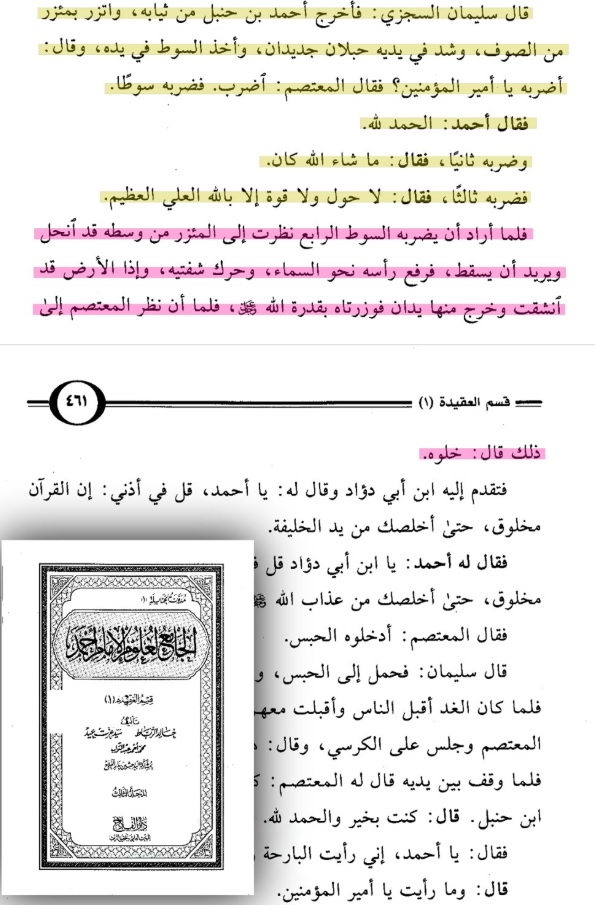
The source: (Tabaqat al-Hanabila -The Generations of the Hanbalis by Ibn Abi Ya’la)
We have exsposed before these type of fantastical narratives here:
Can it truly be believed that so many were killed or tortured and somehow Ahmad Ibn Hanbal comes out of this whole ordeal unscathed?
- Either Ahmad Ibn Hanbal capitulated and said the Qur’an was created.
- Or he was spared altogether for the project of ‘Ahl Sunnah Wal Jammah’.
There is good reason to believe this so called persecution of Ahmad Ibn Hanbal was a ruse. It was a smokescreen to make Ahmad Ibn Hanbal the leader of the Ahl Hadith.
As the saying goes:
“Beware the enemy who bleeds at your doorstep; he buys your pity today to sell you ruin tomorrow.”
Ahmad ibn Hanbal was likely not persecuted; he was close to the Abbasids. His father was a military commander in their army, and his grandfather broke his oath of allegiance to the Umayyads, cooperated with the Khurasani movement, and informed on others.
We know that his grandfather Hanbal was a governor for the Abbasid state and his father Muhammed was one of the Abbasid state’s leaders. Their relationship with the Abbasids and the Hashimites were excellent, which is why he was singled out for prominence during the ordeal over the createdness of the Quran and was not killed, unlike many other scholars.
However, just like his father and grandfather did favours for the Abbasid state Ahmad Ibn Hanbal was yet to play his hand. Ahmad Ibn Hanbal unlike his father and grandfather before him did not bring a sword to the Abbasid court. He brought something far more powerful and far more worthy. He brought his pen and the admiration of the ‘Ahl Hadith’ camp.
Ahmad ibn Hanbal shattered the yoke,and reformed the direction of the school of Ahl al-Hadith,
who are an extension of the “Uthmaniyyah” orientation, for we find him transmitting in his Musnad or his works many narrations concerning the virtues of Ali.
In his mass-volume Hadith compilation, the Musnad, and his book Fada’il al-Sahaba (Virtues of the Companions), Ibn Hanbal narrated an overwhelming amount of traditions exalting Ali’s bravery, spiritual rank, and closeness to the Prophet (saw). He famously noted that no companion had as many verified virtues recorded with good chains as Ali!
In fact, if you research no other hadith collection classified as ‘Sunni’ contains as many narrations and accolades of Ali then the Musnad of Imam Ahmad!
To give you a sense of scale.

The narrations from Ali in the Muwatta are like that tiny human next to the car. Whereas the narrations from Ali in the Musnad of Imam Ahmad are like the Burj Khalifa!
Imam Ahmad ibn Hanbal equated Ali with the Caliphs, going against the consensus of the Uthmaniyyah community for 200 years that the fourth caliph was Muawiyah. This was the view of the Umayyad Caliphate for 89 years as the Umayyad State of Cordoba for 275 years.
Here is where Ahmad Ibn Hanbal become and effective agent of the Abbasid state aparatus.
He was the one who began the Tarbi’ (Squaring) of Ali. He was instrumental in convincing many of his ‘Ahl Hadith’ colleagues to reform. In Particular those of the “Uthmaniyyah” orientation. That who did nto permit or allow Ali ibn Abi Talib to be granted the attribute of “legitimate caliph”.
Imam Yahya ibn Ma’in used to order Ahmad ibn Hanbal to stop narrating from Abd al-Razzaq al-San’ani because he was accused of Tashayyu’ or having (Shi’i leanings). Inspite of this Ahmad Ibn Hanbal would continue to narrate from Abd al-Razzaq.
Ahmad ibn Hanbal began to narrate the hadith of Safina about the caliphate lasting thirty years. This was to spite the Umayyad Caliphs. It was a strong slap in the face.
This was narrated by the Iraqi Sa‘id ibn Jumhan, about whom Imam al-Bukhari said: “There are strange things in his hadith.”
Musnad Ahmad ibn Hanbal is the primary source text for this narration.
In fact the hadith itself as it stands before your very eyes does not even attempt to hide it’s political motivations. Observe yourself dear readers.
“Narrated Safinah:
The Prophet (ﷺ) said: The Caliphate of Prophecy will last thirty years; then Allah will give the Kingdom of His Kingdom to anyone He wills.
Sa’id told that Safinah said to him: Calculate Abu Bakr’s caliphate as two years, ‘Umar’s as ten, ‘Uthman’s as twelve and ‘Ali so and so. Sa’id said: I said to Safinah: They conceive that ‘Ali was not a caliph. He replied: The buttocks of Marwan told a lie.”
Source: (https://sunnah.com/abudawud:4646)
&
Sa’eed bin Jumhan narrated:
“Safinah narrated to me, he said: ‘The Messenger of Allah(s.a.w) said: “Al-Khilafah will be in my Ummah for thirty years, then there will be monarchy after that.”‘ Then Safinah said to me: ‘Count the Khilafah of Abu Bakr,’ then he said: ‘Count the Khilafah of ‘Umar and the Khilafah of ‘Uthman.’ Then he said to me: ‘Count the Khilafah of ‘Ali.”‘ He said: “So we found that they add up to thirty years.” Sa’eed said: “I said to him: ‘Banu Umaiyyah claim that the Khilafah is among them.’ He said: ‘Banu Az-Zarqa’ lie, rather they are a monarchy, among the worst of monarchies.”‘
Source: (https://sunnah.com/tirmidhi:2226)
Ahmad Ibn Hanbal by authenticating the above hadith stating that the Rashidun Caliphate lasted 30 years, effectively made the history that came after pitch black. So what does that say about Mu’awiya?
What does that say about the Uthmaniyyah?
In fact, his son, Abdullah, said to him: How do you say that Ali ibn Abi Talib was a caliph, when Ali himself said, “I am not a caliph, and what happened was a trial”? Ahmad ibn Hanbal replied that this was humility on the part of Ali! Thus, Ahmad ibn Hanbal attributed to Ali what Ali himself did not claim for himself!
For after Ahmad ibn Hanbal made apparent the doctrine of the “Tarbi'” with Ali ibn Abi Talib, the doctrine at the time caused an uproar and a shock among the general body of hadith scholars, to the point that they came to Ahmad ibn Hanbal debating him on the matter and rejecting it upon him, saying to him: By this doctrine you are impugning Talha and al-Zubayr, because the doctrine of the validity of the caliphate of Ali ibn Abi Talib is a direct impugnment of the religion of Talha and al-Zubayr and Mu’awiya and the Mother of the Believers Aisha and Amr ibn al-As, etc.
The Argument of his oppoents was basically this: If Ali ibn Abi Talib was a legitimately mandated, divinely supported Rashid caliph whose obedience was religiously obligatory, then anyone who took up arms against him or refused to pledge allegiance was in major violation of Islamic law.
The conclusion they deduced was as follows: This framework inadvertently cast figures like Talha ibn Ubaydullah, al-Zubayr ibn al-Awwam, Mu’awiya ibn Abi Sufyan, Amr ibn al-As, and Aisha (the Mother of the Believers) as rebels against legitimate authority. To the traditionalists, affirming Ali’s caliphate meant compromised theological integrity for these revered Companions. In the process that makes all of them kharijites, renegades, rebels, breakers of allegiance, and their blood lawful!
Guess which ‘Sunni’ Imam has controversy surrounding him in regard to the permissiblity on cursing Yazid ibn Mu’awiya? Is it Imam Malik? No. Is it Abu Hanifa? No. Is it Imam Shafi’i? No.
Is it Ahmad Ibn Hanbal? Winner winner chicken dinner!
Imam Ahmad bin Hanbal’s son, Saleh bin Ahmad, narrates: I asked my father about some people who say that they love Yazid. Imam Ahmad replied, “My son, can a person who believes in Allah and the Day of Judgment love Yazid?!” I then asked, “Why don’t you curse him, then?” Imam Ahmad replied, “My son, have you ever seen me cursing anyone?”
Source: (Fatawa Ibn Taymiyyah, Vol. 4, Page 483)
And as the Shi’i researcher Shaykh Rasul Jafarian said, “Ahmad shattered the yoke.”
Meaning that he shattered the gate of those Muslims and opened it to the Shi’i, and it will not be closed.
This is why as we mentioned in our earlier article the Neo-Umayyad movement was concerned.
And of course this doctrine opened a door for the Shi’i that they would never have dreamed of, since the Anti-Alid opposition did not acknowledge the caliphate of Ali ibn Abi Talib throughout the Umayyad era, and even into the third century of the Abbasid era, until the era of Ahmad, people at that time did not know the doctrine that Ali was the fourth caliph, and that was considered repugnant among them and a strange doctrine with no evidence for it.
All that the Shi’i wants from the Abbassid ‘Sunni’ is to say that Ali was more in the right and that the Household of the Prophet (saw) are the people of the Hadith of the Cloak (Hadith al-Kisa’).
We have already proved that the narration of (Hadith al-Kisa’) is nothing more than an obvious concoction.
Imagine the Sunni out there who sees him/herself as some adversary of the Shi’i without realizing that they themselves are a form of Shi’i.
The Salafi who burns with rage towards Shi’ism but accepts the various narrations that allows the Shi’i to kick in the front door and park themselves comfortably on the living room couch!
That is just bizzarre to us!
The Schools of Ahl al-Sunnah wa al-Jama’ah (The Role of Ahmad ibn Hanbal in Reform and Change)
By Shaykh Rasul Jafarian
Introduction (1):
It appears that the divergence of opinions in the doctrinal, jurisprudential, and historical fields emerged in the first Hijri century, as sectarian groups gradually arose. As a result of political conflicts and the accompanying doctrinal, jurisprudential, and historical disputes, over time this led to the sectarian division of Muslims according to their cities at first, then this spread within the cities in a manner proportionate to local sectarian conflicts.
These differences crystallized in the second century to a great extent, but before reaching the level of sectarian groups, they remained revolving in the orbit of the doctrines of specific individuals such as: Abu Hanifa, Ghaylan al-Dimashqi, Jahm ibn Safwan, and others, who can be considered the origins of doctrinal conflict.
However, the clear and distinct differentiation between the sects did not appear except in the time of al-Ma’mun, who was known for his zeal and severity in imposing his own beliefs on people, his inclination toward the Mu’tazila, and his lack of concern for the Ahl al-Hadith despite the status they had among the common people.
Thus the various schools emerged gradually under the influence of different historical, cultural, and social circumstances, allowing a single school, within a span of time, to become susceptible to change and alteration, affected by its historical position, its enemies, and even its leaders, such that it could transform and appear in different phases among them, to the extent that it sometimes leads to the division of a single school into a number of different sects.
(1) Years ago, when I was in the service of Professor Ayatollah al-Hajj Sayyid Mahdi Rohani—may his shadow endure—I was inspired by him with the original idea of this article. He graciously reviewed the article before its publication, and it was as if his tongue was saying at the time: “This is our merchandise returned to us.”
[Page – 301]
The most important matter that must be known is to grasp the path of development of a doctrinal current that fell captive to excess and negligence throughout its long history, which may sometimes make it different from its original image in which it arose.
For example, the Sunni school, whose foundation was the events in the era of the two Shaykhs, or what happened of changes in the time of Uthman, and the stance of the Imam Amir al-Mu’minin (peace be upon him) toward them, and most important of all is the form it acquired in the Umayyad era. It differed from what came later under the name of Ahl al-Hadith or the Uthmani school.
A significant part of this doctrinal orientation which did not permit or allow Amir al-Mu’minin Ali ibn Abi Talib (peace be upon him) to be granted the attribute of legitimate caliph was reformed thanks to the efforts exerted by Ahmad ibn Hanbal, which helped in adopting a more appropriate stance toward Imam Ali (peace be upon him).
In the middle of the fourth century, Abu al-Hasan al-Ash’ari introduced many changes into this school in doctrinal matters, and then after that, following the emergence of Sufism, a new image of the school appeared.
It is self-evident that the origin of all that is laxity in the theory of adhering to the hadiths of the Prophet (may God be pleased with both of them), and the way of the righteous predecessors. We may see due to acting upon some hadiths and abandoning others, or changing the authority of the righteous predecessors from one to another that the image of a single matter may change to a great extent. This is assuming that individuals like Ibn Taymiyya or Muhammed ibn Abd al-Wahhab did not come after seven or twelve centuries, raising new matters they claim to be the doctrine of the Salaf, and attributing them to the righteous predecessors.
In any case, the common people in the first and second centuries were followers of the ruling school, which represented nothing but what the Umayyads and some Companions and Successors promoted of doctrines, and perhaps contradiction occurred in their matters at times, but the dominance of the Umayyads and their authority over society made many scholars and hadith scholars submit to their service, and promote their ideas and doctrines.
[Page – 302]
All other people in the Umayyad era were “Uthmaniyya”. This school whose orientation came from Aisha, Talha, and al-Zubayr, and it is the school of Basra in general on the one hand, and the Umayyads on the other. Both groups are united by their enmity toward the Imam Amir al-Mu’minin (peace be upon him). It is natural that this discussion is related to political-doctrinal research. As for purely doctrinal research, it can also include tendencies especially in Medina, Syria, Basra, and Kufa that differ from one another, and revolve in the orbit of the doctrines of specific individuals as we indicated earlier, and the state may sometimes intervene in them, but there is an important intervention of the state that only occurs if political interest requires it. An example of this is that some Umayyad caliphs were accused of following the Qadariyya or the Mu’tazila, and perhaps some went further than that. For example, Hisham (2) killed some heads of schools such as Ghaylan al-Dimashqi or Bayan ibn Sam’an.
In the Abbasid era, we find that intervention in doctrinal and jurisprudential matters came on a much wider scale, and the most prominent intervention in this field is what al-Ma’mun undertook as a supporter of the Mu’tazili school, his resort to force and coercion, and his endeavor to impose his doctrines on scholars in general and hadith scholars in particular.
The common people in this era were still following currents that were, from a doctrinal perspective, an extension of the Uthmani school, and they followed well-known individuals in the cities regarding jurisprudential matters. In reality, apart from the Shi’a and the Khawarij who set boundaries for themselves between them and others, the common people did not have clear sectarian tendencies.
Gradually the discussion of the Murji’a emerged, which did not go beyond the discussion of the definition of faith, as well as the Mu’tazila in the late Umayyad era and part of the Abbasid era, where they to some extent set a definition for their sectarian thought. As for the common people or what is called Muslims in general, they were called “Uthmaniyya” according to their doctrinal and political beliefs, and they did not have clear doctrinal and jurisprudential boundaries. As for the term “Uthmani,” from a historical perspective it was placed in contrast to the term “Shi’i,” and its history goes back to the incident of Siffin.
(2) He is Hisham ibn Abd al-Malik ibn Marwan (71–125 AH), who assumed rule in the year (105 AH / 724 CE). (The Journal).
[Page – 303]
In the early third century, the school of the common people was what was called the Uthmaniyya, and the most important evidence of this is the book al-Uthmaniyya by al-Jahiz, in which he defended the doctrines of the common people against their opponents, especially the Shi’a. In this book there is not abundant mention of Uthman; rather, most of it was a defense of the historical and political views of the Uthmaniyya, which in turn formed an important part of Sunni beliefs later on. Al-Jahiz, of course, did not believe or hold to everything he wrote or composed in books and treatises.He was a person of wavering doctrinal position, and what he mostly sought through his writings was merely to establish the reality of the existence of these doctrinal currents. As for his own school, he was known as a Mu’tazili of Uthmani persuasion.
Most of the discussions in the article “al-Uthmaniyya” came mostly in mentioning the virtues of Abu Bakr, establishing his superiority over the rest of the Companions, and responding to some criticisms directed at him. Al-Jahiz in this book expanded on the discussion of the issue of preferring Abu Bakr over Imam Ali (peace be upon him), and considered him braver and more ascetic than Imam Ali (peace be upon him). There are important chapters in the book responding to the Shi’a’s criticisms of Abu Bakr, and other chapters responding to the Shi’a’s evidences for preferring Imam Ali (peace be upon him) or establishing his imamate.
We find in this treatise that the name of Uthman rarely appears, and even the caliphate of Umar is mentioned only briefly. The treatise came primarily to define the Uthmani school’s view of Abu Bakr and his caliphate and to place it in contrast to the Shi’i view.
Of course, al-Jahiz’s view of Imam Ali (peace be upon him) did not match the view of the Uthmaniyya, for he wrote this treatise in the same period when the Uthmaniyya under the banner of Ahmad ibn Hanbal were reforming their former doctrines regarding Imam Ali (peace be upon him).
Al-Jahiz, in reality, drew a line between the Uthmaniyya and the Sufyaniyya. We find him in another treatise of his titled “Risalat al-Hakamayn wa-Taswib Ali ibn Abi Talib fi Fi’lihi” (The Epistle of the Two Arbitrators and the Vindication of Ali ibn Abi Talib’s Actions)rejecting the views of the Sufyaniyya regarding Mu’awiya, and it appears from the end of this treatise that al-Jahiz was displeased with Mu’awiya. And in the treatise “Fadl Hashim ala Abd Shams” (The Superiority of Banu Hashim over Banu Abd Shams) we also find him rejecting the preference of the Umayyads over the Hashimites (3).
Political Undertones: The Banu Hashim produced the Prophet Muhammed (O Allah, bless Muhammed and the family of Muhammed) and later the Abbasid Caliphate, while the Banu Abd Shams gave rise to the Umayyad dynasty through their prominent branch, the Umayyads (descendants of Umayya ibn Abd Shams
Al-Jahiz’s Objective: Writing during the Abbasid era, al-Jahiz utilized this treatise to argue for the inherent virtues and superiority of the Prophet’s clan (Banu Hashim) over their historical rivals, aligning closely with Abbasid political legitimacy
[Page – 304]
Perhaps the Sufyani sect is itself the Nabitah, which includes a type of fanatical Uthmanis, and the Shi’a refer to it by the name al-Nasiba or the Nasibi school.
Al-Jahiz in the treatise “al-Nabitah,” (The Epistle on the Contemptible/Upstarts)after mentioning the events that occurred from the time of the Prophet’s death (may God be pleased with both of them) until the time of Yazid, and his emphasis on Yazid’s deserving of cursing, proceeded to explain the doctrines of the Nabitah in his time. He says: These people say that cursing the rulers is sedition, and that cursing the oppressor is a innovation even if they committed injustice. Al-Jahiz also considers the disbelief of the Nabitah more egregious than the disbelief of Yazid, and declares that the Nabitah are among the anthropomorphists who liken God to humans and this is the doctrine of Ahl al-Hadith in the second and third Hijri centuries.
The term al-Nabita (or al-Nawabit) literally means “the upstarts,” “the weeds,” or “the newly sprouted”. Al-Jahiz used this derogatory label to describe the early proto-Sunni traditionalists and Hadith-centric scholars (factions that would eventually form the backbone of the Hanbali school of law.
We also see him as a Mu’tazili by tendency launching a harsh attack on the doctrine of the Nabitah regarding predestination and anthropomorphism, and the issue of the eternity of the Qur’an, and declaring that they are followers of Ahmad ibn Hanbal, and he holds that the latter did not take the doctrine of the eternity of the Qur’an from the Salaf, but rather it is from the products of his own mind (4).
This treatise highlights the extent of the beliefs that Ahl al-Hadith possessed during this period from a historical and doctrinal perspective.
Compilation of Refutations and Authorship of Doctrinal Works
At the beginning of the third century, the leaders of the schools in Baghdad who were mostly from Ahl al-Hadith sought to set down and compile treatises in the field of doctrines to define the differences among them, and to distinguish the sound from the corrupt.
The compilation of this type of treatise led to a kind of self-delineation of the sects. If we take into consideration the issues of declaring others disbelievers and sinners which were on a wide scale then the followers of any sect could form an independent community with its own doctrines, ethics, and teachings. This matter led in many cities to the division of the neighborhoods of a single city among different sects, and this had parallels in the past as well.
(3) You will find these three treatises in “Rasa’il al-Jahiz, al-Rasa’il al-Siyasiyya,” edited by Ali Abu Mulhim.
(4) Rasa’il al-Jahiz, al-Rasa’il al-Kalamiyya, pp. 239–247.
[Page – 305]
It is necessary here to give more clarification about Ahl al-Hadith, which is the dominant doctrinal current in Baghdad at the time.
The local authority in the second century was fundamentally formed of two different trends: the first, the Ahl al-Hadith, most of whom were from Medina; the second, the Ahl al-Ra’y, who were originally Iraqis and then gained followers in some cities of Iran as well.
It appears that the term commonly used in contrast to “Ahl al-Hadith” is “Ahl al-Kalam” (5) or “Ahl al-Ra’y.” It can be said that almost all the schools opposed to Ahl al-Hadith arose in Iraq and Iran, yet the influence of Ahl al-Hadith expanded day after day in Iraq and Iran as well, and they were gradually able to become the official representative of the Sunnis or Sunnism alongside the other sects. This is despite the fact that we may find huge numbers of people who did not affiliate with the Mu’tazila, the Murji’a, or the Ahl al-Ra’y, yet they did not accept the doctrines of Ahl al-Hadith, and these did not have a special sect either, but were a distinct group of Sunnis.
It is worth noting that the word “Sunni” began to be used in this period meaning the middle of the second century then its use became widespread later in the third and fourth centuries. Before that, the application of the term “Uthmani” to persons who believed in the caliphate of the first three caliphs was what was common at the time.
It can be said that Ahl al-Hadith appeared at first as a single sect with its own beliefs, then in the second century they became a group of sects that differed among themselves slightly, and they were later called the Sunni school.
The individuals who created this current are a group of hadith scholars who lived mostly in Baghdad in the middle of the second and third Hijri centuries. The most important of these figures are: Abdullah ibn Mubarak (d. 181 AH), Nu’aym ibn Hammad al-Marwazi (d. 228 AH), Ishaq ibn Rahwayh (d. 238 AH), Uthman ibn Sa’id al-Darimi (d. 280 AH), and the most important of them was Ahmad ibn Hanbal (164–241 AH).
(5) See the book: Abdullah ibn Ahmad, al-Sunna, vol. 1, p. 151, hadith 131.
[Page – 306]
Most of the works of these individuals were in refutation of their opponents. In reality, the struggle with opponents strengthened their sense of the independence of their sects. The most important works they left were in refutation of the Qadariyya, the Jahmiyya, the Murji’a, and the heretics. As an example, Ahmad ibn Hanbal, al-Darimi, and Abdullah ibn Muhammed al-Ju’fi (d. 229 AH) wrote treatises in refutation of the Jahmiyya and by the Jahmiyya they meant the Mu’tazila and the Qadariyya, or in other words, those who deny the narrations of anthropomorphism. They sought to establish transcendence regarding Allah Almighty, and perhaps they were also afflicted with some fanaticism.
The compilation of doctrinal treatises began at a time when work on writing refutations was continuous. In order to clarify the boundaries of correct doctrines, they authored their doctrinal treatises, and often the titles of these treatises included the word “al-Sunna,” from which “Ahl al-Sunna” was gradually derived.
The term “al-Sunna” is exactly equivalent to “al-Bid’a” (innovation), and in their view all other sects are people of innovation. We note here a number of those who compiled these works, namely: Abdullah ibn Hanbal (d. 290 AH), Abu Bakr Ahmad ibn Amr al-Shaybani (d. 277 AH), Abu Ali Hanbal ibn Ishaq (d. 273 AH), Abu Bakr Ahmad ibn Muhammed al-Ashram (d. 273 AH), Abu Bakr ibn Abi Shayba (d. 225 AH), Ibn Abi Asim (d. 287 AH), and Abu Mansur al-Isfahani (6). Ibn al-Nadim also attributed books to Muhammed ibn Umayr al-Waqidi, among them: al-Sunna wa al-Jama’a, Dhamm al-Hawa, and Tark al-Khuruj (7).
(6) His book Risalat al-Sunna is printed in Majallat al-Ma’arif, first issue of 1969.
(7) Al-Fihrist, p. 111.
[Page – 307]
Here are the specifications of some of these works:
1. Abdullah ibn Ahmad ibn Hanbal (d. 290 AH), and his book: al-Sunna, two volumes, edited by: Muhammed ibn Sa’id ibn Salim al-Qahtani, Dammam, 1994.
2. Al-Barbahari, Abu Muhammed Hasan ibn Ali ibn Khalaf (d. 329 AH), and his book: Sharh al-Sunna, edited by: Abu Yasir Khalid ibn Qasim, Medina, Maktabat al-Ghuraba’ al-Athariyya, 1993.
3. Al-Khallal, Abu Bakr Ahmad ibn Muhammad ibn Harun (d. 311 AH), and his book: al-Sunna, five volumes, edited by: Atiyya al-Zahrani, Riyadh, Dar al-Raya, 1994.
4. Ibn Abi Asim, Abu Bakr Amr ibn Abi Asim al-Dahhak al-Shaybani (d. 287 AH), and his book: al-Sunna, two volumes, edited by: Muhammed Nasir al-Din al-Albani, Beirut, al-Maktab al-Islami, 1993.
5. Al-Lalika’i, Abu al-Qasim Hibat Allah ibn al-Hasan ibn Mansur al-Tabari (d. 418 AH), and his book: Sharh Usul I’tiqad Ahl al-Sunna wa al-Jama’a, nine volumes, edited by: Ahmad ibn Sa’d ibn Hamdan al-Ghamidi, Riyadh, Dar Tayba, 1994.
6. Ibn Batta, Abu Abdullah Ubayd Allah ibn Muhammed ibn Batta al-Akbari (d. 387 AH), and his book: al-Ibana an Shari’at al-Firqa al-Najiya wa Mujanabat al-Firaq al-Madhmuma, two volumes, edited by Rida Na’san Mu’ti, Riyadh, Dar al-Raya, 1994.
7. Al-Tabari, Muhammed ibn Jarir (d. 310 AH), and his book: Sarih al-Sunna, edited by Badr ibn Yusuf al-Ma’tuq, Kuwait, Dar al-Khulafa’ lil-Kitab al-Islami. Al-Dhahabi mentioned many examples of doctrinal sayings and views on disputed matters in his book Siyar A’lam al-Nubala’ during his exposition of the conditions of the Hanbali scholars and Ahl al-Hadith in Baghdad and other cities.
Jamal al-Din ibn Ahmad ibn Bishr Badi recently collected most of these sayings and expressions in the book: al-Athar al-Warida an A’immat al-Sunna fi Abwab al-I’tiqad (two volumes, Riyadh, Dar al-Watan, 1416 AH).
Aspects of Doctrinal Divergence
We have indicated that the divergence of opinions was prominent in three aspects:
The first: in the doctrinal aspect, which includes important discussions in the science of kalam, such as the discussion of Allah’s attributes and the issue of faith and disbelief. In this field, emphasis was placed on specific hadiths, the most important of which are: the hadith of the vision of Allah, and the hadith of the Prophet sitting beside Allah on His throne. In the field of faith and disbelief, the dispute was fundamentally with Abu Hanifa. Many sayings were reported from the Salaf refuting his sayings, especially regarding the issue of increase and decrease in faith, where evidences from hadiths and traditions were presented.
[Page – 308]
The second: in the jurisprudential aspect; it is natural that there are many minor differences here, but only some of them became a distinguishing feature of certain sects from others. No particular matter was relied upon in the doctrinal treatises available in this field.
The third: in the historical aspect, which is the specific belief of the sects regarding the caliphs, Companions, and Successors. In this area, belief in a number of the early caliphs is considered a doctrinal principle from a practical perspective. Regarding the Companions, the issue of believing in their all being upright and trustworthy is considered a fixed doctrinal principle. Regarding the Successors as well, we find that the issue of ignoring some prominent historical figures was tantamount to a fixed doctrine for some sects, as in the case of denying Abu Hanifa and declaring him a disbeliever. It was tantamount to the official doctrine of Ahl al-Hadith in the third century, which had a special treatment in books.
The Correct Doctrine Regarding the Caliphs according to Ahl al-Hadith
Disagreement regarding the caliphs occurred in the first stage between the Shi’a and the common Muslims. The Shi’a contrary to the common Muslims rejected the caliphate of the early caliphs. Although the Mu’tazila also had criticisms of the caliphs, what is at issue here is not merely the question of recognizing the caliphs, but rather something akin to infallibility was made for them, and tolerating no criticism of them. Thus impugning and directing criticism at the caliphs is considered evidence of Rafidi tendency.
The discussion revolved around the caliphs from different angles including how the caliph is chosen, his pledge of allegiance, obedience to him, and the conditions of the caliphate. Apart from these demands that may pertain to every caliph, there is a specific belief regarding the caliphs of the first era, whom the Sunnis call the “Rightly Guided.” A Muslim, if he is Sunni, must acknowledge the caliphate of these three or four persons, otherwise he is among the people of innovation and outside Sunnism. According to this view, it is not possible for a Sunni to believe in the Qur’an and hadith only and this expression also applies to the Shi’a with respect to the Imams.
[Page – 309]
The issue of the number of caliphs was also among the matters of disagreement among Muslims. The common Muslims apart from the Imami Shi’a and some Zaydis believe in the first and second caliphs, but some Sunnis in the first Hijri century and even the second reject Uthman, although these individuals were accused of Shi’ism when their conditions were explained. However, from a foundational perspective they are completely separate from the Shi’a regarding jurisprudence and doctrines.
Many of the people of Iraq especially the people of Kufa and Wasit rejected Uthman and sided with Ali instead, and they may consider Ali superior even to the first and second caliphs. In contrast, we find Ahl al-Hadith and the Uthmani school exaggerated in their belief in Uthman, and did not allow separation between him and the two caliphs. Based on this belief, a Muslim regarding the issue of the caliphate must believe in the three caliphs: Abu Bakr, Umar, and Uthman, and their order in terms of superiority is exactly their historical order: the first is superior to the second, the second superior to the third, and these are the best of the Companions. This trend from a doctrinal perspective accepts only these three, and there is no place for the fourth caliph.
A look at the book al-Sunna by Abu Bakr al-Khallal (d. 311 AH) shows the scope of the doctrinal principles of Ahl al-Hadith regarding the number of caliphs and the theories stated about them.
This book more than other books of al-Sunna clarified the doctrine of the Sunnis regarding what we should know or believe about the caliphs. The discussion on this topic extended to page five hundred of this book or slightly more, after which the discussion turned to the issue of predestination and free will, faith and disbelief. For this reason, this work can be considered a political work more than a doctrinal and theological one in the technical sense, as it contains the primary material for many issues related to religious politics from a jurisprudential angle. In reality, this book presented the historical view of Sunni Muslims on the issue of the caliphate.
The author in each part of the book proceeded to transmit hadiths from the Prophet (may Allah be pleased with both of them), and various sayings from the senior Companions, Successors, and the Salaf that define the dimensions of correct belief. The following is a section of the book’s chapters: obedience to the Imam and abstaining from revolting against him, the Imams from Quraysh, his emirates and discussions, rulings on those who rebel against the Imam, general discussions of the caliphate, the caliphate of Abu Bakr, Umar, Uthman, and Ali, the discussion of preferring the caliphs over one another, mention of the Rafidis, mention of the trials from the Banu Umayya and others.
[Page – 310]
What we are concerned with is not political discussions in general, but rather the belief of Ahl al-Hadith regarding the early caliphs, and especially their view of the status of Imam Ali ibn Abi Talib (peace be upon him).
The Doctrine of Ahl al-Hadith Regarding the Caliphs
The best of the caliphs and Companions after the Prophet (may Allah be pleased with both of them), from the perspective of Ahl al-Hadith, are: Abu Bakr and Umar. This belief came according to their political perspective, as they assumed the caliphate in an era when Muslims were united, enjoying unity and stability or in other words, they did not face a state of disagreement and division. As for the third caliph, his caliphate was in the view of Ahl al-Hadith by consensus of the Ummah, and there is no doubt or hesitation on this matter (8). Disagreement appeared in the second half of his caliphate gradually, ultimately leading to the revolt against him and his murder. Nevertheless, the political view of Ahl al-Hadith toward this revolt was entirely negative. It was in their view a type of rare rebellion and disobedience, to which the title of rebellion against the Imam may apply.
Ahl al-Hadith’s analysis of these conditions is precisely a defense of the legitimacy of Uthman’s caliphate, as they expressed what happened after it: “Disagreement and innovations came, and people became parties and became sects” (9), and after that only a few remained firm upon the truth. According to the perspective of Ahl al-Hadith, the term “al-Jama’a” appeared in the time of Mu’awiya and after him; it means stability upon the truth, i.e., the Umayyad state. Based on this, the era of Imam Ali (peace be upon him) was an era of disagreement and division. Ahl al-Hadith’s analysis of the revolt of Talha, al-Zubayr, and Aisha against Imam Ali (peace be upon him) which was also a defense of Uthman was not an easy matter. We find Ahl al-Hadith, throughout their history of enmity toward Imam Ali (peace be upon him), at most arguing that the blood of Talha and al-Zubayr was shed in vain in the case of acknowledging the legitimacy of the Imam’s caliphate. The Uthmani view cannot be satisfied with this matter at all, and for this reason we find them committed to silence regarding Imam Ali’s (peace be upon him) war with this group (10).
(8) Al-Barbahari indicated, saying: “The Jama’a is what the Companions of the Messenger of Allah (may Allah bless him and his family and grant them peace) agreed upon during the caliphate of Abu Bakr, Umar, and Uthman” (Sharh al-Sunna, edited by: Abu Yasir Khalid ibn Qasim, Medina, Maktabat al-Ghuraba’ al-Athariyya, 1993, p. 105). The name of Uthman appears in some copies and not in others. He said in another place: “Know that the original religion is what was from the death of the Messenger of Allah to the murder of Uthman, and his murder was the first division and the first disagreement” (Sharh al-Sunna, p. 107).
(9) Sharh al-Sunna, by al-Barbahari, p. 97.
[Page – 311]
Imam Ali (peace be upon him) was martyred in the year forty Hijri, the Shi’a lost, and the Umayyads ruled after that for ninety years, during which they made the Uthmani school the dominant school in the world of Islam. This school that never gave Imam Ali (peace be upon him) any status, but rather tried with difficulty to establish Uthman, as they completely ignored the revolt of the people of Medina against Uthman and his murder, or the rejection of Uthman by the people of Iraq in the time of Imam Ali’s government, and rather considered such matters as innovation in contrast to the Sunna.
In such circumstances the belief of Ahl al-Hadith regarding the caliphs arose, and its basis was the Uthmani view. Since the rebellion of Mu’awiya against Imam Ali (peace be upon him) and after, it became a fixed doctrine to the extent that the Abbasids could not change it significantly perhaps because they felt that changing this doctrine was not in their interest, especially after their clash with the Alids in the time of al-Mansur and after Al-Ma’mun insisted on rejecting Uthman not openly, of course and establishing the position of Imam Ali (peace be upon him), and he only took this stance during his severity toward Ahl al-Hadith, and it led to creating a wave of opposition against him. The Uthmani doctrine returned to its previous state immediately after al-Mu’tasim (d. 227 AH) and the dominance of Ahl al-Hadith.
It was clear that the Uthmanis or the new Sunnis were not the only group living in Baghdad or Iraq or other cities of Iran, Syria, and Egypt; alongside them were the Mu’tazila, the Murji’a or the followers of Abu Hanifa, and also the Shi’a, who in turn formed a large community.
The cornerstone of the emergence of Sunni doctrines is the current of Ahl al-Hadith, which at the beginning of the third decade of the third century and after turned quietly toward reform in order to be able to stand easily before the opponents. Among the most important chapters of this reform is the acceptance of Imam Ali as the fourth caliph, and this means changing the doctrine of Ahl al-Hadith regarding the caliphate and the person against whom they had monitored enmity yesterday to the extent that it can be said that the Uthmani doctrine arose in opposition to him has today become a caliph in the doctrine of Ahl al-Hadith, just as in our current era, where we see the Khawarij in Oman and northern Algeria venerating Imam Ali (peace be upon him), and rejecting what they used to believe in the past, which was fundamentally based on enmity toward Imam Ali (peace be upon him).
(10) The previous source, p. 111.
[Page – 312]
“Al-Sunna” by Abu Bakr al-Khallal and the Correct Doctrine on the Caliphate
The demands that al-Khallal mentioned in the chapters related to the caliphate were long and short texts transmitted by a number of individuals as narrations from the Noble Prophet (may Allah be pleased with both of them), or sayings issued by the Companions and Successors, each of which raised a particular issue. Most of the narrations in this chapter are undoubtedly of later fabrication. We mention here in order excerpts from these reports, each of which represents an angle of the correct doctrine of Ahl al-Hadith regarding the caliphate of the early caliphs.
The first report: the narration of Thursday i.e., the report of the Messenger of Allah (may Allah be pleased with both of them) requesting that a shoulder blade and inkwell be brought to him, and their refusal of the request and their accusation of the Prophet of delirium. This narration is authentic without doubt according to what the verifier stated in the footnote (p. 271) (11).
In another report: Aisha’s denial of the matter of the Prophet (may Allah be pleased with both of them) designating a successor, as she says: If he were to appoint anyone as successor, he would have appointed Abu Bakr or Umar (p. 272).
In another report: It came from Imam Ali (peace be upon him) his saying: We found the Prophet (may Allah be pleased with both of them) preferring Abu Bakr in prayer, so we preferred Abu Bakr (p. 274). This report is clearly false and fabricated, and Imam Ali’s (peace be upon him) positions at the beginning of Abu Bakr’s caliphate are the best evidence of its falsity.
In another report: It came from Ibn Abi Hazim that he used to say: I saw Umar in the last days of Abu Bakr’s caliphate with a staff in his hand, seating the people and saying: “Listen to the words of the Caliph of the Messenger of Allah (may Allah be pleased with both of them).” And this was Abu Bakr’s testament to Umar of the caliphate after him (p. 277).
After that he spoke about Umar’s consultation and texts about the virtues of Abu Ubayda ibn al-Jarrah, where Umar said: “Whom shall I appoint as successor? If Abu Ubayda ibn al-Jarrah were…” (p. 279). He also spoke about Ka’b al-Ahbar who spread the news that Mu’awiya would assume the caliphate (p. 281). We may find this matter mentioned by its title in the old books.
(11) The page numbers in parentheses all refer to the book al-Sunna by al-Khallal.
[Page – 313]
Many expressions were transmitted on the tongue of Imam Ali (peace be upon him) in praise of the first and second caliphs, to remove any trace of disagreement among them. His saying was transmitted: “The best of this Ummah is Abu Bakr, then Umar” (p. 289, 293), and this means nothing but the doctrine of Ahl al-Hadith.
Muharib ibn Dithar said: Hatred of Abu Bakr and Umar is hypocrisy (p. 290). This saying is the content of the Prophet’s (may Allah be pleased with both of them) narration regarding Imam Ali (peace be upon him), which is mutawatir, and it came here inverted. Likewise Muhammed ibn al-Hanafiyya said: The best of the Ummah is Abu Bakr and Umar, and when he was asked about his father, he said: “A man from among the Muslims” (p. 291).
He also cited a detailed narration from Abdullah ibn Umar about the death of his father and who would assume the caliphate after him (pp. 294–297).
At the beginning of the second volume of the book, reports about the caliphate of Abu Bakr were also presented. In the first expression, he considered Abu Bakr’s appointment to lead the prayer during the Prophet’s lifetime (may Allah be pleased with both of them) as tantamount to his appointment to the caliphate (pp. 301–302). Several sayings came in this regard on the tongue of his supporters, all of whom are in a position of accusation. Sometimes in order to establish the authenticity of these sayings they bring texts on the tongue of Imam Ali (peace be upon him) who certainly did not pledge allegiance to Abu Bakr until the death of Lady Fatima (peace be upon her) containing praise of Abu Bakr and Umar and placing them at the rank of the infallible. These are many, among them: “Abu Bakr and Umar are the best of the people of heaven and the best of the people of earth and the best of the first and the best of the last, except the prophets and messengers” (p. 307).
He added a chapter on the caliphate of Umar in which praise and eulogy of Umar predominated (p. 311 and after). He then cited a chapter on the caliphate of Uthman (p. 319), and here too he transmitted virtues of Uthman and a text confirming that Uthman’s caliphate was completed by consensus of the Ummah (p. 320). He also cited an objection to a person who preferred Ali over Uthman, that there was no pledge more sound or more trustworthy than the pledge to Uthman (p. 321). Why? Because it was by the consultation of six of the people of Badr (p. 322).
[Page – 314]
Regarding the rebels’ request that he abdicate, they brought a text that the caliphate is a garment of Allah that He clothed him with, and it is not permissible for him to remove it (p. 321, 329). Of course due to the doubts of the Shi’a of Kufa regarding Uthman’s caliphate Ahl al-Hadith sought to narrate more virtues of Uthman. Most importantly, in order to deny the people’s revolt against him, they tried to create justifications for it, among them: that the murder of Uthman is the first “fitna,” and that the last fitna is the fitna of the False Messiah (p. 335).
Up to here, the doctrine of the Sunnis regarding the validity of the caliphate was a settled matter, and it was described in some reports of this book with the phrase “the caliphate of prophethood” (p. 284, 334) (12).
Ahl al-Hadith and the Order of Preferring the Caliphs
It has passed before us that the caliphate of the Imam (peace be upon him) was not officially recognized in the Uthmani school, who are the Salaf of Ahl al-Hadith. The background of this goes back to the role of the Umayyads in the emergence and appearance of the Uthmani school, which was widespread in Basra and Syria, while it was fought against in Kufa. As for the people of Medina, they were neutral toward it. In other countries such as the cities of Iran, we also find according to the principle of “the right belongs to the one who prevails” the spread of this doctrine throughout the Umayyad era.
There are many evidences confirming that Ahl al-Hadith regarding the core of their doctrine on the caliphate used to say that it suffices to believe in the validity of the caliphate of the first three caliphs. Meanwhile, we see the Shi’a of Kufa, most of whom were not Imami or Zaydi Shi’a, but rather from the perspective of Ahl al-Hadith of Uthmani persuasion were Shi’a because they preferred Imam Ali (peace be upon him) over Uthman. At the same time, we find them in the second century acknowledging the four caliphs and ranking Ali above Uthman.
As for the Ahl al-Hadith in Basra, they reformed their matter somewhat in the late second century, acknowledging the four caliphs. As for the people of Baghdad, in the peak of their fanaticism, they were satisfied with only the three caliphs.
(12) See also: al-Sunna, by Ibn Abi Asim, p. 522.
[Page – 315]
This division came in the book Masā’il al-Imāmah , (The Matters of the Imamate) which was compiled in the third century, as follows: The Ahl al-Hadith in Kufa, such as Waki’ ibn al-Jarrah and Fadl ibn Dukayn, held this view: “The best of people after the Prophet (may Allah be pleased with both of them) is Abu Bakr, then Umar, then Ali, then Uthman. They prefer Ali over Uthman. This is the Shi’ism of the Ahl al-Hadith of the Kufans, and they affirm the imamate of Ali.” In contrast to this view was the doctrine of the Ahl al-Hadith of Basra, which is: “The best of the Ummah after the Prophet (may Allah be pleased with both of them) is Abu Bakr, then Umar, then Uthman, then Ali, then they equate the rest of the consultative committee.” This is while the elders of Ahl al-Hadith in Baghdad fundamentally deny the caliphate of Imam Ali (peace be upon him): “As for the elders of the Ahl al-Hadith of the Baghdadis, they do not affirm the imamate of Ali, among them: Ibn Ma’in, Abu Khaythama, and Ahmad ibn Hanbal. They used to omit Ali from the imamate and claim that his governance was a fitna!” (13).
Masā’il al-Imāmah (The Matters of the Imamate) is a seminal early Islamic theological and heresiographical text attributed to al-Nāshi’ al-Akbar (d. 293 AH / 906 CE), which was famously discovered, edited, and published by the renowned German Islamic scholar Josef van Ess.
It is highly prized book by historians because it captures the fluid ideological landscape of the 2nd and 3rd centuries of the Hijra. Particularly the evolving positions on political legitimacy, the status of the early Caliphs, and the foundational theological divides between the Mu’tazilites, and Shi’ites (such as the Zaydis).
In the book al-Sunna by al-Khallal there is a heading on this topic: “The Sunna on Preference”—i.e., what is the correct belief regarding preferring the caliphs over one another. We have here many evidences indicating that the early Ahl al-Hadith who are the Salaf of the Sunni current in the world of Islam until the early second century and sometimes its middle, used to deny the caliphate of Imam Ali (peace be upon him).
Al-Khallal cited in this chapter many transmitted reports lacking logical order, but they nevertheless represent the doctrinal vision of Ahl al-Hadith on the issue of preference among the caliphs.
In the first report: Salih ibn Ahmad ibn Hanbal asked his father about one who does not prefer Abu Bakr and Umar over others. He said: The Sunna with us regarding preference is what Ibn Umar said: We used to count, while the Messenger of Allah(may God be pleased with both of them) was alive: Abu Bakr, Umar, Uthman, and we would remain silent (p. 371).
It appears from another report that the doctrine of the Kufans was contrary to that, because they believed in Imam Ali (peace be upon him). As for the people of Medina, they did not prefer anyone over another (p. 371).
In the chapter on preference, there are persons who express their view only about Abu Bakr and Umar and then remain silent. Ahmad ibn Hanbal saw that this was not part of the complete doctrine of the Sunna i.e., that one must add the names of the others (p. 372). Ahmad believed that if someone stops after these two, he is not among the people of the Sunna (p. 373).
(13) Masa’il al-Imama, pp. 65–66. We will see Ahmad ibn Hanbal’s attempt to reform this position later.
[Page – 316]
Yahya ibn Sa’id al-Qattan, who was among the prominent Successors and followers of Sufyan al-Thawri, used to stop after the name of Umar, and it was argued against him that the doctrine of the people of Basra was not like that (p. 372 and 373) (14).
We also find Sufyan ibn Uyayna in his beliefs mentioning only Abu Bakr and Umar (15).
Al-Shafi’i, who was accused of Shi’ism, held the view in the second century when Ahl al-Hadith still rejected Imam Ali (peace be upon him) that the order of the caliphate was from Abu Bakr to Ali (peace be upon him) (16). There are many common Muslims who did not join the Ahl al-Hadith sect, but we find them from the first and second centuries placing Ali among the other three.
The doctrine of the Kufans was the major obstacle in the path of the intellectual tendency of Ahl al-Hadith, as the Kufans not only were satisfied with Ali, but preferred him over Uthman as well. The Imami Twelver Shi’a among them preferred him even over Abu Bakr (17). This prompted Abu Bakr al-Khallal to add another heading: “The Denunciation of One Who Prefers Ali over Abu Bakr and Those After Him” (18).
The first report was from Ibn Hanbal, where he says: “Whoever prefers Ali over Abu Bakr has impugned the Messenger of Allah (may Allah be pleased with both of them). Whoever prefers him over Umar has impugned the Messenger of Allah(may Allah be pleased with both of them) and Abu Bakr. Whoever prefers him over Uthman has impugned Abu Bakr and Umar and the people of the consultation and the Muhajirun and the Ansar” (p. 374).
Sufyan al-Thawri said: “Whoever prefers Ali over Abu Bakr and Umar has disparaged twelve thousand of the Companions of the Messenger of Allah (may God be pleased with both of them)” (p. 375).
Perhaps, to confront this conception which is abundantly mentioned in the hadith books of Ahl al-Hadith they brought this report from Imam Ali (peace be upon him) and claimed his saying: “Abu Bakr and Umar are the best of people” (19).
(14) It came in another report: “Sufyan used to prefer Ali over Uthman” (Siyar A’lam al-Nubala’, vol. 7, p. 273). It was mentioned in another report that Sufyan said to Shu’ayb ibn Harb that one must prefer Uthman.
(15) Sharh Usul I’tiqad Ahl al-Sunna, vol. 1, p. 175.
(16) The previous source, vol. 8, p. 1450. On p. 1451 this was also attributed to Malik. Unfortunately, doubt and hesitation occurred in most of these attributions, because shortly before it, on p. 1450, he transmitted from Malik his saying on the issue of preference: one must prefer only Abu Bakr and Umar, and he remained silent about Ali and Uthman.
(17) The Shi’a of Kufa in general are not considered Imami or Zaydi Shi’a. The reason for their existence was the presence of Imam Ali (peace be upon him) in Kufa and his dispute with the Uthmaniyya. They fundamentally reject Uthman and do not acknowledge the well-known theory of Ahl al-Hadith regarding the uprightness of all the Companions. Among them we note here Abu Ishaq al-Sabi’i and al-A’mash. It was said that Salam ibn Abi Muti’ took the hadith book of Abu Awana, which was about the Companions, and burned the hadiths of al-A’mash, and said to Abu Awana: Show us the innovations you brought from Kufa. Then he put it in the oven. Khalid ibn Khidash said: I asked what hadiths were in this book. He said: One of them was the hadith of Ali (peace be upon him): “I am the divider of heaven and hell” (al-Sunna by al-Khallal, pp. 509–510).
Al-Dhahabi also wrote: “Most of the Syrians among them had hesitation about Amir al-Mu’minin Ali (may Allah be pleased with him) from the day of Siffin… just as the Kufans except whom your Lord wills had deviation from Uthman and loyalty to Ali, and their Salaf were his Shi’a and supporters… Then a group of the Shi’a of Iraq love Ali and Uthman, but prefer Ali over Uthman, and do not love those who fought Ali, while seeking forgiveness for them. This is a light Shi’ism” (Mizan al-I’tidal, vol. 3, p. 552).
(18) Al-Lalika’i transmitted several reports regarding this topic in which many senior Ahl al-Hadith directed whatever insults they could at everyone who preferred Ali over Uthman. See (Sharh Usul I’tiqad Ahl al-Sunna, vol. 8, p. 1452).
(19) al-Sunna by Abdullah ibn Ahmad ibn Hanbal, vol. 2, pp. 574–589.
[Page – 317]
Ahmad ibn Hanbal said: “Whoever claims that Ali is superior to Abu Bakr is a bad man; we do not associate with him nor sit with him” (p. 377).
Maymun ibn Mihran also became angry at a person who preferred Ali over the two Shaykhs, and said: “The two Shaykhs are the head of Islam and the head of the Jama’a” (p. 379).
The title of the next chapter in al-Khallal’s book was “The Denunciation of One Who Prefers Ali over Uthman,” and Ibn Hanbal described the holder of this belief as also a bad man (p. 378). Ahmad ibn Hanbal was asked about one who prefers Ali over Uthman: “Is he in your view an innovator?” He said: “This one deserves to be deemed an innovator. The Companions of the Messenger of Allah(may Allah be pleased with both of them) preferred Uthman” (p. 380).
Then al-Khallal transmitted the evidences for preferring Uthman over Imam Ali (peace be upon him), and in this field he cited expressions from Ibn Mas’ud and Abdullah ibn Umar. As for the report transmitted from Abdullah ibn Umar, it is undoubtedly pure fabrication, and they relied on it heavily. It is: “We were in the time of the Prophet (may Allah be pleased with both of them) not equating anyone with Abu Bakr, then Umar, then Uthman, then we would leave off and not prefer among them” (p. 384, 396, 398, 399) (20).
Yazid ibn Harun used to say: “It makes no difference to us whether we prefer Ali over Uthman or the reverse.” Ibn Hanbal said on this matter: “I do not know whether Yazid ibn Harun held this doctrine or not. As for ‘the common people of Wasit, they practice Shi’ism'” (p. 394) i.e., they preferred Ali over Uthman. In another report it came from Ahmad: “The people of Kufa all prefer Ali over Uthman, may Allah be pleased with him, and over all the Companions” (p. 395). He also said: “If I were to find a Sunni among the people of Kufa, he would certainly be known: ‘he surpassed the people'” (p. 395) because the people of Kufa all prefer Ali over Uthman and even over the rest of the Companions. So if there was a dissenter, he would be known. In another report the phrase “a Kufan Sunni” came instead of “a Kufan rational and religious,” and that “he surpassed the people,” and in his view he is among the people of the Qur’an (p. 396). Accordingly, in the view of Ahmad ibn Hanbal, the real Sunni is one who does not prefer Ali in any case over the caliphs and even over Uthman.
The basis of Sunnism was the denial of the caliphate of Imam Ali (peace be upon him), and Abu Bakr al-Khallal placed a chapter under this heading and brought many reports. He transmitted from Ibn Umar his saying: “We used to count while the Messenger of Allah (may God be pleased with both of them) was alive, saying: Abu Bakr, then Umar, then Uthman, then we would remain silent” (p. 396). This hadith is considered authentic by Ahl al-Hadith, and it is in their view the basis of the correct belief of the Sunni, and they always cite it. Ahmad ibn Hanbal himself says: “We say: Abu Bakr, Umar, Uthman, and we remain silent, following the hadith of Ibn Umar” (p. 397).
(20) Sharh Usul I’tiqad Ahl al-Sunna, vol. 8, p. 1446.
[Page – 318]
Ahmad ibn Hanbal contrary to the rest of Ahl al-Hadith used to add the name of Imam Ali (peace be upon him) to the names of the first three caliphs, although he declared that one who acknowledges the three caliphs has no blemish in his Sunnism. When they asked him about preference, he said: “The Sunna is that Abu Bakr, Umar, Uthman, and Ali are among the caliphs, and that we prefer them over others.”
In another report, a questioner asked him: Is the belief in this order Abu Bakr, Umar, Ali, and Uthman correct or not? He said: “I am not pleased with this.” The questioner said: They say whoever believes thus is an innovator. Ahmad said: “This innovation is nothing.” The questioner said: If they say: Abu Bakr, Umar, and Ali, and remain silent. Ahmad said: “I am not pleased with this saying.” The questioner said: Is one who believes that an innovator? Ahmad said: “I am not pleased with this attribution either.” Ahmad added: Some of the Companions used to prefer Uthman. Ibn Mas’ud used to say about Uthman: “The best of those remaining.” He said it when the news of Uthman’s pledge reached Kufa (p. 391). Aisha also used to say: “Uthman has become better than Ali” (p. 378 and 379), with our knowledge of what was attributed to these two of sayings disparaging Uthman, although Aisha after Uthman’s murder expressed regret for what she said.
This report establishes that Ahmad was not very strict regarding the order after the two Shaykhs. It is worth noting that there are reports contrary to that, which we will indicate later. At the same time we will see that Ahmad was exerting his effort to add the name of Ali to the list of caliphs, and the real Sunni in his view is one who believes in the preference of these four according to their order. The strange thing about Ahmad is that despite this, he also saw no problem in omitting the name of Imam Ali (peace be upon him).
Harun al-Dik said: I heard Ahmad say: “Whoever says: Abu Bakr, Umar, and Uthman is a person of the Sunna, and whoever says: Abu Bakr, Umar, Ali, and Uthman is a Rafidi,” or he said, “an innovator” (p. 381).
[Page – 319]
Ahmad ibn Hanbal before his fame and the spread of his name used to promote the former doctrine of Ahl al-Hadith, which says that belief in the three caliphs suffices. He believed until the end of his life that whoever held this doctrine, it would suffice him, but there is no harm if we also add to them the name of Imam Ali (peace be upon him). For this reason, sayings that appear contradictory may sometimes be transmitted from him. For example, Yahya ibn Ma’in considered belief in those three sufficient, and perhaps he had no doctrinal necessity to add the name of Imam Ali (peace be upon him). It was said to him: Ahmad ibn Hanbal says: “Whoever says: Abu Bakr, Umar, Uthman, and Ali I do not reproach him.” Yahya said: “I was alone with Ahmad and asked him: What do you say? He said: ‘I say: Abu Bakr, Umar, Uthman I do not say: Ali'” (p. 397) (21).
Immediately after that, al-Khallal transmitted from Yahya his saying: “I say Abu Bakr, then Umar, then Uthman” (p. 398, 404). What is strange is what came in another book from Yahya ibn Ma’in: “The best of the Ummah after its Prophet is Abu Bakr, then Umar, then Uthman, then Ali. This is our saying and our school.” The narrator confirmed that he heard this saying from him repeatedly (22).
Sulayman ibn Harb used to say: “After the death of the Messenger of Allah (may Allah be pleased with both of them), the best of people was Abu Bakr, then Umar, then Uthman; and we remain silent after these three” (p. 402). Yazid ibn Zuray’ also used to say: “The best of this Ummah after the Messenger of Allah (may Allah be pleased with both of them) is Abu Bakr, then Umar, then Uthman, then we stop” (p. 403).
Likewise Musa ibn Isma’il al-Tanbudhaki used to say: “This is how we learned” meaning the order of the three caliphs “and our flesh grew upon it and we found the people upon it: preferring Abu Bakr, Umar, and Uthman, then silence” (p. 403).
Bishr ibn al-Harith used to say about preference: “Abu Bakr, Umar, and Uthman” (p. 403). Ayyub al-Sakhtiyani said: “I entered Medina while the people were numerous al-Qasim ibn Muhammed and others and I did not see anyone differing regarding the preference of Abu Bakr, Umar, and Uthman” (p. 403).
Qutayba ibn Sa’id (d. 240 AH) one of the imams of Ahl al-Hadith wrote in his brief doctrinal treatise: “The best of this Ummah after its Prophet is Abu Bakr, then Umar, then Uthman, and refraining from the faults of the Companions of Muhammad…” (23).
Given the date of his death, it can be said that he was not influenced by Ahmad ibn Hanbal’s position, but rather continued on the old path of Ahl al-Hadith.
(21) Nevertheless, it was transmitted from Yahya that he said: “Whoever says Abu Bakr and Umar, there is nothing against him; and whoever says Abu Bakr, Umar, and Uthman, there is nothing against him either; but the best is to say: Abu Bakr, Umar, Uthman, and Ali” (Sharh Usul I’tiqad Ahl al-Sunna, vol. 8, p. 1476).
(22) Shi’ar Ashab al-Hadith, edited by Subhi al-Samarra’i (Kuwait, Dar al-Khulafa’ lil-Kitab al-Islami, 1404), p. 35.
[Page – 320]
Ahmad ibn Hanbal and the Doctrine of Tarbi’
We attempt here to clarify the role of Ahmad ibn Hanbal in the matter of “tarbi'” (making Ali the fourth caliph). It is useful to recall his prominent role in the emergence and formation of the Sunni school. He undertook this role because of his wide influence among Ahl al-Hadith. We find him resisting al-Ma’mun with determination on the issue of the Qur’an, not retreating from his doctrine or acknowledging the createdness of the Qur’an, even with the insistence of the Mu’tazili caliph. For this cause he gained a prominent status after him with al-Mutawakkil.
In the era of al-Mutawakkil, who brought Ahl al-Hadith near, Ahmad ibn Hanbal who was considered their head gained wide authority, although Ahmad ibn Hanbal was known from the fifth and sixth centuries onward as a jurist, and the Hanbali school became attributed to him. But before that, in the third to fifth centuries, he was known as the leader of a school, as the Hanbalis referred to him in various doctrinal matters.
In most of the books of al-Sunna compiled in the third century and after, they referred in most chapters to the words of Ahmad ibn Hanbal, and considered his saying the decisive word on disputed matters. An index was made of his theories found in numerous works, among them the book al-Sunna by his son Abdullah, then they were collected in a book, a section of which was devoted to the caliphate (24).
Al-Khallal emphasized in many places in his book, on his own tongue or the tongue of others, the necessity of following Ahmad in doctrinal matters. It came in a treatise containing a response to one of the scholars of Tirmidh mentioned in this book, and in reality it is a response to him for his denial of the hadith of the Prophet sitting on the throne beside Allah as he ceaselessly repeated this saying many times: “May Allah protect us and you from the misguiding trials, and deliver us and you from the misleading whims by His grace and power, and keep us and you firm upon the Sunna and the Jama’a and following the Shaykh Abu Abdullah—may God have mercy on him and be pleased with him” (p. 227).
(23) The previous source, p. 31.
(24) al-Masa’il wa al-Rasa’il al-Marwiyya an al-Imam Ahmad ibn Hanbal fi al-Aqida, by Abd al-Ilah ibn Salman al-Ahmadi (two parts, Riyadh, Dar Tayba, 1412), vol. 1, p. 368 and after.
[Page – 321]
Here the obligation of following Ahmad ibn Hanbal came directly after the obligation of steadfastness upon the doctrine of the Sunna and the Jama’a. After several pages, he said in the words of Ali ibn Dawud al-Qantari: “Now then, hold fast to the guidance of Abu Abdullah Ahmad ibn Hanbal may Allah be pleased with him—for he is the imam of the pious for those after him” (p. 234).
It also came at the end of this treatise: “I ask Allah to bestow upon us and you adherence to the Sunna, and following the righteous Salaf, Abu Abdullah may Allah be pleased with him for he clarified the innovated matters sufficiently for whoever follows him” (p. 236).
The repetition of such expressions came in other places (p. 243).
At the end of the discussion about the hadith of sitting, which came in connection with the verse {It may be that your Lord will raise you to a praised station}, Abu al-Fadl Abbas al-Duri said: “We say about these hadiths what Ahmad ibn Hanbal said, following him and his works in that” (p. 258).
These affirmations show the extent of Ahmad ibn Hanbal’s influence on the emergence of the doctrines of Ahl al-Hadith. What is noteworthy is that Muhammed ibn Jarir al-Tabari who did not consider Ahmad a jurist cited in several places of his treatise Sarih al-Sunna which is his doctrinal treatise the sayings of Ahmad ibn Hanbal. Sometimes, after transmitting Ahmad ibn Hanbal’s words, he says: “This word suffices us.” At the same time, he denies the hadith of the Prophet’s sitting; and for this he was severely attacked by the fanatical Hanbalis in Baghdad (25).
The important part of this influence is related to reforming the view of Ahl al-Hadith regarding Imam Ali (peace be upon him). Ahl al-Hadith, who are a continuation of the Uthmani current, used to harbor enmity toward Imam Ali (peace be upon him). They did not consider him a caliph, nor did they see any merit distinguishing him from the rest of the Companions. As Ibn Qutayba mentioned, Ahl al-Hadith, because of their hatred of the Rafidis, also denied his most famous virtues such as the hadith of Ghadir and the hadith of Manzila (26).
Ahmad ibn Hanbal shattered this yoke. We find him transmitting in his Musnad or his other works many narrations concerning the virtues of Imam Ali (peace be upon him). He spoke in his book Fada’il al-Sahaba (27) printed in two volumes about the virtues and reports of the Companions, beginning in order with Abu Bakr (pp. 65–243), then speaking about Umar (pp. 244–502), then about Uthman (pp. 503–527), then about the virtues of Amir al-Mu’minin (pp. 528–727), and after that up to p. 990 he also spoke about a number of other Companions.
(25) See: the book: al-Maqalat al-Tarikhiyya, the second notebook, the article: (Ahl al-Hadith and the book Sarih al-Sunna of al-Tabari), p. 239.
(26) al-Ikhtilaf fi al-Lafz, pp. 47–49, edited by Muhammed Zahid al-Kawthari. This text is detailed and attractive, and we have provided its translation in the book “The Historical and Human Geography of the Shi’a” (pp. 121–122).
Ibn Hibban, the well-known scholar of men in the fourth century, wrote: I do not recall where I saw Malik ibn Anas or al-Zuhri narrating anything of the virtues of Imam Ali (peace be upon him). See: al-Majruhin, vol. 1, p. 258.
[Page – 322]
His devoting approximately two hundred pages (28) to the virtues of Imam Ali (peace be upon him) in this book with all the narrations transmitted through Ahmad ibn Hanbal establishes the extent to which he went in breaking the yoke of the Uthmani Ahl al-Hadith.
In these two hundred pages there came many matters related to the Imam’s life and virtues, among them: the hadith of Ghadir (p. 569), the Manzila, closing the doors (p. 582), the Two Weighty Things, the revelation of the verse of purification regarding the Ahl al-Bayt (p. 588), the first to embrace Islam (p. 590), the brotherhood (p. 598), and most of his virtues and merits.
Ahmad may transmit virtues for Amir al-Mu’minin that may sometimes be a cause of astonishment (29).
The matter of transmitting the merits of Imam Ali (peace be upon him) expanded over time among Ahl al-Hadith. A look at the book al-Sunna by Ibn Abi Asim shows the extent of the spread of this phenomenon in the books of Ahl al-Hadith. Many of the prominent virtues of Imam Ali (peace be upon him) are mentioned in this book, among them the hadith of Ghadir. Al-Lalika’i devoted a special chapter to the narrations of the virtues of Imam Ali (peace be upon him) (30), among them the hadith of Jabir ibn Abdullah where he said: “We, the Ansar, used to know our hypocrites only by their hatred of Ali ibn Abi Talib” (31).
We have seen up to now that Ahl al-Hadith insisted that belief in the three caliphs was sufficient for the real Sunni in the sum of his beliefs. Hence the efforts of Ahmad ibn Hanbal were directed toward making the matter of the tarbi’ of the caliphate with Imam Ali (peace be upon him) something harmless.
Abdullah ibn Ahmad ibn Hanbal says: I heard from my father that he said on the issue of preference: “Abu Bakr, Umar, and Uthman,” then added: “And we do not fault one who makes Ali the fourth, due to his kinship, his marriage relation, his early Islam, and his justice” (32) (p. 404).
(27) Edited by Wasi Allah ibn Muhammed Abbas, Mecca, Umm al-Qura University, 1403 AH.
(28) From p. 609 onward there are narrations about the virtues of Imam Ali (peace be upon him) narrated by Abu Bakr ibn Malik from his shaykhs other than Abdullah ibn Ahmad ibn Hanbal.
(29) As an example, look at this hadith: Abdullah ibn Ahmad narrated from his father, who said: My father told me, Sufyan told us, from Abu Musa and he is Isra’il from al-Hasan, from Ali may Allah be pleased with him who said: “By Allah, concerning us was revealed: {And We shall remove from their hearts any rancor brothers, on couches facing one another}” (al-Sunna, Abdullah ibn Ahmad, vol. 2, p. 573).
(30) Sharh Usul I’tiqad Ahl al-Sunna, vol. 8, pp. 1455–1468.
(31) The previous source, p. 1462.
(32) al-Sunna, by Abdullah ibn Ahmad, vol. 2, p. 590, 573.
[Page – 323]
A group of individuals transmitted from Ahmad that he said on the issue of preference: “Abu Bakr, Umar, and Uthman; and there is no fault on one who adds Ali ibn Abi Talib” (p. 406).
He said in another report: “I hope there is no harm in it” (p. 406).
Ahmad affirmed in another text that both expressions were correct i.e., if we say Abu Bakr, Umar, and Uthman and remain silent, or we add Ali to them. As for the one in error, it is he who prefers Ali over Uthman (p. 407).
It appears that Ahmad was accommodating Ahl al-Hadith, and feared that his insistence on the doctrine of tarbi’ would provoke the anger of others and their standing against him. This claim can be established from some transmitted texts, as he was striving earnestly to transmit the virtues of Amir al-Mu’minin (peace be upon him). It came in one text that a person asked him: What about one who says: Abu Bakr, Umar, Uthman, and Ali in your view is he not a Sunni? Ahmad said: “He is a Sunni. Why? Because there came about Ali such virtues as make the skins shiver, such as: ‘You are to me as Aaron was to Moses'” (p. 407).
Harun ibn Sufyan said: I said to Ahmad: Is it correct if someone says: Abu Bakr, Umar, and Uthman? He said: “This is the saying of Abdullah ibn Umar, and we accept it.” I said: How about if he says: Abu Bakr, Umar, Uthman, and Ali? He said: “A person of the Sunna.” I said: If he says: Abu Bakr and Umar? He said: “This is the saying of Sufyan al-Thawri, Shu’ba, and Malik ibn Anas.” I said: If he says: Abu Bakr, Umar, and Ali? He said: “This now is severe” (p. 408).
The condition of Ahmad ibn Hanbal and what he feared from the Uthmani Sunnis can be perceived from the following text: Ahmad was asked in the city of Homs known for its Uthmanism about the issue of preference, and his view was that the correct doctrine is belief in the first three only. When they asked Yahya ibn Ma’in about Ahmad’s saying, he said: “Abu Abdullah has spoken the truth; it is my school” (p. 408).
At the same time, we find him expressing his clear belief in other places. Hamid ibn Yahya al-Balkhi used to say: “Ahmad ibn Hanbal used to hold on preference: Abu Bakr, Umar, Uthman, and Ali” (p. 409).
[Page – 324]
Despite this clarity, we find Abu Bakr al-Khallal directly after this text clarifying matters that may draw attention. He says: The well-known saying of Ahmad on the issue of preference is: “Abu Bakr, Umar, and Uthman,” but he used to say to Asim and Abu Ubayd: “I do not reject your saying on the tarbi’ with Ali.” Perhaps these two persons are the origin of the doctrine of tarbi’.
After that, a group of the senior leaders contemporary to him transmitted from him that he said: “Whoever believes in Ali is a Sunni.” Likewise Ahmad ibn Abi al-Hawari transmitted from him that he also believed in Ali. Al-Khallal added: “In my view, he did not like that the people of Syria take from him what they would adopt from him on that, because he is the imam of all people in his time no one among the people denied that so he did not like that anything be taken from him except the moderate saying, because the people of Syria exaggerate about Uthman as the people of Kufa exaggerate about Ali. Sufyan al-Thawri (may Allah have mercy on him) did something similar when he came to Yemen. He said: In what are they famously engaged? It was said: In nabidh and in Ali. So he did not narrate any hadith on that until he left Yemen. Scholars have insight into things and choose what they see as correct for the common people” (p. 410).
In another text, the matter of the opponents’ debate with Ahmad and his ambiguous answers also appears, as follows: Abu Hatim al-Razi said: I heard Ahmad ibn Abi al-Hawari say: Ahmad ibn Hanbal came to us (perhaps in the city of Homs itself), so I went to him and asked him about his belief on the issue of preference, and I said: “What is your doctrine on preference?” He said: “What conforms to the hadith of Sufayna on the issue of preference and the caliphate” (p. 409). The hadith of Sufayna was the hadith: that the caliphate after the Messenger of Allah (may Allah be pleased with both of them) is thirty years, then it becomes kingship.
Ahmad ibn Hanbal resorted to another type of ambiguity in the matter of including Imam Ali (peace be upon him) within the circle of the doctrines of Ahl al-Sunna, and so that he would not be a subject of accusation, we find him making a distinction between belief in preference and belief in the legitimacy of the caliphate.
It came in a report about him that on the issue of preference he mentioned only the names of the three caliphs, while on the issue of the caliphate he mentioned all four caliphs (33).
His evidence on preference was the saying attributed to Abdullah ibn Umar, while on the issue of the caliphate it was the hadith of Sufayna (p. 412) (34).
(33) Sharh Usul I’tiqad Ahl al-Sunna, vol. 8, p. 1453.
[Page – 325]
According to the hadith attributed to the Prophet (may Allah be pleased with both of them) which says: “The caliphate is thirty years,” and since the caliphate of all the caliphs is thirty years, the caliphate of Imam Ali (peace be upon him) must also be a valid and legitimate caliphate. In another report about him, he considered the hadith of Sufayna to be the evidence for the validity of Imam Ali’s (peace be upon him) caliphate from a legal perspective, and this matter is also part of the doctrines of the Sunnis i.e., the real Sunni must believe in it. In the continuation of this report there is a saying from Ahmad: “Ali (may Allah have mercy on him) is a just imam” (p. 412). Ahmad was compelled to support this saying of his with evidences and proofs so that it would be acceptable to Ahl al-Hadith, who were on the path of change and reform from their Uthmani school toward Sunnism.
What is certain is that Ahmad perhaps did not decisively affirm the doctrine of tarbi’, because he was accommodating the people of Syria in those regions. But in general he strove to establish the status of Imam Ali (peace be upon him) among Ahl al-Hadith, and to establish the doctrine of tarbi’ as well, which may have been formulated by some of the Shi’a-leaning Ahl al-Hadith.
Ahmad touched in other sayings on the matter of distinguishing between preference and the caliphate. His saying was transmitted: “I say: Abu Bakr, Umar, and Uthman in preference, and in the caliphate Ali is with us among the caliphs” (p. 413). In reality, the Uthmanis who were raised in the Umayyad era did not consider the caliphate of Imam Ali (peace be upon him) a legitimate caliphate at all. In a saying transmitted from Ahmad by which he intended to establish the legitimacy of Imam Ali’s (peace be upon him) caliphate he said: The Companions of the Messenger of Allah(may Allah be pleased with both of them) were satisfied with the caliphate of Ali and gathered around him. Ali established the legal punishments in the presence of a group of them and they did not oppose him. They used to consider him a caliph, addressing them and distributing the spoils, and they did not deny him.
Hanbal, the nephew of Ahmad, says: I said to Ahmad: “Is the caliphate of Ali established?!” Ahmad said: “Glory be to Allah! Ali (may Allah have mercy on him) establishes the legal punishments, cuts off, takes the charity and distributes it without right, and it becomes obligatory for him?! I seek refuge in Allah from this saying. Yes, a caliph whom the Companions of the Messenger of Allah (may Allah be pleased with both of them) were pleased with, prayed behind him, fought alongside him, strove and performed pilgrimage, and they used to call him Amir al-Mu’minin, satisfied with that, not denying it. We are followers of them, and we hope from Allah the reward for our following them.”
(34) al-Sunna, by Abdullah ibn Ahmad, vol. 2, p. 590.
[Page – 326]
Then Hanbal proceeded to explain Ahmad’s doctrine on the order of preference among the four, adding: “And Ali (may Allah have mercy on him) is a just imam after these. His imamate is established, his rulings are effective, and his command is binding. He was the most deserving of people after Uthman. These imams are the imams of guidance (may Allah have mercy on them)” (p. 413).
Al-Khallal later cited reports about a number of Imam Ali’s (peace be upon him) rulings, the distribution of spoils and fay’, which he brought to demonstrate the stability and firmness of authority for the Imam. In reality, the primary evidence for the imamate in the view of Ahmad and Ahl al-Hadith is the satisfaction of the Companions, who used to call him “Amir al-Mu’minin” (p. 414).
Ahmad said: Ammar and Ibn Mas’ud called him Amir al-Mu’minin (p. 415). It is worth noting that Ibn Mas’ud did not live to see the caliphate of Imam Ali (peace be upon him).
Then al-Khallal brought a detailed narration from Muhammed ibn al-Hanafiyya containing a description of how Imam Ali (peace be upon him) came to the caliphate and how people received him, and he mentioned the pledge of the Muhajirun and Ansar to him in these reports (pp. 415–417).
Al-Khallal transmitted other reports to establish the validity of the Imam’s caliphate, sometimes documented by some hadith scholars, among them the report of Abu Sa’id al-Khudri, where he said: I was with Ali in his war against the Khawarij, and I witnessed the killing of Dhu al-Thadiyya, and I searched for him among the slain and he was brought according to the description the Messenger of Allah (may Allah be pleased with both of them) had described. And I bear witness that I heard this from the Messenger of Allah (may Allah be pleased with both of them). Then he transmitted from Ahmad ibn Hanbal his saying: “There is nothing with me more established in affirming the caliphate of Ali than this hadith of Abu Sa’id al-Khudri” (p. 418) (35). This establishes that Ahmad was earnestly searching for evidences to strengthen the status of Imam Ali (peace be upon him). In the continuation of this report there is a matter about Ahmad’s efforts to validate the narrators of this hadith, which al-Khallal also cited in support of Ahmad ibn Hanbal’s position.
In the course of the discussion, a discussion occurred about the hadith of Sufayna: “The caliphate is thirty years, then after that there will be kingship.” A questioner asked Ahmad, saying to him: Yahya al-Qattan used to speak against Sa’id ibn Jahman. Ahmad answered angrily, having well understood that this impugnment came only to deny the caliphate of Imam Ali (peace be upon him). For this reason he said: “This is false. I did not hear Yahya speak against him. More than one has narrated from Sa’id ibn Jahman.” And he said: “Abu Bakr, Umar, Uthman, and Ali these are the imams of justice. It reached the point of Ali’s justice that he distributed pomegranates and spices, established the legal punishments, and the Companions of the Messenger of Allah (may Allah be pleased with both of them) used to say: ‘O Amir al-Mu’minin.’ Abu Abdullah began to use harsh language against those who did not say that he was a caliph. He said: ‘The Companions of the Messenger of Allah (may Allah be pleased with both of them) call him Amir al-Mu’minin, and these people do not affirm his caliphate.’ This means giving the lie to the Companions of the Messenger of Allah (may Allah be pleased with both of them)” (p. 419).
(35) Ahmad relied particularly on this narration and its like that the Prophet (may God bless him and his family and grant them peace) said regarding the Khawarij. See: al-Sunna, by Abdullah ibn Ahmad, vol. 2, pp. 618–648.
[Page – 327]
In another report he defended Hammad ibn Salama, who transmitted the narration of Sufayna from Sa’id ibn Jahman, and affirmed that he was becoming more insightful day after day regarding the authenticity of this narration (p. 420 and 421).
It is worth noting that the hadith of Sufayna is other than the well-known hadith of Safina concerning the virtues of the Ahl al-Bayt. What is meant here is the hadith: “The caliphate is thirty years, then after that there will be kingship,” or “The caliphate of prophethood is thirty years, then Allah will bring His kingship to whom He wills.” The narrator of this report is Abu Abd al-Rahman, one of the freed slaves of the Messenger of Allah, and it is said his name was Mihran. He transmitted from the Messenger of Allah(may Allah be pleased with both of them) as has passed: “The caliphate after me is thirty years, then after that there will be kingship.” According to this hadith, Ahmad considered the era of the caliphate to extend until the end of the caliphate of Amir al-Mu’minin, and on this basis he built the foundations of his doctrine on tarbi‘.
The aforementioned report was not narrated from Safina except by a single narrator, Sa’id ibn Jahman. When he was asked: Where did you meet Sufayna? He said: In the valley of Nakhlah during the time of al-Hajjaj (p. 421) (36).
In any case, Ahmad clung strongly to this hadith and tried to defend its narrators and the questions raised about them (pp. 421–423).
To know the role Ahmad played in this field, we cite this striking report:
Salih ibn Ahmad said: I asked my father about this matter, saying: If someone says: Is it incumbent upon one who affirms the caliphate of Ali to make him the fourth? He said: “We only follow what has come. And what is our saying?! Ali is in my view a caliph. He called himself Amir al-Mu’minin, and the Companions of the Messenger of Allah (may Allah be pleased with both of them) called him Amir al-Mu’minin, and the people of Badr, who were numerous, called him Amir al-Mu’minin.” I said: If someone says: We find Al-Albani commented at the end of the hadith in al-Sunna by Ibn Abi Asim: that because of this disagreement regarding Sa’id ibn Jahman, this hadith became hasan and not sahih.
(36) Al-Tirmidhi cited this narration in his Sahih, Book of Trials, chapter on what came regarding the caliphate, hadith 2225 (vol. 4, p. 503); Ahmad ibn Hanbal in his Musnad (vol. 5, p. 220); Ibn Abi Asim in al-Sunna (vol. 2, p. 562).
In terms of the shi’i groups from largest to smallest we have:
- Ahl al-Sunnah wa al-Jama’ah.
- Twelver.
- Ismaili.
- Zaydi
May Allah Guide the Ummah.
May Allah Forgive the Ummah.


