“Do not mix truth with falsehood, or hide the truth when you know it.” (Qur’an 2:42)
﷽
Responding to the claim of the Salafi agitator Ibn Shams al-Din about his claims against Ahl al-Haqq wa-l istiqama; as well as his claims against the Mufti of Oman and imminent scholar, Shaykh Ahmed Al Khalili (h)-May Allah bless him and continue to bless us by him.
Ibn Shams al-Din uses deception in quoting from the book Majmu Al Fatawa. He makes claims such as the claim that Ahl al-Haqq wa-l istiqama believes that anyone who is in Bara’ah it means they are a kafir. Which is patently false! This is in reply to him.
This is his video. This one makes constant attacks against our school. He has been replied to many times by the juniors and young people of our school. However, as one has come to realize, the people without little knowledge blossom and grow in this internet environment. Where as the voice of the people of real depth and penetrating insight remain buried in the cacophony.
The title of his video above is called: Ahmed Al-Khalili’s exaggeration in declaring Muslims to be infidels ~ Mufti of Ibadi ~ Muhammad bin Shams al-Din.
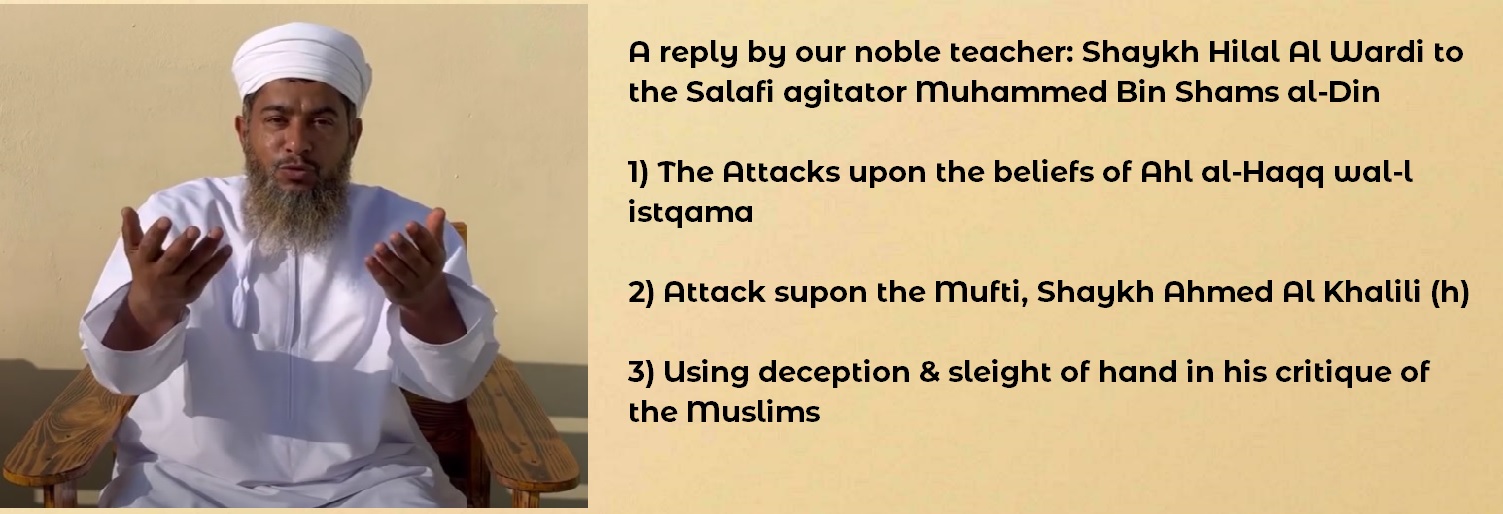
Shaykh Hilal Al Wardi-May Allah protect him is going to give a reply in English for the benefit of those whom are not grounded in Arabic. Prima-Qur’an is for the most part dedicated to an audience conversant in English.
Ibn Shams al-Din is quoting from Shaykh Ahmed Al Khalili’s book Fatawa Aqidah pg.282
Someone asked Shaykh Ahmed Al Khalili (r)
“Is Bara’ah obligatory for those people who are watching films and listening to music?”
Shaykh Ahmed replied:
“The people who are listening to or watching anything haram which is clear haram yes we can put him in bara’ah So the bara’ah is wajib for those who are watching the haram and listening to the haram. And it is very clear and there is no doubt that it is forbidden.”
So that is the first question.
The second question put to Shaykh Ahmed Al Khalii (h)
“Is bara’ah wajib for those people who are smoking and shaving the beard?”
A follow up question:
“Is there any difference between reducing the beard and shaving it?”
Shaykh Ahmed Al Khalili (h) replies: “The man who smokes and the man who is shaving his beard or reduce it they are committing a big sin. And anyone who makes a big sin will be in bara’ah unless he made tauba/repentance.”
Our noble Shaykh Hilal -May Allah protect him says: that before we proceed let us understand something about Ahl al-Haqq wa-l istiqama in regard to this issue of Bara’ah & Walayah.
There is a reply to this by Shaykh Saeed bin Nasser al-Naabi -May Allah protect him. In the reply Shaykh Saeed says that “Ibn Shams Al-Din does not understand what is Bara’ah with Ahl al-Haqq wa-l istiqama.”
It is wajib in our school and it has three types:
Bara’ah al Haqiqah -the real dissociation.
Bara’ah al Dhahir-the apparent dissociation.
Bara’ah al Jumlah -the altogether, or common dissociation.
There are also three types of walayah.
Walayah al Haqiqah -the real friendship
Walayah al Dhahir-the apparent friendship
Walayah al Jumlah -the altogether, or common friendship.
Insh’Allah, I will write on this in the near future as not only is this important to the school it permeates the Qur’an and Sunnah. It is one of the chief reasons that Muslims are in such a bad way today. This subject has been wholly neglected or simply cast aside altogether.
What needs to be clear from the beginning is that Shaykh Ahmed Al Khalili does not say that the Muwahid that they are kafir. However, they (Muwahid of any sect including Ibadi) would be in bara’ah, if they committed a big sin of which they did not repent from. So on this point Ibn Shams Al-Din is a Mudalis. He is covering the reality from the people. Insh’Allah you the reader will see this clear as day.
So we are going to explain to the people the reality from Shaykh Ahmed Al Khalili’s (h) book.
So what is the evidence from the Qur’an and the hadith of the Prophet Muhammed (saw) that Shaykh Ahmed Al Khalili (h) relies upon to take this position & answer those questions in the way in which he did?
The first evidence is from the Qur’an:
“They swear to you so that you might be satisfied with them. But if you should be satisfied with them – indeed, Allah is not satisfied with a defiantly (l-fasiqinia) disobedient sinful people. ” (Qur’an 9:96)
Allah (swt) explains further about fisq in the following verse:
“Hajj is well-known months, so whoever has made ḥajj obligatory upon himself therein, there is no sexual relations and no fusuqa disobedience and no disputing during ḥajj. And whatever good you do – Allāh knows it. And take provisions, but indeed, the best provision is fear of Allāh. And fear Me, O you of understanding.” (Qur’an 2:197)
Narrated Abu Huraira:
The Prophet (saw) said, “Whoever does not give up forged speech and evil actions, Allah is not in need of his leaving his food and drink (i.e. Allah will not accept his fasting.)”
Source: (https://sunnah.com/bukhari:1903)
Hadith of the companion Midam whom other companions thought died as a martyr but in reality the Prophet (saw) said was in hell for stealing what he had no right to take. He stole and before he could make repentance and reconcile with Allah (swt) he died. It is one of the many reasons why we as believers must be vigilant.
Yahya related to me from Malik from Thawr ibn Zayd ad-Dili from Abu’l-Ghayth Salim, the mawla of ibn Muti that Abu Hurayra said, “We went out with the Messenger of Allah, (saw), in the year of Khaybar. We did not capture any gold or silver except for personal effects, clothes, and baggage. Rifaa ibn Zayd presented a black slave boy to the Messenger of Allah, (saw), whose name was Midam. The Messenger of Allah, (saw), made for Wadi’l-Qura, and when he arrived there, Midam was unsaddling the camel of the Messenger of Allah,(saw), when a stray arrow struck and killed him. The people said, ‘Good luck to him! The Garden!’ The Messenger of Allah said, ‘No! By He in whose hand my self is! The cloak which he took from the spoils on the Day of Khaybar before they were distributed will blaze with fire on him.‘ When the people heard that, a man brought a sandal-strap or two sandal-straps to the Messenger of Allah, (saw). The Messenger of Allah, (saw), said, ‘A sandal-strap or two sandal-straps of fire!’ “
Source: (https://sunnah.com/urn/509860)

“And Noah called to his Lord and said, “My Lord, indeed MY SON IS OF MY FAMILY (AHLI) and indeed, Your promise is true; and You are the most just of judges! He said, “O NOAH, INDEED HE IS NOT OF YOUR (AHLIKA) FAMILY; indeed, he is one whose work was other than righteous (ghayru salihin), so ask Me not for that about which you have no knowledge. Indeed, I advise you, lest you be among the ignorant. Noah said, “My Lord, I seek refuge in You from asking that of which I have no knowledge. And unless You forgive me and have mercy upon me, I will be among the losers.” (Qur’an 11:45-47)
The Son of Noah (as) is no doubt a Muwahid when he (Noah) cries out for him and Allah (swt) replied that this Muwahid son of a Prophet -worked other than righteousness. So his son is not in walayah.
Narrated Abu Hurairah:
“That the Messenger of Allah (saw) passed by a pile of food. He put his fingers in it and felt wetness. He said: ‘O owner of the food! What is this ?’ He replied: ‘It was rained upon O Messenger of Allah.’ He said: ‘Why not put it on top of the food so the people can see it?’ Then he said: ‘Whoever cheats, he is not one of us.'”
Source: (https://sunnah.com/tirmidhi:1315)
It was narrated that Safwan bin Muhriz said:
“Abu Musa fell unconscious and they wept for him. He said: ‘I say to you the words of disavowal that the messenger of Allah said: He is not one of us who shaves his head (as a sign of mourning), rends his garments, or raises his voice in Lamentation.”
Source: (https://sunnah.com/nasai:1861)
Narrated `Abdullah:
The Prophet (saw) said, “He who slaps the cheeks, tears the clothes and follows the traditions of the Days of Ignorance is not from us.”
Source: (https://sunnah.com/bukhari:1298)
It was narrated from Ibn ‘Umar that the Messenger of Allah (saw) said:
“Wine is cursed from ten angles: The wine itself, the one who squeezes (the grapes etc), the one for whom it is squeezed, the one who sells it, the one who buys it, the one who carries it, the one to whom it is carried, the one who consumes its price, the one who drinks it and the one who pours it.”
Source: (https://sunnah.com/ibnmajah:3380)
“Jabir said that Allah’s Messenger cursed the one who accepted usury, the one who paid it, the one who recorded it, and the two witnesses to it, saying they were all alike.”
Muslim transmitted it.
Source: (https://sunnah.com/mishkat:2807)
Narrated Abdullah ibn Amr ibn al-‘As:
“The Messenger of Allah (saw) cursed the one who bribes and the one who takes bribe.”
Source: (https://sunnah.com/abudawud:3580)
Do those particular hadiths mean that those people are out of Islam? No! But it means that they are in bara’ah until they give up what they are doing and repent to Allah (swt)
So going back to the fatwa of Shaykh Ahmed Al Khalili (h) those people who are going to the films and listening to the music and committing haram which is very clear haram they are in bara’ah . The Shaykh is quoting from the Qur’an and the hadith is he not?
Even Ibn Shams al-Din and his group (of Salafis) they themselves acknowledge that this is haram. You yourself (Ibn Shams al-Din) have acknowledged that all these things are sins. Drinking wine and the people who are smoking and shaving their beards. Even though we know full that the reducing of the beard has iktilaaf with the people of knowledge (even in our Ibadi school). We also know that it can be the case that scholars do not always stand by their statements until their death. They have been known to change their positions. The Mufti is a learned man and he has the right to give legal verdicts in accordance to what he understands as the evidence and what is more in accord with Wara’ (piety) and Taqwa (righteousness in conjunction with mindfulness of Allah)
For example, we know that the in the school of Imam Shafi’i they have what is called the ‘old madhab’ and the ‘new madhab’. We know our Shaykh Ahmed (h) is one man from the scholars yet once he has said something and he has brought the evidence so when you (Ibn Shams al-Din) are aware of this why do you deny our teacher this methodology, this manhaj?

The above image is the Questions and Answers section of the book from Shaykh Ahmad Al Khalili (r) for anyone whoever is partaking in and doing clear forbidden things that person is in bara’ah with us.
Ibn Shams al-Din goes to the same book page 177 and there he begins to quote the text and answers of Shaykh Ahmed Al Khalili (h) and let us look at what Ibn Shams al-Din is telling others.
On page 177 Ibn Shams al-Din is saying that any body who does these sins and does not make tauba (repentance) will stay in the hellfire forever.
So Ibn Shams al-Din rather than warning people to stay away from such things is instead stating that our teacher, Shaykh Ahmed Al Khalili(h) has exaggeration. Basically, if we could paraphrase Ibn Shams al-Din: ”You see this is what these Ibadi think why would you follow their school?” Rather, than dealing with the evidences he is fishing for the emotions. So we will look at the verses and see the evidences that support the aqidah of Shaykh Ahmed Al Khalili (h)
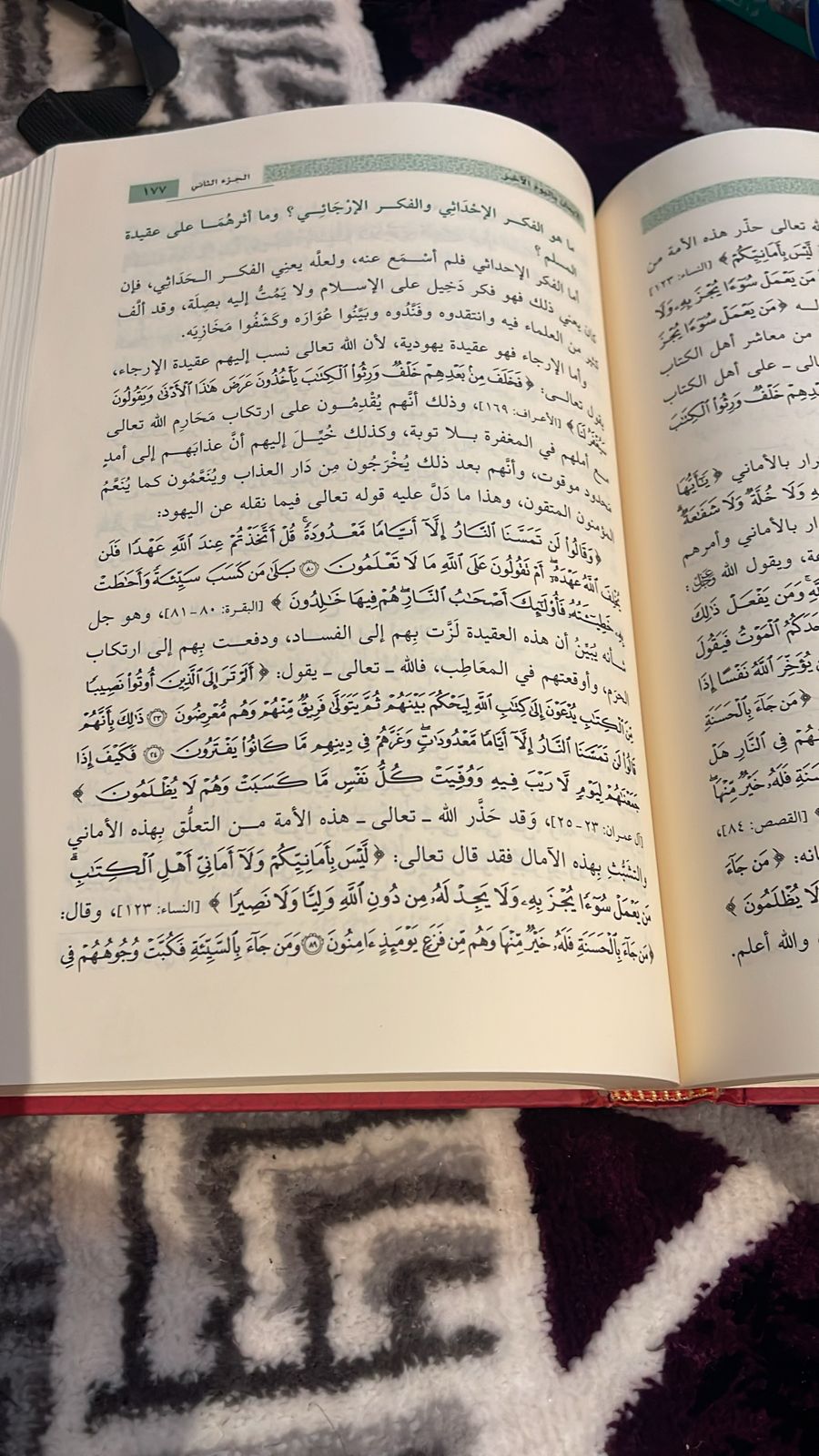

So in the book someone is asking Shaykh Ahmed Al Khalili (h) about ijra. What is the aqidah of irja? Murjiʾah, (Arabic: “Those Who Postpone”) It is the belief of those who people who think they will go to paradise by committing sins without any repentance. Or they believe Allah (swt) will just simply forgive them. Among their beliefs is they may go to hell for a brief period and than enter into paradise. Dear readers does any of this sound familiar?
Shaykh Ahmed Al Khalili (h) has proven in his book that this is the belief of some of the Jews!
“Then they were succeeded by other generations who inherited the Scripture. They indulged in unlawful gains, claiming, “We will be forgiven ˹after all˺.” And if similar gain came their way, they would seize it. Was a covenant not taken from them in the Scripture that they would not say anything about Allah except the truth? And they were already well-versed in its teachings. But the ˹eternal˺ Home of the Hereafter is far better for those mindful ˹of Allah˺. Will you not then understand?” (Qur’an 7:169)
Another belief that is similar to some of the Jews is found here:
“And they say, “Never will the Fire touch us, except for a few days.” Say, “Have you taken a covenant with Allah ? For Allah will never break His covenant. Or do you say about Allah that which you do not know? “Yes, whoever earns evil and his sin has encompassed him – those are the companions of the Fire; they will abide therein eternally.” (Qur’an 2:80-81)
“Do you not consider, those who were given a portion of the Scripture? They are invited to the Scripture of Allah that it should arbitrate between them; then a party of them turns away, and they are refusing.” (Qur’an 3:23)
“This is because they say: ‘The fire of Hell shall not touch us except for a limited number of days.’ The false beliefs which they have forged have deluded them in their faith.” (Qur’an 3:24)
“How, then, will they fare when We shall gather them all together to witness the Day about (the coming of) which there is no doubt, and when every human being shall be repaid in full for what he has done, and none shall be wronged?” (Qur’an 3:25)
“˹Divine grace is˺ neither by your wishes nor those of the People of the Book! Whoever commits evil will be rewarded accordingly, and they will find no protector or helper besides Allah.” (Qur’an 4:123)
“And [mention] the Day when We will resurrect among every nation a witness over them from themselves. And We will bring you, as a witness over your nation. And We have sent down to you the Book as clarification for all things and as guidance and mercy and good tidings for the Muslims. Indeed, Allah commands justice, grace, as well as generosity to close relatives. He forbids indecency, wickedness, and aggression. He instructs you so perhaps you will be mindful.” (Qur’an 16:89-90)
“Whoever comes with a good deed will be rewarded tenfold. But whoever comes with a bad deed will be punished for only one. None will be wronged.” (Qur’an 6:160)
There is a hadith of the Blessed Prophet (saw) relevant to the situation of our Ummah. The fact that we have allowed the beliefs and the ways of the previous people to influence us, this Muslim Ummah.
Narrated Abu Sa`id Al-Khudri:
The Prophet (saw) said, “You will follow the ways of those nations who were before you, span by span and cubit by cubit (i.e., inch by inch) so much so that even if they entered a hole of a mastigure (lizard), you would follow them.” We said, “O Allah’s Messenger (saw)! (Do you mean) the Jews and the Christians?” He said, “Whom else?“
Source: (https://sunnah.com/bukhari:7320)
Shaykh Ahmed Al Khalili (h) says when Allah (swt) says something he will fulfil it. Allah (swt) does not jest! May Allah (swt) protect us from being among the perverts!
“Allah will respond, “Do not dispute in My presence, since I had already given you a warning. My Word cannot be changed, nor am I unjust to ˹My˺ creation.” (Qur’an 50:28-29)
“For them is good news in this worldly life and the Hereafter. There is no change in the promise of Allah. That is ˹truly˺ the ultimate triumph.” (Qur’an 10:64)
“Our Lord! You will certainly gather all humanity for the ˹promised˺ Day—about which there is no doubt. Surely Allah does not break His promise.” (Qur’an 3:9)
Ibn Shams al-Din was basically telling people: “See! Shaykh Ahmed Al Khalili (h) telling the people that Allah (swt) will not forgive them!” Yet, Ibn Shams al-Din has brought no evidence to refute the strong evidence from Shaykh Ahmed Al Khalili (h) in his book!
In the video @2 minutes 40 seconds in Ibn Shams al-Din claims that Shaykh Ahmed Al Khalili (h) says, “That if anyone died and made a big sin you should not make du’a for him.”
For example: Asking Allah (swt) to have mercy on the day of judgement. Ibn Shams al-Din basically said, “For Ahl Sunnah Wal Jammah we can make du’a for someone that Allah (swt) give him forgiveness but for Shaykh Ahmed Al Khalili (h) No! You cannot do like this!” This is what Ibn Shams al-Din is claiming. So leaving fishing for emotions aside. What is the evidence from Shaykh Ahmed Al Khalili (h)?
As has already passed what did Allah (swt) say about the the fasiq?
“They swear to you so that you might be satisfied with them. But if you should be satisfied with them – indeed, Allah is not satisfied with a defiantly (l-fasiqinia) disobedient sinful people. ” (Qur’an 9:96)
So why does Ibn Shams al-Din feign that Shaykh Ahmed Al Khalili (h) is not upon the Qur’an and the Sunnah? Especially when Shaykh Ahmed Al Khalili (h) has quoted from the Qur’an and the Sunnah and the books accepted by the Ahl Sunnah.

Ibn Shams al-Din than goes to this book: Qawaid Al Islam on pg. 71.
Ibn Shams al-Din says, “What is the bara’ah in our religion? That is for us Ibadi. It is for the insulting and making insult for the kafirs.” So he says: “See! They are telling the bara’ah for the Muslims who are committing sins they are kafirs! They are taking them out from Islam!”
This is not correct from Ibn Shams al-Din and he has made a big tablis (deception). Why?
Because in his book Shaykh Abu Ismail Al-Jitali (r) talks in details about bara’ah in 10 chapters. We will walk you through these chapters.
In the first chapter he talks about the kafirs. Not about the Muslims! He talks about those people who commit sins in general. So insh’Allah we will proceed to give some of the key points from these chapters.

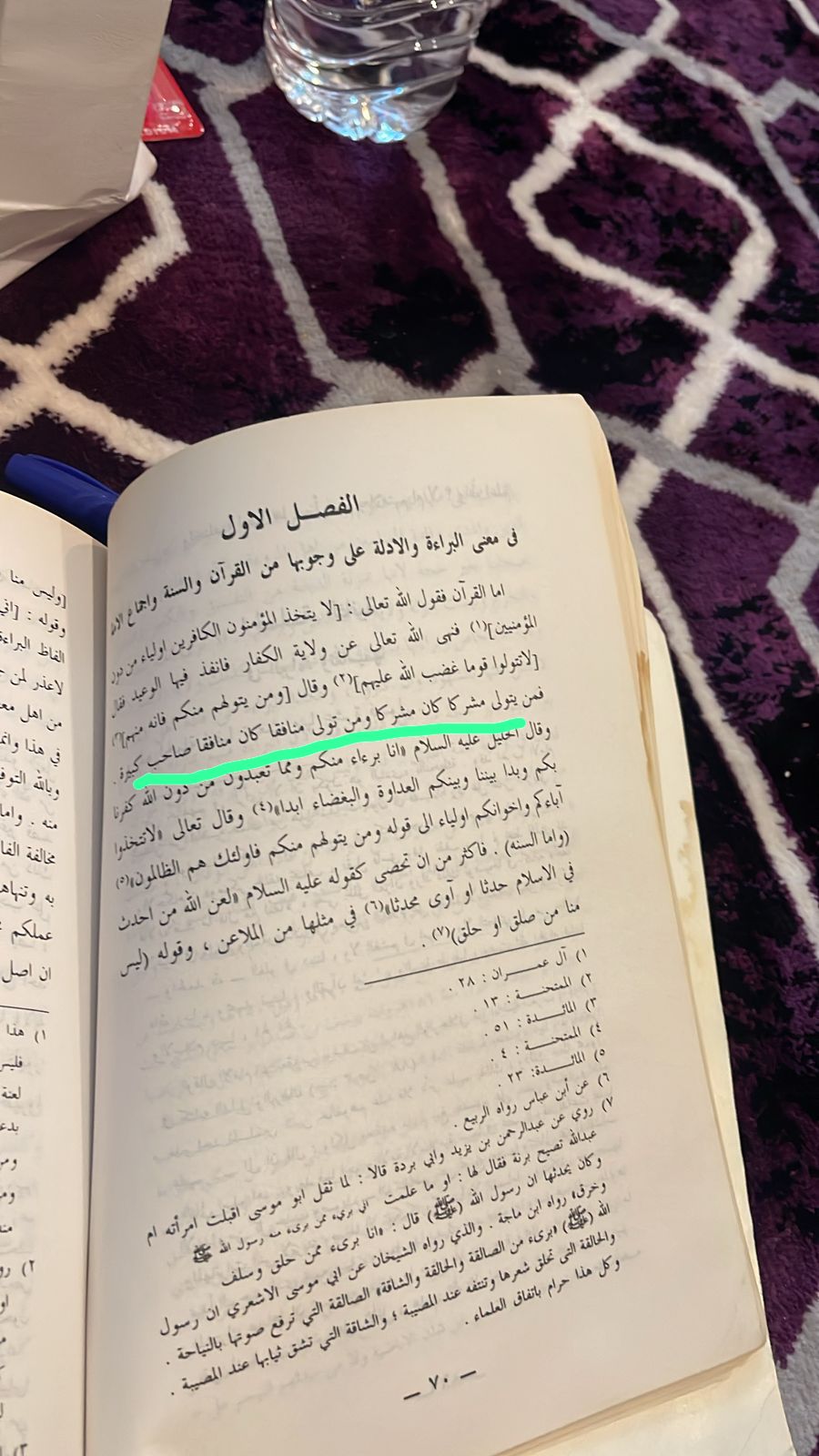
The picture above are pgs. 70 & 71. That which Ibn Shams al-Din quotes is page 71.
This is chapter one. It talks about bara’ah and the evidence for it from the Qur’an and the Hadith and the Consensus (‘Ijma) of the scholars. That is the title for the first chapter.
In the underline text it says:
“Those people who make walayah for the mushrik they will
be a mushrik like them.”
“And those people who make walayah for munafiq they will be
munafiq like them.”
Like the one who is committing a big sin. So he said they are munafiq
but they are not out of Islam.
So he brings the evidence from the Qur’an:
“Believers should not take disbelievers as guardians instead of the believers—and whoever does so will have nothing to hope for from Allah—unless it is a precaution against their tyranny. And Allah warns you about Himself. And to Allah is the final return.”
(Qur’an 3:28)
“O believers! Do not ally yourselves with a people Allah is displeased with. They already have no hope for the Hereafter, just like the disbelievers lying in ˹their˺ graves.” (Qur’an 60:13)
“O believers! Take neither Jews nor Christians as guardians—they are guardians of each other. Whoever does so will be counted as one of them. Surely Allah does not guide the wrongdoing people.” (Qur’an 3:51)
“You already have an excellent example in Abraham and those with him, when they said to their people, “We totally dissociate ourselves from you and ˹shun˺ whatever ˹idols˺ you worship besides Allah. We reject you. The enmity and hatred that has arisen between us and you will last until you believe in Allah alone.” The only exception is when Abraham said to his father, “I will seek forgiveness for you,˹” adding, “but˺ I cannot protect you from Allah at all.” ˹The believers prayed,˺ “Our Lord! In You we trust. And to You we ˹always˺ turn. And to You is the final return.” (Qur’an 50:4)
and much more evidences…
Shaykh Abu Ismail Al-Jitali (r) brought the evidences from the Qur’an and from the Sunnah and from the ‘ijma, consensus of the Muslims. He brought the evidences about those who are doing the big sins and about the mushriks. He never once said all people who commit big sins are a Mushrik! He never said this!

See! Subhan’Allah! See line number 8 in this page when Ibn Shams al-Din misquoted
that: “Anyone committing a sin he is in bara’ah and he’s a kafir.” Where as after that is the rest of the text lines 9, 10, 11 & 12 all continue to explain the difference between bara’ah and the origin of bara’ah. Shaykh Abu Ismail Al-Jitali explains the origin of bara’ah is against the actor and to make bara’ah of him.
Because Allah (swt) says:
“And if they deny you, then say, “For me are my deeds, and for you are your deeds. You are disassociated (bariuna) from what I do, and I am disassociated (barion) from what you do.” (Qur’an 10:41)
The alsi (the origin) of bara’ah means against. Where as walayah means acceptance or it can mean that I am accepting of him, and assisting him to the order of Allah.
So bara’ah is dissociation from him and walayah is friendship and assistance to him.
So here the Shaykh is explaining about this. Not that everyone in bara’ah is a mushrik. But this Ibn Shams al-Din is not reading the text carefully and not quoting context as a means to deceive his viewers. There are 10 chapters in this book and insh’Allah Shaykh Hilal -(May Allah protect him) will continue to comment on the other chapters.
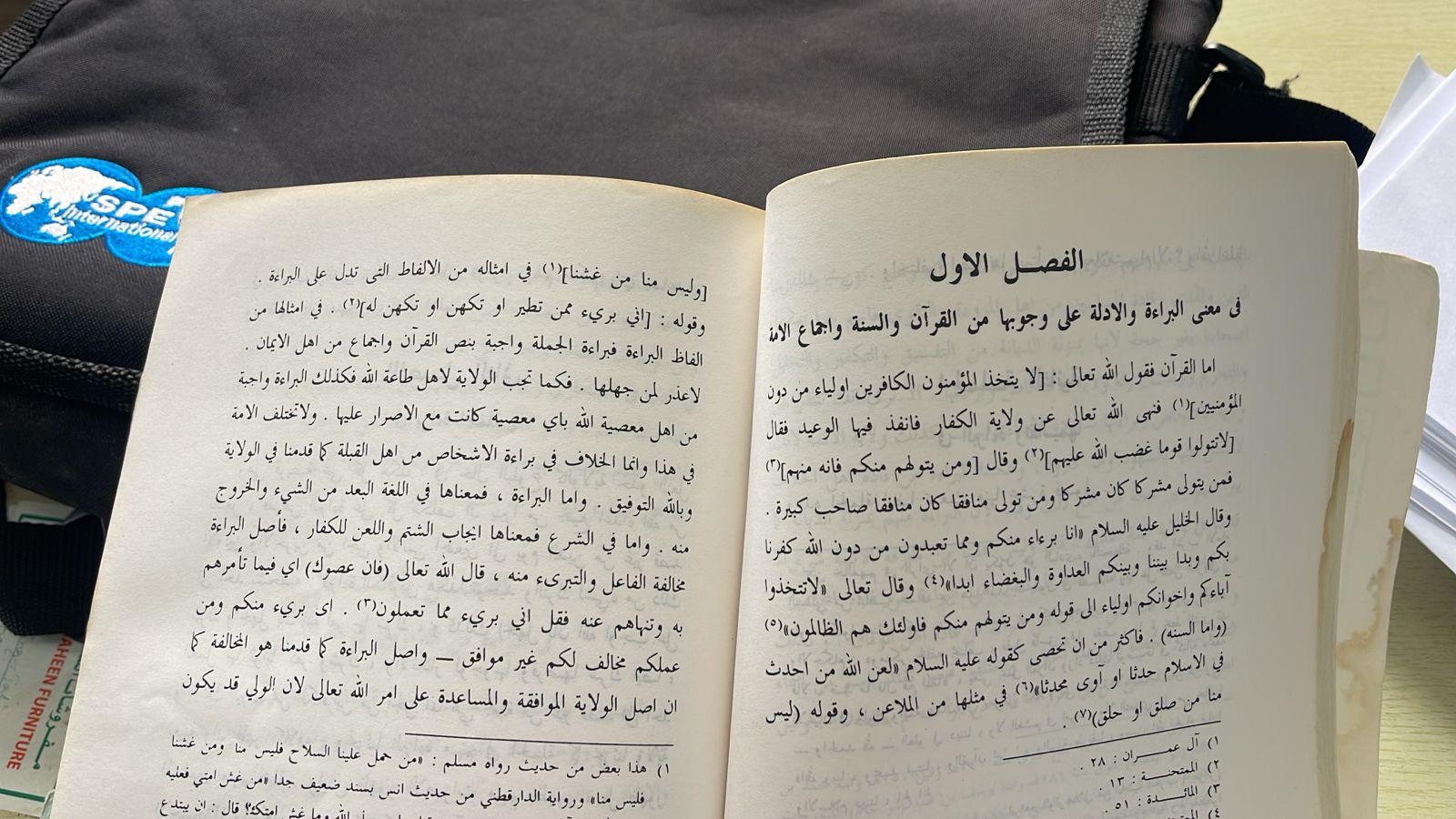
This is the book Quwaid Al Islam which is Ibn Shams al-Din quoted the text from it. As mentioned there are 10 chapters and this is the first chapter. The first chapter on the right hand side (above) he is talking about bara’ah from the kuffar. The conclusion of Shaykh Abu Ismail Al-Jitali (r) is that it is wajib from the Qur’an and the Sunnah and the ‘ijma of the scholars.
The page you see to your left is the page which is misquoted from Ibn Shams al-Din that it is from the duty of the religion to insult and give lanat (curses) upon the kuffar. Which he is basically telling the people: “It is from the Ibadi that anyone who is bara’ah is a kafir!” That is totally wrong! Because it is not the Ibadi view that all the people who are in bara’ah that they are kafir. There are differences on these matters. As well as on the difference between walayah and al bara’ah.
The first chapter it is specifically speaking about kafirs. So what Ibn Shams al-Din did was to quote the bara’ah for kafirs and tried to be under handed in concealing this for the Ummah. Especially when he says that the Ibadi claim that bara’ah is just for the kuffar. This is from the first chapter.
As mentioned before the page on the right hand has verses from the Qur’an.
“Believers should not take disbelievers as guardians instead of the believers—and whoever does so will have nothing to hope for from Allah—unless it is a precaution against their tyranny. And Allah warns you about Himself. And to Allah is the final return.” (Qur’an 3:28)
“O believers! Do not ally yourselves with a people Allah is displeased with. They already have no hope for the Hereafter, just like the disbelievers lying in ˹their˺ graves.” (Qur’an 60:13)
“O believers! Take neither Jews nor Christians as guardians—they are guardians of each other. Whoever does so will be counted as one of them. Surely Allah does not guide the wrongdoing people.” (Qur’an 3:51)
“You already have an excellent example in Abraham and those with him, when they said to their people, “We totally dissociate ourselves from you and ˹shun˺ whatever ˹idols˺ you worship besides Allah. We reject you. The enmity and hatred that has arisen between us and you will last until you believe in Allah alone.” The only exception is when Abraham said to his father, “I will seek forgiveness for you,˹” adding, “but˺ I cannot protect you from Allah at all.” ˹The believers prayed,˺ “Our Lord! In You we trust. And to You we ˹always˺ turn. And to You is the final return.” (Qur’an 50:4)
“Believers should not take disbelievers as guardians instead of the believers—and whoever does so will have nothing to hope for from Allah—unless it is a precaution against their tyranny. And Allah warns you about Himself. And to Allah is the final return.”
“O you who have believed, do not take the Jews and the Christians as allies. They are allies of one another. And whoever is an ally to them among you – then indeed, he is of them. Indeed, Allah guides not the wrongdoing people.” (Qur’an 5:51)
All these verses are talking about bara’ah from the people –especially kafirs.
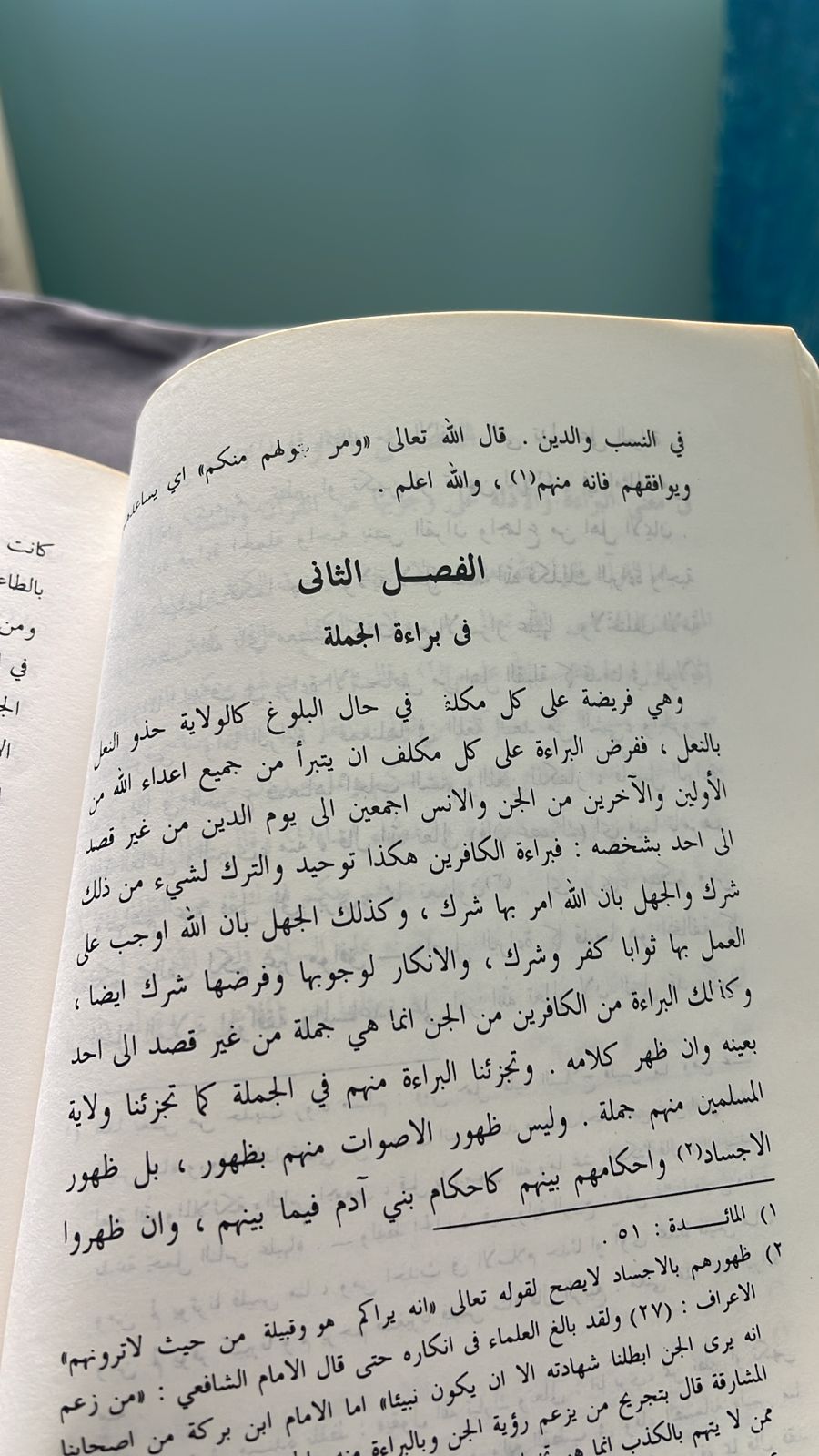
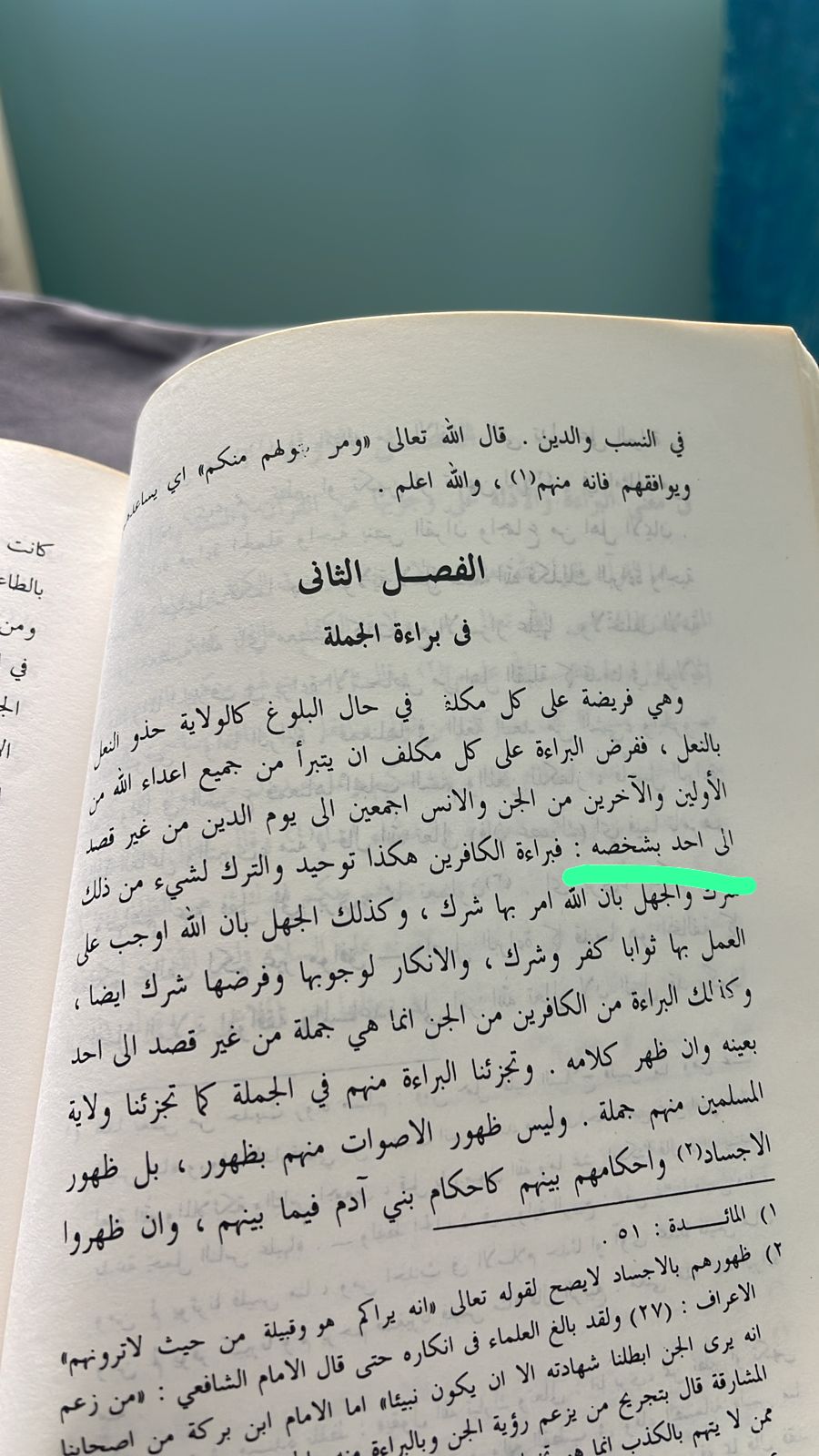
This is the second chapter and it is talking about Bara’ah Jumlah. (The over all or General Dissociation).
You have to put all of a particular type of people in bara’ah who are not following the orders of Allah (swt) without you necessarily going to every individual person himself. This means you are personally not required to know each and every person you meet. Are they committing good or bad/sin or not etc.
Examples being: The non believers, the Muslims who commit big sins, those among the Jinn.
Where as in the opposite is true:
We do walayah for all of a particular type of people who follow Allah (swt) -in general.
From among the Muslims, human beings and from among the Jinn.
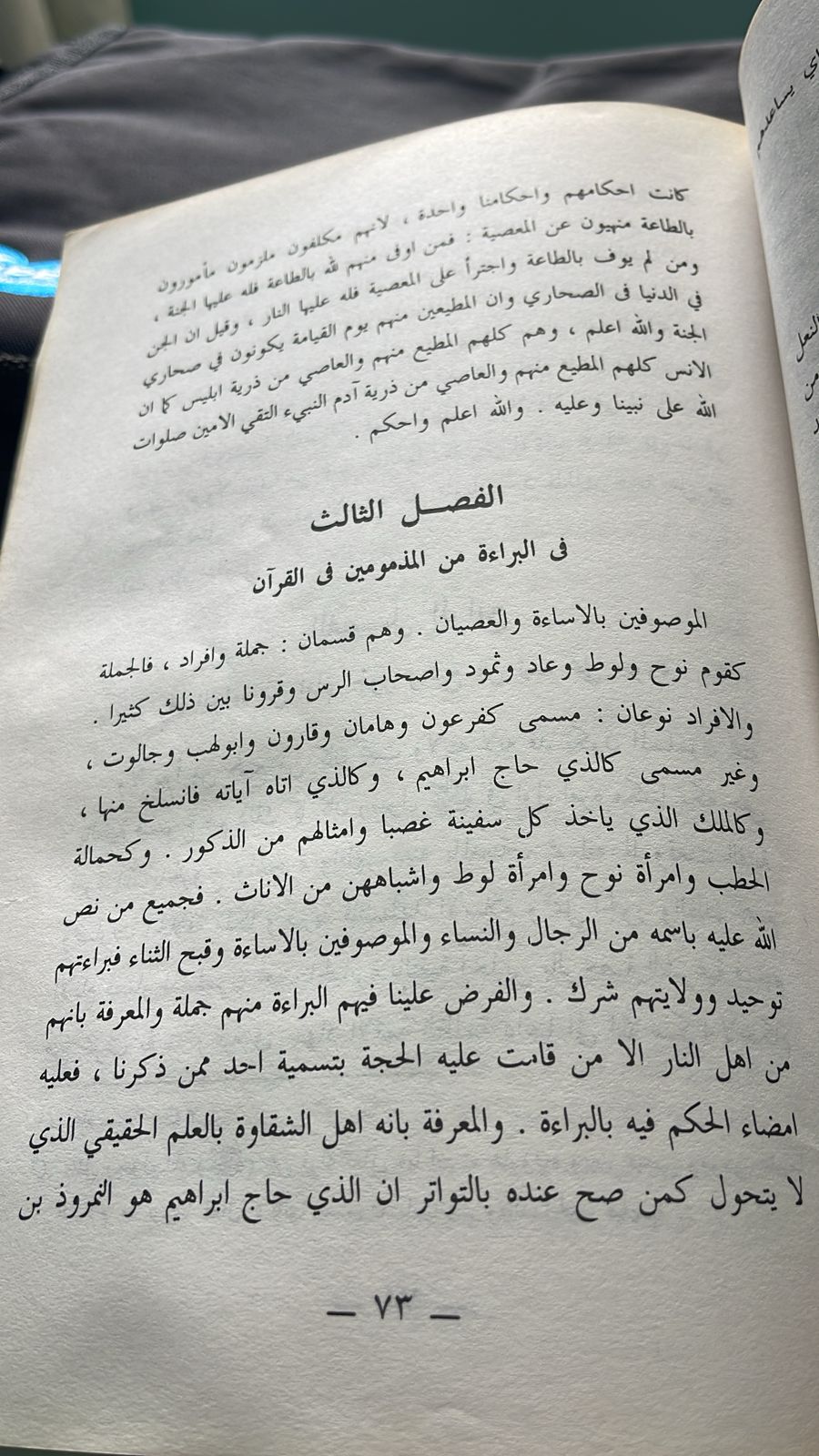
This is chapter 3. This is bara’ah from the Qur’an. The Qur’an has censored them.
Bara’ah al Haqiqah -The Real Bara’ah
For example: Abu Lahab the uncle of the Prophet (saw). Goliath killed by the Prophet David (as). Qarun, The people of ‘Ad and Thamud and Noah and Lut those people went astray and they are all Kafir and they are all in Bara’ah.
Sometimes our brothers from among the Muslims use a flawed argument using Abu Lahab as an example to prove the truth of the Qur’an. They say: “You see Allah says Abu Lahab will be in hell. If Abu Lahab take the shahada it would make the Qur’an false.”
This in and of itself is a false argument. The words of Allah (swt) are true and those of Abu Lahab are false. So even if Abu Lahab took the shahada, it would be in deception as Allah (swt) told us the truth about his fate.
The inverse is true. If Allah (swt) said in the Qur’an someone would be in paradise and this person did a sins or big sins, it is Allah (swt) who knows that this one made sincere repentance. So their ending was a good ending.
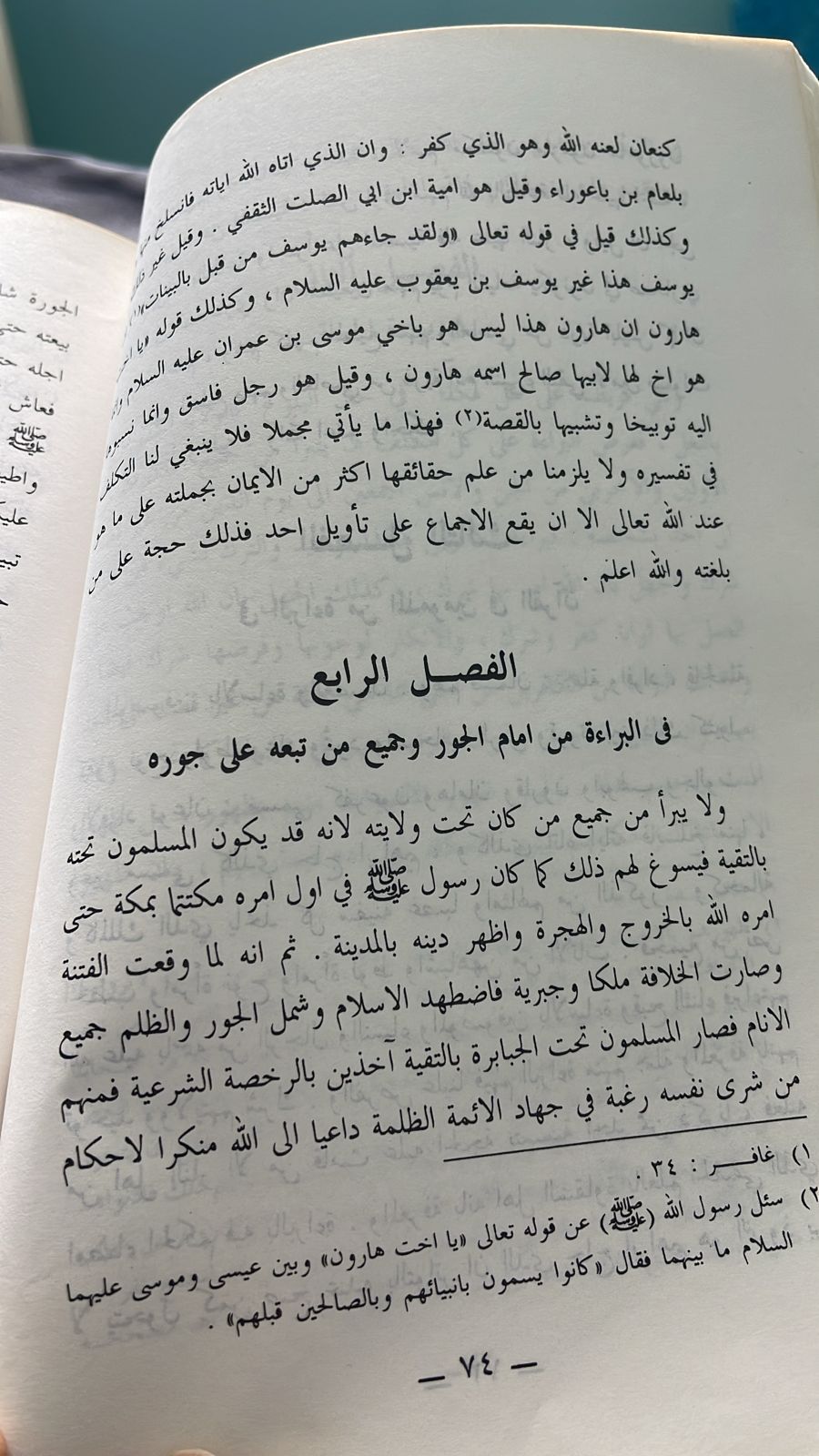
Chapter 4 Title: Bara’ah from the unjust Imam; as well as those who follow the unjust Imam.
Here we are admonished when you do bara’ah of the unjust Imam do be careful not to do general bara’ah of all of his followers. There could be the real believers among them. Those who are doing taqiyah to protect themselves because the brutality of the unjust Imam.
Example of doing taqiyah to save ones life: Ammar bin Yasir (ra).
(Whosoever disbelieves in Allah after his belief…) [16:106]. Said Ibn ‘Abbas: “This verse was revealed about ‘Ammar ibn Yasir. The idolaters had taken him away along with his father Yasir, his mother Sumayyah, Suhayb [al-Rumi], Bilal [ibn Rabah], Khabbab [ibn al-Aratt] and Salim [the client of Hudhayfah] and tortured them. As for Sumayyah, she was tied up between two camels and stabbed with a spear in her female organ. She was told: ‘You embraced Islam for the men’, and was then killed. Her husband Yasir was also killed. They were the first two persons who were killed in Islam. As for ‘Ammar, he was coerced to let them hear what they wanted to hear. The Messenger of Allah, Allah bless him and give him peace, was told that ‘Ammar has renounced faith, but he said: ‘Never, ‘Ammar is filled with faith from his head to his toes; faith is admixed with his flesh and blood!’ ‘Ammar then went to see the Messenger of Allah, Allah bless him and give him peace, crying. The Messenger of Allah, Allah bless him and give him peace, wiped his tears with his own hand and said: ‘if they return to you, let them hear again what you told them’. Then, Allah, exalted is He, revealed this verse”. Mujahid said: “This verse was revealed about some Meccans who accepted faith. The Muslims of Medina wrote to them urging them to migrate and told them that they did not consider them part of them unless they migrated. And so they left Mecca intending to migrate to Medina. The Quraysh caught up with them on the way and coerced them to renounce their faith. It is about them that this verse was revealed”.
Source: Tafsir Wahidi – Asbab Al-Nuzul by Al-Wahidi (https://quranx.com/tafsirs/16.106)
Whoever disbelieves in Allah after their belief—not those who are forced while their hearts are firm in faith, but those who embrace disbelief wholeheartedly—they will be condemned by Allah and suffer a tremendous punishment.” (Qur’an 16:106)
This point in this chapter itself defeats Ibn Shams al-Din. Again Ibn Shams al-Din makes a deception basically telling everyone: “Who the Ibadi put in bara’ah they are kafir.”
Let us see how he would respond to chapter 4? He would be defeated on this point alone.
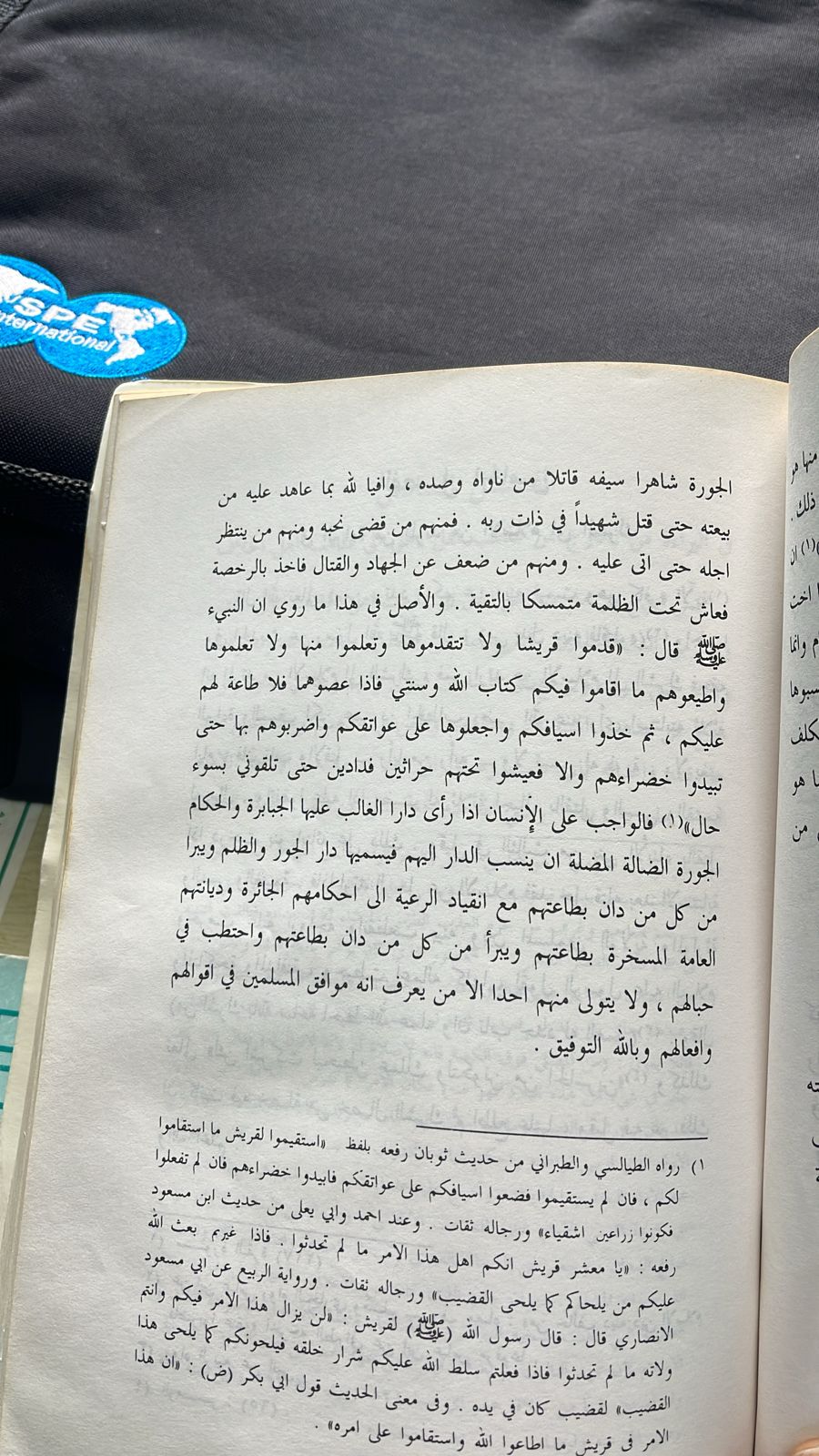
Shaykh Imam Abu Ismail Al Jitali (r) brought a very powerful hadith.
From the Sahaba Thauban (ra). This has been narrated by Musnad Abi Dawud at-Tayalasi & Al-Tabarani So than how? Can the Quraysh said to be in walayah if they are fought against? If they go against the Qur’an & the Sunnah?
Not everyone in bara’ah means they are mushrik.
“Make the Quraysh ahead of you and do not go ahead of them. Learn from them, you are not
their teachers. You follow them as long as they follow the Qur’an and the Sunnah. If they do
not follow the Qur’an and the Sunnah you do not follow them. Than take the swords from
off your shoulders and strike them until you finish them. Or they over take you when you are weak.”
Source: (https://thearchive.me/ask/drhakem/-bo0m1lqOz)
Some translations would render the Arabic as: “Annihilate their green ones. If you do not, then be miserable farmers, eating from the toil of your own hands.”
To use English idioms this basically translates as: “Strike while the iron is hot otherwise; you reap what you sow, or in this case don’t sow.”
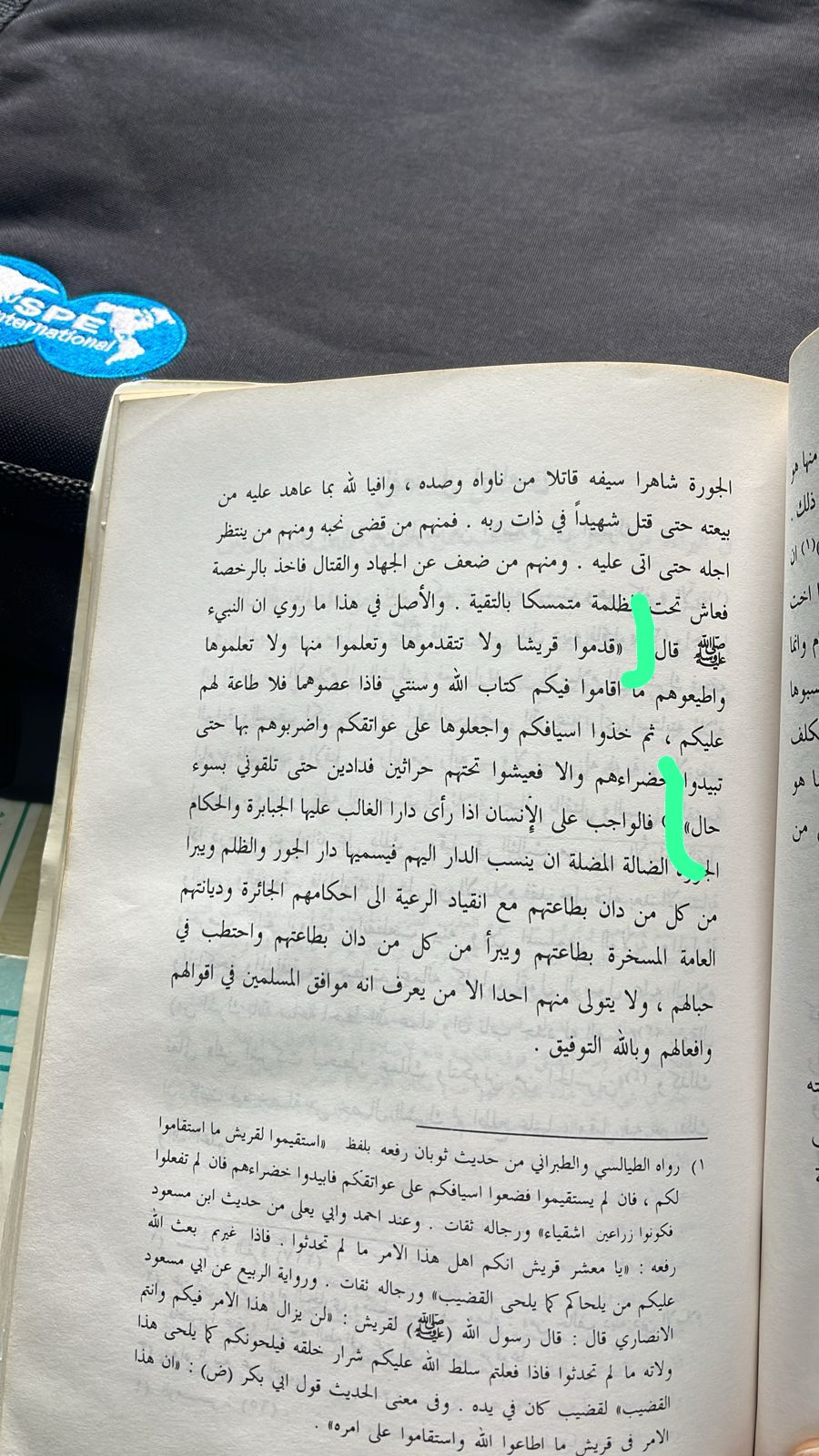
The hadith in question is in between the two green brackets above.

This is the 5th chapter. This chapter is about the people who left Islam and go to shirk. The Murtadeen are in bara’ah.
The following hadith: “Who ever changes his religion kill him.” those are in the books that Ibn Shams al-Din relies upon.
These are not from the books of the Ibadis. These statements are in their (Sunni) books. We do not accept that those people who left Islam they are to be killed because of suspicion or doubts or something is not made clear to him. The Imam would take such people and discuss with them and you have to clear the doubt from them. Then after that the Imam will decide. These hadith are in Ibn Shams al-Din books. So why is he against the Ibadi on this?
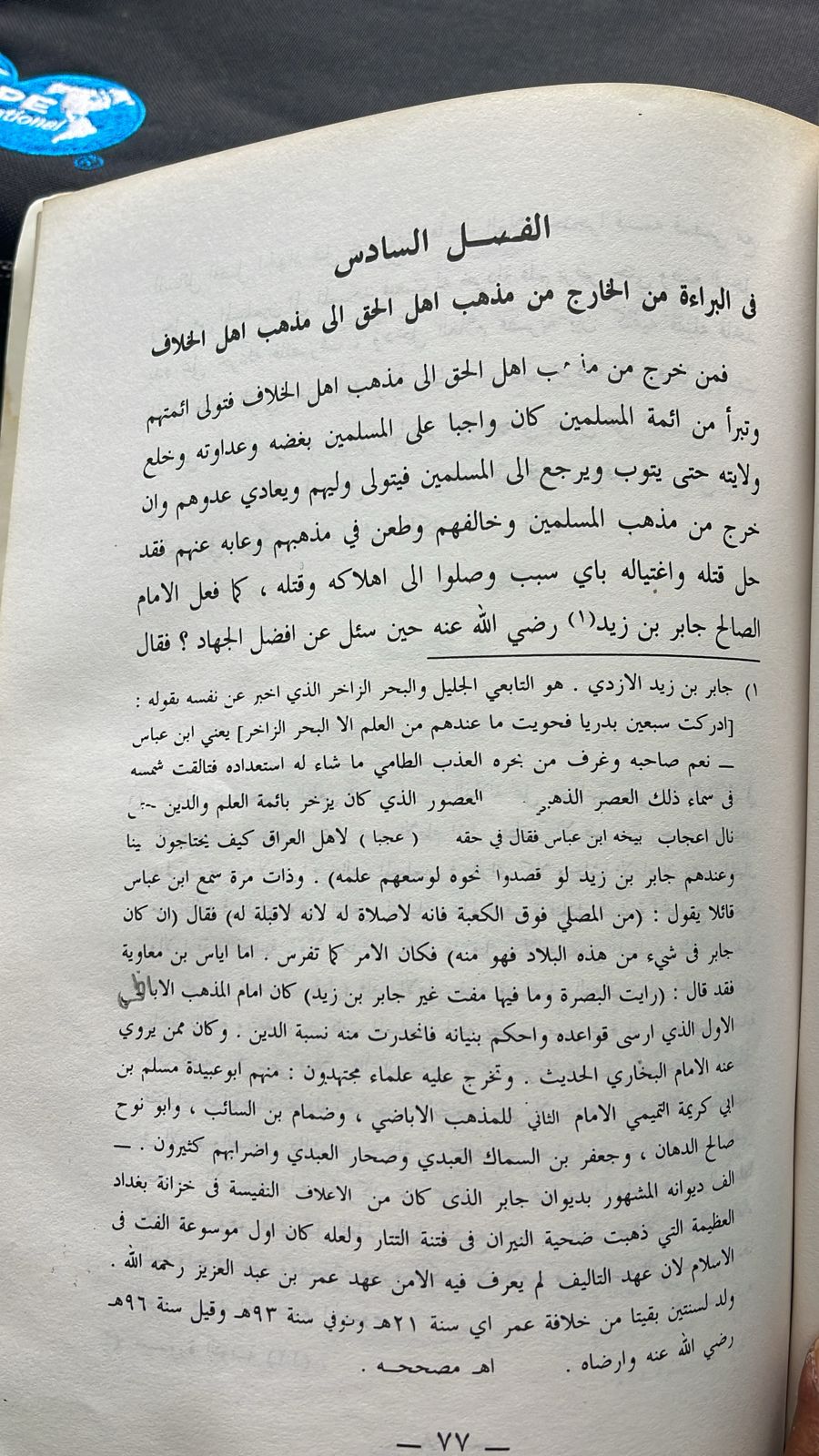
The 6th chapter those who left the Ibadi school to go to another school they are put in bara’ah.
This is the point where Ibn Shams al-Din will try to catch us. He may say: “Ah you see! If you left the Ibadi and became a Shafi’i, Sunni, Shi’a they will put that one in bara’ah!”
You see how these people act tough?
What is actually written here? Whoever goes out from our school not simply because
he has an evidence, but he is putting the scholars of the Ibadi in bara’ah he attacks the
Ibadi school and tries to defeat the Ibadi school.
In one example such a one in the past was killed:
He quotes from Jabir Bin Zayd (ra) a man asked Jabir Bin Zayd (ra) what is the best type of Jihad? Jabir Bin Zayd said, ‘Killing Khardalah,’ because this man would run around and pop off at the mouth insulting the Muslims, was trying to defeat Islam and cause doubts with people. So a man killed in him in that time.
So this person who left the Ibadi school and now attacks it, his case is similar to the one who left Islam and became one of the murtadeen, and now spends his energy and efforts to bring Islam down. So likewise, if a person leaves Islam and goes about their own way they are left to their devices. Likewise, someone leaves the Ibadi school and follows another school and they are left to their own devices we leave them to it.
*note to the reader*
You will hear Shaykh Hilal say something like this person defeated the Ibadi or defeated Islam. English is not his first language. That can be seen in the next voice note where he is searching for the words to describe the division of a chapter. However, he is doing what many in our school fail to do and that is to share knowledge. He will always have our love and respect for it. May Allah (swt) honour him in this life and in the life to come. Amin.
Without doubt he is one who has tremendous love for humanity and for the Ummah in his heart. So when he says, “defeated Ibadi or defeated Islam“-what he means is that they come against it with force.
I need to clarify this because this website/blog is visited by those who are opportunistic enemies of the faith and they will seize on anything.
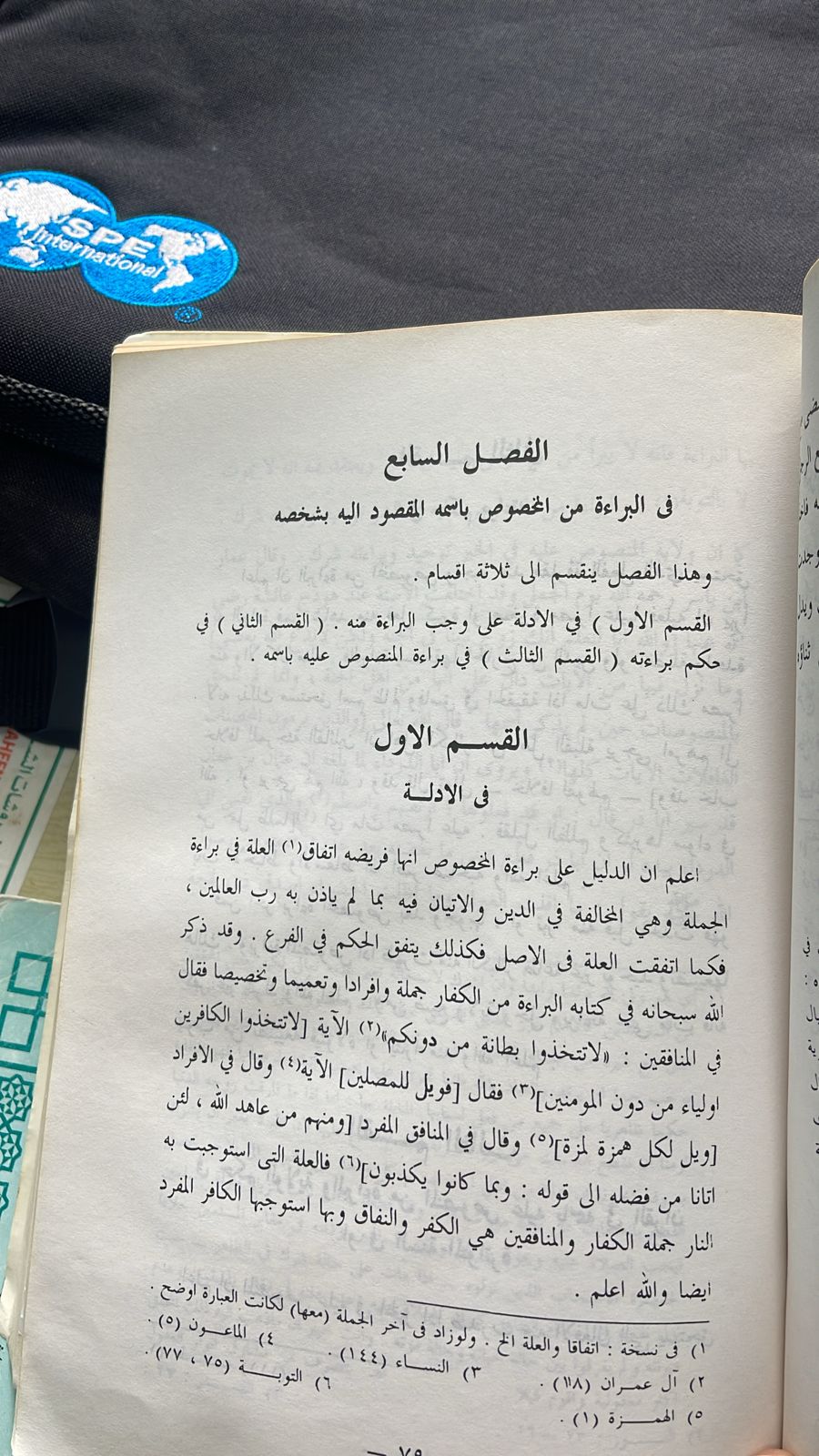
This is chapter 7 Bara’ah/dissociation from the specialist -which is shown by his name.
This chapter is divided into three parts.
A) What is the daleel (evidence) for the bara’ah for the person himself.
B) What is the hukm (judgement) of bara’ah in him?
C) The bara’ah in him by his name.
So let us deal with the first part.
A) What is the daleel (evidence) for the Bara’ah for the person himself.
Evidences for this are as follows:
“O you who have believed, do not take the disbelievers as allies instead of the believers. Do you wish to give Allāh against yourselves a clear case?” (Qur’an 4:144)
“So woe to those who pray!” (Qur’an, 107:4)
What? Woe be to those who pray? The Musaleen?
Read the next verse:
“Those who are heedless of their prayer.” (Qur’an 107:5)
sāhūna-heedless/neglectful. Not one who makes a mistake but one is negligent of praying altogether! They are inattentive about prayer. The timing, proper performance, prerequisites of prayer, showing off in prayer etc.
“Woe to every backbiter, slanderer.” (Qur’an 104:1)
“So woe to those ˹hypocrites˺ who pray yet are unmindful of their prayers;
those who ˹only˺ show off.” (Qur’an 107:4-6)
And many more verses and evidences can be produced for this type of bara’ah.
So these type of people Allah (swt) curse and strong punishment awaits them. Thus, we put them in bara’ah

Here we will deal with the second part.
B) What is the hukm (judgement) of Bara’ah in him? The evidences for those who are against the commands of Allah (swt).
In this is evidence that defeats Ibn Shams al-Din. Ibn Shams al-Din mentioned before about Al-Murji’ah, those who died committing big sins and did not make any tauba. We, Ahl al-Haqq wa-l istiqama put such people in bara’ah because of what Allah (swt) has already mentioned:
“They swear to you so that you might be satisfied with them. But if you should be satisfied with them – indeed, Allah is not satisfied with a defiantly (l-fasiqinia) disobedient sinful people. ” (Qur’an 9:96)
The Murji’ah believe that Ahl Kibar the big sins of Ahl Qiblah, it could be that
Allah would just forgive them. Yet, what has already been established by Allah (swt)
is against them!
“And all faces will be humbled before the Ever-Living, All-Sustaining. Those burdened with their evil deeds (zul’man)will be in utter loss.” (Qur’an 20:111)
We will all stand before a Holy and Just and Sovereign God.
So these questions really come back upon Ibn Shams al-Din and those from the Sunni who follow these views in general. This is the justice of Ahl al-Haqq wa-l istiqama. We follow the clear evidences.
Alas, we don’t have the view that simply because we are Muslims or simply because we follow the Ibadi school we can be unjust to people, rape people, take their money, and than do what ever we want and we go to paradise(after a possible brief stint in hell). In reality this is the aqidah of the Murji’ah.
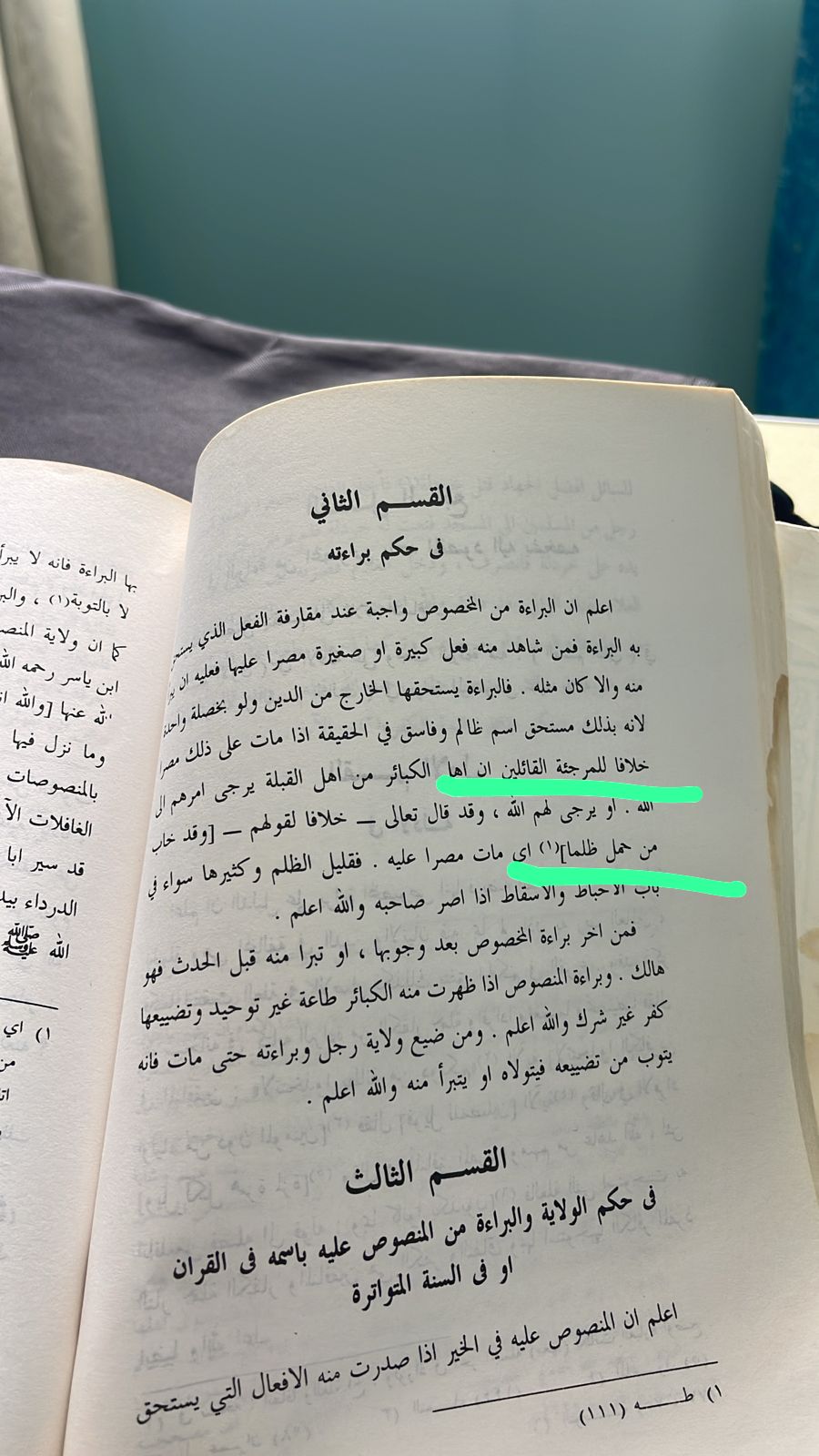
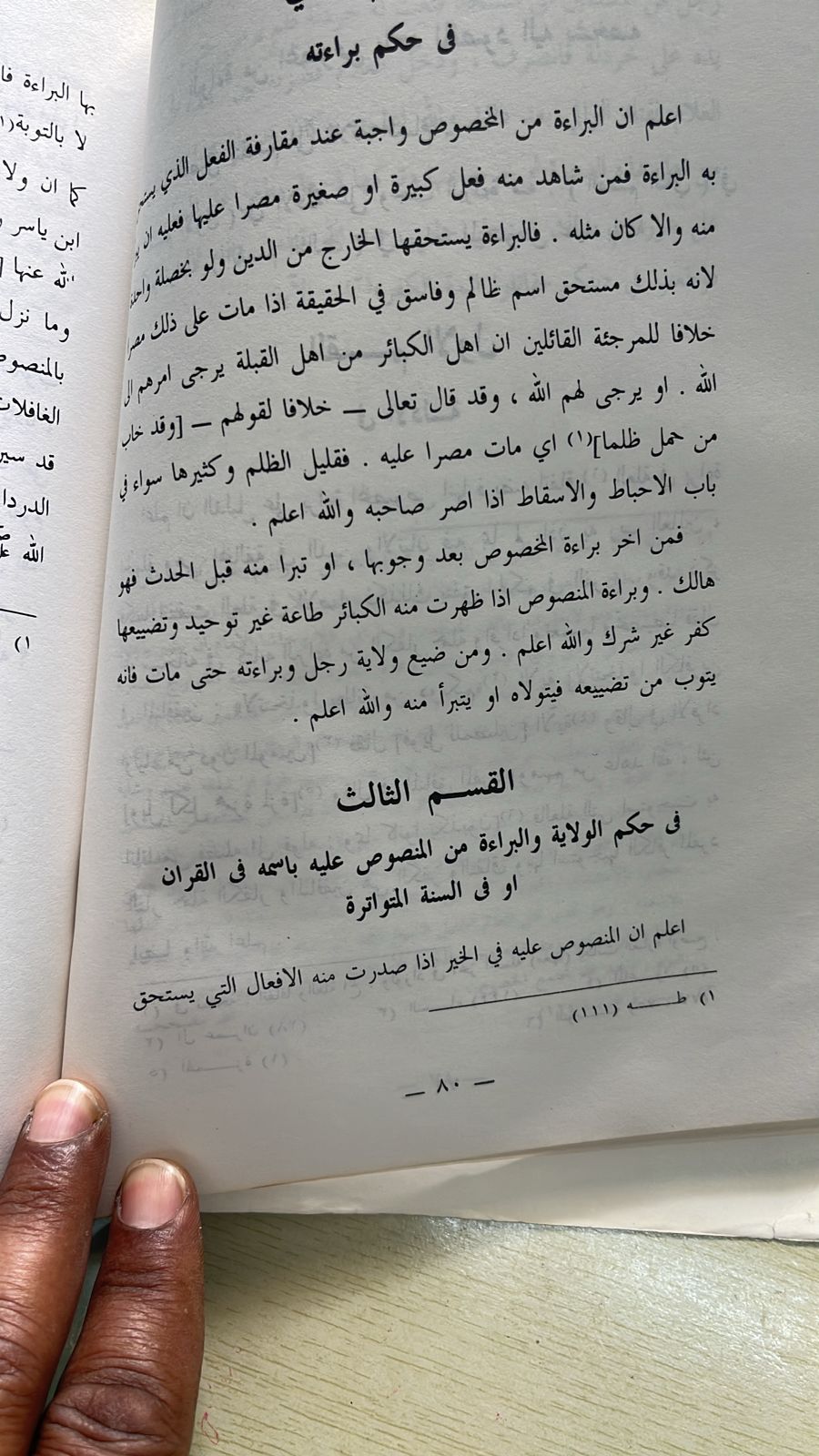
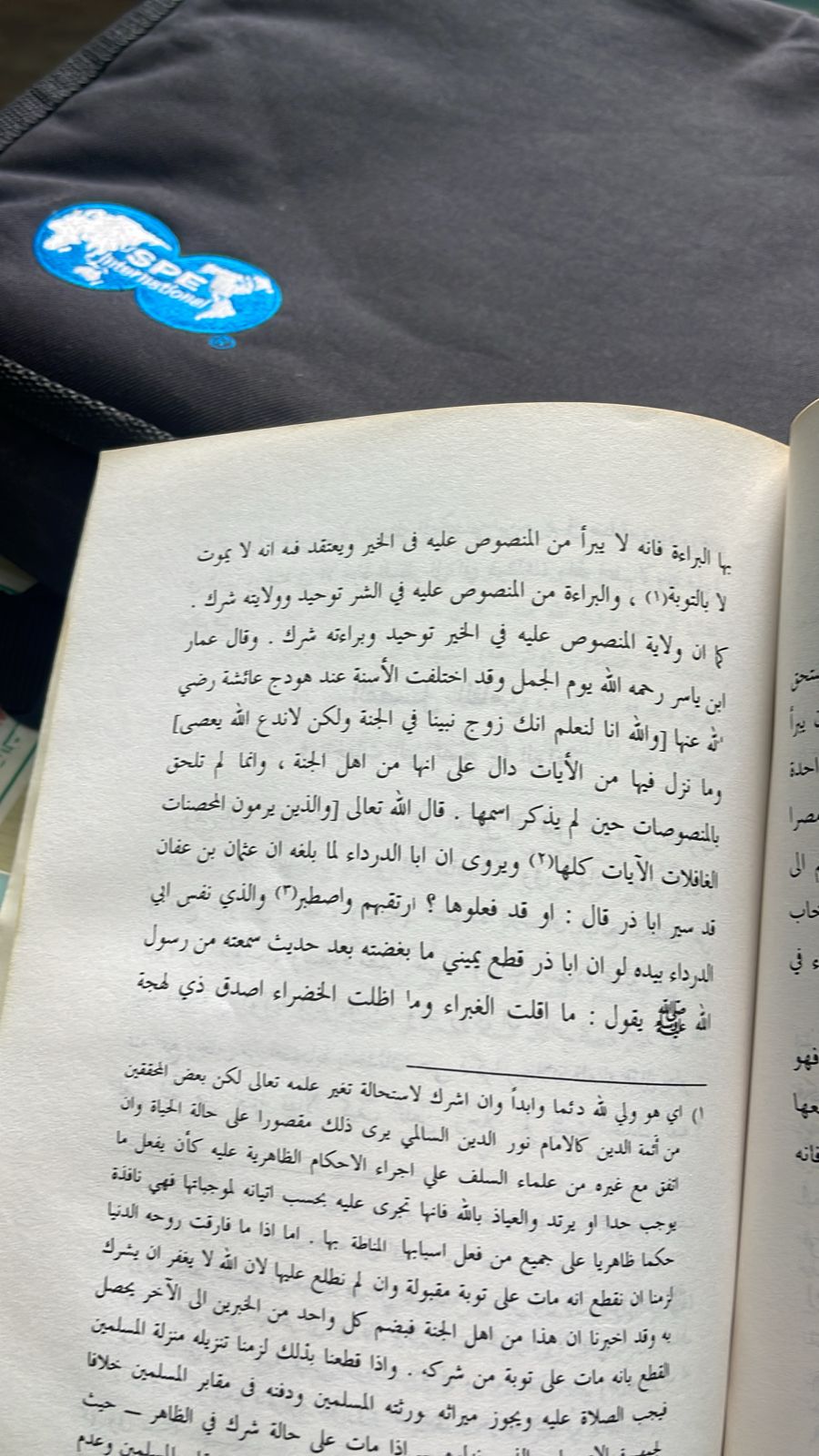
Here we will deal with the third part.
C) The bara’ah in him by his name.
This is the third section. Is those who are in walayah and bara’ah by their names in the Qur’an.
Here the Shaykh has given a very powerful evidence. He said that anyone who is not mentioned by name in the Qur’an, that Allah (swt) put them in bara’ah, then that one is by default in walayah.
Meaning that in general the default position of all people is that they are in walayah. The good thinking is that they will go to paradise. For example, one may have sinned and came back to Allah (swt) and we are not aware of that.
So in general all Muslims are in walayah .
This is why in general there are also people in bara’ah. Meaning in general the thinking is that they will go to hell. An example would be Atheist. They are in a general category but Allah (swt) knows best the individual cases. For example, one in this category may do meritorious acts even though they are in bara’ah. Because Allah (swt) knows best where this person will end up.
Some examples and evidences:
The case of Ayesha (ra) in the battle of the Camel. She was against the rightful Imam. That Imam being Ali Ibn Abu Talib. She is known as the mother of the believers, as we know the mother of the believers are in paradise. Yet, it is not written in paradise her name ‘Aisha’ (ra). So when Ammar ibn Yasir (ra) was fighting with Imam Ali Ibn Abu Talib against Ahl Sham what did Ammar ibn Yasir(ra) say?
Narrated Abu Maryam `Abdullah bin Ziyad Al-Aasadi:
When Talha, AzZubair and `Aisha moved to Basra, `Ali sent `Ammar bin Yasir and Hasan bin `Ali who came to us at Kufa and ascended the pulpit. Al-Hasan bin `Ali was at the top of the pulpit and `Ammar was below Al-Hasan. We all gathered before him. I heard `Ammar saying, “`Aisha has moved to Al-Busra. By Allah! She is the wife of your Prophet in this world and in the Hereafter. But Allah has put you to test whether you obey Him (Allah) or her (`Aisha).
Source: (https://sunnah.com/bukhari:7100)
Even Ammar bin Yasir (ra) fought in Siffin and was killed by Ahl Sham.
We know she is the wife of the Prophet (saw) and she is in Paradise but we will not go against the orders of Allah (swt). Even if Aisha (ra) in the battle of the Camel she is with the opposition! We are with the rightful Imam, Imam Ali Ibn Abu Talib. Even if she is in paradise we are not going to leave the orders of Allah (swt).

Before proceeding it may be well for the reader to go back to the top and re-read the section about Abu Lahab, because he is in the real bara’ah. He specifically mentioned by name that his ending his doom. So the inverse is true. When Allah (swt) specifically mentions a person will be in paradise the Qur’an is a biding decisive proof.
Where as the hadith could be the machinations of the schismatics.
The hadith are examined in a case by case scenario.
So here this means that if Allah (swt) put the person in walayah like the Umm al mu’minin -mothers of the believers; Allah (swt) says that she will be in paradise.
“The Prophet is more worthy of the believers than themselves, and his wives are their mothers (ummahatuhum). And those of relationship are more entitled in the decree of Allah than the] believers and the emigrants, except that you may do to your close associates a kindness. That was in the Book inscribed.” (Qur’an 33:6)
So in our school the above is evidence that Allah (swt) knows the end of Aisha (ra) and that her ending is a good ending.
This was stated in the aforementioned hadith related by Ammar bin Yasir (ra). However, she is not called by her name ‘Ayesha’ as being a woman of paradise. So even though she opposed the rightful Imam, Ali Ibn Abu Talib, Allah’s knowledge does not change and he knows that she would make a tauba (repentance).
This is what has been stated by our Imam, Imam Jabir Bin Zayed (ra) that she, Aisha (ra) made tauba (repentance) before she died. Not like for example, Mu’awiya ibn Sufyan. He never made a tauba (repentance) as we know. Where as Allah (swt) knows that Aisha (ra) will go out against the rightful Imam, Ali Ibn Abu Talib, however, her ending is a good ending.
It is reported that both Jabir b. Zaid and Abu Bilal Mirdas discussed with ‘A’ishah her attitude at the battle of the Camel and blamed her for her opposition to ‘Ali who was the legal Caliph at that time, and she once more repented.
Source: (Darjini, Tabaqat., Ms. 198)
Ibn Shams al-Din is basically saying, ” Ahl al-Haqq wa-l istiqama telling people who are committing a sin are in bara’ah; Even though we saw the people here are fighting against Aisha (ra) and she is the mother of the believers? We saw Uthman Ibn Affan against Abu Dhahr.”
Narrated ‘Abdullah bin ‘Amr:
that the Messenger of Allah (saw) said: “There is no one more truthful, that the sky has shaded and the earth has carried, than Abu Dharr.”
Source: (https://sunnah.com/tirmidhi:3801)
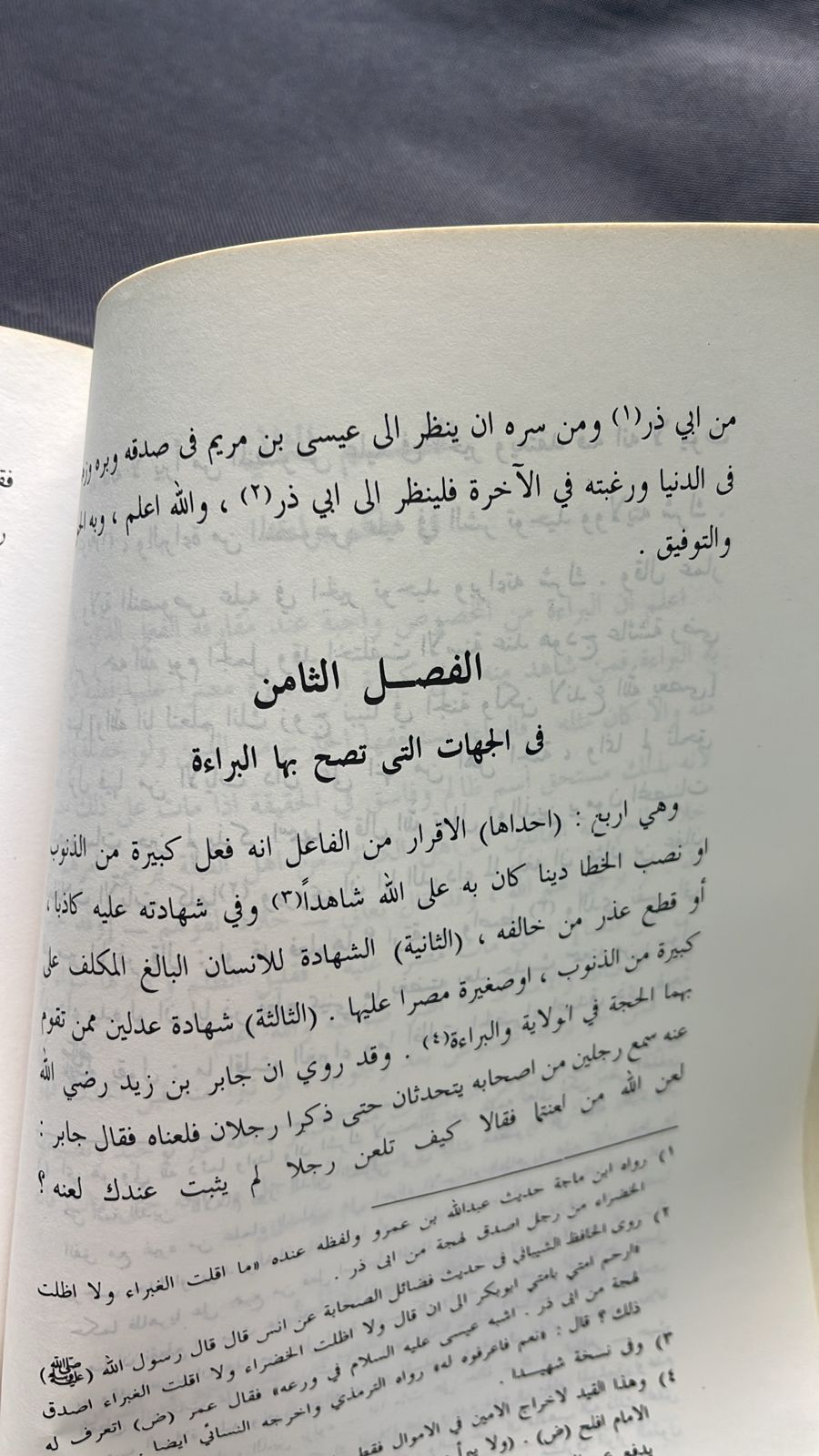
Here in chapter 8 there are four conditions and directions for Bara‘ah
- First if he says he did sins. By his own proclamation.
- If someone saw him committing a big sin and continues to persist in it.
- If two good and truthful people saw him committing a big sin.
- He is infamous. He is well known to do these things. Like Epstein for example.

Chapter 9 is about tauba (repentance) for those who have committed a sin.
This is a point that Ibn Shams al-Din does not understand either from willful ignorance or tadblis (deception). It shows that Ibn Shams al-Din is not just. He is not reading the whole of the text but picking and choosing to make his interlocutors (namely us) to look bad.
What he is extremely ignorant about is that if someone is in walaya with us and than committed a sin. He is going to be put in bara’ah directly/immediately without calling him to repentance.
For example, someone is wali of Allah (swt) and they committed a big sin.
No better example than Adam (as) and he made tauba (repentance) and came back to Allah (swt). Adam (as) is someone whom Allah (swt) himself selected.
So what about those who are less than Adam? Less than the prophets? Can we without reason or rhyme, someone did a big sin and you put him in bara’ah and keep him in bara’ah without calling to tauba directly? No! He is called to straight himself out, and to reform himself. This all of course is depending upon the nature and type of sin. Some things may require temporary banishment.
The evidence for this is many. However, we will quote one hadith that hits the nail on the head on this matter.
It was narrated from Anas bin Malik that:
“The Messenger of Allah (saw) said: ‘None of you truly believes until he loves for his brother” or he said “for his neighbor, what he loves for himself.”
Source: (https://sunnah.com/ibnmajah:66)
So what would you like for yourself dear reader if you committed a sin? To be forgiven or to be lost? Any one of us would like to be reconciled to Allah (swt). We would love to be forgiven and so this is our wish for those Muslims who are in bara’ah. So we call them to repentance and reformation of character and anyone who truly believes wants this for the one who has been ensnared by Satan.
Any school of the Muslims who does not love for his brother/sister to repent and come back to Allah (swt) is not a school worthy of consideration by the Muslims.
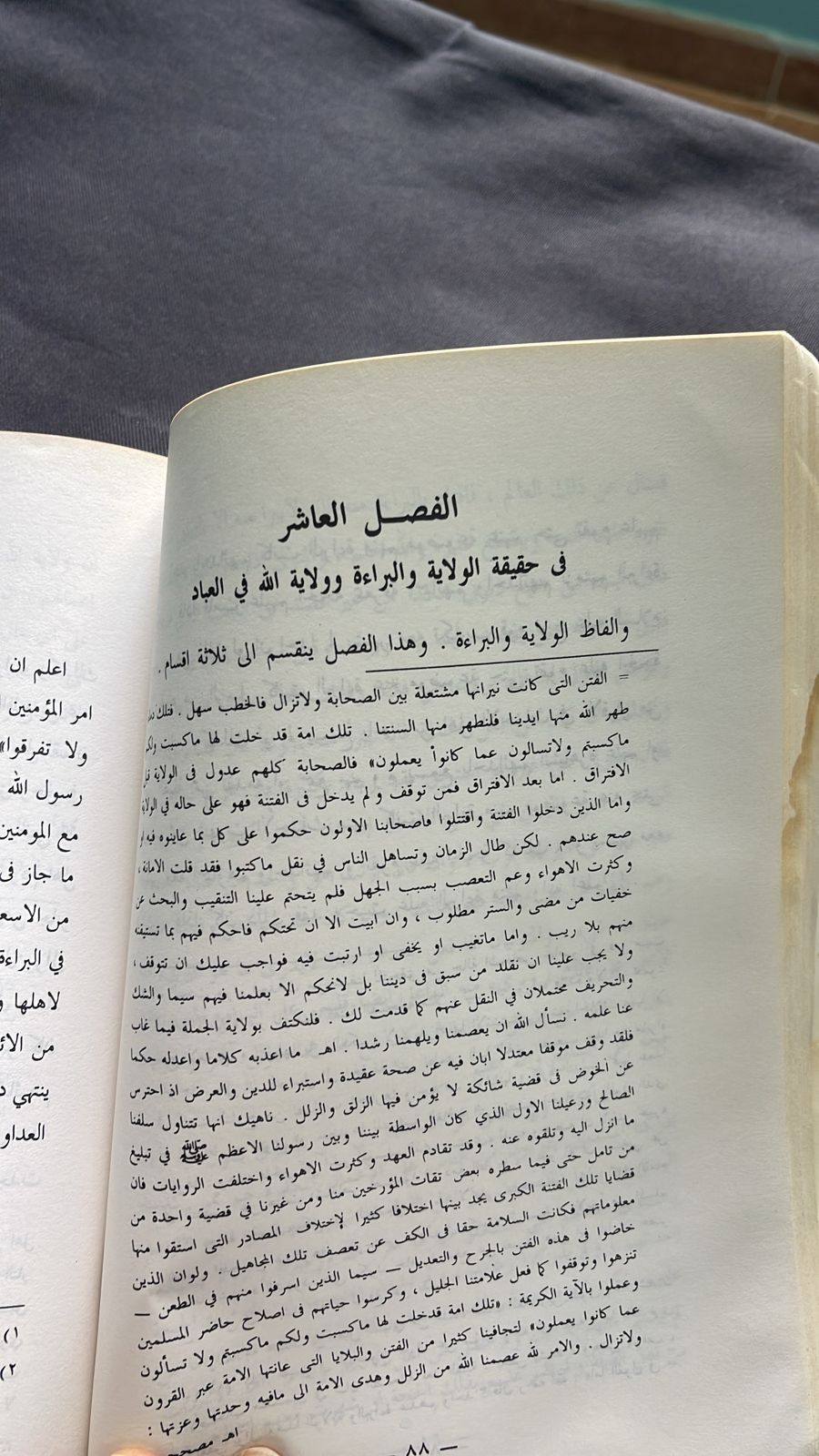
This is the last chapter /chapter 10. What is the reality of walayah and bara’ah and the reality with Allah (swt).
This is divided into three sections.

The first section the reality of walayah/ is to accept them in sharia and to be against them if they are not following the shariah
“And hold firmly to the rope of Allah all together and do not become divided. And remember the favor of Allah upon you – when you were enemies and He brought your hearts together and you became, by His favor, brothers. And you were on the edge of a pit of the Fire, and He saved you from it. Thus does Allah make clear to you His verses that you may be guided.” (Qur’an 3:103)
Bara’ah is being against unbelievers and those among Muslims who commit big sins.
Also ,in the book the Shaykh Jitali (r) said that the Prophet (saw) advised new Muslims to be away from the mushrik and be close to the believers.
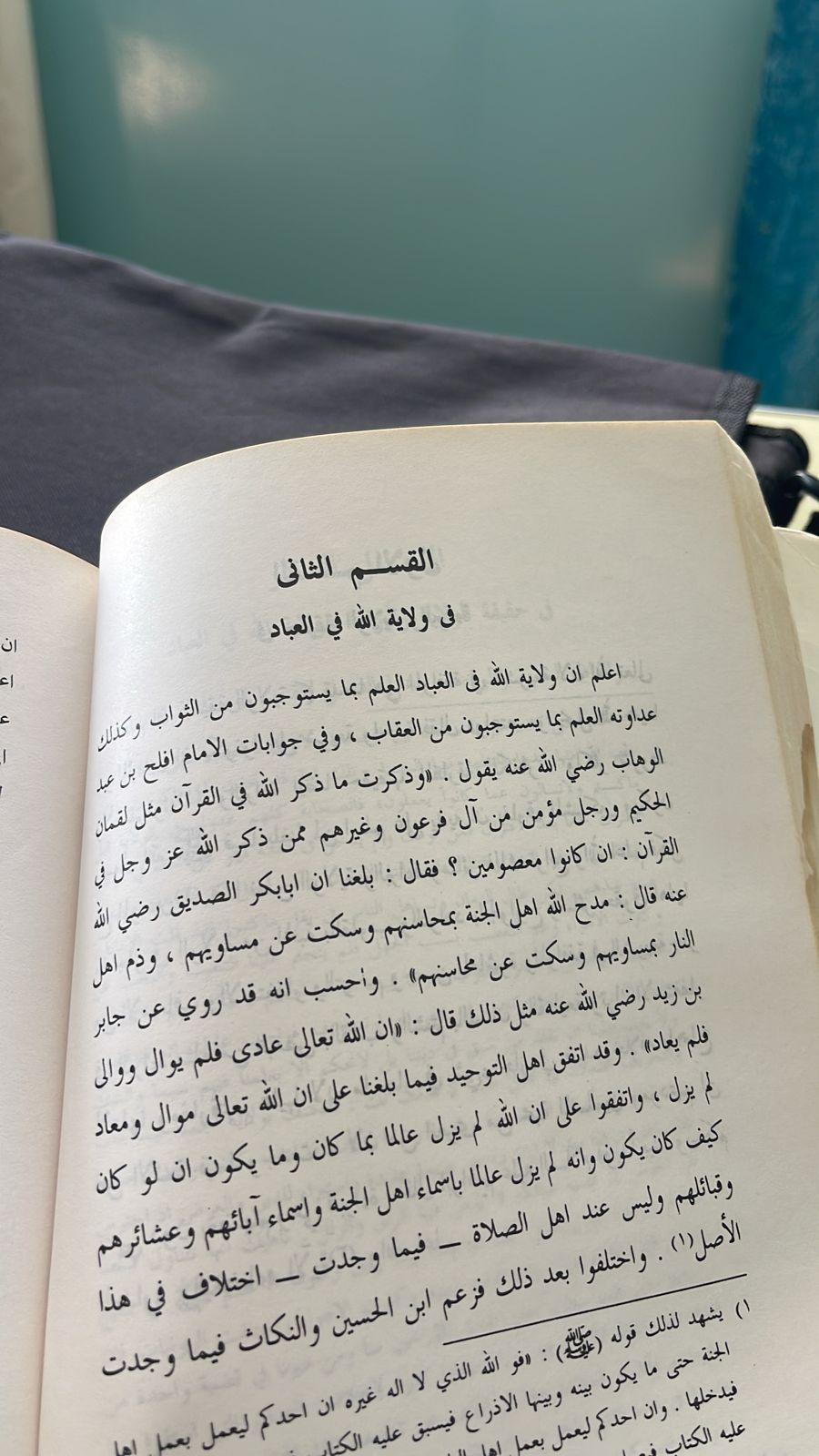
This is the second section. The walayah of Allah (swt) with his servants.
Allah knows best who is obligated for forgiveness and who is obligated for punishment. That is Allah’s knowledge does not change. Allah (swt) knows who will die upon faith even if in his/her life they have committed all types of sins. He knows which of his servants will make sincere repentance before their ending. The bara’ah of Allah (swt) with his servants. Allah (swt) knows will die as a mushrik, or as someone who made big sins without making repentance. Even though this one may for a portion of their life did meritorious works.

The third section of chapter 10. This sums up the whole philosophy. The one in walayah we love him/her we pray for him/her we talk nicely about him/her. What we put the person in bara’ah and we insult him/her and we ask for curses upon him/her.
Walayah wal Bara’ah in the heart is one thing. Dealing with people in general is something else.
For example: we ultimately want good for all people that are open to good. We want all people whose heart is receptive to the light to enter into Islam. The best we can hope for humanity is that which is the best they can hope for. To live and die upon Islam.
Final thoughts: Dear readers thank you for your patience in reading the article in full.
The reality is that this concept of friendship and dissociation is not even something unique to the Ibadi school, or even to Islam, or even to people of faith. Countries take each other in friendship or dissociate. In everyday life people have a circle of those who are in their trust and friendship and those they dissociate from. We live in times where people , even Muslims do ungodly things. They have no wara’ (piety) or taqwa (fear of and being conscious of Allah). We live in a world of tiktok videos where youth knock out random people (often the elderly)walking by them. Muslims engage in serious haram.
You do not encourage this by holding such people in your trust and continuing to extend the ties of friendship. These people and this behavior is to be shunned, not celebrated, embraced and even broadcasted.
At the same time Allah (swt) has clearly stated:
Say, ˹O Prophet, that Allah says,˺ “O My servants who have exceeded the limits against their souls! Do not lose hope in Allah’s mercy, for Allah certainly forgives all sins. He is indeed the All-Forgiving, Most Merciful.” (Qur’an 39: 53)
“Is one who is devoutly obedient during periods of the night, prostrating and standing [in prayer], fearing the Hereafter and hoping for the mercy of his Lord, [like one who does not]? Say, “Are those who know equal to those who do not know?” Only they will remember [who are] people of understanding.” (Qur’an 39:9)
“Your Lord has proclaimed, “Call upon Me, I will respond to you. Surely those who are too proud to worship Me will enter Hell, fully humbled.” (Qur’an 40:60)
As has been said: “Ours is not a caravan of despair”.
Come back to the Qur’an and the Sunnah. Follow the way of the bearer of the flags of truth, and those who hold up the light in a world of darkness, come back to Allah, The Most Merciful, The Most Compassionate, come back to Him, Oh Ummah of Muhammed (saw)!


 Prima Quran
Alhamdulillah. May Allah reward these soldiers of Truth.
He is not Salafi, he has no proof of learning Sharia anywhere, his only certificate shown in his profiles from 2013 are unrelated to religion and it was “virtual.” Be careful of him!!! He has a very bad tone with others, very proud, bot honest, and is dividing the Muslim community.
I believe this is the case for many of them.
All of us, rather we claim we are Salafi, Shafi’i, Hanafi, Maliki, Zaydi, Hanbali, 12er, or Ibadi we need to sit with teachers and take our deen from qualified teachers.
This “self taught” business is very dangerous. I agree he does his level best to divide Muslims as if it is a full time job for him.
They have energy to divide Muslims and not energy to fight the Zionist.
May Allah (swt) assist our brothers and sisters in Palestine, Sudan, Somalia, Mynamar and all over the world.