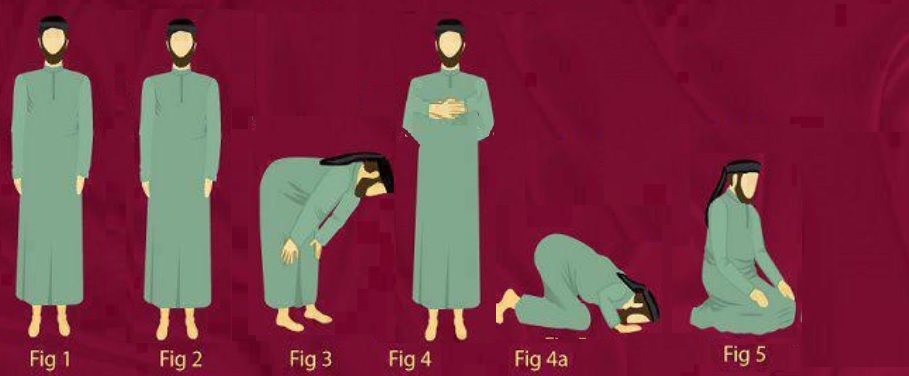
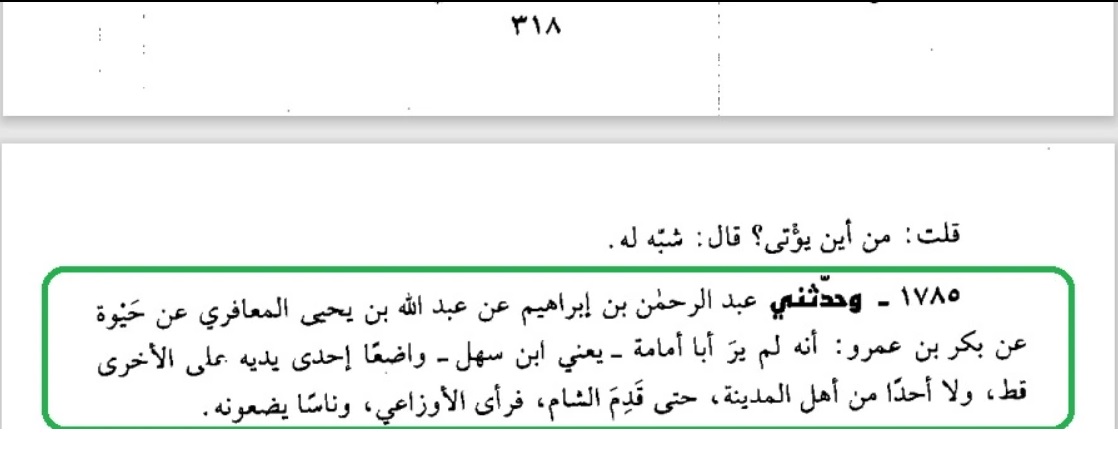
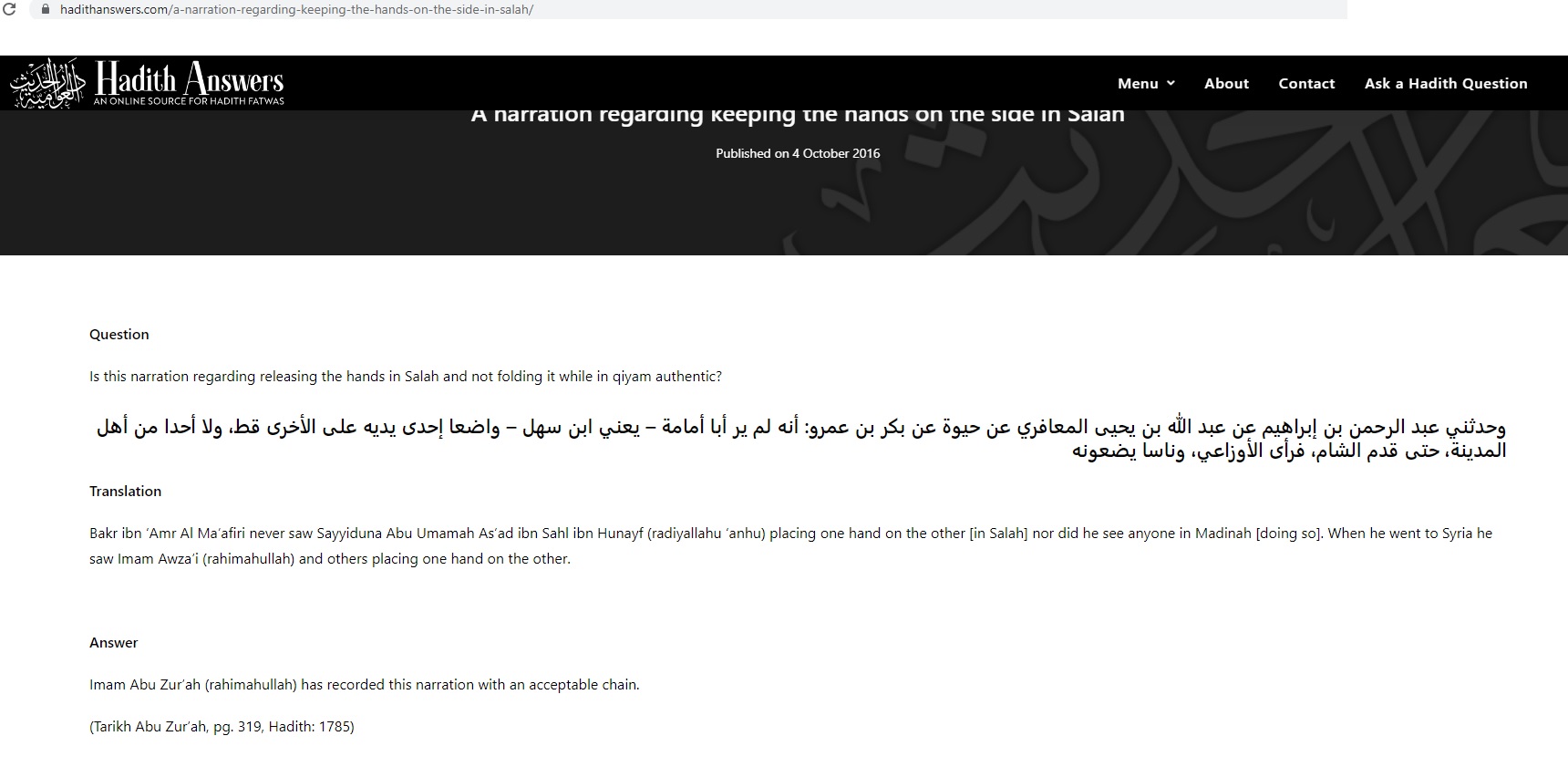
“We certainly brought you the truth, but most of you, to the truth, were averse.” (Qur’an 43:78)
“And of the people is he who disputes concerning Allah without knowledge or guidance or an enlightening Book, twisting his neck to mislead from the way of Allah. For him in this world is disgrace, and We will make him taste on the Day of Resurrection the punishment of the Burning Fire.” (Qur’an 22:8-9)
﷽
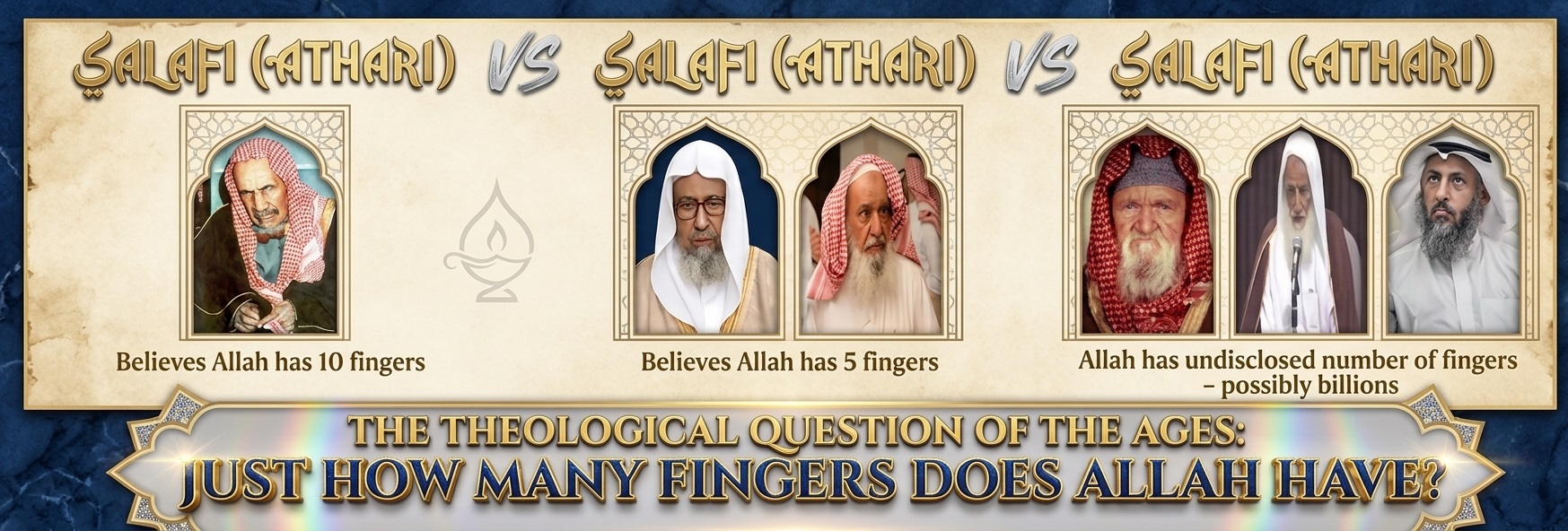
In this article we explore who has the correct aqidah? Which of the Salafi (Athari) are among the Mu’attilah and which are not?
Who is correct in regarding a theological matter of great importance: HOW MANY FINGERS DOES ALLAH HAVE?
A matter in which Muslims can be removed from Islam and a matter in which the blood of a believer may be considered permissible.
Just how many fingers does Allah have? The debate among the Athari/Salafi rages on!
First let it be said as regard the video we disavow the meme and the laughing emojis. We can make our points without appealing to such.
Shaykh Uthman al-Khamis:
فهل نثبت لله خمسه اصابع؟ نثبت لله الاصابع والحديث ما في خمسه اصابع. الحديث ما في خمسه اصابع وانما قال ان الله يحمل السماوات على اصبع والاراضين على اصبع والجبال على اصبع والشجر على اصبع ما في تحديد خمس اصابع فلا نحدد نقول لله اصابع تليق به ونسكت
English Translation: “So do we affirm five fingers for Allah? We affirm fingers for Allah, but the Hadith does not mention five fingers. The Hadith does not mention five fingers; rather, it states that Allah places the heavens on a finger, the earths on a finger, the mountains on a finger, and the trees on a finger. There is no specification of five fingers, so we do not specify. We say that Allah has fingers that befit Him, and we remain silent. -Shaykh Uthman al-Khamis.
احسن الله اليكم سائل يقول هل الاعتقاد الصحيح هو ان لله خمس اصابع فقط
English Translation: “May Allah be good to you, a questioner asks: Is the correct belief that Allah has only five fingers?”
Shaykh Abdul-Aziz Bin Baz:
يعني كل يد لها خمس اصابع ان الله جل وعلا له يدان ولكل يد دن اصابع وهذا من الكمال
English Translation: “Meaning, each hand has five fingers. Indeed, Allah, Majestic and Exalted, has two hands, and each hand has fingers, and this is a matter of perfection.” -Shaykh Abdul-Aziz Bin Baz
Shaykh Muhammed Nasir al-Din al-Albani says the hadith does not prove Allah (swt) has five fingers.
Al-Albani was asked directly: “The hadith counts five. Does this mean Allah has five fingers?” He replied: “No! We do not add to the hadith nor subtract from it.” When pressed that the five is a mafhūm (implied meaning), he said: “There is no harm in taking the mafhūm as long as it does not contradict an explicit text.”
So here we have Shaykh Muhammed Nasir al-Din al-Albani saying that implication has a basis in theology!
Shaykh Al Uthaymin says Allah has an undetermined number of fingers.
Uthaymin was even more explicit in warning against the question itself. In his lecture on al-ʿAqīdah al-Saffārīniyyah, he said:
“A questioner asked me: ‘What do you say about Allah’s fingers. How many?’ I said: ‘Do you have to know this? Affirm that Allah has fingers as the Prophet ﷺ said. As for how many? We cannot speak about this.’ By Allah, you are not more eager for knowledge of Allah than the Companions! When the Prophet ﷺ said ‘Allah places the heavens on a finger,’ did they say: ‘O Messenger of Allah, does Allah have more than three fingers?’ They did not. Because they were more complete in manners and more reverent toward Allah than those who came after them.”
Shaykh Abdul-Aziz al-Rajihi believes that Allah (swt) has five fingers.
في هذه الأحاديث إثبات الأصابع للرب عز وجل، وأن لله خمسة أصابع وهي صفات ذاتية تليق بالله، وأن الله تعالى يضع السموات على أصبع والأرضين على أصبع والشجر والثرى على أصبع وسائر خلقه على أصبع. في الحديث الأول: «يُمْسِكُ السَّمَوَاتِ عَلَى إِصْبَعٍ، وَالأَْرَضِينَ عَلَى إِصْبَعٍ، وَالْجِبَالَ عَلَى إِصْبَعٍ، وَالشَّجَرَ عَلَى إِصْبَعٍ» فهذه خمسة أصابع.
English translation:
“In these hadiths there is affirmation of fingers for the Lord, Mighty and Majestic, and that Allah has five fingers, which are attributes of His essence befitting Allah, and that Allah, the Most High, places the heavens upon a finger, the earths upon a finger, the trees and the soil upon a finger, and the rest of His creation upon a finger. In the first hadith: ‘He holds the heavens upon a finger, the earths upon a finger, the mountains upon a finger, and the trees upon a finger’ So these are five fingers.”- Shaykh Abdul-Aziz al-Rajihi
Shaykh Saleh al-Fawzan’ mentions that Allah has five fingers and he affirms this as the belief of Muhammed ibn Abd al-Wahhab in his ‘Book of Tawhid’.
“نعم، شوف في آخر كتاب التوحيد أن الله -جَلَّ وَعَلا- يطوي السماوات السبع، والأراضين السبع بيديه، أو يجعل البحار على أصبع، أو يجعل الجبال على أصبع، راجع آخر كتاب التوحيد في هذا… إلى أن ذكر خمسة أصابع… نعم، نثبت الأصابع لله عز وجل.”
English translation:
“Yes, look at the end of Kitab al-Tawhid. That Allah, Mighty and Majestic, rolls up the seven heavens and the seven earths with His two Hands, or places the seas upon a finger, or places the mountains upon a finger. Refer to the end of Kitab al-Tawhid on this… until he mentioned five fingers… Yes, we affirm the fingers for Allah, Mighty and Majestic.” -Shaykh Al-Fawzan’
What are the Salafi (Athari) basing their theology on?
They are basing upon the statement of a Jewish scholar (al-ḥabr), where the Blessed Prophet (saw) laughed at what he said and then quoted a verse from the Qur’an in rebuke. However, due to their bizarre theology that relies heavily upon statements from Jews they have taken it as an evidence in regard to a grave matter!
“And they have thereof no knowledge. They follow not except assumption (probablistic), and indeed, assumption avails not against the truth at all.” (Qur’an 53:28)
“O humanity! Eat from what is lawful and good on the earth and do not follow Satan’s footsteps. He is truly your sworn enemy. He only incites you to commit evil and indecency, and to claim against Allah what you do not know.” (Qur’an 2:168-169)
What is the source of this discord among the various shayks of this Salafi sect?
Dear readers this is crucial. Pay close attention to the following information. We want you to note the details.
Narrated `Abdullah:
A (Jewish) Rabbi came to Allah’s Messenger (ﷺ) and he said, “O Muhammed! We learn that Allah will put all the heavens on one finger, and the earths on one finger, and the trees on one finger, and the water and the dust on one finger, and all the other created beings on one finger. Then He will say, ‘I am the King.’ Thereupon the Prophet (ﷺ) smiled so that his pre-molar teeth became visible, and that was the confirmation of the Rabbi. Then Allah’s Messenger (ﷺ) recited: ‘They made not a just estimate of Allah such as is due to Him. And on the Day of Resurrection the whole of the earth will be grasped by His Hand and the heavens will be rolled up in His Right Hand. Glorified is He, and High is He above all that they associate as partners with Him.’ (39.67)
A man from the People of the Book came to the Prophet, may God bless him and grant him peace, and said: O Abu al-Qasim, God holds the heavens on one finger, the earths on one finger, the trees and the soil on one finger, and the creatures on one finger, then He says: I am the King, I am the King. I saw the Prophet, may God bless him and grant him peace, laugh until his molars were visible, then he recited: {They have not appraised God with true appraisal} [Al-An’am: 91]
The [الأنعام: 91] reference in the Qur’an in the above quoted text is an editorial insertion by dorar.net—not part of the hadith wording itself. It is the website’s own cross-reference, added to tell the reader where they think the verse comes from.
The discrepencies between the two reports.
The Questioner: Who came to the Blessed Prophet (saw)?
“A (Jewish) Rabbi” — حَبْرٌ مِنَ الأَحْبَارِ or “A man from the People of the Book” — رَجُلٌ مِنْ أَهْلِ الْكِتَابِ
How does the questioner address the Blessed Prophet (saw)?
“O Muhammed!” — يَا مُحَمَّدُ or “O Abu al-Qasim!” — يَا أَبَا الْقَاسِمِ
This is also reflected here:
“Muhammed, or Abu al-Qasim.” Showing the uncertainty of the transmitter as well as the fluidity of the text.
The description of Allah (swt) putting/holding the creation.
4811: Lists heavens → earths → trees → water and dust(combined) → all other created beings. Five categories.
7415: Lists heavens → earths → trees AND soil (combined) → creatures. Four categories.
2786a: Lists heavens → earths → mountains and trees (combined)→ water and moist soil (combined) → rest of creation. Five categories.
Minor difference in wording: “put” (4811) vs. “holds” (7415)
What does Allah (swt) actually say?
Then He will say, ‘I am the King.’” (once)
“Then He says: ‘I am the King, I am the King.’” (twice — repeated)
How Much of the Qur’anic verse was recited?
Full verse: “They made not a just estimate of Allah such as is due to Him. And on the Day of Resurrection the whole of the earth will be grasped by His Hand and the heavens will be rolled up in His Right Hand. Glorified is He, and High is He above all that they associate as partners with Him.”
Partial verse: “They have not appraised Allah with true appraisal” — {وَمَا قَدَرُوا اللَّهَ حَقَّ قَدْرِهِ}
Qur’an 39:67 (full verse)
Qur’an 6:91 (partial quote) ?
Both verses contain the phrase “وَمَا قَدَرُوا اللَّهَ حَقَّ قَدْرِهِ” — but they are in different surahs and have different full contexts. This could be a way that the narrators shortened the hadith.
The narrator’s framing.
“Thereupon the Prophet smiled… and that was the confirmation of the Rabbi. Then Allah’s Messenger recited…”
“I saw the Prophet laugh… then he recited…”
Analysis.
4811: The narrator inserts an interpretive comment (“that was the confirmation of the Rabbi”) before mentioning the recitation.
7415: The narrator simply reports what he saw and heard: the Prophet laughed, then recited. No interpretation.
The critical phrase: “In confirmation of the Rabbi.”
“and that was the confirmation of the Rabbi” — تَصْدِيقًا لِقَوْلِ الْحَبْرِ
NOT PRESENT — no equivalent phrase
Prima Qur’an comments:
This is a very crucial and important point.
Both websites are quoting from two different hadith in Sahih al-Bukhari. However sunnah.com also has the exact same transmission and wording as that found as the hadith used at dorar.net.
Narrated `Abdullah:
A man from the people of the scripture came to the Prophet (ﷺ) and said, “O Abal-Qasim! Allah will hold the Heavens upon a Finger, and the Earth on a Finger and the land on a Finger, and all the creation on a Finger, and will say, ‘I am the King! I am the King!’ ” I saw the Prophet (after hearing that), smiling till his premolar teeth became visible, and he then recited: — ‘No just estimate have they made of Allah such as due to him… (39.67)
A Jew came to the Prophet (ﷺ) and said, “O Muhammad! Allah will hold the heavens on a Finger, and the mountains on a Finger, and the trees on a Finger, and all the creation on a Finger, and then He will say, ‘I am the King.’ ” On that Allah’s Messenger (ﷺ) smiled till his premolar teeth became visible, and then recited:– ‘No just estimate have they made of Allah such as due to him….(39.67) `Abdullah added: Allah’s Apostle smiled (at the Jew’s statement) expressing his wonder and belief in what was said.
The crucial part of the Arabic text which is not translated into English:
قَالَ يَحْيَى بْنُ سَعِيدٍ وَزَادَ فِيهِ فُضَيْلُ بْنُ عِيَاضٍ عَنْ مَنْصُورٍ عَنْ إِبْرَاهِيمَ عَنْ عَبِيدَةَ عَنْ عَبْدِ اللَّهِ فَضَحِكَ رَسُولُ اللَّهِ صلى الله عليه وسلم تَعَجُّبًا وَتَصْدِيقًا لَهُ
English translation:
Yahya ibn Sa’id said: Fudail ibn ‘Iyad added to it, from Mansur, from Ibrahim, from ‘Abidah, from ‘Abdullah: “The Messenger of Allah (ﷺ) smiled out of amazement and in confirmation of him.”
The Blessed Prophet (saw) rejects the stament of the Jewish Man (Rabbi or not)
What is the evidence?
Now, without getting into the chains of transmission let us just take this phrase: “and that was the confirmation of the Rabbi“ as established.
What does this mean? That is not the statement of the Blessed Prophet (saw). That is the statement of a narrator or sub narrator.
The phrase “in confirmation of” claims to know why the Blessed Prophet (saw) laughed. It asserts that his inner intention was to confirm the rabbi’s statement.
This is a claim about the unseen (ghayb). No Companion, no narrator, and certainly no later transmitter has access to the Prophet’s (saw) internal thought process unless the Prophet (saw) himself stated it. The Prophet (saw) did not say “I am laughing to confirm what you said.” He simply laughed and then recited the verse.
The second evidence.
Narrated Abu Huraira:
The people of the Book used to read the Torah in Hebrew and then explain it in Arabic to the Muslims. Allah’s Messenger (ﷺ) said (to the Muslims). “Do not believe the people of the Book, nor disbelieve them, but say, ‘We believe in Allah and whatever is revealed to us, and whatever is revealed to you.’ “
This is a clear prohibition. The Prophet (saw) instructed his followers not to confirm what the People of the Book said. If the Prophet himself had then “confirmed” the rabbi’s statement, he would be doing the exact opposite of what he commanded his community to do. This is a logical contradiction that cannot stand.
The third evidence.
The verse itself says:
وَمَا قَدَرُوا اللَّهَ حَقَّ قَدْرِهِ-“And they did not appraise Allah with true appraisal”
“They have not appraised Allah with true appraisal, while the earth entirely will be [within] His grip on the Day of Resurrection, and the heavens will be folded in His right hand. Exalted is He and high above what they associate with Him” (Qur’an 39:67) –Sahih International (Athari’s fav translation after Muhammed Muhsin Khan & Muhammed Taqi-ud-Din al-Hilali)
This verse:
Rebukes those who fail to appraise Allah properly.
Replaces the rabbi’s finger-by-finger image with a total, simultaneous grasp.
Declares Allah exalted above what they associate with Him — which includes the anthropomorphic image the rabbi just presented.
So the Prophet’s recitation was a corrective, not a confirmation. The phrase taṣdīqan lahu (“in confirmation of him”) is a narrator’s insertion. One that those who fell victim to anthropomorphism sized upon.
They turned a rebuke into an endorsement!
The broader usage of the word “hand” in the Qur’an reinforces this:
“Be patient over what they say, and remember Our servant, David, the possessor of many hands; he was one who repeatedly turned back [to Us].” (Qur’an 38:17)
Plural in Arabic begins with three and not two! So, at the very least David had three hands. However, notice something from the following site:
It is unanimous that they all translate ‘many hands’ as strength! Even the Salafi/Athari/Saudi translations do! Even the translation that gives us the most literal word for word meaning possible was too shy to translate David as having many hands.
“Be patient over what they say and remember Our servant, David, the possessor of strength; indeed, he was one who repeatedly turned back [to Allah ].” (Qur’an 38:17 Sahih International)
“Be patient (O Muhammed SAW) of what they say, and remember Our slave Dawood (David), endued with power. Verily, he was ever oft-returning in all matters and in repentance (toward Allah).” (Qur’an 38:17 Muhsin Khan & Muhammed Al Hilal)
If you would like to explore more on issues in regard to aqidah(creed) and theology you may be interested in the following:
“Satan made their evil deeds appealing to them, hindering them from the right way, although they were capable of reasoning.” (Qur’an 29:38)
﷽
First and foremost, please stop reading this if you are someone who has had a past of sexual abuse and/or has been traumatized by sexual abuse. This post is likely to trigger unwanted emotions or memories that we would rather not stir.
Kindly be advised.
Indeed as Allah (swt) informs us that Satan often may make our deeds appealling or fair seeming to us even though we are capable of reasoning.
In Islamic jurisprudence, extreme need or a state of dire necessity is called ‘ḍarūrah’
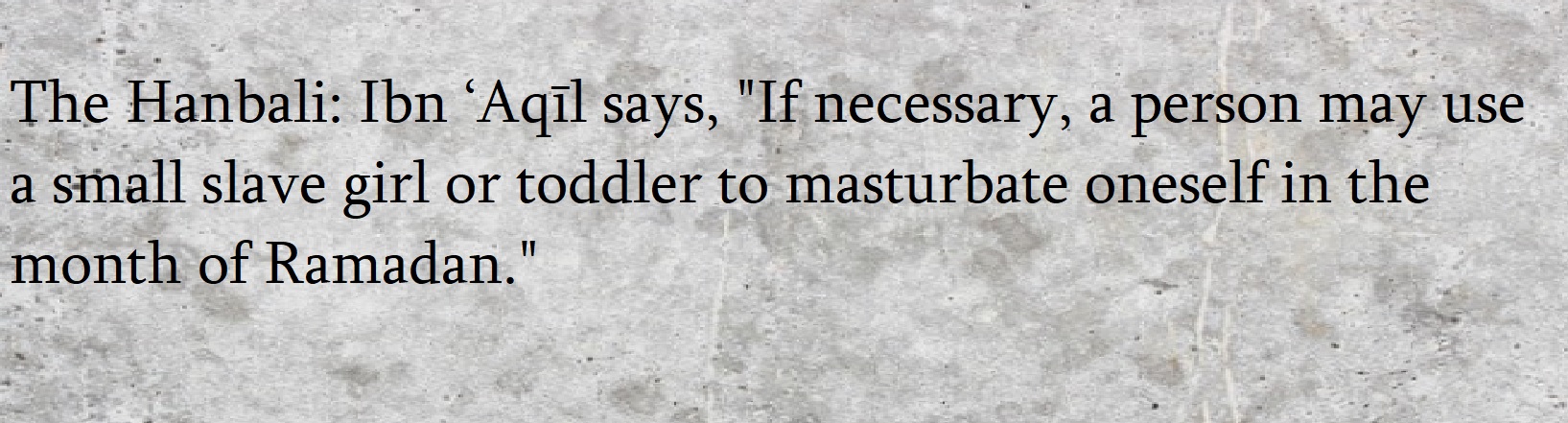
Our opponents inform us that what is being addressed is a case of ‘ḍarūrah‘. Such that if a man is fasting in the month of Ramadan and he feels that is very testicles are going to explode that he may alleviate himself via masterbating using the hand of a small slave girl or a toddler.
The logic is medical and legal: if the desire is so severe that it threatens physical injury, the lesser harm (masturbation) is permitted to avoid the greater harm (rupture).
While this is a real conditon known as: Epididymal hypertension, or commonly known as “blue balls,” is a temporary, harmless aching or heavy feeling in the testicles caused by prolonged sexual arousal without ejaculation.
Epididymal hypertension is not fatal. There have been no recorded cases (that we are aware of) where a person has died from such a condition.
Unfortunately, such lack of understanding has led to legal verdicts that undermine the rights of children, violate the sacred law and perpertuate an environment of exploitation of children.
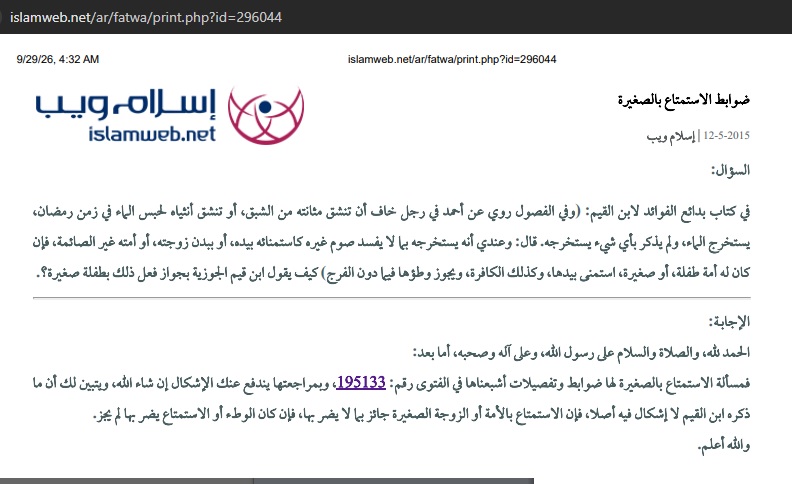
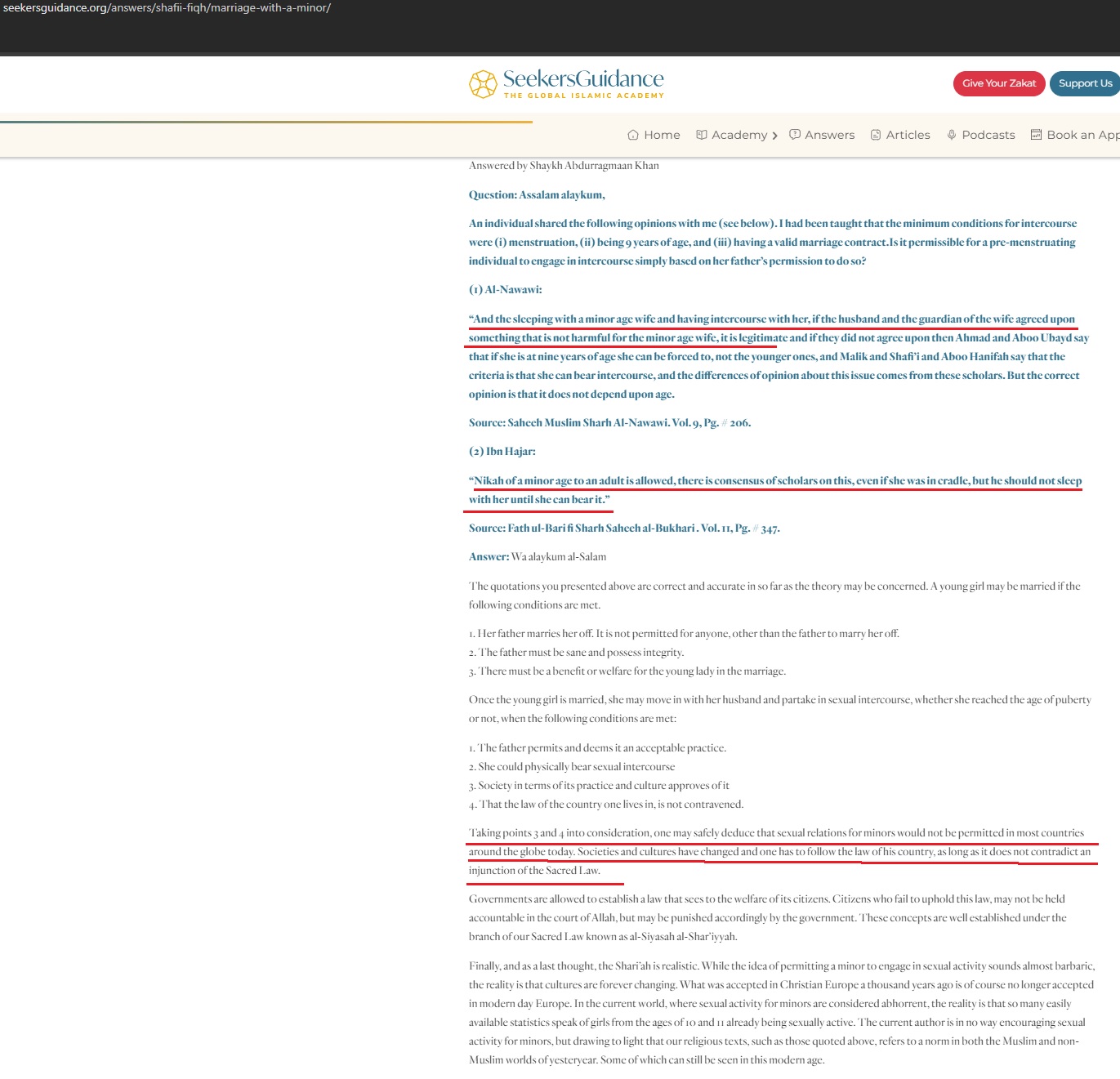
You can see from the following that someone has doubts about this and so he asked an explanation from this Salafi/Athari/Hanbali affiliated website:
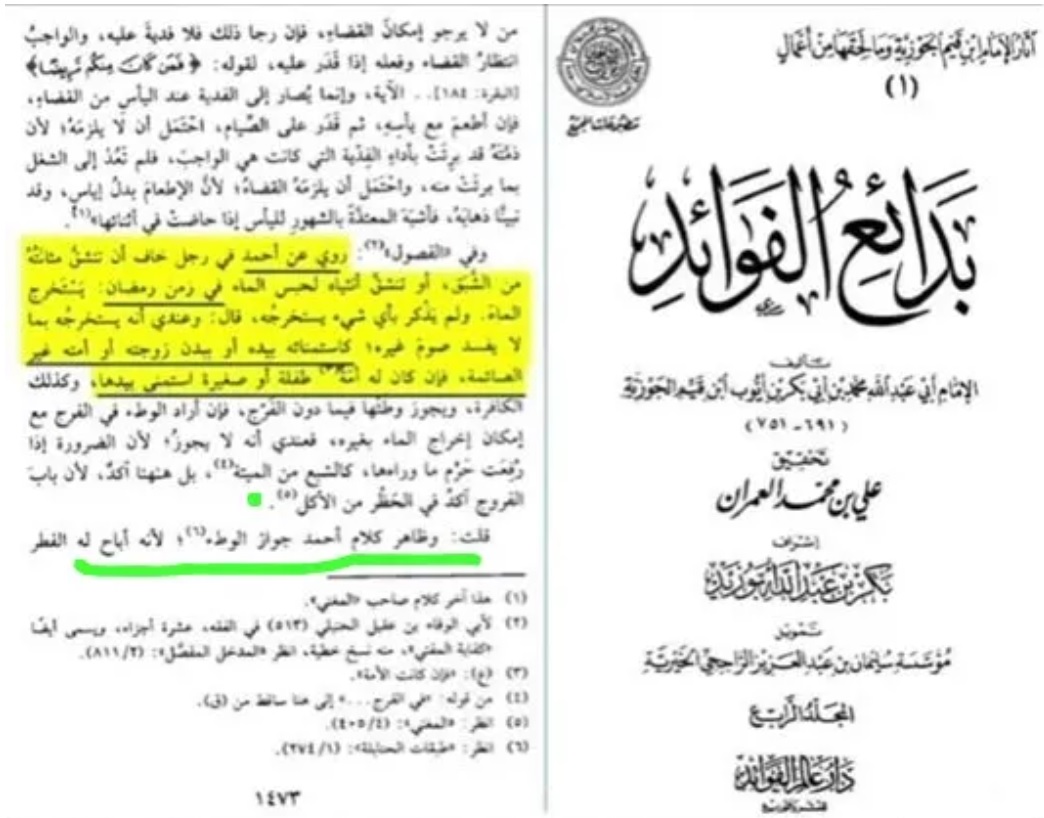
Question: In Ibn al-Qayyim’s book Bada’i’ al-Fawa’id: And in al-Fusul it was narrated on the authority of Ahmad concerning a man who feared that his bladder would burst from lust, or that his testicles would burst from retaining water during Ramadan, that he should extract the water, and he did not mention with what he should extract it. He (Ibn ‘Aqīl) said: And in my opinion, he should extract it with something that does not invalidate the fast of others, such as masturbating with his hand, or with the body of his wife, or his slave girl who is not fasting. If he has a slave girl who is a child, or a young girl, he should masturbate with her hand, and the same applies to a non-Muslim girl, and it is permissible to have intercourse with her in a way that does not invalidate the fast of others) How can Ibn Qayyim al-Jawziyya say that it is permissible to do that with a young girl?
Answer: Praise be to Allah, and peace and blessings be upon the Messenger of Allah, and upon his family and companions. Now then: The issue of enjoying a young girl has rules and details that we have thoroughly discussed in Fatwa No. 195133. By reviewing it, the problem will be resolved for you, Allah willing, and it will become clear to you that what Ibn al-Qayyim mentioned is not problematic at all. Enjoying a young slave girl or wife is permissible as long as it does not harm her. If intercourse or enjoyment harms her, then it is not permissible.
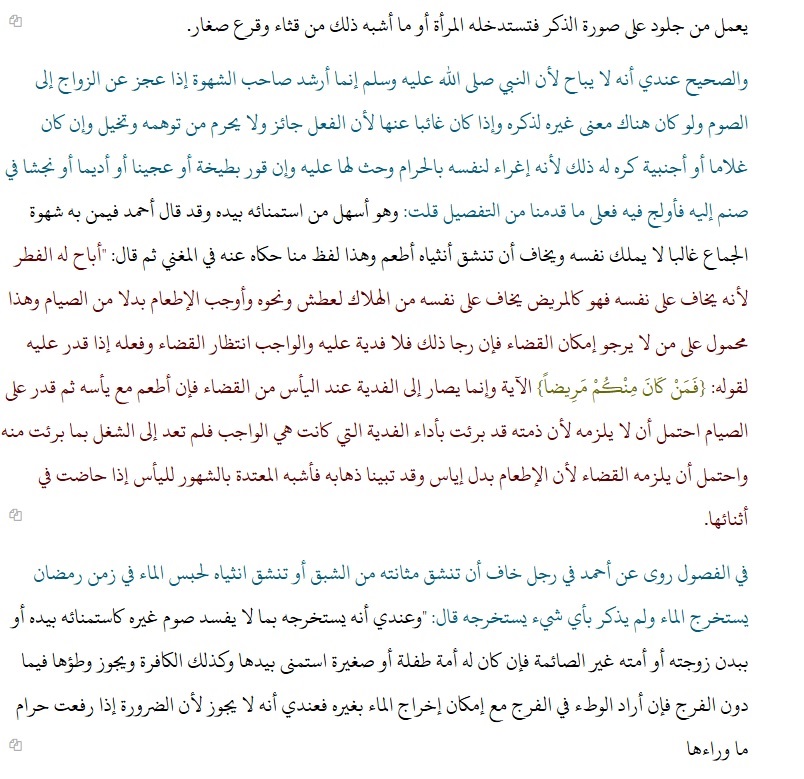
Translation: “It is narrated on the authority of Ahmad concerning a man who feared that his bladder would rupture from lust or that his testicles would rupture from retaining semen during Ramadan. He was instructed to release the semen, but it was not specified how. He (Ibn ‘Aqīl) said:
“In my opinion, he should release it in a way that does not invalidate the fast of others, such as masturbating with his hand or with the body of his wife or his non-fasting slave girl. If he has a young slave girl or toddler, he may masturbate with her hand, and the same applies to a non-Muslim slave girl. It is permissible to have intercourse with her in a manner other than penetration. If he desires vaginal intercourse when it is possible to release the semen in another way, then in my opinion, it is not permissible, because when necessity is removed, what lies beyond it is also forbidden.”
Now pay close attention:
From the green dot we can see Ibn al-Qayyim give the least problematic view of the three (between himself, Imam Ahmad and Ibn ‘Aqīl) he states: “And it is more appropriate that he masturbate with his own hand, and not with the hand of another.”
The underlined green text is Ibn al-Qayyim saying: “And the apparent meaning of Ahmad’s words is the permissibility of intercourse in the vagina with dislike.”
So how would Ibn al-Qayyim know this?
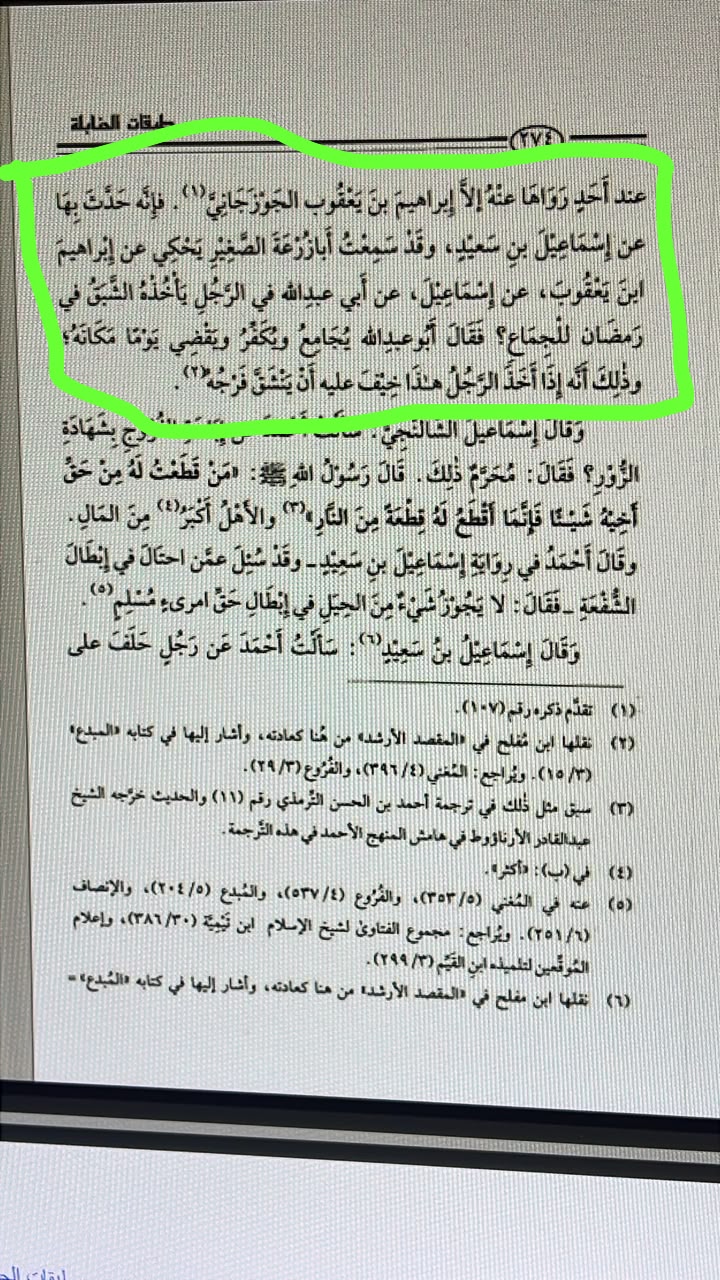
Ibn al-Qayyim would have access to the: Ṭabaqāt al-Ḥanābilah
The text with green highlight: “According to Ahmad, apart from Ibrahim ibn Yaʿqūb al-Jawzajānī, for he narrated it from Ismāʿīl ibn Saʿīd, and I have heard Abū Zurʿah al-Ṣaghīr narrating from Ibrahim ibn Yaʿqūb, from Ismāʿīl, from Abū ʿAbdillāh, regarding a man who is seized by desire in Ramadan for intercourse. He said: Abū ʿAbdillāh said: He has intercourse and expiates, and he fulfills his wife’s need. And that is because if the man takes [her], then it is obligatory upon him to fulfill her desire.”
So it is very likely that Ibn ‘Aqīl was commenting on what he saw as a deficiency on Imam Ahmad’s answer. The assumption that one has a wife. The assumption that the wife is not menstrating.
Ibn Al-Qayyim and Ibn ‘Aqīl: Who are they?
Ibn al-Qayyim (d. 751 AH) is a central figure in the Hanbali school. He was the foremost student of Ibn Taymiyyah and authored numerous influential works in fiqh, theology, and spirituality. His recording of this opinion in Badāʾiʿ al-Fawāʾid means it is preserved within the Hanbali scholarly tradition.
Ibn al-Qayyim recorded this opinion in his book, Badāʾiʿ al-Fawāʾid, and he is indeed a major authority of the Hanbali school.
Ibn ‘Aqīl (Abu al-Wafa’ Ali ibn Aqil, d. 513 AH) is a major Hanbali authority. He was one of the most prominent Hanbali jurists and theologians of Baghdad, a prolific author, and a central figure in the school’s intellectual history. He is not a nobody, and no one can dismiss him as such. When Ibn Aqil reports a position from Imam Ahmad, that is a serious, substantive attribution that carries weight within the Hanbali tradition.
So who reports what and who is attributed with what?
Ibn ‘Aqīl is reporting from Imam Ahmad the following: It is narrated on the authority of Ahmad concerning a man who feared that his bladder would rupture from lust or that his testicles would rupture from retaining semen during Ramadan. He was instructed to release the semen, but it was not specified how. Full stop.
Then Ibn ‘Aqīl gives his commentary and understanding:
“In my opinion, he should release it in a way that does not invalidate the fast of others, such as masturbating with his hand or with the body of his wife or his non-fasting slave girl. If he has a young slave girl or baby girl, he may masturbate with her hand, and the same applies to a non-Muslim slave girl. It is permissible to have intercourse with her in a manner other than penetration. If he desires vaginal intercourse when it is possible to release the semen in another way, then in my opinion, it is not permissible, because when necessity is removed, what lies beyond it is also forbidden.”
This is confirmed by the reply to the questioner in the website above:
“It will become clear to you that what Ibn al-Qayyim mentioned is not problematic at all.“
The phrase in Ibn al-Qayyim’s Badāʾiʿ al-Fawāʾid is:
أَمَة طِفْلَة أَوْ صَغِيرَة Amah ṭiflah aw ṣaghīrah
A break down of the words:
(Amah) her legal status is milk al-yamīn. This text is not addressing a free child. Amah is not an age descriptor it is a status descriptor. It tells you the female in question is not a free person.
(Ṭiflah). The age range is from birth until puberty, but strongly connotes a very young child such as infant or a toddler.
Prima Qur’an comments: We will rule out an infant here because of the obvious reasons. Although the training of a toddler to perform such in this situation is problematic.
One may be shocked. How can someone so young be described as milk al-yamīn.
Through the process of war. These young ones were not left to fend for themsleves but taken in by the tribe.
Through the ijtihad of the legal schools. Many Sunni legal schools rule that a child born to someone who is described as milk al-yamīn is themselves milk al-yamīn.
(Ṣaghīrah) is the standard legal term for a minor female who has not reached puberty. It is broader than ṭiflah. It can include older children. However, paired with ṭiflah, it clearly means a very young child i.e a toddler.
Ṣaghīrah being used as a descriptor reinfornces that the Amah Ṭiflah is younger still, as in an infant or a toddler.
Marriage and sex with toddlers according to Sunni Islamic Jurisrprudence.
From the perspective of the Ibadi school this view by Ibn ‘Aqīl is shocking and totally unacceptable on many levels and from many angles.
Keep in mind that this view is said in the context of the holy month of Ramadan.
The first issue would be: Can retaining/withholding semen reach the point of causing physical harm?
Does Epididymal hypertension lead to death?
The second issue would be: Is masturbation permissible?
The third issue would be: Is masturbation during fasting in the month of Ramadan even permissible?
The fourth issue would be: Is masturbation a sin?
The fifth issue would be: If masturbation is a sin (especially in this month) do sins (in general) validate the fast?
The sixth issue What is meant by “al-amah al-saghirah” ?
The seventh issue: Is non-penetrative sexual intimacy permissible during fasting in Ramadan?
The eighth issue: How can semen be extracted without invalidating the fast?
The ninth issue: Is it permissible to marry or have relations with a young girl?
The tenth issue: Is it permissible to show people’s private parts specifically the most intimate areas and is it permissible to display them during fasting in Ramadan?
The eleventh issue: The non Muslim slave girl. If this is a marriage from a disbelieving woman how is this permissible?
If this article was insightful you may wish to read the following:
“Joseph responded, “It was she who tried to seduce me.” And a witness from her own family testified: “If his shirt is torn from the front, then she has told the truth and he is a liar.” (Qur’an 12:26)
﷽
As Allah (swt) says, “washahida shāhidun min ahlihā” and a witness has witnessed from among themselves/folk/family.
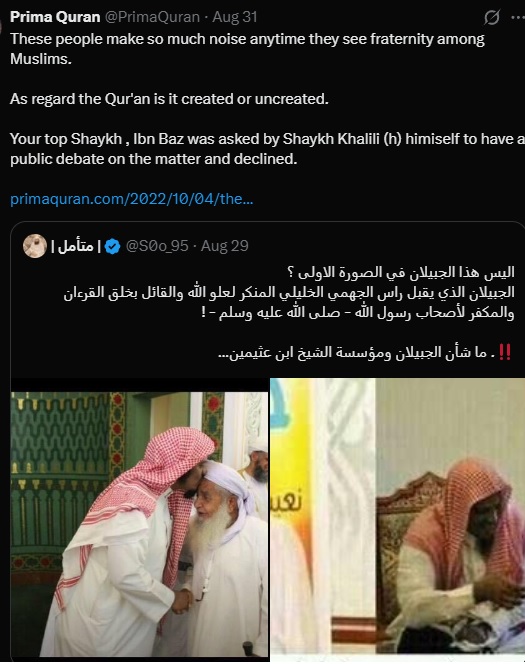
One of the more insolent of the claimants of Salafiyya were visibly upset at the love and camaraderie that is often shown between the people of Oman and the people of Saudi Arabia. This individual is from among those who like the division and fighting among the people. So this individual had posted once more attacking the noble Shaykh Ahmed Al Khalili as well as the good people of the Ibadi school.
So our reply was to remind this one that Ibn Baz himself was asked by Shaykh Khalili to have a public debate on the matter. This was in response to the interrogation and methods of Ibn Baz. It was pointed out to this man that he had his chance to prove the error of our creed and Ibn Baz backed down!
This is the link that was put in the reply to this individual:
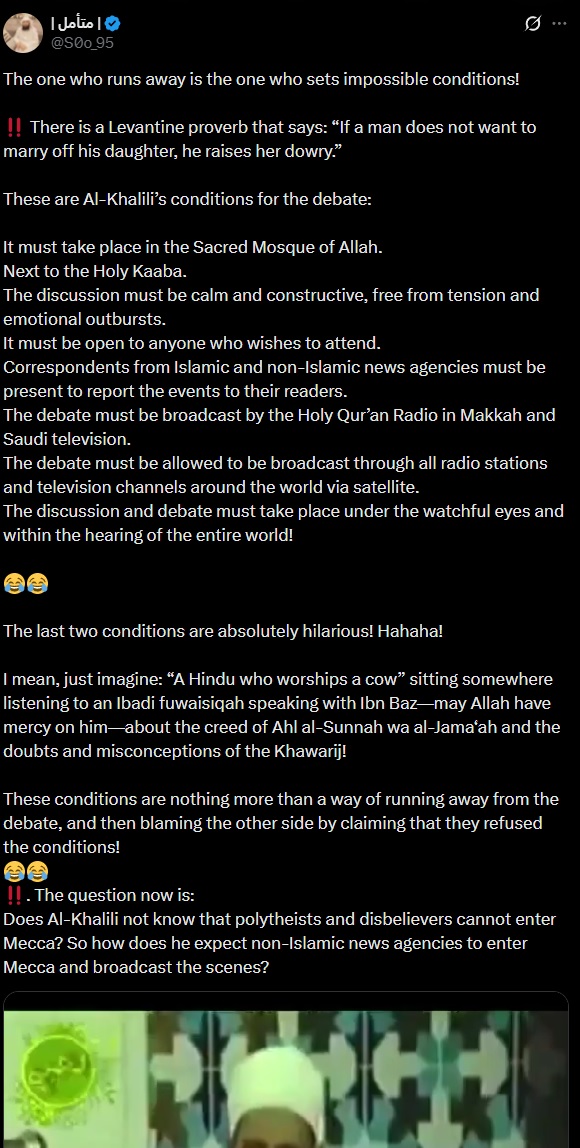
Sometimes when you see these laughing emoji you pray within yourself that you are not dealing with a teenager. This is not something from serious individuals. Yet, the part he seemed most tickled about the following:
“Does Al-Khalili not know that polytheist and disbelievers cannot enter Mecca? So how does he expect non-Islamic news agencies to enter Mecca and broadcast the scenes?”
This shows you that this individual did not even bother to read the initial link for if he had he would have already found something quite shocking.
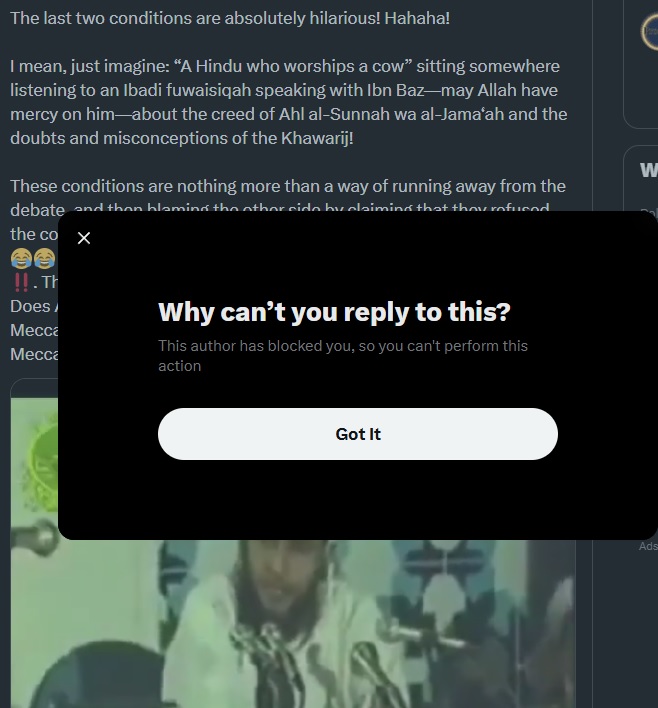
To our dismay the following showed up.
This ‘warrior’ of the supposed correct doctrine tucked tail and ran away. However, there is a day of reckoning in which we all be held accountable. For everything that our hands sent forth.
So let us address the part that tickled this individual.
“Does Al-Khalili not know that polytheist and disbelievers cannot enter Mecca? So how does he expect non-Islamic news agencies to enter Mecca and broadcast the scenes?”
Hmm. So the Mufti of a Muslim nation is not aware that polytheist and disbelievers cannot enter Mecca. How likely is this? This man must be unaware of the fact that Muslims themselves can be employed have been employed by Non Muslim media such as CNN and BBC.
Like how this non Muslim network documented the hajj?
The presence of world media does not equal to the presence of the world itself. Likewise the presence of non Muslim media does not equate to the presence of Non Muslims themselves.
But the deathblow to this rabble-rouser came not from Prima Qur’an, nor from any of the other Ibadi students or laypeople. The deathblow to this rabble rouser came from one of the students of Ibn Baz himself.
الشيخ عبد العزيز بن باز رحمه الله هذا الامام العجيب ارسل احد كبار المفتين في دوله عربيه وهو على مذهب الخوارج على مذهب الخوارج وهو مفتي تلك البلاد وهم ينكرون رؤيه الله جل وعلا كما تعلمون في الاخره ينكرون رؤيه الله كالمعتزلة [موسيقى] ولا نعلم في زمنه اعلم منه فقال لا لا ما ناقش قيل له لماذا يا شيخ قال طيب لما اناقشه قد يكون الحم بحجته مني فاكون سببا لضلال بعض الناس قد يكون الحم مني بالحجه والنقاش فيكون سبب يكون سبب لاظ بعض الناس فرفض الشيخ ناقش فان صاحب الحق لا يكون هيابا ولا جبانه بل صاحب الحق يجر على اظهار الحق الذي يعتقد
Which is translated:
“Shaykh Abdul Aziz ibn Baz, may Allah have mercy on him. This remarkable imam. Once received a message from one of the senior muftis in an Arab country, who follows the doctrine of the Khawarij. Yes, he follows the doctrine of the Khawarij, and he is the mufti of that country. They deny the seeing of Allah, may He be glorified and exalted, in the Hereafter. They deny the seeing of Allah, just like the Mu’tazila. And we do not know of anyone in his time more knowledgeable than him. So he said, “No, no,” and did not engage in debate. He was asked, “Why, O Shaykh?”He said, “Well, if I debate him, it might be that he overcomes me with his argument,and I would then be a cause for the misguidance of some people. Or it might be that I overcome him with argument and de bate, and that would be a cause for the misguidance of some people.” So the Shaykh refused. Debate, for the one who is upon the truth, should not be timid or cowardly; rather, the one upon the truth should be eager to manifest the truth that he believes in.”
Nothing in there at all about Non Muslim media networks! Just a simple admission that Shaykh Ibn Baz felt that Shaykh Khalili could have strong arguments!
As Allah (swt) says, “washahida shāhidun min ahlihā” and a witness has witnessed from among themselves/folk/family.
If you would like to read more about the issue of the Qur’an being created and other aqidah matters we encourage you to read the following:
“We sent them with clear proofs and the Zabur. And we revealed to you the message that you may make clear to mankind what was sent down to them and that they might give thought.” (Qur’an 16:44)
﷽
This section will be on engaging the Pseudo-Islamic.
In particular this section of the blog will have all articles related to two Pseudo-Islamic movements.
The first being the Hafs Qur’an Only Religion.
THE HAFS QUR’AN ONLY RELIGION
It is important to understand that we believe that the adherents of the Hafs Qur’an only movement are a distinct religion in much as we respect the way the Baha’i movement is a distinct religion from Islam.
Insh’Allah this section will deal with common arguments among the federation of sects that are known collectively as the ‘Qur’anist’.
This section will be refuting their many bold assertions; as well as showing why this particular attempt to re-interpret Islam and make it altogether different religion is deeply flawed.
Now why are they called the Hafs Qur’an only view? These people will either out of ignorance about the transmission and textual history of the Qur’an refer to their platform as ‘Qur’an Only’ or Quraniyoon. However, the Hafs Qur’an did not fall out of the sky. Thus, is important for them to reflect on why so much foundational trust is put into the men that transmittedthe Hafs Qur’an to the exclusion of all other transmissions of the Qur’an.
At the core of this religion of theirs is a massive epistemological problem.
In regard to approving comments from followers of the Hafs Qur’an Only Religion we have taken seriously the verse of the Qur’an: “And cooperate in righteousness and piety, but do not cooperate in sin and aggression. And fear Allah ; indeed, Allah is severe in penalty.” (Qur’an 5:2)
Thus, they would do well to read the article listed below: Is the Qur’an a detailed explanation of all things? to understand the policy on this website that keeps them as well as us from sinning and keeps them consistent with in their worldview. Insh’Allah.
THE QADIANI MOVEMENT Also known as AHMADIYYA MOVEMENT is a divided movement, split into two competing jama’at or congregations. That is the LAHORI whom we refer to as The Ahmadiyya A and the QADIANI whom we refer to as the Ahmadiyya B.
As the Qadiani or Ahmadiyyah B believe that Mirza Ghulam Ahmad is a Prophet after The Blessed Prophet Muhammed (saw), they have been marked as being outside the millat of Islam. Likewise, they (the Ahmadiyyah B) or Qadiani have made anyone outside of their jama’at to be kafirs. Though, their is some tongue in cheek wordplay see their website. Source: (https://www.alislam.org/articles/are-non-ahmadis-muslim-or-non-muslim-ahmadiyya-muslim-perspective/)
To the dismay of the Muslim Ummah, The Qadiani have a Khalifa, named MIrza Masroor Ahmed, he lives in Tilford, United Kingdom, where he pays taxes to the United Kingdom. Abu Bakr, Umar, Uthman and Ali were not known to have paid taxes to a Non Muslim government.
For future reference all articles addressed to either of the above movements will be found under: AHL AL-QIBLA / AHL AL-KHILAF under: Engaging with the Pseudo-Islamic:
Refutation that oral traditions came 300 years after the Prophet.
Even though they used to say that the hadith -oral traditions came some 300 years after the Blessed Messenger (saw). Praise be to Allah the more educated among them have backed away from that claim. However, this article is here because many in that movement may be unaware.
See Harold Motzki (a Non-Muslim orientalist and academic) who made short work of that Quranist claim
Does the Qur’an itself tell us to reject all hadith?
This article is a nail in the coffin for the entire movement. Some from their movement have commented but ended up leaving in frustration. It looks at their arguments and misquotations of the Qur’an. Also given in this article is an irrefutable example of Allah confirming a hadith to the Blessed Messenger [saw].
Did the Blessed Prophet Muhammed (saw) write the Qur’an?
Our colleague had written a refutation like this many years ago on the ‘Qur’an only‘ web site known as http://www.ourbeacon.com/ or it used to be known as ‘GalaxyDastak‘. Dr. Shabbir Ahmed founder of the forum had me banned. This was also the last our colleague heard from their former teacher Hamza AbdulMalik. Hamza AbdulMalik used to be the director of IPCI international until he dropped off the radar and re-emerged as a Quranist.
Well, our colleague may have been removed from the forum but here is the refutation of their arguments for all to see here:
A pre-eminent argument used by ‘Quranist’ ripped to shreds By Dr. Jeffery Lang.
The most oft-quoted verse used by Quranist is analyzed and ripped apart by a Muslim convert, academic, and professor of math, Dr. Jeffery Lang.
This is a centerpiece argument used by Edip Yuksel, Sam Gerrans, “Joseph Islam”, Rashad Khilafa, Shabir Ahmed and the lot of them. The reason why this argument is especially devastating coming from someone like Dr. Jeffry Lang is that Dr. Lang is critical of the hadith corpus as we have it today.
The following is a look how Quranist have both misunderstood the word hikma as a reference to the Qur’an and how they do not understand that it is something that Allah gives his messengers to deal with situations and context not immediately addressed by the revelations they were given.
Hating a hadith just for the sake of hating a hadith.
This article a hypothetical question is posed. What if a particular ahad hadith turned out to be correct? Especially one that is of a scientific nature? What would the Quranist do in such a scenario?
Salaat in the Qur’an is not ritual prayer? Examining the claim of some Quranist.
This article looks at one Quranist claim that salat is not ritual prayer. This is what happens when you abandon the understanding of the Blessed Messenger and follow the ‘every man for himself’ approach of the Quranist.
“And each one hath a goal toward which he turns; so contend with one another in good works. Wheresoever you may be, Allah will bring you all together. Lo! Allah is Able to do all things.” (Qur’an 2:148)
“Allah will judge between you on the Day of Resurrection concerning that over which you used to differ.” (Qur’an 22:69)
“So after the truth, what else can there be, save error? How then are you turned away?” –(Qur’an 10:32).
﷽
Insh’Allah the following section in the future will be found under the section above: Ahl Al-Qibla/Ahl Al-Khilaf.
Those of you who are used to seeing these people all over the internet and present on every social media platform available may come to the conclusion that their dawah is dominant. However, those of you who have access to the Arabic language, speak, read and write it will see that in the Arabic sphere these people (Wahhabis and Madkhalis) get absolutely pummelled by the Ibadi school. You will almost pity them (Wahhabis & Madkhalis). Though one should pity them and pray for their deliverance from the corruption and misguidance that they are upon.
The success of those who call themselves Salafi, Athari or those upon the Salafi Manhaj lies primarily in their ability into duping the masses to think that what they are upon is the view of the first three generation of Muslims.
They also feign the idea of taking the text by what they claim is the apparent meaning of a particular text. In fact, they apply ta’wil (interpretation) as do their opponents. Their opponents among Sunni Muslims (The Ash’ari & Maturidi) make the colossal mistake by granting a ‘default meaning’ to said words. Then turn around and say that they apply taʾwīl (interpretation). Whereas we (The Ibadi)say that if a word has a range of meanings and the context determines the meaning, then it becomes dishonest to claim the word can only have one possible meaning. The context based upon use of the Arabic language itself, and the culture that the revelation was revealed in.
Understand that not everyone who goes by the title of Salafi, Athari is adversarial or antagonistic to the Ibadi school. Many of them we can cooperate with on many issues of concern to our communities and respective countries that we live in. Cooperation is always a good thing for the Muslim Ummah.
The inconsistency and flawed theology can readily be seen by the inconsistency that it deploys. Examples abound but the following should suffice:
Demanding a default location for Allah (swt). Where neither the Qur’an or Sunnah give a ‘default’ location for Allah (swt). If one was to follow their literalist approach the Qur’an and Sunnah ascribe to Allah (swt) many locations. The Muslims believe that Allah exist without a place.
Using kalaam to speculate that Allah (swt) has two real eyes when we have no firm text on the matter.
The inconsistency in denying a gender for Allah (swt) when the apparent text clearly states: “There is nothing like Him, for He is the All-Hearing, All-Seeing.” (Qur’an 42:11) They say the language determines the characteristic without realizing that Allah (swt) is the one that chose the rules for the language to begin with. The Muslims believe Allah has no gender.
Their bidʿah disclaimer when referencing what they claim are attributes of Allah (swt) with their bid’ah disclaimer “in a way that befits his majesty” as if there would be anything un-majestic about Allah (swt) having this or that to begin with!
The inconsistency in telling the people to believe in the attributes of Allah (swt) without asking ‘how’ and then the same people saying that the attributes of Allah (swt), are neither identical to the essence of Allah and yet not other than Allah! A deep dive into kalaam to speculate about the Creator what they have no evidence from the Qur’an or Sunnah.
The inconsistency in affirming Allah as the All-Hearing(Qur’an 42:11) without having to have ears; while simultaneously demanding that if Allah exist it must be in a place.
Allah (swt) himself gave mankind the faculty of reasoning and the ability to understand majaaz (metaphor) when He (swt) says:
so I become his sense of hearing with which he hears, and his sense of sight with which he sees, and his hand with which he grips, and his leg with which he walks; and if he asks Me, I will give him, and if he asks My protection (Refuge), I will protect him; (i.e. give him My Refuge) and I do not hesitate to do anything as I hesitate to take the soul of the believer, for he hates death, and I hate to disappoint him.”
But these people would have us to believe that the text is taken by the apparent and Allah (swt) does in some way becomes our hearing, our sight, our hand and our leg!
We have exposed the corruption in their misguided mis-understanding of the primary and secondary sources here:
Since they call us Ibadi as “Khawarij” let us see what Ibn Taymiyya has to say about the so called “Khawarij”.
“No one among the people who follow their desire, the more truthful and more just than the Khawarij. They do not intend to invent lies, indeed they are very famous for truthfulness to the extent that it has been said that the traditions narrated by them are the most authentic of all.”
Source: (Ibn Taymiyya Minhaj Al Sunnah Vol 3. p 3. Dr. Al-Sib’i Al-Sunna Wal Makanatuha Fii Al-Tashrii Al-Islami p. 99-101)
“No one of them has ever been known for lying.” Source: (Ibn Taymiyyah Al Tafsiru Al Kabir Vol. 1, p. 124)
“Their religion is more correct because they do not say lies.” Source: (Ibn Taymiyya Mukhtasar Minhaji Al-Sunna Vol.2, p. 197)
“The Khawarij never says lies, indeed they are more truthful braver and more promise-keeping then the (Shi’ia)” Source: (Ibid Vol. 1 p. 393)
“The Khawarij are truthful, so their accounts are among the most correct ones.” Source: (Ibn Taymiyyah Al Furqan p. 227)
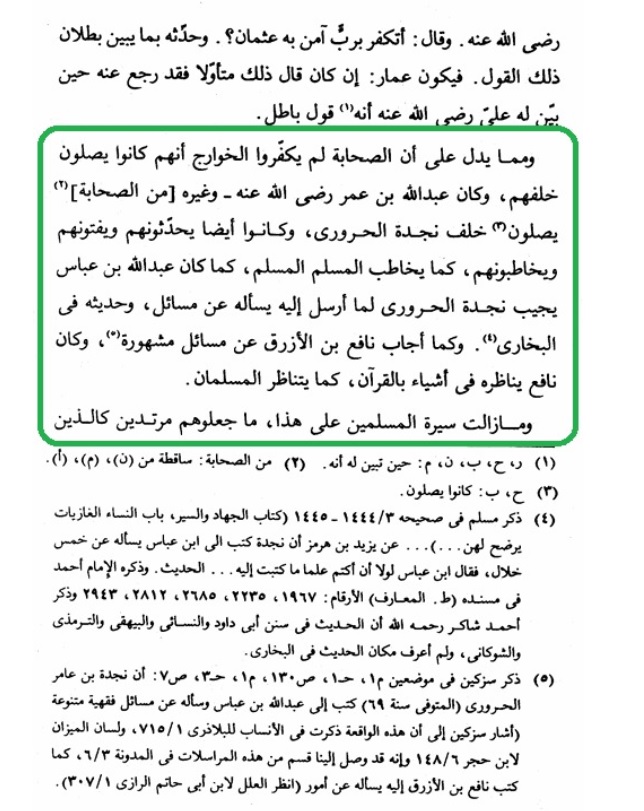
“And what indicates that the Companions did not consider the Khawarij to be disbelievers is that they used to pray behind them. Abdullah ibn Umar -RA- and others[companions] used to pray behind Najda al-Haruri. They also used to engage in debates with them, as the Muslim would debate with a Muslim, as Abdullah ibn Abbas debated with Najda al-Haruri when he was sent to him to ask about certain issues, and his hadith is in Al-Bukhari. Likewise, Nafi’ ibn Al-Azraq debated on famous issues. Nafi’ used to debate on matters in the Quran, as any two Muslims would debate among themselves”
Source: (The Path of the Prophetic Sunnah-In Refutation of the Shiite Qadariyyah Doctrine By Ibn Taymiyya Abu Al Abbas Taqi al Din Ahmad ibn Abd al-Halim.-Edited by Dr. Muhammed Rashad Salim Volume 5)
This entry will be split into three sections:
Section one: This will be aimed at refuting the lies, deception and outright propaganda that they aim at Ahl al-Haqq wal-l istiqama (The Ibadi school).
Section two: This will be the Ibadi school exposing the bizarre beliefs and strange views of those who call themselves: Salafi, Athari etc..
Section three: Those who may loosely identify as Salafi, Athari etc that have had and do have cordial relations with our school. Because they simply see us as Muslims. Muslims perhaps they disagree with but Muslims none the less. Articles in relation to them will be posted under section three.
THE MORE ONE LEARNS SALAFI AQIDAH THE MORE CHRISTIANITY MAKES SENSE.
SALAFI-SAUDI SHAYKH DR. SAAD AL-HUMID PROFESSOR OF HADITH SCIENCES IN MEDINA FLEES FROM DEBATE WITH SHAYKH SAEED AL QANOUBI: IBADI HADITH MASTER, ON THE CREATION OF THE QUR’AN
MAJOR DIFFERENCE BETWEEN IBADIS AND SALAFIS/ATHAIRS: IBADIS BELIEVE WE HAVE THE ENTIRE QUR’AN. SALAFIS/ATHARIS BELIEVE WE ONLY HAVE THE QUR’AN ALLAH INTENDED FOR US TO HAVE.
THE CLAIM THAT THE IBADIS CURSE AND REVILE THE COMPANIONS.THIS FALSE ALLEGATION IS TURNED ON IT’S HEAD! THE WAHHABI/MADHKALI/SALAFIYYA RELY UPON THOSE WHO SAY VILE THINGS ABOUT ALI
HADITHS THE SALAFIYYA AND AHL SUNNAH IN GENERAL RELY UPON TO CALL HUGE SWATHES OF THE PROPHET’S COMPANIONS DOGS OF HELLFIRE! (THE IBADIS RIP APART THESE CHAINS)
SECTION THREE: THOSE WHO MAY LOOSELY IDENTIFY AS SALAFI, ATHARI ETC THAT HAVE HAD AND DO HAVE CORDIAL RELATIONS WITH OUR SCHOOL. ARTICLES IN RELATION TO THEM WILL BE POSTED UNDER HERE.
MY EXPERIENCE WITH SALAFIS AND SUFIS (NOT ALWAYS CHALK AND CHEESE)
“That was a community that had already gone before. For them is what they earned and for you is what you have earned. And you will not be accountable for what they have done.” (Qur’an 2:141)
“Do not mix truth with falsehood or hide the truth knowingly.” (Qu’ran 2:42)
﷽
This is a summary given by one of our Sunni brothers concerning this debate.
“I am not an Ibadi, but I say that Brother Omar was unable to provide Ibn Salam’s interpretation regarding seeking Allah’s pleasure with Imam Ali. Thus, the debate concluded that it was Al-Hawari, the Ibadi, who sought Allah’s pleasure with Imam Ali, who proved the Ibadi’s claim to be true.”
“That al-Tabari is satisfied in his book with Ali ibn Abi Talib, whereas the other two shaykhs from the Hanbali school’s perspective did not express satisfaction with him in their books even a single time!”
Before we break down this debate these are some of our thoughts. Of course we are a site in which the participants follow the Ibadi school. Some may accuse us of bias. That is why you yourself (if you have access to the Arabic language) can watch and see for yourself. Likewise, you can judge if this is a faithful translation of the debate. With Allah is success.
Shaykh Muhammed al-Rashidi stated with complete clarity, without any dissimulation, that among our companions, there are some who disavow certain companions, while others are pleased with them. Thus, we, the Ibadi do not hold to a single position on this matter, and there is also the stance of suspension regarding them.
The Wahhabis focus on the issue of certain prominent Ibadi scholars’ disavowal of certain companions related to the arbitration incident and what accompanies it, because they firmly believe this is the killing blow against us. If they examined it, they would find it is deliberate denial of the Messenger (saw) not disagreement with the companions, for infallibility belongs to the Prophet (saw) alone that expels one from the millat. Accordingly everyone is an opponent among the Wahhabis.
They forget that justice does not mean infallibility, and they forget that the companions cursed and fought one another, and that the phrase “and we do not delve into what transpired among them” is ijtihad, not consensus, even if it is called consensus. Here, the saying “Whoever claims consensus is a liar” proves true to a great extent, for partial consensus of some of the ummah is not consensus of the entire ummah, despite the permissibility of accepting and relying upon it as taking a credible view among views. But not at the expense of expelling some from the community of consensus of the Muslims, and one is not declared kafir with certainty for not seeing some opinion as valid ijtihad or interpretation.
And there is kufr short of kufr, as Ibn ‘Abbas (ra) said, which does not expel its holder from the religion. Some say that hating ‘Ali may be a is a sign of hypocrisy, but hating actions differs from hating persons.
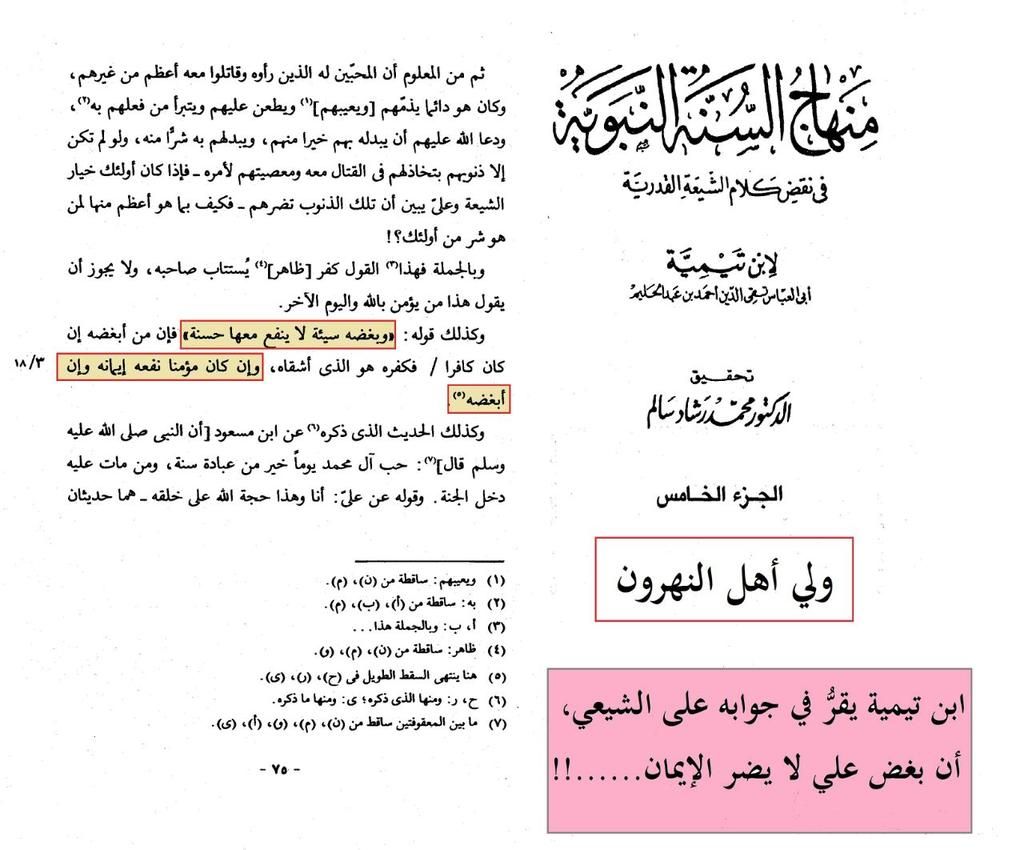
Although Ibn Taymiyyah was of the view that hatred of Ali does not harm faith.
Source: (Volume 5 of Minhaj as-Sunnah an-Nabawiyyah (The Path of Prophetic Sunnah) by Ibn Taymiyyah)
Those among the Ibadi school who show disavowal of Ali cannot be said that they hate the person of ‘Ali but they hated his agreeing to the Arbitration, which led to the fighting. This is a strong excuse with no denial of the Messenger in it, and the Ibadi disavowal cannot be interpreted except according to our principles and rules, for we are an independent Islamic school with our own principles and branches. It is forbidden to expel any Muslim from the fold of Islam except with certainty, just as one enters it with certainty. Shaykh Muhammed ibn ‘Abdullah al-Rashidi excelled in his debate with al-Zahrani, who took it as an opportunity to savage our Ibadi school.
The reason for this debate. Once again the Zionist and the proxies have attacked a Muslim country, Iran. There are certain segments in the Muslim Ummah who shield these Zionist and shield the Muslim rulers that aid the Zionist. Therefore there can be no empathy shown towards Iran and no solidarity shown with the Iranian people. They do not accept this from Sunni Muslims nor from the Ibadi.
Examples:
Shaykh Uthman Ibn Farooq made the following video:
What he said is absolutely true. However, he did not use that opportunity to attack and assail the Shi’i. Therefore most likely he got a call from those Zionist handlers. Guess what immediately followed? Attacks upon Iran of course.
Or, when Zakir Naik mentioned his support for Iran. Zakir Naik clearly mentioned Iran did things that are not appropriate. However, people came out and attacked Zakir Naik for it.
So the reason for this debate is that it well known that Oman and the Omani people stand with and support Muslims against the Zionist. So in this case this means standing with Iran and with the people of Iran against the Zionist aggressors.
Thus, this man Omar Al-Zahrani came with a mission. That mission is to create division and animosity between the Shi’i and Ibadi. You will see in the debate he brings up fatwa from 12er Shi’i about the Ibadi. He brings up some poem by an Ibadi scholar in praise of Ibn Muljam. All the red herrings that he can. Yet mash’Allah, he was no match for the calm, poise and overwhelming knowledge that Shaykh Muhammed Al Rashidi has.
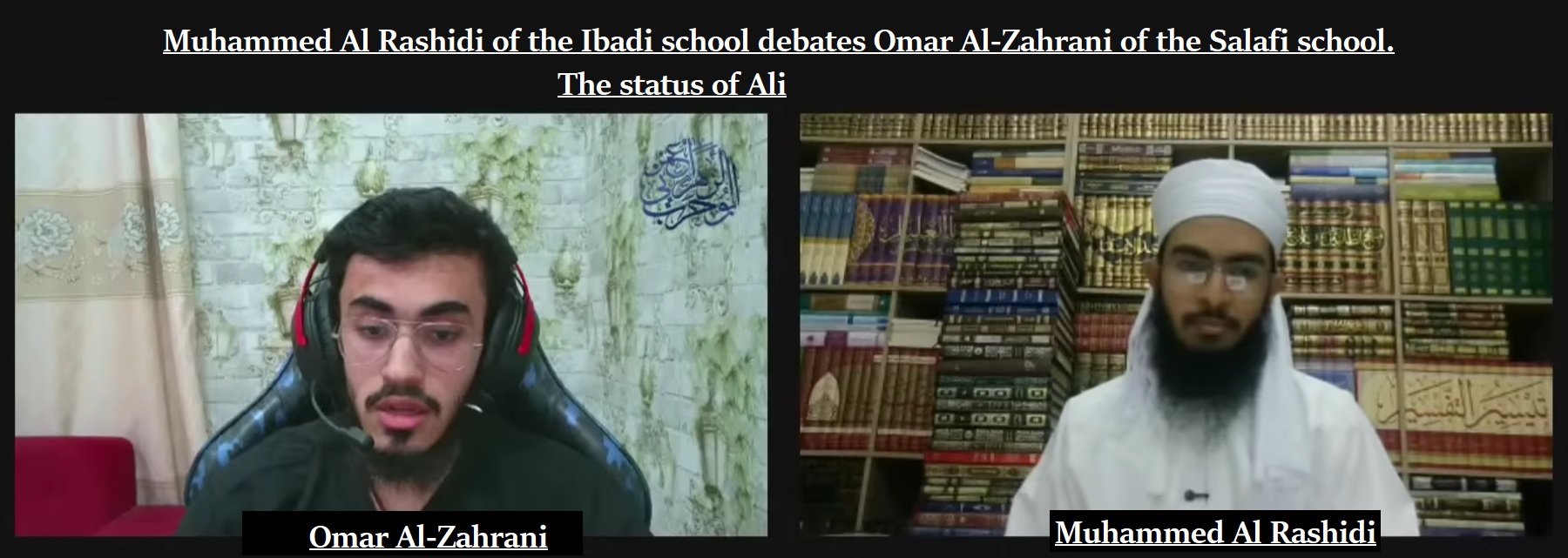
The status of Ali: Muhammed Al Rashidi of the Ibadi school debates Omar Al-Zahrani of the Salafi school.
Opening statement from the moderator:
My greetings to all of you, all the lovers and followers of the “Facts of Religions” channel. The meeting renews with you, respected gentlemen, and with the esteemed guests who are proficient in the language of dialogue, research, thought, and reflection on religion. Diversity is also required. The goal is for you, respected gentlemen, to receive accurate information from this one and that one. Today’s episode and today’s debate are very important because they have a dimension for us to get to know the Ibadi doctrine. Of course, our brother Omar will be with us; he will represent the Salafi belief or concept.
My greetings to all of you, all the lovers and followers of the “Facts of Religions” channel. I hope for mutual respect between you on the chat: respect for symbols, respect for sanctities, respect for guests. The channel’s goal is an intellectual meeting point, setting corrective and clarifying controls for what has been documented in our books.We welcome Brother Muhammed, who will represent the Ibadi thought through the “Dictionary of Sharia.”
He will also clarify, first as an introductory title. Brother Muhammed, you have five minutes, then we will move on to Brother Omar afterwards. It’s better, Brother Muhammed, if you could give an introductory title in the first minute, then start presenting the initial givens that Brother Omar will document and interact with you on. Go ahead, Brother Muhammed.
Muhammed Al Rashidi of the Ibadi school self introduction and opening statements:
In the name of Allah, the Most Gracious, the Most Merciful. O Allah support our brothers in Palestine, Iran, Yemen, Sudan, and in all corners of the earth, O Lord of the worlds. O Allah, protect our homelands, strengthen our ruler, support him with truth, and support truth with him, O Lord of the worlds. O Allah, make this debate beneficial for the seeker of truth and the listener, and keep it away from division and sectarianism.
Regarding this debate: It was raised a while ago that the Ibadis pray for the mercy of Imam Ali (Yataradaw ‘an). I presented evidence from this book, which is the “Tafsir Kitab Allah al-Aziz” by Imam al-Hawari, who is from the scholars of the third century AH, one of the Ibadi scholars. I extracted a text from it and said that the Ibadis pray for the mercy of Imam Ali, and I proved that. Brother Omar (may Allah bless him) came and took a part from the introduction of this book, where the investigator says that Imam al-Hawari relied on another Tafsir, which is the Tafsir of Imam Yahya ibn Salam al-Qayrawani. This is a wonderful thing. Imam al-Hawari indeed relied on this book; no problem, no issue. But the talk here is… Brother Omar, at the beginning, said that since there is “Taraddi” (praying for mercy) in this book, then this “Taraddi” belongs to Yahya ibn Salam, not to Hud ibn Muhakkam al-Hawari, who is one of the Ibadi scholars. He said that the Ibadis took this Tafsir (of Yahya ibn Salam), changed only the title, attributed it to Hud ibn Muhakkam al-Hawari, and made it Ibadi.
Of course, he raised other matters that we will discuss all of them, Allah willing, with Brother Omar, and we will discuss them fully, Allah willing. But I will start with a simple matter, Alah willing. I will prove with three pieces of evidence that these “Taraddiyat” (expressions of seeking mercy) found in this book are “Taraddiyat” of Imam Hud ibn Muhakkam al-Hawari, not of Yahya ibn Salam.
The first matter: Since we are talking about the “Taraddiyat,” and I presented evidence containing “Taraddi” for Imam Ali in this book, it was expected of Brother Omar to show us the same text from the book of Yahya ibn Salam al-Qayrawani and say that this same “Taraddi” exists there, regardless of the fact that the Tafsir of Yahya ibn Salam is incomplete (22 surahs). No problem.
But I tell you now, Brother Omar, what if I challenged you or asked you to produce just one “Taraddi” for Imam Ali in the book of Yahya ibn Salam? Just one “Taraddi” in the Tafsir of Yahya ibn Salam, from the remaining surahs. Ali is mentioned several times; we want just one “Taraddi.”
Now, the “Taraddiyat” are proven in this book. I have prepared dozens of texts, and I have other texts, but ten suffice. I also have a comparison between several texts from the two books. Excellent. So first, I have three pieces of evidence, as I said. I will present two here in this debate or dialogue (better to call it a dialogue). I will keep the third and final evidence for a separate discussion, Allah willing, you will see it. As for now, as we said, I think for every statement there is a challenge, a question, or a request. So we ask Brother Omar, may Allah bless him, to produce for us just one “Taraddi” on Imam Ali from the book of Yahya ibn Salam al-Qayrawani. If he does not produce a “Taraddi” for us, then the “Taraddiyat” were added by Imam Hud ibn Muhakkam al-Hawari, and they are Ibadi “Taraddiyat.” May Allah bless you. The remaining time is for you, Brother Omar.
Moderator speaking:
Okay, I don’t know if Dr. Muhammed is present… Okay, let me thank you, Brother Muhammed. I thank you for your punctuality, and I also thank you for the introduction. I hope from all the lovers and followers of the “Facts of Religions” channel and everyone to focus very well on the data being presented now, especially since it will introduce you to the reality of the Ibadi belief or concept. Brother Omar, you have five minutes with us for initial data. Could you make my picture bigger, Dr. Muhammed, please? On the camera. Okay.
Omar Al-Zahrani of the Salafi school self introduction and opening statements:
Peace be upon you and Allah’s mercy and blessings. In the name of Allah, the Most Gracious, the Most Merciful. O Allah, bless Muhammed and the family of Muhammed and all his companions and wives. Of course, may Allah protect our shyookh, kings, princes in the Gulf countries and in the rest of the Muslim lands.
Of course, as I told you, I will not leave a single word that the guest says without clarifying it. Iran, which you are sitting there… I don’t know why you pray for them, I don’t know if it’s to provoke us or what is your goal? Look at what they say about you in the book “Madinat al-Ma’ajiz” when they talk about the Khawarij. This is the “Mu’assasat al-Ma’arif al-Islamiyyah” in Iran, the ones you pray for. It says: “They are outcasts from Islam by the judgment of all Islamic scholars, ancient and modern. The most important of their sects are the Ibadis, may Allah’s curse be upon them all until the Day of Judgment.” This is not my words; this is the words of Iran. So, may Allah bless you, we try to adhere to the text.
Brother Omar, this phrase you just said, this phrase is attributed to…
Omar Al-Zahrani speaks again.
“…to an Iranian institution for printing. Of course, this investigator says they are outcasts from Islam by the judgment of all Islamic scholars, ancient and modern. The most important of their sects are the Ibadis. I am not saying “May Allah curse you, Muhammed al-Rashidi,” but Iran, the ones you pray for, who bombed our countries and your country, said “May Allah’s curse be upon you until the Day of Judgment.” Got it? Allah forbid, I don’t say such things to you. This is your books that conveyed this to you. Sorry, not your books, their books that you are happy with.”
Okay, the second issue, my dear brothers, may Allah bless you. When he asked me, he said, “I challenge you to prove that this ‘Taraddi’ exists in books…” I will give you from the words of the scholars… What does the investigator, Al-Hajj bin Sa’id Sharif (from Algeria), say? Look, my dear brothers, when he mentioned… even what did he say? “The Messenger of Allah, may Allah bless him and grant him peace.” He says: “This is from al-Hawari?” I tell you, no. He says: “An addition that is necessary, because what follows is a text of an authentic hadith.” Meaning even the prayer upon the Prophet (saw) was added by the investigator, not al-Hawari. So you tell me this “Taraddi” is from… from al-Hawari? No, my dear brother, this is the words of the investigator. So this issue is very natural.
Okay, my dear brothers, of course, now I will show you the many proofs. Our topic was about al-Hawari’s Tafsir and so on, but I will give you this issue: Basically, this entire book, all of it, is taken from… as I explained, from the Tafsir of Yahya ibn Salam. But the strange thing, my dear brothers, the strange thing is that after researching and investigating this book, I discovered that… What’s the idea? That al-Hawari took the complete book of Yahya ibn Salam al-Basri. And when he came to matters that benefit the Ibadi school of thought, or sorry, that harm the Ibadi school of thought (like divine vision, like intercession, etc.), he deleted them. My brothers, this is not my words, this is their books. There is a Master’s thesis… Basically, Hud ibn Muhakkam al-Hawari, hardly anyone talked about him, meaning few researches on “The Methodology of Hud al-Hawari in Tafsir.” It says: “And it concluded with the following results: Complete omission of the personality of Hud ibn Muhakkam al-Hawari – no one, by Allah, knows who Hud al-Hawari is, nor when he was born, nor when he lived, nor his shyookh. No one knows anything about him.”
Second: “Hud’s Tafsir is an abridgment of the Tafsir of Ibn Salam al-Basri the Sunni.” Okay. “The bias of Hud al-Hawari towards his Ibadi school of thought is evident in doctrinal rulings, practical rulings, and in his omission of narrations that contradict his school of thought.” Meaning, as long as you are taking an issue from our books, you must adhere to it. If you are taking an issue from our books, you must be committed to it, Dr. Muhammed. If possible, just enlarge my picture because the quality for some doesn’t show clearly during my intervention. Just enlarge it, may Allah reward you. Okay, my dear brothers, these are the evidences that confirm that the origin of the book is taken from us, from the Tafsir of Yahya ibn Salam al-Basri. For you to prove otherwise, you must bring… For example, this “Taraddi” (رضي الله عنه) is found in your book, while in the original, this “Taraddi” is not found at all. Even the prayer upon the Prophet (saw) – Hud thought it was too much to pray upon the Prophet (saw). So you tell me this action was… My dear brothers, unfortunately, this man (Hud al-Hawari) did not even know the basics of his religion. It says: “Among the criticisms against Hud is his mixing between the hypocrite and the polytheist in some rulings.” Hud says: “Whoever associates partners (with Allah) and is a hypocrite, We will punish him,” meaning killing. And we know that the hypocrite is not killed. Meaning, even the fundamentals of the Ibadi school of thought are deficient according to Hud al-Hawari.
You tell me that this, by the way, is not only taken from the Tafsir of Yahya ibn Salam al-Basri, but also taken from the Tafsir of Ibn Zaminayn, who is also one of our scholars. It is taken from both books. You tell me there is no “Taraddi” in the Tafsir of Yahya ibn Salam? It is found in the Tafsir of Ibn Zaminayn, by the way, found in the same narration about Ali (RA). I will give it to you in the next intervention. I have absolutely no problem with this. Okay. Now, my dear brothers, the next intervention will be…
Moderator: Okay, let’s thank you, Brother Omar. We’ll quickly move to Brother Muhammed. I hope all the esteemed viewers focus well on what is being presented now. Go ahead.
Muhammed Al Rashidi speaks:
Praise be to Allah, and after: “And say, ‘The truth has come, and falsehood has vanished. Indeed, falsehood is [ever] bound to vanish.'” Brother Omar, what do I care if the Tafsir of Hud ibn Muhakkam al-Hawari is correct or incorrect? Now our discussion is about the “Taraddi,” proving the “Taraddi.” Whether it is correct or incorrect, that’s another topic.
The issue of “Taraddi”… You told me about the prayer upon the Prophet. I demanded from you just one “Taraddi”! One “Taraddi”! I have dozens of texts, dozens of texts containing “Taraddi” on Imam Ali. Don’t tell me they added “Salla Allahu alayhi wa sallam” (saw). If they added it, that’s a weak argument. Bring me a text… For example, the investigator himself… I have statements from the investigator himself. He made mistakes in several things. One of the things he said is that this book is an abridgment or called an abridgment. This book cannot be called an abridgment at all; this book is a refinement of the book of Yahya ibn Salam, not an abridgment.
Second, he said that what is criticized in this book is the omission of chains of narration (asanid). Omitting chains of narration is the methodology of the Ibadis, the methodology of the school. You have “Al-Jami'” behind me, the explanation of “Musnad al-Imam al-Rabi'”, without chains of narration. “Musnad al-Imam al-Rabi'” which is the most authentic chain we have, explained without chains of narration. No problem.
I challenged you with one “Taraddi.” You know that the book of Yahya ibn Salam does not contain a single “Taraddi” on Imam Ali, not one! As for this book, it has several “Taraddiyat,” dozens, we can say. No problem. I will show Brother Omar… I will mention something before continuing. He said that Imam al-Hawari added things that benefit his school of thought. Previously, he said the Ibadis only changed the title and kept the Tafsir of Yahya ibn Salam. Why change the statement now?
Second, you said that Imam al-Hawari abbreviated some things, not that he added anything. Your statement is with me. Do you deny any word? Let’s show the clip. No problem, everything is there. These are three contradictions, three statements you made about the book of Imam al-Hawari. I demand from you only one text, one text where Imam Yahya ibn Salam al-Qayrawani prays for mercy on Imam Ali.
This is excellent. We will show pages if possible. There’s still time. Excellent. Let’s show some pages. Brother Omar said… or open a page from the pages. I’ll share it. Open a page from the pages where he compares the Tafsir of al-Hawari and the Tafsir of Yahya ibn Salam. Actually, if I complete that page… Let’s open a page. Does the page appear? Does it appear? It appears, it appears. Yes, go ahead. Excellent, excellent, excellent. This page: Right side is the Tafsir of Imam Yahya ibn Salam, left side is the Tafsir of Hud ibn Muhakkam al-Hawari. He said: “And some said, ‘It does not afflict her in the east nor in the west.'” This is in both books, in the Tafsir of Surat An-Nur. If we go down a little in the book of Imam al-Hawari, he prays for mercy on Imam Ali. As for Yahya ibn Salam, the book of Yahya ibn Salam did not pray for mercy on Imam Ali. I have dozens of texts like this, comparing the same texts from the two Tafsirs. Imam Hud ibn Muhakkam al-Hawari prays for mercy on Imam Ali, while Yahya ibn Salam does not pray for mercy on Imam Ali.
This is the first evidence that the Tafsir… that Hud ibn Muhakkam al-Hawari is the one who added these “Taraddiyat.” Of course, there are other errors in your statement besides this huge contradiction: Imam al-Hawari added jurisprudential things, added doctrinal things from “Musnad al-Imam al-Rabi'”. I have surprises for you as well. He added doctrinal things. I have texts I will show later. There are 30 seconds left. The remaining time is for you. Give me only one text where Imam al-Hawari or Imam Yahya ibn Salam prays for mercy on Imam Ali, just one text. You have now shown the viewer that Yahya ibn Salam does not pray for mercy on Imam Ali. This is clear. Go ahead, Brother Omar.
Omar Al-Zahrani speaks
Okay, could you enlarge me, Dr. Muhammed, so I can show the sources? Yes. In the name of Allah, the Most Gracious, the Most Merciful. Enlarge me, Doctor, may Allah bless you. Okay, my dear brothers, I think my statement is clear. Did I say that al-Hawari only took the Tafsir from Yahya ibn Salam? In the previous intervention, I told you he also took it from Ibn Zaminayn, the Sunni. The evidence for my statement is from “The Methodology of Hud ibn Muhakkam al-Hawari in Tafsir.” It says: “Hud al-Hawari followed, to some extent, the process of abridgment.”
The problem is your scholars say “abridgment,” and you tell me “refinement”! No, it’s not refinement, it’s abridgment. “However, he is criticized for not distinguishing between his opinions and the opinions of Ibn Salam, as Ibn Abi Zaminayn did.”
So, where did he take it from? He took it from two: from Ibn Salam and from Ibn Abi Zaminayn. You demand a “Taraddi” from me. This, my dear brothers, in “Uṣūl al-Sunnah” by Ibn Abi Zaminayn, it says about Ali ibn Abi Talib (RA). There! I have brought you your request. This request is fulfilled. Thank you. Okay, my dear brothers, now we come to the second issue. You are really bringing scandals, may Allah bless you. When you say, “We take our religion without a chain of transmission (sanad), we explain it without a chain.” May Allah bless you, this is a good thing, honestly. I don’t know why there’s a comment in the stream… The problem is, to say “We take our religion without a chain and explain without a chain” – this is not something, my dear brother, you should be proud of. On the contrary, it goes against you. Okay.
Moderator:
“The network weakness is from you, Brother Omar. The network weakness is from you. Just for your information.”
Omar Al-Zahrani speaks:
Okay, no problem. Let’s go back to show the source, my dear brothers. Okay, sorry, so this is in “The Methodology of Hud al-Hawari.” It says: “Hud al-Hawari followed, to some extent, the process of abridgment. However, he is criticiz
ed for not distinguishing between his opinions and the opinions of Ibn Salam, as Ibn Abi Zaminayn did.” Let’s go back to the books of Ibn Abi Zaminayn. He says about Ali ibn Abi Talib (RA). So this is the “Taraddi” now. May Allah bless you. Okay, my dear brothers, now we come, Allah willing, to the second issue with which he challenged me. He said, “You see, we take it without Tafsir, etc.” Brother, this is against you, not for you. Allah is sufficient. Your request I answered. It didn’t come with anything else. Okay, he says, “No, you must retract because Hud ibn Muhakkam al-Hawari added some words.” I know he added two or three words, a line or two. This does not count as an addition to the book. It is indeed an abridgment.
Evidence, my dear brothers, come, let’s make a simple comparison. Okay, this is, my dear brothers, the Tafsir of Yahya ibn Salam al-Basri the Sunni. He says regarding Surat An-Nahl: “In the name of Allah, the Most Gracious, the Most Merciful. ‘The command of Allah is coming, so do not impatiently seek to hasten it.’ Al-Hasan said: ‘This is a response from Allah.'” Let’s go back to the Tafsir of Yahya ibn Salam. He said: “Al-Hasan said: ‘This is a response from Allah to the saying of the polytheists to the Prophet: Bring us the punishment of Allah.'” The exact same thing! Where is the addition? You tell me, “By Allah, he added two words, added two letters”! This does not change the meaning. It’s very natural.
My dear brothers, if I go and take Al-Bukhari and at the end add two words, “Peace be upon you,” does that mean I have added to the interpretation? Absolutely not! Impossible. This is considered an addition by me, two or three words I wrote. It’s a normal matter. Okay, my dear brothers, now we come to the important issue which we will also clarify, because our topic today is about two things: al-Hawari’s Tafsir and the “Dictionary of Sharia.”
The “Dictionary of Sharia,” my dear brothers, Brother Muhammed al-Rashidi presented this source on his account. He said, “We have in the book ‘Dictionary of Sharia’ there is ‘Taraddi’ on Imam Ali. He interpreted it as ‘Ali, may Allah be pleased with him.'” I went back to the introduction of the investigation and discovered a catastrophe, by Almighty Allah! It says: “The words of Taraddi, Tarahhum, Tasliyah, and Taslim were proven in the text as they appeared in the manuscripts, and no intervention was made in them, neither modification nor alteration. Likewise, the author of the dictionary used to prove these words as he found them in their sources. This does not necessarily mean the author’s belief in that Taraddi or Tarahhum, because he was transmitting the text as it appeared in the source.” Meaning, just by him transmitting “Radhiya Allahu ‘anhu,” it does not necessitate that he believes in this Taraddi.
What is the evidence for your statement, Omar? What is the evidence that this man does not believe in this Taraddi? Get ready for the shock, by Almighty Allah! Don’t be shocked! This, my dear brothers, is the same book, “Dictionary of Sharia,” but a few pages later. It says: “We declare allegiance to Abu Bakr al-Siddiq and Umar ibn al-Khattab.” (It was supposed to say Uthman and Ali) – No Uthman, no Ali! And Abu Ubaydah ibn al-Jarrah, Abu Dharr al-Ghifari, Abd al-Rahman ibn Awf, Mu’adh ibn Jabal, Abdullah ibn Mas’ud, Salman al-Farisi, Ubayy ibn Ka’b, and Abdullah ibn Wahb al-Rasibi (who abandoned Ali ibn Abi Talib) – they are present. But Ali ibn Abi Talib is not present!
They declare allegiance to him? Take the great calamity: “And we declare disavowal (al-bara’ah) from those from whom our prominent Imams declared disavowal in the biographies, without needing to disclose or specify.” Who are these you disavow? Let’s go down below and see who you disavow. It says: “And we declare the correctness (taswib) of the people of Nahrawan” (those who fought Ali). “And disavowal (al-bara’ah) from those who killed them.” Who killed them? Ali ibn Abi Talib killed them! So you disavow Ali ibn Abi Talib! From the same book you brought! Not me, you brought this book!
Do you want a clearer declaration that he indeed disavows Ali? Take the catastrophe, brothers. The same book, “Dictionary of Sharia,” Volume 8, by al-Sa’di. It says: “And after the Prophet, we disavow the people of the Qibla (Muslims) who are… Uthman ibn Affan, they disavow him, and Ali ibn Abi Talib, they disavow him, and Talhah, al-Zubayr, Mu’awiyah, Amr ibn al-As, Abu Musa al-Ash’ari, and all who were satisfied with the arbitration of the two arbitrators and abandoned the judgment of Allah.”
Abu Abdullah Muhammed ibn Mahbub (may Allah have mercy on him) said: “We agree with them on this disavowal of those named.” We disavow Ali, we disavow Uthman.And Abu Sa’id al-Kudami prays for mercy on this man… He says: “We agree with them on the disavowal… we disavow Uthman ibn Affan, Ali ibn Abi Talib, Talhah, al-Zubayr, Mu’awiyah, Amr, and Abu Musa al-Ash’ari, and all who were satisfied…”
The sources, Brother Omar! The sources! The same book, brothers, that Brother Muhammed al-Rashidi brought. Not a new book. The same book he brought, “Dictionary of Sharia”! It says: “And after the Prophet, we disavow the people of the Qibla who are Uthman ibn Affan, Ali ibn Abi Talib, Talhah, al-Zubayr, Mu’awiyah ibn Abi Sufyan, Amr ibn al-As, Abu Musa al-Ash’ari, and all who were satisfied with the arbitration of the two arbitrators…” …Disavowal. Okay.
So, my dear brothers, those who agreed to this… Abu Sa’id… Then you come and hold onto an issue saying, “By Allah, he prayed for mercy on him, he said ‘Ali, may Allah be pleased with him.'” Where is the love here? Where is this love?
Moderator:
Okay, thank you, Brother Omar. Thank you for this data, really. Brother Muhammed is indeed worthy of interacting with it for clarification and correction. Go ahead.
Muhammed Al Rashidi speaks:
First, I hope we adhere to the time, first of all. Secondly, we haven’t finished with the Tafsir of Yahya ibn Salam and the Tafsir of Hud ibn Muhakkam al-Hawari. You haven’t denied your contradiction in the statements you made about the book of Yahya ibn… Hud ibn Muhakkam al-Hawari. First.
Second… You did not bring a single “Taraddi” from the book of Yahya ibn Salam! Excellent! Second or third… You talked about Ibn Abi Zaminayn. Excellent! I now challenge you as well to bring one “Taraddi” from the abridgment of Ibn Abi Zaminayn of the Tafsir of Yahya ibn Salam. Don’t give me from the book “Al-Sunnah”! Bring it to me from the Tafsir. Didn’t he abridge the Tafsir? Come on, here’s the shock! Look at the shock!
I will say it while I open the pages… Ibn Abi Zaminayn, in his introduction, says that he abridged much of what was in Yahya ibn Salam’s book and omitted many chains of narration and many reports. In the first preface. Excellent! So, you are dependent on the Ibadis for this as well. Now, if you want the Tafsir of Yahya ibn Salam, it’s incomplete (22 surahs). If you want to refer back, you cannot refer to Ibn Abi Zaminayn’s book because it is very incomplete, and that’s a criticism against it.
As for the Tafsir of Hud ibn Muhakkam al-Hawari, I repeat to you: You say “my scholars say it’s an abridgment.” He is not my scholar! That’s the investigator of the book! Don’t say “your scholars,” he is the investigator of the book, and he made a mistake in this. I say it once more: This book is a refinement. I think you understand – I trust your academic ability – the difference between refinement and abridgment. Excellent! You yourself said he added things! So how can it be an abridgment if he added? Wonderful!
Likewise, will you say that your scholars who abridged, refined, or relied on other books… will you say they stole? Will you say they removed a title and took a book? Can you say this, or only because he is Ibadi? Excellent!
Now, I challenged you with two or three Tafsirs. The first Tafsir contains “Taraddiyat.” The second evidence that Yahya ibn Salam did not pray for mercy on Imam Ali is the Tafsir of Ibn Abi Zaminayn. The Tafsir of Ibn Abi Zaminayn did not pray for mercy on Imam Ali, and he transmitted from reliable books in his abridgment. So, the two books did not pray for mercy: neither the book of Yahya ibn Salam nor Ibn Abi Zaminayn. The one who prayed for mercy is the Ibadi, Hud ibn Muhakkam al-Hawari.
This is evidence that Hud is the one who added the “Taraddiyat” in his Tafsir. Among the things he added are statements in jurisprudence: statements of Abu Ubaydah Muslim ibn Abi Karimah, statements of Jabir ibn Zayd, statements of “our companions,” “our school of thought.” These are additions! They do not exist in the Tafsir of Yahya ibn Salam. Doctrinal statements: I have prepared seven doctrinal issues, on Al-Istiwa’ (The Rising on the Throne), etc. All are Ibadi interpretations. So, how can you say they only took the title? “They only took the title or changed the title and took it” – how is this, Ibadis?
Your Tafsir is incomplete. I challenge us to compare. I tell you, open Surat Al-Fatihah and compare now! Between this Tafsir… The audio is present, your voice is there. You say, “I am ready to compare.” We open the book from the beginning and compare word for word. How? And the things that Yahya… that Hud ibn Muhakkam al-Hawari added…
Alright, I tell you, open Surat Al-Fatihah so we can compare. It’s not present in Surat Al-Fatihah. You rely on the Ibadi Tafsir to refer back to the book of Yahya ibn Salam. Even the Tafsir of Ibn Abi Zaminayn is not sufficient for you! Not sufficient for you to complete! I have brought many texts. Okay, let’s open this text… another text… containing a comparison. Open this text for me…
Moderator:
You have about two minutes…
Muhammed Al Rashidi speaks:
Yes, may Allah bless you. We have this text, the two Tafsirs. This Tafsir (right) is Yahya ibn Salam’s. He mentioned Hamzah and Ali, but did not pray for mercy on them. Look at the Ibadi Tafsir: “Hamzah ibn Abdul-Muttalib and Ali ibn Abi Talib, may Allah be pleased with them all.” This is the Ibadi Tafsir! Okay. Open the other text…. This is another text.
We haven’t even finished with the Tafsir of Hud ibn Muhakkam al-Hawari, and you move to another topic, the “Dictionary of Sharia.” Look at this text: “From Al-Harith, from Ali, that he asked the Messenger of Allah…” This is in Yahya ibn Salam’s Tafsir. Look at the book of Hud ibn Muhakkam al-Hawari: He said about “Ali ibn Abi Talib, may Allah be pleased with him, that he asked the Messenger of Allah…” Okay, now you say the investigator added this. Where is the evidence? Don’t just tell me so.
This is a refinement by… to Hud al-Hawari. Go ahead, but I emphasize an issue now. I challenged you regarding two of his Tafsirs: to produce just one “Taraddi” from two Tafsirs, not one! One “Taraddi” on Imam Ali! I brought dozens!
Moderator:
Okay, thank you, Brother Muhammed. We’ll move on.
Omar Al-Zahrani speaks:
Okay, if possible, could you share with me, Dr. Muhammed? I don’t know what the problem is with the sources I presented. Share this text with me, may Allah bless you, and enlarge my picture, please. Dr. Muhammed, share, may Allah bless you. Yes.
My dear brothers, as I explained to you, this text and these additions… Are they from al-Hawari? I tell you, no! Rather, this is from the scribes (nussakh). In the “Tafsir Kitab Allah al-Aziz,” it says: “The Messenger of Allah, may Allah bless him and grant him peace,” – the prayer upon the Prophet… he says: “An addition that was necessary.” He added it!
So you tell me it’s “Taraddi”? Which “Taraddi”? Naturally, the scribes added it, and you have that he prayed for mercy on Ali. I know. But did al-Hawari say it? The answer is no. Evidence: the text I gave you just now.
If possible, Dr. Muhammed, also share with me in the book “Dictionary of Sharia.” My dear brothers, “Dictionary of Sharia” which we proved… Dr. Muhammed, share with me, may Allah bless you. Yes, this is the “Dictionary of Sharia” we showed earlier. This is “Dictionary of Sharia.” What does it say? “Ali, may Allah be pleased with him.” Then what does the investigator say? “The words of Taraddi, Tarahhum… were proven in the text as they appeared in the manuscripts, and no intervention was made in them, neither modification nor alteration. Likewise, the author of the dictionary used to prove these words… and this does not necessarily mean the author’s belief.” Meaning, this does not necessarily mean the author believes in this Taraddi and Tarahhum. I know that “Radhiya Allahu ‘anhu” is written, correct.
But remember the name of the book. What is the name of the book? “Dictionary of Sharia.” Correct. My dear brothers, the same book “Dictionary of Sharia”… Look, my dear brothers, the same “Dictionary of Sharia”… What does it say? Dr. Muhammed, share, please… the text, may Allah bless you. Yes, this is “Dictionary of Sharia.” It says: “We declare allegiance (nuwalli) to Abu Bakr al-Siddiq, may Allah be pleased with him, and Umar ibn al-Khattab, may Allah be pleased with him.” Where is the name of Uthman? Deleted. The name of Ali? Not there! “And Abu Ubaydah, Abu Dharr, Abd al-Rahman ibn Awf, Mu’adh ibn Jabal, Abdullah ibn Mas’ud, Salman al-Farisi, Ubayy ibn Ka’b, and Abdullah ibn Wahb al-Rasibi, the Khariji who removed Ali ibn Abi Talib from governance at Nahrawan, who said: ‘We don’t want you as a ruler.'” He said: “We declare allegiance to these.” “And we declare disavowal (al-bara’ah) from those from whom our Imams declared disavowal among the famous…”
Who are those you disavow? He tells you: “And we declare the correctness (taswib) of the people of Nahrawan and disavowal (al-bara’ah) from those who fought them.” Question: Who fought the people of Nahrawan? Ali ibn Abi Talib!
So the first “Taraddi” is something… it has no value, no benefit whatsoever, because basically he concealed “Radhiya Allahu ‘anhu.” Does he believe in this? Does he believe in this “Taraddi”? I tell you, no! He does not believe in this “Taraddi”!
Dr. Muhammed, share with me. I assure you, he does not believe in this “Taraddi.” Why, my dear brothers? Because the same book, “Dictionary of Sharia”… first thing, it had “Radhiya Allahu ‘anhu” written. But it says: “And after the Prophet, we disavow the people of the Qibla who are… Uthman ibn Affan – we disavow him. Ali ibn Abi Talib – Ali ibn Abi Talib, the one you go to the Shia for and we love Imam Ali! We love Imam Ali! But Ali ibn Abi Talib – we disavow him! And Talhah, al-Zubayr, Mu’awiyah, Amr ibn al-As, Abu Musa al-Ash’ari, and all who were satisfied with the arbitration of the two arbitrators, abandoned Allah’s judgment, and their followers and supporters, and those who ally with them – upon their disbelief.”
Disbelievers! O disbelievers! And their injustice! From the people of innovation and followers of whims. Who agreed to this statement? Abu Abdullah Muhammed ibn Mahbub (may Allah have mercy on you). “We agree with them on this, and the disavowal of those named.” Abu Sa’id al-Kudami, your friend, the one you love very much, says: “We agree with them on the disavowal of those named, calling them disbelievers.” Who? Uthman ibn Affan, Ali ibn Abi Talib – our brothers, our own selves! Ali ibn Abi Talib! My dear brothers, what… They disavowed him! We disavow you, Ali ibn Abi Talib!
And I explained to you the Tafsir of Ibn Abi Zaminayn, this is present. In “Uṣūl al-Sunnah” by Ibn Abi Zaminayn, this “Taraddi” is present. So I tell you, if you have a million “Taraddiyat” now, a thousand “Taraddiyat”… let’s say you have 10 million “Taraddiyat” in the book, does this mean you believe in them? I tell you, no! You deleted the name of Ali! You prayed for mercy on Ali in “Dictionary of Sharia,” and in the same “Dictionary of Sharia” you said: “We disavow Ali!” And Abu Sa’id al-Kudami says: “Whoever allies with them, upon their disbelief – disbelievers!”
My dear brother, by Allah, “disbelievers”! This is the problem. I don’t know, the sources earlier apparently didn’t appear, sorry, because I’m presenting them again, just to confirm the information which is “Madinat al-Ma’ajiz.” When you prayed for Iran, sorry, by Allah, I don’t know what this situation is, but it must be resolved. “Madinat al-Ma’ajiz” by the “Mu’assasat al-Ma’arif al-Islamiyyah.” When it mentioned the Khawarij, it said: “They are outcasts from Islam.” They declare you disbelievers! And the “Qadhafat al-Kham” (Iranian officials) that you are happy with! It says: “By the judgment of all Islamic scholars, you are outcasts from Islam, and the most important of their sects are the Ibadis.” They declare you disbelievers! Who is this? Iran! Iran declared you disbelievers! “May Allah’s curse be upon them all until the Day of Judgment!” Not my words, by Allah, not my words. On the contrary, I absolve you of such words. I went to Oman and saw respectable Ibadis, by Allah, they are good people. But Iran itself says: “May Allah’s curse be upon you until the Day of Judgment!”
Yes. This is their statement, their own statement! Go ahead, Brother…
Moderator:
Brother Omar Khalil, I thank you, and I don’t know why you are focused on the Iran part. I don’t know. The man mentioned it briefly at the beginning. But certainly, you have dimensions to it. Brother Muhammed is very capable of interacting with this aspect. Brother Muhammed, because I think Brother Omar is somewhat focused on it. Go ahead, Brother Muhammed.
Muhammed Al Rashidi speaks:
No problem, my teacher. But this is not the topic of the debate now. The topic of the debate now is… three rounds?…I agree.
Moderator:
Wait, wait, Brother Muhammed. I agree with you. But it is on the periphery. Since you started it, and he insisted on stopping at this point, you could clarify and correct for the viewers on the periphery, not for him, and then we finish this aspect and move to the title of the episode.
Muhammed Al Rashidi speaks:
No problem, we will clarify. But first, let’s finish what we started, and we will clarify quickly: The Ibadis do not declare their opponent as disbelievers, nor do they pass judgment on their opponent based on what their opponent has within them. Let’s finish this. There are evidences and other matters by which they judge their opponents… Shia, Sunnis… we consider all of them our brothers and do not enter into these matters.
But now, this Tafsir… I told you, or if you zoom in on this… I challenged you with two Tafsirs: the first is the original, and the second is taken from the original (Yahya ibn Salam) and abridged by Ibn Abi Zaminayn. The absence of “Taraddi” in the book of Ibn Abi Zaminayn is evidence that Yahya ibn Salam did not pray for mercy on Imam Ali, or that this “Taraddi” was not present in his book.
Your statement that the Ibadis lack chains of narration and so on is a methodological issue. Ibn Taymiyyah, your shaykh, says the Khawarij do not lie. Even if we differ with him about the name Khawarij, he says the Khawarij do not lie. So what need do we have for chains of narration if the Khawarij do not lie? If you want to verify the hadiths of the Khawarij, the hadiths of the Ibadis, you have something called “mutaba’at” and “shawahid” (follow-ups and supporting evidence). Refer to the book “Musnad al-Imam al-Rabi'”. We have an explanation called “Sharh Sahih al-Rabi'”. Imam al-Salimi explained it. In every hadith, he mentions the “mutaba’at”, “shawahid”, and other such matters. Our methodology is that we do not mention these chains of narration. Omitting chains of narration is not a flaw; rather, it is the methodology of the Ibadis. This is a feature.
But what are we talking about? The “Taraddiyat.”
Regarding the “Dictionary of Sharia,” the text you showed in the introduction says that these “Taraddiyat” exist in the original book and were not added by scribes or investigators. Excellent. It says the author may not believe in them, but he takes them from their sources.
Okay, let me ask you a question, Brother Omar. What are the sources used by the author of the “Dictionary of Sharia”? Did you go to the introduction of the first volume and research which books he relies on? Most of the books he relies on are Ibadi books. All or most of the books he relies on are Ibadi books: “Bayan al-Shar'” and others. So the “Taraddiyat” are inevitably Ibadi “Taraddiyat,” whether he said them or not, whether he believed in them or not.
The other issue: “Al-Wala’ wal-Bara'” (Loyalty and Disavowal) with us Ibadis applies to a specific person. Therefore, they used to mention “so-and-so scholar” is the one who disavows. It applies to that specific person, not to all of us. The disavowal is excellent. Even if the group that was with him agrees, no problem. But the evidence that reached them about disavowing Imam Ali applies to them. We may consider them mistaken.
Excellent. We may consider them mistaken.
But now… I challenged you with two Tafsirs… Excellent. And I proved to you that the “Taraddi” in the “Dictionary of Sharia” is an Ibadi “Taraddi,” whether al-Sa’di believed in it or not. It is an Ibadi “Taraddi.” Now, I want you to produce just one text, one text of “Taraddi” either in the Tafsir of Yahya ibn Salam or in the Tafsir of Ibn Abi Zaminayn. It is difficult for you to produce one text. I produce dozens of texts from this book that you criticize. This book that you say the Ibadis took its title… I bring you dozens of texts. But prove to me just one text, one text from the book of Yahya ibn Salam or from the book of Ibn Abi Zaminayn, no more. Excellent.
I will show some texts… Excellent… Alright… You can’t see these texts?
For example, here is a text on aqeedah. Go to “Al-Istiwa’.” Look at this text… Take this. Pay attention. Yes. Did Yahya ibn Salam interpret it? Or did Hud ibn Muhakkam al-Hawari interpret it? Alright. He said: “The Most Merciful rose over the Throne (istawa).” Is the text clear? He said: “Istawaa… His command and power prevailed over His creation.” Excellent. If you search for this text in the book of Yahya ibn Salam… Although, look in which surah? Look in which surah? In Surat Ta-Ha. If you search for it in Yahya ibn Salam’s book, you will not find it. This is an addition by Hud ibn Muhakkam al-Hawari. Where did Hud ibn Muhakkam al-Hawari bring it from? Go ahead…
Where did al-Muhakkam al-Hawari bring it from? He brought it from “Al-Jami’ al-Sahih” of Imam al-Rabi’ ibn Habib, from the third century AH. Look at this from al-Rabi’: “His command and power prevailed over His creation.” This exact text does not exist with Yahya ibn Salam. But it exists here with al-Muhakkam al-Hawari.
Okay, so the issue of the “Taraddiyat,” Brother Omar, once again, I tell you that the “Taraddiyat” were added by Hud ibn Muhakkam al-Hawari. Even “Salla Allahu alayhi wa sallam” and “Alayhi wa alihi salam” which were added by the investigator or scribes. “Radhiya Allahu ‘anhu” is from the original book! There’s a mark, I don’t know if you noticed it or not.
Can you bring me… I’ll go with you… Can you bring me one “Taraddi” in Yahya ibn Salam’s book and say the scribes added it? Can you? One “Taraddi”! I demanded “Taraddiyat” from two Tafsirs. We Ibadis, when we enter debates… I have read three Tafsirs. I don’t say this unless I know that the only Tafsir that prays for mercy on Imam Ali among these three is this Tafsir.Yes? Excellent! Yes?
So, I demand… mostly in this battle, you bring one “Taraddi” from a Tafsir. If it’s not there, say it’s not there, and we’re done with this. Meaning, you are demanding one “Taraddi”? I demand one “Taraddi.” Why? Because he says the “Taraddiyat” in this book were taken from Yahya ibn Salam. Of course, before, he said “they took them from Yahya ibn Salam”…
Now he says… …because no one knows, professor. Go ahead. Okay, thank you.
Moderator:
Thank you. Brother Omar is also capable of interacting with these issues. Go ahead, Brother Omar.
Omar Al-Zahrani speaks:
Okay, if possible, could you share with me, may Allah bless you, this text that I requested? Share, Dr. Muhammed. Share.
Yes, my dear brothers, “Uṣūl al-Sunnah” by Ibn Abi Zaminayn. He says about Ali ibn Abi Talib, “Radhiya Allahu ‘anhu.” He took it from… Ibn Abi Zaminayn took it, as he says… from the people of the methodology… they studied the methodology of Hud… “Ali ibn Abi Talib, Radhiya Allahu ‘anhu.” By the way, I brought you your request. I don’t know why you repeat it. Maybe you’ve run out of answers, by Allah, I don’t know. My dear brothers, the problem is in the next clip, he will respond to Dr. Asim. Listen…
“Shaykh al-Hadrami, author of ‘Al-Kawkab al-Duri,’ is not Ibadi because he prays for mercy on Imam Ali. Therefore, the author of the ‘Qamus’ (Dictionary) is also not Ibadi. Do not forget…
Yes, meaning he now used the author of the “Dictionary of Sharia” as evidence. Now, when we shocked him that the author of the “Dictionary of Sharia” actually disavows Ali, disavows Uthman, and disavows the companions, and says “disbelievers” and whatnot… By Allah, he definitely took it from an Ibadi book. By Allah, I don’t know from which Ibadi book he took it. But he took it from you. This is the response, my dear brother! This is not a response! This is not a response! He did not take it from you; rather, he found it in some Sunni source and took it and placed it there. Evidence is that he says “We disavow them”! Of course, my dear brothers, he continues to throw words. I am paying attention, by Allah, to every word. He said: “Ha, by Allah, we don’t declare them disbelievers as they declare us disbelievers.” Look at the screen, my dear brothers. Dr. Muhammed, share with me, may Allah bless you.
Okay, my dear brothers, the book “Lubab al-Athar” by Sayyid Muhanna ibn Khalfan. It says: “Issue: About Shaykh Ahmad ibn Madad, may Allah have mercy on him. What do you say about all the other schools of thought besides the Ibadi? What do you say about them? Is it permissible to declare them mistaken and misguided? Is it permissible to curse them (Yal’anuhum)? Does the ablution of the one who does that break or not?” He said: “Yes, that is permissible. Curse them (Tal’anuhum)! And the ablution of the one who does that does not break, because he has spoken the truth.” The truth is that they are cursed! Accursed! You, O Sunnis, according to this man’s tongue! The correct and the truth is that all our opponents from other schools are, with us, perishing, innovators in religion, heretics, ungrateful disbelievers, hypocrites, oppressors. The Book of Allah and the Sunnah of His Messenger testify to that.
Whoever dies on other than the Ibadi religion is in the Fire, in Hell. With this we testify and declare our religion. Whoever doubts the Ibadi religion and claims the truth is in other than the Ibadi religion is, with us, an ungrateful disbeliever, a sinner, a hypocrite, a misguided innovator, an innovator in religion. You don’t declare us disbelievers? By Allah, I wish you would declare us disbelievers rather than saying all this to us!
Also, in the book “Qawa’id al-Islam,” it says about disavowal (al-bara’ah) from whoever leaves the school of the people of truth. Not just takfir now… Take this calamity: Whoever leaves the school of the people of truth for the school of those in opposition, and allies with their Imams and disavows the Imams of the Muslims, it is obligatory upon the Muslims to hate him, be hostile to him, and remove his allegiance until he repents and returns to the Muslims. If he leaves the school of the Muslims, opposes them, criticizes their school, and finds fault with it, then his killing is permissible, his assassination by any means to cause his destruction and death.
Got it, dear teacher? Beware once again! Someone tells me, “You Salafis are takfiris, you Wahhabis are takfiris, you are blood-shedders”! No, I tell you this statement. It shouldn’t appear these days. I know this statement shouldn’t appear. But don’t accuse us of a disease that you yourselves suffer from. If you see this as a disease, then it is a life-ending matter.
It’s a camera, just a question, if you please. Why shouldn’t it appear now? What is the reason? My dear brother, I tell you, now we are in a time of tolerance. What are they doing?
Moderator:
Sorry, transparency and clarity, Brother Omar.
Omar Al-Zahrani speaks:
No, no, I will tell you. Listen to me. Listen to me. What do they do? They go to old books from a certain period, a certain time when some boundaries (hudud) were not suspended, and they apply its rulings. They say, “Look, you have a book from 1000 years ago that says ‘kill’ so-and-so.” It’s not that we kill. Rather, this matter is referred to the ruler (Wali al-Amr), who considers it. There are conditions and prerequisites for seeking repentance (istitabah). They don’t read that. They just see the word “kill” – “Attack the Sunni! Kill the Sunni! Beat the Sunni!” The Sunni commands all this, and we are innocent and good, we don’t do anything. Meanwhile, the opposite is these books of theirs that are hidden in the bellies, no one sees them. And I tell you, we don’t show them. By Almighty Allah, I know the Ibadis are good people, there is goodness and blessing in them. I personally went to Oman, by Allah, I found the immigrant treated better than the citizen, with all manners and respect. But these books… I tell you, hide these books, it’s better.
Moderator:
Thank you, Brother Omar. Faithful transmission is required from you and Brother Muhammed. Faithful transmission. Brother Muhammed, go ahead. May Allah bless you, Brother Omar and Brother Muhammed.
Muhammed Al Rashidi speaks:
Brother Omar has left the topic of the debate several times now, several times, and goes far away from the challenge. You tell me the book “Al-Sunnah” by Ibn Abi Zaminayn. He abridged the Tafsir of Yahya ibn Salam in the book “Al-Sunnah” or in the Tafsir? Why can’t you bring one text from the Tafsir? One text of “Taraddi” from the Tafsir? You say, “Where did he take it from Yahya?” From the book “Al-Sunnah”? How? From the book “Al-Sunnah”? He abridged the Tafsir of Yahya ibn Salam in another Tafsir. Why don’t you bring one text? We are done with this topic.
Let’s repeat it. You have this book, “Dictionary of Sharia,” “Al-Hawi” its wide ways. The introductions that Brother Omar went to… he went to the introduction of the volume, but he did not go to this book, which is the introduction to all the volumes. Here on page 376, you have the sources of the “Dictionary of Sharia.” He took these “Taraddiyat” and others from Ibadi books. You find that Ibadi books constitute more than 90%.
So how can you say that “Taraddi” was taken from a Sunni book? You have said this several times without evidence. You said this “Taraddi” they took from a Sunni book. To this moment, Brother Omar has no evidence that these “Taraddiyat” in the two books are taken from Sunni books.
Now, the topic of the debate is this. I can now say, for example, Ibn Taymiyyah says the companions are disbelievers! Ibn Taymiyyah says the companions are disbelievers based on the Prophet’s hadith: “Do not return after me as disbelievers, striking the necks of one another.” Yes, he said it is a restricted designation, no problem. But he labeled them with the name “disbelievers,” did he not? He said they are disbelievers!
If I want to go away from these texts, I can bring you your takfir of the companions. The people of Nahrawan are not companions? I can bring you this. I can bring you those who besieged Uthman ibn Affan – they are not companions? I can bring you those who fought Imam Ali at the Battle of the Camel and others – they are not companions? I can bring you these texts, and we can discuss this. But what is our topic now? Our topic is this Tafsir and this book. I hope we don’t leave them, we don’t go out from them.
Brother Omar has not been able to prove that the “Taraddiyat” in the two books are Sunni “Taraddiyat” or that they took them from such. Alright, I have other texts once again. I do not leave the topic of research. Every time you leave, I bring you back to the same topic.
Look at these texts that Imam al-Hawari added to his Tafsir. For example, this text… So you don’t say he abridged. You said “abridged.” Pay attention, you said “abridged.” If he abridged and didn’t add anything, why are these texts here? For example, “The general statement of our jurists, Abu Ubaydah, etc.” This text… Search for it in the Tafsir of Yahya ibn Salam. Will you find it?
This other text… “And Abu Ubaydah said” – Abu Ubaydah here means Abu Ubaydah Muslim ibn Abi Karimah. Can you bring these texts from the Tafsir of Yahya ibn Salam? You cannot. Why? An addition by Hud ibn Muhakkam al-Hawari, whom you say the Ibadis only took the title of his book? If they only took the title and the Tafsir itself, then the Tafsir would be identical to the Tafsir of Yahya ibn Salam, wouldn’t it? The two Tafsirs would be presumed to be identical if they only changed the title, as you said. You said they changed the title. You said the “Taraddiyat” are not of Hud al-Muhakkam al-Hawari. Okay, the viewers are waiting for one text… The book “Al-Sunnah”… Did Ibn Abi Zaminayn abridge in the book “Al-Sunnah”? He didn’t abridge it in the Tafsir, or he didn’t abridge it in the book “Al-Sunnah”? He abridged it in another Tafsir. Produce for us from that Tafsir, and produce for us from the Tafsir of Yahya ibn Salam one “Taraddi”! Difficult, very difficult. I now say to you, and I demand the same thing, I say to you, I have not left this topic. You haven’t been able to produce a single text of “Taraddi” from a complete Tafsir! There is no single text of “Taraddi”!
Alright, let’s say the investigator added it. Didn’t the investigator add it? Or didn’t the scribes add it? How is it that this Tafsir has dozens of texts of “Taraddi”? And they are from the original book? Yes. Alright. Yes, okay.
Moderator:
Thank you, thank you, Brother Muhammed. In the next intervention for Brother Omar, then Brother Muhammed, the time will be three minutes. There will be obligations: each guest will ask one question. We are responsible for obligating the guest to answer the question. Thank you, Brother Muhammed. We move to Brother Omar. We have shared your screen. We see what you are also presenting. Brother Omar, go ahead.
Omar Al-Zahrani speaks:
Okay, my dear brothers, by Almighty Allah, I don’t know why the guest attacks me and says, “Why did you say it is an abridgment?” My dear brothers, a question: Did my mother, Um Omar al-Zahrani, say this Tafsir is an abridgment? No! Your scholars say that the Tafsir of Hud ibn Muhakkam al-Hawari is an abridgment! They said! He is biased! I challenge you! Challenge your scholars! Challenge your investigators, dear teacher, who said it is an abridgment!
“Mukhtasar” (abridged) – Meem, Kha, Ta, Sad, Ra – “Mukhtasar”! When I say it, by Allah, you have the right to tell me, “Omar, give me a page!” The cover page! The cover page!
Okay, and the cover page… It’s a complete Master’s thesis. Dr. Muhammed, share with me, please. This, my dear brothers, is “The Methodology of Hud ibn Muhakkam al-Hawari in Tafsir.” The People’s Democratic Republic of Algeria – because al-Hawari is there in Algeria, he’s not Omani.
It’s a complete Master’s thesis. Subhanallah, I read it in one day, finished all of it. This says it is an abridgment, and the investigator himself, the author of the book, says it’s an abridgment. So you… I don’t know why you attack me and get upset at me.
As for Ibn Taymiyyah declaring the companions disbelievers, etc… Where did Ibn Taymiyyah declare the companions disbelievers? Dr. Muhammed, share with me, may Allah bless you. My dear brothers, in the book “Majmu’ al-Fatawa” by Ibn Taymiyyah (may Allah have mercy on him), Ibn Taymiyyah was asked about what happened between the companions: Ali, Mu’awiyah, Talhah, and Aisha. Are they accountable for it or not? He answered: “It is proven by authentic texts that Uthman, Ali, Talhah, al-Zubayr, and ‘Aisha are among the people of Paradise.” May Allah bless you. That’s enough for me. “People of Paradise” means Muslims, their Islam is proven. Thank you.
On the other hand, what do we have, my dear brothers? What is the catastrophe we have on the other hand? Dr. Muhammed, sorry, share with me… Sorry to bother you… In the book “Dictionary of Sharia” which he used as evidence… What is the problem? I am not bringing another book. He brought it in his clip. He was shocked that the author of the book says: “We disavow after the Prophet the people of the Qibla who are the people of the Qibla. Uthman ibn Affan – we disavow them, we don’t want them. Ali ibn Abi Talib – we disavow him.” It’s not “Imam Ali” or anything. On the contrary, basically, I am sorry for the sermon you gave that day, the sermon of Imam Ali… You disavow him in your books! “And after the Prophet, we disavow the people of the Qibla: Uthman ibn Affan, Ali ibn Abi Talib, Talhah, al-Zubayr, Mu’awiyah, Amr ibn al-As, Abu Musa al-Ash’ari, and all who were satisfied with the arbitration of the two arbitrators, their followers, their supporters, and those who ally with them – upon their disbelief and their injustice.”
Oppressors! He tells you Ali ibn Abi Talib is an oppressor, from the people of innovation and followers of whims. And al-Kudami… By Allah, I challenge you to even say that al-Kudami is described as you described the Imam, or as they described the Imam. I challenge you, of course, I don’t say this, but by necessity, you say that al-Kudami is the disbeliever, the one who disavowed… you cannot say that. But what did al-Kudami say about the companions? He said: “Calling them disbelievers.” He said it clearly: “Calling them disbelievers.”
As for the issue… By Allah, since you brought it up, here you are. I obligate you by your own tongue. You said, “By Allah, we have… the one who explained ‘Musnad al-Rabi” is al-Salimi.” Look at what al-Salimi says in “Jawabat al-Imam al-Salimi.” The issue is well-known. You brought it to say he explains the ‘Musnad al-Rabi”. And about Ali ibn Abi Talib, look at what he says: “The issue is well-known among those who agree and those who disagree. However, those who disagree often make excuses for Ali while acknowledging the reality.”
We say, as we say, “We disavow Ali,” even though the reality is that Ali was wrong. Because his Imam, Abdullah ibn Wahb (who removed Ali), said to Ali: “Go away, we don’t want you.” This was after they removed Ali from the Imamate themselves. So the people of Nahrawan who fought Ali, who waged war against Ali, are the ones in the right (muhaqqun). And those who fought them are the ones in the wrong (mubtilun). Whoever understands this, it is obligatory upon them… and those who fought them means Ali, who fought the people of Nahrawan, is in the wrong. And he is not accused of otherwise. Likewise, disavowal of those who fought them is obligatory.
Who is al-Salimi? The al-Salimi you brought? Not me, by Allah, I didn’t bring him. The al-Salimi you brought! Moreover, al-Salimi says later… he tries to soften the expression a little. He says: “It is not from our religion to insult, nor from our school of thought to criticize. We have seen among the specific group (the Ibadis) and the general public (the Sunnis) that we have not seen anyone criticize those who passed, or insult, or curse. People are safe from that.”
Fine. Even if you don’t curse him… If he believes in the allegiance (walayah) of the people of Nahrawan and the disavowal (bara’ah) of those who fought them, fulfilling an obligation from Allah’s religion, without insult, obscenity, or condemnation… except for what occurred with Ibn al-Nadhar in his ‘Lamyyah’ poem. His intention (may Allah forgive him) was to show the truth, but anger for the sake of Allah led him to utter a curse. He started cursing and insulting Ali in his poem. May Allah forgive him. He cursed Ali ibn Abi Talib. May Allah forgive him. He said “May Allah curse him” in the poem. What was appropriate for the school of thought was to clarify who is right and who is wrong. You just say Ali was wrong, but don’t go and curse him. He went to extremes in his statement. What did he say in the poem? “That Ali is in the lowest depth (of Hell).” Ali ibn Abi Talib is in the lowest depth, Ali ibn Abi Talib is in Hell. This is from Ibn al-Nadhar.
I challenge you yourself to denounce Ibn al-Nadhar. But what does al-Salimi say? “May Allah forgive him.” “Allah forgive him, he cursed Ali…” “May Allah curse him”? “He insulted Ali ibn Abi Talib, may Allah forgive him.” He said Ali is in the Hellfire, in the lowest depth. “May Allah forgive him.” This is your al-Salimi that you brought!
Not me, “May Allah forgive him”…
Moderator:
Yes, yes. Okay, Brother Omar, I thank you. Brother Muhammed, we will start from now. You will take five minutes. In the last five minutes, you will ask Brother Omar a question, and he is obligated to answer it, and vice versa. Brother Muhammed, go ahead.
Muhammed Al Rashidi speaks:
Excellent. But, my teacher, we are Muslims according to their conditions. We stipulated not to leave the topic. Brother Omar, every statement he makes leaves the topic. Every round, he leaves the topic of the Tafsir of Imam al-Hawari and the “Dictionary of Sharia.” Almost every statement he makes leaves them. Excellent. So I hope Brother Omar adheres to the hadith of the Prophet (saw). And you, Brother Muhammed, also remind him. Excellent.
Let’s come back to the Tafsir again, Brother Omar. You say the scholars, our scholars, say it’s an abridgment. You yourself read the introduction. Let’s open the clip if… Go ahead. This…Open this.Aha…Is the clip appearing? The reader assumes, like yourself… Yes. That his statement is just audio. Yes, go ahead.
Moderator:
No, we can’t play a video. I can share a screenshot, a picture. Brother Muhammed, you can play the audio. You can let me hear the audio. You can play the audio without showing anything. No problem, we hear the audio if you want.
Muhammed Al Rashidi speaks:
No problem, no problem. I will state what Brother Omar says and he denies it. We will open this. He says that Brother Omar, after reading the introduction, says he discovered the texts are similar between the two Tafsirs after comparison. I tell you now: By comparison, I say the investigator is wrong.
By comparison, can you prove to me that the Tafsir of Hud ibn Muhakkam al-Hawari is an abridgment? This is one of the things you were mistaken about. You said it’s an abridgment once, and that he didn’t add anything. Then in the debate, you said he added what benefits him, what benefits the Ibadi school of thought. You said this in front of people. Third, you said the “Taraddiyat” are not his.
In this statement of yours, Brother Omar, you said the “Taraddiyat” are not his. How do you prove they are not his? You have two methods, one method: to bring these “Taraddiyat” from the Tafsir of Yahya ibn Salam. Can you bring these “Taraddiyat” from the texts that contain prayers for mercy on Imam Ali from the book of Yahya ibn Salam?
You will move to another topic. I know this. And you will not be able to bring texts that pray for mercy on Imam Ali from the Tafsir of Ibn Abi Zaminayn either. Excellent.
How much time is left? Excellent.
What I want to raise, as I told you, Brother Omar… Even the Tafsir of Ibn Abi Zaminayn is an incomplete Tafsir. You have two incomplete Tafsirs. If you want to go back to the original texts of Yahya ibn Salam’s book, you are dependent on the Ibadis. You need the Ibadis. The person who transmitted the most texts of Yahya ibn Salam are the Ibadis. This Tafsir is not less than others… The Tafsir of Ibn Abi Zaminayn is much more incomplete. This is what he said in the preface.
I will show the preface..I think…They don’t lie…
No, Take it out, take it out from my display, or the viewer will go back to it later. No problem. If it doesn’t appear on my screen… He said this in the preface, on page 117. He says in the preface: “I found a lot of repetition in it” – meaning what? The book of Yahya ibn Salam – “and hadiths that the science of Tafsir can do without. So the book became lengthy.” Then in the next line: “So I abridged its repetitions and some of its hadiths.” If you look at the Tafsir of Ibn Abi Zaminayn, it’s a very severe abridgment. There’s no… I mean, there’s no… Even the “Taraddiyat” are not present. Excellent.
Now, what we obligate you with, Brother Omar… We obligate you to either bring a text… We want to finish this issue so we can move to other things you raised. Either you bring a text with “Taraddi” from the two Tafsirs. I gave you two, not one. I made it very easy for you. One text from two Tafsirs! Okay, or admit and say it does not exist. Yahya ibn Salam did not pray for mercy. This is what we want. Go ahead…
Moderator:
Doctor…Okay, Brother Muhammed. Sorry, Brother Omar, this is one. The formulation of your question again, in a sentence, Brother Muhammed.
Muhammed Al Rashidi speaks:
I say to Brother Omar: Are there “Taraddiyat” in the Tafsir of Yahya ibn Salam and in the book of Ibn Abi Zaminayn? The two Tafsirs, don’t bring the book “Al-Sunnah”. The two Tafsirs. Are there “Taraddiyat” in them? If there are, then show us one “Taraddi” from the two Tafsirs. Just one from the two Tafsirs. I show you dozens of texts. I want one from the two Tafsirs. Just one. Go ahead.
Moderator:
Thank you, Brother Muhammed. Brother Omar, you have five minutes to answer the question, and you continue. At the end of your intervention, you will ask your question. Go ahead.
Omar Al-Zahrani speaks:
I’m ready, Dr. Muhammed. But could you share with me and be there? If you don’t mind, just share this text for me… Yes, Dr. Muhammed. Sorry, I apologize. Could you just read this word for me? “Ali ibn Abi Talib”… what? It’s very far away. Enlarge the picture on your end. The words…”Ali ibn Abi Talib”… what? It’s not clear.
Muhammed Al Rashidi speaks:
This is not the Tafsir. It’s a book.
Omar Al-Zahrani speaks:
La ilaha illa Allah. “Radhiya Allahu ‘anhu” also. O Ali, “Radhiya Allahu ‘anhu” for Ibn Abi Zaminayn. In “Al-Sunnah”? In Shia? In Tafsir? This is not my question. You asked for the “Taraddi.” I brought you the “Taraddi” from the same scholar. I didn’t change my word. From Ibn Abi Zaminayn. You tell me “in another book”. Since when am I committed to one book just so you can obligate me with something I am not committed to?
My teacher, now, Professor Muhammed, this is my time. Did you see? The first one who started changing the conditions is you! Then he accuses me of not adhering to the condition. We agreed not to interrupt during the time. He started interrupting me. Then, by Almighty Allah, it’s a catastrophe. He says, “We have Imam al-Salimi, he explained such and such.” Yes, Imam al-Salimi is good. Why, when I respond to him from Imam al-Salimi, he says “this is leaving the topic”? By Allah, this is not leaving the topic. I obligate you with the scholar you brought yourself. Do you understand, good people? So it’s not reasonable that I respond 1000 times, then he comes back and asks me the same question: “Ali, Radhiya Allahu ‘anhu” in the book “Uṣūl al-Sunnah” by Ibn Abi Zaminayn. You tell me, “I want from the Tafsir.” Sorry, respect… It’s not up to you. It exists in this book. Why do you obligate me? Because we don’t commit to it? It exists in this book.
The second issue: You will say we have additions. I know there are additions. I tell you there are additions. 9%? 95% of al-Hawari’s Tafsir is taken from the book of Yahya ibn Salam. You tell me there are additions. I know there are additions. I myself read earlier for you. I told you there are changes, omissions of some verses, some interpretations that do not benefit his school of thought, as I said from the beginning. So it’s not reasonable that I say something and he repeats it. Catastrophe, by Almighty Allah, catastrophe. Okay, and every time I give him something, he doesn’t respond to it.
Dr. Muhammed, you are present, Allah willing, or not? Look at the agreement, Dr. Muhammed, before we started the stream. Didn’t the guest himself say we will talk about the “Taraddi” on Imam Ali? Didn’t he say this, Dr. Muhammed? Sorry… Dr. Muhammed… Dr. Muhammed is the channel owner.
Moderator:
Yes, he pointed out, yes, he pointed this out, may Allah
Omar Al-Zahrani speaks:
Excellent! Did you see, my dear brothers? The one he accuses of fleeing and leaving the topic… we agreed on this. So now, when I talk and give him from other books, I have the right, by the way, to use any book as evidence. Nevertheless, I commit to bringing from the books you bring. The topic of “Taraddi” you requested… I swear by Allah that in the introduction, and with the clear admission just now… he said “we talk about ‘Taraddi’ on Imam Ali.” When we talk about “Taraddi”, he says “this is not our topic, you left the topic”. I did not leave the topic. I am speaking directly about the topic, which is “Taraddi”! Got it? When is it considered leaving the topic? Okay, my dear brothers, may Allah bless you. Look at the screen. I will talk about the topic which is “Taraddi on Imam Ali”.
Moderator:
Yes, but Brother Omar, I will add time for you, don’t worry. But the topic of “Taraddi” was an integral part of the main title, not the primary title. Correct? Go ahead.
Omar Al-Zahrani speaks:
Excellent, and that’s what I brought. I brought the “Taraddi” and explained the words of the scholars. The problem is the words of the investigators… he doesn’t accept them. I bring him from… where should I bring from? Should my mother speak? Should my father speak? He starts explaining. Not reasonable, my dear brother. I bring him from his own investigators, he doesn’t accept. Master’s theses, he doesn’t accept. Who should I bring to explain to him? He says “this is refinement, this is not refinement”. No one from your side said it’s refinement. You said it’s refinement. Your investigators, what do they say? The investigators say it’s an abridgment. The researchers, Masters, a Master’s thesis on his biography, they say abridgment. So what should I do for you? Is there a problem? I give him from books, he doesn’t accept. He says the investigator made a mistake. I challenge you to show me one mistake the investigator made. You are the first one mistaken about him. If it wasn’t for this, by the way, I read the biography of this investigator from the beginning. The poor man died, his back was bent from how much he sat to compile for you. I saw the manuscripts myself. His eyes were exhausted. This poor man came to verify your books for you. At the end of it, you coldly say “the investigator made mistakes”. No, the investigator did not make a mistake. If it wasn’t for this investigator, al-Sharifi, you wouldn’t have al-Hawari’s Tafsir! He said, “By Allah, I found it after 1100 years, I don’t know where it was thrown away, in the ‘Kabt’? We found scattered manuscripts, brought them together, compiled the book.” This is what he says, by Allah, in the introduction. All this is present.
Okay, now, my dear brothers, on the topic of “Taraddi on Imam Ali”… Dr. Muhammed, share with me, may Allah bless you. Dr. Muhammed, share, please.
Okay, my dear brothers, may Allah reward you. Look at the screen. He says in “Al-Siyar wal-Jawabat” for the scholars and Imams of Oman, Volume 2: “We said to them: Likewise, Allah commanded Ali to fight them, so it is not permissible for him to abandon that nor to consider it forbidden to kill them until they fulfill the command of Allah.” This is evidence of the disbelief and misguidance of Ali, and the correctness and justice of the people of Nahrawan. “Then Ali (Allah scattered his command) was killed by Abd al-Rahman ibn Muljam out of anger for Allah, and that was permissible for him because he killed him.” Allah! “Those who command justice from the people. May Allah have mercy on Abd al-Rahman” – not Abd al-Rahman, son of my uncle, no – “May Allah have mercy on Abd al-Rahman ibn Muljam. Yes, may Allah have mercy on Abd al-Rahman ibn Muljam, the killer of Ali!” Did you see? Did you see this? This is what you have! “May Allah have mercy on Abd al-Rahman ibn Muljam who killed Ali.” So, clarify for us…
Moderator:
Thank you, Brother Omar. Where is your question? Your question?
Omar Al-Zahrani speaks:
This is my question. The author of the “Dictionary of Sharia”: does he disavow Ali ibn Abi Talib or not? A clear question. I want a clear answer.
Moderator:
Thank you, Brother Muhammed. Go ahead.
Muhammed Al Rashidi speaks:
My dear teacher, first, I think you remember that what I requested from him was a “Taraddi” from the two Tafsirs. You, Professor Muhammed, did not obligate him for this. Sorry. I requested a “Taraddi” from the two Tafsirs. I did not request from the book “Al-Sunnah”. Why did I request from the two Tafsirs? To prove that this book, Hud ibn Muhakkam al-Hawari, is the one who prayed for mercy. You bring me from the book “Al-Sunnah”? He abridged it in the Tafsir, not in “Al-Sunnah”!
I say to you, this “Taraddi” here… this “Taraddi” here is the original, not the Tafsir of Yahya ibn Salam. This is the first thing.
Secondly, you contradict yourself. You say al-Muhakkam added additions, then you say it is an abridgment. How can it be an abridgment if he adds things? Addition is called refinement! Addition, arrangement, and comments are called refinement. You are contradicting yourself now.
Leave this. You have not been able to bring a single “Taraddi” from the two Tafsirs. I hope you obligate this. You say I am the first person who opposed the conditions. Brother Omar, you leave the topic every time. How am I the first person to oppose the conditions? Likewise, you go to other books to lead us to other topics. I will answer the issue of the “Dictionary of Sharia.” I already answered you originally that “Al-Wala’ wal-Bara'” among the Ibadis applies to a specific person. It applies to a specific person. This is known to every Ibadi. If I disavow Imam Ali, this binds me alone. It does not bind the others. It does not bind you. It binds me alone. But if so-and-so, likewise Imam Ali, that binds him alone. This is all about “Al-Wala’ wal-Bara'” with us. Except, its allegiance and disavowal are realities with us… it has categories. That’s a completely different topic.
Therefore, our topic is this Tafsir. These are things you must study the books of the Ibadis and study “Al-Wala’ wal-Bara'” and other things before entering these topics, so you are aware of this. Don’t bring me texts, understand?
Now, this Tafsir… I tell you, this Tafsir and this book relied in its “Taraddi” on Ibadi books. You say it relied on Sunni books. We want… No problem. It relied on Sunni books. We want evidence that it relied on Sunni books. This you say… or that the “Taraddi” in it is a “Taraddi” of Yahya ibn Salam. No problem. Let’s say it’s a “Taraddi” of Yahya ibn Salam. But where is the evidence that it is a “Taraddi” of Yahya ibn Salam?
You say 95% of the Tafsir is taken from the Tafsir of Yahya ibn Salam. I tell you that only 22 surahs of Yahya ibn Salam’s Tafsir exist today! How are you going to prove this? You say things like this without being able to prove them, Brother Omar. I tell you: open Surat Al-Fatihah today in Yahya ibn Salam’s book so we can compare. You cannot. Why? Because it’s not there. That’s one.
The other issue: the texts he added – how can 95% be from Yahya ibn Salam’s book? The aqeedah, fiqh, and other additions, and the Tafsirs from al-Rabi’, etc. – where are these from? They are not from Yahya ibn Salam. So I hope you stay on topic with these two books.
Likewise, I mentioned Imam al-Salimi in response to you on the point about chains of transmission and the point that the investigator says this is a flaw in the Tafsir, but in reality, it is a feature for the Ibadis. Beyond this, now… I remain on the same challenge because you haven’t answered it. Truthfully. We want one “Taraddi” from the two Tafsirs. I have other questions, other matters. But we want this. We want clarification. We want a statement that the “Taraddiyat” are original in this book. You bring me the book “Al-Sunnah” by Ibn Abi Zaminayn. What does the book “Al-Sunnah” have to do with it? Sorry, he abridged the Tafsir in another book called “Al-Tafsir”. Let’s open the Tafsir of Ibn Zaminayn. No problem. Or bring it out here, it would be clearer.
This is “Tafsir al-Quran al-Aziz”. I don’t know if it’s clear or not. “Tafsir al-Quran al-Aziz” by Ibn Abi Zaminayn. This book. Excellent. Bring out a “Taraddi” from it now. Two Tafsirs! I tell you two Tafsirs. You cannot bring me a single “Taraddi”. What does this mean? It means that the “Taraddi” was original in the book of Yahya ibn Salam. This is the challenge, my teacher.
Moderator:
Is this your question? And you built the challenge upon it. Brother Omar (he misspoke and meant brother Muhammed) wants a “Taraddi” from the two books he relies on.
Omar Al-Zahrani speaks:
My teacher, okay, if possible, enlarge me, may Allah bless you. My dear brothers, I tell you now: For example, this product exists in this supermarket. You go to another supermarket… Why? I tell you, the “Taraddi” exists in the book “Uṣūl al-Sunnah” by Ibn Abi Zaminayn – the same scholar, but in a different book! By Almighty Allah, it’s a catastrophe, my dear brother. It exists in that book! It’s a disaster, by Almighty Allah. How many times do we return and explain this? It exists in this book. No problem. It exists in any book. It exists in the book “Uṣūl al-Sunnah” by Ibn Abi Zaminayn. You tell me, “It doesn’t exist in the Tafsir.” That’s my least concern. Okay, let it exist in “Uṣūl al-Sunnah”. Your problem is you obligate us with an issue we don’t want. It doesn’t matter to me if it exists in “Uṣūl al-Sunnah” or in the Tafsir of Ibn Abi Zaminayn. In the end, it’s the same scholar himself, the same man, Ibn Abi Zaminayn. So this is exactly my point.
Okay, my dear brothers, let’s go back once again. My dear brothers, when he says the Tafsir of al-Hawari is an abridgment… Omar, do you get this statement from your pocket or from a book? You are reading, I tell you, by Allah, from a book! He says: “Today, and after more than years of investigation, comparison, and induction, I can say without hesitation that Shaykh Hud al-Hawari relied heavily, if not completely, on the Tafsir of Ibn Salam al-Basri.” He relied completely, fully, totally!
My dear brothers, I’ll spoil it from the beginning, by Almighty Allah. I came to give you this research: a person named Hud al-Hawari – you want it in Arabic – there is no person named Hud al-Hawari! Evidence for my statement… Enlarge me, please. In this source I presented, the book “The Methodology of Hud al-Hawari”, it says: “The second branch: His birth and death. The Ibadi sources, nor others, have not determined the century in which the Shaykh was born, nor the year of his death. It is not known when he was born, when he died, who he is. No one knows him.” Additionally, his travels and sheikhs: “His travels – where did he travel? And who are his shyookh? Did he leave his country in travels seeking knowledge? Who are his sheikhs whom he sat with and took from? The Ibadi sources have completely omitted talking about the travels of Hud al-Hawari and his sheikhs, except for his father. So his only sheikh was his father! They don’t have a dirham! Even the commentator Hud himself did not tell us about his academic life.”
Because no one knows! How did they get this book of Tafsir? Al-Sharifi from Algeria came. He said: “I found with us a manuscript from 1100 years ago. I took it, compiled it, wrote it.” A person named Hud al-Hawari – who is he? We don’t know. Then we find the investigator asserting that there is no trace of any mention of his shyookh in the Tafsir. He says: “I tried hard to find a reference to some of his shyookh within his Tafsir, but I did not come across any of them.” Talking about the travels of Hud and his shyookh is mere guesswork. This is the reality, brothers. No one knows him. He even says: “The Tafsir of Hud remained for more than 11 centuries, 1100 years, forgotten, obscure. It did not exist until scattered manuscripts appeared in some private libraries.” He found a manuscript in a library. “Come on, this is Tafsir.” Meanwhile, the Tafsir of Ahl al-Sunnah wal-Jama’ah… look where it exists! Look how they took it, researched it, and revised it! This is the issue.
Okay, my dear brothers, let’s go back to the topic of “Taraddi” which we agreed on from the beginning: “Taraddi” on Imam Ali. Basically, the whole issue revolves around “Taraddi” on Ali ibn Abi Talib. Okay, “Al-Jawahir al-Muntaqa” by the scholar Abu al-Qasim ibn Ibrahim al-Baraddi. It says: “But Ali insisted on arbitration, so they left him and he left them. They disavowed him (bari’u minhu) and he disavowed them (tabarra’a minhum). Ali fought them – Ali fought the people of Nahrawan, meaning he fought them while they were ‘Hujjatullah’ (Allah’s proof).” Meaning the truth was with them, the truth was with those whom Ali fought. Oh, peace!
And in the book of Abu Sufyan Mahbub (may Allah be pleased with you): “I asked Abu Sufyan about the statement of the Muslims regarding Abd al-Rahman ibn Muljam. He said: ‘I have not heard anyone praise him nor criticize him, and nothing has reached me about him.’ I said: ‘Perhaps that is due to treachery…’ He said: ‘No, I have come across a biography attributed to Shaykh Abi al-Hasan al-Bisyawi.'” Not “al-Basyawi” – some say “al-Bisyawi” is a mistake, it’s “al-Bisyawi” with kasra. Do you know any of his students? Students of Ibn Barakah. Who is Ibn Barakah? Abdullah ibn Muhammed ibn Barakah, a scholar from the major scholars of the Ibadis, al-Zahrani. Yes. “In it, he mentions the Imams of the Muslims and their shyookh, and those who were people of ‘Al-Wala’ wal-Bara’. He explicitly states in it the disavowal (al-bara’ah) of Ali, disavows Ali, and the allegiance (walayah) to Abd al-Rahman ibn Muljam, and being pleased with him, and praying for mercy on him (tarahhum).” Meaning “May Allah have mercy on Ibn Muljam, and may Allah be pleased with him”, and disavows Ali ibn Abi Talib. So, when we shocked him with the book “Dictionary of Sharia” (which I didn’t bring, he brought it), he said “this applies to him, not to us.” You used it as evidence, and now you say it applies to him? Oh, peace…
Moderator:
Yes, where is your question, Brother Omar?
Omar Al-Zahrani speaks:
This is the question, the second time. I want a clear answer, yes or no. Does Imam al-Salimi and the author of the “Dictionary of Sharia”, al-Sa’di – answer yes or no – do they pray for mercy on Imam Ali or do they disavow him, as individuals? I want this answer: yes, they pray for mercy, or no, they disavow? Clear.
Moderator:
Thank you, Brother Omar. Brother Muhammed, go ahead.
Muhammed Al Rashidi speaks:
Professor Muhammed, remind me of the title of the debate, if you please. Remind me of the title of the debate, Professor Muhammed. I think the “Taraddiyat” we are requesting in this debate are related to…
Moderator:
I said, kind sir, I said and pointed out, I said that “Taraddi” was an integral part of the main title, not the primary title.
Muhammed Al Rashidi speaks:
Thank you, may Allah reward you. This is a clear, good admission that Brother Omar leaves the topics and goes to other books, and this is not the topic of the debate. My topic is to prove that the “Taraddiyat” in these two books are original “Taraddiyat” for the authors of the two books. This is my topic today. I came for this.
You go and talk about “bara’ah” (disavowal) and such. What do I care? Prove to me that the authors of these two books do not pray for mercy. That’s it. Excellent. You go and talk about the book “Al-Sunnah”. I ask you: what is the origin of this book? Is it not the Tafsir of Yahya ibn Salam? Yahya ibn Salam. If you want to say that this “Taraddi” text is originally from Yahya ibn Salam, how do you say that? You go and bring this text from the Tafsir of Yahya ibn Salam. Very simple. Very simple. I bring texts from the Tafsir of Yahya ibn Salam and from the Tafsir of Hud ibn Muhakkam al-Hawari. He prays for mercy. Let’s open the text again, please.
Let’s open the text again. This text you opened and used as evidence. This… Go ahead… Excellent. This text in the two Tafsirs. Yahya ibn Salam… Look at the scientific matter. Look at the scientific comparison like this. You compare. You have two books. The same text. The text exists in the book of Yahya ibn Salam. It exists in the “Tafsir Kitab Allah al-Aziz” of al-Muhakkam al-Hawari, Hud ibn Muhakkam al-Hawari. He prays for mercy. Yahya ibn Salam did not pray for mercy. This is the comparison. We came for these two books, for these two books. This text is clear in Surat An-Nur. Search for them. I have many other texts.
You mention the book “Al-Sunnah”. Is the origin of the book “Al-Sunnah” the book of Yahya ibn Salam? No. The Tafsir! May Allah bless you. The Tafsir book! Bring me a text from the two Tafsirs. You mention Ibn Barakah and Imam al-Salimi, and this is not the debate. Stay on the topic of the debate. You have run out of arguments. You have nothing to say about these two books that we came to debate about, these two books.
I can, by the way, answer all the questions, everything you raised with texts. I can answer you starting from the topic of “Al-Wala’ wal-Bara'”. No problem. Do you want us to stay on the topic of “Al-Wala’ wal-Bara'” today, open the books of the Ibadis on “Al-Wala’ wal-Bara'”, and explain the conditions of “Al-Wala’ wal-Bara'” to understand these texts? No problem. Even if it leads to another discussion, I have no problem. But what is the title of the debate, Professor Muhammed? Please remind us.
Professor Muhammed?
These two Tafsirs, the topic of the debate, and the “Taraddi” within them. You say the topic of the debate is “Taraddi”. Yes, in “Taraddi”. But in these two books! Prove to us that the “Taraddi” is not from the original books! It’s a difficult topic. It seems very difficult. I think Professor Muhammed disconnected…
Moderator:
Okay. Now, Brother Muhammed, from my point of view, if the books you have confirm this “Taraddi”, you have confirmed this matter, sir.
Muhammed Al Rashidi speaks:
I indeed confirmed it. I presented texts of “Taraddi” from this book and from this book. Brother Omar says the “Taraddiyat” in these two books – his argument is that they are not from the original book or the author does not believe in them. That’s what he said. Excellent. That’s what he said. I came to this debate for this topic.
Yes. Can he prove that the “Taraddiyat” are not Ibadi “Taraddiyat”? Starting with the Tafsir. I was generous and gave him two Tafsirs. Yes. Tafsir, Tafsir.
Moderator:
Yes, your message is taken. Okay, I always say something, and the “Facts of Religions” channel says… Brother Muhammed, Brother Omar knows this: the data being presented now… the respected viewers who have a right on the program and a right on you… let them choose. The debate is clear, and the presentation is clear. But between this and that, there must be a dialectic component. I won’t start it now. Sorry, Brother Omar will take an intervention, and Brother Muhammad will take an intervention. Then there will be a dialectic segment. This segment is vital for the viewer. Afterwards, we will leave the judgment to the Lord of the Worlds. Go ahead, Brother Omar.
Omar Al-Zahrani speaks:
Dr. Muhammed, before I take my turn, a question. The thing that Brother Muhammad al-Rashidi wants from me: to give him one “Taraddi” from the Tafsir of Yahya ibn Salam. If I bring it, have I answered the question? Correct?
Moderator:
Professor, I will allow you to interact with… I will stop the timer now. A procedural point. Because what he must answer, he must answer. Go ahead, interact with him.
Muhammed Al Rashidi speaks:
My teacher, to be clear, to be clear: What does Brother Omar say? He says the “Taraddiyat” in this book are “Taraddiyat” of Yahya ibn Salam, not “Taraddiyat” of Hud al-Muhakkam al-Hawari. Excellent? Excellent! Now, bring us a text from here and from here so we can compare. Or to say this, for your statement to be complete, the book must be complete. But I obligate you to only what exists in Yahya ibn Salam’s book, 22 surahs.
Omar Al-Zahrani speaks:
The question is clear. If I bring a “Taraddi” on Ali ibn Abi Talib from the Tafsir of Yahya ibn Salam, then I have answered your question.
Muhammed Al Rashidi speaks:
Yahya ibn Salam’s Tafsir or Ibn Abi Zamin’s.
Omar Al-Zahrani speaks:
Excellent. If I bring it, I have answered your question. You won’t repeat the question. Okay, Dr. Muhammed… Another thing… Just before this, another thing. But I answered you now. My dear brothers… Tafsir…Yahya ibn Salam. From the very first debate, I challenged. Yahya ibn Salam. Part 1, page 241. “And Abu Al-Ash’ath narrated to me from Abu Ishaq al-Hamdani, he said: I heard Ali ibn Abi Talib, may Allah be pleased with him…” Spare me! From where? From the Tafsir of Yahya ibn Salam! I wanted to drag you, drag you, drag you, so I could know that I will answer you in the end. Did you see, my dear brothers? I fled the topic? No, I returned to the topic. I brought your request precisely. “Ali ibn Abi Talib, Radhiya Allahu ‘anhu” – from the same book! By Allah, are we being fair or not? By Allah, fair.
Okay, my dear brothers, now that I have answered his question, I have the right to use my rocket launcher now. My dear brothers, Dr. Muhammed, share with me, may Allah bless you, so we can read these texts. Okay.
My dear brothers, in the book “Sharh Kitab al-Nil wa Shifa’ al-Alil” by Muhammed ibn Yusuf al-Tayyish (an Algerian scholar, but Ibadi). “According to the effect, no one is appointed to the Imamate except one for whom the Muslim scholars have concluded and whose Imamate was valid. Umar ibn Abd al-Aziz (his Imamate was valid) due to the correctness of his conduct, but the Muslims did not appoint him because they did not put him forward, it is said. What is well-known is that they did not appoint him because he did not disavow Uthman.” Disavowal of Uthman! Beautiful!
“Al-Siyar wal-Jawabat” – we read it earlier. “Al-‘Uqud al-Fiddiyyah fi Usul al-Ibadi” by al-Harithi. It says: “The answer: In the name of Allah, the Most Gracious, the Most Merciful. From Abdullah ibn Wahb al-Rasibi, who removed Ali, and Zayd ibn Hisn (or Husayn), and those with them from the Muslims, to Ali ibn Abi Talib: Peace be upon whoever follows the guidance. We praise Allah besides whom there is no deity. To proceed: Your letter has reached us, mentioning that the two arbitrators discarded the Book of Allah and judged by other than what Allah revealed. We have known, praise be to Allah, that their matter was contrary to the truth from the beginning. By appointing them as arbitrators, you committed a greater crime than both of them, O Ali! You, when you appointed them, your crime is greater. If you are truthful, then enter into what the Muslims have entered in obedience to Allah and His Messenger… And who? …Not your Imamate. The Imam of the Muslims is Abdullah ibn Wahb al-Rasibi.” He became the Imam of the Muslims. He removed Ali and put himself in place. “We have pledged allegiance to him after we removed you, O you who are removed (ya makhlu’), because you deserved to be removed by us. It is not possible for us to do otherwise. You must be removed. And peace be upon you.”
Al-Qutb Muhammed ibn Yusuf al-Jaza’iri, the Ibadi, one of the verifying scholars, said: “If you say, ‘Why do they not accept his repentance and return him as an Imam?’ I say: He insisted on arbitration, appeased Mu’awiyah, commanded what is false, refused to repent, repented but broke his promise as mentioned, continued breaking the promise, deserved removal, rather he removed himself, so it was permissible to appoint someone else.”
As for the claim of repentance… They say Ali repented. He claimed repentance after the appointment of Abdullah ibn Wahb. Meaning he claimed repentance after they appointed Abdullah ibn Wahb. So it’s too late.
These books… Okay. Also, we read the “Dictionary of Sharia”: “And after the Prophet, we disavow the people of the Qibla: Uthman ibn Affan and Ali ibn Abi Talib – we disavow him, Ali ibn Abi Talib…” Why? Because they are upon disbelief and injustice, from the people of innovation and followers of whims. And al-Kudami, what does he say? “We agree with them on the disavowal of those named, calling them disbelievers.” Disbelievers! Who is the disbeliever? Uthman ibn Affan, Ali ibn Abi Talib, Talhah, al-Zubayr, Mu’awiyah, Amr ibn al-As, Abu Musa al-Ash’ari, and all who were satisfied with the arbitration of the two arbitrators and abandoned the judgment of Allah.
The issue is over. So, your takfir of us – we brought it. Your call to kill us – naturally, from your Ibadi books. I’m not saying this represents every Ibadi, no. It exists in your books. I criticize it.
Moderator:
What do you mean “your call to kill us,” Brother Omar?
Omar Al-Zahrani speaks:
It’s a problem. He threw the word. I didn’t start it with him. He threw it. He said, “We don’t label you as you label us, declaring us disbelievers, etc.” Declare us disbelievers or not, O good people? The answer is they declared us disbelievers. Okay. Evidence for this statement is that they declared us disbelievers. Let’s look at the screen. Okay, if possible, share, Dr. Muhammed. Okay. The book “Lubab al-Athar”: “Issue: About Shaykh Ahmad ibn Madad. What do you say about all the other schools of thought, everyone other than the Ibadi school? What do you say about them? Is it permissible to declare them mistaken and misguided? Is it permissible to curse them (Yal’anuhum)? And ablution does not break for the one who does that…”
Moderator:
Sorry, sorry, the phrase says… “Yal’anuhum”? It says… Go back, the phrase again. It doesn’t say “Yal’anuhum”, my teacher. Where did you get “Yal’anuhum” from?Wait, wait. Amanat al-naql (Faithful transmission). “Yal’anuhum” – what does it mean? The correct is “Yal’anuhum” (they curse them).
Omar Al-Zahrani speaks:
I don’t know, what is the phrase?
Moderator:
A moment. Ask me “curse”. Tell me, where is the curse? Mistake and misguidance… and now see the catastrophe. Okay, I say there is no curse.
Omar Al-Zahrani speaks:
Yes, “It is permissible. For he has spoken the truth, the correct, and the honest. Because all our opponents from other schools are, with us, perishing.” Come on, not cursed? Perishing! “Innovators in religion, heretics, ungrateful disbelievers, hypocrites, oppressors. The Book of Allah and the Sunnah of His Messenger, and the consensus of the Muslims testify to that.” Okay. “Whoever dies on other than the Ibadi religion…” Where is he? Disneyland? No, he is in the Fire, certainly. With this we testify, not just statements… with this we testify and declare our religion. “Whoever doubts the Ibadi religion, if you doubt the Ibadis are wrong, and claims the truth is in other than the Ibadi religion, is, with us, an ungrateful disbeliever, a sinner, a hypocrite, a misguided innovator, an innovator in religion – doomed.”
Moderator:
We will stop here. Stop here. Thank you, Brother Omar. We will move quickly to Brother Muhammed, who is worthy of interacting with this data.
Muhammed Al Rashidi speaks:
May Allah reward you and thank you very much for this beautiful debate. But Brother Omar, where did you get that “Taraddi” from, may Allah bless you? Could you open the PDF of the book on the same page for us? I have read both books, read the Tafsirs, Brother Omar. I did not find a single “Taraddi”. Where did you bring this “Taraddi” from? This book… on the same page that Brother Omar opened, he mentioned “Ali ibn Abi Talib”. The PDF, I don’t know if it’s clear or not… Excellent. It exists. He did not pray for mercy on him. Here, on the same page, in the same hadith that Brother Omar showed… Where did you get that “Taraddi” from the Tafsir of Yahya ibn Salam? It’s okay. If you want to show now, in my time, the PDF and hack the book, no problem, I have no problem. Hack the PDF and show us this “Taraddi”. I know the two books. I know the Tafsir of Yahya ibn Salam and the Tafsir of Ibn Abi Zaminayn. There are no “Taraddiyat” in them. This “Taraddi” is new to me. I have not seen it before. Excellent.
The issues raised by Brother Omar, once again, I tell you, the debate is about these two books. Don’t drag me to another topic. The debate is about these two books. Any escape from these two books is considered weakness, considered an admission by you that they prayed for mercy on Imam Ali. We’re done. We’re done.
You talk about takfir… First, I did not say “you declare us disbelievers and we do not declare you disbelievers”. I did not say that. I said the Ibadis do not pass judgment on their opponent based on what their opponent has within them. Excellent. When you mentioned the statements of the Shia, I told you that the Ibadis… and that they declared us disbelievers… we do not declare them disbelievers except if those reasons occur. If those reasons occur, we declare them disbelievers. No problem. Excellent. But if those reasons do not occur… not just because they declared us disbelievers, we declare them disbelievers.
Likewise, unlike you, because you declare us disbelievers, we declare you disbelievers if those reasons occur. No problem. We declare you disbelievers. What is takfir? Is not takfir from Allah’s religion, Glorified and Exalted be He, if disbelief occurs? Is it not in Allah’s religion? No problem. So, we agree on this. We do not declare our opponent a disbeliever simply because our opponent declares us a disbeliever. Once again, Brother Omar, where did you bring that “Taraddi” from? Honestly, I see this “Taraddi” for the first time. If you could, Brother Muhammed, stress this, so we can see this “Taraddi” in a PDF book, for example. Because this PDF I have does not have it, this website also does not have it, and Al-Shamilah does not have it.
Moderator:
Since the viewers have a right on you, and the channel has a right, there will be a dialectic segment now between you and the professor. Please, go ahead.
Muhammed Al Rashidi speaks:
Excellent.
Omar Al-Zahrani speaks:
Okay, my dear brothers, as I showed you in the editions… I tell you with all honesty, there are editions that pray for mercy on Ali, and there are editions that do not pray for mercy on Ali. So, I came now… No, please, I now obligate you in the same way… What did he do? No, no… The dialectic, go ahead. Yes.
Look, my dear brothers… So as in the Tafsir of al-Hawari… Look, brothers, look how… There are words in the editions where it says “The Messenger of Allah” and stops. In other editions, it says “Salla Allahu alayhi wa sallam”. So now, how do you prove to us that this is the words of the investigator or the words of the author of the book? The prayer upon the Prophet – is it the words of the investigator or the words of al-Hawari?
Muhammed Al Rashidi speaks:
Excellent. I talked about the prayer upon the Prophet, not the “Taraddi” on Imam Ali.
Omar Al-Zahrani speaks:
The prayer upon the Prophet is greater! The prayer upon the Prophet is greater!
PRIMA QUR’AN COMMMENTS:
Dear readers at this point in the debate there is lots of interruptions and the exchange is free flowing. We will try and break this down differently here.
Omar Al Zahrani: The debate about what? Just answer me this: “Salla Allahu alayhi wa sallam” – this addition is from whom?
Omar Al Zahrani: This addition is from whom? I will show you what you presented. I will show you what you presented on the debate account. I know what you presented. This prayer, this prayer is an addition by whom? You presented… The prayer is an addition by whom? We talked…
Omar Al Zahrani: Just answer. Explain to me. Why am I telling you? What do I have to do with the prayer? Because editions differ. You have editions that do not include the prayer, and you have editions that do include the prayer.
Omar Al Zahrani: So why, when you came to me… why, when you came to the “Taraddi”, are there editions that pray for mercy? Are there editions that pray for mercy? We showed, we showed. Go ahead. I gave you this text earlier.
Omar Al Zahrani: Go ahead, go ahead. Show it to us. Let’s see it.
Omar Al Zahrani: I gave you this text. Go ahead.
Omar Al Zahrani: This is the Tafsir of Yahya ibn Salam: “Ali ibn Abi Talib, Radhiya Allahu ‘anhu”?
Muhammed Al Rashidi: No, no, no. It’s the Tafsir of Hud ibn Muhakkam al-Hawari, not the Tafsir of Yahya ibn Salam.
Omar Al Zahrani: Now we’re back. Now we’re back. Yes, see how he couldn’t…
Omar Al Zahrani: Now it became… Now it became the Tafsir of…
Muhammed Al Rashidi: No, no. The prayer upon the Prophet – where did you bring it from? The prayer upon the Prophet – where did you bring it from? It’s not from the Tafsir…
Omar Al Zahrani: This is my question to you. I asked you. You brought it. Go ahead with it.
Omar Al Zahrani: May Allah bless you.
Omar Al Zahrani: This is my question. You turned the question back on me?
Muhammed Al Rashidi: No, no, I didn’t turn the question back on you. You… the prayer upon the Prophet…
Omar Al Zahrani: My teacher, may Allah bless you. The prayer upon the Prophet: the investigator says he added it.
Muhammed Al Rashidi: Wonderful. But from which book?
Omar Al Zahrani: How should I know? You have to ask the investigator. Not me.
Muhammed Al Rashidi: The investigator’s addition.
Muhammed Al Rashidi: From which book? Which book did you present where there is an investigator’s addition?
Muhammed Al Rashidi: Al-Hawari. Excellent. Then give us a text in the book of al-Hawari indicating that there are texts or editions that did not mention… You don’t bring me Yahya ibn Salam. This is the statement, Professor. He said “The Messenger of Allah”. He, the one who added it, he says to you in the margin: “An addition that is necessary,” he added it.
Omar Al Zahrani: Wonderful, excellent. I am with you on this. Now you say there are editions that include it and editions that don’t. I say to you: show me an edition of the “Tafsir Kitab Allah al-Aziz” that says “An addition that is necessary” – who added it? Understand? Not the author of the book. He says to you: “An addition that is necessary.”
Muhammed Al Rashidi: No problem, I’m with you. I talked about the “Taraddi”.
Omar Al Zahrani: Excellent. This statement – is it from the investigator or from the author of the book?
Muhammed Al Rashidi: What do I care, Brother Omar? What do I care?
Omar Al Zahrani: And what do I care? Okay, and what do I care? No, the debate is about what? The debate is about what? I use this to tell you that the existing “Taraddi” – you don’t know who prayed for mercy? This is the idea. The prayer upon the Prophet, I don’t know. The “Taraddi” – for whom?
Muhammed Al Rashidi: No, by Allah, I know. You can’t use an analogy. The “Taraddi” belongs to al-Muhakkam al-Hawari. Your evidence? My evidence is that Imam al-Muhakkam al-Hawari added the “Taraddi”. No, it exists. Subhanallah. I tell him: prove that Hud added it. He says evidence that Hud added it… He transfers evidence, the least evidence… The “Taraddi” does not exist in the book of Yahya ibn Salam, nor does it exist in the book of Ibn Abi Zaminayn. These two Tafsirs do not contain it. So, he added it.
Omar Al Zahrani: Does not exist? How did he add it? Do you have evidence?
Muhammed Al Rashidi: Evidence is that the investigator tells you… why did I use this phrase? The prayer on the Prophet…
Omar Al Zahrani: Excellent. The investigator said they added the prayer. Did the investigator say they added the “Taraddi”? I tell you: if they added the prayer, what makes you think they didn’t add the “Taraddi”?
Muhammed Al Rashidi: No, now you are relying on the statement of the investigator, aren’t you?
Omar Al Zahrani: Correct.
Muhammed Al Rashidi: You accepted the investigator’s statement originally?
Omar Al Zahrani: No, you rely on it, not me. You rely on it. Correct?
Muhammed Al Rashidi: From your books. Very natural, I mean. No, I ask you, Brother Omar. You rely on it, don’t you?
Omar Al Zahrani: Yes.
Muhammed Al Rashidi: Excellent. Give me a statement from the investigator where he says the scribes added the “Taraddi”. Go ahead. What’s this? You have to answer that, not me. How do you know this addition is from the scribes or not?
Omar Al Zahrani: You are returning the question to me? This is my question! The prayer… you don’t know who added it.
Muhammed Al Rashidi: Brother Omar, organizing the speech is better for the listener.
Omar Al Zahrani: Organization happens with time. Subhanallah. Ask… I say my statement and stay silent. My first questions I asked: Did al-Salimi disavow Ali?
Muhammed Al Rashidi: No, the debate is about what?
Omar Al Zahrani: You said “Taraddi” on Ali in the Kuwalis, and Dr. Muhammed admitted that this is a sub-title. From these two Tafsirs. Excellent. Sub-title, may Allah bless you. Among the branches: Did al-Salimi disavow Ali? “Taraddi” in these two books? Agreed. The second book, “Dictionary of Sharia”. Did the author of the book disavow Ali? These two? No. These two? No. Dr. Muhammed, share how… Dr. Muhammed, share, may Allah bless you, in the book “Dictionary of Sharia”. Or he meant “Taraddi”… “Taraddi”… both of them. “Dictionary of Sharia” when he said: “And after the Prophet, we disavow the people of the Qibla: Uthman and Ali…” Does he disavow or not?
Muhammed Al Rashidi: My teacher, the “Taraddi”… he says “disavowed” or not?
Omar Al Zahrani: Excellent. I will answer you, but you be quiet for a little while.
Muhammed Al Rashidi: I will be quiet for a little while.
Omar Al Zahrani: This book transmitted from other books. Excellent. This book, “Dictionary of Sharia”, transmitted from other books. These books it transmitted from are listed in the introduction. Excellent. All of them are Ibadi books. I say to you that the “Taraddiyat” in the two books are “Taraddiyat” of our companions.
Muhammed Al Rashidi: Agreed.
Omar Al Zahrani: When he said “And after the Prophet, we disavow Ali”… our companions…
Muhammed Al Rashidi: Agreed, by Allah, agreed. I am conceding to you. I am talking to you about the “Dictionary of Sharia”.
Omar Al Zahrani: This is the topic of the debate. Dr. Muhammed, don’t remove the share. Dr. Muhammed, understand his question: Did al-Sa’di, the author of the “Dictionary of Sharia”, say “we disavow Ali”? Yes, he transmitted that.
Muhammed Al Rashidi: He said “we disavow Ali”.
Omar Al Zahrani: He transmitted that. Yes.
Muhammed Al Rashidi: Transmitted from whom?
Omar Al Zahrani: Transmitted from our companions. Yes.
Muhammed Al Rashidi: Our companions disavowed Ali?
Omar Al Zahrani: Some of our companions, yes, disavowed Ali.
Muhammed Al Rashidi: Wait, wait. When I say “I disavow Ali”, how can I have transmitted from someone else?
Omar Al Zahrani: How does he say… man, the introduction, please. The introduction! You read the introduction, didn’t you? The introduction says… This is transmission, not a confession. Correct?
Muhammed Al Rashidi: You say yes.
Omar Al Zahrani: This is transmission, not an explicit confession from him. I tell you he transmitted. I tell you he transmitted, I don’t tell you he confessed.
Muhammed Al Rashidi: The disavowal… Does the author of the “Dictionary of Sharia” disavow Ali or not?
Omar Al Zahrani: I tell you: does he pray for mercy or does he not pray for mercy? I tell you, the “Taraddi” is useless! It’s the reason! He prays for mercy, okay? That’s it. He does not believe in it. How, man? “And we disavow Ali”!
Muhammed Al Rashidi: You first said… Let’s understand. Dr. Muhammed, share. My dear brothers, “Dictionary of Sharia” by al-Sa’di: “We declare allegiance to Abu Bakr al-Siddiq and Umar…”
Omar Al Zahrani: Where is Ali? Do they declare allegiance to Ali?
Muhammed Al Rashidi: No, but…
Omar Al Zahrani: A clear question: “We declare allegiance” – why did he not mention Ali ibn Abi Talib?
Muhammed Al Rashidi: What did I tell you? I told you, my brother, my answer is clear, explicit, very clear, very comfortable. I told you: transmitted from our companions. He transmitted. “We declare allegiance” – he sat and said “We declare allegiance to the Messenger of Allah, we declare allegiance to Abu Bakr…”
Omar Al Zahrani: Go to the introduction of this volume you have. Go to its introduction and see…
Muhammed Al Rashidi: Yes.
Omar Al Zahrani: Man, he says “We declare allegiance” (Nadinu), he doesn’t say “We declare allegiance” (Nadinu).
Muhammed Al Rashidi: By Almighty Allah, it’s correct. By Allah, your guardian, you, the first day, look at this text. You don’t know, by Almighty Allah, that this is his belief? Evidence…
Omar Al Zahrani: He said…
Muhammed Al Rashidi: By Allah, I swear by Almighty Allah that this is the belief of al-Sa’di! He is not transmitting from anyone. This is his belief with which he worships Allah.
Omar Al Zahrani: No, no, you said “I saw it for the first time.” Don’t change the subject. You said “I saw it for the first time.” I tell you that the “Taraddiyat”…
Omar Al Zahrani: The existing “Taraddiyat”… Professor, let’s finish this topic. Let’s stay on this topic. I will bring you, I promise I will bring you… Does he say “We declare allegiance” to Ali? He prays for mercy on him? Yes.
Muhammed Al Rashidi: No, he does not pray for mercy on him. This is not his belief at all. This is his belief! Man, if you open… Professor, my brother…
Omar Al Zahrani: Muhammed, I want to open a text.
Muhammed Al Rashidi: Man, professor, respected, when he said “and disavowal from those who killed him”…
Omar Al Zahrani: Who?
Muhammed Al Rashidi: Please, a minute, open this. You said he does not believe in it. He does not believe in the “Taraddi”? You are trying to confuse people, meaning.
Omar Al Zahrani: You are entering his intention! You say “he does not pray for mercy.” I say the investigator. The investigator is the one who says…
Muhammed Al Rashidi: That he does not believe in it. Yes, he said he does not believe in that “Taraddi”. Yes, he does not believe in the “Taraddi”. Come on, I’ll make you a Shaykh who says… the investigator, come on.
Muhammed Al Rashidi: Let’s open the text. A minute.
Omar Al Zahrani: This text is in front of me. A minute.
Muhammed Al Rashidi: Open it. Let’s read together. Please.
Omar Al Zahrani: In the name of Allah.
Muhammed Al Rashidi: Come on.
Omar Al Zahrani: From “Dictionary of Sharia”. Look at what it says.
Muhammed Al Rashidi: No, a minute.
Omar Al Zahrani: “He does not believe in these ‘Taraddiyat’.” The text.
Muhammed Al Rashidi: Please, if you would, open the text for us and see. They complete it to the end. I am with you. And of course, Brother Omar, I did not leave the topic of addition…
Omar Al Zahrani: The “Taraddi” addition.
Muhammed Al Rashidi: The problem is that this question I answered…
Omar Al Zahrani: A moment, just…
Muhammed Al Rashidi: If you would, open the text in the introduction.
Omar Al Zahrani: I will bring you the introduction. This is Dr. Muhammed. Share with me, please.
Omar Al Zahrani: Okay, this is “Dictionary of Sharia”.
Muhammed Al Rashidi: No, just read.
Omar Al Zahrani: The “Taraddi” on Ali: “He interpreted it as ‘Ali, Radhiya Allahu ‘anhu’.” Wait, wait, wait. I brought this from the very first intervention. I brought it from the first intervention.
Muhammed Al Rashidi: Complete, complete.
Omar Al Zahrani: What does it say in the introduction?
Omar Al Zahrani: “The words of Taraddi and Tarahhum were proven in the text as they appeared in the manuscripts.” Beautiful.
Omar Al Zahrani: “And no intervention was made in them, neither modification nor alteration.” Amen.
Muhammed Al Rashidi: Excellent.
Omar Al Zahrani: “Likewise, the author of the dictionary used to prove these words as he found them in their sources.” Agreed. “And this does not necessarily mean the author’s belief…”
Muhammed Al Rashidi: Complete.
Omar Al Zahrani: “…in that Taraddi or Tarahhum, because he was transmitting it as it appeared in its source.” Excellent. This is exactly what I said!
Muhammed Al Rashidi: Excellent. Now, how do we know the belief of al-Sa’di personally?
Omar Al Zahrani: By going back to his official statements.
Muhammed Al Rashidi: Dr. Muhammed, share with me when he said: “We declare the correctness (taswib) of the people of Nahrawan and disavowal (al-bara’ah) from those who killed them” – who killed them? Who is meant by the one who killed them?
Omar Al Zahrani: The statement is mine.
Muhammed Al Rashidi: Okay, so for me, who killed them?
Omar Al Zahrani: Okay, let’s talk about “Taraddi” first, since you raised the topic…
Muhammed Al Rashidi: La ilaha illa Allah. No, man, answer me: “and disavowal from those who killed them” – what is it? What is it? The debate is about “Taraddi”, isn’t it?
Muhammed Al Rashidi: By Allah, Muhammed al-Rashidi, by Almighty Allah, I tell you it. You mean, honestly, your clips, you just want to reach “Explorer” with them. This is your belief! This is your correct belief, the one that contains the disavowal of Ali.
Muhammed Al Rashidi: Who is the person who killed the people of Nahrawan? What is his name?
Omar Al Zahrani: I, Brother Omar… First, first, from “Dictionary of Sharia”. Before I go, you read in this introduction that “as it appeared in their sources” – what appeared in their sources? The books of the Ibadis are the source of this book, “Dictionary of Sharia”. Above 91 volumes! Excellent.
Omar Al Zahrani: 91 volumes are these Ibadi books. So, whatever the case, this “Taraddi” is an Ibadi “Taraddi”.
Omar Al Zahrani: First, second: The “Taraddi” in the book of Yahya ibn Salam and the book of Hud al-Muhakkam al-Hawari – we haven’t finished this, Brother Omar!
Omar Al Zahrani: Wonderful, wonderful! You just brought a “Taraddi” that doesn’t even exist in the manuscripts!
Omar Al Zahrani: Don’t try to go. Don’t try to go. Don’t try to go. We are still talking about “We declare the correctness of the people of Nahrawan”. Dr. Muhammed, share with me. “And disavowal from those who killed them” – who killed the people of Nahrawan?
Omar Al Zahrani: Go ahead.
Omar Al Zahrani: Who killed the people of Nahrawan?
Muhammed Al Rashidi: This text is in a book! Professor, man, man! “And disavowal from those who killed them” – who killed the people of Nahrawan?
Omar Al Zahrani: Brother Omar, Brother Omar…
Muhammed Al Rashidi: Have mercy on my mother, answer me! Who killed the people of Nahrawan?
Omar Al Zahrani: The “Taraddi” you brought from this book… Where is it?
Muhammed Al Rashidi: See, professor…
Omar Al Zahrani: Bring the mobile closer. Bring the mobile a little closer. Bring the mobile a little closer to the camera, Brother Muhammad. What is this display you are showing?
Muhammed Al Rashidi: Go ahead. A minute. This might be unclear. I will send it to the laptop. No problem. The text that Brother Omar brought in…
Omar Al Zahrani: Man, don’t try to go right or left. By Allah, I won’t leave you until you tell me: “disavowal from those who killed them” – who killed them?
Omar Al Zahrani: Who killed the people of Nahrawan?
Muhammed Al Rashidi: Professor Muhammed, he asked me now.
Omar Al Zahrani: Who killed the people of Nahrawan?
Muhammed Al Rashidi: Let me, Brother Muhammed, asked me, didn’t he? Let him ask.
[Moderator]: Yes. Let’s, Brother Omar. I apologize. Let me just… Let the brother present what he has so the viewer can see what he is using as evidence.
Omar Al Zahrani: Dr. Muhammed, you said there is an obligation to answer the question. Where is my question? This is my question: Ali ibn Abi Talib, when he said “We declare disavowal from those who killed them” – who killed them, Professor?
Muhammed Al Rashidi: And I also said the dialectic segment…
Omar Al Zahrani: He doesn’t want to answer! You didn’t obligate him!
Muhammed Al Rashidi: I obligated you. I brought you the answer. He is now turning it around. He is now saying “Where is the answer?”
Muhammed Al Rashidi: Where is the answer to “We declare disavowal from those who killed them”? Man, I told you there are editions that exist and editions that don’t, just like with al-Hawari you have editions that exist and editions that don’t.
Muhammed Al Rashidi: This statement of yours is not correct. Show me. Show me. Your statement is not correct.
Muhammed Al Rashidi: Dr. Muhammed, share with me. Share the PDF page.
Muhammed Al Rashidi: Dr. Muhammed, share, please. “From those who disavowed…” “From those who killed them” – who killed them? Who is the subject? Who?
Muhammed Al Rashidi: By Allah, you will not leave this topic yourself. The same book, “Dictionary of Sharia”, which you brought: “disavowal from those who killed them” – who killed them?
Muhammed Al Rashidi: Now, Brother Omar, who killed the people of Nahrawan?
Muhammed Al Rashidi: By Allah, if you try…
(Interruption)
Moderator: I apologize with your permission. Each guest will take two minutes because the dialectic segment is not disciplined. Theoretically, between question and answer, we wait about 10-15 seconds. Brother Muhammed, start your two minutes.
Muhammed Al Rashidi: Professor, now… my killer?…
Muhammed Al Rashidi: You said… you said to him… you didn’t answer my questions or my challenges, Brother Omar.
Moderator: Excellent, meaning he hasn’t answered.
Muhammed Al Rashidi: You brought a Taraddi from a website. I don’t know which website you brought it from. Open a PDF for us. I want to prove my theory or the truth that I believe: that the Taraddiyat exist only in this book. Open a PDF in front of the people. Let the people see it. Bring out that text containing the Taraddi. You said there are editions that contain the Taraddi and editions that don’t. Isn’t that right? Bring out the edition that contains the Taraddi. Here is a PDF. Go ahead. This is simple, very simple. I am clear, simple, and very lenient with you. Go ahead.
Omar Al Zahrani: Thank you for your leniency. I, my dear brothers, am very clear. When I ask…
Moderator: Okay, my dear brothers. Dr. Muhammed, share, please. Two minutes, my dear brothers.
Omar Al Zahrani: When he said “We declare the correctness of the people of Nahrawan and disavowal from those who killed them” – who, my dear brothers, killed the people of Nahrawan? Who is this who crushed the people of Nahrawan? Who is this who destroyed the people of Nahrawan? He is the Commander of the Faithful, Ali ibn Abi Talib!
Omar Al Zahrani: What are they doing? They declare him correct (yusawwibunahu)! Who fought Ali? In which book? In the same book he brought, the one he wants to debate about! It says: “We declare the correctness of the people of Nahrawan.” Moreover, the author of the book himself says: “We disavow after the Prophet the people of the Qibla: Uthman ibn Affan and Ali.” He says “disavowal is our belief.” And Ali ibn Abi Talib… And al-Kudami says: “We agree with them on the disavowal, calling them disbelievers.” Why? Because they are disbelievers! “And their followers, supporters, and those who ally with them, upon their disbelief and their injustice, from the people of innovation and followers of whims, according to the saying of Allah Almighty: ‘And who is more unjust than one who follows his own desire?’” What is this? Disbelief! Disbelievers! From the same book you brought!
Omar Al Zahrani: I give him from other books – problem. I give him from the same books he brought, he doesn’t respond! I give him from other books, he says “this is not our topic”! By Allah, this is not the state. This is not the state, brothers.
Omar Al Zahrani: Is my time now?
Moderator: Your time now. Go ahead.
Muhammed Al Rashidi: May Allah reward you, Brother Omar. I demanded one text from you, and I repeat: one text. Open a PDF – simple. Open a PDF in front of the people so they see that the book of Yahya ibn Salam contains a Taraddi. Okay. The only copy that contains the Taraddi that you opened… an electronic copy. Give him a PDF copy. Give him a PDF copy. They add a lot to those electronic copies. You know this. Excellent. Give us an authenticated PDF copy that says Yahya ibn Salam prayed for mercy on Imam Ali. I brought a book with dozens of texts that pray for mercy on Imam Ali, from a scholar of the third century, Imam al-Hawari.
Muhammed Al Rashidi: Because I also demanded from the people, and the texts… Open the text that Brother Omar opened exactly. Give me a little time… Excellent…
Muhammed Al Rashidi: You open it.
Muhammed Al Rashidi: A minute, just a few minutes…
Muhammed Al Rashidi: A few minutes…
Muhammed Al Rashidi: This is the blue one…
Muhammed Al Rashidi: Yes, yes.
Muhammead Al Rashidi: The same text that Brother Omar brought from a PDF copy. Excellent. Yes.
Muhammed Al Rashidi: This…
Muhammed Al Rashidi: The same text…
Moderator: Two minutes…
Muhammed Al Rashidi: Go ahead. The same text. I presented it to you. A gift from me. Go ahead.
Omar Al Zahrani: Thank you. Thank you for the gift. May Allah bless you.
Omar Al Zahrani: Okay, Dr. Muhammed, enlarge me, may Allah bless you.
Omar Al Zahrani: My dear brothers, let’s go back to the same text, Allah willing. Look, brothers. By Allah, I will treat it the same way. Isn’t it an electronic copy, my dear brothers? The PDF he has, doesn’t he have a book? This book was a PDF, an electronic print. Okay. I tell you that the Taraddi was added by those who wrote it, those who placed it in this book. They added the Taraddi. You tell me, “What is the evidence?” I say, like his evidence – he has no evidence. He just throws words: “Perhaps it is like this and that.” Okay. Let’s go back once again, my dear brothers.
Omar Al Zahrani: My dear brothers, I requested from him a very simple request. As he says, “simple, simple, easy, very easy.” He doesn’t need anything. He just answers us.
Omar Al Zahrani: When he said “We declare the correctness of the people of Nahrawan and disavowal from those who killed them” – who killed the people of Nahrawan? Just a simple word…
Omar Al Zahrani: Just “disavowal from those who killed them”… who is the one who killed them? “We declare disavowal from those whom our famous Imams disavowed in the biographies without disclosure or specification… We declare the correctness of the people of Nahrawan and disavowal from those who killed them.” The problem is, I ask him “who killed them?” because I want him to say the name. He can say the name. But here, in the declaration, it says “We disavow Ali ibn Abi Talib.” We disavow Ali ibn Abi Talib. So why all this trouble?
Omar Al Zahrani: By Almighty Allah, it’s a disaster!
Omar Al Zahrani: Then he tells me, “This is an electronic copy.” I agree. It’s an electronic copy. Suppose there is no other. Okay. The book you have basically – what is the evidence that the one who wrote this Taraddi is al-Hawari? Perhaps the scribes wrote it. Perhaps the printer of the book wrote it. Perhaps the investigator wrote it. You haven’t proven anything. It’s all “perhaps, perhaps, perhaps.” Meanwhile, when I came to the most important issue and told you, “Here is a Taraddi on Ali, and the author of the book does not believe in it.” What is the evidence? The evidence is that he said “We disavow Ali.” He said “We disavow Ali, we disavow Ali, and we declare the correctness of the people of Nahrawan, and we disavow those who killed them.” So the issue is easy.
Omar Al Zahrani: I will repeat. Just tell me: who are the ones you declared correct? Who are those who killed the people of Nahrawan?
Omar Al Zahrani: Brother Omar, Brother Muhammed…
Moderator: Professor, Professor Muhammed, may Allah bless you. Is it possible in debates to present such unreal evidence? Because this is the first time I know…
Muhammed Al Rashidi: Are you accusing me of something? What are you saying, sir?
Moderator: I’m saying, is it possible in debates to present unreal evidence?
Moderator: Let me just comment on this point. Is it permissible to present unreal evidence? Why? So that the respected viewer, who has a right on you and us, after reviewing, is certain that the person is a liar or the person is deceptive. We always leave the judgment to the viewer and leave the first and final judgment to the Lord of the Worlds. Not to me, not to you. Go ahead, Brother Muhammed.
Muhammed Al Rashidi: Brother, you are a man. I love you for the sake of Allah. May Allah bless you. Now…
Muhammed Al Rashidi: We leave the judgment to the viewer, as Professor Muhammed said, may Allah bless you.
Muhammed Al Rashidi: Open any book, any electronic copy, I mean any PDF copy of the Tafsir of Yahya ibn Salam, and see if it contains Taraddi. Any copy, even printed. Does it contain Taraddi or not? If it does not exist, then the origin of the Taraddi is from this book that I came today to prove. You come to me with “disavowal”! I came to prove the Taraddi in this book. Moreover, I answered you, Brother Omar. I answered you. I told you that this book transmits from our companions, and indeed, some of our companions disavow. I don’t hide anything from you. There are indeed some of our companions who disavow Imam Ali. But that judgment is for them, not for all Ibadis. They themselves… I am with you, very clear. He mentioned the names of scholars. But I tell you, the Taraddi in it – for whom? Is the Taraddi for the Ibadis or not? And the Taraddi here – is it from Hud ibn Muhakkam al-Hawari or not? This is the topic of the debate. The judgment is for the viewer.
Muhammed Al Rashidi: These two books… Allah bears witness that I did not leave these two books. I did not leave these two books.
Muhammed Al Rashidi: Dr. Muhammed, two minutes have passed. Okay.
Muhammed Al Rashidi: Look, my dear brothers, the issue is that I specified certain scholars. He says, “Yes, we have others, and we have others.” No. I specified specific ones. I said al-Salimi, al-Sa’di. Do they disavow or not?
(Interruption)
Muhammed Al Rashidi: The beloved al-Salimi and al-Sa’di – do they disavow or not disavow?
Omar Al Zahrani: Al-Salimi and al-Sa’di…
Moderator: Aha…
Muhammed Al Rashidi: I think the debate is about these two books, Brother Omar.
Omar Al Zahrani: La ilaha illa… Who is al-Sa’di? The author of which book? Not “Dictionary of Sharia”?
Muhammed Al Rashidi: No, I…
Omar Al Zahrani: Surely from the two books, better.
Omar Al Zahrani: Answer me clearly: Does he believe in disavowal or not?
Muhammed Al Rashidi: He transmitted.
Omar Al Zahrani: No, he said “Nadinu” (we declare as religion). What does “Nadinu” mean?
Muhammed Al Rashidi: “Nadinu” is that which Imam al-Sa’di transmitted. Where did he transmit it from? He doesn’t say… Belief, belief… No, no, no. Evidence is that he said at the end of the book… I read the book, by the way…
Muhammed Al Rashidi: At the very end, he said “Nadinu” with… meaning he is mentioning what he worships Allah with. He said this statement in the introduction…
Omar Al Zahrani: Ma sha’ Allah.
Omar Al Zahrani: Sorry, sorry, on the last page… Dr. Muhammed, share with me, may Allah bless you. Look, brothers… Okay, this said: “We declare as religion (Nadinu) upholding family ties, honoring parents, what the right hand possesses, the rights of the neighbor, we declare as religion all of Allah’s rights, we declare as religion all avoidance of major sins…” This is “Nadinu” – belief of whom? This is al-Sa’di!
Omar Al Zahrani: You tell me it’s someone else. I tell you, the evidence you don’t have. “By allegiance”… I answered you, I told you that this book relies on other books. Here, al-Sa’di is not speaking in his own tongue.
Muhammed Al Rashidi: Not correct. He says “Nadinu” – he believes. No, he believes with his own tongue, by his own self. He said this statement. At the very end of it…
Omar Al Zahrani: Not correct. By Allah, not correct. I challenge you to show me one… Wait, wait. I challenge you to show me from whom he transmitted this statement…
Omar Al Zahrani: Go ahead. No, no, just a moment. Just a moment, I’ll tell you… “The one in which he said ‘Nadinu‘”…
Muhammed Al Rashidi: No, just a moment. He says to you…
Omar Al Zahrani: From the book “Dictionary of Sharia”… You read the book, and in it “Nadinu” – from Ali? “Nadinu” – from the disavowal of Ali ibn…
Omar Al Zahrani: The fifth, the fifth, the fifth…
Muhammed Al Rashidi: Excellent, excellent.
Omar Al Zahrani: Excellent. I will bring you from where he transmitted it…
Moderator: Okay, until he brings the source, let me just remind the respected viewer… My greetings to you all, all lovers and followers of the “Facts of Religions” channel. The channel transmits the written to visual and audio. The guests who are part of the program’s family participate in this work. It is counted for them, which is transmitting the written to visual and audio, whether you disagree with them or agree with them.
Moderator: Okay, Dr. Muhammed, why doesn’t the guest… Could you share with me, please, this text?
Omar Al Zahrani: Look, my dear brothers, he says now, “By Allah, we love Imam Ali and pray for mercy on Imam Ali, etc.” But do you know, my dear brothers, who called them liars? I don’t call them liars. Look who calls them liars…
Omar Al Zahrani: In the book “Ali wal-Khawarij”… Yes, go ahead.
Omar Al Zahrani: Go ahead.
Omar Al Zahrani: Open.
Omar Al Zahrani: Yes.
Omar Al Zahrani: Page 376.
Muhammed Al Rashidi: Which book?
Omar Al Zahrani: “Dictionary of Sharia”… What does it say? What does it say?
Omar Al Zahrani: Go ahead, the books it relied on.
Muhammed Al Rashidi: I know it relied on books. I tell you, “Nadinu” – this statement, “Nadinu” – whose statement is it? Whose statement?
Omar Al Zahrani: It says here that he used to write them…
Muhammed Al Rashidi: He wrote them from whom?
Omar Al Zahrani: He wrote them from our scholars who did…
Muhammed Al Rashidi: From whom? Name for me. Name for me who said “Nadinu” with disavowal from Ali. Name him.
Muhammed Al Rashidi: Name him.
Muhammed Al Rashidi: Name the Ibadi scholar who prays for mercy… who disavows Imam Ali.
Omar Al Zahrani: No, the one from whom he transmitted that text.
Omar Al Zahrani: He transmitted that… Yes, he disavows Ali. What is the fifth…
Muhammed Al Rashidi: I know he transmitted from him the disavowal of Ali. Who is this scholar? What is his name?
Omar Al Zahrani: Okay, Dr. Muhammed, share with me… Yes, this is the book “Ali wal-Khawarij” by Sayyid Ja’far Murtada al-‘Amili. Remember his name, ‘Adil. He says: “It has become apparent that the Ibadis and others, when they showed some flexibility towards Ali (AS), they were not truthful in what they showed.” This is a Shi’i. He says: “As it has become apparent from some of their writings published in this era.” He says you use Taqiyya! From Ja’far Murtada al-‘Amili! Imagine! Of course, Ja’far Murtada al-‘Amili died recently, around 2019. Imagine who praised and commended this man? Imagine! Who is Ja’far Murtada? Who praised him when he died? It was Khamenei! Imam Khamenei offered condolences on the death of Sayyid Ja’far Murtada al-‘Amili and said: “This venerable scholar provided great service to the Islamic world and filled an important cultural gap with his solid writings.” What are his solid writings? That he goes and lies about the Ibadis! What is the devil… I quote lines from Professor Muhammed al-Rashidi: “The devil hopes for a meteor’s flame, but these are the Qadhafat al-Kham!” You see what the Qadhafat al-Kham are? Indeed, he lied about the Ibadis!
Muhammed Al Rashidi: Allah…
Muhammed Al Rashidi: I repeat to you, Brother Omar… I repeat to you, Brother Omar: The judgment of the Ibadis on their opponent is not like the judgment of their opponent upon them. We are done with this. Even if you repeat it dozens of times.
Muhammed Al Rashidi: Here, Imam al-Sa’di is mentioned… that he transmitted in the first volumes of this book from several books… The first is “Bayan al-Shar’”, the second is “Jami’ ibn Barakah”, “Jami’ ibn Ja’far”… It is known that he transmitted “Nadinu” with disavowal – this statement “Nadinu” with disavowal – from whom did he disavow Ali? Wonderful. He transmitted in these volumes from these scholars. We’re done.
Omar Al Zahrani: No, who specifically disavowed Ali? Name him.
Muhammed Al Rashidi: How can I name him? He transmitted from these four…
Omar Al Zahrani: Meaning, Ibn Barakah disavows Ali?
Muhammed Al Rashidi: I tell you he transmitted from these four. He does not explicitly say…
Omar Al Zahrani: You couldn’t. You couldn’t say. I tell you, basically, this is the statement of al-Sa’di. You can’t say it because you know what will happen to you. Since you, masha’Allah, have a good relationship with the Shia, if you say the scholar’s name, you will harm yourself. You know what? You can’t say it. So, I prove to you very much, dear one, that the Taraddi exists in this book… And I prove to you that the Taraddiyat exist in this book. What do I have to do with the Shia? I have already declared to you that there are scholars among us who disavow Ali. What is their name? What is their name? Al-Kudami disavows Ali! How? Now I… Now I’m not… I mean, close…
Muhammed Al Rashidi: No, what are you saying? You say “we have”, you don’t want to name them. Al-Kudami disavows Ali.
Muhammed Al Rashidi: Isn’t it my time?
Omar Al Zahrani: Brother Omar…
Muhammed Al Rashidi: Al-Kudami disavows Ali… He is taking your time and spoke now…
Moderator: Leave him. Let him take his time, Brother Omar.
Omar Al Zahrani: Brother Omar, I have declared to you with my tongue. You say he will ruin his relationship with the Shia. I declared it to you with my tongue.
Omar Al Zahrani: I said there are scholars who disavow. That binds them.
Muhammed Al Rashidi: What business is it of yours? What business is it of yours?
Omar Al Zahrani: My question, my question, my question! What business is it of yours? What business is it of yours with the Tafsir of Yahya ibn Salam? What business is it of yours? It’s a debate, now it’s a debate about “What business is it of yours?”
Muhammed Al Rashidi: You said the Taraddi is not from the original book.
Omar Al Zahrani: What business is it of yours? What business is it of yours? Done…
Muhammed Al Rashidi: You can’t name them…
Muhammed Al Rashidi: You can’t name them. So once again, don’t come and attack the Sunni shyookh when they say the Ibadis declared disbelief. I know…
Muhammed Al Rashidi: Disbelief… The Ibadis do not declare disbelief… The Ibadis do not declare Ali a disbeliever. Not all of them disbelieve Ali, or some of them disbelieve Ali. Not all of them. This is not the statement. I informed you that whoever disbelieves Ali, it applies to him alone. You cannot say “the Ibadis disbelieve Ali.”
Omar Al Zahrani: Excellent. Al-Kudami – did he say it or not?
Muhammed Al Rashidi: So your statement is wrong. The Ibadis do not disbelieve…
Omar Al Zahrani: I ask you, does al-Kudami say it or not? Answer me.
Muhammed Al Rashidi: By Allah, you can’t say. By Allah, you can’t say. I ask you a clear question: Al-Kudami – he is like Imam Ahmad to them. Do you know Imam Ahmad ibn Hanbal? This al-Kudami of theirs, you can’t say anything about him? Not correct. Not correct. This statement…
Moderator: So, for the sake of us understanding and the viewer understanding, is your actual belief, Dr….? You answer the opposite, Brother Omar. Just like that, without interruption. Just two minutes. Two minutes. Is your belief effective, Brother Muhammed?
Muhammed Al Rashidi: I have explained several times, in the same debate and in several rounds, I said that “Al-Wala’ wal-Bara’” applies to a specific person. I said this and repeated it several times. We cannot say that the belief of the Ibadis is the disavowal of Imam Ali, or the belief of the Ibadis is the allegiance to Imam Ali, or the belief of the Ibadis is to stop (tawaqqquf) regarding Imam Ali. Each person is bound by his own self. This is our school of thought. This is our school of thought. We know our school of thought. The books on “Al-Wala’ wal-Bara‘” exist. Do you want to open a book explaining “Al-Wala’ wal-Bara‘” now in front of you? “Qawa’id al-Wala’ wal-Bara‘”. Even books used by our children on “Al-Wala’ wal-Bara‘”. I will explain to you the topic of “Al-Wala’ wal-Bara‘” among the Ibadis. No problem. You are now talking about the takfir of Imam Ali. This topic is related to “Al-Wala’ wal-Bara‘”. But now, I am surprised by this matter, honestly. Our topic is proving the Taraddiyat of this book and proving the Taraddiyat of this book. You have moved to many topics. I am still with these two books and have not…
Moderator: But you concealed concepts. You denied this claim so that the viewer who will review the episode has a document. You deny it, and that’s it.
Muhammed Al Rashidi: May Allah bless you. I said, “Yes, I said that the ‘Taraddiyat‘ – prayers for mercy on Imam Ali – firstly, exist in our books in abundance. I can open several books from this library for you that contain many prayers for mercy on Imam Ali.” Imam Abu Muslim al-Bahlani al-Rawahi praises him in his verses. Our Imams, many of them praise him, and others, especially our Maghrebi scholars. Many, I think even most, if not all… So what I say is that the topic of today’s debate, may Allah bless you, is about these two books. We agreed on these two books. I say, so as not to prolong… I say, so as not to prolong it for you, that the Taraddiyat in the Tafsir of Hud ibn Muhakkam al-Hawari, “Tafsir Kitab Allah al-Aziz”, are originally from Hud ibn Muhakkam al-Hawari. The evidence is that they are not present in the book of Yahya ibn Salam (first), and not present in the abridgment of Yahya ibn Salam, which is the abridgment of Ibn Abi Zaminayn (second). These two books, the original and the branch, do not contain them. But they are present in this Ibadi book, which is Hud al-Muhakkam al-Hawari. Likewise, in this book, “Dictionary of Sharia”. Brother Omar says the investigator says that this Taraddi in this book may not be the belief of the author, but he may transmit from other books. Okay, what are the other books, Brother Omar? The other books, in the introduction, he tells you they are Ibadi books. So, this Taraddi is, in any case, an Ibadi Taraddi. So, the Ibadis pray for mercy on Imam Ali. That’s it. These two books… I…
Muhammed Al Rashidi: Dr. Muhammed, I just want the last intervention… I need…
Moderator: Yes, yes, yes.
Moderator: Yes, just a second. Just a second. A point of view. Thank you for the confirmation. Brother Omar, now you have the opportunity to refute what Brother Muhammed has just said and say the opposite, through the books. And we leave the judgment to the viewer. Go ahead.
Omar Al Zahrani: Meaning it will be the last intervention. Okay, because he started, I will conclude. Enlarge me, please. May Allah bless you.
Moderator: No, just…
Omar Al Zahrani: Last intervention. Okay, so I know if I should go or not. Okay.
Moderator: Yes, go ahead. Enlarge me, enlarge me, please.
Omar Al Zahrani: Okay, my dear brothers, may Allah bless you. Enlarge my picture, Doctor. The picture itself. Yes.
Omar Al Zahrani: Okay, brothers, may Allah bless you. To summarize the issue. We talked about al-Hawari’s Tafsir. This Tafsir is an abridgment – not by my statement, but by the statement of his scholars and his investigators: that it is an abridged book. You will tell me, “There are additions, some matters.” Yes, I tell you, yes, there are some additions, but you cannot find a single page except that it is taken from the Tafsir of Yahya ibn Salam. This is a proven issue.
Omar Al Zahrani: Okay, the Tafsir… Sorry, the book “Dictionary of Sharia” by al-Sa’di. Does this book contain Taraddi? I tell you, yes, it contains Taraddi. Okay, does the author of the book believe in this Taraddi? The answer is no. Evidence: The author of the book himself said “We declare as religion (Nadinu) the disavowal of Ali”, “We declare as religion the correctness of the people of Nahrawan”, “We declare as religion the disavowal of those who killed the people of Nahrawan.” So this is the belief of al-Sa’di, the one you brought.
Omar Al Zahrani: That’s regarding the two books. We’re done with this.
Omar Al Zahrani: Regarding your beliefs… Why can’t you declare? You say “What business is it of mine with their names?” or “What business is it of mine with their names?” No, declare their names! He can’t. Al-Kudami said this. The scholars of the Ibadis said this, that they disavow. Evidence, my dear brothers, look at the screen. Dr. Muhammed, share with me now…
Omar Al Zahrani: We’ll give it all. Okay, brothers, okay. In the book “Manhaj al-Talibin”: “So whoever did not change nor alter, and denounced the evil when it appeared from them…” Look who did not change: Abu Bakr and Umar. It was supposed to be Uthman and Ali. Not there. “And Abdullah ibn Mas’ud, Abu Dharr al-Ghifari, Ammar ibn Yasir – those who denounced evil when it appeared. And Abdullah ibn Wahb al-Rasibi (the one who removed him) and his companions, the people of Nahrawan and his companions, the people of Nahrawan, and those martyred with them. These are the ones who did not change nor alter the religion.” Meaning their opposite is Ali ibn Abi Talib, he changed and altered.
Omar Al Zahrani: “Dictionary of Sharia”, we read it 1000 times: “We declare allegiance to Abu Bakr al-Siddiq and Umar ibn al-Khattab.” No Ali, no Uthman. Rather, we find the opposite. “We declare the correctness of the people of Nahrawan. We declare correct the people of Nahrawan. We disavow those who killed them” – who is Ali ibn Abi Talib – “we disavow him.” And here, in bold letters, it says: “And after the Prophet, we disavow the people of the Qibla: Uthman ibn Affan and Ali ibn Abi Talib – we disavow him, Talhah, al-Zubayr, Mu’awiyah…”
Omar Al Zahrani: “Jawabat al-Imam al-Salimi”: “The issue is well-known among those who agree and those who disagree. However, those who disagree often make excuses for Ali while acknowledging the reality. So his Imam, Abdullah ibn Wahb (who removed Ali), was only after Ali himself removed himself from the Imamate. So the people of Nahrawan are the ones in the right (muhaqqun), and those who fought them are the ones in the wrong (mubtilun). Whoever understands this, it is obligatory upon him… and he is not accused, with no disagreement among the Muslims. Likewise, disavowal of those who fought them is obligatory upon him” – meaning you must disavow Ali. He also says: “It is not from our religion to insult, nor from our school of thought to criticize. We have seen among the specific and the general that we have not seen anyone criticize those who passed, or insult, or curse. People are safe from that. Except for what occurred with Ibn al-Nadhar in his ‘Lamyyah’. His intention (may Allah forgive him) was to show the truth, but anger for the sake of Allah led him to utter a curse. He started cursing and insulting Ali in his poem. What was appropriate for the school of thought was only to clarify who is right and who is wrong. He went to extremes in his statement: ‘That Ali is in the lowest depth (of Hell).’ That Ali is in the lowest depth – meaning Ali ibn Abi Talib is in Hell. Allah forbid!”
Omar Al Zahrani: “Al-‘Uqud al-Fiddiyyah”: The answer, of course, when he said: “By appointing them as arbitrators, you committed a greater crime than both of them, O Ali. If you are truthful, then enter into what the Muslims have entered. Come and pledge allegiance to Abdullah ibn Wahb. We have pledged allegiance to him after we removed you, because you deserved to be removed by us. You are removed (makhlu’), O Ali, you do not deserve to be the Caliph.” Al-Qutb Muhammed ibn Yusuf al-Jaza’iri, the Ibadi, one of the verifying scholars, said: “If you say, ‘Why do they not accept his repentance and return him as an Imam?’ I say: He insisted on arbitration, appeased Mu’awiyah, commanded what is false, refused to repent, repented but broke his promise as mentioned, continued breaking the promise, deserved removal, rather he removed himself, so it was permissible to appoint someone else.” As for the claim of repentance – Ali claimed repentance – meaning Ali did not repent. He claimed repentance only after the appointment of Abdullah ibn Wahb al-Rasibi.
Omar Al Zahrani: “Al-Siyar wal-Jawabat” for the scholars and Imams of Oman: “We said to them: Likewise, Allah commanded Ali to fight them, so it is not permissible for him to abandon that nor to consider it forbidden to kill them until they fulfill the command of Allah. This is evidence of the disbelief and misguidance of Ali, and the correctness and justice of the people of Nahrawan.” Then Ali removed the two arbitrators, he was not satisfied with their judgment. Allah scattered his command. Ali was killed by Abd al-Rahman ibn Muljam out of anger for Allah, and that was permissible – the blood was permissible originally because he killed him. So, “May Allah have mercy on Abd al-Rahman ibn Muljam,” the one who killed Ali.
Omar Al Zahrani: And in “Al-Jawahir al-Muntaqa”: “But Ali insisted on arbitration, so they left him and he left them. They disavowed him and he disavowed them. He fought them…” Meaning the truth was with them, the truth was with those whom Ali fought, not with Ali.
Omar Al Zahrani: Abu Sufyan Mahbub (may Allah be pleased with you)… “I asked Abu Sufyan about the statement of the Muslims…” until he says: “I have come across a biography attributed to Shaykh Abi al-Hasan al-Bisyawi. In it, he mentions the Imams of the Muslims and their sheikhs, and those who were people of ‘Al-Wala’ wal-Bara‘. He explicitly states in it the disavowal (al-bara’ah) of Ali… and the allegiance (walayah) to Abd al-Rahman ibn Muljam, and being pleased with him, and praying for mercy on him (tarahhum) – on Ibn Muljam, the one who killed Ali ibn Abi Talib.”
Omar Al Zahrani: So, Ahl al-Sunnah wal-Jama’ah are the people of truth and righteousness. And peace be upon you and the mercy and blessings of Allah.
Moderator: Wait, wait, Brother Omar. Wait, Brother Omar, please. So that the conclusion is musk, and you are striving and capable of it. Brother Muhammed, there is a phrase: the test (ikhtibar) through the certificate (shahada). If we ask a question, we leave its results to the respected viewer, who has a right on you. This is the channel’s goal: the viewer.
Moderator: Who bears witness for you that the Ibadi creed is the correct creed, the true creed? Who is the witness for this, sir?
Muhammed Al Rashidi: The Messenger of Allah , may Allah bless him and his family and grant them peace, bears witness, and Allah Almighty bears witness to that. Okay. And the sources of deriving the Sharia are known: the Quran and Sunnah. The researcher can research the Quran and Sunnah. I always say the phrase: “Whoever reads the entire Holy Quran and ponders over it will not end up except as an Ibadi.” Excellent. But I draw attention to a point: I say that the people of piety (Ahl al-Taqwa) may be from any school of thought. Excellent. They may be from any school of thought: pious, pure, knowledgeable, a worshipper. No problem. I see this. So, who bears witness? Allah and His Messenger bear witness to that. May Allah bless you.
Moderator: Thank you very much, Brother Muhammed. You said the testimony for the Ibadi, the Ibadi belief, is Allah, the Messenger, the Book, or the Sunnah. Brother Omar, who bears witness for you that the Salafi belief is the true and correct belief?
Omar Al Zahrani: Bears witness to this: Firstly, Allah and His Messenger. And the Shia and the Ibadis. Why? Because, by Almighty Allah, you will hardly find a single book in the world, neither from the Shia nor from the Ibadis, except that it takes from the Sunnah. Some take from the Sunnah. I even went to some of their books of biography. All of it: “So-and-so narrated, and Al-Tabarani narrated, and Al-Haythami narrated, and Ibn Hajar narrated, and he cited such and such.” Meanwhile, do you find in the books of the Sunnah – with rare exception – they say “and Al-Tabarsi narrated”? Impossible! We don’t need Al-Tabarsi, nor al-Kudami. Not to belittle them, but I say we don’t need them. Praise be to Allah, our scholars are present. My dear brothers, have you ever found in our books of creed we say, “By Allah, So-and-so said…” meaning we adhere to his statement? The answer is no. You find the Shia using the statement of Umar as evidence. The Ibadis take, for example, the statement of Sunni scholars…
Moderator: So, Omar, the witness that the Salafi creed is the truth is Allah and His Messenger…
Omar Al Zahrani: …And the Shia and the Ibadis.
Moderator (Closing): Thank you. My greetings to all of you, all the lovers and followers of the “Facts of Religions” channel. A very important debate with good data. I hope you review it well. Brother Muhammed, thank you, you honored and enlightened us on the “Facts of Religions” channel. Brother Omar, thank you, you honored and enlightened us on the “Facts of Religions” channel. All the respected viewers, lovers and followers of the channel, we hope from Allah Almighty that we have contributed to presenting visual and audible material that you can benefit from later. My greetings to all of you. Peace be upon you.
Prima Qur’an scores the debate.
Muhammed Al Rashidi (Ibadi)
Strengths:
Stayed on topic: Throughout the debate, Muhammed repeatedly tried to return the discussion to the two agreed-upon books: al-Hawari’s Tafsir and Yahya ibn Salam’s Tafsir. He consistently refused to be dragged into other issues.
Clear, repeated challenge: He asked Omar a simple, direct, and verifiable question dozens of times: “Bring me just one text of ‘Taraddi’ (prayer for mercy) for Imam Ali from the Tafsir of Yahya ibn Salam or from the Tafsir of Ibn Abi Zaminayn.”
Procedural victory: Omar never produced this text. The one time Omar claimed to have found it (page 241 of Yahya ibn Salam’s Tafsir), Muhammed immediately pointed out that the text Omar showed was actually from al-Hawari’s Tafsir, not Yahya ibn Salam’s. Omar conceded this (“Now we’re back. Yes, see how he couldn’t…”).
Cautious on takfir: Muhammed explained the Ibadi doctrine of Al-Wala’ wal-Bara’ (loyalty and disavowal) as applying to specific individuals, not entire groups.
Weaknesses:
Defensive on al-Sa’di: When Omar quoted the “Dictionary of Sharia” showing al-Sa’di disavowing Ali and declaring the people of Nahrawan correct, Muhammed’s response (“he transmitted from our companions”) was technically correct but appeared evasive to a neutral viewer.
Admitted some Ibadis disavow Ali: This was an honest admission but weakened his position that the Ibadis as a whole pray for mercy on Ali.
Verdict:Won the debate on technical grounds. He successfully defended his original claim (that the Taraddiyat in al-Hawari’s Tafsir are Ibadi additions) by forcing Omar to fail the simple challenge. He remained focused and disciplined.
Omar Al Zahrani (Salafi)
Strengths:
Strong command of sources: Omar demonstrated extensive knowledge of Ibadi texts (al-Salimi, al-Kudami, al-Sa’di, Ibn al-Nadhar, al-Tayyish, al-Harithi) and effectively quoted them to show that some classical Ibadi scholars held hostile views toward Ali.
Effective use of the “Dictionary of Sharia”: He successfully showed that the same book Muhammed relied upon for Taraddi also contains explicit disavowal (bara’ah) of Ali and support for the people of Nahrawan. This was a powerful rhetorical point.
Exposed potential contradictions: He highlighted that Muhammed could not definitively prove whether the phrase “Salla Allahu alayhi wa sallam” (PBUH) was added by the author or by later scribes, using this as an analogy for the Taraddi.
Weaknesses (Significant):
Repeatedly left the core topic: Instead of answering Muhammed’s simple challenge (produce one Taraddi from Yahya ibn Salam’s Tafsir), Omar continually shifted to new topics: Iran, the “Dictionary of Sharia,” the people of Nahrawan, Ibn Muljam, al-Salimi’s poems, Shia sources, and takfir.
Failed the core challenge: Despite dozens of opportunities, Omar never produced the requested text from Yahya ibn Salam’s Tafsir. When he thought he had, he was immediately corrected by Muhammed.
Emotional and accusatory tone: Omar frequently accused Muhammed of lying, hiding beliefs, and using taqiyya. He also made several personal comments and invoked Iran repeatedly, which was outside the agreed scope.
Cinematic turn: His closing segment quoting multiple Ibadi books (al-Siyar wal-Jawabat, al-‘Uqud al-Fiddiyyah, al-Jawahir al-Muntaqa) was rhetorically powerful but largely irrelevant to the original question about the two Tafsirs.
Verdict:Lost the debate on focus and procedural grounds. While he demonstrated broader knowledge and landed some strong rhetorical blows, he failed the central challenge and spent most of the debate introducing new topics rather than answering the specific question.
Who tried to derail the debate and bring in issues outside the context?
Omar Al Zahrani overwhelmingly. He introduced:
Iran and its statements about Ibadis.
The “Dictionary of Sharia” (not one of the two agreed Tafsirs).
The people of Nahrawan and Ali’s battle against them.
Abd al-Rahman ibn Muljam (killer of Ali).
Imam al-Salimi’s poems and Ibn al-Nadhar’s “Lamyyah.”
Muhammed Al Rashidi occasionally responded to these topics but consistently tried to return to the core topic.
Who stayed focused on the debate?
Muhammad Al Rashidi stayed significantly more focused. His repeated refrain was: “The debate is about these two books. Don’t drag me to another topic. We haven’t finished with al-Hawari’s Tafsir.”
Omar even admitted this when he said: “You said ‘Taraddi’ on Ali in the Kuwalis, and Dr. Muhammed admitted that this is a sub-title. From these two Tafsirs. Excellent. Sub-title, may Allah bless you.” This was an inadvertent acknowledgment that Muhammed had consistently tried to stay on the topic.
Final Observation
The moderator, Dr. Muhammed (channel host), recognized the dynamic and eventually decided to leave the judgment to the viewer. He stopped trying to enforce the original scope and allowed the debate to become a broader theological exchange. You decide if this was a wise decision.
The two participants were effectively debating different questions:
Muhammed wanted to debate: “Did the Ibadis add the ‘Taraddi’ to al-Hawari’s Tafsir?”
Omar wanted to debate: “Do the Ibadis secretly disbelieve in Ali and support his killer?”
Because they were never debating the same question, a decisive knockout was impossible. However, on the agreed-upon original topic, Muhammed clearly prevailed, and Omar avoided the core challenge.
With Allah is the final argument. (Qur’an 6:149)
You might be interested in the following articles:
“O humanity! Eat from what is lawful and good on the earth and do not follow Satan’s footsteps. He is truly your sworn enemy. He only incites you to commit evil and indecency, and to claim against Allah what you do not know.” (Qur’an 2:168-169)
﷽
According to Islamic teachings does Allah have attributes such as teeth, biceps, 66 thumbs, 17 hooves, a tail, gills, or fur?
First, let it be clear that we are not aware of any sects among Muslims today who does affirm such things for Allah (swt).
However, we need to understand something.
If someone asks usdoes Allah have attributes such as teeth, biceps, 66 thumbs, 17 hooves, a tail, gills, or fur we can answer absolutley not. We can negate these for Allah (swt). This is because of our holistic approach to the Qur’an and the Sunnah.
We have dealt with that in the following articles:
However, there is another vocal group among the Muslims who would not be able to deny that Allah (swt) has attributes such as teeth, biceps, 66 thumbs, 17 hooves, a tail, gills, or fur.
The best they can do is to say: We have no revealed texts in regard to these attributes. We can neither affirm nor deny.
They could quote the following:
“Although they have no knowledge of this. They follow nothing but assumptions. And surely assumptions can in no way replace the truth.” (Qur’an 53:28)
The text is warning us not to speculate about that which we have no certain knowledge of. Howver, according to the appraoch of these Muslims the above text does not negate those possible attributes for Allah (swt).
Likewise, we may outright reject the idea of Allah (swt) having attributes such as teeth, biceps, 66 thumbs, 17 hooves, a tail, gills, or fur by quoting the following:
“To those who disbelieve in the Hereafter belong all evil qualities, whereas to Allah belong the finest attributes. And He is the Almighty, All-Wise.” (Qur’an 16:60)
But to those who interpret otherwise, they would claim that there is nothing inherently evil to Allah (swt) having teeth, biceps, 66 thumbs, 17 hooves, a tail, gills, or fur.
Other examples:
Say: “Take on Allah’s colour.” And whose colour is better than Allah’s? It is Him that we serve.” (Qur’an 2:138)
The Arabic Term: The word used is Sibghah (صِبْغَةَ), which literally means dye, tint, or color.
The Meaning of “Colour of Allah”: It refers to the true faith of Islam that permeates a person’s inner and outer life, just as dye changes the color of a cloth entirely. It represents purity, sincerity, and the adoption of divine characteristics in behavior and worship.
However, some Muslims may understand from the above verse that Allah (swt) has a colour! Though accordingly, Allah (swt) has not revealed what colour he is it leaves some to wonder rather Allah (swt) is white (in a way that befits his majesty) or rather Allah (swt) is black (in a way that befits his majesty).
Those Muslims do not seem to understand or appreciate that the Qur’an and Sunnah has Majaz.
Majaz (مجاز) in Arabic has a few related meanings depending on the context, but the most common and important one — especially in language, literature, and Islamic studies — is figurative language or metaphor/trope.
“Such as took their religion to be mere amusement and play, and were deceived by the life of the world.” That day shall We forget them as (كَمَا) they forgot the meeting of this day of theirs, and as they were wont to reject Our signs.” (Qur’an 7:51)
The Arabic word كَمَا (transliterated as kamā or kama) is a very common conjunction and particle. Its primary meaning is “as”, “like”, or “just as” (indicating similarity, manner, or comparison).
We know that it is a huge error to say that Allah (swt) forgot anything.
“He replied, “That knowledge is with my Lord in a Record. My Lord neither falters nor forgets.” (Qur’an 20:52)
Another way to translate Qur’an 7:51 would be:
“Those who took this faith as mere amusement and play and were deluded by worldly life.” “Today We will ignore them just as they ignored the coming of this Day of theirs and for rejecting Our revelations.” (Qur’an 7:51)
You can see multiple translations of the above verse here:
While Allah (swt) does not forget anyone, He may leave those who are arrogant and refuse to repent, or those who commit sins against others without seeking forgiveness, to face the consequences of their actions. This can be interpreted as a form of divine abandonment.
This is why translating as ignoring makes more sense in light of the other verses of the Qur’an that clearly state that Allah (swt) is All Knowing.
It also make sense in regard to human beings. No human being really forgets that they will die or ultimately meet their fate. However, they put this issues off. Proof of this is how many people who believe in the afterlife have not even made a will?
There is Majaz in the hadith as well.
Narrated Abu Huraira:
Allah’s Messenger (saw) said, “Allah said, ‘I will declare war against him who shows hostility to a pious worshipper of Mine. And the most beloved things with which My slave comes nearer to Me, is what I have enjoined upon him; and My slave keeps on coming closer to Me through performing Nawafil (praying or doing extra deeds besides what is obligatory) till I love him, so I become his sense of hearing with which he hears, and his sense of sight with which he sees, and his hand with which he grips, and his leg with which he walks; and if he asks Me, I will give him, and if he asks My protection (Refuge), I will protect him; (i.e. give him My Refuge) and I do not hesitate to do anything as I hesitate to take the soul of the believer, for he hates death, and I hate to disappoint him.”
So to say that Allah (swt) becomes something means he was not that before. This means that Allah (swt) changes based upon a believer’s particular state at any given moment.
The outward reading of the hadith leads to unacceptable positions such as: incarnation (hulul) or union (ittihad).
“Say “Each is waiting, so keep waiting! You will soon know who is on the Straight Path and is guided.” (Qur’an 20:135)
“This is a Warner of the series of the Warners of old. The (hour) ever approaches draws nigh” (Qur’an 53:56-57).
﷽
Yasir Qadhi: The Return of Jesus and the Qur’an.
Shaykh Yasir Qadhi takes a look at the four verses that are often advanced to make the claim.
“The issue about coming back at the end of times is one that has caused a little bit of controversy uh in the last few years online and before this point in time has also been a point of contention actually for the last few decades. I thought that in today’s library chat let’s take an academic look. Let’s remove ourselves from the emotional back and forth and let us see uh the reality of this issue and uh allow the evidences to speak for themselves. So today’s talk is going to be about a very interesting topic inshalla and it’s also one that uh on the one hand it is a very introductory level in the sense that everybody will benefit but on the other hand um because of the nature of this talk there will be quite a lot of packed information with names and dates and uh I will be at times speeding up uh I I know people say I talk uh quickly but I think I’m going to have to speed up quite a lot for this particular talk because I have quite a lot of information I want to just um uh put into today’s uh library chat. So it is at the same time an introduction and also it is a very uh comprehensive inshallah uh introductory level talk.”- Shaykh Yasir Qadhi
“Obviously I always make that caveat uh so that people don’t think that this is the end all and be all. Uh today’s talk will be dealing with theology uh with history even with methodology. And before I begin I’d like to point out that there’s there’s two primary ways to look at a controversy or to look at a contentious issue. Uh usually what I do is uh one of the ways to look at it is start from the end and to lay out all of the opinions and then to backtrack and say who says what and why did they say that and that’s a very standard and academic approach. You can flip it around and you have another approach and that is to build and that is to go back to the beginning and say what does the Quran have to say? What does the sunnah have to say? And so today we’re going to be following uh that particular uh procedure and I’m going to be working chronologically forward. And what we’re going to do is divide this entire library chat into a number of different sections. Firstly, does the Quran mention the return of or not? Uh secondly, what does the hadith have to say? And is are they a hadith mutawat or not? And who said they uh thirdly, uh what did the early scholars of Islam have to say about this issue? Uh fourthly uh the is there unanimous consensus on this issue. Uh fifthly what do the other strands of Islam say? Sunni Islam is obviously you know generally clear but what do the other strands of Islam say? And then finally sixth point uh what is the modern controversy and where did this arise and who are the main figures and players with regards to the modern controversy.” – Shaykh Yasir Qadhi
“So uh this is a fairly comprehensive uh lengthy introduction to the entire uh topic and I did spend a good amount of time uh around a day and a half doing uh this research to demonstrate uh a methodology of of how we talk about uh contentious issues. So we begin from the beginning and that is the book uh the book of Allah the Quran. The Quran uh has four verses in it that are used by some uh to posit that the Quran preaches the return “Isa of two of these verses have the exact same phrase in them. And so in reality it boils down to three particular phrases in the Quran because once again there are four verses but two of the verses are pretty much the same for what we want to do. So the two that are the same are (Qur’an 3:46 and Qur’an 5:110)and the both of them have the phrase that is going to speak this is repeated twice in the Quran. He shall speak shall speak to mankind which basically means you know in the cradle he’s going to speak as a baby.” – Shaykh Yasir Qadhi
“Now uh the the word has been defined by many early scholars including that means when the whiteness of the hair begins to appear. So that’s what means and the actual age is something that is disputed. Most say around 40 some say 35 some say even beyond the age of 30. The number is not what is important. means that uh at at an older age and the the notion here is that the Quran says something that should be miraculous that he’s going to speak as a baby and he’s going to speak at an older age. Now it’s not a miracle to speak at an older age but if is not around at an older age then this is a prediction that he’s going to come back and speak when he’s an older man. So both the word and the context of the verse according to a group of scholars is indicating that is going to uh come back and uh this is the interpretation of quite a number of early authorities.” – Shaykh Yasir Qadhi
“Nonetheless, it is not something that is explicit and uh the verse is ambiguous about this point about the return of this particular verse because even if we say that was 33 when his ministry finished Jesus was 33. So 33 would be considered by quite a number of uh linguists. Therefore, we say that this verse has been interpreted by a group of to imply that will come back. Nonetheless, A, it is not universally interpreted that way and B, the language in and of itself does not indicate that Isa is coming back. Okay? But it can be said that the context would indicate this. Okay? that why would it be miraculous unless there is a miracle involved.” – Shaykh Yasir Qadhi
“The third verse that we’re going to discuss is verse (Qur’an 4:159).That Allah subhana wa ta’ala says there’s not a single person of the people of the book except that he will believe in Isa before his death. Now the context of this series of verses is the context of the notion that the Yahood killed Isa. And Allah says very explicitly that they neither killed him nor did they crucify him but rather it was made to appear to them so. And Allah says they did not kill him for sure for certainty. They did not kill him. Rather Allah raised him up to himself. And then Allah subhana wa ta’ala says, “And there is no one from the people of the book except that he shall believe in him.” These are now pronouns. He shall believe in him before he dies. These are all pronouns here. Okay, the majority of early Mufasirun have interpreted this verse to mean that there will not remain a single person of the Ahl Kitab except that they will believe in Jesus before Jesus dies. Okay. So the and according to the majority say that this is Isa Ibn Maryam and therefore before Isa dies the Ahl Kitab will believe in him. Okay the Ahl Kitab will affirm him.” – Shaykh Yasir Qadhi
“However, there is a minority opinion from Qatada and Saeed Ibn Jubary and others that the pronoun biti and mauti are different and the bihi is a reference according to them to the Prophet sallallahu alaihi wasallam and the mauti is a reference to the person of the Ahl Kitab and therefore the verse will translate and there is not a single person of the Ahl Kitab except that he shall believe in the Prophet Muhammed sallallahu alaihi wasallam before he dies. And so they had a bizarre belief. Well, we say it’s bizarre. They don’t they wouldn’t think it is bizarre. They have a bizarre belief that at the time of death of the soul of the when the angel of death comes that before the angel of death takes the soul of the of the Ahl Kitab, the Kitabi must confess their emaan in the Prophet sallallah aii wasallam. This confession is a spiritual one. It doesn’t make them a Muslim. In other words, they’re not going to confess with the tongue that is physical. They’re going to confess with their soul and then they shall be allowed to uh escape their bodies. Now the problem of course is that uh the context of this these series of verses does not mention the Prophet sallallahu alaihi wasallam at all. And also by the way uh the the the the notion that the soul is going to have to uh confess the belief of the Prophet it’s something that’s not found in any other source neither a verse of the Quran nor hadith of the Prophet sallallahu alaihi wasallam. And that is why uh says so says the correct position about this verse is that it goes back to Isa and that none of the people of the book shall remain alive at that time except that they believe in Jesus before Jesus dies. and uh kir says there is no doubt that what says is the better opinion. So this verse therefore seems to be pretty strong. However to be clear it has been interpreted differently as well.” – Shaykh Yasir Qadhi
“There is a third uh problem if you like or problematization and that is done by the famous grammarian Abū Isḥāq Ibrāhīm ibn Muḥammed ibn al-Sarī al-Zajjāj and al-Zajjāj says that how can all of the Ahl Kitab believe in Jesus when most of them would have died before the coming of Jesus. Right? So al-Zajjāj says this verse does not mean what people think it means because he is saying that uh uh the verse says not a single person of the Ahl Kitab shall remain except that they believe in Jesus before Jesus dies. He is saying the bulk of Ahl Kitab have lived and died before the return of Jesus. By the way, al-Zajjāj is affirming the return of Jesus, he’s simply saying that this verse does not apply to that. That’s his interpretation. Others have responded that this verse is going to be restricted by common sense and the restriction by common sense means there is no person of the Ahl kitab that shall be alive when Jesus comes down except that he shall believe in Jesus before Jesus dies. So that restriction that shall be alive when Jesus comes down, it’s not in the Quran but it is assumed. It is something that is understood by the context of the uh verse. And another problematization that occurs is that uh the verse says there is not a single person of the Ahl Kitab except that they shall believe in him before he dies. Even if we say it is Jesus, what do we say to the Yehood that will be fighting on the side of the Dajjal and they’re seeing Jesus? they’re not going to believe in Jesus, right? So, what does this mean? And some have responded to this by the claim that well, iman here does not necessarily mean they shall believe uh in Jesus the belief of the Kalima and the belief of an acceptance of Islam, but rather they shall believe that Jesus was a prophet even if they reject his prophethood. Just like Allah says in the Quran that Allah affirmed the Quraysh have in Allah but they commit. So this is a partial im and so they believe in the concept of God. They believe that there is an Allah out there but they don’t believe that Allahel alone is the and the now the the same can apply over here that when you’re fighting on the side of the those people that are fighting they’re going to recognize that that is Jesus and they’re going to believe that that is the prophet but they know or they for whatever reason they are rejecting likel rejected they’re rejecting the following but they know that he is Jesus so to summarize this verse This verse seems to strongly indicate but to be fair uh a number of dissenting voices have not interpreted this verse to to confirm the return of Jesus Christ.” – Shaykh Yasir Qadhi
“The fourth verse that we will uh discuss is considered to be the most explicit and it is considered to be uh uh the strongest indication that the Quran is affirming the coming of Jesus, the second coming of Jesus and that is Qur’an 43:61. Allah says in the Quran and he is or it because again and it or he is a knowledge of the day of judgment. Now what is the context of these verses? Go back a few verses and Allah subhana wa ta’ala describes the that when uh the son of Mary is given as an example your people they uh break out in applause in applause and they they become happy and they say which one is better our gods or Jesus and Allah says they’re only using him to argue now the the context of revelation that when Allah subhana wa ta’ala revealed uh in the Quran you and those whom you worship uh besides Allah will all end up in Jahannam. One of the members of the Quraysh thought that he had outwit the Quran. And he said, “Okay, if everything that is worshiped besides Allah is going to end up in Jahannam. How about the Christians who worship Jesus and you guys think that Jesus is a prophet? This means that Jesus is going to go to Jahannam as well.” And of course we know from the Quran and from the Sunnah that uh the righteous who were mistakenly worshiped uh will not end up in Jahannam and uh the idols that were constructed as false god will end up in Jahannam. So the verse here says when the son of Mary is given as an example your pe your people meaning the Quraysh they become happy at this and they say which one is better our gods or Jesus and then the verses go on he is but a righteous example and a good a good servant and then Allah says and he shall be a a knowledge of the day of of the hour a knowledge of judgment So do not have any doubt about this.” – Shaykh Yasir Qadhi
“Now this verse has been interpreted by a number of Sahabah most prominently Abbas as being an explicit affirmation of the return of and in fact Ibn Abbas and a number of other uh early Sahabah Ubai and others they actually had a variant recitation of this verse which is actually even more explicit and that recitation rather than it would become means a flag means a sign means an indication and they would recite the verse. Now, of course, the whole concept of recitations and something is a very very deep one and you’re probably aware that it’s probably best I do not go into a lot of detail because people are super sensitive about this topic even though again the evidences are very clear about this. But uh the Sahabah had their multiple recitations and all of them are valid as our Prophet sallallahu alaihi wasallam said is very explicit that do not argue over these uh verses. Our Prophet said do not argue over these recitations and the Quran was revealed in seven and uh Abbas and others would recite this verse in a different recitation and Jesus is a sign for the day of judgment. Now that recitation it is authentic from the Sahabah. However, it has not been preserved in the 10 recitations. It is not preserved in the 10 karat that are commonly recited in our times. It is however well known in the early books of so the way that we recite the verse and is and he comments on this that whoever recites this verse as it means that he is a knowledge of the closeness and proximity of the day of judgment. And whoever recites it with a fat then that means that he is an and he is a sign for the day of judgment. The point being that whether you recite or uh the meaning uh slightly changes but the concept is still the same. Either Jesus is a knowledge of the proximity of the day of judgment or Jesus is a sign of the day of judgment. So this is the majority interpretation of this verse from a whole bunch of early.” – Shaykh Yasir Qadhi
“However, still there is an alternative interpretation and that is the interpretation of Hassan Al Basri said wa-innahu la’il’mun lilssa’ means wa-innahu the ha goes back to the Quran or goes back to the Prophet sallallahu alaihi wasallam that the Quran is uh the knowledge of the day of judgment and it goes back to the revelation of Allah subhanahu wa ta’ala and so he did not understand this verse to be uh now again Hassan Al Basri affirms the coming of Jesus. It’s just a matter of does the Quran talk about it or not. So these are the four verses in order of strength from the weakest in terms of its uh dala in terms of its evidence to the strongest. And to conclude this particular section about the verses of the Quran, the Quran suggests and indicates there is really a very strong suggestion that isa shall return. And this has been the derivation of the vast majority of Sahabah and the early commentators of the Quran that the Quran indicates the coming of. However, to be academic and pedantic, uh this is not the unanimous uh interpretation of the Quran. And again, right now we’re talking about does the Quran talk about to the coming of Jesus or not. As for other sources of the coming of Jesus, that is a separate topic. Does the Quran talk about the coming back of Jesus or not? For every one of these verses, you will find some of the early authorities, a minority opinion, uh interpreting the verse in a different manner. And therefore uh we can say that the Quran strongly suggests the Quran seems to have a very strong indication that Isa is coming. However, it is not definitive and it is not conclusive in and of itself. Just from the language of the Quran and just from the context of the Quran, we give it the presumption but not the certainty. And that’s the first evidence, the Quran.” – Shaykh Yasir Qadhi
wa-innahu la’il’mun lilssa’ wa-innahu the ha
If you would like to see other articles in regard to Shaykh Yasir Qadhi we would invite you to read the following:
“Oh Mankind! Behold, We have created you all out of a male and a female, and have made you into nations and tribes so that you might come to know one another. Truly, the noblest of you in the sight of Allah is the one who is most deeply conscious of Him. Behold, Allah is all-knowing, All-Aware.” (Qur’an 49:13)
﷽
There are many across the Islamic spectrum who claim superiority based upon lineage, family affiliation via blood ties, tribe or ethnicity.
This includes and is not limited to all Alids, Imami Shi’i, Zaydis, and the Sunni scholars this article will address in particular. Prepare to deal with the overwhelming force of the Qur’an, Sunnah, and basic 101 common sense logic.
By the way, the above-mentioned groups are glib when it comes to this issue anyway. You would think that if you claim superior merit based upon lineage, family affiliation via blood ties, tribe or ethnicity, that this would be the case for the whole of said lineage, family, tribe or ethnicity.
Yet, you have Hussein bin Talal, former Viceroy of Jordan who was married once to Toni Avril Gardiner & Lisa Halaby.
These names didn’t sound very Islamic, nor did they cater to the sensitivities of Arab superiority, to say, King Hussein and “Queen Toni” so she became: “Muna Al Hussein.”
Likewise, it didn’t sound very Islamic, nor cater to the sensitivities of those who believed in Arab superiority to say, King Hussein and “Queen Lisa,” so she became: Noor Al Hussein.”
Guess what happens to all these alid women, rather they are from the lineage of Hassan or Hussein? Well, very often they are confined to a life of bitter spinsterhood.
While the men get their pick of the entire planet (and often do pass up the supposed superior brand), the superior brand often get consigned to a life of Netflix, cats and spinsterhood.
What is the point of mentioning these things? Is it to shame these women? Did Toni Avril Gardiner & Lisa Halaby do something wrong by getting wooed and marrying a wealthy man? No, we pity these women (in the case of the Alid spinsters). They are simply victims of an unjust system and a flawed representation of Islam.
Remember how we are told that the Aga Khan is a descendant of the Blessed Prophet (saw) via Fatima(ra)? What does that even matter?
Andrew Ali Aga Khan Embiricos
A descendant of the Aga Khan, Andrew Embiricos made headlines in 2007 when his secret life as an amateur porn star was exposed. He was found to be posting a series of raunchy videos starring himself. It was said he contracted HIV and battled drug addiction.
The claim being refuted: That descent from the Prophet (saw) confers some inherent spiritual status, nobility, or moral excellence.
The evidence: Andrew Embiricos—a descendant of the Aga Khan, and thus tracing lineage to the Prophet through Fatima (ra)—lived a life dramatically contrary to Islamic teachings (pornography, drug addiction).
The rhetorical question: “What does that even matter?” — i.e., if this person has the lineage but not the righteousness, what value did the lineage actually provide?
Once again, you have acclaimed descendants of the Blessed Prophet (saw) passing over the women of the household for western women.
This entry is to soundly refute the unfounded and baseless assertions made by scholars from the Ahl Sunnah, in particular, Abū ʿAbdullāh Muhammed ibn Idrīs al-Shāfīʿī and Abu Zakaria Muhiy ad-Din Yahya Ibn Sharaf al-Nawawi. As well as Aḥmad ibn ʿAbd al-Ḥalīm ibn ʿAbd as-Salām Ibn Taymiyya al-Ḥarrānī whom we reference as Ibn Taymiyya.
You know it is rather tongue in cheek when many of these so-called ‘traditionalists’ lament about ‘the good ‘ole days’. Especially in the imaginary chess game of ‘Islam vs the West’. What a rather clever and sinister thing to do; rally the masses to throw off one oppressor only to clothe themselves in another tyranny.
So before we begin our refutationn let us take a look at what some from Ahl Sunnah have to say shall we?
Note: We are not quite sure if this is a troll site because there are numerous other articles here that are simply bizarre. However, there have been people within our tradition who have held some of the views that he posts. As regards this particular article, everything he says here checks out. It checks out, meaning he did not misquote any of the sources.
We are going to produce the totality of what is said here:
Recently I’ve noticed a trend among Arab Muslim families, especially those living in the West, where they allow their daughters to get married to non-Arab men.
Yes, it is true,I am not making this up.
How disgusting!
Yes, I know that it is not haraam to do so, but neither is rubbing feces on your face! Would you do that as well?
Brothers and Sisters, our deen is clear. It is recommended for people to marry someone who is their kafa’a (religiously suitable match), and non-Arab men are NOT a suitable match for Arab women.
This is well-established in our faith. Read, for example, my previous post about how Arabs are the most superior of all races. But if that isn’t enough, read what our worthy scholars have told us about this matter. We see the following regarding the kafa’a for marriage in the classic Shafi’i manual of Islamic law titled ‘Umdat as-Salik wa ‘Uddat an-Nasik (Reliance of the Traveller and Tools of the Worshipper):
والكفاءةُ في: النسَبِ والدِّينِ والحريةِ والصَّنعةِ وسلامة العيوبِ المُثْبِتَةِ للخِيار، فلا يُكافئ العجميُّ عربيةً، ولا غيرُ قُرَشيٍّ قُرشيَّةً، ولا غيرُ هاشميٍّ أو مُطَّلبيٍّ هاشميةً أو مطَّلبيةً، ولا فاسقٌ عفيفةً، ولا عبدٌ حرةً، ولا العتيقُ أو من مسَّ آباءَهُ رِقٌّ حرةَ الأصلِ، ولا ذو حِرفَةٍ دنيئةٍ بنتَ ذي حِرفةٍ أرفعَ، كخياطٍ بنتَ تاجرٍ، ولا معيبٌ بعيبٍ يُثْبِتُ الخِيارَ سليمةً منهُ، ولا اعتبارَ باليسارِ والشيخوخةِ، فمتى زوَّجها بغَيْرِ كُفءٍ بغَيرِ رضاها ورِضا الأولياءِ الذينَ هم في درَجتهِ فالنِّكاحُ باطلٌ، وإن رَضُوا أو رضيَتْ فليسَ للأبعدِ اعتراضٌ.
(Taken from the section of Kafa’a in the chapter of Nikaah in the text)
Translation: Kafa’a (Suitability in marriage for a female) is in the lineage (ancestry of the man), and in religiousness, and his being a free man (not a slave), and in his profession, and his being free of defects that can cause the annulment of the marriage. And the ajami (non-Arab) is NOT suitable for an Arab woman, and a non-Qurayshi is NOT suitable for a Qurayshi woman (Quraysh was the tribe of the Holy Prophet (S)), nor is a non-Hashimi or non-Muttalabi suitable for a Hashimi or Muttalabi woman (Hashimites are the members of the clan to which the Holy Prophet (S) belonged to, and Muttalabites are the descendants of the grandfather of the Holy Prophet(S)). Nor is an immoral man suitable for a virtuous woman, nor is a slave suitable for a free woman, nor is a freed slave or one whose ancestors were touched by slavery suitable for a (free) woman whose ancestors were free. Nor is a man of a lowly profession suitable for the daughter of someone with a noble profession, such as a tailor wanting to marry a tradesman’s daughter.
So we see that the following are NOT kafa’a (suitable for marriage) for women:
Non-Arab men for Arab women
Non-Qurayshi man for a Qurayshi woman
Non-Hashimi or non-Muttalabi for a Hashimi or Muttalabi woman
Sinful man for virtuous a woman
A slave or a freed slave for a free woman
A free man but one whose ancestors might have been slaves for a free woman whose ancestors were not slaves
A man with a lowly profession for a woman whose father has a noble profession
Brothers and Sisters, your deen is not a game. Do not ignore the instructions of our scholars who labored long and hard for our benefit and left us with such treasures. As for this book, you might be pleased to know that there exists a partial translation of this work in English as well, which you can read more about here and here. The translator included the Arabic text I’ve quoted above in the book (pages 523-524), but did not translate it into English. It seems that he is also one of these “modern Muslims” who stoops low to ingratiate the Western kuffaar by ignoring the teachings of our Muslim scholars.
So I warn you again, do not ignore your deen for the sake of worldly desires or to please the kuffaar Westerners, and keep your daughters and sisters away from non-Arab men, descendants of slaves, and those in lowly professions.
But that is only if you are Arab. If you do not belong to this superior race, then these conditions do not apply to you, so do with your women as you please.”
Prima Qur’an comments: We will respond to the above. They continue with:
“SubhanAllaah! What has the ummah come to when Muslims ban you for quoting Imam Nawawi! You’re right, Imam Nawawi has been very clear about this issue in his Minhaj. He says:
The characteristics of suitability (kafa’a) are the following: Absence of permanent (bodily) defects And freedom: The male slave is not suitable for a free woman. And the freed slave is not suitable for a woman who is free since birth (hurratun asliyyah).
And genealogy: The non-Arab male (A’jamiy) is not suitable for an Arab woman, nor is a non-Qurayshi male (suitable) for a Qurayshi woman, nor a non-Hashimi or non-Muttalibi male for a Hashimi or Muttalibi female. Rather the consideration of genealogy among non-Arabs is to be taken into account just as it is with Arabs. And virtuousness: An evil-doer man is not suitable for a virtuous/chaste woman.
And occupation (job/profession): A male with a lowly occupation is not suitable for a woman whose rank (in society) is higher than his. A sweeper, a cupper (or barber), a doorkeeper (or guard), a shepherd, a person who works at a bathhouse (hummaam) are not suitable for the daughter of a tailor. And a tailor is not suitable for the daughter of a merchant or clothier. And neither of those are suitable for the daughter of a scholar or judge.
Differences in ease of circumstances (wealth) are not considered (in suitability for marriage).
Defects in certain characteristics (of suitability) are not compensated by (excellence in) other characteristics. (As for men) A man cannot marry his minor (sagheer), son, to a slave woman, for this is dishonorable for the religion (madhab), but it is allowed for him to marry his son to a woman even if the remaining suitability conditions (mentioned above) do not match his.
From the beginning of Creation, humans of every race have been wondering which race is the most superior. Alhamdulillah, with the arrival of our Blessed Prophet (S), this question has been thoroughly answered to the satisfaction of all. For our Blessed Prophet (S) has said in this authentic narration:
Narrated Wathilah bin Al-Asqa’: that the Messenger of Allah (S) said: “Indeed Allah has granted eminence (istafa) to Isma’il [the ancestor of the Arabs] from the children of Ibrahim, and He granted eminence to Banu Kinanah from the children of Isma’il, and He granted eminence to the Quraish [the tribe of the Prophet(s)] from Banu Kinanah, and He granted eminence to the Banu Hashim [the clan of the Prophet(S)] from the Quraish, and He granted eminence to me from Banu Hashim.” http://sunnah.com/urn/634660
As well as in this authentic narration from Imam Muslim’s Saheeh:
Wathila b. al-Asqa’ reported: I heard Allah’s Messenger (S) as saying: Verily Allah granted eminence to Kinana from amongst the descendants of Isma’il [the ancestor of the Arabs] and he granted eminence to the Quraish amongst Kinana, and he granted eminence to the Banu Hashim amongst the Quraish, and he granted me eminence from the tribe of Banu Hashim. http://sunnah.com/muslim/43/1
And in a similar authentic narration from our Blessed Prophet (S), he said:
أنا محمدُ بنُ عبدِ اللهِ بنِ عبدِ المطلبِ ، إنَّ اللهَ تعالى خلق الخلْقَ فجعلني في خيرِهم ، ثم جعلهم فرقتَين ، فجعلَني في خيرِهم فرقةً ، ثم جعلهم قبائلَ ، فجعلني في خيرِهم قبيلةً ، ثم جعلهم بيوتًا ، فجعلني في خيرهم بيتًا ، فأنا خيركُم بيتًا ، وأنا خيرُكم نفسًا
(The Prophet(S) said): ‘I am Muhammad bin ‘Abdullah bin ‘Abdul-Muttalib. Indeed, Allah created the creation and made me from the best of them, and He then made them two groups (Arabs and non-Arabs) and made me from the best of them (the Arabs), then He made the tribes and made me from the best tribe, then He made the houses and made me from the best house. So I am the best house among them, and I am the best person among them.’”
This narration has been recorded and authenticated by Shaykh Albani in his Saheeh Jami` al-Sagheer, hadith number 1472 (the book (in Arabic) can be read here: http://www.alalbany.net/4314)
The following is the text from the scanned PDF of this text:
This narration has also been authenticated in the following texts:
Shaykh Albani also authenticated it (as narrated by Abbas bin Abd al-Muttalib) in his Takhreej Mishkat al-Masabeeh, hadith number 5689
Imam Ahmad bin Muhammad Shakir authenticated it in his Umdah at-Tafseer, volume 1, page 819
Imam Ibn Hajar al-Asqalaani said it is sound (Hasan) in his Al-Amaali al-Mutlaqah, page 70
Imam Ibn Hajar al-Haythami authenticated it in his Mujma` al-Zawa’id, vol 8, pg 218
Imam Ibn Katheer said it has a good (jayyid) chain in his Jami` al-Masaneed wal-Sunan, hadith #5933
Shaykh Amjad Rasheed of SunniPath.com has also clarified this matter for us:
It is obligatory on a Muslim to believe that Arabs are preferred over other nations because there is a proof for it. However, this is not one of the pillars of our religion such that if someone rejected this, they would be considered outside of Islam. But if one does reject this, one has sinned for not believing in it because it is an affirmed matter according to a clear rigorously authenticated hadith.
So, dear brothers and sisters, do not be deceived by the propaganda of the Westerners, who wish to debase the deen of Allaah because of their own racial inferiority. But what Allaah has elevated, no one can debase!
To close, I will leave you with this statement from Shaykh al-Islaam Ibn Taymiyyah in his IqtiDaa’ Siraat al-Mustaqeem, volume 1, page 419:
فإن الذي عليه أهل السنة والجماعة اعتقاد أن جنس العرب أفضل من جنس العجم عبرانيهم وسريانيهم رومهم وفرسهم وغيرهم وأن قريشا أفضل العرب وأن بني هاشم أفضل قريش وأن رسول الله صلى الله عليه وسلم أفضل بني هاشم فهو أفضل الخلق نفسا وافضلهم نسبا
Indeed it is the belief of the Ahlus-Sunnah wal Jama’ah that the race of Arabs is superior to the race of non-Arabs, the Hebrews (Jews), the Syrians (Arameans), the Romans (Europeans), the Persians, and others. And indeed the Quraysh [tribe of the Prophet (S)] is the most superior among the Arabs. And indeed the Banu Hashim [the clan of the Prophet (S)] is the most superior among the Quraysh. And indeed the Prophet, may the Blessings and Peace of Allaah be upon him, is the most superior of the Banu Hashim, for he is the most superior of all creation by his own self, and also the most superior among them because of his lineage (ancestry) PDF Scan of the above:
The Ibadi school refutes the claims of Arab superiority.
How the Ibadi school uses the Qur’ān, Sunnah, and manṭiq(logic).
Let’s get into it.
As far as preference and superiority are concerned. Allah (swt) has himself informed us that he has given preference to some people over others in various situations.
“Behold! The angels said: “O Mary! Allah has chosen you and purified you- chosen you above the women of all nations.” (Qur’an 3:42)
“O Children of Israel, remember My favor which I have bestowed upon you and that I preferred you over the worlds.” (Qur’an 2:122)
It is likely and even factual that there are people who are ‘superior’ to us in terms of mathematical knowledge, basketball skills, archery skills, typing speed, etc.
In fact, we know this to be the case. The opposite is also true. However, this has absolutely nothing to do with one’s ethnicity, family affiliation or tribal identity.
In fact, often when Allah (swt) does favour one group of people or an individual over the other with his blessings, they ‘repay’ Allah (swt) with blatant rebellion, defiance of his command or outright negligence.
An example would be the following verse:
“And on some of you Allah has bestowed more abundant means of sustenance than on others: and yet, they who are more abundantly favoured are [often] unwilling to share their sustenance with those whom their right hands possess, so that they [all] might be equal in this respect. Will they, then, Allah’s blessings [thus] deny?” (Qur’an 16:71)
How about the fact that Allah (swt) conditions his statements of praise? for example:
“You are the best of people, evolved for mankind, enjoining what is right, forbidding what is wrong, and believing in Allah. If only the People of the Book had faith, it would be best for them: among them are some who have faith, but most of them are perverted transgressors.” (Qur’an 3:110)
Why are they the best of people? They enjoin what is right and forbid what is wrong. Yet some of those people from the above-mentioned groups believe that those who are the ‘best of people’ betrayed the trust of the blessed Prophet (saw).
The station of people can change before Allah (swt). This should go without saying, as one can go from a sinner to one who is repentant. One who is far from Allah (swt) to one who is close to Allah (swt).
“Say: “O Allah! Lord of Sovereignty! You give power to whom You please, and You strip off power from whom You please: You endow with honour whom You please, and You bring low whom You please: In Your hand is all good. Verily, over all things You have power.” Qur’an 3:26)
“Lo! you are those who are called to spend in the way of Allah, yet among you, there are some who hoard. And as for him who hoards, he hoards only from his soul. And Allah is the Rich, and you are the poor. And if you turn away He will exchange you for some other folk, and they will not be the likes of you.” (Qur’an 47:38)
Allah (swt) not once gives anyone in the Qur’an some protected status based solely upon their lineage, family blood ties, tribe or ethnicity.
Let the Alids, Imami Shi’i, Zaydis, and the Sunni scholars bring their proofs and evidence.
On the contrary, this is what we find:
“So they say, “Never will the Fire touch us, except for a few days.” Say, “Have you taken a covenant with Allah? Allah will never break His covenant. Or do you say about Allah that which you do not know?” (Qur’an 2:80)
“But the Jews and the Christians say, “We are the children of Allah and His beloved (hibbaohu).” Say, “Then why does He punish you for your sins?” Rather, you are human beings from among those He has created. He forgives whom He wills, and He punishes whom He wills. And to Allah belongs the dominion of the heavens and the earth and whatever is between them, and to Him is the [final] destination.” (Qur’an 5:18)
“So when the Horn is blown, no relationship will there be among them that Day, nor will they ask about one another.” (Qur’an 23:10)
“O humanity! Be mindful of your Lord, and beware of a Day when no parent will be of any benefit to their child, nor will a child be of any benefit to their parent. Surely Allah’s promise is true. So do not let the life of this world deceive you, nor let the Chief Deceiver deceive you about Allah.” (Qur’an 31:33)
The English say: Blood is thicker than water. In Islam, we say: Faith is thicker than blood.
Believers, do not take your fathers and brothers for allies if unbelief is dearer to them than faith; those of you who do so are unjust. (Qur’an 9:23)
You will not find a people who believe in Allah and the Last Day having affection for those who oppose Allah and His Messenger, even if they were their fathers or their sons or their brothers or their kindred. Those – He has decreed within their hearts faith and supported them with spirit from Him. And We will admit them to gardens beneath which rivers flow, wherein they abide eternally. Allah is pleased with them, and they are pleased with Him – those are the party of Allah . Unquestionably, the party of Allah – they are the successful. (Qur’an 58:22)
“The Day when neither wealth nor children will be of any benefit. Only those who come before Allah with a pure heart.” (Qur’an 26:88-89)
So, basically, the ‘adab’ or the hierarchy when it comes to phenotypes, according to Ibn Taymiyya, Imam Al Shafi’i, The Imami Shi’i, Zaydis and Alids, are as follows:
So let us see if this pyramid that is championed by Ibn Taymiyya (Imami Shi’i, Shafi’i, Zaydi, Alids) stands up to scrutiny.
Allah (swt) not once gives anyone in the Qur’an some protected status based solely upon their lineage, family blood ties, tribe or ethnicity.
The best that any of them are going to bring forward is as follows:
“O wives of the Prophet, whoever of you should commit a clear immorality – for her, the punishment would be doubled two fold, and ever is that, for Allah, easy. And whoever of you devoutly obeys Allah and His Messenger and does righteousness – We will give her reward twice; and We have prepared for her a noble provision. O wives of the Prophet, you are not like anyone among women. If you fear Allah, then do not be soft in speech [to men], lest he in whose heart is disease should covet, but speak with appropriate speech. And abide in your houses and do not display yourselves as [was] the display of the former times of ignorance. And establish prayer and give zakah and obey Allah and His Messenger. Allah intends only to remove from you the impurity of sin, O people of the Prophet’s household, and to purify you with extensive purification. And remember what is recited in your houses of the verses of Allah and wisdom. Indeed, Allah is ever Subtle and Acquainted with all things.” (Qur’an 33:30-34)
Wives, women, her. The wives of the Prophet (saw) are all pure and purified. These verses, in their context, have absolutely nothing to do with any male relations of the Prophet (saw).
Allah (swt) gives instructions for how the wives of the Blessed Prophet (saw) are to become purified.
There is no ‘ismah or infallibility being imputed here and this is clear from the admonishment that Allah (swt) gives: “O wives of the Prophet, whoever of you should commit a clear immorality – for her, the punishment would be doubled twofold, and even is that, for Allah, easy.”
The purification is due to their being wives and proximity to the Blessed Prophet (saw) and not because of blood ties. Safiyya bint Huyayy (ra) is proof of this.
Whatever blessing is being conferred upon the wives of the Blessed Prophet (saw) the verses are absolutely silent about their descendants.
Similar to Allah (swt) doing this for the Blessed Virgin Mary (as)
“Behold! the angels said: “O Mary! Allah has chosen you and purified you- chosen you above the women of all nations.” (Qur’an 3:42)
Look again at point 4.
“Whatever blessing is being conferred upon the wives of the Blessed Prophet (saw) the verses are absolutely silent about their descendants.”
“Moreover, remember that Abraham was tried by his Lord with certain commands, which he fulfilled: He said: “I will make you an Imam to the Nations.” He pleaded: “And also (Imams) from my offspring!” He answered: “But My Promise is not within the reach of evildoers.” (Qur’an 2:124)
The Shi’i (Zaydi, Imami) would counter as follows: “My covenant does not include the wrongdoers.” This is a cornerstone of their argument. They use it to prove that an Imam must be free from wrongdoing (infallible). They would argue that Abraham, after passing his tests, was made an Imam, and then asked about his progeny. Allah’s response clarified that the Imamate would continue in his progeny, but only among those who are not wrongdoers. Therefore, they would say, the Imamate is a divinely bestowed position that runs in the purified lineage of Abraham, through Ismail, and ultimately to the Prophet Muhammed (saw) and his purified Ahl al-Bayt (Ali, Fatima, and their righteous descendants). The sinful descendants we mention are precisely the ones who are excluded from this covenant because they are wrongdoers.
This counter argument is also deeply flawed. It puts the carriage before the horse. We will not know which of the descendants are just. We can only know by observing their behavior through their lifetime.
This brings a crucial distinction between ontological reality (what something is) and epistemological access (how we know what it is).
If you notice Allah (swt) didn’t write a blank check for the descendants of Abraham. If you were made virtuous by being a descendant of a prophet, then Allah(swt) would have simply granted Abraham’s du’a; however, he did not. He made a caveat, “My promise is not within reach of the evildoers.”
Is this not interesting? Make Imams of me and my offspring!
In other words, I will grant your du’a to those who hold on to my commands and strive their utmost to be righteous servants.
What did these descendants of Prophet Ibrahim (as) get up to?
They cried, “Our father! We went racing and left Joseph with our belongings, and a wolf devoured him! But you will not believe us, no matter how truthful we are.” (Qur’an 12:17)
These Muwahid, The Ahl Bayt of Jacob (as), Sons of a Prophet lied to their father! Imagine telling your own father that his son (your own brother) was eaten by a wolf! Can you imagine the grief it would bring him?!
Allah (swt) tells us in very vivid language how severe was the grief and trauma of Jacob (as). The trauma that Prophet Jacob (as) went through on account of his progeny, the progeny of the Household.
“He turned away from them, lamenting, “Alas, poor Joseph!” And his eyes turned white out of the grief he suppressed.” (Qur’an 12:84)
A more recent example.
As mentioned above, Andrew Ali Aga Khan Embiricos is a more recent and widely known example, that if this person has the lineage but not the righteousness, what value does the lineage actually provide?
Allah (swt) has given us multiple examlpes of lineage not equating to piety or righteousness.
Cain killed his brother Abel. Both were descendants of the Prophet Adam (upon whom be peace). Yet, one was righteous and the other became the ‘first’ murderer. Such that Allah (swt) made an example of this particular incident throughout time.
“So his soul permitted to him the murder of his brother, so he killed him and became among the losers.” (Qur’an 5:30)
In reality, if you want to be technical, from the perspective that we all came from Adam, or are ‘Bani Adam‘—the children of Adam, we are in reality all descendants of the Prophets.
However, there has not been revealed in the Qur’an (the primary source for all Muslims) any indication that righteousness, piety, awareness of Allah, humility, humbleness, charity, chivalry etc. are traits that one acquires via genetics.
So let us take this group’s ideas that tend to be shared among the cabal that preaches supremacy on the basis of tribal affiliation.
“And the ajami (non-Arab) is NOT suitable for an Arab woman, and a non-Qurayshi is NOT suitable for a Qurayshi woman (Quraysh was the tribe of the Holy Prophet (saw), nor is a non-Hashimi or non-Muttalabi suitable for a Hashimi or Muttalabi woman (Hashimites are the members of the clan to which the Holy Prophet (saw) belonged to, and Muttalabites are the descendants of the grandfather of the Holy Prophet (Saw). Nor is an immoral man suitable for a virtuous woman, nor is a slave suitable for a free woman, nor is a freed slave or one whose ancestors were touched by slavery suitable for a (free) woman whose ancestors were free.”
Their first argument: and a non-Qurayshi is NOT suitable for a Qurayshi woman
Ibadi response: You can go and tell that to the Blessed Prophet (saw) whom married Zayd ibn Haritha al-Kalbi (ra) of a non-Qurayshi to Zaynab bint Jahsh (ra) a Qurayshi.
When there was some consternation from the family of Zaynab (ra) on the very point of tribal concerns the following verses were revealed:
“It is not fitting for a Believer, man or woman when a matter has been decided by Allah and His Messenger to have any option about their decision: if anyone disobeys Allah and His Messenger, he is indeed on a clearly wrong Path.” (Qur’an 33: 36)
So it does not matter what people think.
What matters is what Allah (swt) and his Messenger (saw) has given us.
No Qurayshi individual is praised by name in the Qur’an. This is a valid observation.
In fact, the only companion that is mentioned by name in the Qur’an just so happens to be a Non-Qurashi.
“And [remember, O Muhammed], when you said to the one on whom Allah bestowed favor and you bestowed favor, “Keep your wife and fear Allah ,” while you concealed within yourself that which Allah is to disclose. And you feared the people, while Allah has more right that you fear Him. So when Zayd had no longer any need for her, We married her to you in order that there not be upon the believers any discomfort concerning the wives of their adopted sons when they no longer have need of them. And ever is the command of Allah accomplished.” (Qur’an 33:37)
Where as the one Qurashi mentioned by name is done so in damnation and dishonour!
“May the hands of Abu Lahab perish, and he ˹himself˺ perish!” (Qur’an 111:1)
Their second argument: And the ajami (non-Arab) is NOT suitable for an Arab woman
Ibadi response: Yet here we have Bilal Ibn Rabah (ra) whom married Arab women. He married Halah bint Auf (Halal bint Awf) the sister of Abd al-Rahman ibn Awf. He married Hind Khaulaniyah (Hind bint Awf Al-Khazraji).
Their third argument: nor is a slave suitable for a free woman, nor is a freed slave or one whose ancestors were touched by slavery suitable for a (free) woman whose ancestors were free
Pay close attention to the status of the on in this verse before society and before Allah.
“And do not marry mushrik women until they believe. And a believing slave woman is better than a mushrik, even though she might please you. And do not marry mushrik men until they believe. And a believing slave is better than a mushrik, even though he might please you. Those invite to the Fire, but Allāh invites to Paradise and to forgiveness, by His permission. And He makes clear His verses to the people that perhaps they may remember.” (Qur’an 2:221)
In the scenario above the slave has a low status before the people. The free person has the high status before the people.
In both situations when a believer is to access who to give their son or daughter to for the continuation of their lineagethe believer is always superior to the unbelieverin every scenario.
They may even agree and say yes, yes, but the slave is not suitable for a believer that is free. Well, Allah (swt) didn’t qualify that at all. Allah (swt) shows us in the text above that, in a consideration of marriage, that a believing slave is better than a mushrik. Which does not disbar the free from marrying them, as the text itself would not make any sense.
Not withstanding the previous examples given. Coupled with the fact that none of these people who are obsessed with lineage give us clear text from the Qur’an or Sunnah to counter our evidence.
THE QUR’AN NEVER ONCES REFERENCES THE ARABS AS A QAWM (PEOPLE or NATION)
The Qur’an’s silence on “Arabs” as a distinct people (qawm) is striking precisely because the term existed and was used in pre-Islamic poetry and contemporary sources. The Qur’an could have addressed them as a qawm—but it doesn’t. This isn’t accidental.
When the Qur’an wants to address a people by their collective identity, it does so repeatedly:
“Children of Israel” (Bani Isra’il) — over 40 times
“People of Pharaoh” (Āli Fir’awn)
“People of Noah” (qawmi Nūh)
“People of ‘Ād” (qawmu ‘Ād)
“People of Thamūd” (qawmu Thamūd)
“People of Abraham” (qawmi Ibrāhīm)
“People of Lot” (qawmi Lūt)
“People of Shu’ayb” (qawmi Shu’ayb)
The contrast with “Children of Israel” is telling
Allah repeatedly addresses the Children of Israel, reminding them of their favored status and holding them accountable. The Qur’an could have similarly addressed “Arabs” or “Children of Ishmael”—but it doesn’t. Instead, the only ethnic/national group addressed as a collective with a shared genealogy is the Israelites.
This suggests the Qur’an is deliberately decenteringgenealogy-based collective identity for the new community, except as a point of reference to past nations.
“Arab” in the Qur’an is adjectival, not nominal
“arabiyyun” appears 11 times—always describing:
The Qur’an itself (lisanun ‘arabiyyun mubin)
Clear Arabic speech
Arabic judgment
The term describes a linguistic medium of revelation, not an ethnic identity that confers privilege. This shifts the frame: what matters is that the message was revealed in a particular language for accessibility, not that the people who spoke it are inherently superior.
You will not find the expression: “lisan al qawm al Arabi” in the Qur’an. Rather, the Qur’an uses the adjective arabiyy-un to describe the Qur’an and as a language. It does this 11 times.
“Had We made it a Quran not in Arabic, surely they would have said, “These verses should have been understandable! A non-Arabic (Quran) to one Arabic speaking? ” (wa’arabiyyun) Say, “It is guidance and healing (enabling healthy thought) for the believers!” As for those who do not believe, there is heaviness in their ears; it is an unperceivable object for them! (Thus it is as though) they are being called from a distant place.” (Qur’an 41:44)
“Indeed, We have sent it down as an (‘arabiyyan) Arabic Qur’an that you might understand.” (Qur’an 12:2)
What does this mean?
First, it is important to know that the Blessed Prophet (saw) himself is a descendant of Ishmael (Ismail). Ismail (as) is said to have had 12 sons. One of those are Kedar.
“These are the names of the sons of Ishmael, listed in the order of their birth: Nebaioth the firstborn of Ishmael, Kedar, Adbeel, Mibsam.” (Genesis 25:13)
Those who claim descent from Qahţān were called al-‘Arab al-Āribah (The Arabizing Arabs) while the descendants of Ismā’īl were called Al-‘Arab al-Musta’ribah (The Arabized Arabs). The Quraysh, the tribe of the Blessed Prophet Muhammed (saw) belonged to the class of Arabized Arabs and they were the Northern Arabs.
The Blessed Prophet (saw) comes from Ismail (as) whom is the progenitor of the musta’rab. This means they became Arab via adoption of the language and customs.
An eye opening and powerful reminder of those who put stock in one’s lineage. Interestingly, this also gives the meaning of what it is to be an Arab a broader range relating to adaptation and adoption and language culture and customs.
Think about the case of adoption. People in the former United States who adopt children from Cambodia or other places raise those children as their own. Those children will be raised learning to speak the English language and not Khmer. Culturally that child would be part of what ever cultural milieu is part and parcel of the family that adopted him/her; as well as the dominant society that surrounds them.
This totally undermines the kafa’a framework structurally
In discussions of marriage, كفاءة (kafāʾa) refers to compatibility or suitability between spouses (for example in religion, social standing, character, etc.).
If the Qur’an consistently avoids treating “Arab” as a qawm with inherent spiritual status, then building a marriage suitability system on that very category (al-‘arabiyyah vs. al-‘ajamiyyah) imports a framework the Qur’an itself doesn’t authorize. The kafa’a rules require “Arab” to be a meaningful religious-legal category. The Qur’an’s linguistic usage suggests otherwise.
So why does this matter?
We are pointing out that the classical jurists’ entire edifice of racial/ethnic hierarchy in marriage relies on treating “Arab” as a qawm with inherent spiritual weight. But the Qur’an—the primary source—doesn’t do that. It uses “Arab” adjectivally, for language. It uses “qawm” for peoples who receive prophets and face judgment.
This is textual evidence for a deliberate divine framing: your value isn’t in your ethnic identity but in your response to the message delivered in your tongue. We are defending what the Qur’an itself authorizes versus what categories later jurists imported.
Let’s take this statement of Ibn Taymiyyah:
“That the race of Arabs is superior to the race of non-Arabs, the Hebrews (Jews)…”
We can drop a precision guided nuke right on top of that statement with the following:
“Behold! The angels said: “O Mary! Allah has chosen you and purified you — chosen you above the women of all nations.” (Qur’an 3:42)
It is impossible for the Arabs to be above all people as this would include their women too. The Qur’an flat contradicts this assertion by asserting that the Blessed Mother Mary was above women of all nations.
This would mean that Arabs could not be de facto superior to Jews, because a Jewish woman is above all their women. Preferred by none other than Allah (swt)!
Not only this, but it is also not possible for the Quraysh or the Arabs to ever be superior to any other tribes of people who received Prophets and Messengers from Allah (swt) while they (the Quraysh and the Arabs — in general) were in a state of Jahiliyyah.
How anyone in their right frame of mind could argue this to be the case is truly beyond us!
Allah (swt) has reminded humanity of their lowly origins in the following verse:
“Surely We created man from a sperm-drop, a mingling, trying him; so We made him constantly hearing, constantly beholding.” (Qur’an 76:2)
The Blessed Messenger (saw) was brought into this world through conjugal relations.
Contrast that with the following:
“Behold! The angels said: “O Mary! Allah has chosen you and purified you — chosen you above the women of all nations.” (Qur’an 3:42)
Christ Jesus’ miraculous birth did not evolve the use of conjugal relations.
However, do we hold Christ Jesus (as) to be superior to the Blessed Prophet (saw)?
We do not.
Allah (swt) didn’t give the Blessed Messenger (saw) any sons. He gave other prophets many sons. However, Allah (swt) gave the Blessed Prophet (saw) Al Kawthar, the river of abundance. Which shows that this blessing supersedes the blessing of having children.
As mentioned above: Notice that Allah (swt) also admonished that those who given material wealth often squandered it over others.
“And on some of you Allah has bestowed more abundant means of sustenance than on others: and yet, they who are more abundantly favoured are [often] unwilling to share their sustenance with those whom their right hands possess, so that they [all] might be equal in this respect. Will they, then, Allah’s blessings [thus] deny?” (Qur’an 16:71)
Notice what Allah (swt) says to the children of Jacob
“O Children of Israel, remember My favor which I have bestowed upon you and that I preferred you over the worlds.” (Quran 2:122)
Yet, in the Bible we find:
” Thus says the LORD, which gives the sun for a light by day, and the ordinances of the moon and of the stars for a light by night, which divides the sea when the waves roar; The LORD of hosts is his name: if those ordinances depart from before me, says the LORD, then the seed of Israel also shall cease from being a nation before me forever. Thus says the LORD; If…the foundations of the earth [can be] searched out beneath, I will also cast off all the seed of Israel for all that they have done, saith the LORD.” Source: (Jeremiah 31:35-36)
Thus, being in favour with Allah (swt) is contingent.
“You are the best of people, evolved for mankind, enjoining what is right, forbidding what is wrong, and believing in Allah. If only the People of the Book had faith, it would be best for them: among them are some who have faith, but most of them are perverted transgressors.” (Qur’an 3:110)
This verse shows that being the ‘best of people’ is contingent upon: A enjoining what is right. B forbidding what is wrong
This verse cannot refer to Arabs (only) because there were and are many Arabs who are not-yet-Muslims. Many of them (Arabs) even killed those near and dear to the Blessed Messenger (saw).
“Lo! you are those who are called to spend in the way of Allah, yet among you, there are some who hoard. And as for him who hoards, he hoards only from his soul. And Allah is the Rich, and you are the poor. And if you turn away He will exchange you for some other folk, and they will not be the likes of you.” (Qur’an 47:38)
We also know, as the verse above and others like it show us that Allah (swt) only replaces with that which is better.
Again, Allah (swt) would not threaten the people of that time by being replaced by other folk if their status was not contingent upon obeying Him, following His commands and leaving that which He prohibited.
“Even if the one appointed over you is a mutilated Ethiopian slave whose nose and ears have been cut off, listen to him and obey, so long as he leads you according to the Book of Allah.”
Be prepared to be ruled over by people you used to own.
Be prepared to be ruled over by someone who you may even personally find uncomely or unsightly.
“The Messenger of Allah (saw), said: Be upright to the Quraysh as they are upright to you. If they do not do so, put your swords on your shoulders and annihilate their green crops. If you do not do so, then be wretched farmers and eat from the toil of your hands.”
Prima Qur’an Commentary on the above hadith: What does it mean to take the sword on the shoulders and to “annihilate their green crops” ? It means to “take their ni’ama” (take their blessings from them). Another meaning is to “waste their face,” i.e. annihilate them. To fight them because they are rejecting the orders of Islam. They become unjust. Just like the Prophet (saw) fought them when they rejected the truth.
As the Alids and the Ahl Bayt are from the Quraysh, the statement of the Blessed Prophet (saw) equally applies to them. If they are just to us, we are just to them. If they are not, we annihilate their green crops.
They are no better than anyone else.
So these (Alids, Imami Shi’a, Zaydis and those among the Sunnis) who claim superiority of this family or that tribe or this ethnic group is the same tired tune that was played by the Children of Israel before them.
The Quraysh tribe have something over the vast majority of the other tribes of the Earth. They put an embargo on the Blessed Prophet (saw). They killed many of his companions and loved ones. They treated him ill and more.
We can clearly see that Jews started to develop such doctrines themselves. In fact, the Talmud is filled with disdain for non-Jews.
It can be easy to be a member of the 12 tribes of Israel or, as Jews are the descendants of Judah and think that since they are ‘chosen’, they are somehow superior.
“But the Jews and the Christians say, “We are the children of Allah and His beloved (hibbaohu).” Say, “Then why does He punish you for your sins?” Rather, you are human beings from among those He has created. He forgives whom He wills, and He punishes whom He wills. And to Allah belongs the dominion of the heavens and the earth and whatever is between them, and to Him is the [final] destination.” (Qur’an 5:18)
Narrated by Abdullah ibn Umar:
When we were sitting with the Messenger of Allah (saw), he talked about periods of trial (fitnahs), mentioning many of them.
When he mentioned the one when people should stay in their houses, some asked him: Messenger of Allah, what is the trial (fitnah) of staying at home?
He replied: It will be flight and plunder. Then there will come a test which is pleasant. Its murkiness is due to the fact that it is produced by a man from the people of my house, who will assert that he belongs to me, whereas he does not, for my friends are only the God-fearing. (رَجُلٍ مِنْ أَهْلِ بَيْتِي يَزْعُمُ أَنَّهُ مِنِّي وَلَيْسَ مِنِّي وَإِنَّمَا أَوْلِيَائِيَ الْمُتَّقُونَ) Then the people will unite under a man who will be like a hip-bone on a rib. Then there will be the little black trial which will leave none of this community without giving him a slap, and when people say that it is finished, it will be extended. During it a man will be a believer in the morning and an infidel in the evening, so that the people will be in two camps: the camp of faith which will contain no hypocrisy, and the camp of hypocrisy which will contain no faith. When that happens, expect the Antichrist (Dajjal) that day or the next.
“Say: “O Allah! Lord of Sovereignty! You give power to whom You please, and You strip off power from whom You please: You endow with honour whom You please, and You bring low whom You please: In Your hand is all good. Verily, over all things You have power.” (Qur’an 3:26)
The following is such a powerful verse!
Oh Mankind! Behold, We have created you all out of a male and a female, and have made you into nations and tribes so that you might come to know one another. Truly, the (akramakum) noblest of you in the sight of Allah is the one who is (atqākum)most deeply conscious of Him. Behold, Allah is all-knowing, All-Aware.” (Qur’an 49:13)
Akram — embodies the high qualities of nobility, honour and dignity.
Atqa — The one most fearful of Allah. Most conscious of one’s duty to Allah (swt).
Allah is addressing all mankind with a common point of origin and a common denominator. All of mankind is addressed in the above verse. Allah (swt) did not automatically give the qualities of atqa to blood ties, tribe, or ethnic group. Never!
“Those who avoid the major sins and immoralities, save small faults. Indeed, your Lord is vast in forgiveness. He was most knowing of you when He produced you from the earth and when you were fetuses in the wombs of your mothers. So do not claim yourselves to be (tuzzaku) pure; He is most knowing of who fears (ittaqa) Him.” (Qur’an 53:32)
Do not ascribe purity to yourselves.
Allah is most knowing of who truly fears him.
Prima Qur’an Conclusion:
Dear reader, any impartial and fair-minded individual will recognize from the preceding discussion, along with the many Qur’anic verses cited, that the Ibadi arguments—supported by evidence from the Qur’an, the Sunnah, and historical precedent—provide a compelling refutation of the opposing view on this issue.
It is already challenging enough that many Muslim men and women are being denied an opportunity to marry another believer because they are from another tribe or have a particular social status.
The last thing we need is people trying to Judaize Islam with some false notion of superior lineage, clans and families.
Simple basic logic shows the self-refutation nature of such a stance. It’s not made wajib for men to marry the best of women, but the best of women can only marry the best of the men?
“The Messenger of Allah is certainly a good example for those of you who have hope in Allah and in the Day of Judgment and who remember Allah very often.” (Qur’an 33:21)
“And perform the prayer, and pay the alms, and bow with those that bow.” (Qur’an 2:43)
“And obey Allah and obey the Messenger. But if you turn away, then Our Messenger is responsible only for conveying the message clearly. (Quran 64:12)
﷽
What you are about to see cannot be unseen.
You are about to learn information concerning the prayer of the Blessed Prophet (saw). Whoever adopts it adopts and is blessed and whoever leaves it is accountable.
It has been attributed to the Blessed Messenger (saw) in the following hadith:
Malik ibn Al-Huwayrith reported:
We came to the Prophet (saw) while we were young men, and we stayed with him twenty nights. Then the Prophet considered that we were anxious to see our families, so he asked us who we had left behind to take care of them, and we told him. The Prophet was kindhearted and merciful, and he said, “Return to your families, teach them, and enjoin good upon them.” Pray as you have seen me praying. When the time of prayer arrives, then one of you should announce the call to prayer and the eldest of you should lead the prayer.
The hadith above has been used by many people to advocate that Muslims should try and pray the way that the Blessed Messenger (saw) prayed.
Often what they really mean is to pray the way they think he prayed.
Clarity from Obfuscation: Where to place the hands in the prayer?
We have a situation in the Muslim Ummah in which there are certain groups who go around and police other people’s prayers. They are like the ‘prayer police’. I honestly think that many of them are coming from a place of sincerity in that they only want you to follow what they believe the Blessed Messenger (saw) was doing.
However, they give the false impression that the correct way of doing the prayer is to place the right hand over the left hand (somewhere…) –we will come to this latter. Thus, they will give the impression that anyone who does anything different from this is not doing the prayer of the Blessed Messenger (saw) or worse, ye,t they are doing innovation!
Interestingly enough, the statement “placing the hands on the chest” is not contained in either of the two most authentic collections of the Sunni hadith corpus, namely, al-Bukhari or Muslim!
What we have are two ways of obtaining evidence about the way the Blessed Messenger (saw) performed his prayer.
Since we do not have a video recording of how the Blessed Prophet (saw) prayed how is the sunnah of the Blessed Messenger (saw) preserved and transmitted?
1. Diagram A: Sunnah preserved via mass living connected chains via the mass transmitted living sunnah as actual practice. This means that masses of people pray who observe their seniors, scholars and learned people pray who observe their seniors and scholars, and learned people pray who observe their seniors, scholars and learned people pray who observed the Prophet (saw) prayed.
2. Diagram B: Sunnah preserved in the form of an oral report as theoretical practice. Theoretical practice because these are scholar’s interpretations of what the lone narrator reports entail. Often they contain many conflicting suggestions about how the Prophet (saw) prayed. Often the scholar who employs this method does his/her best to deduce how the Prophet (saw) might have prayed. These become documented in writings.
3. Diagram C: Now, obviously, the hadith (report) or sunnah (practice) — which we have in our hands in the form of writings, started off as khabar al-wahid or lone narrator oral reports. However, without context, (mass living and mass transmitted practice) it is difficult to determine with certainty and clarity the authority they convey. This is why these reports are often called dhaani, which means they imply certainty about a matter but do not necessarily convey it.
Diagram B & Diagram C, for all practical purposes, are the same methodologies.
An example of context in regard to the sunnah is knowing if a prophetic practice was enforced or abrogated.
An example of abrogated sunnah
“Narrated Al-Bara:
The Prophet (saw) prayed facing Bait-ul-Maqdis (i.e. Jerusalem) for sixteen or seventeen months but he wished that his Qibla would be the Ka`ba (at Mecca). (So Allah Revealed (2.144) and he offered `Asr prayers(in his Mosque facing Ka`ba at Mecca) and some people prayed with him. A man from among those who had prayed with him, went out and passed by some people offering prayer in another mosque, and they were in the state of bowing. He said, “I, (swearing by Allah,) testify that I have prayed with the Prophet (saw) facing Mecca.” Hearing that, they turned their faces to the Ka`ba while they were still bowing. Some men had died before the Qibla was changed towards the Ka`ba. They had been killed and we did not know what to say about them (i.e. whether their prayers towards Jerusalem were accepted or not). So Allah revealed:– “And Allah would never make your faith (i.e. prayer) to be lost (i.e. your prayers offered (towards Jerusalem). Truly Allah is Full of Pity, Most Merciful towards mankind.” (2.143)
What this means is that it was the sunnah of the Blessed Messenger (saw) to pray facing towards Jerusalem and then the sunnah was to pray facing towards the Ka’ba and there were companions who died, and this information did not reach them.
An example of the sunnah in theoretical practice as interpreted by scholars.
“Abdullah ibn Maslama related to us, on the authority of Malik from Abi Hazim from Sahl ibn Sa’d He said:
“The people were ordered that a person is to place their right hand over their left forearm during prayer” Abu Hazim said, “I know only that he attributes that (yanmi dhalika) to the Prophet.” Isma’il said,” (I only know that) That is attributed (yunma dhalika).”
#1) It is not an explicit report or statement or action of the Prophet (saw).
#2) The statement, “That the people were ordered that a person is to place their right hand over their left forearm during prayer” is the statement of the Companion, Sahl. And he doesn’t say that the Prophet (saw) gave this order. So there is a possibility that another could have given this order.
#3) The statement, “I know only that he attributes that (yanmi dhalika) to the Prophet” is not the statement of Sahl. Rather, it is the statement of the Tab’i Abu Hazim. So there is no certainty that Sahl actually attributed this to the Prophet (saw), since Abu Hazim is merely conjecturing about what he remembers.
#4) The statement of Isma’il is that (I only know that) That is attributed to (yunma dhalika).” And he didn’t say, “He attributes (yanmi).” Further emphasizes the belief that Abu Hazim didn’t actually hear Sahl attribute the order to the Prophet (saw).
TAKING THE SUNNAH BY THE METHOD OF DIAGRAM Bor DIAGRAM C
The problem with scholars’ interpretations of lone narrator’s reports will be shown.
Notice that many Muslims pray with their right hand over their left hand below their navel or up midway above the navel or high up on the chest. So, obviously that hadith above (which has been shown not to be firmly established by the Prophet) doesn’t help us to know where to place the hands.
You could even do takbir and then put your hands behind your back taking the left forearm with the right hand as in the picture above! Of course, no one among Muslims is doing this. However, this clearly demonstrates why relying upon the methodology relied upon in diagrams B & C above can be problematic.
The group(s) that proclaim the ‘Salafi Manhaj’ are in major dispute in regard to the Prophets prayer based upon the principles of interpretation in diagrams B & C
Sticking with the already previously mentioned Hadith: “The people were ordered that a person is to place their right hand over their left forearm during prayer” and showing the challenges of interpretation rather than going by mass-living mass-transmitted practice.
A very important point.
Many among the Salafis think that just quoting the above hadith is enough to negate sadl-laying the arms at the side. However, that is simply not the case at all! Because that hadith does not indicate if this was to be done before the ruku (see fig 3. and fig 4. below)or the returning position after ruku.
Salafi Interpretation number 1.
The Salafi will place the right hand over the left hand before bowing and after bowing, they leave the hands at the side (sadl).
In figure 4, the majority of Muslims, Ibadi, Shi’i, Shafi’i, Maliki, Hanafi leave their hands at the side after bowing.
Salafi Interpretation number 2.
The Salafi will place right hand over the left hand before bowing and after bowing, they again place the right hand over the left!
In figure 4, the majority of Muslims, Ibadi, Shi’i, Shafi’i, Maliki, Hanafi do not grasp their hands after bowing.
For some strange reason someone didn’t want you to see the above video. As if it was a national intelligence secret. Thankfully, for you dear reader, we saved it. Voilà!
So you can see those Salafis who follow interpretation number 2 in the video below. They place the right hand over the left hand after bowing.
It is a point of dispute among those Muslims who claim to be following: “The way of the Salaaf.”
Among the big Salafi Shaykhs who practice this are:
Shaykh Badeeu deen As-Sanadi and Shaykh Bin Baaz, whereas Shaykh al-Albaani declared that those who did that are innovators.
The proof text that Bin Baaz uses for his position is the very hadith under discussion above! So this hadith does not tell us if the hand is placed one over the other (where they are to be placed) and if they are to be folded (before or after the bowing- ruku)!
So who was the correct way of praying? Who was upon innovation? If people say this is just a matter of ijtihad (interpretation), what they are saying is that one can still be rewarded for guessing how the Prophet (saw) prayed. One of them, either Bin Baz or Albaani, went their entire life without praying one prayer correctly? Yikes!
Possible Salafi Interpretation number 3.
A possible interpretation of the above hadith is to leave the hands at the side before bowing and, after bowing, they place the right hand over the left.
In figure 4, now no one is currently doing this, but it does show the problem of simply relying upon interpretation of the hadith.
In the above hadith you will not find any of the following information:
It doesn’t tell you to place your right hand over your left forearm behind your back.
It doesn’t tell you to place your right hand over your left forearm below your navel.
It doesn’t tell you to place your right hand over your left forearm in the mid-section.
It doesn’t tell you to place your right hand over your left forearm before ruku.
It doesn’t tell you to place your right hand over your left forearm after ruku.
It doesn’t tell you to place your right hand on your left shoulder.
It doesn’t tell you to place your right hand under the chin at the top of the sternum.
THE PEOPLE WERE ORDERED THAT A PERSON IS TO PLACE THEIR RIGHT HAND OVER THEIR LEFT FOREARM DURING PRAYER.
Various Muslim polities and empires would often force their viewpoints and positions on the masses. They would also force people to change their acts of worship.
Example being: The Shirazi Shi’a dynasty that forced people to adopt their prayer as well as adopt their version of Shiasm in general!
“It was, however, nothing less than a reign of terror that inaugurated the new dispensation. On capturing Tabriz in 907/1501, a city two-thirds Sunnite in population, Shah Esmāʿil threatened with death all who might resist the adoption of Shiʿite prayer ritual in the main congregational mosque, and he had Qezelbāš soldiers patrol the congregation to ensure that none raise his voice against the cursing of the first three caliphs, viewed as enemies of the Prophet’s family. In Tabriz and elsewhere, gangs of professional executors known as the tabarrāʾiān would accost the townsfolk at random, forcing them to curse the objectionable personages on pain of death. Selective killings of prominent Sunnites occurred in a large number of places, notably Qazvin and Isfahan, and in Shiraz and Yazd, outright massacres took place. Sunnite mosques were desecrated, and the tombs of eminent Sunnite scholars destroyed (Aubin, 1970, pp. 237-38; idem, 1988, pp. 94-101).”
Another example of prayer being an issue of politics is the history of the rivalry in West Africa between the two Sufi Tariqah: The Tijani and The Qadiri.
“Beginning with the 1949 demolition of the Tijani mosque in Sokoto Province at the order of the sultan of Sokoto, tensions between Tijaniyya and Qadiriyya periodically erupted into violence throughout the 1950s and 1960s. A 1956 riot in two districts of Sokoto resulted in four deaths, including that of a Qadiri imam. In 1965, again in Sokoto Province, clashes attributed to Tijaniyya-Qadiriyya disputes resulted in the deaths of eleven policemen. As in Mali , a potent symbol of and perhaps pretext for inter-brotherhood antagonism remains the posture of arms during prayer: Tijanis cross their arms over the chest (kabalu), whereas Qadaris keep their arms straight at their sides. The Qadiris regard kabalu as heretical.”
Source: (The History of Islam in Africa page 219)
“The exact ritual of prayer has long been an expression of difference-especially whether the arms are folded (kablu) or at one’s side(sadlu) when standing in the course of prayer. After Friday prayer, there is also the issue of what dhikr is said and for how long-and whether, as a novelty, bandiri drums are used. There were thus very visible and audible differences between Qadiri and Tijani Muslims, and these could become a source of much controversy. In some emirates, the Tijaniyya clearly represented opposition to the ruling establishment when that establishment was Qadiri. Given that ‘Uthman dan Fodio was a Shaikh of the Qadiriyya and his son was a successor Muhammad Bello refused to abandon his father’s tariqa in favour of the new, radical Tijaniyya (which a visitor to Sokoto, ‘Umar al-Futi, was then strongly promoting), then joining the Tijaniyya was in effect an act of dissidence or at least dissent.”
Source: (Sects & Social Disorder: Muslim Identities & Conflict in Northern Nigeria page 43)
The issue of the kabalu (folding the hands) or the sadlu (leaving them) was ordered in the Tijani Tariqa as an outward display of political dissonance and a means of separating them and making them distinct.
“For example, Shaykh al-Tijani (RA) strongly recommended us to recite the Basmalah loudly before the Fatihah. This is against the Maliki and Hanafi Madhhabs, but we have to follow it. Shaykh Ibrahim (RA) ordered his (mostly Maliki) followers to pray with folded hands, so Maliki Tijanis have to do it, even if it goes against the Maliki Madhhab. Indeed, when he was ordered by Allah, Rasul (SAW), and Shaykh al-Tijani (RA) to order the people to pray with folded hands, many people in West Africa fought him. They said to him: “But your father (RA) prayed with open arms???” He replied: “Al-Humduli’Llah! Allah has not ordered us to follow anyone absolutely but the Prophet (SAW)”. Also, when someone said: “But Shaykh al-Tijani (RA) is related to have prayed with open arms too?” Baye (RA) replied: “We take the Tariqah from Shaykh al-Tijani (RA) and we don’t go an inch against him. But, we take the Shari’ah from Rasul-Allah (SAW).” As Shaykh Mahy Cisse told me, Shaykh al-Tijani (RA) also wished to pray Qabd but was not given the permission than as he had other affairs to see to, as well as the fact that his following in Fes and Morocco was not big enough to bring about such a major change. Everything has a time, and the Shaykh al-Tijani (RA) ordered Shaykh Ibrahim (RA) to revive this Sunnah among the Malikis.”
We should be careful not to take our fiqh and our ijtihad from dreams as anyone can say anything.
If a Shaykh, especially a Sufi Shaykh, does such a thing, they put you in a difficult position. They are either lying or telling the truth.
Shaykh Hamza Yusuf on the politics of prayer.
Shaykh Hamza Yusuf had quoted something very interesting from the great Hanafi master of fiqh and hadith: Mulla ‘Ali al-Qari.
Quoting from Mulla ‘Ali Qari Shaykh Hamza Yusuf says,
“Mulla ‘Ali Qari says it could have been the Prophet, It could have been the Khulafa, or it could have been the rulers that were telling people to do that.”
Shaykh Hamza Yusuf continues:
“So even the Hanafi, one of the great Hanafi scholars of Hadith, it’s not clear who was telling who to do what.”
Shaykh Hamza Yusuf continues:
My conclusion is, I actually think it’s a political thing. Because the two people who were leaving their hands at their side were the people who were most resistant to the Umayyad rule. And that was the Khawarij and the Shi’a. So it’s very interesting that the thing that immediately distinguishes your political allegiance is the prayer.”
Source is: @ 07:20 seconds into the video
In fact, further proof of what Shaykh Hamza Yusuf says comes to us in the following hadith:
Ibn ‘Abd Al-Barr in his book al-Tamheed narrates that:
‘Abd Allah ibn al-Izar said, ‘I used to make tawaf around the Kaba with Said ibn al-Jubayr. Once, he saw a man placing one hand over the other, so he went to him, separated his hands, and then returned to me.
Source: (al-Tamheed Ibn ‘Abd al-Barr 20:76)
Placing one hand over the other was considered to be munkar by Said ibn Al-Jubayr because you can only change an act that is known to be munkar. It is also interesting that he (Said ibn Al-Jubayr) observed a man doing this, meaning that this novel practice ‘stood out to him’. So the majority practice during the time of the companions and their successors was to place the arms at the side.
Keep in mind that Said ibn Al-Jubayr took part in the Battle of Dayr al-Jamājim against the Umayyds!
Also, keep in mind that not everyone who prayed sadl (hands to the side) opposed the Umayyads.
An example of this is: Sa’id ibn al-Musayyib. Sa’id ibn al-Musayyib refused to give allegiance to Abdullah ibn Al-Zubayr, who was opposed to the Umayyads.
Also, the hadith narrated in al-Tamheed: ‘Abd Allah ibn Yazid said, “I never saw Said ibn al-Musayyib holding his left hand with his right hand in the prayer, he used to lay them straight.”
Sa’id ibn al-Musayyib was one of the biggest Tabi’een in Madina, and this was thus the practice of the people of Madina that Imam Malik witnessed.
Source: (al-Tamheed Ibn ‘Abd al-Barr 20:76)
These pieces of information are important and anyone who takes this religion seriously needs to pause and reflect.
Where did these men get the practice of laying their hands straight in prayer from?
Where these people innovators? If they were, how can we trust information from them?
Is there anyone from among the Salafi, or any other group of Muslims who claims that Sadl (laying hand straight) was a sunnah of the Prophet (saw) that was abrogated?
If yes to question 3, what is the proof?
HOW DID ABU UMAMA BIN SAHL PRAY?
How did Abu Umama Bin Sahl Ibn pray?
Abu Umama bin Sahl is one of the Sahaba. His full name is Asad bin Sahal bin Hunaif Al Ansari and The Blessed Messenger (saw) used to call him Abu Umama.
Look at the hadith of Imam Abu Zur’ah, the Shaykh of Imam Al Bukhari!
وحدثني عبد الرحمن بن إبراهيم عن عبدالله بن يحيى المعافري عن حيوة عن بكر بن عمرو أنه لم ير أبا أمامة -يعني ابن سهل- واضعا إحدى يديه على الأخرى قط ولا أحدا من أهل المدينة حتى قدم الشام فرأى الأوزاعي وناسا يضعونه
Source: (Tarikh Abu Zur’ah pg. 319. Hadith 1785)
“Abd al-Rahman ibn Ibrahim told me on the authority of Abdullah ibn Yahya al-Ma`fari on the authority of Haywa on the authority of Bakr ibn Amr that he had never seen Abu Umamah – meaning Ibn Sahl -ever put one of his hands on the other [in prayer], and no one from the people of Madinah did that either. When he came to Syria he saw al-Awza`i and other people placing one hand on the other.”
In other words, Bakr ibn Amr observed that this was a practice of the Syrians.
Recall the hadith:
“Abdullah ibn Maslama related to us, on the authority of Malik from Abi Hazim from Sahl ibn Sa’d He said:
“The people were ordered that a person is to place their right hand over their left forearm during prayer” Abu Hazim said, “I know only that he attributes that (yanmi dhalika) to the Prophet.” Isma’il said,” (I only know that) That is attributed (yunma dhalika).”
Sahl ibn Sa’d — the same one who has informed us that people were ordered by an undisclosed source to initiate a practice in prayer (namely, put the right hand over the left arm in the prayer),is the same one who informed usthat some vile undisclosed individual ordered him (Sahl ibn Sa’d) to curse Ali.
Sahl b. Sa`d reported that a person from the offspring of Marwan was appointed as the governor of Medina. He called Sahl b. Sa`d and ordered him to abuse `Ali. Sahl refused to do that. He (the governor) said to him:
If you do not agree to it (at least), say: May Allah curse Abu Turab. Sahl said: There was no name dearer to `Ali than Abu Turab (for it was given to him by the Prophet himself) and he felt delighted when he was called by this name. He (the governor) said to him: Narrate to us the story of his being named as Abu Turab. He said: Allah’s Messenger (saw) came to the house of Fatima, and he did not find `Ali in the house; whereupon he said: Where is your uncle’s son? She said:”There was something that cropped up between me and him which had annoyed him. He went out and did not rest there. Allah’s Messenger (saw) asked a person to find out where he was. He came and said: Allah’s Messenger, he is sleeping in the mosque. Allah’s Messenger (saw) came to him and found him lying in the mosque and saw that his mantle had slipped from his back and his back was covered with dust and Allah’s Messenger (saw) began to wipe it away from him (from the body of Hadrat `Ali) saying: Get up, covered with dust (Abu Turab); get up, covered with dust.
THE THREE PIECES OF EVIDENCE THAT ARE USED BY SOME MUSLIMS TO ADVOCATE CLASPING THE HANDS ABOVE THE NAVEL.
Now we will be looking at the only three pieces of evidence to support the majority practice (all three of them hotly disputed).
1) The Hadeeth of Wa’il Ibn Hujr in Ibn Khuzaimah
2) The Hadeeth of Halb At-Taa’ee in Tirmidhi3)
The Mursal report of Tawus in Sunan Abu Dawud
Now we will be looking at the only three pieces of evidence to support the idea of placing the hands on the chest in prayer (all three of them hotly disputed).
Before we begin this section,we want to say that the proofs and evidence are largely taken from the Sunni Maliki scholar, Mukhtar ibn Muhaydimat ad-Daudi ash-Shinqiti.
He wrote a treatise called: “The Legality of Draping the Arms in Salah”. His works are often used but rarely is the source credited. Allah (swt) has certainly rewarded all who have contributed towards learning and truth!
1) The Hadith of Wa’il Ibn Hujr in Ibn Khuzaimah
2) The Hadith of Halb At-Taa’ee in Tirmidhi
3) The Mursal hadith of Tawus in Sunan Abu Dawud
HADITH NO. 1 THE HADITH OF WA’IL IBN HUJR
Sayyiduna Wail bin Hujr says, ‘I prayed with the Prophet (saw) and he placed his right hand over his left on his chest’.
Source: (Ibn Khuzaimah, 479)
This hadith has been reported by Muammal bin Ismaeel from Sufyan al Thawri from Aasim bin Kulaib from Wail bin Hujr.
However, it is only Muammal who reports these additional words from Sufyan al Thawri.
Sufyan’ al Thawri’s other student, Abdullah bin al Waleed, who also narrates this hadith from him, does not include these words in his narration as recorded in Imam Ahmad’s Musnad. Source: (Ahmad 18392)
It is an accepted principle of hadith that if a certain authentic and reliable narrator contradicts other equally authentic or more reliable narrators in his wording of a hadith, then his narration will be declared shaadh (irregular) and will not be accepted.
Ibn al Qayyim al Jawziyyah also says in I’laam al Muwaqqieen, ‘No one has said upon the chest apart from Muammal bin Ismaeel.’
Source: (I’ilaam al Muwaqqieen 2/361)
Study the following observations of the scholars of Jarh and T’adeel about Muammal bin Ismaeel:
Hafiz Ibn Hajar Al Asqalani has made it clear in his Fath al-Bari that there is daif (weakness) in Muammal bin Ismaeel’s narration from Sufyan. The above hadith has this very chain of narration
Source: (Fath al Bari, 9/297).
WHY IS SUCH A HADITH NOT INCLUDED IN BUKHARI OR MUSLIM?
Imam Bukhari mentions that Muammal ibn Ismaeel is among the munkarul Hadith (denounced in hadith).
Source: (Aathar Us-Sunan Pg. 65, Chapter: Placing the hand on the chest).
(People who view Imam Bukhari as the ultimate authority in matters of hadith should note his following statement:
“It is not permissible to narrate from anyone whom I have labeled munkar al hadith” Source: (Mizan al I’itidal. 1/119)
Shaykh ibn al-Hammaam said in ‘at-Tahreer’, ‘when al-Bukhari says about someone, “there is a problem in him” then his hadith is not depended upon or used for support, or given any consideration.’
Observe the following list of narrators who have all reported the same hadith from Aasim bin Kulaib but none of them have included the additional words‘upon the chest’reported by Muammal bin Ismaeel
Sh’ubah, Abdul Wahid, and Zubair bin Muawiyah as in Imam Ahmad’s Musnad.
Source: (Ahmad 18398, 18371 & 18397)
Zaidah as in Imam Ahmad’s Musnad, Darimi, Abu Dawood. Nasai and Baihaqi
Source: (Ahmad 18391, Darimi 1357, Abu Dawood 726, Nasai 889 and Baihaqi 2325)
Bishr bin al Mufaddhal as in Ibn Majah, Abu Dawood, and Nasai
Source: (Ibn Majah 810, Abu Dawood 726 & 957, and Nasai 1265)
Abdullah bin Idrees as in Ibn Majah
Source: (Ibn Majah 810)
Salam bin Saleem as in Abu Dawood Tayalisi’s Musnad
Source: (Abu Dawood Tayalisi 1020)
In Layperson understanding, it is like this.
A -B-C-D-E-F than G says… A -B-C-D-E-F A -B-C-D-E-F A -B-C-D-E-F
So what happens if we go and double-check what G says? So after double-checking what G says, we go back and see transmissions from F through other chains and none of them say what G is saying. G stands alone in his statement!
Those who claim the Salafi approach have some bizarre logic.
We have 7 people in the example above who narrate this hadith from Aasim bin Kulaib. 6 out of 7 confirm they do not have the extra wording. One of these students, Sufyan Al Thawri, now has two people narrating from him. One of the two students, Abdullah bin al Waleed, also narrated the same as the other 6 students of Aasim bin Kulaib. However, one of Sufyan’s students, Muammal bin Ismail, has the extra wording.
This is what passes as daleel for the Salafi!
Which should be a huge eye-opener to anyone reading this. If the prayer of the Blessed Messenger (saw) was folding the right hand over the left upon the chest, it would be a mass-transmitted practice.
This is something as frequent as praying five times a day, every day until He (saw) died! The very fact that they need to go and double-check these statements should open some eyes!
Questions:
So, before we would be inclined to accept such a description of the prayer, just our hearts and curiosity:
1) Is it possible to have the quote from Sufyan Al Thawri or Aasim bin Kulaib where he said the Blessed Prophet (saw) prayed with his hands upon his chest?
We would ike to ensure thjat we are following the Salaaf and not someone’s simple mistake by making an added addition.
2) Why did Imam Bukhari denounce Muhammal ibn Ismaeel, and why does he not use him in his narrations?
3) Why did Ibn Hajar Al Asqalani declare Muhammal’s narrations from Sufyan At Thawri as weak?
HADITH NO. 2 THE HADITH OF HULB AT-TA’I
The hadith of Hulb Al-Ta’i reported by Imam Ahmad in his ‘Musnad’. Also reported in Tirmidhi, Ibn Majah, and Daraqutni,
“That Yahya bin Sa’eed narrated to us from Sufyan At Thawri , from Simak bin Harb from Qabisa bin Hulb from his father that, ‘I saw the Messenger of Allah (saw) turn from his left to right, and place these on his chest, and Yahya al-Yamanee depicted this by placing the right hand upon the left (on the chest) above the level of the elbows.’
The above hadith contains the words ‘upon his chest‘. This extra wording is not firmly established or confirmed, because of all the narrators who report this hadith from Simak, only one reports this extra wording.
Observe the following narration of the same hadeeth without the extra wording of ‘upon his chest’.
Abu al Ahwas reports from Simak bin Harb from Qabisa bin Hulb from his father that the Prophet (saw) would lead us in prayer and would clasp his left hand with his right.
Source: (Ibn Abi Shaibah 3934, Ahmad 21467, Ibn Majah 809 and Tirmidhi 252. Imam Tirmidhi adds that it is a hasan-fair hadith)
Shareek reports from Simak from Qabisa bin Hulb from his father, who says (towards the end of a longer hadith), ‘I saw him place one of his hands on the other and I also saw him turn once towards his right and once towards his left.’
Source: (Ahmad 21464)
Wakee reports from Sufyan from Simak bin Harb from Qabisa bin Hulb from his father, who says, ‘I saw the Prophet (saw) place his right hand upon his left in prayer and I also saw him turn away from both his right and left.’
Source: (Ahmad2146I & 21475. Daruqutni 1087. al T’aleeq al Hasan 1/145)
Daraqutni narrates from Abdul Rahman bin Mahdi and Wakee’, from Sufyan from Simak bin Harb from Qabisa bin Hulb from his father who says, ‘I saw the Prophet (saw) place his right hand upon his left in prayer.’ Source: (Daruqutni 1087)
The above narrations all clearly show that the wording ‘upon his chest’ is an unreliable addition on the part of one of the reporters and therefore this particular narration is shaadh.
The weakness of this Hadith.
Weakness #1: Qabisa ibn Hulb has been classified as weak and unknown.
Shawkani said: “In the chain of this hadith is Qabisa ibn Hulb. Simak bin Harb is the only one to narrate from him. Al-‘Ijli considered him to be reliable. And Ibn Al-Madini and Nasa’i said: “(He is) Unknown.”
Source: (Nayl Al-Awtar [2/200])
Weakness #2: Simak bin Harb has been classified as weak.
Dhahabi said about him: “Sufyan At Thawri, Shu’ba, and others declared him to be weak. And Imam Ahmad said: “He is unstable (mudtarib) in Hadith.” And Nasa’i said: “He used to be dictated to. And he would learn (from those dictated notes.).”
Source: (Al-Mizan [2/422 &423])
So there is a weak transmitter that transmits from another who is unknown. So no attention is to be shown to it!
As for what Tirmidhi relates from Simak bin Harb from Qabisa ibn Hulb from his father, who said:
“The Messenger of Allah used to lead us, and take his left with his right.” and declared it to be Hasan (of fair grading), then said, “Action is in accordance with this among the companions of the Prophet (saw). “
There is no doubt that he (Tirmidhi) depended upon the hadith of Hulb in attributing this action, since there is a distance (in time) between him, and between the Sahaba and Tabieen. Also, because he didn’t mention any support for that (placing hands on the chest) other than the Hadith of Hulb.
If it (the hadith) had been Sahih (sound) in chain and text, it could have possibly passed as evidence. However, it is one of the narrations of Simak and Qabisa. And it has already preceded that Simak is weak… and Qabisa is unknown (majhool). And only Simak narrates on his authority. And Tirmidhi’s choosing of this chain from (all) the different chains going back to the Prophet in this chapter is proof that all chains of transmission fall in the center of embarrassment.
In the layperson’s understanding, it is like this: A -B-C-D-E-F than G says…H…says A -B-C-D-E-F A -B-C-D-E-F A -B-C-D-E-F
So, what happens is we go and double-check what G says. So after double-checking what G says, we go back and see transmissions from F through other chains and none of them say what G is saying from F. Not only that, but it is known that G is unstable as a transmitter. Not only this but G is relying upon H and no one seems to know who H is!
Those who claim the Salafi approach have some bizarre logic.
Three transmitters transmit from Simak without the extra wording, and out of those three transmitters, one of them, Sufyan, has three transmitters and only one of them, Yahya bin Sa’eed, has the extra wording. It is highly likely that this is a text corruption by a scribe.
Questions:
1) Again why isn’t such a Hadith in Bukhari or Muslim?
2) Why did Tirmidhi choose this chain from all the different ones going back to the Prophet (saw)?
3) Why did Imam Ahmad declare him (Simak bin Harb) to be unstable in Hadith?
4) Why did Imam Nasa’i declare Qabisa ibn Hulb as unknown?
HADITH NO. 3 THE HADITH OF TAWUS
And from the Hadith these people depend upon is the hadeeth of Tawus.
Reported by Abu Dawud in ‘al-Maraaseel’ who said, ‘Abu Tawba narrated to us from al-Haytham (ibn Humaid) from Thawr bin Yazeed from Sulaiman bin Musa from Tawus who said, ‘The Messenger of Allah (saw) placed his right hand upon his left and then hold them tight on his chest while in prayer.’’
Source: (Abu Dawud 759)
Weakness #1:
This report is incompletely transmitted since there are undisclosed companion and/ or even non-companion intermediaries between these Tabi’in.
So the Hadith of Tawus is Musral, because Tawus is a Taabi’ee. So he could not have seen the Blessed Messenger (saw).
However, the mursal hadith is considered a proof by Imam Abu Hanifa, and the Hanafi’s have their response to this.
Status of Mursal Hadith.
How did the Sunni Imams deal with mursal Hadith?
It is a proof with Imam Malik when it confirms the Amal of Madinah. This does not confirm the Amal of Madinah from a Maliki point of view, because the view of Imam Malik is that the hands are laid to the sides.
Unless the report describes the nawaafil or sunnah prayers.
It’s a proof with Imam Ahmad in general, and we all know the best position of Imam Ahmad is that the hands are below the navel.
And according to Imam Shafi’i, the mursal hadith are not acceptable unless there is another chain with a complete isnaad that backs it up.
Weakness #2: The first narrator of this tradition is Abu Tawba, whose full name is Ahmed bin Salem. IIbn Hajar Al-Asqalani, said of him, “He is famous for tailoring fake traditions.”
Source: (Mizan ul E’tidaal, volume 1, page 100
Ibn Hajar writes in Taqreeb al-Tehzeeb that, “he was unreliable and an extreme liar“. “He used to make changes in the traditions and steal traditions, he could never find a person more of a liar than him.”
Source: (Taqreeb al-Tehzeeb, volume 2, page 69.)
Weakness #3: The second narrator is Haytham, whose full name is Haytham bin Hameed al-Damishqi; Abu Dawud himself has called Haytham a follower of Qadri religion, Abu Mushar Ghasani has called him a Qadri and unreliable.
Source: (Al Mizan ul E’tidaal volume 4, page 319, series 9289)
Weakness #4:
This hadith is mursal and its isnad contains Sulaiman bin Musa, who has been classified as weak by some scholars.
Bukhari claims that he has munkar narrations.
Source: (Aathar Us-Sunan Pg. 65, Chapter: Placing the hand on the chest)
Dhahabi said about him that Nasa’i says that he is a weak narrator of hadith.
Source: (Al-Mizan volume 2, page 225)
Weakness #5:
The third narrator is Thawr bin Yazeed; he too followed the Qadri faith.
Source: (Mizan ul E’tidaal, volume 1, page 373)
In the Layperson’s understanding, it is like thisA -B-C-D-E-F than G says… A -B-C-D-E-F A -B-C-D-E-F A -B-C-D-E-F
So in this case, we have a report from G, who has been declared to be an outright liar and someone who is known for making up traditions. Then G takes from F, who apparently has issues with his creed. F takes from E, who is apparently classified as weak by some scholars, and Bukhari outright claims he has denounced traditions! E takes from D, who again has issues with his creed. D claims to get information from C, who relates information from an undisclosed source.
Which hadith are these popular da’i following?
In the picture below I see most gripping the left forearm with the right hand. I see placement just above the navel, on the stomach and on the sternum.
“Placed his right hand upon his left and then hold them tight on his chest while in prayer.” -Hadith of Tawus
“By placing the right hand upon the left (on the chest) above the level of the elbows.” -Hadith of Hulb At-Tai
“‘I prayed with the Prophet (saw) and he placed his right hand over his left on his chest’. ” -Hadith of Wail ibn Hujr
The above picture is not to defame or discredit any of the teachers above. The picture is for illustration purposes to show that they themselves do not have uniformity in the approach to prayer.
Questions:
1) Why isn’t such a report in Bukhari, or Muslim?
2) Why is such a description of the prayer such as ‘pressing one hands to the chest tightly‘ only a Musral Hadith?
3) Is it possible that, since there is a break in this chain the Blessed Messenger (saw) may not have even done it at all?
4) Since Abu Dawud mentions many ahadith about the positions of the hands in prayer, can we know for certain the hadith that he followed?
Abu Dawud transmits hadith with different placements for the hands.
Abu Dawud transmitted the following hadith:
hands below the navel
on the chest
and even hands to the sides
Just like Imam Malik related the hadith from Sahl ibn Sa’d, in his Muwatta as mentioned above. Imam Malik related this hadith to show his awareness of this hadith being in circulation.
Similarly, Abu Dawud has transmitted three hadith that he was aware of in regard to the placement of the hands.
Proof that Imam Malik related the same hadith above:
“Yahya related to me from Malik from Abu Hazim ibn Dinar that Sahl ibn S’ad said,
The people were ordered that a person is to place their right hand over their left forearm during prayer” Abu Hazim said, “I know only that he attributes that (yanmi dhalika) to the Prophet.” Isma’il said,” (I only know that) That is attributed (yunma dhalika).”
Source: (pg. 59 Al Muwatta of Imam Malik ibn Anas translated by Aisha Abduurrahman Bewley)
Yet, Imam Malik, who was from the city of Madinah, was of the view that the hands should be placed at the sides during the prayer.
This is the opinion narrated by his student Ibn al-Qasim.
Source: (al-Mudawanna (1:74) )
Salafis claim to be people of evidence, and yet they spread rumors about Sunni Mujtahid Imams.
The false claim regarding Imam Malik.
Yet there are some untruths and some huge lies being circulated concerning why Imam Malik prayed with his hands to the side. One of these lies is being circulated by Salafi preacher Abu Ameenah Bilal Philips.
“He was severely beaten in the year 764 CE by the order of the Ameer of Madeenah, because he made a legal ruling that forced divorce was invalid. This ruling opposed the ‘Abbaasid rulers’ practice of adding in the oath of allegiance given to them by the masses the clause that whoever broke the oath was automatically divorced. Malik was tied and beaten until his arms became severely damaged to such a degree that he became unable to clasp them on his chest in Salaah and thus he began the practice of praying with his hands at his sides according to some reports.”
Source: (pg 78. The Evolution of Fiqh Islamic Law & The Madh-habs) By Abu Ameenah Bilal Philips International Islamic Publishing House.)
“Some reports” such as? Doesn’t Abu Ammenah Bilal Philips have to give his evidence or are we just supposed to accept what he said?
Can such a claim be verified by and in any of the traditionally relied upon books of Islamic history? No! One will be hard-pressed to find any evidence substantiating this argument.
Remember what Allah said:
“Verily, those who conceal the clear proofs, evidence, and the guidance, which We have sent down after We have made it clear for the people in the Book, they are the ones cursed by Allah and cursed by those who curse.” (Qur’an: 2:159)
So where is the proof? Secondly, how could Imam Malik not have enough strength to clasp his hands on his chest but still be able to do the tabkir—, go into ruku, and go into sajdah and to push his hands up from sujuud, since Imam Malik’s view is that the knees go up than the hands after sajdah? What about all the other Tabieen who prayed the way Imam Malik did? Did each one of them have their arms broken as well? Also, don’t you think Imam Malik would have said as plain as day, “Hey everyone, as you know, I’m only praying this way because my arm was pulled out of my socket, don’t follow me, follow the Blessed Messenger!”
Likewise, where did the Shi’a get the idea of praying with the arms to the side?
Where did the so-called Khawarij get the idea of praying with their arms to the side?
Where did the Ibadi get the idea of praying with their arms to the side?
Are they all following someone who got their arms pulled out of their shoulder joint? We need to use some common sense!
AAnd when a narrator narrates something about the Blessed Messenger (saw) and doesn’t follow it he’s either:
A fasiq
He knows that it isn’t Authentic about the Blessed Messenger (saw)
He may have forgotten
And since Malik is a respectable scholar, then the first option is removed. The last option is also removed because Imam Malik mentioned the hadith in his Muwatta. Which means only option 2 is left, because he saw another thing than what was reported.
THE THREE POSITIONS OF IMAM ABU DAWUD ON WHERE THE HANDS GO DURING THE PRAYER:
So what was Abu Dawud’s position on the matter? Did he pray with hands below the navel, at the sides, just above the navel or pressed tight to the chest? Abu Dawud transmits three hadith concerning the position of the hands in prayer.
Inquiring minds want to know!
For example:
Abu Dawud also narrates the following:
Place them below the navel.
Narrated / Authority Of Abu Huraira (The established way of folding hands is) to hold the hands by the hands in prayer below the navel.
Reported by Abu Dawud in ‘al-Maraaseel’ who said, ‘Abu Tawba narrated to us from al-Haytham (ibn Humaid) from Thawr bin Yazeed from Sulaiman bin Musa from Tawus who said, ‘The Messenger of Allah (saw) placed his right hand upon his left and then hold them tight on his chest while in prayer.’’
No indication that the hands were to be lifted or placed anywhere.
It has been related by Abu Dawud on the authority of `Amr ibn `Ataa al-Qurashi al-`Aamiri who said:
He said: “I heard Abu Humayd as-Sa`adi, who was present among ten of the Companions of the Messenger of Allah, (saw), among whom was Abu Qatada, say the following. ‘ I am the most learned of you regarding the prayer of the Messenger of Allah, (saw).’ They said to him: ‘How is this? By Allah! You did not follow him more than us nor did you proceed us in companionship to him.’ He replied: ‘Indeed, this is true.’ They then said: ‘Then show us.’ He said: ‘The Messenger of Allah, may Allah bless him and grant him peace when he stood for the prayer he would raise his hands equal with his shoulders.
يَقِرَّ كُلُّ عَظْمٍ فِي مَوْضِعِهِ مُعْتَدِلًا
He would then make the takbir letting all of his limbs settle in their proper places... … قَالُوا صَدَقْتَ هَكَذَا كَانَ يُصَلِّي صَلَّى اللهُ عَلَيْهِ وَسَلَّمَ They all said: “You have told the truth. Likewise did he, may Allah ta`ala bless him and grant him peace perform his prayer.”
This hadith can be found in the Sunan of Abu Dawud, Ibn Maajah, and others and is sound!
So far, we quoted the ahadith from Abu Dawud about pressing the hands on the chest and two hadith about placing the hands under the navel, and leaving the arms and hands to the side.
Anyone who studies these Hadiths knows they are fraught with issues and intra-madhab rivalry and intra-Sunni conflict about where the hands are to be placed and how they are to be placed.
Does this mean he found this to be the strongest evidence or acted upon it? Why even narrate such a hadith at all?
Similarly, Imam Malik narrated the hadith that people were ordered to place ‘the right over the left’ (unspecified place). Does this mean he found this to be the strongest evidence or acted upon it?
Why even narrate such a hadith at all? Malik related such hadith just as Abu Dawud did to let people know he was aware of such a narration. So, just because Malik narrates a hadith doesn’t mean he acts upon it. Just as Abu Dawud narrates a hadith does not mean he acts upon it.
*Note* It should be understood that placing the hands below the navel is the view of the Hanafi school of Sunni jurisprudence. It is also one of many views that are ascribed to Imam Ahmed of the Hanbali school of jurisprudence.
The Hanafi school brings us an anomaly. This anomaly consists of instructing men to place their hands below the navel and instructing women to place their hands on their chest.
The placing of the hands on the chest is considered ‘makrooh’ and extremely disliked in the Hanafi school.In the school it is next to haram. One then wonders why one standard for the men and another for the women?
Certainly, this issue has perturbed many in the Hanafi school.
THE IBADI SCHOOL FOLLOWS THE PRAYER OF THE BLESSED PROPHET AS SHOW CASED IN BUKHARI
So then what about the hadith about praying with arms on the side (which is not disputed or controversial) and actually is in Bukhari and is simply brushed aside?
It is related from Abu Hurayra, “The Messenger of Allah, may Allah bless him and grant him peace, entered the mosque and a man entered and prayed. He greeted the Prophet, may Allah bless him and grant him peace, who returned the greeting and said, ‘Go and back and pray. You have not prayed.’ He went back and prayed as he had prayed before. Then he came and greeted the Prophet, may Allah bless him and grant him peace, who said three times, ‘Go back and pray for you have not prayed.’ He said, ‘By the One who sent you with the truth, I cannot do any better than that, so teach me.’ He said, ‘When you stand for the prayer, say the takbir and then recite something you know well from the Qur’an and then do ruku’ until you are at rest in your ruku’ . Then stand back up until you are completely upright. Then go into sajda until you are at rest in your sajda. Then sit back until you are at rest in the sitting position. Do that throughout all of your prayers.’
So where is all the critique of this hadith? Where is the critique of its chains of transmissions, its matn, its narrators?
By the way, we do not even need these lone narrator reports. Everyone knows that our school has lived in relative isolation from the rest of the ummah. Anyone who has met and lived and studied with our scholars knows they have the utmost circumspect adherence to the Blessed Sunnah of the Blessed Messenger (saw).
We follow the Sunnah preserved via mass living connected chains via the mass transmitted living sunnah as actual practice. This means that masses of people pray, who observe their scholars and elders and learned people pray, who observe their scholars and elders, and learned people pray, who observe their scholars and elders and learned people pray who observed the Prophet (saw) pray.
Whereas the confusion of the rest of the ummah began with a hadith that says that the people were ordered to place their hands somewhere. It doesn’t even tell you where to place your hands and this has led to confusion and debate about where to place one’s hands in the prayer. Leading to some bizarre displays in the prayer that do not resemble anything remotely close to tranquility and serenity.
Now our dear brothers and sisters and respected readers, after reading all of this, we have to do some reflection.
How is that the Ibadi, Shi’a, Maliki and even people like Said ibn Al Musayyib who were all opposed to each other historically and would jump at the opportunity to cite the other for innovation and infraction can all agree that the method of the prayer of the Blessed Messenger (saw) is to let the hands be at the side?
How is it the ‘Ahl Sunnah Wal Jammah’ who seem to have a clearer majority than any of the groups mentioned above, and yet have such conflicting views on where the hands are to be placed in the prayer?
We have, in the Hanafi school, men placing their hands below the navel and women placing them on the chest. We have disputes among the Salafi, who do not know if they place their hands on the chest after the ruku or not.
In fact, the Salafi have disputes about actually where to place their hands. The Arabic word yad could refer to any part of the human arm up to and including the shoulder joint.
This is why you see them placing their hands:
Pressed on the chest.
Clasped over the left hand.
On the forearm.
On the shoulder.
Just below the chin…
After examination and close consideration, you will find that the practice of placing one hand over the other above the navel has as their evidence basically only two ahadith and one mursal hadith.
We can see that our brothers are relying upon lone narrator’s reports that are chalked full of problems. However, a very clear report about the Blessed Messenger (saw) praying without placing one hand over the other is reported in Abu Dawud, Bukhari, Muslim, Ibn Majah, and the only ones who seem to be following it are a few Sunni Muslims of the Maliki school.
“If you stand up for prayer say ‘Allāhū Akbar’ then read that which is easy for you from the Qurʾān. Then bow (make rukūʿ) until you are at ease and tranquil in your rukūʿ. Then stand up fully until you are standing up straight. Then prostrate until you are at ease and tranquil in your sujūd. Then sit until you are tranquil in you sitting – and do this in your entire prayer. Source: (Bukhārī (757), Muslim (397) from Abū Hurayrah)
So, when it comes to anyone who wants to separate us from the Blessed Sunnah of the prayer of the Blessed Messenger (saw), we will say to them:
“Produce your proof, if you should be truthful” (Qur’an 2:111)
May Allah (swt) open the hearts and the eyes of this Ummah!
With Allah (swt) is success!
If you would like to learn the prayer of the Blessed Prophet (saw), you are encouraged to use the following as a guide.