
“Do not follow what you have no knowledge of. Indeed, all will be called to account for ˹their˺ hearing, sight, and intellect.” (Qur’an 17:36)

﷽
“To Allah belongs whatsoever is in the heavens and whatsoever is in the earth, that He may recompense those who do evil for what they have done, and recompense those who have done good (ahsanu) with the reward most fair (bil-hus’na).” (Qur’an 53:31)
The issue of the companions is a sensitive one among the Muslim ummah. Often one dives right into the subject without taking some time to define terms. For example:
Who actually is a companion (sahaba)? What are the criteria that are used?
Is there a universally agreed upon definition?
All of these preliminary questions would be very helpful in establishing the truth of the matter.
So, for us, we do not deal with emotions. We deal with proof and evidence because this is what ultimately establishes truth from error.
The following verses are those that the Sunni Muslims will use to somehow justify that a certain group of the companions are going to paradise. However, we need to do a tight textual analysis to see if this is actually correct.
“And why do you not spend in the cause of Allah while to Allah belongs the heritage of the heavens and the earth? Not equal among you are those who spent before the conquest [of Makkah] and fought [and those who did so after it]. Those are greater in degree than they who spent afterward and fought. But to all Allah has promised reward (l-husna). And Allah, with what you do, is Acquainted.” (Qur’an 57:10)
“Not equal are those believers remaining [at home] – other than the disabled – and the mujahideen, [who strive and fight] in the cause of Allah with their wealth and their lives. Allah has preferred the mujahideen through their wealth and their lives over those who remain [behind], by degrees. And to both Allah has promised reward (l-husna). But Allah has preferred the mujahideen over those who remain [behind] with a greater reward (ajran aziman).” (Qur’an 49:5)
First, neither of these verses are speaking about paradise or promising anyone paradise. Someone will need to show where in the Arabic text it says this.
This is the issue of comparison of deeds. What deeds are more meritorious than the other. This text does not address the issue that all of them will go to paradise.
Allah (swt) differentiates those who do jihad and those who remain at home. Allah (swt) differentiates between those who have spent and fought before and those who came later.
Also, if you juxtapose the two verses together, look at them closely.
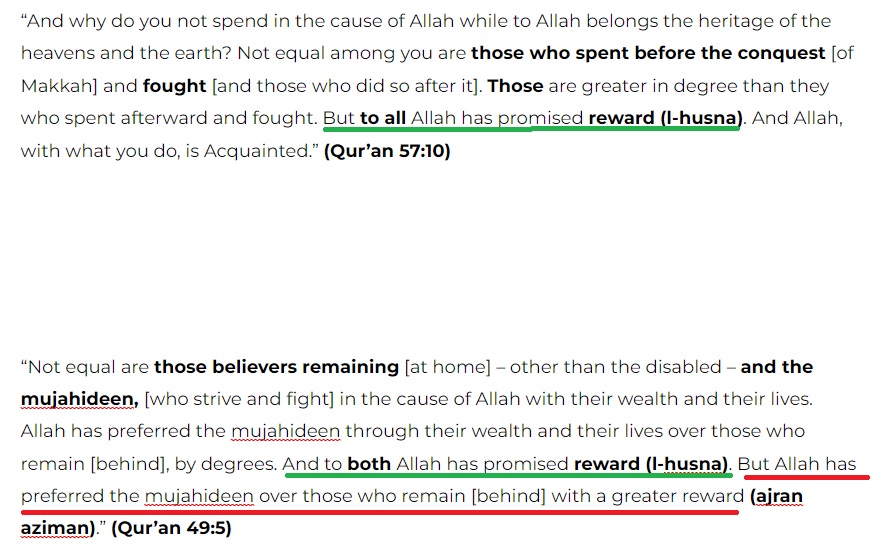
The statement: ”With a greater reward (ajran aziman)” cannot mean paradise/heaven.
First, because the Arabic text does not say so.
Second, because it would exclude from paradise those from the statement: “But to all Allah has promised reward (l-husna)” because the verse in 49:5 indicates that ajran aziman is distinct from l-husna.
The only way for Sunni scholars to solve this is for them to use strained interpretative devices to suggest that husna means heaven and ajran aziman means seeing Allah, or that husna means heaven and ajran aziman means greater heaven.
The Qur’an speaks in generality. It speaks in terms of generality. When it speaks of the companions as we see above, it speaks in terms of generality. Thus, Qur’an 57:10 and Qur’an 49:5 speak in generalities and do not explicitly mention paradise. Therefore, we should not read paradise into those general verses simply because we assume that the recipients as a whole were righteous or guaranteed paradise.
This is methodologically sound. A general promise of al-ḥusnā (the best reward) does not, by itself, constitute an explicit guarantee of paradise for every individual within the groups mentioned, especially when:
- The Qur’an itself affirms that hypocrites existed among the Muhājirūn and Anṣār (Qur’an 9:101).
- The Prophet (saw) explicitly stated that some of his companions would be barred from his Ḥawḍ (Bukhārī, 6582).
- Any creedal claim of universal salvation for all companions requires additional evidence beyond these two verses.
Contrast those verses above where no mention of paradise is in the Arabic text with a text that has explicit mention.
“And their Lord responded to them, “Never will I allow to be lost the work of [any] worker among you, whether male or female; you are of one another. So those who emigrated and were evicted from their homes and were harmed in My cause and fought and were killed – I will surely remove from them their misdeeds, and I will surely admit them to gardens (jannatin) beneath which rivers flow as reward from Allah , and Allah has with Him the best reward.” (Qur’an 3:195)
Notice how Allah (swt) describes those, their, them who receive the gardens(janna)? They are those whom: emigrated, were evicted, harmed, fought and were killed.
Qur’an 3:195 describes a specific group with specific qualities and promises them paradise. It does not say others are excluded, but it also does not authorize us to extend its promise beyond those qualities.
Allah does not cause the loss of anyone who does good.
So, certainly, if anyone does good, they will be rewarded with what is better. And whoever does evil will be rewarded for that. So, if this is the ruling for mankind in general, of course, the believers get reward for good, and it is no secret that in Islam some intentions are more noble than other intentions. Some actions are more meritorious than other actions.
Whoever comes with a good deed will be rewarded with what is better. And whoever comes with an evil deed, then the evildoers will only be rewarded for what they used to do.” (Qur’an 28:84)
“Be patient in hard times.(Oh Muhammed) Allah does not fail to repay those who do good.” (Qur’an 11:115)
Also, keep in mind, based upon the verses in the Qur’an, we know that people who die as a shaheed in the path of Allah (swt) will be in paradise. This is also our good opinion and outward perception. However, only Allah (swt) really knows what is in the heart of people.
“It has been narrated on the authority of Sulaiman b. Yasar who said:
People dispersed from around Abu Huraira, and Natil, who was from the Syrians. said to him: O Shaykh, relate (to us) a tradition you have heard from the Messenger of Allah (saw). He said: Yes. I heard the Messenger of Allah (saw) say: The first of men (whose case) will be decided on the Day of Judgment will be a man who died as a martyr. He shall be brought (before the Judgment Seat). Allah will make him recount His blessings (i. e. the blessings which He had bestowed upon him) and he will recount them (and admit having enjoyed them in his life). (Then) will Allah say: What did you do (to requite these blessings)? He will say: I fought for Thee until I died as a martyr. Allah will say: You have told a lie. You fought that you might be called a” brave warrior”. And you were called so. (Then) orders will be passed against him and he will be dragged with his face downward and cast into Hell.”
Source: (https://sunnah.com/muslim:1905a)
The principles of interpreting the Qur’an are twofold.
When one text is general and another is specific, the specific is regarded as stronger as evidence.
A clear text is preferable to an interpretation of the text.
An example:
Allah (swt) says in the Qur’an:
“In it are Signs Manifest; (for example), the Station of Ibrahim; whoever enters it attains security; Pilgrimage therefore it is a duty mankind (nas) owe to Allah,- those who are able to perform the journey; but if any deny faith, Allah stands not in need of any of His creatures.” (Qur’an 3:97)
Nass (people/mankind) includes children, women, slaves, the insane; all are included in the word nass (people). When it comes to hadith, some are lifted from the obligation. Children must not go on hajj alone. Women must not go unless they have the company of a mahrim. The mentally challenged are not obligated at all. All of those categories are not obligated unless certain conditions are met—even though they are all nass (people, mankind)
For example the companion/sabaha that Allah (swt) called a fasiq.
“O you who believe! If a Fasiq (liar- evil person) comes to you with any news, verify it, lest you should harm people in ignorance, and afterwards you become regretful for what you have done” (Qur’an 49:6)
“And as for those who are Fasiqun (disbelievers and disobedient to Allah), their abode will be the Fire, every time they wish to get away therefrom, they will be put back thereto, and it will be said to them: “Taste you the torment of the Fire which you used to deny.” (Qur’an 32:20)
I said to ‘Ammar: What is your opinion about that which you have done in case (of your siding with Hadrat ‘Ali)? Is it your personal opinion or something you got from Allah’s Messenger (saw)? ‘Ammar said: We have got nothing from Allah’s Messenger (saw) which people at large did not get, but Hudhaifa told me that Allah’s Apostle (saw) had especially told him amongst his Companion, that there would be twelve hypocrites out of whom eight would not get into Paradise, until a camel would be able to pass through the needle hole. The ulcer would be itself sufficient (to kill) eight. So far as four are concerned, I do not remember what Shu’ba said about them.”
Source: (https://sunnah.com/muslim:2779a)
Narrated Anas:
The Prophet (saw) said, “Some of my companions will come to me at my Lake Fount, and after I recognize them, they will then be taken away from me, whereupon I will say, ‘My companions!’ Then it will be said, ‘You do not know what they innovated (new things) in the religion after you.”
Source: (https://sunnah.com/bukhari:6582)
If Umar Ibn Al Khattab (ra) understood the verses of 57:10 and 49:5 in the way contemporary Sunni Muslims strenuously interpret them, then Umar(ra) would not go to Hudhayfah ibn Yaman (ra) and ask if he was a hypocrite.
Now someone will reply: “This is a sign of his sincerity.”
Yes, that is true, but it is a sign of nifaq to doubt a promise of Allah (swt)!
Rather, Umar Ibn Al Khattab (ra) did this because of both. He was not certain of his place in paradise, and he had sincerity and true fear of Allah (swt).
As the following verse reminds us:
“Did they feel secure against Allah’s planning? None would feel secure from Allah’s planning except the losers.” (Qur’an 7:99)
The next set of verses to look at:
“And the vanguard among (min’al) the emigrants and the helpers, and those who followed them in goodness, Allah is well pleased with them and they are well pleased with Him, and He has prepared for them gardens beneath which rivers flow, to abide in them forever; that is the mighty achievement.” And among (min’al) those around you of the Bedouins are hypocrites, and also from the people of Madinah. They have become accustomed to hypocrisy. You do not know them, We know them. We will punish them twice, once in this world; then they will be returned to a great punishment.” (Qur’an 9:100-101)
So when we look at this verse in Arabic and in context we realize a few important points.
This verse starts off with words of praise and reward for the vanguard among the emigrants and the helpers, as well as anyone ‘those‘ who followed them in goodness. They are the subject of Allah’s grace and promise.
So, the first part of the verse is not all the companions who immigrated to Madinah. However, the following verse also makes the first verse clear. ‘And among the Bedouins and people of Madinah.’
So is the second verse saying that all the Bedouins are hypocrites?
Is the second verse saying that all the people of Madinah are hypocrites?
So, when we consider that the Bedouins are people who could have migrated with the Blessed Messenger (saw), they could be among the Muhajirun.
When we consider that the Ansar are from Madinah, they could be from among those in Madinah. However, even after these clear points are presented, there are additional points of consideration.
“And those who came after them say: “Our Lord! Forgive us, and our brethren who came before us into the Faith, and leave not, in our hearts, rancour (or sense of injury) against those who have believed. Our Lord! You are indeed Full of Kindness, Most Merciful.” (Qur’an 59:10)
This very beautiful revelation was revealed as a reminder to the people of Madinah who were receiving the immigrants, the people who were coming from Mecca to join them. Notice the verse does not say, “all those who came before us”. Rather, the verse says, ‘those who have believed.’.
Now, even though this verse was in the context of the Ansar receiving the Mujahirin, we should see no reason why not to apply this verse today for us as Muslims.
We should certainly harbor no ill will from those who came before us who were believers. No one needs to insert words into the text that is not there. There is no problem with praying, “leave not in our hearts rancour against those who believed”, because Allah (swt) knows those who believed and those who did not.
This is an issue of creed (aqidah) for Sunni Muslims, but it is not for our school, Ahl al-Haqq wa-l istiqama
The Sunni Muslims state in Al-Aqidah al-Tahawiyyah.
This is the Sunni statement of creed in regards to the companions.
We respond to this with the angels du’a in the Qur’an:
“Those (angels) who bear the Throne and those around it glorify the praises of their Lord, and believe in Him, and ask forgiveness for those who believe (saying): ‘Our Lord! You comprehend all things in mercy and knowledge, so forgive those who repent and follow Your Way, and save them from the torment of the blazing Fire! Our Lord! And make them enter the Paradise which you have promised them, and to the righteous among their fathers, their wives, and their offspring! Verily, You are the All-Mighty, the All-Wise. And save them from the sins, and whomsoever You save from the sins that Day, him verily, You have taken into mercy.” And that is the supreme success.’” (Qur’an 40: 7-9)
The beauty of this du’a is that it says: ‘for those who believe’ and ‘those who repent and follow Your Way’.
Thus, if Abu Bakr, Umar, Uthman, Ali, Muaviya, Yazid or anyone else are those people, then the du’a lands on them. And if Abu Bakr, Umar, Uthman, Ali, Muaviya, Yazid or anyone else are not them, then the du’a misses them.
The point being that is the purview of Allah (swt).
May Allah Guide the Ummah.
May Allah Forgive the Ummah.


 Prima Quran