
“Those who humble (khāshi‘ūn)themselves in prayer.” (Qur’an 23:2)
﷽
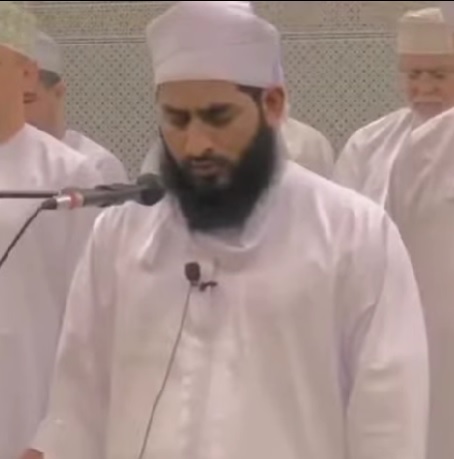
The Ibadis do not raise their hands at all during the prayers.
We do not raise our hands at the opening takbir, nor before or after ruku, nor after tashahud, nor before or after sujud nor after the end of the prayer.
The issue of raising the hand (raf’ al-yadayn) in the prayer is one in which there has been debate and discussion among the different schools of jurisprudence in Islam.
It has two aspects.
The initial Takbirat Al-lhram’ (the act that consecrates or initiates the actual prayer).
The second would be raising hands during various aspects of the prayer.
There are 8 schools of jurisprudence on this matter.
- Ibadis
- Zaydis
- Imami Jafar
- Imami Ismaili
- Hanafi
- Shafi’i
- Hanbali
- Maliki
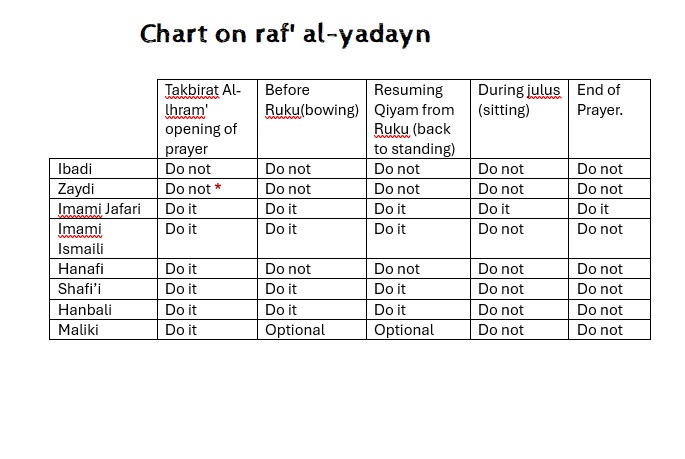
* Among the Zaydis there are two positions on this matter:
1.That the hands are raised only at the beginning of the prayer. This is similar to the Hanafis.
- That the hands are not raised at the beginning of the prayer. This is similar to the Ibadis.
The following Zaydi Imams are said to hold to the first view: Yahya b. Hamza, Zayd b Ali, al-Qasim b. Ibrahim & Al-Mu’ayyad Billah.
The following Zaydi Imams are said to hold the second view: Mahdi Ahmed, al-Qasim b. Muhammed, al-Qasim b. Ibrahim & al-Hadi ila al-Haqq.
This view is ascribed to the hadawi branch or the dominant branch of the Zaydi school.
What is quite interesting when looking at the chart above is that it runs the gamut in terms of scope. You have Ibadis and Zaydis doing no raf’ al-yadayn (or raising of hands) throughout the prayer at all. Then you have the 12er Imami Jafari school having raf’ al-yadayn (raising of hands) being a very prominent feature of their prayers.
For the Malikis, both in the Al-Muqaddimah Al-Izziyah & Matn al-‘Ashmawiyyah, both by Egyptian Maliki scholars, mention the “permissibility” of raising the hands in the prayer. However, the obligation is only for the Takbirat Al-lhram’.
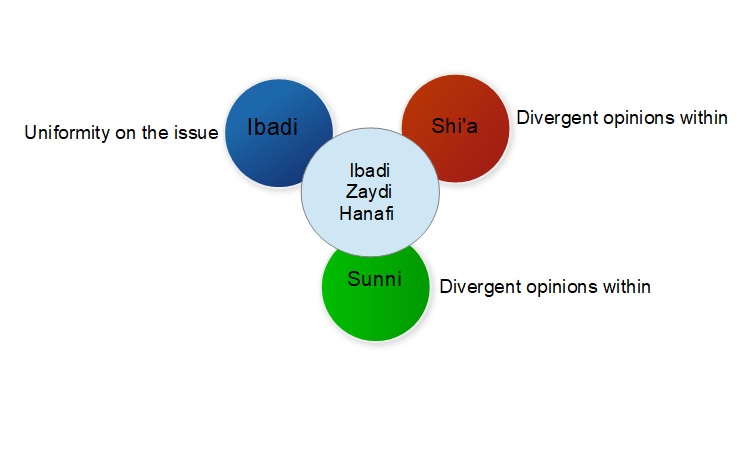
Another interesting aspect is that in the Sunni and Shi’a branches of Islam there are quite a number of divergent opinions on the matter of (raf’ al-yadayn). Whereas in the Ibadi school, there is uniformity on the matter.
There is an intersection on the issue between the Ibadi, Zaydi and Hanafi schools. With the Zaydi and Hanafi being closer (as there is an opinion in the Zaydi school of an initial raising of hands at Takbirat Al-lhram’. You could technically put the Maliki school here as well if we are to take what is said to be the favoured position of Imam Malik.
Another interesting aspect is that the Ibadi school, and the dominant position of the Zaydis of not raising hands during the Takbirat Al-Ihram’ goes against the position of all the other schools of Islam, including the Hanafi and Maliki (on this point).
The issue of raising the hands in prayer is one on which there has been much discussion and debate. It may surprise those who have been in the habit of practicing (raf’ al-yadayn) that, rather than being something firmly established by the Blessed Prophet, (saw) has been subject to criticism from the most erudite and learned scholars.
The purpose of this article is to make the reader aware of some of the discussions and contention surrounding this particular issue of jurisprudence.
This article will be divided into two parts.
- We look at the evidence for those who support raising the hands (raf’ al-yadayn) at various intervals of the prayer. *
- We will look at the evidence of those who do not support raising the hands (raf’ al-yadayn) at any intervals during the prayer. *
* kindly note that the hyper focus will be on (raf’ al-yadayn) during Takbirat Al-Ihram’ and before and after the ruku (bowing)
Only a cursory glance will be given to the Imami schools on this matter. That is because, ultimately, for them, authority is derived from Imams that are descendants of the Blessed Prophet (saw) and this would entail an entirely different approach and line of discussion..
When it comes to the Shia sects, they are divided into Imamis and the Zaydis. The Imamis consist of both the Twelver Shia and the Isma’ilis. The Imamis narrate various views from their imams. For example, they narrate in their collections the following:
This report appears in Usul al-Kafi’ of the Twelvers.
It is a narration from him (narrator of previous Hadith) by his father from Hammad from Hariz from Zurarah who has said the following: “Abu Ja’far , has said, ‘When you stand up for Salah (prayer) say Takbir (Allah is great beyond description) and raise your hands. Do not allow your palms (hands) to rise higher than your ears. Keep them on the sides of your face.’”
Source: (https://thaqalayn.net/chapter/3/4/20)
Note: We did reach out to two Ismaili, Nizari and Musta’li, for a reference from Da`im al-Islam, but unfortunately, neither got back to us.
Thus, for the most part, this article will focus on the four surviving Sunni schools of jurisprudence. The hadawi branch of the Zaydi school, as well as the Ibadi school share the same view on the matter.
An examination of the proofs of those who advocate for raising the hands in the various aspects of the prayer.
In the following section we will look at the references of those reports that are deemed to be the strongest evidence for the practice of ((raf’ al-yadayn) raising the hands in prayer.
Are these narrations free from defects? Are they wholly reliable and sufficient for proof ?
1st evidence advanced.
“Narrated Nafi`:
Whenever Ibn `Umar started the prayer with Takbir, he used to raise his hands: whenever he bowed, he used to raise his hands (before bowing) and also used to raise his hands on saying, “Sami`a l-lahu liman hamidah”, and he used to do the same on rising from the second rak`a (for the 3rd rak`a). Ibn `Umar said: “The Prophet (saw) used to do the same.”
Source: (https://sunnah.com/bukhari:739)
Narrated `Abdullah bin `Umar:
I saw that whenever Allah’s Messenger (saw) stood for the prayer, he used to raise both his hands up to the shoulders, and used to do the same on saying the Takbir for bowing and on raising his head from it and used to say, “Sami`a l-lahu liman hamidah”. But he did not do that (i.e. raising his hands) in prostrations.
Source: (https://sunnah.com/bukhari:736)
The above hadith is said to be the strongest proof for the practice of raising the hands in prayer. One of the principles of hadith sciences is that a hadith can be relied upon as a proof when the ‘matn’ or text is free of conflicting details with narrations of equal strength.
Without examining the chain of narrators (the sanad) of the above hadith, we can see that it has reached us through various chains where in the ‘matn’ or text contains conflict with other narrations of equal strength.
For example: In the Muwatta of Imam Malik, a report narrated by the same companion, only two raisings of hands are mentioned; whereas Bukhari has mention of three hand raisings! All the while being narrated by the same companion!
Yahya related to me from Malik from Ibn Shihab from Salim ibn Abdullah from Abdullah ibn Umar that the Messenger of Allah, (saw) used to raise his hands to the level of his shoulders when he began the prayer and when he raised his head from the ruku he raised them in the same way, saying, “Allah hears whoever praises him, our Lord and praise belongs to You.” He did not raise them in the sujud.
Source: (https://sunnah.com/malik/3/17)
The following hadith indicates this is an action of Ibn Umar and not of the Blessed Prophet (saw)
Yahya related to me from Malik from Ibn Shihab from Salim ibn Abdullah that Abdullah ibn Umar used to say “Allah is greater” in the prayer whenever he lowered himself and raised himself. Yahya related to me from Malik from Nafi that Abdullah ibn Umar used to raise his hands to the level of his shoulders when he began the prayer and when he raised his head from the ruku he would raise them less than that.
Source: (https://sunnah.com/malik/3/21)
This is what led one of the Hanafi scholars, Shaykh Yusuf Banuri, to mention in his book Al-Ma’arif as-Sunan, that the weakness of this report is based on the fact that six different variations of Ibn ‘Umar’s report exist with variant details that conflict with one another!
I have highlighted Ibn Shihab Az-Zuhri because he was notorious for Tadlees.
Tadlees is when a narrator aims to conceal defects in the information they transmit. It is seen as a form of blatant dishonesty. As for the chain of transmission, there is a long discussion, such as the deception of Al-Zuhri.
The absence of mentioning of raising the hands three times in Al-Muwatta as an attribute of the Blessed Prophet (saw) is rather revealing.
It is the earliest of the hadith books for Sunni Muslims. It has a chain of transmitters much shorter than the later texts.
This raises the question: Where did the additional raising of the hands before the bowing come from?
There is no mention of Ibn ‘Umar raising his hands three times in the report by Imam Malik. It is also telling that despite the existence of these two reports in Al-Muwatta, the author, Imam Malik, did not act upon this narration of Ibn ‘Umar, even though he reported it from him.
This would mean that although Imam Malik’s report on the authority of Ibn ‘Umar is older and foundational and its chain is shorter than that of the texts that came after it, the author still saw the practice as weak. This would raise doubt and uncertainty regarding the narration’s authenticity.
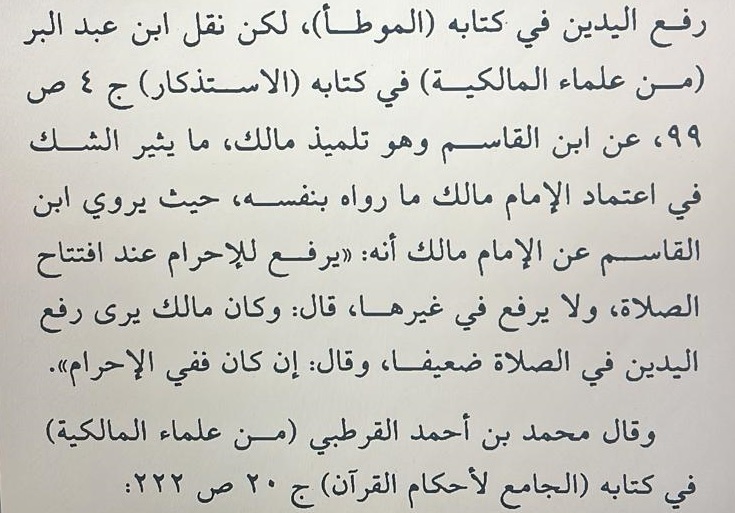
Ibn Abdul Barr (a Maliki scholar) mentions in his book Al-Istidhkar, vol. 4, page 99, from Ibn al-Qasim, who was a student of Malik, that what raises doubt is Imam Malik’s reliance on what he personally narrated. Ibn al-Qasim narrates from Imam Malik that he said: ‘Raising the hands is done at the opening Takbir and not at other times.’ Malik saw raising the hands in prayer as weak and said, ‘If it is in the opening Takbir, then it is permissible.’
The hadith from Ibn Umar about the Blessed Prophet (saw) raising his hands to his shoulders conflicts with reports stating that the Blessed prophet (saw) raised his hands in front of his ears.
Narrated Wa’il ibn Hujr:
I witnessed the Prophet (saw) raise his hands in front of his ears when he began to pray. I then came back and saw them (the people) raising their hands up to their chest when they began to pray. They wore long caps and blankets.
Source: (https://sunnah.com/abudawud:728)
So this has led the proponents of (raf’ al-yadayn) to claim that the Blessed Prophet (saw) did both.
2nd evidence advanced.
The second report cited as proof for the raising of the hands is related by Muslim, Abu Dawud, an-Nisa’i, as well as others on the authority of Wa’il b. Hujr.
Wa’il b. Hujr reported:
He saw the Messenger of Allah (saw) raising his hands at the time of beginning the prayer and reciting takbir, and according to Hammam (the narrator), the hands were lifted opposite to ears. He (the Holy Prophet) then wrapped his hands in his cloth and placed his right hand over his left hand. And when he was about to bow down, he brought out his hands from the cloth, and then lifted them, and then recited takbir and bowed down, and when (he came back to the erect position) he recited:” Allah listened to him who praised Him.” And when he prostrated, he prostrated between his two palms.
Source: (https://sunnah.com/muslim:401)
As one can see, this hadith is found in the collection of Muslim and has the grade of ‘sahih’ or sound. Let us examine the issues concerning this hadith:
- The narration of Waʾil ibn Hajar regarding raising the hands in prayer is weak because it was transmitted through Alqamah ibn Waʾil. Scholars have differed on whether he heard it from his father or not.
- It was also narrated by Abd al-Jabbar ibn Waʾil by his family members about his father, but his family members are unknown, and the narration is weak.
- It was further narrated by ʿAsim ibn Kulayb from his grandfather about Waʾil ibn Hajar, which is another weak chain of transmission. There are other weak chains as well.
3rd evidence advanced.
The third proof brought forward is the report of Abu Humayd as-Sā’idi in which he said in the presence of ten companions:
Muhammed bin Amr bin Ata‘ narrated from Abu Humaid As-Saidi, :
He (Muhammed) said: “I heard him saying – while he was among ten of the Companions of the Prophet, one of whom was Abu Qatadah bin Ribi – ‘I am the most knowledgeable among you of the Salat of the Allah’s Messenger.’ They said: ‘You did not precede us in his companionship, nor were you in his company more than us.’ He said: ‘Even still.” They said: ‘Go ahead.’ So he said: ‘When Allah’s Messenger stood for Salat he would stand with his back straight and raise his hands until they were at the level of his shoulder. Then he would say: (Allahu Akbar) “Allah is Most Great” and bow. Then he would straighten (his back) so that he would not lower his head, nor raise it, and he placed his hands on his knees. Then he said: (Sami Allahu liman hamidah) “Allah listens to those who praise Him.” And he raised his hands and stood up straight until all of his bones completely returned to their places. Then he went down to the ground prostrating, then he said: (Allahu Akbar) “Allah is Most Great.” Then he held his upper arms away from his midsection, and opened his toes on his feet (facing the Qiblah), then he bend his left foot and sat on it then straightened up until all of his bones completely returned to their placed, then he went down to prostrate. Then he said: (Allahu Akbar) …….
Source: (https://sunnah.com/tirmidhi:304)
Reasons why a cursory look at this hadith looks impenetrable from several vantage points. Among them are:
- It appears in quite a number of hadith canons.
- It was reported by a companion in the presence of at least ten companions.
- The companions seemingly affirm that what was described was correct. Why would they collectively agree upon an error?
1st point. Who would know the prayer of the Blessed Prophet (saw) better than a companion? The Blessed Prophet (saw) himself would know better, of course!
Abu Huraira reported:
The Messenger of Allah (saw) entered the mosque and a person also entered therein and offered prayer, and then came and paid salutation to the Messenger of Allah (saw). The Mes- senger of Allah (saw returned his salutation and said: Go back and pray, for you have not offered the prayer. He again prayed as he had prayed before, and came to the Messenger of Allah (may peace be upon. him) and saluted him. The Messenger of Allah (saw) returned the salutation and said: Go back and say prayer, for you have not offered the prayer. This (act of repeating the prayer) was done three times. Upon this the person said: By Him Who hast sent you with Truth, whatever better I can do than this, please teach me. He (the Holy Prophet) said: When you get up to pray, recite takbir, and then recite whatever you conveniently can from the Qur’an, then bow down and remain quietly in that position, then raise your- self and stand erect; then prostrate yourself and remain quietly in that attitude; then raise yourself and sit quietly; and do that throughout all your prayers.
Source: (https://sunnah.com/muslim:397a)
2nd point. It was transmitted by Muhammed ibn ʿAmr ibn Ata’ from Abu Humaid As-Sa’idi, but Muhammed Bin Amr never heard from Abu Humaid.
The report is narrated by the authority of Muhammed b. ‘Amr b. ‘Ata, about whom the scholars of Hadith differ over whether he even met Abu Humaid or Abu Qatada, another companion who was said to have been present at the aforementioned gathering. The reason that they disagree is that there is a difference of opinion as to the year that Muhammed b. ‘Amr b. ‘Ata was reported to have died as well as his age at the time of death. Some of the dates of his purported death and age create discrepancies that make it unlikely that he even came into contact with the aforementioned companions.
3rd point. Some of the chains of this report contain a sub-narrator known as Abdul-Hamid b. Ja’far whom some scholars of hadith have weakened. Adh-Dhahabi has said in his Al-Mizan:
“Abu Hatim said that he cannot be used as a proof…and although he is reliable according to us, Sufyan [ath-Thawri] weakened him.”
The fourth evidenced advanced.
Hadith of Malik bin Al-Huwayrith regarding raising the hands in prayer.
It was narrated that Malik bin Huwairith said that when the Messenger of Allah (saw) said Allahu Akbar, he would raise his hands until they were close to his ears; when he bowed in Ruku’ he did likewise, and when he raised his head from Ruku’ he did likewise.
Source: (https://sunnah.com/ibnmajah:859)
Narrated Abu Qilaba:
I saw Malik bin Huwairith saying Takbir and raising both his hands (on starting the prayers and raising his hands on bowing and also on raising his head after bowing. Malik bin Huwairith said, “Allah’s Messenger (saw) did the same.”
Source: (https://sunnah.com/bukhari:737)
The first problem with this hadith comes from Abu Qulabah al-Mudalis himself!
Ibn Hajar said in his At-Tahdhib that Ibn at-Tīn, who authored a commentary on Sahih al-Bukhari, weakened Abu Qulabah
Adh-Dhahabi declared him to be reliable in his Al-Mizan, but he nonetheless admitted that Abu Qulabah narrated deceptive traditions (tadlis).
The second problem is that the sub-narrator is Khalid Al-Hatha’ , about whom Abu Hatim said that he cannot be used as a proof. Although other traditionalists declare him reliable, there is some criticism of his narrations. Such that his memory was unreliable towards the later years of his life.
The third problem is the above Hadith states: “he would raise his hands until they were close to his ears.” which goes against: “and raise his hands until they were at the level of his shoulder. Then he would say: (Allahu Akbar)“
This has led to the advocates of raf’ al yadayn to say that the blessed Prophet (saw) did both!
The justification of the Ibadi school for not implementing the practice raf’ al yadayn (raising the hands) at any juncture during the prayer.
It can be said after study, observation and participation that the Ibadi prayer is the only prayer that is unanimously agreed upon by all sects and madhabs, making it the most authentic and safest prayer. There is no fear of an increase or decrease of the Sunnah. Al hamdulillah!
The evidence and proof text advanced will mostly be taken from:
عشرة أسباب تمنع من رفع اليدين وضمها في الصلاة
10 reasons why one should not lift or squeeze the hands in prayer.
للشيخ ناصر بن سليمان السابعي
Shaykh Naser Bin Sulaiman As-Sabe’i (May Allah preserve him and continue to benefit the ummah by means of him).
We are thankful to Allah (swt) that an English translation of the above is available for the English audience.
Before we start, it is perhaps important to understand that many Muslims who practice raf’ al yadayn at any interval of prayer do so thinking that it is a sunnah of the Blessed Prophet (saw).
However, this is not correct. What we will see is that this was the action of some of the companions. Because there was seemingly no objection to it, others would imitate them and would transmit it. This became conflated as something the Blessed Prophet (saw) did. However, whenever the Blessed Prophet (saw) saw people doing raf’ al yadayn, he stopped them.
Some depend upon narrations that are attributed to the Blessed Prophet (saw) which, as shown, have weaknesses. If there are hadiths that are sound (sahih), they would conflict with those narrations that are even stronger and that contain no irregularities or contradictions in the text.
Lastly, it is important to know that our school does not censure nor abuse the Muslims who practice raf’ al yadayn in any part of their prayers. We are not against them. However, because they are our brothers we are giving the evidence of the Blessed Prophet (saw).
Proofs advanced by those in the Ibadi school who do not practice raf’ al yadayn (raising of hands) in any part of their prayers.
1st evidence or proof.
Jabir b. Samura reported:
The Messenger of Allah (saw) came to us and said: “How is it that I see you lifting your hands like the tails of headstrong horses? Be calm in prayer.” He (the narrator) said: He then again came to us and saw us (sitting) in circles. He said: “How is it that I see you in separate groups?” He (the narrator) said: He again came to us and said: “Why don’t you draw yourselves up in rows as angels do in the presence of their Lord?” We said: Messenger of Allah, how do the angels draw themselves up in rows in the presence of their Lord? He (the Holy Prophet) said: “They make the first rows complete and keep close together in the row.”
Source: (https://sunnah.com/muslim:430a)
When we look at this hadith we will see that the Blessed Prophet (saw) asked them not a question out of curiosity but rather a rhetorical question of criticism.
The question shows that the Blessed Prophet (saw) himself was unaware of such actions. This in and of itself calls into question all those narrations in which it is said that he raised his hands in prayer.
So the people who rejected raising the hands at any juncture during the prayer held onto the agreed-upon clear prohibition among all the Ummah from the Blessed Prophet (saw) against raising the hand in the prayer. They are closer to the Sunnah of the Blessed Prophet (saw), avoiding his prohibitions, working with the agreed-upon views and dropping those in which there is vast difference in opinion.
The Ahl Sunnah say the hadith is correct (about the lifting of the hands like horse tails). However, they are making tawil or an interpretation of this hadith. They say this is not a reference to lifting the hands when standing, but rather lifting hands when sitting.
(Ironically, some Sunnis actually continue this supposed practice.) As you see, the Jafari Shi’a do this throughout their prayer.
*Note: An example of this is in the video of Shaykh Dr. Aziz bin Farhan Al Anzi, PhD in Islamic Jurisprudence from King Saud University. You will come across this shortly.
If the hadith was talking about tashahud or julus (sitting), the Blessed Prophet (saw) would specifically state it. However, in this Hadith he does not specifically state this.
The hadith we rely upon no one has said it did not come from the Prophet (saw). It is a correct hadith, no one said it was incorrect. Who attacked it? So our evidence is stable.
That which has agreement we are upon; and what has suspicion and doubt we have left.
There is another hadith from Jabir b. Samura.
Jabir b. Samura reported:
We said our prayer with the Messenger of Allah (saw) and, while pronouncing salutations, we made gestures with our hands (indicating)” Peace be upon you, peace be upon you.” The Messenger of Allah (saw) looked towards us and said: “Why is it that you make gestures with your hands like the tails of headstrong horses? When any one of you pronounces salutation (in prayer) he should only turn his face towards his companion and should not make a gesture with his hand.”
Source: (https://sunnah.com/muslim:431b)
Now those who are advocates of raf’ al yadayn in other than the Takbirat Al-lhram’ will claim that the above hadith relate to the same occasion. Thus, they both relate to raising the hands in the sitting position.
We disagree:
Point 1.
The first incident does not indicate that the Blessed Prophet (saw) was initially with them:
“The Messenger of Allah (saw) came to us.”
The second incident indicates that the Blessed Prophet (saw) was with them:
“We said our prayer with the Messenger of Allah.”
Point 2.
The first report clearly says that the companions were raising their hands in the prayer, but the second report says that they were gesturing with their hands at the final salutations, which indicates the completion of the prayer.
Point 3.
Next, this whole incident also proves that there were indeed those who did actions in the prayer that the Blessed Prophet (saw) did not approve of. Note he did not say that what they were doing was something once approved and now it is not.
Point 4.
Even if they wanted to argue that the two narrations refer to the same occasion, the statement: “Be settled in your prayer.” is general and not restricted to the final salutations because the Blessed Prophet (saw) said: “in your prayer” and not “…in your sitting.”
Point 5.
Next: Notice the ire of the Blessed Prophet (saw). He gave reason as to why he did not like the acts that they were doing. In both Hadith, the Blessed Prophet (saw) states:
“How is it that I see you lifting your hands like the tails of headstrong horses?“
&
“you make gestures with your hands like the tails of headstrong horses?“
Now our interlocutors have already admitted that the prohibited action is a reference to raf’ al yadayn (raising hands in the prayer) but they state it was in the sitting position and not while in the standing position.
The Hanafi will not use the following argument because they will be called out for consistency’s sake.
The point of consistency in which the Ahnaf/Hanafi may be called into question is: Why do the Hanafi say this applies to raising the hands before and after the ruku but not to the Takbirat Al-lhram‘?
Both the Hanafi and Ismaili Sh’ia keep the initial takbira and both schools refrain from raf’ al yadain (raising the hands) for the duration of the prayer after. We can say the same of the Malikis if we are to take a particular view ascribed to Imam Malik. Both the (Hanafi/Ismaili Shi’ia) schools have ladies practice qabd (folding of hands) on the chest during prayer, while the men fold hands below the navel (Hanafi) or drape arms to the side (Ismaili). Whereas the Maliki school has both men and women draping the arms to the side..
Tails of headstrong horses: to be or not to be consistent, that is the question.
Before we proceed, we want the followers of these particular schools to know this is not done with the intention of mocking or ridicule. This is a point of difference in jurisprudence in trying to understand on what consistent basis some schools form their views.
Actual horse tails in action.
(raf’ al-yadayn) raising the hands after the Tashahud by Shaykh Dr. Aziz bin Farhan Al Anzi, PhD in Islamic Jurisprudence from King Saud University.
@0:08 he raised his hands after the Tashahud.
(raf’ al-yadayn) raising the hands before and after Ruku in the Shafi’i school.
@0:51 he raised his hands before the ruku.
(raf’ al-yadayn) raising the hands before after sujud (prostration) in the Imami Jafari Shi’a School.
@1:48 he raised his hands twice after the sujud and after the sujud before resuming qiyam (standing).
So we do not know about you, dear reader, but all of those actions of raising the hands (raf’ al-yadayn) at different places in the prayer look exactly the same. The only difference is when they are done, at what intervals or places in the prayer.
So, seeing that these are the exact same actions and seeing that the Blessed Prophet (saw) specifically said that such actions resemble the tails of headstrong horses on what consistent basis is the action condemned for the sitting position and not the standing position?
On what consistent basis is the action condemned before and after ruku and not at the Takbirat Al-lhram’ ?!
It certainly is food for thought for the thoughtful.
So, in summary, in regard to the two hadith of Jabir b. Samura one is different from the other. They affirm what came in it, the prohibition of absolutely any movement of the hand by either raising them, pointing with them or moving them left and right, through the rule by the scholars of Usul; if a text came with a specific reason, then the moral is in the broadness of the wording, not the specificity of the reason.
2nd evidence or proof.
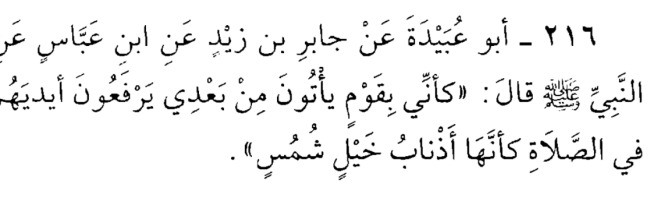
Imam ar Rabi’i narrated from Abu ‘Ubayda Muslim Bin Abi Karima at Tamimi who narrates from Jabir ‘Ibn Zayd Al Azdi from ‘Ibn ‘Abbas (ra) that the Prophet, (saw), said: “I have the impression of seeing people who will come after me, and who will raise their hands in prayer like the tails of wayward horses”.
Source: (Al-Jami’ As-Sahih, chapter 36, Hadith 213,216)
This hadith is only found with us, the Ibadi school. All the men that transmit are trustworthy, truthful. This is proof for us against the raising of the hands (raf’ al-yadayn) in total at any juncture during the prayer.
What makes this hadith absolutely crushing for our opponents is that the Blessed Prophet (saw) was not present as in the other two hadith of Jabir b. Samura witnesses something.
This was a revelation given to him about all future acts of (raf’ al-yadayn)!!
Seeing the Ummah continue this wayward practice is also proof of the credibility and truthfulness of the Blessed Prophet (saw).
So we not only have hadith where the Blessed Prophet (saw) saw people do activities in front of his eyes and he stopped them, but those who come after will continue this practice.
Many reasons why this is:
Maybe this information did not reach them. Maybe they heard this and did not understand it. Or perhaps, as we see, people will follow their own schools and scholars on the matter.
3rd evidence or proof.
(raf’ al-yadayn) raising the hands in prayer contradicts Kushu’ (humility)
Do I recall in the first evidence or proof that the Blessed Prophet (saw) said:
“How is it that I see you lifting your hands like the tails of headstrong horses? Be calm in prayer.”
Khushu’ in prayer is an obligation, which is a way to achieve success, as Allah (swt) says:
“Successful indeed are the believers. Those who humble (khashi’una) themselves in prayer.” (Qur’an 23:1-2)
The point is that though the description of this verse is a reference to the humility of the internal, it doesn’t preclude the humility of the external.
“And [all] voices will be humbled (khasha’at) before the Most Merciful.” (Qur’an 20:108)
Qur’anic exegetes point out that this lowliness mentioned in the verse can be a reference to both outward and inward states.
Through Jabir ‘Ibn Zayd Al Azdi , the mother of believers Aisha (ra) said: the Blessed Prophet (saw) said: “Everything has a core, and the core of prayer is humility.”
Source: (Al-Jami’ As-Sahih, chapter 47, Hadith 285)
Falsely attributed to the Blessed Prophet (saw) but accurately attributed to the tabi’i, Sa’id ibn Al Musayyab, who saw a man playing with his beard in prayer and remarked:, ‘If his heart was devoted, his limbs would also have been devoted?’
(raf’ al-yadayn) falls under the category of ‘amal kathir (excessive movement), similar to waving at a friend, talking or eating, all of which would nullify the prayer.
Many scholars have defined Tuma’neenah as praying while a person’s limbs remain motionless between the movements or positions of the prayer.
Narrated `Aisha (ra):
I asked Allah’s Messenger (saw) about looking hither and thither in prayer. He replied, “It is a way of stealing by which Satan takes away (a portion) from the prayer of a person.”
Source: (https://sunnah.com/bukhari:751)
4th evidence or proof.
A reason that prevents raising the hand in prayer is the clear prohibition by the Blessed Prophet (saw), for the Muslim to do things that resemble animal forms or actions during prayer. It was not uncommon for the Blessed Prophet (saw) to prohibit or discourage the actions of the companions in the prayer by comparing them to the actions of animals.
The guidance of the person praying is different from the guidance of animals.
“It was narrated that ‘Abdur-Rahman bin Shibl said:
“The Messenger of Allah (saw) forbade three things: Pecking like a crow, spreading (the forearms) like a beast of prey, and a man having a place in the masjid in which he usually offers the prayer, like a camel has a place to which it usually goes.”
Source: (https://sunnah.com/ibnmajah:1429)
So among the animals the Blessed Prophet (saw) is said to have mentioned that people imitate during the prayer, are the crow, the dog, the fox, the black crow, the rooster, the monkey, the camel and the horses. All of these comparisons to the actions of animals show a form of extremely strong censure.
5th evidence or proof.
A reason that prevents raising the hands in the prayer is the weakness of all the Hadiths and narrations on this topic.
Those who advocate for raising the hands, are not unanimous on the authenticity of the narrations regarding it. They differ greatly on this matter, and there is not a single narration about raising the hands, except that it contains disputation, criticism, and rejection.
The Hanafis weaken all the narrations that mention raising the hands after the opening Takbir, whereas on the other hand, the Hadith scholars and Shafi’is, and others like them, weaken the narrations used by the Hanafis, which limit the raising of the hands to the opening Takbir only.”
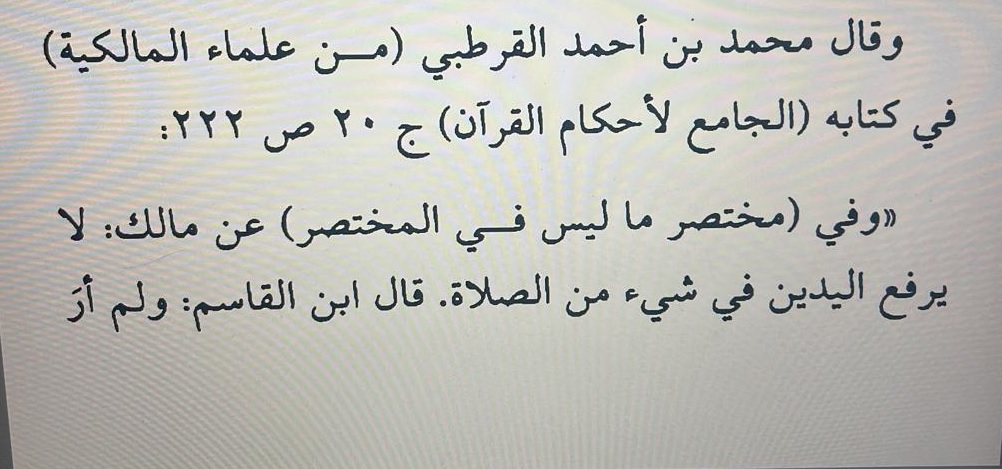
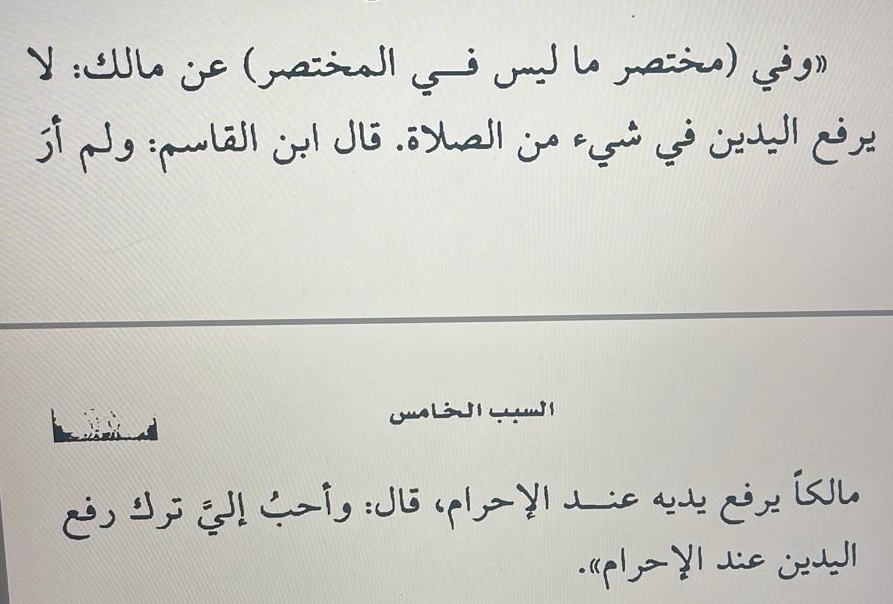
Muhammed ibn Ahmad al-Qurtubi (a Maliki scholar) stated in his book Al-Jamiʿ li-Ahkam al-Qurʾan, vol. 20, page 222: ‘What is not summarized in the (Mukhtasar ma laisa fi Al-
Mukhtasar) from Malik is that he does not raise his hands in any part of the prayer.’ Ibn al-Qasim said: “I never saw Malik raising his hand in Ihram”, and said: “I prefer not raising my hands in Ihram.”
The scholar Al-Awtabi narrated in his book Al-Dhiyaʾ, vol. 5, page 153, that Imam Malik retracted the opinion about raising the hands in prayer altogether.
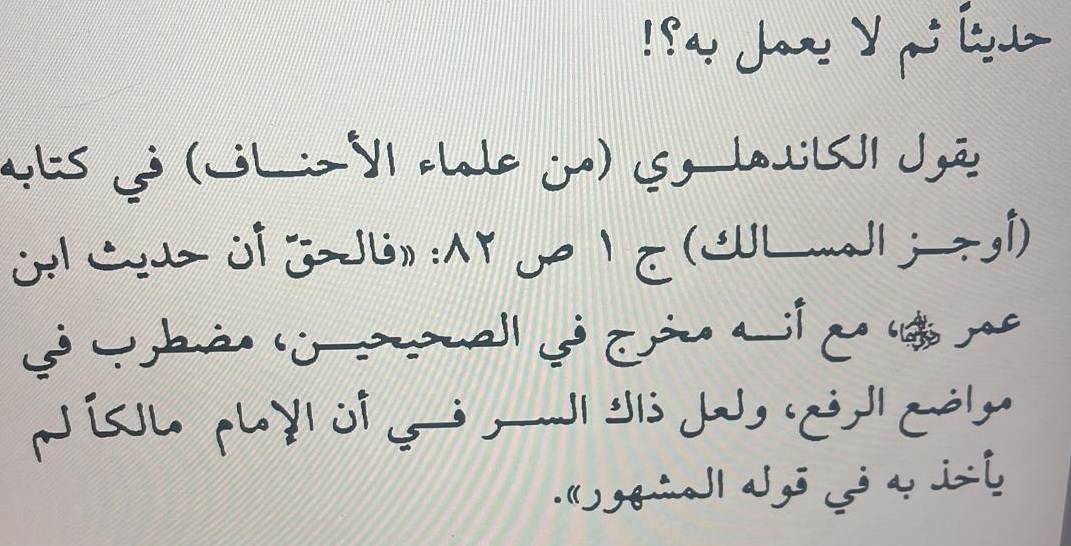
Shaykh Zakariyya Kandhlawi, a hadith master of the Hanafi school commented:
Al-Kandahlawi (one of the Hanafi scholars) stated:
“The truth is that the narration of Ibn Umar, even though it is found in the two Sahihs, is confused regarding the instances of raising the hands. The reason for this confusion may lie in the fact that Imam Malik did not adopt it in his well-known opinion.”
Source: (Al-Kandahlawi, Awjaz al-Masalik, v.1, p.82)
Even those who hold to the hadith of raising their hands are not in agreement. They are in disarray on the matter. They have disagreements among them. The Hanafi say that all the hadith on raising the hands after takbirat ihram are daif (weak).
Shafi’i scholars say all the hadith that the Hanafi rely upon that one raises the hands only at the opening of the prayer, they are daif (weak).
6th evidence or proof.
Hadith transmissions in which the prayer of the Blessed Prophet (saw) is described without mentioning raising the hands (raf’ al-yadayn) as well as those narrated traditions in which the Blessed Prophet, (saw), verbally described the prayer but mentioning nothing about (raf’ al-yadayn) raising of the hands.
The first type of report: Report about the Prayer of the Blessed Prophet (saw) being described without mention of (raf’ al-yadayn)
Abu Huraira reported:
When the Messenger of Allah (saw) got up for prayer, he would say the takbir (Allah-o-Akbar) when standing, then say the takbir when bowing. then say:” Allah listened to him who praised him,” when coming to the erect position after bowing, then say while standing:” To Thee, our Lord, be the praise”, then recite the takbir when getting down for prostration, then say the takbir on raising his head, then say the takbir on prostrating himself, then say the takbir on raising his head. He would do that throughout the whole prayer till he would complete it, and he would say the takbir when he would get up at the end of two rak’as after adopting the sitting posture. Abu Huraira said: My prayer has the best resemblance amongst you with the prayer of the Messenger of Allah (saw).
Source: (https://sunnah.com/muslim:392b)
The second type of report: Report where the Blessed Prophet (saw) himself verbally describes the prayer without mention of (raf’ al-yadayn)
Abu Huraira reported:
The Messenger of Allah (saw) entered the mosque and a person also entered therein and offered prayer, and then came and paid salutation to the Messenger of Allah (saw). The Mes- senger of Allah (saw returned his salutation and said: Go back and pray, for you have not offered the prayer. He again prayed as he had prayed before, and came to the Messenger of Allah (may peace be upon. him) and saluted him. The Messenger of Allah (saw) returned the salutation and said: Go back and say prayer, for you have not offered the prayer. This (act of repeating the prayer) was done three times. Upon this the person said: By Him Who hast sent you with Truth, whatever better I can do than this, please teach me. He (the Holy Prophet) said: When you get up to pray, recite takbir, and then recite whatever you conveniently can from the Qur’an, then bow down and remain quietly in that position, then raise your- self and stand erect; then prostrate yourself and remain quietly in that attitude; then raise yourself and sit quietly; and do that throughout all your prayers.
Source: (https://sunnah.com/muslim:397a)
In this report as well as a number of others, the prayer of the Blessed Prophet (saw) is described but, the raising of the hands is not even mentioned or implied.
This is significant because the prayer’s visible features were known to all and the neglect of mentioning something that was apparent would raise objections from the listeners.
All those matters and points of controversy among the schools are missing from the above hadith. Among them are: (raf’ al-yadayn) -raising the hands, squeezing and gripping the hands, movement of the finger in the tashahud etc.
Notice that these are general physical descriptions of the outward actions of the prayer. It would therefore be unnecessary to mention what the Blessed Prophet, (saw), recited or did outside the visible actions of the prayer. However, if (raf’ al-yadayn) raising the hands was a necessary attribute of the outward actions, it would not be missing from such descriptions.
There is another report similar to the one above that is rather telling regarding the fact that it does not mention (raf’ al-yadayn) raising the hands. It is narrated by Abu Dawud and others on the authority of Salim al-Barrad and declared sahih or ‘sound’ by traditionalists. It is related as follows:
Narrated Uqbah ibn Amr al-Ansari:
Salim al-Barrad said: We came to Abu Mas’ud Uqbah ibn Amr al-Ansari and said to him: Tell us about the prayer of the Messenger of Allah (saw).
He stood up before us in the masjid and said the takbir. When he bowed, he placed his hands upon his knees and put his fingers below, and kept his elbows (arms) away from his sides, so everything returned properly to its place. Then he said: “Allah listens to him who praises Him”; then he stood up so that everything returned properly to its place; then he said the takbir and prostrated and put the palms of his hands on the ground; he kept his elbow (arms) away from his sides, so that everything returned to its proper place. Then he raised his head and sat so that everything returned to its place; he then repeated it in a similar way. Then he offered four rak’ahs of prayer like this rak’ah and completed his prayer.
Then he said: Thus we witnessed the Messenger of Allah (saw) offering his prayer.
Source: (https://sunnah.com/abudawud:863)
In this report, the narrator did not fail to mention other actions of the hands, such as firmly grasping the knees, placing his palms on the ground and keeping his elbows away from his sides; yet, he did not mention raising the hands at all. This is quite evident from the report.
When we couple the above hadith along with those in which (raf’ al-yadayn) is explicitly prohibited, it becomes quite evident that there is no “absence of raising the hands” in these reports, for the simple fact that it wasn’t done to begin with.
Why fail to mention an act that is supposed to be a Mu’akkadah sunnah or a sunnah that is a ‘consistent and emphasized action’ of the prayer that the Blessed Prophet (saw) never left out?
The proponents of raising the hands (raf’ al-yadayn) respond by saying that this report does not imply that the hands were not raised; rather, the purpose of this report is to emphasize the obligatory actions of the prayer. If this is their position, then, by their own admission, our prayer, as well as that of the Zaydis who follow this, is sound and correct.
Leaving aside the fact that dividing the prayer into obligations and ‘Sunnah’ actions was not something done by the Blessed Prophet (saw) or his companions but rather something later developed by the fuqaha (jurists).
7th evidence or proof.
The consensus of the Muslim Ummah is that the prayer without raising the hands is considered valid. If a person were to perform the opening supplication and then raise their hands without uttering the opening takbir and pray, their prayer would be considered invalid? The consensus is yes. Likewise if a person were to perform the opening supplication and declare the opening takbir without raising their hands, would their prayer be considered valid and complete even though no raising of hands occurred? The consensus is yes.
Look what Imam Al-Nawawi states:
“No type of raising the hands is mandatory with consensus.”
Source: (Al-Nawawi, Sharh Sahih Muslim, v.4, p.95)
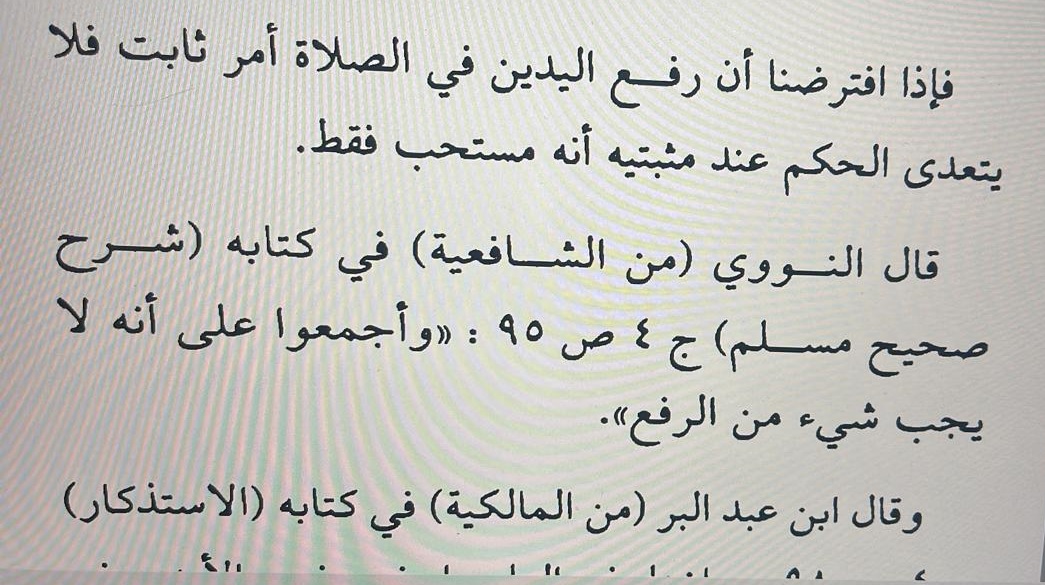
If these actions were something essential to the prayer and absolutely necessary, why are an overwhelming number of scholars saying that this action is mustahab only?
8th evidence or proof.
The next evidence and proof for not doing is actually the weakness and contradictions inherent in the evidence and narrations of those who support doing this action.
The massive contradictions in various reports about raising the hands (raf’ al-yadayn)
The number of raises of the hand in the prayer based on all opinions are around:
- once
- 5 times
- 7 times
- 8 times
- 9 times
- 10 times
- 13 times
- 19 times
- 20 times
- 25 times
- 26 times
By this we see that some people raise their hand 26 times in one prayer!
And for the rulings related to raising the hand in prayer, they varied as follows:
In the opening, some say disliked, some say recommended، some say Sunnah, some say an obligation but leaving it isn’t a sin, some say an obligation and leaving it is a sin, some say a pillar, some say who drops it is a sinner.
After Ruku’ Some say allowed, some say it’s from the perfection of the prayer, some say Sunnah, some say obligatory, some say Bid’ah, some say who drops it is a sinner.
In other positions. Some say recommended, some say allowed, some say it’s disliked, some say not allowed.
For the position of fingers during raising the hand, it is as follows:
- First opinion: The individual raises their hands with their fingers spread apart, facing the palms toward the Qibla, without excessive spacing between the fingers.
- Second opinion: The individual places the palms of each hand facing the other.
- Third opinion: The individual raises the backs of the hands upward toward the sky and the palms downward toward the ground.
- Fourth opinion: The individual slightly bends the hands while raising them.
For the formation of fingers when raising the hand, it is as follows:
- First opinion: It’s recommended to space between fingers.
- Second opinion: individuals shouldn’t overburden themselves with the spacing and just position the fingers naturally.
- Third opinion: Spacing the fingers should be medium.
- Fourth opinion: It’s recommended to spread the fingers while joining them together.
For the time of raising the hand:
- Say the Takbir, then raise the hands.
- Raise the hands then say the Takbir
- Raising the hands should match the Takbir, and this opinion has further subdivision of five opinions:
- First opinion: The hands are raised without uttering the Takbir, and then the Takbir is initiated while lowering the hands simultaneously with the completion of the Takbir.
- Second opinion: The hands are raised without uttering the Takbir, followed by the Takbir, and then the hands are lowered.
- Third opinion: The raising of the hands begins with the start of the Takbir and ends simultaneously with its completion.
- Fourth opinion: Both the raising of the hands and the Takbir begin together and conclude with the lowering of the hands.
- Fifth opinion: The raising of the hands begins with the start of the Takbir but does not necessarily end with its completion. If one finishes raising their hands before completing the Takbir, they should pause with their hands in position until the Takbir is completed. Conversely, if the Takbir is completed before the hands are fully raised, they should continue raising their hands to the intended position.
For where the hands are raised to, there are several opinions as follows:
- To the shoulder
- To the chest
- To the shoulder or chest
- To the ear
- To over the head
- The first Takbir is higher than the rest, even behind the head.
Maybe we could say that one of these is correct, or none of these are correct, but to say that all of them are correct is patently false.
These are exactly the type of points this Hanafi Imam makes here:
9th evidence or proof.
This proof or evidence is admittedly a circular argument. However, it is sufficient for us. That we are the earliest of the schools in Islam. The(Ibadi) see that it is not proven, and all the evidence to the contrary is weak. If it were true, the people of truth and integrity would not have left it. However, it is not acted upon and it is not found with us.
Imam Noor Ad-deen As-Salemi says:
It has not been proven for us what has been narrated from the Messenger of Allah (saw), and even if it were proven, it would contradict what has been established from the Hadith of Jaber.
Source: (As-Salemi, Ma’arig Al’amal, v.3, p.612)
10th evidence or proof.
Imam Noor Ad-deen As-Salemi says:
“It has been narrated that the practice of raising the hands was reported by a significant number of the Companions. However, if it is authentic — and I do not see it as such — it would be abrogated by what we mentioned, and it might be possible that the Prophet (saw)raised his hands once for a specific excuse; but even this has no firm evidence.”
Source: (As-Salemi, Sharh Al-Jami’ As-sahih, v.1, p.318)
With our scholars, that which is forbidden takes precedence over what is approved. This is closer to wara’ وَرَع or piety
May Allah (swt) guide this Ummah to the purified Sunnah of the Blessed Prophet (saw).
May Allah (swt) forgive the Ummah.


 Prima Quran
In the article it mentioned: Shafi’ite scholar, as-Subki said in his commentary of Sunan Abi Dawud:
Are you sure he wrote a commentary on Sun Abi Dawud? If so please give the wording in Arabic. Shukran.
Thank you for pointing this out. We wanted to publish this article. However, we need to go back through and simply use the arguments that are advanced by the Shaykh in his book (the Arabic one which is included).
Will make amendments latter today (Allah-willing).