
“My Lord! Increase me in knowledge.” (Qur’an 20: 114)

﷽
“My Lord! Increase me in knowledge.” (Qur’an 20:114)
The above verse is a direct plea to our Creator. That we ask Allah (swt) to advance us in knowledge.
“Then ask those who have knowledge.” (Qur’an 21:17)
The above verse has its context; however it is apt. If you do not know ask those who do know. It is quite sensible.
It is in this spirit that the Ibadi have been on the forefront of opening thier libraries to the curious researchers from Western Academia.
Western academia has a penchat for pursing degrees and doctorate thesis on novel subjects or that which seems to be obscure.
This creates wonderful opportunities to learn.
Some brief comments about the author.
Valerie J. Hoffman, research professor emerita in the Department of Religion, has served at the University of Illinois for more than 39 years.
Valerie Hoffman was one of the first women in the field of Islamic Studies at a time when few universities even offered such a program.
It is said that she recently retired from her position at the University of Illinois Urbana-Champaign.
She has otherwise presented excellent lectures and introductions on the Ibadi school.
She plans a forthcoming book: “Islamic Sectarianism Reconsidered: Ibadi Islam in the Modern Age.”
That book may well have been prompted by this site: primaquran.com
It is hoped that she will take on board the feedback and introduce the very important and crucial nuances that she missed.
It is also hoped that she introduces the eye opening statment from Shaykh Shamsu-Deen Abū Ya‘qūb Yūsuf ibn Ibrāhīm al-Warijilānī (r) that is quoted in Kitab al Wada’ Al Mukhtasar Fi Usul Al -Fiqh by Shaykh Abū Zakariyyā Yaḥyā ibn Abī al-Khayr al-Jannāwunī.
These were Shaykhs in the 12th century. To have the positions that they had at the time would be considered quite ‘progressive’. We don’t take into account the blame of the blamers. We take into account the Qur’an and the Sunnah. That forms the basis of our judgements.
Some breif comments about the book.
The Essentials of Ibadi Islam:-Valerie J. Hoffman. An Orientalist translation of Arabic Ibadi creedal text into English. This basically is a translation work of: Al-Aqidah ‘l-Wahbiyya -the most relied upon by the Ibadi in the West. As well as a treatise from Shaykh ‘Abd al-Aziz al-Thamini al-Mus’abi on God’s Power and Human Acts, from Kitab Ma’alim al-Din
The author overall does a faithful job of sticking to the original sources. She often engages the text by asking questions left unresolved* (which could have been resolved had she consulted the scholars in her midst). She often correctly detects errors in the Arabic and other times superimposes what she thinks it should mean. Notwithstanding these minor irritations, it is overall a faithful translation.
*To give you just one example of this in Ms. Hoffman’s work.

Source: (pg. 172)
So, this can leave in the mind of the reader that we some how are going against a clear edict in the Qur’an. Unfortunately, this shows Ms. Hoffman’s lack of engagement with our scholars in regards to some questions she raises in the book.
Another point. She recklessly misrepresents as the default view of the Ibadi school that:
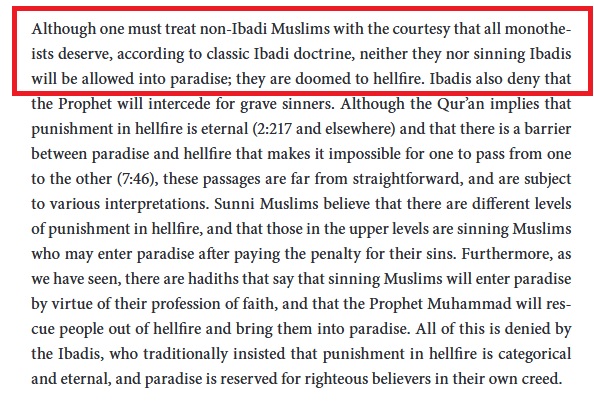
“Although one must treat non-Ibadi Muslims with the courtesy that all monotheist deserve, according to classic Ibadi doctrine, neither they nor sinning Ibadis will be allowed into paradise they are doomed to hellfire.” Source: (pg. 30)
This is extremely reckless and can be the cause of real life physical attack upon those in our community. For example: It has NEVER been the position of the Ibadi school that sinning Ibadi or sinning non-Ibadi Muslims are doomed to hellfire. The position has ALWAYS been that Ibadi’s who repent are subject to the mercy of Allah. Second as regard non-Ibadi at the very least a person needs to be: mukallāf-someone pubescent and sane. Next the clear evidence has to be presented to the individual and we take as evidence the following:
“So after the truth, what else can there be, save error? How then are you turned away?” –(Qur’an 10:32).
That judgement can only be passed on non-Ibadi on the basis of masail al din and not masail al-ra’y. If she bothered to look into the position of the school in regard to the theological position as regard those who Islam may not have reached (isolated islands etc.) she would have appreciated as much.
Again, personally I find it a bit of a disrespect. Here you are being welcomed in a country by its people, they open up their libraries and manuscripts to you. The claim is that you are exposing the Western world to Ibadhism. Yet, you leave comments like the above which could have been clarified. It is certainly not helpful. In regard to one passing comment it is actually dangerous in today’s hyper-sectarian world not to clarify the position of the school or at the very least pass over the matter.
Though, as stated: minor irritations, it is overall a faithful translation. Surely she will receive her reward with her Lord in this life. My hope is that she will embrace the haqq before she meets her Lord.
In fairness to her one man did an interview with her. Our understanding from him is that prior to the interview she wanted to make sure it was not a ‘hit piece’ on the Ibadi school. Now rather or not that was to ensure she would be invited back to Oman (self-interest) or out of genuine concern that it would stir up sectarian passions (selfless-interest) and (altruism) Allah knows best.
Also, keep in mind that we encourage people to study text with our teachers and with our scholars. We had an individual some years back who made the boisterous claim that he was teaching Ibadi Aqidah using Ms. Hoffman’s work! Notwithstanding the fact that this person scarcely knowns Arabic, nor receieved knowledge from teachers, but the book leaves out many fundamentals that would be taught in a structured class on the subject. It is a translation of particular text.
The book itself it is put in the format of Student/Teacher. Surely this would have opened some eyes.
May Allah (swt) forgive our obstinance and soften our hard hearts.
Books are helpful. I said before and I said again. If you want to learn about the Ibadi school, the Hanafi school, the Maliki school, the Zaydi school, or any school you absolutely must connect with practices teachers and masters of those schools. Otherwise all you will ever half are baked surface level knowledge -which often could be mistaken.
May Allah (swt) rectify our state.
May Allah (swt) forgive the Ummah!
May Allah (swt) guide the Ummah!


 Prima Quran