
“It is He who has sent His Messenger with guidance and the world view that is based on the truth to manifest it over all other world views, although they who rely upon other than or associate partners with Allah dislike it.” (Qur’an 9:33)
﷽
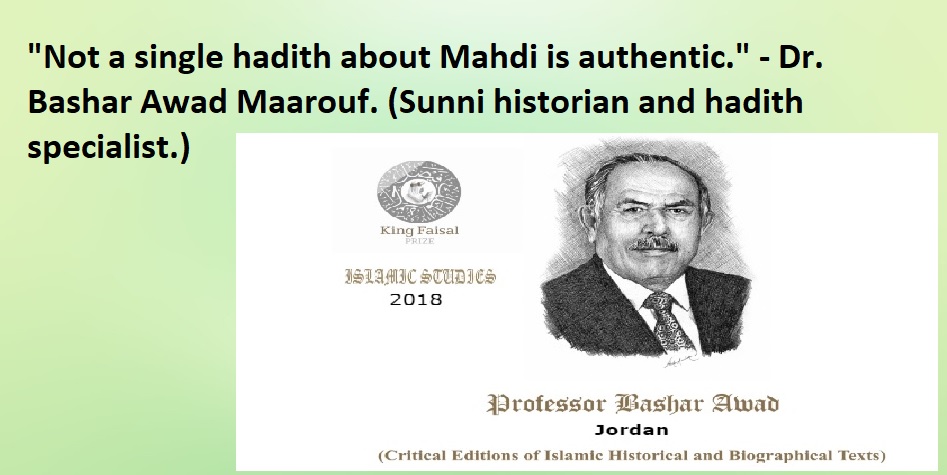
Dr. Bashar Awad Maarouf, a Sunni historian and hadith specialist, has concluded that there is not a single authentic narration concerning the coming of some Mahdi.
While it is common knowledge that the Qur’an does not speak about the Mahdi at all. That the two most authentic collections of hadith, according to Sunni Muslims, Sahih Bukhari & Sahih Muslim, do not speak about the Mahdi at all, what is not so commonly known is the general weakness and unreliability of all other reports.
If you are interested to see the full interview we would recommend:
Some background concerning Dr. Professor Bashar Awad Maarouf.
Bashar Awad Marouf was born in 1940 in Alazamiyah, northern Baghdad. He graduated from primary and secondary schools in the 1960s. He enrolled in the Department of History at the College of Arts in Baghdad University from which he graduated in 1964. In that same year, he enrolled in the Master’s Program of History and Archeology at Baghdad University. Professor Marouf was appointed in 1967 as the teacher at the College of Shari’a Studies at Baghdad University. He later earned his PhD from the College of Arts at the same university in 1976. His doctoral thesis was titled: “Ad-Dhahabi’s Approach in the History of Islam.” Professor Marouf worked at Baghdad University and advanced through academic work, eventually earning a professorship in 1981. He has been keenly interested in studying and minutely scrutinizing the Prophet’s Hadiths. He has been particularly devoted to studying biographies, narrators and the ‘hidden defects’ of some of the Hadiths. He has taught as Professor of Hadith at several universities. Many of Marouf’s studies have been published in Baghdad, Cairo, Damascus, Beirut, Amman, Tunis and London.
Notable among his publications are: “The Impact of Hadith on the Emergency of Muslim History.”, “Al-Mundhiri and his ‘Al Takmila”, “Baghdad’s Biographical Histories.”, “Ad Dhahabi’s approach to the History of Islam.” , “A Journey through Thought and Heritage.” , “The History of Islam and the concept of the Arab Leadership of the Islamic Ummah.” , “Explanation of the Rulings on Chanting the Qur’an.” “A Selection of the Prophet’s Hadith.” , “The Whole Musnad (22 volumes)” “Classified and Verified Musnad” (41 volumes)
Among the many books Professor Marouf verified are: “Al-Wafayat” by Abu Masoud Al Hajji, “Ahlu Al Mi’a and Upward” by Al Hafiz Ad Dahabi. “Postscripts of the History of Baghdad, City of Peace by Ibn Al-Daybathi (5 volumes). “The Grand Mosque” -by Imam Abu Issa Al Tirmidhi (six volumes), “Sunan Ibn Majah by Imam Muhammed Ibn Yazid Al Qazwini (6 volumes),
“The Hstory of the City of Peace” by Hafiz Abu Bakr Al Khatib Al-Baghadadi (17 volumes). “The History of Islam and the Deaths of Celebrities and the Famous” by Al Hafiz Shams Addeen Ad-Sahabi (17 volumes) and many more.
Some of his works and publications may be purchased here:
https://www.abebooks.com/book-search/author/bashar-awad-marouf/
A dean of investigators in the science of Prophetic Hadith. Former rector at the Islamic University in Baghdad. He is a Fellow of the Royal Aaal Al-Bayt Institute for Islamic Thought in Amman, Jordan.
Dr. Professor Bashar Awad Maarouf does not fear the blame of the blamer. He made his conclusion after thorough investigation, tracking all the narrators and investigating all the paths.
In regard to those who say: “But our club says this, and if you differ with the club it is a departure from faith!”
Is the weakness of these hadiths considered a denial of the Sunnah and a departure from Islam!!! Fear Allah!
We personally have considered that there are many such scholars among Ahl Sunnah who have come to this conclusion. However, they do not come out to the public for one of two reasons.
- Being ostracized and condemned. Not being welcomed to the table anymore.
- The fear that if this widely held belief is now considered mistaken it could cause the masses to wonder what other views or beliefs are mistaken. Thus, a desire to protect the tradition.
Allah knows best.
You may be interested to read the following:
https://primaquran.com/2022/10/04/hadith-on-imam-mahdi-in-the-light-of-ibn-khaldun/
https://primaquran.com/2024/02/27/which-mahdi-would-you-choose/comment-page-1/
https://primaquran.com/2024/01/28/what-will-ahl-sunnah-do-after-57-years-have-passed-and-no-mahdi/
May Allah (swt) guide the Ummah!
May Allah (swt) forgive the Ummah!


 Prima Quran
very interesting. Whilst the belief of coming Mehdi doesn’t affect day to day life of muslims the idea is so prevalent that one would have imagined authentic hadiths backing the idea
Do Sunnis generally percieve the Mahdi as an essential aspect of their faith ?
I would not go so far as to say that it is an essential aspect. This can readily be seen by this article itself. The article links to the famed historian Ibn Khaldun, who he himself mentioned problems with the chain of narrators and Dr. Bashar Awad Maarouf himself remains overall a Sunni.
There is among the Maliki school today a group that calls itself the Murabitun, they don’t believe any Mahdi is coming either.
So no, nothing essential. Though, as the article also shows some say if you go against the consensus on any issue it becomes problematic.
Hope this helps.