
“Do not confound the with falsehood, nor conceal the truth when you know.” (Qur’an 2:42)

﷽
Abu Hanifa, Ikrima and the truth.
Abu Abdullah al-Madani, Mawla Abdullah bin Abbaas (r.a)
This is an article we had been wanting to write for some time now. The companion Ikrima (ra) has come under attack by both Shaykh Atabek Shukurov An-Nafsi and his former student Sulaiman Ahmed in their joint book “Hanafi Principles of Testing Hadith” as well as in the following article: https://sulaimanahmed.com/2017/07/28/ikrima-as-imam-of-modern-hanafis-part-1/
Shaykh Atabek Shukurov An-Nafsi
Curriculum Vitae –https://emadina.com/our-team/shaykh-atabek-shukurov-al-nasafi/
Sulaiman Ahmed
Curriculum Vitae -There does not seem to be any third party academic institute and/or organization that verifies his education, training or background. It is not certain if he pays a third party to translate Arabic text or does so directly. To our knowledge, no independent demonstration of Arabic proficiency has been shown.
This article also contains statements taken from other websites/blogs wherein people have replied to the attacks on Ikrima (ra) and we have not seen any meaningful responses to it whatsoever. Thus we have linked to them. It is our hope that this article will be free from personal attacks, insults, and emotive language.
Certainly, the article we linked to above is up to the reader to decide if personal attacks, insults, and emotive language are contained therein or not.W feel that people who are undecided on this matter deserve the very best from us.
So let us just come directly to the point.
The first point that nobody can escape from is the fact that Abu Hanifa had not a single jarh (criticism) against Ikrima (ra). The second point that nobody can escape from is the fact that Abu Hanifa narrated from Ikrima (ra).
The first point is responded to by using an argument from silence. That is to say, because we do not have any historical documents from Imam Abu Hanifa that criticize Ikrima (ra). We can’t say that he never criticized him. The absence of evidence is not evidence of absence.
However, we can say with certainty that we have nothing from Imam Abu Hanifa critiquing Ikrima. If there was even a modicum of evidence for it, certainly Shaykh Atabek and former student, Sulaiman Ahmad would have used it.
The second point is responded to by showing Imam Abu Hanifa narrating from someone and then disparaging that same narrator.
Does this say something about everyone Imam Abu Hanifa narrates from or only that particular person?
So for us, when Imam Abu Hanifa critiques someone he narrates from, that only shows he critiqued the person he narrated from. Otherwise, how do you establish proof for Abu Hanifa from anyone he narrates from?
The following bit is not directed at Shaykh Atabek nor former student Sulaiman but a person we had an exchange with on social media. Perhaps he may read this.
We have recently encountered a brother online who mentioned Abu Hanifa lived during the Umayyads. So what was he trying to suggest by this?
A) That Abu Hanifa was more terrified of Umayyads than Allah (swt)?
B) That the Umayyads forced Abu Hanifa to narrate from Ikrima (ra)?
In fact, if Ikrima (ra) is a so-called “khawarij”, it means he believed against the established opinion of the Sunni majority that Muslims can rebel against the unjust rulers. Abu Hanifa could have used this as a point against Ikrima (ra) but didn’t.
So this very powerful fact should merit some reflection.
“Imam Malik stated that he did not accept hadith unless it was taken from the fuqaha (jurist as opposed to simple hadith scholars). On one occasion, it is reported that Abu Hanifa took Imam Abu Yusuf to his library. Abu Yusuf saw that it contained many tomes of hadith but Imam Abu Hanifa said that he only narrated a few of them, namely those which would benefit people.”
Source: (pg 89 Hanafi Principles for Testing Hadith)
Interestingly, out of this massive tome, Abu Hanifa managed to narrate from Ikrima (ra)
In reality, when all was said and done, the best that could be brought against Ikrima (ra) was an argument by way of innuendo. Even then, the argument from innuendo doesn’t hold up.
The following is from Mufti Zameel found here: https://ahlussunnah.boards.net/thread/499/response-atabek-ikrimah-mawl-ibn#ixzz4EZJK4ckB
Atabek’s Double Standards in Assessing Reports from Abū Ḥanīfah
“Regarding a particular report from Abū Ḥanīfah that he regarded ‘Ikrimah as being from the ‘seniors/great ones’ (kubarā’), Atabek rejected it primarily on account of a problematic narrator in its chain of transmission. But at the same time he quotes the following with full confidence:
“Imam Abu Hanifa said; “Do not take knowledge from the scholars of Royal Palace. I do not say they lie, but they do not always tell the truth, how it really is.””
And:
“But, just to underline the dishonesty and poor level of Islamic knowledge on display, Abu Hanifa said; ”Take the knowledge from everyone except the following” and he listed the ones who are around the royals and rulers (as Ikrima most certainly was and as his erstwhile interlocutors accept). He said; ”But don’t take from the ones who are around the royals! I don’t say they lie, but they don’t say the truth as it is!””
He did not give a source for this quote. (My guess is he got it from the footnotes to Qawā‘id fī ‘Ulūm al-Ḥadīth).
The original source for this quote is al-Kifāyah fī ‘Ilm al-Riwāyah of al-Khaṭīb al-Baghdādī as follows:
‘Abū Bishr Muḥammad ibn ‘Umar al-Wakīl (350 – 438 H) reported to me, he said: ‘Umar ibn Aḥmad ibn ‘Uthmān al-Wā‘iẓ [Ibn Shāhīn] (297 – 385) narrated to us, he said: Muḥammad ibn al-Ḥasan al-Muqri’ [al-Naqqāsh] (266 – 351) narrated to us, he said: ‘Abdullāh ibn Maḥmūd al-Marwazī (d. 311) narrated to us: Aḥmad ibn Muṣ‘ab narrated to us, he said: ‘Umar ibn Ibrāhīm (d. ca. 220 H) narrated to us, he said: I heard Ibn al-Mubārak say:
‘Abū ‘Iṣmah asked Abū Ḥanīfah: “From whom do you order me to listen to narrations?” He said: “From every moderate one in his deviation, besides the Shī‘ah, since the foundation of their doctrine is to regard the companions of Muḥammad (Allāh bless him and grant him peace) as misguided; as well as those who attend the ruler wilfully. Pay attention, I am not saying that they lie to them or command them what is not appropriate, but they pave the way for them so the masses are loyal to them. These two ought not be from the imāms of the Muslims.”’ (al-Kifāyah fī ‘Ilm al-Riwāyah, p. 126)
First, one will notice the clear differences between the actual account and the “translation” of Atabek. Atabek’s translation (deliberately?) omits the unfavourable reference to Shī‘ah. Atabek’s translation is also inaccurate, as the actual report says: ‘I am not saying that they lie to them or command them what is not appropriate’ from which Atabek somehow got: ‘I do not say they lie, but they do not always tell the truth, how it really is’.
But secondly, and more importantly, this narration is inauthentic. There are two highly problematic narrators in this chain:
1. Muḥammed ibn al-Ḥasan al-Muqri’ al-Naqqāsh (266 – 351). Ṭalḥa ibn Muḥammed al-Shāhid said: ‘He would lie in ḥadīth.’ (Lisān al-Mīzān, 7:78). Abū Bakr al-Barqānī said: ‘Every narration of Naqqāsh is rejected’ (ibid.); Khatib said: ‘In his narrations are absurdities despite the chains being famous’ (ibid. 7:79). Al-Dāraquṭnī regarded him as extremely weak (ibid.). Ibn al-Jawzī mentioned two ḥadīths which he believes al-Naqqāsh falsified (ibid.). Dhahabī said: ‘My heart is not satisfied with him; according to me he is suspect [i.e. of being a liar].’ (Siyar A‘lām al-Nubalā’, 15:576)
2. ‘Umar ibn Ibrāhim ibn Khālid al-Kurdī (d. ca. 220). Al-Dāraquṭnī said: ‘A rotten, flagrant liar.’ (kadhdhāb khabīth). (Lisān al-Mīzān, 6:62) Al-Khaṭīb said: ‘He narrates absurdities from reliable narrators.’ (Lisān al-Mīzān, 6:62)
These are the most serious issues with the chain. As one can see from the above, it can never be accepted according to the standards Atabek applies to the other narration. Yet he accepts this report and rejects the other. Is this anything but clear double standards (i.e. agenda-driven bias)?”
Prima Qur’an comments:
It is crystal clear to us that Mufti Zameel exposed a fundamental flaw in Shaykh Atabek’s reasoning.
Not only that but the point about Imam Abu Yusuf being employed by Harun Al Rashid was completely sidestepped.
“Also, I saw the hilarious ‘argument’ being proffered on these secret forums that if we criticise Ikrima for accepting money and being in thrall of genocidal maniacs such as the rulers of his time, then we must likewise criticise Imam Abu Yusuf, the student of Imam Abu Hanifa, because he was in the employ of Harun Al Rashid. Obviously, this is not even an argument at all and barely even qualifies as emotional blackmail – it is merely saying that ignore the bad stuff that one person did because other people perhaps did it too. So I eagerly await the canonisation of this ‘principle’ which can excuse anything and everything which more than one famous person does. Thus the Iraq War mist have been good, because if you criticise the West for doing it you would have to criticise Saudi and Muslim countries for supporting it too. So you shouldn’t criticise anyone. Excellent moral ‘principles’!”-Sulaiman Ahmed
“It is merely saying that ignore the bad stuff that one person did because other people did it too.”
Our response: Is it really saying that or is it saying that we should apply consistent standards and consistent principles?
“Thus the Iraq War mist have been good, because if you criticise the West for doing it you would have to criticise Saudi and Muslim countries for supporting it too.”
Our response: Or how about we be consistent and criticize both the West and Saudi Arabia? What would not be moral or consistent is to suggest that the West (Ikrima) be castigated for his involvement in the war and Saudi Arabia (Abu Yusuf) be let off the hook for his involvement.
An argument from Ra’y:
“as well as those who attend the ruler wilfully.”
Let’s assume that the hadith that Shaykh Atabek brought was sound. Doesn’t both histories testify to the fact that there has been Muslim faithful in every court of rulership in Muslim history? Is it not within reason to say that, just like Abu Yusuf, that not every person is corrupt due to some affiliation with rulers?
Wouldn’t the reasonable thing to do in this situation be to sift through the reports individually and see where a report actually might be something that benefits rulers etc.?
In fact, the hadith narrated by Ikrima (ra) can be used against rulers. How often do you think rulers used siege engines and firebombed besieged strongholds? In the process of killing innocent men, women, and children? In fact, couldn’t that very hadith be used against, let’s say, the use of nuclear weapons?
So the following statement is absolutely rejected. “Imam Abu Hanifa rejected all narrations from Ikrima as well, but this reasoning was different. He held a principle that he would not take any narration from a person associated with the rulers, as it could affect their righteousness due to the loyalty they may hold to those in authority.”
Source: (pg 227 Hanafi principles for testing Hadith)
Prima Qur’an conclusion:
Imam Abu Hanifa has no jahr (criticism) of Ikrima (ra). Out of the ‘tomes of hadith’ that Imam Abu Hanifa had in his collection, Imam Abu Hanifa narrated from Ikrima (ra). The hadith about the rulers has problems in its chain of narrators. If consistent principles were applied, this would mean we would need to steer clear of Imam Abu Yusuf. Also, the objection doesn’t pass the test from Ra’y.
That should really be the end of the article at this point.
However, there are many other ancillary issues surrounding this that we feel should be addressed.
So you have to wonder what is the issue they have with Ikrima (ra) to begin with?
If the main point was to establish evidence against killing apostates? They themselves admit:
“It is largely based on the following hadith, which both groups like to use to justify the killing of those who leave Islam and to portray this as the ‘true teachings of Islam’. ”
Source: (pg 226 Hanafi Principles for Testing Hadith)
If it has to do with weakening the view of killing apostates, then why not go after the other narrators? Or why not go after Ali Ibn Abu Talib himself, who is said to have narrated this hadith about killing people who go out of Islam.
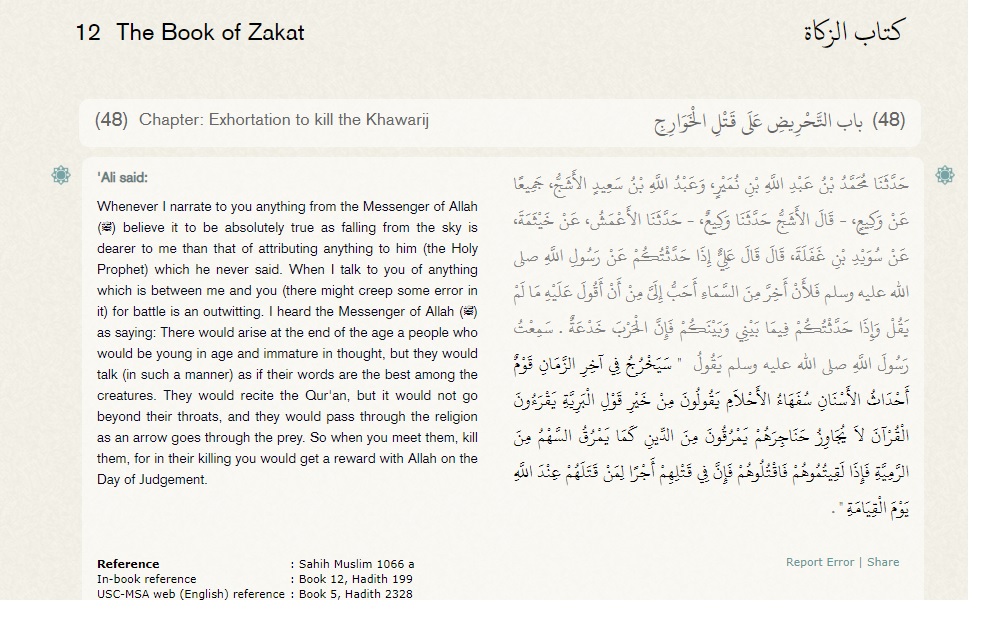
Let’s analyze the text of this hadith.
“Whenever I narrate to you anything from the Messenger of Allah (saw), believe it to be absolutely true, as falling from the sky is dearer to me than that of attributing anything to him (The Holy Prophet) which he never said.”
Such a disclaimer. Have you ever noticed Ali ever preface a hadith like that?
“When I talk to you of anything which is between me and you (there might creep some error in it) for battle is outwitting.”
An interesting statement. Errors might creep into things he said and battle is about outwitting. Hmmm.
“There would arise at the end of the age a people who would be young in age and immature in thought, but they would talk (in such a manner) as if their words are the best among the creatures. They would recite the Qur’an, but it would not go beyond their throats, and they would pass through the religion as an arrow goes through the prey. So, when you meet them, kill them, for in their killing you will get a reward from Allah on the Day of Judgement.”
At the very least, it is an open license to kill apostates and, at the most, it’s an open license to kill fellow Muslims. “They would recite the Qur’an, but it would not go beyond their throats.”
On what consistent basis is an attack launched upon Ikrima(ra) but not Ali?
Atabek nor Sulaiman have engaged with this question in any meaningful way. In fact, they have not engaged with it at all.
We have demonstrated how the dog whistle of Khawarij has been used in the past and is currently being used to effectively crush any opposition to government authority.
Please see our article here:
They seem to have taken issue with the fact that Ikrima (ra) narrated hadith about Ali, which shows Ali being criticized by Ibn Abbas (ra) for setting people on fire.
This report was narrated by al-Bukhary (6922) on the authority of `Ikrimah who said: Heretics were brought before Ali (may Allah be pleased with him) and he burnt them. When Ibn `Abbas (may Allah be pleased with him) was informed about this, he said, “If I were in his place, I would not have burnt them for the Messenger of Allah (peace and blessings be upon him) forbade this saying, “Do not torment with the torment of Allah” and I would have killed them, for the Messenger of Allah (peace and blessings be upon him) said, “Whoever changes his religion, kill him.”“
What will be noted is that neither Shaykh Abdullah bin Bayyah nor Bassam Zawadi attacked the chain of narrators nor Ikrima (ra) himself.
You can see a fuller discussion on that here:
Next, you would have to go after the other narrators. You would have to weaken the chains of the following hadith:
It was narrated from Anas that :
‘Ali came to some people of Az-Zutt, who worshipped idols, and burned them. Ibn ‘Abbas said: “But the Messenger of Allah [SAW] said: ‘Whoever changes his religion, kill him.’”
Source: (https://sunnah.com/nasai:4065)
Narrated Abu Musa:
“A man embraced Islam and then reverted back to Judaism. Mu’adh bin Jabal came and saw the man with Abu Musa. Mu’adh asked, “What is wrong with this (man)?” Abu Musa replied, “He embraced Islam and then reverted back to Judaism.” Mu’adh said, “I will not sit down unless you kill him (as it is) the verdict of Allah and His Apostle.”
Source: (https://sunnah.com/bukhari:7157)
As regards the above hadith Shaykh Atabek and Sulaiman have stated in their book:
The Known Narrators
“The known narrator is one who is recognized by knowledge and rulings such as The rightly guided Caliphs, Abdullah bin Masood, Abdullah bin Abbas, Zayd bin Thabit, Mu’adh bin Jabal, Abu Musa al-Ash’ari, and Aisha, etc.”
“Their narrations are considered as proofs, irrespective of their conflict with analogy or conformance with it.”
Source: (pg 53-54 Hanafi Principles for Testing Hadith).
Narrated ‘Abdullah:
“Allah’s Messenger (saw) said, “The blood of a Muslim who confesses that none has the right to be worshipped but Allah and that I am His Apostle, cannot be shed except in three cases: In Qisas for murder, a married person who commits illegal sexual intercourse and the one who reverts from Islam (apostate) and leaves the Muslims.”
Source: (https://sunnah.com/bukhari:6878)
So what is deficient about Mu’adh bin Jabal according to Shaykh Atabek and student Sulaiman Ahmed?
Shaykh Atabek and hist former Sulaiman Ahmed on pages 228 and 229 of Hanafi Principles for Testing Hadith give ample evidence from the Qur’an that murder without right is imperssible. They give examples from the Qur’an and ahadith that seem to justify the freedom of disbelief.
However, they both seem to miss that quoting all of that does nothing to attack the chain of the narration from Ikrima (ra). They are holding assumptions that Ali didn’t do that act because it would go against established principles. However, if we are making assumptions, we could also assume that Ali did do that act. Ibn Abbas (ra) reprimanded him for it and Ikrima (ra) is simply narrating the incident.
We hope they are not making the argument that, just because the Qur’an mentions doing or not doing something that Muslims automatically follow these dictates. Wouldn’t that be amazing if they did!
It is possible that people who have philo-Shi’a tendencies would be troubled by Ali making an error in his ijtihad. After all, Bassam Zawadi stated:
“Nevertheless, if someone is not willing to accept any of the above explanations and is persistent that `Ali (ra) actually burnt these criminals to death, even then the most that can be said is that `Ali’s decision of burning the criminals to death was not correct, in view of the directive of the Prophet (pbuh) to the contrary. This, obviously, would amount to criticism on Ali’sdecision – not a criticism on Islam.”
“After all, `Ali (ra) was but a human being, he may have erred in his decision.”
Source: (https://www.call-to-monotheism.com/why_did_ali_burn_some_apostates___by_understanding_islam)
Shaykh Atabek and former student, Sulaiman Ahmed are not suggesting that criticism of Ikrima (ra) is a criticism of Islam, right? Likewise, criticism of Ali is not a criticism of Islam.
Likewise,
There is something similar in Imami Shi’i sources.
Narrated from Abū ʿAbdillāh (Imām Jaʿfar al-Ṣādiq), who said: Amīr al-Muʾminīn (ʿAlī), said:
“If it were possible for me, and if I found someone to help me, I would kill all the adherents of these sects (aṣnāf), and I would burn them with fire. And this is [in accordance with] the saying of Allah, Mighty and Exalted:
‘Say, I am only a man like you to whom it has been revealed that your God is but one God. So whoever would hope for the meeting with his Lord – let him do righteous work and not associate anyone in the worship of his Lord’ (Qur’an 18:110).”
Source: (Bihār al-Anwār al-Jāmiʿah li-Durar Akhbār al-Aʾimmat al-Aṭhār Volume and Page: Vol. 25, p. 265, Hadith #30)
So what do Shaykh Atabek and his former student, Sulaiman Ahmed do with information like this? Ikrima(ra) is not a narrator on him? So you cannot use your sectarian bias against him.
It is also possible that people who have philo-Shi’a tendencies would be troubled by Ikrima (ra) given his weight on the tafsir of a key point of conflict between Ahl Sunnah and the Shi’a..
Because he (Ikrima) said the following:
Ibn Jarir recorded that `Ikrimah used to call out in the marketplace:(Allah wishes only to remove Ar-Rijs from you, O members of the family, and to purify you with a thorough purification. (33:33)) “This was revealed solely concerning the wives of the Prophet.”
Source: (Tafsir Ibn Kathir on Qur’an 33:33).
Ikrimah said: “Whoever disagrees with me that it was revealed solely concerning the wives of the Prophet, I am prepared to meet with him and pray and invoke the curse of Allah upon those who are lying.”
Source: (Tafsir Ibn Kathir on Qur’an 33:33)
However, he either got that information.
A) Directly from Ibn Abbas (ra) because Ibn Abbas (ra) said:
Ibn Abi Hatim recorded that Ibn `Abbas said concerning the Ayah: ( Allah wishes only to remove Ar-Rijs from you, O members of the family, ) “It was revealed solely concerning the wives of the Prophet .”
Source: (https://surahquran.com/tafsir-english-aya-33-sora-33.html)
B) Simply by looking at the context of the Qur’an itself.
C) Lastly, this is due to the poor reading or gross misunderstanding that Shaykh Atabek and his former student, Sulaiman Ahmed have. has. Neither of them have brought any evidence of ‘Ikrima stating it “excludes his kin, daughter and grandsons.” What Ikrima (ra) is saying is that concerning the Asbab an-Nuzool (the occasion for the revelation) it was due soley to the wives of the Prophet (saw).
Which as stated was the view of Ibn Abbas (ra). This can be determined via the context of the Qur’an itself.
More investigations into Ikrima (ra).
There are some interesting points from Shaykh Atabek and his former student, Sulaiman Ahmed in their book.
“So regardless of who he is, we need to bear in mind that scholars also have biases and sometimes sectarian affiliations too.” Sources: (pg. 195 Hanafi Principles for Testing Hadith)
A very good point!
Scholars can have biases and sectarian affiliations that may colour their investigations.
“Therefore criticism needs to be valid and not based on sectarian or personal reasons and as we have seen, even some of the senior scholars were not above this.”
Source: (pg. 197 Hanafi Principles for Testing Hadith).
“An Innovator is someone who holds to a view which does not conform to the position of the ‘Ahl Sunnah wa al-Jama’ah’ which are the Maturidi and Ash’ari Schools of creed.”
Source: (pg. 94 Hanafi Principles for Testing Hadith).
This statement itself merits reflection. The statement itself is biased and sectarian. It means that the Shi’a are innovators. Ibadi’s are innovators. Sunni Muslims from the Mutazalite and Athari schools of theology are innovators.
“The narrations of all innovators are accepted unless there is an innovator who believes that lying is permissible or their view constitutes disbelief.”
Source: (pg. 133 Hanafi Principles for Testing Hadith)
“So for example, Imam Bukhari takes hadith from the Khawarij such as Ikrima and Waleed ibn Kathir, who believe lying equates to disbelief.”
Source: (pg. 133 Hanafi Principles for Testing hadith)
“If the narrator is from the Khawarij, some do not accept them as they are a deviant sect, whereas others do as they state that for the Khawarij lying equates to disbelief and therefore they would be even more careful to ensure that the hadith were narrated accurately.”
Source: (pg. 199 Hanafi Principles for Testing Hadith)
Classifying someone as being from a ‘deviant sect‘ is itself a sectarian reason to discard a hadith. Also, it is quite clear that Shaykh Atabek and his former student, Sulaiman Ahmed, believe that Ikrima (ra) is a “Khawarij” (a sectarian term applied by sectarians, rest assured). They also show in their book that the belief of the “Khawarij” is that lying equates to disbelief.
Prima Qura’n comments:
Firstly, we do not need to rely upon anyone concerning rather or not lying is kufr when we have the words of Allah (swt).
“Surely, the religion is for Allah only. And those who take Auliya’ (protectors and helpers) besides Him (say): “We worship them only that they may bring us near to Allah.” Verily, Allah will judge between them concerning that wherein they differ. Truly, Allah guides not him who is a liar, and ungrateful (kadhibun kaffarun).” (Qur’an 39:3)
“let us sincerely invoke Allah’s curse upon the liars.” (Qur’an 3:61)
“And a fifth oath that Allah may condemn him if he is lying.” (Qur’an 24:7)
The cursed the condemened such a one is described as a believer?
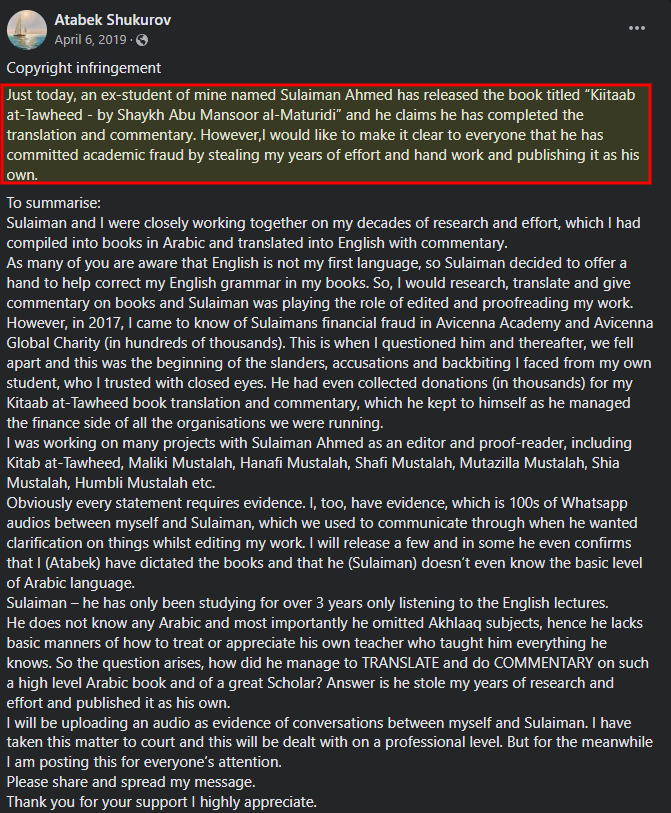
Ironically, the issue of integrity and who is truthful became very public between Shaykh Atabek and his former student, Sulaiman Ahmad, when they had their very public divorce. Issues of integrity and honesty were at the heart of the court case.

Bringing the subject back to Ikrima (ra)
So, as the narrations of all innovators are accepted, unless they believe in lying (the Khawarij don’t) or unless their view constitutes disbelief, we have a very pointed question for both Shaykh Atabek and his former student, Sulaiman Ahmed.
- Do either of you regard Ikrima (ra) as a kafir?
- If your answer is: “Yes, Ikrima is a kafir” What is this based upon?
- If your answer is no, then our next question is: “Was Ikrima (ra) a liar?”
- If your answer is: “Yes, Ikrima is a liar” What is it based upon?
Especially in light of the overwhelming view that the “Khawarij” equate lying to disbelief.
Contradictions and no sources quoted in regards to Ikrima (ra)
“The next topic that needs to be analysed is Kirma’s religious idealogy. it is agreed by consensus that he was from the Khawarij. He ALLEGEDLY declared many Muslims to be disbelievers due to the extreme methodology of the Khawarij. Dhahabi, a hadith scholar who considers Ikrima reliable wrote “the first reason for rejecting the narrations of Ikrima is based on the fact that he is Khawarij. The second reason is that being a Khawarij, he justified the killing of his fellow Muslims.”
Source: (pg. 228 Hanafi Principles for Testing Hadith)
So he ALLEGEDLY (no proof, no evidence) declared many Muslims to be disbelievers. This is a far cry from what Sulaiman Ahmed states in a tirade that is filled to the brim with emotive language. Dhahabi (raheemullah) considers Ikrima (ra) reliable.
“The second reason is that, being a Khawarij, he justified the killing of his fellow Muslims.”
Our response to this is who didn’t find justification for killing fellow Muslims?
“Ali directed his army to attack the Khariji camps, and his forces MASSACRED many of them at Nahrawan. At this point, Ibn ‘Abbas seems to have doubted his initial support of ‘Ali. He resigned from the governorship of Basra and stigmatized ‘Ali’s killing of his Khariji opponents”
Source: (Scott Riraj Al Haqqa Kugle in his book: Homosexuality in Islam: Critical Reflection on Gay, Lesbian, and Transgender pg. 107)
Did Ali feel he had justification to kill the forces of Muawiya in Syria? Did Ali feel he had justification to kill Muslims at the battle of the camel?
“But whoever kills a believer intentionally – his recompense is Hell, wherein he will abide eternally, and Allah has become angry with him and has cursed him and has prepared for him a great punishment.” (Qur’an 4:93)
Bakrah Ath-Thaqafi reported – The Blessed Messenger (saw) is reported to have said: “If two Muslims meet each other with their swords, then both the killer and the killed will be in the Hell-fire.” I said, “O Allah’s Messenger, that is the case for the killer but why should that be the case for the killed?” He answered, “Because he wanted to kill his companion.”
Source: (https://sunnah.com/nasai:4118)
Narrated Ibn `Umar
“I heard the Prophet (saw) “Do not revert to disbelief after me by striking (cutting) the necks of one another.” Source: (https://sunnah.com/bukhari:7077)
In light of this verse of the above Qur’an and these ahadith every group among the early Muslims is trying to find justification for what they are doing.
Recall what we quoted above: So “he ALLEGEDLY (no proof, no evidence) declared many Muslims to be disbelievers.”
Yet Shaykh Atabek’s former student, Sulaiman Ahmed says:
“Since releasing my https://sulaimanahmed.com/2017/07/28/ikrima-as-imam-of-modern-hanafis-part-1/ on Ikrima the Liar and Kharijite, I have received a lot of positive feedback from readers who were either blissfully unaware of the genocidal propensities of some of the people that groups such as Deobandis and Salafis expect them to ‘respect’ as ‘Imams’ or had already heard about Ikrima (who narrates some of Salafis favourite hadiths, such as those about burning apostates and gays) and his ‘tendencies’ and had their faith shaken, as they mistakenly believed that such individuals who sanction the murder of senior Sahahbah were somehow nonetheless indispensable to Islam. I also received a few sincere emails with requests of clarification of some issues.” -Sulaiman Ahmed
The questions put Sulaiman Ahmed are as follows:
- What are these ‘genocidal propensities’ of Ikrima (ra)?
- Ikrima (ra) didn’t burn apostates, Ali did. Ali also narrated the above hadith about getting a reward for killing ex-Muslims. Why is this not touched by yourself or your former teacher?
- Believed in and sanctioned the “murder” ? of senior sahabah? What’s the source for this?
As regards point 3. above. Let us say, for the sake of argument, this was proven. In what way did he ‘sanction’ the murder of senior Sahaba in a way that Talha, Zubayr, Muaviya, Ali, didn’t?
“I have to clarify, because these peoples’ feelings and ‘right’ to display academic incompetence are not more important than the reputation of Islam.” -Sulaiman Ahmed
What is contained in the following paragraphs is so far from academic.
“What is sad is that despite endangering the faith and reputation of Muslims whilst ‘responding’ to my article and insisting that someone who takes money from tyrannical governments that kill sahabah, calls Ali and Uthmaan, senior companions of the Prophet, apostates who will burn in Hell forever, is a ‘reliable Imam’ that is ‘accepted by everyone’, these people never explain how this is the case: they in no place denied that he is a Kharijite (and a Safari and Ibadi i.e worst type at that) nor his attacks on the Sahabah nor his genocidal tendencies: they merely keep repeating that he was ‘accepted’ by Abu Hanifa because he (they claim) quoted from him (as if everyone who quotes from George Bush for any reason is automatically a Republican). They never, you will note, stop to explain how you can be reliable if you have such beliefs and practices nor will they ever once even condemn him for holding these beliefs. It is entirely lost on these people that by prostituting the reputations of Imams Abu Hanifa and Bukhari to rescue that of Ikrima all they do is cast doubt on the latter two real imams for ‘accepting’ such a vile and deranged individual in the first place. “-Suliman Ahmed

Questions for Shaykh Atabek’s former student, Sulaiman Ahmed:
What is the source that he called Ali and Uthman apostates?
“Kharijite (and a Safari and Ibadi i.e worst type at that.”
One of our team members almost spit his drink out reading this. If you realized what he said was akin to saying ‘Sunni’ (and a Shafi’i and Hanafi i.e. the worst type at that”! Does that even make sense to anyone? This person did not read on the subject of the Ibadi school, or he would not have made the most rudimentary of mistakes.
“Finally, if Ikrima is ‘truthful’ and ‘doesn’t lie’, then is he being truthful and accurate when he says that the Sahabah are kaafir and should be killed?” — Sulaiman Ahmed
Where did Ikrima (ra) state this? A source until this very day has not been given.
“Also, if you have to believe everything that an authority you quote believes, then do these guys, who so vociferously quote Ikrima, believe that Ali and the senior Sahabah were apostates and should be killed?” — Sulaiman Ahmed
We saw no source given for this.
“Also, maybe these people can show us where in their books this ‘presumption of reliability’ for narrators, i.e narrators are all reliable even if they takfir or anathematise the Sahabha or call for mass genocide, unless specifically mentioned otherwise, is found?” -Suliman Ahmed.
Ikrima (ra) called for mass genocide? Is there a source for this?
“He ALLEGEDLY declared many Muslims to be disbelievers due to the extreme methodology of the Khawarij.”
Source: (pg. 228 Hanafi Principles for Testing Hadith)
So did he indeed say the things you are claiming, Sulaiman, or is this alleged? If he said these things, can you furnish the proofs for them? If he did not say those things, and they are alleged, are you willing to repent to Allah (swt) and retract these comments?
We have also noticed this in their book:
“This means Wasil ibn Ata would thus take the utmost precautions before narrating anything. As we have seen, many top Muhaditheen narrated from the Khawarij, who were violent radicals who attacked Ali (r.a) since they too believed that lying equates to disbelief, Anthropomorphist (who attribute a human or other form to God) and those who insulted Ali(r.a).”
Source: (pg. 197 Hanafi Principles for Testing Hadith)
To put ‘Anthroporphism’ next to the Khawarij, or to attribute that to them is to speak ignorantly about their views. That is not something that can be attributed to them at all. Certainly not well-read nor informed. It is gross ignorance. Of all the ignorance that was proclaimed this has to be the most jarring.
Then you have to wonder about all that time and association with Ibn Abbas (ra). Was it hidden from Ibn Abbas that Ikrima (ra) was a “Kharijite”? Wasn’t Ibn Abbas (ra) aware of Ali and the command to kill such people?
Especially in light of Ibn Abbas (ra) and his known correspondence with Najda ibn Amir al-Hanafi (ra), a known “Kharijite”.
“If I were not afraid of hiding the knowledge (and of the severe punishment) I would not have replied to him.”
Source: (pg. 42 Studies in Early Hadith Literature M.M Azami)
For that matter, aren’t all those people who take hadith from Ikrima (ra) aware of the so-called hadith that commands the killing of “Kharijites”?
We’ve always found it interesting that the Orientalists think that Ikrima (ra) was enticed by the ‘Kharjite” doctrine due to egalitarianism. Is that not a tacit admission that Sunnism was not a champion of egalitarianism?
However, why can’t it be conceivable that, as a slave of Ibn Abbas (ra), that Ikrima(ra) was privy to some of the thoughts of Ibn Abbas (ra) and possibly overheard Ibn Abbas (ra) make comments that were pro “Kharijite” and/or at the very least hear Ibn Abbas (ra) admit that they were right?
If we are going to question centuries-long assumptions about Ikrima (ra) in relationship to the Hanafi school, why not question the centuries-long assumptions the Hanafi school has towards the so-called “Kharijites”?
Why not question the centuries-long-held assumptions about the “Kharijites” from the Ahl Sunnah altogether?
So, after having failed to establish that Imam Abu Hanifa had criticism of Ikrima (ra) Shaykh Atabek and his former student, Sulaiman Ahmed, pulled out all the stops. Any criticism against Ikrima (ra) throws it onto the wall and let’s see what sticks.
Attacks upon Ikrima (ra) from the sciences of jarh wa ta’dil
“After the death of Ibn Abbas, his son Ali bin Abdullah bin Abbas imprisoned Ikrima and when he was asked for the reason he said: “He is narrating likes on behalf of my father.” Sa’id Ibn Al Mussayib, A tab’i, was one of the leading Faqih scholars. He is renowned as one of the seven Fuqaha of Medina, one of the pillars upon which the Maliki School is based and the most eminent of those Fuqaha’ He is narrated to have said to his servant Burd; “O Burd, do not lie and attribute to me like Ikrima lied and attributed to Ibn Abbas” Ibn Umar also said the same to his slave Nafia, “Do not lie on behalf of me as the slave of Ibn Abbas lied on behalf of him.” (although this specific narration of Ibn Umar is disputed by the Muhaditheen.) Sa’eed ibn Jubayr and Ibn Sirin also considered him a liar. Ibrahim Nakhai the grand-teacher of Imam Abu Hanifa also rejected all narrations of Ikrima.”
Source: (pg. 227 Hanafi Principles on Testing Hadith)
This in turn is taken from Source: (Muhammed ibn Ahmad ibn Uthman Al-Dhahabi al Shafi Mizan al I’tidal fi Naqd Arrijal) -Darul al-Ma’rifah , Beirut Lebanon, Volume 3 pg. 93 and Biography number 5716.)
So the primary source that Shaykh Atabek and his former student, Sulaiman Ahmed, used to disparage Ikrima (ra) is from Imam Al-Dhahabi.
So what was Al-Dhahabi’s conclusion after having access to the same information that Shaykh Atabek and Sulaiman Ahmed used him for?
“Dhahabi, a hadith scholar who considers Ikrima reliable.”
Source: (pg. 228 Hanafi Principles for Testing Hadith) –from their own book!
Yazid bin Abi Ziyad.
Yazid bin Abi Ziyad reported that Ali bin Abdullah bin Abbas once tied up Ikrimah with a door when he was asked about the reason, he said: “This filthy person lies upon my father”
Source: (Ad-Du’afa al-Kabeer by al-Ukaylee: 3/373)
“Yazīd ibn Abī Ziyād was from the great leaders of the Shīʿa“
Source: (Al-Dhahabī records this in Mīzān al-Iʿtidāl (vol. 4, p. 423, no. 9727)
What can we say about Yazid bin Abi Ziyad? Well…..https://makarem.ir/main.aspx?lid=1&mid=250316&typeinfo=23&catid=24374
Sa’id Ibn Al Mussayib
“do not lie and attribute to me like Ikrima lied and attributed to Ibn Abbas”
Sources: (Al-Ma’rifa wal Tarikh: 2/5) & (Siyar A’lam An Nubala, 5 page 22)
As this is criticism among peers. Ikrima (ra) and Sa’id Ibn Al Mussayib (ra) had characteristic of personal animosity.
Imam Malik called Ibn Ishaq a liar and an imposter for writing false stories about The Blessed Prophet Muhammed. Imam Malik has said that Ibn Ishaq “reports traditions on the authority of the Jews”.
Source: (Kadhdhab and Dajjal min al-dajajila. Uyun al-athar, I, 16-7)
“When Sufyan ath-Thawri heard the news about the death of Imam Abu Hanifa, he said: ‘Praise be to Allah that such a man had died as he was gradually destroying Islam. There could not be a worse person born in Islam.”
Source: (Ta’rikh Saghir, Biography of Imam Abu Hanifa)
Ibn Umar.
Abu Khalf Abdullah bin Isa al-Kharaz narrated from Yahya bin Muslim Yahya al-Baka: I heard Ibn Umar say to Nafi: “Fear Allah O Nafi’ and do not lie upon me as Ikrimah lies upon Ibn Abbas.”
Source: (Tahdhib al-Kamal fi asma’ al-rijal 20/279)
Ibn Hajar al-Asqlani said: “He is Thiqah Thabat, the Scholar of Tafsir. The accusation of lying about him from Ibn Umar is not proven, nor is the Bid’ah (of any kind) proven from him.”
Source: (Taqreeb: 4673)
Also, are we to regard Nafi (ra) as someone who lied about Ibn Umar (ra)?
The golden chain?
Even Shaykh Atabek and Sulaiman Ahmed admit:
“Ibn Umar also said the same to his slave Nafia, “Do not like on behalf of me as the slave of Ibn Abbas lied on behalf of him.” (although this specific narration of Ibn Umar is disputed by the Muhaditheen).”
Source: (pg. 227 Hanafi Principles on Testing Hadith)
Sa’eed ibn Jubayr
Actually, Imam Sa’eed bin Jubayr said: “If Ikrimah stops narrating his hadith to them, people would travel to him”
Source: (Tabaqat al-Kubra: 2/294)
Ibn Sirin
We do not have l-Dhahabi’s source to see how he dismissed Ibn Sirin’s critique.
Ibrahim Nakhai
We do not have l-Dhahabi’s source to see how he dismissed Ibrahim Al Nakhai’s critique.
In the end, Imam Dhahabi looked at the justifications and various statements attributed to the 5 above and his conclusion is that Ikrima (ra) is reliable.
As regards the personal accusations that Shaykh Atabek and his former student, Sulaiman Ahmed, have towards each other, we can only say that there can only be one victor in their struggle. If the court ruled in favour of Shaykh Atabek, this would mean that Sulaiman Ahmed was not honest in his claims against his former teacher. Also, if the court ruled in favour of Sulaiman Ahmed, this would mean that Shaykh Atabek was not honest in his claims against his former student.
May justice be done. May our pens write the truth. May our tongues speak the truth. May our hearts desire the truth. May Allah (swt) guide us to the truth and may the destination of us all be the truth.
“And whatever strikes you of disaster – it is for what your hands have earned, but He pardons much.” (Qur’an 42:30)

You may also wish to read the following:
May Allah Guide the Ummah.
May Allah Forgive the Ummah.


 Prima Quran
Atabek is one of the scholars I enjoyed reading a few years ago and I used to frequent Sulaiman Ahmed’s blog, too. The latter was quite a bit more polemical in his condemnation of those who disagreed with him. The falling out is of course disheartening… May Allah swt reveal the truth and may the guilty party find forgiveness after they repent. You are correct that this case will have an impact on how we view one or both of these men and their work… it’s unfortunate, but it’s a good case study of human nature. This is especially important when looking back and trying to make sense of the discord amongst the early Muslims. It used to absolutely destroy me trying to make sense of Islamic history. It’s a bit easier to be perspicacious when you stop reading the Shi`i hagiographies that have overwhelmed any discussions online. Thank you again for this blog!
That aside, I vividly recall reading these mens’ dismissals of `Ikrima because of the narrations on apostasy and Musa (as)’s nakedness being witnessed when a rock steals his clothing. I didn’t think much of it, since the Khawarij are automatically dismissed in much of the Muslim world. Maybe the one thing that Sunnis and Shi`as agreed on was that killing Ali (ra) was wrong! But I never explored the context behind that until recently. Knowledge really is a double edged sword, sometimes. I miss being a vanilla Muslim who knew without a doubt that there was only one way to be in this world! Alhamdulilah for the tests and for the struggle though.
“Knowledge really is a double edged sword, sometimes. I miss being a vanilla Muslim who knew without a doubt that there was only one way to be in this world!”
Some times the light can bring discomfort to the eyes, where as ignorance is not always bliss.
I’d like to know if there was poison in my drink!
“Maybe the one thing that Sunnis and Shi`as agreed on was that killing Ali (ra) was wrong!”
And the killing of the Muslims of Al Nahrawan should be equally wrong, yet we are selective in outrage isn’t it.
” May Allah swt reveal the truth and may the guilty party find forgiveness after they repent. You are correct that this case will have an impact on how we view one or both of these men and their work.”
The judge ruled in favour of Sulaiman. He reached out to me recently and I believe updated his social media status on the matter. Yes, I hope they are able to find forgiveness between them.
https://primaquran.com/2023/02/11/the-genius-of-nahiem-ajmal-can-we-criticize-the-companions/
I mean there is one group among the Muslims who cannot let go of the narrative of the past. That is the Shi’i and to be fair you could say the Sufi in general since they trace their spiritual lineage via Ali and for him to be cast in a bad light is not a good sales pitch for them and blind fealty to their Shaykhs.
Ultimately for us, the Qur’an says,
” And We have not sent you, [O Muhammed], except as a mercy to the worlds.” (Qur’an 21:107)
One must show us conclusively how believing Ali, Uthman, Muaviyah are angels and saints effects any aspect of our 5 pillars?
One must show us conclusively how believing Ali, Uthman, Muaviyah are angels and saints effects any aspect of our emaan? Our aqidah?
Our relationship to Allah (swt) and following the Sunnah of the Beloved Messenger (saw).
We are not bound by the past. Nor do we have to suffer while waiting for some salvinc figure (Mahdi/Jesus) etc…
The Ibadi school is here to remind the Muslims that Islam is not about the past or even the future. It is about NOW.
Right here, Right now! Where do I stand with Allah (swt) right now!
Not yesterday, not tomorrow, right now, because death can come at any time.
Tomorrow is too late to be prepared for death. Death may come before tomorrow.
So best to be prepared to meet death, now.
“And the killing of the Muslims of Al Nahrawan should be equally wrong, yet we are selective in outrage isn’t it. ”
Agreed, brother. I’ve done a lot of reading and researching (ok, on the internet, not books!) about Islamic history over the decades, and yours is the first blog that handles this topic. It’s possible I just haven’t been looking in the right places. But it’s even more likely that there is some level of collusion to hide embarrassing episodes that cast an unflattering light on Ali (ra). I understand a lot more what MALM/Nahiem means, now, in that video above. I had never come across much that was worthy of criticizing from Ali…until now. Abu Bakr, Omar, and Othman’s (ra)’s mistakes and short-comings are splayed everywhere, though. May Allah swt guide us all.
“One must show us conclusively how believing Ali, Uthman, Muaviyah are angels and saints effects any aspect of our emaan? Our aqidah?”
There’s certainly a lot riding on Ali (ra) being infallible for the Shi`i denomination. This belief is hard to defend, the more you read. It’s a matter of working through the propaganda that is put out by both Shi`a and Sufi sources.
I would argue that Omar (ra) similarly supported interpretations of Qur’anic verses that were hard to justify, when I looked into it (he is said to be the source of triple talaq which some madhabs adhere to in Sunni Islam.) But there’s been such a concerted effort to build up the Companions to defend against the histrionic retelling of history from the other side, that we’ve gotten to a point where we can’t say this. Was it also Omar (ra) who disallowed mut`a marriage ? Neither topic is on the level of the 5 Pillars but certainly still socially important for Islamic social norms, at the end of the day.
“We are not bound by the past. Nor do we have to suffer while waiting for some salvinc figure (Mahdi/Jesus) etc…”
“Tomorrow is too late to be prepared for death. Death may come before tomorrow.
So best to be prepared to meet death, now.”
Ameen, ameen, ameen. These lines really speak to my pain, brother. Thank you for writing and repeating them. I want to live a life that makes sense in the modern world without forgetting the sacrifices my beloved rasool (saaws) and his companions and family made for us. But the only way I can do that is to come face to face with the ugly reality of how fallible and weak human beings really are… and then forgive and move forward. We were chosen to live a life practicing Islam in these times.
May Allah continue to bless your writing and journey.
Yes, agreed, there are in fact many unflattering things about Ali it is just that some groups, the Shi’i and Sufi being chief among them choose to close one eye, or both!
” Ali…until now. Abu Bakr, Omar, and Othman’s (ra)’s mistakes and short-comings are splayed everywhere.”
To be quite frank I would take that challenge from a Shi’i. Any Shi’i. Let them bring forth the so called short comings of Abu Bakr (r.a) and those of Ali and let us see how the score board pans out. Ali is going to come out looking the worse of the two.
Even when some Shi’i try to paint Umar (r.a) as a monster and supposedly striking Fatima (r.a) , that story comes back and hits those particular Shi’i soo hard. It paints Ali as a coward who will let another man put hands on his wife.
Sunni and Shi’i narrators cast Ali as someone who did prayers while either intoxicated or in a major state of ritual impurity.
I have yet to write the article but there are ahadith that claim Ali was almost in a constant state of erection to the point where you wonder if he was suffering from PGAD.
Though they will spin it as if he was simply a virile man.
Not to mention the controversy about him burning people, where Ibn Abbas (r.a) had scolded him concerning it.
They very strange hadith where it looks as if Ali is imputing words in the mouth of the Blessed Messenger (saw) in order to justify the killing of others.
“Whenever I narrate to you anything from the Messenger of Allah (saw) believe it to be ABSOLUTELY TRUE as falling from the sky is dearer to me than that of attributing anything to him which he never said. WHEN I TALK TO YOU OF ANYTHING WHICH IS BETWEEN ME AND YOU (THERE MIGHT CREEP SOME ERROR IN IT) FOR BATTLE IS AN OUTWITTING. I heard the Messenger of Allah (saw) as saying: There will arise AT THE END OF THE AGE a people who would be young in age and immature in thought, but they would talk (in such a manner) as if their words are the best among creatures. They would recite the Qur’an, but it would not go beyond their throats, and they would pass through the religion as an arrow goes through the prey. So when you meet them, kill them, for in their killing you would get a reward with Allah on the Day of Judgement.”
I have yet to write an article on the most heart wrenching of it all, the battle of Al Nahrawan.
Yes, everything has to be referred back to the Qur’an and the Sunnah of the Blessed Messenger (saw).
That is if we are to scrutinize everyone, Abu Bakr, Umar, Ali, Muaviyah, Fatima, Uthman, Yazid, Hassan, Aisha, Hussein you name them.
Then we apply this command and advise given to us by Allah (swt).
“O you who have believed, obey Allah and obey the Messenger and those in authority among you. And if you disagree over anything, refer it to Allah and the Messenger, if you should believe in Allah and the Last Day. That is the best [way] and best in the result.” (Qur’an 4:59)
We don’t have this concept the Christians have, “You are covered by the blood of Christ” there for the judgement of God passes over you.
No, all those whom were previously mentioned will have to face a just and sovereign God, just you and I will have to face a just and sovereign God.
“But the only way I can do that is to come face to face with the ugly reality of how fallible and weak human beings really are… and then forgive and move forward.”
Absolutely, in fact doesn’t Allah (swt) tell us about the father of Ali, and Muhammed (saw) and you and I when he informed us:
رَبَّنَا ظَلَمْنَا أَنْفُسَنَا وَإِنْ لَمْ تَغْفِرْ لَنَا وَتَرْحَمْنَا لَنَكُونَنَّ مِنَ الْخَاسِرِينَ
Rabbanaa zalamnaaa anfusanaa wa-in lam taghfir lanaa wa tarhamnaa lanakoonanna minal khaasireen
“Our Lord, we have wronged ourselves, and if You do not forgive us and have mercy upon us, we will surely be among the losers.” (Qur’an 7:23)
“Then Adam received from his Lord words (to be said), and He accepted his repentance. Indeed, it is He who is the Accepting of repentance, the Merciful.” (2:37)
So you see the progenitor of the human race was someone who sinned.
Yet, Allah (swt) himself inspired to Adam (a.s) the words that are to be used to seek reconciliation with Allah (swt).
To err is to human and to forgive is divine.
“May Allah continue to bless your writing and journey.”
Ameen wa ajmaeen. Likewise respected Kamillah.