Surely those who say, “Our Lord is Allah,” and then remain steadfast, the angels descend upon them, “Do not fear, nor grieve. Rather, rejoice in the good news of Paradise, which you have been promised.” (Qur’an 41:30)

﷽
The Prophet (saw) said to Ali: Lā yadkhulu al-jannah illā nafs muʾminah” (لَا يَدْخُلُ الْجَنَّةَ إِلَّا نَفْسٌ مُؤْمِنَةٌ)
Zaid bin Yathi’ said: We asked Sayyiduna Ali: With what message did the Messenger of Allah (saw) send you? He replied: I was sent with four things. First, that only a believing soul will enter Paradise.
Source: (https://en.tohed.com/hadith/sunan-ad-darimi/1957/)
Belief in Islam is composed of three major elements.
- To proclaim with the tongue there is no God except Allah and Muhammed (saw) is his Messenger.
- Sincerity with Allah.
- Actions. To do righteous deeds and to avoid evil deeds.
Surely those who say, “Our Lord is Allah,” and then remain steadfast, the angels descend upon them, “Do not fear, nor grieve. Rather, rejoice in the good news of Paradise, which you have been promised.” (Qur’an 41:30)
Does anyone understand from the above verse that a person can enter paradise simply by believing in Allah and Muhammed is his Messenger without the need to perform any actions?
Have you ever pondered on the message delivered in one of the shortest chapters in the Qur’an?
Surah Al-‘Asr.
By the time!
Surely humanity is in loss, except those who have faith, do good, and enjoin on each other the truth, and enjoin on each other patience.
(Qur’an 103:1-3)
Can you imagine, based upon your own understanding of this previously quoted chapter, that people are entitled to receive that great reward of paradise, of Al Jannah, without doing good deeds?
This chapter of the Qur’an delivers a clear message. The salvation of mankind is linked to both faith and actions. Good deeds are inseparable from true faith. True faith is necessarily linked to good deeds. The two are interlocked.
If we want to know the correct Islamic creed, the correct Islamic aqidah as taught by the Blessed Prophet (saw), make sure first and foremost you base your creed on the verses of the Qur’an that are clear with clear meanings. If you do so, you will be able to differentiate between the authentic traditons of the Blessed Prophet (saw) from the fabricated ones.
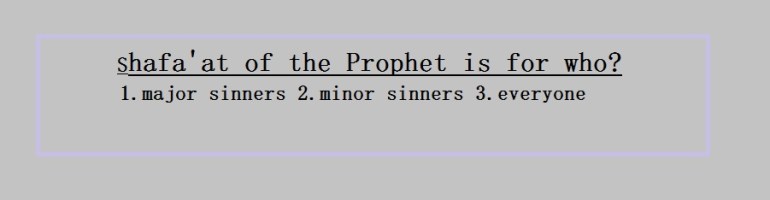
Muslims the world over, in all their denominations, believe that on the day of judgement no one will enter paradise without the intercession of the Blessed Prophet (saw).
The debate comes down to the following:
- Is this intercession for all those who testify that there is no god except Allah and Muhammed (saw) is his Messenger ?
- A special honour and privilege for the Muslims who fear Allah.
“He knows what is before them, and what is behind them, and they cannot intercede except for him, with whom He is pleased. And they stand in awe for fear of Him.” (Qur’an 21:28)
Imagine an individual who, their whole life they miss the prayers, they commit fornication and adultery, and they die unrepentant.
Is Allah content or pleased with this person? The answer is no!
The above verse provides clear-cut evidence that whatever Shafa’at that there will be, it will be for those with whom Allah (swt) is pleased.
In Christianity, they have a theological position that Christ Jesus is their intercessor on the day of judgement.
“My dear children, I write this to you so that you will not sin. But if anybody does sin, we have an advocate with the Father—Jesus Christ, the Righteous One.” (1 John 2:1)
“Who then is the one who condemns? No one. Christ Jesus who died—more than that, who was raised to life—is at the right hand of God and is also interceding for us.” (Romans 8:34)
“For, There is one God and one Mediator who can reconcile God and humanity—the man Christ Jesus.” (1 Timothy 2:5)
In Christianity, Faith in Jesus is enough. It is sufficient to enter into paradise.
In Islam, true faith is accompanied by righteous living, righteous action, and righteous deeds.
“He knows what is before them, and what is behind them, and they cannot intercede except for him, with whom He is pleased. And they stand in awe for fear of Him.” (Qur’an 21:28)
“Those who carry the Throne and those around it glorify the praises of their Lord, have faith in Him, and seek forgiveness for the believers, Our Lord! You encompass everything in mercy and knowledge. So forgive those who repent and follow Your Way, and protect them from the torment of Hellfire.” (Qur’an 40:7)
From this verse we can understand that there are three major pre-conditions for Allah (swt) to forgive your sins.
- To believe in Islam.
- TTo actually want to be forgiven—via repentance.
- Follow the way Allah (swt) has set out for us.
One of the most important methods of interpreting the Qur’an is to apply to it the rules and the principles of the Arabic language. As the Qur’an itself was sent down in Arabic.
Consider, for example, the following verse:
“And warn them, [O Muhammed], of the Approaching Day, when hearts are at the throats, filled [with distress]. For the wrongdoers there will be no devoted friend and no intercessor [who is] obeyed.” (Qur’an 40:18)
When you look at this verse you will see the مَا (mā) which is used in the Arabic language to negate. And then come two nouns. The first is ḥamīmin and the other is shafīʿin. Both are indefinite nouns. This means that this verse implies a general sense. Meaning that all intercessors and all friends will not be acceptable on the day of judgement to intercede for the wrong doers.
So there is a principle in the Arabic language and fundamentals of Islamic jurisprudence known as uṣūl al-fiqh saying that if an indefinite noun is found in a negative context or prohibitive context or conditional context, it will produce a general sense.
So what we get from this is that no one will intercede for a person who did not repent in this temporal world.
We have seen that one of the most damnable articles of faith held by some Muslims is the belief that the sinners who died unrepentant will be admitted into paradise on the day of judgement.
Now contrast this belief with the following authentic tradition of the Blessed Prophet (saw).
Narrated Abu Huraira:
When Allah revealed the verse: “Warn your nearest kinsmen,” Allah’s Messenger (saw) got up and said, “O people of Quraish (or said similar words)! Buy (i.e. save) yourselves (from the Hellfire) as I cannot save you from Allah’s Punishment; O Bani `Abd Manaf! I cannot save you from Allah’s Punishment, O Safiya, the Aunt of Allah’s Messenger (saw)! I cannot save you from Allah’s Punishment; O Fatima bint Muhammed! Ask me anything from my wealth, but I cannot save you from Allah’s Punishment.”
Source: (https://sunnah.com/bukhari:2753)
Now what do we understand from this tradition? Will there be intercession for the unrepentant sinners? Will there be intercession for the wrongdoers and wicked who died unrepentant?
If you want to learn more about authentic doctrine derived from the Qur’an and Sunnah you may wish to read here: https://primaquran.com/theology-al-%ca%bfaqidah/
May Allah Guide the Ummah.
May Allah Forgive the Ummah.


 Prima Quran