“Indeed, We have made it (ja’alnahu) an Arabic Qur’an that you might understand.” (Qur’an 43:3)
﷽
The truth of the matter is that the entire Muslim Ummah are in agreement that some aspect of the Qur’an is created. What they differ and disagree about are the specifics.
This debate has been framed incorrectly. It has been framed as a debate between those who believe the Qur’an is created and those who believe the Qur’an is uncreated.
The reality: The debate is about to what degree and which aspects of the Qur’an are created.
For example:
1. The Mushaf. The pages that the ink is printed upon. All Muslims call this the Qur’an. There is etiquette in regard to it. We do not bring it to dirty places. The proper disposal is to burn it’s pages. Yet, this is called ‘Qur’an’. Everyone who can be called Muslim agrees to this. That is that the Mushaf of the Qur’an is created. If there is a person who disagrees with this and or is hesitant to affirm this then know that they are upon something very strange.
2. The ink and the words which are written. The words and letters on the pages that were placed there by ink or the printing press. All Muslims call this the Qur’an. Everyone who can be called Muslim agrees to this. That is that the ink and the words on the pages are created.If there is a person who disagrees with this or is hesitant to affirm this then know they upon something very strange.
3. The recitation of the words of the Qur’an. This is is what we will be discussing today.
We will learn that the one who compiled ‘Sahih Bukhari’, whose full name is: Abū ʿAbd Allāh Muḥammed ibn Ismāʿīl ibn Ibrāhīm ibn al-Mughirah ibn Bardizbah al-Juʿfī al-Bukhārī and his supporter who compiled ‘Sahih Muslim’ . Both believed that their recitation of the Qur’an is created. This caused a boycott of Bukhari by major Hanbali scholars..
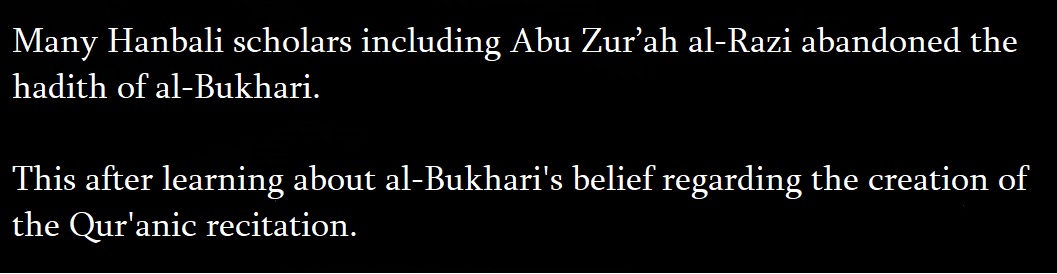
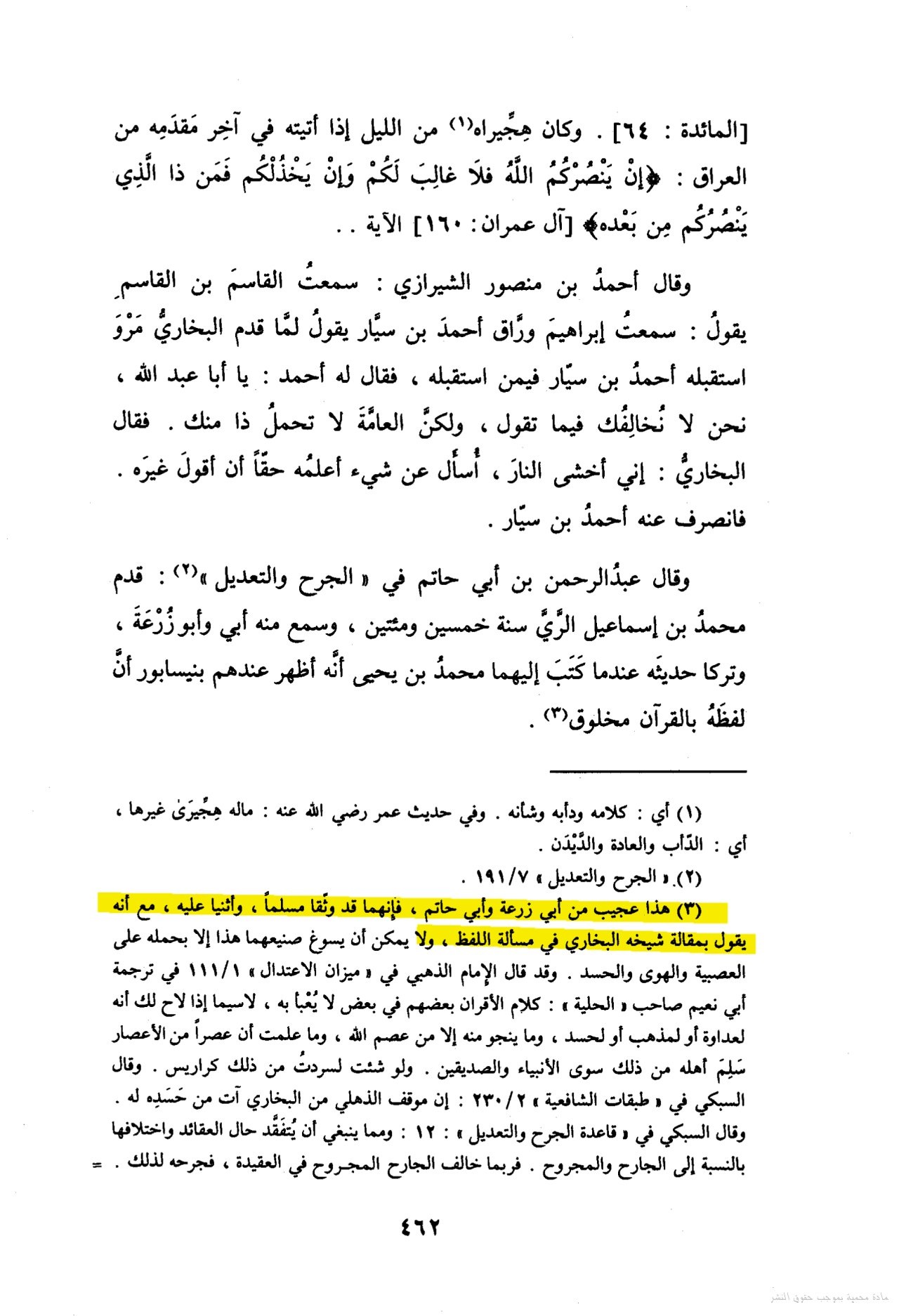
“Muhammed bin Yahya al-Nisaburi wrote to the people of Rayy, informing them of al-Bukhari’s position. The accusation was that al-Bukhari held “lafzi bil-Quran makhluq”. That his pronunciation/recitation of the Quran is created.”
“My father and Abu Zur’ah heard from him, then they both abandoned his hadith when Muhammed bin Yahya al-Nisaburi wrote to them that he [al-Bukhari] had made it apparent to them that his pronunciation of the Qur’an is created.”
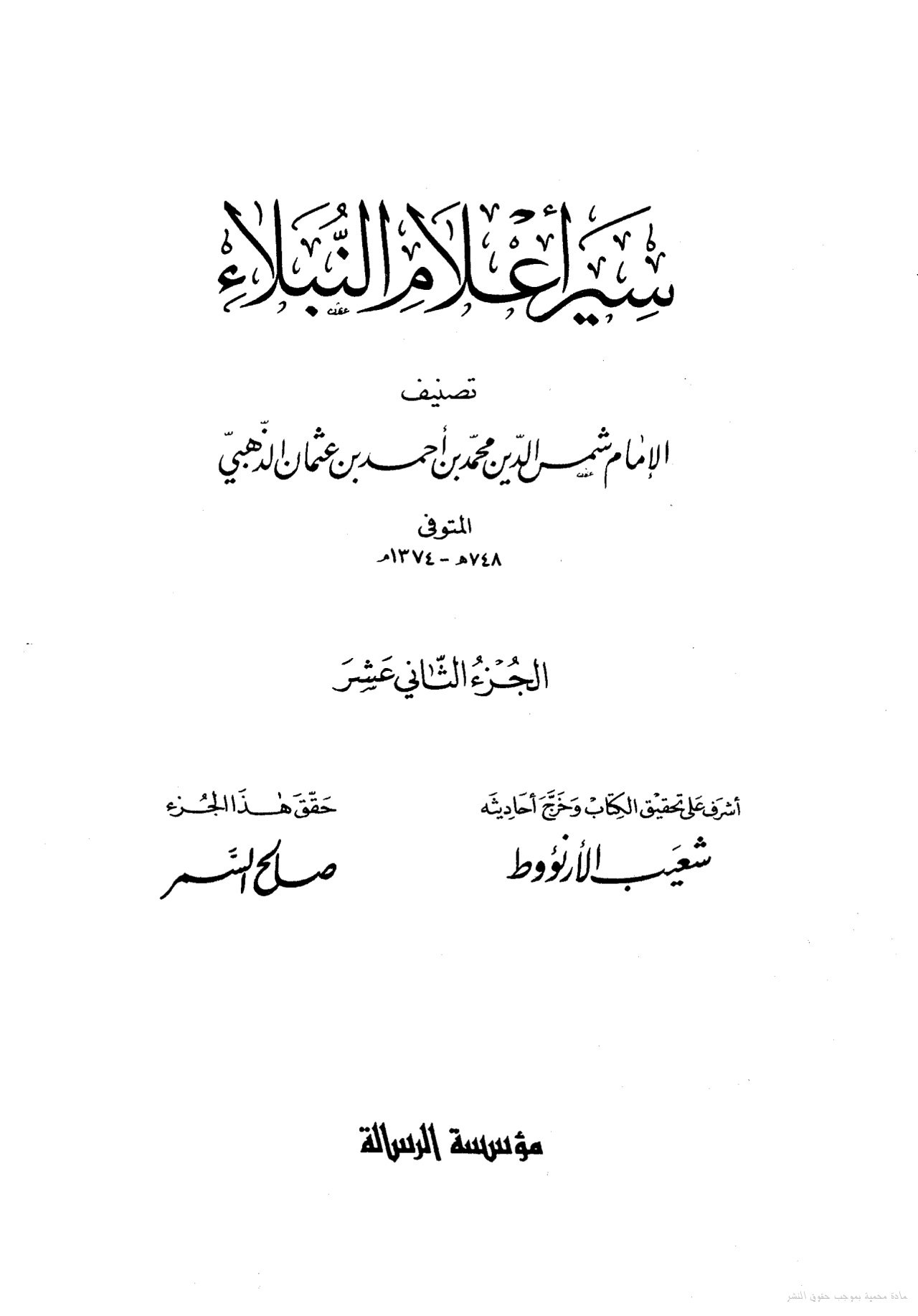
Source: (page 462 from Volume 12 of Siyar A’lam al-Nubala’ (Biographies of the Noble Scholars) by Imam al-Dhahabi, edited by Shu’ayb al-Arna’ut.)
“[Al-Ma’idah: 64]. And his emigration (hijrah)(1) was from Mecca. He came to Iraq at the end of the night… [Quranic verse]: “If Allah helps you, none can overcome you; and if He forsakes you, who is there after Him that can help you?” [Al Imran: 160].”
“And Ahmad bin Mansur al-Shirazi said: I heard al-Qasim bin al-Qasim say: I heard Ibrahim, the scribe of Ahmad bin Sayyar, say: When al-Bukhari arrived in Marw, Ahmad bin Sayyar met him. So he said to him: “O Abu Abdullah, we do not oppose you in what you say, but the common people cannot bear this from you.” He [al-Bukhari] said: “I only ask about something I know to be true, fearing the Fire, lest I say other than it.” So Ahmad bin Sayyar turned away from him.”
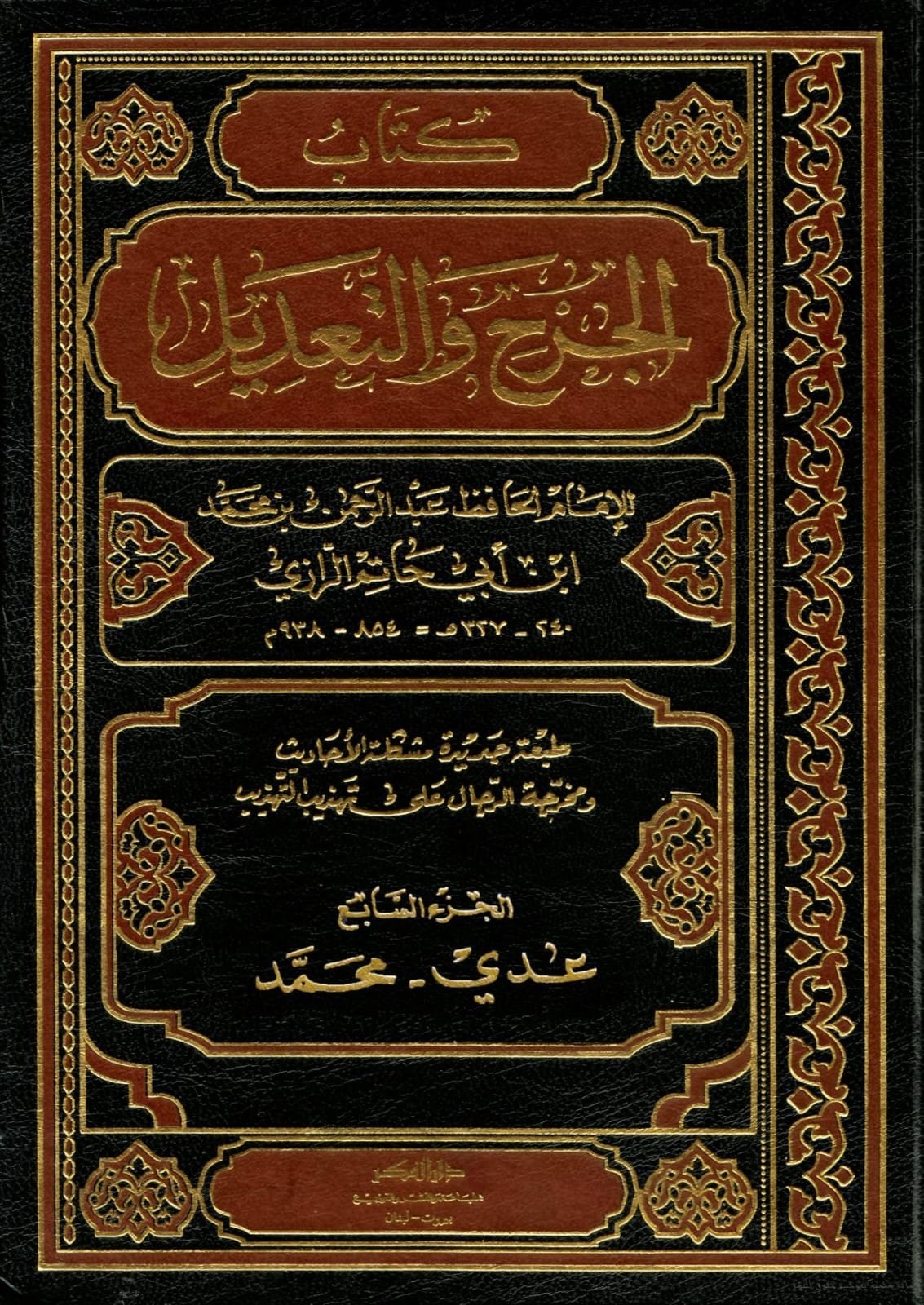
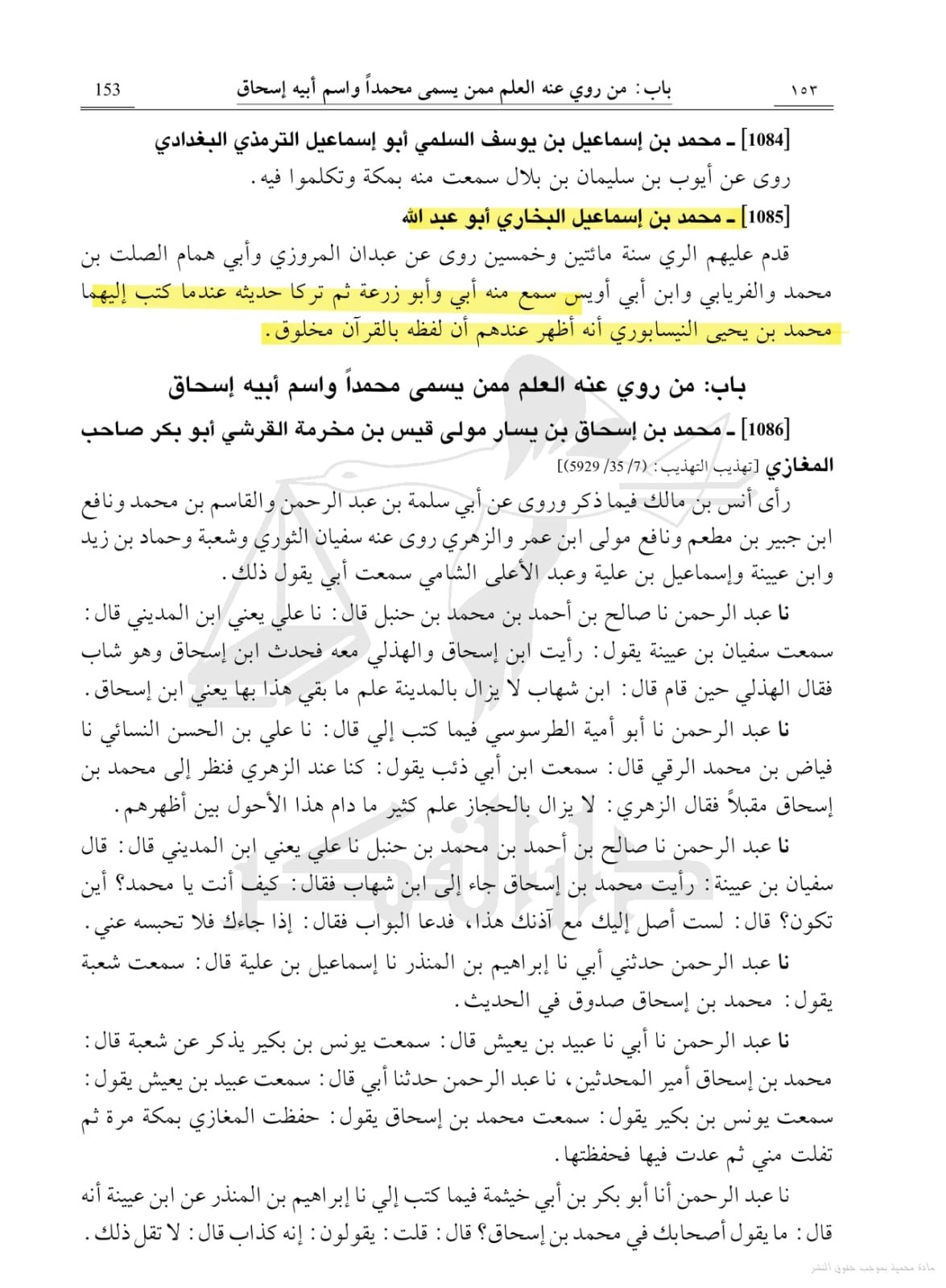
“And Abd al-Rahman bin Abi Hatim said in Al-Jarh wa al-Ta’dil (2): Muhammed bin Isma’il al-Rayy came in the year 210 AH, and my father and Abu Zur’ah heard from him. And they abandoned his hadith when Muhammed bin Yahya al-Nisaburi wrote to them that he [al-Bukhari] had made it apparent to them that his pronunciation of the Quran is created.“
Then Shu’ayb al-Arna’ut comments on this.
By the way for those not familiar when you see the name Shu’ayb al-Arna’ut it is a reference to Abū Usāmah Shuʿayb ibn Muḥarram ibn ʿAlī al-Albānī al-Arnāʾūṭ.
Most people in Salafi/Athari circles simply refer to him as: al-Albānī.
So al-Albānī (Shu’ayb al-Arna’ut) comments:
“This is strange from Abu Zur’ah and Abu Hatim, for they both had already heard from him [al-Bukhari] and narrated from him, and they did not abandon him except based on the statement of their teacher al-Bukhari regarding the issue of lafz [pronunciation]. And it is not permissible for them to act upon this, due to what it entails of sin, caprice, and envy. And Imam al-Dhahabi said in Mizan al-I’tidal 1/111 in the biography of Abu Nu’aym, the author of Al-Hilyah: “The words of some of them regarding others are not to be relied upon, especially if it becomes clear to him that it is due to partisanship for a madhhab or envy. And no one is safe from that except one whom Allah protects. And I do not know of an era from the eras that is safe from that except the era of the Prophets and the Rightly Guided Caliphs. And if you wish, I could list that in volumes.” And al-Subki said in Tabaqat al-Shafi’iyyah 2/230: “The position of al-Dhuhali [Muhammed bin Yahya] regarding al-Bukhari came from envy of him.” And al-Subki said in Qa’idah al-Jarh wa al-Ta’dil 12: “And from what should be examined is the state of beliefs and their differences in relation to the critic and the criticized. For perhaps the critic is wronged in creed, so his criticism of him is [invalid].”-Shaykh al-Albānī
Source: (page 462 from Volume 12 of Siyar A’lam al-Nubala’ (Biographies of the Noble Scholars) by Imam al-Dhahabi, edited by Shu’ayb al-Arna’ut.)
Examining Shaykh al-Albānī charge of envy for abandoning Bukhari for his position on the createdness of the Qur’an.
Shaykh Shaykh al-Albānī’s argument in the highlighted footnote is essentially this: Abu Zur’ah’s criticism cannot be sincere because he also narrated from Muslim, who shared al-Bukhari’s theological position.
If Abu Zur’ah was willing to accept hadith from Muslim, he should have accepted them from al-Bukhari on the same grounds. Unless his abandonment of al-Bukhari was motivated by petty jealousy, or partisanship.
We have to be fair here in saying that Shaykh al-Albānī’s claim has a very strong basis.
This reasoning has some historical traction, but it is not the whole picture:
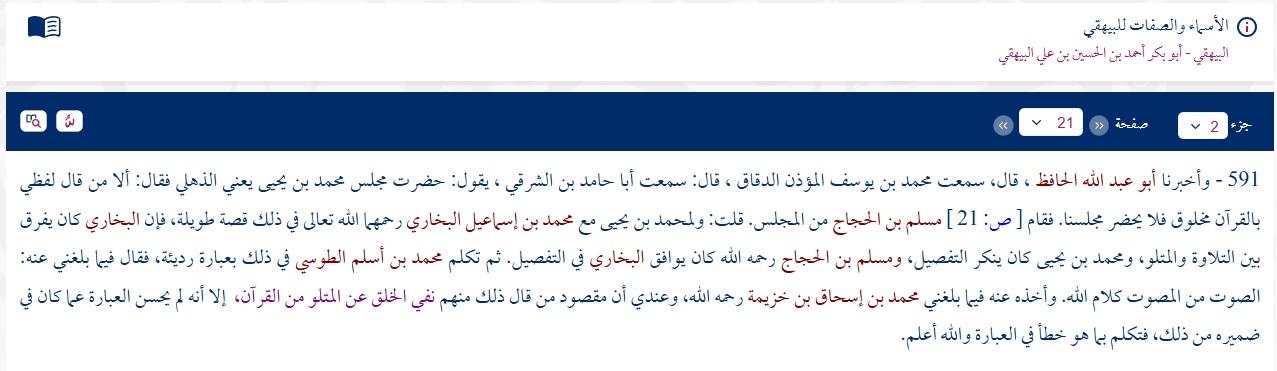
Muslim’s Position: It is well-established that Imam Muslim did agree with al-Bukhari on the lafz issue. Al-Bayhaqi explicitly stated that Muslim “was on the madhhab of al-Bukhari in the distinction” between recitation and the recited. Muslim also famously stood by al-Bukhari during the boycott, taking his written works back from al-Dhuhali and withdrawing from his circle.
Source: (Siyar A’lam al-Nubala’ 12/460, Huda al-Sari in the introduction to Fath al-Bari 2/264)
Imam Muslim was the only one who did not abandon Imam al-Bukhari, since they were upon the same creed. Their creed opposed that of the Hanbali who opposed them.
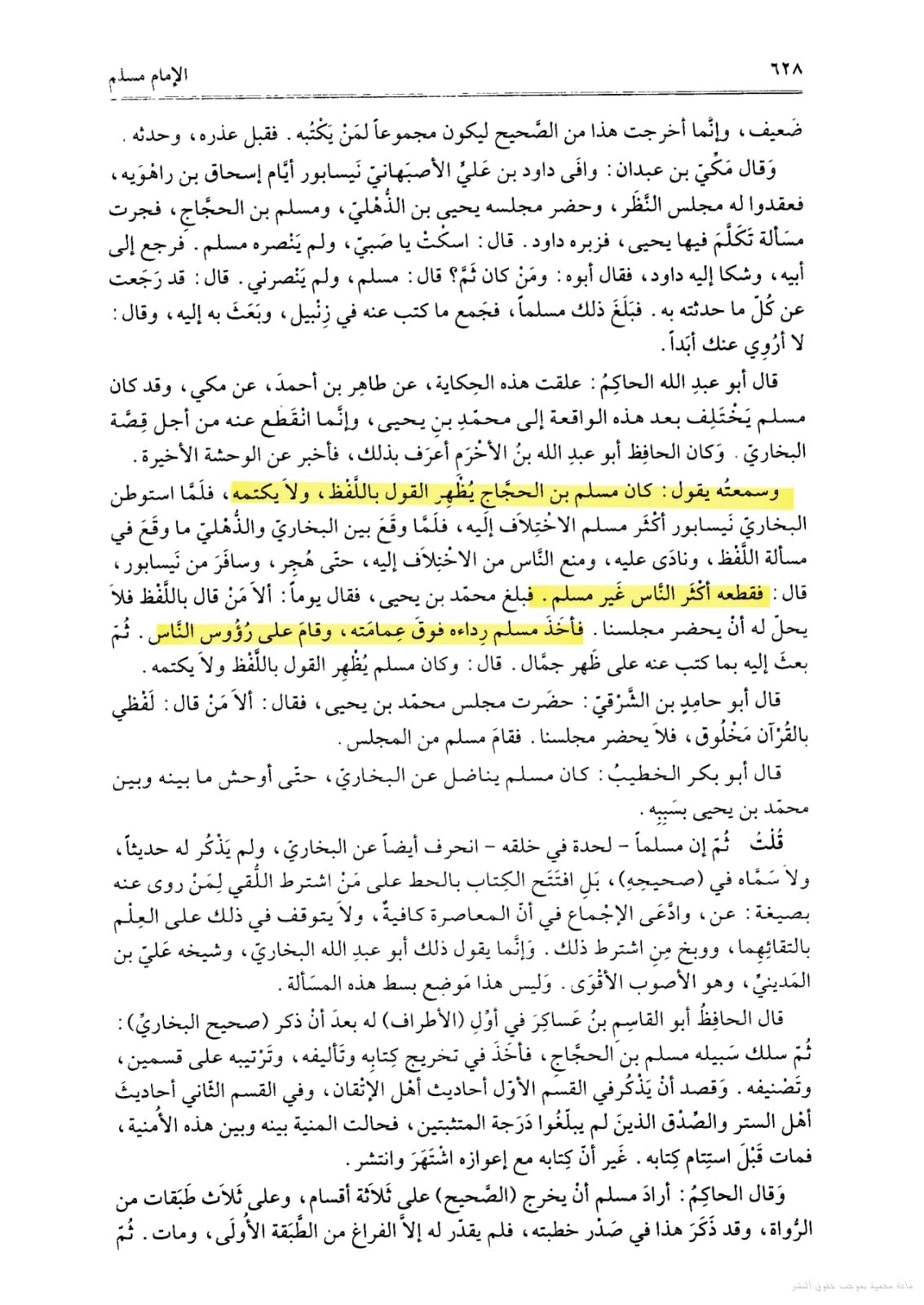
“And Makki bin Abdan said: Dawud bin Ali al-Asbahani came to Nisapur during the days of Ishaq bin Rahwayh. They held a session of debate for him, and he attended the circle of Yahya bin al-Dhuhali, and Muslim bin al-Hajjaj. A theological issue was discussed in which Yahya spoke, and he silenced him, saying: “Be quiet, O boy!” So Muslim did not support him. He returned to his father and complained to him. His father said: “Who was he?” He said: “Muslim.” He said: “You have returned from every single one of my hadiths!” [Meaning: you have ruined your standing with him]. When this reached Muslim, he gathered what he had written from him in a notebook, sent it to him, and said: “I will never narrate anything from you ever again.”
“Abu Abdullah al-Hakim said:I have noted this story from Tahir bin Ahmad, from Makki, and Muslim may have differed after this incident with Muhammed bin Yahya, but he only cut him off because of the issue of al-Bukhari. And al-Hafiz Abu Abdullah bin al-Akhram knew that, so he informed about the alienation [that occurred] later.”
“And I heard him [al-Hakim] saying:Muslim bin al-Hajjaj used to openly declare the statement regarding al-lafz [the pronunciation of the Quran], and he did not conceal it. When al-Bukhari settled in Nisapur, he openly declared more of the disagreement with him. When the issue of al-lafz occurred between al-Bukhari and al-Dhuhali, and the people of Nisapur were prevented from differing with him [al-Dhuhali], and he called to that, the majority of people cut off from Muslim, other than a few. It reached Muhammed bin Yahya, and he said one day: “Whoever says al-lafz is not created, it is not permissible for him to attend my circle.” So Muslim took his garment, placed it on his shoulder, stood up before the people, and sent to him what he had written from him, saying: “We only used to narrate from you because of al-lafz.” And Muslim used to openly declare the statement regarding al-lafz and not conceal it.“
“Abu Hamid bin al-Sharqi said: I attended the circle of Muhammed bin Yahya, and he said: “Whoever says: ‘My pronunciation of the Quran is created,’ let him not attend my circle.” So Muslim stood up from the circle.”
“Abu Bakr al-Khatib said: Muslim used to fight on behalf of al-Bukhari, until the relationship between him and Muhammed bin Yahya became estranged, due to his [al-Bukhari’s] reason.”
“I [al-Dhahabi] said:Then, [if] he was a Muslim due to his createdness [meaning: his stance on the creation of actions] he also turned away from al-Bukhari, and did not mention him as a narrator of hadith, nor did he name him in his Sahih. Rather, he began the book with the wording of those who stipulated al-lafz for whomever he narrated from, in a manner that claims consensus in the contemporary era is sufficient [to establish it], and he did not pause on that knowledge of the two of them, and he criticized whoever stipulated that. But rather, Abu Abdullah al-Bukhari said that, and his teacher Ali bin al-Madini, and it is the most correct and most sound [position]. And this is not the place to elaborate on this issue.”
“The Hafiz Abu al-Qasim bin Asakir said in Al-Atraf: It is after he mentioned [the Sahih of al-Bukhari]: Then he followed the path of Muslim bin al-Hajjaj, and he took the extraction of his book, its composition, and its arrangement into two parts. He intended to mention in the first part the hadiths of the reliable people of precision, and in the second part the hadiths of the people of covering and truthfulness, those who did not reach the rank of the firmly established. The death prevented him from completing this aspiration, and between him and this aspiration was the completion of his book. However, his book became famous and spread despite his need for it [to be completed].”
“And al-Hakim said: Muslim wanted to extract the Sahih into three categories, and upon three generations of narrators. He mentioned this at the beginning of his introduction, but he was not able to finish except the first category, and he died.”
Source: (page 628 from Volume 12 of Siyar A’lam al-Nubala’, in the biography of Imam Muslim)
The second point.
Abu Zur’ah’s Relationship with Muslim: Abu Zur’ah was not hostile to Muslim. In fact, Muslim submitted his Sahih to Abu Zur’ah for review, and Abu Zur’ah’s approval was seen as a mark of its authenticity. if Abu Zur’ah accepted Muslim’s Sahih despite his lafz views, why did he abandon al-Bukhari?
Insh’Allah we will update this page and provide an easily accessible online source when it becomes available.
If you would like to learn more about this specific subject please read the following:
“We certainly brought you the truth, but most of you, to the truth, were averse.” (Qur’an 43:78)
“And of the people is he who disputes concerning Allah without knowledge or guidance or an enlightening Book, twisting his neck to mislead from the way of Allah. For him in this world is disgrace, and We will make him taste on the Day of Resurrection the punishment of the Burning Fire.” (Qur’an 22:8-9)
﷽
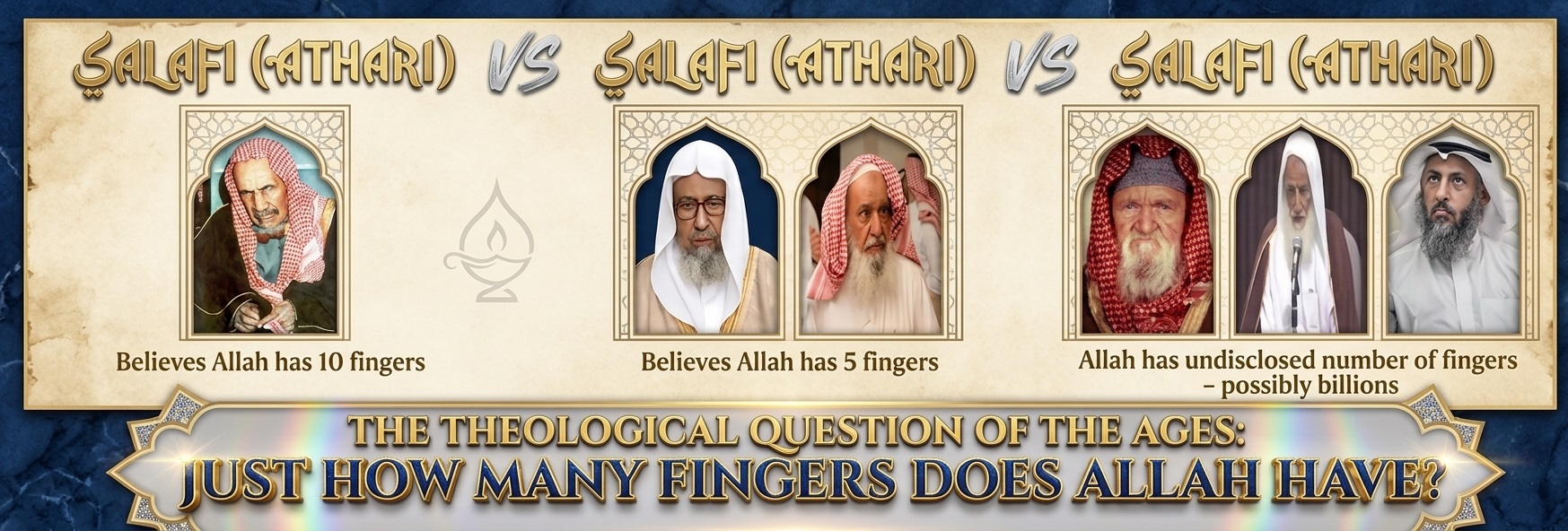
In this article we explore who has the correct aqidah? Which of the Salafi (Athari) are among the Mu’attilah and which are not?
Who is correct in regarding a theological matter of great importance: HOW MANY FINGERS DOES ALLAH HAVE?
A matter in which Muslims can be removed from Islam and a matter in which the blood of a believer may be considered permissible.
Just how many fingers does Allah have? The debate among the Athari/Salafi rages on!
First let it be said as regard the video we disavow the meme and the laughing emojis. We can make our points without appealing to such.
Shaykh Uthman al-Khamis:
فهل نثبت لله خمسه اصابع؟ نثبت لله الاصابع والحديث ما في خمسه اصابع. الحديث ما في خمسه اصابع وانما قال ان الله يحمل السماوات على اصبع والاراضين على اصبع والجبال على اصبع والشجر على اصبع ما في تحديد خمس اصابع فلا نحدد نقول لله اصابع تليق به ونسكت
English Translation: “So do we affirm five fingers for Allah? We affirm fingers for Allah, but the Hadith does not mention five fingers. The Hadith does not mention five fingers; rather, it states that Allah places the heavens on a finger, the earths on a finger, the mountains on a finger, and the trees on a finger. There is no specification of five fingers, so we do not specify. We say that Allah has fingers that befit Him, and we remain silent. -Shaykh Uthman al-Khamis.
احسن الله اليكم سائل يقول هل الاعتقاد الصحيح هو ان لله خمس اصابع فقط
English Translation: “May Allah be good to you, a questioner asks: Is the correct belief that Allah has only five fingers?”
Shaykh Abdul-Aziz Bin Baz:
يعني كل يد لها خمس اصابع ان الله جل وعلا له يدان ولكل يد دن اصابع وهذا من الكمال
English Translation: “Meaning, each hand has five fingers. Indeed, Allah, Majestic and Exalted, has two hands, and each hand has fingers, and this is a matter of perfection.” -Shaykh Abdul-Aziz Bin Baz
Shaykh Muhammed Nasir al-Din al-Albani says the hadith does not prove Allah (swt) has five fingers.
Al-Albani was asked directly: “The hadith counts five. Does this mean Allah has five fingers?” He replied: “No! We do not add to the hadith nor subtract from it.” When pressed that the five is a mafhūm (implied meaning), he said: “There is no harm in taking the mafhūm as long as it does not contradict an explicit text.”
So here we have Shaykh Muhammed Nasir al-Din al-Albani saying that implication has a basis in theology!
Shaykh Al Uthaymin says Allah has an undetermined number of fingers.
Uthaymin was even more explicit in warning against the question itself. In his lecture on al-ʿAqīdah al-Saffārīniyyah, he said:
“A questioner asked me: ‘What do you say about Allah’s fingers. How many?’ I said: ‘Do you have to know this? Affirm that Allah has fingers as the Prophet ﷺ said. As for how many? We cannot speak about this.’ By Allah, you are not more eager for knowledge of Allah than the Companions! When the Prophet ﷺ said ‘Allah places the heavens on a finger,’ did they say: ‘O Messenger of Allah, does Allah have more than three fingers?’ They did not. Because they were more complete in manners and more reverent toward Allah than those who came after them.”
Shaykh Abdul-Aziz al-Rajihi believes that Allah (swt) has five fingers.
في هذه الأحاديث إثبات الأصابع للرب عز وجل، وأن لله خمسة أصابع وهي صفات ذاتية تليق بالله، وأن الله تعالى يضع السموات على أصبع والأرضين على أصبع والشجر والثرى على أصبع وسائر خلقه على أصبع. في الحديث الأول: «يُمْسِكُ السَّمَوَاتِ عَلَى إِصْبَعٍ، وَالأَْرَضِينَ عَلَى إِصْبَعٍ، وَالْجِبَالَ عَلَى إِصْبَعٍ، وَالشَّجَرَ عَلَى إِصْبَعٍ» فهذه خمسة أصابع.
English translation:
“In these hadiths there is affirmation of fingers for the Lord, Mighty and Majestic, and that Allah has five fingers, which are attributes of His essence befitting Allah, and that Allah, the Most High, places the heavens upon a finger, the earths upon a finger, the trees and the soil upon a finger, and the rest of His creation upon a finger. In the first hadith: ‘He holds the heavens upon a finger, the earths upon a finger, the mountains upon a finger, and the trees upon a finger’ So these are five fingers.”- Shaykh Abdul-Aziz al-Rajihi
Shaykh Saleh al-Fawzan’ mentions that Allah has five fingers and he affirms this as the belief of Muhammed ibn Abd al-Wahhab in his ‘Book of Tawhid’.
“نعم، شوف في آخر كتاب التوحيد أن الله -جَلَّ وَعَلا- يطوي السماوات السبع، والأراضين السبع بيديه، أو يجعل البحار على أصبع، أو يجعل الجبال على أصبع، راجع آخر كتاب التوحيد في هذا… إلى أن ذكر خمسة أصابع… نعم، نثبت الأصابع لله عز وجل.”
English translation:
“Yes, look at the end of Kitab al-Tawhid. That Allah, Mighty and Majestic, rolls up the seven heavens and the seven earths with His two Hands, or places the seas upon a finger, or places the mountains upon a finger. Refer to the end of Kitab al-Tawhid on this… until he mentioned five fingers… Yes, we affirm the fingers for Allah, Mighty and Majestic.” -Shaykh Al-Fawzan’
What are the Salafi (Athari) basing their theology on?
They are basing upon the statement of a Jewish scholar (al-ḥabr), where the Blessed Prophet (saw) laughed at what he said and then quoted a verse from the Qur’an in rebuke. However, due to their bizarre theology that relies heavily upon statements from Jews they have taken it as an evidence in regard to a grave matter!
“And they have thereof no knowledge. They follow not except assumption (probablistic), and indeed, assumption avails not against the truth at all.” (Qur’an 53:28)
“O humanity! Eat from what is lawful and good on the earth and do not follow Satan’s footsteps. He is truly your sworn enemy. He only incites you to commit evil and indecency, and to claim against Allah what you do not know.” (Qur’an 2:168-169)
What is the source of this discord among the various shayks of this Salafi sect?
Dear readers this is crucial. Pay close attention to the following information. We want you to note the details.
Narrated `Abdullah:
A (Jewish) Rabbi came to Allah’s Messenger (ﷺ) and he said, “O Muhammed! We learn that Allah will put all the heavens on one finger, and the earths on one finger, and the trees on one finger, and the water and the dust on one finger, and all the other created beings on one finger. Then He will say, ‘I am the King.’ Thereupon the Prophet (ﷺ) smiled so that his pre-molar teeth became visible, and that was the confirmation of the Rabbi. Then Allah’s Messenger (ﷺ) recited: ‘They made not a just estimate of Allah such as is due to Him. And on the Day of Resurrection the whole of the earth will be grasped by His Hand and the heavens will be rolled up in His Right Hand. Glorified is He, and High is He above all that they associate as partners with Him.’ (39.67)
A man from the People of the Book came to the Prophet, may God bless him and grant him peace, and said: O Abu al-Qasim, God holds the heavens on one finger, the earths on one finger, the trees and the soil on one finger, and the creatures on one finger, then He says: I am the King, I am the King. I saw the Prophet, may God bless him and grant him peace, laugh until his molars were visible, then he recited: {They have not appraised God with true appraisal} [Al-An’am: 91]
The [الأنعام: 91] reference in the Qur’an in the above quoted text is an editorial insertion by dorar.net—not part of the hadith wording itself. It is the website’s own cross-reference, added to tell the reader where they think the verse comes from.
The discrepencies between the two reports.
The Questioner: Who came to the Blessed Prophet (saw)?
“A (Jewish) Rabbi” — حَبْرٌ مِنَ الأَحْبَارِ or “A man from the People of the Book” — رَجُلٌ مِنْ أَهْلِ الْكِتَابِ
How does the questioner address the Blessed Prophet (saw)?
“O Muhammed!” — يَا مُحَمَّدُ or “O Abu al-Qasim!” — يَا أَبَا الْقَاسِمِ
This is also reflected here:
“Muhammed, or Abu al-Qasim.” Showing the uncertainty of the transmitter as well as the fluidity of the text.
The description of Allah (swt) putting/holding the creation.
4811: Lists heavens → earths → trees → water and dust(combined) → all other created beings. Five categories.
7415: Lists heavens → earths → trees AND soil (combined) → creatures. Four categories.
2786a: Lists heavens → earths → mountains and trees (combined)→ water and moist soil (combined) → rest of creation. Five categories.
Minor difference in wording: “put” (4811) vs. “holds” (7415)
What does Allah (swt) actually say?
Then He will say, ‘I am the King.’” (once)
“Then He says: ‘I am the King, I am the King.’” (twice — repeated)
How Much of the Qur’anic verse was recited?
Full verse: “They made not a just estimate of Allah such as is due to Him. And on the Day of Resurrection the whole of the earth will be grasped by His Hand and the heavens will be rolled up in His Right Hand. Glorified is He, and High is He above all that they associate as partners with Him.”
Partial verse: “They have not appraised Allah with true appraisal” — {وَمَا قَدَرُوا اللَّهَ حَقَّ قَدْرِهِ}
Qur’an 39:67 (full verse)
Qur’an 6:91 (partial quote) ?
Both verses contain the phrase “وَمَا قَدَرُوا اللَّهَ حَقَّ قَدْرِهِ” — but they are in different surahs and have different full contexts. This could be a way that the narrators shortened the hadith.
The narrator’s framing.
“Thereupon the Prophet smiled… and that was the confirmation of the Rabbi. Then Allah’s Messenger recited…”
“I saw the Prophet laugh… then he recited…”
Analysis.
4811: The narrator inserts an interpretive comment (“that was the confirmation of the Rabbi”) before mentioning the recitation.
7415: The narrator simply reports what he saw and heard: the Prophet laughed, then recited. No interpretation.
The critical phrase: “In confirmation of the Rabbi.”
“and that was the confirmation of the Rabbi” — تَصْدِيقًا لِقَوْلِ الْحَبْرِ
NOT PRESENT — no equivalent phrase
Prima Qur’an comments:
This is a very crucial and important point.
Both websites are quoting from two different hadith in Sahih al-Bukhari. However sunnah.com also has the exact same transmission and wording as that found as the hadith used at dorar.net.
Narrated `Abdullah:
A man from the people of the scripture came to the Prophet (ﷺ) and said, “O Abal-Qasim! Allah will hold the Heavens upon a Finger, and the Earth on a Finger and the land on a Finger, and all the creation on a Finger, and will say, ‘I am the King! I am the King!’ ” I saw the Prophet (after hearing that), smiling till his premolar teeth became visible, and he then recited: — ‘No just estimate have they made of Allah such as due to him… (39.67)
A Jew came to the Prophet (ﷺ) and said, “O Muhammad! Allah will hold the heavens on a Finger, and the mountains on a Finger, and the trees on a Finger, and all the creation on a Finger, and then He will say, ‘I am the King.’ ” On that Allah’s Messenger (ﷺ) smiled till his premolar teeth became visible, and then recited:– ‘No just estimate have they made of Allah such as due to him….(39.67) `Abdullah added: Allah’s Apostle smiled (at the Jew’s statement) expressing his wonder and belief in what was said.
The crucial part of the Arabic text which is not translated into English:
قَالَ يَحْيَى بْنُ سَعِيدٍ وَزَادَ فِيهِ فُضَيْلُ بْنُ عِيَاضٍ عَنْ مَنْصُورٍ عَنْ إِبْرَاهِيمَ عَنْ عَبِيدَةَ عَنْ عَبْدِ اللَّهِ فَضَحِكَ رَسُولُ اللَّهِ صلى الله عليه وسلم تَعَجُّبًا وَتَصْدِيقًا لَهُ
English translation:
Yahya ibn Sa’id said: Fudail ibn ‘Iyad added to it, from Mansur, from Ibrahim, from ‘Abidah, from ‘Abdullah: “The Messenger of Allah (ﷺ) smiled out of amazement and in confirmation of him.”
The Blessed Prophet (saw) rejects the stament of the Jewish Man (Rabbi or not)
What is the evidence?
Now, without getting into the chains of transmission let us just take this phrase: “and that was the confirmation of the Rabbi“ as established.
What does this mean? That is not the statement of the Blessed Prophet (saw). That is the statement of a narrator or sub narrator.
The phrase “in confirmation of” claims to know why the Blessed Prophet (saw) laughed. It asserts that his inner intention was to confirm the rabbi’s statement.
This is a claim about the unseen (ghayb). No Companion, no narrator, and certainly no later transmitter has access to the Prophet’s (saw) internal thought process unless the Prophet (saw) himself stated it. The Prophet (saw) did not say “I am laughing to confirm what you said.” He simply laughed and then recited the verse.
The second evidence.
Narrated Abu Huraira:
The people of the Book used to read the Torah in Hebrew and then explain it in Arabic to the Muslims. Allah’s Messenger (ﷺ) said (to the Muslims). “Do not believe the people of the Book, nor disbelieve them, but say, ‘We believe in Allah and whatever is revealed to us, and whatever is revealed to you.’ “
This is a clear prohibition. The Prophet (saw) instructed his followers not to confirm what the People of the Book said. If the Prophet himself had then “confirmed” the rabbi’s statement, he would be doing the exact opposite of what he commanded his community to do. This is a logical contradiction that cannot stand.
The third evidence.
The verse itself says:
وَمَا قَدَرُوا اللَّهَ حَقَّ قَدْرِهِ-“And they did not appraise Allah with true appraisal”
“They have not appraised Allah with true appraisal, while the earth entirely will be [within] His grip on the Day of Resurrection, and the heavens will be folded in His right hand. Exalted is He and high above what they associate with Him” (Qur’an 39:67) –Sahih International (Athari’s fav translation after Muhammed Muhsin Khan & Muhammed Taqi-ud-Din al-Hilali)
This verse:
Rebukes those who fail to appraise Allah properly.
Replaces the rabbi’s finger-by-finger image with a total, simultaneous grasp.
Declares Allah exalted above what they associate with Him — which includes the anthropomorphic image the rabbi just presented.
So the Prophet’s recitation was a corrective, not a confirmation. The phrase taṣdīqan lahu (“in confirmation of him”) is a narrator’s insertion. One that those who fell victim to anthropomorphism sized upon.
They turned a rebuke into an endorsement!
The broader usage of the word “hand” in the Qur’an reinforces this:
“Be patient over what they say, and remember Our servant, David, the possessor of many hands; he was one who repeatedly turned back [to Us].” (Qur’an 38:17)
Plural in Arabic begins with three and not two! So, at the very least David had three hands. However, notice something from the following site:
It is unanimous that they all translate ‘many hands’ as strength! Even the Salafi/Athari/Saudi translations do! Even the translation that gives us the most literal word for word meaning possible was too shy to translate David as having many hands.
“Be patient over what they say and remember Our servant, David, the possessor of strength; indeed, he was one who repeatedly turned back [to Allah ].” (Qur’an 38:17 Sahih International)
“Be patient (O Muhammed SAW) of what they say, and remember Our slave Dawood (David), endued with power. Verily, he was ever oft-returning in all matters and in repentance (toward Allah).” (Qur’an 38:17 Muhsin Khan & Muhammed Al Hilal)
If you would like to explore more on issues in regard to aqidah(creed) and theology you may be interested in the following:
They will reply, ‘We used to worship Messiah, the son of Allah.’ It will be said, ‘You are liars, for Allah has neither a wife nor a son. What: do you want (now)?’ They will say, ‘We want You to provide us with water.’ It will be said to them, ‘Drink,’ and they will fall down in Hell (instead). When there remain only those who used to worship Allah (Alone), both the obedient ones and the mischievous ones, it will be said to them, ‘What keeps you here when all the people have gone?’ They will say, ‘We parted with them (in the world) when we were in greater need of them than we are today, we heard the call of one proclaiming, ‘Let every nation follow what they used to worship,’ and now we are waiting for our Lord.’ Then the Almighty will come to them in a shape other than the one which they saw the first time, and He will say, ‘I am your Lord,’ and they will say, ‘You are our Lord.’ And none will speak to Him then but the Prophets, and then it will be said to them, ‘Do you know any sign by which you can recognize Him?’ They will say. ‘The Shin,’ and so Allah will then uncover His Shin whereupon every believer will prostrate before Him and there will remain those who used to prostrate before Him just for showing off and for gaining good reputation. These people will try to prostrate but their backs will be rigid like one piece of a wood (and they will not be able to prostrate). Then the bridge will be laid across Hell.” We, the companions of the Prophet (ﷺ) said, “O Allah’s Messenger (ﷺ)! What is the bridge?’
“Also among the narrations that contradict the verses of the Qur’an is that on the Day of Resurrection, people will be gathered on one plain. Then it will be said: then every nation will be commanded to follow what it used to worship. So the worshippers of the sun will follow the sun.” -Shaykh Masoud bin Muhammed Al Miqbali
“I don’t know where she is, the sun?! To protect the sun? Because the sun will be rolled up, so I don’t know who will protect the sun a second time. But the worshippers of the sun will follow the sun, and the worshippers of the moon will follow the moon. So each will follow what he used to worship.” -Shaykh Masoud bin Muhammed Al Miqbali
And this nation will remain, among them its hypocrites. Then Allah will come to them in a form other than the one in which they saw Him the first time — and in another narration, the one by which they knew Him the first time — and He will say to them, “What are you waiting for?” They will say, “We are waiting for our Lord; we will not leave our place until our Lord comes to us.” -Shaykh Masoud bin Muhammed Al Miqbali
“Then He will say, “I am your Lord.” They will say, “We seek refuge in Allah from you; you are not our Lord. We will not leave until our Lord comes to us.” Then He will go away from them, then come to them in another form and say to them, “I am your Lord.” -Shaykh Masoud bin Muhammed Al Miqbali
“In another narration, He says to them, “Is there a sign between you and Him?” They say, “Yes, the shin, the shin.” So He will uncover His shin for them, and they will all fall prostrate except those who did not pray in this world, for they will be prevented from prostrating. And this is His saying, the Most High: “On the Day when the shin shall be uncovered and they shall be called to prostrate, but they shall not be able.” -Shaykh Masoud bin Muhammed Al Miqbali
“This hadith I mean, it is more invalid than to be invalidated. And defining the known is not from the unknown.” -Shaykh Masoud bin Muhammed Al Miqbali
“First, attributing coming and going invalidates the divinity of Allah entirely! Because Ibrahim what did he say when the star set and the sun set? He said, “I do not love those that set.” Every god that disappears and appears this cannot be a god. “I do not love those that set.” And a god in this hadith who disappears and appears is not a god. What is Allah?” -Shaykh Masoud bin Muhammed Al Miqbali
“Then He has parts . He uncovers a shin. If you did not know, it is enough hmm. “On the Day when the shin shall be uncovered.” Okay, what was the barrier between Him and the shin? Is it an attribute of Allah, or something other than Allah? This is an issue. I mean, a dialectical, philosophical, theological matter.”-Shaykh Masoud bin Muhammed Al Miqbali
“But this which was uncovered? He did not say “so the shin is uncovered” or “so His shin is uncovered” like this. Okay, this which was uncovered, is it from Allah, an attribute of Allah’s attributes, or something additional? What is this which was uncovered?” -Shaykh Masoud bin Muhammed Al Miqbali
“And the shin. This means they do not know His face, they know His shin? They did not know Him by His face, they know Him by His shin? Something strange, this. And they saw Him the first time. Where did they see Him the first time?”-Shaykh Masoud bin Muhammed Al Miqbali
“And in reality, Allah said, “No vision can grasp Him. No vision can grasp Him, but He grasps all vision, and He is the Subtle, the Aware.” And the discussion ended. The hadith is sealed on this topic — the topic of vision. It was cooked until it was done, until it burned. It needs no words about it. So it is impossible for Allah, glorified and exalted, to ever be seen, absolutely.”-Shaykh Masoud bin Muhammed Al Miqbali
The Shaykh’s Critique: Point by Point
The Shaykh is analyzing the famous “hadith of the shin” / حديث الرؤية) and showing how it contradicts the Qur’an on multiple levels. Here is the breakdown:
The Narration Itself (Summary of the Hadith Being Critiqued)
The hadith describes the Day of Resurrection as follows:
People are gathered on one plain.
Every nation is told to follow what it used to worship.
Sun-worshippers follow the sun; moon-worshippers follow the moon.
The Muslim nation remains, including its hypocrites.
Allah comes to them in a form other than the one they first saw Him in.
They reject Him, saying: “We seek refuge in Allah from you — you are not our Lord.”
He leaves, then returns in a second form.
He says: “I am your Lord.”
They ask for a sign; He uncovers His shin.
They all prostrate except those who never prayed, who are prevented.
This is then linked to Qur’an 68:42: “On the day when it befalleth in earnest, and they are ordered to prostrate themselves but are not able.”
Point 2: The Sun Being “Rolled Up” Contradicts the Narration
The Shaykh’s argument:
The hadith says sun-worshippers will follow the sun on Judgment Day.
But the Qur’an says the sun will be “rolled up” (كُوِّرَتْ) — Qur’an 81:1.
So how can anyone “follow” the sun if it has already been extinguished/collapsed?
This is an internal contradiction in the narration itself.
Point 3: Coming and Going Invalidates Divinity
The Shaykh’s argument:
The hadith describes Allah as coming, leaving, then coming again in different forms.
But Ibrahim (Abraham) said about the star, moon, and sun when they set: “I do not love those that set” (Qur’an 6:76).
A god who disappears and reappears cannot be God.
If Allah “goes away” and “comes back,” He is subject to change, absence, and limitation — all of which contradict divine perfection.
Therefore, the very structure of the narration destroys Allah’s divinity.
Point 4: The “Shin” (Sāq) A Philosophical and Theological Problem
The Shaykh’s argument:
The hadith says Allah will “uncover His shin” as a sign.
The Shaykh asks: What was the barrier between them and the shin? Was the shin hidden? If so, why?
If the shin is an attribute of Allah, then Allah has body parts. Which contradicts His transcendence.
If the shin is something other than Allah, then what is it? And why would uncovering it serve as a sign of identity?
The people couldn’t recognize Him by His face, but they recognize Him by His shin? This is absurd.
The Qur’an says: “No vision can grasp Him, but He grasps all vision; and He is the Subtle, the Aware”(Qur’an 6:103).
This verse definitively closes the door on seeing Allah in any form.
Point 5: “Where Did They See Him the First Time?”
The Shaykh’s argument:
The hadith assumes they saw Allah before — “in the form they first saw Him.”
But when did they see Him the first time?
If seeing Allah is impossible (Qur’an 6:103), then the entire premise of the hadith collapses.
The narration is built on an assumption that itself contradicts the Qur’an.
Point 6: The Topic of Ru’yah (Seeing Allah) Is Settled
The Shaykh’s conclusion:
The hadith has been “cooked until it burned” meaning: it has been analyzed to death.
The Qur’an is explicit: Allah cannot be seen, ever, absolutely.
No further discussion is needed on this point.
The hadith is “more invalid than to be invalidated” — i.e., it is so clearly false that it doesn’t even need a formal refutation.
Summary Table of Contradictions
#
The Hadith Says
The Qur’an / Reason Says
Contradiction
1
Sun-worshippers follow the sun
The sun will be rolled up (81:1)
How can they follow something already destroyed?
2
Allah comes, leaves, returns
“I do not love those that set” (6:76)
A god who disappears is not God
3
Allah uncovers His shin
“No vision can grasp Him” (6:103)
Allah has no body parts; He cannot be seen
4
They saw Him the first time
When? Seeing Allah is impossible
False premise
5
They recognize Him by His shin
They couldn’t recognize His face
Absurd and degrading
The Shaykh’s Core Thesis
The hadith of the shin (and similar narrations about seeing Allah) are fabricated or corrupted because:
They contradict explicit Qur’anic verses.
They describe Allah withhuman-like attributes(body parts, movement, change).
They undermine tawhid (the absolute oneness and transcendence of Allah).
The Qur’an’s statement “No vision can grasp Him” is final and definitive — no hadith can override it.
The Shaykh is pointing to four Qur’anic verses that he says the hadith contradicts:
1. Qur’an 81:1 (Sūrat al-Takwīr) — “When the sun is wrapped up”
This verse states that on the Day of Resurrection, the sun will be extinguished and folded away. The Shaykh argues this contradicts the hadith’s claim that sun-worshippers will “follow the sun.” If the sun is already destroyed, how can anyone follow it?
2. Qur’an 6:76 (Sūrat al-An’ām) — “I do not love those that set”
This is from the story of Ibrahim (Abraham), who declared that a god who disappears (sets) cannot be Allah. The Shaykh argues this directly contradicts the hadith’s description of Allah “coming and going” in different forms. A deity subject to absence and change is, by Ibrahim’s own criterion, not divine.
This verse states that eyes cannot perceive Allah, while He perceives all vision. The Shaykh argues this absolutely closes the door on any possibility of seeing Allah. Whether in this world or the next. The entire premise of the hadith (that people will see Allah, recognize Him by His shin, etc.) is therefore impossible.
4. Qur’an 68:42 (Sūrat al-Qalam) — “On the day when it befalleth in earnest, and they are ordered to prostrate themselves but are not able”
Look at how various disparate English translations render the text:
The hadith uses this verse to justify its claim that Allah will literally “uncover His shin.” The Shaykh argues this is a gross misinterpretation. The verse is an Arabic idiom meaning a day of extreme hardship and severity. It is not a description of Allah’s body parts.
Look at: https://corpus.quran.com/wordbyword.jsp?chapter=68&verse=42#(68:42:1) The original Arabic word ساق which some translations render as ‘shin’ is in indefinite noun form. an-nakirah (النَّكِرَة). That is that it is not even a reference to Allah! That cannont be underscored enough!
If you enjoyed this article you may find the following articles useful:
“Joseph responded, “It was she who tried to seduce me.” And a witness from her own family testified: “If his shirt is torn from the front, then she has told the truth and he is a liar.” (Qur’an 12:26)
﷽
As Allah (swt) says, “washahida shāhidun min ahlihā” and a witness has witnessed from among themselves/folk/family.
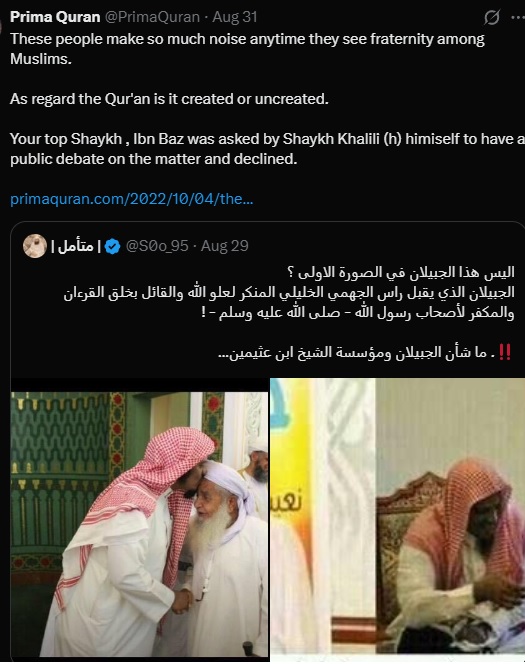
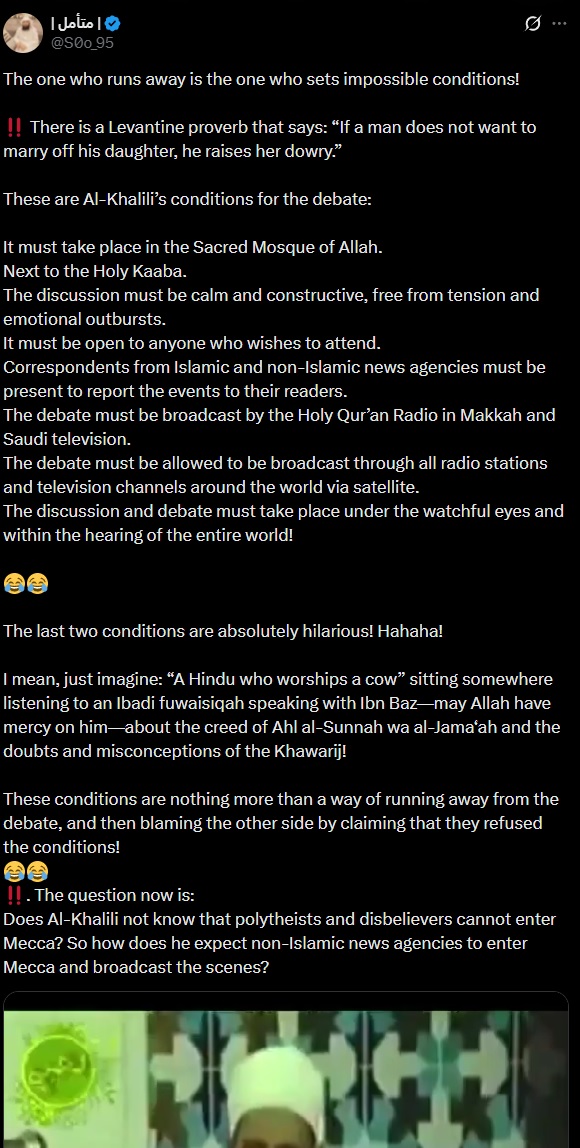
One of the more insolent of the claimants of Salafiyya were visibly upset at the love and camaraderie that is often shown between the people of Oman and the people of Saudi Arabia. This individual is from among those who like the division and fighting among the people. So this individual had posted once more attacking the noble Shaykh Ahmed Al Khalili as well as the good people of the Ibadi school.
So our reply was to remind this one that Ibn Baz himself was asked by Shaykh Khalili to have a public debate on the matter. This was in response to the interrogation and methods of Ibn Baz. It was pointed out to this man that he had his chance to prove the error of our creed and Ibn Baz backed down!
This is the link that was put in the reply to this individual:
Sometimes when you see these laughing emoji you pray within yourself that you are not dealing with a teenager. This is not something from serious individuals. Yet, the part he seemed most tickled about the following:
“Does Al-Khalili not know that polytheist and disbelievers cannot enter Mecca? So how does he expect non-Islamic news agencies to enter Mecca and broadcast the scenes?”
This shows you that this individual did not even bother to read the initial link for if he had he would have already found something quite shocking.
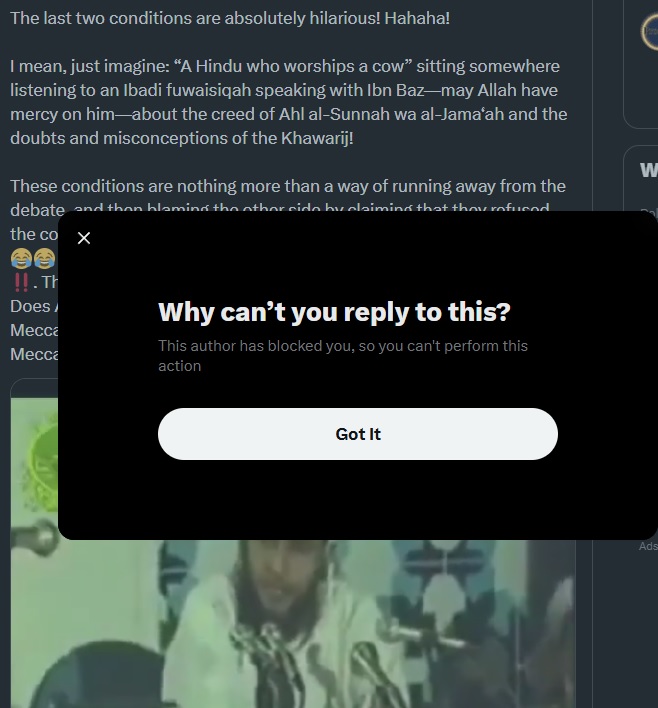
To our dismay the following showed up.
This ‘warrior’ of the supposed correct doctrine tucked tail and ran away. However, there is a day of reckoning in which we all be held accountable. For everything that our hands sent forth.
So let us address the part that tickled this individual.
“Does Al-Khalili not know that polytheist and disbelievers cannot enter Mecca? So how does he expect non-Islamic news agencies to enter Mecca and broadcast the scenes?”
Hmm. So the Mufti of a Muslim nation is not aware that polytheist and disbelievers cannot enter Mecca. How likely is this? This man must be unaware of the fact that Muslims themselves can be employed have been employed by Non Muslim media such as CNN and BBC.
Like how this non Muslim network documented the hajj?
The presence of world media does not equal to the presence of the world itself. Likewise the presence of non Muslim media does not equate to the presence of Non Muslims themselves.
But the deathblow to this rabble-rouser came not from Prima Qur’an, nor from any of the other Ibadi students or laypeople. The deathblow to this rabble rouser came from one of the students of Ibn Baz himself.
الشيخ عبد العزيز بن باز رحمه الله هذا الامام العجيب ارسل احد كبار المفتين في دوله عربيه وهو على مذهب الخوارج على مذهب الخوارج وهو مفتي تلك البلاد وهم ينكرون رؤيه الله جل وعلا كما تعلمون في الاخره ينكرون رؤيه الله كالمعتزلة [موسيقى] ولا نعلم في زمنه اعلم منه فقال لا لا ما ناقش قيل له لماذا يا شيخ قال طيب لما اناقشه قد يكون الحم بحجته مني فاكون سببا لضلال بعض الناس قد يكون الحم مني بالحجه والنقاش فيكون سبب يكون سبب لاظ بعض الناس فرفض الشيخ ناقش فان صاحب الحق لا يكون هيابا ولا جبانه بل صاحب الحق يجر على اظهار الحق الذي يعتقد
Which is translated:
“Shaykh Abdul Aziz ibn Baz, may Allah have mercy on him. This remarkable imam. Once received a message from one of the senior muftis in an Arab country, who follows the doctrine of the Khawarij. Yes, he follows the doctrine of the Khawarij, and he is the mufti of that country. They deny the seeing of Allah, may He be glorified and exalted, in the Hereafter. They deny the seeing of Allah, just like the Mu’tazila. And we do not know of anyone in his time more knowledgeable than him. So he said, “No, no,” and did not engage in debate. He was asked, “Why, O Shaykh?”He said, “Well, if I debate him, it might be that he overcomes me with his argument,and I would then be a cause for the misguidance of some people. Or it might be that I overcome him with argument and de bate, and that would be a cause for the misguidance of some people.” So the Shaykh refused. Debate, for the one who is upon the truth, should not be timid or cowardly; rather, the one upon the truth should be eager to manifest the truth that he believes in.”
Nothing in there at all about Non Muslim media networks! Just a simple admission that Shaykh Ibn Baz felt that Shaykh Khalili could have strong arguments!
As Allah (swt) says, “washahida shāhidun min ahlihā” and a witness has witnessed from among themselves/folk/family.
If you would like to read more about the issue of the Qur’an being created and other aqidah matters we encourage you to read the following:
Surely those who say, “Our Lord is Allah,” and then remain steadfast, the angels descend upon them, “Do not fear, nor grieve. Rather, rejoice in the good news of Paradise, which you have been promised.” (Qur’an 41:30)
﷽
The Prophet (saw) said to Ali: Lā yadkhulu al-jannah illā nafs muʾminah” (لَا يَدْخُلُ الْجَنَّةَ إِلَّا نَفْسٌ مُؤْمِنَةٌ)
Zaid bin Yathi’ said: We asked Sayyiduna Ali: With what message did the Messenger of Allah (saw) send you? He replied: I was sent with four things. First, that only a believing soul will enter Paradise.
Belief in Islam is composed of three major elements.
To proclaim with the tongue there is no God except Allah and Muhammed (saw) is his Messenger.
Sincerity with Allah.
Actions. To do righteous deeds and to avoid evil deeds.
Surely those who say, “Our Lord is Allah,” and then remain steadfast, the angels descend upon them, “Do not fear, nor grieve. Rather, rejoice in the good news of Paradise, which you have been promised.” (Qur’an 41:30)
Does anyone understand from the above verse that a person can enter paradise simply by believing in Allah and Muhammed is his Messenger without the need to perform any actions?
Have you ever pondered on the message delivered in one of the shortest chapters in the Qur’an?
Surah Al-‘Asr.
By the time! Surely humanity is in loss, except those who have faith, do good, and enjoin on each other the truth, and enjoin on each other patience. (Qur’an 103:1-3)
Can you imagine, based upon your own understanding of this previously quoted chapter, that people are entitled to receive that great reward of paradise, of Al Jannah, without doing good deeds?
This chapter of the Qur’an delivers a clear message. The salvation of mankind is linked to both faith and actions. Good deeds are inseparable from true faith. True faith is necessarily linked to good deeds. The two are interlocked.
If we want to know the correct Islamic creed, the correct Islamic aqidah as taught by the Blessed Prophet (saw), make sure first and foremost you base your creed on the verses of the Qur’an that are clear with clear meanings. If you do so, you will be able to differentiate between the authentic traditons of the Blessed Prophet (saw) from the fabricated ones.
Muslims the world over, in all their denominations, believe that on the day of judgement no one will enter paradise without the intercession of the Blessed Prophet (saw).
The debate comes down to the following:
Is this intercession for all those who testify that there is no god except Allah and Muhammed (saw) is his Messenger ?
A special honour and privilege for the Muslims who fear Allah.
“He knows what is before them, and what is behind them, and they cannot intercede except for him, with whom He is pleased. And they stand in awe for fear of Him.” (Qur’an 21:28)
Imagine an individual who, their whole life they miss the prayers, they commit fornication and adultery, and they die unrepentant.
Is Allah content or pleased with this person? The answer is no!
The above verse provides clear-cut evidence that whatever Shafa’at that there will be, it will be for those with whom Allah (swt) is pleased.
In Christianity, they have a theological position that Christ Jesus is their intercessor on the day of judgement.
“My dear children, I write this to you so that you will not sin. But if anybody does sin, we have an advocate with the Father—Jesus Christ, the Righteous One.” (1 John 2:1)
“Who then is the one who condemns? No one. Christ Jesus who died—more than that, who was raised to life—is at the right hand of God and is also interceding for us.” (Romans 8:34)
“For, There is one God and one Mediator who can reconcile God and humanity—the man Christ Jesus.” (1 Timothy 2:5)
In Christianity, Faith in Jesus is enough. It is sufficient to enter into paradise.
In Islam, true faith is accompanied by righteous living, righteous action, and righteous deeds.
“He knows what is before them, and what is behind them, and they cannot intercede except for him, with whom He is pleased. And they stand in awe for fear of Him.” (Qur’an 21:28)
“Those who carry the Throne and those around it glorify the praises of their Lord, have faith in Him, and seek forgiveness for the believers, Our Lord! You encompass everything in mercy and knowledge. So forgive those who repent and follow Your Way, and protect them from the torment of Hellfire.” (Qur’an 40:7)
From this verse we can understand that there are three major pre-conditions for Allah (swt) to forgive your sins.
To believe in Islam.
To actually want to be forgiven. This happens via repentance.
Follow the way Allah (swt) has set out for us.
One of the most important methods of interpreting the Qur’an is to apply to it the rules and the principles of the Arabic language. As the Qur’an itself was sent down in Arabic.
Consider, for example, the following verse:
“And warn them, [O Muhammed], of the Approaching Day, when hearts are at the throats, filled [with distress]. For the wrongdoers there will be no devoted friend and no intercessor [who is] obeyed.” (Qur’an 40:18)
When you look at this verse you will see the مَا (mā) which is used in the Arabic language to negate. And then come two nouns. The first is ḥamīmin and the other is shafīʿin. Both are indefinite nouns. This means that this verse implies a general sense. Meaning that all intercessors and all friends will not be acceptable on the day of judgement to intercede for the wrong doers.
So there is a principle in the Arabic language and fundamentals of Islamic jurisprudence known as uṣūl al-fiqh saying that if an indefinite noun is found in a negative context or prohibitive context or conditional context, it will produce a general sense.
So what we get from this is that no one will intercede for a person who did not repent in this temporal world.
We have seen that one of the most damnable articles of faith held by some Muslims is the belief that the sinners who died unrepentant will be admitted into paradise on the day of judgement.
Now contrast this belief with the following authentic tradition of the Blessed Prophet (saw).
Narrated Abu Huraira:
When Allah revealed the verse: “Warn your nearest kinsmen,” Allah’s Messenger (saw) got up and said, “O people of Quraish (or said similar words)! Buy (i.e. save) yourselves (from the Hellfire) as I cannot save you from Allah’s Punishment; O Bani `Abd Manaf! I cannot save you from Allah’s Punishment, O Safiya, the Aunt of Allah’s Messenger (saw)! I cannot save you from Allah’s Punishment; O Fatima bint Muhammed! Ask me anything from my wealth, but I cannot save you from Allah’s Punishment.”
“We have sent you only as a mercy for the whole world.” (Qur’an 21:107)
“I did not create jinn and humans except to worship Me.” (Qur’an 51:56)
“And when your Lord brought forth from the loins of the children of Adam their descendants and had them testify regarding themselves. “Am I not your Lord?” They replied, “Yes, You are! We testify.” “Now you have no right to say on Judgment Day, ‘We were not aware of this.’ (Qur’an 7:172)
“Messengers of good cheer and of warning, in order that mankind might have no argument against Allah after the messengers. Allah was ever Mighty, Wise.” (Qur’an 4:165)
“And We will extract from every nation a witness and say, “Produce your proof,” and they will know that the truth belongs to Allah , and lost from them is that which they used to invent.” (Qur’an 2:75)
﷽
There are several key differences between the Ibadi school of creed and the Ash’ari when it comes to the status of the Ahl Al Fatrah or those people who did not hear about the message of Islam.
We as Muslims take the Qur’an in total. We look at verses within their immediate context as well as look at verses in light of other verses. This helps give us an overall picture of what Allah (swt) is conveying to us.
The Ash’ari stance makes Islam into a curse and a burden.
The Ash’ari stance makes it more of a mercy to never hear about the Prophet (saw) than to hear about him. This is a damnable position.
The Ash’ari stance makes the objective of Da’wah redundant and illogical.
The Ash’ari admit that in many cases the kufar go to paradise!
Worse the Ash’ari have to admit that those who commit shirk go to paradise!
Before we proceed let us say that the following will look like this is a critique of Dr. Shadee El Masry, it is not.
You can replace him with any other Ash’ari and it would be the same message. This is a critique of that view. As regard Dr. Shadee El Masry (if you live in or around New Jersey) we would recommend you to be part of his community. The man talks the talk and walks the walk. In their community it is known they try and reach out to people who are struggling (both Muslim and not-yet-Muslim). They have soup kitchens and they are activist. We sincerely believe you are in safe hands with him and his community. May Allah bless him and that community.
Shadee El Masry an Ash’ari explains what happens to those Non Muslims who did hear about Islam.
“As a result of that nobody is Mukhalif. What is the aqidah of Muslims when someone can’t find the truth or there is no truth or no prophet? They go to janna right away. What’s the proof for that? wama kunna mu’adhibinia hatta nab’atha rasulan. (Qur’an 17:15) That’s the qati’i proof. What do you have to say? They get tested in the afterlife that’s an ahad hadith. That’s ahad hadith. Why is it rejected by most of the Ulemah? Because the Qur’an affirms ….huh? The people who will be tested on the day of judgement that is an opinion but I’ll tell you why it’s weak. The hadith basically says that people will be tested on the day of judgement if they never received a prophet. Or they were mentally incapacitated or something like that. Yeah, Senile when the Messenger came, things like that. The proof for that, the reason they hold that against that is that is that the Qur’an itself states that the akhira is not the abode of testing. This world is the abode of testing. And they don’t take an ahad hadith over a Qur’anic verse, in aqidah. That’s Ash’ari aqidah; if there’s a clear cut Quranic verse and there’s a solitary chain hadith, they’ll go with the Quranic verse as the proof. Not the solitary chain hadith. Yup.”
Prima Qur’an comments: Can you imagine that this is the belief of the Ash’ari? They don’t even believe that the person goes to hellfire to be purified of shirk!
Shadee El Masry discusses: Are the Prophet’s Parents in Hellfire?
“He said abi wabuka fi nar. O.k let me answer both of them. So the first one the mother of the Prophet (saw) to say that she’s in the hellfire because he asked to make du’a for her and that he was told no. The answer is this. There’s a category of people who never received the message they are by fiqh by sharia mulhaqq bil kufar hukam an sharan-in our law they are treated as kufar; but the message never reached them and hence they are people of paradise. Because we say:wa kinabata wa rasula( )this is the aqidah right? Of the Ashariya and Matrudiya and many of the Hanabila. We don’t punish until you get the message. So she didn’t get the message obviously. Right? There’s no message at that time. Right? So she didn’t get the message, so we must-they must be treated kufar mulhaqq bil kufar meaning what? Meaning when I go to Native American they never heard about Islam right? Can I go now and and make du’a at his grave? I can’t. Okay? If a person comes to me and brings me a person and tells me they never heard about Islam. I said to her on her deathbed have you ever heard anything called Islam? Allah? Muhammed? She said no I never heard of that and before I could speak another word she died. So we say is Min Ahl Fatrah, she never heard the message she goes to jannah. But we bury her in the Non-Muslim grave yard. By law she’s not a Muslim but with Allah she’s forgiven; goes to paradise. That’s number one.“
The rest of the discussion he addresses the issue of the parents of the Blessed Prophet (saw).
Our position in regard to this is outlined by Dr. Shaykh Abdullah al-Mu’ammari here:
The Ash’ari stance makes Islam into a curse and a burden.
Let us think about this. If you had to choose between one of two options which would you choose.
Hear about Islam, embrace Islam, eventually choose the wrong sect and go to hellfire, and/or commit major sins and go to hell-fire for a while (maybe a few billion years who knows) and than enter paradise.
Never hear about Islam and enter into paradise no questions asked.
The choose is rather obvious. The position of the Ash’ari turns Islam into some type of curse. Allah-forbid anyone hear about Islam!
The Ash’ari stance makes it more of a mercy to never hear about the Blessed Prophet (saw) than to hear about him.
“We have sent you only as a mercy for the whole world.” (Qur’an 21:107)
Let us think about this. How does it make sense that not hear about the mercy for the whole world is more of a mercy than hearing about the mercy sent to mankind? In the Ash’ari aqidah not hearing about rahmatan lil’alamin becomes more a mercy for the person than hearing about him! Assuredly this is a damnable position!
The Ash’ari stance makes the objective of Da’wah redundant and illogical.
What is the point of da’wah? Is it not to invite people to ‘the’ truth. So that they may be rightly guided and obtain salvation?
“Invite to the Way of your Lord with wisdom and kind advice, and only debate with them in the best manner. Surely your Lord knows best who has strayed from His Way and who is guided.” (Qur’an 16:125)
This verse is rendered moot in the Ash’ari position. Allah already knows who is rightly guided and since Allah (swt) already knows he will forgive those who do not encounter the guidance than we are in a situation with circular reasoning.
The Ash’ari admit that in many cases the kufar go to paradise!
You heard the Shaykh above state the following:
“in our law they are treated as kufar; but the message never reached them and hence they are people of paradise.“
“But we bury her in the Non-Muslim grave yard. By law she’s not a Muslim but with Allah she’s forgiven; goes to paradise.”
Allah (swt) has stated:
“Indeed, they who are kafaru-ungrateful among the People of the Scripture and the polytheists will be in the fire of Hell, abiding eternally therein. Those are the worst of creatures.” (Qur’an 98:6)
“Indeed, those who are ungrateful-kafaruand die while they are ungrateful-kuffarun– upon them will be the curse of Allah and of the angels and the people, all together.” (Qur’an 2:161)
“Indeed, Allah does not forgive association with Him, but He forgives what is less than that for whom He wills.” (Qur’an 4:48)
What is the Ibadi Aqidah position on Ahl Al Fatrah?
It is important to understand that for our school there are two types of information one may utilize to come to knowledge about the existence of Allah.
Where we differ with the Mu’tazilah is that human reason and intellect is insufficient in and of itself to determine if an action is inherently good or evil a part from divine guidance.
1) Sama’ -Hearing arguments from the Qur’an, Sunnah, Prophets. 2) Al Aql-The Mind, reasoning.
It is also important to note that we take the following hadith as authentically transmitted:
It was narrated from ‘Aishah that the Prophet (saw) said:
“The pen has been lifted from three: From the sleeper until he wakes up, from the minor until he grows up, and from the insane until he comes back to his senses or recovers.”
That the Messenger of Allah (saw) said: “The pen has been lifted from three; for the sleeping person until he awakens, for the boy until he becomes a young man and for the mentally insane until he regains sanity.”
What we do in our sleep we are not held accountable for it.
The young of all people who have ever lived on the face of the earth, rather they are from tribes that are polytheist, animist etc. If they die before they become mukhalif -the are not held accountable.
The person mentally insane -until they regain sanity (if ever).
So imagine the worse possible oppressor ever. This person is drunk with the blood of the Muslim believers. This person kills the Muslim man, women and children. If this person (the evil doer) has children that die before they become mukhalif -those children go to paradise.
The people of Fatrah. Do we say they are excused?
Are they are excused in their kufr and worship of idols or are they not excused? The popular opinion with us is that they are not excused. They are not excused for their disbelief of shirk or worship of idols because the proof of Allah’s existence is established by the mind. So for as long as they have gone through puberty and have their minds, then the proof has been established by their minds. Every human knows this by his natural disposition even if no messenger has reached him. The evidence for this is the fact that Allah (swt) directed his speech to the mind to establish the proof of his existence by the observation of the signs of Allah:
“Indeed, in the creation of the heavens and the earth and the alternation of the day and night there are signs for people of reason.” (Qur’an 3:190)
Indeed, in the creation of the heavens and the earth; the alternation of the day and the night; the ships that sail the sea for the benefit of humanity; the rain sent down by Allah from the skies, reviving the earth after its death; the scattering of all kinds of creatures throughout; the shifting of the winds; and the clouds drifting between the heavens and the earth—are surely signs for people of understanding. (Qur’an 2:164)
“In the earth, there are diverse regions side by side and gardens of grapes and cultivated fields, and palm-trees sharing one root and others with individual roots, all watered with the same water. And We make some things better to eat than others. There are Signs in that for people who use their intellect.” (Qur’an 13:4)
“Those who remember Allah while standing, sitting, and lying on their sides, and reflect on the creation of the heavens and the earth, “Our Lord! You have not created this without purpose. Glory be to You! Protect us from the torment of the Fire.” (Qur’an 3:191)
“There is also evidence of the Truth within your own selves. Will you then not see?” (Qur’an 51:21)
Every person of sound intellect reaches this conclusion, it is not necessary to know that this particular creator is called Allah, for the mind doesn’t give such information.
“Say, “Call upon Allah or call upon the Most Compassionate—whichever you call, He has the Most Beautiful Names.” (Qur’an 17:110)
In fact Allah (swt) tells about those who do not use their faculty of reason and intellect:
“Notwithstanding that no human being can ever attain to faith otherwise than by Allah’s leave, and it is He who cast uncleanliness upon those who will not use -their reason!” (Qur’an 10:100)
Allah has condemned the polytheist for worshipping idols, for the mind knows that such things cannot be gods. This is a proof that Ibrahim was able to establish to his people.
“He said, “Then do you worship instead of Allah that which does not benefit you at all or harm you? Uff to you and to what you worship instead of Allah. Then will you not use reason?” (Qur’an 21:66-67)
Them worshipping something that neither benefits nor harms them proves they are not using reason. Thus not using their brains and making them upon misguidance. And it is not said that this only applies to polytheist living in the time of the Prophet (saw) and remained on their misguidance.
Even in the case of those polytheist they were not people without any clue. There were vestiges of the truth among them. In fact, the most important point was already established among them.
“And if you asked them, “Who created the heavens and earth?” they would surely say, ” Allah.” Say, “[All] praise is [due] to Allah “; but most of them do not know.” (Qur’an 31:25)
“And if you asked them, “Who created the heavens and the earth?” they would surely say, ” Allah.” Say, “Then have you considered what you invoke besides Allah ? If Allah intended me harm, are they removers of His harm; or if He intended me mercy, are they withholders of His mercy?” Say, “Sufficient for me is Allah ; upon Him rely the wise.” (Qur’an 39:38)
“If you ask them who created the heavens and the earth and subjected the sun and the moon , they will certainly say, “Allah!” How can they then be deluded ˹from the truth˺?” (Qur’an 29:61)
Allah (swt) also reprended them for following the footsteps of their predecessors
“But when they are told, Follow what Allah has sent down, they answer, We will follow the ways of our fathers, even though their fathers did not use their reason, and were devoid of all guidance.” (Qur’an 2:170)
What did Allah say? He says, “Even though their fathers did not use their reason, and were devoid of all guidance?”
He (swt) described them as not having reason, and described them as being misguided. If they were not guided, if they were excused how could he describe them as possessing no minds? If they had minds then they will be guided by their intellects to the monotheism of Allah (swt). And if they were upon guidance it would be impossible for Him to denounce their right to it, if they were excused believers.
More thoughts on what Dr. Shadee El Masry said.
Notice that the Shaykh said: “We don’t punish until you get the message.” That is a huge twist. The actual text says: “And never would We punish until We sent a messenger.”
There is a huge difference between saying:
“We don’t punish until you get the message.”
“And never would We punish until We sent a messenger.”
What Dr. Shadee El Masry said in the red implicitly states passivity. As if one can sit at home and a messenger has to knock on their door (like the Jehovah’s Witness) and ask for their time and attention.
Where as the verse in the Qur’an does not imply in any shape or form passivity at all.
In fact, the very verse that Dr. Shadee El Masry quoted is a proof against him. Has not Allah (swt) sent a Messenger? Many in fact, so what onus is upon an individual to actually actively seek out that message?
Allah has sent prophets and messengers to every people -the whole of humanity.
The Message of the Fitra and why reason is a proof against us for denying the Creator.
“And when your Lord brought forth from the loins of the children of Adam their descendants and had them testify regarding themselves. “Am I not your Lord?” They replied, “Yes, You are! We testify.” “Now YOU HAVE NO RIGHT TO SAY on Judgment Day, ‘WE WERE NOT AWARE OF THIS.’ (Qur’an 7:172)
“They will further say: “Had we but listened or used our intelligence, we should not (now) be among the Companions of the Blazing Fire!” (Qur’an 67:10)
Notice the above listened OR used intelligence.
1) Sama’ -Hearing arguments from the Qur’an, Sunnah, Prophets. 2) Al Aql-The Mind, reasoning.
The progenitor of the human race-Adam (as) was a monotheist that believed in Allah. So that is the basis of the tribes of humanity. Default position are people who are aware of Allah (swt).
“We said, “Descend all of you! Then when guidance comes to you from Me, whoever follows it, there will be no fear for them, nor will they grieve.” (Qur’an 2:38)
“Allah said, “Descend, both of you, from here together as enemies to each other. Then when guidance comes to you from Me, whoever follows My guidance will neither go astray nor suffer.” (Qur’an 20:123)
In both of the above verses Allah (swt) is using a rhetorical device to foreshadow the coming of guidance to you(humanity).
“For every community We appointed a code of life to follow. So do not let them dispute with you in this matter. And invite to your Lord, for you are truly on the Right Guidance.” (Qur’an 22:67)
“And [mention] the Day when We will resurrect among every nation a witness over them from themselves. And We will bring you, [O Muhammed], as a witness over your nation. And We have sent down to you the Book as clarification for all things and as guidance and mercy and good tidings for the Muslims.” (Qur’an 16:89)
“Have they not traveled through the earth and observed how was the end of those before them? They were greater than them in power, and they plowed the earth and built it up more than they have built it up, and their messengers came to them with clear evidence. And Allah would not have wronged them, but they were wronging themselves.” (Qur’an 30:9)
Examining the Ash’ari positin in light of the Qur’an.
The Ash’ari love to quote the following verse:
“Whoever is guided is only guided for the benefit of his own soul. And whoever errs only errs against it. And no bearer of burdens will bear the burden of another.And never would We punish until We sent a messenger.” (Qur’an 17:15)
So the question has to be asked. Is there anyone on this Earth that has not received a messenger?
“For We assuredly sent among every People a Messenger, (with the Command), “Serve Allah, and eschew Evil”: of the People were some whom Allah guided, and some on whom error became inevitably (established). So travel through the earth, and see what was the end of those who denied (the Truth).” (Qur’an 16:36)
So the Ash’ari claim is moot. It is bunk.
Their misunderstanding also clashes with the following:
“If Allah were to punish people for their wrongdoing, He would not have left a single living being on earth. But He delays them for an appointed term. And when their time arrives, they cannot delay it for a moment, nor could they advance it.” (Qur’an 16:61)
At the very least the Ash’ari see the force of the verse. At the very least the wrongdoing that can be ascribed to such people is shirk.
It is very clear that Allah (swt) has already sent a messenger. So he most assuredly can punish.
It is also very clear that Allah (swt) has sent a messenger to every people.
So that this has been established we have to look at the follow scenarios.
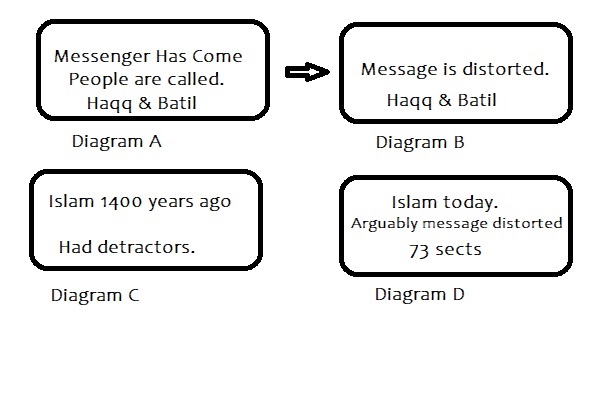
In Diagram A a Messenger has come. What obligation do the people around this messenger have to ascertain the truth of his message? Note there will be people who will call to haqq and people who will call to batil. There were detractors. So the fact that there are people who try and distort the message does that lift the obligation upon the people to discern the truth?
“And [there are] those [hypocrites] who took for themselves a mosque for causing harm and disbelief and division among the believers and as a station for whoever had warred against Allah and His Messenger before. And they will surely swear, “We intended only the best.” And Allah testifies that indeed they are liars.” (Qur’an 9:107)
In Diagram B the messenger has passed away. There is no current messenger. The message of the messenger has been distorted. Does this now lift the obligation of the people to ascertain the truth? To discern between distortion and authenticity?
Up until what generation are said people under obligation to learn the truth or lifted from that obligation?
In Diagram C Islam (in its current manifestation) came and there were detractors. There were people who called to the haqq and those who called to batil. So the fact that there are people who try and distort the message does that lift the obligation upon the people to discern the truth?
In Diagram D Islam (in its current manifestation) being debated over by 73 (or more) different sects and groups. There are those who call to the haqq and those who call to batil. So the fact that there are people who try and distort the message does that lift the obligation upon people to discern the truth? What about the adherents of the religion themselves. Is there any obligation upon them to discern the facts about their religion?
On what consistent basis do the Ash’ari claim that a Muslim who could be following one of the 72 misguided sects will be in hell while the rest of the world who did not hear about Islam will be granted paradise?
“Then will We treat the Muslims like the criminals?What is [the matter] with you? How do you judge?” (Qur’an 68: 35-36)
People are only accountable for the legal codes that were revealed to them.
“Allah does not burden a soul beyond that it can bear.” (Qur’an 2:286)
All that can be deduced from this is that if a legal code and/or moral law is not revealed to a particular people they cannot be held accountable for that. However, they are held accountable to that which was revealed to them.
The Example of the Prophet Ibrahim (as)
“He has made night and day subservient to you, and the sun and moon and stars, all subject to His command. There are certainly Signs in that for people who use their intellect.” (Qur’an 16:12)
This is exactly what Ibrahim (as) did.
“We also showed Ibrahim the wonders of the heavens and the earth, so he would be certain (l-muqinina) in faith. When the night grew dark upon him, he saw a star and said, “This is my Lord!” But when it set, he said, “I do not love things that set.” Then when he saw the moon rising, he said, “This one is my Lord!” But when it disappeared, he said, “If my Lord does not guide me, I will certainly be one of the misguided people.” Then when he saw the sun shining, he said, “This must be my Lord—it is the greatest!” But again when it set, he declared, “O my people! I totally reject whatever you associate. I have turned my face towards the One Who has originated the heavens and the earth—being upright—and I am not one of the polytheists.” (Qur’an 6:75-79)
Ibrahim (as) was observing that the stars, moon and sun are all following an order. Or they were all subject to some phenomena. Thus, Ibrahim (as) reasoned that which follows laws and patterns can not be the law giver or the pattern maker.
Thus the verse above:
“He has made night and day subservient to you, and the sun and moon and stars, all subject to His command. There are certainly Signs in that for people who use their intellect.” (Qur’an 16:12)
Notice that at that point Ibrahim (as) had not received any formal revelation (wahyu) from Allah (swt). Ibrahim (as) is even known as the friend of Allah. So this millat (creed) of Ibrahim that was so basic and fundamental which was not to associate anything as equal to Allah (swt). It was to worship the ultimate source of all.
If that is sufficient for Ibrahim (as) that is sufficient enough for all the Ahl Al Fatara. Allah (swt) knows best.
“Then We revealed to you, [O Muhammed], to follow the creed (millata) Ibrahim, inclining toward truth; and he was not of (l-mush’rikina) those who associate with Allah.” (Qur’an 16:123)
“And who is better in their way of life (dinan) than those who (aslama) submit themselves fully to Allah, do good, and follow the millata (creed) Ibrahim, the upright? Allah chose Ibrahim as a close friend.” (Qur’an 4:125)
Among societies that became predominantly polytheist or animist one can still come to the conclusion that Allah is one. Human beings have been given intellect and with this intellect, a person would realize that they were created. As this Creator has created me it is a right of the Creator that I believe in him.
“We will soon show them Our signs in the Universe and in their own souls until it will become quite clear to them that it is the truth. Is it not sufficient as regards your Lord that He is a witness over all things?” (Qur’an 41:53)
For the Ash’ari simply to claim that all these people will go to heaven belies the fact that they were sent Messengers, and if it is unnecessary for these people to reflect and research due to the distortion of the message than the same can be said of the Muslims today, even though ironically we have our sources.
Second, it believes the justice of Allah (swt) concerning any evil these people may/may not have done. At the very least to not suggest that among them will be judged based upon how they lived their lives in the same way Muslims will be judged based upon how we lived our lives would is folly.
“And when it is said to them, “Follow what Allah has revealed,” they say, “Rather, we will follow that upon which we found our fathers.” Even if Satan was inviting them to the punishment of the Blaze?” (Qur’an 31:21)
This verse is crystal clear that during the period of distortion and corruption or when no messenger was sent it was still likely for Satan to suggest things to their base selves that would lead them to hellfire.
“On a Day when their tongues, their hands, and their feet will bear witness against them as to what they used to do.” (Qur’an 24:24)
This is a very powerful verse.
Everywhere one travels on this Earth there is certainly an understanding of selfishness, injustice, cruelty, and malice towards others. One’s own consciousness is a witness against his/her self.
“And the earth shines bright with the light of her Lord, and the Book is set up, and the prophets and the witnesses are brought, and it is judged between them with truth, and they are not wronged. And every soul shall be paid back fully what it has done, and He knows best what they do.” (Qur’an 39:70)
“And We will set up a just balance on the day of resurrection, so no soul shall be dealt with unjustly in the least; and though there be the weight of a grain of mustard seed, (yet) will We bring it, and sufficient are We to take account.” (Qur’an 21:47)
The most that can be said is that those among them who committed shirk they will be in the hellfire. The least that can be said is that we suspend judgement (wuqoof) and leave their matter to Allah (swt).
“Notwithstanding that no human being can ever attain to faith otherwise than by Allah’s leave, and it is He who cast uncleanliness upon those who will not use -their reason!” (Qur’an 10:100)
Yet to grant paradise to every person that they claim has not heard the undistorted message of Islam is fallacious for the many reasons that have been given.
Even if messengers reach people it does not guarantee guidance.
As one of the sages have said:
“The person who is seeking the truth, one evidence will be enough for him. A person who is upon their desires, a thousand clues will still not be clear for him.”
“And if you invite them to guidance, they do not hear; and you see them looking at you while they do not see.” (Qur’an 7:198)
“[Even] if you should strive for their guidance, [O Muhammed], indeed, Allah does not guide those He sends astray, and they will have no helpers.” (Qur’an 16:37)
“And who does more wrong than those who, when reminded of their Lord’s revelations, turn away from them and forget what their own hands have done? We have certainly cast veils over their hearts—leaving them unable to comprehend this and deafness in their ears. And if you invite them to guidance, they will never be guided.” (Qur’an 18:57)
So just as Messengers, and Revelations and Miracles can be sent to people it does not mean that they will be guided just as the inverse is true. By this we mean just because a messenger, or revelation or miracle was not sent to a people it does not mean they will not be guided. [Even though Allah has stated he sent to every people a Prophet].
Lastly, guidance is the purview of Allah (swt).
“It is certainly upon Us to show guidance.” (Qur’an 92:12)
Conclusion: Guidance is a blessing and not a curse. Guidance is both for serenity, safety, stability and peace in this life as well as increases the certainty of those who obey Allah of entering into ever lasting paradise in the next.
The Ash’ari say the believers go to hell (possibly for billions or trillions of years) and non believers go to paradise just on not hearing about Islam.
The Ibadi school based upon the Qur’an and Sunnah say that the believers do not enter hell and that the disbelievers do not enter into paradise.
“Tell them, “I do not claim to have all the treasures of Allah in my hands, nor to know the unseen, nor do I claim to be an angel. I follow only what is revealed to me.” Say to them, “Are the blind and the seeing equal?” Will, you not reflect? (Qur’an 6:50)
“Those blind and those who can see are not equal, nor are those who believe and do good to those who do evil. Yet you are hardly mindful.” (Qu’ran 40:58)
Rather, in the Ash’ari aqidah the blind are those who are the inheritors of paradise.
If you are interested to read more we would suggest the following:
“And if it was not for the favor of Allah upon you, and His mercy, a group of them would have determined to mislead you. But they do not mislead except themselves, and they will not harm you at all. And Allah has revealed to you the Book and wisdom and has taught you that which you did not know. And ever has the favor of Allah upon you been great.” (Qur’an 4:113)
“By Allah , We did certainly send messengers to nations before you, but Satan made their deeds attractive to them. And he is the disbelievers’ ally today [as well], and they will have a painful punishment.” (Qur’an 16:63)
“And when Satan made their deeds seem fair to them and said: No-one of mankind can conquer you this day, for I am your protector.” (Qur’an 8:48)
“If only, when Our calamity came upon them, they humbled themselves. But their hearts hardened, and Satan made their deeds appear good to them.” (Qur’an 6:43)
“And Satan had made pleasing to them their deeds and averted them from the path, and they were endowed with perception.” (Qur’an 29:38)
﷽
“As for the disbelievers, their deeds are like a mirage in a desert, which the thirsty perceive as water, but when they approach it, they find it to be nothing. Instead, they find Allah there ˹ to settle their account. And Allah is swift in reckoning. Or ˹ like the darkness in a deep sea, covered by waves upon waves, topped by clouds. Darkness upon darkness! If one stretches out their hand, they can hardly see it. And whoever Allah does not bless with light will have no light!” (Qur’an 24:39-40)
This entry is not to say that the Ibadi school holds disdain for the Mu’tazila for they agree with us on many positions. Positions that are based upon the Qur’an & Sunnah. This is where the Ashari school agrees with the Ibadis of Basra on this matter.
However, as Allah (swt) has informed us:
“Such is Allah, your Lord, the Truth. So after the truth, what else can there be, save error? How then are you turned away?” (Qur’an 10:32)
We should state that our team has neither a theologians or a philosophers and not classically trained in either field. We weigh in on this matter as a students. Much of the depth, richness and treasure of the Ibadi perspective in is behind the grasp of the Arabic language.
Surely the point of difference with the Mu’tazila on this matter are twofold
That human beings via reason alone can reach absolute truth of moral laws apart from divine revelation or divine inspiration. Which leads people to believe in point 2.
That actions have innate qualities of ‘good’ or ‘bad’ and/or that actions have innate qualities of ‘evil’ and ‘righteousness’ apart from being informed by revelation on the matter.
Our school stands apart from the Mu’tazila on these doctrinal errors.
That is to say the Ibadi school stands on the belief of what is called by others as ‘Divine Command Theory‘.
What is divine command theory? That is the belief that actions in and of themselves are neither morally evil nor good. Rather it is divine revelation that reveals to us if actions are morally ‘good’ or ‘bad’.
Take eating pork for example. In general Muslims are prohibited from eating pork. Thus eating pork would be morally wrong according to revelation. However, revelation has also revealed that there are situations in which eating pork is necessary, and therefore a meritorious act. So it is not that the action of eating the pork in and of itself is morally repugnant or morally meritorious. It is what divine guidance informs us about the matter.
“Prohibited to you are dead animals, blood, the flesh of swine, and that which has been dedicated to other than Allah, and killed by strangling or by a violent blow or by a head-long fall or by the goring of horns, and those from which a wild animal has eaten, except what you slaughter, and those which are sacrificed on stone altars, and that you seek decision through divining arrows. That is grave disobedience. This day those who disbelieve have despaired of your religion; so fear them not, but fear Me. This day I have perfected for you your religion and completed My favor upon you and have approved for you Islam as religion. But whoever is forced by severe hunger with no inclination to sin – then indeed, Allah is Forgiving and Merciful.” (Qur’an 5:3)
Some of us used to hold to the position 1. That was before we were graced with this right guidance on this matter.
So as what they published on the matter was public they hereby make a public repentance to Allah (swt) and to all thosethey may have unknowingly mislead on this essential epistemological matter.
Another point is this. Many in the Muslim ummah understand the problems of ascribing Allah (swt) parts such as limbs and hands and a foot. Yet, we equally must be careful in creating an idol of Allah (swt) in our minds by superimposing upon the Creator that he should or should not be like this or that.
Allah (swt) has never been, is not and never will be under the sovereignty of his Creation. Allah is sovereign and we are under him!
Allah is not constrained by any laws. Physical, Natural or Moral laws. The only constraints upon Allah are that which he imposes upon himself.
“The word will not be changed with Me, and never will I be unjust to the servants.” (Qur’an 50:29)
Allah has clearly stated that he has the capability and capacity to be unjust. However, it is something that he has forbidden to himself.
Note that Allah (swt) has never ascribed himself with the ability or capacity to lie.
“Those messengers – some of them We caused to exceed others. Among them were those to whom Allah spoke, and He raised some of them in degree. And We gave Jesus, the Son of Mary, clear proofs, and We supported him with the Pure Spirit. If Allah had willed, those [generations] succeeding them would not have fought each other after the clear proofs had come to them. But they differed, and some of them believed and some of them disbelieved. And if Allah had willed, they would not have fought each other, but Allah does what He intends.” (Qur’an 2:253)
Allah tells us that it IS his will that they fight each other, otherwise they would not.
“Mankind was a single community, then Allah sent prophets to bring good news and warning, and with them He sent the Scripture with the Truth, to judge between people in their disagreements. It was only those to whom it was given who disagreed about it after clear signs had come to them, because of rivalry between them. So by His leave Allah guided the believers to the truth they had differed about: Allah guides whoever He will to a straight path.” (Qur’an 2:213)
“Indeed, those who say, “Allah is the Messiah, son of Mary,” have fallen into disbelief. Say, ˹O Prophet,˺ “Who has the power to prevent Allah if He chose to destroy the Messiah, son of Mary, his mother, and everyone in the world all together?” To Allah ˹alone˺ belongs the kingdom of the heavens and the earth and everything in between. He creates whatever He wills. And Allah is Most Capable of everything.” (Qur’an 5:17)
When Allah (swt) says and who would prevent Allah from destroying Jesus the son of Mary, including his mother and everyone on the earth altogether? The answer is no one. Allah is a the ultimate sovereign creator.
“He is not questioned about what He does, but they will be questioned.” (Qur’an 21:23)
So a major difference between Ahl al-Haqq wa-l istiqama (The People of Truth and Straightness) and the Mu’tazila is that we believe that Allah (swt) is Sovereign above all. Allah (swt) determines what is good or bad via his commands and prohibitions.
Where as for the Mu’tazila Allah is good and must do good because we want Him to be good. A god of our own making.
Note the following:
” Verily, we know with certainty that some things are [morally] good and some things are [morally] bad, [and we know this] without considering revelation. Thus, every sane person firmly believes that charity is good, and they praise the charitable, and [firmly believes] that injustice is [morally] bad, and they blame the unjust. These [moral beliefs] are necessary judgments, and not subject to any doubt; and they are not acquired from Sharia, as the Brahmins and atheists, who do not believe in any Sharia, also make the [moral] judgments.”
Sources: (al-Ṭūsī & al-Ḥillī, Kashf al-murād, 281. Cf. al-ʿAllāma al-Ḥillī, Nahj al-ḥaqq, 83. For an articulation of the argument in earlier kalām periods, see ʿAbd al-Jabbār, al-Mughnī, vol. 6, part 1, 18, 106, and 109; vol. 14, 152)
Prima-Qur’an comments. So the Mu’tazila claim that it is innate that charity is good.
Our position is that charity is not some how innately ‘good’. Charity can breed short term dependency this can become long term dependency, stops one from becoming self reliant and makes them feel dependent upon others. Charity can be used to manipulate people, organizations and institutes.
The aim of charity often cultivates a false sense of duty to society.
As Warren Buffet stated:
“The American investor and philanthropist Warren Buffett acknowledges that he would not have acquired his own wealth without certain necessary conditions: “If you stick me down in the middle of Bangladesh or Peru, you’ll find out how much this talent is going to produce in the wrong kind of soil.” Without stable infrastructures, it will be difficult if not impossible to rise above poverty, no matter how hard you work or how talented you are .”
Source: (Peter Singer, The Life You Can Save, p. 31).
Thus, instead of tackling the core reasons why people need charity, charity becomes a simple cop out to make one feel they have done some moral good for society.
To make statements like: “every sane person firmly believes that charity is good.” is emotive rhetoric and poisons the well.
As regard what is just and what is injustice that is also begging the question. What is justice and what is injustice?
“As the Brahmins and atheists, who do not believe in any Sharia, also make the [moral] judgments.”
Note the Mu’tazila appeal to atheism. We will crush this argument soon enough. Allah-willing.
It is also this man made inclination to make Allah in our own image that lead to strife among the Mu’tazila, The position of the Zaydi, Twelver Shi’i, and Ibadi is that hellfire is eternal for whoever enters it. However, some under the umbrella of Mu’tazila notions of ‘justice’ present the idea of an eternal hellfire as not just. Does any evil action truly merit eternal suffering and damnation?
Interestingly and perhaps ironically the Ibadi school recognizes the logical outcome of Nihilistic societies wherein we are left with moral relativism. The irony here being that adherents of the Mu’tazila school often appeal to absolute truth and revelation in the push back against moral relativism.
Yet, when the human reason is left at the seat of power moral relativism is one of logical outcomes.
“These are the ones who have purchased straying with guidance; their trade did not profit them, nor were they guided.” (Qur’an 2: 16)
“It is they who take error in exchange for guidance, and suffering in exchange for forgiveness: yet how little do they seem to fear the fire.” (Qur’an 2:175)
The two schools of Islam that follow the position of the Mu’tazila are Twelver Imami Shi’i and Zaydis.
The Twelver Imami Shi’i believe that divine guidance comes from the infallible interpretation of a divinely appointed Imam.
Yet, the Mu’tazila position undermines guidance from divinely appointed Imams. It certainly does not make the juristic position of a learned Imam from the line of Fatima (ra) conclusive; especially If human beings can reach absolute truth concerning morality via reason then being led by Imams or practicing taqlid becomes moot.
Questions for the Mu’tazila position.
Is belief in Allah morally good?
Is it morally evil?
Is belief in Allah inherently good or inherently bad?
How is this reasoned apart from divine revelation, or divine inspiration?
So what does it say about a worldview in which a person can be moral atheist?
Because our argument is there are moral atheist but there is no moral atheism. Mu’tazila would bring in a world view in which moral atheism is plausible.
The Mu’tazila position is able to accept and accommodate a deist view of God. No God at all. Pantheism, Pan-deism. It is an accommodating model.
So when having such an accommodating model one must ask:
How does that enjoin the good and forbid the bad? How does this invite people to believe in Allah?
The Mu’tazila effectively strip the da’wah of Muslims against moral relativism.
Have we not noticed that people like Sam Harris whom are trying to argue for a world in which science will be able to tell us what we ought to do to live the best lives possible.
“Sam Harris’s first book, The End of Faith, ignited a worldwide debate about the validity of religion. In the aftermath, Harris discovered that most people—from religious fundamentalists to non-believing scientists—agree on one point: Science has nothing to say on the subject of human values. Indeed, our failure to address questions of meaning and morality through science has now become the most common justification for religious faith. It is also the primary reason why so many secularists and religious moderates feel obligated to “respect” the hardened superstitions of their more devout neighbors.”
“In this explosive new book, Sam Harris tears down the wall between scientific facts and human values, arguing that most people are simply mistaken about the relationship between morality and the rest of human knowledge. Harris urges us to think about morality in terms of human and animal well-being, viewing the experiences of conscious creatures as peaks and valleys on a “moral landscape.” Because there are definite facts to be known about where we fall on this landscape, Harris foresees a time when science will no longer limit itself to merely describing what people do in the name of “morality”; in principle, science should be able to tell us what we ought to do to live the best lives possible.”
“Bringing a fresh perspective to age-old questions of right and wrong, and good and evil, Harris demonstrates that we already know enough about the human brain and its relationship to events in the world to say that there are right and wrong answers to the most pressing questions of human life. Because such answers exist, moral relativism is simply false—and comes at increasing cost to humanity. And the intrusions of religion into the sphere of human values can be finally repelled: for just as there is no such thing as Christian physics or Muslim algebra, there can be no Christian or Muslim morality.”
Just a quick comment about the above statement:
“Harris foresees a time when science will no longer limit itself to merely describing what people do in the name of “morality”; in principle, science should be able to tell us what we ought to do to live the best lives possible.”
Allah (swt) knows best the future. Yet, given that this world is dominated by global conglomerates and economic interest watch and see a dark utopian world unfold where science does not merely tell us what we ought to do but science compels us to do what we must do.
The Mu’tazila have objections against divine command theory. However, they do not have solid epistemological evidence for their position.
It’s good because it’s good is circular. In order for reason to be reasonable it must have imposed limitations on it.
Who or what imposes those limitations upon reason?
The same in our position against moral relativism. Sam Harris has to make a case for some kind of morality otherwise he and his colleagues lose a basis or a grounding to attack hudud laws of the Shari’a. He has to make a case (under the rubric of the so called ‘neutrality’ of science) so as to mask the attacks for what they really are: Namely arguing for the cultural/civilizational superiority of one people over another.
So just as the there has to be an objective basis to determine what is moral there therefore needs to be an objective basis to determine what is reasonable. Otherwise it would not have an opposite: unreasonable.
In order for reason to be reasonable it must have imposed limitations on it.
The self evident and self refuting nature of reason being some type of objective basis to determine what is rationally good or rationally bad is that people have not come to a consensus on the matter.
Killing animals to sustain ourselves. Is this ethical? On what reasonable basis is such an action deemed good or bad?
Are our positions more or less justified and/or reasonable on the basis concerning the manner in which we kill the animal? Bullet to the head, strangulation, arrow to the jugular?
What about plants? If they are sentient on what objective basis grounded in reason is it morally good or bad to uproot them and eat them? What about destroying trees to make way for the building of residences?
If I have been informed that over population of the planet will most definitely lead to the extinction of our species would it be unreasonable for me to develop a virus with the intent to save the species by killing of a huge number of people in the process? I could cover my tracks by releasing said virus near a biolab to make it look like it was an accidental contagion leak. I could further justify my reasoning by stating to myself that the virus is indiscriminate it kill rich and poor and all ethnic groups alike.
In fact, in 2019 Marvel Studios debuted a movie called: End Game. The Protagonist, a not-very-well-thought-out villain named ‘Thanos’ did not see himself as a villain. His objective was to collect a series of 6 stones with the ability to grant him any wish he wanted. His motive or his reasoning was that the universe is filling up with life forms, thus he wanted to indiscriminately annihilate half of all life so that the other half could be grateful and thrive.
However, his reasoning is deeply flawed on many accounts.
By annihilating half of all living things including those living things that other living things consume, eat or depend upon for their own survival essentially made things the way they were before.
The above example amounts to 500 trillion we can say represent higher life forms and sentient beings. The 1000000 trillion represent the living things that the 500 trillion depend on. Thus, Thanos by eliminating half of all life forms across the board did not really fix much of anything. His reasoning being deeply flawed.
Lastly, he could have willed for a universe of infinite resources and cooperation across all sentient species. But that would not have made for an interesting film.
Metaethics. Who would you kill and why?
This question tries to determine the basis or reason that each party would give for doing what they do. The very fact that there are different responses to this question also shows that human reasoning is limited. It is limited in both its ability and capacity to see what is ultimately good or bad.
The question also assumes that a person would want to make the decision to kill anyone at all. Though the counter is that by not acting the person is killing. The counter to that counter is that by not acting the person is taking into account the possibility of train malfunction or derailment etc..
Many might reason that killing one is preferable to killing five. Thus life is quantified. However, are there situations when killing more people is preferable to killing less? Think of a battlefield. Killing more of the enemy soldiers does it instill in them reason to come to the negotiating table or surrender or does it instill in them hardened resolve wanting them to press on to victory?
What if a person reasons killing the five is better than killing the one. The justification, basis or reasoning can be that they know nothing about the one or the individual. The one is a potentially nasty person and the five are nasty people. Thus sparing one nasty person is better than sparing five nasty people.
On and on it goes. In fact there could be organizations willing to test the moral fabric of a human being on the basis of reasoning alone by posing hypothetical questions to see how far they would be willing to go to commit certain acts.
There is a perfectly healthy human child. Humans are born all the time. This child has not manifested anything note worthy about themselves. Yet we have five well known philanthropist and entrepreneurs who contribute a great deal to human culture and civilization. Each of them are gong to die unless they get a Heart, Kidney, Liver, Lungs and Pancreas respectively. It could be perfectly reasonable to kill the child who has yet to manifest any potential and harvest those organs.
Recall Harris remark:
“Harris foresees a time when science will no longer limit itself to merely describing what people do in the name of “morality”; in principle, science should be able to tell us what we ought to do to live the best lives possible.”
There are already people on this planet who have a great deal of disdain for the impoverished.
We learn our ethics and our morality and our right and wrong via our culture.
The Ibadi view is that culture conditions us where as revelation breaks this conditioning.
The limits of the mind and the limits of human sensory perception.
“The human intellect is a gift from Almighty Allāh, and the ability to think and reason is one of his favours bestowed upon us. Thus, pondering over the written verses of the Qur’ān and reflecting over visual signs of Allāh are things both the Book of Allāh and His Prophet’s Sunnah urge us to practice. However, deactivating the mind from understanding the texts in their entirety leads to serious issues, such as likening all-Powerful Allāh to human beings and giving Him some of His creatures’ physical and non-physical attributes. This group of literalists became captives to the apparent literal wordings of the texts, forgetting that the Qur’ān is an Arabic book, including both literality and metaphor. On the one hand, it is beyond doubt that the human mind is limited, just like any limb or organ in a human being. Likewise, the human senses that feed the mind with intellectual material are also limited. On the other hand, it is well-known that the human mind cannot work in a vacuum without intellectual material to deal with, and to conduct its logical processes. Hence, al-Akmah (who was born blind) cannot imagine in his mind colours, such as red and yellow, even if he or she hears about their beauty and descriptions of them.”-Shaykh Al-Muatasim Al-Mawali
Shaykh Al-Muatasim continues…
“Similarly, the person who was born deaf and never heard people’s speech cannot, even with his sound mind, express with his tongue what he finds within himself. This is because of the fact that his mind does not perceive such images or words, due to the simple fact that the receivers for this data are not working. In the same manner, it is said regarding the rest of these human faculties. Likewise, it is said about the favours of paradise, the human being cannot imagine its reality, as is narrated in the tradition: ‘There will be bounties which no eye has seen, no ear has heard and no human heart has ever perceived’.” -Shaykh Al-Muatasim Al-Mawali
“The senses that represent the mind’s intellectual sources, even in their ideal condition, are limited. Our bare eyes cannot see what is too far away, such as those millions of stars, planets and galaxies with their magnificent sizes; neither can they see what is too close to them, nor the millions of microscopic living creatures floating around us. Equally, we are unable to see sound and electromagnetic waves, even though they undoubtedly exist, as proven by specially designed devices. On the contrary, the human eyesight might see a mirage from afar and would think it is fresh water. This optical scene has been affirmed in His saying:
‘But those who disbelieved – their deeds are like a mirage in a lowland which a thirsty one thinks to be water until, when he comes to it, he finds it is nothing’ (Qur’an 24:39).
“The same is applicable to the other source of the mind, hearing. The human ear cannot perceive the super-fine sounds around it, despite them being very close to the ears. It does not hear loud and noisy voices if they are too far away, nor can it hear the voices of earthly explosions that might take place under our feet.” -Shaykh Al-Muatasim Al-Mawali
“With all that in mind, and with the assumption that the inputs entering through these limited senses are correct, the mental outputs do not have to be necessarily correct and conclusive, because the mind might be influenced by various secondary factors caused by the impact of the surrounding environment. Another influencing factor is the different beliefs and ideologies that different people assume to be unquestionable reality. Had all these differences not existed, people would not have been different from each other. But such difference is the divine will and an ongoing precedent in creatures, as Allāh states: ‘
And if your Lord had willed, He could have made mankind one community; but they will not cease to differ. Except whom your Lord has given mercy, and for that He created them’ (Qur’an 11:118-119).
“Besides these external factors, some people might be influenced by some inner diseases, such as pride, arrogance and showing off, with which some are obsessed. Consequently, such subtle diseases could mask reality from people so much so that they view reality as an illusion, the truth to be falsehood and a mirage to be sweet water.”-Shaykh Al-Muatasim Al-Mawali
“Additionally, the soundness of the mind is a prerequisite of responsibility/accountability (taklīf). Thus, none of the legal responsibilities are binding upon the insane, as the scholars say: ‘If Allāh takes what he granted (i.e. the mind), he drops what he obliged’. Hence, the mind is just a condition of obligation, and not a legislating source for legally responsible/accountable humans (mukallaf). The issue of legislation is tied to sending messengers of warning, as the all-Powerful says:
“And We never punish until We have sent a Messenger’ (Qur’an 17:15).
“We can see here, in this verse, that He did not say until We have fixed minds. Otherwise, everybody around the globe would have his unique religion, due to the variety of thoughts and ways of thinking. Therefore, even if the mind arrives at a conclusion regarding something being good or bad, that does not mean in any way that it is permissible or prohibited, because the matters of Sharī‘ah and legal rulings are dependent on the two kinds of revelation: explicit (the Qur’ān) and implicit (His Prophet’s Sunnah).” -Shaykh Al-Muatasim Al-Mawali
Source: (Shaykh Al-Muatasim Al-Mawali Al-Muatamad The Reliable Jurisprudence on Prayer pgs. 32-35)
Section 9: Divine Law Has No Rational Foundation
“The corruption of the Mu‘tazilite doctrine that the laws of the Shari‘a concerning human acts can be rationally discerned, even without a prophetic mission, can also be clarified by admitting, for the sake of argument, the principle of the rational necessity of deeming something good or evil because of the contradiction between different perspectives, in order that the corruption of their opinion on this matter may become manifest.”
“If we consider gratitude to The Most High for His blessings on us before the coming of the law, according to them reason would make gratitude to The Most High obligatory, without requiring the coming of a lawgiver, because knowledge of The Most High and the knowledge that He bestows blessings are rationally comprehended without the law, as are the goodness of thanking the One who bestows blessings and the evil of ingratitude to Him. Therefore, the obligation to give thanks and the prohibition of ingratitude are understood without the law.”
“We will say to them: This obligation to give thanks before the Shari‘a must have a benefit, because if there is no benefit to it, then it is not good until it becomes obligatory. But the affirmation of a benefit before the coming of the Shari‘a is absurd, because either its benefit goes to the person who gives thanks, or to the Lord Who is thanked. If it goes to the person, the benefit is either immediate or postponed, or all the allotments [of benefit] are void. Th e falseness of its going to the person immediately is because the immediate impact on him is only fatigue. The falseness of its going to him later is because, according to consensus, the intellect had no ability to understand the affairs of the afterlife before the coming of the law. The falseness of its going to the Lord Most High is because He transcends any renewal of His perfection; indeed, in His essence He has no need of people and their deeds.”
“This point of view is rational and repels the obligation of giving thanks and contradicts their point of view which makes it obligatory, which is the comprehension that The Most High bestows blessings.”
“If they say, “We do not accept that there is no benefit to giving thanks before the coming of the Law; indeed, there is a benefit to the person, and that is safety from the punishment that could be imposed for turning away from giving thanks,” we say that likewise it is possible for the act of giving thanks to be punished, for two reasons:
“First, he has caused fatigue to someone who belongs to Allah Most High and has done this without His permission. In this he is like someone who thanks a king who has enabled him to receive a blessing, in that he causes the king’s servant fatigue by giving thanks for it without his permission. There is no doubt that by thanking the king for this blessing, he has exposed himself to punishment.”
“Second, it is a matter of an extremely generous king giving him a little piece of barley bread, for example, while he has treasure-houses of different types of food and infinite wealth, and it would not diminish him in any way for him to give him from his stores. Then that poor, needy person mentions the king and praises him in social gatherings for giving him this piece of barley bread. He would deserve punishment from the king for mocking him and thinking little of him, making him out to be a coward by praising him for something that imposes no burden on him at all. There is no doubt that all the blessings of this life and the next are like nothing compared to the greatness of Allah Most High and the wideness of His dominion and majesty. So it is clear to you by this that for reason to enter into the laws of Allah Most High concerning acts with the scale of approval and disapproval is to enter with a faulty scale that will make its owner turn back exhausted.”
“If you say, “All this clashes with what you have affirmed before from the teaching of your imams, who agree with the doctrine of the Mu‘tazila,” I say, as for its clashing with it, you are right; what I have affirmed here is the teaching of the company of our companions, as well as the Ash‘arites. As for the teaching of some of our imams being the same as that of the Mu‘tazila, this is incorrect, as I have already explained, because of the evident difference between the two schools: the Mu‘tazila say that the judge is reason and that the law is an affirmation of rational judgment, and that it does not bring anything that differs from this, whereas the teaching of those imams is that judgment belonged to reason before the coming of the law, but after it comes, the law is the foundation, and it may bring something that does not accord with human reason. So there is a difference.”
“Another thing that demonstrates the denial of the principle that good and bad can be rationally known is that we say, regarding someone with respect to whom all acts are equal, that nothing he does can be deemed good or bad. Acts are equal with respect to the Creator; nothing He does can be deemed good or bad, because if an act is deemed good, this requires a preference for doing it over not doing it, and if it is deemed bad, this requires a preference for abandoning it over doing it, but deeming them equal negates any preference. This is why we said previously that what is preferred in contingent things is simply whatever The Most High wills.”
“The demonstration (bayan) that all acts are equal with respect to Him is that the Glorified One transcends benefit and harm. If we are able to do something that causes us no harm, and if by not doing it no benefit escapes us, then there are no repercussions from our doing it or not doing it. All acts with respect to The Most High are like this supposed act with respect to us. Furthermore, if all acts were not equal with respect to Him, it would be better for Him to bring them into existence than not to bring them into existence, which would lead to His perfection being due to His acts, and you know that He is perfect in His essence and in His attributes, which are the same as His essence, not by His acts. So the conclusion is that with respect to The Most High, nothing is either good or evil. And Allah grants success (wa-bi-’l-lahi ’l-tawfi q).”
Source: (Shaykh ‘Abd al-Aziz al-Thamini al-Mus’abi on God’s Power and Human Acts, from Kitab Ma’alim al-Din)
What about the justice of Allah in creating humanity?
One may say, “I was never asked to be created. I was never asked to be brought into an existence in which I had to choose between heaven and hell.” “The stakes are so high. I could go to heaven but I could end up in hell.” “I never asked for this reality to be foisted upon me!”
If Allah must do what is good at all times cannot it not be effectively and rationally argued that given the choice between non being and non existence and being brought into being exposed to a world of different belief sets, choosing the wrong belief set or the wrong course of action could damn one to eternity in hell; than what is maximally good is to not create or bring that individual into being in the first place. Unless, no matter what choices or what actions the individual does they would be guaranteed paradise.
“He is not questioned about what He does, but they will be questioned.” (Qur’an 21:23)
The proof of “Fitrah” (natural inborn belief in Allah)
Allah (swt) has informed us in the Qur’an:
“I did not create jinn and humans except to worship Me.” (Qur’an 51:56)
For those Arabic grammarians out there look closely at the above text.
the lam [translated here as “so that”] is placed there only to indicate the outcome (al-sayrura wa-’l-‘aqiba) thus the verse can be understood as: “I created the jinn and humans therefore they worship.”
There is a growing field of scientific research centered around neurology that states: ‘Human beings are wired for worship.’
“When your Lord brought forth from the loins of the children of Adam their descendants and had them testify regarding themselves. “Am I not your Lord?” They replied, “Yes, You are! We testify.” “Now you have no right to say on Judgment Day, ‘We were not aware of this.’” (Qur’an 7:172)
“So, set your face toward the religion in uprightness. That is the “Fitrah” of Allah, upon which He has created mankind. Let there be no changing of Allah’s creation.” (Quran 30:30)
The pledge which Allah took from the soul of every one of us before we came into this world.
“And [remember], when your Lord took from the children of Adam, their children behind them, and made them testify over their own selves, [saying to them], ‘Am I not your Lord?’ They said, ‘Yea.'” (Quran 7:172)
The human being has an inherent and inborn recognition of the Creator.
Abstract language.
The very fact that the word ‘nothing’ has a meaning that we understand but cannot give a physical representation to. If you were to close your eyes and try to imagine nothingness you would either imagine an all black space or an all white space, both of which would still be something.
How many times have we known about atheists who find themselves in the middle of turbulence on an airplane reaching out to Allah? And how feeble and uncertain are the disbelievers when death or old age approaches one of them. Suddenly, they are not so arrogant.
“[Allah] it is who causes you to travel over land and sea; until, when you are in the ships, and they sail with [their passengers] with a fair breeze, and they are glad therein, a tempestuous wind reaches them, waves are coming at them from everywhere, and they think that they are overwhelmed therein; [then] they call to Allah, making their faith pure for Him [alone], ‘If You save us from this, we will surely be among the thankful!'” (Quran 10:22)
“Yet, this sincerity is often short-lived. Allah Says (what means): “Then, when He saves them, behold, they rebel upon the earth wrongfully.” (Quran, 10:23)
“Even though they were convinced, they rejected them out of spite and pride. So consider what happen to those who spread corruption.” (Qur’an 27:14)
Objections that the Mu’tazila raise against our position.
“If [moral] goodness and badness are determined by Sharia, then it would be fine for Allah to command disbelief, denying the prophets, glorifying the idols, observing adultery and theft … as the actions would not be evil per se . . . and thanking the benefactor, returning the deposit, and truth-telling would not be good per se; if Allah were to prohibit them they would become evil. But since it happened, without any objective or reason, that Allah commanded them, they became good. Likewise, it happened that Allah prohibited those [former] actions, and so they became evil. Before He commanded [the latter actions] and prohibited [the former actions] there was no difference between the actions. Anyone whose reason leads him to follow someone whose conviction is this is the most ignorant of the ignorant, and the most foolish of the foolish.”
Prima Qur’an responds: If these are the best arguments they have surely they are upon error. An argument like this is half mad and half sound. Allah commands people to disbelieve in him is circular in reasoning. “I am Allah therefore disbelieve in me!”
As regard the points on adultery and theft if Allah commanded it than it would be what is done. Do they not say that Muslims can take the property of the mushrik in battle?
By theft are we not talking about the acquisition of a good, item or property that belonged to one and is considered unlawfully taken by another. But than again who or what determines if an item good or property was taken unlawfully if not Allah? Consider for example war booty.
“And know that anything you obtain of war booty – then indeed, for Allāh is one fifth of it and for the Messenger and for [his] near relatives and the orphans, the needy, and the [stranded] traveler, if you have believed in Allāh and in that which We sent down to Our Servant on the day of criterion [i.e., decisive encounter] – the day when the two armies met [at Badr]. And Allāh, over all things, is competent.” (Qur’an 8:41)
From the vantage point of those who have had their booty taken from them would they not argue that this was indeed theft and acquisition of their property that was not taken with consent?
Again as regard the comment on adultery who or what defines what is a legal marriage and what is not if not Allah? The Mu’tazila wants to impose some moral order on the Sovereign, Allah. However, for those who submit to the Sovereign Allah it comes down to: “Did Allah command this or not?” “Is this something permissible or not?”
Again we turn to the Qur’an.
“O you who have believed, when the believing women come to you as emigrants, examine them. Allah is most knowing as to their faith. And if you know them to be believers, then do not return them to the disbelievers; they are not lawful [wives] for them, nor are they lawful [husbands] for them. But give the disbelievers what they have spent. And there is no blame upon you if you marry them when you have given them their due compensation. And hold not to marriage bonds with disbelieving women, but ask for what you have spent and let them ask for what they have spent. That is the judgement of Allah ; He judges between you. And Allah is Knowing and Wise.” (Qur’an 60:10)
So it can be asked is it not inherently morally wrong to marry a woman who is already “lawfully” married to another man according to their custom, beliefs or creed?
Notice I said lawfully in brackets. Because who determines what is or is not? So in the above text that believing woman is indeed married to a disbelieving man according to the laws, customs and beliefs of his society and his people. Thus, she is in adultery in accordance to them. However, Allah (swt) has made that marriage null and void!
In fact, Allah (swt) is being rather magnanimous by ordering: But give the disbelievers what they have spent. When Allah (swt) could have ordered that they receive nothing!
Example of two sisters taking in marriage.
“And [also prohibited are] the wives of your sons who are from your [own] loins, and that you take [in marriage] two sisters simultaneously, except for what has already occurred. Indeed, Allāh is ever Forgiving and Merciful.” (Qur’an 4:23)
Was it morally wrong to do that before? If so why the quasi-tolerance of it by Allah (swt) during the transition period of the Muslims?
Allah is not constrained nor shaped by morality but morality is constrained and shaped by Allah.
The Mu’tazila say that Allah does not do anything immoral -so they want to put human constraints upon Allah. How is it possible for Allah (swt) to do anything immoral when morality itself is defined by Allah (swt).
Thus, is it not surprising to find those who want to shape Islam in accordance with whatever the moral whim of society is to often claim themselves as the inheritors of the Mu’tazila.
Another argument used by the Mu’tazila is as follows:
“If morality is determined by Allah’s will, then, given that Allah might will different things for different communities, morality would turn out to be relative. Thus, one and the same action would be good for one community and bad for another community. However, morality is not relative. Therefore, morality is not determined by Allah’s will.”
Prima Qur’an responds: Not at all. As in the case that context determines the will of Allah. Just as he wills a woman one thing and a man a different thing he can will one community one thing and another community different. Saying it makes morality relative makes man the author of what is and what is not moral. This is man centric not Allah centric.
This was also addressed by Shaykh Al-Muatasim above.
“To each of you We have ordained a code of law and a way of life. If Allah had willed, He would have made you one community, but His Will is to test you with what He has given ˹each of˺ you. So compete with one another in doing good.” (Qur’an 5:48)
The Question the Mu’tazila cannot address.
Below map let us say represents the entirety of Earth. The Mu’tazila would have to prove that the idea of human reason deciphering or learning that something is inherently good or inherently evil happened in isolation far from any religious tradition. That there was no mark of having any contact with any religious tradition and therefore able to thwart the charge that what they claim that what they claim happened apart from revealed faith, was actually inspired by those who either received revealed faith or received it from those before them.
There has not been until this day an effective response from the Mu’tazila on this point.
Mu’tazila argument:
“Then people who do not believe in any revelation will not have moral knowledge.”
False it is possible for people to have remnants of knowledge based upon previous moral codes before.
“For every community We appointed a code of life to follow. So do not let them dispute with you in this matter. And invite to your Lord, for you are truly on the Right Guidance.” (Qur’an 22:67)
The other thing is people can simply assume. They can assume but how certain is that? Would it be Relative or Absolute? (Again what is the objective criteria)
“And they have thereof no knowledge. They follow not except assumption, and indeed, assumption avails not against the truth at all.” (Qur’an 53:28)
“If you obey most of those on earth they would mislead you far from Allah’s way. They follow naught but an opinion, and they do but guess.” (Qur’an 6:116)
The guess, zann, assumption. They have the probability of being correct and the probablity of being incorrect.
Where are all these ancient cultures and societies where everyone was an atheist? Or did they have theist and atheist? The assumption is that they did not get their morality from revealed revelation.
A massive assumption on behalf of the Mu’tazila considering the default position of humanity is Adam (as) who learned words from his lord!
Nothing in the Mu’tazila position entails a readiness to accept a sovereign God that interacts with humanity.
If Mu’tazila believe in good and bad independent of sharia than it stands to reason that they must have an objective means to determine what is truth from what is not truth. Where does this objective means come from?
The Mu’tazila argue as follows:
“We can only make sense of divine justice if God abides by predetermined moral principles.”
Again these put human reasoning of what is and is not concerning the moral law before Allah. Who is in control of what gets pre-determined by God? Man of course!
Mu’tazila believe in a constructed deity that is perfect moral being (because we deem it so).
Other poor arguments -directed against the Ash’ari (but by that token us as well)
They may propose a scenario as follows: One might appeal to cases where no clear end is served by an appreciably good action. For instance, suppose whether you tell the truth or lie, you will achieve your desired end.”
The question itself contains a contradiction. How can there be no clear end being served along with the idea of an achievable desired end?
This Machiavellian reasoning by the Mu’tazila further strengthens our argument because the argument itself is that telling the truth or lying in this scenario is not ethically or morally wrong as the desired outcome was achieved either way.
But this cannot be. This maybe so for this life but not in the life to come. Allah’s curse is upon the liars. How can it said to be an argument at all?
“Allah certainly does not guide whoever persists in lying and disbelief.” (Qur’an 29:3)
As regard the ‘beneficial truth telling’ and ‘harmful lying’ -who or what determines it to be ‘beneficial’ or ‘harmful’.
Beneficial to the one telling the truth or to the one being told the truth? The same applies to harmful lying. Harmful to the one lying or to the one being lied to?
No to mention the unseen motives of the individual telling this supposed ‘beneficial truth telling’ or the ‘harmful lie’- is the individual altruistic or egocentric?
Lastly, as this is a thought experiment it is difficult to concede that this happening in a society independent of revelation and guidance as this was the default position of humanity and as mentioned Allah (swt) had sent prophets to every people.
And again, there are cases where being transparent and truthful are deemed by Allah (swt) not to be morally or ethically the best judgement call.
“Whoever disbelieves in Allah after their belief—not those who are forced while their hearts are firm in faith, but those who embrace disbelief wholeheartedly—they will be condemned by Allah and suffer a tremendous punishment.” (Qur’an 16: 106)
Again it only solidifies our position.
“Or, suppose that a child is drowning, that saving the child will not benefit you, and that it may even be a hardship for you. In such a scenario, it is still appreciably good to save the child, even though no benefits are gained from the action.”
Another poor argument. Everything is taken into account by Allah (swt)
“And be not slack so as to cry for peace and you have the upper hand, and Allah is with you, and He will not bring your deeds to naught.” (Qur’an 47:35)
Question for the Mu’tazila is Allah telling the truth when he says:
“Fighting has been made obligatory upon you, though you dislike it. Perhaps you dislike something which is good for you and like something which is bad for you. Allah knows and you do not know.” (Qur’an 2:216)
That you can incline towards something that is ultimately not good for you. You can recoil from something that is ultimately good for you? So does Allah know or do you know?
This includes the moral law and ethics. Remember, culture conditions us. Revelation breaks that conditioning.
The Qur’an itself is testimony to this. It is filled with edicts that repeal what was culturally acceptable to the Arabs of that time.
In order for us to be truly objective concerning Allah (swt) we would have to encompass all knowledge and it is known that only Allah (swt) encompasses all knowledge. We cannot encompass the whole but we are encompassed by the whole.
We and the Mu’tazila both posit a belief in Allah. We both believe that the need and desire to worship Allah or practice ritual is instilled in us. We believe that an aspect of that is trigged from our fitra; which leads us to Allah.
Our challenge lies therein where we impose upon Allah (swt) our concepts of what is morally good or morally evil. If we are to talk about Free Will & Suffering.
Take for example the Komodo Dragon.
“Any prey manages to escape an attack might not consider themselves lucky for long. A Komodo dragon’s killing power is intensified by a combination of secondary weapons: venom and bacteria. The sharp, serrated shape of a Komodo dragon’s tooth makes it easy for bits of rotten flesh to get caught in the reptile’s mouth, turning their saliva into a mini-habitat for harmful bacteria that can cause untreated bite wounds to become septic. Researchers have also documented a venom gland in the dragon’s lower jaw. This venom prevents their prey’s blood from clotting, which causes massive blood loss and induces shock. Even larger prey animals like water buffaloes may succumb to their wounds after escaping an initial attack—although it may take days for that to happen.”
This is how this creature was designed by Allah (swt) to survive. It’s survival comes at the cost of immense , immense unimageable pain and suffering in this case to this water buffalo. Already imagine the discomfort of sepsis setting in after a bite from one of these Komodo Dragons. Sepsis lasting days and these Buffalo do not have a natural form of defense against it. It is plausible that Allah (swt) could have given them any number of means to defend against this bacteria. Than as you slow down imagine being over powered and eaten alive.
WARNING THIS VIDEO CONTAINS GRAPHIC IMAGES.
Whereas it cannot be effectively argued that it is a must for this creature to exist; or even to survive in this way. There are a myriad of other living things that exist that are not sustained through such obvious suffering.
So does this reflect Allah’s power, terror, wrath, wisdom it is not something readily discernable.
Notable personalities that are influenced by this Mu’tazila position water down sharia.
Lastly, we were thinking of using ad hominem to actually launch a blistering attack upon known personalities that take on Mu’tazila positions. What have we seen from them? Watering down of the sharia. Fantastical interpretations of text they find problematic. Open to accepting LGBTQ+
This is a fundamentally important position of belief that cannot be emphasized enough.
Muslims are having to justify themselves according to the world views of others; and we have done that long enough.
If morality is fully deductible by reason, then what’s the point of revelation to begin with?
If one can just ponder and reach answers on moral questions it completely robs religion of any meaningful role really.
And this is doubly worse for imami shi’i who try to put forth their imamate doctrine in everything. So it is bizarre for those imami shi’i who do take this counterintuitive view.
Let us rather be justified by our Creator, by submitting to his commands and avoiding his prohibitions and let us not give a concern for the detractors of truth.
“And they say, ‘Our hearts are in a covering from that to which you call us, and in our ears is a deafness, and between us and you is a veil, so act, we [also] are acting.” (Quran 41:5)
“Those against whom the decree of your Lord has been verified, will not believe, although every sign should come to them, until they see the painful punishment.” (Quran 10:96-97)
Thanks are due to Allah, Al Aziz Al Hakim (the Might & the Wise) and prayers and peace be upon the Prophet Muhammed who has followed the righteous path and had the purist mind, and upon all his companions and followers till the Day of Judgment.
The Ibadis as a school have contributed greatly to the Islamic ‘Aqidah studies as they share schools with Sunnah, Shi’ah and Mu’tazilah. Even though many consider Ibadism as a Fiqh or a political movement, what make Ibadis so special are their “Aqidahh foundations and principles. All their political and Fiqh opinions are only reflections of their ‘Aqidah and convictions that have been established long ago on a solid ground. The disagreements between classic and modern scholars and between the Mashariqa and Maghariba (Ibadies of the east and west) are minor; most of these disagreements fall under the second or third degree ‘Aqidah issues such as the torment of the grave or Createdness of the Quran. Moreover, in many cases these disagreements stem from linguistic choices and do not touch core principles.
In the 18th and 19th centuries AD, a number of Omani scholars emerged with a qualitative shift in ‘Aqidah writing be it in presentation or content. Most notably of these scholars are four: Shaykh Abu Nabhan Ja’ed bin Khamis Al Kharousi, Al Mohaqiq Said bin Khalfan Al Khalili,Shaykh Nasser bin Abi Nabhan Al Kharousi and Shaykh Nasser Abu Muslim Nasser bin Salim bin Adai’em Al Rawahi. The writings of those scholars were relatively contemporary in terms of the ‘Aqidah issues they tackle and the interrelated sciences they use. Their predecessors would not have touched on such issues or if they did, they would do that superficially. The efforts of those four led to an intellectual movement that remained strong till today, even if with less momentum.
In this brief paper, the researcher will try to highlight the role of those scholars in renovating the intellectual movement of the late centuries. The researcher will try to highlight the impact of their movement and how they were influenced by and did in turn influence the ‘Aqidah and intellectual principles of the Ibadi School in general.
Preface: Introduction of the scholars:
1.Shaykh Abu Nabhan Jai’ed bin Khamis bin Mubarak Al Kharousi (1147-1237 AH/ 1734-1822 AD)1, also known as Al Rais (the president). He was born in Al Aliya town in Wadi Bani Kharus, and was responsible for an intellectual revolution by writing more than twenty books in different disciplines:Tafseer, Fiqh, ‘Aqidah, Nahw & Saraf (interpretation, jurisprudence, faith, syntax and morphology). He mentored a number of famous scholars such as his son Nasser bin Ja’ed and Shaykh Said bin Khalfan Al Khalili. Most notable of his books are: Maqaleed AlTanzeel, Al Diqqaq li’Ahl AnNifaq, Sharh Hayat Al Muhaj & Kitab Al Haj. He passed away mid-day Thursday 3rd of Thi Al Hija 1237, aged more than 90 years, and was buried in his hometown Al Aliya.
2.Shaykh Nasser bin Abi Nabhan Ja’ed bin Khamis bin Mubarak Al Kharusi (1192-1262 AH/ 1778-1847 AD)2. He was born in Al Aliya town, Al Awabi, to an educated family; his father is a well-known figure in Islamic studies. He wrote many well-known books such as: Kitab Al Ikhlas, Mubtada Al Asfar an AtTahtheeb and has a good question-answer collection in different issues mentioned by the author of Oamoos Al Sharia. He also wrote Tarf Al Altaf and Diwan Al Mustafa, a poetic piece organized in the chronology of the dictionary alphabet, and touches on philosophy and the wisdom of the Almighty Allah.
3. Shaikh Said bin Khalfan bin Ahmed bin Saleh Al Khalili (1231-1287 AH/ 1816-1870 AD)3, whose lineage goes back to Imam Al Khalil bin Shathan bin Al Imam Al Salt bin Malik Al Kharusi. He is considered one of the most well-known figures in the 13th century AH in religion and politics. He lived in Izki then moved to Baushar and finally settled in Samail. He was best known as Al Muhaqiq, for his dedication to Tahqeeq and assigning evidence and principle to different issues. He was a key member of the cabinet of Imam Azzan bin Qais in his revolution (1869-1871 AD), along with Saleh bin Ali Al Harthi and Muhammed bin Saleem Al Gharbi. He wrote many books and combined poetry with science and thus was known as the most knowledgeable of poets and the most poetic of scholars. Some of his key books are: Orjoozat Ilm AsSarf and he wrote a commentary for it called Al Maqaleed. He wrote another poem in Aroodh called Al Madhar Al khafi fil Arood wal Qawafi, another orjooza in Zakat, Al Nawamees Al Rahmaniya fi Tasheel Al Turuq Ela Al Olum Al Rabbaniyya, Al Saif Al Muthaker fil Amer bil Maroof wan Nahi anl Munkar, and a collection of Fatwa. He was killed together with his son in 1287 AH.
4. Scholar and poet Abu Muslim Nasser bin Salim bin Adai’em Al Rawahi (1273-1339 AH/ 1867-1920 AD). He grew up initially in Mahram town, where he studied at the hands of Shaykh Ahmed bin Said bin Khalfan Al Khalili. He later moved to Zanzibar with his father who was appointed judge at that time. He returned to Oman for five years and went back again to Zanzibar to take up his father’s role. In Zanzibar he dedicated his time to teaching and authoring. He combined mastery of Sharia sciences, literature and poetry. He was considered a genius of his time and deserved the title “The poet of scholars and the scholar of poets”. He died in Zanzibar in 1339 AH/ 1920 AD. He wrote many books most notably of which are: Nithar Al Jawhar fi Ilm Al Shara Al Zahar, Al Nashat Al Mohamadiya, Al Noor Al Mohammadi and Al Nafs Al Rahmani. He has a big collection of poetic works4.
The Development in the Ibadi Theology during the 18th and 19th Centuries can be summed up in the following:
First: Development in Authoring:
The eighteenth and nineteenth centuries AD witnessed a considerable development in Ibadi ‘Aqidah authoring and writing in Oman. This development can be summed up in the following:
Writing style: A considerable development has been witnessed in the style of scientific writing in general and more notably in ‘Aqidah issues. ‘Aqidah writing featured more expressive force and attention to rhetoric, especially when refuting opposing opinions. A closer look at the Ajwiybah (Questions-Answers) of AlMohaqia Al Khalili will notice a great deal of rhetoric styles, especially Saj’a (rhymed phrase endings).
Use of poetry in authoring: The time of those scholars saw a new trend of authoring in different ‘Aqidah issues using poetry as a vehicle. A good example of this trend is the poem written by Abu Muslim Al Bahlani in the issue of seeing Allah, in which he starts with:
Realize Allah’s Transcendence from being seen to know Him. Would you be able to know Him and prove so?
Know your capacity in what you are attempting. What you are attempting is what will hurt you.
In fact, Abu Muslim used poetry a lot in expressing his ‘Aqidah and political opinions, whether for contemporary or classic issues. One famous example of classic political issues is the Nahrawania poem in which he expressed his opinion in the battles of Sifeen and Al Nahrawan.
Another common way of using poetry in authoring is the question-answer books, a trend which expanded on later stages5. The aim was to use a rhetoric appealing way of expressing Fiqh opinions. Full fiqh books were written in this style such as Kitab Bahjat Al Majalis by Shaykh Khlfan bin Jumayel Al Siyabi and Al Fiqh fi Itar Al Adab by Abi Surour Abdullah bin Humaid Al Jami’e.
Commentary expansion in ‘Aqidah issues: It is found that those four scholars (Shaykh Ja’ed bin Khamis, his son Nasser, Al Mohaqiq Al Khalili and Abu Muslim Al Bahlani) expanded commentary in some ‘Aqidah issues as a response to the Wahabi invasion of Oman and the conversion of many Omanis to Wahabism as a result of fear and desire. A lot of debates took place and much skepticism was casted on the foundation of Ibadi ‘Aqidah principles. Those four scholars took it on them to explain and counter the sceptics of Ibadi ‘Aqidah principles.
ShaykhSaid bin Khalfan Al Khalili for example expanded commentary on the issue of seeing Allah and his commentary runs to about thirty pages. He stated the evidences used by the opposition from the Quran and Sunnah and refuted every single claim of them6. Shaykh Abu Muslim Al Bahlani on the other hand expanded commentary on the issue of Quran createdness in his Nithar Al Jawhar using many Quranic and Hadith evidence to support his opinion that the Quran is created.7
Second: Tendency toward Rationalism:
There is no doubt that Islamic Sharia, especially in ‘Aqidah issues, is based on conclusive evidence from Quran and Sunnah. Rational is used only on what is perceivable such as knowing the existence of Allah and His attributes. Sheikh Al Khalili emphasized this opinion and said: “One thing that must be believed in once it occurs to the mind is knowing the existence of Allah and knowing His attributes after knowing His existence . . .”.8
During the 18th and 19th centuries AD, those scholars expanded on the use of rational evidence ‘Aqidah issues driven and supported by extensive reading in philosophical sciences, besides their strong mental capabilities. They critically read and scrutinized what other Muslim philosophers wrote such as Abu Hamid Al Gazali. Al Khalili for example after reading Al Gazali’s book rejected al-Gazali’s attempt to prove the possibility of seeing Allah by using a claimed incident of angel Jibril being seen in the picture of Dihyat Al Khalbi, and said: “This man compared Allah with angels which is wrong, as Allah is not a comparable entity”9.
This rational trend helped those scholars to reject some stories that were attributed to the Prophet (MPBUH) whenever they felt they contradict logic reasoning. Shaykh Nasser bin Abi Nabhan for example denied the idea of the torment of the grave and blessings10 despite many evidences from the Sunnah. In fact, the abundance of evidence on the torment of the grave led some scholars to categorize the idea as Mutawatir Manawi (successive reporting of the same concept over time), and one of those was Al Imam Noor Al Deen Al Salmi in his Anwar Al ‘Uqul, where he said:
“and then the torment of the grave, you shall understand that stories have been successfully reported . . . and you shall believe in it as a truth and do not look at other possibilities”1 1
Shaykh Nasser’s denial of the torment of the grave, besides being difficult to imagine, was the absence of evidence from the Quran or absolute evidence from the Sunnah. Furthermore he thinks that Quranic evidence actually says the opposite; a dead person is resurrected only on the Day of Judgment as per the verse: “They will say, “Our Lord, You made us lifeless twice and gave us life twice, and we have confessed our sins. So, is there to an exit anyway?” Ghafer:11. The common opinion of Ibadi scholars though is that the torment of the grave is true, but they don’t shun opposing opinions12.
Another example of rational justification is Shaykh Nasser bin Abi Nabhan’s rejection of the Hadith that says some Prophets are alive in the heavens and that Adam is alive in the heaven of this life and is presented with the deeds of his descendants. Shaykh Nasser said: “This is not possible. They are dead in this earth and they are not different than the prophet Mohammed MPBUH”.
Shaykh Nasser also rejected the story of prophet Issa’s (Jesus) second coming at the end of time, and the Mahdi’s prophecy, despite the narrated hadiths such as the one narrated by Al Bukhari and others from Abu Huraira that the Prophet Muhammed (saw)said:
“The Hour will not be established until the son of Mary (i.e. Jesus) descends amongst you as a just ruler, he will break the cross, kill the pigs, and abolish the Jizya tax. Money will be in abundance so that nobody will accept it (as charitable gifts).”13
There is also another Hadith narrated by Abi Said Al Khudari that the Prophet Muhammed (saw) said: “The Hour shall not be established until the earth is filled with injustice and tyranny, and then a man from my house will rise up and fill the earth with as much justice as there was injustice”14.
However, ShaykhNassr rejected these Hadiths casting doubt on their credibility and said: “I believe that the second coming of Jesus and the rise of the Mahdi are not true and there is no explicit or implicit evidence on that from the Quran, Sunnah or logic. After all, why would they be resurrected? Why would they be resurrected together?
The teachings of the prophet are clear like the sun. If the resurrection is meant to distinguish between the right and the wrong and if the right is not possible to be identified without their guidance, how would Allah leave the followers of Prophet Mohammed (saw) in their divide and chaos since the day the companions disagreed till the day of Jesus and Mahdi resurrection?
Many of Allah’s servants want to worship Him with the right religion and Allah leaves them in their aberrance. The benefit of resurrecting the prophet Mohammed (saw) becomes pointless except for himself and his companions who died before the divide of the companions. And if the right truth is clear and known why would Jesus and the Mahdi be resurrected?
From whatever angle you look at it, you find it wrong. And Allah knows better.15
Third: Tendency toward Sufism:
Sufism emerged in the second century after Hijra as an independent and established movement with its own principles and terminology, focusing on cleansing one’s self, drawing closer to Allah and dedicating worship for Him. Like most widespread movements, Sufism branched out to other sub-schools and despite sharing common objectives; some practices were overtaken by extremism.
There is no doubt that Sufism’s ultimate goal is the cleansing of the soul and dedication of self to Allah, which is the essence of Islam that has been narrated in both Quran and Sunnah. For example, in the Hadith Qudsi: “…And the most beloved thing with which My slave comes nearer to Me, is what I have enjoined upon him; and My slave keeps on coming closer to Me through performing Nawafil (voluntary prayers or doing extra deeds besides what is obligatory) until I love him, (so much so that) I become his hearing with which he hears, and his sight with which he sees, and his hand with which he strikes, and his leg with which he walks; and if he asks Me something, I will surely give him, and if he seeks My Protection (refuge), I will surely protect him …”l6, and this Hadith is at the core foundation of Sufism.
If we also go back to what the prophet’s (saw) companions were described with, we find that they were described as “monks of the night”, apart from being knights of the day, and this became the essence of Sufism. Ibadis however define Sufism in a different original way such as what Abu Hamza AI Shari described his companions: “… young but followed the path of the wise elders, their eyes blinded from evil, their feet are heavy to walk the path of wrong doings, dedicated to worship and in love with late hours of the night. They gave away their souls that may die tomorrow in exchange for eternal souls. Allah looks upon them in the hollowness of the night and sees their bodies leaning over their copies of the Quran, and if they happen to read any verse about heaven, they would cry longing for it, and if they read a verse bout hell they would gasp as if the hellish fires are breathing in their ears. Earth has eaten their knees, hands, noses and foreheads, and they know no rest whether at day or night, their bodies have turned yellow and withered from long standing and fasting. They do all this for the sake of their promise to Allah. However, if they see the arrows, spears and swords of the enemy approaching and the thunder of war calls out, they take the fear of legions lightly for the sake of their reward from Allah; they never take the promise of Allah lightly in fear of legions of the enemy. They take spears and arrows heads on with their chests and faces. A young man (such as them) moves ahead with his head high and when he falls down and the earth dirties his handsome face and the birds and predators prey on his body …”17
However, the relation between Ibadis and Sufism was barely notable with the early Ibadi scholars; there are no books on Sufism and they didn’t use Sufi terminology in their books. This relationship thrived though in the 18thcentury with many scholars such as Shaykh Ja’ed and his son Nasser, Al Mohaqiq Al Khalili and Abu Muslim Al Bahlani embracing Sufism and producing some of the most influential and hard-core writings on Sufism. The contributions of those scholars can be summed up in the following:
Books: Those four scholars added a number of rich books in Sufism and behavioral science (‘ilm al-suluk), most famous of which are:
1. Commentary on Hayat Al Mohaj poem and the poem itself by Shaykh Ja’ed bin Khamis Al Kharusi: Hayat Al Mohaj poem is a lengthy poem in Sufism and behaviors, and starts with:
My brothers in Allah listen to me,
as I am always advising for the Sake of Allah till He is pleased.
2. Other poems of Shaykh Ja’ed: He wrote other poems in Sufism, and one of them starts with:
The sun of the enlightened is above all,
and they are abstinent from the love of anything but Allah
3.Al Nawamees Al Rahmaniya fi Tasheel Turuq Ela oloum ArRabaniya, a book by Shaykh Said bin Khalfan Al Khalili. This book was described by Shaykh Khalfan Al Harthi as: “This book tackles issues of knowledge acquisition tools. He started by talking about the brain and the beneficial food and drugs. After that the book talks about the secrets of verses, prayers and divine names of Allah. In doing so, Shaykh Said quotes Al Antaki, Al Ghazali Al Bani and others18.
4.Lydah Nudum AsSoluk Ela Hadarat Malik AlMolok by Shaykh Nasser bin Ja’ed Al Kharusi in which he gives extensive commentary on Ibn Al Faridh’s “T rhyming” poem in Sufism, a lengthy poem that runs to about 759 lines, and starts with:
Yes, my heart has longed for my beloved…
This book was printed in 2011 in 786 pages with an introduction by Dr. Waleed Mahmood Khalis. This is a valuable and unique book that reflects deep understanding and knowledge of ShaykhNasser.
5.Poems of Shaykh Said bin Khalfan Al Khalili in Sufism and behavior: Shaykh Said Al Harthi says: “He wrote many poems in the divine love, supplication, prayer, motivation and guidance to the path of the enlightened”19. Some of the poems are very lengthy; one of them runs to 220 lines. Shaykh Abu Muslim Al Bahlani did Takhmis (extension of a poem line by adding one and a half line to an existing line) of one of those poems.
6. Poems of Abu Muslim Al Bahlani in Sufism: Lengthy poems that can reach to 1000 lines. The total number of lines in prayer poems of Abu Muslim reached about 5500 lines20, which can be considered a full book on their own. Dr. Mohamed Nasser says about these poems: “All these poems can be categorized under the supplication, because they were simply written for this purpose as can be seen in the introductions. The author puts forward a certain behavior before and during the poems which means he used to practice a certain ritual. He would prepare himself by Ablution, supplication and prayer at midnight. The poem lines would flow in his tongue and he uses them to call upon his creator in moments of spiritual highness and emotional fulfillment”21
Uniqueness of Ibadis Sufism: Despite embracing, practicing and writing in Sufism, those scholars did not follow that path blindly without critique. In fact, they created their own Sufism as Dr. Waleed Khalis says: “It is important to note that, in embracing Sufism, those Omani scholars and poets chose only what aligns with their ‘Aqidah and their sects principles. We did hint to this earlier. That is why they used the concept of Soluk not Holol or Wihdat AlWojood (unity of existence) or other concepts embraced by some Sufis. Ibn Al Faridh in fact himself falls under a conservative group that keeps the Quran and Sunnah always as a super guide. Omani scholars and poets expressed interest in Al Faridh’s works because they share common foundations objectives”22
This uniqueness can be summed up in the following:
Their definition of Ibadi Sufism: Those scholars defined Sufism in a unique way that moves away from extremism, trying to repel the stereotype that had become a norm. They stressed that Sufism in its essence calls for good and virtue, and all impurities have to be ruled out. Shaykh Nasser bin Ja’ed said: “A person shall not overlook Sufism; even if he couldn’t reach its peak he should pray and supplicate with whatever is possible to him. Sufism cannot be achieved by roaming the lands, but by the dedication to Allah in everything and following the straight path. Then a person needs to ask Allah and supplicate by abandoning bad habits and traits and embracing the steps of Iman after completing the mandatory prayers and worships…”23
Sufism doesn’t mean solitude and escape from other religious duties, and it doesn’t mean monasticism; it is rather a state of the heart that a Muslim tries to deepen by drawing closer to Allah through prayers and supplications. This is clearly noted by Shaykh Nasser bin Abi Nabhan when he said: “You should know that supplications to Allah is the tool of Sufism and it works even if a person sleeps with four women at night, righteously fight the infidels during the day, helps people and works in Sharia; all of this can’t spoil Sufism. No one knows that a person is Sufi without a revelation from Allah or by direct hearing from the mouth of a Prophet as Sufism is a hidden state in the heart. Naming someone ‘Sufi’ on the basis of outlooks is allowed …”24
This precise understanding of the essence of religion and Sufism is what is clearly referred to by many verses of the Holy Quran and many Hadiths. In the days of the Prophet Mohammed (saw) some people misunderstood religion for monasticism but the prophet explained to them that religion is not about solitude and worship only. Anas bin Malik said: “Thus, it has been narrated that a group of three men came to the houses of the wives of The Prophet (saw) asking how the Prophet (MPBUH) worshipped (Allah), and when they were informed about that, they considered their worship insufficient and said: “Where are we in comprise to The Prophet as his past and future sins have been forgiven.” Then one of them said: “I will offer the prayer throughout the night forever.” The other said: “I will fast throughout the year and will not break my fast.” The third said: “I will keep away from the women and will not marry forever.” Allah’s Messenger (saw) came to them and said: “Are you the same people who said so-and-so? By Allah, I am more submissive to Allah and more afraid of Him than you; yet I fast and break my fast, I do sleep and I also many women. So, he who does not follow my tradition in religion, is not from me (not one of my followers).”25
This definition and conception of Sufism by these scholars is not theoretical but had been their way of living, despite having been very active in political, social and intellectual life. Sufism didn’t restrain them from engaging in life activities. Shaykh Said bin Khalfan AI Khalili was the strongest pillar of the Imamate of Azzan bin Qais AI Busaidi; he was the one backing the Imam, the one who appointed him and the one who fought his wars and battles until he got killed for the sake of his principles.
Shaykh Ja’ed bin Khamis and his son were very active in political, social and intellectual life in their days. This is evident in their multidisciplinary books; Shaykh Ja’ed himself left behind more than 20 books.
On the other hand, Abu Muslim Al Bahlani played a critical role in the intellectual renaissance in Zanzibar and his newspaper (Al Falaq) was one of the first Arabic newspapers at that time. He printed a number of books and his deep devotion to Sufism didn’t withhold him from writing poetry in other fields such as praise, ghazal, humor and obituary.
Sufism terminology: Those four scholars used in their books and poems many Sufi terms. Dr. Sharifa Al Yahyai said: “The pioneering of Al Khalili in Sufi poetry made his poems a reservoir of Sufi terminology, a rich pool for research on Sufi language. Moreover, his poems acquired some linguistic alienness as a result of the deep connection with Sufi literature and this influence is demonstrated in complex structures, a common feature of Sufi poetry. He was also influenced by Ibn Al Faridh, one of the most prominent Sufi poets”26. However, they also tried to avoid misleading terms, such as the word ‘Sufi’ itself and replaced it with ‘Soluk’ which denotes the objective of this movement, to reach to the ultimate understanding of Allah and His attributes and get His blessings.
Holding on to the Ibadi ‘Aqidah: The Sufi movement emerged and grew in non-Ibadi cultures and no Ibadi scholar wrote on this field before those four who remained rooted and firmly holding their Ibadi ‘Aqidah principles. Whenever they felt something contradicting the Ibadi ‘Aqidah, they would promptly reject it and rectify it. Two examples of this are:
The meaning of (unity) with Allah in Sufism: One of the extreme thoughts of Sufism is the actual unity between the creator and the created, which is claimed to happen when a person rises high in love and closeness to Allah. However, Shaykh Nasser bin Ja’ed explains that Sufism (or the correct Sufism) doesn’t actually mean so27. What it actually means is not a unity of entities but rather of attributes, as a believer takes on the attributes of Allah when he draws closer to Him. With this explanation, ShaykhNasser may be referring to the hadith: “And the most beloved thing with which My slave comes nearer to Me, is what I have enjoined upon him; and My slave keeps on coming closer to Me through performing Nawafil (voluntary prayers or doing extra deeds besides what is obligatory) until I love him, (so much so that) I become his hearing with which he hears, and his sight with which he sees, and his hand with which he strikes, and his leg with which he walks; and if he asks Me something, I will surely give him, and if he seeks My Protection (refuge), I will surely protect him”28
Seeing Allah: Ibadis believe that Allah cannot be seen by the eye sight in this world or in the afterlife. The common Sunni opinion is that Allah can be seen, and most of them agree that this seeing happen only in the afterlife as a reward for believers. When Ibadis faced the paradox of seeing Allah with the eye sight, they were firm about their opinion and emphasized that whatever revelation happens is only a revelation of His attributes. Shaykh Nasser bin Ja’ed said in the context of explaining the concept of seeing Allah in this life and the life after: “It is not Allah’s entity that will be seen, it is only His attributes. In the afterlife, paradise dwellers will have Allah always with them, and they will feel His mighty presence and His attributes, but they won’t be seeing His entity. In the same context, Shaykh Abu Nabhan said: “they feel His attributes in their hearts. In the afterlife the sighting of Allah’s attributes is conceived by the mind just like the Prophet (saw) sees Allah in his mind by His attributes not His entity… and some people believe in seeing Allah’s entity which is not possible and not right to believe. Allah’s entity is and will not be conceived or seen by anyone but Allah only, and not even prophets or angels can do that. It is just impossible and believing otherwise is a delusion”29.
·And he also said: “I swear that ultimate joy in paradise is to comprehend the attributes of Allah not seeing Him by the eye. Seeing Allah is something that we reject anyway. When we say ‘seeing’ we mean the presence of the mind with Allah and seeing his attributes”30.
Conclusion
This paper concludes with the following findings:
1.A considerable development has been witnessed in theology (‘Ilm Al Kalam) with the Ibadis in the 18th and 19th centuries AD, in terms of the style or writing and expansion in the issues that have not been touched by other Ibadi scholars in Oman before.
2. The authoring style in Ilm Al Kalam saw some development with the use of more expressive and rhetoric force.
3. Poetry was used to refute the opinions of the opposition in ‘Aqidah issues.
4. Some scholars expanded their commentary in some ‘Aqidah issues and in response to opposing opinions.
5. Many scholars wrote on Ilm Al Suluk (Sufism) whether in poetry or in prose.
6. The writing on Suluk (Sufism) was done with due consideration of Ibadi ‘Aqidah principles, and without deviating from the founding principles of the Ibadi school.
_________________________
1 See his biography: Mujam Alaam Al Ibadiyah (Mashriq Scholars) p. 43-44, Daleel Alam Oman 45, Al Khusaibi, Shaqaiq Al Numan 1/139-154.
See his biography: Al Salmi, Abdullah, Tuhfat Al Aayan 2/172-175, Daleel Aalam Oman p.159, Al Sadi, Fahad, Muajam Al Fuqaha wal Mutaklmeen Al Ibadia 3/240-247.
3 See his biography: Daleel Alaam Al Ibadiay (Mashriq Scholars) p. 132-133, Al Harthi, Khalfan, Fiqh of Shaykh Said bin Khalfan Al Khalili p.35-60, Al Yahyaiya, Sharifa, Shaykh Said bin khalfan Al Khalili, Pioneer of Sufi Poetry in Oman p1.
Shariaf bin Khalfan AI Yahyai Al Saadi, Fahad, Mujam AI Fuqaha wal Mutaklmeen Al Ibadiay 3/240-247.
4 See his biography in Daleel Alam Oman 159-160, Al Khusaibi, Shaqaiq Al Numan 2/347, Al Bahlani, Nithar Al Jawhar 1/15-20, Al Sadi, Fahad, Mujam AI Fuqaha AI Mutaklmeen AI Ibadiay 3/252-259.
5 See for example: Al Khalili, Said, Ajwibat AI Mohaqiq AI Khalili 1/165, 1/187.
6 Al Khalili, Said, Ajwibat Al Mohaqiq Al Khalili 1/165, 1/187. See also: Al Khalili, Said, Tamheed Qawa’ed Al lyman, 1/262-286.
7 Al Bahlani, Abu Muslim, Nithar Al jawhar, 1/92-98.
8 Al Kkalili, Said, Ajwibat Al Mohaqiq Al Khalili, 1/79.
9 Al Khalili, Said, Ajwibat Al Mohaqiq Al Khalili, 1/163.
10 Al Khalili, Said, Ajwibat Al Mohaqiq Al Khalili, 1/216.
11 Al Salmi, Noor Al Deen, Mashariq Anwar AI Oqool, p.355.
12 See: Al Salmi, Noor Al Deen, Mashariq Anwar Al Oqool, p.358, Al Khalili, Said, Ajwibat Al Mohaqiq Al Khalili 1/220.
13 Al Bukari, Mohammed, Sahih Al Bukhari, Hadith No. 2476.
14 Ibn Habban, Abu Hatim, Sahih Ibn Habban, Hadith No. 6823.
15 Al Khalili, Said, Ajwibat Al Mohaqiq Al Khalili, 1/202.
16 Al Bukhari, Mohammed, Sahih Al Bukhari, Hadith No. 6502.
17 Safwat, Ahmed Zaki, Jamharat Khutab Al Arab, 2/469-476.
18 AI Harthi, Khalfan, Fiqh Said bin Khalfan AI Khalili p.56.
19 Al Harthi Khalfan, Fiqh Said bin Khalfan Al Khalili p.69.
20 Nasser Dr Mohammed, Abu Muslim AI Rawahi Hassan Oman p.39.
21 Nasser, Dr. Mohammed, Abu Muslim Al Rawahi Hassan Oman p.39-40.
22 Khalis, Dr. Waleed, Iydah Nudum Al Soluk, p.32.
23 Al Kharusi, Nasser, Iydah Nudum Al Soluk, p.482.
24 Al Kharusi, Nasser, Iydah Nudum AI Soluk, p.485.
25 Al Bukhari, Mohammed, Sahih Al Bukhari, Hadith No. 5063.
26 Al Yahyaiya, Sharifa, Al ShaykhSaid bin Khalfan AI Khalili, Doyen of Sufi Poetry in Oman,p.3
Sharifa bint Khalfan Al yahiyai for Saidi, Fahad, Mujam AI Fuqaha wal Mutaklmeen AI Ibadia 3/240-247.
27 Al Kharusi, Nasser, Iydah Nudum AI Soluk, p.315.
28 Al Bukhari, Mohammed, Sahih Al Bukhari, Hadith No. 6502.
29 Al Kharusi, Nasser, Iydah Nudum Al Soluk, p.328-329.
30 Al Kharusi, Nasser, Iydah Nudum AI Soluk, p.136.
“When they see it, the criminal will wish he can ransom himself from the chastisement of that day by sacrificing his children.” (Qur’an 70:11)
“Indeed, Allah does not do injustice, [even] as much as an atom’s weight; while if there is a good deed, He multiplies it and gives from Himself a great reward.” (Qur’an 4:40)
﷽
“And the request of forgiveness of Ibrahim for his father was only because of a promise he had made to him. But when it became apparent to Ibrahim that his father was an enemy to Allah, he disassociated himself from him. Indeed was Ibrahim compassionate and patient.” (Qur’an 9:114)
In this short entry we will be discussing a very curious hadith found in Bukhari.
We like to call this: The TO BE CONTINUED….hadith.
You can see how some Sunni scholars tried to deal with this hadith.
Ibn Ḥajar al-ʿAsqalānī in Fatḥ al-Bārī says Āzar was transformed from human form into an animal form for two reasons:
The first reason: As a mercy to Abraham — because if Āzar entered the Fire in the form that Abraham knew, Abraham would be pained every time he looked toward the Fire and saw his father. So Allah wished to show mercy to Abraham by transforming his father’s form.
The second reason: Āzar had seen the signs indicating Allah’s oneness, the proof had been established against him, yet he refused anything but polytheism. Therefore, the punishment is of the same kind as the deed. He was transformed into a stupid hyena because he was characterized by stupidity and rejected the call to monotheism, so he was transformed into this form.
The Lord will answer him with the decisive word, that He has forbidden Paradise to the disbelievers. Then it will be said to Abraham: Look at what is under your feet. So Abraham, peace be upon him, will look and see a hyena covered in filth. The hyena is the male hyena with much hair. He will find it covered in excrement or blood. Then it will be seized by its limbs—that is, its hands and feet—and thrown into the Fire. It is said that it appeared to him in this repulsive form because So that he might disown him. The wisdom behind his transformation into a hyena, rather than any other animal, lies in the fact that the hyena is the most foolish of animals. Part of its foolishness is its heedlessness of what requires vigilance. When Azar rejected the advice of the most compassionate person towards him and instead accepted the deception of Satan, he resembled the hyena, known for its foolishness. This hadith also illustrates God’s honoring of His friend Abraham. Furthermore, it provides evidence that a child’s conversion to Islam will not benefit the parent on the Day of Judgment if the parent was not a Muslim
“This hadith also illustrates God’s honoring of His friend Abraham.” What?! This wild explanation does nothing to tell us how Abraham (as) was notdisgraced on that day. What is the resolution? What did Abraham learn about Āzar?
If Ibrāhīm knows the animal is his father, he still sees his father punished. The transformation doesn’t remove the shame—it merely changes the visual. This explanation solves nothing theologically. It also introduces a special privilege for Ibrāhīm that no other believer gets, which contradicts Qur’ānic justice (Qur’an 4:40).
If the animal were a ransom, Āzar would be saved. But the ḥadīth explicitly says Paradise is forbidden to disbelievers. So the animal is not a ransom—it’s just an animal being punished. That’s the plain reading.
Also, if this whole elaborate and fanciful interpretation is needed so that Abraham is not disgraced and dishonored, what good is that those reading this very article know that indeed his father was disgraced?!
So now we will need another elaborate and fanciful interpretation (let us see if we can beat the Sufis to it). That someone would suggest that we all have our memories wiped concerning the fate of Azar on the day of judgment!
We call the above hadith: The TO BE CONTINUED hadith.
You know, sometimes you get wrapped up in watching a series on television, and suddenly they cancel season three just when it was getting really interesting!
That’s the case with the following hadith:
“Ibrahim will meet his father on the Day of Resurrection, and Azar’s face will be dark and covered with dust. Ibrahim will say to him, “Did I not tell you not to disobey me?’ His father will say, ‘Today I will not disobey you.” Ibrahim will say, ‘O Lord! You promised me not to disgrace me on the Day of Resurrection; and what will be more disgraceful to me than cursing and dishonoring my father?” Then Allah will say, ‘I have forbidden Paradise to the disbelievers.’ Then he will be addressed, ‘O Ibrahim, what is beneath your feet?’ He will look and there will be a sacrificial animal (Dhahb) WHICH WILL BE CAUGHT BY THE LEGS AND THROWN INTO THE FIRE!”
In ya go ya little booger!
“He will look and there will be a sacrificial animal (Dhahb) which will be caught by the legs and thrown into the fire!”
When you look at this text, it is sensible that it stops at this part: “Then Allah will say, ‘I have forbidden Paradise to the disbelievers.” This concludes the matter.
Now the messy part.
The following part is all too easily an accretion by a redactor:
“Then he will be addressed, ‘O Ibrahim, what is beneath your feet?’ He will look and there will be a sacrificial animal (Dhahb) which will be caught by the legs and thrown into the fire!”
So we saw that this particular Hadith had a sensible conclusion. Yet theology won’t have it that way….we need it to continue…. “THEN….”
From this part on, the redactor just lets the imagination run wild…..
This becomes more interesting when you consider that, in Islamic history, both theShi’i Muslims and the Ash’ari Sunni Muslims have had a real problem with the idea of the parents of the Prophet (saw) being in hellfire or even the father of Ibrahim being in the hellfire.
The Shi’i have made some very wild attempts to assert that Azar is not the father of Ibrahim but his uncle instead. Not to be outdone by none no other than Jalal Al-Din Al-Suyuti, threw his weight behind the idea as well.
(insh’Allah, perhaps these are subjects for future articles) ..
So there are two things to be immediately said about the Hadith above.
First point.
If Prophet Ibrahim (as) gets to ask for privileges on behalf of his father, then this means that all the Prophets will get to ask privileges for their wives, sons, daughters, uncles. Noah (as) gets to ask for his sons. Lut (as) gets to ask for his wife.
Second point.
This will indicate double standards. The Prophets get special treatment from Allah (swt) — Astaghfirullah and the rest of us. If we go to the Jannah, can we ask the same for our family members:” Will Allah (swt) be just and give this same treatment to everyone or only to the Prophets?
“And certainly We know best those who are most worthy of being burned therein.” (Qur’an 19:70)
So what did the sacrificial animal do to be burned by the fire?
Was this (let’s say a goat) was he:
Among the Mujrimun-criminals?
Among the Fasiq-defiantly disobedient?
Among the Munafiq-hypocrites?
Among the Mushrik-those who associate partners with Allah (swt) ?
May Allah (swt) forgive us. May Allah (swt) deal justly with those who forge narrations and put words in the mouth of the Blessed Messenger (saw).
Our understanding in the Ibadi school is that the animals are the creations of Allah (swt). They are created according to their fitra, and they do not rebel against Allah (swt). They are not subject to any punishment, certainly not hellfire.
To believe that the Blessed Messenger (saw) would not overburden camels or that he would cut his robe so as not to disturb a sleeping cat and then turn around and think that he narrated something like this is certainly wanting.
All praise be to Allah. Al hamdulillah.
“And the request of forgiveness of Ibrahim for his father was only because of a promise he had made to him. But when it became apparent to Ibrahim that his father was an enemy to Allah, he disassociated himself from him. Indeed was Ibrahim compassionate and patient.” (Qur’an 9:114)
The idea of not accepting that the father of Prophet Ibrahim (as) goes to hell is the same train of thought that leads some Sunni Muslims to launch attacks upon the very Sahih hadith themselves!