
“That Allah may forgive (liyaghfira) for you (Oh Muhammed) what preceded of your (dhanbika) sins and what will follow and complete His favor upon you and guide you to a straight path.” (Qur’an 48:2)
﷽
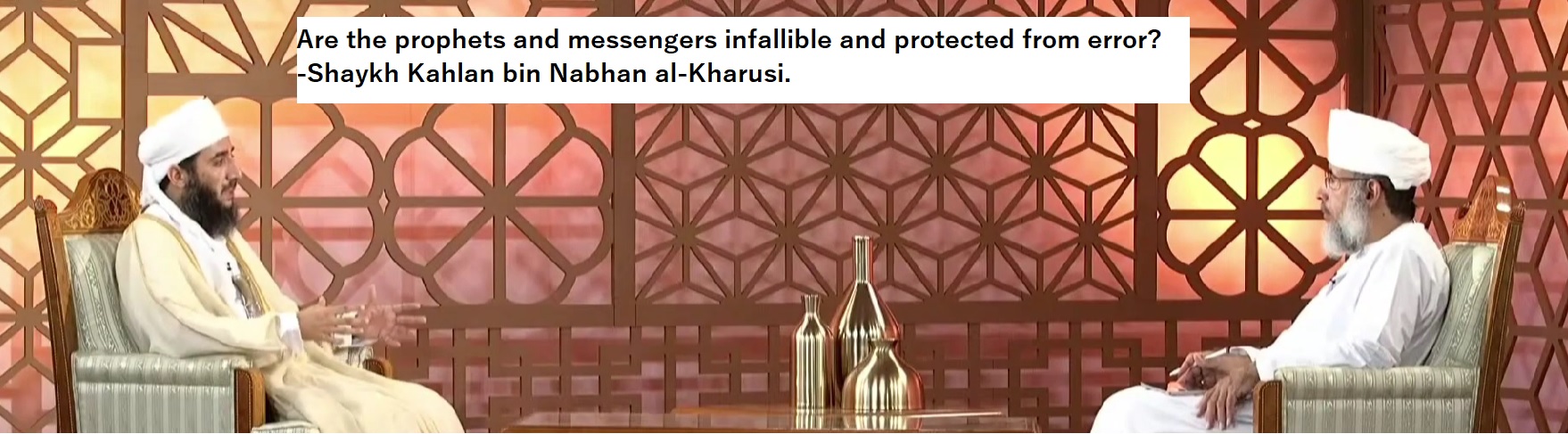
Title: Are the prophets and messengers infallible and protected from error?
Attribution: His Eminence Shaykh Kahlan bin Nabhan al-Kharusi
The translation is from the following video.
Brother Badr asks: “Are the prophets and messengers infallible and protected from error? Adam (as), as he says, made a mistake by eating from the tree. Moses (as) made a mistake by killing the Coptic man. Jonah (as) made a mistake by leaving his village without Allah’s permission. So how do we reconcile what we hear? Namely that the prophets are infallible with these mistakes?”
Shaykh Kahlan bin Nabhan al-Kharusi: What was the original question?
Questioner: Are the prophets and messengers infallible and protected from error?
Shaykh al-Kharusi: Yes.
Shaykh al-Kharusi: Regarding clarification of certain matters: what one finds among scholars on the issue of prophetic infallibility is that their intent in this matter pertains to sins and transgressions, not to mistakes in general.
Questioner: Yes.
Shaykh al-Kharusi: Sometimes some scholars use the word “mistake,” but they mean sins and transgressions. This must be clear. The discussion on prophetic infallibility relates to committing sins and transgressions.
Questioner: Yes.
Shaykh al-Kharusi: This is the first point.
The second point:
There is agreement among Muslim scholars, or the majority of Muslim scholars on the issue of prophetic infallibility from sins and transgressions. Regarding anything connected to revelation and conveying the message, they are infallible and protected from error or mistake in that.
Questioner: Yes.
Shaykh al-Kharusi: And anything that could involve shirk (associating partners with Allah), whether apparent or hidden, they are infallible from it. Likewise, they are unanimously protected from major sins.
Questioner: Yes.
Shaykh al-Kharusi: These matters are points of agreement among all scholars.
Questioner: Yes.
Shaykh al-Kharusi: Among the vast majority of scholars, any opinions to the contrary are anomalous and not given weight.
Questioner: Yes.
Shaykh al-Kharusi: The remaining discussion concerns minor sins. Scholars have differing views.
- Some hold that minor sins could occur from prophets.
- Others say minor sins could occur before prophethood but not after;
Questioner: Yes.
Shaykh al-Kharusi: 3. And some deny the occurrence of minor sins from them altogether.
Questioner: Yes.
Shaykh al-Kharusi: May Allah’s prayers and peace be upon them all. These are the various positions. According to our scholars, they are free from minor sins both before and after prophethood.
Questioner: Yes.
Shaykh al-Kharusi: However, the view that minor sins could possibly occur from them without persistence in them and without them being left unaddressed is also a well-known view. Some even report that this is the position of the majority of scholars.
Questioner: Yes.
Shaykh al-Kharusi: Regarding minor sins without persistence and without being left unaddressed.
Questioner: Yes.
Shaykh al-Kharusi: So they do not persist in them, nor do they remain upon them, nor are they left unrebuked. And no sin or punishment results from them.
Questioner: Yes.
Shaykh al-Kharusi: As for those who hold that minor sins are impossible for prophets, both before and after prophethood, how do they interpret what is mentioned in the Book of Allah or authentically reported in the Sunnah of the Messenger of Allah (peace and blessings be upon him and his family) that appears to involve a sin? They interpret it as doing what is contrary to what is better and more appropriate for the station of prophethood. This station is the highest and most perfect of stations. Therefore, something that is contrary to what is better is inconsistent with the station of prophethood but this could occur from them. This is a good interpretation, as it shows proper etiquette toward the prophets of Allah (may Allah’s prayers and peace be upon them all) and interprets their actions in a good and acceptable manner.
Now we come to some examples that scholars mention: what occurred from Adam (as), what happened with Moses in that incident when he struck the Coptic man and killed him.
Questioner: Yes.
Shaykh al-Kharusi: and what happened with Dhul-Nun (Jonah) when he fled to the laden ship.
Questioner: Yes.
Shaykh al-Kharusi: and some other examples. I say that each of these has an interpretation.
Questioner: Yes.
Shaykh al-Kharusi: Regarding Adam and his wife eating from the tree, the correct view is that that stage was not a stage of religious obligation (taklif). Yes.
Prima Qur’an comments: By this Shaykh al-Kharusi means taklīf, تَكْلِيف or religious duty, obligation, or moral responsibility assigned to a them by Allah. This was not assigned during the time of Adam (as).
The honourable Shaykh continues:
Shaykh al-Kharusi: This has been reported by several exegetes, and it was greatly relied upon by Imam al-Tahir ibn Ashur in Al-Tahrir wa al-Tanwir. He reported it, as did others before him, and they mentioned that it is the view of the majority: that stage in Adam’s preparation, training, and upbringing was not a stage of religious obligation but rather a stage of discipline.
Questioner: Yes.
Shaykh al-Kharusi: Therefore, what occurred from him that appears to be error and disobedience was actually a violation of the discipline of training. Violating what was required for his preparation and development. Ibn Ashur gave an example: like the head of a household training his children. When they disobey his command even if the act itself is not inherently sinful or described as a sin.
Questioner: Yet it is disobedience to the head of the household’s command, a deviation from his path.
Shaykh al-Kharusi: For example, he tells them, “Do not enter this room,” and they enter.
Questioner: Yes.
Shaykh al-Kharusi: So this falls under violation of discipline because it was not a stage of religious obligation. That was not a stage of legal responsibility.
Questioner: Yes.
Shaykh al-Kharusi: This is a good interpretation that brings together various points made about the story of Adam and his eating from the tree. Moreover, the noble Qur’an explicitly describes Adam as having forgotten “And Adam disobeyed his Lord and erred” (Qur’an 20:121) & “but he forgot, and no firm resolve was found in him.” (Qur’an 20:115) So it occurred as an oversight and forgetfulness on his part, not as a deliberate intention to disobey Allah’s command.
Questioner: Yes.
Prima Qur’an comments:
“And We had already taken a promise from Adam before, but he forgot (fanasiya); and We found not in him determination.” (Qur’an 20:115)
In Arabic Nisyan (نِسْيَان) is of two types. Unintentional human lapses of memory and abandonment/neglect.
Human Memory Lapse
Examples:
Moses (as) says:
“He replied, “Do you remember when we rested by the rock? (nasiytu al-ḥūta)I forgot the fish. None made me forget (ansānīhu) to mention this except Satan. And the fish made its way into the sea miraculously.” (Qur’an 18:63)
When Joseph asked a fellow inmate who was being released to mention him to the king, the inmate experienced a lapse of memory.
“And he said to the one whom he knew would be saved along with him, ‘Mention me before your master.’ But Satan made him forget (fa-ansāhu al-shayṭānu) mentioning it to his master, so Joseph remained in prison for several years.” (Qur’an 12:42)
Conscious Disregard / Abandonment
“On the Day of Judgment, those who ignored the afterlife will face spiritual isolation. “And it will be said, ‘Today We will forget you as you forgot (nasītum) the meeting of this Day of yours, and your refuge is the Fire, and for you there are no helpers.'” (Qur’an 45:34)
“Do you order righteousness of the people and forget yourselves (wa-tansawna anfusakum) while you recite the Scripture? Then will you not reason?” (Qur’an 2:44)
The above verse admonishes people who preach goodness to others but entirely neglect their own moral obligations.
The honourable Shaykh continues:
Shaykh al-Kharusi: As for what occurred with Moses (as) for you asked about it.
Questioner: Yes.
Shaykh al-Kharusi: That was not a sin on Moses’ part but rather an error.
Questioner: Yes.
Shaykh al-Kharusi: He intended to defend the Israelite from the Coptic man because the Coptic man was transgressing. He was an aggressor.
Questioner: Yes.
Shaykh al-Kharusi: So Moses intended to push him away, and he struck him. But Allah decreed that he died from that blow.
Questioner: Yes.
Shaykh al-Kharusi: This is accidental killing. Therefore, it is not described as a sin. However, due to the station of prophethood, Moses sought forgiveness from his Lord and said,
“My Lord, indeed I have wronged myself” (Qur’an 28:16). He sought forgiveness from his Lord because he did not intend that, nor did he want it to happen. It occurred from him while his intention was to forbid evil. But Allah decreed what happened.
Questioner: Yes
Shaykh al-Kharusi: This is what is mentioned in the Book of Allah or the Sunnah of the Messenger of Allah(saw) regarding this matter is interpreted in this way.
In summary, it is important to pay attention to the following: matters related to conveying revelation, shirk (whether apparent or hidden), as well as major sins the prophets are infallible in these.
Questioner: Infallible.
Shaykh al-Kharusi: Infallible, peace be upon them.
As for minor sins, there is a difference of opinion, and the various views have been mentioned. As for errors, those things that are not sins and not within the scope of religious obligations, their situation in this regard is like that of all human beings: they may make a mistake in some matter that is not a sin, for which no legal obligation had been established. And Allah knows best.
Questioner: Or for which no obligation had previously existed.
Shaykh al-Kharusi: Yes. This, as I said, is interpreted as doing what is contrary to what is better.
for example. [ When Allah says to the Prophet-peace be upon him] “May Allah pardon you. Why did you give them permission?” (Qur’an 9:43)
Questioner: Yes.
Shaykh al-Kharusi: This is a matter of proper etiquette. It has been said that it was left to their own judgment, and they exercised ijtihad. So the matter is clear. As for those who hold that an error occurred, they describe it as doing what is contrary to what is better. And Allah knows best.
Prima Qur’an comments.
On the last point that Shaykh al-Kharusi mentioned:
for example. [ When Allah says to the Prophet-peace be upon him] “May Allah pardon you. Why did you give them permission?” (Qur’an 9:43)
This would be known as: Khilaf al-awla (خلاف الأولى)which in Islamic legal term meaning “contrary to what is best” or “opposing the preferred action”
Thus, on prophetic infallibility there are four points.
The discussion on prophetic infallibility relates to committing sins and transgressions.
- Regarding anything connected to revelation and conveying the message, they are infallible and protected from error or mistake in that.
- And anything that could involve shirk (associating partners with Allah), whether apparent or hidden, they are infallible from it.
- As for errors, those things that are not sins and not within the scope of religious obligations, their situation in this regard is like that of all human beings: they may make a mistake in some matter that is not a sin, for which no legal obligation had been established. And Allah knows best
- Likewise, they are unanimously protected from major sins.
Summary:
- They are protected from making any mistakes or errors in conveying the revelation.
- They do not do anything that involves shirk.
- They are not protected from making errors or mistakes in personal ijtihad like all human beings.
- They do not commit major sins.
An example of point 3.
Musa b. Talha reported:
I and Allah’s Messenger (saw) happened to pass by people near the date-palm trees. He (the Holy Prophet) said: What are these people doing? They said: They are grafting, i. e. they combine the male with the female (tree) and thus they yield more fruit. Thereupon Allah’s Messenger (saw) said: I do not find it to be of any use. The people were informed about it and they abandoned this practice. Allah’s Messenger (saw) (was later) on informed (that the yield had dwindled), whereupon he said: If there is any use of it, then they should do it, for it was just a personal opinion of mine, and do not go after my personal opinion; but when I say to you anything on behalf of Allah, then do accept it, for I do not attribute lie to Allah, the Exalted and Glorious.
Source: (https://sunnah.com/muslim:2361)
The discussion concerns minor sins. There are three views.
- Some hold that minor sins could occur from prophets.
- Others say minor sins could occur before prophethood but not after.
- Some deny the occurence of minor sins from them altogether.
Shaykh al-Kharusi pauses and corrects himself.
He says: “According to our scholars, they are free from minor sins both before and after prophethood.”
Then he corrects himself: “However, the view that minor sins could possibly occur from them without persistence in them and without them being left unaddressed is also a well-known view. Some even report that this is the position of the majority of scholars.”
Some examples from the Qur’an.
Adam-alayhi salam
“And We had already taken a promise from Adam before, but he (fanasiya) forgot; and We found not in him determination.” (Qur’an 20:115)
فَنَسِيَ (fa-nasiya) = “but he forgot” (or “then he forgot”)
This word for forget or negligence is the wording used to describe the Christians who received the wrath of Allah (swt). However, notice the verse above says: ‘We found not in him determination.’ Meaning persistence in his sin.
“And from those who say, “We are Christians” We took their covenant; but they (fanasu)forgot a portion of that of which they were reminded. So We caused among them animosity and hatred until the Day of Resurrection. And Allah is going to inform them about what they used to do.” (Qur’an 5:14)
فَنَسُوا (fa-nasū) — “but they forgot” (or “they neglected” / “they abandoned”)
We have already discussed this point above.
The injustice of “Dhu’n-Nun” (the Man of the Whale) and “Sahib al-Hut” (the Companion of the Fish) or Jonah.
“And [mention] the man of the fish, when he went off in anger and thought that We would not decree [anything] upon him. And he called out within the darknesses, “There is no deity except You; exalted are You. Indeed, I have been of the (l-ẓālimīna) wrongdoers.” (Qur’an 21:87)
“Then the fish swallowed him, while he was (mulīmun)blameworthy.” (Qur’an 37:142)
That same word is used in the Qur’an to describe the state of Pharaoh when he was cast into the sea.
“So We took him and his soldiers and cast them into the sea, and he was (mulīmun) blameworthy.” (Qur’an 51:40)
It should be noted that Pharoah is in the barā’ah ḥaqīqah. One truly cut off from Allah (swt).
So how do we understand this?
There are three types of Ẓulm.
Ẓulm Against Allah (Shirk / Polytheism).
“And [remember] when Luqman said to his son while he was advising him, ‘O my son, do not associate [anything] with Allah. Indeed, association [with Him] is great injustice (ẓulmun ‘aẓīm).‘”
(Qur’an 31:13)
We do not even find this among the noble companions much less the Prophets!
Ẓulm Against Others (Oppression of People or Creatures)
This involves violating the rights, property, physical safety, or dignity of fellow human beings and other living things. Allah does not forgive this type of injustice unless the victim first forgives the oppressor or the oppressor does his/her level best to make things right with the one oppressed.
“The blame is only against those who wrong the people (yaẓlimūna-nās) and tyrannize upon the earth without right. For those there will be a painful punishment.” (Qur’an42:42)
Ẓulm Against Oneself (Committing Sins)
“And those who, when they commit an immorality or wrong themselves (ẓalamū anfusahum), remember Allah and seek forgiveness for their sins and who can forgive sins except Allah?”
(Qur’an 3:135)
“Then We caused to inherit the Book those We have chosen of Our servants; and among them is he who wrongs (ẓālimun)himself, and among them is he who is moderate, and among them is he who is foremost in good deeds by permission of Allah. That is what is the great bounty.” (Qur’an 35:32)
So coming back to “Dhu’n-Nun” (the Man of the Whale) and “Sahib al-Hut” (the Companion of the Fish) how would we understand him as being among those who commit Ẓulm?
And indeed, Jonah was among the messengers. When he ran to the laden ship, he cast lots and was among those who lost. Then the fish swallowed him while he was blameworthy. And had he not been of those who exalt Allah, he would have remained inside its belly until the Day they are resurrected. (Qur’an 37:139–144)
&
And [mention] the man of the fish, when he went off in anger and thought that We would not decree [anything] upon him. And he called out within the darknesses, “There is no deity except You; exalted are You. Indeed, I have been of the wrongdoers.” So We responded to him and saved him from the distress. And thus do We save the believers. (Qur’an 21:88)
The Qur’an does not state that Allah explicitly forbade Jonah (Prophet Yunus) from leaving in these specific verses. Instead, the text focuses on the manner of his departure and the fact that he left without receiving Divine permission.
So this is an example of Khilaf al-awla (خلاف الأولى)
The example of Moses.
“And he entered the city at a time of unawareness of its people, and he found there two men fighting. One of the men being from his party and one of his enemy. And the one of his party appealed to him against his enemy, so Moses struck him and killed him. He said, “This is from the work of Satan. Indeed, he is a manifest, misleading enemy.” He said, “My Lord, indeed I have wronged myself, so forgive me,” and He forgave him. Indeed, He is the Forgiving, the Merciful. He said, “My Lord, for the favor You bestowed upon me, I will never be an assistant to the criminals.” And he became inside the city fearful and anticipating, when suddenly the one who sought his help the previous day cried out to him once again. Moses said to him, “Indeed, you are an evident, misled one.” And when he wanted to strike the one who was an enemy to both of them, he said, “O Moses, do you intend to kill me as you killed someone yesterday? You want only to be a tyrant in the land and do not want to be of the amenders.” And a man came from the farthest end of the city, running. He said, “O Moses, indeed the eminent ones are conferring over you to kill you, so leave. Indeed, I am to you of the sincere advisors.” So he left it, fearful and anticipating. He said, “My Lord, save me from the wrongdoing people.”
“And you did that deed of yours which you did, and you are one of the (l-kāfirīna)ungrateful. He said, “I did it then, when I was of those who are ( l-ḍālīna) astray.” (Qur’an 26:19-20)
We as Muslims ask Allah to guide us and keep us away from the l-dalina.
“The path of those upon whom You have bestowed favor, not of those who have evoked [Your] anger or of those who are (l-ḍālīna) astray.” (Qur’an 1:7)
It is used of the Prophet (saw) before divine guidance.
“And He found you lost (ḍāllan), and He gave you guidance.” (Qur’an 93:7)
Thus, the the “accident” label is an interpretive conclusion drawn by scholars, not a direct statement of the Quranic text itself. However, what is clear is that there are no verses in the Qur’an that address Moses (as) as a prophet before the incident where he killed the man.
In fact, his divine comission starts here: Qur’an 20:11–24 and Qur’an 28:29–35.
What is also clear is that Musa (as) prayed: “My Lord, indeed I have wronged myself, so forgive me,”
Which is followed by: “and He forgave him.” So in that sense you can say that Moses (as) was sinless as he did not begin his comission as a Prophet. The one whose sin is forgiven is like the one who never sinned.
Then there is this verse where Allah (swt) addresses the Blessed Prophet (saw).
“That Allah may forgive (liyaghfira)for you what preceded of your (dhanbika) sins and what will follow and complete His favor upon you and guide you to a straight path.” (Qur’an 48:2)
When addressing Pharaoh a word from the same Arabic root is used.
“[Theirs is] like the custom of the people of Pharaoh and those before them. They denied Our signs, so Allah seized them for their (bidhunūbihim)sins. And Allah is severe in penalty.” (Qur’an 3:11)
In classical Arabic, Dhanb literally means:
- A fault or shortcoming like human oversight or “leaving the better option” Khilaf al-awla (خلاف الأولى)
- A sin, crime, or offense
Also note that the verse above says: That Allah may forgive (liyaghfira) Forgiveness is only for that which needs forgiveness. Which doesn’t necessarily entail a moral sin.
Some Muslim translators were embarassed by this because the text is a direct assault upon their contrived beliefs.
This is why as Muslims we follow the evidence. We do not follow our desires.
Observe:
https://www.islamawakened.com/quran/48/2/translations/
*Mohammed Tahir-ul-Qadri*has translated the above as:
“So that Allah forgives, for your sake, all the earlier and later sins (of all those people) of your Umma ([Community]* who struggled, fought and sacrificed by your command), and (this way) may complete His blessing on you (outwardly and inwardly) in the form of Islam’s victory and forgiveness for your Umma (Community), and may keep (your Umma) firm-footed on the straight path (through your mediation).”
* Note *We understand the claimants of Sufism to be lovers of Al-Haqq (The Truth) and not people who manipulate the religion.
It is rather obvious why people would interpret the text like this. Because when you have a Pir-Murid (master-disciple) culture where people are expected to pledge fealty to the Pir, then it becomes impossible for the Pir to commit even the smallest infraction or mistake.
All acts of kufr (ingratitude) are sins. However, not all sins are acts of kufr (ingratitude).
All acts of shirk are acts of kufr but not all acts of kufr are acts of shirk.
There is no verse in the Qur’an where Allah (swt) forgives an act of kufr without repentance.
Major sins committed with persistence and unrepentance that are acts of kufr, yet it is evident to you the reader that it is impossible for any Prophets (peace and blessings upon them) to persist in commiting a sin. Furthermore, we do not pass judgement of disbelief or disavowal regarding those who possess true *walayah* (spiritual sanctitiy/freindship with Allah), yet we do not condone sin on anyone’s part.
A case in point is the story of the brothers of Joseph (peace be upon him) ” we attest to their *walaya* and their place in Paradise, while simultaenously disavowing before Allah the sins they committed against their brother Joseph and their father Jacob (peace be upon them both).
The following lecure by Shaykh Hilal Al Wardi (h) is also very eye opening:
The methodology of the Prophets in dealing with sins. Shaykh Hilal Al Wardi.
You may also enjoy reading the following:
May Allah Guide the Ummah.


