Tag Archives: aisha

For those Shi’a who do slander Aisha (ra)

“And hold not to the ties of marriage of unbelieving women.”(Qur’an 60:10)

﷽ .

Muslims believe that the Blessed Prophet Muhammed (saw) was guided in every way. This should also include his choice of wife. If the Blessed Messenger (saw) chose Aisha (ra) as his wife, then this choice had to be a blessed and correct decision. Or even more so if Allah (swt) chose her as his wife.

“Concerning verse Qur’an 24:26 (Vile women are for vile men and vile men are for vile women. Good women are for good men and good men are for good women… Majmaʿ al-bayān says: There are a few interpretations proposed for this verse… The third meaning is: “The vile among women belongs to the vile among men, and the vile among men belongs to the vile among women.” This is narrated from Abū Muslim and al-Jubbāʾī. It is also narrated by Imams al-Bāqir and al-Ṣādiq…”

Source: (Tafsir Al Mizan pg 142 https://almizan.org/vol/29/129-154)

First, the Ibadi scholars have already shown the flaws in the Shi’i Imams and their misunderstanding of such verses. 

You can read about that here:

Dealing with a report accepted in the Sunni tradition.

Before we move on to the Shi’i narrations concerning the event, we have to deal with a report accepted in the Sunni tradition. The Blessed Messenger (saw), calls `Ali bin Abi Talib and Usama bin Zaid to consult with them. In this narration, Usama bin Zaid (ra) was quick to still the heart of the Blessed Prophet (saw). Whereas the narrators have `Ali bin Abi Talib being a source of waswas. 

For those of our readers unfamilar with waswas. 

Waswas (Arabic: وَسْوَاس) in Islam refers to whispering doubts, intrusive thoughts, or temptations placed in a person’s mind—especially by Shaytan—to cause confusion, doubt, sin, or anxiety.

“When the Divine Inspiration was delayed. Allah’s Messenger (saw) called `Ali bin Abi Talib and Usama bin Zaid to ask and consult them about divorcing me. Usama bin Zaid said what he knew of my innocence, and the respect he preserved in himself for me. Usama said, ‘(O Allah’s Messenger (saw)!) She is your wife, and we do not know anything except good about her.’ `Ali bin Abi Talib said, ‘O Allah’s Messenger (saw)! Allah does not put you in difficulty and there are plenty of women other than she, yet, ask the maid-servant who will tell you the truth.’ On that Allah’s Messenger (saw) called Barira (i.e. the maid-servant) and said, ‘O Barira! Did you ever see anything which aroused your suspicion?” Barira said to him, ‘By Him Who has sent you with the Truth. I have never seen anything in her (i.e. Aisha) which I would conceal, except that she is a young girl who sleeps leaving the dough of her family exposed so that the domestic goats come and eat it.’

Source: (https://sunnah.com/bukhari:4141)

Dealing with reports accepted in the Shi’i tradition.

Some Shi’i, in their frustration that Allah (swt) had cleared Aisha (ra) of false accusations and honored her, decided that they would fabricate their own vicious story. In doing so, they became people who hold lightly that they will indeed meet Allah (swt) and that Allah (swt) is severe in taking into account.

In their fabrication of Hadith, rather than Aisha (ra) becoming the victim of a vicious rumor, she becomes someone who spreads a vicious rumor.

Yet, these fabricators are not very clever at all. By creating this story, what they are in effect doing is saying that any rumors regarding the chastity of Aisha (ra) are false. There is no basis for them. If so, on what grounds?

“According to Shi’i narrations, this was revealed about Māriyah al-Qibṭiyyah, who was accused [of indecency] by Aisha. Then it narrates from Zurārah: I heard Imam al-Bāqir say: The Messenger of Allah was extremely bereaved upon the death of his son Ibrāhim [from Māriyah]. Aisha told him, “Why are you so upset with him? He was the son of Jarīḥ.” Thus, the Messenger of Allah charged Ali to go after him [Jarīḥ] and kill him. Ali took his sword and went after him. At the time, Jarīḥ al-Qibṭī (the Coptic) was in a garden. Alī knocked on the garden’s door. Jarīḥ went to open the door, but when he saw Alī [from behind the door] he recognized anger in his face. Thus, he went back and did not open the door. Alī jumped over the wall into the garden and followed him. Jarīḥ started running for his life, and when he felt that Alī is about to catch him, he climbed up a palm tree. Alī climbed behind him, and when he got very close to him, Jarīḥ threw himself down from the tree. As he fell down, his private part was revealed, and Alī saw that he had neither the male nor the female organ. Alī returned to the Prophet and told him, “O Messenger of Allah! When you charge me with a task, should I be like a hot iron spike rubbed against fur, or should I verify the matter?” He replied, “Rather, you should verify.” He said, “By the One Who has sent you with truth, he is devoid of what men have, and he is devoid of what women have.” Thus, the Prophet said, “Praise be to Allah Who diverted evil from us Ahl al-Bayt.”

Source: (Tafsir Al Mizan pg 137 https://almizan.org/vol/29/129-154)

Prima Qur’an comments:

Now, dear readers, we want you to reflect on the story that you just read. Instead of making Aisha look (ra) bad, these people from among the Shi’i have insulted the Blessed Prophet Muhammed (saw) as well as Ali.

Now let’s think about the rationality of someone like Aisha (ra) who knows that the Blessed Prophet (saw) is aware of the unseen, and receives revelation about the unseen concocting a story like this, to begin with.

Was she not aware that Allah reveals the unseen to the Blessed Prophet (saw) or not?

Are we really to believe the Prophet Muhammed (saw) didn’t know that Aisha (ra) was allegedly lying?

Are we really to believe that Ali would go chase down a non-Muslim without a chance for the man to be charged, tried, and found guilty?

There were people not comfortable with the idea of the justice of Islam being portrayed as some ill-tempered man charging at a non-Muslim with a sword in hand without even taking the time to explain the charges to him or give him a chance to prove his innocence.

That the poor soul Ibn Jarih wasn’t compensated for his ordeal?

Why would Aisha (ra) choose Mariyah (ra) over any other wife?

These people who fabricated this hadith have insulted the intelligence of the Blessed Messenger (saw).

Aisha(ra) obviously knew IF she concocted such a story that it would have to be something believable. This means there would have had to be an occasion for Mariyah and Ibn Jarih to be together.

This would mean that the Blessed Prophet Muhammed (saw) was negligent of his wife, and was unaware of the condition of Ibn Jarih. The one who narrates this story is one who believes that it is possible for the Blessed Messenger (saw) to be duped by such simple lies.

Certainly, after creating this fabrication, what is very revealing is that all of them seemed to be comfortable with the idea of Ali studiously fixated on a man’s crotch as he fell from a tree. Obviously, if a man’s private area is exposed, the pure of heart averts their gaze right away, whereas the diseased heart would have tarried there for a moment.

Are we really to believe that Ali, instead of averting his gaze, took it upon himself to gawk at another man’s privates?

“Tell the believing men to lower their gaze and guard their chastity. That is purer for them. Surely Allah is All-Aware of what they do.” (Qur’an 24:30)

Are we really to believe that Ali had very harsh words towards the Prophet Muhammed (saw)?

There were certainly more honorable and noble people among the Shi’a who were uncomfortable with Ali having the following terse words for the Messenger of Allah (saw).

“O Messenger of Allah! When you charge me with a task, should I be like a hot iron spike rubbed against fur, or should I verify the matter?”

What we end up finding out from the commentators is that the story is a fabrication all along.

Now, obviously, there are among the Shi’a thinking people who are looking at this story and realizing things are not adding up.

Just look at how the commentators have to try and salvage this story:

“Abd-Allāh b. Bukayr said: I asked Imam al-Sadiq, “May I be your ransom! When the Messenger of Allah ordered the killing of the Coptic man, did he know that he had been lied to or not? Because it was only through Alī’s verification that Allah spared the Coptic man.” He answered, “No! By Allah, he knew [that he had been lied to]. If that was the real intention of the Messenger of Allah[that the Coptic man should be killed], then Alī would not have returned before killing the man. However, the Messenger of Allah only said this apparently so that she Aisha may drop her sin [of false allegation], but she did not drop it and did not mind the killing of a Muslim man [innocently].”

Source: (Tafsir Al Mizan page 138 https://almizan.org/vol/29/129-154)

Prima Qur’an comments:

So what we learn is that the commentators come along and try and salvage this half-baked story.

The student who questions Imam Al Sadiq is either literary fiction invented by Al Sadiq to seemingly give answers to some very obvious holes in the narration. One’s that Al Sadiq saw himself. Or it is an honest objection and line of inquiry that Al Sadiq does his best to answer.

However, it gets even worse!

“Tafsīr al-Qummī, on the authority of Muḥammed b. Jaʿfar, on the authority of Muḥammed b. Īsā, on the authority of al-Ḥasan b. Alī b. Faḍḍāl, on the authority of ʿAbd-Allāh b. Bukayr means that the Prophet pretended to be serious in his command, but between himself and Alī they knew that he does not really mean it.” (Trans.)”

Source: (Tafsir Al Mizan page 138 note 2 https://almizan.org/vol/29/129-154)

Prima Qur’an comments:

Obviously it now raises questions about Ali’s knowledge of the unseen. Because the student (if they are real and not a literary device) when asking Al Sadiq didn’t stop to think about Ali’s knowledge of the unseen. So the commentators have: means that the Prophet pretended to be serious in his command, but between himself and Alī they knew that he does not really mean it.

But that is not what the narration reflects at all! We have Ali asking: “O Messenger of Allah! When you charge me with a task, should I be like a hot iron spike rubbed against fur, or should I verify the matter?”

So we are supposed to believe that the man behind nahjul balagha just speaks redundantly?

What makes this very devestating is that it makes both Imams al-Bāqir and Al Sadiq as people who attributes false reasoning and false shenanigans to the Blessed Prophet (saw)!

Look what the narration states! Go back and read it and see the lies oh Muslim readers!

“the Messenger of Allah only said this apparently so that she Aisha may drop her sin [of false allegation], but she did not drop it and did not mind the killing of a Muslim man [innocently].”

So if Aisha (ra) is allegedly that wicked that she would lie about a wife of the Prophet (saw) and she didn’t mind the killing of a Muslim man [innocently] then surely the Prophet (saw) knew this?! Which in case makes the whole excercise of sending Ali after Jarīḥ (ra)!

If these things can be authentically attributed to Imams al-Bāqir and Al Sadiq then we can only hope they repented before they died and that Allah (swt) saved them from the hellfire.

If these things are not true, then may Allah deal with those Shi’i who unjustly attributed such things to their Imams.


In the end, none of these stories are true or really happened. Ultimately, we know it’s not true because nothing came of the whole story.

The Prophet Muhammed (saw) did nothing to Aisha (ra).

He didn’t divorce her.

You would think that the dignity and the honour and the justice of the Blessed Messenger (saw), who had his son Ibrahim (May Allah cover him in mercy),honour disparaged, and an innocent man’s life put at risk, that the Blessed Messenger (saw) would have done something in regard to Aisha (ra).

He didn’t!

“Moreover, one of His signs is that He created mates for you from yourselves that you may find tranquility in them, and He ordained between you love and compassion.” (Qur’an 30:21)

“And hold not to the ties of marriage of unbelieving women.”(Qur’an 60:10)

If what is narrated is authentically attributed to Imams al-Bāqir and Al Sadiq then what we see is that some of these Shi’I scholars and their wicked hearts became a playground for Iblis. They were so vile as to use the Blessed Prophet (saw) ‘s own son, Ibrahim (May Allah cover him in mercy,) as a plot device to disparage Aisha (ra).

How twisted and dark can one’s heart become?

So the sober-minded among the Shi’a commentators also point out other problems with this fabrication here:

“There are also certain problems with these narrations: First, the story suggested by these narrations does not match the verses, especially verses like: “Surely they who concocted the slander”…(24:11),” Why did not the believing men and the believing women, when you heard it, think well of their own people.”(24:12), and “When you received it with your tongues and spoke with your mouths what you had no knowledge of.” (24:15). These verses indicate that: This was a collaborative plot by a connected network of individuals, who spread the story in order to disrepute the Prophet. That the people were passing the news by their tongues, to the point that it widely diffused among them, and this continued for some time. That they did not respect the Prophet’s divine honor and sanctity in doing so. The story depicted by these narrations is far from these points. The only possible explanation is to say that these narrations have been abridged in their portrayal of the story. Second, the story would necessitate that the legal penalty [of eighty lashes]should be applied to the accuser, but that did not happen. The only possible response to this objection is to say that the verse outlining the penalty for the accusation of adultery [24:4] was revealed quite a while after this story. Not applying the legal penalty for accusation right away poses a problem for both accounts. To dodge this problem, we should conclude that the verses about the story of slander were revealed before the verse about the accusation of adultery (qaḍf).

This means that the only laws that were revealed in the story of slander were the following:

(1) the accused person is innocent as long as no evidence is shown for the accusation; and

(2) accusation of adultery [without evidence] is forbidden [but no legal penalty was decreed for it]. Had the legal penalty for unwarranted accusation been legislated before the story of slander, there would have been no room [for the Prophet] to delay the penalty for such a considerable time or to wait for revelation about it. Also, no accuser would have been spared the penalty in that case. Similarly, if all of the above verses [including both the legal penalty and the story of slander] were revealed together, then there would have been some reference made to their penalty in the verses about the story, at least by having the story come right after the verse about accusation [24:4]. Those who know about the theme and flow of speech would not doubt that verses 24:11—26, “Surely they who concocted the slander…”—are disconnected from their previous verses. In addition, if the legal penalty of those who accuse the Prophet’s wives with adultery were twice, then it would have been mentioned in the verses about the slander. That would have perfectly fit in the verses given their harsh treatment of the accusers with curse and threat of punishment. One may answer the above by saying that perhaps the verses of slander[24:11ff] and accusation [24:4] were revealed together. However, this will only add a further problem to the last one, because it entails that there was a need for two laws but only one was revealed.”

Source: (Tafsir Al Mizan pg 139 https://almizan.org/vol/29/129-154)

Prima-Qur’an comments:

Obviously, they are grasping at straws.

The only possible explanation is to say that these narrations have been abridged in their portrayal of the story.”

Notice they don’t bring all these narrations together? Because you, the reader, will find even more holes in these fabrications.

The only possible response to this objection is to say that the verse outlining the penalty for the accusation of adultery [24:4] was revealed quite a while after this story.

So do tell us what the occasion was of 24:4 then? To say that this ayat has been chopped up into two occasions is a real stretch.

Also, tell us who the male architect is here?

“Indeed, those who came with falsehood are a group among you. Do not think it is bad for you; rather it is good for you. For every person among them is what [punishment] he has earned from the sin, and he who took upon himself the greater portion thereof – for him is a great punishment.”(Qur’an 24:11)

In the end, such people are described by Allah (swt).“There is a sickness in their hearts, and Allah only lets their sickness increase. They will suffer a painful punishment for their lies.” (Qur’an 2:10)

May Allah (swt) bless our mother Aisha (ra). May Allah (swt) instill in our hearts love for her. May Allah (swt) bless those sincere and righteous Shi’a who defend her honour against the diseased among them.

For those interested, you may also wish to read the following articles:

May Allah (swt) guide the Ummah!

May Allah (swt) forgive the Ummah!

4 Comments

Filed under Uncategorized

“We Shi’i believe the Prophets are Masoom however Aisha…..”

“And hold not to the ties of marriage of unbelieving women.” (Qur’an 60:10)

“The Prophet has a stronger affinity to the believers than they do themselves. And his wives are their mothers. As ordained by Allah, blood relatives are more entitled than believers and immigrants, unless you show kindness to your associates. This is decreed in the Record.” (Qur’an 33:6)

﷽ 

If the Shi’i believe that the Blessed Prophet Muhammed (saw) was infallible in every way, this should also include his choice of wives. Rather or not, the Blessed Messenger (saw) chose Aisha (ra) as his wife or Allah (swt) chose her as his wife.

Indeed, those who falsely accuse chaste, unaware and believing women are cursed in this world and the Hereafter; and they will have a great punishment.” (Qur’an 24:23)


These verses above were revealed on an occasion in which some of the companions made insinuations about the noble wife Aisha(ra). Allah (swt) cleared Aisha(ra) of the insinuations and has clearly questioned the faith of those who would repeat such allegations.

However, if some want to assume that this verse exonerates Maria Al-Qibtiyya (ra) and not Aisha (ra) you would have to wonder why the Blessed Messenger (saw) remained married to Aisha(ra).

Even the Shi’i admit that the Blessed Messenger (saw) never divorced Aisha (ra).

“Moreover, one of His signs is that He created mates for you from yourselves that you may find tranquility in them, and He ordained between you love and compassion.” (Qura’n 30:21

“And hold not to the ties of marriage of unbelieving women.” (Qur’an 60:10)


Now, if the Shi’i want to say the Blessed Messenger (saw) didn’t know, we should ask on what basis they know then? On what basis are they better informed about the wife of the Blessed Messenger (saw) than the Blessed Messenger (saw) is himself!

Even still, the Shi’i will often bring up the following verse and ask if the wives of Lot and Noah (May Allah’s peace be upon his prophets), were either made pure simply by their marriage to these noble prophets or were the best choice for them.

What is interesting about them doing this is that there is not a denial that Aisha(ra) was indeed the wife of the Blessed Messenger (saw).

“Allah sets forth an example to those who disbelieve: the wife of Noah and the wife of Lot. They were both two of our righteous servants, but they acted treacherously towards them, so they availed nothing against Allah, and it was said: Enter the fire with those who enter.” (Quran 66:10)

Let us see how a member of the Ahl Bayt has explained this verse.

“Allah warned ‘A’ishah and Hafsah because they hurt the Prophet (saw). By mentioning the example of the wives of Noah and Lot, saying: Allah explains (an example) a trait (for those who disbelieve) by mentioning the two disbelieving women: (the wife of Noah) Wahilah (and the wife of Lot) Wa’ilah, (who were under two of our righteous slaves) messengers (yet betrayed them) yet opposed them in religion, displaying belief outwardly while hiding their disbelief inwardly, such that they kept their hypocrisy in their hearts; but they did not betray their husbands in the sense that they committed adultery, for no wife of a prophet had ever done this, (so that they the husbands availed them naught) benefited them naught (against Allah) against the chastisement of Allah; i.e. the righteousness of their husbands did not benefit them while they were disbelievers (and it was said (unto them): Enter the Fire) in the Hereafter (along with those who enter) the Fire.”

Source: Tanwir Al-Miqbas min Tafsir Ibn Abbas https://quranx.com/Tafsirs/66.10

Unless someone wants to say that Ibn Abbas (ra) made a flaw in his commentary of the verse, this is what the great scholar has had to say.

If someone says that they do not accept the Tafsir of Ibn Abbas (ra), then this should be noted.

However, the person should be reminded that the verse in the Qur’an does not specify what the betrayal of the wives was.

The other point is this. In the case of Lot (as) and Noah (as), we do not know if their wives were apart of some arranged marriage.

Whereas we know that the Blessed Messenger (saw) chose Aisha (ra) as his wife.

Narrated by ‘Aisha:

Allah’s Messenger (saw) said (to me), “You were shown to me in a dream. An angel brought you to me, wrapped in a piece of silken cloth, and said to me, ‘This is your wife.’ I removed the piece of cloth from your face, and there you were. I said to myself. ‘If it is from Allah, then it will surely be.’ “

Source: https://sunnah.com/bukhari:5125

So the point still stands against those of the Shi’i who hold bad things in their heart towards Aisha (ra).

Was the Blessed Messenger (saw) exercising sound decision-making when choosing Aisha (ra) as a wife?

“O you who believe! Truly, your wives and your children are enemies to yourselves: so beware of them! But if you forgive and overlook, and cover up their faults, truly Allah is Oft-Forgiving, Most Merciful.” (Quran 64:14)

Let us see how a member of the Ahl Bayt has explained this verse.

“O you who believe! Indeed, among your wives and children there are enemies for you, so beware of them of obeying them in neglecting the performance of good deeds such as struggling or emigrating — because the reason why this verse was revealed was precisely their obedience of them in such matters. And if you pardon them for their impeding you from such good deeds, justifying it on account of the distress that parting with you causes them, and overlook such enmity and forgive them, then assuredly, Allah is Forgiving Merciful.

Source: Tanwir Al-Miqbas min Tafsir Ibn Abbas https://quranx.com/Tafsirs/64.14

Prima Qur’an comments

This statement, explained by Ibn Abbas(ra), is made specifically (khāṣṣ) to the people that migrated from Mecca to Medina. However, if someone wants to make this verse (ʿāmm) or general, it now applies to anyone who has a wife or children.

By that it COULD mean that Fatima (ra) is an adversary of Ali.

By that, it COULD mean that the children of Ali are an adversary to him. If you are going to take a general meaning of it.

Not only this but the verse COULD imply something that is not as grave as it sounds. Especially as it encourages forgiveness, covering up and overlooking faults.

The Children of Fatima (ra) and Ali are described as a fitna by the Blessed Prophet (saw).

“Beautified for men is the love of things they covet; women children, Qanatir Al-Muqantarah of gold and silver, branded beautiful horses, cattle and well-tilled land. This is the pleasure of the present world’s life, but Allah has the excellent return with him.)” (Qur’an 3:14) and the Ayah after it. Imam Ahmad recorded that Buraydah said, “The Messenger of Allah was giving a speech and Al-Hasan and Husayn came in wearing red shirts, walking and tripping. The Messenger descended from the Minbar, held them and placed them in front of them and said,

«صَدَقَ اللهُ وَرَسُولُهُ إِنَّمَا أَمْوَالُكُمْ وَأَوْلَادُكُمْ فِتْنَةٌ، نَظَرْتُ إِلَى هَذَيْنِ الصَّبِيَّيْنِ يَمْشِيَانِ وَيَعْثُرَانِ، فَلَمْ أَصْبِرْ حَتْى قَطَعْتُ حَدِيثِي وَرَفَعْتُهُمَا (Allah and His Messenger said the truth,` Truly, your wealth and your children are a Fitnah.’ I saw these two boys walking and tripping and could not be patient until I stopped my speech and picked them up.)” This was recorded by the Sunan compilers, and At-Tirmidhi said, “Hasan Gharib.”

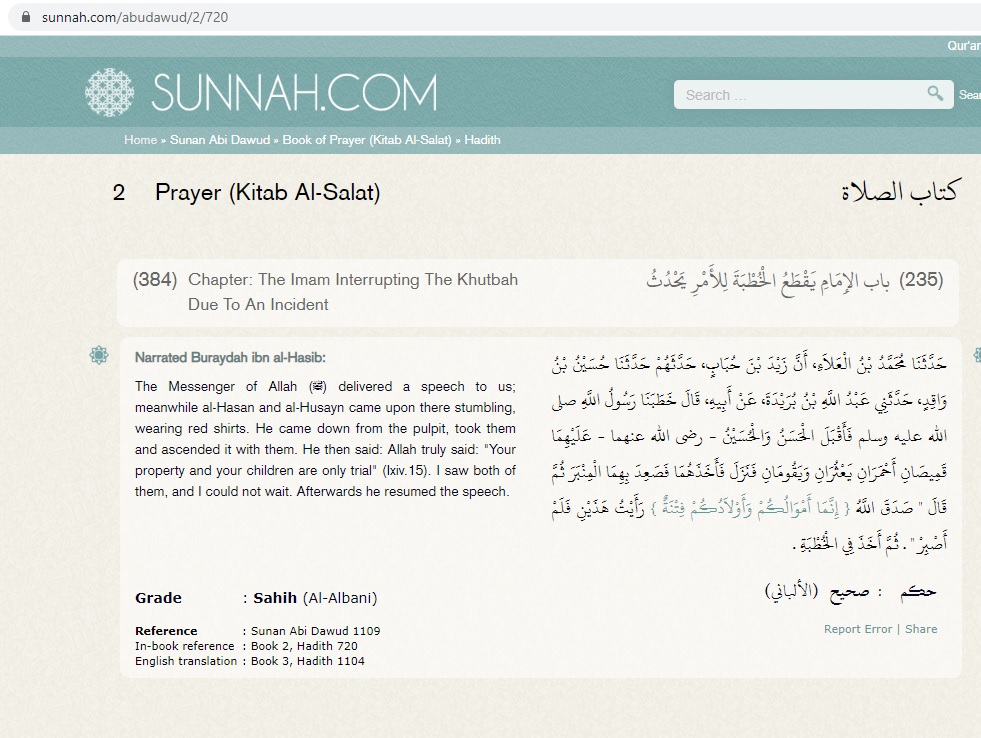
Narrated by Buraydah ibn al-Hasib:

The Messenger of Allah (saw) delivered a speech to us; meanwhile, al-Hasan and al-Husayn came upon there stumbling, wearing red shirts. He came down from the pulpit, took them and ascended it with them. He then said: Allah truly said: “Your property and your children are only (fitnat) trial” (Ixiv.15). I saw both of them, and I could not wait. Afterwards, he resumed the speech.

Source: (https://sunnah.com/abudawud:1109)

So what are we to make of the Blessed Messenger (saw) calling the children of Ali and Fatima (ra) a fitna?

Fitna never has pleasant connotations in the Qur’an.

So this COULD be understood as something not so severe as in the usual sense of understanding the word fitna.

In the end, we can say that the Blessed Prophet Muhammed (saw) was Masoom in the choice of his wives, including chief among them the Mother of the Believers, Aisha(ra). She is included among the ‘Ahl Bayt’ and those purified by Allah (swt). The Creator of the universe came to her defense in a revelation of the Qur’an.

As our Creator, who is both merciful and severe in punishment, has reminded us:

Indeed, those who falsely accuse chaste, unaware and believing women are cursed in this world and the Hereafter; and they will have a great punishment.(Qur’an 24:23)

You might be interested in reading the following articles:

May Allah Forgive the Ummah.

May Allah Guide the Ummah.

8 Comments

Filed under Uncategorized

Shafi’i Muhaddith (Salah al-Din al-idlibi) questions age of Aisha in Bukhari

“Follow not that whereof you have no knowledge. Lo! the hearing and the sight and the heart – of each of these it will be asked.” (Qur’an 17:36)

﷽ 

A very interesting discussion Ṣalāḥ al-Dīn al-’idlibī, a contemporary Muḥaddīth using matn critique to show that the age of Aisha(ra) as reported in Bukhari and understood by the majority does not add up when all evidence and factors are considered.

This is all too important because time and time again we hear that anyone who challenges the hadith corpus is some modernist Muslim who has no grounding in his/her faith.

This humble article is one of many that refute these overly simplistic and unfounded allegations. The source for the original article in Arabic is: https://salahsafa.blogspot.com/2013/02/blog-post_27.html?fbclid=IwAR0rRA_ODrbLmqTsJ4-ObzBNbTwWcuw7hjbi_KWnDruTvkKNLsEzt_PuTnw

Ṣalāḥ al-Dīn Ibn Aḥmad al-’idlibī was born in 1948 in the Syrian city of Aleppo* He is Shāfi‘ī in lineage and got a PhD in Islamic sciences with a specialty in Ḥadīth from the Dār al-Ḥadīth al-Ḥassīniyah in Morocco in 1980. He has taught Ḥadīth sciences at several Arab universities, including the Kulliyah al-Darāssāt al-’islāmiyah wa al-‘Arabiyah in Abu Dhabi and the Kulliyah al-Sharī‘ah in the United Arab Emirates. * in the comments section a man who is claimed to be his grandson wanted the city of birth changed from Idlib to Aleppo. I have made the changes accordingly.

21 He has a website where his publications and media appearances are posted.

He is famous for writing a 22 detailed response 23 to a Salafī critique against the ’Āsh‘arī theological school.24 His first publication (probably a rework of his PhD thesis) is a detailed research that tries to prove that textual (matn) criticism of prophetic Aḥadīth has been part of Islam since its beginnings.25 The Aisha-age-traditions are not discussed in it, but he provides many examples of famous Aḥadīth that are found in the Ṣaḥīḥ collections, which has been criticized by many foundational scholars, including ‘Ā’īsha who was famous for criticizing traditions that spoke in a denigrating manner about women or traditions with anthropomorphic contents.26

This book in my eyes shows the key element in al-‘idlibī’s approach to the Ḥadīth corpus whereby traditions are determined firstly by contents, and not just by isnād. Although scholars of Fiqh have always applied textual criticism, over the centuries the authenticity level of the isnād became more and more decisive in accepting a tradition and increased the reluctance to reject it.27 Al-’idlibī on the other hand points out that to declare an isnād authentic (ṣaḥīḥ) it needs to comply to five conditions, while there are numerous reasons for a text (matn) to contain a mistake (’asbāb al-Wahm kathīrah).

Only a tradition which is deemed both ṣaḥīḥ in isnād and matn can overcome its probable truth factor (ghalab ‘alā al-Ẓann), but it still isn’t multiple transmitted (lā yatawātar) and thus doesn’t gain the certain truth factor (maquṭū‘a) of a multiple transmitted tradition (al-Mutawātir). When a tradition has 28 an authentic isnād but deviant contents (’isnād ṣaḥīḥ wa matnahu shādh) it is classified as weak and deficient (ḍa‘īf) and can be rejected.29 Al-’idlibī thus clearly presents an ’usūlī methodology in judging and classifying traditions .30, although he never references his methodology to any ’usūlī scholar.

Jonathan Brown calls this approach ‘Late Sunni Traditionalism’, which is a revival of the ’Ahl al-Rā’y juristic methodology whereby ”jurists, not hadith scholars, with the ultimate authority in determining the authenticity and implication of a hadith“, making jurists ”responsible for content criticism“.31 Al-’idlibī is clearly influenced by, or follows a similar vision as, the late ’Aẓharī scholar Muḥammad al-Ghazālī (d. 1996 CE) who saw a Ḥadīth only as truly ṣaḥīḥ if it didn’t contain a hidden flaw (‘illā) or contradict more reliable evidence.32 It is this methodology which we will also find in his discussion on the Aisha-age-traditions.

Al-’idlibī’s analysis on the age of marriage of ‘Ā’īsha

Although I was acquainted with English works on the age of ‘Ā’īsha, and knew there were already Arabic discussions on this matter from the 1950s 33, I hadn’t come across any work in Arabic until I saw a blog post by professor Mohammed Fadel (University of Toronto) where he recounted his meeting with al-’idlibī and had posted a link to al-’idlibī’s essay.34 While reading I noticed he used many similar sources and arguments as the English works, but because he used classical terminology it didn’t feel apologetic. That he wrote a specific essay on it shows that the age presented in the traditions were probably disconcerting to him, but by applying his methodology and terminology this apologetic element isn’t present.

In the essay, he points out that because the Aisha-age-traditions are of ṣaḥīḥ status, there is no avoiding in studying it. If we take his ’usūlī methodology in mind, it means that the ṣaḥīḥ status of the isnād demands that the matn must also be checked for an error (wahm), so that its probability status (ẓann) can be judged.

Secondly, he says he came across some articles on this subject by some scholars, and he wanted to write about it to “sharpen some scientific thoughts in the condoning indifference on the positions of weakness”.

Meaning, he wants to point out to people that they remain too much indifferent to possible weaknesses in historical sources. Thus according to him, his objective is not to simply discredit the Aisha-age traditions because he rejects the possibility of the Prophet marrying an underaged girl, but to use it as an example of how people easily overlook mistakes in generally accepted sources. Just as his book on matn criticism tries to prove the classical practice of it, and thus its authenticity level as an Islamic methodology, this essay tries to show the necessity and usefulness of such criticism.

In his analysis he tries to determine ‘Ā’īsha’s age by determining:

  1. The age difference and the birth-year of her older sister ’Asmā’
  2. The possibility she experienced and narrated events at a certain age
  3. The words used to describe her
  4. When she converted to Islam
  5. When her father married her mother
  6. The way she was proposed as a possible spouse for the Prophet

He does this by using both graded and ungraded narrations, thus collecting as much evidence to prove there is a conflict between the gathered evidence and the original narration under question.

Part of his argument is also based on the idea that it is unreasonable that she was four or younger at certain events (2.) and when she was proposed to the Prophet (6.), which uses assumptions about a child’s capability and the way seventh-century culture discussed possible spouses. It thus not simply an argument based on the clear textual and linguistic comparison, but also involves the idea of what is reasonable. All this taken together is enough proof for al-’idlibī to declare the Aisha-age-traditions as containing an error (wahm), and thus being defective (ma‘lūl).

Translation of al-’idlibī’s essay

The transmitted Ḥadīth in the estimated age of the honorable ‘Ā’īsha on the day of marriage contract and marriage

In the name of Allah Most Merciful ever Merciful.

Praise to Allah numerous good blessed praising such as loving and pleasing our Lord, and praise to Allah whom by His blessings completes the righteous, the Lord completes through the good, and seals for us through the good, through Your beneficence and grace and honor, O Honored of the honored.

A Ḥadīth is transmitted about the Prophet, salutations of Allah upon him and peace 36, that the marriage-contracted (‘aqada)37 honorable ‘Ā’īsha, Allah’s pleasure upon her 38, and her years were six years and he married her [when she was] nine years. And is this Ḥadīth authentic in transmission chain (isnād) and textual contents (matn)?? [There] is no avoiding from its study.

I came across an article about this important subject written by some researcher in weakening (taḍa‘īf) that Ḥadīth regarding transmission chain and textual contents, and I found that one [can get] possible gain (al-Mumkin al-Istifādah) from it in the sharpening.

(al-Taqāṭ) of some scientific thoughts in the condoning (al-Taghāḍī) on the positions of

weakness (nuqaṭ al-Ḍu‘f), for the leaving [of this condoning] (al-Khurūj) through constituent result (bi natījah mu’assisah) on evidence (al-’Adilah) and conductive indications (al-Qarā’īn al-Muwaṣṣilah) towards the rational correct expression, by Allah’s authority.

And for necessary clarification (li ḍarūrah tajliyah) of the aspect of the rational correct (wajh al-Ṣawāb) in this important issue from the issues of the noble Prophetic biography and the reported tradition so this research supported through evidence in the history of the birth of honorable ‘Ā’īsha (rA‘), and estimation of her age (miqdār ‘umrahā) at the time the marriage-contract [was placed] upon her from the Messenger of God (ṣA‘ws) and her age at the time of her wedding. And in this [there are] two said issues:

The first saying is well known (al-Mashūr): Is that he marriage-contracted her and she was a girl of six years and he married her and she was a girl of nine. They take through what is established on it from her saying in ṣaḥīḥ al-Bukhārī and others, which means that she’s born after the Prophetic mission (ba‘ada al-Ba‘thah al-Nabawiyah)39 by four years.

The second saying: Is that he marriage-contracted her and she was a girl of fourteen years and he married her and she was a girl of eighteen years, which means that she was born before (qabla) the mission by four years.

The evidence of the first saying:

Al-Bukhārī, Muslim, and others reported from Ṭariq on Hishām bin ‘Arwah on his father on ‘Ā’īsha that the Prophet (ṣA‘ws) married her and she was a girl of six years, and he consummated with her and she was a girl of nine years. And Muslim’s transmission is from Ṭarīq Mu‘ammar on al-Zuhrī on ‘Arwah on ‘Ā’īsha

And Ibn Ḥanbal and Muslim’s transmission is from Ṭarīq al-’Aswad bin Yazīd al-Nakha‘ī on ‘Ā’īsha. And the wording “he married her (tazawwajahā)” 40 is intended with the meaning of marriage-contract (al-‘Aqd), and this is the objective (al-Maqṣūd) here.

And the Ḥadīth it’s transmission chain (sanad) is ṣaḥīḥ. And it’s certainly incorrect (’akhṭā’) as an opinion (ẓann) that Hishām bin ‘Arwah is isolated (tafarrada) in its transmission and that it is from his imagination (’awhāmahu).41

The evidence of the second saying:

1 – ‘Ā’īsha is younger than her sister ’Asmā’ (rA‘) with 10 years, and ‘Asmā’ was born before the Hijrah by twenty-seven years, meaning before the Prophet mission by fourteen years, and this means that ‘Ā’īsha was born before the Hijrah by four years.

Ibn ‘Asākir reported in the “Tārīkh Damashqi” through its sanad on ibn ’Abī al-Zanād that he said: ”’Asmā’ the daughter of ’Abū Bakr was older than ‘Ā’īsha by ten years.“42

And ’Abū Na‘īm said in the “Ma‘rifah al-Ṣaḥābah” in the biography (tarjamah) of ’Asmā’:” She was born before the history 43 by twenty-seven years, and she died seventy-three years later in Makkah after her son killed ‘Abd Allah bin al-Zubayr in [those] days, and she was a hundred years.“44 And [that] which confirms this report in the knowing the year of birth of ’Asmā’ is what ’Abū Na‘īm reported such about her that she said: ”I saw Zayd bin ‘Amrū bin Nafīl and supporting himself on the wall of the Ka‘abah, he said: Oh community of Quraysh, none of you today is on the religion of Abraham other than I.“ 45 Zayd had passed away and the Quraysh was building the Ka‘abah before He [God] send down a revelation on the Messenger of God by five years. Such was reported by Ibn Sa‘ad in the “al-Ṭabaqāt” on Sa‘yd bin al-Musayb 46, meaning [this] was before the Hijrah by eighteen years, thus her age was nine years [when] she heard this as that time.

And this is logical (ma‘aqūl), because anyone recollecting what was heard from him (yaḍbuṭ mithl hadhā al-Samā‘ minhu) cannot be anything other than predominantly nine (tisa‘a fī al-Ghālib). And ibn al-’Athīr in the “’Asad al-Ghābah”: ’Abū Na‘īm said: ”She was born before history by twenty-seven years.“47 And ibn ‘Abd al-Birr said in “al-istī‘āb”: ”And ’Asmā’ passed away in Makkah in Jumādī al-’Awwalā year seventy-three [after Hijrah], and at her death, she had reached a hundred years.“48

2 – Al-Bukhārī reported on ‘Ā’īsha (rA‘) that she said: ”Indeed He sent in Makkah on Muḥammad (ṣA‘ws), while I proceeded to play (li-jāriyah ’ala‘abu), {But surely the Hour is their appointed time, and the Hour is calamitous and bitter} 49, and what was sent down of chapter al-Baqarah and al-Nisā’ except what was already with him.“ 50

Al-Qurṭubī says in his commentary (tafsīr): Ibn ‘Abbās said: ”Between the sending down of this verse and between [the battle of] Badr were 7 years“51. And when it is as such, this means that it was sent down before the Hijrah by five years and after the [Prophetic] mission by eight.

And ibn Sayd said in the “al-Muḥkām” and ibn Manẓūr in ” 52 Lisān al-‘Arab”53: ”al-Jāriyah: The youthful from the women (al-Fatiyyah min al-Nisā’).“ And al-Fatiyyah is the juvenile woman (al-Shābbah). And they applied (yuṭaliqūn….‘alā) the word “al-Jāriyah” for the girl in her adolescence (fatā’īhā) and juvenileness (shabābahā) until the appearance of coming and going [of her menstrual period].54

So how much is the age of ‘Ā’īsha with the sending down of the Exalted His saying {But surely the Hour is their appointed time, and the Hour is calamitous and bitter} which was sent down after the [Prophetic] mission by eight years?!

Concerning the first saying her age is four years and a girl of four isn’t called jāriyah as the first saying outlines. As for the second saying, her age is placed with the sending down of the verse estimating (thantī) ten years and thus is harmonious (al-Mansajim) with the meaning of al-Jāriyah.

3 – al-Bukhārī transmitted on ‘Ā’īsha (rA‘) that she said: ”I didn’t understand my parents except that they professed the religion [of Islam], and no day would pass except with the visit of the messenger of God (ṣA‘ws) at the morning daylight and night. So when the Muslims were tested [by being persecuted] Abū Bakr went out-migrating towards Ethiopia, and when he reached al-Ghimād early he was met by Ibn al-Daghnah…” [till the end of the] tradition.

The aspect of interference from this narration are two issues:

First of the two is that a child cannot know the custom (al-‘Āddah) professed by the majority of the people from its religious conversion and its religiosity (tadayyun) and its condition (aldīhu) by the religion of others at four years, and if ‘Ā’īsha was born four years after the [Prophetic] mission, and her first awareness (‘ayahā) of her surroundings in the 8th year [of the Prophetic mission] then her statement “I didn’t understand my parents except that they professed the religion [of Islam]” is a result without use; because Abū Bakr was known to have been one of the earliest converts to Islam, and [his wife] ’Umm Rūmān became Muslim in Mecca in early times, as Ibn Sa‘ad said.

However if she was born before the mission by four years, and her first awareness of her surroundings in the first year of the mission, that statement is useful. And is that – it explains she begins to become aware of her surroundings – she sees the condition of both of them professing the religion of Islam, and not only one condition.

And this proves that she was born before the mission with approximately four years, and this is proven in other evidence.

Second, of the two is that her statement ”So when the Muslims were tested [by being persecuted] Abū Bakr went out-migrating towards Ethiopia“ is a turning point (Ma‘ṭūfā) on her realization of her parents and they two professed the religion is so candid in that when she was was aware to this event (al-Ḥuduth) and the departure of the companions from Mecca for the migration to Ethiopia was in the middle of the fifth year from the mission and their migration second for her in the last of the fifth or beginning of the sixth.

And if ‘Ā’īsha was born four years after the mission it was possible for her to be aware of that event in the beginning of the sixth year, and because she was born before the mission with four years, thus this means the possibility of her awareness for that with clarity (bi-wuḍūḥ).

4 – Muḥammad bin ’isḥāq said in the Prophetic biography in mentioning ’Asmā’ as one of the first who became Muslim: ”Then people from the Arab tribes submitted, from them Sa‘īd bin Zayd bin ‘Amr bin Nafīl and his wife Faṭimah bint al-Khaṭāb, and ’Asmā’ bint Abū Bakr, and ‘Ā’īsha bint Abū Bakr and she was young (ṣaghīrah)….then Allah the Exalted commanded His Messenger (ṣA‘ws) that he proclaim (yaṣda‘) with what came with him. And that he announces through His command to mankind, and call towards Allah the Exalted, and maybe he concealed something and hide through it that command with its appearance, so it was broadcasted years after the mission, then God the Exalted said {So proclaim what you have been commanded, and turn away from the idolaters}.55

And Ibn Kathīr transmitted some of this text with the meaning as said: ”Ibn ’isḥāq said: Then Allah commanded His Messenger (ṣA‘ws) after three years after the mission through that he proclaimed with what he was commanded, and that he endured on whom are idolaters.“56 And Ibn ’isḥāq’s statement means here that ‘Ā’īsha became Muslim during the time of the secret call [to Islam] (fitrah al-Da‘wah al-Siriyah) after the mission, and that she was young, and if that fitrah time period was 3 years, ‘Ā’īsha may have been brought in to some of the gatherings of the Muslims at the end of the fitrah.

And on the statement that she was born after the mission by four years, this cannot be right in principle because she wasn’t born after.

In regards to the second statement, her age would be six years or seven. Perhaps ibn ’isḥāq mentioned her as being amongst the first Muslims in spite of her young years as a respect for her father Abū Bakr (RA‘) and consisted the turning point (Ma‘ṭūfah)57 of her sister ’Asmā’ who was older than her by ten years.

5 – al-Ṭabarī says in his “Tārīkh”: ”Abū Bakr married in the pre-Islamic times (al-Jāhiliyah) Qutīlah ibnah ‘Abd al-‘Uzzā and she fathered for him ‘Abd Allah and ’Asmā’, and he also married in the pre-Islamic times ’Umm Rūmān bint ‘Amir and she fathered for him ‘Abd al-Raḥman and ‘Ā’īsha, so all these four children were born from his two wives whom their [marriage] oaths were taken in the pre-Islamic times.“58 So these historical texts are candidly obvious in that ‘Ā’īsha (rA‘) was born before the Prophetic mission.

6 – Ibn Abī ‘Āṣam transmitted in the first and second, and al-Ṭabarānī in the “al-Mu‘jam al-Kabīr” and al-Ḥākim in the “al-Mustadarak” on ‘Ā’īsha (rA‘) that Khawlah bint Ḥākim, the wive of ‘Uthmān bin Muẓa‘ūn (rA‘), said in Mecca to the messenger of God (ṣA‘ws): ”In other words, the messenger of God desists from marrying? He said: And who [do you suggest]? She said: Do you want a young woman (bakrā) or an old woman (thayibā)? He said: So who is the young woman? She said: The daughter of the most beloved of Allah’s creation to you, ‘Ā’īsha bint Abī Bakr. And he said: Who is the older woman? She said: Sawdah bint Zama‘ah. He said: So go and mention me to both of them.“59

The context (al-Siyāq) proves that Khawlah (rA‘) wanted to speak to the messenger of Allah (ṣA‘ws) after the passing of the honorable Khadijah, because from that moment he had no wife, and in the purpose (Ghāyah) is improbable that she speaks to him in this case about her who is of the age of six years!! However when she is a girl of fourteen years then this is reasonable (ma‘qūl), and seems that this is correct (al-Ṣaḥīḥ).

– And there is no doubt that together these proofs and external indications on the statement in that the Prophet (ṣA‘ws) married ‘Ā’īsha and her age being eighteen years is proven by strong proof that this is correct.

And in regards to what is established about ‘Ā’īsha from that the messenger of God married her and she was of nine years, and it is unavoidable that this is an error (wahmā). And she (rA‘) lived – [based] on the deciding statement here – seventy-five years. So perhaps she was afflicted (’aṣābahā) by forgetfulness (al-Nisayān) in this matter, thus its narration is erroneous (al- awahhum).60 And the error of the narrated statement (tawahhīm al-Qawl al-Murawī) about ‘Ā’īsha (rA‘) doesn’t escape it, and that from the gathered evidence and indications which presents its conflict (khilāfahi).

The summary of the research:

Based on the gathering of evidence and indications that the honorable ‘Ā’īsha (rA‘) was born before the mission by four years, and she was marriage-contracted (‘aqada ‘alayhā) by the messenger of Allah (ṣA‘ws) in the tenth year of the mission and her age was fourteen years, before the Hijrah by three years. And married her at the end of the first year after the Hijrah and her age were eighteen years.

The mentioned tradition in specifying the age of ‘Ā’īsha by six years on the day of the marriage-contracting and nine years on the day of marriage are authentic in the chain of transmission (ṣaḥīḥ al-’isnād), however, it conflicts with the researched texts and historical indications. Thus it is defective (ma‘lūl) because it is from those that are erroneous (al-’Awhām).

The imams (rA) stated that the narration when its contents (matn) conflicts with what is stronger evidence from reliable history, it is thus rejected (yuradd), because it is proven that it is in some way unsound (al-Khalal) through an occurring cause of the error (al-Wahm) in the single narration.

And Allah knows best.

And praise is to Allah, Lord of the worlds.

References:

19 See a discussion on this in Jonathan A.C. Brown, Misquoting Muhammad: The Challenge and Choices of Interpreting the Prophet’s Legacy (London: Oneworld, 2014), 145-148. Early 20th century Orientalist writing caused some discussions on this among higher classes and some intellectuals in Egypt, but it is the post-1990 era when this discussion seemed to have returned in Arabic, in far more Arab countries among the larger population, and by scholars trained in Islamic sciences.

20 See for example a lecture by the well-known preacher Dr. Adnan Ibrahim: http://www.youtube.com/watch?v=v8Nz2LpiYVs (accessed on 26-01-2015).

21 Personal communication from his students at these universities.

22 http://www.salahsafa.blogspot.com

23 Ṣalāḥ al-Dīn al-’idlibī, ‘Aqā’īd al-’Āshā‘irah fī Ḥiwār hādī ma‘ Shubhāt al-Munāwi’īn (Cairo: Dār al-Salām, 2010).

24 Safar ibn ‘Abd Raḥmān al-Ḥawālī, Minhaj al-’Āshā‘irah fī al-‘Aqīdah (Riyadh: Dār al-Taybāt al-Kudharā, n.dt.).

25 Ṣalāḥ al-Dīn al-‘idlibī, Minhaj Naqd al-Matn ‘inda ‘ulamā’ al-Ḥadīth al-Nabuwī (Beirut: Dār al-’Afaq al-Jadīdah, 1983).

26 For example, a famous tradition transmitted by Abū Hurayrah claims that the prayer is nullified when a donkey, dog or woman passes in front of the praying men, ‘Ā’īsha scolded Abū Hurayrah for this. Another famous saying by her is that “anyone claiming Muḥammad saw Allah is lying, as God cannot be seen by human eyes”, whereby she refuted the still dominant belief that Muḥammad’s night journey to heaven was in a bodily form.

27 Wael B. Hallaq, “The Authenticity of Prophetic Ḥadîth: A Pseudo-Problem”, Studia Islamica, No. 89 (1999), 75-90.

28 A Mutawātir is a Ḥadīth or saying (khabar) which is transmitted in every stage of the stages of the sanad by multiple transmitters (general agreed-upon requirement is 10 transmitters), whereby it can be rationally be concluded that these transmitters could not have agreed upon a fabrication (’ikhtilāq). A Mutawātir provides necessary knowledge (al-‘ilm al-Ḍarūriyya). Any ṣaḥīḥ tradition that doesn’t confirm to these criteria, but has an authentic isnād, is of the status of Aḥād (singular transmission) only provides conditional knowledge (al-‘ilm al-Mutawaqqif), which needs further investigation. Maḥmūd al-Ṭaḥḥān,Taysīr Muṣṭalaḥ al-Ḥadīth (Riyadh: Maktabah al-Ma‘ārif li-lNushr wa al-Tawzī‘a, 1425 AH), 23-25, 27.

29 al-’idlibī, ibid, 33.

30 For the difference between’usūlī and ’athārī methodology, see Hallaq, ibid, 79-85. For a classical ’usūlī exposition, see Abū Ishāq al-Shāṭibī, al-Muwāfiqāt fī ’usūl al-Sharī‘ah (Beirut: Dār al-Kutub al-‘ilmiyyah, n.dt.), 4:3-21.

31 Jonathan A.C. Brown, Hadith: Muhammad’s Legacy in the Medieval and Modern World (Oxford: Oneworld, 2009), 262.

32 Brown, ibid, 263. See the first two chapters in al-Ghazālī’s The Sunna of the Prophet between the People of the Fiqh and the People of the Ḥadīth (al-Sunnah al-Nubuwiyyahbayna ʾAhl al-Fiqh wa ʾAhl al-Ḥadīth) (translated by Aisha Bewley, Istanbul: Dar al-Taqwa,2009).

33 See footnote 19 above. Brown also points out that other known ‘Late Sunni Traditionalist’ scholars as ‘Alī Goma‘a also have written arguments against the Aisha-age-traditions, I hope to compare these in later writing.

34 http://shanfaraa.com/2013/07/salah-al-din-al-idlibi-on-the-age-of-aisha-r-when-shemarried-the-prophet-s/ (accessed on 10-09-2014). I thank prof. Fadel for his kind encouragement to translate and analyze al-’idlibī’s essay. The Arabic essay is added as Appendix I.

35 I have transliterated important words between brackets (), my additions to the text to amplify readability between [], and I stay as close to the Arabic sentence structures as possible by retaining the long sentences as much as possible. al-’idlibī refers to several sources without precise references (he doesn’t use footnotes in this essay), when I could trace the exact citations in the mentioned works I have added them in footnotes. I have added dates of death of the mentioned historians to show the period they were working in (which was mostly centuries after the compilers of Ḥadīth).

36 Translation of ṣalā Allah ‘alayhi wa salam, in the rest of the translation abbreviated as: (ṣA‘ws)

37 The contracting of marriage refers to the agreement between the guardians and/or prospected spouses on the wish to get married and on the amount of dowry. The root-word ‘aqada literally means making a knot (thus the English expression on marriage as “tying the knot” comes very close) and is used for contracts, agreements etc. It can be used to refer to the contracting of the marriage and the existing marriage itself as a form of contract. In classical Sharī‘ah constructs, betrothal (khiṭbah), contracting the marriage (‘aqd), and consummating it are separate acts whereby the first is an unofficial agreement between parties, the second an officializing agreement between parties with a dowry, while the latter is generally when the female is deemed physically ready. [al-Zuḥaylī, ibid, 7:23-26, 43-65. Brown, Misquoting Muhammad, 143]

38 Translation of raḍī Allah ‘anhā, in the rest of the translation abbreviated as: (rA‘)

39 Throughout most of the essay, al-’idlibī uses only al-Ba‘ath, the mission, to refer to the advent of the Prophetic mission. Although I will sometimes add ‘prophetic’ between brackets, I mostly just translate it literally with ‘the mission’, but it is best read as ‘advent to the Prophetic mission’. It is generally accepted that the Prophet received his first revelation in 610 CE, thirteen years before the Hijrah.

40 See footnote 3 above.

41 Here al-’idlibī dismisses the attempts by some apologists to try to find a weakness in the transmission chains of the Aisha-age-traditions to discredit them. See footnote 18 above.

42 Abū al-Qāsim ibn al-‘Asākir (d. 571 AH), Tārīkh Damashqi (Dār al-Fikr al-Ṭabā‘h wa al-Nushr wa al-Tawziya‘, 1995), 69:8. The isnād is not graded, thus its authenticity compared to the Aisha-age-traditions is unknown.

43 The history here means the Hijrah in 623 CE, when the Meccan Muslims migrated to Medina, which soon after was turned into the starting point of the Islamic calendar, and thus, history.

44 Abū Na‘īm al-’Aṣbihānī (d. 430 AH), Ma‘rifah al-Ṣaḥābah (Riyadh: Dār al-Waṭan li-lNushr, 1998), 6:3253. See also ibn al-‘Asākir, ibid, 69:9. Again the isnād is not graded, thus its authenticity compared to the Aisha-age-traditions is unknown.

45 al-Aṣbihānī, ibid, tradition 2843, 3:1134. Ungraded isnād.

46 ibn Sa‘ad (d. 230 AH), al-Ṭabaqāt al-Kubrā (Beirut: Dār al-Kutub al-‘ilmiyyah, 1990), 3:291. Ungraded isnād.

47 ‘Azz al-Dīn ibn al-’Athīr (d. 630 AH), ’Asad al-Ghābah fī Ma‘rifah al-Ṣaḥābah (Beirut: Dār al-Kutub al-‘ilmiyyah, 1994), tradition 6705, 7:7. Ungraded isnād.

48 ibn ‘Abd al-Birr (d. 463 AH), al-istī‘āb fī Ma‘rifah al-Ṣaḥābah (Beirut: Dār al-Jīl, 1992), tradition 6705, 7:7. Ungraded isnād. See also in al-‘Asākir, ibid, 69:8.

49 Qur’ān 54:46.

50 al-‘Asqalānī, ibid, 7:290. Isnād graded ṣaḥīḥ.

51 Shams al-Dīn al-Qurṭubī, Jāma‘a al-Aḥkām al-Qur’ān (Cairo: Dār al-Kutub al-Miṣriyah, 1964), 17:146. Ungraded isnād. The battle of Badr occurred in 2 AH (624 CE).

52 Bin Sayd al-Mursī, al-Muḥkām wa al-Muḥīṭ al-‘Aẓim (Beirut: Dār al-Kutub al-‘ilmiyyah, 2000), 7:625-626 (under the heading al-Shīn wa al-Bā’, the root of al-Jāriyah is jarā).

53 ibn Manẓūr al-’Anṣārī, Lisān al-‘Arab (Beirut: Dār Ṣādr, 1414 AH), 7:81.

54 I interfere that it refers to the coming and going of her menstrual period, although by my knowledge it is unusual to use it for such.

55 Qur’ān 15:94

56 Ibn Kathīr al-Damashqī (d. 774 AH), al-Sīrah al-Nabawiyah (min al-Bidāyah wa al-Nihāyah li-ibn Kathīr) (Beirut: Dār al-Ma‘rifah li-lṬabā‘h wa al-Nushr wa al-Tawzī‘, 1976), 1:454. Ungraded isnād.

57 Meaning here the conversion of ’Asmā’.

58 Ibn Jarīr al-Ṭabarī (d. 310 AH), Tārīkh al-Rusul wa al-Mulūk (Beirut: Dār al-Turāth, 1387

AH), 3:425-426. Ungraded isnād.

59 Abū al-Qāsim al-Ṭabarānī, al-Mu‘jam al-Kabīr (Cairo: Maktabah ibn Taymiyah, 1994),

23:23. Nu‘īm bin al-Ḥākim al-Naysābūrī, al-Mustadarak ‘alā al-Ṣaḥīḥayn (Beirut: Dār al-Kutub al-‘ilmiyah, 1999), tradition 2704, 2:181. Isnād graded ṣaḥīḥ.

60 Wahm is a technical indication within the classical Ḥadith sciences: ”When an error (wahm) is discovered through external indications (al-Qarā’īn) and the gathered the paths [of transmission], then it is defective (al-Mu‘allal)“, al-‘Asqalānī, Nukhbah al-Fikr fī Muṣṭalaḥ Ahl al-Athār (Cairo: Dār al-Ḥadīth, 1997), 8.

Dr. Shaykh al-Din al-idilibi (Surely he received his reward with Allah).

You may also be interested in reading the following article by the Shaykh:

https://primaquran.com/2024/01/12/hadith-of-73-sects-analyzed-by-shaykh-salah-al-din-bin-ahmad-al-idlibi/

You may also be interested in reading the following:

May Allah (swt) guide the Ummah.

May Allah (swt) forgive the Ummah.

4 Comments

Filed under Uncategorized

The Age of Aisha and the Highly Detailed Qur’an?

“Indeed, those who came with falsehood are a group among you. Do not think it bad for you; rather it is good for you. For every person among them is what he has earned from the sin, and he who took upon himself the greater portion thereof – for him is a great punishment. Why, when you heard it, did not the believing men and believing women think good of one another and say, “This is an obvious falsehood”? Why did they not produce for it four witnesses? And when they do not produce the witnesses, then it is they, in the sight of Allah, who are the liars. And if it had not been for the favor of Allah upon you and His mercy in this world and the Hereafter, you would have been touched for that in which you were involved by a great punishment. When one tongue received it from another and you uttered with your mouths something /that you knew nothing about. You deemed it to be a trifle while in the sight of Allah it was a serious matter. And why, no sooner than you had heard it, did you not say: “It becomes us not even to utter such a thing? Holy are You! This is a great slander.” Allah admonishes you: If you are true believers, never repeat the like of what you did. Allah makes clear to you his verses. Allah is All-Knowing, All-Wise.” (Qur’an 1-18)

﷽ 

From the perspective of the Qur’an Only Religion, all one can say is that something happened, to someone, somewhere. There are many, many details that are left out of this passage alone, let other parts of the Qur’an.

Who are those who come with falsehood? Qur’an answer: irrelevant.

The nature of the falsehood/allegation? Qur’an answer: irrelevant.

We can only assume, based upon the key phrase, “Why did they not produce for it four witnesses?” That someone, somewhere, accused somebody of either adultery/fornication. That is the best we can surmise from the text. Interestingly, this section ends with “Allah makes clear to you his verses.”

So recently, a follower of the Qur’an Only Religion who goes by the moniker of “The British Muslim” decided that the Qur’an just doesn’t clarify the age of Aisha (ra). So he decided to make this video:

So, instead of going to the text that he felt “left nothing out” and is “highly detailed”, he went to extraneous sources to satisfy his curiosity. However, this is inconsistent with the methodology of the Qur’an Only Religion. The Qur’an Only Religion teaches us that all we need is the Qur’an, the whole Qur’an, and nothing but the Qur’an.  Even though, for some odd reason, Allah (swt) associated himself with a human being. Muhammed (saw) was used as a vehicle to convey his message, even though Allah (swt) states clearly he could have done otherwise.

Yet for some reason(in the warped thinking of the Qur’an Only community), having the divine speech pass through the vehicle of a human being is not shirk (associating a partner with Allah). 

In reality, the position of the Qur’an Religion with regard to Aisha (ra) is this: Aisha who? Who is she? Why does she even matter? She doesn’t. The Qur’an does not mention her at all. All we know is that some guy named Muhammed (saw) received the Qur’an. There is no mention of his last name or his father’s name. Nothing. It’s just Muhammed, nothing more and nothing less.

The truth of the matter is that, from a Qur’an Only perspective, it does not give a specific appropriate age for getting married. This has been made abundantly clear is this article:

In this article we were interacting with the material from a member of the Qur’an Only Religion that goes by the pseudonym ‘Joseph Islam’ and perhaps he was uncomfortable with the very obvious fact that Allah (swt) decreed that WOMEN start ovulating at 11 and 12 and can conceive children.  You may be interested in seeing our conversation with a member of the Qur’an Only Religion. Even he acknowledged that the Qur’an doesn’t stipulate an age for marriage. However, he had tried in his own way to force the Qur’an to say what he felt was the appropriate age for marriage. 

You may also be interested in reading the following:

https://primaquran.com/2023/06/06/shafii-muhaddith-salah-al-din-al-idlibi-questions-age-of-aisha-in-bukhari-2/

You the discerning reader be the judge.

May Allah (swt) Guide the Ummah.

May Allah (swt) Forgive the Ummah.

2 Comments

Filed under Uncategorized