“It is He who has sent His Messenger with guidance and the world view that is based on the truth to manifest it over all other world views, although the mushrik make dislike it.” (Qur’an 9:33)
﷽
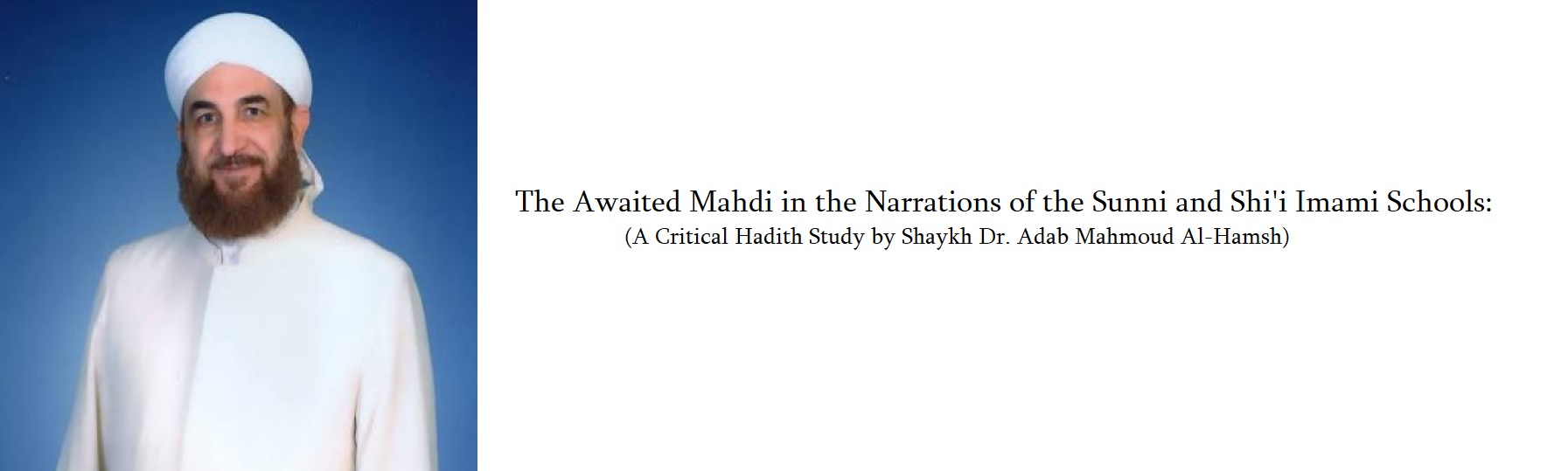
Mostly known in the West for the Sunni-on-Sunni confrontations between himself and Shaykh Saeed Fodeh, this claimed descendant of the Blessed Prophet (saw), Shaykh Dr. Adab Mahmoud Al-Hamsh himself is not a believer in the coming of any Mahdi figure.
In his critical hadith study: “Al-Mahdi al-Muntazar fi Riwayat Ahl al-Sunna wa al-Shi’a al-Imamiyya” (The Awaited Mahdi in the Narrations of Sunni and Imami Shi’i Islam), Shaykh Dr. Adab Mahmud al-Hamsh concludes that all the specific hadiths concerning the advent of a literal, awaited Mahdi whether marfu’ (attributed directly to the Prophet) or mawquf (attributed to companions) are weak (da’if) upon close critical examination.
Key Aspects of Al-Hamsh’s View
Flawed Transmission: He argues that what has been narrated about the Mahdi either lacks explicit authenticity in its wording or lacks clear attribution where the wording is authentic (ma swa sahha lam yakun sarihan, wa ma swa sarihan lam yakun sahihan).
Rejection of Consensus/Mutawatir Claims: Contrary to the mainstream traditional Sunni position which holds that Mahdi narrations reach the level of Tawatur Ma’nawi (mass-transmitted in meaning) Shaykh al-Hamsh contends that the proofs do not support a binding doctrinal belief (aqeedah) regarding a future awaited savior.
Critique of Shia Reports: He similarly devalues the Imami Shi’i reports concerning the specific birth, lineage, and occultation of Muhammed bin Hasan al-Askari, treating them as unproven through rigorous hadith-criticism standards
Published by Dar Al-Razi (Amman, 1422 AH – first edition). It comprises 553 pages in a large format and consists of six chapters. These chapters provide a general overview of most writings on the subject of the Mahdi. Both individually and within other contexts from Sunni and Shi’i perspectives. They also present the various conceptions of the Mahdi held by Sunnis and Shi’i, discuss the narrations related to him from both sides (those affirming and those rejecting them), and address other related topics, including the author’s own perspective on the issue. The hadith-based study of these narrations occupies 145 pages of the book.
His objective is to deny the negative effects of this doctrine on the development and behavior of Muslims (p. 532), both Sunni and Shi’i, with the latter being particularly egregious among Shi’i Muslims. This is because the failure to rely solely on authentic texts has led to an exaggeration of this doctrine among Sunnis, who believe the Mahdi is the savior and deliverer, thus negating the need for work and jihad.
They believe the Mahdi’s appearance will bring only a few years of happiness and prosperity followed by hardship. Meanwhile, Sufis portray the Mahdi as a pious, devout leader for whom Allah provides everything, and he has no say in the matter. Others see the Mahdi as an invincible warrior who fights infidels and hypocrites.
The Mahdi, according to the Shi’i, is part of the pillars of the religion because he is connected to the Imamate. However, he is different from the Mahdi of the Sunnis, as the Mahdi of the Sunnis is from the lineage of Al-Hasan ibn Ali. While according to the Shi’i he is from the lineage of Al-Husayn ibn Ali. Furthermore, the Mahdi of the Sunnis will come at the end of time, but the Mahdi of the Shi’i appeared between the years 252-260 AH, but he disappeared from that time in a minor occultation and then a major occultation, and he will appear at the end of time. Throughout this period, he is alive on earth but hidden from sight.
Based on the negative effects of the aforementioned Mahdi doctrine, the author studied the chains of transmission of the hadiths related to the Mahdi. He concluded that these hadiths are not authentic, and those that are authentic are not explicit on the subject of the Mahdi. Therefore, there is no need to link them to the Mahdi because the Mahdi is not authentic in the first place!
Therefore, Shaykh Dr. Adab Mahmud al-Hamsh believes that the Mahdi and the savior is the Messenger of Allah (saw). This is clear on pages (p. 212, p. 525), and that understanding the approach of the Messenger of Allah (saw) in calling for adherence to the religion of Allah Almighty is the only way to achieve happiness for Muslims throughout time, and not for a limited period as is the case with the Mahdi.
Because we have many articles that deal with Sunni scholars (from across the spectrum) that have rejected the hadiths concerning the Mahdi we will give special focus to Shaykh Dr. Adab Mahmud al-Hamsh repudiation of the Imami Shi’i concept.
That chapter is one of the most important chapters in the book for several reasons: The author is claims to descend from the family of the Prophet (saw) as He explained in (pp. 408, 539). The author narrates Shi’i books with chains of transmission. The author addressed the topic according to the Shi’i methodology in hadith, and did not cite any other books.The author is an advocate of rapprochement and cooperation between Sunnis and Shi’i, while disavowing what he disagrees with. A commendable approach as compared to others. As for the importance of the topic of the Mahdi to the Imami Shi’a, it is because it is one of the fundamentals of the religion, and whoever denies it is considered an infidel by them, and this includes the Shi’i declaring all Muslims other than themselves as infidels as he cites in his book in (pp. 411, 531)
Therefore, the author discussed with the Shi’i what they claim to be the fundamentals of religion; he found that they cite (5303) hadiths (p. 412), and these narrations relate to everything about the Mahdi. Because it is impossible to discuss this number of narrations, the author limited himself to discussing the narrations of his birth, so that if the narrations of his birth and existence are proven to be weak and invalid, then what is the value of the narrations of those who saw him, or spoke to him. He mentions this on (p. 412). This is a sound strategy. The author discussed the Shi’a approach to verifying historical accounts, revealing that they place no value on objectivity or scientific rigor; rather, emotion dictates their interpretation of events and history. He quoted the author of the ten-volume encyclopedia “History of the Minor Occultation,” Sayyid Muhammed Muhammed Sadiq al-Sadr (The father of Muqtada al-Sadr), who described his methodology as follows: “The historian is a mixture of emotions, instincts, mental predispositions, and habits. Reason and intellect represent only a part of this mixture. He does not write his history with his intellect and intellect, but rather with the sum of his emotions and all his other predispositions” (p. 414).
The author explains the Shi’i position on narrations; that they are divided into two groups: the Akhbari, who accept all transmitted narrations even if they are fictional, and the Usuli, who examine the narrations. He also explains that they did not exist before Ibn Tawus (d. 673 AH) or his student al-Hilli (d. 726 AH).But when the narrations that the fundamentalists corrected regarding the birth of the Mahdi were presented and criticized, it became clear that the fundamentalists also have no business in the science of Hadith at all!
The author’s method of critiquing the narratives of the Mahdi’s birth consisted of five steps.
The first step: Criticizing the narrations of the Imamate of Al-Hasan Al-Askari; because the previous Imam must specify be the Imam after him, so if the Imamate of Al-Hasan Al-Askari is not valid, then the Imamate of Al-Mahdi is not valid. Here he discussed what Al-Kulayni mentioned in his book “Al-Kafi”, the most important book of the Shi’i, in which he mentioned thirteen narrations (853-865), and it became clear that not one of them was authentic, neither according to the scale of Al-Khu’i, the late Shi’i reference and author of the encyclopedia “Men of Hadith”, nor according to the scale of Shaykh Al-Muzaffar Al-Shi’i, the investigator of Al-Kafi. If the original principle, which is the Imamate of Al-Hasan Al-Askari, is not valid, then how can the Imamate of Al-Mahdi be valid?
Step two: Discussing the story of the mother of the Mahdi: This is a funny issue; because the Mahdi must have a mother, so who is she? This is what the author researched in the second section of the fifth chapter, and he showed the falsehood of the story of Nargis, the mother of the Mahdi, which is contrary to reason and reality, and which contains many gaps. The problem is that this strange and long story has no fixed historical basis. Is it conceivable that the mother of the Mahdi, one of the foundations of faith, is not proven by a clear and correct basis?! Unless it is nonexistent, then it is conceivable. The author comments on this at the end of the discussion, saying: “It is unfortunate that a scholar like you Mr. Sadiq al-Sadr would build an encyclopedia in ten volumes about Imam al-Mahdi without having a single authentic historical account that proves his birth or that one of the trustworthy people saw him” (p. 470).
Step three : Did Al-Hasan Al-Askari explicitly designate Al-Mahdi as his successor as Imam? The author stated that the chapter narrations that Al-Kulayni included in “Al-Kafi” do not contain an explicit statement or reference to the Imamate of Al-Mahdi.Al-Kulayni included six hadiths in it, one of which was deemed weak by the Shi’i scholar of “Al-Kafi”, and he pointed out that two of them contained unknown narrators. The author discussed the remaining three narrations, and the result was that none of them are valid according to the standards of Shi’i biographical books.
Step four: Did the Mahdi see a human being? The author explained that Al-Kulayni included fifteen hadiths (872-886), one of which was deemed weak by the Shi’i investigator of Al-Kafi, another was judged to be disputed, eleven hadiths to be unknown, and only two hadiths were deemed authentic. The author reviewed the two authenticated hadiths and the disputed hadith, and the result was that none of them were authentic.
Step five: Has the Mahdi been born?It was mentioned that Al-Kulayni included 31 hadiths under this chapter (1362-1392). The Shi’i scholar Al-Muzaffar judged twenty of them to be unknown, two hadiths to be weak, one to be silent, and another to be good like the authentic, and he authenticated seven hadiths. When reviewing these remaining eight, none of them were safe. All of this was based on Al-Khu’i’s Encyclopedia of Hadith Men, even though he criticized what was less wrong than it in the books of hadith and terminology. It is clear that the Shi’i, while acknowledging that their books of fundamentals contain weak and fabricated hadiths, also authenticate these false narrations without a scientific basis.The author commented on these narrations about the Mahdi among the Shi’i, saying: “How I wished that one or several narrations from this huge collection of weak and unknown ones would be correct, so that I could excuse the Imami scholars for building an Islamic doctrine on the report of a single person” (p. 496).
After the invalidation of this Shi’i belief, which is the birth of the Mahdi, and that whoever does not believe in him is an infidel, it is incumbent upon the Shi’i to review their principles and books, and not to try to invite the Sunnis to enter their sect and spread propaganda books among the Sunnis such as the books of Al-Tijani and Al-Mawsawi. (pp. 535-537).
Conclusion: After these reflections on the book “The Awaited Mahdi” by Shaykh Dr. Adab Al-Hamsh, it should be emphasized that:The belief in the appearance of the Mahdi is a belief stated by a group of great scholars, and many scholars have stated that the hadiths concerning the Mahdi are transmitted through multiple chains of narration.- Some people exaggerating aspects of this doctrine without a legitimate basis and this is not permissible, but it does not invalidate belief in it.Belief is belief and people will go on believing irregardless of what is presented to them. That if one is to believe in the Mahdi then it should not become a reason for complacency and inaction.The Shi’i belief in the Mahdi is false and invalid, and they must retract it and stop declaring all Muslims as infidels. In the Shaykh’s assesment the Shi’i have no knowledge of the science of Hadith, and their books are full of fabrications, lies, and myths, and this is in the fundamentals of religion, not just in the branches.
We have uploaded Shaykh Dr. Adab Al-Hamsh book here:
This website will be one of the few places you may find this. May Allah (swt) aid the student of knowledge and the truth seekers among the Muslim and Non Muslim alike.
May Allah (swt) aid the student of knowledge among the Ibadi, the Shi’i and the Sunni and bless them and guide them in their sincere efforts.
The above article will be moved here where other prominent individiuals claim the hadiths of the Mahdi are not authetic.
“And abide in your houses and do not display yourselves as [was] the display of the former times of ignorance. And establish prayer and give zakah and obey Allah and His Messenger. Allah intends only to remove from you the impurity [of sin], O people of the [Prophet’s] household, and to purify you with [extensive] purification.” (Qur’an 33:33)
“Then whoever argues with you about it after [this] knowledge has come to you – say, “Come, let us call our sons and your sons, our women and your women, ourselves and yourselves, then supplicate earnestly [together] and invoke the curse of Allah upon the liars [among us].” (Qu’ran 3:61)
﷽
Today we are going to take a look at ‘The Hadith of the Cloak’.
Let us look at the stages of this hadith.
Stage 1. A simple observation about the Prophet (saw).
“A’isha reported that Allah’s Apostle (ﷺ) went out one morning wearing a blanket made of (camel’s or sheep’s) black hair with patterns of camel saddles upon it.”
That is it. The Blessed Prophet (saw) went out of his home and he was wearing a particular garment. Aisha (ra) asked to be clothed in one cloak and she was cloaked twice!
Stage 2. The Theological machination begins.
‘A’isha reported that Allah’s Apostle (ﷺ) went out one morning wearing a striped cloak of the black camel’s hair that there came Hasan b. ‘Ali. He wrapped him under it, then came Husain and he wrapped him under it along with the other one (Hasan). Then came Fatima and he took her under it, then came ‘Ali and he also took him under it and then said:
Allah only desires to take away any uncleanliness from you, O people of the household, and purify you (thorough purifying)
How do we go from plain ol frank to an ultra galactic mega hotdog?!
The plain ol frank.
“A’isha reported that Allah’s Apostle (ﷺ) went out one morning wearing a blanket made of (camel’s or sheep’s) black hair with patterns of camel saddles upon it.”
This is the hadith of the cloak. (Hadith al-kisa) before the Kufan spices and seasonings. Before the merchants of falsehood snatched it up and turned an innocent hotdog into something extra!
You will note that the above hadith appears under the heading:
Chapter: Humility In Dress/Clothing And Sticking To Coarse And Simple Clothes, Furnishings Etc., Permissibility Of Wearing Clothes Made From Camel Hair And Those On Which There Are Markings.
This hadith which comes to us by way of Mus’ab bin Shaybah himself originally rejected in hadith (munkar al-hadith) as he has rejected narrations. More on this latter insh’Allah.
The chain: So, on the authority of Mus’ab bin Shaybah, on the authority of Safiyyah bint Shaybah, on the authority of Aisha, who said: “The Prophet (saw) went out one morning wearing a striped cloak made of black hair.” End of point. That’s it. Nothing else. The hadith ended right there, just in the chapter of ‘Humility in Clothing.’ There is nothing else in it!
The ultra galactic mega hotdog.
So how did it develop? How did it become the ultra galatic mega hotdog that so many quote to us?
Now it is in The Book of the Merits of the Companions! With the subheading: Chapter: The Virtues Of The Household Of The Prophet (saw).
The exact same chain: Mus’ab bin Shaybah, on the authority of Safiyyah bint Shaybah, on the authority of Aisha. The same one, the exact same chain. With the exact same text: “The Prophet (saw) went out one morning wearing a striped cloak made of black hair.” Period. That’s it! It should have stopped there.
But the Kufans would not have it to be the case.
“Then Al-Hasan bin Ali came.” He was actually very small!
How could he come by himself when he was only three years old?
How did he know? Did he know that the Prophet (saw) had just gone out? I mean, what kind of coincidence brought Hasan’s exit together with the exit of the Prophet? And how did Aisha (ra) see this scene? How did she know about this scene?
‘”Then Al-Hasan bin Ali came, so he let him in…”
Okay, let him in where? Meaning, did he stand in the street and sit down, placing the blanket over his head? Where? Where did he go back to, the house? We don’t know.
فَجَاءَ الْحَسَنُ بْنُ عَلِيٍّ فَأَدْخَلَهُ
fa-jāʾa al-Ḥasan ibn ʿAlī fa-adkhalahu
“Then al-Hasan ibn Ali came, so he brought him inside.”
Notice that the Arabic does not explicitly say “inside the cloak” here. The object of أَدْخَلَهُ (adkhalahu, “he brought him inside”) is implicit from the context.
“Al-Hasan came, so he let him in. A little later, Al-Husayn came.”
ثُمَّ جَاءَ الْحُسَيْنُ فَدَخَلَ مَعَهُ
thumma jāʾa al-Ḥusayn fa-dakhala maʿahu
“Then al-Husayn came, and he entered with him.”
Here the wording changes. The Prophet (saw) is not explicitly said to have adkhalahu (“brought him inside”); rather:
فَدَخَلَ مَعَهُ — “and he entered with him.”
So up to this point the Prophet (saw) is just waiting around for Al-Husayn to arrive? Furthermore, how old was Al-Husayn? I mean, the Verse of the Cloak, which they say are in Surah Al Ahzab, was revealed in the year 5 or 6 AH (After Hijrah). Think about it! How old were these grandchildren when the Blessed Prophet (saw) passed away. So how old are they here? Coming out one by one?!
Al Hasan was around two to three years old. So how old was Al Husayn? Definitely less than two years old! How did he come?
Where was their mother? Is it believable, that a mother would leave her children to go out in the street like that? Because at this point in the narration, there is no mention of their mother. She hadn’t entered yet, May Allah be pleased with her.
It says:
‘”Then Fatima came, and he let her in. Then he (Ali) came.”
Okay, what brought Ali out? We can understand Fatima (ra) going out to catch up with her children—that makes sense, it’s a justified matter. But why did Ali bin Abi Talib come out?
“Then he said, after letting them in: “Allah intends only to remove from you the impurity [of sin], O people of the household, and to purify you with [extensive] purification.”‘
The Blessed Prophet (saw) did he only have one daughter named Fatima(ra)?
Where are the rest of his daughters?
Where is Um Kulthum (ra)? Where is Zainab (ra)? Zainab was definitely alive; she didn’t pass away until 9 AH. Zainab was absolutely present. This incident happened in 6 AH or let’s say 5 to 6 AH. Therefore, Zainab was definitely present, and her sister was present, may Allah be pleased with them both. Where is Um Kulthum (ra). Um Kulthum was alive. Ruqayyah had passed away before that, may Allah have mercy on her.
Why didn’t the Messenger of Allah (saw) purify them along with Fatima (ra)? Why did he purify Fatima and leave her sisters?
Why?
And why did he only purify his grandsons Hasan and Husayn, but did not purify Umamah bint Abi al-As bin al-Rabi’ (Ra). She was the daughter of Zainab, who is also his granddaughter! She is a grandchild too! And why didn’t he purify Zainab bint Ali (ra), the sister of Husayn? And why didn’t he purify Abdullah bin Uthman bin Affan (ra)?
The Absences Are Telling.
The story’s silence about Zaynab and Umm Kulthum. The Blessed Prophet’s other daughters who were alive at the time is difficult to explain if this were a spontaneous historical event. If the Prophet (saw) wanted to honor his family, why exclude his other daughters? The only coherent answer is that the story’s purpose was not to honor “his family” broadly, but to define a specific lineage. One that runs through Ali and Fatima. That is a Shi’i theological concern, not a general historical one.
The narrative reads like a carefully choreographed scene rather than anything that actually happened.
The arrival sequence:
The hadith has each person arrive one after another:
Hasan comes → wrapped
Husayn comes → wrapped
Fatima (ra) comes → wrapped
Ali comes → wrapped
This implies the Prophet (saw) was waiting under the cloak (or holding it) while each person independently walked to him.
How did Hasan and Husayn know to come?
Why would a 1–2 year old leave the house alone and find his grandfather?
If Fatima (ra) came after her children, was she not watching them? Did they wander off?
Why did Ali come last? Was he not with Fatima (ra)? Did he not see his children leave?
Where were Zaynab (ra) and Umm Kulthum (ra), the Prophet’s other daughters who were alive at the time? Their absence is conspicuous.
The ages:
The event is typically dated to around 5–6 AH, based on the association with Surah Al-Ahzab.
Hasan was born in 3 AH, so he would have been 2–3 years old.
Husayn was born in 4 AH, so he would have been 1–2 years old.
A 1–2 year old walking out on his own, knowing where his grandfather went, and arriving at the right moment to be wrapped under a cloak? This strains credulity.
A 2–3 year old doing the same is only slightly less implausible.
The Size of the Cloak
This is a genuinely under-discussed issue. The hadith describes the Blessed Prophet (saw) wrapping Hasan, Husayn, Fatima (ra), and Ali under a single cloak. In some versions, he himself is under it too.
A few observations:
The cloak is described as a “striped cloak of black camel’s hair” (kisa’ min sha’r aswad). These were typically rectangular wool or hair garments, not enormous tents. They were worn as outer wraps.
To cover five people (Ali was a grown man, Fatima (ra) was an adult woman) plus two small children under one such garment requires either:
A cloak ofexceptional size which is not indicated in the text.
The narrative detail that he went out wearing it, then let each person in one by one, suggests a staged, deliberate scene rather than a spontaneous moment. That raises the question: if he was standing outside, how did a cloak cover everyone?
The text as narrated doesn’t explain the mechanics and that’s a legitimate gap.
The Zayd ibn Arqam Contradiction in Sahih Muslim. One of which is certainly not like the other!
Exhibit A.
Yazid b. Hayyan reported, I went along with Husain b. Sabra and ‘Umar b. Muslim to Zaid b. Arqam and, as we sat by his side, Husain said to him:
Zaid. you have been able to acquire a great virtue that you saw Allah’s Messenger (ﷺ) listened to his talk, fought by his side in (different) battles, offered prayer behind me. Zaid, you have in fact earned a great virtue. Zaid, narrate to us what you heard from Allah’s Messenger (ﷺ). He said: I have grown old and have almost spent my age and I have forgotten some of the things which I remembered in connection with Allah’s Messenger (ﷺ), so accept whatever I narrate to you, and which I do not narrate do not compel me to do that. He then said: One day Allah’s Messenger (ﷺ) stood up to deliver sermon at a watering place known as Khumm situated between Mecca and Medina. He praised Allah, extolled Him and delivered the sermon and. exhorted (us) and said: Now to our purpose. O people, I am a human being. I am about to receive a messenger (the angel of death) from my Lord and I, in response to Allah’s call, (would bid good-bye to you), but I am leaving among you two weighty things: the one being the Book of Allah in which there is right guidance and light, so hold fast to the Book of Allah and adhere to it. He exhorted (us) (to hold fast) to the Book of Allah and then said: The second are the members of my household I remind you (of your duties) to the members of my family. He (Husain) said to Zaid: Who are the members of his household? Aren’t his wives the members of his family?Thereupon he said: His wives are the members of his family (but here) the members of his family are those for whom acceptance of Zakat is forbidden. And he said: Who are they? Thereupon he said: ‘Ali and the offspring of ‘Ali, ‘Aqil and the offspring of ‘Aqil and the offspring of Ja’far and the offspring of ‘Abbas. Husain said: These are those for whom the acceptance of Zakat is forbidden. Zaid said: Yes.
We went to him (Zaid b. Arqam) and said to him. You have found goodness (for you had the honour) to live in the company of Allah’s Messenger (ﷺ) and offered prayer behind him, and the rest of the hadith is the same but with this variation of wording that lie said: Behold, for I am leaving amongst you two weighty things, one of which is the Book of Allah, the Exalted and Glorious, and that is the rope of Allah. He who holds it fast would be on right guidance and he who abandons it would be in error, and in this (hadith) these words are also found: We said: Who are amongst the members of the household? Aren’t the wives (of the Holy Prophet) included amongst the members of his house hold? Thereupon he said: No, by Allah, a woman lives with a man (as his wife) for a certain period; he then divorces her and she goes back to her parents and to her people; the members of his household include his ownself and his kith and kin (who are related to him by blood) and for him the acceptance of Zakat is prohibited.
In Exhibit A, Zayd bin al-Arqam (ra) is asked by people. He says: “And his wives are among his household (Ahl al-Bayt)?’ He says: “Yes, his wives are among his household. And the family of Abbas, the family of Aqil, and the family of Ja’far.”
Yet, under the same people, the same narration, the same day, the same place, they ask him a second time: In Exhibit B“And his wives are among his household?” [And Zayd replies]: “By Allah, no! They are not of his household.”
Yet, Allah (swt) says in the Qur’an: “O wives of the Prophet!” (Qur’an 33:32)
So there is a problem. Either Muslim brought Exhibit B hadith to show its weakness, because The Blessed Prophet (saw) said: “Go to my household, I remind you of Allah concerning my household,” who are his wives in the first place!
His wives are originally his household, okay? So if you go to “I remind you of Allah…” in the same hadith… I am saying this just for the sake of public awareness, nothing more and nothing less. Because sometimes a Shi’i might come to you and make your head spin, saying to you: “Go to Muslim, you have Zayd bin al-Arqam saying: ‘No, by Allah [they are not].'” While the verse of the Qur’an is clear!
It says: “O wives of the Prophet,” (Qur’an 33:32) and “Allah intends only to remove from you the impurity [of sin], O people of the [Prophet’s] household (Ahl al-Bayt), and to purify you with [extensive] purification” (Qur’an 33:33)
Yet the detractors will say: “Yes, he divorces her and does this and that!” Did the Blessed Prophet (saw) divorce Aisha (ra). Did he permanently divorce any of his wives (May Allah be pleased with them all).
What are these scams? What are these lies?
The Blessed Prophet (saw) never permanently divorce a wife, sent her away from his household, or remained separated from her until death! Every blessed woman who truly lived with him as a wife in his household remained his wife until either her death! For example: Khadijah (ra) and Zaynab bint Khuzaymah(ra).
Hafsah (ra) he took her back immediately. The divorce was completely undone. For the women like hte one from Banu Jawn, the marriage contract (Nikah) was signed, but the marriage was never consummated.
So the hadith here: https://sunnah.com/muslim:2408d. Muslim brought it to show its weakness. Because if it were otherwise, then there is a blatant contradiction!
And let no one come and say to you: “Well, it is because charity is forbidden to them [the household],” because there is the following hadith:
“11016 – Waki’ narrated to us, from Muhammed bin Sharik, from Ibn Abi Mulaykah, that Khalid bin Sa’id sent a cow from the charity (Zakat) to Aisha, but she returned it and said: ‘We are the family (Aal) of Muhammed ﷺ; charity is not permissible for us.’”
“The second are the members of my household I remind you (of your duties) to the members of my household.”
Of course, the household, are the wives of the Blessed Prohet (saw). From the very start, they are the wives of the Prophet (saw). This house. Who are its inhabitants? The inhabitants of the house are the household who live in it. Not his cousin. Fatima (ra) is from the household of Ali bin Abi Talib, by the way.
For if there are others why not bring the whole family in?! The more the merrier! Why do we let some people in and exclude the others? The whole family: Aqil, the family of Ja’far, the family of Abu Talib, the daughters: Zainab, Ruqayyah, Um Kulthum.
Why the descrimination when dealing with the text? “I remind you (of your duties) to the members of my household.”
Narrated Anas:
A banquet of bread and meat was held on the occasion of the marriage of the Prophet (ﷺ) to Zainab bint Jahsh. I was sent to invite the people (to the banquet), and so the people started coming (in groups); They would eat and then leave. Another batch would come, eat and leave. So I kept on inviting the people till I found nobody to invite. Then I said, “O Allah’s Prophet! I do not find anybody to invite.” He said, “Carry away the remaining food.” Then a batch of three persons stayed in the house chatting. The Prophet (ﷺ) left and went towards the dwelling place of Aisha and said, “Peace and Allah’s Mercy be on you, O the people of the house!” She replied, “Peace and the mercy of Allah be on you too. How did you find your wife? May Allah bless you. Then he went to the dwelling places of all his other wives and said to them the same as he said to Aisha and they said to him the same as Aisha had said to him. Then the Prophet (ﷺ) returned and found a group of three persons still in the house chatting. The Prophet was a very shy person, so he went out (for the second time) and went towards the dwelling place of `Aisha. I do not remember whether I informed him that the people have gone away. So he returned and as soon as he entered the gate, he drew the curtain between me and him, and then the Verse of Al-Hijab was revealed.
Anas narrates the story of the Prophet’s wedding to Zaynab bint Jahsh. Three men overstay their welcome. The Prophet, being shy, leaves and goes to Aisha’s dwelling, saying:
“Peace and Allah’s Mercy be on you, O the people of the house (Ahl al-Bayt)!”
Aisha replies, and he does the same at the dwellings of all his other wives. Then he returns, finds the men still there, leaves again, and finally when he enters, he draws the curtain and the Verse of Al-Hijab (33:53) is revealed.
Key observations:
“Ahl al-Bayt” here explicitly refers to Aisha and the other wives. The Blessed Prophet (saw) addresses each wife’s dwelling with “Peace be upon you, O Ahl al-Bayt.” This is a direct, unambiguous Prophetic usage of the term for the wives.
The context is domestic and legal. The Verse of Al-Hijab (Qur’an 33:53) is about modesty, privacy, and boundaries in the Prophet’s household. It addresses the believers: “And when you ask [his wives] for something, ask them from behind a partition.” The entire passage is about the wives’ status and the sanctity of the Prophet’s home.
This is the same Surah (Al-Ahzab) that contains 33:33. That is the Verse of Purification used in the Hadith of the Cloak. The immediate context of 33:33 is:
33:28–34: Addresses to the wives of the Prophet.
33:33: “Allah intends only to remove from you the impurity, O Ahl al-Bayt, and to purify you.”
33:53: The Verse of Al-Hijab, again about the wives and the Prophet’s household.
So the Quranic usage of Ahl al-Bayt in this surah is consistently about the wives, with 33:33 embedded in a passage about them.
“To be, or not to be, that is the question” The Companion included and the Wife rejected.
Let us move to the next report.
Narrated ‘Umar bin Abi Salamah – the step-son of the Prophet (ﷺ):
“When these Ayat were revealed to the Prophet (ﷺ): ‘Allah only wishes to remove the Rijs from you, O members of the family, and to purify you with a thorough purification (33:33)’ in the home of Umm Salamah, he called for Fatimah, Hasan, Husain, and wrapped him in the cloak, and ‘Ali was behind him, so he wrapped him in the cloak, then he said: ‘O Allah! These are the people of my house, so remove the Rijs from them, and purify them with a thorough purification.’ So Umm Salamah said: ‘And I, Prophet of Allah?’ He said: ‘You are in your place (meaning you are already a member of my household), and you are goodness.’ (HERE WE TRANSLATE THE UNTRANSLATED ARABIC WHICH IS AS FOLLOWS: Tirmidhi says ” He [Imam at-Tirmidhi] said: ‘This hadith is Gharib (scarce/unfamiliar) from this route, from the narration of ‘Ata from ‘Umar bin Abi Salamah.'”
*note* the comment: (meaning you are already a member of my household) is not in the Arabic text. It is an editorial comment in English.
Fāṭimah went to the Messenger of Allah ﷺ calling him until he came. He said: The Messenger of Allah ﷺ came and entered, and I entered with them. The Messenger of Allah ﷺ called Ḥasan and Ḥusayn and seated each one of them on his thigh, drew Fāṭimah near to his lap, then wrapped his garment over them while I was leaning back. Then he said, {Allah only intends to remove from you impurity, O people of the household, and to purify you thoroughly.} Then he said, “These are my family.” Wāthilah said, “I said, ‘O Messenger of Allah, and am I of your family?’ He said, ‘And you are of my family.’” Wāthilah said, “It is indeed the most hope I have.”
So what is going on here? Umm Salamah (ra) gets excluded while Wāthilah (ra) gets included?
To be, or not be, that is the question. Imagine a scenario where Umm Salamah (ra), the wife of the Blessed Prophet (saw) gets rejected where she witnesses this companion, Wāthilah get accepted!
Ahl al-Kisa’ are Al-‘Abbas and his descendants?
Narrated Ibn ‘Abbas:
“The Messenger of Allah (ﷺ) said to Al-‘Abbas: ‘On the night of Monday, come to me, you and your offspring, so that I may supplicate for them with a supplication that Allah will benefit you and your children by.’ So he went, and we went with at night, so he (ﷺ) covered us in a Kisah (shawl), then said: ‘O Allah, forgive Al-‘Abbas and his offspring, for what is open and what is secret, with a forgiveness that does not leave any sins. O Allah! Take care of him concerning the affair of his offspring.‘” (HERE WE TRANSLATE THE UNTRANSLATED ARABIC WHICH IS AS FOLLOWS: Tirmidhi says: “This is a good but scarce (Hasan Gharib) hadith; we do not know it except from this path.”
He reported Allah’s messenger as saying to al-`Abbas, “When Monday morning comes come to me with your children so that I may make for you a supplication by which Allah may benefit you and your children.” He and they came in the morning, and when he had put his cloak over them he said, “O Allah, grant al-`Abbas and his children such forgiveness without and within as will not leave a sin. O Allah, guard him in his children.” Tirmidhi transmitted it, and Razin added, “And cause the Caliphate to remain among his descendants.” Tirmidhi said this is a gharib tradition.
The political intrigue here is too obvious not to see it. Razin added, “And cause the Caliphate to remain among his descendants.”
This Hadith of the Cloak does not even exist with an authentic chain of narration.
Al-Bukhari did not narrate it. It is not in the Muwatta. It is not in the Musnad al-Rabi’ ibn Habib and Muslim narrated it via Mus’ab bin Shaybah.
The primary chain (Aisha → Safiyya bint Shaybah → Mus’ab bin Shaybah → Zakariyya) runs through Kufa, a city with strong early Shi’i sympathies. The key narrator, Mus’ab bin Shaybah, is criticized by multiple hadith critics (Ahmad, Abu Hatim, al-Nasa’i, al-Daraqutni) as weak or having “rejected” narrations.
The tradition’s common link is Zakariyya ibn Abi Za’ida, a Kufan with Banu Hamdan tribal ties again, a milieu associated with proto-Shi’i sentiment.
The Abbasid Sunnis* turn to Ikrima (ra) for help!
*Abbasid Sunnis is a reference to the vast majority of those who consider themselves: Ahl al-Sunnah wa-l-Jamāʿah today. We do not mean that the Abbasids of the past turned to Ikrima (ra).
During the Abbasid era a Shi’a-fication of the Proto-Sunni Umayyads takes place.
Ibn Abi Hatim recorded that Ibn `Abbas said concerning the Ayah: “Allah wishes only to remove Ar-Rijs from you, O members of the family. “It was revealed solely concerning the wives of the Prophet .”
Ibn Jarir recorded that ‘Ikrimah used to call out in the marketplace: إِنَّمَا يُرِيدُ اللَّهُ لِيُذْهِبَ عَنْكُمُ الرِّجْسَ أَهْلَ الْبَيْتِ وَيُطَهِّرَكُمْ تَطْهِيرًا ( Allah wishes only to remove Ar-Rijs from you, O members of the family, and to purify you with a thorough purification. ) “This was revealed solely concerning the wives of the Prophet.” Ibn Abi Hatim recorded that Ibn ‘Abbas said concerning the Ayah: إِنَّمَا يُرِيدُ اللَّهُ لِيُذْهِبَ عَنْكُمُ الرِّجْسَ أَهْلَ الْبَيْتِ ( Allah wishes only to remove Ar-Rijs from you, O members of the family, ) “It was revealed solely concerning the wives of the Prophet ﷺ.” ‘Ikrimah said: “Whoever disagrees with me that it was revealed solely concerning the wives of the Prophet ﷺ, I am prepared to meet with him and pray and invoke the curse of Allah upon those who are lying.”
Having Aisha(the wife of the Prophet) also narrate this is doubly suspicious. After all one side says Aisha is part of the Ahl Bayt (which the Qur’an explitily affirms) and the other side says no she’s not.
The Logical Problem and how the Abbasid Sunnis attempt to reconcile reports.
If Aisha (ra) is the narrator of the Hadith of the Cloak, and the hadith’s function is to exclude the wives from Ahl al-Bayt, then Aisha is narrating her own exclusion.
Why would she do that?
If she agreed with the exclusion, she is narrating something that diminishes her own status. Possible, but unusual.
If she disagreed with the exclusion, why narrate it at all? Why preserve a tradition that undercuts your own position?
The most common answer given is: she narrated what she saw, regardless of its implications. That’s a pious answer, but it doesn’t resolve the literary problem. It assumes Aisha (ra) understood the event the same way later Shi’i interpreters did. This is as an act of exclusion. But nothing in her narration says she saw it that way. The exclusion is an interpretation imposed on the event by later readers, not something Aisha (ra) herself states.
The Deeper Suspicion
Here’s where it gets more interesting. If the tradition was shaped in proto-Shi’i circles to establish the exclusive Ahl al-Bayt, why attribute it to Aisha at all?
There are several reasons:
Authority laundering. A tradition attributed to Aisha carries weight with Sunni audiences. If you want a Sunni to accept a Shi’i-leaning theological point, you attribute it to a figure they trust. Aisha is the perfect vehicle. She is a wife, she was in the household, and she is highly respected in Sunni Islam.
Plausible deniability. If Aisha narrates it, it can’t be dismissed as a “Shi’i fabrication”. It’s in the most trusted Sunni collection, narrated by the Mother of the Believers herself.
The irony is the point. Some have argued that the tradition’s power lies precisely in the fact that Aisha narrates her own exclusion. It makes the exclusion appear undeniable. If even Aisha reports it, who can argue?
But this creates a theological trap for the Sunni reader:
The Quran addresses the wives as Ahl al-Bayt (33:33 in context).
Aisha, a wife, narrates a hadith that seems to exclude the wives from Ahl al-Bayt.
Zayd ibn Arqam, in the same Sahih Muslim, gives contradictory answers on whether the wives are included.
What Aisha’s Narration Actually Says
If you strip away the later theological framing, Aisha’s narration says:
The Prophet went out one morning wearing a cloak.
Hasan, Husayn, Fatima, and Ali came and were gathered under it.
He recited the purification verse.
That’s it. It does not say:
“These are the only Ahl al-Bayt.”
“My wives are not included.”
“This verse is exclusively about these five.”
Those are interpretations added by later communities. Aisha’s narration is descriptive, not prescriptive. The prescriptive reading, the one that makes it a boundary-setting document, is a later Shi’i development.
So Why Is It Suspicious?
It’s suspicious because the tradition functions as a boundary-setting document in its fully developed form, but it is narrated by someone whose inclusion in Ahl al-Bayt is precisely what’s being debated. That’s not how organic historical memory usually works. It’s how contested traditions get shaped: they are attributed to authoritative figures on both sides of a debate to lend them weight.
Aisha narrating her own exclusion is either:
A sign of her incredible objectivity (the pious reading), or
A sign that the tradition was crafted by people who wanted to use her authority to settle a debate she may not have even known was happening (the critical reading).
The second is more consistent with what we know about how sectarian traditions developed in the first two centuries of Islam.
The attempt to trick and swindle the Muslim Ummah.
The blatant contradiction between the hadith of Umm Salamah (ra) and Aisha (ra).
Narrated ‘Umar bin Abi Salamah – the step-son of the Prophet (صلى الله عليه وسلم):”When these Ayat were revealed to the Prophet (صلى الله عليه وسلم): ‘Allah only wishes to remove the Rijs from you, O members of the family, and to purify you with a thorough purification (33:33)’ in the home of Umm Salamah, he called for Fatimah, Hasan, Husain, and wrapped him in the cloak, and ‘Ali was behind him, so he wrapped him in the cloak, then he said: ‘O Allah! These are the people of my house, so remove the Rijs from them, and purify them with a thorough purification.’ So Umm Salamah said: ‘And I, Prophet of Allah?’ He said: ‘You are in your place (meaning you are already a member of my household), and you are goodness.’ (HERE WE TRANSLATE THE UNTRANSLATED ARABIC WHICH IS AS FOLLOWS: Tirmidhi says ” He [Imam at-Tirmidhi] said: ‘This hadith is Gharib (scarce/unfamiliar) from this route, from the narration of ‘Ata from ‘Umar bin Abi Salamah.'”
A’isha reported that Allah’s Apostle (صلى الله عليه وسلم) went out one morning wearing a striped cloak of the black camel’s hair that there came Hasan b. ‘Ali. He wrapped him under it, then came Husain and he wrapped him under it along with the other one (Hasan). Then came Fatima and he took her under it, then came ‘Ali and he also took him under it and then said: Allah only desires to take away any uncleanliness from you, O people of the household, and purify you (thorough purifying)
The Blatant Contradictions Between the Two Narrations. Matn Analysis.
A strict textual comparison reveals these primary contradictions:
Feature
Umm Salamah’s Narration (Tirmidhi 3205) [1]
Aisha’s Narration (Sahih Muslim 2424) [2]
The Location
Indoors: Specifically inside the (Bayt) of Umm Salamah.
Outdoors: The Prophet ﷺ “went out one morning” (kharaja… ghadatan).
The Catalyst
The Revelation of the Quran: The event is triggered instantly because Verse 33:33 just came down.
A Spontaneous Gathering: No mention of a sudden revelation; the family members just walk up to him one by one.
The Order of People
Simultaneous/Grouped: He calls Fatimah, Hasan, and Husayn together, then wraps Ali.
Sequential/One-by-One: Hasan arrives first, then Husayn, then Fatimah, then Ali.
The Prophet’s Action
An Active Supplication: The Prophet ﷺ explicitly begs Allah: “O Allah! These are the people of my house, so remove the Rijs…”
A Passive Recitation: The Prophet ﷺ simply recites the verse aloud after they are gathered.
The Exclusion of Wives
Explicitly Addressed: Umm Salamah tries to enter, and the Prophet ﷺ stops her, saying, “You remain in your place.”
Entirely Absent: No one asks to join, and no exclusion is voiced.
One event takes place inside a house and another takes place outside of the house.
These are certainly not the same. You can smell the polemic here. Because ahl bayt (literaly means people of the house) so you have to have it take place inside a house right?! So Umm Salamah’s house it is!
The issue with the chain of Umm Salamah (and why usually the learned among the Shi’i prefer to go directly to the hadith in Muslim)
Imam At-TIrmidhi from Qutaybah bin Sa’id al-Balkhi from Muhammed bin Sulayman al-Asbahani from Yahya bin ‘Ubayd Allah from ‘Ata bin Abi Rabah from ‘Umar bin Abi Salamah.
Yahya bin ‘Ubayd Allah bin Mihsan al-Khazraji al-Madani
He is the primary critical flaw in this specific chain.
The Consensus: He is universally rejected by classical hadith critics.
Specific Critiques:
Imam Ahmad ibn Hanbal and Yahya ibn Ma’in (two of the greatest critics) stated that his narrations are Munkar (denied/unacceptable) and that he is Da’if (weak).
Imam al-Bukhari explicitly wrote in Al-Tarikh al-Kabir: “He is Munkar al-Hadith” (his hadiths are rejected), and added elsewhere that he is “Matruk” (abandoned).
Imam an-Nasa’i also declared him Matruk.
Verdict: Because of Yahya bin ‘Ubayd Allah, this specific line of transmission in Jami` at-Tirmidhi is considered highly weak (Da’if Jiddan). This is why Imam at-Tirmidhi himself flagged the route as Gharib (unfamiliar/isolated).
Final verdict. Ahl al-Kisa’ The Hadith of the Cloakor Cruel Joke?
This hadith is a cruel joke foisted upon the Ummah of Muhammed (saw). Many have unfortunately fallen for it. Our detailed demolition of the hadith’s narrative coherence shows that the tradition is not a reliable historical report, and therefore cannot bear the weight of the doctrine built upon it.
“We sent them with clear proofs and the Zabur. And we revealed to you the message that you may make clear to mankind what was sent down to them and that they might give thought.” (Qur’an 16:44)
﷽
This section will be on engaging the Pseudo-Islamic.
In particular this section of the blog will have all articles related to two Pseudo-Islamic movements.
The first being the Hafs Qur’an Only Religion.
THE HAFS QUR’AN ONLY RELIGION
It is important to understand that we believe that the adherents of the Hafs Qur’an only movement are a distinct religion in much as we respect the way the Baha’i movement is a distinct religion from Islam.
Insh’Allah this section will deal with common arguments among the federation of sects that are known collectively as the ‘Qur’anist’.
This section will be refuting their many bold assertions; as well as showing why this particular attempt to re-interpret Islam and make it altogether different religion is deeply flawed.
Now why are they called the Hafs Qur’an only view? These people will either out of ignorance about the transmission and textual history of the Qur’an refer to their platform as ‘Qur’an Only’ or Quraniyoon. However, the Hafs Qur’an did not fall out of the sky. Thus, is important for them to reflect on why so much foundational trust is put into the men that transmittedthe Hafs Qur’an to the exclusion of all other transmissions of the Qur’an.
At the core of this religion of theirs is a massive epistemological problem.
In regard to approving comments from followers of the Hafs Qur’an Only Religion we have taken seriously the verse of the Qur’an: “And cooperate in righteousness and piety, but do not cooperate in sin and aggression. And fear Allah ; indeed, Allah is severe in penalty.” (Qur’an 5:2)
Thus, they would do well to read the article listed below: Is the Qur’an a detailed explanation of all things? to understand the policy on this website that keeps them as well as us from sinning and keeps them consistent with in their worldview. Insh’Allah.
THE QADIANI MOVEMENT Also known as AHMADIYYA MOVEMENT is a divided movement, split into two competing jama’at or congregations. That is the LAHORI whom we refer to as The Ahmadiyya A and the QADIANI whom we refer to as the Ahmadiyya B.
As the Qadiani or Ahmadiyyah B believe that Mirza Ghulam Ahmad is a Prophet after The Blessed Prophet Muhammed (saw), they have been marked as being outside the millat of Islam. Likewise, they (the Ahmadiyyah B) or Qadiani have made anyone outside of their jama’at to be kafirs. Though, their is some tongue in cheek wordplay see their website. Source: (https://www.alislam.org/articles/are-non-ahmadis-muslim-or-non-muslim-ahmadiyya-muslim-perspective/)
To the dismay of the Muslim Ummah, The Qadiani have a Khalifa, named MIrza Masroor Ahmed, he lives in Tilford, United Kingdom, where he pays taxes to the United Kingdom. Abu Bakr, Umar, Uthman and Ali were not known to have paid taxes to a Non Muslim government.
For future reference all articles addressed to either of the above movements will be found under: AHL AL-QIBLA / AHL AL-KHILAF under: Engaging with the Pseudo-Islamic:
Refutation that oral traditions came 300 years after the Prophet.
Even though they used to say that the hadith -oral traditions came some 300 years after the Blessed Messenger (saw). Praise be to Allah the more educated among them have backed away from that claim. However, this article is here because many in that movement may be unaware.
See Harold Motzki (a Non-Muslim orientalist and academic) who made short work of that Quranist claim
Does the Qur’an itself tell us to reject all hadith?
This article is a nail in the coffin for the entire movement. Some from their movement have commented but ended up leaving in frustration. It looks at their arguments and misquotations of the Qur’an. Also given in this article is an irrefutable example of Allah confirming a hadith to the Blessed Messenger [saw].
Did the Blessed Prophet Muhammed (saw) write the Qur’an?
Our colleague had written a refutation like this many years ago on the ‘Qur’an only‘ web site known as http://www.ourbeacon.com/ or it used to be known as ‘GalaxyDastak‘. Dr. Shabbir Ahmed founder of the forum had me banned. This was also the last our colleague heard from their former teacher Hamza AbdulMalik. Hamza AbdulMalik used to be the director of IPCI international until he dropped off the radar and re-emerged as a Quranist.
Well, our colleague may have been removed from the forum but here is the refutation of their arguments for all to see here:
A pre-eminent argument used by ‘Quranist’ ripped to shreds By Dr. Jeffery Lang.
The most oft-quoted verse used by Quranist is analyzed and ripped apart by a Muslim convert, academic, and professor of math, Dr. Jeffery Lang.
This is a centerpiece argument used by Edip Yuksel, Sam Gerrans, “Joseph Islam”, Rashad Khilafa, Shabir Ahmed and the lot of them. The reason why this argument is especially devastating coming from someone like Dr. Jeffry Lang is that Dr. Lang is critical of the hadith corpus as we have it today.
The following is a look how Quranist have both misunderstood the word hikma as a reference to the Qur’an and how they do not understand that it is something that Allah gives his messengers to deal with situations and context not immediately addressed by the revelations they were given.
Hating a hadith just for the sake of hating a hadith.
This article a hypothetical question is posed. What if a particular ahad hadith turned out to be correct? Especially one that is of a scientific nature? What would the Quranist do in such a scenario?
Salaat in the Qur’an is not ritual prayer? Examining the claim of some Quranist.
This article looks at one Quranist claim that salat is not ritual prayer. This is what happens when you abandon the understanding of the Blessed Messenger and follow the ‘every man for himself’ approach of the Quranist.
“And each one hath a goal toward which he turns; so contend with one another in good works. Wheresoever you may be, Allah will bring you all together. Lo! Allah is Able to do all things.” (Qur’an 2:148)
“Allah will judge between you on the Day of Resurrection concerning that over which you used to differ.” (Qur’an 22:69)
“So after the truth, what else can there be, save error? How then are you turned away?” –(Qur’an 10:32).
﷽
Insh’Allah the following section in the future will be found under the section above: Ahl Al-Qibla/Ahl Al-Khilaf.
Those of you who are used to seeing these people all over the internet and present on every social media platform available may come to the conclusion that their dawah is dominant. However, those of you who have access to the Arabic language, speak, read and write it will see that in the Arabic sphere these people (Wahhabis and Madkhalis) get absolutely pummelled by the Ibadi school. You will almost pity them (Wahhabis & Madkhalis). Though one should pity them and pray for their deliverance from the corruption and misguidance that they are upon.
The success of those who call themselves Salafi, Athari or those upon the Salafi Manhaj lies primarily in their ability into duping the masses to think that what they are upon is the view of the first three generation of Muslims.
They also feign the idea of taking the text by what they claim is the apparent meaning of a particular text. In fact, they apply ta’wil (interpretation) as do their opponents. Their opponents among Sunni Muslims (The Ash’ari & Maturidi) make the colossal mistake by granting a ‘default meaning’ to said words. Then turn around and say that they apply taʾwīl (interpretation). Whereas we (The Ibadi)say that if a word has a range of meanings and the context determines the meaning, then it becomes dishonest to claim the word can only have one possible meaning. The context based upon use of the Arabic language itself, and the culture that the revelation was revealed in.
Understand that not everyone who goes by the title of Salafi, Athari is adversarial or antagonistic to the Ibadi school. Many of them we can cooperate with on many issues of concern to our communities and respective countries that we live in. Cooperation is always a good thing for the Muslim Ummah.
The inconsistency and flawed theology can readily be seen by the inconsistency that it deploys. Examples abound but the following should suffice:
Demanding a default location for Allah (swt). Where neither the Qur’an or Sunnah give a ‘default’ location for Allah (swt). If one was to follow their literalist approach the Qur’an and Sunnah ascribe to Allah (swt) many locations. The Muslims believe that Allah exist without a place.
Using kalaam to speculate that Allah (swt) has two real eyes when we have no firm text on the matter.
The inconsistency in denying a gender for Allah (swt) when the apparent text clearly states: “There is nothing like Him, for He is the All-Hearing, All-Seeing.” (Qur’an 42:11) They say the language determines the characteristic without realizing that Allah (swt) is the one that chose the rules for the language to begin with. The Muslims believe Allah has no gender.
Their bidʿah disclaimer when referencing what they claim are attributes of Allah (swt) with their bid’ah disclaimer “in a way that befits his majesty” as if there would be anything un-majestic about Allah (swt) having this or that to begin with!
The inconsistency in telling the people to believe in the attributes of Allah (swt) without asking ‘how’ and then the same people saying that the attributes of Allah (swt), are neither identical to the essence of Allah and yet not other than Allah! A deep dive into kalaam to speculate about the Creator what they have no evidence from the Qur’an or Sunnah.
The inconsistency in affirming Allah as the All-Hearing(Qur’an 42:11) without having to have ears; while simultaneously demanding that if Allah exist it must be in a place.
Allah (swt) himself gave mankind the faculty of reasoning and the ability to understand majaaz (metaphor) when He (swt) says:
so I become his sense of hearing with which he hears, and his sense of sight with which he sees, and his hand with which he grips, and his leg with which he walks; and if he asks Me, I will give him, and if he asks My protection (Refuge), I will protect him; (i.e. give him My Refuge) and I do not hesitate to do anything as I hesitate to take the soul of the believer, for he hates death, and I hate to disappoint him.”
But these people would have us to believe that the text is taken by the apparent and Allah (swt) does in some way becomes our hearing, our sight, our hand and our leg!
We have exposed the corruption in their misguided mis-understanding of the primary and secondary sources here:
Since they call us Ibadi as “Khawarij” let us see what Ibn Taymiyya has to say about the so called “Khawarij”.
“No one among the people who follow their desire, the more truthful and more just than the Khawarij. They do not intend to invent lies, indeed they are very famous for truthfulness to the extent that it has been said that the traditions narrated by them are the most authentic of all.”
Source: (Ibn Taymiyya Minhaj Al Sunnah Vol 3. p 3. Dr. Al-Sib’i Al-Sunna Wal Makanatuha Fii Al-Tashrii Al-Islami p. 99-101)
“No one of them has ever been known for lying.” Source: (Ibn Taymiyyah Al Tafsiru Al Kabir Vol. 1, p. 124)
“Their religion is more correct because they do not say lies.” Source: (Ibn Taymiyya Mukhtasar Minhaji Al-Sunna Vol.2, p. 197)
“The Khawarij never says lies, indeed they are more truthful braver and more promise-keeping then the (Shi’ia)” Source: (Ibid Vol. 1 p. 393)
“The Khawarij are truthful, so their accounts are among the most correct ones.” Source: (Ibn Taymiyyah Al Furqan p. 227)
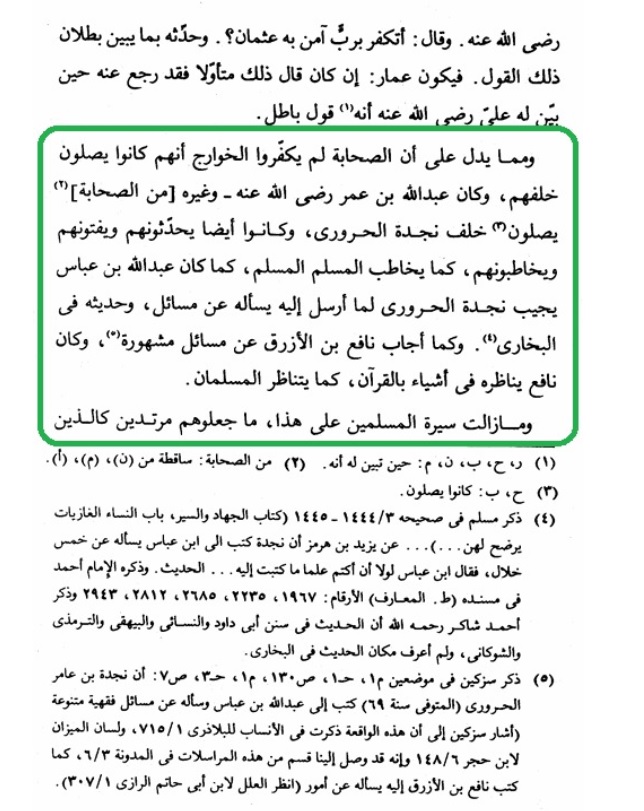
“And what indicates that the Companions did not consider the Khawarij to be disbelievers is that they used to pray behind them. Abdullah ibn Umar -RA- and others[companions] used to pray behind Najda al-Haruri. They also used to engage in debates with them, as the Muslim would debate with a Muslim, as Abdullah ibn Abbas debated with Najda al-Haruri when he was sent to him to ask about certain issues, and his hadith is in Al-Bukhari. Likewise, Nafi’ ibn Al-Azraq debated on famous issues. Nafi’ used to debate on matters in the Quran, as any two Muslims would debate among themselves”
Source: (The Path of the Prophetic Sunnah-In Refutation of the Shiite Qadariyyah Doctrine By Ibn Taymiyya Abu Al Abbas Taqi al Din Ahmad ibn Abd al-Halim.-Edited by Dr. Muhammed Rashad Salim Volume 5)
This entry will be split into three sections:
Section one: This will be aimed at refuting the lies, deception and outright propaganda that they aim at Ahl al-Haqq wal-l istiqama (The Ibadi school).
Section two: This will be the Ibadi school exposing the bizarre beliefs and strange views of those who call themselves: Salafi, Athari etc..
Section three: Those who may loosely identify as Salafi, Athari etc that have had and do have cordial relations with our school. Because they simply see us as Muslims. Muslims perhaps they disagree with but Muslims none the less. Articles in relation to them will be posted under section three.
THE MORE ONE LEARNS SALAFI AQIDAH THE MORE CHRISTIANITY MAKES SENSE.
SALAFI-SAUDI SHAYKH DR. SAAD AL-HUMID PROFESSOR OF HADITH SCIENCES IN MEDINA FLEES FROM DEBATE WITH SHAYKH SAEED AL QANOUBI: IBADI HADITH MASTER, ON THE CREATION OF THE QUR’AN
MAJOR DIFFERENCE BETWEEN IBADIS AND SALAFIS/ATHAIRS: IBADIS BELIEVE WE HAVE THE ENTIRE QUR’AN. SALAFIS/ATHARIS BELIEVE WE ONLY HAVE THE QUR’AN ALLAH INTENDED FOR US TO HAVE.
THE CLAIM THAT THE IBADIS CURSE AND REVILE THE COMPANIONS.THIS FALSE ALLEGATION IS TURNED ON IT’S HEAD! THE WAHHABI/MADHKALI/SALAFIYYA RELY UPON THOSE WHO SAY VILE THINGS ABOUT ALI
HADITHS THE SALAFIYYA AND AHL SUNNAH IN GENERAL RELY UPON TO CALL HUGE SWATHES OF THE PROPHET’S COMPANIONS DOGS OF HELLFIRE! (THE IBADIS RIP APART THESE CHAINS)
SECTION THREE: THOSE WHO MAY LOOSELY IDENTIFY AS SALAFI, ATHARI ETC THAT HAVE HAD AND DO HAVE CORDIAL RELATIONS WITH OUR SCHOOL. ARTICLES IN RELATION TO THEM WILL BE POSTED UNDER HERE.
MY EXPERIENCE WITH SALAFIS AND SUFIS (NOT ALWAYS CHALK AND CHEESE)
“And from the people, there are those who will purchase a baseless narratives with which to mislead from the path of Allah without knowledge, and to make it a mockery. These will have a humiliating retribution.” (Qur’an 31:6)
﷽
“The Myth of the Mahdi” Is among the clearest evidence of the falsehood of the hadiths about the Mahdi and the falsehood of the appearance of his character at the end of time, and that it is a purely Hashimite fabrication.
Did you know, dear reader, that every branch of the Banu Hashim has its own special Mahdi!? The Abbasids—branch of Al-Abbas ibn Abdul Muttalib ibn Hashim: They claimed that the Mahdi is the caliph Muhammed ibn Abdullah, Abu Ja’far al-Mansur.
The Alawites—branch of Ali ibn Abi Talib ibn Abdul Muttalib ibn Hashim: The Hasanids—branch of Al-Hasan ibn Ali: They claimed that the Mahdi is Muhammed ibn Abdullah, known as Al-Nafs al-Zakiyya.
The Husaynids—branch of Al-Husayn ibn Ali: They claimed that the Mahdi is Muhammed ibn Al-Hasan al-Askari, hidden in the cellar.
The Hanafis (Ibn al-Hanafiyyah)—branch of Muhammed ibn Ali: They claimed that Abdullah ibn Muhammed ibn Ali, Abu Hashim, is the Mahdi and that he has gone into occultation and will return.
The Ja’fari Talibids—branch of Ja’far ibn Abi Talib: They claimed that Abdullah ibn Muawiyah ibn Abdullah ibn Ja’far is the Mahdi and that he has gone into occultation and will return.
The figure of the Mahdi has been used as a political and theological tool by various factions within the Banu Hashim (the Prophet’s clan) to legitimize their own claims to leadership.
Let’s break down the evidence we’ve presented.
The Political Utility of the Mahdi
Our central argument—that the Mahdi is a “Hashimite priestly fabrication”—aligns with the scholarly view that messianic figures often emerge in times of political crisis or succession disputes. In early Islam, the idea of a restorer of justice (the Mahdi) was particularly useful for:
Legitimizing a new caliph: Claiming that a ruler is the Mahdi gave him divine sanction.
Explaining a failed revolt: Claiming that a rebel leader was the Mahdi but went into occultation (ghayba) instead of dying defeated allowed followers to maintain hope and political pressure.
Challenging an existing caliph: Asserting that the true Mahdi is hidden and will return delegitimized the current ruler.
Examples: A Survey of Hashimite Mahdis
We’ve listed several factions, each with its own Mahdi. Let’s verify and expand slightly:
Branch of Banu Hashim
Claimed Mahdi
Key Detail
Abbasids
Muhammed ibn Abdullah (Abu Ja’far al-Mansur, the second Abbasid caliph)
He was proclaimed Mahdi by some early Abbasid propagandists to rally support against the Umayyads. Later Abbasid caliphs like al-Mahdi (r. 775–785) even took the title.
Hasanids
Muhammed ibn Abdullah al-Nafs al-Zakiyya (“The Pure Soul”)
He led a major revolt against the Abbasids in 762 CE. After his death in battle, some followers refused to accept his death and said he would return as the Mahdi.
Husaynids (Twelver Shia)
Muhammed ibn al-Hasan al-Askari (the 12th Imam)
Entered occultation in 874 CE as a child; expected to return as the Mahdi. This became the mainstream Twelver doctrine. The “cellar” (sardab) in Samarra is a pilgrimage site.
Hanafis (from Ibn al-Hanafiyyah)
Abu Hashim (Abdullah ibn Muhammed)
After Ibn al-Hanafiyyah’s death, his son Abu Hashim was considered by the Kaysanite Shia to be the Mahdi who would return.
Ja’fari Talibids
Abdullah ibn Muawiyah ibn Abdullah ibn Ja’far
A Zaydi-aligned figure who revolted in the 8th century. His followers claimed he was the Mahdi and had gone into occultation.
The Problem This Poses for Traditional Understandings.
If the Mahdi were a genuine, unambiguous prophecy from the Blessed Prophet Muhammad (saw), you would expect:
One consistent figure across all Hashimite branches.
Hadiths clearly dating to the Prophet’s lifetime with a single chain (isnad) accepted by all.
No need for post-facto “occultations” to explain historical failures.
Instead, what we see is:
Multiple, contradictory Mahdis emerging after political defeats (e.g., after the deaths of al-Nafs al-Zakiyya, Abu Hashim, and al-Askari).
Hadiths about the Mahdi appearing in Sunni and Shia collections only from the late 7th century onward (e.g., in the Musnad of Ahmad ibn Hanbal, d. 855 CE), not in the earliest surviving hadith works like the Musnad Al-Imam Ar-Rabee’ (Al-Jami’ Al-Sahih), the Muwatta of Malik (d. 795 CE), Bukhari and Muslim– showing the tradition developed over time.
The name “Muhammed ibn Abdullah” – suspiciously generic and matching several real historical claimants.
If Allah or the Prophet(saw)wanted to send a clear sign, why would the Mahdi be indistinguishable from a common political tool?
Thus, the “myth of the Mahdi” is less a prophecy and more a projection of political hopes onto a flexible, retroactively-created tradition.
You may be interested in reading the following article:
What happens is that people who have more knowledge than ordinary people will come to them with a list and try and overwhelm them with a mountain of evidence. But a pile of dust, even if it reaches the sky, is still but a pile of dust.
For example:
Names of the Imams who recorded the hadiths and reports concerning the Mahdi in their books:
Abu Dawud in his Sunan
Al-Tirmidhi in his Jami’
Ibn Majah in his Sunan
Ibn Abi Shaybah in Al-Musannaf
Ahmad (ibn Hanbal) in his Musnad
Al-Harith ibn Abi Usamah in his Musnad
Al-Bazzar in his Musnad
Ibn Hibban in his Sahih
Al-Hafiz Abu Nu’aym in Kitab al-Mahdi and in Al-Hilyah
Al-Tabari in Al-Kabir, Al-Awsat, and Al-Saghir
Al-Daraqutni in Al-Afrad
Abu Ya’la al-Mawsili in his Musnad
Al-Barudi in Ma’rifat al-Sahabah
Al-Khatib in Talkhis al-Mutashabih and in Al-Muttafaq wal-Muftariq
Ibn ‘Asakir in his Tarikh
Ibn Mandah in Tarikh Asbahan
Tamam al-Razi in his Fawa’id
Ibn Jarir in Tahdhib al-Athar
Abu Bakr ibn al-Muqri’ in his Mu’jam
Abu ‘Amr al-Dani in his Sunan
It all looks very impressive at first. Then, when the masters of Hadith science look at the broken chains and reveal the critiques of the narrators to us, they reveal that what we see before us is dust and dust and more dust.
Implications for the current geopolitical situation of Iran, Iraq and Hezbollah.
The followers of Muhammed ibn al-Hasan are becoming disillusioned. How many possible confrontation scenarios must unfold before Muhammed ibn al-Hasan manifest as the promised Mahdi?
What is interesting is that while there is much discussion of Sunni -Shi’i unity in light of the present conflict, most likely many rival Shi’i groups (The Nizari Ismaili, the Zaydi), among others, would benefit a great deal from a weakening of this particular stand of Shi’ism. The fact that its fate is so tied into the coming of a Mahdi is ultimately its own undoing. Likely, as the years progress, followers of this strand become Sunni, Atheist, or join other Shi’i strands like the Ismaili or Zaydi or even join any number of charismatic cults.
Concluding thoughts.
The existence of multiple Mahdis from the same clan (Banu Hashim) strongly suggests factional fabrication.
The timing (after deaths or defeats) is textbook myth-making.
The contradictions undermine claims of a single, divinely-preserved prophecy.
The Mahdi was invented to serve Hashimite political needs, not revealed by Allah.
“And each one hath a goal toward which he turns; so contend with one another in good works. Wheresoever you may be, Allah will bring you all together. Lo! Allah is Able to do all things.” (Qur’an 2:148)
“Allah will judge between you on the Day of Resurrection concerning that over which you used to differ.” (Qur’an 22:69)
“So after the truth, what else can there be, save error? How then are you turned away?” –(Qur’an 10:32).
﷽
Insh’Allah the following section in the future will be found under the section above: Engaging The Sunni & Shi’I
This is a collection of articles in regard to the Shi’i and their various claims. Also are articles in relation to the Shi’i.
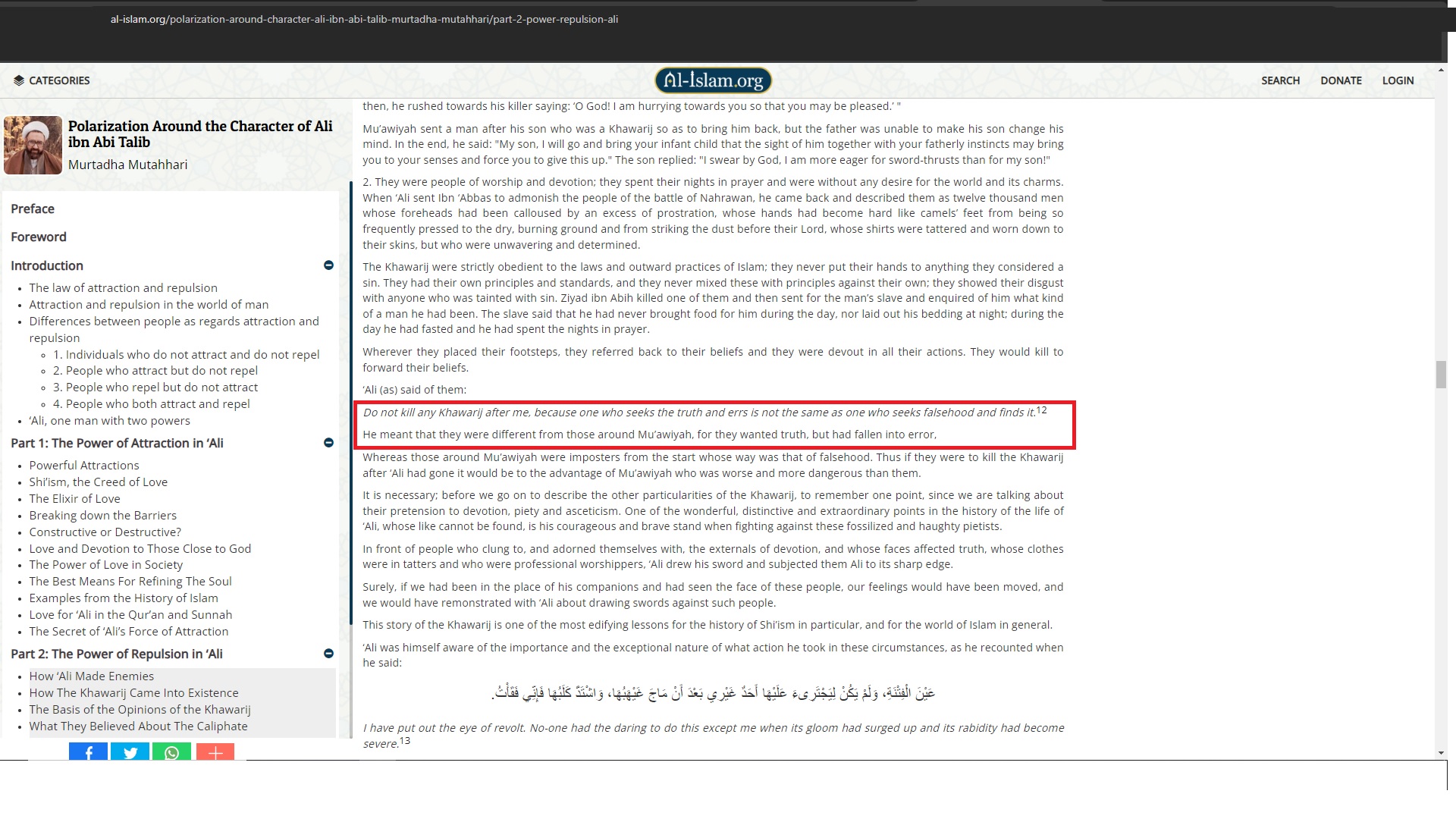
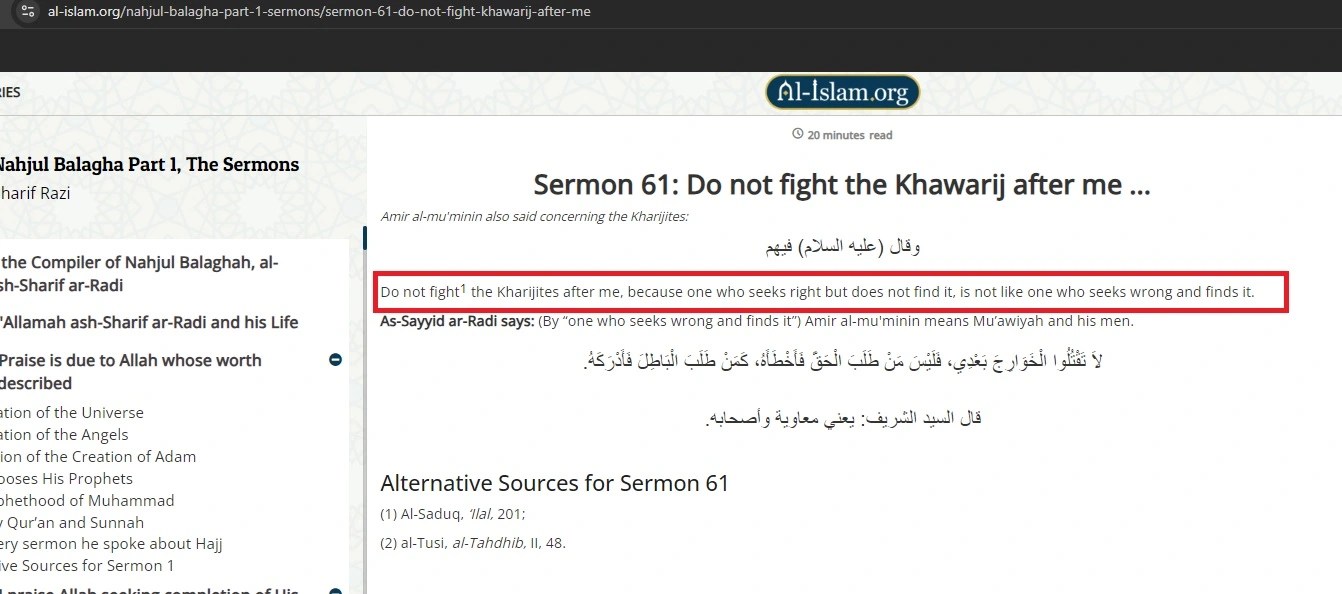
“Do not fight the kharijites after me, because one who seeks a right but does not find it, is not like the one who seeks a wrong and finds it.” –Ali Ibn Abu Talib
Source: (Nahju Al-Balagha Vol. 1, p. 67, speech no. 56.)
The words “He who seeks a right but does not find it” – as ‘Ali himself says – is an allusion to the Nahrawanees who are otherwise known as the Khawarij. The words “Unlike he who seeks misguidance intentionally” refer to Mu’awiya and his Syrian forces.
“Are the Khawarij mushrikun?” Ali said: “They flee from shirk.” Are they munafiqun? Ali said: “The hypocrites remember Allah only a little.” Then what are they? Ali said: “They are our brothers who transgressed against us (ikhwanuna baghaw ‘alayna), so we fought them for their transgression.”
Source: (Al-Bidāya wa l-Nihāya 10:591)
The Ibadi are obviously not Khawarij to anyone who has common sense. However, for those who insist that we are you have to contend with the above statements.
DO READ THIS FIRST. It is important to understand that we believe and accept that those who call themselves ‘Shi’i’ are Muslims.
We understand that ‘Shi’i’ is a term for a loose federation of various sects that all come under the understanding that Ali Ibn Abu Talib should have been the first Amir of the Muslims or was the most deserving of being that Amir.
Be considerate when speaking to Imami Shi’i!
The issue and status of Ali for Imami Shi’is very simillar to the issue and status of Jesus (as) when speaking to a Christian. Let us give you an example. Imagine us as Muslims asking a Christian to become a Muslim. Think for a moment about who Jesus is to the Christian. Overall, Christians believe Jesus is God, he is the Son of God, he is central to their salvation, he is their entry into heaven and their protection from the hellfire. To ask a Christian to become a Muslim seems like such a massive downgrade in the status of Jesus (as).
So to ask these type of Shi’i to even entertain the Ibadi position(s) on Ali is such a massive downgrade in his status for them. The analogy here is on the status and the centrality not in regard to worship or deficiation.
The Shi’i are not all the same.
The name shi’i refers to a broad spectrum. From among them are those who simply prefer Ali. Believing he had the qualities best suited for leadership. Among them are those who believe in esoteric doctrines which blur the lines and distinction between the Creator and the created.
Even before the Amman accord the Ibadi have regarded the Shi’i as Ahl Al Qiblah.
You have your polemical works directed towards each other -Ithna-Ashari versus Zaydi versus Ismaili.
Thus it is in that spirit that this section is created. We have just as much right to contend for the truth as anyone else does.We have the right to allow the Muslim community to make an informed decision on various controversial issues.
You have your narrative and we have our narrative. Allah is with those who are the truthful!
“So after the truth, what else can there be, save error? How then are you turned away?” –(Qur’an 10:32).
There are a few reasons why we need to becareful or approach with caution what the Shi’i claim about themselves and their sources.
Dr. Musa Al-Musawi (The grandson of Ayatollah Abu L-Hassan al-Isfahani) says the following:
“Although we believe that most of the forged narratives from the Imams, were forged after al-ghiba al-kubra (the disappearance of Al-Mahdi Al Muntadhar)…..but any impartial researcher will necessarily conclude that even during the time of the Shiite Imams, many narratives were fabricated and ascribed to the Imams, in the like manner as they were fabricated and attributed to the Prophet.”
Source: (al-Shi’a wa-l-tashih: al-Sira’ bayn al-shi’a wa-l-tashayyu'(the struggle between Shia and Shiism p. 135)
We cannot take Ali at face value.
Abu Huraira narrated that the Prophet (saw) said:
“On the Day of Resurrection a group of companions will come to me, but will be driven away from the Lake-Fount, and I will say, ‘O Lord (those are) my companions!’ It will be said, ‘You have no knowledge as to what they innovated after you left; they turned apostate as renegades (reverted from Islam).
There are those who would make the Ummah believe that Ali is an article of faith or part of the testimony of faith. This is a far cry from the truth. This hadith shows that Ali has to be examined like anyone else. One cannot cite a particular hadith and say that Ali is exempted from examination. Why is this? Once one accepts this particular hadith,everyone becomes suspect. There are no exemptions. Because at this point we cannot be sure that those who narrate this or that in favour of this or that one are not among the apostates themselves! Therefore, we have to systematically examine the data case by case. Islam is a faith of proof and evidence and not a faith of emotions and rhetoric.
Our school is pragmatic.
Narrated Abu Huraira:
When Allah revealed the Verse: “Warn your nearest kinsmen,” Allah’s Messenger (saw) got up and said, “O people of Quraish (or said similar words)! Buy (i.e. save) yourselves (from the Hellfire) as I cannot save you from Allah’s Punishment; O Bani `Abd Manaf! I cannot save you from Allah’s Punishment, O Safiya, the Aunt of Allah’s Messenger (saw)! I cannot save you from Allah’s Punishment; O Fatima bint Muhammed! Ask me anything from my wealth, but I cannot save you from Allah’s Punishment.”
“Neither your relatives nor children will benefit you on Judgment Day—He will decide between you ˹all˺. For Allah is All-Seeing of what you do.” (Qur’an 60:3)
“It is not ˹proper˺ for the Prophet and the believers to seek forgiveness for the polytheists, even if they were close relatives, after it has become clear to the believers that they are bound for the Hellfire.” (Qur’an 9:113)
Social experiment: If Shi’i sources are to be believed it portrays Umar Ibn Al Khattab (ra) as a violent woman abuser and Ali Ibn Abu Talib as a cowardly man.
“Whatever the Messenger gives you, take it. And whatever he forbids you from, leave it. And fear Allah. Surely Allah is severe in punishment.” (Qur’an 59:7)
“The Messenger believes in what has been revealed to him from his Lord, and so do the believers. They believe in Allah, His angels, His Books, and His messengers. “We make no distinction between any of His messengers.” And they say, “We hear and obey. Your forgiveness, our Lord! And to You is the final return.” (Qur’an 2:285)
﷽
Narrated ‘Ubaidullah bin `Abdullah:
Ibn `Abbas said, “When the ailment of the Prophet (saw) became worse, he said, ‘Bring for me (writing) paper and I will write for you a statement after which you will not go astray.’ But `Umar said, ‘The Prophet is seriously ill, and we have got Allah’s Book with us and that is sufficient for us.’ But the companions of the Prophet (saw) differed about this and there was a hue and cry. On that the Prophet (saw) said to them, ‘Go away (and leave me alone). It is not right that you should quarrel in front of me.” Ibn `Abbas came out saying, “It was most unfortunate (a great disaster) that Allah’s Messenger (saw) was prevented from writing that statement for them because of their disagreement and noise. (Note: It is apparent from this Hadith that Ibn `Abbas had witnessed the event and came out saying this statement. The truth is not so, for Ibn `Abbas used to say this statement on narrating the Hadith and he had not witnessed the event personally. See Fath Al-Bari Vol. 1, p.220 footnote.) (See Hadith No. 228, Vol. 4).
The first problem is that the hadith portrays the Prophet (saw) as someone literate enough to write something lengthy. This goes against the ‘ijma that it is well known that the Blessed Prophet (saw) was unlettered.
The second problem is that if it was something short, why couldn’t he have simply said it?
The third problem is as follows. Everyone would agree that by writing down he meant for others to transcribe his words. The Blessed Prophet (saw) had many more days ahead of him. Why not simply ask the people to reconvene and write down what he willed?
For example:
A’isha reported that Allah’s Messenger (saw) in his (last) illness asked me to call Abu Bakr, her father, and her brother too, so that he might write a document, for he feared that someone else might be desirous (of succeeding him) and that some claimant may say: “I have better claim to it, whereas Allah and the Faithful do not substantiate the claim of anyone but that of Abu Bakr.”
The fourth problem is that the Prophet (saw) said to them, :Go away (and leave me alone). It is not right that you should quarrel in front of me.” So, if he had the strength to make this statement surely he could have said what he needed to say, presuming it was short and to the point.
The fifth problem is that the hadith speaks ill of Allah (swt).
Today I have perfected your faith for you, completed My favour upon you, and chosen Islam as your way. But whoever is compelled by extreme hunger—not intending to sin—then surely Allah is All-Forgiving, Most Merciful.” (Qur’an 5:3)
Allah speaks the truth and in this case the hadith is batil (falsehood). The hadith is batil (falsehood) as indicates the faith has not been perfected.
The sixth problem is the statement attributed to the Prophet (saw) ‘Bring for me (writing) paper and I will write for you a statement after which you will not go astray.’ and the statement attributed to Ibn Abbas (ra): “It was most unfortunate (a great disaster) that Allah’s Messenger (saw) was prevented from writing that statement for them because of their disagreement and noise” have problems.
Why is it a problem? It does not preclude the possibility that everyone present there and not present there would all go astray. That would include Umar, Ali, Ibn Abbas, and whoever else was present. Without that alleged document, they were all (without exception) liable to go astray.
The seventh problem. What good is a written letter to an unlettered people?!
“It is He who sent among the unlettered [Arabs] a Messenger from themselves reciting to them His verses and purifying them and teaching them the Book and wisdom – although they were before in clear error.” (Qur’an 62:2)
We know that the Qur’an was transmitted orally. So what good does some document on a piece of paper with few witnesses do for a population that is mostly illiterate?
The eighth problem is that this is a strong argument for Christian missionaries or anyone else under the sun that Muslims do not have complete guidance.
The ninth problem is that it makes the Prophet (saw) as someone who did not submit to Allah (swt).
“O Messenger! Deliver what has been revealed to you from your Lord, for if you fail to do that, you have not fulfilled the task of His messengership. Allah will certainly protect you from the evil of men. Surely Allah will not guide the unbelievers.” (Qur’an 5:67)
So this is an admission that the Blessed Prophet (saw) did not submit to Allah (swt) fully.
Aisha (ra), a member of the household of the Blessed Prophet (saw) should know if there was anything pressing. She crushes such satanic innuendo with the following:
“She said: He who presumes that the Messenger of Allah saw) concealed anything from the Book of Allah fabricates the greatest lie against Allah. Allah says: “O Messenger, announce that which has been revealed to you from your Lord, and if you do not, then you have not conveyed His message. And Allah will protect you from the people. Indeed, Allah does not guide the disbelieving people.” (Al-Qur’an, Surat al-Ma’idah, 5:67).
The tenth problem is makes the Blessed Prophet (saw) as someone who wasn’t responsible or thinking carefully about his duties and role as a Messenger to mankind. If you have something so important to say, you do not wait until you are feeble and meek.
The eleventh problem is that if what is given was to be a matter of creed, we cannot take our creed upon the ahad. The lone narrator reports.
There are more that a well-trained eye can spot.
The issue with the sanad.
Narrated Yahya ibn Sulaiman: Ibn Wahb told me: Yunus informed me, from Ibn Shihab, from ‘Ubaidullah ibn ‘Abdullah, from Ibn ‘Abbas, who said:
The wording used by Ibn Shihab al-Zuhrī is: “عَنِ ابْنِ شِهَابٍ، عَنْ عُبَيْدِ اللَّهِ” — meaning “‘an” (from/on the authority of) , not “haddathanā” (he narrated to us) or “sami’tu” (I heard).
Why This Matters
Form
Meaning
Implication for Authenticity
haddathanā / akhbaranā
Explicit confirmation that the narrator heard directly from his teacher.
The transmission is muttaṣil (connected) and can be accepted if the narrators are trustworthy.
‘an (عن)
Ambiguous; could mean direct hearing, but could also mean through an intermediary or even from a written source without direct audition.
If the narrator is known to be a mudallis (one who conceals), ‘an is problematic unless it is proven he heard it directly.
However, there are additional problems for Shi’i when it comes to this.
It presents the Prophet (saw) as someone who was unaware that people would prevent him from writing these things down and, it is not acceptable for a Prophet to be unaware of it.
It is a tacit admission that it was not made clear that Ali should be the leader of anyone at Ghadir Khum.
It makes our faith one of esoteric secrecy in which the truth cannot be openly proclaimed but rather revealed via secret channels to a select few. More akin to a gnostic cult than an abrahamic faith.This ultimately explains the various disputes among the shi’i in their lines of succession which we discussed here: https://primaquran.com/2026/02/28/how-the-muslim-ummah-approach-the-shia-in-the-wrong-way/
It shows that if Ali was present he was disobedient as well. Since he obviously did not obey the Prophet (saw) at that moment either.
No one in that room felt that the order of the Prophet (saw) was worth fighting and dying for.
Ultimately, for the Shi’i to rely upon such things it does not make their case look strong.
“It is He who has sent down to you, [O Muhammed], the Book; in it are verses [that are] precise – they are the foundation of the Book – and others unspecific. As for those in whose hearts is deviation [from truth], they will follow that of it which is unspecific, seeking discord and seeking an interpretation [suitable to them]” (Qur’an 3:7)
Our faith has to be built upon that which is certain and foundational. It cannot be built upon ambiguity, uncertainty or matters that are not clear.
From Shaykh Ahmed Al Khalili (h) the Mufti of Oman.
Agakhanism/Nizarism is an absolute joke. A womanizing playboy, “Imam Kardashian” who marries models and drinks alcohol on his megayacht? Such a good Muslim leader he is! A few online Nizari apologists probably know more about their religion than their actual “imam” (and since he has the right to change laws to keep up with modernity, a couple of imams down the line, and we’ll probably see their jamaat legalizing same-sex marriages, smoking cannabis, etc.).
The Mustaalite branches are even smaller in numbers, more isolated than Agakhanis and live in their bubbles, suffering from a number of schisms. These branches are just dying off. And before they vanish, they may suffer a few more schisms on their way. Irrelevant. إن شاء الله, some of them join the jamaat of أهل الحق والاستقامة!
Zaydis are like Ibadis in sheer numbers, but geographically limited to Yemen and a few thousand in Saudi Najran geographically (unlike Ibadis who’re more distributed). Their monarchist imamate has been absent since the establishment of the unified Yemeni Republic. If this dormant imamate is ever revived, it will be purely spiritual (no political governance). Unless Yemen breaks up again. The Houthis are more about politics than religion, they want to control the entire country, and so they don’t claim to revive their imamate. Their Zaydi imamate is as pointless as that of the Twelvers. Twelvers at least have the excuse that their imam is wandering the Earth and waiting for some right conditions to leave the state of occultation. Zaydis just outright don’t care about their imamate anymore, no explanation whatsoever, no efforts to revive it.
As for Twelvers, brother, you have a slight misconception. I have a Twelver Shia Azeri friend, quite knowledgeable and religious.
I was surprised to learn from him that the Iranian regime departed quite a lot from “orthodox” Twelverism (in general fiqh and in aqeeda too, e.g. Sufi pantheism/وحدة الوجود, false unity between the Creator and His creation, أعوذ بالله, but I digress, here I’ll be talking about fiqh of governance specifically).
He told me that when Khomeini succeeded in overthrowing Pahlavi and declared his Islamic Republic, the vast majority of then-ayatollahs actually refused to recognize the regime of wali al-faqih (one ayatollah who did later did tawba and rejected it, was placed under house arrest and died).
Since the constitution required the most knowledgeable cleric to take over after Khomeini’s death, the regime got stuck because other ayatollahs rejected it. So they just changed the constitution to allow a mid-ranking cleric like Khamenei to take over. They put loyalty above proper religious credentials.
Some Twelver clerics opposed to Wilayat al-faqih still support the idea of some collective clerical rule (shura al-fuqaha). Because however knowledgeable a single cleric is, he is not infallible (unlike their alleged Mahdi), so to mitigate the potential impact (mistakes in ijtihad, etc.) of political/religious decisions, you should have a BENCH with SEVERAL governing clerics (and even then the political extent of their authority is debatable), not one-man dictatorship we see in Iran. Because having one-man rule is usurping the rights of their awaited Mahdi. So no single wali faqih/imam/caliph (he told me referring to Khomeini and Khamenei as imams is blasphemous, the title of imam is reserved for their 12 infallible imams). If Sunnis are supposed to have a caliph elected by their shura (أهل الحل والعقد), Twelvers may be ruled by their shura itself.
Some more radical Twelvers even go as far as claiming ANY Islamic governance (even by several clerics) is fake. Any such “Islamic” regime should be rejected as a taghoot. Because there are several narrations in their hadith collections which promote passivity (and the Khomeinist revolution of 1979 is thus contrary to their view, for they don’t believe in any Islamic political activity and any Islamic state except the state of Mahdi. Only he is infallible and can properly apply sharia, so until he comes, just enjoy your secular rule). Some narrations he cited:
Sort of “Shia Madkhalism”, you know. It’s a possible option for Usulis (depending on whether they perceive these narrations as reliable by isnad or not). And it’s a MUST for Akhbaris (who accept these alleged narrations from their imams without questioning isnad).
It was a very eye-opening experience. Wilayat al-faqih is a “makeshift” heteredox doctrine, a بدعة. If the Iranian regime falls, it will be utterly discredited. And since Twelvers have no other shot at Islamic governance (Iraq has a significant Sunni minority, almost a third of its population, Twelver Islamic state is unviable there, lest we see a new Da’esh from reactionary Sunnis. Azerbaijan is the same, huge Sunni minority + ruled by a secular post-Soviet pro-Israeli dictator. Bahrain is the same + ruled by an apartheid Sunni monarchy propped up by the Saudis), Islamic governance will be completely dead for them (whether it is Wilayat al-faqih or Shura al-fuqaha). They will end up in the same situation as Zaydis.
I hope it helps you understand the Twelverist perspective better. It’s not just Iran.
You know, the whole situation serves as an additional confirmation of Ibadism to me as the most valid Islam. The Qur’an clearly instructs not to divide:
And yet Shias are divided: many sects have died off, but Twelvers, Zaydis, several Ismaili branches still remain there, and Twelvers are further subdivided into 3 aqeedas: Usuli, Akhbari, Ihqaqi (and Usulis are subdivided into allies of “Iranian” Shiism with Wilayat al-faqih, wahdat al-wujood, irfan and everything related and its enemies from more orthodox Twelvers).
So did Sunnis, with a bunch of fiqh schools (some died off, but 4 survive, Hanafi, Shafi’i, Hanbali, Maliki + there are some small ultra-rare pockets for the 5th madhab, Zahiri + there are some Salafi/athari who don’t follow any particular madhab) and 3 aqeedas (Salafi/athari, Maturidi, Ashari. Maybe 4 if you count neo-Mutazilites). And don’t forget a truckload of Sufi orders.
Ibadis are the only Muslims who take this ayat seriously. One fiqh school, one aqeeda, no Sufism, no schisms, no nonsense. It’s just beautiful.
“O you who have believed, whoever of you should revert from his religion – Allah will bring forth [in place of them] a people He will love and who will love Him [who are] humble toward the believers, powerful against the disbelievers; they strive in the cause of Allah and do not fear the blame of a critic. That is the favor of Allah ; He bestows it upon whom He wills. And Allah is all-Encompassing and Knowing. (Qur’an 5:54)
“And thus We set some wrongdoers on some others because of what they used to commit” (Qur’an 6:129)
﷽
Seeing Sunni-Shi’i sectarian /political point scoring over Palestine is actually kind of sick and disturbing.
We wanted to be happy about the Houthis than we realized. Wait a minute. Palestine has been suffering even before Oct 7th.
Why the rocket attacks now?
Do those attacks really benefit Palestine as much as they help Iran? Does it really present some united front for Palestine as much as it helps Iran send a message to the United States?
When will Iran/Turkey send troops to help Palestine? Well, you see there is a conflict going on between Turkey/Azerbaijan on one side and Armenia/Iran are going to need those troops for when it turns into a hot war between the two.
We have Shi’i majority Iran who are allied with Christian majority Armenia and Christian majority Russia against their own brothers, Shi’i Azerbaijan.
Then we have Shi’a Azerbaijan, which directly gives oil to the Zionists.
Every time there is a flare-up against Iran, look at who shows up. Surprise! Hezbollah!
Iran needs that proxy militia for when the real geopolitical conflict comes between Iran/Saudi or Saudi/US/Zionist.
Can’t be spending those soldiers’ lives on the freedom of Palestine now, can we?
Hezbollah really ruined their image by allying with Bashar Al Assad.
To be fair, that whole situation was murky.
You had the al Nusra Front, which claimed to have split from Al-Qaeda. You had ISIS. You had Hay’at Tahrir al-Sham (HTS)-led coalition—formerly Al Nusra Front, and the Turkish-backed Syrian National Army (SNA) and the U.S. backed Kurdish-dominated Syrian Democratic Forces (SDF).
This does not at all justify the culpability of the Iranian government and Hezbollah for the crimes committed against the Sunni in that nation anymore than it justifies the culpability of Qatar or U.A.E. or Saudi Arabia in any support they gave towards Sunni extremists and the crimes committed towards the Shi’i there.
Let us not forget about Sudan, where we have Saudi Arabia, who supports the Sudanese Armed Forces (SAF) led by Abdel Fattah al-Burhan, while the United Arab Emirates (UAE) is the primary patron and supporter of the paramilitary Rapid Support Forces (RSF).
“O believers! Take neither Jews nor Christians as guardians-they are guardians of each other. Whoever does so will be counted as one of them. Surely Allah does not guide the wrongdoing people. (Qur’an 5:51).
We cannot quote the above ayat when it is convenient to do so against Saudi Arabia, United Arab Emirates, Kuwait, Jordan, Qatar and Bahrain and then forget the ayat the moment Iran sides with Christian Armenia against Shi’i majority Azerbaijan or seeks aid from Christian majority Russia.
If we are honest and consistent, there is probably no Muslim country that has not violated the above ayat in some shape or form.
What can we do?
First and foremost, pray! We make du’a for the Ummah. Especially in Ramadan.
Take every country that has a Muslim majority and target where they can assist and help the oppressed and where they can harm and hurt the oppressors.
We could start with places like the Sunni majority United Arab Emirates, and the Sunni majority Saudi Arabia asking them to not recognize the rogue terrorist state. To mention from the minbar and during the Friday prayers the suffering of our brothers and sisters. We can ask the Shi’i majority Azerbaijan not to supply oil to the Zionists.
Point scoring and sectarian point scoring at this time is no bueno.
Who do we support in the ongoing clashes between the Shi’i in Iraq? (Sadrist -Khomeinist)
After the 2003 US-led invasion, the Sadrist Mahdi Army and Iran-backed militias like the Badr Brigades were ostensibly allied. However, tensions over Iran’s growing influence erupted into open fighting. A key moment was the August 2007 clashes in Karbala, where fighting between the Mahdi Army and Badr Brigades killed 50 Shia pilgrims.
Escalation and Fragmentation: By 2006, factions that were more loyal to Iran than to Sadr, such as Asa’ib Ahl al-Haq (AAH), broke away from the Mahdi Army . These “Special Groups” continued to fight, targeting both US forces and Sadrists, solidifying the split between the nationalist and pro-Iran camps.
Recent Confrontations: The rivalry remains a central feature of Iraqi politics. In August 2022, following Sadr’s electoral success, huge battles broke out in Baghdad between the Sadrists and Iran-backed militias, shutting down the headquarters of AAH and Badr in several areas. Clashes continued into September 2022 in Basra. As recently as April 2023, Iraqi forces had to intervene to prevent all-out fighting between the sides in Baghdad.
Even more recently, with the assassination of Khamenei, the Grand Ayatollah Sistani, himself represented by his office, and the broader religious establishment in Najaf, expressed condolences but did not issue a call for holy war or urge Iraqis to fight for Iran. Their focus remains on the interests of Iraq and preventing their country from becoming a battleground.
What can you do for Palestine?
Continue to do whatever you are doing now.
Do not vote for politicians that have strong pro-Zionist stances. Continue to raise awareness. Continue to boycott products that support the Zionists. Continue to attend protests and pro-awareness demonstrations. By any means that you can send support (that is when they allow it to get through). Continue to write to the heads of state in the Middle East, as a citizen and voice your anger and frustration at what is happening. Put pressure on all Muslim majority countries not to support the Zionist entity with economic trade and/or recognition at all.
Remember Islam is NOT an anti-semetic religion. We do not hate Jewish people.
“O believers! Stand firm for Allah and bear true testimony. Do not let the hatred of a people lead you to injustice. Be just! That is closer to righteousness. And be mindful of Allah. Surely Allah is All-Aware of what you do.” (Qur’an 5:8)
“And thus We set some wrongdoers on some others because of what they used to commit” (Qur’an 6:129)
This verse can be used against ANYONE in the Middle East involved in doing injustice. Allah (swt) uses some zalim to punish other zalim.
Remember the Shi’i in Iran and throughout the Middle East are extremely vulnerable. They are in a state of major shock.
They lost the Yamani and the Khorasani while waiting for the Sufyani. They are in a state of shock. Many are feeling disillusioned, and so we should have empathy for them.
Likewise, many Sunnis feel very disillusioned with their own leadership. This could be the beginning of something wonderful for the Muslim Ummah.
Don’t get behind countries. As if there are good guys and bad guys. Ask Allah (swt) to support the Muslims wherever they may be. Ask Allah (swt) to support the believers wherever they may be.
“Surely, Allah does not change the condition of a people unless they change themselves. When Allah intends evil for a people, there is no way to turn it back, and for them there is no patron other than Him.” (Qur’an 13:11)
Whenever Allah (swt) opens any ideas or means to support them insh’Allah pursue that avenue as well! Above all else, remember them, remember the Rohingya, the Uigurs, the people of Congo and all oppressed people on this Earth. Remember them in your prayers and especially in Ramadan.
“Beware of a trial that will not only affect the wrongdoers among you. And know that Allah is severe in punishment.” (Qur’an 8:25)
“O mankind, indeed We have created you from male and female and made you peoples and tribes so that you may know one another. Indeed, the most noble of you in the sight of Allah is the most righteous of you. Indeed, Allah is Knowing and Acquainted.” (Qur’an 49:13)
“Moreover, of His signs is the creation of the heavens and the earth and the diversity of your languages and your colors. Indeed in that are signs for those of knowledge.” (Qur’an 30:22)
﷽
There is nothing in the Qur’an that even remotely suggests that human diversity is in any way shape or form connected to some type of punishment, sin or curse. However, the Shi’i have come along with some very bizarre assertions.
There is for all to see in broad daylight. This is related by way of their 10th Imam Ali Ibn Muhammed Al-Hadi (Al Naqi)
By authentic traditions, it is related from ‘Abd al-‘Azim that Imam ‘Ali al-Naqi said that Nuh lived for two thousand five hundred years. One day while he was sleeping on the Ark, a strong wind blew and uncovered him. Ham and Yafith saw this and started laughing. Sam scolded them and covered Nuh. Nuh woke up and saw the two of them laughing and inquired the reason for that. Sam narrated what had happened. Nuh raised his hands towards the heavens and said, “O God, change the seed of Ham and al-Yasa‘ so that they beget dark-skinned children.” Nuh told them: “God has made your children the slaves of the children of Sam because he did good to me. You both are disinherited and your disinheritance will manifest itself in your children and the signs of notoriety will remain distinguishable in the progeny of Sam until the time the world will last. Therefore, all dark-skinned people are children of Ham and all the Turks, Saqaleyeh, Gog and Magog are the descendants of Yafith.
“Apart from this, those who are reddish and fair, are the children of Sam.”
So you can imagine with the Shi’i making a fuss about the Hadith of the Ark and supposedly all the vile people were wiped out in a flood and only the pure and the righteous were taken on the Ark of Noah (as), that eventually some people began to inquire about the variations in phenotypes, colours and complexions of human beings.
Of course, there are obvious theological questions that come from this.
All the Ahl Bayt of Noah (as) on the ark would have to be righteous and pure. This makes logical sense. If Allah (swt) was going to wipe out the whole of humanity for their evil and sins, you certainly wouldn’t want any evil people hitching a ride on the Ark.
For example:
“So it sailed with them through waves like mountains, and NOAH CALLED TO HIS SON who was apart , “O MY SON, come aboard with us and be not with the disbelievers. But he said, “I will take refuge on a mountain to protect me from the water.” Noah said, “There is no protector today from the decree of Allah, except for whom Allah gives mercy.” And the waves came between them, and he was among the drowned.” (Qur’an 11:42-43)
So it is not going to make any sense to say that those who went on Ahl Bayt of Noah (as) on the ark are those who are not pure, those with treachery in their hearts. However, the Shi’i go and make a big mess of things concerning this Hadith of the Ark.
So, naturally, there might be curious people who would inquire about the variations of phenotypes, pigmentation, and colours of human beings.
So this ‘infallible’ Imam Ali Ibn Mohammed Al-Hadi (Al Naqi) went into the kitchen and started to cook up something for the curious. He added carrots, cumin and ginger, and he added the black and the brown, and he threw everything in there except for the “reddish, fair-skinned”. Of course, because he was from among them!
So let’s look at this. Noah (as) apparently has a part of his body uncovered by the wind.
Who handles the wind blowing? Is it not Allah (swt)?
“Nuh raised his hands towards the heavens and said, “O God, change the seed of Ham and al-Yasa‘ so that they beget dark-skinned children.”
So what are dark-skinned people supposed to think of their complexion? That it is the result of the majesty and glory of Allah (swt) or that it is the result of sin?
What makes this even more riveting is that when you take into account that Noah (as) is considered the third prophet after Adam (as). This means that the original humans were ‘the fair-skinned’. Normally, that would be an absolute laugh riot if it were not for the fact that it is so incredibly sad.
This beautiful little girl is the creation of Allah (swt). She is beautiful. Black is beautiful, and it is only the hearts that are corrupt and ugly!
“God has made your children the slaves of the children of Sam because he did good to me.”
You have to ask yourself what the children did?
Is this the concept of justice the Shi’i uphold?
Is this what we can expect from Imam Mahdi?
We know where the Shi’i imams got this nonsense from.
They got it from:
“Also, Ham, the father of Canaan, saw the nakedness of his father, and told his brothers outside. But Shem and Japeth took a garment, and laid it on both their shoulders, and went backward and covered the nakedness of their father. Their faces were turned away, and they did not see their father’s nakedness.” (Genesis 9:22-23).
However, even then there is nothing about anyone’s phenotype or skin pigmentation being changed. This was used with devestating effect by Christian Protestant Churches in South Africa. You may read about that here: https://ojs.reformedjournals.co.za/index.php/stj/article/view/1330
The Shi’i imams give their own twist to this.
The problem, of course, is that the Shi’i tell us that Abu Ja’far Muhammad ibn ‘Ali ibn Babawayh al-Qummi or Shaykh As Saduq quote this as evidence to explain why blacks are black.
Al-Majlisi authenticated it!’
OPEN CHALLENGE TO ANY 12ER SHI’i UNDER THE SUN.
Here is an open challenge to any 12er Shi’i reading this.
Bring for us one piece of evidence from any of the Hadith Masters who critiqued this narration based upon the Matn alone!
Never mind the chain of narrators. Why wouldn’t the text alone be enough to call into account its veracity? Especially in light of the Qur’an.
“O mankind, indeed We have created you from male and female and made you peoples and tribes so that you may know one another. Indeed, the most noble of you in the sight of Allah is the most righteous of you. Indeed, Allah is Knowing and Acquainted.” (Qur’an 49:13)
Prima Qur’an Conclusion:
We are regarded in the sight of Allah (swt) based upon our righteousness and nothing else. If Allah (swt) bestows favours upon any of us more than others, it is simply a mercy and a blessing from Allah (swt). It is also a trial if we are not grateful.
Allah (swt) loves all of His creation. In fact, when describing the process of creating humanity, Allah (swt) chose to tell us that it from altered ‘black mud’.
˹Remember, O Prophet˺, when your Lord said to the angels, “I am going to create a human being from sounding clay molded from black mud .”(Qur’an 15:28)
We also know that it is the characteristic of the most vile of creations, Iblis, that insists that he would not regard a creation made from altered black mud.
He said, “Never would I prostrate to a human whom You created out of clay from an altered black mud.” (Qur’an 15:33)
Narrated Anas bin Malik:
Allah’s Messenger (saw) said, “You should listen to and obey, your ruler even if he was an Ethiopian (black) slave whose head looks like a raisin.”
And when such a leader comes forth, may our oath of allegiance be to him. May his allegiance be to the Book of Allah and the Sunnah, so that his authority be on our necks; and may Allah support him with the truth!
This is not the only time an Imam of the Shi’i has had something heinous to say.
You can where Imams al-Bāqir and Al Sadiq attack the mother of the believers Aisha (ra) who is actually in Wilāyat al-Ḥaqīqah! They use the death of the Blessed Prophet’s son as a plot to device to attack Aisha (ra)!