
“Whenever a newly (muḥ’dathin) spoken reminder comes to them from their Lord, they listen to it while they are playing.” (Qur’an 21:2)
﷽
Dear readers and truth seekers, today we turn our attention to those who possibly were shaped by Greek philosophy and John of Damascus will apply ta’wil to unambiguous passages of the Qur’an. From there, they go on to speculate about the nature of Allah (SWT) and His actions, passing off conjecture as certainty.
Can you believe these people?!
“And he to whom Allāh has not granted light – for him there is no light.” (Qur’an 24:40)
Today we are going to be responding directly to the claims of this article: https://athari-archive.com/2026/08/04/is-the-quran-muhdath-emergent/
The Uncreated Qur’an: A Critical Examination of Ibn Taymiyyah’s Formula
Introduction
The article under consideration presents itself as a definitive statement of orthodox belief concerning the Qur’an! It claims to steer a middle path between the Mu’tazilah (who held the Qur’an to be created) and the Karramiyyah (who held that Allah’s speech is a newly occurring act subsisting in His Essence). It offers a “safest and clearest wording”:
“The Qur’an is the uncreated speech of Allah. Allah spoke it by His will. Allah has always been One who speaks whenever He wills.”
This article will demonstrate that this formula, and the broader argument surrounding it, is not coherent. It contains internal contradictions, philosophical problems, and exegetical difficulties that undermine its central claim. We will argue three theses:
- The Qur’an is created: Not in the sense of being separate from Allah’s knowledge and will, but in the sense that its particular words, sounds, and letters are brought into existence by Allah’s creative act. They are the created effects of speech, not an eternal attribute subsisting in the divine Essence.
- Allah has never been without the ability and power to produce speech: The attribute of speech as a capacity is eternal. But capacity is not the same as actual particular speech. Allah was not eternally uttering the words of the Qur’an.
- “Kun fa-yakun” is an expression of Allah’s expediency to bring non-being into being: It is not a phrase He has been repeating throughout eternity. The very composition of the phrase letters and sounds that follow one another demonstrates its temporal, created nature. For a word composed of parts that precede and succeed one another cannot be eternal, since eternity admits no before and after.
Part One: The Contradiction at the Heart of the Formula
1.1 The Formula Says Allah Was Not Eternally Speaking the Qur’an
The article’s “safest and clearest wording” states:
“Allah spoke it by His will. Allah has always been One who speaks whenever He wills.”
Read plainly, this means:
- The Qur’an was spoken by Allah’s will. An act that occurred at a moment of willing, not from eternity.
- Allah has always been One who speaks whenever He wills. The attribute or capacity of speech is eternal, and it is eternally exercisable.
The structure is: eternal capacity + temporal exercise. On this formula, Allah was not eternally speaking the Qur’an. He eternally had the power to speak, and He spoke the Qur’an at a moment of will.
However, this is precisely what the article’s own quoted authorities say. Al-Qadi Abu Ya’la is quoted:
“We say that Allah has always been speaking, without there necessarily being anyone whom He was speaking to, addressing, commanding, or forbidding.”
And Ibn Hamid:
“Allah has always spoken however He willed and in whatever manner He willed. Whenever He wills, He sends down His speech, and whenever He wills, He does not send it down.”
But then Ibn Hamid also says:
“Allah was speaking the Qur’an before He created creation and before all created beings existed.”
These two statements are in direct contradiction. If Allah “spoke the Qur’an by His will,” then the speaking of the Qur’an is an act of will. It is temporal. If He “was speaking the Qur’an before He created creation,” then the speaking of the Qur’an is eternal without a moment of willing that brought it into actuality. The article tries to reconcile these by distinguishing the “general category” of speech (eternal) from “particular instances” (willed). But then “Allah was speaking the Qur’an before creation” must mean He was speaking some Qur’an but not this Qur’an, since this Qur’an was spoken by His will at a time. What Qur’an was He speaking then? An eternal Qur’an? Then there are two Qur’ans an eternal one and a temporal one which is precisely the Ash’ari distinction the article rejects.
1.2 The Formula Makes the Qur’an Temporal in Its Occurrence
If the Qur’an was spoken by Allah’s will at a moment of willing, then the words of the Qur’an are temporally originated. They did not exist eternally; they came to be when Allah willed to speak them.
The article insists they are “not created.” But what work is “not created” doing here if the words are willed, temporal, and did not exist eternally?
The article’s answer is: they are Allah’s speech, and Allah’s speech is not created. But this is circular. The Mu’tazilah would say: precisely because they are willed and temporal, they are created. The Ash’aris would say: precisely because they are willed and temporal, they are created expressions of the eternal inner speech. The article wants to say: they are willed and temporal and uncreated. But “willed and temporal” is the definition of muhdath, and the article itself acknowledges that muhdath in one sense means created. It tries to reserve a second sense of muhdath (“spoken at a chosen time”) that is not created. However, this is a stipulative definition, not a metaphysical demonstration.
1.3 The Analogy to Knowledge Breaks Down
The artticle repeatedly insists that speech is like knowledge:
“Speaking resembles knowledge because it is an attribute established in Allah and does not depend upon the existence of a created being.”
But knowledge is an attribute that is always actually present. Allah is not merely able to know; He always actually knows. If speech is like knowledge, then Allah is not merely able to speak; He always actually speaks.
But the formula says He “spoke it by His will” meaning He was able to speak and then spoke. That makes speech disanalogous to knowledge and analogous to creation. And the article explicitly rejects this comparison:
“This is not comparable to describing Allah with creation and provision. Those attributes must be understood as taking place whenever He wills.”
So the article wants speech to be like knowledge (eternal, actual) and unlike creation (capacity exercised in time). But its own formula makes speech exactly like creation: a capacity exercised at a moment of will. The analogy to knowledge is asserted but not maintained.
1.4 The Article’s Own Tradition Denies That Speech Is a Perfection
Why does Allah not once call Himself al-Mutakallim (the Speaker)?
“There is nothing like Him, for He is the All-Hearing, All-Seeing.” (Qur’an 42:11)
The article’s central premise is that speech is an attribute of perfection:
“His ability to speak did not begin after previously being absent, because speech is an attribute of perfection.”
And:
“Allah has always been speaking, knowing, and forgiving.”
The logic is: speech is a perfection; therefore Allah must always have it; therefore the Qur’an (as His speech) is eternal and uncreated.
But this premise is denied by the very tradition the article claims to represent. Ibn Taymiyyah himself—the article’s primary authority—says:
“As for speech and will, they may be divided into praiseworthy types such as truthfulness and justice, and blameworthy types such as wrongdoing and lying. Allah can only be described in praiseworthy terms, not blameworthy ones, hence His names do not include al-Mutakallim (the Speaker) or al-Mureed (the Willer).” Source: (Sharh al-‘Aqeedah al-Isfahaniyyah, 1/19-20)
Ibn al-Qayyim says:
“The names of Allah does not include al-Mureed (the Willer), al-Mutakallim (the speaker), al-Faa’il (the Doer) or al-Saani’ (the Manufacturer), because these names may apply to both good and bad.” Source: (Mukhtasar al-Sawa’iq, 2/34)
And Shaykh Ibn ‘Uthaymeen says:
“Hence Allah did not call Himself al-Mutakallim (the Speaker), although He speaks, because speech may be good or bad, and it may be neither good nor bad. Evil cannot be attributed to Allah, and idle speech cannot be attributed to Him either, because it is foolishness; only good can be attributed to Him. Hence He did not call Himself al-Mutakallim (the Speaker).” Source: (Sharh al-Waasitiyyah, 1/86)
This is a direct contradiction of the article’s central premise. The article says speech is a perfection. Ibn Taymiyyah, Ibn al-Qayyim, and Ibn ‘Uthaymeen say speech is not a perfection. Rather it is neutral, capable of good or bad, which is why Allah does not call Himself al-Mutakallim.
The implication is devastating. If speech is not inherently a perfection, then the argument that Allah must always be speaking (because speech is a perfection) collapses. Allah has always been knowing because knowledge is a perfection. Allah has always been forgiving because forgiveness is a perfection. But Allah has not always been speaking because speech is not inherently a perfection. It is a capacity that may be exercised in good or bad ways. Allah speaks when He wills, and He speaks only good. But He was not eternally speaking, because speech is not the kind of thing that must always be actual in order to be perfect.
The article cannot have it both ways. It cannot claim that speech is a perfection (to argue for the Qur’an’s uncreatedness) while also claiming to follow Ibn Taymiyyah (who denies that speech is a perfection). The article’s own tradition refutes its central premise.
This is a genuinely devastating point. It shows that the article is not only philosophically incoherent but also selectively cites its own authorities, ignoring the parts of Ibn Taymiyyah’s teaching that contradict its position. The very tradition the article claims to represent—Salafi/Athari/Hanbali—denies the premise on which the article’s entire argument rests.
Part Two: The Problem of Eternal Particular Speech
2.1 “Kun Fa-Yakun” and the Question of Address
The Qur’an contains the phrase “Kun fa-yakun”—”Be, and it is” (Qur’an 2:117, Qur’an 3:47, Qur’an 19:35, Qur’an 40:68). This is a creative command addressed to something that does not yet exist. The command is relational: it is a speech-act directed at an addressee that is brought into being by the very command.
If this speech is eternal meaning Allah was saying “Kun” before there was any kayn (existent thing) to address then one of several problematic conclusions follows:
- Speaking to nothing: Allah eternally addressed a non-existent object. But addressing nothing is not a coherent speech-act; it is, at best, a disposition to speak, not actual speech.
- Speaking to Himself: Some might say the address is internal to the divine Essence. But this makes the command reflexive and unintelligible—”Be” addressed to oneself is not a creative command.
- Speaking to an eternal recipient: If there was always something to address, then something other than Allah is eternal, which is the doctrine of the eternity of the world (qidam al-‘alam) that the article explicitly rejects. Or in Christian theology, the ‘Son’.
- Speaking without an addressee: This is the position the article seems forced into: “Allah has always been speaking, without there necessarily being anyone whom He was speaking to, addressing, commanding, or forbidding” (quoting al-Qadi Abu Ya’la). But this is a deflationary account of speech it reduces “speaking” to something like an internal monologue or a pure act without content or relation. Many theologians would say this is no longer “speech” in any meaningful sense; it is closer to knowledge or self-awareness.
The article does not resolve this problem. It asserts eternal speech and particular speech, but it does not explain how particular speech can be eternal without an eternal addressee or an eternal object. The question “To whom was Allah saying ‘Kun’ eternally?” has no coherent answer on the article’s premises.
“Kun fa-yakun” is therefore an expression of Allah’s expediency to bring non-being into being. It is not a phrase He has been repeating throughout eternity. It is a creative command spoken at the moment of creation, to bring something into existence. The word “kun” is a command addressed to something that does not yet exist. Before creation, there was no one and nothing to address. So “kun” could not have been spoken eternally. It was spoken when Allah willed to create.
The phrase “fa-yakun” means “and it is.” This is the result of the command. The command is spoken, and the thing comes into being. The “being” is created. The “command” is also created, since it is composed of letters and sounds that are temporal.
The article’s attempt to make “kun fa-yakun” eternal is untenable. It would mean that Allah was eternally commanding things to be before they existed. But a command to a non-existent thing is not a command; it is a disposition to command. And a disposition is not an act.
2.2 The Composition of Words: Letters and Sounds Precede and Succeed One Another
The phrase “Kun fa-yakun” is composed of letters and sounds. The word “kun” (كُن) consists of the letters kāf and nūn. The word “fa-yakun” (فَيَكُون) consists of the letters fā’, yā’, kāf, wāw, and nūn. These letters and sounds precede and succeed one another. The kāf comes before the nūn; the fā’ comes before the yā’; the yā’ comes before the kāf; and so on.
This is a crucial point. A word composed of parts that precede and succeed one another cannot be eternal. Eternity admits no before and after, no sequence, no succession. If the letters of “Kun fa-yakun” follow one another in time even if that time is not measured by created clocks then the word is temporal. It has a beginning and an end. It is composed of parts that are arranged in a sequence.
The article acknowledges that Allah’s speech is “particular” and composed of words. But it insists that this particular speech is uncreated. How can a particular speech composed of sequential letters and sounds be uncreated? The article does not answer this question. It asserts that the speech is “established in Him” and “not created,” but it does not explain how a sequential, composed, particular speech can be eternal.
The only way to avoid this problem is to say that the eternal speech is not composed of letters and sounds that it is a single, indivisible attribute of meaning, neither Arabic nor Hebrew, neither command nor prohibition in its essence. But this is precisely the Ash’ari doctrine of al-kalam al-nafsi (inner speech), which the article explicitly rejects as an innovation of the Kullabiyyah and Ash’ariyyah.
So the article is caught in a dilemma:
- If the eternal speech is composed of letters and sounds, then it is temporal (since composition implies sequence), and thus created.
- If the eternal speech is not composed of letters and sounds, then it is not the Qur’an (which is composed of letters and sounds), and the article has adopted the Ash’ari position it rejects.
2.3 The Article’s Own Authorities Contradict Themselves
The article quotes al-Qadi Abu Ya’la:
“We say that Allah has always been speaking, without there necessarily being anyone whom He was speaking to, addressing, commanding, or forbidding.”
This is an attempt to de-relationalize speech to make it a monadic attribute rather than a dyadic act. But this is precisely what the article elsewhere criticizes the Ash’aris for: stripping speech of its reality. If speech is not addressed to anyone, not commanding or forbidding, not composed of particular meaningful words, then in what sense is it “speech” rather than “knowledge” or “will”?
The article also quotes Ibn Hamid:
“Allah was speaking the Qur’an before He created creation and before all created beings existed.”
But this contradicts the formula that “Allah spoke it by His will.” If He was speaking the Qur’an before creation, then the speaking of the Qur’an is eternal. If He spoke it by His will, then the speaking of the Qur’an is temporal. The article tries to reconcile these by distinguishing the “general category” from “particular instances,” but this distinction is not maintained consistently.
2.4 Qur’an 76:1 Testifies to Its Own Createdness
The article’s position is that the Qur’an is the eternal, uncreated speech of Allah. But the Qur’an itself contains a verse that contradicts this claim:
“Has there come upon man a period of time when he was nothing to be mentioned?” (Qur’an 76:1)
This verse affirms that there was a time (ḥīn) when man was not mentioned (lam yakun shay’an madhkūran). It speaks of a period before man existed, before he was a thing worth mentioning.
Now consider the implications for the article’s doctrine:
First, if the Qur’an is eternal, then this verse: “Has there come upon man a period of time when he was nothing to be mentioned?” has been spoken by Allah from eternity. But the verse mentions man. It speaks about man. It says man was not mentioned, but in saying so, it mentions him. So the eternal existence of the verse contradicts the content of the verse: the verse says man was not mentioned, but the verse’s eternity means man was always mentioned in the verse itself!
Second, the only way to resolve this contradiction is to say the verse was spoken at a time the time when man was not yet mentioned, or the time when the verse was revealed. But that means the verse is temporal, not eternal. And if the verse is temporal, then the Qur’an is temporal, and therefore created.
Third, the verse uses the word ḥīn (a period of time). It speaks of time before man existed. But if the Qur’an is eternal and beyond time, how can it speak of “a period of time” before man? The verse is embedded in a temporal framework: before man, then man. This is a sequence. A sequence implies time. Time implies createdness. The verse itself bears witness to its own temporality.
Fourth, the verse says man was “not a thing mentioned” (lam yakun shay’an madhkūran). The word dhikr (mention) is precisely the word used for the Qur’an itself—dhikr (reminder). The Qur’an is called dhikr (Qur’an 15:9, Qur’an 16:44, Qur’an 21:50, etc.). So the verse is saying: there was a time when man was not part of the dhikr. But if the Qur’an is eternal, man was always part of the dhikr always mentioned in the eternal speech. The verse contradicts the doctrine of eternal speech.
The verse is therefore self-referential in a way that refutes the article’s position. It testifies to its own createdness. It says: there was a time when man was not mentioned. But if this verse is eternal, man was always mentioned in this verse. Therefore the verse cannot be eternal. It must have been spoken at a time. And what is spoken at a time is created.
This is not a peripheral or obscure verse. It is the opening verse of Surah Al-Insan, a chapter that speaks of the creation of man, the testing of man, and the reward of the righteous. It is a verse about time and creation and mention. And it testifies, in its own content, that the Qur’an is temporal and created. The article’s doctrine of eternal speech cannot accommodate this verse without contradicting either the verse’s content or the verse’s eternity. Either the verse is eternal (in which case man was always mentioned, contradicting the verse’s content) or the verse is temporal (in which case the Qur’an is created, contradicting the article’s doctrine). There is no third option.
Part Three: The Createdness of the Qur’an
3.1 The Qur’an as the Created Effects of Speech
The Qur’an is the created effects of Allah’s speech. This means:
- Allah has the eternal power to express meaning.
- When Allah wills to produce particular words, He brings those words into existence. They are created.
- The Qur’an: Its words, letters, sounds, and meanings as expressed in Arabic which is brought into existence by Allah’s creative act. It is not eternal. It is not an attribute subsisting in the divine Essence. It is a created effect of the eternal power to express meaning.
This position affirms:
- Allah has never been without the ability to produce speech. The power to produce meaning is eternal. Allah was never lacking the power to express Himself.
- Allah produces speech whenever He wills. He is not constrained by His creation. He speaks when He wills, and He remains silent when He wills.
- The Qur’an is created. Its particular words and letters are brought into existence by Allah’s will. They are not eternal.
This position avoids the problems of the article:
- It avoids the problem of eternal particular speech (since the Qur’an is created, it is not eternal).
- It avoids the problem of “to whom was Allah speaking ‘Kun’ eternally?” (since “Kun” was spoken at a moment of creation, to bring something into being).
- It avoids the problem of composed speech being eternal (since the Qur’an is created, its composition is temporal).
- It avoids the problem of the analogy to knowledge breaking down (since speech is not like knowledge in the way the article claims; knowledge is always actual, but speech is exercised when Allah wills).
3.2 The Ibadi are Right About the Qur’an’s Createdness
The Ibadi hold that the Qur’an is created. The article condemens any such sentiment as false:
“If a person means that the Qur’an is created, separate from Allah, and brought into existence as the Jahmiyyah, Mu’tazilah, and Najjariyyah claimed, then this meaning is false.”
But the Ibadi are right about the Qur’an’s createdness. On the specific question of the Qur’an’s createdness, our position is correct.
The Qur’an is created because:
- Its words and letters are composed of parts that precede and succeed one another. Composition implies temporality. Temporality implies createdness.
- It was revealed to the Prophet Muhammed (saw) over a period of twenty-three years. Revelation is a temporal event. What is revealed in time is temporal. What is temporal is created.
- It is recited by human beings in time. The recitation is created. The recited (the Qur’an) is also created, since it is composed of the same letters and sounds that are recited.
- It is written in copies (masahif) with ink and paper. The writing is created. The written (the Qur’an) is also created, since it is composed of the same letters that are written.
The article tries to distinguish between the “speech of Allah” (uncreated) and the “recitation” (created). But this distinction is not maintained. If the Qur’an is the speech of Allah, and the speech of Allah is uncreated, then the Qur’an is uncreated. But the Qur’an is composed of letters and sounds that are temporal. So the article must either:
- Deny that the Qur’an is composed of letters and sounds (which is absurd), or
- Deny that the Qur’an is the speech of Allah (which is also absurd), or
- Admit that the speech of Allah is created (which is what the Mu’tazilah claim).
3.3 Allah Has Never Been Without the Ability to Speak—But This Does Not Mean He Was Eternally Speaking
The article insists:
“Allah has always possessed the attribute of speech, and He speaks whenever He wills. His ability to speak did not begin after previously being absent, because speech is an attribute of perfection.”
The article’s argument is: speech is a perfection; therefore Allah must always have it; therefore the Qur’an (as His speech) is eternal and uncreated.
But as Section 1.4 demonstrated, this premise is false according to the article’s own tradition. Ibn Taymiyyah, Ibn al-Qayyim, and Ibn ‘Uthaymeen all deny that speech is inherently a perfection. They say speech may be good or bad, praiseworthy or blameworthy, which is precisely why Allah does not call Himself al-Mutakallim (the Speaker). If speech were a perfection, Allah would call Himself the Speaker. He does not. Therefore speech is not a perfection.
So the article’s argument collapses at its first premise. It is not true that “speech is an attribute of perfection” in the way the article claims. Allah has never been without the ability to speak the eternal capacity to express meaning. But this does not mean He was eternally speaking the Qur’an. The capacity is eternal; the particular exercise of it is temporal.
The article conflates the capacity with the exercise. It says:
“The general category of Allah’s speech is qadim (without beginning), since Allah has always been One who speaks whenever He wills. Particular instances of His speech occur whenever He wills, yet they are not created because they are His speech and are established in Him.”
But this is a contradiction. If particular instances of speech “occur whenever He wills,” then they are temporal. If they are temporal, they are created. The article says they are “not created because they are His speech and are established in Him.” But this is circular. The question is precisely whether particular instances of speech can be uncreated. The article asserts that they can, but it does not explain how.
Furthermore, the article’s own tradition by implication denies that Allah was eternally speaking. Ibn Taymiyyah says that Allah’s names do not include al-Mutakallim because speech is not inherently praiseworthy. If Allah were eternally speaking, and speech were a perfection, then He would be al-Mutakallim from eternity. But He is not called al-Mutakallim at all. This shows that speech is not the kind of attribute that must always be actual in order to be perfect. Allah speaks when He wills, and He remains silent when He wills. The attribute is eternal; the particular speech is created.
Part Four: The Article’s Semantic Evasions
4.1 The Redefinition of “Muhdath”
The article spends considerable time arguing that the term muhdath (newly originated) is ambiguous. It says:
“If a person means that the Qur’an is created, separate from Allah, and brought into existence as the Jahmiyyah, Mu’tazilah, and Najjariyyah claimed, then this meaning is false.”
“If a person means that Allah spoke particular words by His will after He had not previously spoken those exact words, while He had spoken other words before them and has always been One who speaks whenever He wills, then this meaning is correct.”
This is a semantic evasion. The article wants to avoid the word “created” while affirming the very thing that implies createdness namely, that the Qur’an was spoken at a moment of will, after not having been spoken before.
But this is precisely what “created” means in this context. To say that something is created is to say that it was brought into existence by Allah’s will at a moment of willing. The article affirms this for the Qur’an, but it refuses to call it “created.” This is not a metaphysical distinction; it is a verbal one.
4.2 The Appeal to Imam Ahmad’s Rejection of Muhdath Is a Rejection of Its Plain Meaning
The article appeals to Imam Ahmad’s rejection of the statement “The Qur’an is muhdath.” It says:
“The reports from Imam Ahmad show that he rejected the unrestricted statement, ‘The Qur’an is muhdath.’ His rejection does not mean that Allah did not speak particular words when He willed. Rather, the expression could suggest a false belief.”
The article treats Ahmad’s rejection as a matter of caution about a term that could be misread. But the primary source tells a different story.
In Ahmad’s Al-Radd ‘ala al-Jahmiyyah wa al-Zanadiqah, he addresses the Jahmiyyah’s use of the verse “a renewed reminder from their Lord” (Qur’an 21:2) to argue that the Qur’an is created. Ahmad reports their argument:
“He claimed that Allah said: ‘The Qur’an is muhdath.’ And every muhdath is created.”
Notice what Ahmad does not do. He does not say: “They are wrong to equate muhdath with created; muhdath can mean merely ‘spoken at a time.'” Instead, he accepts the equation every muhdath is created and argues that the Qur’an is not muhdath in the first place, because it is rooted in Allah’s eternal knowledge:
“That which He has always known cannot be muhdath. His knowledge is eternal as He is eternal, and His act is contained in His knowledge. Only that which He did not know and then came to know is muhdath.”
But this reasoning is flawed, and fatally so. Eternal knowledge of a thing is not the eternality of the thing itself. If it were, then everything Allah has always known would be eternal. By this logic:
- Jesus would be eternal since Allah always knew He would create him.
- Iblis would be eternal since Allah always knew he would exist and rebel.
- Every human being including Donald J Trump would be eternal, since Allah’s knowledge of them is eternal.
- The actions of created beings would be eternal since Allah always knew them.
- The disbelievers who deny the Qur’an is created would themselves be eternal since Allah always knew them.
This is absurd, and it contradicts the Qur’an itself, which affirms that humans were created after a time when they were “not a thing mentioned” (Qur’an 76:1) even though Allah always knew them. The eternity of Allah’s knowledge does not make the objects of His knowledge eternal. Knowledge is an attribute of the Knower; it does not confer eternity on the known.
Ahmad’s argument, therefore, proves too much. If “that which He has always known cannot be muhdath,” then nothing that Allah has always known could be muhdath which would mean nothing created could ever be muhdath, since Allah knows everything from eternity. The category of muhdath would be empty. But the Qur’an itself uses muhdath (Qur’an 21:2) for the revelation that comes to the Blessed Prophet (saw). And Ahmad’s opponents used it for the Qur’an. Ahmad’s response does not preserve the plain meaning of muhdath; it eliminates it.
The correct distinction is not between “what Allah knows” and “what is muhdath,” but between the eternal attribute of knowledge and the temporal objects of that knowledge. The Qur’an, as Allah’s ability to produce speech, is rooted in His eternal knowledge in the sense that He always knew He would produce. But the actual words, letters, and sounds itself was brought into being at a moment of will. It was not eternal. It is muhdath in the plain sense: brought into being after not being. Ahmad’s argument, taken at face value, would make every created thing eternal which is precisely the error the article claims to avoid.
This is precisely why Ahmad rejected Dawud al-Isfahani’s statement that “The Qur’an is muhdath.” The article quotes al-Marwadhi’s report of Ahmad’s curse upon Dawud , but it does not quote Ahmad’s reason. The reason is that Dawud applied muhdath to the Qur’an itself, and Ahmad understood muhdath in its plain lexical sense: brought into being after not being. In the Arabic language, muhdath is the passive participle of ahdatha “to bring into existence,” “to originate,” “to make new.” A muhdath is something that was not and then came to be. That is the definition of createdness.
The Lexical Evidence, Properly Stated
The root ḥ-d-th (حدث) in Arabic carries the basic meaning of newness, occurrence, and coming to be. Lisan al-‘Arab states explicitly:
“الحدوث: كون شيء لم يكن” — “Al-ḥudūth is a thing’s coming to be after it was not.”
And it defines muḥdath as:
“ويقال لشيء جديد الوجود: محدث وحديث” — “A thing newly brought into existence is called muḥdath and ḥadīth.”
This is the plain lexical meaning. Muḥdath is the passive participle of aḥdatha “that which has been brought into existence,” “that which has come to be after not being.” The word does not carry a special philosophical sense in the lexicon; the philosophical sense is simply the lexical sense applied to temporal entities.
Now, what about the article’s claim that muhdath can mean “spoken at a chosen time” without createdness? The lexical sources do not support this. They support the opposite: muḥdath is defined by newness of existence, not by newness of speaking. The word describes the thing itself as newly existent, not the act of speaking as newly performed.
Where the Philosophical Load Actually Comes From
The article’s attempt to reserve a second meaning of muhdath is not lexical; it is a theological stipulation introduced to escape the plain implication of the word.
The article’s attempt to reserve a second meaning of muhdath—”spoken at a chosen time” without createdness—has no lexical basis. It is a theological stipulation invented to escape the plain implication of the word. Imam Ahmad understood this. The article wants to use Ahmad’s authority while quietly reversing his logic: Ahmad rejected muhdath because it means created, not because it might be misunderstood as meaning created. The article’s “caution” interpretation is a retrojection.
The article cannot have it both ways. If Ahmad’s rejection of muhdath is normative, then the reason for that rejection must be acknowledged: muhdath means brought into being after non-being, and the Qur’an is not that because it is rooted in Allah’s eternal knowledge. But the article elsewhere insists that the Qur’an was “spoken by Allah’s will” at a moment of willing which is precisely what muhdath means. The article thus affirms the reality of muhdath for the Qur’an while denying the word. This is not caution; it is a flat contradiction.
4.3 The Distinction Between the “Act” and the “Object”
The article mentions the distinction between the divine act (fi’l) and the object (maf’ul):
“The divine act is qadim (without beginning), while the thing acted upon is created.”
This is a useful distinction. But the article does not apply it consistently. If the Qur’an is the object of Allah’s act of speaking, then it is created. If it is the act itself, then it is eternal but then it is not composed of letters and sounds (since the act of speaking is not the same as the words spoken ).
The article wants to say that the Qur’an is the act of speaking (uncreated) and the object of speaking (created) at the same time. But this is a contradiction. The act of speaking is one thing; the words spoken are another. The act is eternal; the words are created.
Part Five: The Correct Position
5.1 The Qur’an is Created
The Qur’an is created. This is not a denial of its divine origin. It is an affirmation that the Qur’an its words, letters, sounds, and meanings as expressed in Arabic is brought into existence by Allah’s creative act. It is not eternal. It is not an attribute subsisting in the divine Essence. It is a created effect of the eternal attribute of speech.
This position is affirmed by:
- Revelation: The Qur’an was revealed to the Prophet Muhammaed (saw) over a period of twenty-three years. Revelation is a temporal event. What is revealed in time is temporal. What is temporal is created.
- The Practice of the Prophet (saw) and the Companions: They recited the Qur’an, wrote it, and memorized it. These are all temporal acts. What is recited, written, and memorized is temporal. What is temporal is created.
- Reason: The Qur’an is composed of parts that precede and succeed one another. Composition implies temporality. Temporality implies createdness.
5.2 Allah Has Never Been Without the Ability to Speak—But Speech Is an Attribute of Action, Not Essence
Allah has never been without the ability to produce speech. The attribute of speech is eternal. Allah was never mute, never lacking the power to express Himself. He speaks whenever He wills, and He remains silent whenever He wills.
But this does not mean that Allah was eternally speaking the Qur’an. It means that Allah has the eternal capacity to speak. When He wills to speak particular words, He brings those words into existence. The words are created; the capacity is eternal.
This distinction is not an innovation. It is acknowledged—implicitly—by the article’s own tradition. The Athari/Salafi categorization of divine attributes divides them into three types:
- Sifāt Dhātiyyah (attributes of the Essence): those intrinsically bound to Allah’s Self, such that He never ceases to be described with them—life, knowledge, power, might, wisdom.
- Sifāt Fi’liyyah (attributes of action): those connected to His Will, which He does if He wills and does not do if He does not will—ascending over the Throne, descending to the nearest heaven, coming on the Day of Resurrection. These are “newly happening events in terms of their type and in their individual occurrences.”
- Sifāt Dhātiyyah Fi’liyyah (attributes of both Essence and action): those that are bound to the Self in their type but connected to the Will in their occurrence. The article’s tradition places speech in this third category.
But notice what the article’s own tradition admits about the third category:
“And if one was to consider its occurrence, he would find that it is also connected to His Will, and not intrinsically bound to the Self.”
Source: (https://abukhadeejah.com/categories-of-the-attributes-sifat-of-allah/)
This is a devastating concession! Even the article’s tradition admits that the occurrence of speech is connected to Allah’s Will and not intrinsically bound to His Self. If the occurrence of speech is connected to His Will, then the occurrence is temporal. If it is temporal, it is created. The article’s tradition places speech in the third category precisely because it wants to affirm both: the type is eternal, but the occurrence is willed. But this is exactly the distinction the article refuses to make consistently. It says the Qur’an is “spoken by Allah’s will” (which is an occurrence connected to the Will) while denying that the Qur’an is created (which is what a willed occurrence implies).
The article cannot have it both ways. If speech is an attribute of both Essence and action, then its occurrence is willed and temporal and therefore created. If speech is purely an attribute of Essence, then it is eternal and not willed but then the Qur’an is not spoken by Allah’s will, contradicting the article’s own formula. The article wants the eternity of the Essence-attribute and the willedness of the action-attribute, but it refuses to accept the createdness that follows from the latter.
Furthermore, the article’s tradition admits that speech is not inherently a perfection. As Section 1.4 demonstrated, Ibn Taymiyyah, Ibn al-Qayyim, and Ibn ‘Uthaymeen all deny that Allah is called al-Mutakallim (the Speaker) because speech may be good or bad. If speech were an attribute of the Essence, it would be inherently praiseworthy and Allah would be called the Speaker. He is not. This confirms that speech belongs to the category of action, not Essence and what belongs to the category of action is willed and temporal, and therefore created.
The correct position is therefore:
- Allah has never been without the ability to produce speech. The capacity is eternal.
- Speech as an occurrence is connected to Allah’s Will. It is an attribute of action, not Essence.
- The Qur’an is the created effect of Allah’s speech. Its words, letters, and sounds are brought into existence by Allah’s will. They are not eternal. They are not an attribute subsisting in the divine Essence.
This position affirms both matters together: Allah’s ability to produce speech is eternal, and the Qur’an is created. The article’s attempt to affirm the eternity of the Qur’an while also affirming that it is spoken by Allah’s will is incoherent. The Qur’an is the created effect of the eternal attribute of speech.
Conclusion
The article position is not cogent. It contains internal contradictions, philosophical problems, and exegetical difficulties. Its central formula “The Qur’an is the uncreated speech of Allah. Allah spoke it by His will. Allah has always been One who speaks whenever He wills” is incoherent. It affirms that the Qur’an was spoken by Allah’s will (which implies temporality and createdness) while denying that the Qur’an is created.
The correct position is:
- The Qur’an is created. Its words, letters, sounds, and meanings as expressed in Arabic are brought into existence by Allah’s creative act. They are the created effects of speech, not an eternal attribute subsisting in the divine Essence.
- Allah has never been without the ability and power to produce speech. The ability to produce speech as a capacity is eternal. But capacity is not the same as actual particular speech. Allah was not eternally uttering the words of the Qur’an.
- “Kun fa-yakun” is an expression of Allah’s expediency to bring non-being into being. It is not a phrase He has been repeating throughout eternity. The very composition of the phrase letters and sounds that follow one another demonstrates its temporal, created nature. For a word composed of parts that precede and succeed one another cannot be eternal, since eternity admits no before and after.
The article’s attempt to defend the uncreatedness of the Qur’an is a valiant but ultimately unsuccessful effort. It fails because it tries to affirm two incompatible propositions: that the Qur’an is particular, willed, and temporal, and that it is uncreated and eternal. These propositions cannot both be true. The Qur’an is created, and Allah’s ability to produce speech is eternal. This is the position that revelation, reason, and the practice of the Blessed Prophet (saw) and the Companions all support.
It was not until John of Damascus and Syria and the introduction of Greek Philsophy did a certain section of the Ummah become confused about these matters. This led them to cling to ideas and beliefs alien to Islam. They remind us of the verse:
“Those whose effort is lost in worldly life, while they think that they are doing well in work. “ (Qur’an 18:104)
“In fact, We hurl the truth against falsehood, leaving it crushed, and it quickly vanishes. And woe be to you for what you claim!” (Qur’an 21: 18)
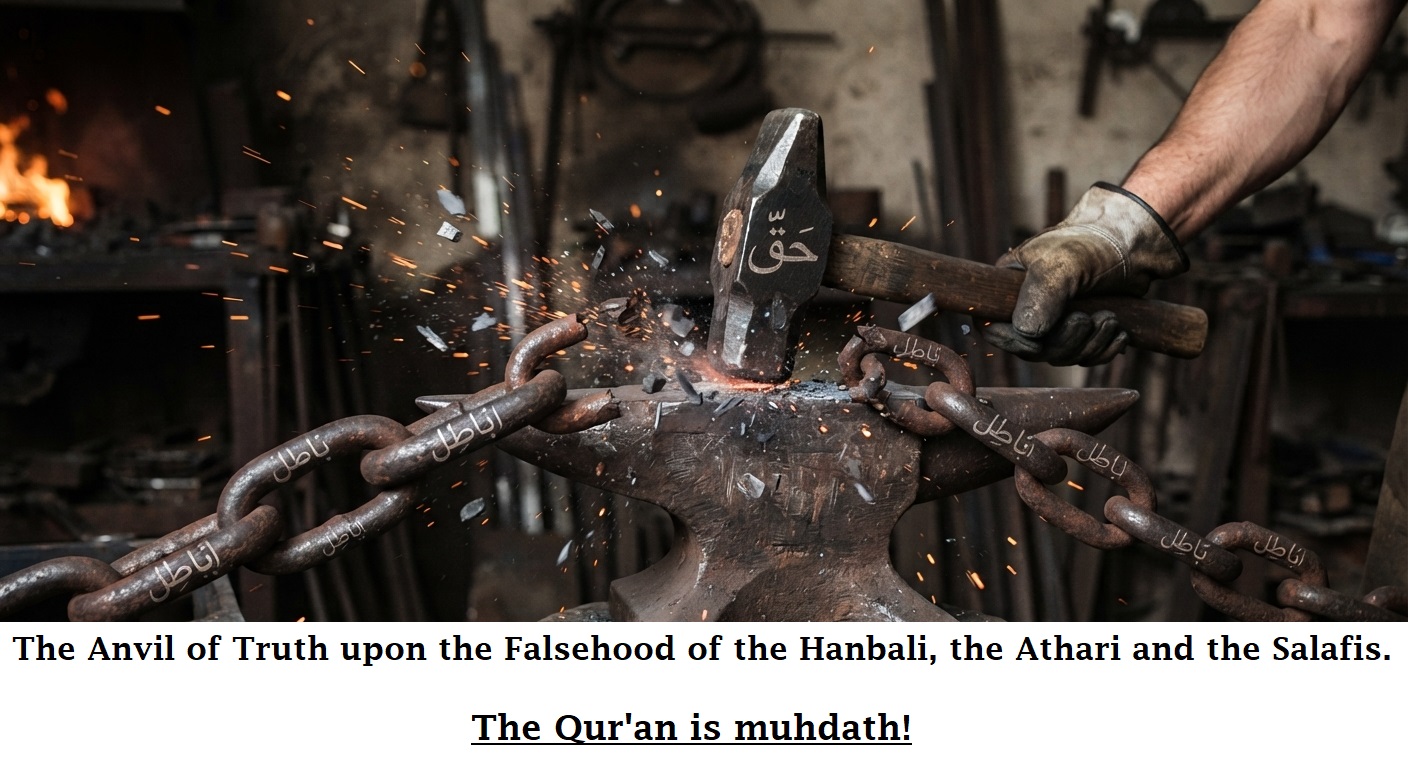
The anvil of truth has come and broken the chains that bind the Ummah to theological conjecture, philosophy and falsehood!
May Allah Forgive the Ummah.
May Allah Guide the Ummah.


