Tag Archives: imami

Ismaili Shi’a and Circular Reasoning

O you who have believed, obey Allah and obey the Messenger and those in authority among you. And if you disagree over anything, refer it to Allah and the Messenger, if you should believe in Allah and the Last Day. That is the best [way] and best in the result. (Qur’an 4:59)

﷽ 

Some time back, an Ismaili Shi’i e-mailed us with regard to our entry on the Hadith of Ghadir Khum. Though he has sent us a PDF with many contentions he asked us to address, we feel that we have needed to respond to the heart of the matter.

The heart of the matter is to understand what the Qur’an says about this issue. He had sent us a link that we are sure he felt would help to establish the case. Unfortunately, if you click on the link, it shows that the page is not there! Thankfully, we have the habit of saving materials.

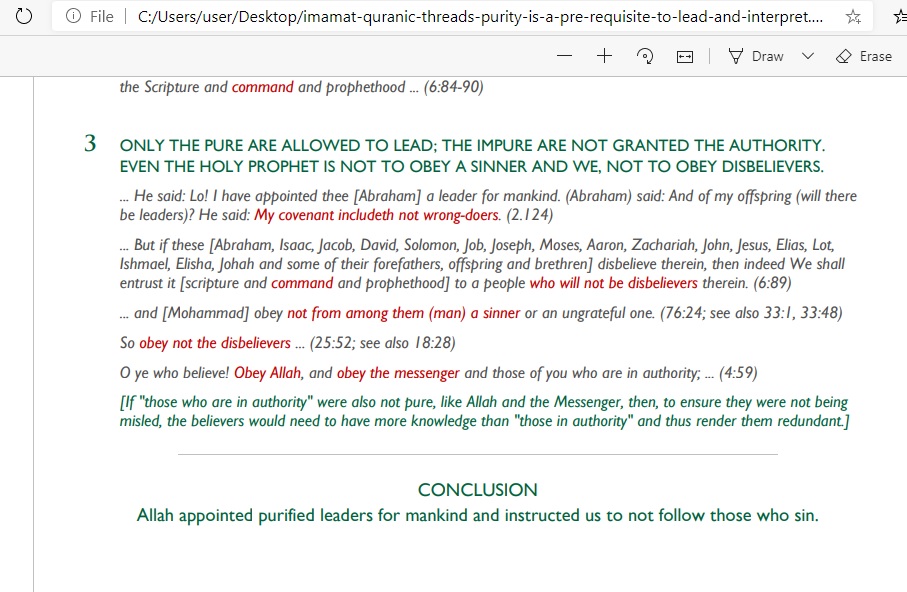
So here is the PDF file with the arguments in it. This was written by Mohib Ebrahim.

Originally to appear here: https://ismailignosis.com/2014/07/08/how-to-validate-the-shia-imamat-from-the-holy-quran/

If the link fails, we have uploaded the PDF file here:

imamat-quranic-threads-purity-is-a-pre-requisite-to-lead-and-interpret

So, for now, let us deal with the heart of the issue. What if we left all the contentious issues aside, and we stuck with the question of what evidence we have in the Qur’an to substantiate this position?

So in the e-mail, he wrote:

Likewise, there are numerous verses in the Qur’an that highlight the doctrines of the Imamate, infallibility of the Shi’a Imams (as) and the nobility of the Ahl ul Bayt (peace be upon them). It is not true that such concepts are absent from the Qura’n in a way that we, the Shi’i of Ali (as), are forced to consult supplementary ahadith to support our viewpoints. For more information on the Qura’nic and philosophical/rational proofs of Imamate you can visit: https://ismailignosis.com/2014/07/08/how-to-validate-the-shia-imamat-from-the-holy-quran/


So let us address what Mohib Ebrahim has written.

What immediately stood out to us was the very diplomatic way that the reader was being prepped for the clear admission that there is no ‘smoking gun verse’ in the Quran with regard to the Imamate at all.

Instead, the reader is teased with information like:

“The dilemma is not improved, but rather compounded, when evidence from the Qur’an is relied upon simply because the Qur’an itself admits, in verse 3:7, to its own partial ambiguity thereby rendering those parts open to individual interpretation “

“Given the disagreement about a historical event despite overwhelming agreement on its record by both sides, one can only imagine the disagreement over arguments relying on the Qur’an, given its admitted ambiguity”

Interestingly, the issue is compared to the ‘Gordian Knot‘

He continues thus,

“So does this Gordian Knot have a solution or are we of modern and later times hamstrung with the vexing task of trying to tease out the truth from an incomplete historical record 1,400 years after the fact?” “Leaving aside those ambiguous verses that require the Imamat to explain they refer to the Imamat, past attempts to validate the Imamat from the Qur’an were, in general, based on arguing a specific interpretation of what were, hopefully, “smoking gun” verses that one could then point to and proclaim, “Here, clear verses where Allah ordained the Imamat.” However, the fact is that such “smoking gun” verses are few and far between — if they are to be found at all, given the disagreements over interpretation, as explained above. Furthermore, even if they are very clear when read in a certain light, it is precisely because they need to be read in that certain light and then argued in isolation, that they do not, in my opinion, provide substantive, let alone conclusive, evidence.”

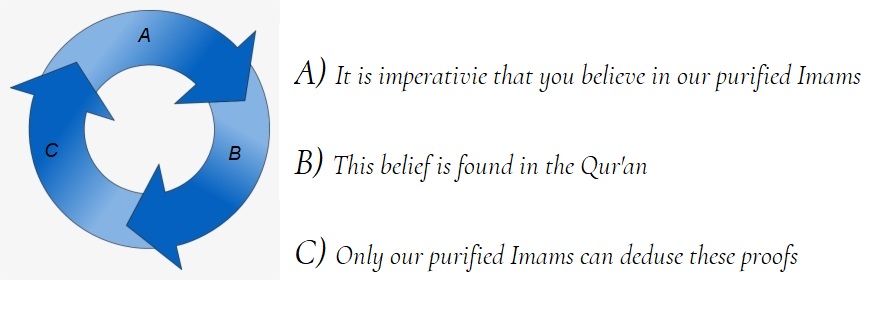
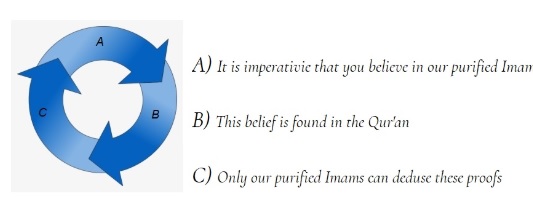
This creates an infinite regress or a closed loop:

To understand the Quran, you need the Imam.
To know who the Imam is, you need to understand the Quran.
To understand the Quran, you need the Imam.

Now you people are intelligent. This is not a misrepresentation by us. This is a clear-cut admission.

So, ultimately, this is the intellectual endeavor of Ismail’s. The gentleman in the e-mail asked us to be circumspect with regard to Islamic sects. Let us just say this particular sect of Ismaili Shi’i, as they too have many subdivisions.

Ultimately, the intellectual endeavors of this particular sect of Ismaili Shi’i want us to believe in circular reasoning, putting the cart before the horse and finding passages simply because we want so desperately to find them.

In fact, the author, Mohib Ebrahim, states:

I find it hard to accept that Allah has left the truth of this matter hostage either to the irreconcilable differences of expert Arabic linguists or personal interpretations of the Qur’an’s ambiguous verses.”

Surely it is self-evident that answers must be found in the “plain verses,” and not the ambiguous ones, for otherwise we would have an unresolvable paradox where the instructions on how we are to acquire the correct meaning of the Qur’an’s ambiguous verses, were themselves cloaked in ambiguity.”

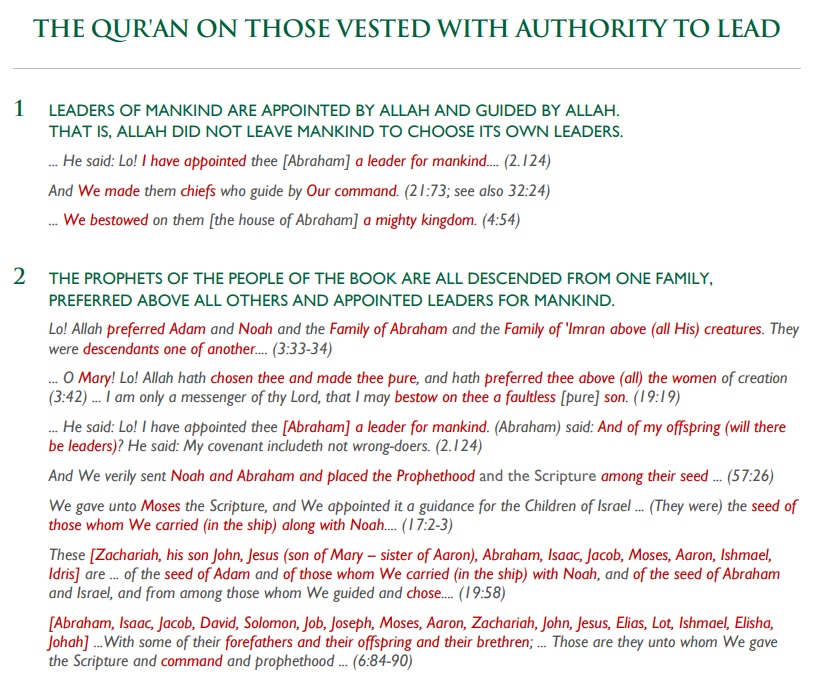
“Therefore, rather than trying to find and interpret a single “smoking gun” verse, argued and relied on in isolation, to justify Imamat, I use what I call Qur’anic Threads.”

To preface one’s argument in such a way, it is the end of the discussion, period. In fact, there was no beating around the bush. We have no ‘smoking gun‘ verse. Such ambiguous verses require us to put the cart before the horse, believe in the infallible imam’s ability to interpret before finding such passages. However, we will continue the article with a look into these various ‘threads‘ insh’Allah.

We don’t know if it would be appropriate to say that Ibrahim, Jacob, Issac were leaders of mankind. As in the whole of humanity. It is more appropriate to say leader for the people, meaning his people.

Also, to say that Allah (swt) appoints a leader, the question has to be asked. If people appoint a leader and Allah (swt) appoints a leader, are the two things mutually exclusive? After all, that is the reason for this post. That is the reason for this discussion. There is no clear-cut verse in the Qur’an for us to follow infallible Imams. There is no clear-cut verse in the Qur’an that names Ali as a leader for the community. In fact, people point to extraneous sources to indicate that Ali was to be preferred as a leader.

Look at verse Qur’an 2:124 “His covenant is not with the evildoers.” If a purified lineage also equates to purified offspring, then why did Allah (swt) put the clause ‘My covenant does not include the doers of evil‘?

Look at the verses: Qur’an 3:33-34 THEY were descendants of one another is true, but not all prophets are descendants of one another.  Unless one means that we all come from Adam (as). In that sense, the whole of humanity is the Ahl Bayt of Adam (as)

They were all descendants of one another..  We are all from Adam (as). So what is the point?

From Adam (as) we got two sons, one of whom is the first murderer of another human being. Which brings us back to what Ibrahim (as) prayed for, ‘and of my offspring?’ to which Allah (swt) responds, ‘My covenant does not include the doers of evil.’

You can imagine Adam (as) making such a du’a for his Ahl Bayt, his offspring, one of which became a murderer.

Look at verse Qur’an 57:26 among their seed…

It is interesting that the verse above is half quoted. The full verse says,

“And We have already sent Noah and Abraham and placed in their descendant’s prophethood and scripture; and among them is he who is guided, but many of them are (fasiqun) defiantly disobedient.” (Qur’an 57:26)

Among those descendants of Noah and Abraham are those who are guided but most of their descendants are defiantly disobedient. We have a clear example of one of the children of Noah (as) who disobeyed.

“And Noah called to his Lord and said, “My Lord, indeed MY SON IS OF MY FAMILY (AHLI) and indeed, Your promise is true; and You are the most just of judges! He said, “O NOAH, INDEED HE IS NOT OF YOUR (AHLIKA) FAMILY; indeed, he is one whose work was other than righteous, so ask Me not for that about which you have no knowledge. Indeed, I advise you, lest you be among the ignorant. Noah said, “My Lord, I seek refuge in You from asking that of which I have no knowledge. And unless You forgive me and have mercy upon me, I will be among the losers.” (Qur’an 11:45-47)

Also, look at verses Qur’an 17:2-3 quoted above. “From the seeds carried along with Noah” came evil beyond evil. In fact, it is interesting that if we continue to read the passage it says:

“And We conveyed to the seeds of Israel in the Scripture that, “You will surely cause corruption on the earth twice, and you will surely reach [a degree of] great haughtiness.” (Qur’an 17:4)  

“Those were the ones upon whom Allah bestowed favor from among the prophets of the seeds of Adam and of those We carried [in the ship] with Noah, and of the seeds of Abraham and Israel, and of those whom We guided and chose. When the verses of the Most Merciful were recited to them, they fell in prostration and weeping.” (Qur’an 19:58)

So why didn’t that guidance and choice descend to their progeny? If Allah (swt) saved Noah (as) and wiped out the evil, it is only reasonable that evil manifested from among the descendants of Noah (as)

Allah (swt) clearly said that the seeds of Israel would cause corruption and become haughty.

Just like one of the seeds of Adam was a murderer.

Just like Allah (swt) put a clause in Ibrahim’s du’a request.

It’s almost as if these people would own a chain of hotels across Europe one day that sells alcohol. It is as if these people one day would preoccupy themselves with the worldly life and marry supermodels.

“Also, from their fathers and their seed and their brothers-and, We chose them and We guided them to a straight path.” (Qur’an 6:87)

“Those are they unto whom We gave the Scripture and command and prophet-hood. But if these disbelieve in that, then indeed We shall entrust it to a people who will not be disbelievers in that.” (Qur’an 6:89)

Allah (swt) chose and guided them, but if they were to disbelieve therein, they would be replaced by those who would not disbelieve therein. So the possibility of disbelieve is there. This is also confirmed to me by our experience meeting people who are descendants of the Blessed Messenger (saw) who are atheists.

Look at what he says above about “Obey Allah and Obey the Messenger” (Quran 4:59)

Mohib Ebrahim continues:

“For, it is self-evident that if “those who are in authority” were also not pure, like Allah and the Messenger, they will make mistakes and, thus by definition, cannot be rightly guided. Consequently, to avoid being misled by such leaders, others with more knowledge would have to double-check them rendering such leaders redundant and undermining the legitimacy of their claim as rightly guided leadership.”


Wait a minute. When did tahara (purity) become equated with infallibility? No, that is certainly not the case. We hope no one thought they could sneak that one past us.

“So they ask you about menstruation. Say, “It is harmful, so keep away from wives during menstruation. And do not approach them until they are pure (tatahharna). And when they have purified themselves, then come to them from where Allah has ordained for you. Indeed, Allah loves those who are constantly repentant and loves those who purify themselves.” (Qur’an 2:222)

We hope no one is seriously suggesting that we do not approach our wives until they become infallible?  

“Truly, it is a noble Quran in a protected book. None touch it but the purified.” (Qur’an 56:79)

Ibn Abbas said concerning the verse, “None touch it except the purified,” that this refers to the Book in the heavens and “the purified” refers to the angels.

Source: (Tafsīr Ibn Kathīr 56:79 https://quranx.com/Tafsirs/56.79)


To say that people who are in ritual impurity touch the Qur’an is true. However, to turn around and apply an esoteric meaning to a plain word ‘touch‘ doesn’t help the ‘thread‘ case at all. Nowhere is that word in Arabic used for touch means to interpret.

Notice he says, “Consequently, to avoid being misled by such leaders, others with more knowledge would have to double-check them, rendering such leaders redundant and undermining the legitimacy of their claim as rightly guided leadership.”

The Qur’an itself subjects itself to a falsification test by even the most uncouth of people. How is that the Qur’an is subject to a falsification test and these supposed Imams are not?

In fact, this whole argument used by Shi’i is critiqued here:

As we noted, one would have to prove the odd assertion that purity equates to infallibility.  If that is the case, then we know that Ali is not pure because he made a colossal error in the battle of Siffin.   

You can see Ali’s decision critiqued here:

“Furthermore and notwithstanding the above, the Sunni position — that “those in authority” do not need to be pure and faultless — is just an interpretation since there aren’t, to my knowledge, any verses in the Qur’an stating that Allah left mankind free to choose their own leaders .” -Mohib Ebrahim

Are there any verses in the Qur’an where Allah (swt) categorically tells mankind that we are not free to choose our leaders?

So should Western Democracy’s be wary of being too cozy to Aga Khan and the Ismail’i since their doctrine is that democracy is at its core an aberration of what Allah (swt) wants?

Mohib Ebrahim wants us to believe in even more circular reasoning:

Since we are unable to judge — perfectly and without error — who are the pure, Thread III will address the apparently impossible command not to follow disbelievers or those who have sinned. Indeed, Allah has said He will judge wherein we differ (42:10,22:67-69,5:48,39:46,6:164, etc.), thus precluding us from even making such assessments.”

“Since we are unable to judge or assess..perfectly and without error.”

Ponder that for a moment.

Question: Are we supposed to believe in perfect error-free Imams?

Answer: Yes you are.

Question: Are we able to judge perfectly and without error who these Imams are?

Answer: No you are not.

So these infallible Imams are objectively useless.

Which ahurf or qir’aat are the masses of Muslims to follow?   

These ‘infallible pure imams‘ could simply throw it up in the air and pick one.

Who was the divine guide for 700 years between Jesus (as) and Muhammed (saw)?

It doesn’t matter because these ‘infallible pure imams don’t have an answer, and you are in no position to judge.

The Qur’an itself subjects itself to a falsification test; these imams do not.

We will tell you what is really convenient. It’s really convenient that we only have one infallible pure imam at a time. Apparently, in the time of the Blessed Prophet Muhammed (saw), we had him, Ali, and his two sons.

Wouldn’t it have been quite cool to have put Ali and his two sons in isolated rooms and give them a couple of questions and see if they come up with the same answers?

Question: What are the people to do when there become violent fractious splits between these infallible Imams?

Answer: Pick up your sword and hope to Allah that you start stabbing the wrong one. You have no way of objectively knowing which one is the right one!

Conclusion.

  1. The “No Smoking Gun” Admission: We seized on Ebrahim’s acknowledgment that there is no single, clear, and unambiguous verse in the Quran that establishes the Imamate of infallible leaders or names Ali specifically. We argue that this admission is fundamentally damaging to the Shia case, forcing them into circular reasoning.
  2. The Flawed “Purity = Infallibility” Equation: We refuted the Shii attempt to equate the Quranic term for purity (tahara) with theological infallibility (‘isma). We provided clear counter-examples, such as the verse about menstruation (2:222) and the interpretation of “none touch it but the purified” (56:79) referring to angels, to show the word has a different, context-dependent meaning.
  3. The Problem of Progeny and Sin: We used several Quranic examples (Adam’s son, Noah’s son, the prophesied corruption from the seed of Israel) to demonstrate that being a descendant of a prophet does not guarantee righteousness or leadership. This directly challenges the Shia concept of a lineage-based, infallible Imamate.
  4. The Practical Uselessness of an Unidentifiable Infallible Imam: Which is a brilliant logical critique. If ordinary people are unable to “judge perfectly and without error” who the infallible Imam is, then the Imam’s existence provides no practical guidance. How can people be commanded to follow someone they cannot reliably identify? This stands in stark contrast to the Quran, which issues a clear challenge of falsification and is accessible to all.
  5. The Question of Choice: We challenge the notion that Muslims are not free to choose their leaders, asking for the Quranic verse that prohibits this. This highlights the fundamental political and theological difference: Shiaism posits divine appointment.

May Allah (swt) Guide the Ummah.

May Allah (swt) Forgive the Ummah.
2 Comments

Filed under Uncategorized

My own experience with Shi’a.

“Travel through the land and observe how He began creation. Then Allah will produce the final creation. Indeed Allah, over all things, is competent.” (Qur’an 29:20)

﷽ 

Our colleague recounts their encounter with Shi’i 

Now when I say, “My experience with the Shi’i”, I should clarify that by that I mean the 12er Shi’i. The bulk of my experience has been with them.

When I was studying at Zaytuna before it became Zaytuna college, a fellow student and I named Wasif and I went for an afternoon stroll. I recall how he was telling me, “C’mon brother, just one more burger before we walk the straight and narrow.” He had a love for American burgers and was bound and determined to have just one more before going completely halal.

The time for Maghrib came upon us and there was a mosque on the side of a street. We walked in, and it was certainly a 12er Shi’a Mosque. You can see pictures of various Imams on the wall. We did not hesitate to join the congregation for the Maghrib prayer. I only noted to myself afterward that it was interesting that the whole prayer was out loud. Of course, when we went back to Zaytuna, the brothers were sharing their day-to-day things, and the subject came up. One brother approached Wasif and I said, “You prayed behind the Shi’i. Your prayer may not be valid. You better go and talk to Shaykh Mohamed Yaqubi.”

Well, low and behold, we were advised to do our prayer over again. I cannot speak for Wasif, but I didn’t take the advice. I saw no valid reason to. They prayed and I prayed. My prayer is not for them or their school. It is for Allah (swt).

Then there was the time I went for the ATMT (Awareness Through Mosque Tour) training course in Manama, Bahrain. Very beautiful team, great host, and amazing instructors! Unfortunately, during my first Friday prayer there, after everyone does there two nawafil many gather in small groups to simply chit-chat. So, one of the people with us nearby was talking about how “The Shi’i are spreading like cock roaches”. I was really disgusted by the fact that he would like this about other Muslims, and in the mosque no less! So I told him, “We should not talk about other Muslims like this.”

On another occasion, we (the trainees) were going on a guided tour of museums. A Mualif (convert) sister, who came from either the Czech Republic or Hungary was talking to a very stout Arab man. As we were walking they were discussing the current(then) volatile situation in Iraq. I made the comment that, “Sunni and Shi’i Muslims should unite.” To which he quipped: “Who said they are Muslims?” I responded, “What do you mean?” He replied, “The Shi’i who said they are Muslims?” I responded, “Our scholars (Sunni) say they are deviant, but Muslims nonetheless.” At that time I was still following the Maliki School.

The adhaan had sounded. Frustrated with what I had just heard, I stormed off from the group and happened upon a local mosque just a few blocks away. I sat in the front row waiting for the Imam to come forward. The congregants of the Mosque seemed primarily Indo-Pakistani from what I could tell. One brother said the Iqama and an elderly man was pushing me to lead the salaah! I looked around and was wondering if the actual Imam would come forward, and they kept pushing me to lead the prayer. Well, I did just that. Let me tell you it is a huge thing to lead the prayer. It was like a huge weight to lead the congregational prayer. My respect to every Imam of every Masjid on the planet. You can really feel the weight of doing something that one would think is a simple task. After the salaah, I made du’a, did more rakats and left.

Later, that robust Arab brother came up to me during dinner and apologized to me. That took me by surprise because, to be honest, he did not strike me as the type of person who would do that. I later found out from some organizers of ATMT that this brother’s family was killed by a Shi’i death squad in Iraq. May Allah (swt) soften his heart and grant him ease.

Let me tell you, you need to choose your words very carefully when traversing this Earth. Once, in what I thought was a casual conversation, when talking about the region (I being from the States), I called the waters around Bahrain, the “Persian Gulf”. Boy! That’s a blunder! “It is the Arabian Sea!” One man interrupted. I responded with, “Why not call it the sea of Islam, or the Gulf of Allah?”

I remember not far from the hotel we were staying I went out one evening to do dhikr by the “Gulf of Allah” all the while staring off into the direction of Iraq. The cool breeze of the water filled the surrounding air. It was surreal because just a few hundred kilometers was the closest I ever was physically to a war zone. I reflected on the events of the day and made du’a that Allah (swt) would fill the region with peace.

Another encounter was with when I was in Singapore. A brother I met at the Sultan Masjid. Brother Ali Al Ausi, a very kind and jovial brother. I do not want to take from his good deeds by publicly stating the many good things he has done, but Al hamdulillah I saw first hand how he was there to help those in need (fisabilillah). We were roommates for a while, and sometimes I would lead the salaah and other times he would. l was sometimes amused by his method of salah because he would wear jeans that have loops (where the belt goes through) and he would put his thumbs there and hang them during the prayer. Quite cavalier I thought to myself! Haha.

He told about his family leaving Najaf and going to Russia and from there eventually settling in the United Kingdom. His father worked in pizza shops until he became a manager and worked very hard to put his family on a proper footing.

He also told me about his doubts concerning Shi’sm and that he agreed Muslims should be Qur’an centric. He told me about how Shi’i get worked up in the Mosque during sermons on Karbala and that they would want to go out and beat up the first Sunni they saw. By Allah, these are his words, not mine.

Interestingly enough, for those of you who remember the man in Iraq who took off his shoe and threw it at president George Bush Jr, well, that man (the man who threw the shoe) was going to marry his daughter to my friend Ali. They met in Damascus, Syria, and once Ali confided in her that he didn’t believe in some of the stuff about Shi’ism, she stormed off saying, “I would rather marry a Sunni than you!”

He also divulged to me about some rather wealthy Shi’a Arabs that would practice Muta with some of the poorer Arab women in Egypt, and he was rather disgusted by it all. I recall how he remarked, “If everyone is doing Muta, then who will get married?”

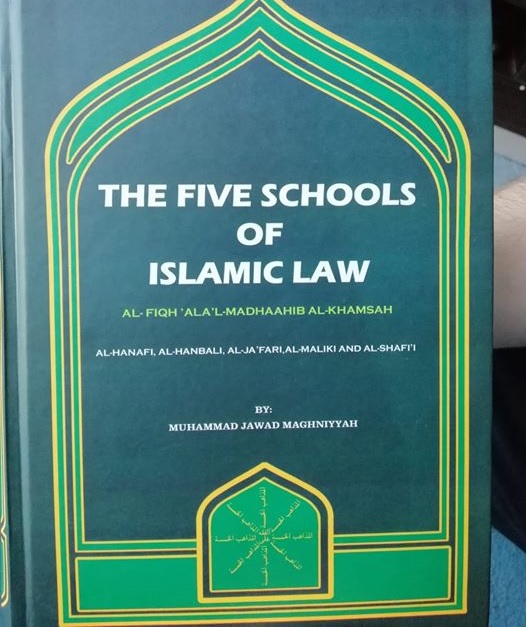
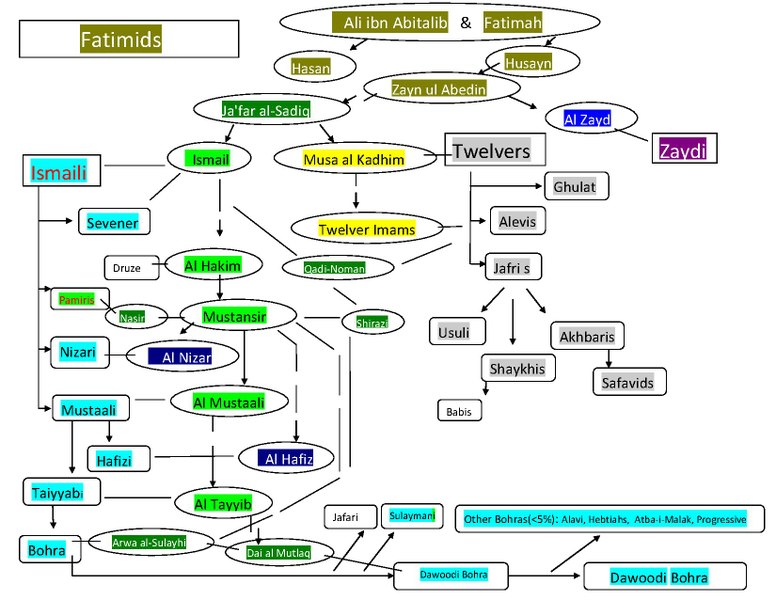
I just wanted to say that this book was given to me by my good friend Dr. Ali Al-Ausi, upon my request. He informed his mother that he had a friend wanting to know more about the 12er jurisprudence. The book is still in my collection. Brother Ali is one of the kindest, honest, generous, and most truthful Muslims I have ever met.

My meeting with the respected, Ali Larijani (The Former Speaker of the Parliament of Iran). This was an occasion at the Sultan Mosque in Singapore when his delegation came to Singapore. I was actually scheduled to give a talk to him and his delegation and there was a change of plans. I prepared before he came by trying to find out about his background. I saw that he studied Philosophy and particularly liked the philosopher Immanuel Kant.

His entourage created quite a shock at the Mosque because the ladies who were with them prayed in the main prayer hall (where the men usually pray). I was amused by it all. Nonetheless, after the prayer, I approached Ali Larijani, who had two bodyguards and one cleric with him. I greeted him, “Assalamu alaikum warahmutallahi wabaraktuh.” He replied the same. I then told him, “I am from America and I wish for peace between us and Iran.” He replied, “That they too wish for peace.” I then asked him what his favourite quote from Kant was. I could tell by his reaction. He was surprised. He responded with Kant quoting the golden rule: “Do not do that to others that you would not like them to do to you.”

Now that is the sum total of my personal experience and interaction with Shi’i or anything in relation to them in my lifetime. If you think, based upon what I shared above, that I hate Shi’i, that is really up to you.

That being said, when it comes to what I encounter online, via various social media platforms and what have you, I have found Shi’a (12er,especially) to be very dishonest, disingenuous and not very forward.

The one thing I do admire about Salafis, Sunnis of all stripes, even those who follow the Hafs Qur’an only religion. Ahmadiyyah etc. is there willingness to be forthright.

Their willingness to say, “I am such and such and this is where I stand.” With the Shi’i, I don’t get this. What I find is they often join groups posing that they are part of this or that and keeping quiet about being Shi’a.

Look! If we were in Syria, Iraq, Lebanon or other places where sectarianism is highly charged and a person’s life is in danger, I would get it. However, this skulking around various platforms pretending to be Hanafi, or Quranist. Anything else is simply just cowardly. It truly is.

All these people saying Ya Ali, Ya Ali Madad. How they would have loved to be at Karbala, or have lifted their sword for Ali. Look, mate, you cannot even be honest enough with yourself to say what you are openly.

And honestly, what I do see on YouTube, of the interactions of 12ers and Zaydi’s with Sunnis, is that the Shi’a end up getting intellectually owned, time and again.

You may also wish to read the following:

May Allah (swt) Forgive the Ummah.
May Allah (swt) Guide the Ummah.

12 Comments

Filed under Uncategorized

Sociological Experiment: Ali, Umar and Fatima

“Indeed, Allah commands you to render trusts to whom they are due and when you judge between people to judge with justice. Excellent is that which Allah instructs you. Indeed, Allah is ever Hearing and Seeing.” (Qur’an 4:58) 

﷽ 

This is a sociological experiment our colleague conducted on their social media regarding the tale of some from among the Shi’i in relation to Umar (ra), Ali and Fatima (ra).

Narrated `Aisha:

Once, Fatima came walking and her gait resembled the gait of the Prophet (saw). The Prophet (saw) said, “Welcome, O my daughter!” Then he made her sit on his right or on his left side, and then he told her a secret and she started weeping. I asked her, “Why are you weeping?” He again told her a secret and she started laughing. I said, “I never saw happiness so near to sadness as I saw today.” I asked her what the Prophet (saw) had told her. She said, “I would never disclose the secret of Allah’s Messenger (saw).” When the Prophet (saw) died, I asked her about it. She replied. “The Prophet (saw) said: ‘Every year Gabriel used to revise the Qur’an with me once only, but this year he has done so twice. I think this portends my death, and you will be the first of my family to follow me.’ So I started weeping. Then he said. ‘Don’t you like to be the chief of all the ladies of Paradise or the chief of the believing women? So I laughed for that.” 

Source: (https://sunnah.com/bukhari:3623)

If indeed the Shi’i believe that this narration is true and that Fatima (ra) would be the first from among the family of the Beloved Messenger (saw) to die, it cannot also be true that the “unborn” son of Fatima would die as he would technically be the ‘first of my family’ to follow.

Ali bin Abi Talib said:

“When al Hassan was born, the Prophet (saw) came and said: Show me, my boy, what have you named him? I said: I called him Harb, he said: Nay,” He is Hassan When al Hussein was born, the Prophet (saw)said: Show me my boy, what have you named him? I said: Harb, he said: Nay, he is Hussein, and when the third was born, the Prophet (saw) came, then said: Show me, my boy, what have you named him? I said: Harb. He said: Nay, he is Muhassin, then he said: I have named them after the names of the children of Haroun(Aaron). They are Shibr, Shubeir, Mushabbar.” 

Source: (Musnad Ahmad 1/98, Isnad is sound)

  • لمَّا وُلِد الحَسنُ فقال أروني ابنِي ما سمَّيْتُموه قُلْتُ حَرْبًا قال بل هو حَسنٌ قال فلمَّا وُلِد الحُسَينُ سمَّيْتُه حَرْبًا فجاء رسولُ اللهِ صلَّى اللهُ عليه وسلَّم فقال أروني ابنِي ما سمَّيْتُموه قُلْتُ حَرْبًا قال بل هو حُسَينٌ فلمَّا وُلِد الثَّالِثُ سمَّيْتُه حَرْبًا فجاء النَّبيُّ صلَّى اللهُ عليه وسلَّم فقال أروني ابنِي ما سمَّيْتُموه قُلْتُ حَرْبًا قال بل هو مُحَسِّنٌ ثُمَّ قال سمَّيْتُهم بأسماءَ ولدِ هارونَ شَبَرٍ وشُبَيرٍ ومُبشِّرٍ [ وفي روايةٍ ] قال سمَّيْتُهم بأسماءِ ولدِ هارونَ جَبَرٍ وجُبَيرٍ ومُجَبِّرٍ. خلاصة حكم المحدث: رجالهما رجال الصحيح غير هانئ بن هانئ وهو ثقة‏‏
    الراوي: علي بن أبي طالب
    المحدث: الهيثمي
    المصدر: مجمع الزوائد
    الصفحة أو الرقم: 8/55
    التخريج : أخرجه أحمد (769)، وابن حبان (6958)، والطبراني (3/ 96) (2773) جميعا بلفظه.

موقع الدرر السنية – الموسوعة الحديثية
https://dorar.net/h/NmytTfjY

It’s not believable to say that Muhassin was aborted as a fetus and yet the above narration says that he was born.

Here is a video of Ayatollah Sayyid Fadhlallaha, a Shi’i Imam, who thinks this whole tale about Ali, Umar (ra) and Fatima (ra) is a big fat, juicy fabrication. For those who can’t click on English subtitles in the post, we have put the YouTube link where you can click on English subtitles.

Surely the Imam has his reward with Allah (swt) for seeking truth on the matter.

Also, remember the presence of a statement in a book does not necessarily make it authentic. We do not know of anyone who holds this position. The chains of narrators the isnad needs to be scrutinized. Do the reports contradict other pieces of evidence? This is what needs to be understood when engaging in dialogue with anyone from among the Muslims.

Now let us assume, for the sake of argument, that this incident took place as suggested by the Shi’i. Obviously, learned people like the Ayatollah above don’t buy it for a hot minute.

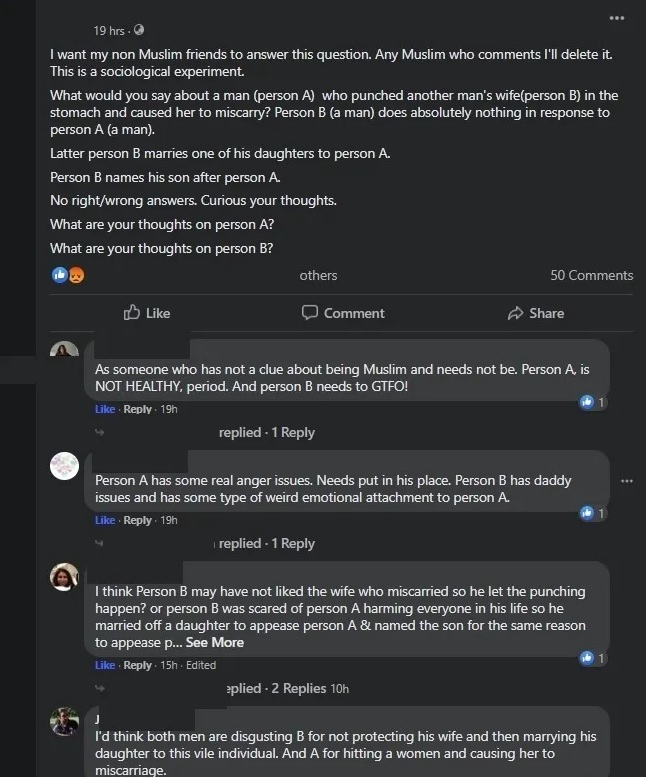
SOCIOLOGICAL EXPERIMENT ON FACEBOOK. I CALL THIS: “THE FATIMA EXPERIMENT”

So, knowing that Muslims have a vested interest in this alleged incident and there are emotional attachments to it, I decided to ask people who were absolutely clueless about this incident.

I decided that I would ask my non-Muslim friends about their thoughts concerning the characters of the two major individuals in this incident. So this is the data that I gave to them:


I want my non-Muslim friends to answer this question. Any Muslim who comments, I’ll delete it. This is a sociological experiment.

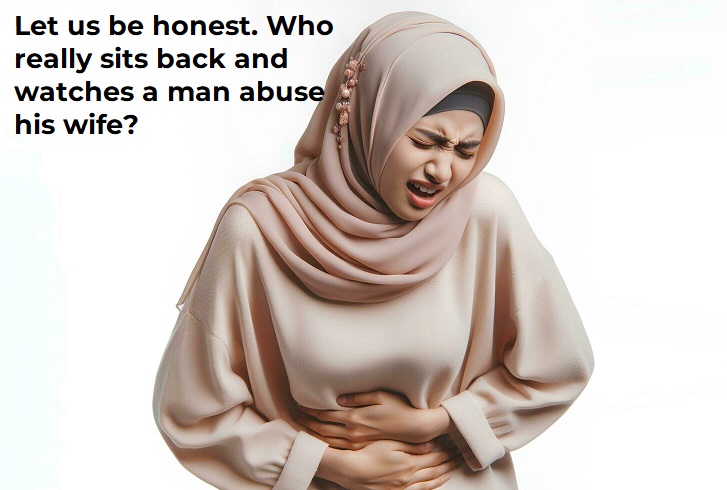
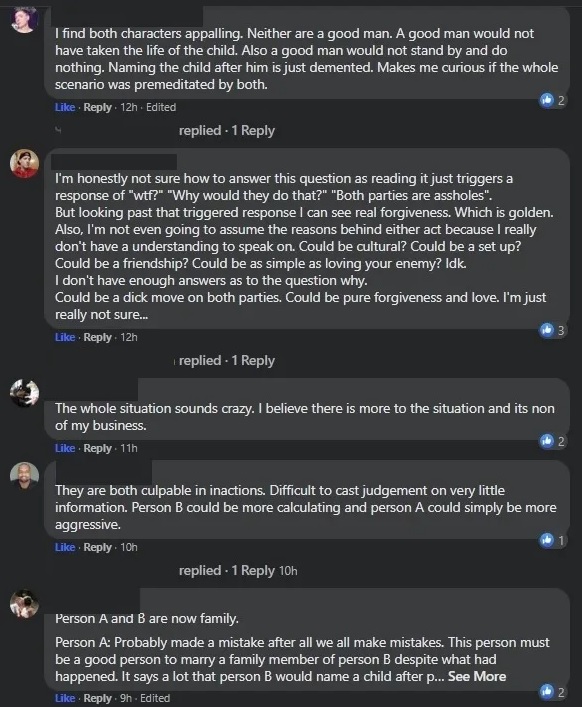
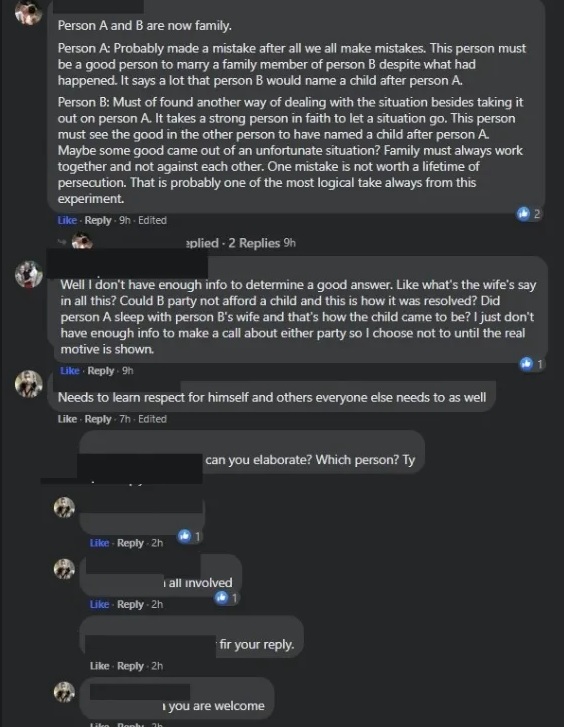
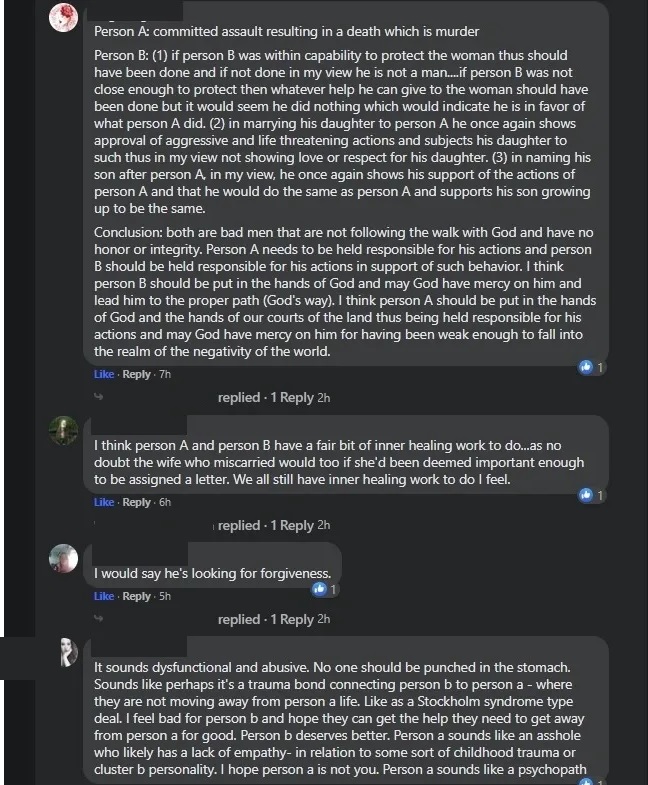
What would you say about a man (person A) who punched another man’s wife (person B) in the stomach and caused her to miscarry? Person B (a man) does absolutely nothing in response to person A (a man).

Later, person B marries one of his daughters to person A.

Person B names his son after person A. 

In the Fatima experiment. Person A is Umar Ibn Al Khattab (ra) and Person B is Ali ibn Abu Talib.

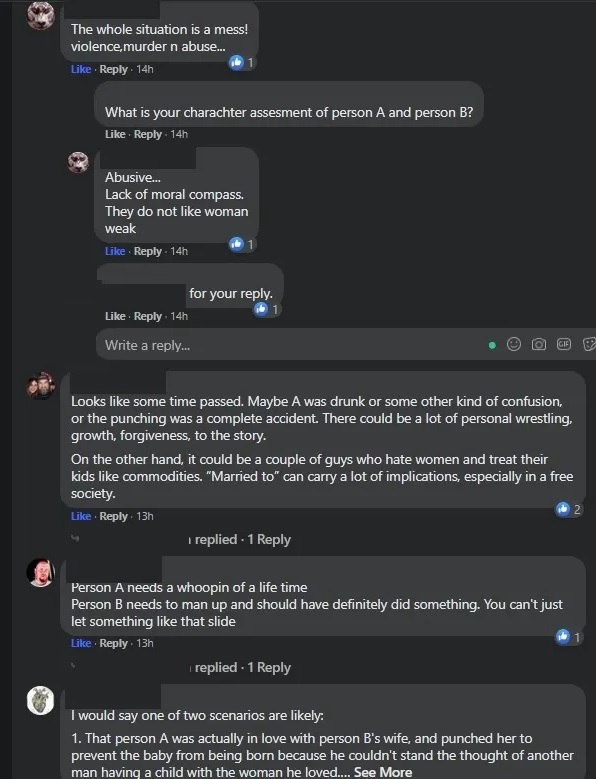
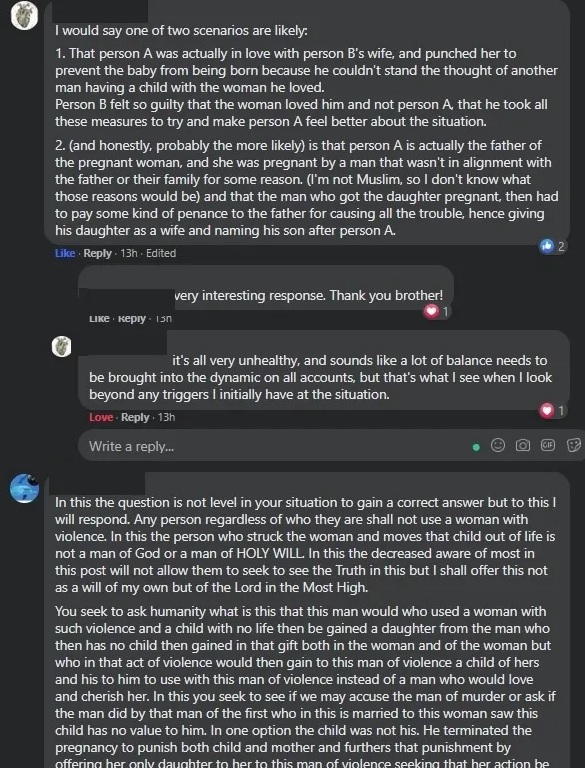
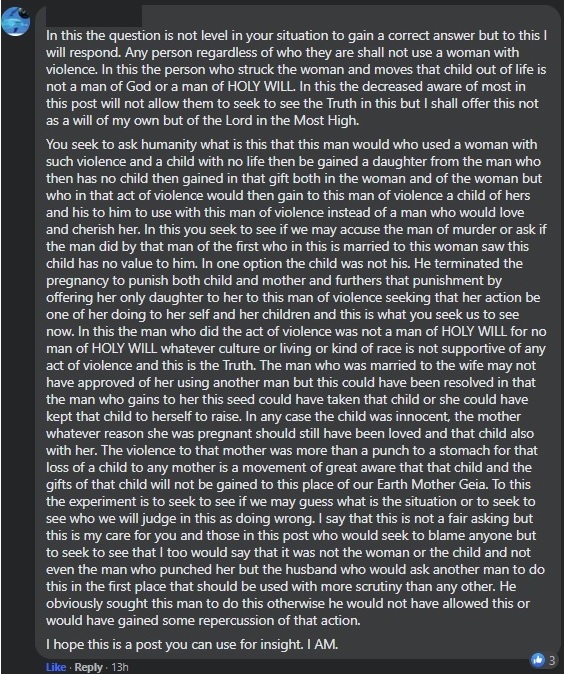
What follows are their responses. Some of them are quite interesting. I have covered up their names to protect/respect their personal privacy.  These are mostly U.S. Americans. They hold nothing back.

Well, so there you have it. 20 different responses to this scenario. Not favourable views of Umar (ra) and almost unanimously unfavourable views of Ali

Now we have The Lady of Heaven film that has created quite a controversy.

May Allah (swt) guide our tongues to speak the truth and our hearts to have the courage to say it. May Allah (swt) guide us from speaking falsely about any person’s incident or matter. Amin!

You may also wish to read the following:

May Allah Guide the Ummah.

May Allah Forgive the Ummah.
6 Comments

Filed under Uncategorized

The Ibadi Stance on Ali bin Abi Talib

“Wherever you are ˹O Prophet˺, turn your face towards the Sacred Mosque. And wherever you ˹believers˺ are, face towards it, so that people will have no argument against you, except the wrongdoers among them. Do not fear them; fear Me, so that I may ˹continue to˺ perfect My favour upon you and so you may be ˹rightly˺ guided.” (Qur’an 2:150)

﷽ 

Logic and facts will always rule over feelings and fallacy.

First it should be known that the default position of all the companions of the Blessed Prophet (saw) is Wilayat al dhahir. Which means they are known to follow the Qur’an and the Sunnah, and they are known for their piety. This is the default position for all companions.


Now, if anyone of them did a major sin and did not make tauba to Allah (swt) up until his death, you can put that companion in Bara’ah al Dhahir.

So, in regard to Ali, there are three positions held among the Ibadi.

  1. Wuqoof. Suspend judgement. That is not to put Ali in wilayah or bara’ah. To leave his matter to Allah.
  2. Bara’ah al-Dhahir – The apparent dissociation. This is a matter of jurisprudence. Ali committed kufr ni’ma and there is no indication that he repented of his sins.
  3. Walayah al-Dhahir – The apparent friendship. This is a matter of jurisprudence. Ali was remorseful and repented of his sins.

Bara’ah and Wilayah are a huge part of Islam of which many Muslims are ignorant of. If you want to know how it is understood. We would suggest you read the following:

Wuqoof is to pause if there is khilaf on the person. Wuqoof is to stop at everyone you don’t know. You do not make a judgement on him/her to be in Walayah or Bara’ah. This is a very safe path to take.

Bara’ah al DhahirThe Apparent disassociation. This to perform Bara’ah to whoever you see disobeying the commandments of his Lord. Be it in the Quran or Sunnah- whether you’ve seen him by yourself or by him admitting to committing that sin or by the famous/infamous act that he did. They can return to Walayah if they repent and reform.

Walayah al-Dhahir – The Apparent Friendship. This means to show walayah (loyalty/friendship) to anyone you see following the commandments of Allah—whether from the Qur’an or Sunnah. Even those who have committed sins and repented of the sins.

Shaykh Massoud bin Muhammed Al Miqbali (hafidullah) gives the range of the Ibadi views regarding Ali bin Abi Talib. We did our best to clean up the subtitles below. The Shaykh is giving a reply to one of the Salafi detractors.

The Ibadi stance regarding Ali bin Abi Talib.

“The Ibadis have different positions on Ali bin Abi Talib. And it cannot be said that Ibadis takfir Imam Ali (kufr ni’amah) and it cannot be said that they associate with him (wilayah), and it can not also be said that Ibadis stop on him (Wuqoof). Rather, all three positions exist.”

“So it cannot be said that it is only one of these sayings that the Ibadi adopt.”


“And those that stated he was a kafir by that didn’t mean to remove him out of the fold of Islam. Rather, they looked upon the events and clashes that occurred in Siffin, and they built upon it a judgement. And it’s a Godly judgement. They see that Ali is alike to the people, alike to anyone else. For him, it is that for others, and for him, it is that for others, and he is obligated by what they’re obligated to.”

“So, if it falls on that which obligates deviance, he is considered a deviant, tafseeq he is considered a fasiq, kufr he is takfeered. And this is the madhab of the sahaba which you narrate. The companions who had insulted, killed and cursed him. Was it out whim? Or by a religious obligation?”

“Without a doubt, the madhab of the sahaba (and you claim you follow the salaf, and you say that you’re salafiyyah). This is the madhab of the salaf, where whoever falls on kufr is takfeered, and whoever falls on that which obligates cursing is cursed, and whoever falls on what obligates criticism is criticized. This is the madhab of the salaf, rather it is the madhab of the Qur’an and the honest Prophet (saw). This is the madhab that we adopt.”

“And we do not, after that, believe that if it’s permissible to takfir him, that he’s out of the fold of Islam. No! We say that kufr is split into two. Kufr Shirk and Kufr ni’ama. (That doesn’t take him out of Islam). To make this simple: all mushriks are kafirs, but not all kafirs are mushriks. This is with those that adopted the madhab of takfir, but there are those that didn’t adopt it. And there’s him who stopped.”

“And if you have knowledge just like they have, then it is permissible for you to judge like they have. And if you’re a jahi (not learned), then stopping on him is enough for you, and that is a known way with us.”

“And they say that a monotheist isn’t takfeered except for shirk, and this is a false saying. Here are the texts of the shari’ah and its infallible proof that the takfir doesn’t take its committer out of islam.”

“It is the duty of all men towards Allah to come to the House a pilgrim, if he is able to make his way there. As for the (kafara) ungrateful, Allah is All-sufficient nor needs any being.” (Qur’an 3:97)

“This is a favor from my Lord by which He wants to test whether I am grateful or ungrateful.” (Qur’an 27:40)

Narrated ‘Abdullah:

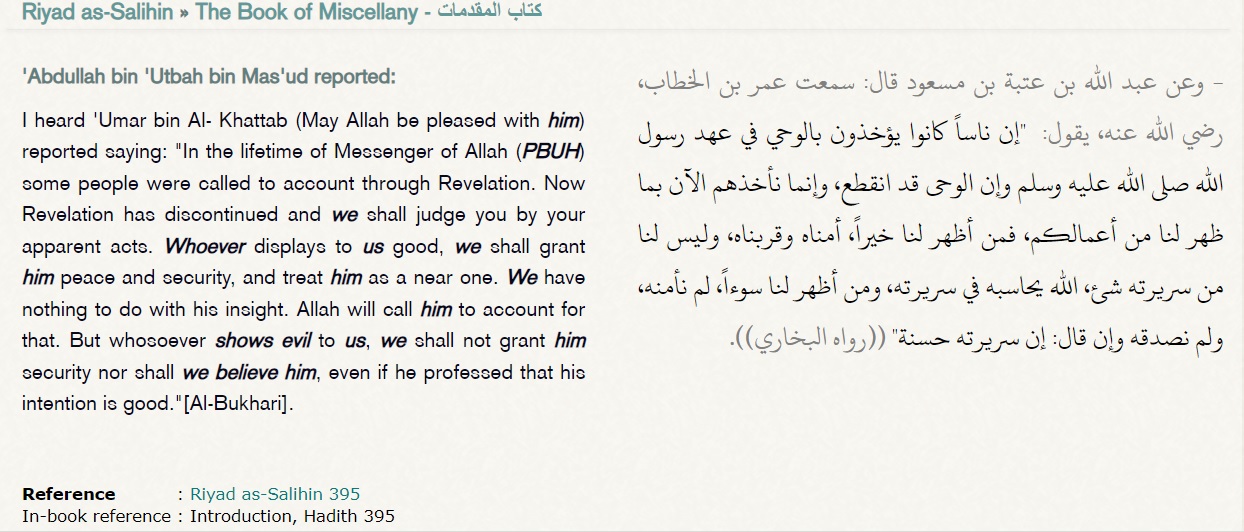
The Prophet (saw) said, “Abusing a Muslim is Fusuq (an evil doing) and killing him is Kufr (disbelief).” Source: (https://sunnah.com/bukhari:48)

Narrated Ibn `Umar:

I heard the Prophet (saw) saying, “Do not revert to disbelief (kuffaran) after me by striking (cutting) the necks of one another.”

Source: (https://sunnah.com/bukhari:7077)

“Abu Hurairah narrated that the Prophet (saw) said: “Whoever engages in sexual intercourse with a menstruating woman, or a woman in her anus, consults a soothsayer, then he has disbelieved (kafar) in what was revealed to Muhammed.”

Source: (https://sunnah.com/tirmidhi:135)

You may read more about that here:

“All of these texts show clearly that there is from kufr which doesn’t take its committer out of Islam. Rather, it’s a synonym to fusooqi, fujoori, isyaani. So trying to distort the picture of the Ibadi madhab is a miserable and desperate and unsuccessful try. And I said that there are those that said he (Ali) repented, and that narration has been denied by the other group.”

“This narration exists within our books, and if we hated and considered him (Ali) a kafir for personal reasons, we wouldn’t have mentioned this narration, which acquits his position.”

“We have in our athars and books like Bayan al-Shar‘ (بيان الشرع) — written by Muhammed b. Ibrahim al-Kindi, which was written in the 5th century, shows evidence of him (Ali) repenting. And this repenting narration maybe it is something that only the Ibadis have. It doesn’t exist with others. So if they were opposing him (Ali) personally, they wouldn’t have narrated his repentance.”

“But they (The Ibadi scholars) are the just ummah, the righteous ummah, they narrate all that is for them, and they narrate all that is against them. There is no opposition between them and the truth.”

“So we take the truth whenever we see it, even if it’s a hater that brought it, and the false is the rejected by us, even if it was brought by a friend who is taken highly.”

“We accept what Allah accepts from his deen, and reject what He rejects. Our biography is that of Ahmed (saw) companions. We do not accept people of injustice as models. This is the Minhaj that we walked upon. We narrate that which is for us, and narrate that which is against us, and it’s not really our concern about the pleasure of whoever is pleased and the anger of whoever is angry.”

First: From the outset, one must understand that our predecessors were what one may call the Shiat Ali. They were in the battles of the Camel and Siffin and fought hard on behalf of Ali Ibn Abu Talib. Losing life and limbs and relatives. Which is more than what those who claim to profess him can claim.

Second: The disappointment comes with his decision at Siffin, and his injustice in taking the life of the believers at Nahrawan. It becomes abundantly clear that his followers never had even any concept of the terms maʿṣūm (معصوم) and ʿiṣmah (عصمة) being applied to him. If that were the case, they would not have left his camp. Nor were these concepts used by Ibn Abbas (ra) in his debate with the people of the river. (Nahrawan).

Third: The issue surrounding Ali Ibn Abu Talib is similar to that of Uthman ibn Affan, in that
they are political in nature. No one from our school accuses either Ali Ibn Abu Talib or Uthman ibn Affan of being a mushrik. Far from it.

Fourth: Just like a group of companions were the ones to rise up against Uthman ibn Affan, likewise, a group of companions differed with Ali’s decision of arbitration.

All Muslim groups today are formed on the basis of political events in the early period of Islamic history.

There are a few things in the video a person should take away.

The differences in the types of kufr. Kufr ni’ma doesn’t put the person out of the fold of Islam.

The other point is that those who have knowledge of this subject may form a particular opinion on it. Those who do not have knowledge of this subject can and should refrain from having any opinion on it. (wuqoof)

The fact that he (Ali) went against the Qur’an-based ruling at Siffin and killed the Muslims at Nahrawan put him in the state of kufr ni’ma (which doesn’t take the person out of Islam).

However, that person would still need to repent of their kufr before they died. To us, Ali is like others. He can make mistakes.

Indeed, major sins nullify obedient acts, no matter how great. In the case of Ali, he committed major sins. So the point of difference in the school is on rather or not he repented before he met his end.

Those who do not believe he repented before death can say that Ali would be in Bara’ah-al dhahir. The apparent disassociation.

For those that believe Ali repented before he died. Ali would be in Walayah al dhahir. The apparent association.

So, basically to sum up, the Ibadi position. There are three positions regarding Ali Ibn Abi Talib.

Anyone who refuses to mention this (three views) or relates only one view is either willfully ignorant or a deceiver and a liar.

Background into some of the reasons for the opposition of the companions against Ali bin Abi Talib

The main cause of fierce opposition to Ali was the perceived failure or reluctance to punish the culprits, including his stepson, Muhammed bin Abu Bakr, who was involved in the killing of Uthman. Ali married his (Abi Bakar’s) mother, Asma (ra), after the death of Abu Bakr (ra). So there was a marriage relationship between Ali and Muhammed bin Abu Bakr, although, as we have seen, Muhammed bin Abu Bakr did not actually kill Uthman, at best he aided and abetted the assassins. (This for another article).

What might have strengthened people’s suspicion on Ali was that Ali appointed Muhammed bin Abi Bakar as governor of Egypt, which his opponents may have interpreted (right or wrong) as a type of reward for his hand in the matter of killing Uthman.

Furthermore, Ali’s own brother Aqil ibn Abi Talib fought on the side of Muawiya. Aqil ibn Abi Talib is the cousin of the Blessed Prophet (saw) and elder brother of Ali. So, as one can see, these were quite chaotic times.

Prior to this, there was the whole incident of Ali bin Abi Talib burying Fatima (ra) in secret and people were not pleased about it. You may read about this here:

https://sunnah.com/bukhari:4240

Ali bin Abi Talib disappeared from the scene of events throughout the caliphate of the three Shaykhs: Abu Bakr (ra), Umar (ra), and Uthman. For a total of 25 years (a quarter of a century), the man was absent, completely out of sight. No one knew what he was doing. It is said that he did not participate in a single Muslim battle, neither with himself, nor with his children, nor with his money. While the chieftains of the Arabs were crushing the apostates and toppling the thrones of the Caesars, not a single inch did he conquer for Islam!

To many, the greatest of shocks came. When he finally ascended to power after what many saw as the conspiracy to kill Uthman, the momentum of the conquests was paralyzed, the flame of victories of tawhid was extinguished, so that the sword that “slept” on the enemies of the Ummah would awaken suddenly in the breasts of the Muslims!

Furthermore, what set the people against Ali are the various conflicting narratives about how he dealt with Aisha (ra), a member of the purified household according to (Qur’an 33:30-34) as well as “Mother of the Believers” as per (Qur’an 33:6).

They ask how Ali bin Abi Talib would face the Messenger of Allah, (saw) when he fought his wife!! And he sent his helpers against her until they hamstrung her camel and she fell from her litter, and her enemies paraded her around like a captive? This is a sign of humiliation for the man’s family, her violation, her captivity, and the foreigners’ force to subjugate, humiliate, and degrade her!

The test of Aisha (ra) and the test of Ali.

Thus, the case of Ali with us, Ibadi, is similar to the case of Aisha (ra) with many Shi’i. Consider the following:

Aisha (ra) was a test on rather the believers will follow her or the Imam. Ali Ibn Abu Talib himself became a test for the believers at Siffin; to see whether or not people would follow what Allah (swt) ordered in the Qur’an, or Ali’s decision.

Narrated by Abu Maryam `Abdullah bin Ziyad Al-Aasadi:

“When Talha, AzZubair and `Aisha moved to Basra, `Ali sent `Ammar bin Yasir and Hasan bin `Ali who came to us at Kufa and ascended the pulpit. Al-Hasan bin `Ali was at the top of the pulpit and `Ammar was below Al-Hasan. We all gathered before him. I heard `Ammar saying, “`Aisha has moved to Al-Busra. By Allah! She is the wife of your Prophet in this world and in the Hereafter. But Allah has put you to test whether you obey Him (Allah) or her (`Aisha).”

Source: (https://sunnah.com/bukhari:7100)

So even though Aisha (ra) is acknowledged by Ammar bin Yasir to be the ‘wife of the Prophet in this world and in the Hereafter‘, he was not about to leave the dhahir (the apparent) evidence.

Which is that Ali was the rightful 4th Imam of the Muslims. One who is to be obeyed as long as he obeys the Qur’an and Sunnah. 

The idea that a particular blood tie, clan or family affiliation exempted one from the Sharī’ah is absolutely foreign to the Blessed Prophet (saw).

Narrated `Aisha:

Usama approached the Prophet (saw) on behalf of a woman (who had committed theft). The Prophet (saw) said, “The people before you were destroyed because they used to inflict legal punishments on the poor and forgive the rich. By Him in Whose Hand my soul is! If Fatima (the daughter of the Prophet (saw) did that (i.e. stole), I would cut off her hand.”

Source: (https://sunnah.com/bukhari:6787)

Narrated Abu Huraira:

When Allah revealed the verse: “Warn your nearest kinsmen,” Allah’s Messenger (saw) got up and said, “O people of Quraish (or said similar words)! Buy (i.e. save) yourselves (from the Hellfire) as I cannot save you from Allah’s Punishment; O Bani `Abd Manaf! I cannot save you from Allah’s Punishment, O Safiya, the Aunt of Allah’s Messenger (saw)! I cannot save you from Allah’s Punishment; O Fatima bint Muhammed! Ask me anything from my wealth, but I cannot save you from Allah’s Punishment.”

Source: (https://sunnah.com/bukhari:2753)

Likewise, whatever alleged superiority that Ali enjoyed and is claimed to have had does not eclipse one’s obedience to the Qur’an and Sunnah.

As Aisha (ra) was abandoned in favour of the apparent, likewise Ali was abandoned in favour of the apparent. In our madhab, Jabir Bin Zaid (ra) informed us that Ayesha (ra) repented from her sins before she died. The sin being to make war against the legitimate Imam of the Muslims.

This must be the case because Allah (swt) has confirmed this.

Aisha (ra) mother of the believers.

“The Prophet is more worthy of the believers than themselves, and his wives are their mothers (ummahatuhum). And those of relationship are more entitled in the decree of Allah than the] believers and the emigrants, except that you may do to your close associates a kindness. That was in the Book inscribed.” (Qur’an 33:6)

So Aisha (ra) is in Walayah al Haqiqah -The real friendship or friendship that is with Allah (swt). 

The Three views among Ibadis regarding Ali Ibn Abu Talib.

1. Bara’ah al Dhahir- The Apparent disassociation. Disavowed.

This view is that Ali Ibn Abi Talib did not repent of his sins and, therefore, the one who dies without repenting of major sins is doomed. What happens to the one who does not repent from major sins is no secret in Islam.

We must understand that disavowing a person who commits major sins (even if they are a companion) is actually a Sunnah of the Blessed Prophet (saw).

Narrated Salim’s father:

The Prophet (saw) sent Khalid bin Al-Walid to the tribe of Jadhima and Khalid invited them to Islam but they could not express themselves by saying, “Aslamna (i.e. we have embraced Islam),” but they started saying “Saba’na! Saba’na (i.e. we have come out of one religion to another).” Khalid kept on killing (some of) them and taking (some of) them as captives and gave every one of us his Captive. When there came the day then Khalid ordered that each man (i.e. Muslim soldier) should kill his captive, I said, “By Allah, I will not kill my captive, and none of my companions will kill his captive.” When we reached the Prophet, we mentioned to him the whole story. On that, the Prophet (saw) raised both his hands and said twice, “O Allah! I am free from what Khalid has done.” ‏ اللَّهُمَّ إِنِّي أَبْرَأُ إِلَيْكَ مِمَّا صَنَعَ خَالِدٌ

Source: (https://sunnah.com/bukhari:4339)

Loyalty to the Qur’an and Sunnah takes primacy over any other affiliation, or perceived rank or status of an individual.

“You will not find those who believe in Allah and in the Hereafter having (yuwadduna) love/affection with those who oppose Allah and His Messenger, even though they may be their fathers or their sons or their brothers or their clan. They are such that Allah has inscribed faith on their hearts, and has supported them with a spirit from Him. He will admit them to gardens beneath which rivers flow, in which they will live forever. Allah is pleased with them, and they are pleased with Allah. Those are the party of Allah. Be assured that it is (the members of) the party of Allah that are the successful.” (Qur’an 58:22)

Imami Shi’i would take issue with this because of the doctrine of ‘Iṣmah 

Todays Sunnis would take issue with this because of they under went aa Shi’ification under the Abbasid empire and developed the doctrine of Adalat al-Sahaba.

2. Walayah al-Dhahir – The Apparent Friendship.

This view is that Ali Ibn Abi Talib, possibly after seeing that the arbitration with Muaviya did not bring any good for the Muslim ummah, and seeing the world crumble around him and possibly at the prompting of Ibn Abbas (ra), he repented to Allah (swt) and therefore his ending was a good ending.

The evidence that Imam Ali was remorseful and repented is found at the end of this article:

Under the section: Evidence used by the Ibadi school to show that Ali Ibn Abu Talib had repented for his sins.

https://primaquran.com/2024/09/12/the-battle-of-nahrawan-the-ibadi-perspective/

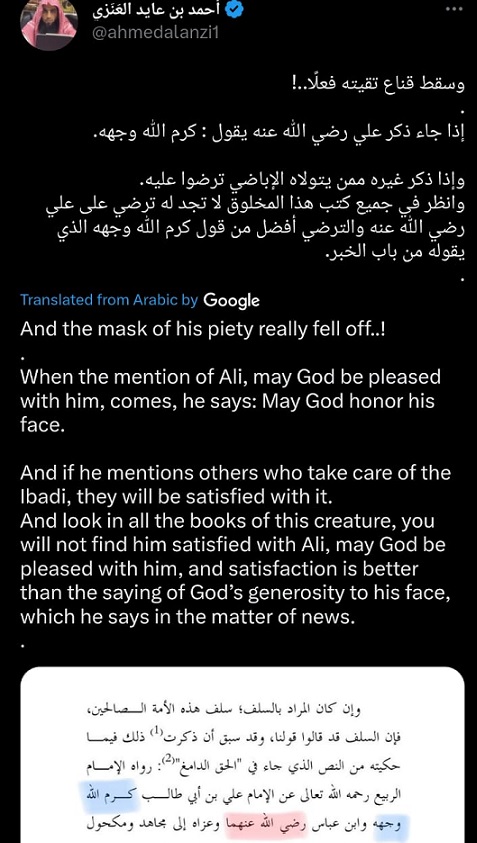
Often these Ibadi’ may say, Karram-Allah-u Wajhah, meaning: “Allah honored his face” as a statement of fact, rather than a du’a.  Meaning that he embraced Islam and was not known to have worshiped idols. Also, the statement: “Allah honored his face” is almost said with a tinge of disappointment, as if to recall what could have been and what sadly was not.

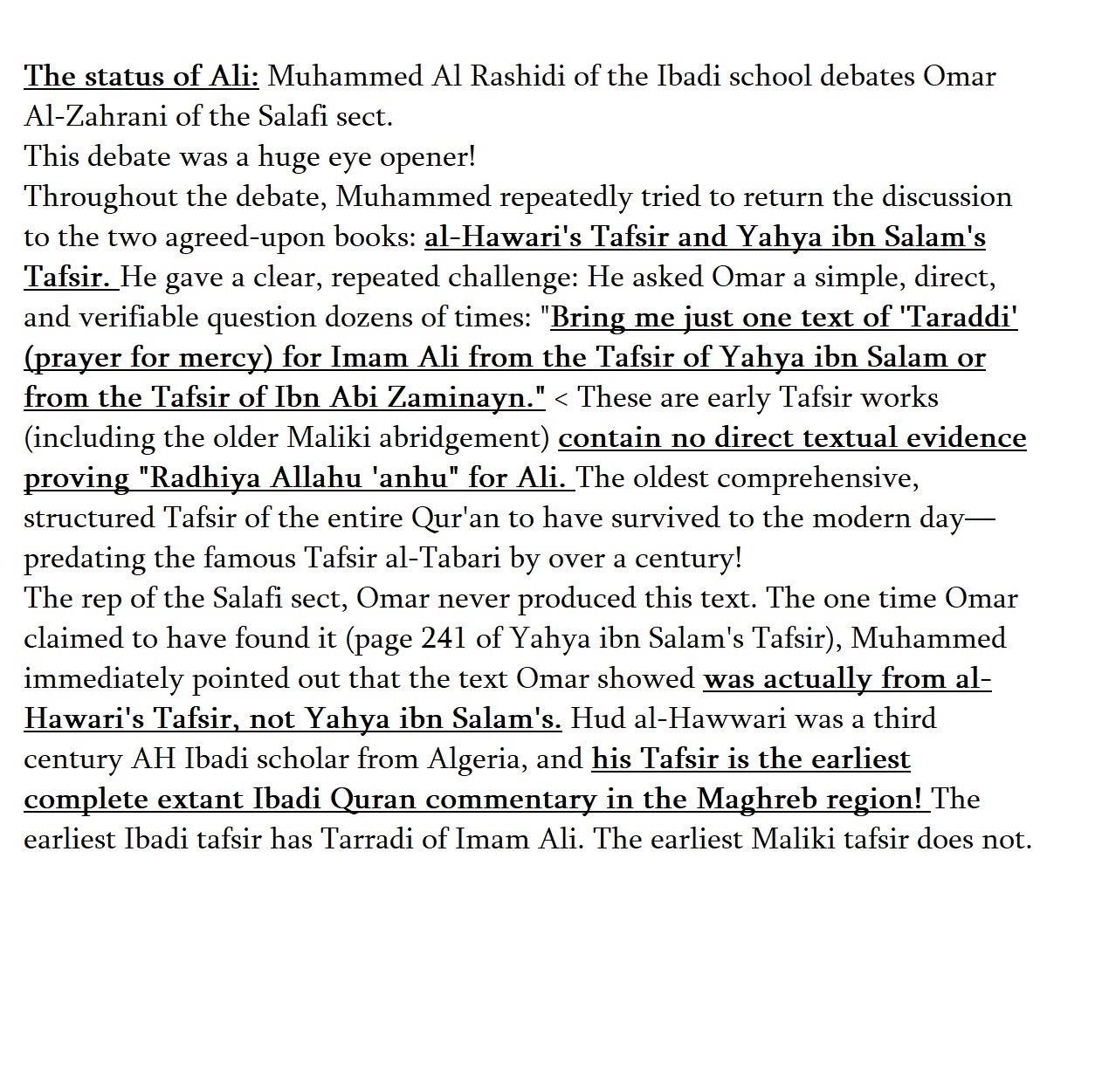
These Ibadi will not do Taraddi. This is a technical term which refers to invoking Allah’s pleasure upon someone by saying Radiy Allahu ‘Anh

May Allāh be pleased with him”. That is because it is not possible to say May Allah be pleased with the deeds of the one who went against the word of Allah and killed the Muslims without right.

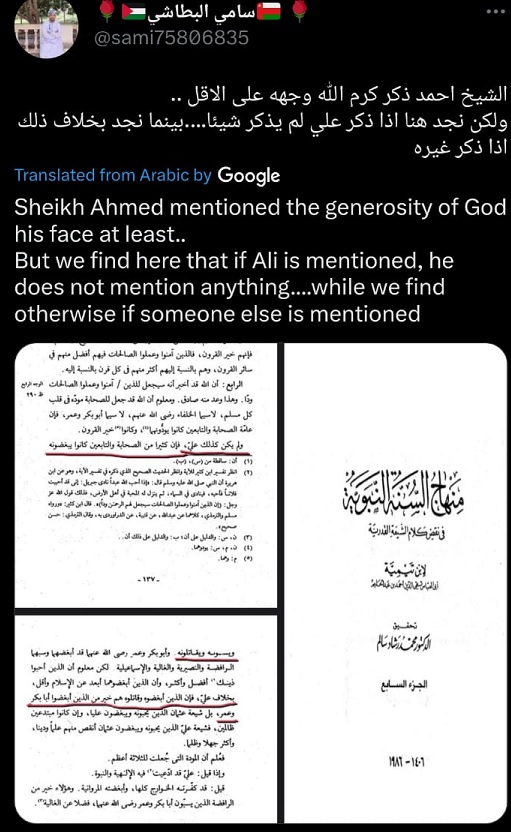
For example: The Mufti of Oman, Shaykh Ahmed Al Khalili (h) is not known to say “May Allah be pleased with him” after mentioning the name of Ali. So some of the detractors point this out. Trying to make a mountain out of a molehill. We share with you because nothing is hidden about our school. Cards are on the table!


So one of them, this @ahmedalanzi1 (who blocked many Ibadi who tried to engage with him) his claim is that saying Radiy Allahu ‘Anh : meaning: May Allah be pleased with him is higher and better than saying: Karram-Allah-u Wajhah: meaning Allah honoured his face.

The following is where our teacher: Shaykh Juma Al Mazruii explained this is not necessarily the case:

So Shaykh Juma Al Mazruii mentioned that this Salafi agitator (which is what he is) wants to have some issue about it than he can take it up with Ibn Kathir. Ibn Kathir was not happy that people say, “Allah honuored his face” after mentioning Ali, but not when mentioning Abu Bakr (ra) or Umar (ra). So he (Ibn Kathir) actually feels that statement is higher than saying, “May Allah be pleased with him.”

Likewise, Shaykh Juma mentions that Ibn Taymiyyah himself felt Ali was inferior to other companions. So this Salafi agitator can go and sort out his own house before he tries to knock on our door or the door of anyone else, for that matter.

To this, our beloved Shaykh Juma Al Mazrui gave a very befitting reply (the audio above).

3. Ambivalence (Wuqoof) towards Ali Ibn Abu Talib. An individual does not have enough data or information to put Ali in Bara’ah or Walayah.

Wuqoof is to pause iif there is khilaf on the person. Wuqoof is to stop at everyone you don’t know. You do not make a judgement on him to be in Walayah or Bara’ah. This is by far the position of the vast majority, as they are layman and do not bother to look into these matters..

Those who are ambivalent as they just do not have enough data to give a conclusive answer. They hold their tongues regarding companions like Ali Ibn Abi Talib. They do not say radhiallahu anhu for those who are possibly under Allah’s wrath. Nor do they say this one met doom when they may have repented for their sins and met a good end under Allah’s spacious grace. This regards students of knowledge and the masses of Muslims in particular who have not investigated these matters. This is a recommended and safe road.

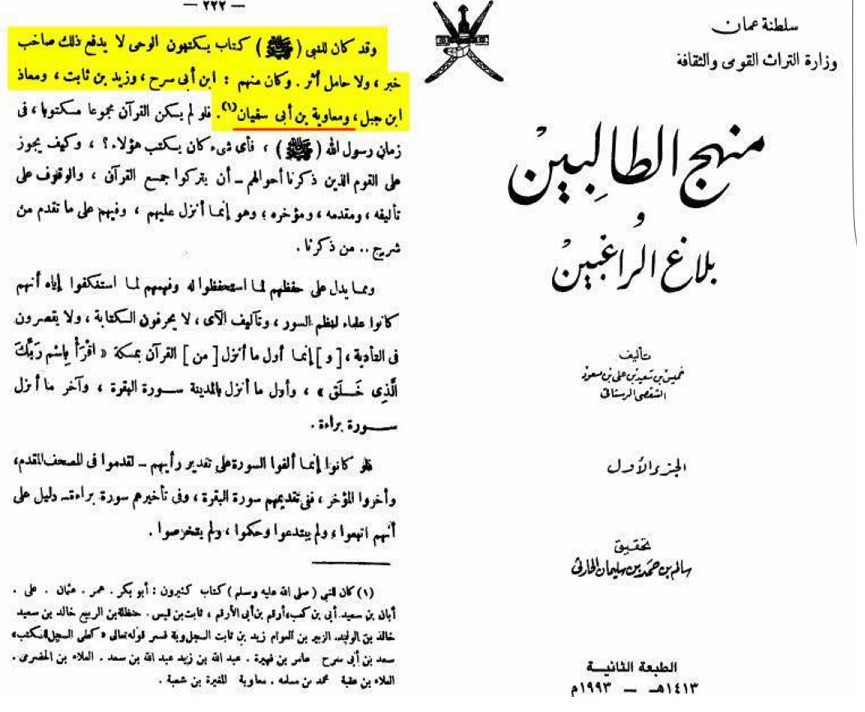
Do not be surprised to find none other than Shaykh Khamis bin Saeed Al-Shaqsi (r) say, “May Allah be pleased with him” after mentioning the name of Muaviya!

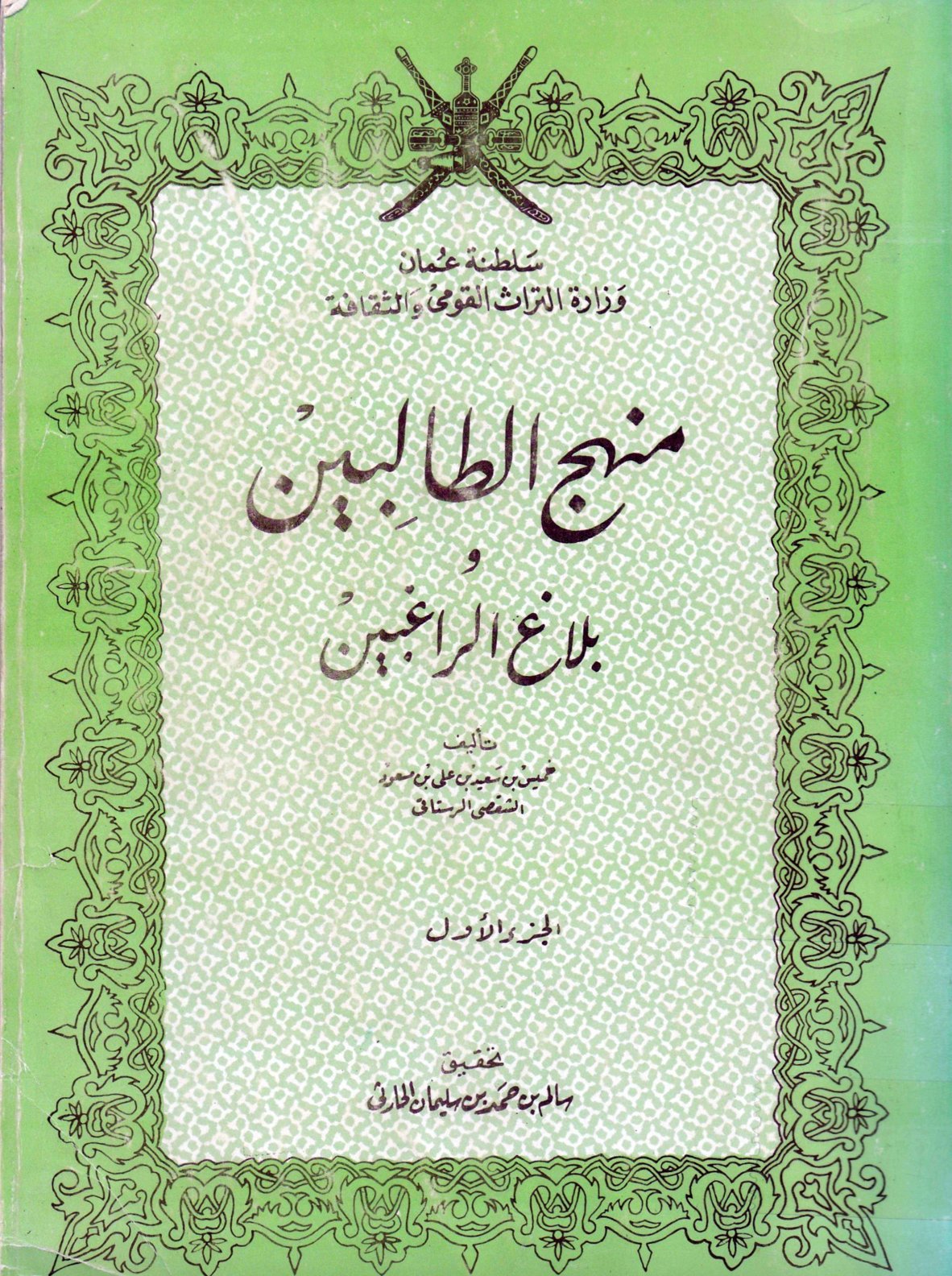
Do not be surprised to find none other than Shaykh Khamis bin Saeed Al-Shaqsi (خميس بن سعيد الشقصي) (r) say, “May Allah be pleased with him” after mentioning the name of Muaviya! He is a highly significant and foundational scholar in the Ibadi school of Islam. He is best known for his monumental encyclopedia, Manhaj al-Talibin wa Balagh al-Raghibin (منهج الطالبين وبلاغ الراغبين).

Sources: (Manhaj Al Talibeen and Balagh Al-Raghibhin)

Do the Ibadi hate Ali because of his actions at Siffin and Nahrawan?

As we have seen, there are three views of the Ibadi. We ask you to imagine that if you were among those companions of the Blessed Prophet (saw) that personally suffered loss at the hands of Ali and his soldiers, you would not have a high or favourable view of him. This is human nature. However, those people would not be Ibadi in a technical sense. As they were the companions and successors who disengaged from Ali. The term ‘Ibadi’ or the school was simply non-existent at that point. This could be a reason why Abd al-Rahman ibn Muljam took revenge. Allah knows best.

You must hate those whom you apply the judgement of Allah (swt) to? No, not necessarily.

Based upon mantiq (logic) and the fact that this particular statement of the narration would clash with the qati’i (decisive) nature of Qur’an, such that a particular understanding of being infallible or not accountable becomes null and void.

Secondly. There is a story which you can read here full of grandiose verbiage that many are familiar with. Ali fights a man and the man spits in Ali’s face. Ali is said to have sheathed his sword. You can read that here: https://www.dar-al-masnavi.org/n-I-3721.html

The point is that just because you oppose someone does not necessarily entail hatred.

An example is this:

Narrated `Aisha:

Usama approached the Prophet (saw) on behalf of a woman (who had committed theft).
The Prophet (saw) said, “The people before you were destroyed because they used to inflict legal punishments on the poor and forgive the rich. By Him in Whose Hand my soul is! If Fatima (the daughter of the Prophet (saw) did that (i.e. stole), I would cut off her hand.”

Source: (https://sunnah.com/bukhari:6787)

So let us imagine a scenario where Fatima (ra) did steal, and she did get caught. Would one necessarily have to have hatred in his/her heart towards Fatima (ra) when executing the punishment?


That means that every judge or Qadi would need to hate the person they pass sentence on?


Would it mean that Ali, as an Amir, any time he inflicted a punishment upon anyone who transgressed, means he would need hatred in his heart as a prerequisite?

However, does one need to necessarily hate an individual that has gone against Allah (swt) and his Messenger (saw)?

Lastly, if someone loves or hates someone or something for the sake of Allah (swt), then there is no harm in this.

Narrated Abu Umamah: The Prophet (saw) said: “If anyone loves for Allah’s sake, hates for Allah’s sake, gives for Allah’s sake and withholds for Allah’s sake, he will have perfect faith.”

Source: (https://sunnah.com/abudawud:4681)

First point. As Shaykh Massoud bin Muhammed Al Miqbali (hafidullah) has mentioned in the video, if the matter of Ali was based upon whims and personal grudges you would not have found in our books that he (Ali) repented..

Second point.

Third point.

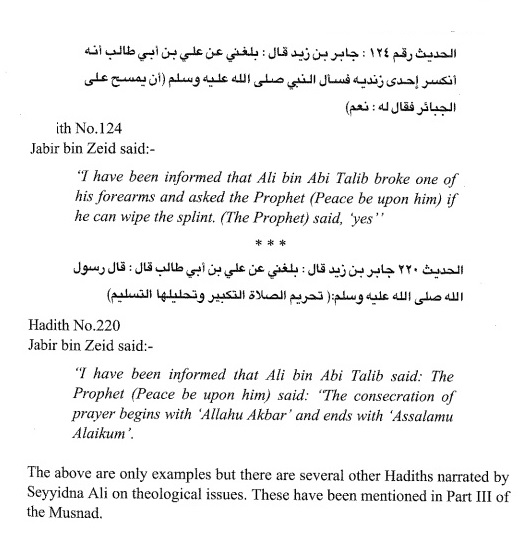
Ali Ibn Abi Talib is quoted as a transmitter of hadith in our Musnad Al-Imam Ar-Rabee’.

Ali Ibn Abi Talib is used as a transmitter of hadith in the Musnad Al- Imam Ar-Rabee’

Parting thoughts.

So let us be practical for a moment. Whatever feelings may have been stirred up by you reading this entry, think of the feelings that may be stirred up among Sunni Muslims when they know of your view concerning some of the companions? Yet, you want to be on cordial terms with them? Then do the same with us.

What amazes and perplexes the thinking individual is that there are among the Shi’i who hold very unfavorable views of Muviyah, Abu Bakr (ra), Umar(ra), Aisha (ra) and other companions, and they expect, no! They almost demand unity with Sunni Muslims.

So, if there are Sunnis who want unity with Shi’i, knowing full well that they (Shi’i) hold unfavourable views of Talha, Zubair, Muaviya and others, then they should have no issues wanting unity with Ibadi, who holds three distinct positions concerning Ali.

So, those who are thinking about following the Ibadi school and have reservations due to certain positions in regard to Ali Ibn Abu Talib. This is not something fundamental to our school. Our school is not about digging up the graves of the people of the past or cursing anyone. We simply give our account of how things were and what that may entail. Practice Wuqoof and focus on your relationship with Allah (swt). Simple.

“We take the truth even from a man of hatred, and we reject falsehood even from a chosen friend. We have no respect for a man, however exalted, if from the truth he has deflected.”-Shaykh Abdullah bin Humeid Al Salmy.

You may also wish to read the following:

There is a very moving poem by the eloquent poet, the Sufi, Abu Muslim al-Bahlani expressing his remorse and admonishment over the actions of Ali at Siffin.

https://primaquran.com/2023/02/11/the-genius-of-mufti-abu-layth-can-we-criticize-the-companions

May Allah guide the Ummah

May Allah Forgive the Ummah.
4 Comments

Filed under Uncategorized