Tag Archives: khawarij

The Differences between Ibadis and Khawarij by Shaykh Ibrahim Attfayish

“Oh my Lord advance me in knowledge.” (Qur’an 20:14)

﷽ 

The Differences between Ibadis and Khawarij

Written by: Shaykh (Abu Is’haq) Ibrahim Attfayish (hafidhullah)

To know more about this great Shaykh please see the write up our sister, Bint Ibadh.

https://bintibadh.blogspot.com/2021/05/a-brief-review-of-biography-and.html

“The Khawarij [Kharijites] were groups of people who appeared at the time of Al-Tabieen and those who came after them. Their leaders were Nafi’a bin Al Azraq, Najdah bin Aamir, Abdul-Allah bin Al-Asfer and their followers. They were given this name because of their radical approach of accusing others of unbelief, which set them apart from the truth and the Muslim community. For Khawarij, a sinner was a heretic whom it was permissible to kill and whose properties could be despoiled. This false accusation was all based on their misinterpretation of the A1mighty’s words: “If you were to obey them, you would indeed be heretics”, (Qur’an 6:121).

“They claimed that this verse meant if you obey heretics in eating carrion, you will be deemed one of them. However, the correct understanding of this verse is that those who make carrion lawful are heretics.”

“When the news reached Imam Al-Rabi bin Habeeb bin Amr Al-Basri Al-Farahidi Al-Ibadhi, the author of Al-Musnad As-Sahih, (r), he said: “Leave them until they apply what they say. If they do so, we will apply Allah’s ruling on them”. Thus, when their wrong innovations [bid’ah] became apparent, and they applied their incorrect and dangerous doctrines, and started killing Muslims, the Ibadis declared their dissociation from them, expelled them from their meetings and fought them in different places. Ibadis announced, based on clear and assertive verses from the Qur’an, that Khawarij were Kufaar [unbelievers] for they permitted what Allah forbade.

“Omanis, for example, stood with Al-Muhalab to confront the Khawarij armies. (For more information see Al-Kamil written by Al-Mubarad). The famous Umayyad Azdi Omani warrior, Al-Muhallab bin Abi Sufrah, took the responsibility of suppressing this group and motivating people to fight them. However, to give a stronger motive for fighting the Khawarij, Al-Muhallab started creating fabricated hadith against the Khawarij. This doubled the crisis of the Khawarij as not only many Muslims were killed, but also, fabricated hadiths were made up. Because these groups of Khawarij were against arbitration, Ibadis who were against it as well were falsely and unjustly attached to them.”

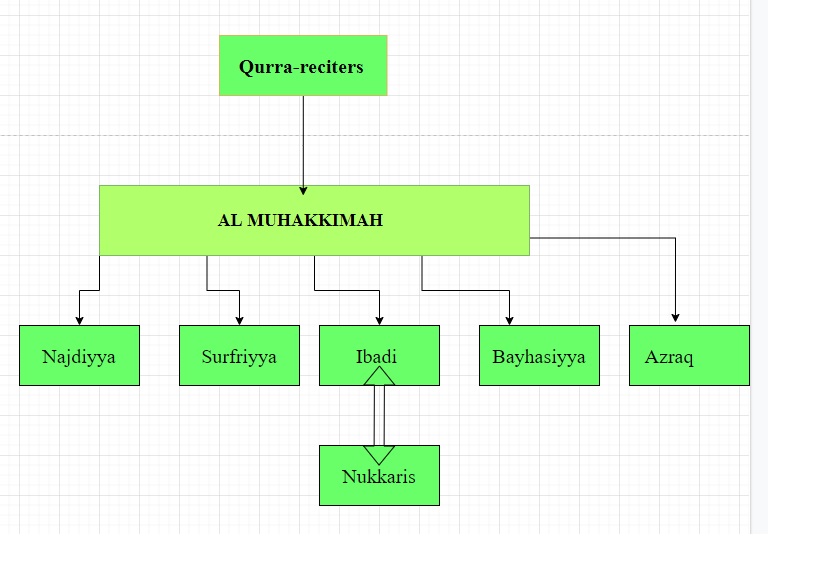
However, this unjust attachment can be refuted as follows:

“Ibadis do not approve of the ruling of tyrant kings. For them, it is a must that the Caliph should follow the steps of the rightly guided Caliphs, among them Abu Bakr and Umar. This was clearly stated by the Prophet (saw) as he said in an authentic hadith, “Follow the examples of those who came after me, Abu Baker and Umar.” When the hadith was narrated concerning Ammar bin Yasir, (r), “you’ll be killed by the transgressing party”, it was used by the opponents of arbitration as well as the other party. Although its authenticity was confirmed by both parties, Mu’awiyah’s group interpreted it in a way that twists the reality in their favor.”

Prima Qur’an comments: See our article:

“Second, driven by their desires, many people claim that the people of Al-Nahrwan rebelled against Ali. This is an unsound claim, for Ibadis had insisted that Ali should stay as the Caliph of the Muslims.”

However, when he accepted arbitration, they freed themselves from the allegiance because they didn’t see any point in negotiating his right as an elected Caliph by Muslims. His concession to the arbitration with Mu’awiyah’s group means that his election was questioned; therefore, they elected their own Caliph.

“The Caliph they chose was among the most pious companions of the Prophet (saw). This person was none other than Abdul-Allah bin Wahab Ar-Rasbi Al-Azdi. When Wahab was elected, Ibadis asked their brothers, including Imam Ali, to give allegiance to the newly chosen Imam. However, Ali bin Abi Talib saw that allegiance was given to Azdi, a non-Qurashi, so he fought them before they could get any stronger and thus, the Quraish would lose the Imamate. This was the only reason for the Battle of Al-Nahrawan. Ali’s attack upon the people of Nahrawan was politically motivated.”

“In Dawmat Al-Jandel, Mu’awiyah took the Caliphate after the negotiation of the two arbitrators, Amr bin Alas and Abu Musa Al’Ash’ari. Consequently, Ali debated with and asked Wahab’s group to fight Mu’awiyah and his followers once more, but by this time it was too late as they were free from their allegiance to him. Ibadis didn’t elect a new Caliph, until the result of arbitration appeared. What they warned against happened, for arbitration was hatched by Al’Ash’ath bin Qais, who was put into Ali’s group by Mu’awiyah.”

Prima Qur’an comments: For those who do not know, Abu Bakr (ra) made the following statement:

But the three things I did not do and wish I had: the first is that when Al-Ash’ath bin Qais was brought to me in captivity, I wish I had struck his neck, because I suspect he will enforce evil wherever he finds it; and the other one is that I wish when I sent Khalid Bin Waleed to the battle of the apostates I had remained at Zil Qissah so that I could help the army if they were defeated; and the third one, I wish that when I delegated Khalid to Sham I had sent Omar to Iraq so that I had opened my two hands in the cause of Allah.

Then he opened his hands and added:

I wish I had asked the Messenger of Allah (saw)that to whom the caliphate belonged, so that nobody would go to war on it; and I wish I had asked him did Ansar have any right in this matter; and I wish I had asked him if the the brother’s daughter and the father’s sister would inherit anything [from the deceased], because I’m not sure about it.

Source: (Târîkh Tabarî, v 3 p 429 ; Târîkh Ya’qûbî, v 2 p 137)

Shaykh Attfayish continues…

“Thus, it is not as claimed by falsifiers of history and extreme sectarians that the Battle of Al-Nahrawan happened because of a rebellion against Ali. On the contrary, they did not leave his group when his allegiance was valid. Therefore, people looking for the truth should be aware of making a mistake in this regard, as it is apparent that desires are pervasive among such people.”

“Third, the name Khawarij didn’t appear until the spread of Azariqah’s movement. Thus, the people of Al-Nahrwan were not described as Khawarij. We challenge such claimants to bring forth their evidence.”

“The first use of this name was by Mu’awiyah, using it against one of his visitors from the people of Mu’awiyah, Al-Ahnaf bin Qais. He said to him, “Why do people admire you when they know that you are from Khawarij?” Al-Ahnaf replied, “If people had found water bad, they wouldn’t have drunk it.” Mu’awiyah meant here those who refused to accept him as Caliph (see Al-Amali by Abdu Ali Al-Qali).”

“Was Mu’awiyah’s accusation of Al-Ahnaf as being Khariji because Al-Ahnaf was with the people fought by Ali in the Battle of Al-Nahrwan? Or was it because he did not pledge allegiance to Mu’awiyah? If it were because of the former reason, Mu’awiyah’s party would have been more eligible for this description as he was the one who fought against Ali on the Day of Siffin and freed himself of Ali’s allegiance, knowing that he was given allegiance by prominent companions and his allegiance must be followed by all Muslims.”

“Fourth, Ibadis have never fought against any monotheists [Muslims], even when AI-Hajjaj and Ziyad bin Abeeh got tough on Muslims based on their own doubts. However, they were rebelled against by a group called At-Tawwabun (The Penitents) headed by great scholars like Saeed bin Jubair and Ibrahim A’Nakh’i. Later, Al-Hajjaj killed Saeed bin Jubair, who was a scholar in the interpretation of the Qur’an. What was surprising was that this big group of scholars who took up the sword against the horrible injustice done by Al-Hajjaj were not called Khawarij, but they were called At-Tawaboon [the people of repentance]. They were all carriers of knowledge who died in the fighting. Certainly, a mind is stunned because of such a tragedy, yet many readers overlook it.”

“However, those who scrutinize history objectively will find out that the word Khawarij was unjustly given to Ibadis because they only believed that the Imamate [Caliphate] should not be restricted to the tribe of Quraish.”

This position is the right of whoever is elected by Muslims to lead them, because it is clearly unwise to accept that Allah places the leadership of all humankind in the hands of only one tribe irrespective of whether it does right or wrong. Common sense supports what Ibadis believe on this issue, and how they have used this belief to interpret the hadith that “the Imams are from Quraish.” It is a kind of arrogance and avoidance of the truth to claim that leadership is restricted to the Quraish.”

“Even the supporters [Ansar] of the Blessed Prophet (saw), who understood his teachings, said to Abu Bakr, “A leader from us and a leader from you.” With the same token, the reply of Abu Bakr was as follows: “Leaders are from us, and ministers are from you as Arabs are subservient to this tribe” does not support the restriction of the Caliphate Quraish. He justified it with Arabs being subservient to the Quraish but not for any other reason as claimed by people of political and sectarian desires. Would nations of different races accept being driven by a man from Quraish only because of his tribe?! It is unlikely.”

“Fifth: Ibadis desire justice to disseminate the application of the Quran and Sunna, and to follow the political paradigm of rightly guided Caliphs whether the person in charge is Qurashi, Habashi [Ethiopian], Arab, or non-Arab, as it was narrated in sound hadiths.

Prima Qur’an comments: For more on this please see our article:

This is why they accepted the leadership of Umar bin Abdul-Aziz, and they sent a group of six great Ibadi scholars, J’afer bin A’Simak, Abu AlHur Ali bin AlHusain Al’Anbri, AlHattat bin Kateb, AlHabab bin Kulaib, Abu Suyan Qanber AlBasri, and Salim bin Thakwan among other unnamed scholars, but these were the names I came across, may Allah have his mercy upon them all. “

Non-Ibadi historians mentioned these delegates to Umar bin Abdul-Aziz, though they said with their usual insinuation: “The Khawarij sent him a delegation.” However, they did not mention what happened between them and the Caliph Umar and his acceptance of all their suggestions about spreading justice and purging the country of the Umayyad tradition of cursing Ali from the pulpit. The Ibadi delegation said to Umar, “Muslims are cursing from pulpits in mosques, so this evil tradition must be changed.” Thus, Umar replaced it with the words of Allah: “Indeed, Allah orders justice and good conduct and giving to relatives and forbids immorality and bad conduct and oppression. He admonishes you that you remember.” (Qur’an 16: 90)

Prima Qur’an comments: For more on this please see our article here:

Often we hear this in our Friday Prayers during the Khutbah. At the council of these Ibadi luminaries in place of cursing Ali at the pulpit we get the following:

“Indeed, Allah orders justice and good conduct and giving to relatives and forbids immorality and bad conduct and oppression. He admonishes you that you remember.” (Qur’an 16: 90)

  • What it Orders:
    • Al-‘Adl (Justice): This is the foundation of all social interactions, governance, and even personal conduct. It means giving everyone their due rights and being fair.
    • Al-Ihsan (Goodness/Excellence): This goes beyond mere justice. It is to do good, to be kind, generous, and to perform acts of excellence in worship and dealings with others, as if you are seeing Allah.
    • Ita’i Dhi al-Qurba (Giving to Relatives): This emphasizes maintaining family ties, fulfilling the rights of kin, and treating them with extra kindness and financial support if needed.
  • What it Forbids:
    • Al-Fahsha’ (Immorality/Shameful Deeds): This includes all major sins and lewd behavior.
    • Al-Munkar (Bad Conduct/Evil): All that is recognized by sound human nature and scripture as wrong and objectionable.
    • Al-Baghy (Oppression/Transgression): Wronging others, tyranny, and exceeding the limits set by Allah.

Shaykh Attfayish continues…

“Despite this, many historians still do not admit the good that Ibadis have done to this Ummah [Muslim nation]. Blindly, they overlook many incidents that prove how Ibadis were always there defending justice and truth and fighting injustice with words not swords, as was done by Abdul-Allah bin Ibadh, with Abdul-Malik bin Marwan and Abu Bilal Mirdas bin Hudair as well as Ziyad bin Abeeh.”

“They have never accepted that it is permissible to shed blood among Muslims or lawful to despoil their properties. Ibadis have always believed in freedom of choice and opinions, as everyone is accountable for what he/ she has. They were unlike others who used the sword to establish their states or to force people to follow their sects. Ibadis gave people the freedom of expression and the freedom to choose their sects, for there is no compulsion in religion. For Ibadis, truth is acceptable from whoever brings it, and falsehood is returned to whoever brings it.”

“Thus, Ibadism is the only sect that grants a slave freedom once he/ she agrees with his/her lord, even if s/he does not pay the full price of his/her freedom. The remaining amount is a debt the slave must pay later. This shows how Ibadis were ahead of others in understanding the essence of Shari’ah [Islamic Law].”

Prima Qur’an comments: Let us elaborate more on this point.

The Ibadi Position vs. Other Schools

  • The Ibadi View: The Ibadi school holds that the mere agreement between the master and the slave on the terms of the kitabah is sufficient to enact the contract and grant the slave a new legal status as a mukatab. The payment of the money is not a precondition for the contract’s validity but becomes a debt to be paid afterwards. This means freedom begins with the agreement, not with the final payment.
  • The Majority Sunni View (Hanafi, Maliki, Shafi’i, Hanbali): The prevailing view in the four major Sunni schools is that the contract is not binding until the first installment is paid. They argue that the kitabah is a contract of sale (of one’s freedom) and, like any sale, requires an exchange of value at the time of agreement to be valid. Therefore, if the slave has no money to make an initial payment, the master is under no obligation to grant the contract.

Why This Difference Matters: “Ahead in Understanding the Essence of Shari’ah”

Ibadis were ahead in understanding the essence of Shari’ah is astute. Here’s why this legal opinion is considered so progressive and aligned with the spirit of Islamic law:

  1. Primacy of Freedom: The Ibadi position places the ultimate objective—freeing a human being—above the commercial formalities of the contract. It prioritizes a person’s liberty immediately upon mutual agreement.
  2. Practicality and Empowerment: It provides a practical path to freedom for those who have no means to make a down payment. By allowing the debt to be incurred after the fact, it empowers the enslaved person to go out, work, and earn the money as a free person, which is psychologically and economically much more feasible than trying to save while still enslaved.
  3. Reducing Barriers: The majority view creates a significant barrier for the poorest slaves. The Ibadi interpretation removes this barrier, making the Islamic directive of facilitating freedom more accessible to all, regardless of their current financial state.
  4. Emphasis on Goodwill and Trust: The ruling is built on the principle of trust and goodwill (husn al-dhann) between the master and the slave, encouraging a merciful and cooperative relationship rather than a purely transactional one.

Shaykh Attfayish continues…

“By mentioning Khawarij’s hideous actions, it has become clear that Ibadis do not have any connection with Khawarij. These differences between Ibadis and Khawarij have become clear for just those non-Ibadi intellectuals who realized the truth and admitted it, for returning to the truth is an obligation and a great virtue.”

“Sixth, Ibadis allow intermarriages between them and all other monotheists, while Khawarij do not because the Khawarij see others as polytheists [heretics] — as explained before. Based on this, they also do not allow inheritance between them and those who disagree with them because heresy that prevents intermarriage prevents inheritance as well. So, did the falsifiers of history turn a blind eye to these differences?”

Prima Qur’an comments:

Please see our article here:

“That is what a person sees when turning the pages of history in the records and books of other Muslims [non-Ibadis] who have not learned from what Allah says in the Holy Quran: “And those who annoy believing men and women undeservedly, bear on themselves the crime of slander and plain sin” (Qur’an 33: 58).

“Allah says: “O you who believe! Stand out firmly for Allah, as witnesses to fair dealing, and let not the hatred of others to you make you swerve to wrong and depart from justice. Be just: that is next to piety and fear Allah. For Allah is well-acquainted with all that you do”, (Qur’an 5:8).

“Indeed, a Muslim gets bewildered by those calumniators on the People of Truth and Straightness, (The lbadis). How dare they say those things for no other reason than for their hidden desires. We seek refuge with Allah from following desires and denying the truth. Do they not know that they would meet Allah with this slander? Or is it their belief that leaving Hell Fire has eased everything for the sake of following desires?”

“Seventh, Ibadis have turned their efforts to serve Islam through knowledge and practice since the Fitnah started. They were the first to write down the hadith of the Prophet; our Imam, Jabir bin Zaid (ra), was the first to write down the hadith and the Blessed Prophet (saw) of the companions’ sayings in his Diwan [volumes of books] which was described to be as large as a load of a camel. Then after him, his students, carriers of knowledge to the east and the west, followed his steps.”

“The Khawarij practiced bloodshed, terrified the people and abolished the rulings of Islam. None of the Khawarij were known to have written a book and those who are attributing books to Khawarij mean Ibadis. Undoubtedly, they want to distort the Ibadis’ repute through this obfuscation.”

“The same thing is said about the Sufriya, Azariqah, and Najdiyah; they did not care about the narrations of the Blessed Prophet (saw) or writing down hadith except a narration by Najdah bin Amer who narrated one hadith and Nafe bin Al-Azraq who had questions addressed to Ibn Abbas, yet this is not the place to mention them. Rather, the Khawarij were concerned about warring rather than the compilation and narration of knowledge. All those who were mentioned as scholars of Khawarij by other non-Ibadi Muslims were in fact Ibadi scholars!”

“Our ancestors [Ibadis] came with wonders in recording knowledge, and they were well known for their piety, trustworthiness, and honesty to a status none but them attained. Therefore, some non-Ibadi Muslim writers resorted to distorting the facts with false and promiscuous propaganda when they were shocked by those bright lights. They did not mix Ibadis with Khawarij except to blur the lines of truth in envy.”

“How would a person who has taken distortions as his principles and whose insight has gone blind admit to the truth?! You find that those false writers would never mention our companions [Ibadis] with any good virtue even when they were to be mentioned. Rather, they would ignore their greatness in knowledge and religious perfection. Indeed, I have come across some books on history and literature in which there must have been a mention of our companions [Ibadis] as to what they have contributed. Yet, with no piety, those authors ignored them as if they did not exist. This is a transgression and indulgence in blurring the truth that you never find with our companions [Ibadis]. Praise be to Allah, the Most High, the Most Great.”

“Eighth, when our Muslim brothers [non-Ibadis] recorded history, and they mentioned our companions [Ibadis], they failed to tell the truth. Instead, they mixed Ibadis with Khawarij. Sometimes, they attribute Ibadis to Khawarij, while other times they attribute Khawarij to Ibadis, as done by many authors in Usul [the Fundamentals of Islamic Law] attribute the sayings of Mutazilah to Ibadis and vice versa. This resulted in mixing things up and distortion, because those authors who depended on copying from these sources fell in the same mistake. To me, they do not have any excuse, for the one who spreads the truth should request it from its source and not forge it as he wants.”

“We find those who claim that Abu Bilal bin Mirdas bin Hudair was among the Khawarij and Qatri bin Al-fuja’a was among the Ibadis! Yet, the reality is the opposite. Another confuses that Imam Talib Al-Haq Abdu-Allah bin Yahya Al-Kindi was Imam Abdu-Allah bin Ibadh, but that was not right. Imam Abdul-Allah bin Ibadh died in the last days of Abdul-Malik bin Marwan, while Talib Al-Haq Abdul-Allah bin Yahya appeared during the time of Marwan Al-Himar [Marwan the donkey] in l30H. This is how those authors mix facts up to distort the Ibadis’ reputation. Looking at the history of Andalusia, you will not see a mention of Ibadis. The truth is that lbadis have attained in Andalusia a great status in knowledge and wealth. Ibiza island in Andalusia was fully inhabited by Ibadis until the sixth century, Hijri, or even further until the fall of Andalusia.”

“When reading Tabakat Ibn S’ad, there is no mention of Ibadis except for Imam Jabir bin Zaid, who had to be mentioned as he was too famous to be ignored.”

“The indisputable truth is that important figures are closer to [well known by] their people and history is better known by its people than others. Allah says the truth, and He guides us to the right path.”

“The innovations of the Khawarij necessitated Islamic guidelines against them. Muslims said that there must be a distinction between major sins, so Muslims do not fall into the crimes of Khawarij. Major sins are of two types: sins of heresy [shirk], and sins of hypocrisy [nifaq].”

“Major sins of heresy [shirk] include every sin that violates Islamic creed, like allowing what Allah forbids, forbidding what Allah allows, rejecting what must be known about religion, or rejecting Islamic rulings such as stoning. The sins of hypocrisy are sins of ingratitude to Allah’s bounties. This is what scholars of hadith call a deviation without unbelief [kufr duna kufr]; they are the major sins of corruption [fisq] to non-lbadis. These sins include committing adultery, anal intercourse, eating unlawful food, perjury, disobedience of parents, and other similar acts and deeds. More examples include ceasing the performance of obligatory orders of Allah without believing that they are non-obligatory.”

Prima Qur’an comments: Kufa duna kufr is an understanding that is attributed to Ibn Abbas (ra)

https://fitrahtawheed.com/kufr-duna-kufr

“Ibadis call all these sins major sins of hypocrisy [nifaq] and ingratitude to Allah’s bounties [kufr ne’mah]. When Ibadis call a sin ‘kufr’, this would lead to the next question: does it affect the major belief [creed] or is it part of doing acts of worship or not? Accordingly, the type of disbelief [kufr] can be recognized whether it is kufr of hypocrisy or kufr of shirk. Our Ibadi companions do not call others kuffar [unbelievers] without a legitimate reason, and they do not call the people of Qibla [Muslims] kuffar [disbelievers] if they are under the word of sincerity [ikhlas].

“The truth is that they are distinguished by this method even if it is claimed by other Islamic schools of thought. If you realize this, you will know that there is a marked distinction between Ibadis and Khawarij and nothing links them together except rejecting the arbitration, which is the truth that is supported by the Qur’an, Sunnah, the path of Omarein and the consensus of Muslims. So, hold firmly to the truth as anyone who depends on Allah will be guided to the straight path.”

“Some of our scholars and other non-Ibadi scholars said that Khawarij deny stoning. In my opinion, this is not true unless we consider their ruling that a person who commits a major sin is an unbeliever whose blood is lawful. In this case, the one who commits adultery is killed because he is considered a non-believer, not killed as a punishment for adultery; therefore, there is no need to deny stoning.”

“This matter, according to me, is not as many think it is; some non-Ibadi Muslims’ claim that Khawarij reject stoning is an insinuation. This claim backfires on them because they narrated a verse that states “if an old man and old woman commit adultery, stone them as a punishment from Allah and Allah is Almighty All-Wise” was recited in the Holy Quran in Al-Ahzab but was eaten by a goat. Based on this false narration, an imperfection has occurred in the Qur’an. This terrible error will always accompany them despite their claims that its recitation is being abrogated while its ruling remains in effect! However, our Ibadi scholars say that stoning is not prescribed in the Holy Qur’an but in the hadith. Imam Al-Hafidh Al-Hujjah Ar-Rabi bin Habeeb narrated in his Sahih that Imam Jabir bin Zaid said, “Istinja, circumcision, witr and stoning are obligatory Sunnah.”

Praise be to Allah Who has protected our companions from error and may Allah bless our Prophet Muhammed, his righteous family, followers and his companions.

Abu Is’haq Ibrahim Attfayish

________________________________________________

1 This book hopes to clear out some misconceptions that many people hold about Ibadis based on other inaccurate or biased sources written long time ago.

2 Two ways of spelling the same word.

3 Those who met the companions of the Prophet but did not see him.

4 Carrion means here a dead animal meat that is not slaughtered in the lawful way.

5 Once, while Allah’s Messenger, peace be upon him, was reciting the above verse, ‘Adi bin Hatim said, “O Allah’s Prophet! They do not worship them (rabbis and monks).’ Allah’s Messenger said, “They certainly do. They (i.e., rabbis and monks) made legal things illegal, and illegal things legal, and they (i.e., Jews and Christians) followed them; and by doing so they really worshiped them”. Narrated by Ahmed, At-Tirmidhi, and Ibn Jarir. (Tafsai AT-Tabari, Vol. 10, p.114)

6 Died in 175H.

7 A book that has very authentic Prophet’s tradition because the narrators are described as golden chain.

8 This is the author’s note within the original text.

Hadiths: The Prophet’s traditions, his sayings and practices and sometimes called ‘the Sunnah of the Prophet’.  

10 Arbitration was a trick used by Amr bin Alas, who was in Mu’awiyah’s side, to take the Caliphate from Ali during the Battle of Siffin in 37H/ 657G.

11 They were the first two successors after the Prophet peace be upon him.

12 An authentic hadith narrated by Al-Hakim, and At-Tirmidhi.

13 He was one of the loyal companions who accepted Islam early and was killed in Siffin in 37H.

14 Mu’awiyah claimed that Ali killed Ammar because he brought him and threw him at Mu’awiyah’s lances (or swords)

15 A Place in Iraq, in the southeast of Baghdad

16 The fourth Caliph elected by Muslims and the cousin and son-in-law of the Prophet.

17 He was a companion of the Prophet described as a knowledgeable brave person and one of the reciters of the Qur’an. He supported Imam Ali in his battles, and he participated in the conquest of Iraq with S’ad bin Abi Waqas. He died in 38AH.

18 Azdi is an attribution to a person who belongs a famous Arabic tribe called Azd.

l9 Qurashi is an attribution to a person who belongs a famous Arabic tribe called Quraish from Meccah.

20 Some Ibadi scholars question the validity of this claim.

21 A place 1n the far north of current Saudi Arabia.

22 Falsifiers of history.

23 Died in 67H.

24 A note by the author.

25 Khariji: a singular form of the plural form of Khawarij.

26 An Umayyad Caliph who followed the way of the rightly guided Caliphs. He died in l0lH/ 720CE.

27 He was the political spokesman of a group of Muslims who were attributed to his name, Ibn Ibadh. He lived during the time of Umayyad.

28 He was with Imam Ali’s group then after the arbitration, he was one of the main leaders in Al-Nahrawan and among the few who survived the Battle of Al-Nahrawan. Later, he became the closet companion of Jabir bin Zaid and was killed in 61H.

29 Fitnah, an Arabic word, refers to the time when Muslims split into political groups and fought each other in 37H/ 657CE.  

30 of Khawarij.

31 He was the founder of An-Najdat’s group, a group of Khawarij, and took over Bahrain during Umayyad’s era and he was killed in 73H.

32 He was the founder of Azariqah’s group.

33 A metaphor means great scholars.

34 A school of Islamic theology based on rational thought. It emerged in the Umayyad Era, and flourished in the Abbasid period.

35 There are many explanations why he was called the donkey.

36 Al-Andalus was the old Arabic name for the land conquered by Arabs including Spain and Portugal.

37 Hijri refers to the Islamic calendar starting from the emigration of the Prophet from Mecca to Madinah in 622CE.

38 Ibn S’ad was born in 168 AH / 784CE and died in 230 AH/ 845CE. This book is an eight-volume work that included the biographies of outstanding Islamic personalities.

39 This is one level of disbelief. It means a person is insisting on committing sins, but he is still a Muslim.

40 Unbeliever or non-believer is outside the faith, either by choice or because they haven’t been told. Disbeliever implies a deliberate and definite rejection of the belief, ideas, concepts in a religion.

41 The word of sincerity means that people witness that there is no God but Allah and Muhammed is His messenger.

42 The first two rightly guided Caliphs after the Prophet peace be upon him.

43 Chapter 33 in the Holy Qur’an.

44 These names are titles given to Ar-Rabi and many other great scholars as they are distinguished in their field of knowledge.

45 Cleaning private parts by water.

46 An Islamic prayer performed at night after Isha’a (night-time prayer (or before Fajr (dawn prayer)

47 The sayings and practices prescribed by the Prophet Muhammed; (peace be upon him).

48 Ibadi scholars.

Reference:

The Differences between Ibadis and Khawarij, written by: Shaykh Ibrahim Attfayish, translation and commentary by: Muneer Al-Hadhrami and Abdullah Al-Rawahi. May Allah bless them both.

May Allah Guide the Ummah.

May Allah Forgive the Ummah.

Leave a comment

Filed under Uncategorized

The noble companion Hurqus ibn Zuhair and the deception of Ahl Sunnah “Be Just!”

“And know that among you is the Messenger of Allāh. If he were to obey you in much of the matter, you would be in difficulty, but Allāh has made beloved to you the faith and has beautified it in your hearts and has made hateful to you disbelief, wickedness, and disobedience. Those are the guided.” (Qur’an 49:7)

﷽ 

The noble companion Hurqus b. Zuhair al-Sa’di and the deception of Ahl Sunnah. “Be Just!”

In order to defame the noble companion, Hurqus ibn Zuhair (ra), some of the Ahl Sunnah have pulled out all the stops in their attempts at deception and blatant lying.

Allah (swt) has exposed them and laid bare their attempts to defame and besmirch him for no other reason than the fact that he saw through the lies and deception of Muaviya and left with those companions who deserted Ali bin Abu Talib who went against the hukm of Allah (swt).

This article will show you beyond a shadow of a doubt (Allah-willing) that some of the past scholars of Ahl Sunnah have mixed up Hurqus b. Zuhair al-Sa’di (ra) with one Abdullah ibn Dhul Khawaisara At Tamimi, Rather or not this was a major blunder on behalf of their scholars or done with evil intentions, will be up to you the reader to decide.

The Core Argument: Mistaken Identity or deliberate obfuscation?

Our central thesis is that Ahl al-Sunnah scholars have mistakenly—or perhaps deliberately—conflated two distinct individuals:

  • Ḥurqūṣ ibn Zuhayr aṣ-Ṣaʿdī (ra): A noble companion who later opposed ʿAlī due to his stance on the arbitration at Ṣiffīn.
  • ʿAbdullāh ibn Dhī al-Khawāṣira at-Tamīmī: The anonymous “man” in the hadiths who criticized the Blessed Prophet’s (saw) distribution of wealth and was prophesied to be the progenitor of the Khawārij.

We argue that pinning the so-called Kharijite prophecy on Ḥurqūṣ is a defamation stemming from sectarian motives to discredit those who opposed ʿAlī’s later political decisions.

The status of the hypocrites in Islam.

It was narrated from Umar bin al Khattab that the Messenger of Allah (saw) said:

`The thing I fear most for my Ummah is every hypocrite who speaks with knowledge`

Source: (https://sunnah.com/ahmad:143)

Allah (swt) says about the hypocrites:

“Indeed, the hypocrites will be in the lowest depths of the Fire – and never will you find for them a helper.” (Qur’an 4:145)

The very first exercise. The name of Hurqus ibn Zuhair in the hadith literature.

First thing that you, the truth seeker, should do is bring up this name of Hurqus ibn Zuhair as-Sadi (ra) and bring him to your teachers! Bring him to the people you trust. Rather, you are a Barelvi, Deobandi, Salafi, Ikwani, follower of one of the four madhabs.

Simply bring his name up and ask your learned people: “Show us the hadith with his name, ‘Hurqus ibn Zuhair’, explicitly mentioning where the Blessed Messenger (saw) said he is a Khawarij.” Should be quite a simple exercise!

“Be Just O Messenger of Allah!”

“O Muhammed, fear Allah!”

“O Messenger of Allah! Fear Allah!”

“Be Just”

Now let us analyze these various hadith shall we?

1st Hadith Analyzed.

Narrated by Jabir bin Abdullah

While Allah’s Apostle was distributing the booty at Al-Ja’rana, SOMEBODY said to him “Be just (in your distribution).” The Prophet replied, “Truly I would be miserable if I did not act justly.”

Source: (https://sunnah.com/bukhari:3138)

Prima Qur’an Comment: A “somebody” said. An anonymous individual. The Prophet (saw) was told to ‘be just‘.

2nd Hadith Analyzed.

It was narrated that Sharik bin Shihab said:

“I used to wish that I could meet a man among the Companions of the Prophet (saw) and ask him about the Khawarij. Then I met Abu Barzah on the day of ‘Id, with many of his companions. I said to him: ‘Did you hear the Messenger of Allah (saw) mention the Khawarij?’ He said: ‘Yes. I heard the Messenger of Allah (saw) with my own ears, and saw him with my own eyes. Some wealth was brought to the Messenger of Allah (saw) and he distributed it to those on his right and on his left, but he did not give anything to those who were behind him. Then A MAN stood behind him and said: “O Muhammed! You have not been just in your division!” He was a man with black patchy (shaved) hair, wearing two white garments. So Allah’s Messenger (saw) became furious and said: “By Allah! You will not find a man after me who is more just than me.” Then he said: “A people will come at the end of time; as if he is one of them, reciting the Qur’an without it passing beyond their throats. They will go through Islam just as the arrow goes through the target. Their distinction will be shaving. They will not cease to appear until the last of them comes with Al-Masih Ad-Dajjal. So when you meet them, then kill them, they are the worst of created beings.

Source: (https://sunnah.com/nasai:4103)

Prima Qur’an Comments: Then “a man” stood behind him. An anonymous individual.

Note: The Blessed Messenger (saw) did mention the word ‘Khawarij’. That is simply the statement of the narrator. Here the narrator does not say that the Blessed Messenger (saw) said: “Dogs of hellfire.”He does not allow the Prophet (saw) to go beyond what Allah (swt) ever did. So the narrator has the Prophet (saw) say, “The worst of created beings.”

They come “at the end of time.

Also, how ironic that it is claimed that the Prophet (saw) would say, “When you meet them, then kill them,” and that this hadith ends up in a section titled: “The Prohibition of Bloodshed.”

Also, note the lack of adaab. In other narrations, this man simply says, “Be Just.” However, in this narration we have to have the man call out the Blessed Messenger (saw) by name, “O Muhammed, you have not been just.”

Also note that such people appear “at the end of time.”

3rd Hadith Analyzed.

Narrated Abu Sa`id Al-Khudri:

When `Ali was in Yemen, he sent some gold in its ore to the Prophet (saw). The Prophet (saw) distributed it among Al-Aqra’ bin H`Abis Al-Hanzali who belonged to Bani Mujashi, ‘Uyaina bin Badr Al-Fazari, ‘Alqama bin ‘Ulatha Al-`Amiri, who belonged to the Bani Kilab tribe and Zaid AI-Khail at-Ta’i who belonged to Bani Nabhan. So the Quraish and the Ansar became angry and said, “He gives to the chiefs of Najd and leaves us!” The Prophet (saw) said, “I just wanted to attract and unite their hearts (make them firm in Islam).” Then there came A MAN with sunken eyes, bulging forehead, thick beard, fat raised cheeks, and clean-shaven head, and said, “O Muhammed! Be afraid of Allah! ” The Prophet (saw) said, “Who would obey Allah if I disobeyed Him? (Allah). He trusts me over the people of the earth, but you do not trust me?” A man from the people (present then), WHO, I THINK, was Khalid bin Al-Walid, asked for permission to kill him, but the Prophet (saw) prevented him. When THE MAN went away, the Prophet said, “Out of the offspring of this man, there will be people who will recite the Qur’an but it will not go beyond their throats, and they will go out of Islam as an arrow goes out through the game, and they will kill the Muslims and leave the idolaters. Should I live till they appear, I would kill them as the Killing of the nation of ‘Ad.”

Source: (https://sunnah.com/bukhari:7432)

Prima Qur’an comments: Then there came “a man”. Anonymous individual.

Able to recall bulging forehead, thick beard, fat raised cheeks, clean-shaven head, but not the name. Nope! Also, you think that if this man had a deformed hand that looked like a woman’s breast that it would be the most noteworthy description.  Nope! 

Also, *note* the lack of adaab. In other narrations, this man simply says, “Be Just.” In another narration we have to have the man call out the Blessed Messenger (saw) by name, “O Muhammed, you have not been just.” 

In this one: “O Muhammed Be afraid of Allah!“.

Which is it? Be just or be afraid of Allah?

Then, the narrator can’t recall who asked for permission to kill this guy. “I think it was Khalid bin Al-Walid.”

Then, apparently, the Blessed Messenger (saw) says, “Out of the offspring of this man will be a people who will kill the Muslims. Then, apparently the Blessed Messenger (saw) says, “Should I live till they appear, I would kill them as the Killing of the nations of ‘Ad”.

Yet the man is standing right there, so why doesn’t the Blessed Prophet (saw) kill the man then and there? The narrator is content to make the Blessed Prophet (saw) let future generations do the killing.

This is very much unlike Khidr, who slew a boy on the spot for future evils he would commit. Yet, here we have the Prophet (saw) apparently saying he would kill them. Yet, being fine to let this particular individual live and bring about all kinds of fitna!

“And as for the boy, his parents were ˹true˺ believers, and we feared that he would pressure them into defiance and disbelief. So we hoped that their Lord would give them another, more virtuous and caring in his place.” (Qur’an 18:80-81)

4th Hadith Analyzed.

Narrated Abu Sa`id Al-Khudri:

`Ali bin Abi Talib sent a piece of gold not yet taken out of its ore, in a tanned leather container to Allah’s Messenger (saw). Allah’s Messenger (saw) distributed that amongst four Persons: ‘Uyaina bin Badr, Aqra bin H`Abis, Zaid Al-Khail and the fourth was either Alqama or Amir bin at-Tufail. On that, ONE OF HIS COMPANIONS said, “We are more deserving of this (gold) than these (persons).” When that news reached the Prophet (saw) , he said, “Don’t you trust me though I am the truth worthy man of the One in the Heavens, and I receive the news of Heaven (i.e. Divine Inspiration) both in the morning and in the evening?” There got up A MAN with sunken eyes, raised cheek bones, raised forehead, a thick beard, a shaven head and a waist sheet that was tucked up and he said, “O Allah’s Messenger (saw)! Be afraid of Allah.” The Prophet (saw) said, “Woe to you! Am I not of all the people of the earth the most entitled to fear Allah?” Then that man went away. Khalid bin Al-Walid said, “O Allah’s Messenger (saw)! Shall I chop his neck off?” The Prophet (saw) said, “No, for he may offer prayers.” Khalid said, “Numerous are those who offer prayers and say by their tongues (i.e. mouths) what is not in their hearts.” Allah’s Messenger (saw) said, “I have not been ordered (by Allah) to search the hearts of the people or cut open their bellies.” Then the Prophet looked at HIM while the latter was going away and said, “From the offspring of this (man there will come out (people) who will recite the Qur’an continuously and elegantly but it will not exceed their throats. They would go out of the religion (i.e. Islam) as an arrow goes through a game’s body.” I THINK HE ALSO SAID, “If I should be present at their time I would kill them as the nations a Thamud were killed.”

Source: (https://sunnah.com/bukhari:4351)

Prima Qur’an comments:One of his companions” was complaining that he was upset about the distribution of the booty. “One of his companions was an anonymous individual.

That man doesn’t get scolded. No prophecy about his descendants being murderous individuals, nada, nothing.

Yet, another “man”, an anonymous individual, also shows his disdain. Then, when Khalid bin Al Walid wants to chop off his head, we get the narrator putting into the mouth of the Blessed Messenger (saw), “I have not been ordered (by Allah) to search the hearts of the people or cut open their bellies.” 

Yet, then they have the Blessed Messenger (saw)proceed to tell us knowledge of the unseen about this man’s children. In other words, I can’t tell you about the intentions of this guy who is alive right here in front of us both. However, I can tell you the murderous intentions of his children.

Welcome to the world of the bizarre! 

Then, the narrator isn’t sure if the Prophet (saw) said if he wanted to annihilate these people totally or not. “I think he also said.”

Well, you better jog your memory!” You are talking about annihilation here!

5th Hadith Analyzed.

Narrated Abu Sa`id:

While the Prophet (saw) was DISTRIBUTING (SOMETHING, ‘Abdullah bin Dhil Khawaisira at-Tamimi came and said, “Be just, O Allah’s Messenger (saw)!” The Prophet (saw) said, “Woe to you ! Who would be just if I were not?” `Umar bin Al-Khattab said, “Allow me to cut off his neck ! ” The Prophet (saw) said, Leave him, for he has companions, and if you compare your prayers with their prayers and your fasting with theirs, you will look down upon your prayers and fasting, in comparison to theirs. Yet they will go out of the religion as an arrow darts through the game’s body in which case, if the Qudhadh of the arrow is examined, nothing will be found on it, and when its Nasl is examined, nothing will be found on it; and then its Nadiyi is examined, nothing will be found on it. The arrow has been too fast to be smeared by dung and blood. The sign by which these people will be recognized will be A MAN whose one hand (or breast) will be like the breast of a woman (or like a moving piece of flesh). These people will appear when there will be differences among the people (Muslims).”

Abu Sa`id added: I testify that I heard this from the Prophet (saw) and also testify that `Ali killed those people while I was with him. The man with the description given by the Prophet (saw) was brought to `Ali. The following Verses were revealed in connection with that very person (i.e., `Abdullah bin Dhil-Khawaisira at-Tamimi): ‘And among THEM are MEN who accuse you (O Muhammed) in the matter of (the distribution of) the alms.’ (9.58)

Source: (https://sunnah.com/bukhari:6933)

Prima Qur’an Comments: So the Prophet (saw) was disturbing “something.” Ambiguous.

Why would need clarity on what the Prophet (saw) was distributing? It’s not like the narrator is about to quote the Qur’an in the distribution of alms! (reflect dear reader!)

In this narration, the narrator wastes no time. We get a name right from the start: “Abdullah bin Dhil Khawaisira at-Tamimi.”

This time it’s Umar bin Al Khattab and not Khalid bin Al Walid that wants to kill this man.

This time we do not need to make way for this man’s descendants or for those who come at the end of time. The companions will deal with him in their very lives!

We also get some identifying markers of this individual: whose one hand or breast (we are not quite sure) will be like the breast of a woman or a moving piece of flesh (or a goat, according to Ali Ibn Abu Talib). See: https://sunnah.com/muslim:1066g .

So here we are given some important identifiers from the Blessed Prophet (saw) but we aren’t quite sure what those are. Now as to the verse that narrator quoted.

“And among them are some who criticize you concerning the distribution of charities (ṣadaqāti). If they are given from them, they approve; but if they are not given from them, at once they become angry. If only they had been satisfied with what Allah and His Messenger gave them and said, “Sufficient for us is Allah ; Allah will give us of His bounty, and His Messenger; indeed, we are desirous toward Allah” (Qur’an 9:58-59)

In fact those verses were revealed about some of the Ansar that were upset with the distribution of booty from Hunain.

No future prophecy about some diabolical group of people that has yet to arrive.

Narrated Anas Bin Malik:

When it was the day (of the battle) of Hunain, the tributes of Hawazin and Ghatafan and others, along with their animals and offspring (and wives) came to fight against the Prophet (saw) The Prophet (saw) had with him, ten thousand men and some of the Tulaqa. The companions fled, leaving the Prophet (saw) alone. The Prophet then made two calls which were clearly distinguished from each other. He turned right and said, “O the group of Ansar!” They said, “Labbaik, O Allah’s Messenger (saw)! Rejoice, for we are with you!” Then he turned left and said, “O the group of Ansar!” They said, “Labbaik! O Allah’s Messenger (saw)! Rejoice, for we are with you!” The Prophet (saw) at that time, was riding on a white mule; then he dismounted and said, “I am Allah’s Slave and His Apostle.” The infidels then were defeated, and on that day the Prophet (saw) gained a large amount of booty which he distributed amongst the Muhajirin and the Tulaqa and did not give anything to the Ansar. The Ansar said, “When there is a difficulty, we are called, but the booty is given to other than us. The news reached the Prophet (saw) and he gathered them in a leather tent and said, “What is this news reaching me from you, O the group of Ansar?” They kept silent, He added,” O the group of Ansar! Won’t you be happy that the people take the worldly things and you take Allah’s Messenger (saw) to your homes reserving him for yourself?” They said, “Yes.” Then the Prophet said, “If the people took their way through a valley, and the Ansar took their way through a mountain pass, surely, I would take the Ansar’s mountain pass.” Hisham said, “O Abu Hamza (i.e. Anas)! Did you witness that? ” He replied, “And how could I be absent from him?”

Source: (https://sunnah.com/bukhari:4337)

Prima Qur’an Comments:

Notice that no one seems to have a problem with the Ansar saying they felt they were not being treated with justice. They are not called dogs of the hellfire.  

So, either Abu Said Al Khudri was absolutely wrong with regard to the Asbab-al-Nuzul (The Occasion of Revelation) of those verses, or worse, a latter redactor put those words in the mouth of Abu Said Al Khudri. Either way, it doesn’t look good!

A look at some Tafsir in regards to these verses:

“And among them are some who criticize you concerning the distribution of charities (ṣadaqāti). If they are given from them, they approve; but if they are not given from them, at once they become angry. If only they had been satisfied with what Allah and His Messenger gave them and said, “Sufficient for us is Allah ; Allah will give us of His bounty, and His Messenger; indeed, we are desirous toward Allah” (Qur’an 9:58-59)

Prima Qur’an Comments: In the commentary of Ibn Abbas (ra) we have:

“And of the hypocrites: Abu’l-Ahwas and his host. They claimed that he did not divide them fairly.”

In the commentary of Tafsir al-Jalalayn we have:

“Some of them defame you concerning the apportioning of voluntary alms-giving; if they are given a share of them they are content but if they are given none then they are enraged.”

In the commentary of Ibn Kathir we have:

“We were told that a Bedouin man, who had recently embraced Islam, came to the Prophet, when he was dividing some gold and silver.”

So the tafsir are all over the place!

Ibn Abbas tafsir has Abu’l-Ahwas and his host.

Jalalayn has them and they, unnamed and unspecified.

Ibn Kathir has a a Bedouin man, who had recently embraced Islam,

Asbāb al-Nuzūl Error: We correctly point out that the claim that Qur’an 9:58-59 was revealed about this specific Tamīmī man contradicts the well-established occasion of revelation (asbāb al-nuzūl) documented by Anas ibn Mālik, which attributes it to the Ansār after Ḥunayn. This is a strong point against the reliability of that specific chain or narrator’s addition in Bukhārī 6933 https://sunnah.com/bukhari:6933

Very important point that Ibn Kathir is the one who starts the obfuscation.


And also from Ibn Kathir: “This statement of Qatadah is similar to the Hadith that the Two Shaykhs narrated from Abu Sa’id about the story of Dhul-Khuwaysirah, whose name was Hurqus.” Hurqus protested against the Prophet’s division of the war spoils.”

Prima Qur’an comments:

Ibn Kathir mixes up Dhul-Khuwaysirah with Hurqus. This is where the confusion comes in from Ahl Sunnah. It has never been explained to anyone we have encountered among Ahl Sunnah hadith specialist why Ibn Kathir makes this connection?

Why does he say: “It is similar to the hadith that the two shaykhs narrated from Abu Sai’d about Dhul-Khuwaysirah?

Which hadith? Did Ibn Kathir have access to transmissions from Bukhari and Muslim that are no longer in circulation? Certainly raises some questions!

Also, a very important point! We have not seen any mention of Hurqus in any of these hadith!

“There stood up ‘Umar b. Khattab, and said: Should I not strike his neck? Upon this he said: No. Then he turned away, and Khalid the Sword of Allah stood up against him, and said: Prophet of Allah. shall I not strike off his neck? He said, No, and then said: A people would rise from his progeny who would recite the Book of Allah glibly and fluently. ‘Umar said: I THINK he (the Holy Prophet) also said this: If I find them I would certainly kill them like Thamud.”

Source: (https://sunnah.com/muslim:1064c)

Prima Qur’an Commentary:

When trying to reconcile obvious discrepancies, we get this innovative approach. We get both Umar bin Al Khattab and Khalid bin Al Walid both wanting to cut off the culprit’s neck! However, we are still not sure if the Prophet (saw) will kill such people in the future. “I think” he (the Holy Prophet) also said this...…

Narrated Jabir b. Abdullah

A PERSON came to the Messenger of Allah (saw) at Jirana on his way back from Hunain, and there was in the clothes of Bilal some silver. The Messenger of Allah (saw) took a handful out of that and bestowed it upon the people. HE (THE PERSON who had met the Prophet at Ji’rana) said to him:

Muhammed, do justice. He (the Holy Prophet) said: Woe be upon you, who would do justice if I do not do justice, and you would be miserable and a loser if I do not do justice. Upon this Umar b. Khattab said: Permit me to kill this hypocrite. Upon this he (the Holy Prophet) said: May there be protection of Allah! People would say that I kill my companions. This man and his companions would recite the Qur’an but it would not go beyond their throat, and they swerve from it just as the arrow goes through the prey.

Source: (https://sunnah.com/muslim:1063a)

Prima Qur’an Commentary: A person“. An anonymous individual.

In this instance it was silver from Bilal and not gold from Ali.

Umar ibn Al Khattab says, “Permit me to kill this hypocrite.” Upon which the Prophet (saw) is reported to have said: “People would say that I kill my companions.”

Why would that be an issue?

If a companion has done something deserving of death?

Who does the Prophet (saw) report to other than Allah (swt)?

Also, it didn’t seem to be an issue in the following hadith:

“On the day when Mecca was conquered, the Messenger of Allah (saw) gave protection to the People except for four men and two women, and he named them. Ibn Abi Sarh was one of them. He then narrated the tradition. He said: Ibn Abi Sarh hid himself with Uthman ibn Affan. When the Messenger of Allah (saw) called the people to take the oath of allegiance, he brought him and made him stand before the Messenger of Allah (saw). He said: Messenger of Allah, receive the oath of allegiance from him. He raised his head and looked at him three times, denying him every time. After the third time he received his oath. He then turned to his Companions and said: Is not there any intelligent man among you who would stand to this (man) when he saw me desisting from receiving the oath of allegiance, and kill him? They replied: We do not know, Messenger of Allah, what lies in your heart; did you not give us a hint with your eye? He said: It is not proper for a Prophet to have a treacherous eye.”

Source: (https://sunnah.com/abudawud:2683)

Prima Qur’an Commentary:

Remember that Umar ibn Al Khattab (ra) supposedly called this man a hypocrite and wanted permission to cut off his head (if we are to combine the reports). Ibn Kathir apparently says this person is Hurqus (ra). How could Umar ibn Al Khattab (ra) use Hurqus (ra) — (who is a supposed hypocrite) as a leader of armies and fighting battles on behalf of the Muslims? This makes no sense!

Tabari next says (paragraph 2538 Vol. 13, pp. 119–120):

“When Muslim warriors invaded al-Hurmuzan’s territory and set up their camp close to where he was in al-Ahwaz, he realized that he lacked manpower to overcome them. So he begged for peace, whereupon they wrote about that proposal to Utbah, asking him for directives in this matter. Al-Hurmuzan sent a letter to Utbah who, while accepting the proposed peace treaty, answered that al-Hurmuzan was to remain in control of all of al-Ahwaz and Mihrijan Qadhaq with the exception of Nahr Tira and Manadhir and that area of Suq al-Ahwas that the Muslims had already conquered. What we had liberated from Persian rule would not be returned to them. Sulma b. al-Qayn placed a garrison in Manadhir under the command of Ghalib, and Harmala placed one in Nahr Tira under the command of Kulayb. They had formerly commanded the forces of al-Basra.

(paragraph 2541) Umar Ibn Al Khattab sendsHurqus b. Zuhair al-Sadi one of the Prophet’s Companions as reinforcement.” and “So, when they crossed over the bridge to the other side, fighting broke out while they were still on that part directly facing Suq al-Ahwas. In the end al-Hurmuzan was beaten. He set out in the direction of Ramhurmuz took a village called al-Shaghar on the dam of Arbuk and finally alighted at Ramhurmuz. Hurqus conquered Suq al-Ahwaz and took up residence there. Then he entered the mountain region, and the administration of the whole region from Suq al-Ahwaz all the way to Tustar became well organized. He imposed the jizah, wrote the news about the conquest to Umar Ibn Al Khattab and sent fifth parts of the booty acquired in the different areas, dispatching a delegation to carry this to him.”

Tabari quotes a poem by “al-Aswad b. Sari” (paragraph 2542): “We wrested from al-Hurmuzan a whole area so rich in provisions in every district. It’s dry land and water supply well in balance, when excellent groves come to early fruition. This land has a turbulent stream into which pored tributaries from both sides, always overflowing.” Then In paragraph 2543, Tabari says: “When al-Hurmuzan had arrived in Ramhurmuz and the province of al_ahwaz had become full of the Muslims settling in it, even right in front of him, he sent a peace agreement and sent messages to Hurqus and Jaz asking for this.” Hurmuzan was defeated again in Ramhormoz.

Sources: (The History of al-Tabari Vol. 13 page 140)

Prima Qur’an Commentary:

Ask yourself the question dear reader. How on earth is Umar Ibn Al Khattab (ra) going to send a munafiq with the flag of Islam to go to conquered lands? Umar ibn Al Khattab (ra), who was a caliph of the Rashidun Caliphate sent an army under Hurqus ibn Zuhayr al-Sa’di (ra) who defeated Hormuzan in 638 at Hormizd-Ardashir!

The Historical Ḥurqūṣ: A Valued Commander, Not a Reviled Outcast
A most powerful evidence. The historical record from al-Tabari is unequivocal:

Caliph ‘Umar ibn al-Khattab (ra) personally appointed Ḥurqūṣ ibn Zuhayr (ra) as a commander of a Muslim army during the conquest of Persia.

Ḥurqūṣ (ra) was successful, leading troops to victory at Suq al-Ahwaz and imposing jizyah. He sent the khums (one-fifth of the booty) back to ‘Umar in Medina.

This is not the action of a caliph towards a man he believed to be the “progenitor of the dogs of hellfire.” ‘Umar, who in the hadiths wanted to behead the critic, would never later entrust a entire army and the spread of Islam to that same man.

This historical fact completely dismantles the narrative of conflation. It is logically impossible for the Ḥurqūṣ (ra) who was a trusted general under ‘Umar (ra) to be the same individual as the one ‘Umar (ra) wanted to kill for hypocrisy in front of the Blessed Prophet upon him be peace).

Sunni website goes all out in castigating the sahaba Hurqus b Zuhair al-Sa’di (ra)

Now go and look at this Sunni website and see how they try and defame the sahabah Hurqus (ra). First they bring up this name: Dhu’th-Thudayyah, which is not the companion Hurqus b. Zuhair al-Sa’di

https://islamqa.info/en/answers/191140/dhuth-thudayyah

Dhuth-Thudayyah’s

Praise be to Allah.

Dhuth-Thudayyah’s full name was Hurqoos ibn Zuhayr al-Bajali. He was one of the Khawaarij (Khaarijites) who rebelled against Ameer al-Mu’mineen ‘Ali (may Allah be pleased with him), spread mischief in the land and shed blood that it was forbidden to shed. ‘Ali (may Allah be pleased with him) fought them at the battle of an-Nahrawand and killed them; none of them escaped except a few.

The Messenger of Allah (blessings and peace of Allah be upon him) urged the believers to fight them. The first of them was Dhu’l-Khuwaysirah at-Tameemi, who told the Messenger of Allah (blessings and peace of Allah be upon him): Be fair! And Dhu’th-Thudayyah was the last of them.

He was a very dark black man, who had a foul odour and a deformed arm; there was only an upper arm, with no forearm, and at the end of his upper arm there was something like a nipple on which there were some white hairs.

They (the Khawaarij) are the ones concerning whom the Messenger of Allah (blessings and peace of Allah be upon him) said: “Among the progeny of this man will be people who will recite the Qur’an, but it will not go any further than their throats. They will pass through Islam as an arrow passes through the prey. They will kill the people of Islam and leave the idol-worshippers alone. If I live to see them, then I will certainly kill them like ‘Aad (i.e., as ‘Aad were destroyed).”.

Dhu’th-Thudayyah was the sign of these people; he was the sign of fitnah (turmoil) and a symbol of mischief and evil.

When ‘Ali (may Allah be pleased with him) and the believers who were with him fought them, he asked them to look for this man among the slain, and they found him. ‘Ali (may Allah be pleased with him) and those who were with him rejoiced greatly at that, and ‘Ali prostrated to Allah in gratitude.

al-Bukhaari (3610) and Muslim (1064) narrated that Abu Sa’eed al-Khudri (may Allah be pleased with him) said: Whilst we were with the Messenger of Allah (blessings and peace of Allah be upon him) and he was sharing out some wealth, Dhu’l-Khuwaysirah, a man from Banu Tameem, came to him and said: O Messenger of Allah, be fair! The Messenger of Allah (blessings and peace of Allah be upon him) said: “Woe to you! Who will be fair if I am not fair? You will be doomed and lost if I am not fair.” ‘Umar said: O Messenger of Allah, give me permission to strike his neck. The Messenger of Allah (blessings and peace of Allah be upon him) said: “Let him be, for he has companions, in comparison to whose prayer one of you would regard his prayer as insignificant, and he would regard his fasting as insignificant in comparison to their fasting. They recite the Qur’an but it does not go any further than their collarbones. They will pass out of the faith as an arrow passes out of the prey. Their sign will be a black man, one of whose upper arms will be like a woman’s breast, or like a piece of quivering flesh. They will emerge when there is division among the people.

Abu Sa’eed said: I bear witness that I heard this hadeeth from the Messenger of Allah (blessings and peace of Allah be upon him), and I bear witness that ‘Ali ibn Abi Taalib fought them when I was with him. He ordered that man be sought, and he was found and brought; I looked at him and saw that he was just as the Messenger of Allah (blessings and peace of Allah be upon him) had described him.

According to another report narrated by them (al-Bukhaari and Muslim): “Among the progeny of this man will be people who will recite the Qur’an, but it will not go any further than their throats. They will pass through Islam as an arrow passes through the prey. They will kill the people of Islam and leave the idol-worshippers alone. If I live to see them, then I will certainly kill them like ‘Aad (i.e., as ‘Aad were destroyed).

It was narrated that Naafi‘ ibn Maslamah al-Akhnasi said: Dhu’th-Thudayyah was a man from (the clan of) ‘Arnah from (the tribe of) Bajeelah. He was a very dark black man who had a foul odour. He was well-known among the troops, and before that he used to accompany us.

Al-Bidaayah wa’n-Nihaayah, 7/289

Ibn al-Atheer (may Allah have mercy on him) said:

Dhu’th-Thudayyah – thudayyah is the diminutive of thadiy (breast nipple) And may be taken as meaning a piece of a breast.

An-Nihaayah, 1/592

Muslim (1066) narrated from ‘Ubaydah as-Salmaani, from ‘Ali (may Allah be pleased with him) that he mentioned the Khawaarij and said: and said: Among them is a man with a defective arm, or a small arm. I would tell you what Allah promised on the lips of Muhammad (blessings and peace of Allah be upon him) to those who kill them. I said: Did you hear that from Muhammad (blessings and peace of Allah be upon him)? He said: Yes, by the Lord of the Ka‘bah; yes, by the Lord of the Ka‘bah; yes, by the Lord of the Ka‘bah.

Muslim (1066) and Abu Dawood (4768) narrated that Salamah ibn Kuhayl said: Zayd ibn Wahb al-Juhani told me that he was

He was in the army that was with ‘Ali and went out to fight the Khawaarij. ‘Ali said: O people, I heard the Messenger of Allah (blessings and peace of Allah be upon him) say: “There will appear some people among my ummah who will recite the Qur’an and your recitation will not compare to theirs, and your prayer will not compare to theirs, and your fasting will not compare to theirs. They will recite the Qur’an and you will think that it is to their credit but in fact it will count against them. Their prayer will not go any deeper than their collar bones and they will pass out of Islam as an arrow passes out of the prey. If the army that attacks them knew what has been decreed for them on the lips of their Prophet (blessings and peace of Allah be upon him), they would have relied on their deeds. The sign of that is that among them there is a man who has an upper arm but no forearm, and on his upper arm there is something like a nipple with white hairs on it. Would you go to Mu’aawiyah and the people of Syria, and leave these people in charge of your families and wealth in your absence? By Allah, I hope that they are the same people, for they have shed blood unlawfully and attacked the people’s cattle. March in the name of Allah.

Salamah ibn Kuhayl said: Zayd ibn Wahb described to me the stops (made by the army) until he said: then we crossed a bridge, and when we met (the Khawaarij), who were being led that day by ‘Abd-Allah ibn Wahb al-Raasibi, he (‘Abd-Allah) said to (his men): Throw your spears and draw your swords from their sheaths, for I am afraid that they may urge you to negotiate as they did on the day of Haroora’. So they threw their spears and unsheathed their swords, and (the companions of ‘Ali) fought back with their spears, and they (the Khawaarij) were killed and piled up one on top of another, but only two of the people (i.e., the companions of ‘Ali) were killed that day. ‘Ali said: Search among them for the one with the deformed hand. But they did not find him. Then ‘Ali himself went to some people who had been killed and were lying on top of one another. They took them out and found him among those who were closest to the ground (at the bottom of the pile). He said takbeer and said: Allah spoke the truth and His Messenger conveyed it. ‘Ubaydah al-Salmaani stood up and said: O Ameer al-Mu’mineen, by Allah besides Whom there is no other god, did you hear this from the Messenger of Allah (blessings and peace of Allah be upon him)? He said: Yes, by Allah besides Whom there is no other god – until he asked him to swear three times and he did so.

Then Abu Dawood narrated that Abu’l-Wadee’ said: It is as if I can see him, an Abyssinian wearing a shirt, one of his hands like a woman’s nipple with hairs on it like the hairs on the tail of a jerboa.

Classed as saheeh by al-Albaani in Saheeh Abi Dawood.

Ahmad (850) narrated that Taariq ibn Ziyaad said: We went out with ‘Ali to fight the Khawaarij, and he killed them then he said: Look, for the Prophet of Allah (blessings and peace of Allah be upon him) said that there would emerge people who would speak of the truth but it would not go past their throats; they will pass out of the truth as the arrow passes out of the prey. The sign is that one of them will be a black man with a deformed arm, with some black hairs on his arm. If it is him, then you have killed the worst of people, and if it is not him, then you have killed the best of people. And we wept, then he said: Look. So we looked and we found the deformed man, and we fell down in prostration and ‘Ali fell down in prostration with us.

This hadeeth has several isnaads; see al-Irwa’, 2/231

Al-Haafiz (may Allah have mercy on him) said:

It was narrated that Abu Maryam said: Indeed that deformed man was with us in the mosque, and he was a poor man. I gave him a burnous of mine to wear and I saw him attending meals with ‘Ali. He had on his arm something like the breast of a woman, with a nipple on its end like the nipple of a breast, with something on it like the whiskers of a cat. Both reports were narrated by Abu Dawood.

At-Tabari narrated it at length via Abu Maryam. In it, it says: Before that, ‘Ali used to tell us that some people would appear and the sign would be a man with a deformed arm. I heard that from him many times until I saw him – meaning the deformed man – not wanting to eat with ‘Ali because he often heard that from him. And in it, it says: Then he instructed his companions to look for the deformed man, so they looked for him but they could not find him until a man came and told him: We have found him beneath two slain men in a ditch.

According to the report of Aflah: ‘Ali said: Which of you recognizes this man? One of the people said: We recognize him; this is Hurqoos.

According to the report of ‘Aasim ibn Shamkh, Abu Sa‘eed said: Ten of the Companions of the Prophet (blessings and peace of Allah be upon him) told me that ‘Ali said: Look for the sign that the Messenger of Allah (blessings and peace of Allah be upon him) spoke of, for I have never told lies and I will never tell lies. He (that man) was brought, and ‘Ali praised and thanked Allah when he recognised the sign. In the report of Abu Bakr, the freed slave of the Ansaar, from ‘Ali, there were seven nipples around it. In that report it states that the people were upset after the killing of the people of the river, but ‘Ali said: I do not think but he was one of them. They found him on the bank of the river, beneath the slain. ‘Ali said: Allah and His Messenger spoke the truth. The people rejoiced when they saw his body, and what they had been feeling disappeared.

End quote from Fath al-Baari, 12/298

For more information on the sect of the Khawaarij (Kharijites), please see the answer to question no. 182237. And Allah knows best.

Prima Qur’an Comments.

Our argument is devastatingly simple and to the point: Show usthe hadith where the Blessed Prophet (saw) says, “Hurqus ibn Zuhayr is a Khariji.” They cannot, because it doesn’t exist. The named figure in the hadith is ‘Abdullah bin Dhil-Khawaisira at-Tamimi.

They get confused between Hurqus b. Zuhair al-Sa’di and Dhu’l-Khuwaysirah. This seems to have its origin with Ibn Kathir, who himself does not supply the narrations he claims are from Bukhari and Muslim. Also, don’t you find it odd that when mentioning the bad qualities of an individual you start off with:

He was a very dark black man, who had a foul odour and a deformed arm; there was only an upper arm, with no forearm, and at the end of his upper arm there was something like a nipple on which there were some white hairs.”

He was a very dark black man who had a foul odour.

This is jarring. Not a good look at all, Ahl Sunnah not a good look at all!

Remember the hadith quoted above? We will produce it here again:

Narrated Abu Sa`id:

While the Prophet (saw) was DISTRIBUTING (SOMETHING,`Abdullah bin Dhil Khawaisira at-Tamimi came and said, “Be just, O Allah’s Messenger (saw)!” The Prophet (saw) said, “Woe to you ! Who would be just if I were not?” `Umar bin Al-Khattab said, “Allow me to cut off his neck ! ” The Prophet (saw) said, Leave him, for he has companions, and if you compare your prayers with their prayers and your fasting with theirs, you will look down upon your prayers and fasting, in comparison to theirs. Yet they will go out of the religion as an arrow darts through the game’s body in which case, if the Qudhadh of the arrow is examined, nothing will be found on it, and when its Nasl is examined, nothing will be found on it; and then its Nadiyi is examined, nothing will be found on it. The arrow has been too fast to be smeared by dung and blood. The sign by which these people will be recognized will be A MAN whose one hand (or breast) will be like the breast of a woman (or like a moving piece of flesh). These people will appear when there will be differences among the people (Muslims).” Abu Sa`id added: I testify that I heard this from the Prophet (saw) and also testify that `Ali killed those people while I was with him. The man with the description given by the Prophet (saw) was brought to `Ali. The following Verses were revealed in connection with that very person (i.e., `Abdullah bin Dhil-Khawaisira at-Tamimi): ‘And among THEM are MEN who accuse you (O Muhammed) in the matter of (the distribution of) the alms.’ (9.58)

Source: (https://sunnah.com/bukhari:6933)

`Abdullah bin Dhil-Khawaisira at-Tamimi IS NOT Hurqus b. Zuhair al-Sa’di. Hurqus b. Zuhair al-Sa’di (ra) is a righteous companion. He fought hard to with the banner of Islam in his hand. He left the camp of Ali at Siffin when he saw that Ali settled for the arbitration. He is a noble man who the detractors of truth want to defame!

The Case for Ḥurqūṣ:

Companionship: He was a recognized companion (ṣaḥābī), and this status commands respect.

Sincere Motive: His opposition to ʿAlī at Nahrawān was, from his perspective, based on a rigorous understanding of the Qur’an and what it called for at that time: “No judgment but Allah’s” (لَا حُكْمَ إِلَّا لِلَّهِ).

Not the “First Kharijite”: Mainstream Sunni historiography distinguishes between the early Muḥakkima (those who cried “lā ḥukma” at Ṣiffīn) and what they consider the later, more extreme Khawārij

A Call for Nuance:

Contextualizing Ḥurqūṣ’s Actions: His opposition to ʿAlī should be understood within the complex political and theological chaos of the First Fitna. He was not a “dog of hellfire” but a sincere, Muslim who with a group that left ‘Ali’s camp because they believed his acceptance of arbitration was a sin against the rule of Allah. Ḥurqūṣ ibn Zuhayr (ra) was among them when ‘Ali waged war against them at the Battle of Nahrawan.

Later Sunni historiography, written from a polemical standpoint against the Muḥakkima, had a motive to tarnish the origins of this movement. What better way to do that than to retroactively link Ḥurqūṣ to the prophetic prophecies about the ‘dogs of hellfire’?

By conflating him with the anonymous/Dhul-Khuwaysirah figure, they could:

Demonize the Muḥakkima : Frame them not as sincere Muslims, but as the literal fulfillment of a prophecy about a people born from a hypocrite.

Justify their Extermination: If they are the “dogs of hellfire,” then fighting them is not just a political necessity but a religious duty.

Protect the Narrative: It discredits any potential valid criticism from the Muḥakkima’s early stance by associating it entirely with a condemned group.

Conclusion: A Successful Vindication insh’Allah
Our defense of Ḥurqūṣ ibn Zuhayr (ra) is compelling and, based on the evidence we’ve presented, largely successful. A just (‘ādil) conclusion must acknowledge:

Two Distinct Figures: The evidence strongly suggests that ‘Abdullah bin Dhil-Khawaisira at-Tamimi (the supposed critic in the booty distribution narrations) and Ḥurqūṣ ibn Zuhayr aṣ-Ṣa’di (the companion, general of ‘Umar, and later seceder at Ṣiffīn) were two different people.

Historical Conflation: A conflation of these two figures occurred in later Islamic historiography and continues to be perpetuated by modern scholars and websites (like IslamQA.info) without critical examination of the primary sources.

Motive for Conflation: This conflation served a sectarian and polemical purpose: to retroactively tarnish the early Muḥakkima movement by linking one of its prominent figures directly to a damning prophecy.

The Status of Ḥurqūṣ: He should be remembered as a Companion of the Blesed Prophet (saw) who was among the first teeth of Islam, was a trusted general of Caliph ‘Umar (ra).

Is acknowledged in the books of those who call themselves people of the Sunnah that the people of Nahrwan the following:

 He said: and who are these? By Allah they are the first teeth, the companions of Muhammed, Ahl Al Barani wa Sawari, which are the Ahl Suffa.”

Source: (Al-Kitab Al-Musannaf Fi Al-Ahadith Wal A’thar (The classified book in Hadiths and Narrations) By Imam Al-Hafiz: Abu Bakr Abdullah Bin Muhammed Bin Abi Shaibah Al-Kufi Al-Absi Volume 7)

Our call to “Be Just!” We have provided a powerful corrective to a historical injustice embedded within the tradition, demanding a return to the primary texts and a more nuanced understanding of the companions and the tragic conflicts that divided them.

You may also be interested in reading our article here:

May the Allah open the hearts and open the eyes of this Ummah!

May Allah guide the Ummah!

May Allah forgive the Ummah!

2 Comments

Filed under Uncategorized

Marxist Ash’aris

“Do not mix truth with falsehood or hide the truth knowingly.” (Qur’an 2:42)

﷽ 

Why was I not surprised when reading the latest attacks upon those of us in the Muslim ummah who will speak out against injustice.

Now, it seems the Asha’ari have split into different political camps. Those of them who decry injustice and those of them who ally with power. Even if allying with power is to the detriment of their own souls.

In the former United States, Shaykh Hamza Yusuf has been fond to call such people Marxist. In traditional circles in the Middle East the pejorative term of choice is Khawarij.

Yet, the people do not sleep. We have a generation of people who are researching and looking into matters. The betrayal of our brothers and sisters in Palestine as caused a great deal of soul searching in the Muslim Ummah. Those who wish to shape the present and the future how honest have they been about the past?

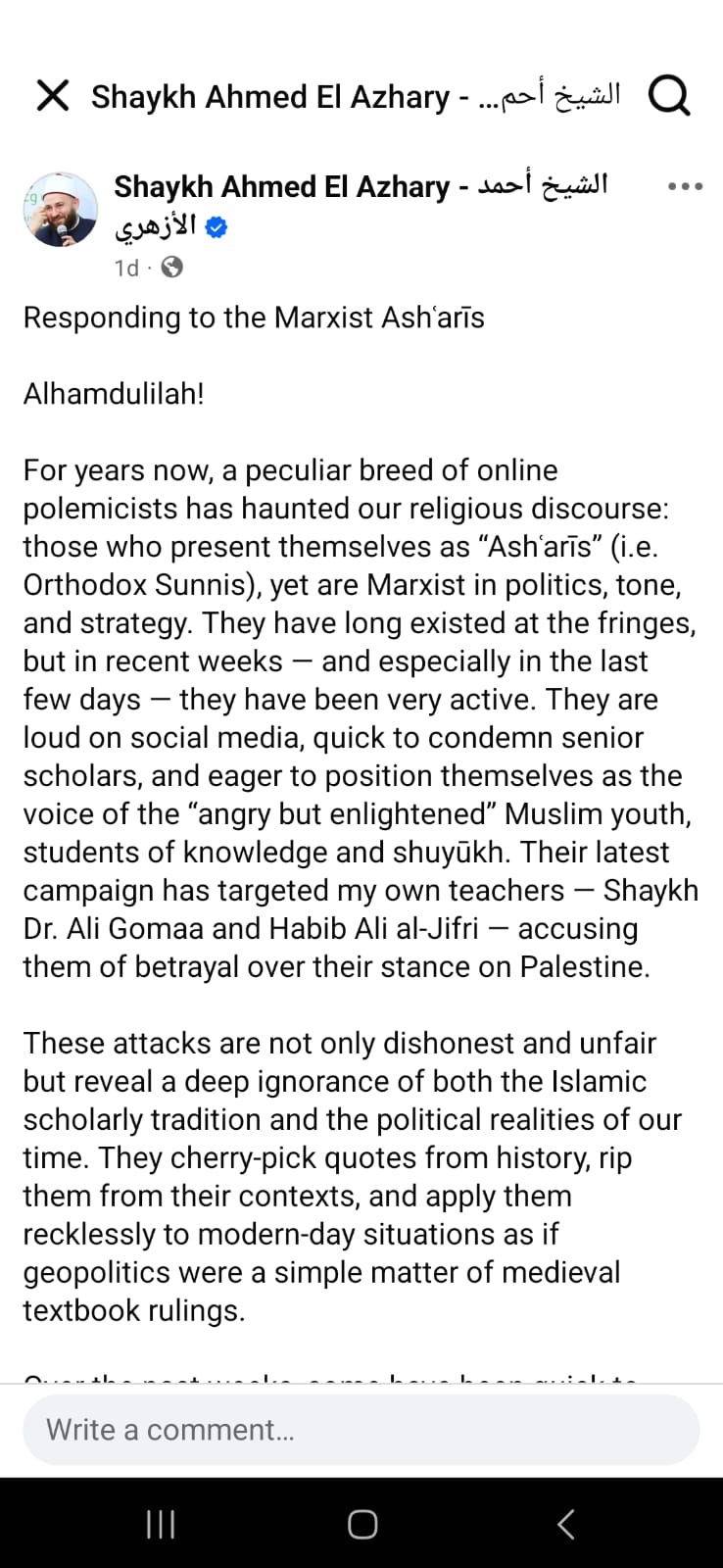
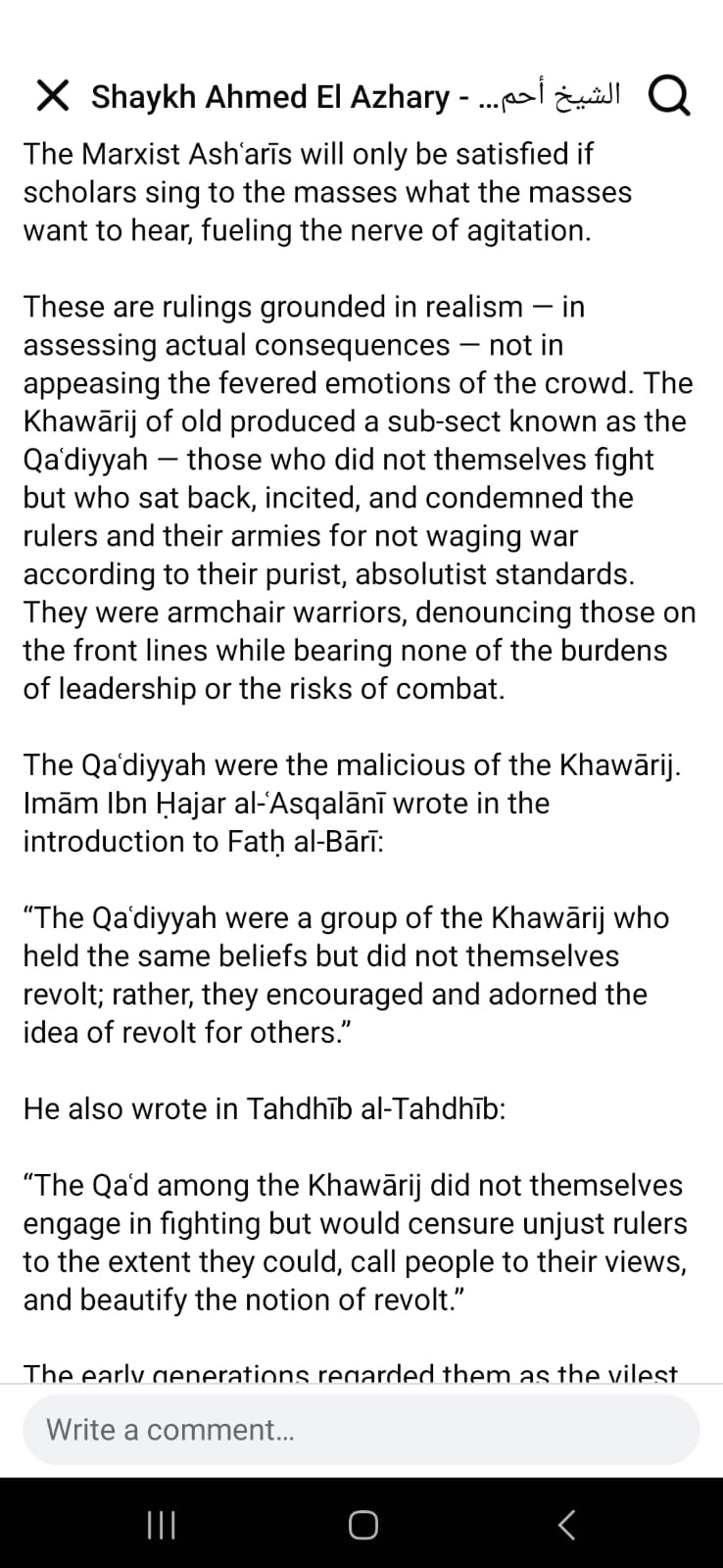
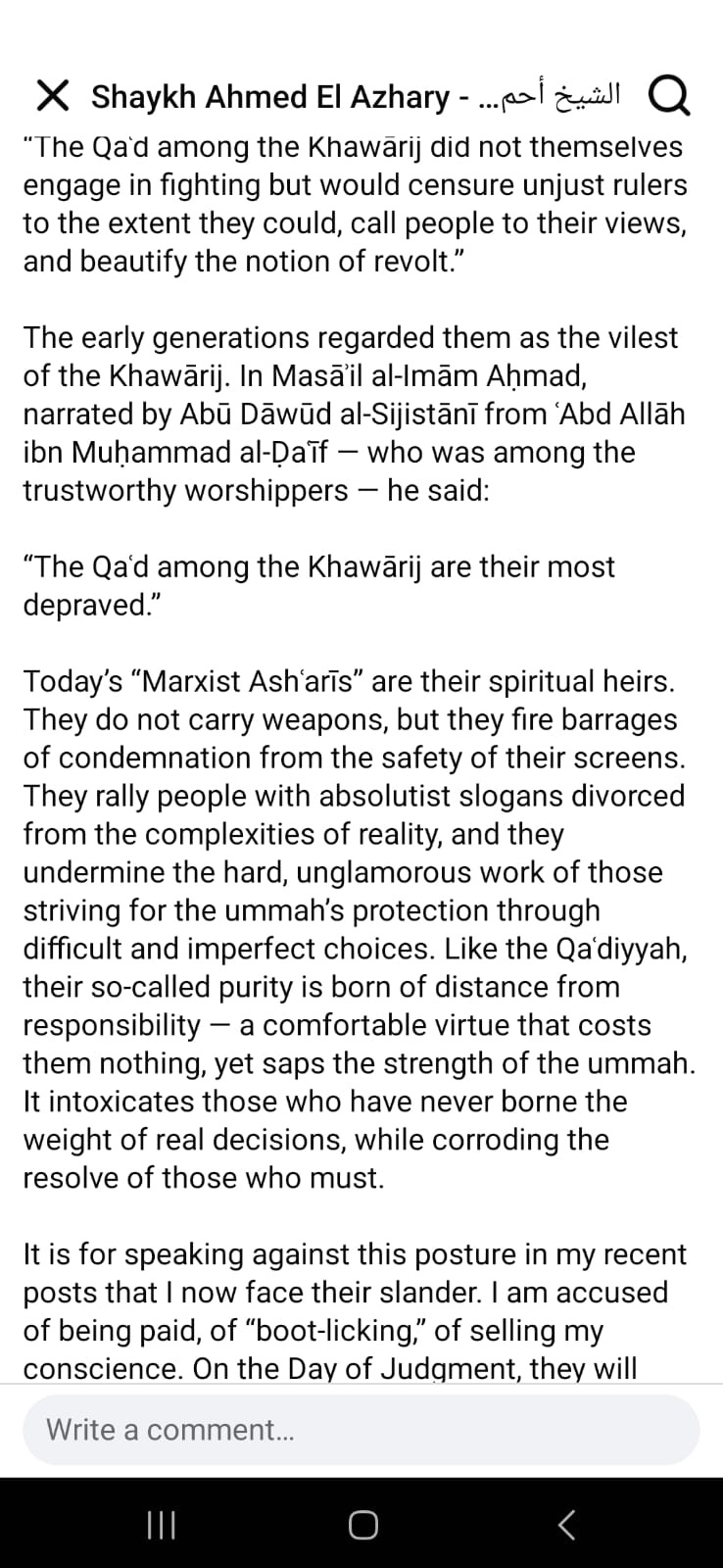
Thus, especially eye opening was Shaykh Ahmed El Azhary’s statement:

“They cherry-pick quotes from history, rip them from their contexts, and apply them recklessly to modern-day situations as if geopolitics were a simple matter of medieval textbooks rulings.”

That is quite the statement coming from someone who proceeds to do the exact same thing. Especially in regards to selective quotes from the past and his own political spin.

So what has happened is that the Ummah has began to research about the Khawarij and they have come to places like primaquran.com and they started to research. They started to see that the picture is not as what has been painted to them. So what do we do when we are told that the Khawarij were blood thirsty savages and yet we come across a group that were quietist and did not want to wet their swords with the blood of the believers?

What we do is we make them the worst of the lot!

So now a people are to be faulted for following the advise of none other than the Blessed Messenger (saw)?

It was narrated that Abu Burdah said:

“I entered upon Muhammed bin Maslamah and he said that the Messenger of Allah (saw) said: ‘There will be tribulation, division and dissension. When that comes, take your sword to Uhud and strike it until it breaks, then sit in your house until there comes to you the hand of the evildoer (to kill you) or a predestined (natural) death.’” “And that came to pass, and I did as the Messenger of Allah (saw) said.”

Source: (https://sunnah.com/ibnmajah:3962)

At this juncture in history a group of the believers saw that the Ummah was beset by injustice on all fronts. The situation had become murky and mired in corruption.

Yet, what else did the Blessed Messenger (saw) instruct us?

Abu sa’Id al-Khudri said:

I head the Messenger of Allah (saw) say: If any one you sees something objectionable, he should change it with his hand if he can change it with his hand. (The narrator Hammad broke the rest of the tradition which was completed by Ibn al-‘Ala’.) But if he cannot (do so), he should do it with his tongue, and if he cannot (do so with) his tongue he should do it in his heart, that being the weakest form of faith.

Source: (https://sunnah.com/abudawud:4340)

So remember,

According to Shaykh Ahmed El Azhary we cannot even give vocal support to the oppressed, or we are Marxist and Khawarij!

Indeed many of those whom Shaykh Ahmed El Azhary call as ‘armchair’ warriors would be warriors on the battlefield. Yet, the very governments that people like Shaykh Ahmed El Azhary defend prevent the people from fighting in the cause of Allah!

“And what is it with you? You do not fight in the cause of Allah and for oppressed men, women, and children who cry out, “Our Lord! Deliver us from this land of oppressors! Appoint for us a saviour; appoint for us a helper—all by Your grace.”  (Qur’an 4:75)

” But those ˹believers˺ who were certain they would meet Allah reasoned, “How many times has a small force vanquished a mighty army by the Will of Allah! And Allah is ˹always˺ with the steadfast.” (Qur’an 2:249)

No, rather people like Shaykh Ahmed El Azhary he would take the hadith of the munkar and if they had their way not only would you not change evil with your hands or your tongue but if they could silence your conscience they would do so. “He should do it in his heart, that being the weakest form of faith.” If they could even remove from your heart the pain and anger and sorrow you feel towards the suffering of the Ummah they would! If that is the weakest form of faith and it is removed what would we have left?

May Allah (swt) guide the Ummah.

May Allah (swt) forgive the Ummah.

Leave a comment

Filed under Uncategorized

Ibn Taymiyya and his sect are ready to slaughter all Muslims in the world.

“And when it is said to them, “Do not cause corruption on the earth,” they say, “We are but reformers.” Of a surety, they are the ones who make mischief, but they realise (it) not.” (Qur’an 2:11-12)

“And whoever kills a believer intentionally, their reward will be Hell—where they will stay indefinitely. Allah will be displeased with them, condemn them, and will prepare for them a tremendous punishment.” (Qur’an 4:93)

﷽ 

Ibn Taymiyya and his sect are ready to slaughter all Muslims in the world.

Ibn Taymiyya and his Salafiyyah sect are the one’s who espouse ideas to cut off the heads of all Muslims who are against them and their ideology.

All you need to do is spend a little time on social media, Twitter, Facebook, Instagram, TikTok and you will not fail to who those who are extremist in their ideology, whom they support in reality.

Read it and weep! If people want to ascribe to the early Khawarij the doctrine of take no prisoners and slaughter them all than what do we have here?!

These so called callers of Salafiyyah tell people: “The Khawarij are the dogs of hellfire!” “They Kill Muslims Who Disagree With Them And They’re Views And Give Bloodshedding Fatwas And They’re Blood Is Halal For Them, They’re Extreme Takfiris!”

But let us look at the following text and be reminded of the saying: If the shoe fits wear it!

Interesting…Interesting…

That sounds awfully familiar (ask them the ruling for one who says the Qur’an is Created)

The following text are from Ibn Taymiyya al Harrani as well as his sect!

“We bear witness-and we are the scholars of Makkah-the Authors of these statements and the conclusions found here. That this religion/sect was established by Shaykh Muhammed B. Abdulwahab and was called too by the Imam of the Muslims. Shaykh Saud B AbdulAziz, To the Oneness of Allah and Negating Polytheism. -That is mentioned in the book is the truth of which there is no doubt or uncertainty of. And of that which occurred prior in Makkah and Madinah. -In Egypt and Syria -and all other countries-up until now is from the forms of polytheism (Shirk). That is mentioned in this book as being disbelief (kufr) that makes the committers of such wealth and blood permissible. And they will be damned to hell forever, residing there and whoever does not enter this religion/sect and acts upon it and supports its people and hates its enemies is a disbeliever (kafir) of Allah and the Last Day. And it is obligatory for the Imam of the Muslims and the Muslims themselves to wage war against them (Jihad) and to Kill them until they repent to Allah from that which they were upon. And he must uphold this religion/sect.”

Source: (Al Duraru Sunniyah Fi Al Jawabat Al Najdiyyah, Vol 1, Pg 314.)

“And the caller too innovation what is deserving of them-is the recompense-by agreement of all Muslims. And that recompense is given by killing them or other than that. As the Salaf killed Jahm B. Safwaan, al-Ja’d b. Dirham (teacher of Jahm bin Safwan) and Gilaan Al Qadari and others..”

He goes on to say if you cannot kill them-that being the first and best option-you should at least warn of them. As he says it is from: “Enjoying Good and Forbidding the Evil”, that “Allah has ordered.”

Source: (Majmoo Al Fatawa: Ibn Taymiyya, Page 242.)

“And whoever amongst them is a caller to misguidance, his deviance cannot be removed except by death! Either he shows open repentance and if he does not he is given judgement for his disbelief (kufr). Like the Imams of the Rafidhis (Shias); they are among those who have misguided people. As the Muslims, Gilan Al Qadari, al-Ja’d b. Dirham (teacher of Jahm bin Safwan) and their likes form the deviant callers. Therefore this dajjal is killed absolutely. -And Allah knows best. And for the killing the caller to innovation then he can be killed as well, to stop his misguidance from affecting the people. Just as one at war is killed. Even if the the situation is not the same as the infidels.”

Source: (Majmoo Al Fatawa: Ibn Taymiyya Page 303 And Page 197)

According to the above Fatwa they are ready to kill all Muslims in the world that accept these views!

“And from the book: Taarikh Al Naysapuri – I heard from Muhammed B. Saleh B. Haani, who heard the Imam of the Scholars: Abu Bakr B. Khuzaymah say: “Whoever does not affirm that Allah is over the throne, and has settled on the throne, above the seven heavens and that he is separate from his creation, then he is a kafir-he is obligated to repent or to be struck (killed). Otherwise he will harm the people of the qiblah and the non-Muslims with his presence.”

Source: (Kitab Ijtima Al Juyush Vol 2: Ibn Qayyim.)

“And he was in the 7th Heaven, Because the Prophet (saw) – Saw his Lord. While he was in this world, and did you know that the scholars did no differ that the entirety of the believers will see they’re lord in the hereafter, and not in this world. Whoever denies the seeing of they’re Lord on the day of gathering is not a believer in the eyes of the believers. And He is worse to the scholars than the Jews and Christians and the Magians. As Ibn Mubarak said: “We can bare the sayings of the Christians and Jews but we cannot bare the saying of the Jahmiyyah.” [end of blue section]

Source: (Page 587 Kitab Al Tawheed By Ibn Khuzaymah)

“And from the book: Taarikh Al Naysapuri – I heard from Muhammed B. Saleh B. Haani, who heard the Imam of the Scholars: Abu Bakr B. Khuzaymah say: “Whoever does not affirm that Allah is over the throne, and has settled on the throne, above the seven heavens and that he is separate from his creation, then is a kafir-he is obligated to repent or to be struck (killed). Otherwise he will harm the people of the qiblah and the non-Muslims with his presence.”

The Imam, Ibn Khuzaymah Died In The Year 312 a.h And he says in his book also, “Whoever denies the seeing of Allah in the hereafter, then he is in the sight of the believers, more worse than a Jew or a Christian or a Magian-and they are not believers in the view of the believers.”

Sources: (Kitab ijtima al Juyush Vol 2 Page 194: Ibn Qayyim Kitab Ijtima Al Juyush Vol 2: Ibn Qayyim.)

“This Is The Saved Group, Those who have gathered upon the truth brought by the The Messenger (saw) and that which he was steadfast upon and those who steer upon the path of the Messenger (saw) and his companions. These are the Ahlul Sunnah Wal Jamaah, The people of the noble hadith-the Salafis those that follow the righteous Salaaf-and strive upon their path in upholding the Qur’an and Sunnah and any other sect opposing them-for them is the promise of Hell.”

“Therefore you-oh seeker-are too look at every sect that proclaims they are the saved sect and look into their actions. If their actions actions is in compliance with the Shari’ah then they are the saved sect and if not, then no. And what is the scale that is meant of judging is the Qur’an and Purified Sunnah in (validating) the truth all of it.”

Source: (Fatawaa Noor Alaa Al Darb, Vol 2, Pg 12: Ibn Baz.)

OPEN YOUR EYES DEAR READERS AND SEE FOR YOURSELF! THE SALAFI MANJAH IS UPON THE MANHAJ OF SLAUGHTER AND KILLING.

Ibn Taymiyya al Harrani what is he is talking about!?

If this guy was a transformer his name would be TAKFIRA-TRON.

This Salafiyyah dawah is effective ONLY in that the people they talk to on the streets they only show the people what they want them to see. Those people (who they invite to Islam) are not researchers and they don’t have access to the Arabic language.

If people really know about them they will know that what they present is not Islam at all.

May Allah guide the Ummah.

May Allah forgive the Ummah.

6 Comments

Filed under Uncategorized

Khawarij are the dogs of hellfire!!

“Indeed, they who disbelieved among the People of the Scripture and the polytheists will be in the fire of Hell, abiding eternally in that. Those are the worst of creatures.” (Qur’an 98:6)

﷽ 

Analyzing the Hadith: Khawarij are the dogs of hellfire!!

This is an analysis of the hadith that are attributed to the Blessed Messenger (saw), in terms of their chains of narration and analysis of the text being transmitted Insh’Allah.

This particular hadith which has been put in the mouth of the Blessed Messenger (saw) has him insult, revile and curse his companions!

Before we start dear reader one should be reminded. What I am about to share with you be extremely careful in what you attribute to the Blessed Messenger (saw).

Narrated by Ali: “The Prophet said, “Do not tell a lie against me for whosoever tells a lie against me then he will surely enter the hell-fire.”

Source: (https://sunnah.com/bukhari:106)

Narrated By ‘Abdullah bin Az-Zubair: ” I said to my father, ‘I do not hear from you any narration (Hadith) of Allah s Apostle as I hear (his narrations) from so and so?” Az-Zubair replied. l was always with him (the Prophet) and I heard him saying “Whoever tells a lie against me then (surely) let him occupy, his seat in Hell-fire.”

Source:  (https://sunnah.com/bukhari:107)

Narrated By Anas: “The fact which stops me from narrating a great number of Hadiths to you is that the Prophet said: “Whoever tells a lie against me intentionally, then (surely) let him occupy his seat in Hell-fire.”

Source: (https://sunnah.com/bukhari:108)

Narrated By Al-Mughira: “I heard the Prophet saying, “Ascribing false things to me is not like ascribing false things to anyone else. Whosoever tells a lie against me intentionally then surely let him occupy his seat in Hell-Fire.” I heard the Prophet saying, “The deceased who is wailed over is tortured for that wailing.”

Source: (https://sunnah.com/bukhari:1291)

There are two options here. If you lied about the Blessed Prophet (saw) intentionally than you will be in the hellfire. If you lied about the Prophet (saw) unintentionally you still need to make tauba (repentance) and vow to never repeat such again.

Ibn Sirin said:

“Nobody used to ask about the isnad (chain of narration), but when the fitna occurred (infighting among the companions), they would question others by asking: “Tell us the names of your men?” After this they were cautious about every narrator, and they would take narrations from those who were known to be scrupulous in following the Sunnah, and leave (or reject) the narrations of those who were known as innovators in religion.”

Source: (Muslim Volume 1 P. 15)

HADITH: KHAWARIJ ARE THE DOGS OF HELLFIRE.

This huge statement attributed to the Blessed Messenger (saw) comes to us by way of two transmissions attributed to two companions.

Hadith #1 The first is by way of Abdullah Ibn Abi Awfa.

‘Abdullah Ibn Abi Awfa

It was narrated that Ibn Awfa said:

“The Messenger of Allah said: ‘The Khawarij are the dogs of Hell.'”

Source: (https://sunnah.com/ibnmajah:173)

Hadith #2 This hadith is by way of Abu Umamah said:

“(The Khawarij) are the worst of the slain who are killed under heaven, and the best of the slain are those who were killed by them. “Those (Khawarij) are the dogs of Hell. Those people were Muslims but they became disbelievers.” I said: “O Abu Umamah, is that your opinion?” He said: “Rather I heard IT from the Messenger of Allah.”

Source: (https://sunnah.com/ibnmajah:176)

Now let us analyze the chains of transmissions.

An example of difference in the text when Abu Ghalib claims to narrate from Abu Umamah:

“Abu Umamah saw heads (of the Khawarij) hanging on the streets of Damascus. He said:The dogs of the Fire and the worst dead people under the canopy of the heavens. The best dead men are those whom these have killed.’ He then recited: On the Day when some faces will become white and some faces will become black… (3:106) until the end of the Ayah. I said to Abu Umamah: ‘Did you hear IT from the Messenger of Allah (saw)?’ He said: ‘If I had not heard IT but one time, or two times, or three times, or four times – until he reached seven – I would not have narrated it to you.”

Source: (https://sunnah.com/tirmidhi:3000)

ANALYZING THE FOUR CHAINS THROUGH ABU UMAMAH AL BAHILI

1. Abu Ghalib

Ibn Hibban says we cannot take his hadith.
An Nasai’ says he is weak.
Ibn Sa’d also says he is weak.
Yahya ibn Ma’in & Tirmidhi both comment that he is a good transmitter.
Al Dhahabi comments that in all of his (Abu Ghalib’s) narrations there is something.

2. Safewan bin Suliam Almadni

He did not meet Abu Umamah Al Bahili
He met with another Abu Umamah As Said ibn Suhair ibn Hanif
On account of that Ibn Hajar Al Asqalni commented that it is possible this transmission is cut off.
And it is proven that it has a cut as he did not meet the one he claims to transmit from. The lack of ‘an ‘an, that he was listening makes this clear he did not get from the source. This is why in the matn it says: “He entered” he did not say, “I heard from…” “I listened..” In the narration when the hadith is a strong and correct hadith the wording will be: “I saw him”, “I met him”, “I listened from him”

3. Shadad ibn Abdillah Abi Ammar

Ibn Hajar-says He is sincere; however, the hadith is musral. The sahaba is cut off.

3a. Ikrima ibn Ammar

Ibn Hajar says: sincere but a faulty individual.
His narration through Yahya ibnu Kathir -His hadith via this route is Maqloob.
Fulaan yasriq al-Hadith -so and so steals Hadith.

4. Siyar Ashami Al Amawi

Virtually none of the people of Jarh wa Tadeel has given him trust, with the exception of Al Bukhari. Even than it is not that Bukhari gave him trust but Bukhari uses him in Tarikh Al Kabir.
Ibn Hibban gives him trust. However, it is noted that Ibn Hibban is lax when giving trust to narrators.
No other is with Ibn Hibban considering him.
Ibn Abi Hatim in his Al Jarh wa Tadeel claims no one gives Siyar Ashami Al Amawi trust.
Al Dhahabi says of him ‘wuthiq’ and not ‘thiqa’. This indicates weakness in Siyar Ashami Al Amawi.

4a. Abi Saeed Abur Rahman bin Abdillah Al Basri

He is a mawla (client) of Bani Hashim. He is a Shaykh for Ahmed bin Hanbal.
Ibn Hajar says about him: He is sincere but may have faults.
Imam Al Uqali says Imam Ahmed mentioned that his teacher had “many faults”.
Al Qabani also says that Imam Ahmed found found fault in his teacher.

The chain for this hadith is: Abu Bakr bin Abi Shayba narrates from Ishaq bin Yusuf bin Mrdas narrating from Sulaiman bin Mahran al-Ahmash narrating from Abdullah Ibn Abi Awfa.

ANALYZING THE TWO CHAINS THROUGH ABDULLAH IBN ABI AWFA

1. al-Amash

al-Amash is known as Mudallas.

A Mudallas (“concealed”) in hadith is one which is weak due to the uncertainty caused by tadlis. Tadlis (concealing) refers to an isnad where a reporter has concealed the identity of his Shaykh.

Tadlis al-Isnad. A person reports from his Shaykh whom he met, what he did not hear from him, or from a contemporary of his whom he did not meet, in such a way as to create the impression that he heard the hadith in person. A mudallis (one who practices tadlis) here usually uses the mode (“on the authority of”) or (“he said”) to conceal the truth about the isnad.

There is agreement that al-Amash did not meet Abdullah ibn Abi Awfa.

2. Saeed Ibnu Jamhan via Allalakaee via two ways:

2a. Allalakaee -via- Hashragu Ibnu Nabatha

Ibn Hajar says about him (Hashraju): Truthful but forgets allot.

2b. Allalakaee-via- Qutnu ibnu Nusair

Ibn Hajar says about him: Truthful but forgets allot.
Abu Zuhra says he is carrying something in his heart about that man.
Ibnul Adei says that he is stealing the hadith. Fulaan yasriq al-Hadith -so and so steals Hadith

MATN (TEXTUAL) CRITICISM OF THE HADITH: KHAWARIJ ARE THE DOGS OF HELLFIRE.

The statement:

The dogs of the Fire and the worst dead people under the canopy of the heavens. The best dead men are those whom these have killed.”

This is not from pure Arabic grammar and the Prophet (saw) did not speak like this.

The statement: “Did you hear IT from the Messenger of Allah (saw)?’ He said: ‘If I had not heard IT but one time, or two times, or three times, or four times – until he reached seven – I would not have narrated it to you.”

Is hardly believable. This is a huge hadith this is not something light or small. Where are the other sahaba, companions?

This hadith is giving a hukm! It is talking about taking the life of others, which is not a small matter.
How are we to believe that especially in light of the claim of one narrator that the Prophet (saw) mentioned as such seven times! Only 1 or 2 have heard this!?

After 64 hijri, this hadith mentions this term ‘khawarij’ which was not there in the time of the Prophet (saw).

Dr. Salahuddin ibn Ahmad al-Idlib says this hadith is mawdu, it is lies!

Source: (Manhaj Naqd al-Matn ‘Inda ‘Ulama’ al-Hadith al-Nabawi (منهج نقد المتن عند علماء الحديث النبوي) page 362)

Translated from the above:

Concerning the Condemnation of the Khawarij: Ibn Majah narrated from Ibn Abi Awfa that the Messenger of God (peace be upon him) said:

“The Khawarij are the dogs of Hellfire.” (1)

The fabricators did not neglect condemning the Rawafid (a term for some Shi’a sects), so they fabricated hadiths for that purpose. Among them is what Ibn al-Jawzi narrated from Abu Sa’id al-Khudri that the Messenger of God (peace be upon him) said:

[There will be] “The Qadariyyah, the Murji’ah, and the Rawafid.” (2)

And in Al-Mawdu’at (The Fabricated Hadiths), it is also narrated from Anas that the Messenger of God (peace be upon him) said:

“The Qadariyyah, the Jabriyyah, the Murji’ah, the Rawafid, and the Khawarij will be stripped of a quarter of Tawhid (monotheism), so they will meet Allah, the Mighty and Majestic, as disbelievers, abiding eternally in Hellfire.” (3)

These labels (for sects) did not exist during the time of the Messenger of God (peace be upon him), so it is not permissible to attribute these hadiths condemning them and insulting them to him.

The Second Issue: Fabricated Hadiths in Support of Jurisprudential Schools (Madhahib)

Ijtihad (legal reasoning) in subsidiary jurisprudential matters led to the emergence of different schools of thought (Madhahib). Each jurisprudential school had its principles, conclusions, and theories. Each group would support its viewpoint with what it understood from the texts of the Noble Quran and what was narrated from His Messenger (peace be upon him).

Regrettably, some ignorant zealots among the followers of the jurists were not content to limit their evidence to sound, established texts. Instead, they wanted to silence their opponents with decisive proofs that did not accept rebuttal, even if they were not proven. Thus, they began to compose forged hadiths and attribute them to the Messenger of Allah (peace be upon him).

(1) Sunan Ibn Majah, No. 172
(2) Al-Mawdu’at (Ibn al-Jawzi), Vol. 1, p. 272
(3) Al-Mawdu’at (Ibn al-Jawzi), Vol. 1, p. 278

Notice that to Abu Ghalib this is not some common knowledge or something well known. 

 Also, note that he asked Abu Umamah if that was his opinion or rather he heard IT from the Blessed Messenger (saw).   Another point of consideration is that the ‘it‘ is not qualified.   What part of his statement is he actually saying he heard from the Blessed Messenger (saw)? Notice the statement of takfir  “They used to be Muslims but they became disbelievers.”   

The very thing they accuse the so called ‘Khawarij’ of doing are that which they themselves are doing!

Do take note of the following!

Notice how apparently this individual takes an ayat of the Qur’an that is used to describe unbelievers and arguably applies the text to believers (or former believers).  Again, something they accuse the so called ‘Khawarij’ of doing!

Also, notice the ghastly image the narrator finds in Damascus. The heads of these people are on pikes: “Abu Umamah saw heads (of the Khawarij) hanging on the streets of Damascus.”

Now, that sounds like something that an imperium would do against dissenters.

Lastly, this text differs remarkably from the first one. Unless someone wants to make the spacious argument that Abu Ghalib is relating two different instances. That makes the matter worse because it makes Abu Ghalib question Abu Umamah’s statement as being truthful on two different occasions!

Also, it is extremely telling to note that Abu Umamah al Bahili was in the battle of Siffin on the side of Ali, even after the events.

OVER ALL ASSEMENT OF THE THREE HADITH ABOVE.

The Blessed Messenger (saw) never call people dogs.

The strongest condemnation of unbelievers and those who reject the message of truth comes from Allah (swt) in the Qur’an:  “Those are the worst of creatures.” (Qur’an 98:6).  

Allah (swt) never called anyone dogs, let alone the Blessed Messenger (saw)

Now dear reader imagine you are walking with a friend of yours. This friend suddenly says, “And the Litharians are the worst of people! They are absolute scum!”

Wouldn’t that be odd? Wouldn’t you want to have some context to this statement?

Considering this statement: “dogs of hellfire” coming from the lips of the Blessed Messenger (saw) it should have more context and more background to it and it simply doesn’t!

It just gives the impression that the Blessed Messenger (saw) was walking around during the brisk afternoon and stated: “The Khawarij are the dogs of Hell.”   Really?  Just like that?  

No context?

The three hadith quoted above give you absolutely no context.   Now what Ahl Sunnah does is that they take these hadith and juxtapose them besides other hadith to paint a picture.  However, these hadith quoted above give no picture, no context and no clue to the situation that has given rise to the very strong words that are allegedly used by the Blessed Messenger (saw).

This is a huge statement of the Blessed Messenger (saw). Only two of the companions narrate this?


The other point is that the word ‘Khawarij’ was not in use in the time of 640 Hijra. This is a tell tale sign itself.

Now, if we want to talk about a hadith that talks about rebels or those who do khurooj. Why not talk about a hadith that has no ambiguity in the text or in its chain of transmission? Then we can know who these ‘khawarij’ are.

Narrated `Ikrima:

“That Ibn `Abbas told him and `Ali bin `Abdullah to go to Abu Sa`id and listen to some of his narrations; So they both went (and saw) Abu Sa`id and his brother irrigating a garden belonging to them. When he saw them, he came up to them and sat down with his legs drawn up and wrapped in his garment and said, “(During the construction of the mosque of the Prophet) we carried the adobe of the mosque, one brick at a time while `Ammar used to carry two at a time. The Prophet (saw) passed by `Ammar and removed the dust off his head and said, “May Allah be merciful to `Ammar. He will be killed by a rebellious aggressive group. `Ammar will invite them to (obey) Allah and they will invite him to the (Hell) fire.”

Source: (https://sunnah.com/bukhari:2812)

Now this presents a clear dilemma for Ahl Sunnah and the Pro Alid camp. They are in a pickle. However, it does not present a dilemma for truth seekers.  

Are we to believe that Ikrima (ra) whom is an impeccable narrator, and whom narrated the above hadith about Ammar that is used by the pro Alid camp to attack the Umayyad’s was among the dogs of the hellfire?  

Or,

Is it more likely given the ambiguity of the ‘dogs of the hell fire’ text quoted above, no context for such a tremendous statement of the Blessed Messenger (saw), and the issues surrounding the chains of transmission that they are indeed fabrications with malevolent intent?

May Allah (swt) open your hearts and your eyes dear Ummah! Muslims are to be guided by the Qur’an and the Sunnah. Our noble scholars lead the way.

The Amir of the Muslims is the head of the Muslims. It is not a theocracy. It is a human government. One in which the head of state can make mistakes and can be removed from office! Peacefully preferably and forcibly if need be.

I recommend the following articles for you dear reader. Remember the victors write history and know that Allah (swt) will allow the truth to prevail in the end.

Say, ‘Truth has come and falsehood has been banished; it is doomed to banishment.'” (Qur’an 17:81)

Dogs of hellfire? Who really believes that animals are going to hell?

This article addresses the bizarre belief that Allah (swt) has a goat into hell ….well…just because.

https://primaquran.com/2023/02/24/do-muslims-believe-animals-can-go-to-hell

Defending the noble companion Hurqus ibn Zuhair (ra) from the slander of Ahl Sunnah.

Who is really doing the cursing and reviling?
*The following article is still in the process of being updated*

https://primaquran.com/2022/10/04/analyzing-the-chains-of-abu-said-al-khudri-concerning-the-khawarij

7 Comments

Filed under Uncategorized

Salafi preacher admits a companion killed Uthman not the so called Khawarij.

“However, whoever deliberately slays another believer, his requital shall be hell, to abide there in; and Allah will condemn him, and will reject him, and will prepare for him awesome suffering.” (Qur’an 4:93)

Salafi preacher insults the companion Amr b. al-Hamiq al-Khuzāʿī for stabbing Uthman in the chest 9 times. He did this out of ignorance. However, once senior and more learned scholars told him that Amr b. al-Hamiq al-Khuzāʿī was a companion he had to resort to the position of ‘May Allah be pleased with them all.’

You have to wonder what was the conclusion of this Shaykh  even after he found out there was only one Hamaq al Khuzai and that was the Sahabi who killed Uthman.  

So let us just pretend like the narrations are not in the books, and pretend that he didn’t insult the companion who claimed he killed Uthman.

It is also worthy of note that Amr b. al-Hamiq al-Khuzāʿī joined the ranks of Ali bin Abi Talib.  

If there was some supposed hadith of ‘the 10 promised paradise’, Uthman certainly didn’t recite it. Those who wanted him dead and those who killed him certainly never heard of it.

Just for the readers information, I did not create the above video. I did not really enjoy the giggling and laughing in the background of the video. It takes away from the serious nature of the point being made.

By the way Amr b. al-Hamiq al-Khuzāʿī is only one. There are other companions who participated in this. However, some people wish to deceive the masses, and erase names from history and claim some shadowy group were involved in all these things.

This is to uphold their doctrines and not to uphold the truth.

Remember, the noble commander of the faithful Umar Ibn Al Khattab (ra) who said:

““O people, if anyone from among you finds any fault in me, he should rectify it.” A man stood up and said, “If we find any crookedness in you, we will rectify it with our swords.” Umar (ra) said, “I am thankful to Allah that he has created such a man in this nation who would rectify Umar’s crookedness with his sword.” 

“That is a nation which has passed on. It will have what it earned, and you will have what you have earned. And you will not be asked about what they used to do.” (Qur’an 2:141)

If you must know. Shaykh Masoud bin Mohammed Al Miqbali (h) lays it out for you.

May Allah (swt) open the eyes and the hearts of this ummah!

10 Comments

Filed under Uncategorized