Tag Archives: mohamed-hijab

Mohamed Hijab’s excellent argument against the Qur’an being uncreated.

“Indeed, We have made it an Arabic Qur’an that you might understand.” (Qur’an 43:3)

﷽ 

Mohamed Hijab, who is a known Muslim speaker based in the United Kingdom, has recently put forward some excellent arguments against the idea of the Qur’an being eternal and uncreated (unbeknownst to him).

Now, to be fair, we want to say from the outset that Mohamed Hijab (as far as we know) believes that the Qur’an is eternal and uncreated.

However, it doesn’t seem that he has pondered the implications of his kalaam argument on the subject of the Qur’an being makhluq (created).

Listen carefully to the exchange between Marwan and Mohamed Hijab

The contingency argument.

@1:28:36 listen to Marwan’s question about pantheism and contingency argument.

@1:30:18 Mohamed Hijab gives his reply listen carefully.

“This is a book, and it’s made out of parts and the parts are the pages of the book right. Correct? So these are the pages of the book. I dunno what book. ‘Jewish historical society of England’ …..This is a book, right, and this is the whole of the book, correct? And it’s made out of parts, correct? Now if I pick a part out. Now if I take all parts out of this book, does it remain as a book? If the parts are taken out, then the whole thing is taken out. If that’s conceivable that parts taken out the whole thing is taken out than there is no way that this thing that I’m talking about is necessary and independent. Because necessary and independent means it’s always there and it can never be any other way. It’s a simple as that. You said, well, if it’s inter-dependent, anything which is inter-dependent by definition is dependent because what does the word inter-dependent mean? Interdependent means things which rely upon each other. So, if in order for this book to exist, there’s an inter-dependence or each page relies upon the existence of other pages in this book in order to exist. Then what we’re saying is this thing is dependent, because everything interdependent is, by definition dependent. What is dependence? Something which relies upon something else for its existence. What is inter-dependence? Something which relies upon something else in order to exist. So, in many ways, what you’re saying is, if we admit that it’s dependent than khalas (finished), it cannot be dependent and necessary at the same time.”

@1:33:16 “How do we describe the kul here? How do we describe the whole of this book? How do we describe the whole of this book?  We describe it through its parts, right?  Now if I say I just dissembled all its parts, and it’s maybe what 3-400 pages, and I’ve scattered them around. They still exist, but they exist in a different form. Now what I’m saying is the fact that I can re-arrange them like this I can you see this hundred, I dunno, let me see 208 pages of this book, yeah. If I take the 232 pages and make page 1 and page 232 and make it like munaqis (opposite), so instead of 1,2,3,4,5 it’s 232, 231, etc., etc. I’ve re-arranged it. The fact that now I can rearrange this book means there is nothing necessary about the arrangement and the form of this book. There is nothing necessary about it at all.”

@1:34:27 “The book as it is the way in which the book is now from 1 to 232, the way in which the book is like that the form the sura the shaqil the hakel -what ever word you want to use, the form of the book as it is now can be re-arranged. Now let me give you an example because I feel, I feel like the issue here is we don’t know the difference between contingency in this necessity. Necessity: 2 +2=4. 2+2=4. Is there any way 2+2=4 can be arranged any other way. Can it re-arrange in any other way? Can 2+2=anything other than 4? Which means its necessary. So its impossible to re-arrange 2+2 to equal anything other than 4. It’s eternally that way, it’s necessarily that way and it will continue being that way. It cannot be any other way. Now this is not the same with the arrangement of the parts of this book. The arrangement of the parts of this book can be other ways. This book itself can be another way. Instead of this colour; which I will describe as beige I dunno maybe I’m colour blind. It could have been blue. I can actually paint it right now. I can make it blue. I can , you want me to do? It looks like a historic book I dun want to ruin it. But I can change this book. There is nothing necessary about this book. Now you might say well, if we define necessity as something susceptibility, destructibility and generation. Yeah? And then in the closed system of the universe energy cannot be destroyed. Cannot be destroyed and therefore the atoms will take another form. I’m saying. I am not defining. I’m not defining contingency in only that way. I’m defining contingency in three ways. Number 1. Something that can be any other way. Number one yeah? Number 2. Something susceptibility to destruction and generation destruction yeah? And number 3. Something which relies upon something else for its existence. Now even if you argued that well this cannot be really destroyed because it’s atoms will take other form. I’m saying its still not necessary because it can be arranged in another way. The parts of this whole can be arranged in a way which is currently not arranged. It can be a way which is currently not/is. So which means that it, it meets the criterion of contingency; because it can be another way.”

@1:37:24 “You are confusing eternality and necessity. O.K? It’s conceivable that something can be eternal and not necessary. It’s conceivable how so? Because something can be eternal but rely upon something necessary. And that’s why the ‘ulemah of Islam they differentiated between what is referred to as wajibun an nafsi and wajibun al ghayri which is necessary for its own sake and necessary or in and of itself and necessary because of something else. So for example if I were to say. You have a sun. Let’s say the sun is necessary. The sun yani. Shams yeah? And it’s rays are contingent based-dependent upon the sun. The fact that the rays exist and they are contingent on the sun doesn’t’ mean that just because they are both eternal. The fact that the rays exist and are contingent on the sun doesn’t’ mean that the rays are necessary just because their eternal because they are dependent upon something which is necessary in this case, the sun or the eternal. You get it?

@1:38:37 “Yeah that’s his Ibn Cena beliefs. Yeah well Islamic refutation of the universe being eternal is clearly against the Qur’an and the Sunnah. Al Ghazali had this kind of refutation if you wanna.”

Marwan ask about the attributes of Allah (swt).

@1:39:00 “We affirm all the attributes of God through these kind of argumentations. That is why, there is a point where you need like the Rahma of Allah. The fact that he is ghafu and afuw and raheem and all that stuff. That needs to be affirmed through revelation.”

Marwan ask are these attributes necessary or contingent?

@1:39:19 ‘Yeah all attributes of Allah are necessary.” @1:40:25 “We don’t use the word dependent it’s being controlled by the irada (intention) of Allah. By the will of God. So the verb all the attributes of God are controlled by the will of God. If Allah wants to speak yeah? If Allah wants to speak he wills that and he does that.”

Marwan so they are contingent upon his will?

Listen to how uncomfortable is the response of Mohamed Hijab. The sudden shift. Also notice that Mohamed Hijab does not affirm that Allah is speaking, or is speaking eternally. He attributes the speaking to his will! Al hamdulillah! Thank you!

@1:40:44 “We don’t need to use the word contingent. They are controlled by his will.

I believe at this point Marwan doesn’t really seem to buy it. A quick glance of the ideas upward and simply responds . ‘O.K’

The arguments brought by Mohamed Hijab absolutely decimate the idea that the Qur’an is uncreated.

Its message is dependent upon asbaab an nuzul (occasion of revelation), which conceivably could have been different. According to our brothers from the Sunni denomination, it has text that has been abrogated and that is dependent upon what abrogates and what is abrogated. It is composed of letters and words and sentences that are dependent upon structure to have a coherent meaning. It’s conceivable that the Ahruf /Qir’aat of the Qur’an could be more or less than what they are. It is conceivable that the Qur’an could have been revealed in a language other than Arabic. It is conceivable that the Qur’an itself cannot be necessary, because it is conceivable that Allah (swt) could have had the Torah or any other revelation completely intact and reach us until this very day.

In the words of Fakhr al-Din Al-Razi:

“The impossibility of a word which is composed of letters and sounds being eternal is self-evident to the mind for two reasons:

The first is that a word cannot be a word unless its letters are sequential. The letter uttered before the last that is uttered is originated, and if something’s being originated is affirmed, its eternity is then impossible. So, for the letter following the end of the first, there is no doubt that it originated.

The second is that, if those letters from which the word is composed occurred in one go, the word cannot be. A word composed of three letters can occur in any one of six combinations. If the letters occurred altogether, the words occurring in some of those combinations would not be better than they are occurring in any of the rest. Alternatively, if the letters occurred in succession, then the word is originated.”

Source: (Al-Tafsir al-kabir (Tehran: Dar al-Kutub al-Illmiyyah, 2nd edition, 1:P20.)

Fakhr al-Din took fellow Sunni Muslims of the Hanbali school to task when he says,

“These people are so low as to not deserve mention among the group of the learned. It happened one day that I said to one of them: “If Allah spoke these, then either He spoke them in one go, or in succession. The first is void because the speaking of all these letters in one go will not convey an orderly composition which is a combination in sequence. It necessarily follows that this composition, combined with these successive letters, cannot by themselves be Allah’s speech. The second is void, because if Allah spoke them in succession, then it would be originated.’ When the man heard this statement of mine, he said: ‘It is obligatory for us to affirm and pass on’, i.e., we affirm that the Qur’an is eternal and pass by this statement that we have heard. At that point, I wonder greatly at the safety of this speaker.” 

Source: (Al-Tafsir al-kabir (Tehran: Dar al-Kutub al-Illmiyyah, 2nd edition, 27, 187-88)

May Allah (swt) forgive the Ummah. May Allah (swt) guide the Ummah.

If you would like to read more on the issue of the Qur’an being created, perhaps you may want to read the following articles.

https://primaquran.com/2022/10/04/lets-attack-hamza-yusuf-in-ramadan-the-quran-is-created/

https://primaquran.com/2022/10/05/ef-dawah-discussion-with-josh-jewish-is-the-quran-being-uncreated-against-tawheed/

If you would like to see more articles featuring Mohamed Hijab you may be interested in the following:

https://primaquran.com/2022/10/05/mohamed-hijab-and-divine-simplicity/

May Allah Guide the Ummah.

May Allah Forgive the Ummah.
Leave a comment

Filed under Uncategorized

Allah’s Word Created Or Uncreated? -Mohamed Hijab.

“Indeed, We have made it (ja’alnahu) an Arabic Qur’an that you might understand.” (Qur’an 43:3)

﷽ 

This video was brought to our attention. Here we have our Muslim sister asking Mohamed Hijab about the age-old question about whether Allah’s words (speech) is created.

So what we are going to do is to let you listen to the exchange. We have also transcribed the exchange between Mohamed Hijab and the questioner (referenced as ‘Muslim sister’.) We will then provide our commentary and thoughts on the exchange.

Muslim sister:

“About like the Qur’an being like there, you know the issue about it being created and not created, about how there was a big debate in the past, so I don’t exactly understand like those two sides, like what do people mean when they say it’s created and what do they mean when they say it’s not created because I don’t think either side actually meant that created in terms of written by people so like how yeah so what do they even mean like how do you make sense of it.”

Mohamed Hijab:

“The Muʿtazilah believed that it was was created, it was makhluq. That Allah created the Qur’an. The words were created. They were not…whereas the Ahl Sunnah position is that the words are not created and that the words are exactly are uh, they are a subset of an attribute of Allah (swt) which is speech. So like I’m speaking to you right now, I have the ability to speak, and my speech is a subset of my ability to speak in my capacity to speak. Likewise, Allah (swt) speech is not created, it’s not manufactured. It’s a subset of one of his attributes. So the Muʿtazilah believed that it was created in the same way as human beings are created, or the universe was created. And Ahl Sunnah believed that’s not the case.”

The sister was asked: “Does that make sense?”

Muslim sister:

“Um, I mean, like it just don’t sound like I guess I cannot fully comprehend in (??) not in terms of how it’s possible but rather like, um, are the words kind of emitted at some point and does that omission all…” (interrupted by Mohamed Hijab)

Mohamed Hijab: “Yeah, omission …all right, look, so does Allah (swt) does he umm create?”

Muslim sister: “Yup”

Mohamed Hijab: “Yup.” So he creates. Allah (swt) does he hear all things?

Muslim sister: “Yeah.”

Mohamed Hijab: “Does he see all things?”

Muslim sister: “Yeah.”

Mohamed Hijab: “Yeah? Right, now all of those things are they created? Like did Allah create-Did Allah create an ability for himself to hear?”

Muslim sister: “Oh I see. So, when you say the words are not created like the Qur’an is not created you mean the ability to speak was not created, yeah?”

Mohamed Hijab:

“That Allah’s ability to speak is not created and that the words themselves are not created. They are uh omitted as you mentioned from Allah (swt) in a way that suits his majesty. Which is nothing like the khalq (the creation). But they are not created it’s like-just like Allah (swt) does not create his ability to hear, and he does not create his ability to see and thus, intrinsically, it’s a part its its its an aspect of what he is, not a part. An aspect of what he is. Then, in that case, the same can be said about kalam about speech. That he is not created.”

Muslim sister:

“But what if, like a single verse or like um like um, you know the message itself it’s dependent is it like of um depending on the rule of Allah? Or is it kind it’s not like part of the essence, right? It’s not like unnessary-it was I don’t know how..”

Mohamed Hijab:

“Yeah, I got you, I got you. So the sifat of Allah (swt) are broken down into two. There’s the attributes which are intrinsic and necessary. Actually all of Allah’s attributes are necessary, yeah? But there’s those which are intrinsic. They’re called Al-Sifāt Dhātiyyah. They’re the intrinsic attributes. So, for example that Allah is pre-eternal that he is post-eternal. That he is All-Powerful, that he has all knowledge all of that is meant Sifat Allah (swt) Dhātiyyah, or the intrinsic attributes of Allah. And then you have the will of Allah (swt) Okay? The Will of Allah. And the Will is Allah’s ability to make decisions okay?”

Muslim sister: “okay”.

Mohamed Hijab:

And then then you have another set of sifat or attributes of Allah called Sifat Al Ikhtiyariyah or Sifāt Fi’liyyah -which are the verbal attributes -now verbal attributes refer to that which Allah does and that which Allah does it is linked to Allah’s will. So, when Allah decides something -the verbal attributes are then activated. Okay? As a result of whatever he wills. So some of the uh some of the examples of those is like speech. Allah wills to speak. He shall speak. If he wills not to he will not. If Allah wills to create he will create. If he wills not to he will not. So, the sifat, the attributes which are Sifat al filiyyaha they are connected to the will of Allah (swt)

Prima Qur’an commentary: 

The first point to keep in mind is that the Qur’an and Sunnah are not quoted to the respected Muslim sister. The issue over whether the Qur’an was created or not created did not come up during the time of the companions.  They contended themselves with Allah (swt) is uncreated and everything other than Allah (swt) is created. If only the Muslims were contented with this.

In Mohamed Hijab’s initial response he says:

So like I’m speaking to you right now I have the ability to speak and my speech is a subset of my ability to speak in my capacity to speak. Likewise Allah (swt) speech is not created it’s not manufactured.”

Allah (swt) says:

There is nothing whatsoever like unto Him, and He is the All-Hearing, the All-Seeing” [Qur’an 42:11].

So, whenever you get involved in tashbih (comparing Allah to his creation) like Mohamed Hijab does, you run into problems. His comparison breaks down because he (Mohamed Hijab) is a created being. His speech is created. He has the ability to speak, but he had not been speaking before he spoke. He produced a speech on the occasion of it. Allah (swt) could destroy Mohamed Hijab and the entirety of his existence, including his speech.

In the second reply to the Muslim sister Mohamed Hijab says:

But they are not created it’s like-just like Allah (swt) does not create his ability to hear and he does not create his ability to see and thus intrinsically it’s a part its its its an aspect of what he is, not a part.

People like Mohamed Hijab and the bulk of Sunni Muslims who come across as confused about the issue.  Often times they also set up traps that are meant less to have meaningful discussion and more often to win.

Remember Mohamed Hijab said: Allah wills to speak. He shall speak. If he wills not to he will not.

He doesn’t create his ability to hear. We would agree.

He doesn’t create his ability to see. We would agree.

He doesn’t create his ability to speak. We would agree.

—————————————————————————————————

He doesn’t create his ability to hear. Agreed.

He doesn’t create his ability to see. Agreed.

He doesn’t create his ability to create. Agreed.

He doesn’t create his ability to speak. Agreed.

Now we ask:

Is that which he sees created? They say, “Yes”.

Is that which he hears created? They say, “Yes”.

Is that which he speaks created? They are silent.

You see they don’t like the way the question is framed. It is meant as a trap. A possible response to this could very well be: Is that which he speaks to created? They would say yes.

But that wasn’t the question. So you can see they evaded the question. Or they will reply to Is that which he speaks created? They can simply reply: “No.”

Or they could pretend to lay a trap for us:

Is his hearing created? We say, “No.”

Is his seeing created? We say, “No.”

Is his speaking created? We say, “Yes!”

So this is the problem with approaching the Creator using tashbih. Rather, it has to be decided by the decisive text of the Qur’an and the Sunnah. 

Now the last two paragraphs even had us puzzled because we began to say among ourselves.  How is it that Sunni Muslims like Mohamed Hijab differ with us about this? Because he says:

There’s the attributes which are intrinsic and necessary, actually all of Allah’s attributes are necessary yeah? But there’s those which are intrinsic they’re called Al-Sifāt Dhātiyyah. They’re the intrinsic attributes.

Actually, we are glad Mohamed Hijab caught himself because we were wondering what attributes of Allah (swt) he thought were redundant or unnecessary because that creates a whole host of problems. Anyway, he says there are attributes which are intrinsic and necessary.  We (Ibadi) agree.

Mohamed Hijab says:

And than then you have another set of sifat or attributes of Allah called Sifat Al Ikhtiyariyah or Sifāt Fi’liyyah -which are the verbal attributes.”

So some of the uh some of the examples of those is like speech Allah wills to speak he shall speak if he wills not to he will not. If Allah wills to create he will create. If he wills not to he will not.

Excellent! So, if Allah (swt) wants to speak, he will speak. If he wants to create, he will create. Just as what he creates is not eternal, neither is that which he speaks. He has the ability to do both. This is exactly the position of The Ibadi School. (The People of Truth and Straightness.)

However, you will find that, unfortunately, some of Mohamed Hijab’s cohorts have put the attribute of speech into two categories: both Sifat Dhatiyyah & Sifat Fi’liyyah and that is what our article spoke about as well.

May Allah (swt) bless Mohamed Hijab in his efforts for the daw’ah and attempting his level best to explain an issue to our sister that has unfortunately and unnecessarily split the Ummah.

Rather, it has to be decided by the decisive text of the Qur’an and the Sunnah. In the article provided you will see that the textual evidence of our position is in the Qur’an and the Sunnah, starting off with a sahih (sound) hadith in which a well-known companion mentioned verses of the Qur’an is created. This is followed by the clear verse of the Qur’an and other textual proofs.

Both Sifat Dhatiyyah & Sifat Fi’liyyah and that is what our article spoke about as well. This issue was neither discussed by the Blessed Messenger (saw) discussed this issue nor his noble companions.

Unfortunately, some people form theological concepts and impose this upon the Qur’an and the Sunnah. Whereas our methodology is to be guided by the explicit text when available.

May Allah (swt) guide us to what is beloved to Allah (swt). May Allah (swt) guide the Ummah!

May Allah (swt) forgive the Ummah!

You maybe interested in reading:

If you would like to see other articles featuring Mohamed Hijab you maybe interested in the following:

https://primaquran.com/2022/10/05/mohamed-hijab-and-divine-simplicity/

May Allah Guide the Ummah.

May Allah Forgive the Ummah.
2 Comments

Filed under Uncategorized

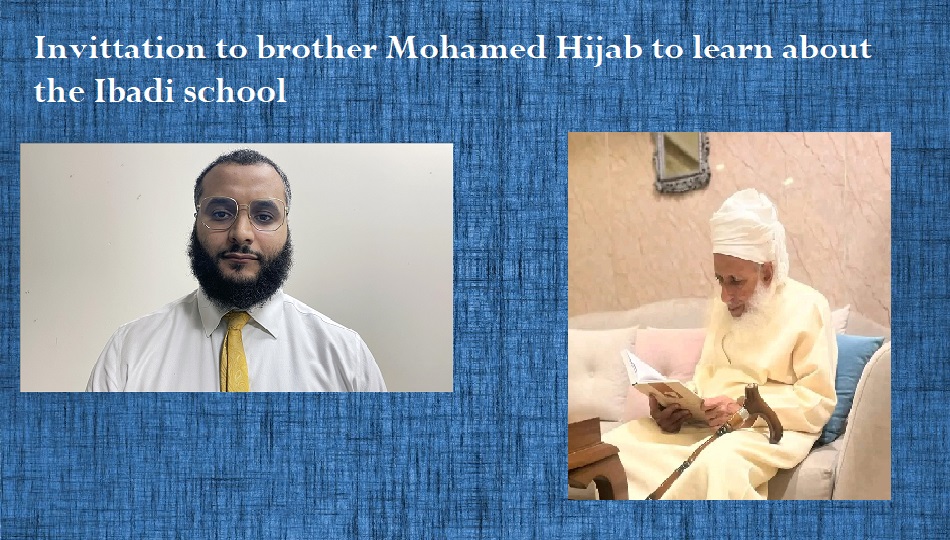
Mohamed Hijab invitation to learn about the Ibadi school

“Invite to the way of your Lord with wisdom and good instruction, and argue with them in a way that is best. Indeed, your Lord is most knowing of who has strayed from His way, and He is most knowing of who is [rightly] guided.” (Qur’an 16:125)

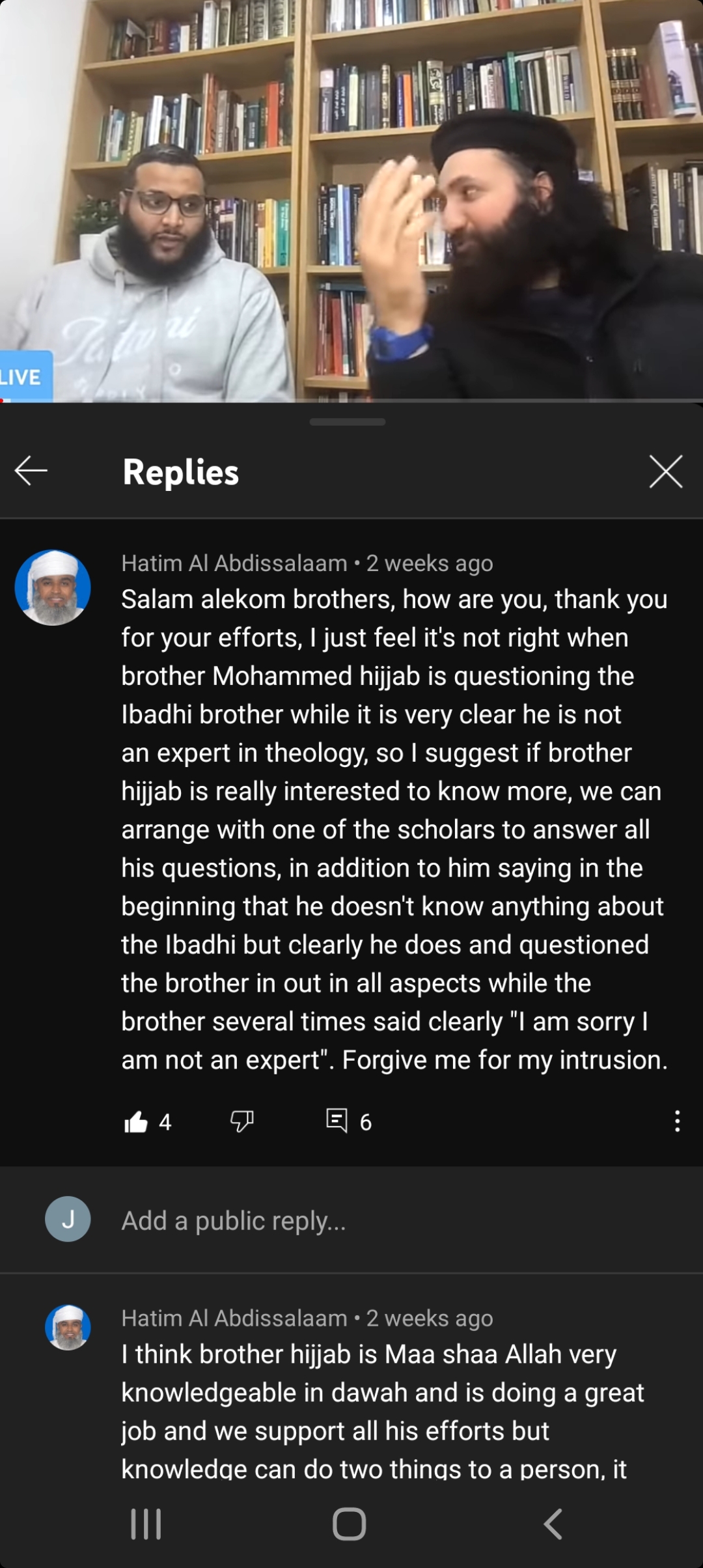
Recently our brother Mohamed Hijab had a gentleman on his show from Algeria. This brother had identified as following the Ibadi school. The brother from Algeria mentioned many times that he was not a scholar or someone very learned concerning the school.

Brother, Mohamed Hijab professed not to know much about the Ibadi school yet, subsequent dialogue followed that he (Mohamed Hijab) had some cursory knowledge about some of the school’s theological perspectives.

The brother from Algeria mentioned time and again that his knowledge was so simple, yet, Mohamed Hijab proceeded to to delve into difficult questions.

1:03:12 -A conversation with an Ibadi Muslim.

Al hamdulillah. At least they are not tafkiri and recognized their brother as a Muslim.

Thus, Shaykh Hatim Abdissalam extended a gracious offer for him to learn more about the school from our learned scholars if he was interested. It would go a long way in building bridges among Muslims.

By the way, many of our brothers from the Sunni denomination have been invited to Oman and given a platform by people who are predominately of the Ibadi denomination. The exchange was always respectful and most courteous.

In fact respected Shaykh Mufti Menk spent some time with us in Oman. The very same Shaykh Hatim Abdissalam who extended the offer to Mohamed Hijab is seen in this beautiful and harmonious meeting with Shaykh Mufti Menk.

In fact many Muslims from diverse views among our brothers in the Sunni denomination have been invited to speak in Oman from, Shaykh Mufti Menk, to Shaykh Yusuf Estes, to Shaykh Hamza Yusuf, to Imam Khalid Yasin to Adnan Ibrahim.

Another point is that a very close friend, brother and associate of Mohamed Hijab, our brother Hamza Tzortzis came and spoke in Oman. Maybe he picked up some books for Mohamed Hijab? Mohamed Hijab is an excellent orator and insh’Allah if he would like to come and speak with his brothers in Oman ahlan!

Certainly he believes in the hadith of the Blessed Messenger (saw):

Abu Barza reported that Allah’s Messenger (saw) sent a person to a tribe amongst the tribes of Arabia. They reviled him and beat him. He came to Allah’s Messenger (saw) and narrated to him (the story of atrocities perpetrated upon him by the people of the tribe). Thereupon he (the Holy Prophet) said:

“If you were to come to the people of ‘Uman, they would have neither reviled you nor beaten you.”

Source: (https://sunnah.com/muslim:2544)

https://primaquran.com/2022/11/19/hamza-andreas-tzortzis-to-speak-in-oman-in-december/

Muslims from the Ibadi school have been very active in building schools and watering wells for our brothers and sisters all over East Africa and no one gives them literature saying, “You must be an Ibadi or you are astray.” No!

The Ibadi community in Ghana west Africa is quite large and they get on well there with our brothers from both the Sunni and Shi’a schools.

We should not try to intentionally misrepresent anyone else’s belief, be they Muslim or not Muslim because dishonesty is not honorable. Insh’Allah may Allah (swt) put more mercy, love, peace, respect and understanding between us all. Amin!

“And be not as those who divided and differed among themselves after the clear proofs had come to them” (Qur’an 3:105)

“Indeed, your Lord is most knowing of who has strayed from His way, and He is most knowing of who is guided” (Qur’an 16:125)

And hold firmly to the rope of Allah all together and do not become divided. And remember the favor of Allah upon you – when you were enemies and He brought your hearts together and you became, by His favor, brothers. And you were on the edge of a pit of the Fire, and He saved you from it. Thus does Allah make clear to you His verses that you may be guided.” (Qur’an 3:103)

If you want to see more articles that feature brother Mohamed Hijab you maybe interested in the following:

https://primaquran.com/2023/06/05/mohamed-hijabs-excellent-argument-against-the-quran-being-uncreated/

https://primaquran.com/2022/10/05/mohamed-hijab-and-divine-simplicity/

https://primaquran.com/2024/01/18/allahs-word-created-or-uncreated-mohammed-hijab/

May Allah Guide the Ummah.

May Allah Forgive the Ummah.

Leave a comment

Filed under Uncategorized