“And DO NOT OBEY the order of the transgressors, Who cause corruption in the land and do not amend their ways” (Qur’an 26:151-152)

﷽
Introduction
Between Rebellion and Oppression: The Ibadi Perspective.
Political authority and its limits have long been debated within Islamic thought. Central to this discussion is the Qur’anic directive:
“O you who have believed, obey Allah and obey the Messenger and those in authority among you. And if you disagree over anything, refer it to Allah and the Messenger.” (Qur’an 4:59)
This verse establishes a hierarchy of obedience while simultaneously allowing for disagreement. The presence of such a mechanism indicates that those in authority (ulī al-amr) are neither infallible nor absolute. This article explores how the Ibadi tradition interprets this framework, particularly in relation to unjust rule and the permissibility of resistance.
The Value of Stability and Governance
A stable government and stable governance is a blessing from Allah (swt).
Before addressing resistance, it is essential to recognize that stable governance is a profound societal blessing. Functional societies depend on key material and institutional conditions, including:
- Access to clean water and food
- Availability of housing and electricity
- Maintenance of law and order
The removal of even a few of these elements can result in rapid societal breakdown. This aligns with modern frameworks such as Maslow’s hierarchy of needs, where physiological and safety needs form the foundation of human well-being.
However, while stability fulfills basic needs, it does not necessarily ensure justice, dignity, or moral development. Governments often promote belonging through nationalism and self-worth through material success. You have a better this. You have more of that. You have greater access to….and so forth. These all give feelings of accomplishment.
The feeling of self-esteem presents itself through merit through the education system, feats of valor in military service, and/or sports. However, even then most feelings of self-esteem and prestige come from the privileged group continuing to hold on to their privilege and usually in today’s market economy where materialistic nihilism is the new spirituality whereby making oneself feel superior to the next guy.
Yet, these may produce superficial or “false” forms of fulfillment. True human flourishing or what might be termed self-actualization is rarely cultivated within systems that prioritize conformity over moral truth, or justice.
In the last part of Maslow’s pyramid, the feeling of self-actualization is never reached or even encouraged in any government that we are aware of. Often for some people reaching that state of self-actualization and a sense of true freedom and/or awakening means going against the status quo.
So indeed having a stable government is a blessing from Allah (swt). That being said having a government that oppresses people, does not allow legal representation, has kangaroo court systems, death squads, etc are not a blessing from Allah (swt).
Violence, Nature, and Islamic Regulation
A key premise of this article is that violence is an inherent aspect of existence. From biological ecosystems to human societies, forms of conflict and self-defense are unavoidable. The Qur’an acknowledges this reality and regulates it rather than denying it.
Relevant verses include:
- Permission to fight in response to oppression (Qur’an 22:39–40)
- Prohibition of transgression in warfare (Qur’an 2:190)
- Legal retribution balanced with the virtue of forgiveness (Qur’an 5:45)
Islam, therefore, does not advocate absolute pacifism. Instead, it establishes ethical constraints on violence, ensuring it is exercised only within moral and legal boundaries.
“So stand firm in your devotion to the faith, inclining to truth, [according to] the innate nature Allah has instilled in [all] people. There is no changing Allah’s creation. This is the correct religion, but most people do not know it..” (Qur’an 30:30)
The innate nature (fit’rata)
“When your Lord told the angels, “I will place a steward on earth,” they said, “Will you put someone there who will corrupt it and shed blood, while we glorify, praise, and sanctify You?” He said, “I know things you do not know.” (Qur’an 2:30)
Islam a religion that regulates violence.
We are commanded to sacrifice animals on certain occasions.
Those of us who are magistrates (judges) are commanded to enact the penalties of the Islamic penal code on those who transgress the limits.
The Blessed Prophet (saw) is threatened with extreme violence if he even were to think of pretending to write something on authority from Allah (swt).
Allah (swt) commands Muslims to fight those who fight them, and that some times Allah (swt) uses some people as a means of checks and balance upon the Earth.
What is violence?
The English definition of violence is as follows:
behavior involving physical force intended to hurt, damage, or kill someone or something.
strength of emotion or of a destructive natural force.
So we speak of a violent storm or we say that the volcano had a violent eruption.
There is not a creature on this earth even among plants and corals that do not act violently in some way shape or form or have not been given the means to defend themselves from aggression.
Vegans and vegetarians do violence to plants.
Insects, fish, and all manner of plants, flora, fauna, and creatures do violence to each other in this world.
Even if we were to witness a Jain in seemingly peaceful meditation one may not see the battlefield of violence inside the devotee’s body as different types of bacteria unleash violence on other types of bacteria.
We do not believe that there is a man reading this very article that if someone was to go into his home and try and rape his mother, daughter, sister, wife, or anyone else that he would put his life on the line to defend that person.
This is natural. Even among animals that try to flee a situation if given no other opportunity, they will stand their ground and fight.
“So stand firm in your devotion to the faith, inclining to truth, [according to] the innate nature Allah has instilled in [all] people. There is no changing Allah’s creation. This is the correct religion, but most people do not know it..” (Qur’an 30:30)
Now let us do some thinking for a moment. Let us look at some passages from the Qur’an.
“And if he [Muhammed] had made up about Us some [false] sayings
We would have seized him by the right hand; Then We would have cut from him the aorta valve.” (Qur’an 69:44-46)
“Permission (to fight) is given to those upon whom war is made because they are oppressed, and most surely Allah is well able to assist them;[They are] those who have been evicted from their homes without right – only because they say, “Our Lord is Allah.” And were it not that Allah checks the people, some by means of others, there would have been demolished monasteries, churches, synagogues, and mosques in which the name of Allah is much mentioned. And Allah will surely support those who support Him. Indeed, Allah is Powerful and Exalted in Might.” (Qur’an 22:39-40)
“Fight in the way of Allah those who fight you but do not transgress. Indeed. Allah does not like transgressors.” (Qur’an 2:190)
“Indeed, the penalty for those who wage war against Allah and His Messenger and strive upon earth [to cause] corruption is none but that they are impaled…” (Qur’an 5:33)
“A prophet may not take captives until he has thoroughly decimated [the enemy] in the land. You desire the transitory gains of this world, while Allah desires [for you] [the reward of] the Hereafter and Allah is all-mighty, all-wise.” (Qur’an 8:67)
“So if you come upon such people in war, make a harsh example of them to deter those coming after them so that hopefully they will pay heed.” (Qur’an 8:57)
Turn the other cheek?
The closest verse to pacifism or turning of the other cheek that one will find is the following:
“And We ordained therein for them: Life for a life, eye for an eye, nose for a nose, ear for an ear, tooth for a tooth, and wounds equal for equal. But if anyone remits the retaliation by way of charity, it shall be for him, an expiation. And whosoever does not judge by that which Allah has revealed, such are the wrong-doers.” (Qur’an 5:45)
So in this verse, a person can forgive a wrong that is done to them; however, they are not required to do so.
These verses are only a handful of many many more than can be quoted.
Authority and Its Limits and conditions in the Qur’an
The Qur’an consistently conditions obedience to authority:
- Obedience is linked to adherence to divine guidance (Qur’an 4:59)
- Disputes must be referred back to revelation
- Oppression must be resisted (Qur’an 49:9) & (Qur’an 42:39–43)
Moral Priority of Justice Over Social and Familial Bonds
The Qur’an further emphasizes that moral commitment supersedes even the strongest social ties:
- Loyalty to family is conditional upon righteousness (Qur’an 9:23)
- Justice applies universally, regardless of status (Qur’an 5:32)
If familial bonds may be overridden in the face of injustice, then political authority being a lesser bond cannot claim unconditional obedience.
Positive proofs from the Qur’an that we can rebel against an unjust leader.
First, it should be understood that if there is a dispute among parties that they refer the matter back to the book of Allah (swt). Second, the administration or government deserves admonishment first and foremost. No one group or individual has the right to take any matters into their own hands.
“Do you not see those who have been given a portion of the Book being invited to let Allah’s Book be the judge between them? But then a group of them turn away.” (Qur’an 3:23)
So the first point of reference is to the Qur’an.
“Fight in the way of Allah those who fight you but do not transgress. Indeed. Allah does not like transgressors.” (Qur’an 2:190)
“And if two parties from the believers should fight, then you [O men] should reconcile between them. Then if one of them transgresses against the other, then fight against the one that transgresses until it returns to the command of Allah. And if it returns, then reconcile between them in justice and act justly. Indeed, Allah loves those who act justly.” (Qur’an 49:9)
Understanding the first proof:
These two verses together absolutely debunk the idea that Muslims cannot rebel against a leader. It is not reasonable to think that if two partices from the believers were fighting each other (with intent to kill) that the leader would not be opposed (if not among one of the two warring factions). So it is plausible that the leader could be from the party that oppresses!
Also says until it complies with Allah’s command (amri-l-lahi). Notice it does not say until it complies with the uli-l-amri (those that are given authority over you).
O you who have believed, obey Allah and obey the Messenger and those in authority among you. And if you disagree over anything, refer it to Allah and the Messenger, if you should believe in Allah and the Last Day. That is the best [way] and best in the result. (Qur’an 4:59).
Understanding the second proof.
In this clear verse, we find that in matters of disagreement between those in authority and those under authority, we need to refer back to Allah and the Messenger. Had it been that, those in authority were infallible or divinely appointed, or to be given absolute obedience then, Allah (swt) wouldn’t have given any scope to disagree with them.
The fact that there is disagreement proves that “those in authority aka the Uli-l-amri”, are neither an absolute nor an infallible authority, nor are Muslims to submit to their seat of power in all things and/or all occasions.
In fact, often those who argue that we should obey the ruler no matter what will use this verse to deceive the masses! They will quote, “Obey Allah and obey the Messenger and those in authority among you.” However, they do not quote the full verse! Why is that? Because it is proof against them!
“People, be mindful of your Lord, who created you from a single soul, and from it created its mate, and from the pair of them spread countless men and women far and wide; be mindful of Allah, in whose name you make requests of one another. Beware of severing the ties of kinship: Allah is always watching over you. (Qur’an 4:1)
“O you who believe, do not take your fathers nor brothers as allies if they prefer rejection to belief. And whoever of you takes them as such, then these are wicked.” (Qur’an 9:23)
Understanding the third proof.
The proof here is from inference. There can be no greater bonds than that of family, kith and kin. Yet even these blood ties are to be forsaken when our family turns to evil. If this is the case of blood ties how much more to an unjust, impious, or evil ruler?
“For that cause, We decreed for the Children of Israel that whoever kills a human being for other than manslaughter or corruption in the earth, it will be as if he had killed all mankind, and whoever saves the life of one, it will be as if he had saved the life of all mankind. Our messengers came to them of old with clear proofs (of Allah’s Sovereignty), but afterward lo! many of them continued to commit excess on the Earth.” (Qur’an 5:32)
Understanding the fourth proof.
No commentary, no tafsir that we have ever come across said that the verse above applies to everyone except the Caliph/Sultan/Leader/Imam, etc. If there is dear reader bring forth the evidence!
If you saved the life of the Caliph/Sultan/Leader/Imam, etc. It will be as if you saved the life of the whole mankind.
If you took the life of the Caliph/Sultan/Leader/Imam, etc. unjustly it will be as if you destroyed the life of the whole of mankind.
Now there are two caveats here the verse tells us.
You can take a life if someone has taken a life unjustly. You can take a life if someone is spreading fasadin (corruption). Who better to spread corruption on the Earth than a corrupt Caliph/Sultan/Leader/Imam, etc who is in a position of authority, influence, and power.
The killing of one person from a practical perspective outweighs the millions of lives that can be lost due to a leader who continues to kill and oppress. The killing of one may prevent the killing of thousands and millions.
“And that was ‘Aad, who rejected the signs of their Lord and disobeyed His messengers and followed the order of every obstinate tyrant. and they were [therefore] followed in this world with a curse and [as well] on the Day of Resurrection. Unquestionably, ‘Aad denied their Lord; then away with ‘Aad, the people of Hud.” (Qur’an 11:59-60)
Understanding the fifth proof.
Allah (swt) contrary to the hadiths that “Ahl Sunnah” will quote, did not find following the orders of every obstinate tyrant to be something meritorious and praiseworthy but rather something blameworthy and shameful, even to the point of being cursed in this life as well as the life to come! May Allah (swt) protect us from it!
“And those who, when tyranny strikes them, they defend themselves, Although the just requital for an injustice is an equivalent retribution, whoever pardons and makes reconciliation – his reward is [due] from Allah. Indeed, He does not love the unjust. And whoever avenges himself after having been wronged – those have not upon them any cause [for blame]. The cause is only against the ones who wrong the people and tyrannize upon the earth without right. Those will have a painful punishment. And whoever is patient and forgives – indeed, that is of the matters requiring determination.” (Qur’an 42:39-43)
Understanding the sixth proof.
While this verse has in two places that discuss forgiveness when retaliation is due, it also has two places that mention retribution for injustice and avenging oneself if wronged that this person is not to be blamed.
Now of course this verse is not encouraging vigilante justice or taking matters into one’s own hands. However, this verse is general and it equally applies to anyone in authority. No one understands that this verse excuses an officer, a judge, an imam, or a person in a position above others, including the Caliph/Sultan/Leader.
Interestingly, the word used for tyranny l-baghyu is also used for injustice, rebellion, discord. So it is not that masses who are the only one’s who rebel, but rulers, who do rebellion against Allah (swt) and against their sacred trust and duty towards people.
Now you will note that for us we rely heavily upon the revelation of Allah (swt) for our position and our proofs. Whereas those who differ with us rely heavily upon the oral traditions for their positions and their proofs.
Hadith Evidence and Conditional Obedience
It should be known clear as day that we follow the Manhaj of the Blessed Prophet (saw) who has given us a great deal of evidence. As well as his noble companions who understood the evidences and implemented it when necessary.
Proof 1.
On the authority of Abu Sa`eed al-Khudree who said:
I heard the Messenger of Allah (swt) say, “Whosoever of you sees an evil, let him change it with his hand; and if he is not able to do so, then [let him change it] with his tongue; and if he is not able to do so, then with his heart — and that is the weakest of faith.”
Source: (https://sunnah.com/muslim/1/84)
Understanding the proof:
Note that the very first recourse was to change the situation with the hands ……not to abide it with patience, not to run and hide like a coward but to change it with your hands…..first….not last…
Lastly, notice that it says clear as day that hating it with your heart (is the weakest of faith).
This hadith establishes a graduated obligation to oppose wrongdoing, scaled according to one’s capacity. Crucially, it affirms that passive acceptance of injustice is not the normative ideal; rather, moral engagement is.
In the political context, this implies that unjust governance cannot be indefinitely tolerated when the conditions for meaningful change are present. The “hand” in this narration has been interpreted by many scholars to include forms of direct intervention, though always within the bounds of prudence and collective welfare.
Proof 2.
Keep in mind that those who say and claim it is a sin to go against the ruler the well-known exchange between Umar Ibn Al Khattab (ra) and a companion.
One day Khaleefah Umar bin al-Khattab stood up and delivered a speech in which he said: “O people, whoever among you sees any crookedness in me, let him straighten it.” A man stood up and said: “By Allah if we see any crookedness in you we will straighten it with our swords.” Umar said: “Praise be to Allah Who has put in this ummah people who will straighten the crookedness of Umar with their swords.”
Source: (Dr Muhammed as-Sallabi, ‘Umar ibn al-Khattab, His Life and Times,’ vol. 1, p. 213)
This is well known.
Understanding the proof:
Umar (ra) was humble and pious and just. The people had the right to say such statements because people like him and Abu Bakr (ra) were immense people and great leaders.
However, when the “Ahl Sunnah” started to be ruled by dynasties and oppressors and people who were less than these great men, they made much excuses for them.
Proof 3.
“Verily, tyrannical rulers will come after me and whoever affirms their lies and supports their oppression has nothing to do with me and I have nothing to do with him, and he will not drink with me at the fountain in Paradise. Whoever does not affirm their lies and does not support their oppression is part of me and I am part of him, and he will drink with me at the fountain in Paradise.”
Source: (https://sunnah.com/nasai:4208)
Understanding the proof.
One of the objectives of the Prophets is to establish justice in the land. It is contrary to the teachings of mercy and justice that people should support and affirm the lies of the oppressors.
Attempts to distort what the Blessed Messenger (saw) gave us concerning oppression and rulers.
Proof 4 & 5.
Narrated Anas bin Malik:
Allah’s Messenger (saw) said, “You should listen to and obey, your ruler even if he was an Ethiopian (black) slave whose head looks like a raisin.”
Source: (https://sunnah.com/bukhari/93/6)
“If an Ethiopian slave with a cut off nose and ear were appointed as your ruler, you would have to listen to and obey his orders as long as he rules in accordance with the Book of Allah.”
Source: (https://sunnah.com/ibnmajah:2861)
Understanding the proofs.
This hadith puts to bed the idea that “Ahl Sunnah” have first that the ruler can only come from the Quraish. However, notice that this hadith comes to us with a very interesting addition. That we are to under no circumstances to rebel against a leader/ruler/caliph/sultan/imam/leader etc, of any racial/ethnic background as long as that person rules in accordance with the Book of Allah (swt).
Proof 6.
Narrated ‘Abdullah:
The Prophet said, “A Muslim has to listen to and obey (the order of his ruler) whether he likes it or not, as long as his orders involve not one in disobedience (to Allah), but if an act of disobedience (to Allah) is imposed one should not listen to it or obey it.
Source: (https://sunnah.com/bukhari:2955)
Understanding the proof.
The hadith before this one mentions that we are to obey the ruler as long as they rule in accordance with the Book of Allah (swt). The hadith quoted above states that we are to obey the ruler as long as they do not impose upon those they rule over disobedience to Allah (swt).
So we can see that allegiance to a ruler is conditional upon two points.
a) That this ruler actually rules in accordance with the book of Allah (swt).
b) That this ruler does not impose upon the Muslim disobedience to Allah (swt).
Proof 7.
Narrated ‘Ali:
“The Prophet sent an army unit (for some campaign) and appointed a man from the Ansar as its commander and ordered them (the soldiers) to obey him. (During the campaign) he became angry with them and said, “Didn’t the Prophet order you to obey me?” They said, “Yes.” He said, “I order you to collect wood and make a fire and then throw yourselves into it.” So they collected wood and made a fire, but when they were about to throw themselves into it, they started looking at each other, and some of them said, “We followed the Prophet to escape from the fire. How should we enter it now?” So while they were in that state, the fire extinguished and their commander’s anger abated. The event was mentioned to the Prophet and he said, “If they had entered it (the fire) they would never have come out of it, for obedience is required only in what is good.”
Source: (https://sunnah.com/bukhari:7145)
Understanding the proof.
This hadith has shown that thankfully the companions were not dimwitted. These people had the intelligence to understand that throwing themselves into fire even though the commander commanded them to do so, that this was something ridiculous. Also again the hadith states that the Blessed Messenger (saw) said, ‘obedience is required only in what is good.’
Here, obedience is explicitly restricted to what is morally sound. The implication is clear: authority does not generate morality; rather, morality as given by revelation defines the limits of temporal authority.
Proof 8.
“There is no obedience to the created in the disobedience of the Creator.”
Sources: (https://sunnah.com/ahmad:1095) & (Ahmad Al-Musnad Vol 1. p. 366, tradition no. 1065, p 372-373, tradition no, 1095, Al-Nasai Al Kubra Vol. 8 p 71 traditions 8667-8668, Mariful Qur’an pg 481 Volume 5)
Understanding the proof.
This can be used on many occasions. We are exhorted to obey our parents but they asked us to worship other than Allah (swt) we can refuse them. If a husband asked his wife to do something immoral she can refuse. If the wife asks the husband to do something immoral he can refuse. If a government or any authority asks us to do anything that is in disobedience to Allah (swt) we do not have to obey them.
The combined weight of Qur’anic and Prophetic evidence does not support a doctrine of unconditional political quietism. Rather, it establishes a dynamic ethical system in which:
Authority is obeyed when it is just, corrected when it errs, and resisted when it becomes oppressive—within the limits of wisdom and the preservation of the greater good.
The Ibadi Position on Rebellion
The Ibadi tradition articulates a nuanced and conditional approach to political resistance:
A.1 Foundational Principles
- Obedience to just rulers is obligatory
- Rebellion against just rulers is a grave sin
- Resistance against unjust rulers may become obligatory
A.2 Conditions for Legitimate Resistance
Resistance is only justified when:
- There is a high likelihood of success
- It results in less harm than continued oppression
Conversely, rebellion is prohibited if it leads to greater chaos, bloodshed, or societal collapse.
This reflects a deeply pragmatic ethic that balances justice with social stability.
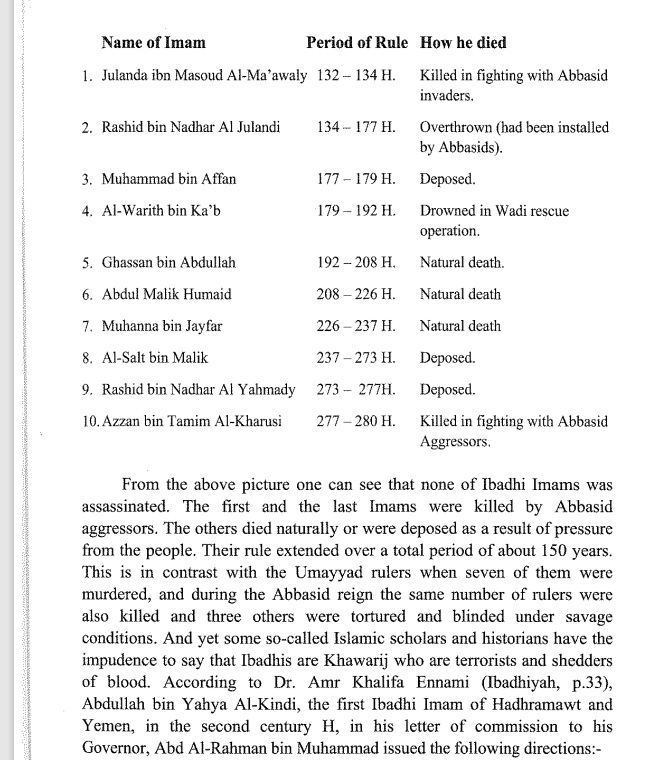
The Ibadis do not encourage revolts against their Imams to avoid bloodshed. It is justifiable only as a last resort and in extreme circumstances, The history of the Ibadi Imamate in Oman speaks for itself as the following list shows:
Source: (Shaykh Soud H. Al-Ma’awaly in his book: Ibadhism the Cinderella Story Of Islam)
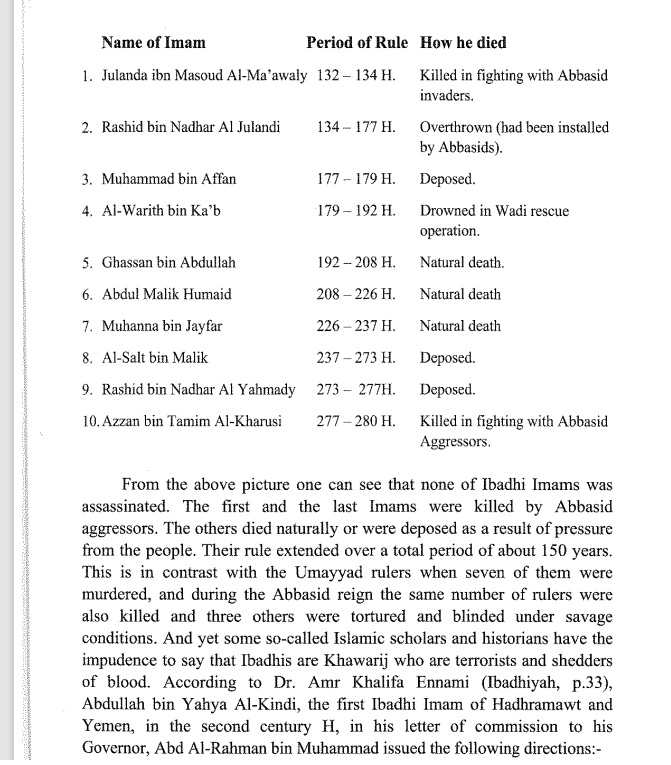
So there you have it. Yet some so-called Islamic scholars and historians have the impudence to say that Ibadhis are Khawarij who are terrorists and shedders of blood.
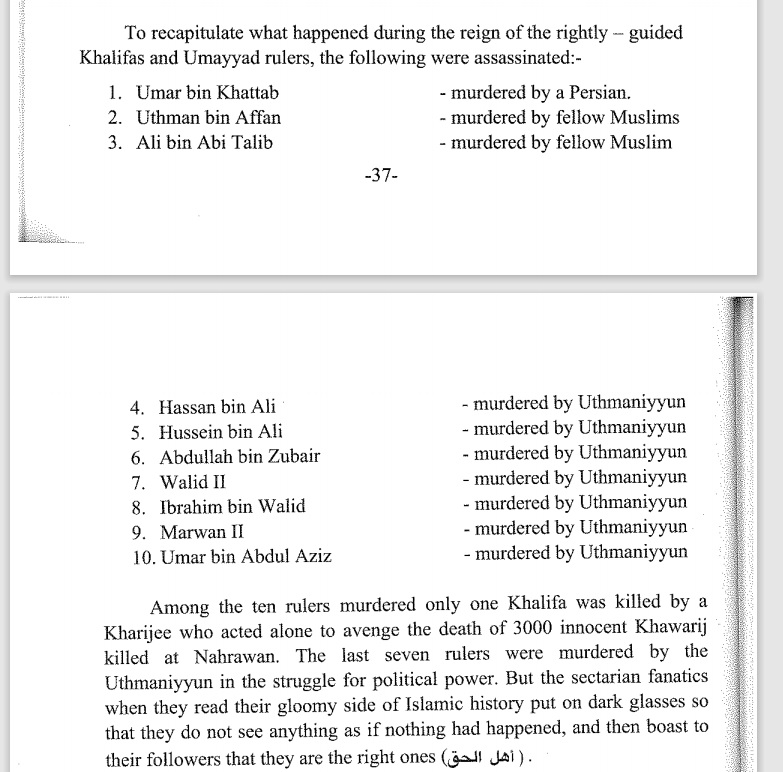
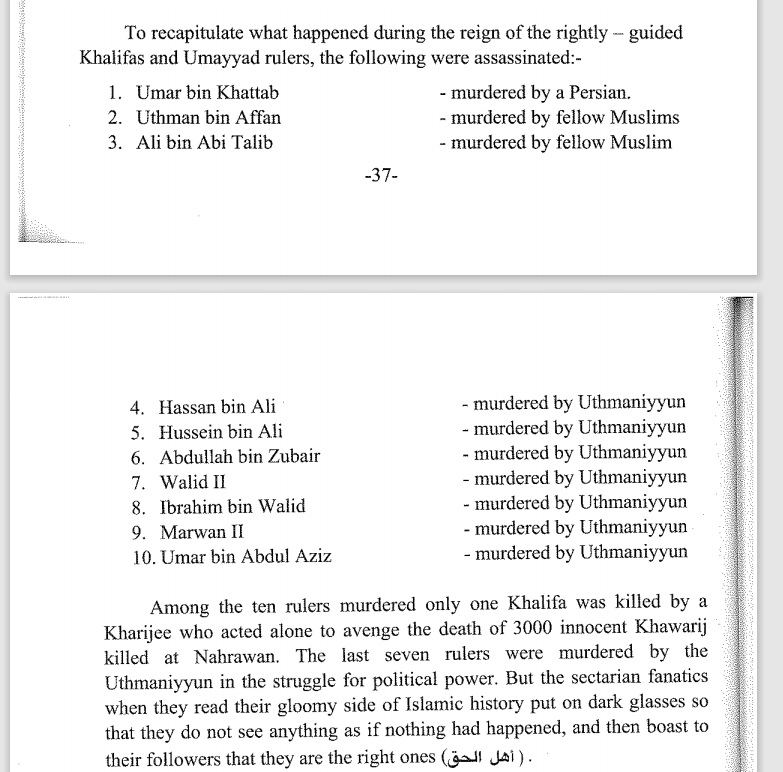
Now compare/contrast this with the first four Caliphs and the Umayyads/Uthmaniyyun
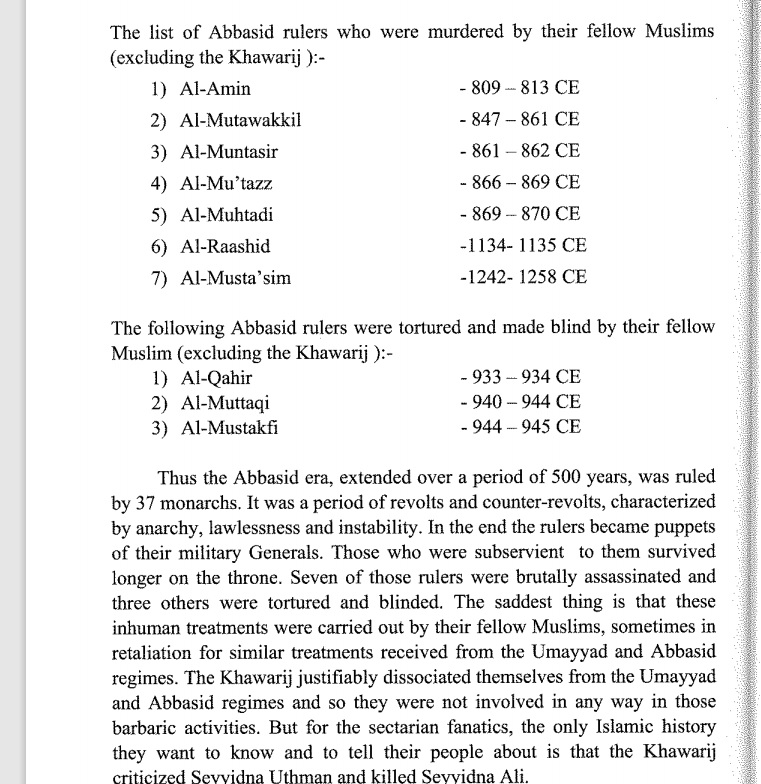
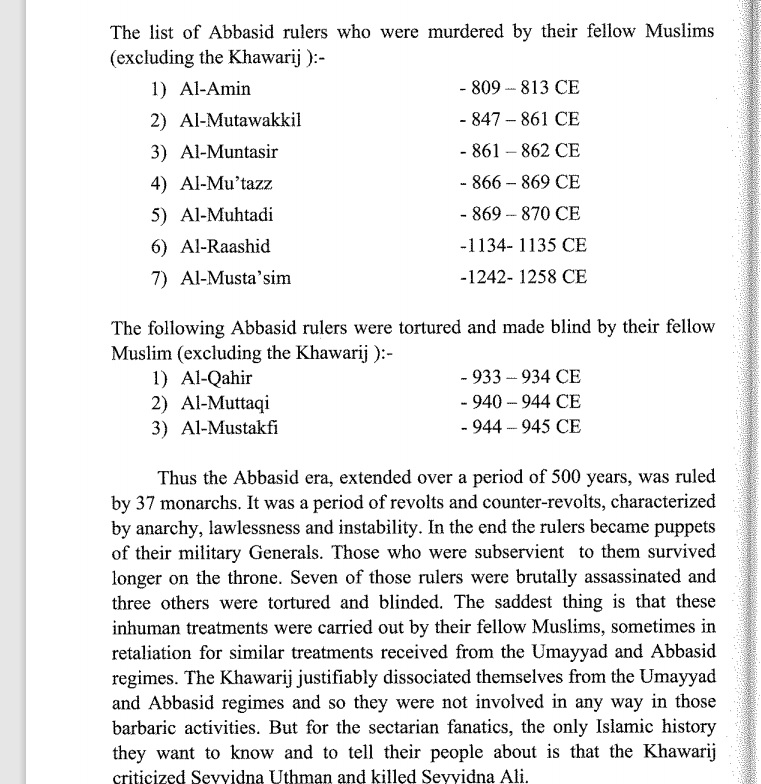
Now compare/contrast this with the Abbasids:
Now let us also mention to you (the reader) that the position of the Ibadi school (Ahl Istiqamah) is as follows:
- We are absolutely to obey the just and good rulers in our society.
- To go against the just and good rulers in our society is a major sin.
- To go against an unjust and corrupt ruler who is spreading fitna and fasad is meritorious, praiseworthy, and obligatory.
Now there is a caveat to point 3.
A) If going against the unjust and corrupt ruler will actually meet with little chance of success and cause more bloodshed and chaos than if one had not, it is a sin to go against the rulers. One must abide by their cruelty and oppression with great patience. Until the circumstance arises to change course.
B) If going against the unjust and corrupt ruler will actually meet with a great chance of success and it will cause less bloodshed, suffering, and chaos than as mentioned it is obligatory and meritorious to do so.
That is our position (the position of the Ibadi).
Comparative Observations
The Ibadi framework differs from other Islamic traditions in its emphasis on:
- Accountability of rulers
- Conditional legitimacy
- Moral merit over lineage or political control
While other traditions often prioritize stability to avoid civil strife, the Ibadi approach maintains that stability without justice cannot be morally justified. Often times the people themselves cannot endure it.
Now a few points to make about some of our brothers from “Ahl Sunnah” and those that take an opposite stance.
- The Majority sect does not have a consensus on the issue no matter what they claim. In fact, they even say that one can go against a ruler if they commit a clear act of disbelief. Shaykh Muhammed Al Yaqoubi (may Allah continue to benefit us by him) asked for the overthrowing of Assad in Syria. Or the Madhkali Salafi Muslims who are active in the overthrow of the government of Libya.
- Their claim of ‘ijma’ of course excludes us (Ibadi), Zaidi, and 12er Shi’i
- Name a single scholar in the history of “Ahl Sunnah” that was against the rebellion of an unjust ruler or tyrant that was A) Not on the government payroll or patronized by the government & B) Not admired and patronized by the elites.
- The fact that the “Ahl Sunnah” will claim that going against the ruler will result in more bloodshed and death and yet they will not even entertain the idea that replacing an obstinate tyrant by force would actually result in less bloodshed and death in the end.
- Their inconsistency in saying that those who rebel against the sultan/caliph/imam/leader ect. have left Islam but their recognition that if such a rebellion is successful that the new leadership (taken by force) is now legitimate!
- Their inconsistency regarding the companions on this matter.
- Some of their bizarre stances that are taken in geopolitics which is self evident today before the entire ummah!
We hold fast to the following:
“O you who have believed, obey Allah and obey the Messenger and those in authority among you. And if you disagree over anything, refer it to Allah and the Messenger, if you should believe in Allah and the Last Day. That is the best [way] and best in the result.” (Qur’an 4:59).
That’s it. If we are all Muslims than we can certainly turn to the book of Allah (swt) to settle our disputes.
Conclusion
The Ibadi perspective offers a balanced approach to political authority:
- It affirms the necessity of order and governance
- It rejects unconditional obedience
- It permits resistance under strict ethical and pragmatic conditions
Ultimately, the Qur’anic paradigm establishes that:
- Authority is a trust, not an absolute right
- Justice is a requirement, not an ideal
- Resistance is a last resort, not a default position
“And do not obey the order of the transgressors—those who spread corruption in the land and do not reform.” (Qur’an 26:151–152)
This verse encapsulates the ethical core of the discussion: obedience is not a virtue when it enables injustice.
Islam does not command obedience to power. It commands obedience to justice.
Muslims are thus called to be responsible citizens who uphold justice, avoid chaos, and remain anchored in divine guidance. When oppression becomes systemic and inescapable, and when conditions allow for meaningful change, resistance may become not only permissible but necessary. Government’s all over the world are intelligent enough to know that if they oppress people there will be repercussions to their actions.
May Allah (swt) guide all governments in making just decisions.
Allah (swt) knows best and the help of Allah (swt) is sought.
We dedicate this particular article to all people suffering from oppression and injustice all over the world.
May this world be filled with peace and justice. Amin.
May Allah Guide the Ummah.
May Allah Forgive the Ummah.